1.1.1 - Well-Woman Visit Components
Well-Woman Visit Components
What you’ll learn
- DOMAIN: Health Promotion and Preventive Care Across the Lifespan → Preventive encounter structure — Organize the ambulatory well-woman visit into history, exam, screening review, counseling, and follow-up.
- DOMAIN: Diagnostics, Clinical Reasoning, and Data Interpretation → Best next step logic — Identify what must be assessed first versus what can be deferred when time is limited.
- DOMAIN: Ethics, Legal Issues, Professional Role, and Patient-Centered Care → Confidential, trauma-informed care — Apply consent, privacy, and culturally responsive communication during preventive visits.
- DOMAIN: Contraception, Fertility, and Reproductive Planning → Reproductive intention counseling — Incorporate pregnancy intention, contraception needs, and preconception risk reduction into routine care.
- DOMAIN: Health Promotion and Preventive Care Across the Lifespan → Risk-based prevention planning — Distinguish universal well-woman components from age- and risk-modified components.
- Health Promotion and Preventive Care Across the Lifespan → preventive visit structure and counseling
- Diagnostics, Clinical Reasoning, and Data Interpretation → focused data gathering and prioritization
- Ethics, Legal Issues, Professional Role, and Patient-Centered Care → confidentiality, consent, documentation, scope-aware escalation
- Contraception, Fertility, and Reproductive Planning → reproductive life planning within preventive care
Why it matters
- Board questions often test the most appropriate next step in a routine ambulatory visit, not memorized lists in isolation.
- The well-woman visit is where WHNPs integrate screening, contraception, sexual health, chronic disease risk, pregnancy intention, and safety screening in one encounter.
- Many exam distractors exploit overtesting, performing nonindicated pelvic exams, or missing a red flag that requires same-day escalation.
- A structured preventive framework improves efficiency: gather the right history, identify who needs targeted screening, and document a plan patients can follow.
Key Terms & Must-Know Facts
1.1.1.1 Key terms
- Preventive visit: Routine health maintenance encounter focused on risk assessment, screening, counseling, and anticipatory guidance.
- Problem-focused visit: Visit driven by a specific symptom or concern requiring targeted evaluation.
- Confidential care: Protection of private health information, especially relevant for adolescents and sensitive topics.
- Reproductive life plan: Discussion of pregnancy intention, timing, spacing, and contraception/preconception needs.
- Trauma-informed care: Care that emphasizes safety, choice, collaboration, trustworthiness, and empowerment.
- Screening: Testing in asymptomatic patients based on age, risk, anatomy present, or exposure history.
- Risk stratification: Adjusting prevention and follow-up based on family history, medications, conditions, behaviors, and access barriers.
- Red flag: Finding that changes outpatient routine care into urgent evaluation, referral, or emergency transfer.
- Shared decision-making: Collaborative discussion of options, risks, benefits, and patient preferences.
- Chaperone: Additional staff presence during sensitive examination per patient preference and local policy.
- Anatomy present: Screening decisions depend on cervix, uterus, ovaries, breasts/chest tissue, and sexual/reproductive organs currently present.
- Anticipatory guidance: Counseling delivered before a health issue arises.
1.1.1.2 Must-know facts
- A well-woman visit is not just a pelvic exam; it is a comprehensive preventive encounter.
- Routine pelvic examination is not automatically required in every asymptomatic patient.
- Always ask about pregnancy intention, current contraception use, and medication safety if pregnancy is possible.
- Confidential sexual, substance use, and safety screening improves disclosure and exam performance.
- Symptoms such as syncope, severe unilateral pelvic pain, heavy bleeding with instability, severe hypertension in pregnancy, or sexual assault crisis needs are not routine preventive issues; they require escalation.
- Screening is based on age, risk, anatomy present, and exposure history rather than one universal checklist.
- The WHNP board perspective rewards choosing the safest outpatient next step and recognizing referral thresholds.
- Preventive counseling must include vaccines, STI prevention, substance use, mental health, and interpersonal violence/safety.
Exam takeaway: Use this visit sequence to prioritize safety screening and avoid jumping straight to testing.
flowchart TD
A[Start preventive visit] --> B[Clarify visit goals and confidentiality]
B --> C[Screen for urgent symptoms or safety concerns]
C -->|Red flag present| D[Convert to urgent problem-focused evaluation or transfer]
C -->|No red flag| E[Obtain preventive history]
E --> F[Focused exam as indicated]
F --> G[Apply age and risk-based screening]
G --> H[Counsel on contraception preconception STI prevention lifestyle]
H --> I[Document follow-up and referrals]
Exam takeaway: A well-organized room supports trauma-informed, efficient history, screening, and optional sensitive examination.
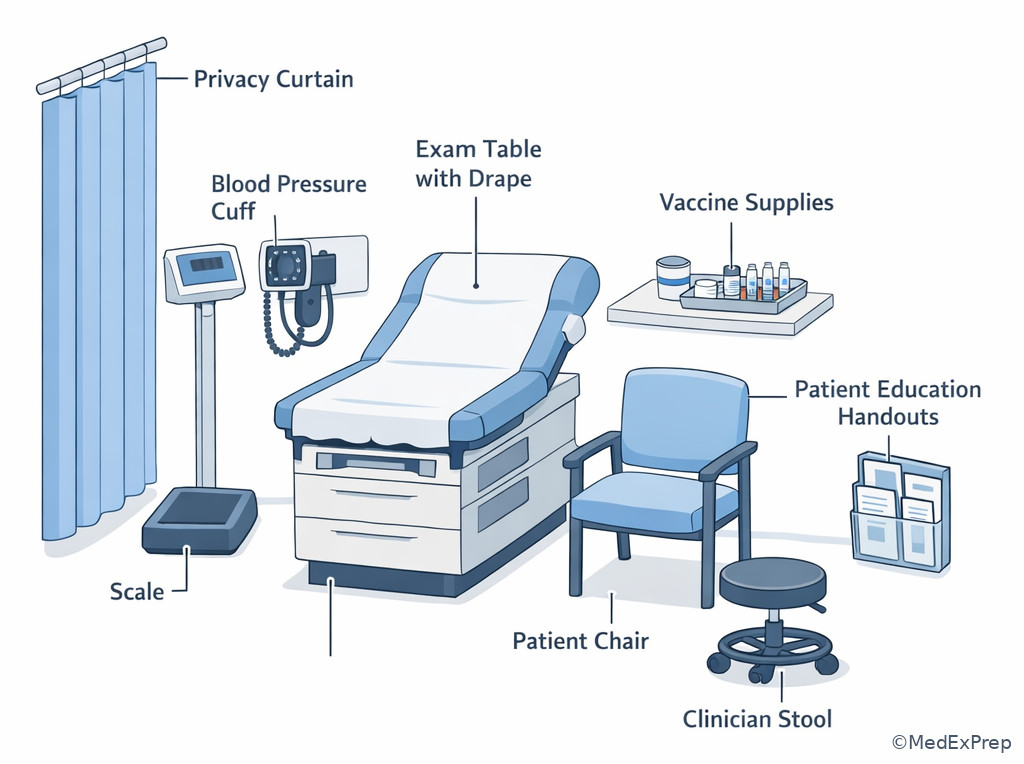
Core content
1.1.1.3 Foundational structure: what belongs in every well-woman visit
A Explanation
The board-style decision conflict here is simple: Is this a routine preventive encounter, or is there enough symptom burden or safety concern to change the visit type? The single resolving rule is this: if the patient has acute red flags, unstable symptoms, or urgent psychosocial safety needs, you do not continue as though this is only a routine annual visit.
A high-yield well-woman visit includes five universal domains: establish agenda and confidentiality, review interval history and risks, perform targeted preventive assessment, complete indicated examination, and close with counseling plus follow-up. The best answer is rarely “perform every possible exam.” It is usually “do the most appropriate preventive components for this patient today.” See Fig 1.
WHY THIS IS TESTED: Questions often ask which component is most important to include first, or which finding changes a routine annual exam into a same-day problem-focused evaluation.
- Choose: agenda setting, menstrual/reproductive history, sexual history, medication review, allergies, preventive screening review, mental health and violence screening, lifestyle counseling.
- Reject: automatic pelvic exam, automatic STI testing, or automatic hormone/thyroid testing in an asymptomatic patient with no indication.
- Monitor: whether preventive gaps, risk factors, or patient priorities require close follow-up.
B Worked example
A 29-year-old G1P1 presents for her annual visit. She has migraine without aura, obesity, and uses sertraline for depression. She says, “I’m mostly here for a checkup,” but also mentions intermittent spotting after intercourse for 2 months. She wants to discuss pregnancy in “maybe a year.” A medical assistant notes a mildly elevated heart rate after she rushed from the parking lot. The tempting wrong move is to proceed as a fully routine annual exam without addressing the spotting because the visit was scheduled as preventive.
Reasoning chain: Identify task: determine whether this remains purely preventive. Extract key facts: postcoital bleeding is not normal preventive background noise; pregnancy intention matters; transient tachycardia after exertion is a distracting clue, not the key finding. Apply rule: a preventive visit can include additional problem-focused evaluation when a new symptom may require cervical/vaginal assessment. Eliminate distractors: do not ignore the symptom, but do not send to the ED if she is stable and otherwise well. Verify: include confidential sexual history, assess STI risk, review cervical screening status, perform indicated exam, and create both preventive and symptom-based follow-up.
C Exam trap
D Checkpoint
Question: A 24-year-old presents for her first well-woman visit in 3 years. She reports no acute symptoms, uses condoms inconsistently, and asks whether she needs “the full exam.” Which action is most appropriate at the start of the visit?
- Begin with a bimanual and speculum exam because she is overdue for routine women’s care.
- Clarify her goals, explain confidentiality, and screen for urgent symptoms or safety concerns before deciding which exam elements are indicated.
- Order a broad hormone panel because irregular follow-up often reflects endocrine disease.
- Defer sexual history until after the physical exam to avoid discomfort.
- A: Tempting because annual women’s care is often linked with pelvic exams; wrong because exam components must be indication-based, not automatic.
- B: Tempting because it seems basic; right because agenda setting, confidentiality, and red flag screening determine the safe structure of the encounter.
- C: Tempting because preventive visits uncover silent disease; wrong because broad laboratory screening without indication is low-value.
- D: Tempting because it appears patient-sensitive; wrong because sexual history often determines whether any genital exam or STI testing is needed.
1.1.1.4 History domains that drive prevention decisions
A Explanation
The decision conflict in this section is which history elements actually change management versus which are low-yield extras. The resolving rule: prioritize history domains that alter screening, counseling, medication safety, reproductive planning, or urgency.
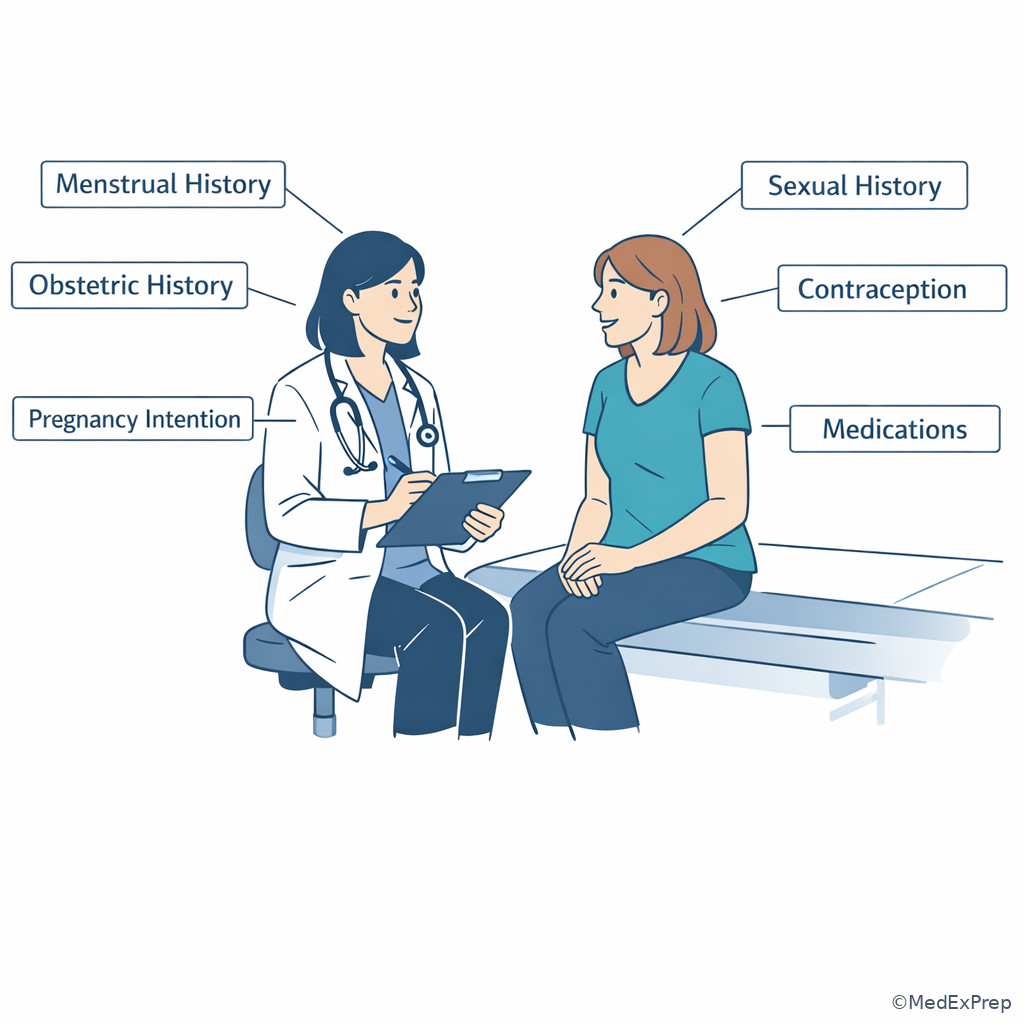
The high-yield well-woman history is not just “LMP and Pap.” It includes interval medical history, surgeries, medications including OTC/herbals, allergies, menstrual pattern, obstetric history, sexual practices, STI history, pregnancy intention, contraceptive use, substance use, exercise/nutrition, mood, sleep, safety/violence, family history, and social barriers to follow-up. On the exam, the best answer is often the history item that changes what you do next: a uterus or cervix no longer present, tobacco use with migraines, intimate partner violence risk, or a family cancer pattern.
WHY THIS IS TESTED: Board stems hide the decisive clue in the history. A symptom, medication, family history, or reproductive goal often outweighs a normal exam.
History should also be patient-centered. Offer private time when appropriate, normalize sensitive questions, and ask permission before discussing sexual trauma or substance use. For adolescents and some dependents, explain the boundaries of confidentiality clearly and early.
Exam takeaway: The highest-yield history questions are the ones that alter screening, counseling, medication safety, or referral.
flowchart LR
A[History start] --> B[Symptoms and interval events]
A --> C[Medications allergies supplements]
A --> D[Menstrual obstetric sexual history]
A --> E[Pregnancy intention and contraception]
A --> F[Family history and genetics clues]
A --> G[Mood substance use violence social barriers]
B --> H[Changes urgency]
C --> H
D --> H
E --> H
F --> H
G --> H
H[Determines exam screening counseling follow-up]
Exam takeaway: Use a consistent intake sequence so high-yield reproductive, sexual, psychosocial, and medication clues are not missed.
B Worked example
A 41-year-old G3P3 comes for a preventive visit. She has hypertension, takes lisinopril and hydrochlorothiazide, and says her menses are “kind of late but that’s probably stress.” She had unprotected intercourse 3 weeks ago, smokes 10 cigarettes daily, and asks for a refill of her combined oral contraceptive. She also mentions her mother had breast cancer at age 47. A mildly low vitamin D from an outside lab is included in the chart and is meant to distract.
Reasoning chain: Identify task: determine which history elements change immediate management. Extract key facts: late menses, pregnancy possible, ACE inhibitor exposure risk if pregnant, smoker over 35, family history relevant for future risk assessment. Apply rule: first clarify pregnancy status and reproductive intentions before contraception refill decisions; combined hormonal contraception may be inappropriate given age plus smoking. Eliminate distractors: low vitamin D does not drive the visit priority. Verify: assess pregnancy, medication safety, contraceptive alternatives, and family-history implications.
C Exam trap
D Checkpoint
Question: During a preventive visit, which history item most directly determines whether medication counseling must happen before the visit ends?
- Whether the patient has a sedentary lifestyle.
- Whether the patient is interested in future menopause counseling.
- Whether the patient could currently be pregnant or plans pregnancy soon.
- Whether the patient prefers morning appointments.
- A: Tempting because lifestyle matters for prevention; wrong because it does not usually create immediate medication safety decisions.
- B: Tempting because anticipatory guidance is part of prevention; wrong because it rarely changes same-day medication safety.
- C: Tempting because it seems narrow; right because pregnancy potential changes teratogenicity counseling, contraception discussion, and preconception planning.
- D: Tempting because access barriers matter; wrong because scheduling preference does not guide urgent counseling content.
- The most management-changing reproductive history question is current pregnancy intention/potential.
- True or False: Family history matters only if the patient has symptoms. False.
- Name 3 psychosocial preventive screens commonly embedded in a well-woman visit: depression, substance use, interpersonal violence/safety.
1.1.1.5 Physical exam: what to do, what not to overdo
A Explanation
The decision conflict is which examination elements are indicated in an ambulatory preventive visit and which are unnecessary if the patient is asymptomatic. The single rule that resolves most exam questions: perform a general preventive exam for all, and add breast, pelvic, or focused components only when indicated by age, symptoms, screening needs, anatomy present, or patient concern.
Core exam elements usually include vitals, weight/BMI context when relevant, general appearance, and focused systems review as prompted by history. Breast/chest and pelvic/genital examinations are not reflexive rituals. They are chosen when symptoms, patient request, screening procedures, or risk-based indications justify them. Pelvic examination may be indicated for symptoms such as pain, discharge, bleeding, lesions, or when obtaining a specimen for cervical screening or specific testing. The board frequently rewards avoiding a nonindicated internal exam in an asymptomatic patient.
Use trauma-informed technique: explain each step, ask permission, allow stopping at any time, offer a chaperone per policy and patient preference, and preserve dignity. A normal preventive visit should not become physically or psychologically invasive without reason.
WHY THIS IS TESTED: Learners are often tempted to “do more” to seem thorough. The exam instead rewards indication-based examination and patient-centered communication.
Exam takeaway: Sensitive examination should be permission-based, explained, and limited to what the history and screening needs support.
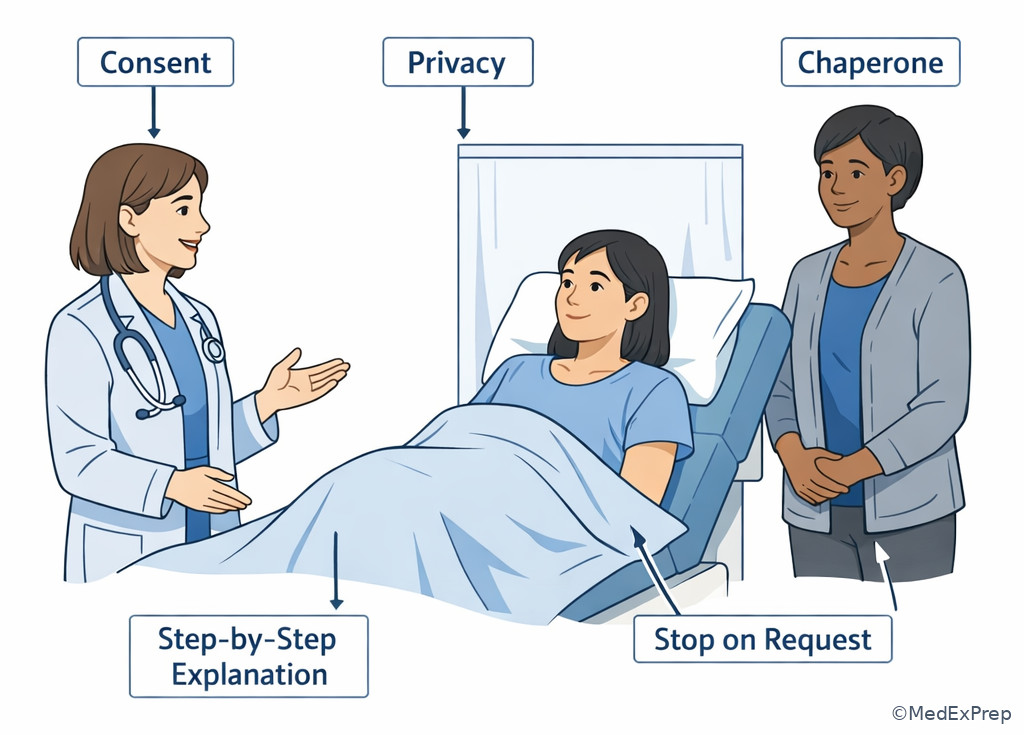
Exam takeaway: Distinguish universal general assessment from focused internal examination triggered by symptoms or indicated testing.
flowchart TD
A[Preventive visit] --> B[General vitals and overall assessment]
B --> C{Symptoms or indicated specimen?}
C -->|No| D[No automatic internal pelvic exam]
C -->|Yes| E[Focused external and/or internal exam as indicated]
E --> F[Obtain needed specimens or evaluate findings]
D --> G[Counsel and follow-up]
F --> G B Worked example
A 52-year-old patient with type 2 diabetes and obesity presents for a preventive visit. She is postmenopausal, not sexually active, and denies discharge, bleeding, pain, or urinary symptoms. She appears anxious and states she had a prior traumatic exam years ago. She asks, “Do I have to do the internal exam today to keep up with my health?” A mildly elevated blood pressure is noted after she discusses the prior trauma.
Reasoning chain: Identify task: decide whether an internal exam is required today. Extract key facts: asymptomatic, concern is trauma-informed care, blood pressure rise is likely situational noise unless persistently severe. Apply rule: do not perform a nonindicated internal exam solely because the visit is annual. Eliminate distractors: “thoroughness” does not override patient-centered indication-based care. Verify: continue preventive counseling, confirm due screenings based on age/risk/anatomy, and explain when pelvic evaluation would be needed.
C Exam trap
D Checkpoint
Question: Which statement best reflects the safest approach to the physical exam in an asymptomatic well-woman visit?
- Every adult patient should have an internal pelvic exam annually regardless of symptoms.
- Only a breast exam is appropriate in preventive care; vitals and general assessment are optional.
- General preventive assessment is routine, while breast or pelvic components are added based on symptoms, screening needs, patient concerns, and anatomy present.
- Examinations should be skipped if the patient is nervous because counseling alone is always sufficient.
- A: Tempting because it sounds comprehensive; wrong because internal exams are indication-based.
- B: Tempting because it avoids overuse; wrong because basic preventive assessment still includes general evaluation and vitals.
- C: Tempting because it sounds nuanced; right because it matches indication-based, patient-centered preventive care.
- D: Tempting because trauma-informed care matters; wrong because indicated exams can still be performed with consent and support.
1.1.1.6 Counseling, screening review, and preventive services integration
A Explanation
The decision conflict is what counseling and preventive review cannot be omitted even when the patient presents “just for a checkup.” The resolving rule: prioritize topics that change risk reduction today—screening status, contraception or pregnancy intention, STI prevention, vaccines, substance use, mood, violence/safety, and lifestyle factors.
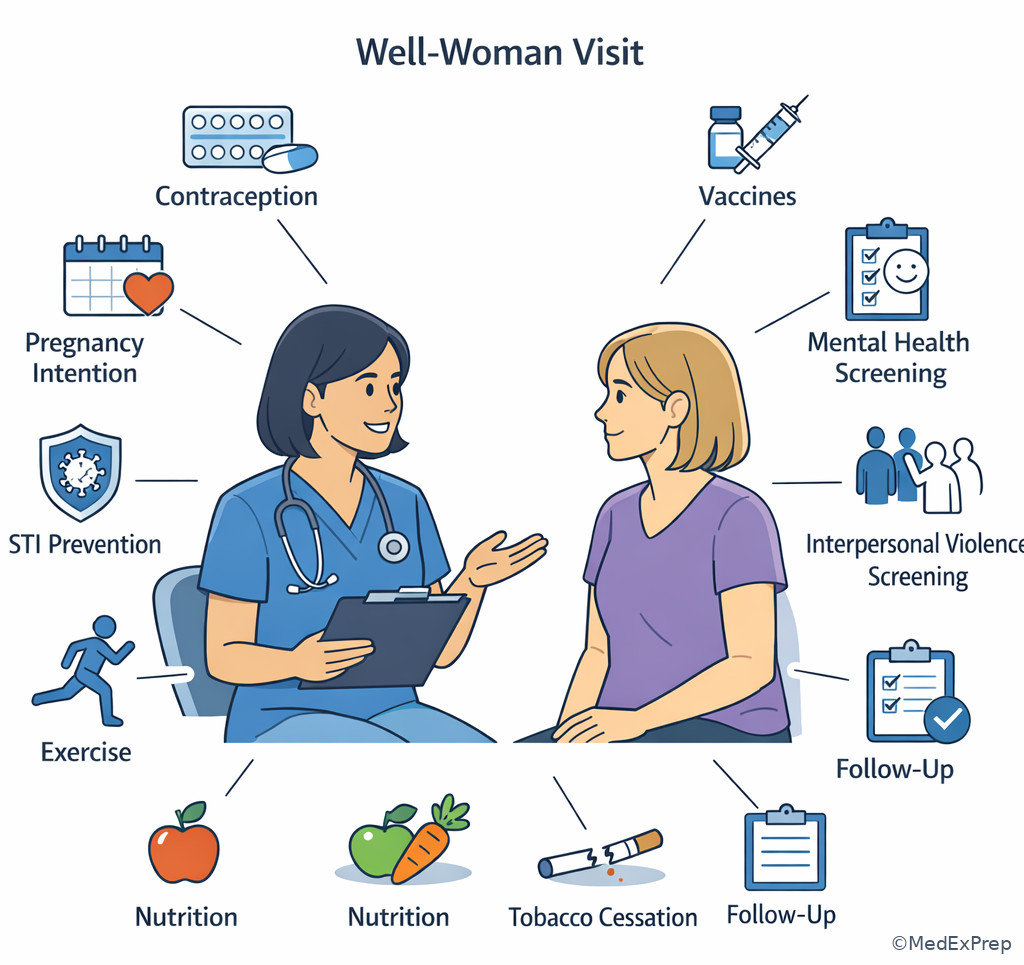
A strong well-woman visit integrates counseling with screening review rather than treating them as separate add-ons. Ask whether pregnancy is desired in the next year. If yes, transition toward preconception optimization and medication review. If no or unsure, discuss contraception needs and emergency contraception awareness when relevant. Review STI prevention based on sexual practices and exposure risk. Confirm immunization status in broad terms and address preventive care gaps. Screen for depression and interpersonal violence using trauma-informed language. Counsel on exercise, nutrition, sleep, tobacco, alcohol, and substance use with a realistic, patient-centered plan.
Because this is a foundational lesson, do not memorize ages or intervals here; that is the next topic. Instead, learn the categories of preventive review that belong in the encounter. See Fig 2.
WHY THIS IS TESTED: Board stems may ask which counseling topic is most important to address before the patient leaves. The right answer is usually the topic with immediate safety or reproductive relevance, not the broadest wellness lecture.
Exam takeaway: The best preventive visit weaves screening review together with contraception, STI prevention, vaccines, mental health, and safety counseling.
flowchart TD
A[Preventive counseling] --> B[Screening gaps review]
A --> C[Pregnancy intention and contraception]
A --> D[STI prevention and sexual health]
A --> E[Vaccines and infection prevention]
A --> F[Mood safety and substance use]
A --> G[Lifestyle cardiometabolic counseling]
B --> H[Shared plan with follow-up]
C --> H
D --> H
E --> H
F --> H
G --> H
Exam takeaway: One well-woman encounter should efficiently integrate screening review, contraception, STI prevention, vaccines, and lifestyle counseling.
B Worked example
A 33-year-old nulliparous patient comes for preventive care. She has lupus, takes mycophenolate, and reports a new partner. She says she is “not trying but would be okay if it happened.” She declines a lengthy nutrition discussion because she is late for work. Her employer recently changed insurance, and she is worried about costs. A mildly elevated LDL from a biometric screening is listed in the chart.
Reasoning chain: Identify task: choose the most important counseling priorities before she leaves. Extract key facts: teratogenic medication, ambivalent pregnancy intention, new partner with STI risk, access barrier due to insurance. Apply rule: counseling must focus on pregnancy prevention/preconception safety, contraceptive reliability, STI prevention, and realistic follow-up. Eliminate distractors: diet counseling matters but is not the most urgent issue today. Verify: document shared plan, discuss safe contraception/preconception timing, and arrange needed screening/testing based on risk.
C Exam trap
D Checkpoint
Question: A patient says, “I’m not planning pregnancy, but I’m not really preventing it either.” Which preventive counseling domain becomes most important to clarify during the visit?
- Detailed travel vaccine requirements for the next decade.
- Pregnancy intention, contraception reliability, and medication safety.
- Office décor preferences to reduce visit stress.
- Whether she prefers paper or digital receipts.
- A: Tempting because vaccines are part of prevention; wrong because it is not the highest-yield immediate issue in this stem.
- B: Tempting because it narrows the focus; right because ambivalent pregnancy intention can still create immediate reproductive and medication safety needs.
- C: Tempting because trauma-informed environment matters; wrong because it does not guide clinical risk reduction directly.
- D: Tempting because logistics influence adherence; wrong because it is administrative, not clinically decisive.
- Fill in the blank: If pregnancy is possible, review medication safety before the visit ends.
- True or False: STI prevention counseling is only needed if the patient requests testing. False.
- Name 3 universal preventive counseling categories: reproductive goals, mental health/safety, lifestyle risk reduction.
1.1.1.7 Integration: red flags, visit conversion, documentation, and follow-up
A Explanation
The final decision conflict is when to continue a routine preventive visit versus when to convert it into a problem-focused evaluation, urgent referral, or emergency transfer. The single rule: red flags outrank routine prevention.
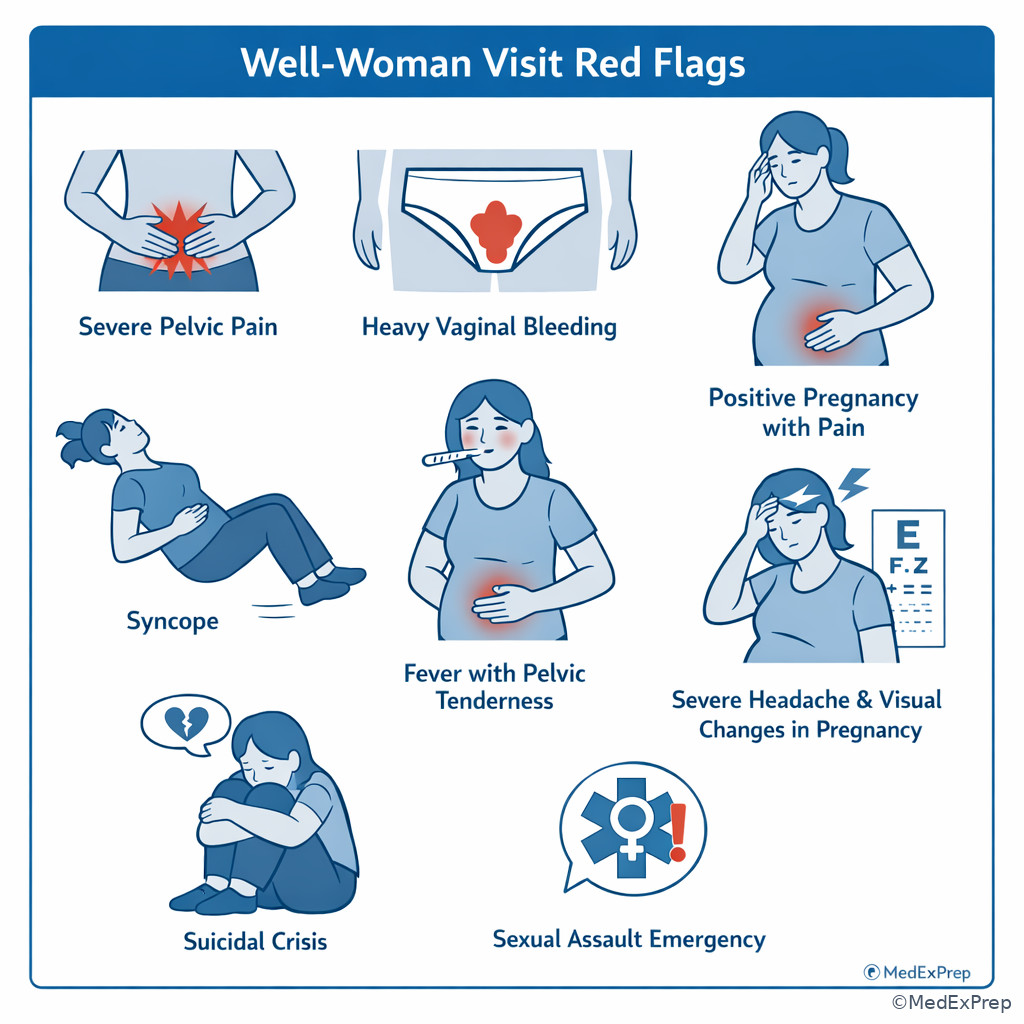
Examples include suspected ectopic pregnancy, severe unilateral pelvic pain, syncope, heavy bleeding with instability, hypertensive emergency symptoms in pregnancy, fever with pelvic pain suggesting significant infection, suicidal risk, sexual assault crisis needs, or concerning findings suggestive of malignancy. In those settings, the WHNP board answer is not definitive inpatient management; it is outpatient stabilization within scope, immediate escalation, or referral/transfer. Preventive care can be rescheduled.
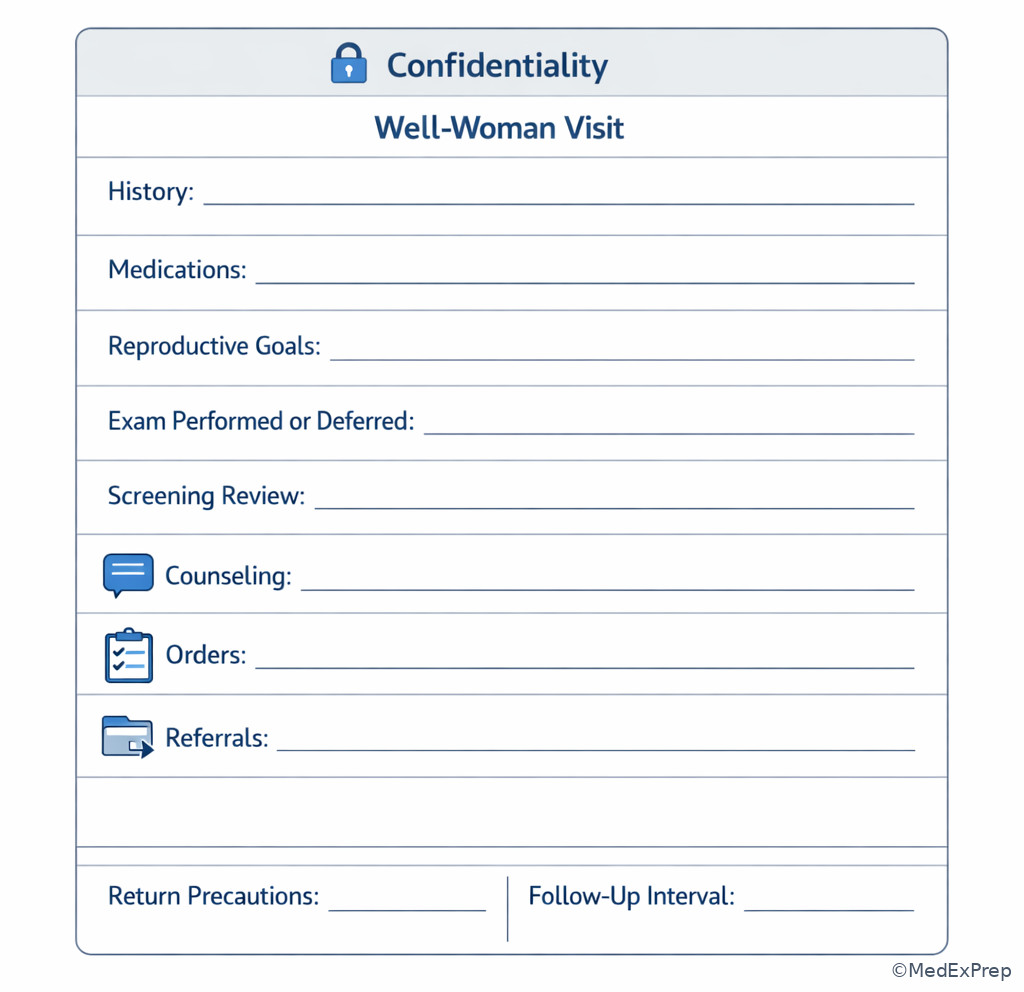
Documentation matters because the board often tests safe care processes indirectly. Record confidentiality discussion when relevant, key history domains reviewed, symptoms that were denied or endorsed, rationale for examination performed or deferred, patient counseling delivered, orders/tests/referrals placed, and follow-up instructions with timeframe. A strong note shows reasoning, not just a checklist.
Follow-up plans should be specific: when results will be reviewed, when to return routinely, what symptoms require urgent care, and what referrals are needed. See Fig 3 and Fig 4.
WHY THIS IS TESTED: The exam frequently uses “annual visit” as camouflage for a red flag. The safest answer is the one that recognizes the change in acuity and acts within outpatient WHNP scope.
Exam takeaway: Red flags convert routine preventive care into urgent evaluation, escalation, or transfer rather than routine screening completion.
flowchart TD
A[Well-woman visit in progress] --> B{Urgent symptom or safety concern?}
B -->|No| C[Continue preventive plan]
B -->|Yes| D{Stable for outpatient focused evaluation?}
D -->|Yes| E[Same-day problem-focused assessment and expedited referral/testing]
D -->|No or unstable| F[Emergency transfer or urgent escalation]
C --> G[Routine follow-up]
E --> G
F --> G Exam takeaway: Learn the visual pattern of bleeding, pain, pregnancy, infection, and safety red flags that stop a routine annual workflow.
Exam takeaway: Good documentation links history, indication-based exam, counseling, and explicit follow-up instructions.
B Worked example
A 36-year-old presents for an annual visit. She has rheumatoid arthritis, uses methotrexate, and reports “a little spotting.” On further history she is 7 weeks from her last menstrual period, had a positive home pregnancy test yesterday, and now has increasing right lower quadrant pain with lightheadedness. She drove herself to clinic. A distracting clue: she also wants to discuss whether she is due for a mammogram because her coworker was just diagnosed with breast cancer.
Reasoning chain: Identify task: determine whether this remains a preventive visit. Extract key facts: positive pregnancy test, pelvic pain, lightheadedness, spotting—ectopic pregnancy red flags. Apply rule: convert immediately from routine preventive care to urgent evaluation and emergency referral. Eliminate distractors: mammography timing and routine preventive counseling are not the priority. Verify: stabilize within outpatient capabilities, arrange immediate emergency care, and document the red flags and instructions clearly.
C Exam trap
D Checkpoint
Question: Which finding most clearly requires conversion of a routine well-woman visit into urgent same-day escalation?
- Interest in changing contraception next year.
- Mild fatigue and a request for routine preventive labs.
- Positive pregnancy test with unilateral pelvic pain and dizziness.
- Questions about exercise goals after menopause.
- A: Tempting because contraception decisions matter; wrong because this remains routine preventive planning.
- B: Tempting because fatigue can reflect disease; wrong because the stem lacks urgent red flags.
- C: Tempting because it could still be early normal pregnancy; right because unilateral pain and dizziness raise urgent ectopic concern.
- D: Tempting because midlife prevention is testable; wrong because it does not change visit acuity.
Exam Traps & Differentiators
- Most common wrong answer: ordering or examining too broadly. Why: “Thoroughness” feels safe. Fix: choose the most appropriate indicated component, not the largest workup.
- Looks similar but isn’t: annual preventive visit versus symptom visit added onto preventive care. If the stem includes bleeding, discharge, pelvic pain, a lesion, or pregnancy concern, the encounter is no longer purely routine.
- Looks similar but isn’t: screening versus diagnostic testing. Screening is for asymptomatic patients; symptoms convert the task.
- Looks similar but isn’t: patient anxiety versus contraindication. Anxiety requires explanation and trauma-informed care; it does not by itself make an indicated exam inappropriate.
- Looks similar but isn’t: family history counseling versus immediate safety issue. Acute pregnancy risk, assault concern, or suicidal risk outranks longer-term prevention planning.
| Stem says... | Think... |
|---|---|
| “I’m here for my annual, but I’ve had pain/bleeding/discharge” | Convert from purely preventive to preventive + problem-focused evaluation |
| “Not trying, but not preventing pregnancy” | Clarify pregnancy intention, contraception reliability, and medication safety |
| “I had a hysterectomy” | Do not assume screening needs; determine cervix status and indication history |
| “I’m nervous about the pelvic exam” | Use trauma-informed explanation; decide whether the exam is actually indicated |
| Positive pregnancy test + pain/lightheadedness | Urgent ectopic assessment/escalation, not routine annual care |
| New partner/inconsistent barrier use | STI risk and prevention counseling become high-yield today |
| Look-alike pair | Why they are confused | Single differentiator |
|---|---|---|
| Routine preventive visit vs problem-focused gynecologic visit | Both may occur in outpatient women’s health settings | Presence of active symptoms or red flags |
| Routine counseling vs urgent medication safety counseling | Both involve education | Current pregnancy possibility or teratogenic exposure |
| General exam vs internal pelvic exam | Both may be described as part of “the exam” | Internal pelvic exam requires indication, symptoms, or specimen need |
| Preventive screening review vs broad lab ordering | Both sound comprehensive | Screen only when recommended or indicated; avoid shotgun testing |
Related trap from upcoming topics: in Age-Based Screening Principles, learners often apply one-size-fits-all screening intervals. In this lesson, the parallel mistake is one-size-fits-all visit structure. In Risk Stratification Patterns, the related distractor is missing how comorbidities or medications intensify prevention needs.
Tables
| Well-woman component | Purpose | Common board error |
|---|---|---|
| Agenda setting/confidentiality | Clarifies priorities and improves sensitive disclosure | Skipping straight to exam or testing |
| Interval medical history | Identifies new diagnoses, surgeries, hospitalizations, medication changes | Focusing only on gynecologic history |
| Menstrual/reproductive history | Guides pregnancy, contraception, and symptom interpretation | Documenting LMP only without cycle meaning |
| Sexual history | Guides STI risk, counseling, and testing needs | Deferring it until after exam or omitting due to discomfort |
| Medication review | Identifies interactions and teratogenicity concerns | Ignoring OTC/herbal products or pregnancy potential |
| Mental health/safety screening | Finds depression, violence, and urgent psychosocial risk | Treating these as optional add-ons |
| Targeted exam | Addresses indications without overtesting | Automatic internal pelvic exam in asymptomatic patients |
| Counseling and follow-up | Converts findings into action | Ending the visit without explicit next steps |
| Comparison | Routine preventive visit | Preventive + problem-focused visit | Urgent escalation visit |
|---|---|---|---|
| Primary goal | Maintenance, screening, counseling | Address preventive needs plus a new symptom | Stabilize and arrange immediate higher-level care |
| History emphasis | Risk review and health maintenance | Targeted symptom characterization plus preventive review | Red flags, stability, time-critical facts |
| Exam intensity | General and indicated focused exam | Symptom-driven focused exam | Rapid assessment within scope |
| Testing approach | Screening if due/indicated | Diagnostic testing as clinically indicated | Emergency referral or urgent same-day workup |
| Disposition | Routine follow-up | Short-interval follow-up/results review | ED transfer, urgent referral, or same-day specialty escalation |
| Differential classification | Examples encountered during “annual” visit | Best WHNP frame |
|---|---|---|
| True preventive issue | Vaccine review, contraception counseling, routine mental health screen | Complete during scheduled visit |
| Preventive issue with risk modification | Family cancer history, smoking, obesity, teratogenic medication exposure risk | Adjust prevention plan and follow-up |
| Problem-focused but stable outpatient issue | Postcoital spotting, nonsevere discharge, stable urinary symptoms | Add focused evaluation and short-interval follow-up |
| Urgent outpatient/escalation issue | Positive pregnancy with pain, severe bleeding, assault crisis, suicidality | Stop routine flow and escalate immediately |
| History clue | Why it matters today | Immediate well-woman consequence |
|---|---|---|
| Possible pregnancy | Medication and contraceptive safety | Clarify pregnancy status/intention; review teratogenic exposures |
| New sexual partner | STI exposure risk | Prevention counseling and possible screening/testing review |
| Prior traumatic exam | Affects consent and approach | Use trauma-informed steps; avoid nonindicated internal exam |
| Family cancer history | May change screening/referral pathway | Risk stratify and plan future preventive steps |
| Access/insurance barrier | May impair adherence | Prioritize high-value actions and concrete follow-up |
Algorithm / Approach
Use this mini-algorithm when answering board stems: identify the task → extract management-changing facts → determine whether the visit is still routine → choose only indicated exam/testing → prioritize immediate counseling needs → verify follow-up and escalation thresholds.
Rapid Review
- Preventive visit → agenda and confidentiality come before testing
- Annual exam → not synonymous with automatic internal pelvic exam
- Possible pregnancy → medication safety and contraception/preconception counseling jump to top priority
- Symptom during annual visit → convert to preventive plus problem-focused reasoning
- Positive pregnancy + pain/dizziness → think urgent ectopic evaluation
- New partner/inconsistent condoms → sexual history changes preventive actions today
- Family history clue → risk-modifies screening; does not automatically outrank acute safety issues
- Trauma history → permission-based, indication-based sensitive exam
- Asymptomatic patient asking about “full exam” → choose only indicated components
- Preventive counseling → pregnancy intention is more discriminating than generic wellness advice
- Documentation → include why an exam was performed or deferred
- Follow-up plan → must include timeframe plus return precautions
- Screening logic → age, risk, anatomy present, exposure history
- WHNP scope → recognize red flags, stabilize within scope, and escalate rather than manage inpatient crises
Self-check quiz
1. A 27-year-old presents for preventive care and says, “I’m healthy, I just need my annual.” She has no pain, bleeding, discharge, or urinary symptoms and appears comfortable. Which action is the most appropriate way to begin the visit?
- Perform an internal pelvic exam before asking sensitive questions.
- Clarify her goals, explain confidentiality, and screen briefly for urgent symptoms or safety concerns.
- Order broad endocrine testing before reviewing history.
- Skip the history and provide general lifestyle handouts first.
2. A 38-year-old with hypertension presents for a routine checkup. She reports no acute symptoms but says her period is late and she is not sure whether she wants pregnancy. Which history item most needs clarification during this visit?
- Preferred pharmacy parking availability
- Current pregnancy possibility and reproductive intention
- Favorite exercise app
- Whether she prefers printed after-visit summaries
3. A 31-year-old G0 with migraines without aura and anxiety presents for a well-woman visit. She denies symptoms but asks whether she “has to” have a pelvic exam to stay current on care. She had a traumatic exam in college and is visibly tense. Which action is most appropriate?
- Explain that annual care always requires an internal exam and proceed efficiently.
- Use trauma-informed communication, determine whether any pelvic exam is actually indicated, and proceed only with consent.
- Cancel all preventive care because anxiety makes the visit invalid.
- Order STI tests for every possible organism to compensate for deferring the exam.
4. A 35-year-old with psoriasis and obesity presents for an annual visit. She takes methotrexate, has a new sexual partner, and says, “We’re not trying, but if it happens, it happens.” She also wants help with healthy eating. Which counseling priority is most appropriate before the visit ends?
- Detailed meal planning only
- Pregnancy intention, contraceptive reliability, and medication safety
- Sleep hygiene only
- General wellness counseling without discussing sexual history
5. A 46-year-old presents for preventive care. She has diabetes and asks about routine health maintenance. During history she reports new postcoital spotting for 6 weeks but no syncope, severe pain, or heavy bleeding. Which action is most appropriate?
- Continue as a purely routine visit and address the spotting another year
- Convert the encounter to include focused evaluation of the bleeding concern while still addressing preventive needs as appropriate
- Send her immediately to emergency care solely because she has spotting
- Order a large panel of tumor markers before any focused assessment
6. A 30-year-old presents for an annual visit. She has rheumatoid arthritis treated with leflunomide, mild asthma, and depression. She reports a missed period, intermittent lower abdominal pain, and a positive home pregnancy test this morning. She also wants to know when she should update routine vaccines. Which action is the most appropriate next step?
- Discuss vaccines first because prevention is the purpose of the visit
- Assess stability and urgently evaluate or escalate the pregnancy-related pain concern before continuing preventive counseling
- Complete the entire routine history before addressing the positive pregnancy test
- Reassure her that mild pain is expected early in pregnancy and schedule routine follow-up next month
7. A 55-year-old postmenopausal patient with obesity and controlled hypothyroidism presents for preventive care. She denies bleeding, discharge, pelvic pain, or sexual activity. She is anxious because a friend recently had ovarian cancer and requests “every possible exam today.” Which action is most appropriate?
- Perform an internal pelvic exam and broad cancer labs because patient anxiety increases pretest probability
- Provide reassurance only and omit all preventive assessment because she is upset
- Perform general preventive assessment, address her concerns, and limit sensitive examination to indicated components rather than fear-driven overtesting
- Refer all asymptomatic postmenopausal patients to gynecologic oncology for complete evaluation
8. A 22-year-old college student presents for a routine well-woman visit. She has no gynecologic symptoms, takes isotretinoin prescribed elsewhere, uses condoms inconsistently, and becomes tearful when asked about relationships, stating she does not always feel safe with her partner. Which action most requires immediate clarification during this visit?
- Favorite menstrual tracking application
- Exact number of caffeinated drinks per week
- Current pregnancy possibility and immediate personal safety concerns
- Whether she would like nutrition handouts emailed
Answer key
1.1.1.8 1. Answer: B
A: Tempting because annual gynecologic care is often associated with a pelvic exam. Incorrect because the nursing priority is assessment first; you determine whether a sensitive exam is indicated only after history, confidentiality, and red-flag screening. Single clue: she is asymptomatic.
B: Tempting because it sounds basic rather than technical. Correct because the first priority in a preventive visit is to establish the agenda, explain confidentiality, and rule out urgent concerns before choosing exam elements. Single clue: this is a routine preventive visit with no acute symptoms yet identified.
C: Tempting because preventive visits can uncover silent conditions. Incorrect because broad endocrine testing without indication violates focused preventive reasoning and jumps ahead of assessment. Single clue: no endocrine symptoms are provided.
D: Tempting because education is part of prevention. Incorrect because nursing process prioritizes assessment before teaching; generic handouts do not replace a tailored history. Single clue: the visit has not yet been individualized.
Priority rationale: Using assessment-first logic, the clinician should gather decision-making information before implementing exams or teaching. This matches safe ambulatory preventive care and patient-centered standards. Sources: NCSBN Clinical Judgment Model principles; ANA Standards of Practice.
1.1.1.9 2. Answer: B
A: Tempting because access barriers can affect adherence. Incorrect because parking does not change immediate reproductive safety decisions. Single clue: the period is late.
B: Tempting because it narrows the visit quickly. Correct because possible pregnancy changes medication review, counseling, and prevention priorities immediately. Single clue: late menses plus uncertainty about pregnancy goals.
C: Tempting because exercise counseling belongs in prevention. Incorrect because it is lower priority than clarifying pregnancy potential. Single clue: pregnancy risk has same-day implications.
D: Tempting because communication preferences matter. Incorrect because it is administrative rather than clinically decisive. Single clue: no impact on medication or reproductive safety.
Priority rationale: In Maslow/safety terms, potential pregnancy raises immediate physiologic and medication safety concerns, outranking convenience preferences or general wellness coaching. Sources: ANA Standards of Practice; NCSBN prioritization framework.
1.1.1.10 3. Answer: B
A: Tempting because it sounds efficient and thorough. Incorrect because annual care does not automatically require an internal exam, and trauma-informed practice requires consent and indication. Single clue: she denies symptoms.
B: Tempting because it may seem slower. Correct because the proper nursing priority is patient safety, consent, and using only indicated sensitive examination components. Single clue: no symptoms plus prior trauma.
C: Tempting because patient distress deserves respect. Incorrect because anxiety does not cancel all preventive care; the clinician should adapt the approach rather than abandon care. Single clue: she is asking for guidance, not refusing all care.
D: Tempting because STI testing can be preventive. Incorrect because indiscriminate testing is not a substitute for history-based decision-making. Single clue: no exposure details or indications are provided.
Priority rationale: Safety and psychological comfort are part of nursing care, but assessment still leads. The correct action balances trauma-informed communication with indication-based examination. Sources: ANA Standards of Practice; NCSBN patient-centered care and safety principles.
1.1.1.11 4. Answer: B
A: Tempting because obesity counseling is relevant preventive care. Incorrect because meal planning is not the highest immediate priority when a teratogenic medication and possible pregnancy exist. Single clue: methotrexate plus pregnancy ambivalence.
B: Tempting because it narrows to reproductive issues. Correct because pregnancy intention, contraception effectiveness, and medication safety have immediate consequences today. Single clue: “if it happens, it happens” while taking methotrexate.
C: Tempting because sleep is always useful wellness counseling. Incorrect because it does not address the urgent reproductive safety issue in the stem. Single clue: new partner and pregnancy ambivalence are more decisive.
D: Tempting because broad wellness counseling feels comprehensive. Incorrect because it avoids the two specific management drivers: sexual risk and teratogenic exposure. Single clue: new partner plus high-risk medication.
Priority rationale: Using safety hierarchy, reproductive and medication risk outrank general lifestyle teaching in this encounter. The clinician should address the highest-risk issue first, then expand counseling as time allows. Sources: ANA Standards of Practice; NCSBN prioritization and safety framework.
1.1.1.12 5. Answer: B
A: Tempting because the visit was scheduled as routine annual care. Incorrect because new postcoital spotting requires focused outpatient evaluation rather than deferral. Single clue: active abnormal symptom for 6 weeks.
B: Tempting because it complicates scheduling. Correct because the visit can appropriately include both preventive care and symptom-focused assessment when the patient is stable. Single clue: spotting is present, but there are no emergency red flags.
C: Tempting because bleeding can sound dangerous. Incorrect because the stem lacks instability, severe pain, or heavy bleeding that would mandate emergency transfer. Single clue: no syncope or severe symptoms.
D: Tempting because malignancy concern can trigger anxiety. Incorrect because tumor markers are not the first nursing/clinical step in stable outpatient symptom assessment. Single clue: focused assessment comes before expansive testing.
Priority rationale: Assessment and problem identification come before high-cost or emergency-level actions. Stable symptomatic patients generally need focused outpatient evaluation integrated into the visit. Sources: ANA Standards of Practice; NCSBN nursing process framework.
1.1.1.13 6. Answer: B
A: Tempting because vaccines are part of preventive care and the visit is annual. Incorrect because pregnancy-related pain with a positive test is a time-sensitive safety issue that outranks routine counseling. Single clue: positive pregnancy test plus abdominal pain.
B: Tempting because it interrupts the planned visit. Correct because nursing priority is to assess stability and urgently address potential early pregnancy complications before any routine prevention topics. Single clue: missed period, pain, and positive pregnancy test.
C: Tempting because full history is usually important. Incorrect because the ABCs/safety framework supports immediate triage of time-sensitive red flags before completing routine history. Single clue: acute potentially dangerous symptom cluster.
D: Tempting because mild discomfort can occur in early pregnancy. Incorrect because reassurance alone is unsafe when the stem includes pain and pregnancy without established location or stability. Single clue: pain in early pregnancy is not automatically benign.
Priority rationale: Safety and potential circulatory threat outrank preventive counseling. The clinician should assess and escalate first, then return to routine care later if appropriate. Sources: NCSBN prioritization/ABCs; ANA Standards of Practice.
1.1.1.14 7. Answer: C
A: Tempting because cancer anxiety can pressure clinicians toward more testing. Incorrect because patient fear does not create indication for broad overtesting in an asymptomatic visit. Single clue: she denies bleeding, discharge, and pain.
B: Tempting because emotional distress needs support. Incorrect because reassurance alone neglects the preventive assessment and counseling she came for. Single clue: she still needs appropriate routine care.
C: Tempting because it may feel less decisive than “doing everything.” Correct because the appropriate action is indication-based prevention with attention to patient concerns and avoidance of unnecessary sensitive examination. Single clue: asymptomatic postmenopausal patient requesting excessive testing out of fear.
D: Tempting because ovarian cancer is serious. Incorrect because referral of all asymptomatic postmenopausal patients to oncology is not justified and exceeds appropriate preventive reasoning. Single clue: no concerning symptom or specific oncology trigger is given.
Priority rationale: Safety includes avoiding unnecessary procedures while still completing indicated assessment. The nursing process supports focused, patient-centered, evidence-aligned care rather than fear-driven escalation. Sources: ANA Standards of Practice; NCSBN safety and clinical judgment principles.
1.1.1.15 8. Answer: C
A: Tempting because menstrual apps relate to reproductive care. Incorrect because it does not address immediate safety or teratogenic risk. Single clue: isotretinoin and feeling unsafe with a partner.
B: Tempting because caffeine intake can be part of lifestyle counseling. Incorrect because it is much lower priority than pregnancy and violence assessment. Single clue: inconsistent condoms plus possible coercion or unsafe relationship.
C: Tempting because it narrows the visit to high-stakes issues. Correct because current pregnancy possibility and immediate safety concerns both require same-visit clarification, especially with isotretinoin exposure risk and relationship safety disclosure. Single clue: teratogenic medication plus inconsistent condoms plus unsafe partner statement.
D: Tempting because follow-up education matters. Incorrect because administrative teaching choices do not address urgent risk. Single clue: patient safety and pregnancy risk are the key discriminators.
Priority rationale: Maslow and safety place immediate protection from harm above routine wellness education. This stem combines reproductive risk and interpersonal safety concern, both of which outrank low-yield lifestyle details. Sources: ANA Standards of Practice; NCSBN safety, psychosocial integrity, and prioritization principles.
Keep going with the full WHNP-BC Prep Course (WHNP)
You just studied the way members do, in the same lesson interface. Full access unlocks every lesson, the question bank and flashcards for a full year.
One payment · 1 year of access · No auto-renewal