1.1.1 - VTNE Domain Map
Why it matters
- The VTNE rewards organized thinking: many “hard” questions become easier once you recognize the domain and the technician task being tested.
- Study time is limited; a domain map prevents overstudying rare details and understudying safety-heavy, cross-cutting content.
- Many distractors are not fact errors but role errors: the wrong answer often reflects veterinarian judgment rather than technician action.
- Domain mapping supports retention because related topics cluster together; monitoring, documentation, safety, and escalation recur across almost every chapter.
Key Terms & Must-Know Facts
1.1.1.1 Key terms
- Domain — a major tested content area on the VTNE.
- Subskill — a practical task inside a domain, such as tube selection or anesthetic trend recognition.
- Scope boundary — the line between technician responsibilities and veterinarian-only decisions.
- Next-best action — the safest appropriate step within role and protocol.
- Cross-domain skill — a skill tested in multiple domains, such as documentation or infection control.
- Trend recognition — noticing change over time rather than isolated values.
- Specimen integrity — how sample quality affects test validity.
- Asepsis — prevention of contamination during procedures.
- Triage priority — urgency ranking based on immediate threats to life or safety.
- Monitoring parameter — a measurable value followed during patient care.
- Distractor — a plausible wrong option designed to exploit confusion in logic, scope, or safety.
- Blueprint mapping — connecting content to likely exam objectives and practical task types.
1.1.1.2 Must-know facts
- The VTNE tests technician execution, monitoring, safety, documentation, and escalation.
- If an answer requires diagnosis, prescribing, prognosis, or independent treatment-plan changes, it is often outside technician scope.
- Patient safety and error prevention are high-yield across every domain.
- Normal-versus-abnormal recognition matters more than memorizing isolated rare diseases.
- Questions often mix domains: an anesthesia stem may also test pharmacy math, documentation, or emergency response.
- Species matters; a correct action in a dog may be incomplete or unsafe in a bird, rabbit, horse, or ruminant.
- Board-style items reward identifying the task first: collect, verify, monitor, report, prepare, document, or protect.
- You do not need invented blueprint percentages to prioritize well; use frequency, risk, and integration value.
Exam takeaway: Use the domain first to predict the tested technician task and eliminate out-of-scope distractors.
flowchart TD
A[VTNE] --> B[Animal Care and Nursing]
A --> C[Pharmacy and Calculations]
A --> D[Laboratory Procedures]
A --> E[Diagnostic Imaging]
A --> F[Anesthesia and Analgesia]
A --> G[Surgical Nursing and Asepsis]
A --> H[Dentistry]
A --> I[Emergency and Critical Care]
A --> J[Preventive Medicine and Practice Safety]
B --> B1[Assessment and routine care]
C --> C1[Verification and math]
D --> D1[Specimen quality and testing]
E --> E1[Safety and positioning]
F --> F1[Monitoring and response]
G --> G1[Asepsis and OR workflow]
H --> H1[Charting and dental support]
I --> I1[Triage and stabilization support]
J --> J1[Biosecurity, ethics, safety]
Exam takeaway: Start with the task, then the safety risk, then the role boundary to choose the best technician action.
flowchart TD
A[Read stem] --> B{What is the task?}
B -->|Collect/process| C[Laboratory]
B -->|Prepare/administer/calculate| D[Pharmacy or anesthesia]
B -->|Monitor/respond| E[Anesthesia, nursing, emergency]
B -->|Position/image safely| F[Imaging]
B -->|Asepsis/instruments| G[Surgery or dentistry]
E --> H{Immediate safety threat?}
H -->|Yes| I[Prioritize support and notify veterinarian]
H -->|No| J[Continue protocol and document]
I --> K{Within technician role?}
J --> K
K -->|Yes| L[Perform and verify]
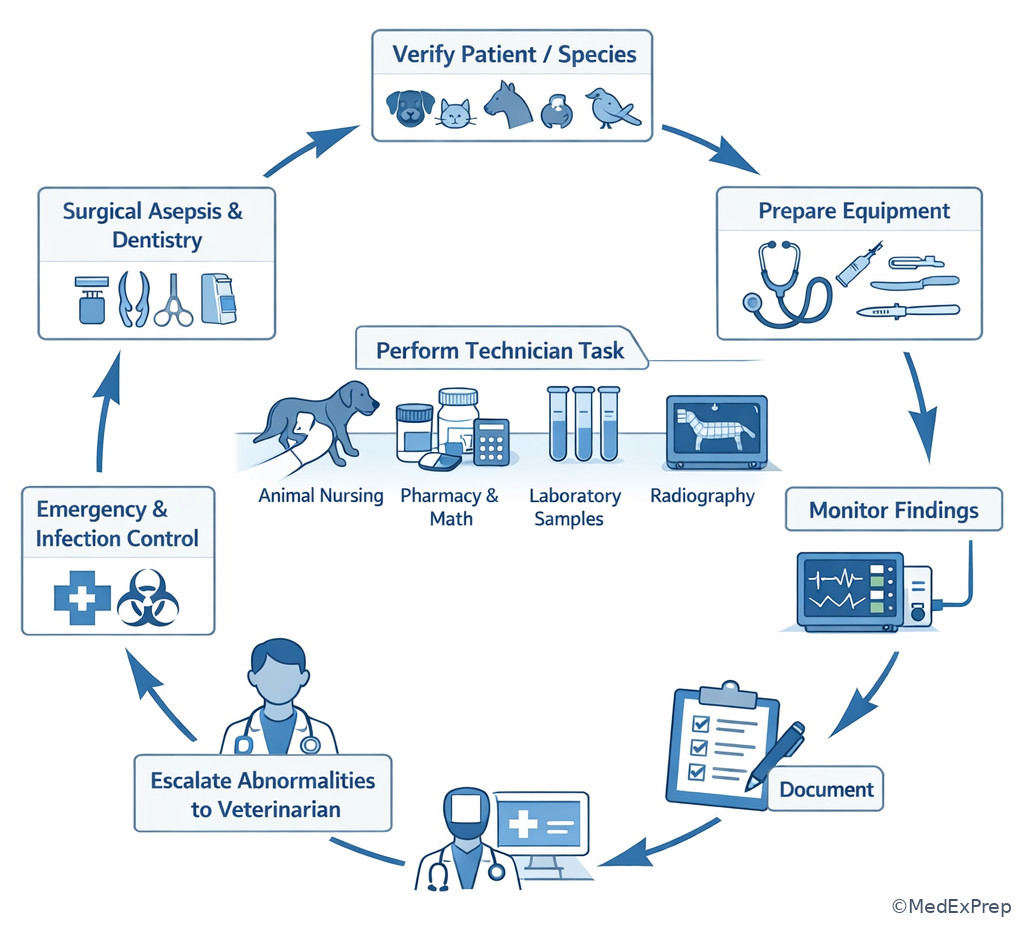
K -->|No| M[Escalate to veterinarian] Exam takeaway: Visualize that the same technician workflow—verify, prepare, monitor, document, escalate—repeats across domains.
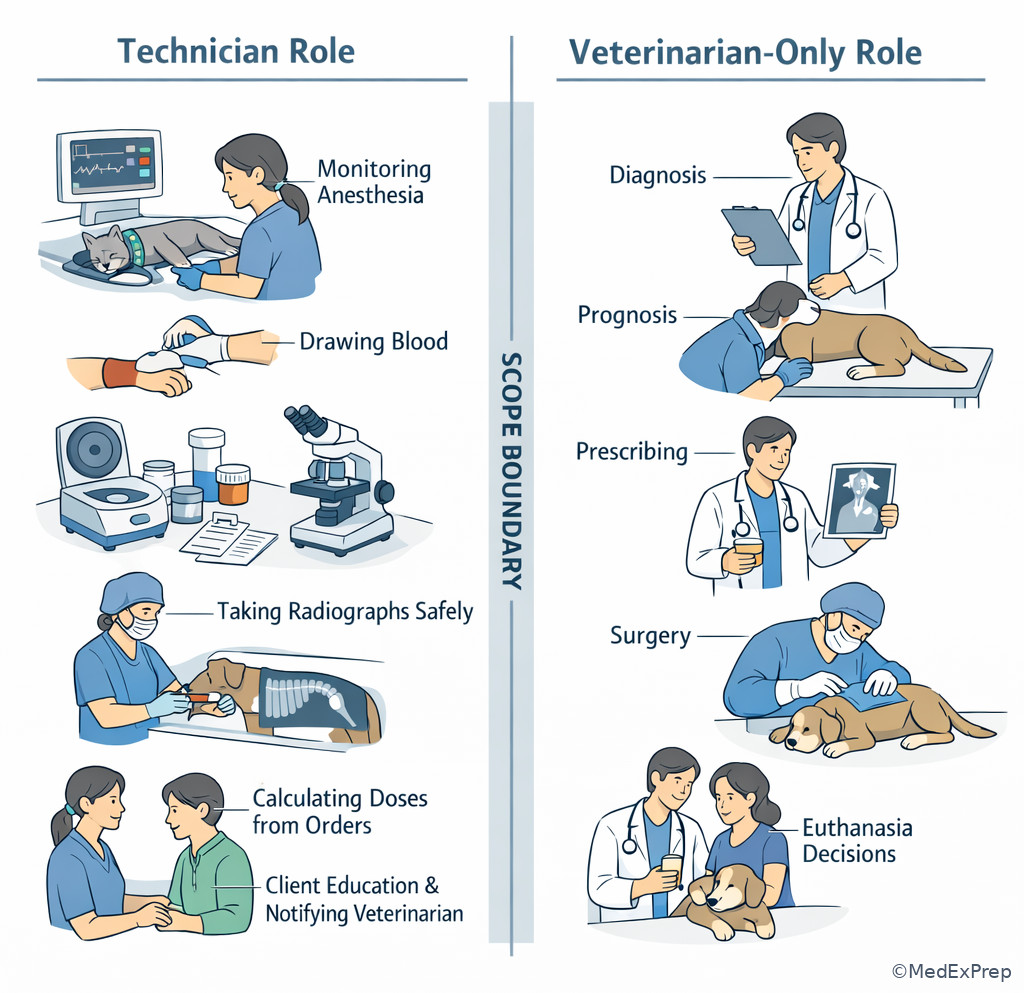
Exam takeaway: Separate technician-performed tasks from veterinarian-only judgments to avoid the most common exam trap.
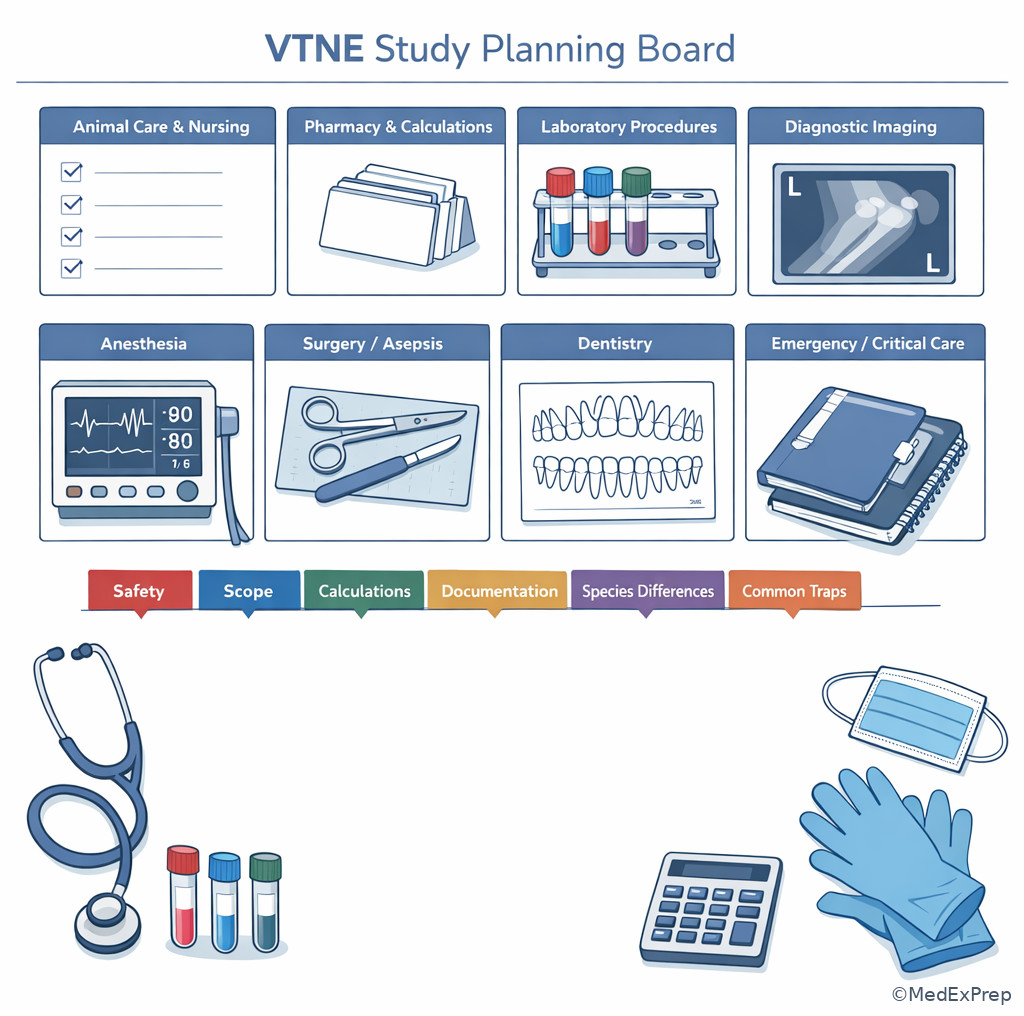
Exam takeaway: Prioritize topics by patient risk, recurrence across domains, and your own error pattern—not by guessing secret weighting.
flowchart TD
A[Topic list] --> B{High safety risk?}
B -->|Yes| C[Study first]
B -->|No| D{Appears in many domains?}
D -->|Yes| C
D -->|No| E{Personal weak area?}
E -->|Yes| F[Study next]
E -->|No| G[Lower priority review]
C --> H[Active practice + cases]
F --> H
G --> I[Rapid review cycles]
H --> J[Track misses by rule]
I --> J Exam takeaway: Organize notes by domain, task type, and safety trigger so recall stays usable under exam pressure.
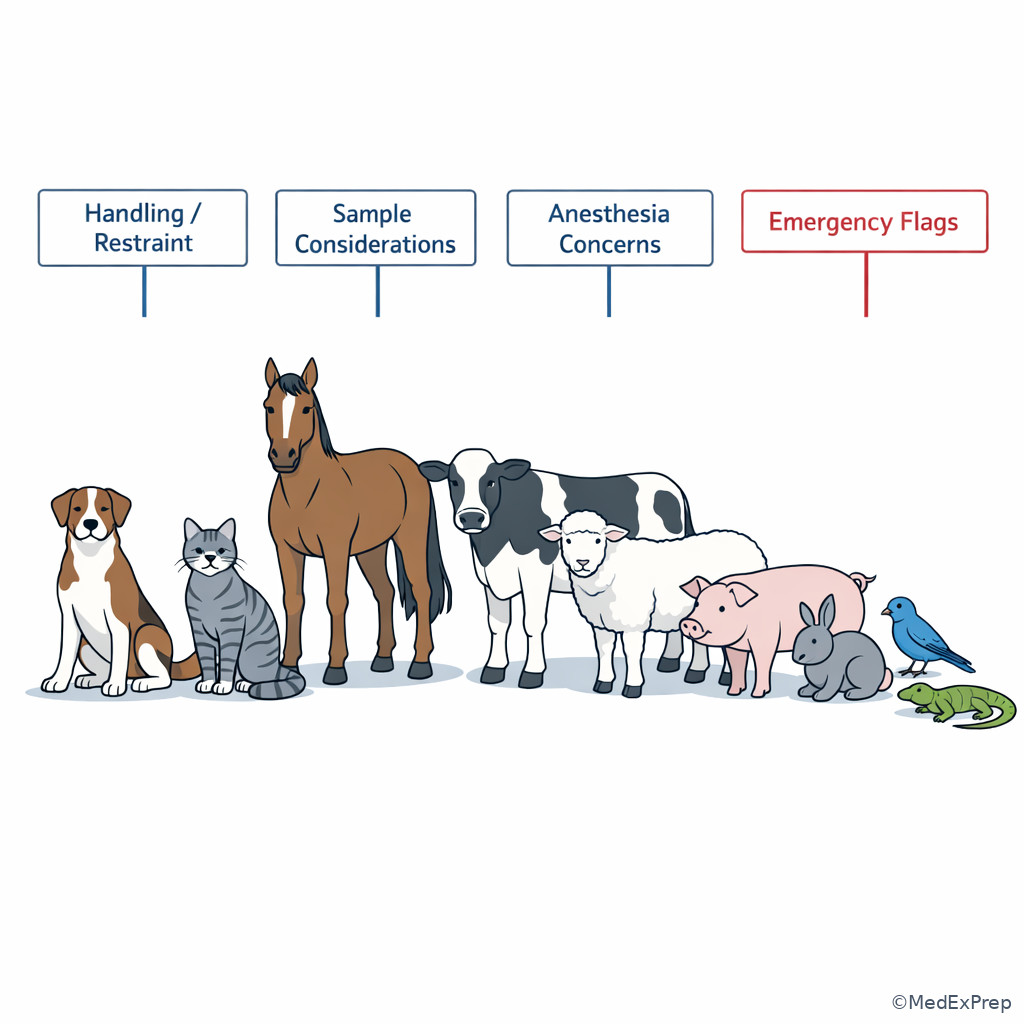
Exam takeaway: Species context changes handling, restraint, monitoring, and communication priorities across many domains.
Exam takeaway: Most lab questions are really about preserving sample quality before interpretation ever happens.
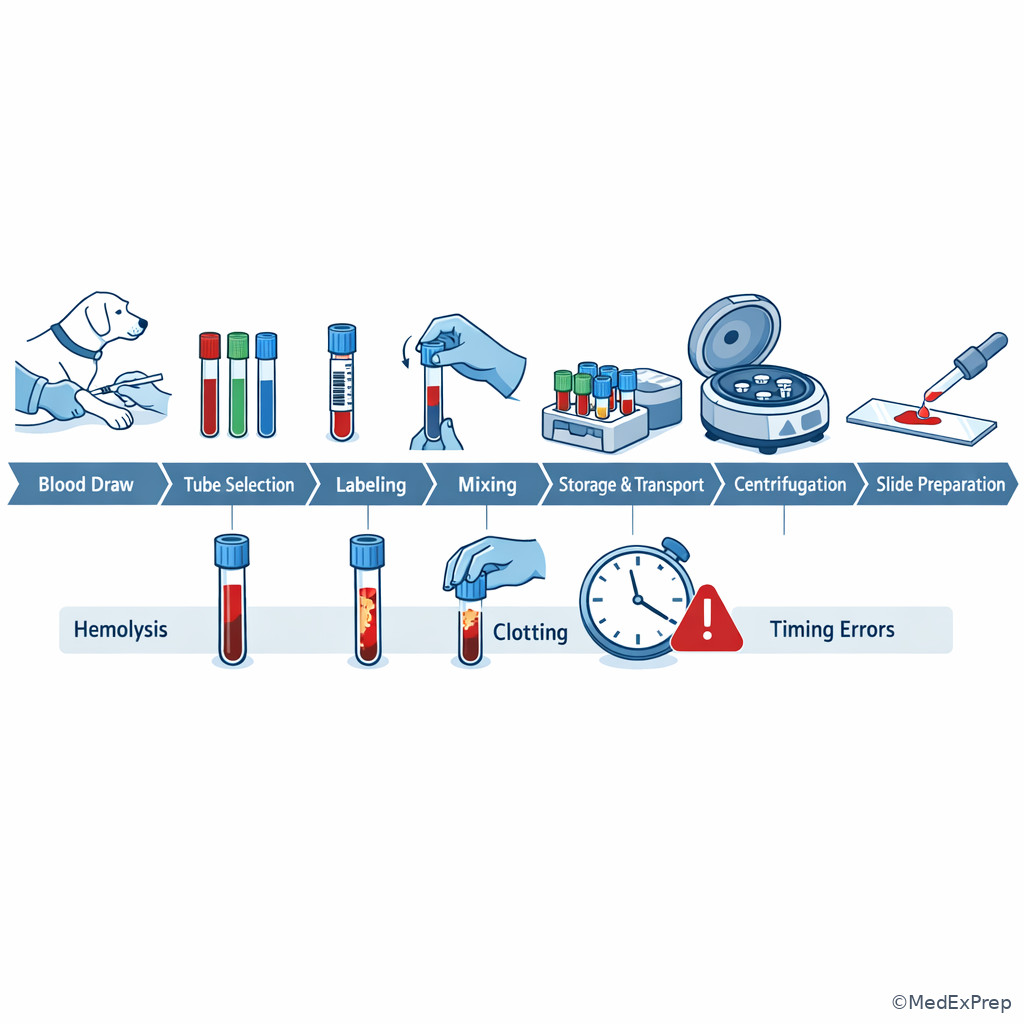
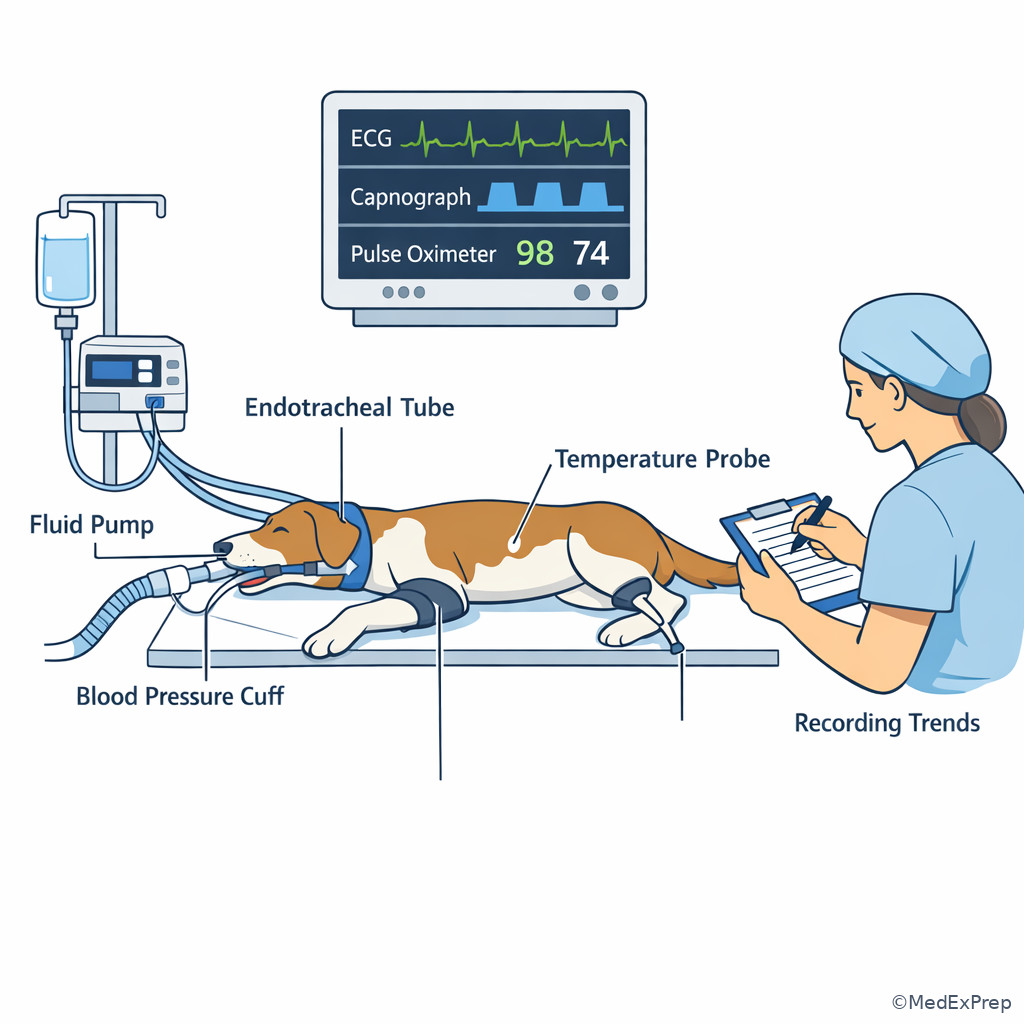
Exam takeaway: Monitoring questions reward recognition of trends and prompt escalation of instability within protocol.
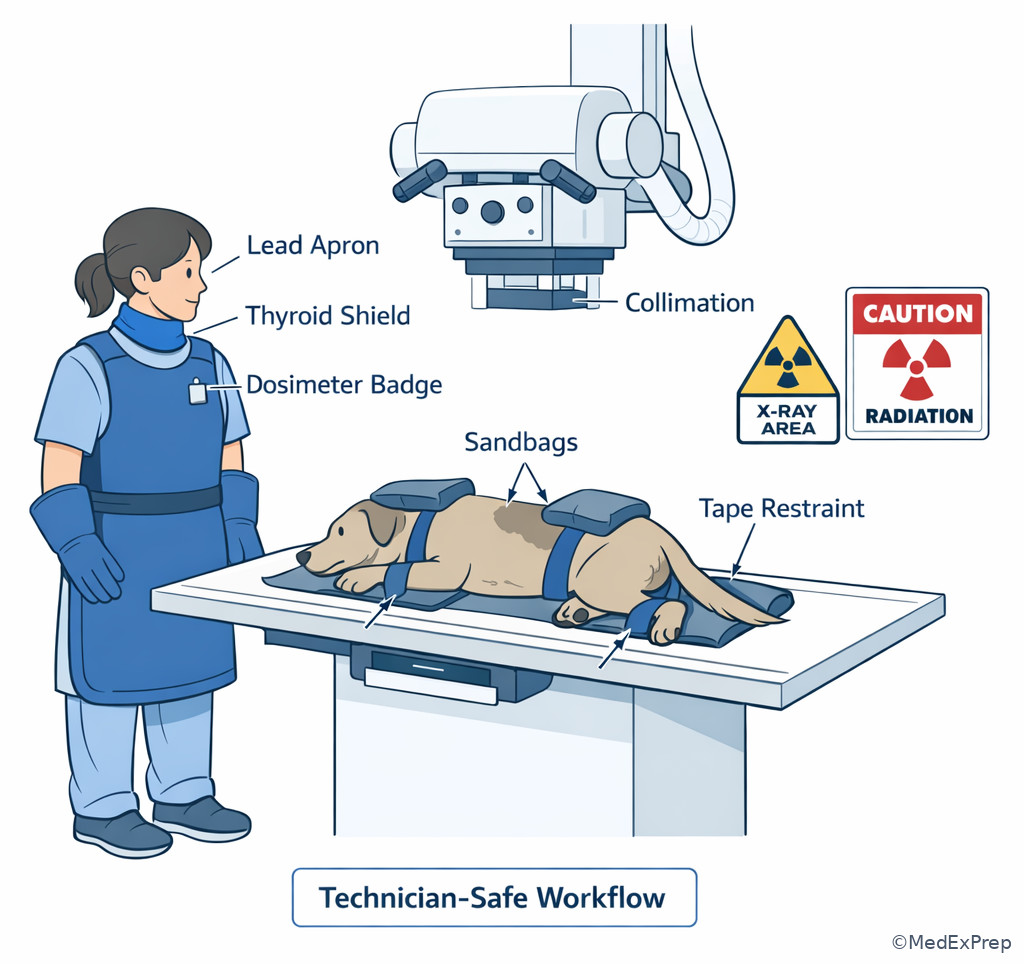
Exam takeaway: Imaging stems commonly test positioning accuracy and radiation protection at the same time.
Exam takeaway: Expect the same core skills to reappear in different clinical wrappers throughout the exam.
flowchart LR
A[Verification] --- B[Documentation]
B --- C[Monitoring]
C --- D[Escalation]
D --- E[Safety]
E --- F[Species awareness]
F --- A
A --> G[Pharmacy]
B --> H[Laboratory]
C --> I[Anesthesia]
D --> J[Emergency]
E --> K[Imaging]
F --> L[Nursing]
Use Fig 1 when you need the big picture. Use Fig 2 when a question feels vague and you need to classify the task quickly. See Fig 3 and Fig 4 for the repeated technician workflow and scope boundary pattern that drive many VTNE items. For study planning, see Fig 5 and Fig 6.
Core content
1.1.1.3 Foundational domain structure: what the exam is really sorting you into
A Explanation
The first conflict on this topic is not “Which fact do I memorize?” but “Which bucket does this question belong in?” On the VTNE, broad domains are really containers for practical technician behaviors: nursing assessment, calculation accuracy, specimen handling, safe positioning, anesthesia monitoring, asepsis, dental support, emergency prioritization, and preventive safety. The resolving rule is simple: classify the stem by the action expected of the technician, not by the disease label floating in the background. A vomiting dog in oxygen may look like internal medicine, but if the task is “what should the technician monitor and report during anesthesia,” the operational domain is anesthesia monitoring.
WHY THIS IS TESTED: exam writers want to know whether you can recognize the task beneath the clinical noise. Domain recognition improves speed and prevents distractors from dragging you into irrelevant details.
Think of the VTNE as a map with recurring verbs: verify, prepare, collect, administer, monitor, protect, document, escalate. When the question focuses on obtaining data or carrying out an order safely, it usually remains in technician territory. When it asks for a medical conclusion or independent therapeutic decision, the safe exam instinct is to identify the role boundary and choose communication to the veterinarian plus appropriate supportive action within protocol. See Fig 1 for the course-level domain view.
B Worked example
A 9-year-old FS Labrador retriever with obesity, osteoarthritis, and a history of mild chronic otitis is admitted for dental prophylaxis. During pre-op preparation, the chart notes a recent episode of vomiting at home. The stem asks for the most appropriate next technician focus before the procedure. Options include choosing an anesthetic drug, confirming preanesthetic instructions and reporting the vomiting, diagnosing aspiration risk, and prescribing an antiemetic. The distracting clue is the vomiting history, which tempts a disease-management mindset.
Reasoning chain: Identify task: this is preanesthetic technician workflow, not internal medicine diagnosis. Extract key facts: scheduled anesthesia, recent vomiting, technician role, need for safety verification. Apply rule: technicians verify history, report abnormalities, prepare safely, and do not independently choose definitive drug plans or diagnose aspiration. Eliminate distractors: choosing anesthetic drugs and prescribing antiemetics are veterinarian decisions; diagnosing aspiration risk is also beyond scope. Verify best answer: confirm and document the abnormal history, withhold further prep steps that require veterinarian direction if protocol indicates, and notify the veterinarian promptly.
C Exam trap
Common wrong answer: “Select the anesthetic protocol most appropriate for a vomiting patient.”
Why it is tempting: The stem sounds clinical and urgent, so test-takers jump to a medically sophisticated answer.
Single clue that eliminates it: The exam is asking for the technician focus or next technician action, not the veterinarian’s treatment choice.
D Checkpoint
Question: A stem describes a cat with dyspnea, a pending thoracic radiograph, and concern about handling stress. Which classification best helps you choose the next action?
- Diagnostic imaging only — tempting because radiographs are mentioned, but wrong because immediate patient stability and handling risk may supersede routine imaging workflow.
- Emergency triage with imaging support — tempting and correct because the stem prioritizes breathing compromise first, then technician-safe preparation for imaging.
- Definitive respiratory diagnosis — tempting because dyspnea invites diagnosis thinking, but wrong because diagnosis is veterinarian-level judgment.
- Client communication counseling only — tempting because owner concerns may be present, but wrong because the urgent problem is physiologic instability.
1.1.1.4 Cross-domain priorities: safety, scope, and repeated task patterns
A Explanation
The second foundational conflict is choosing between detailed content memorization and repeated high-yield process rules. On the VTNE, cross-domain rules often outperform isolated trivia. The single rule that resolves many stems is this: if a task involves patient identification, medication verification, sample integrity, asepsis, radiation protection, anesthetic trend recognition, or escalation of deterioration, it is high priority because it carries both safety and legal implications. See Fig 2 for the classification pathway and Fig 4 for the scope line.
These repeated patterns include verifying the right patient and species, checking the order, preparing the correct equipment, monitoring continuously, recognizing abnormal findings, communicating promptly, and documenting clearly. The domains differ in wrapper, but the technician workflow is stable. A blood gas sample ruined by air exposure, an unlabeled urine cup, a wrong-side dental chart entry, a missing dosimeter in radiography, and an unreported drop in blood pressure under anesthesia all reflect the same deeper failure: unsafe execution of technician workflow.
B Worked example
A 4-year-old domestic shorthair cat with diabetes mellitus and a healed previous forelimb fracture is scheduled for abdominal radiographs. The stem notes the cat is fractious, panting, and has not yet had insulin that morning. One distractor highlights the old fracture; another suggests proceeding quickly to minimize stress. The question asks for the most appropriate technician priority.
Reasoning chain: Identify task: imaging support with patient-safety overlay. Extract key facts: panting/fractious cat, diabetic status, stress-sensitive patient, technician role. Apply rule: immediate physiologic concern and safe handling come before routine positioning efficiency. Eliminate distractors: the healed fracture is noise; “proceed quickly” sounds practical but ignores patient distress and safety; choosing sedation independently crosses role boundaries unless protocol is explicit. Verify: minimize stress, alert the veterinarian to the respiratory/handling concern, prepare for safe low-stress handling or protocol-directed support, and document the change in status before imaging proceeds.
C Exam trap
Common wrong answer: “Continue because the image is the goal and speed reduces stress.”
Why it is tempting: In real workflow, efficiency matters, and the stem may mention a time-sensitive schedule.
Single clue that eliminates it: Panting and escalating distress shift the priority from efficiency to safety assessment and escalation.
D Checkpoint
Question: Which issue is most likely to appear as a cross-domain safety test rather than a single-domain fact test?
- Unlabeled specimen container — tempting and correct because identification/documentation errors can invalidate care across laboratory, surgery, emergency, and medicine.
- Breed-specific dermatologic lesion pattern — tempting because species knowledge matters, but wrong because it is more narrow and less universally cross-domain.
- Exact dental instrument sharpening angle — tempting because dentistry is tested, but wrong because it is more specialized and less broadly cross-cutting.
- One uncommon reptile parasite name — tempting because exotics appear on the exam, but wrong because it is lower-yield than universal safety processes.
- The repeated workflow across most domains is verify → perform safely → monitor → document → escalate.
- True or False: If a question asks for diagnosis or prescribing, that is usually a technician-level answer. False.
- Name 3 cross-domain safety targets: patient identification, medication/sample verification, trend recognition.
1.1.1.5 Application: translating domains into technician tasks and study buckets
A Explanation
Once you recognize the big domains, the next conflict is whether to study them by organ system or by technician task. For VTNE prep, task-based buckets work better. Instead of a loose category like “anesthesia,” divide it into preanesthetic assessment support, machine/equipment checks, induction/recovery assistance, parameter monitoring, trend response, and documentation. Instead of “laboratory,” divide it into collection, labeling, additive/tube choice, smear prep, storage/transport, quality control, and escalation of critical results. This converts broad domains into retrievable actions.
WHY THIS IS TESTED: the exam usually does not ask, “What do you know about anesthesia?” It asks, “What is the most appropriate next technician action when blood pressure trends downward during a procedure?” Task buckets mirror test construction.
Task-based study also reveals overlap. Pharmacy and anesthesia share dose verification, concentration awareness, and route/formulation choices. Laboratory and preventive medicine share infection control and specimen handling. Imaging and surgery both depend on setup accuracy and contamination/safety prevention. If you build study sheets by tasks—verification, setup, monitoring, documentation, abnormal-response triggers—you can review multiple domains at once. See Fig 5 for how to prioritize these buckets.
B Worked example
A student builds a study plan called “Dentistry” and spends two hours on tooth numbering, then misses multiple practice questions on dental radiography positioning, anesthetic support, and chart documentation. Another student divides dentistry into oral anatomy/charting, instrumentation/prophylaxis sequence, radiography positioning, anesthesia-risk monitoring, and recordkeeping. The second student improves faster. Why? Because the exam is task-driven.
Reasoning chain: Identify task: determine the better study framework. Extract key facts: broad topic caused narrow memorization; missed questions span multiple practical tasks. Apply rule: review by technician task and risk point, not title alone. Eliminate distractors: “study more tooth anatomy” or “focus on rare pathology” may help somewhat but will not fix workflow-based misses. Verify: the task-based framework aligns with how VTNE stems are written.
C Exam trap
Common wrong answer: “Study the biggest chapter names first and trust that broad exposure is enough.”
Why it is tempting: It feels comprehensive and organized.
Single clue that eliminates it: Broad chapters hide the real tested unit: the technician action or safety decision inside the chapter.
D Checkpoint
Question: Which study bucket best matches how the VTNE commonly tests Laboratory Procedures?
- All hematology diseases by diagnosis — tempting because disease names are familiar, but wrong because technician stems usually focus first on specimen quality and processing.
- Collection, tube choice, handling, QC, and critical-value escalation — tempting and correct because these are technician actions repeatedly tested.
- Only analyzer brand differences — tempting because equipment matters, but wrong because brand-specific details are less universal than process rules.
- Only reference interval memorization — tempting because numbers feel objective, but wrong because intervals matter only after the sample is collected and handled correctly.
1.1.1.6 Application: recognizing scope-heavy and safety-heavy question design
A Explanation
Many candidates lose points not because they do not know the medicine, but because they choose an answer that is too independent for the technician role or too passive for the patient’s condition. The conflict is often choose-versus-reject: choose the action that is both clinically safe and within scope; reject the option that sounds advanced but requires veterinarian authority. See Fig 4.
Scope-heavy stems frequently contain words like diagnosis, treatment plan, prescribe, change protocol, or discharge decision. The technician-safe move is often to gather/verify information, continue supportive care already authorized, and notify the veterinarian. Safety-heavy stems use time pressure, distressed animals, abnormal anesthesia trends, compromised samples, wrong-patient risks, medication discrepancies, or contamination breaches. Here, the best answer is rarely “wait and see.” Instead, it usually requires immediate correction, communication, or halt of the unsafe process.
B Worked example
A 12-year-old MN domestic shorthair cat with chronic kidney disease and hypertrophic cardiomyopathy is under anesthesia for dental radiographs. Blood pressure trends downward over three readings, capillary refill time is prolonged, and the heart rate is lower than at induction. The stem asks for the most appropriate next technician action. One option says “reduce inhalant concentration and administer a fluid bolus immediately”; another says “notify the veterinarian immediately while continuing protocol-based monitoring and supportive steps already authorized”; another says “diagnose excessive anesthetic depth”; another says “continue to watch because a single reading can be inaccurate.”
Reasoning chain: Identify task: anesthesia monitoring response within technician role. Extract key facts: downward trend, not an isolated reading; patient has cardiac and renal comorbidity; technician action requested. Apply rule: trend deterioration requires prompt notification and technician-appropriate support within standing orders/protocol, but independent protocol change may exceed scope depending on setting. Eliminate distractors: diagnosing excessive depth is not the technician’s final medical judgment; watchful waiting ignores the trend; immediate independent protocol changes may be wrong provider action unless explicitly ordered. Verify: notify the veterinarian immediately, continue careful monitoring, and carry out authorized supportive measures per protocol.
C Exam trap
Common wrong answer: “Independently fix the anesthetic plan because you recognize the physiology.”
Why it is tempting: It feels proactive and clinically knowledgeable.
Single clue that eliminates it: The stem asks for the best technician action, and the option changes the medical plan without stated authorization.
D Checkpoint
Question: Which wording in an answer choice should most strongly alert you to a possible scope violation on the VTNE?
- “Document the trend and notify the veterinarian” — tempting because it sounds simple, but it is usually within scope and often correct.
- “Recheck patient identification before medication administration” — tempting because it adds a step, but it is a technician safety action.
- “Determine the definitive diagnosis and begin treatment” — tempting because decisive care sounds ideal, but wrong because it crosses into veterinarian judgment.
- “Prepare the ordered equipment and continue monitoring” — tempting because it feels passive, but it is often exactly the technician role.
- Fill in the blank: If an option requires independent diagnosis or prescribing, the safest exam response is often to ______ the veterinarian. Notify.
- True or False: “Wait and recheck later” is usually best when a trend shows progressive deterioration. False.
- Name the SAFE steps: Stay in role, Assess data, Follow protocol, Escalate abnormal findings.
1.1.1.7 Integration: building a study plan from the domain map
A Explanation
The final integration conflict is choosing between equal-time study of all topics and risk-based prioritization. Equal time feels fair but is inefficient. The rule that resolves this is: prioritize topics that combine high patient risk, repeated appearance across domains, and personal weakness. That means safety systems, calculations, anesthesia monitoring, emergency prioritization, specimen integrity, documentation, and scope boundaries rise early. Narrow low-frequency facts can be reviewed later in short cycles. See Fig 5 and Fig 6.
An effective domain-map study plan has three layers. Layer 1: core cross-domain rules such as patient ID, documentation, scope, trend recognition, math setup, safety, and escalation. Layer 2: major operational domains such as nursing, lab, imaging, anesthesia, surgery, dentistry, emergency, and preventive medicine. Layer 3: specific species or procedure details. This order mirrors how the exam traps you: it first tests whether you can act safely, then whether you know the workflow, and only then whether you know the narrower detail.
As this is the first topic in the course, your goal is orientation, not mastery of every later subtopic. The best next step after this lesson is to move into scope boundaries and next-best action logic, because those skills let you use every later chapter more effectively.
B Worked example
A candidate has 6 weeks left. She scores lowest in anesthesia, calculations, and emergency, but spends most of her time on favorite topics like dentistry and canine behavior. She argues that broad confidence will carry over. The question asks for the best study adjustment. A tempting distractor says to keep equal study time to avoid neglecting any domain. Another suggests chasing rare exotic facts because they feel “high difficulty.”
Reasoning chain: Identify task: study prioritization using the domain map. Extract key facts: limited time, clear weak domains, high-risk areas underperforming. Apply rule: prioritize by patient risk, recurrence across domains, and personal error pattern. Eliminate distractors: equal time ignores performance data; rare facts lack return on time; only studying favorite areas worsens weakness imbalance. Verify: front-load anesthesia monitoring, calculations, emergency triage logic, and scope/safety integration, then maintain other domains with shorter review blocks.
C Exam trap
Common wrong answer: “Study everything equally to stay balanced.”
Why it is tempting: It sounds disciplined and unbiased.
Single clue that eliminates it: The stem gives performance data showing specific weak, high-risk domains that need disproportionate attention.
D Checkpoint
Question: A student repeatedly misses questions involving anesthetic trends, mislabeled samples, and wrong-dose math. Which plan is most appropriate?
- Increase review of rare disorders to improve challenge tolerance — tempting because difficulty feels productive, but wrong because it ignores the recurring safety-process weaknesses.
- Rebuild notes around cross-domain safety and verification tasks, then layer domain specifics — tempting and correct because the errors cluster around repeated technician workflows.
- Stop studying calculations until later to reduce stress — tempting because math avoidance feels relieving, but wrong because calculations are core safety content.
- Focus only on species facts for cats and dogs — tempting because species matters, but wrong because the misses are process-driven, not species-driven.
Exam Traps & Differentiators
Most common wrong answer and why: choosing the most medically sophisticated option instead of the safest technician-level option. It is tempting because advanced answers sound decisive; they are wrong when the stem is testing monitoring, communication, or execution rather than veterinarian judgment.
| Looks similar | Actually testing | Discriminator | Best technician mindset |
|---|---|---|---|
| Disease-heavy anesthesia stem | Monitoring trend response | Question asks what the technician should do next | Monitor, support within protocol, notify veterinarian |
| Imaging stem with unstable patient | Triage and safe handling | Breathing or distress issue appears before positioning details | Stabilization priority before routine imaging workflow |
| Laboratory result stem | Specimen integrity or labeling | Collection/storage details are emphasized | Protect sample quality before interpreting numbers |
| Medication stem with exact dose listed | Order verification and math safety | Weight, concentration, route, or patient mismatch present | Verify before administering |
| Emergency stem with disease clues | ABC priority and escalation | Immediate compromise outweighs diagnosis detail | Support life threats first |
If the stem says...
- “Most appropriate technician action” → think technician workflow first, not definitive diagnosis.
- “Trend over several readings” → think deterioration pattern, not isolated artifact.
- “Unlabeled, contaminated, expired, or wrong patient” → think stop, correct, verify, document.
- “Fractious, dyspneic, collapsing, or anesthetized” → think immediate safety and monitoring priority.
- “Choose the best next step” with medically advanced options → think scope filter before choosing.
- “Client asks what disease this means” → think communication within protocol and veterinarian referral for diagnosis/prognosis.
Common traps & distractors: Nearby topics intensify these errors. In Technician Scope Boundaries, the trap is acting like the veterinarian. In Next-Best Action Logic, the trap is noticing the right problem but choosing the wrong sequence. When these combine, the wrong answer is often both out-of-scope and out-of-priority.
Tables
| Domain | What it commonly looks like on the exam | High-yield technician tasks | Frequent trap |
|---|---|---|---|
| Animal Care and Nursing | TPR, pain, hydration, restraint, rounds, husbandry | Assess, monitor, provide routine care, report abnormalities | Ignoring subtle deterioration because values are not extreme |
| Pharmacy and Calculations | Dose math, route, formulation, controlled substance handling | Verify order, calculate accurately, prepare/administer safely | Unit conversion or concentration error |
| Laboratory Procedures | Tube choice, smear quality, storage, transport, QC | Collect, label, preserve integrity, perform tests, escalate criticals | Interpreting a compromised sample as if valid |
| Diagnostic Imaging | Positioning, radiation safety, image quality | Prepare patient, protect staff, acquire quality images | Choosing speed over patient and radiation safety |
| Anesthesia and Analgesia | Machine check, induction support, parameter trends, recovery | Prepare, monitor, recognize trends, notify veterinarian | Independent plan changes without authorization |
| Surgical Nursing and Asepsis | Sterility, instruments, packs, patient prep, OR workflow | Maintain asepsis, prepare equipment, document events | Failure to recognize contamination breach |
| Dentistry | Charting, instruments, radiography, prophylaxis sequence | Set up, chart accurately, support anesthesia, image correctly | Studying numbering only and missing workflow |
| Emergency and Critical Care | Triage, shock, CPR roles, respiratory distress, toxins | Prioritize ABCs, support, monitor, communicate urgently | Chasing diagnosis before stabilization |
| Preventive Medicine and Practice Safety | PPE, disinfection, biosecurity, vaccine handling, ethics | Protect patients/staff, follow protocols, educate within role | Shortcutting safety because the case seems routine |
| Study approach | Best use | Strength | Weakness if used alone |
|---|---|---|---|
| By domain title | Initial orientation | Shows full exam coverage | Can hide the actual action being tested |
| By technician task | Most board-efficient review | Matches question design and workflow | Needs later species/detail layering |
| By body system or disease | Background understanding | Helpful for context | Encourages diagnosis-focused thinking over role-based action |
| By missed-question log | Late-stage targeted remediation | Highly efficient and individualized | Requires enough practice data |
| Question clue | Likely domain emphasis | What to ask yourself first |
|---|---|---|
| Weight, dose, concentration, route | Pharmacy/Calculations | Is the order verified and the math correct? |
| Tube color, clotting, hemolysis, transport time | Laboratory Procedures | Is the sample still valid? |
| Lead apron, marker, collimation, view | Diagnostic Imaging | What protects staff and improves image quality? |
| ET tube, capnograph, blood pressure trend | Anesthesia | Is this a trend requiring notification? |
| Scrub, drape, packs, contamination | Surgical Nursing and Asepsis | Where is the sterility breach? |
| Pain score, TPR, hydration, rounds | Animal Care and Nursing | What abnormal finding needs reporting? |
| Dyspnea, collapse, hemorrhage, seizure | Emergency and Critical Care | What threatens life first? |
| PPE, isolation, vaccine handling, bite exposure | Preventive Medicine and Safety | What immediate protection step prevents spread or injury? |
Algorithm / Approach
Rapid Review
- Domain map → organizes by technician action, not disease label.
- Scope-heavy stem → reject independent diagnosis or prescribing.
- Safety-heavy stem → correct the risk before routine workflow continues.
- Trend over time → stronger than one isolated reading.
- Laboratory question with tube/storage detail → sample validity first.
- Imaging question with distress → patient stability outranks perfect positioning speed.
- Anesthesia question with falling values → notify promptly; do not ignore a trend.
- Pharmacy math question → verify patient, weight, units, concentration, route.
- Surgical asepsis stem → contamination recognition is often the discriminator.
- Dentistry review → charting, imaging, and anesthesia support matter as much as numbering.
- Emergency stem → ABC priorities beat diagnostic curiosity.
- Preventive medicine stem → routine cases still test PPE, biosecurity, and legal safety steps.
- Best study plan → risk + recurrence + personal miss pattern.
- Best distractor defense → ask “Is this within technician role?”
Self-check quiz
1.1.1.8 1. Which answer best reflects the primary purpose of a VTNE domain map?
A veterinary technician candidate is reviewing a mixed set of questions on sample handling, anesthesia trends, radiography positioning, and controlled drug logs. The candidate asks what the domain map is most useful for. Which answer is best?
- Grouping questions by technician task and study priority
- Predicting hidden score percentages for each topic
- Replacing the need for case-based practice
- Memorizing disease diagnoses by organ system only
1.1.1.9 2. Which option is the clearest signal of a likely scope violation?
A practice item asks for the most appropriate technician action in a hospitalized dog with new hypotension. Which option should most strongly alert the candidate that it may be outside technician scope unless explicitly authorized?
- Notify the veterinarian and continue monitoring trends
- Prepare ordered supplies and recheck blood pressure
- Determine the definitive diagnosis and start a new treatment plan
- Document the abnormal value and time it was noted
1.1.1.10 3. A domain-classification vignette
A 7-year-old MN English Bulldog with brachycephalic airway disease and obesity is scheduled for thoracic radiographs after coughing. He becomes more cyanotic and stressed when positioned. A previous skin mass history is noted in the chart. Which domain emphasis should guide the most appropriate next technician action?
- Routine imaging positioning because the test ordered is radiography
- Emergency triage and safe handling because breathing compromise changes priority
- Oncology staging because the old skin mass may explain coughing
- Client education because the owner is anxious in the room
1.1.1.11 4. A study-planning vignette
A candidate has 5 weeks before the VTNE and keeps missing dose calculations, anesthetic trend questions, and mislabeled sample items. She scores well on favorite dentistry flashcards and wants to spend the next week on tooth numbering to “build confidence.” Which plan is most appropriate?
- Continue strongest topics first because confidence predicts exam performance
- Shift to high-risk repeated workflows, especially calculations, monitoring, and verification
- Study rare exotic diseases to improve difficulty tolerance
- Review only broad chapter titles without task subdivision
1.1.1.12 5. A cross-domain safety vignette
A 3-year-old FS rabbit with gastrointestinal stasis, recent dehydration, and stress sensitivity is scheduled for bloodwork and radiographs. The technician notices the blood tube is unlabeled after collection, and the rabbit is becoming more distressed with handling. Which choice best reflects the correct domain-map logic?
- Proceed with testing quickly because repeating collection increases stress
- Pause and correct the identification error while prioritizing safe handling and escalation of distress
- Interpret the blood values first and relabel later if needed
- Give a sedative based on species stress response without further direction
1.1.1.13 6. Integration vignette: anesthesia, scope, and next step
A 10-year-old FS domestic shorthair cat with chronic kidney disease and a grade II/VI heart murmur is under anesthesia for dentistry. Over 8 minutes, systolic pressure trends from 110 mm Hg to 82 mm Hg to 74 mm Hg, heart rate is lower than baseline, and capnography remains present. The candidate must choose the most appropriate next technician action. Which is best?
- Independently reduce inhalant and change the fluid plan because hypotension is present
- Notify the veterinarian immediately while continuing authorized monitoring and supportive steps
- Wait for one more reading because motion artifact is always possible
- Record the values after the procedure to avoid distracting the team
1.1.1.14 7. Integration vignette: laboratory, documentation, and role
A 6-year-old Holstein cow with decreased milk production, recent transport stress, and mild dehydration has blood collected for chemistry. The serum tube was not centrifuged promptly, transport is delayed, and the requisition has a partial patient ID mismatch. The veterinarian is in another barn. Which is the most appropriate technician response?
- Submit the sample anyway and interpret any abnormalities in light of the farm history
- Correct the ID discrepancy, preserve sample integrity as able per protocol, and notify the veterinarian of limitations
- Rewrite the patient identifier from memory so the testing can proceed on time
- Discard the sample and independently decide the cow likely has metabolic disease
1.1.1.15 8. Integration vignette: selecting the best domain framework under noise
A 2-year-old male umbrella cockatoo with feather-destructive behavior and a recent toe injury presents for sedation-assisted radiographs after a fall. The chart also notes a prior positive fungal culture from months ago. During preparation, the candidate notices the dosimeter badge is missing, the sedation order has not yet been verified, and the bird is open-mouth breathing with restraint. Which framework best leads to the correct answer?
- Focus on avian infectious disease because the old fungal culture may explain current signs
- Focus on orthopedic positioning because the toe injury is the presenting complaint
- Use safety-first domain mapping: verify order, address respiratory distress/handling risk, and maintain radiation safety
- Choose the answer that most aggressively expedites imaging before the bird deteriorates further
Answer key
1.1.1.16 1. Correct answer: A
- A. Grouping questions by technician task and study priority — tempting because it sounds organizational, and it is correct because a domain map is most useful when it helps the candidate classify stems by actionable technician workflows and prioritize review accordingly. Single stem clue: the mixed set includes multiple task types, not one disease category. Sources: AAVSB VTNE candidate-facing content structure; McCurnin and Bassert’s Clinical Textbook for Veterinary Technicians and Nurses.
- B. Predicting hidden score percentages for each topic — tempting because candidates want certainty about weighting, but incorrect because safe exam prep should not rely on invented hidden percentages. Single stem clue: the question asks purpose, not speculation about undisclosed weighting. Sources: AAVSB exam information principles; course blueprint guidance.
- C. Replacing the need for case-based practice — tempting because frameworks feel powerful, but incorrect because classification must be applied in scenarios to become test-ready. Single stem clue: the candidate is reviewing question sets, which require application. Sources: educational best practices reflected in exam-prep frameworks; McCurnin and Bassert.
- D. Memorizing disease diagnoses by organ system only — tempting because many health sciences exams reward disease categorization, but incorrect for VTNE-style technician workflows, which emphasize actions such as monitoring, collecting, verifying, and documenting. Single stem clue: the examples include logs, positioning, and sample handling, not primarily diagnosis. Sources: Mosby’s Comprehensive Review for Veterinary Technicians; AAVSB role expectations.
1.1.1.17 2. Correct answer: C
- A. Notify the veterinarian and continue monitoring trends — tempting because it is active but not flashy, and incorrect only as the best signal of a scope violation because this is actually an appropriate in-scope response. Single stem clue: it preserves role boundaries. Sources: NAVTA technician role principles; McCurnin and Bassert.
- B. Prepare ordered supplies and recheck blood pressure — tempting because it adds patient support, but incorrect as the best signal of scope violation because it remains technician-appropriate if ordered/protocol-based. Single stem clue: it does not create a new medical plan. Sources: anesthesia nursing standards in veterinary technician texts.
- C. Determine the definitive diagnosis and start a new treatment plan — tempting because hypotension seems to demand decisive action, and correct because this crosses into veterinarian-only diagnosis and treatment planning. Single stem clue: “definitive diagnosis” and “start a new treatment plan.” Sources: AAVSB candidate role guardrails; NAVTA role distinctions.
- D. Document the abnormal value and time it was noted — tempting because documentation alone may feel incomplete, but incorrect as a scope violation marker because documentation is part of proper technician workflow. Single stem clue: charting is explicitly technician-level. Sources: veterinary medical record practice standards; McCurnin and Bassert.
1.1.1.18 3. Correct answer: B
- A. Routine imaging positioning because the test ordered is radiography — tempting because the order is for radiographs, but incorrect because cyanosis and stress indicate a breathing compromise that changes the immediate priority. Single stem clue: “more cyanotic and stressed when positioned.” Sources: veterinary emergency/triage principles; imaging safety workflow texts.
- B. Emergency triage and safe handling because breathing compromise changes priority — tempting and correct because the domain emphasis shifts from routine imaging execution to immediate patient safety and handling risk. Single stem clue: brachycephalic patient with worsening cyanosis during positioning. Sources: emergency nursing principles in McCurnin and Bassert; imaging restraint safety guidance.
- C. Oncology staging because the old skin mass may explain coughing — tempting because it offers a deeper diagnostic narrative, but incorrect because it chases medical interpretation instead of urgent technician action. Single stem clue: the mass history is old and not the current instability driver. Sources: AAVSB scope framework; emergency prioritization standards.
- D. Client education because the owner is anxious in the room — tempting because communication matters, but incorrect because the dog’s respiratory compromise is more urgent than owner reassurance. Single stem clue: cyanosis outranks client anxiety. Sources: triage principles and technician workflow standards.
1.1.1.19 4. Correct answer: B
- A. Continue strongest topics first because confidence predicts exam performance — tempting because confidence matters psychologically, but incorrect because the candidate’s misses cluster in high-risk core workflows. Single stem clue: repeated misses in calculations, anesthetic trends, and labeling. Sources: exam-prep prioritization principles; veterinary technician review texts.
- B. Shift to high-risk repeated workflows, especially calculations, monitoring, and verification — tempting and correct because these topics recur across domains and carry patient-safety implications. Single stem clue: all misses reflect recurring process failures. Sources: McCurnin and Bassert; Mosby review; AAVSB-aligned role emphasis.
- C. Study rare exotic diseases to improve difficulty tolerance — tempting because hard facts feel high yield, but incorrect because rarity does not outweigh repeated safety-process weaknesses. Single stem clue: limited time and clear weak areas. Sources: course prioritization framework.
- D. Review only broad chapter titles without task subdivision — tempting because it simplifies planning, but incorrect because it hides the exact skill failures the candidate needs to fix. Single stem clue: the misses are task-based, not title-based. Sources: task-based learning principles in exam prep.
1.1.1.20 5. Correct answer: B
- A. Proceed with testing quickly because repeating collection increases stress — tempting because minimizing handling is valuable in rabbits, but incorrect because an unlabeled sample creates a major identification error and ongoing distress still requires safe handling reassessment. Single stem clue: unlabeled tube plus escalating stress. Sources: specimen handling standards; exotic patient stress-handling principles.
- B. Pause and correct the identification error while prioritizing safe handling and escalation of distress — tempting and correct because the scenario combines a cross-domain identification breach with patient-safety deterioration. Single stem clue: both mislabeled specimen risk and worsening handling stress are present. Sources: laboratory quality standards; McCurnin and Bassert; exotic animal nursing safety principles.
- C. Interpret the blood values first and relabel later if needed — tempting because preserving sample use seems efficient, but incorrect because results tied to uncertain identification are unsafe. Single stem clue: specimen is unlabeled now, not merely delayed. Sources: lab QA/QC standards.
- D. Give a sedative based on species stress response without further direction — tempting because sedation may reduce stress, but incorrect because independently deciding sedation is outside technician authority unless explicit order/protocol already exists. Single stem clue: no verified sedation order is provided. Sources: AAVSB scope guidance; exotic handling references.
1.1.1.21 6. Correct answer: B
- A. Independently reduce inhalant and change the fluid plan because hypotension is present — tempting because this seems physiologically targeted, but incorrect for this specific question because it independently changes the medical plan without stated authorization. Single stem clue: the question asks for the best technician action, and the options do not mention standing orders. Sources: AAVSB scope guardrails; veterinary anesthesia monitoring texts.
- B. Notify the veterinarian immediately while continuing authorized monitoring and supportive steps — tempting and correct because the trend is progressive, clinically important, and within technician responsibility to recognize, report, and support within protocol. Single stem clue: serial downward blood pressure values over 8 minutes. Sources: Grimm et al., Veterinary Anesthesia and Analgesia; technician role standards.
- C. Wait for one more reading because motion artifact is always possible — tempting because artifact does occur, but incorrect because multiple declining readings plus comorbidity make delay unsafe. Single stem clue: repeated trend, not one questionable value. Sources: anesthesia monitoring standards in veterinary texts.
- D. Record the values after the procedure to avoid distracting the team — tempting because team flow matters, but incorrect because delayed communication during active hypotension jeopardizes patient safety. Single stem clue: instability is current, not retrospective. Sources: anesthesia safety guidelines and nursing standards.
1.1.1.22 7. Correct answer: B
- A. Submit the sample anyway and interpret any abnormalities in light of the farm history — tempting because efficiency matters in large-animal settings, but incorrect because compromised sample handling and partial ID mismatch threaten validity before interpretation. Single stem clue: both processing delay and ID discrepancy are present. Sources: veterinary laboratory quality-control standards; large-animal clinical pathology handling references.
- B. Correct the ID discrepancy, preserve sample integrity as able per protocol, and notify the veterinarian of limitations — tempting and correct because it addresses both documentation integrity and sample-quality limitations while staying within technician role. Single stem clue: the veterinarian is away, but technician workflow still includes correction and communication. Sources: lab QA/QC standards; McCurnin and Bassert.
- C. Rewrite the patient identifier from memory so the testing can proceed on time — tempting because technicians often know their patients, but incorrect because memory-based correction is unsafe and not defensible documentation. Single stem clue: “partial patient ID mismatch” requires verified correction, not guesswork. Sources: medical record integrity standards.
- D. Discard the sample and independently decide the cow likely has metabolic disease — tempting because the history may fit common production problems, but incorrect because independent diagnosis is outside role and immediate discard may be unnecessary before protocol-based salvage steps. Single stem clue: the problem asks for technician response, not diagnosis. Sources: AAVSB scope guardrails; lab handling standards.
1.1.1.23 8. Correct answer: C
- A. Focus on avian infectious disease because the old fungal culture may explain current signs — tempting because birds can have respiratory disease and the chart includes culture history, but incorrect because the old result is noise compared with the immediate safety failures. Single stem clue: current open-mouth breathing with missing dosimeter and unverified sedation order. Sources: avian handling and triage principles; imaging safety standards.
- B. Focus on orthopedic positioning because the toe injury is the presenting complaint — tempting because the visit is for radiographs after a fall, but incorrect because positioning comes after respiratory and procedural safety checks. Single stem clue: the bird is in respiratory distress during restraint. Sources: radiography workflow and exotic restraint references.
- C. Use safety-first domain mapping: verify order, address respiratory distress/handling risk, and maintain radiation safety — tempting and correct because it integrates immediate patient safety, order verification, and staff radiation protection in the proper sequence. Single stem clue: three simultaneous safety issues are listed, and all outrank image acquisition speed. Sources: AAVSB scope framework; radiography safety texts; avian nursing references.
- D. Choose the answer that most aggressively expedites imaging before the bird deteriorates further — tempting because urgency can justify speed, but incorrect because haste without order verification or radiation protection compounds risk and may worsen restraint-induced distress. Single stem clue: missing dosimeter and unverified sedation order are unresolved safety barriers. Sources: radiation safety guidance; technician workflow standards.
Keep going with the full VTNE Prep Course (VTNE)
You just studied the way members do, in the same lesson interface. Full access unlocks every lesson, the question bank and flashcards for a full year.
One payment · 1 year of access · No auto-renewal