1.1.1 - RN Trauma Decision Framework
Why it matters
- TCRN questions often reward the nurse who identifies the first dangerous problem, not the nurse who notices the most visible injury.
- Most wrong answers are not absurd; they are reasonable actions at the wrong priority.
- Trauma patients deteriorate quickly, so the correct answer often depends on trend recognition and reassessment, not a single number.
- The exam tests RN judgment: stabilize, monitor, communicate, prepare, and escalate rather than choosing definitive surgical management.
Exam takeaway: Use this loop to move from stem interpretation to the safest in-scope nursing action.
flowchart LR
A[Identify task in stem] --> B[Extract key facts: ABCs, vitals, mechanism, trend]
B --> C[Apply trauma rule or protocol]
C --> D[Choose safest RN action]
D --> E[Verify response and reassess]
E --> F[Escalate if instability persists or worsens]
See Fig 1 for the core loop that should guide nearly every board-style trauma question in this course.
Key Terms & Must-Know Facts
1.1.1.1 Key terms
- Primary survey: Rapid ABCDE search for immediate life threats.
- Reassessment: Repeat focused evaluation after each intervention or status change.
- Trend: Direction of change over time, often more important than one isolated value.
- Occult injury: Serious internal injury not obvious on first look.
- Compensated shock: Early shock with preserved blood pressure but worsening perfusion signs.
- Decompensated shock: Shock with overt hypotension and end-organ compromise.
- Escalation: Timely activation of trauma team, provider, or higher level response when deterioration is recognized.
- Within RN scope: Assessment, interventions per protocol/order, monitoring, preparation, communication, and safety actions.
- Out-of-scope distractor: Option asking the RN to independently make provider-level definitive decisions.
- Life threat: Problem likely to rapidly impair airway, breathing, circulation, or neurologic status.
- Noise: Extra details in a stem that are true but not priority-determining.
- Closed-loop communication: Message sent, repeated back, and confirmed.
- Most appropriate next step: The best action now, not the complete plan for the whole encounter.
1.1.1.2 Must-know facts
- In trauma, treat life threats as they are found; do not finish a full assessment before acting.
- A dramatic deformity can be lower priority than silent hypoxia or early hemorrhagic shock.
- The best nursing answer often includes assess + intervene + reassess + escalate.
- Normal blood pressure does not rule out significant blood loss.
- A worsening mental status in trauma is an escalation trigger until proven otherwise.
- If two actions are both correct, choose the one that addresses the highest ABC priority.
- On TCRN-style questions, provider-only definitive management is rarely the RN's best answer.
- Trend changes in respiratory effort, pulse pressure, skin findings, and mentation are high-yield clues.
| Exam phrase | What it usually asks you to do | Best response style |
|---|---|---|
| Most appropriate next step | Choose the first priority action now | Use ABCs and immediacy |
| Priority finding | Identify the clue linked to life threat | Focus on instability, not severity appearance |
| Requires immediate escalation | Recognize deterioration beyond routine monitoring | Notify/activate and continue stabilization |
| Most important to monitor | Pick the trend that changes management fastest | Choose time-sensitive deterioration marker |
| Best initial nursing action | Act within RN scope before definitive treatment | Assess-intervene-reassess-escalate |
| Requires immediate clarification | Spot unsafe, unclear, or out-of-scope action | Protect patient and confirm plan |
Exam takeaway: Anchor your first glance to airway effort, chest movement, major bleeding, mental status, and overall perfusion.
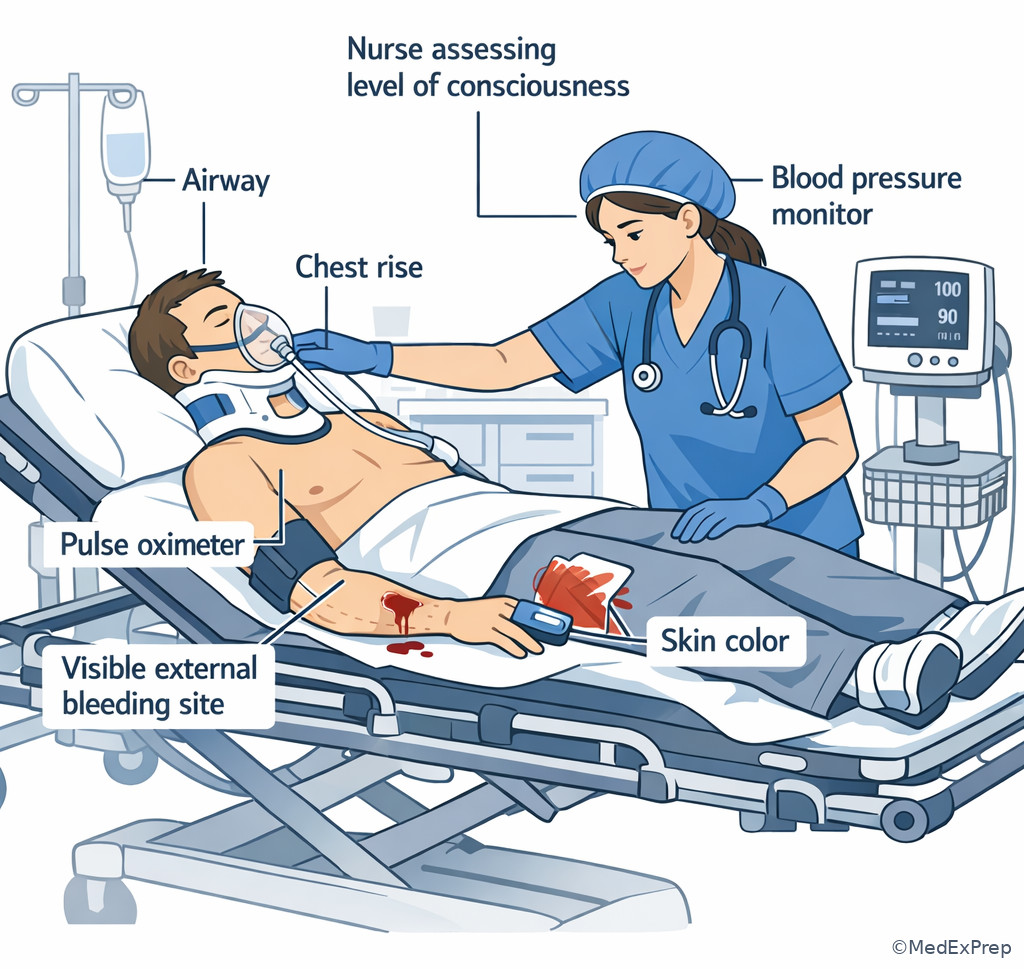
Core content
1.1.1.3 Foundational decision sequence: identify the task, then rank the threat
A Explanation
Most trauma exam errors begin before any clinical reasoning starts: the learner answers the wrong question. On TCRN stems, first identify the task. Are you being asked for the first nursing action, the priority finding, the best reassessment target, or the time to escalate? Once the task is clear, rank the threat using ABCs plus immediate hemorrhage control. The decision conflict is usually this: Do I respond to the obvious injury or the life-threatening physiology? The single rule that resolves it is simple: choose the finding that most threatens oxygenation, ventilation, perfusion, or neurologic survival right now.
WHY THIS IS TESTED: exam writers load stems with visible but lower-priority findings such as open fractures, facial lacerations, or pain complaints while burying the actual discriminator in mental status, work of breathing, skin perfusion, or a vital-sign trend.
Use a five-step internal script: identify the task, extract key facts, apply the governing trauma principle, choose the safest in-scope nursing action, and verify with reassessment. The key word is in-scope. If an option asks the RN to independently decide an operative plan, diagnose definitively, or perform provider-only invasive management as a routine assumption, it is usually a distractor. Your tested role is to recognize instability, intervene within protocol, prepare for next steps, communicate clearly, and reassess response.
B Worked example
A 31-year-old man arrives after a motorcycle crash. He has type 1 diabetes and hypertension. He is shouting that his right leg hurts and has an obvious open tib-fib deformity with moderate bleeding controlled by EMS dressing. He smells of alcohol. Vital signs are BP 122/78, HR 126, RR 30, SpO2 89% on room air. He is restless, answers in short phrases, and has asymmetric chest rise. The stem asks for the most appropriate initial nursing action.
Reasoning chain: Identify task: initial nursing action. Extract key facts: hypoxemia, tachypnea, restlessness, asymmetric chest rise, major mechanism. Apply rule: breathing threat outranks extremity injury. Eliminate distractors: splinting the leg is real care but wrong priority; checking glucose is tempting because of diabetes but irrelevant now; completing secondary survey is too slow. Verify: support oxygenation/ventilation, continue reassessment, and prepare for immediate team intervention. The leg is important, but the chest finding is the discriminator.
C Exam trap
D Checkpoint
Question: A trauma patient arrives after a fall from a roof. He has a visibly angulated forearm, HR 118, RR 28, SpO2 90% on room air, and increasing agitation. Which action is the most appropriate next step?
- A. Apply a splint to the forearm - Tempting because fracture stabilization reduces pain and further tissue injury, but it is wrong because hypoxemia and agitation suggest a higher-priority breathing issue.
- B. Begin oxygen support and reassess breathing - Tempting because it directly addresses the abnormal oxygenation data, and it is correct because ABC priorities place breathing before extremity care.
- C. Document the mechanism and visible deformity - Tempting because mechanism matters in trauma, but it is wrong because documentation never precedes stabilization.
- D. Obtain a detailed pain history - Tempting because pain can guide injury assessment, but it is wrong because the patient has physiologic instability that requires immediate intervention first.
1.1.1.4 Scope, priority, and the difference between nursing action and definitive management
A Explanation
A second major exam conflict is this: Should the RN choose the final treatment, or choose the safest nursing response that moves the patient toward definitive care? On TCRN items, the right answer usually stays within nursing scope. That means you identify deterioration, support ABCs, initiate approved protocols, prepare for procedures, administer ordered therapies per policy, monitor the response, and escalate clearly. You do not independently decide the operative procedure, write orders, or delay stabilization while waiting for provider-level confirmation.
WHY THIS IS TESTED: trauma care is team-based, and board questions distinguish nurses who recognize when to act independently within protocol versus when to escalate and prepare rather than overstep scope.
The single rule that resolves many close calls is: if the stem drifts toward provider-only definitive management, convert it into the RN role: recognize, stabilize, notify, prepare, and monitor. For example, a nurse may recognize worsening tension physiology, apply oxygen, closely monitor, call for immediate provider/team response, and prepare for emergent intervention. The nurse is not expected to independently choose or perform the definitive invasive procedure unless the question explicitly states an advanced RN role under local policy.
B Worked example
A 67-year-old woman is brought in after a high-speed MVC. She has COPD and atrial fibrillation on anticoagulation. She is anxious, tachycardic, and increasingly dyspneic with absent breath sounds on one side and jugular venous distention. A distracting detail in the stem is a large scalp laceration with brisk oozing now controlled by pressure. The question asks which action by the nurse is most appropriate.
Reasoning chain: Identify task: best nursing action. Extract key facts: worsening dyspnea, unilateral absent breath sounds, JVD, major trauma. Apply rule: probable life-threatening thoracic process requiring immediate escalation and preparation; do not choose provider-only definitive management as the RN's independent endpoint. Eliminate distractors: requesting extra laceration supplies is real but lower priority; waiting for a chest x-ray delays stabilization; choosing an invasive decompression procedure independently exceeds routine RN scope. Verify: provide high-flow oxygen per protocol, call/activate immediate trauma response, prepare equipment, monitor status, and reassess.
C Exam trap
D Checkpoint
Question: A patient with blunt chest trauma becomes more dyspneic, pale, and restless. The best answer choice should most likely involve which RN response pattern?
- A. Independently selecting the definitive thoracic procedure - Tempting because it targets the likely cause, but it is wrong because it moves beyond routine RN scope.
- B. Providing oxygen, activating the appropriate response, preparing equipment, and reassessing - Tempting because it feels less definitive, and it is correct because it matches trauma RN responsibilities under ABC priority.
- C. Waiting for complete diagnostic confirmation before acting - Tempting because it avoids acting on incomplete data, but it is wrong because trauma care treats life threats as they are recognized.
- D. Focusing first on pain control documentation - Tempting because pain is significant in chest trauma, but it is wrong because respiratory compromise takes priority.
- The first job in a trauma stem is to identify the task.
- True or False: A normal blood pressure excludes early hemorrhagic shock. False.
- Name the five TEAR-V steps: Task, Extract, Apply, Respond, Verify.
1.1.1.5 Trend interpretation: when one abnormal value matters less than the direction of change
A Explanation
Foundational trauma reasoning becomes reliable only when you stop treating numbers as isolated facts. The real decision conflict is this: Do I respond to a single mildly abnormal value, or do I escalate because the trend shows deterioration? The single rule that resolves it is: when sequential findings show worsening oxygenation, perfusion, neurologic status, or work of breathing, the trend outranks a less alarming one-time measurement.
WHY THIS IS TESTED: trauma stems often present compensated shock or evolving respiratory failure early, before full collapse. The learner who waits for dramatic hypotension or arrest misses the tested clue.
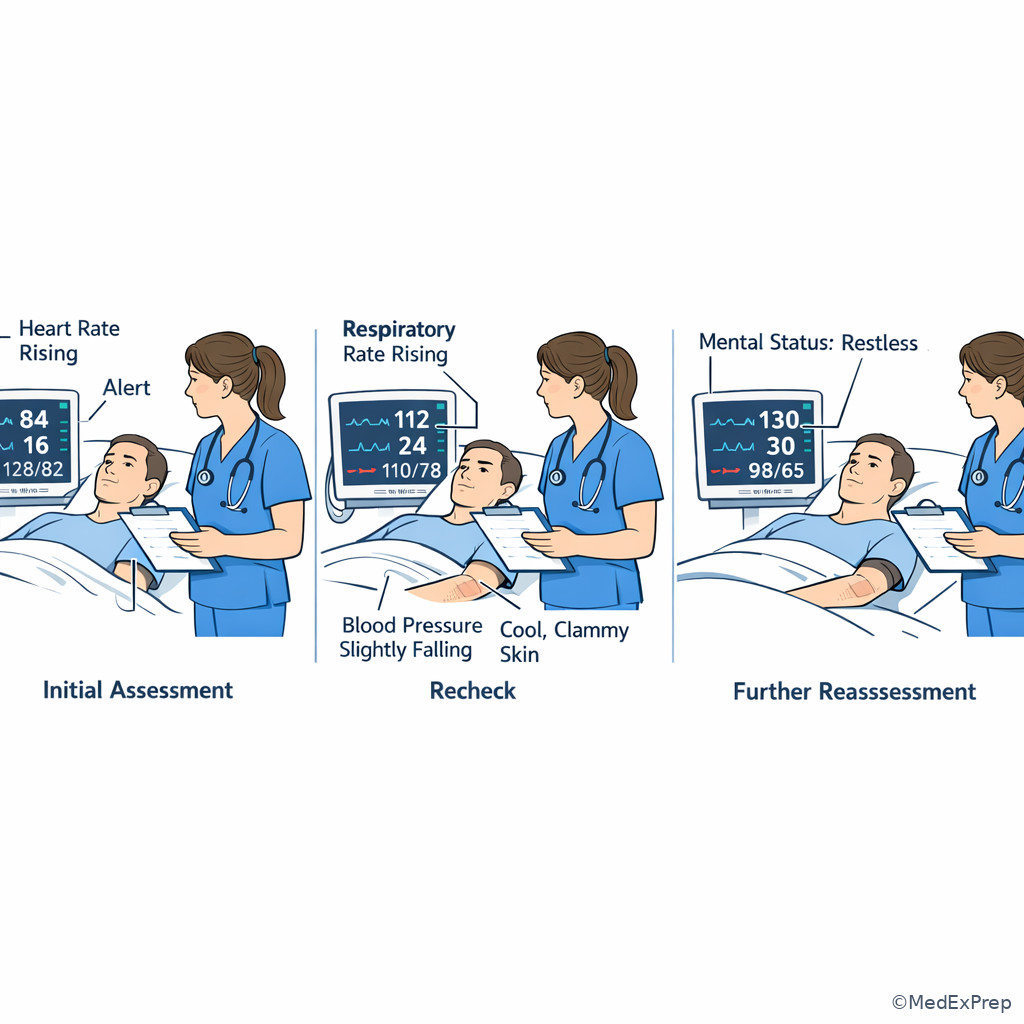
High-yield trends include rising heart rate with narrowing pulse pressure, increasing respiratory effort despite oxygen support, new confusion or restlessness, falling urine output when provided, progressive cool clammy skin, and a patient who “looks worse” despite numbers that seem only mildly off. Trend recognition should trigger earlier reassessment and escalation. Board questions frequently use a distracting stable number such as a near-normal systolic BP to pull you away from the deteriorating pattern.
For the TCRN exam, do not overcomplicate trend analysis. Ask three questions: Is the patient breathing harder? Perfusing worse? Thinking less clearly? If yes to any of these over time, act sooner.
Exam takeaway: Escalate on worsening perfusion and mental status trends before profound hypotension appears.
flowchart TD
A[Initial trauma arrival] --> B[HR rising and RR rising]
B --> C[Cool skin and anxiety/restlessness]
C --> D[Normal or borderline BP may persist]
D --> E[Perfusion worsens and mentation declines]
E --> F[Late hypotension and decompensation]
See Fig 2 for the common exam pattern in which trend recognition should trigger action before late hypotension appears.
B Worked example
A 44-year-old construction worker falls 12 feet. He has obesity and chronic kidney disease. On arrival he is alert, BP 118/76, HR 104, RR 22, SpO2 95% on nasal cannula, skin slightly cool. Fifteen minutes later he is more restless, BP 110/72, HR 124, RR 28, SpO2 94%, and now complains of worsening abdominal pressure. A distracting clue is a superficial scalp abrasion. The question asks what finding should most concern the nurse.
Reasoning chain: Identify task: priority finding. Extract key facts: rising HR, rising RR, worsening restlessness, subtle BP decline, possible occult torso injury. Apply rule: trend toward shock matters more than the still-not-hypotensive pressure. Eliminate distractors: the scalp abrasion is visible but minor; stable oxygen saturation alone does not reassure; pain alone is nonspecific. Verify: prioritize reassessment of perfusion and rapid escalation for possible occult hemorrhage.
C Exam trap
D Checkpoint
Question: Which trend most strongly supports early deterioration in a trauma patient?
- A. HR 96 to 118 with increasing restlessness and cooler skin - Tempting because each change alone might seem minor, and it is correct because the combined trend suggests worsening perfusion.
- B. Pain score 6 to 8 with unchanged vitals and mentation - Tempting because pain matters, but it is wrong because it does not signal the same immediate physiologic decline.
- C. Visible bruising enlarging slightly without respiratory or hemodynamic change - Tempting because bruising may imply internal injury, but it is wrong because the stem asks for the strongest evidence of current deterioration.
- D. Systolic BP remaining 124 with stable pulse and respiration - Tempting because stability is reassuring, but it is wrong because it does not indicate decline.
1.1.1.6 Pattern recognition under noise: visible injury versus occult life threat
A Explanation
Now move from foundational rules to application. Trauma stems are intentionally noisy. You may see intoxication, chronic disease, distracting wounds, family statements, or minor lab details. The decision conflict is this: Which detail actually changes priority? The single rule is to privilege findings that map directly to ABC compromise, hemorrhage, or neuro decline. Mechanism matters, but only as it raises suspicion for hidden injury; it does not outrank current instability.
WHY THIS IS TESTED: exams simulate real trauma environments, where loud clues are often less important than subtle ones. A screaming patient may still have a patent airway; a quiet drowsy patient may be far more dangerous.
Useful filters for noise: first, ask whether the detail affects airway, breathing, circulation, disability, or exposure decision-making now. Second, ask whether the detail changes urgency. Third, ask whether it is a tempting-but-lower-priority task like pain treatment, splinting, photography, transport paperwork, or full history. If not, set it aside. This is not ignoring information; it is sequencing information.
Exam takeaway: In trauma stems, noisy visible injuries should not distract from breathing, perfusion, or neurologic red flags.
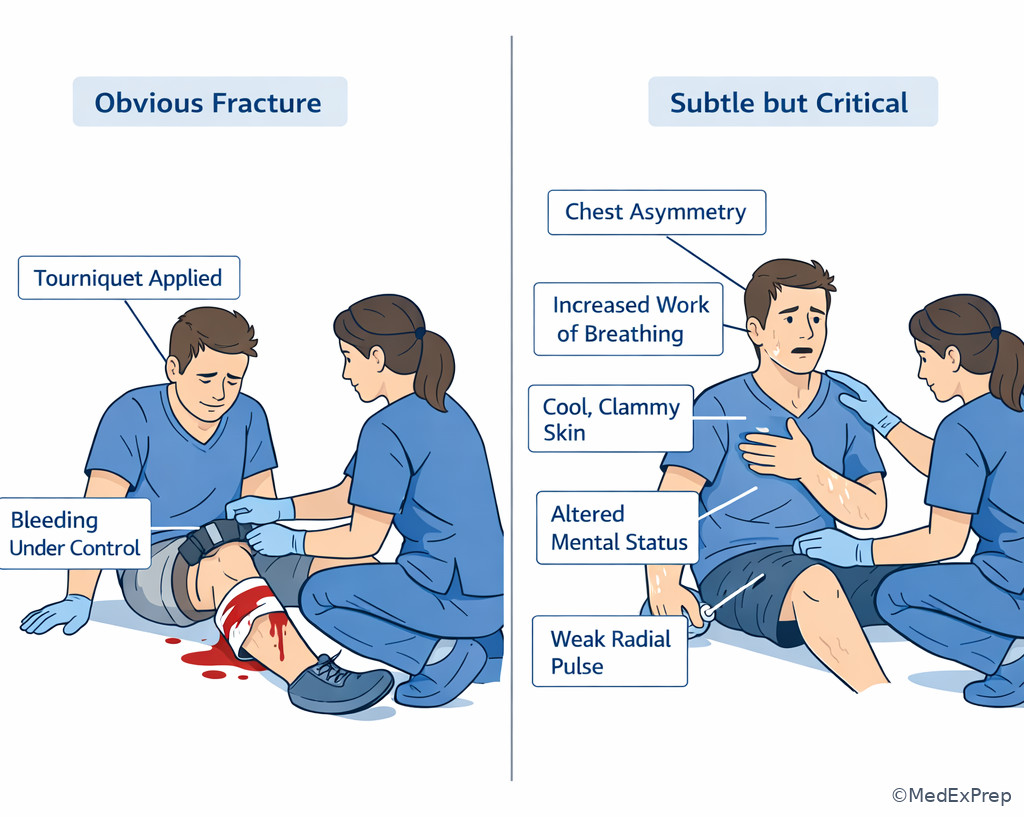
See Fig 3 for the exam habit you want: do not let a dramatic external injury eclipse subtler but more lethal physiologic clues.
B Worked example
A 22-year-old unrestrained passenger is brought after a rollover crash. She has asthma and anxiety. She is crying, repeatedly asking for her phone, and has a deformed left wrist. Her BP is 108/70, HR 132, RR 26, skin cool, and abdomen firm with increasing tenderness. A distracting detail is that she is speaking loudly and appears emotionally upset. The stem asks for the nurse's priority concern.
Reasoning chain: Identify task: priority concern. Extract key facts: tachycardia, cool skin, firm tender abdomen, rollover mechanism. Apply rule: occult internal hemorrhage risk outweighs visible wrist injury and emotional behavior. Eliminate distractors: anxiety can cause tachycardia but does not explain the abdominal findings; the wrist fracture is painful but lower priority; phone requests are noise. Verify: rapid reassessment, circulation focus, team notification, and preparation for escalating care.
C Exam trap
D Checkpoint
Question: A trauma patient is loud, crying, and has a deformed ankle. Which additional finding should most shift the nurse away from the visible extremity injury?
- A. Complaint of severe ankle pain - Tempting because pain is prominent, but it is wrong because it still centers on the lower-priority visible injury.
- B. Cool clammy skin and increasing abdominal distention - Tempting because it may reflect hidden injury, and it is correct because it suggests a circulation threat.
- C. Request for family at bedside - Tempting because psychosocial support matters, but it is wrong because it does not direct immediate trauma priority.
- D. Superficial abrasions over the shoulder - Tempting because they add mechanism clues, but they are wrong because they do not outweigh internal hemorrhage signs.
- The most dangerous trauma clue is the one that signals immediate ABC compromise or hemorrhage.
- True or False: A patient who can speak loudly has no trauma emergency. False.
- Name three common noise items: visible deformity, emotional distress, and minor superficial wounds.
1.1.1.7 Integration: the RN action package for first-pass trauma decisions
A Explanation
At integration level, do not think of the “correct answer” as one isolated move. Think in action packages. The decision conflict is this: Which action package best matches the patient's immediate risk? The single rule is to choose the answer that links assessment, immediate intervention, reassessment, and escalation in the correct priority order.
WHY THIS IS TESTED: many options on trauma exams are technically correct, but only one reflects full nursing judgment in the right sequence.
For example, in a deteriorating trauma patient, “obtain another full history” is not wrong forever; it is wrong now. “Apply oxygen and continue monitoring” may be partly right, but if the stem shows worsening instability, the stronger answer adds team activation or urgent notification. Likewise, “call the provider” alone may be incomplete if the nurse has not started immediate in-scope stabilization. The best answer often sounds like this: support ABCs, control obvious bleeding, monitor closely, activate or notify the appropriate team, prepare needed equipment, and reassess continuously.
When options are close, prefer the one that is actionable, immediate, and reversible. Board-style items reward nurses who start the highest-priority intervention without delay and continue the cycle of reassessment. See Fig 1 again as the decision loop that turns isolated facts into an RN action package.
Exam takeaway: The strongest answer usually combines priority assessment, immediate nursing intervention, reassessment, and escalation.
flowchart TD
A[Abnormal trauma finding] --> B{Immediate threat?}
B -->|Yes| C[Start in-scope stabilization]
C --> D[Notify or activate team]
D --> E[Prepare equipment or therapies]
E --> F[Reassess response]
B -->|No| G[Continue focused assessment and monitoring]
See Fig 4 for the packaging idea: the strongest answer is usually not a lone task but a sequence anchored to threat level.
B Worked example
A 58-year-old man with coronary artery disease and obesity arrives after being pinned briefly under farm equipment. He has bruising across the chest, increasing work of breathing, HR 122, BP 98/64, SpO2 91% despite oxygen, and is now less responsive than on arrival. A distracting clue is a complaint of severe right shoulder pain. The question asks for the best initial nursing action.
Reasoning chain: Identify task: best initial action. Extract key facts: worsening breathing, borderline hypotension, declining mentation, chest mechanism. Apply rule: choose an action package centered on ABC stabilization and escalation, not pain treatment or isolated monitoring. Eliminate distractors: obtaining a complete medication history is useful but delayed; documenting shoulder pain is nonurgent; waiting for the next full set of vitals wastes time. Verify: immediate breathing support within protocol, urgent trauma team/provider escalation, preparation for advanced interventions, continuous reassessment.
C Exam trap
D Checkpoint
Question: Which option best reflects a complete RN trauma action package for a patient with worsening respiratory distress after blunt trauma?
- A. Recheck vital signs in 15 minutes - Tempting because reassessment matters, but it is wrong because it omits immediate stabilization and escalation.
- B. Administer ordered analgesia and reassess pain - Tempting because pain can worsen breathing, but it is wrong because analgesia is not the first priority when respiratory compromise is progressing.
- C. Support oxygenation, activate or notify the team, prepare needed equipment, and reassess response - Tempting because it seems broad, and it is correct because it matches RN trauma priorities and sequencing.
- D. Complete the secondary survey before changing the plan - Tempting because thoroughness feels safe, but it is wrong because life threats are treated as found.
Exam Traps & Differentiators
- Most common wrong answer and why: treating the most visible injury first. This is tempting because it feels concrete and urgent, but trauma prioritization follows physiologic threat, not visual drama.
- Second common wrong answer: waiting for complete confirmation. This is tempting because it appears careful, but trauma nursing treats life threats as they are recognized and escalates early.
- Third common wrong answer: choosing provider-only definitive management. This is tempting because it shows you recognized the diagnosis pattern, but the TCRN tests the RN action pathway.
| Looks similar | Actually different because | What the RN should prioritize |
|---|---|---|
| Obvious fracture vs occult internal bleeding | Visible injury may be less urgent than subtle perfusion decline | Trend perfusion, control life threats, escalate |
| Anxiety vs early shock | Both may cause tachycardia, but cool skin, worsening mentation, and mechanism favor shock | Reassess circulation and notify promptly |
| Pain-related tachypnea vs respiratory compromise | Work of breathing, chest asymmetry, and oxygenation changes indicate higher threat | Support breathing first |
| Monitoring vs intervention | Monitoring alone is insufficient when deterioration is active | Intervene and monitor together |
| RN escalation vs RN definitive management | One is within scope; the other is provider-level | Stabilize, prepare, communicate, reassess |
| If the stem says... | Think... |
|---|---|
| Restless, cool, tachycardic, major mechanism | Early perfusion problem even before marked hypotension |
| Asymmetric chest rise or increasing work of breathing | Breathing problem outranks distal extremity injury |
| Worsening mentation after trauma | Immediate reassessment and escalation |
| Option asks nurse to choose surgery/procedure independently | Likely out-of-scope distractor |
| Obvious wound plus subtle abdominal/chest findings | Prioritize hidden torso injury risk |
| All options are reasonable nursing actions | Choose the one highest on ABCs and closest to now |
Exam takeaway: Reject options that are correct eventually but wrong in priority, timing, or RN scope.
flowchart LR
A[Option in stem] --> B{Addresses top threat now?}
B -->|No| C[Reject: lower priority]
B -->|Yes| D{Within RN scope?}
D -->|No| E[Reject: provider-level distractor]
D -->|Yes| F{Includes reassessment or escalation when needed?}
F -->|No| G[Weak answer]
F -->|Yes| H[Best answer]
See Fig 5 when two choices both sound helpful; the best answer must fit timing, priority, and RN scope simultaneously.
Exam takeaway: Rank findings by immediate threat to airway, breathing, circulation, and neurologic status rather than by how dramatic they appear.
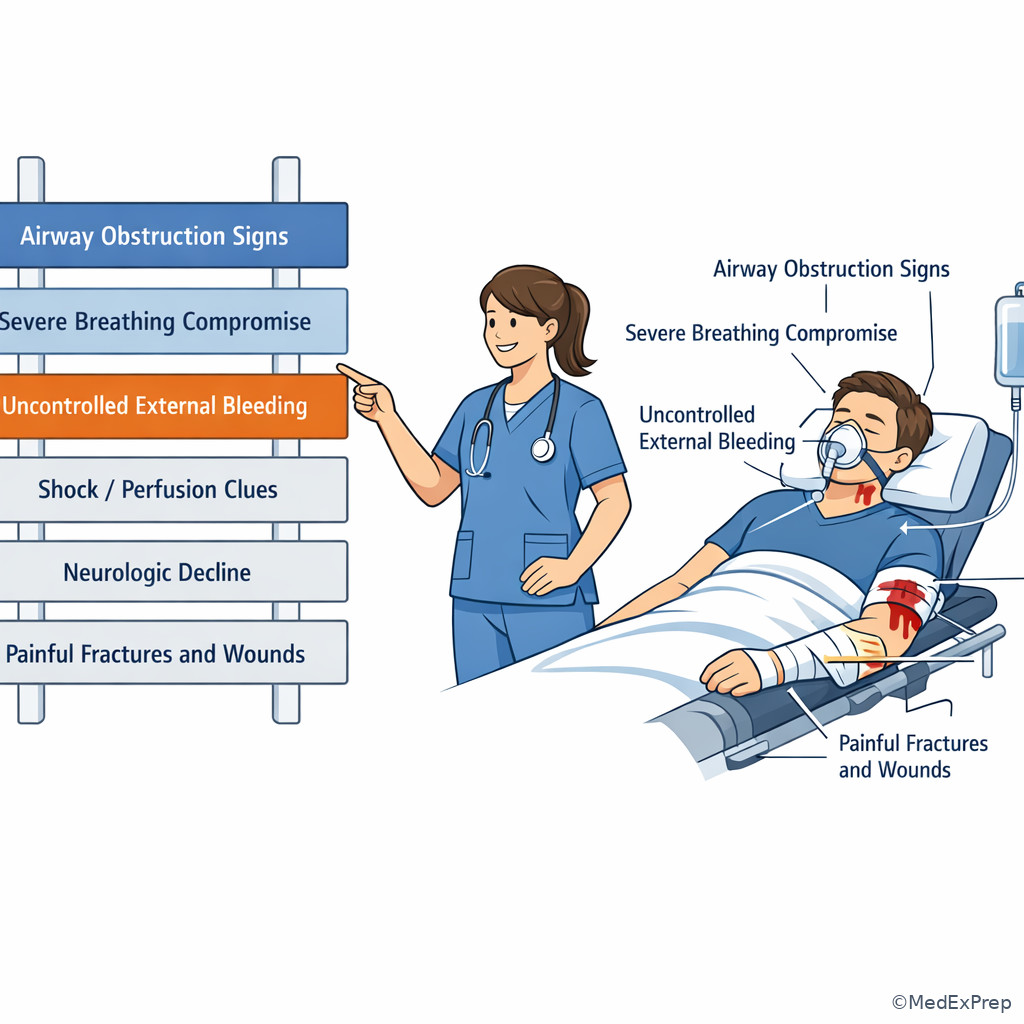
Algorithm / Approach
| Decision point | Choose | Reject |
|---|---|---|
| Obvious injury plus hypoxemia | Breathing support first | Splinting first |
| Tachycardia plus cool skin plus restlessness | Possible early shock pathway | Reassure because BP is normal |
| Worsening distress and provider-level option listed | Escalate and prepare | Independently choose definitive procedure |
| All options are true tasks | The one highest in ABC priority and closest to now | The one that is eventually useful |
| Subtle decline over serial checks | Act on trend | Wait for dramatic collapse |
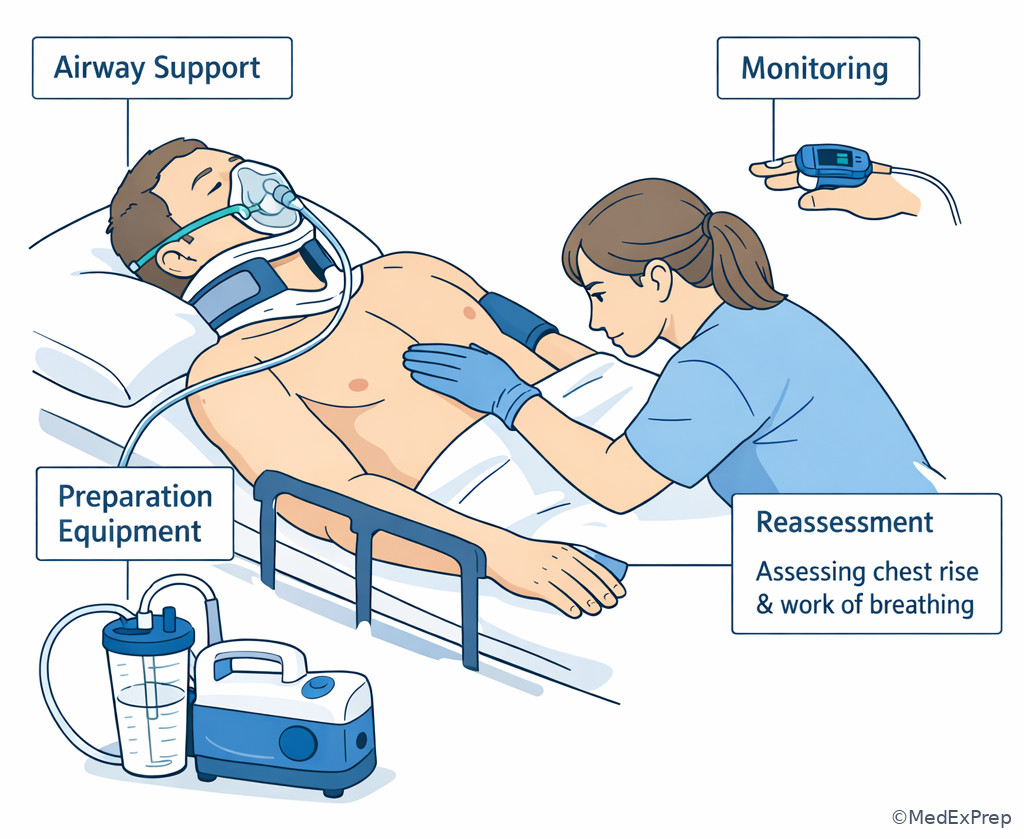
Exam takeaway: When deterioration is recognized, the RN stabilizes within scope, communicates clearly, prepares equipment, and reassesses continuously.
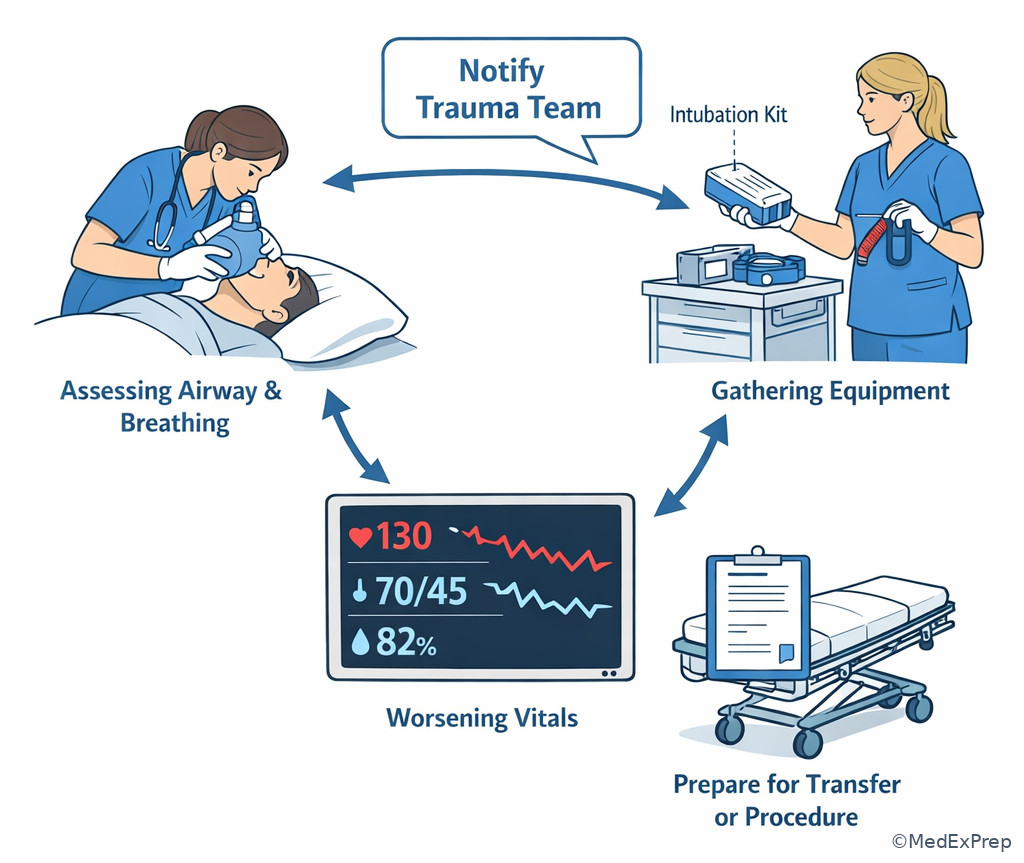
See Fig 6 for the RN-centered workflow expected on exam questions that approach provider-level management decisions.
Exam takeaway: Serial changes in heart rate, respiratory effort, skin perfusion, and mentation should prompt earlier action than a single near-normal blood pressure.
Exam takeaway: Early supportive nursing measures often precede definitive treatment and are frequently the best next step on exam stems.
Rapid Review
- Task wording -> answer the question being asked before solving the clinical problem.
- Visible fracture -> lower priority than hypoxemia, asymmetrical chest rise, or worsening perfusion.
- Normal BP -> does not exclude compensated shock.
- Restlessness -> often earlier than overt hypotension in deterioration.
- Provider-level option -> usually convert to stabilize, notify, prepare, reassess.
- Monitoring alone -> insufficient when the stem shows active decline.
- Mechanism -> raises suspicion; current physiology sets priority.
- Pain intervention -> correct eventually, but not before ABC threats are addressed.
- Trend -> beats isolated values when deciding urgency.
- Speaking patient -> airway may be patent, but breathing or perfusion can still be failing.
- Quiet patient after trauma -> may be more dangerous than the loud patient.
- Best answer -> highest-priority in-scope action plus reassessment and escalation when needed.
Self-check quiz
1. A trauma patient arrives after a fall. He has a deformity of the left wrist, HR 110, RR 30, SpO2 88% on room air, and increasing agitation. Which nursing action is most appropriate next?
- A. Splint the wrist
- B. Begin oxygen support and reassess breathing
- C. Obtain a pain score and medication history
- D. Complete the secondary survey
2. A patient after blunt abdominal trauma has BP 116/74, HR 126, cool clammy skin, and new restlessness. Which finding should most concern the nurse?
- A. Blood pressure still above 110 systolic
- B. Cool skin with tachycardia and restlessness
- C. Complaint of abdominal pain rated 8/10
- D. Presence of superficial abrasions
3. A 72-year-old woman with COPD and atrial fibrillation on apixaban arrives after an MVC. She has a chest wall bruise, increasing dyspnea, unilateral decreased breath sounds, HR 128, BP 94/60, and SpO2 90% on nonrebreather. A scalp laceration is oozing under a dressing. Which nursing action is most appropriate?
- A. Continue documenting the scalp wound while awaiting imaging
- B. Provide ongoing oxygen support, activate the trauma response, prepare for urgent intervention, and reassess
- C. Independently select the definitive thoracic procedure
- D. Give the ordered analgesic first to reduce dyspnea from pain
4. A 29-year-old man with obesity and asthma is brought after a rollover crash. He is anxious and shouting, has an open ankle fracture with bleeding controlled by a tourniquet placed prehospital, BP 108/68, HR 134, cool skin, and a firm distending abdomen. Which is the best initial nursing priority?
- A. Remove the tourniquet to evaluate the wound more completely
- B. Prioritize circulation reassessment and immediate escalation for possible occult hemorrhage
- C. Ask detailed questions about the last tetanus shot
- D. Reassure the patient that tachycardia is likely anxiety-related
5. A trauma patient who initially answered questions appropriately becomes quieter over 10 minutes, with HR rising from 98 to 122 and RR from 20 to 28. BP changes from 124/80 to 112/74. Which action best reflects trauma nursing judgment?
- A. Wait for systolic BP to fall below 90 before escalating concern
- B. Repeat a complete pain assessment before notifying the team
- C. Treat the trend as deterioration, reassess perfusion and breathing, and notify the provider or trauma team
- D. Focus on the earlier normal blood pressure as the most reliable indicator
6. A 54-year-old man with diabetes and coronary artery disease arrives after a crush injury. He is pale, increasingly confused, RR 32, SpO2 89% despite oxygen, BP 92/58, and has a painful deformed leg. Which response requires the strongest RN prioritization?
- A. Prepare to splint the leg before anything else
- B. Support breathing, perform focused reassessment, activate urgent team response, and prepare equipment
- C. Obtain a detailed history of home medications first
- D. Delay action until the definitive diagnosis is documented
7. A 36-year-old pregnant trauma patient at 24 weeks' gestation arrives after a high-speed collision. She is alert but becoming more restless, HR 124, RR 26, BP 104/66, and has mild vaginal spotting plus left chest tenderness. The provider is not yet at bedside. Which action is most appropriate for the RN?
- A. Independently determine whether the patient should go directly to the operating room
- B. Maintain trauma priorities, support oxygenation and perfusion, notify the trauma team immediately, and continue serial reassessment
- C. Delay intervention until fetal monitoring is set up because pregnancy changes priorities completely
- D. Focus first on collecting a complete obstetric history before changing care
8. A 68-year-old man on a beta-blocker arrives after a fall down stairs. He has multiple rib fractures, SpO2 92% on oxygen, RR 30 with increasing effort, BP 100/64, skin cool, and is less interactive than on arrival. HR is only 88. Which interpretation best supports the nurse's next step?
- A. A heart rate below 100 rules out significant deterioration
- B. The nurse should focus on pain because the heart rate is not elevated
- C. Beta-blockade can blunt tachycardia, so worsening breathing effort, perfusion signs, and mentation still require urgent escalation
- D. Wait for oxygen saturation to fall below 88% before acting
Answer key
1. Correct answer: B
- A. Splint the wrist - Tempting because fracture stabilization is a real nursing intervention and reduces pain and further injury. Incorrect because ABCs take priority; the discriminating clue is SpO2 88% with agitation and tachypnea, indicating a breathing problem. Priority principle: breathing before musculoskeletal care. Sources: NCSBN clinical judgment principles; Lewis, Medical-Surgical Nursing.
- B. Begin oxygen support and reassess breathing - Tempting because it directly addresses the current abnormal physiology. Correct because the stem asks for the most appropriate next step and hypoxemia plus tachypnea outrank wrist care. Single clue: low oxygen saturation with increasing agitation. Priority principle: ABCs. Sources: NCSBN; Lewis.
- C. Obtain a pain score and medication history - Tempting because pain management and history are standard nursing tasks. Incorrect because they are lower priority while the patient is hypoxemic. Single clue: active respiratory compromise. Priority principle: physiologic stability before history. Sources: ANA Standards of Practice; NCSBN.
- D. Complete the secondary survey - Tempting because trauma care requires a full assessment. Incorrect because life threats are treated as found during the primary survey. Single clue: current breathing issue. Sources: Lewis; Saunders Comprehensive Review for the NCLEX-RN.
2. Correct answer: B
- A. Blood pressure still above 110 systolic - Tempting because many learners anchor on hypotension as the marker of shock. Incorrect because a preserved systolic pressure does not exclude compensated shock. Single clue: tachycardia plus cool clammy skin and restlessness. Priority principle: trend and perfusion over one number. Sources: Lewis; Saunders.
- B. Cool skin with tachycardia and restlessness - Tempting because it signals subtle but meaningful change. Correct because these combined findings suggest worsening perfusion in trauma. Single clue: sympathetic compensation with altered behavior. Priority principle: early shock recognition. Sources: NCSBN; Lewis.
- C. Complaint of abdominal pain rated 8/10 - Tempting because abdominal pain can signal internal injury. Incorrect because pain alone is less discriminating than perfusion findings. Single clue: cool skin/restlessness outrank pain score. Sources: ANA; Saunders.
- D. Presence of superficial abrasions - Tempting because abrasions reflect mechanism. Incorrect because they do not indicate physiologic deterioration. Single clue: superficial nature. Sources: Lewis.
3. Correct answer: B
- A. Continue documenting the scalp wound while awaiting imaging - Tempting because documentation and wound care are valid nursing tasks. Incorrect because worsening dyspnea, unilateral decreased breath sounds, hypotension, and hypoxemia indicate a more urgent thoracic emergency. Single clue: respiratory compromise with hemodynamic instability. Priority principle: ABCs over documentation. Sources: NCSBN; Lewis.
- B. Provide ongoing oxygen support, activate the trauma response, prepare for urgent intervention, and reassess - Tempting because it sounds broad and practical. Correct because it combines immediate stabilization, escalation, and preparation within RN scope. Single clue: the patient is unstable and likely needs urgent provider intervention. Priority principle: assess-intervene-reassess-escalate. Sources: ANA; Lewis.
- C. Independently select the definitive thoracic procedure - Tempting because the learner may correctly recognize the thoracic emergency. Incorrect because the question tests RN action, not provider-level procedure choice. Single clue: nursing-scope framing. Sources: ANA Standards of Practice; NCSBN.
- D. Give the ordered analgesic first to reduce dyspnea from pain - Tempting because pain can worsen respiratory effort and analgesia is a real nursing intervention. Incorrect because it does not address the immediate life threat first. Single clue: hypoxemia and unilateral breath sound loss. Sources: Saunders; Lewis.
4. Correct answer: B
- A. Remove the tourniquet to evaluate the wound more completely - Tempting because wound reassessment sounds thorough. Incorrect because removing effective hemorrhage control without a priority reason is unsafe, and the stem points more strongly to occult torso hemorrhage. Single clue: firm distending abdomen with cool skin and tachycardia. Priority principle: do not disrupt effective hemorrhage control; address circulation threat. Sources: Lewis; NCSBN.
- B. Prioritize circulation reassessment and immediate escalation for possible occult hemorrhage - Tempting because the visible fracture might distract from this choice. Correct because the abdomen and perfusion signs indicate a higher-priority hidden threat. Single clue: distending abdomen plus cool skin. Priority principle: circulation before extremity detail work. Sources: Lewis; Saunders.
- C. Ask detailed questions about the last tetanus shot - Tempting because open fractures need follow-up care. Incorrect because preventive history is lower priority during instability. Single clue: current perfusion concern. Sources: ANA; Saunders.
- D. Reassure the patient that tachycardia is likely anxiety-related - Tempting because the patient is shouting and appears anxious. Incorrect because anxiety does not explain the abdominal findings and cool skin. Single clue: firm distending abdomen. Priority principle: never attribute physiologic signs to emotion alone in trauma. Sources: Lewis.
5. Correct answer: C
- A. Wait for systolic BP to fall below 90 before escalating concern - Tempting because severe hypotension is clearly abnormal. Incorrect because trauma deterioration often appears before late hypotension. Single clue: rising HR/RR with reduced interaction. Priority principle: act on trends, not collapse. Sources: Lewis; NCSBN.
- B. Repeat a complete pain assessment before notifying the team - Tempting because reassessment is part of nursing care. Incorrect because the trend suggests worsening physiology and requires higher-priority action. Single clue: quieter mental status with worsening vital signs. Sources: ANA; Saunders.
- C. Treat the trend as deterioration, reassess perfusion and breathing, and notify the provider or trauma team - Tempting because it responds to serial change rather than a single threshold. Correct because trend deterioration is the discriminator. Single clue: progressive decline over 10 minutes. Priority principle: early recognition and escalation. Sources: NCSBN; Lewis.
- D. Focus on the earlier normal blood pressure as the most reliable indicator - Tempting because the earlier value was reassuring. Incorrect because older stable data are less important than current worsening findings. Single clue: present deterioration. Sources: Saunders; Lewis.
6. Correct answer: B
- A. Prepare to splint the leg before anything else - Tempting because the leg is painful and deformed, and splinting is appropriate care. Incorrect because hypoxemia, hypotension, confusion, and tachypnea indicate more urgent ABC compromise. Single clue: SpO2 89% and confusion. Priority principle: life threat before limb threat. Sources: NCSBN; Lewis.
- B. Support breathing, perform focused reassessment, activate urgent team response, and prepare equipment - Tempting because it feels more global than a single task. Correct because it matches the RN action package for an unstable patient. Single clue: multiple worsening ABC findings. Priority principle: integrated stabilization and escalation. Sources: ANA; Lewis.
- C. Obtain a detailed history of home medications first - Tempting because diabetes and CAD increase risk and medications matter. Incorrect because history is secondary during active instability. Single clue: current abnormal oxygenation and perfusion. Sources: ANA; Saunders.
- D. Delay action until the definitive diagnosis is documented - Tempting because confirmation feels safe. Incorrect because delaying stabilization in trauma is unsafe and contrary to trauma priorities. Single clue: active decompensation. Sources: NCSBN; Lewis.
7. Correct answer: B
- A. Independently determine whether the patient should go directly to the operating room - Tempting because pregnancy plus trauma can feel exceptionally urgent. Incorrect because deciding operative disposition is provider-level management. Single clue: the question asks for the RN's action. Priority principle: scope of practice. Sources: ANA Standards of Practice; NCSBN.
- B. Maintain trauma priorities, support oxygenation and perfusion, notify the trauma team immediately, and continue serial reassessment - Tempting because it preserves both trauma and special population thinking. Correct because maternal stabilization remains the RN priority while escalation occurs immediately. Single clue: restlessness, tachycardia, and chest tenderness with trauma mechanism. Priority principle: ABCs and maternal stabilization first. Sources: Lewis; Saunders.
- C. Delay intervention until fetal monitoring is set up because pregnancy changes priorities completely - Tempting because fetal assessment matters. Incorrect because pregnancy modifies care but does not replace immediate trauma stabilization priorities. Single clue: maternal signs of possible deterioration. Sources: Lewis; NCSBN.
- D. Focus first on collecting a complete obstetric history before changing care - Tempting because obstetric details are relevant. Incorrect because history collection does not outrank current perfusion and respiratory assessment. Single clue: current instability pattern. Sources: ANA; Saunders.
8. Correct answer: C
- A. A heart rate below 100 rules out significant deterioration - Tempting because tachycardia is often a key clue to shock. Incorrect because beta-blockers can blunt that response, so other deterioration signs become more important. Single clue: beta-blocker use. Priority principle: interpret trends in context of comorbidity. Sources: Lewis; Saunders.
- B. The nurse should focus on pain because the heart rate is not elevated - Tempting because rib fractures are painful and pain management is appropriate. Incorrect because worsening work of breathing, cool skin, and reduced interaction suggest higher-priority instability. Single clue: increasing respiratory effort. Priority principle: breathing before pain. Sources: NCSBN; Lewis.
- C. Beta-blockade can blunt tachycardia, so worsening breathing effort, perfusion signs, and mentation still require urgent escalation - Tempting because it integrates medication effect with trauma assessment. Correct because it uses the discriminating stem detail to avoid a common false reassurance trap. Single clue: on a beta-blocker. Priority principle: contextual trend interpretation. Sources: Lewis; Saunders.
- D. Wait for oxygen saturation to fall below 88% before acting - Tempting because lower thresholds may seem more alarming. Incorrect because the patient is already showing respiratory and perfusion deterioration and should not wait for a worse number. Single clue: less interactive with increasing work of breathing now. Sources: ANA; NCSBN.
Keep going with the full TCRN Prep Course (TCRN)
You just studied the way members do, in the same lesson interface. Full access unlocks every lesson, the question bank and flashcards for a full year.
One payment · 1 year of access · No auto-renewal