1.1.1 - Gestational Dating Basics
Why it matters
- Incorrect dating changes the answer choice for prenatal screening, anatomy ultrasound timing, induction timing, and interpretation of fetal growth.
- Many NBME stems hide the real task: not “what test?” but “is the pregnancy dated well enough to interpret this test?”
- First-trimester ultrasound is one of the highest-yield tie-breakers in OB questions because it is the most accurate method for establishing gestational age.
- Dating errors can make a normal fetus appear growth-restricted, a term pregnancy appear preterm, or a post-term pregnancy seem falsely reassuring.
Key Terms & Must-Know Facts
1.1.1.1 Key terms
- Gestational age (GA): time from first day of the last menstrual period.
- Embryonic/fetal age: time from conception; about 2 weeks less than GA.
- Estimated due date (EDD): predicted date of delivery at 40 weeks GA.
- LMP: first day of last menstrual period.
- Naegele rule: \(EDD = LMP + 1 year\) − 3 months + 7 days.
- Crown-rump length (CRL): best first-trimester ultrasound dating measurement.
- First-trimester ultrasound: most accurate method for dating pregnancy.
- Suboptimally dated pregnancy: pregnancy without ultrasound confirmation or revision before 22 weeks.
- Term: 37 0/7 to 41 6/7 weeks.
- Early term: 37 0/7 to 38 6/7 weeks.
- Full term: 39 0/7 to 40 6/7 weeks.
- Late term: 41 0/7 to 41 6/7 weeks.
- Postterm: 42 0/7 weeks or more.
- Viability: institution-dependent threshold of possible neonatal survival; shelf reasoning usually focuses on viability-relevant management, not exact legal definitions.
1.1.1.2 Must-know facts
- Pregnancy duration is counted as 40 weeks from LMP, not from conception.
- First-trimester ultrasound outranks uncertain LMP for establishing EDD.
- The earlier the ultrasound, the more accurate the dating.
- CRL is the preferred sonographic measure for first-trimester dating.
- Second- and third-trimester ultrasounds are progressively less accurate for dating.
- Do not change the EDD repeatedly based on later scans suggesting “small” or “large” size.
- Accurate dating is required to interpret growth restriction, post-term pregnancy, and screening windows.
- Regular cycles and certain LMP make LMP-based dating more reliable, but ultrasound still governs when discrepancy exceeds accepted thresholds.
Core content
1.1.1.3 Foundational dating language: what exactly are you counting?
A Explanation
The first decision conflict is simple but heavily tested: Do you count pregnancy from conception or from the LMP? The shelf answer is from the first day of the last menstrual period. That means gestational age is about 2 weeks longer than actual embryonic age because ovulation and conception usually occur about 2 weeks after menses begins. When a question says a patient conceived 8 weeks ago, the estimated gestational age is roughly 10 weeks if cycles are regular.
WHY THIS IS TESTED: Many questions hide management timing inside terminology. If you confuse gestational age with fetal age, you will mis-time screening, anatomy scan, viability discussions, and induction thresholds.
The next choose-versus-reject issue is whether EDD is exact. Choose: EDD is an estimate used to anchor clinical decisions. Reject: EDD is a guaranteed delivery date. Only a minority of patients deliver exactly on the assigned EDD. The value of dating is not prediction of the exact day of delivery; it is safe alignment of testing and management to the correct stage of pregnancy. See Fig 1.
Key rule: For exam purposes, gestational age starts on day 1 of the LMP; conception usually occurs about 2 weeks later.
Exam takeaway: Distinguish LMP-based gestational age from conception-based fetal age before answering any timing question.
flowchart LR
A[LMP day 1] --> B[Gestational age clock starts]
B --> C[Ovulation/conception about 2 weeks later]
C --> D[Embryonic age about 2 weeks less than GA]
D --> E[EDD anchored at 40 weeks GA]
Memory anchor: LMP leads management — if a stem mentions conception, mentally add 2 to get the OB clock.
B Worked example
A 27-year-old G2P1 with hypothyroidism and migraine without aura presents for her first prenatal visit. She says she “conceived about 6 weeks ago” using an ovulation-tracking app. She also mentions a brief episode of spotting 3 weeks ago and worries she may now be “8 or 9 weeks pregnant.” Her cycles are usually 30 to 32 days. The task is to determine the most appropriate gestational age language for exam-style decision making.
Reasoning chain: Identify task: convert history to OB dating language. Extract key facts: conception estimate 6 weeks ago, regular but slightly long cycles, distracting spotting episode. Apply rule: OB uses gestational age from LMP, so conception at 6 weeks ago suggests about 8 weeks gestational age. Eliminate distractors: spotting does not redefine gestational age; cycle length matters for LMP reliability but does not change the fact that gestational age is counted from LMP. Verify: the best shelf-level answer is approximately 8 weeks gestation pending dating ultrasound if needed.
C Exam trap
Common wrong answer: “6 weeks gestation.” Why it is tempting: the stem hands you a conception estimate, and students treat it like the obstetric clock. Single clue that eliminates it: OB gestational age is counted from the first day of the LMP, not the day of conception.
D Checkpoint
A 24-year-old primigravid patient reports certain conception 9 weeks ago after a single donor insemination cycle. Which gestational age is most appropriate to use in standard obstetric timing language?
- 7 weeks — tempting because implantation timing can blur early dating, but wrong because gestational age is longer, not shorter, than conception age.
- 9 weeks — tempting because the conception date is known, but wrong because this gives fetal age rather than gestational age.
- 11 weeks — correct because gestational age is approximately 2 weeks greater than conception age in standard OB dating.
- 13 weeks — tempting because some students overcorrect by adding an entire menstrual cycle, but wrong because the offset is about 2 weeks.
Answer: C. 11 weeks.
Clinician Action: Diagnose the time reference first. Order early ultrasound if history is uncertain or management depends on precise dating. Treat dating as a safety anchor for the rest of prenatal care. Refer/Escalate to the supervising OB team when timing affects urgent decisions such as viability-related counseling or possible preterm delivery.
1.1.1.4 How to calculate the EDD: LMP, Naegele rule, and common calendar errors
A Explanation
The decision conflict here is: Should you calculate the due date directly from LMP or rely on vague memory of “9 months later”? Choose the explicit rule. With Naegele rule, \(EDD = LMP + 1 year\) − 3 months + 7 days. Equivalent mental math is often “add 7 days, subtract 3 months, add 1 year.” If the LMP is January 10, the EDD is October 17. If the LMP is November 2, the EDD is August 9 of the following year.
Choose-versus-reject framing matters when cycle regularity is poor. Choose LMP-based EDD if the patient has a reliable remembered LMP and regular cycles. Reject unquestioned LMP dating if the patient has irregular cycles, uncertain recall, recent hormonal contraception, postpartum lactational amenorrhea, or bleeding that may not represent a true period. In those settings, ultrasound becomes more important.
WHY THIS IS TESTED: Shelf questions often present an apparently arithmetic problem that is really a source-reliability problem. The calculation itself is easy; deciding whether to trust the input is the actual testable skill. See Fig 2.
Exam takeaway: Calculate the due date from a reliable LMP, but switch to ultrasound-based dating when the menstrual history is not trustworthy.
flowchart TD
A[Need EDD] --> B{LMP known and reliable?}
B -->|Yes| C[Use Naegele rule]
B -->|No or irregular cycles| D[Use ultrasound dating]
C --> E[Cross-check with early ultrasound]
D --> E
E --> F[Assign best obstetric EDD] B Worked example
A 32-year-old G3P2 with obesity and polycystic ovary syndrome presents for pregnancy confirmation. She says her LMP was February 18, but then adds that her cycles are “all over the place,” occurring every 35 to 60 days. She recently stopped combined oral contraceptives 3 months ago. A home pregnancy test was positive last week. The distracting clue is the exact LMP date, which may lure you into using Naegele rule without checking reliability.
Reasoning chain: Identify task: determine best dating approach, not just compute an EDD. Extract key facts: irregular cycles, recent hormonal contraception, uncertain ovulation timing, exact but unreliable LMP. Apply rule: LMP-based EDD is less trustworthy when cycles are irregular; ultrasound should establish dating. Eliminate distractors: PCOS and obesity increase irregularity but do not themselves determine gestational age; recent positive test does not by itself date the pregnancy. Verify: the next best step is to obtain an early ultrasound rather than commit to an LMP-only EDD.
C Exam trap
Common wrong answer: “Use the exact reported LMP to assign the due date.” Why it is tempting: the stem gives a clean date, which feels test-ready. Single clue that eliminates it: irregular cycles make ovulation timing unpredictable, reducing LMP reliability.
D Checkpoint
A patient with regular 28-day cycles reports the first day of her last menstrual period was April 6. What is the estimated due date by Naegele rule?
- January 6 — tempting because it keeps the day constant, but wrong because Naegele rule adds 7 days and subtracts 3 months.
- January 13 — correct because April 6 + 7 \(days = April 13\), minus 3 months = January 13.
- February 13 — tempting because some students add 40 weeks inaccurately by month blocks, but this shifts too far forward.
- December 30 — tempting because it approximates 9 calendar months, but wrong because the standard EDD method is more precise.
Answer: B. January 13.
- The usual duration of pregnancy in obstetric dating is 40 weeks from LMP.
- True or False: A precisely remembered LMP is always the best dating method. False.
- Name the preferred first-trimester ultrasound measurement for dating: crown-rump length.
Recall: This is the first topic in the course, so there is no prior content to revisit yet. As you move to Maternal Physiologic Changes, keep dating fixed first; “normal” labs and vitals in pregnancy only make sense when you know how far along the patient is.
Clinician Action: Diagnose whether the menstrual history is reliable before trusting the number you calculate. Order early ultrasound when cycles are irregular or dates are uncertain. Treat the assigned EDD as the reference point for all future prenatal timing. Refer/Escalate questions affecting invasive testing windows or time-sensitive management to the supervising OB team.
1.1.1.5 Choosing the best dating method: why first-trimester ultrasound wins
A Explanation
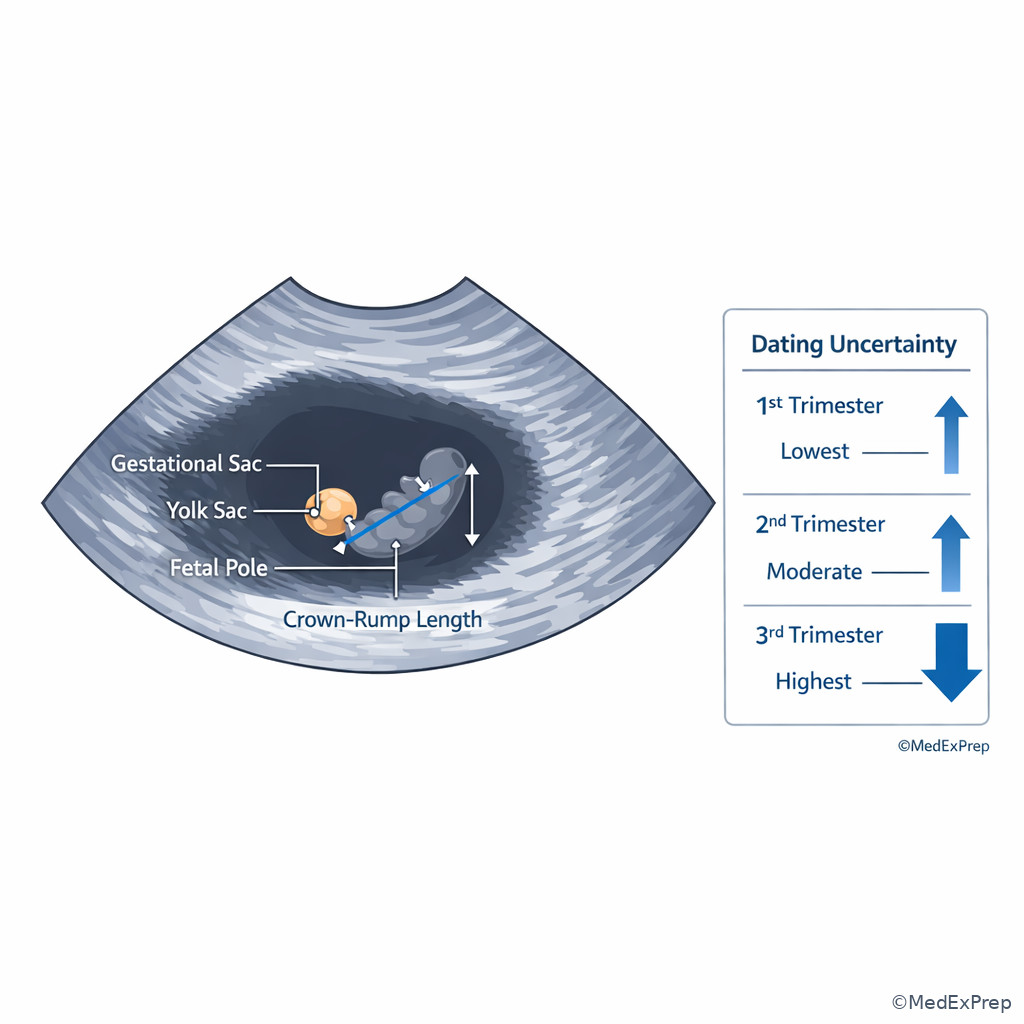
The central board-style conflict is: LMP says one gestational age, ultrasound says another — which one should you trust? The single resolving rule is that the earliest accurate ultrasound is the most reliable method for establishing gestational age, especially in the first trimester. First-trimester CRL dating has the least biologic variation because embryos grow at a relatively uniform rate early on. As pregnancy progresses, fetal size reflects genetics and placental factors more strongly, so ultrasound becomes less accurate for dating.
Choose first-trimester ultrasound when LMP is uncertain or when discrepancy exceeds accepted thresholds. Reject the reflex to keep changing EDD based on later ultrasounds. A later scan that shows a fetus smaller than expected may represent true growth restriction, not incorrect dating. Reassigning the due date late can erase pathology rather than identify it.
WHY THIS IS TESTED: This rule sits under many different topics: growth restriction, post-term induction, preterm labor, and prenatal test interpretation. The exam often disguises a dating question as a growth or testing question. See Fig 3.
High-Yield Connection: This concept is tested alongside Ultrasound And Anatomy Survey and Fetal Growth Restriction. Know both dating accuracy and why later biometric differences may reflect pathology rather than wrong dates for exam day.
Exam takeaway: The earlier the ultrasound, the stronger its authority when menstrual dates and sonographic age disagree.
flowchart LR
A[Certain regular LMP] --> B[Compare with ultrasound]
C[First trimester ultrasound] --> D[Highest dating accuracy]
E[Second trimester ultrasound] --> F[Moderate accuracy]
G[Third trimester ultrasound] --> H[Lowest dating accuracy]
B --> I[Use earliest reliable data to assign EDD]
D --> I
F --> I
H --> I
Exam takeaway: Use early sonographic structures and crown-rump length to anchor the most accurate gestational dating.
B Worked example
A 19-year-old G1 with type 1 diabetes and mild asthma presents for prenatal care. She reports an LMP that suggests 11 weeks gestation, but she is unsure because she bled for 2 days after stopping depot medroxyprogesterone. Ultrasound today shows a single intrauterine pregnancy with CRL consistent with 8 weeks 6 days. A tempting but wrong clue is the “LMP,” which may not represent a true cycle.
Reasoning chain: Identify task: choose the correct dating source. Extract key facts: uncertain bleeding history, recent hormonal contraception, first-trimester CRL. Apply rule: first-trimester ultrasound is the most accurate dating tool and is preferred when LMP is unreliable. Eliminate distractors: type 1 diabetes matters for prenatal risk but not the dating method; asthma is noise; the presence of an intrauterine pregnancy does not itself settle dating. Verify: assign EDD based on the first-trimester ultrasound, not the uncertain LMP.
C Exam trap
Common wrong answer: “Keep the earlier LMP date because menstrual history always comes first.” Why it is tempting: many learners memorize that OB dating starts with LMP and overapply it. Single clue that eliminates it: the stem provides a first-trimester CRL plus an unreliable menstrual history.
D Checkpoint
A pregnant patient has a certain LMP suggesting 10 weeks 2 days, but a first-trimester ultrasound suggests 8 weeks 6 days. Which dating source should generally guide management?
- LMP only — tempting because it was certain, but wrong because first-trimester ultrasound is more accurate when there is meaningful discrepancy.
- The average of LMP and ultrasound — tempting as a compromise, but wrong because EDD assignment is not done by averaging discordant sources.
- First-trimester ultrasound — correct because early ultrasound provides the most accurate dating and should guide EDD assignment in significant disagreement.
- A repeat third-trimester ultrasound — tempting because later fetal size seems more developed, but wrong because dating accuracy worsens later in pregnancy.
Answer: C. First-trimester ultrasound.
Memory anchor: Early is exact; late is estimate. If ultrasound is early, trust it more. If ultrasound is late, use it cautiously.
Clinician Action: Diagnose whether the pregnancy is well dated by checking for an early confirming ultrasound. Order first-trimester ultrasound whenever dates are uncertain or management depends on precise gestation. Treat that assigned EDD as fixed for future decisions. Refer/Escalate any concern for growth restriction or post-term pregnancy using the established date, not a newly invented late date.
1.1.1.6 Applying gestational age to prenatal testing, trimesters, and viability framing
A Explanation
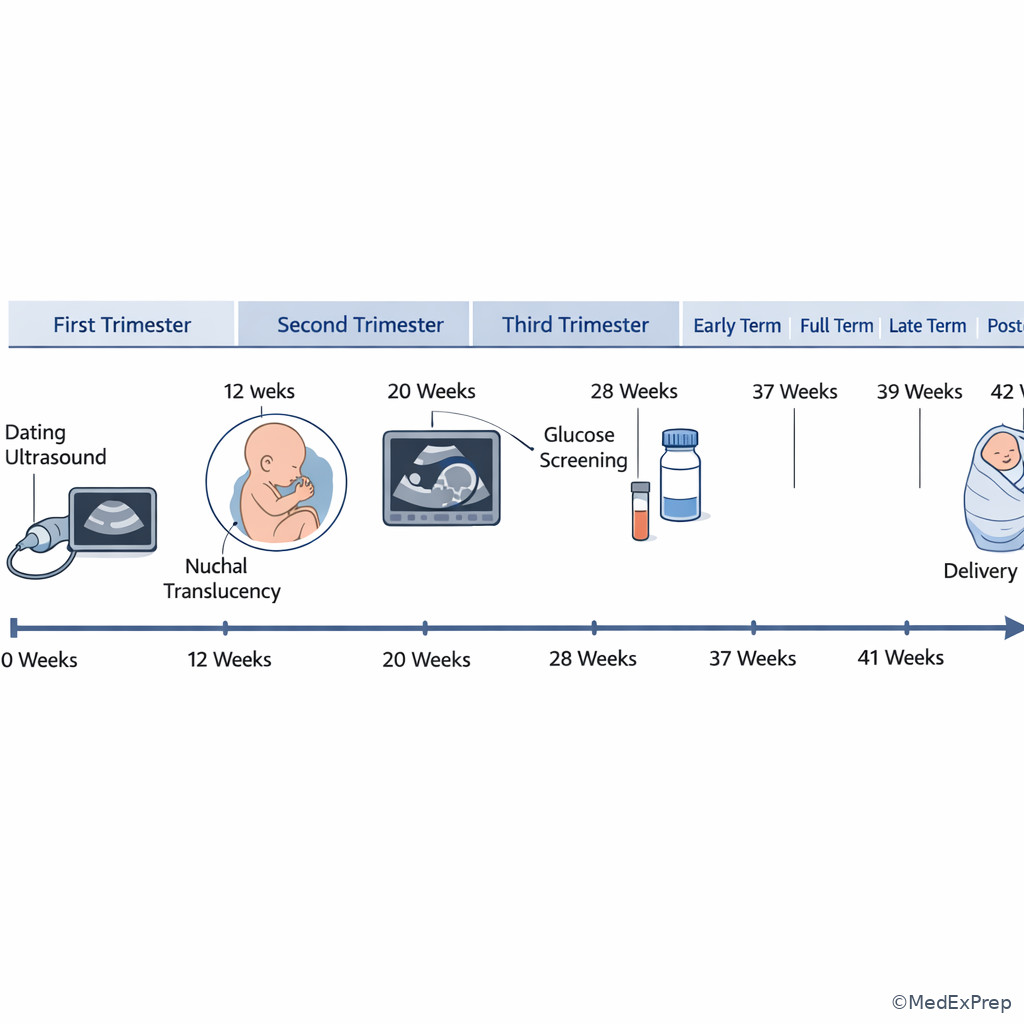
Once the date is assigned, the next decision conflict is: Which test or management option fits this gestational age window? The single rule is that many OB interventions are time-dependent. A test can be correct in general but wrong for the current gestational age. Examples: nuchal translucency is a first-trimester window study, the anatomy survey is usually a mid-second-trimester study, and post-term management depends on a reliable due date. If the date is wrong, the interpretation is wrong.
Students must also distinguish trimester labels from term labels. First trimester extends through 13 6/7 weeks, second trimester through 27 6/7 weeks, and third trimester begins at 28 weeks. Separately, delivery timing is described as early term, full term, late term, or postterm. Reject the trap of calling 37 weeks “full term” in board language; it is early term.
WHY THIS IS TESTED: NBME questions often ask for the next best step in prenatal care, but the real discriminator is whether the patient is in the correct gestational window for that action. See Fig 4.
High-Yield Connection: This concept overlaps strongly with Routine Prenatal Counseling and the entire Prenatal Screening Sequence section. Know the date first, then decide whether a screening test is too early, on time, or already missed.
Exam takeaway: Correct dating determines whether a prenatal test is appropriately timed, too early, or too late.
timeline
title Pregnancy timing milestones
LMP : Gestational clock starts
First trimester : Dating ultrasound most accurate
11 to 13+6 weeks : Nuchal translucency window
18 to 22 weeks : Anatomy ultrasound
28 weeks : Third trimester begins
37 weeks : Early term
39 weeks : Full term
42 weeks : Postterm
Exam takeaway: Match each prenatal assessment to its gestational age window rather than choosing it by diagnosis name alone.
B Worked example
A 30-year-old G2P0 with chronic hypertension and class I obesity presents after transferring care from another clinic. Her chart lists “about 16 weeks” by LMP, but a documented first-trimester ultrasound from 9 weeks gave a different EDD that makes her 18 weeks 5 days today. She asks whether it is too early for the fetal anatomy survey. A distracting detail is chronic hypertension, which suggests high risk but does not answer the timing question.
Reasoning chain: Identify task: determine correct timing for anatomy scan. Extract key facts: documented first-trimester ultrasound provides the official dating; current GA by that date is 18 weeks 5 days. Apply rule: anatomy survey is typically performed around 18 to 22 weeks. Eliminate distractors: chronic hypertension affects surveillance later but not whether the anatomy scan window is open; LMP estimate is less authoritative than documented early ultrasound. Verify: she is appropriately timed for anatomy ultrasound now.
C Exam trap
Common wrong answer: “Delay the anatomy scan because the LMP says only 16 weeks.” Why it is tempting: the stem gives two ages, and learners choose the more familiar menstrual date. Single clue that eliminates it: there is a documented first-trimester ultrasound, which is more accurate and should govern timing.
D Checkpoint
Which label is most accurate for a pregnancy at 37 weeks 4 days?
- Preterm — tempting because it is before 38 weeks, but wrong because preterm is before 37 0/7 weeks.
- Early term — correct because 37 0/7 through 38 6/7 weeks is early term.
- Full term — tempting because older language used “term” loosely at 37 weeks, but wrong in current classification.
- Late term — tempting because “late” sounds near delivery, but wrong because late term begins at 41 0/7 weeks.
Answer: B. Early term.
- True or False: A pregnancy at 39 weeks 2 days is full term. True.
- The anatomy scan is typically performed at 18–22 weeks.
- Postterm begins at 42 0/7 weeks.
Clinician Action: Diagnose the exact gestational window before picking the next prenatal test. Order time-sensitive studies only when the patient is in the appropriate range. Treat discrepant timing data by returning to the assigned EDD. Refer/Escalate uncertain dating that affects delivery timing or fetal surveillance to the supervising team.
1.1.1.7 Integration: suboptimally dated pregnancy, late presentation, and exam-safe management
A Explanation
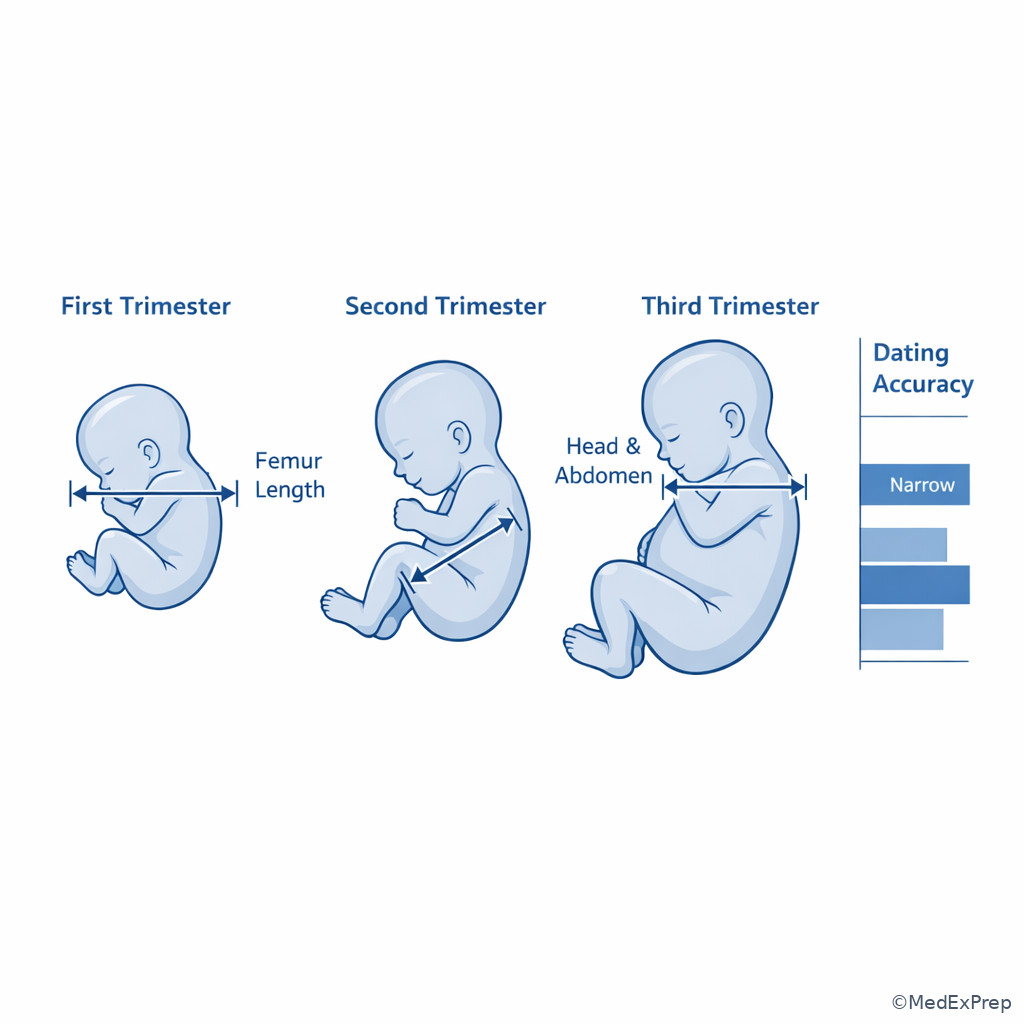
The highest-yield integration conflict is: The patient presents late with uncertain dates. Should you assign a brand-new exact due date from a late scan or manage as a suboptimally dated pregnancy? The single rule is to recognize that a pregnancy without ultrasound confirmation before 22 weeks is considered suboptimally dated. Late second- or third-trimester ultrasound can provide a best estimate, but it is less precise. Choose cautious management that acknowledges uncertainty; reject overconfidence in late biometric dating.
This matters because late dating uncertainty affects interpretation of “post-term,” assessment of growth, and scheduling of elective delivery. If a third-trimester scan suggests the fetus is smaller than dates, the problem may be wrong dates, fetal growth restriction, or both. The safe exam move is not to casually reset the EDD late unless the dating framework specifically supports it. Instead, recognize uncertainty and manage with appropriate surveillance and supervision.
WHY THIS IS TESTED: NBME stems use late prenatal care to test whether you understand the limits of third-trimester ultrasound. The test is often not “what is the exact due date?” but “how certain are you that this pregnancy is actually post-term or growth-restricted?” See Fig 5.
Common distractor logic: When the pregnancy presents late, students may over-trust a third-trimester ultrasound because it feels more “current.” In reality, late ultrasound is useful but less accurate for establishing the original gestational age.
Exam takeaway: When prenatal care starts late, recognize a suboptimally dated pregnancy and manage with caution instead of treating late ultrasound as perfectly precise.
flowchart TD
A[Late prenatal presentation] --> B{Early ultrasound before 22 weeks available?}
B -->|Yes| C[Use established EDD]
B -->|No| D[Suboptimally dated pregnancy]
D --> E[Estimate GA with available ultrasound]
E --> F[Avoid overconfident date revision]
F --> G[Use surveillance and cautious timing decisions] Exam takeaway: Dating becomes less precise as pregnancy advances, so later fetal size should not be treated as an exact calendar replacement.
B Worked example
A 22-year-old G1 with sickle cell trait and depression presents for her first prenatal visit after moving states. She has had no prior records and is unsure of her LMP because she was breastfeeding until recently. Fundal height seems larger than expected, and a third-trimester ultrasound estimates 31 weeks. She asks for her exact due date because she needs to plan work leave. The distracting clues are fundal height and the desire for precision.
Reasoning chain: Identify task: determine how confidently the pregnancy can be dated. Extract key facts: no early ultrasound, uncertain LMP, late presentation, third-trimester scan only. Apply rule: this is a suboptimally dated pregnancy; the late scan offers an estimate but not the precision of an early dating scan. Eliminate distractors: fundal height can vary with body habitus, fibroids, fluid, or fetal position and does not precisely date a pregnancy; personal scheduling needs do not improve biologic certainty. Verify: the correct shelf-level approach is to estimate gestational age with available data, recognize uncertainty, and avoid overconfident timing claims.
C Exam trap
Common wrong answer: “Assign the EDD exactly from the third-trimester ultrasound and treat all later timing decisions as precise.” Why it is tempting: ultrasound seems objective. Single clue that eliminates it: no ultrasound before 22 weeks means the pregnancy is suboptimally dated.
D Checkpoint
A patient first enters care in the third trimester with uncertain LMP and no prior records. Which statement best reflects the correct approach?
- The third-trimester ultrasound provides the most accurate EDD because the fetus is larger and easier to measure — tempting, but wrong because later ultrasound is less accurate for dating.
- The pregnancy should be considered suboptimally dated — correct because there is no ultrasound confirmation before 22 weeks.
- The LMP should always override ultrasound even if the patient is unsure of it — tempting because OB starts with LMP, but wrong when recall is unreliable.
- Fundal height should replace ultrasound for dating in late pregnancy — tempting because it is used in prenatal visits, but wrong because it is too imprecise for formal dating.
Answer: B. The pregnancy should be considered suboptimally dated.
Recall: In the upcoming topic Routine Prenatal Counseling, you will schedule counseling, screening, and warning-sign education by gestational window. That only works if the pregnancy has been dated correctly first.
Clinician Action: Diagnose whether the pregnancy is well dated or suboptimally dated. Order ultrasound and record review to capture the best available estimate. Treat later biometric estimates as approximations, not exact replacements for early dating. Refer/Escalate to the supervising OB team when uncertainty affects timing of surveillance, corticosteroids, or delivery planning.
Memory anchor: DATE — Day 1 of LMP starts the clock, Add 7 subtract 3 for EDD, Trimester 1 ultrasound is most accurate, Early data outrank late estimates.
| Dating fact | High-yield value | Why it matters on questions |
|---|---|---|
| Pregnancy length | 40 weeks from LMP | Sets the OB clock for all screening and delivery timing |
| Gestational age vs conception age | GA is about 2 weeks greater | Prevents underestimating true OB age |
| Best first-trimester dating measure | Crown-rump length | Most accurate sonographic dating tool |
| Anatomy scan window | 18–22 weeks | Common next-best-step timing question |
| Third trimester starts | 28 0/7 weeks | Frames surveillance and preterm/term categories |
| Early term | 37 0/7 to 38 6/7 weeks | Common terminology trap |
| Full term | 39 0/7 to 40 6/7 weeks | Used in delivery timing language |
| Postterm | 42 0/7 weeks or more | Requires reliable dating before diagnosis |
| Suboptimally dated pregnancy | No confirming ultrasound before 22 weeks | Late dating is less precise and changes management confidence |
| Dating source | Best use | Main strength | Main limitation |
|---|---|---|---|
| Reliable LMP with regular cycles | Initial dating estimate | Immediately available from history | Falls apart with irregular cycles or uncertain recall |
| First-trimester ultrasound | Preferred dating method when available | Highest accuracy | Requires early access to care |
| Second-trimester ultrasound | Moderate dating support | Useful if early scan unavailable | Less accurate than first trimester |
| Third-trimester ultrasound | Late estimate when no earlier data exist | Better than no estimate | Poor precision; should not be over-trusted |
| Fundal height | Follow-up growth screening | Simple office tool | Not reliable for establishing EDD |
| Looks similar | Correct interpretation | Discriminating clue |
|---|---|---|
| Known conception date | Convert to gestational age by adding about 2 weeks | OB timing uses LMP-based gestational age |
| Exact reported LMP in patient with irregular cycles | Use caution; favor ultrasound dating | Irregular ovulation weakens LMP reliability |
| Later ultrasound shows fetus smaller than expected | Consider growth restriction before changing EDD | Late scans are less accurate for dating |
| 37-week pregnancy called “full term” | Actually early term | Full term begins at 39 0/7 weeks |
| Late prenatal entry with third-trimester scan only | Suboptimally dated pregnancy | No confirming ultrasound before 22 weeks |
| Spotting episode used as new LMP | Do not assume abnormal bleeding is a true menstrual period | Bleeding history may be nonmenstrual |
Exam Traps & Differentiators
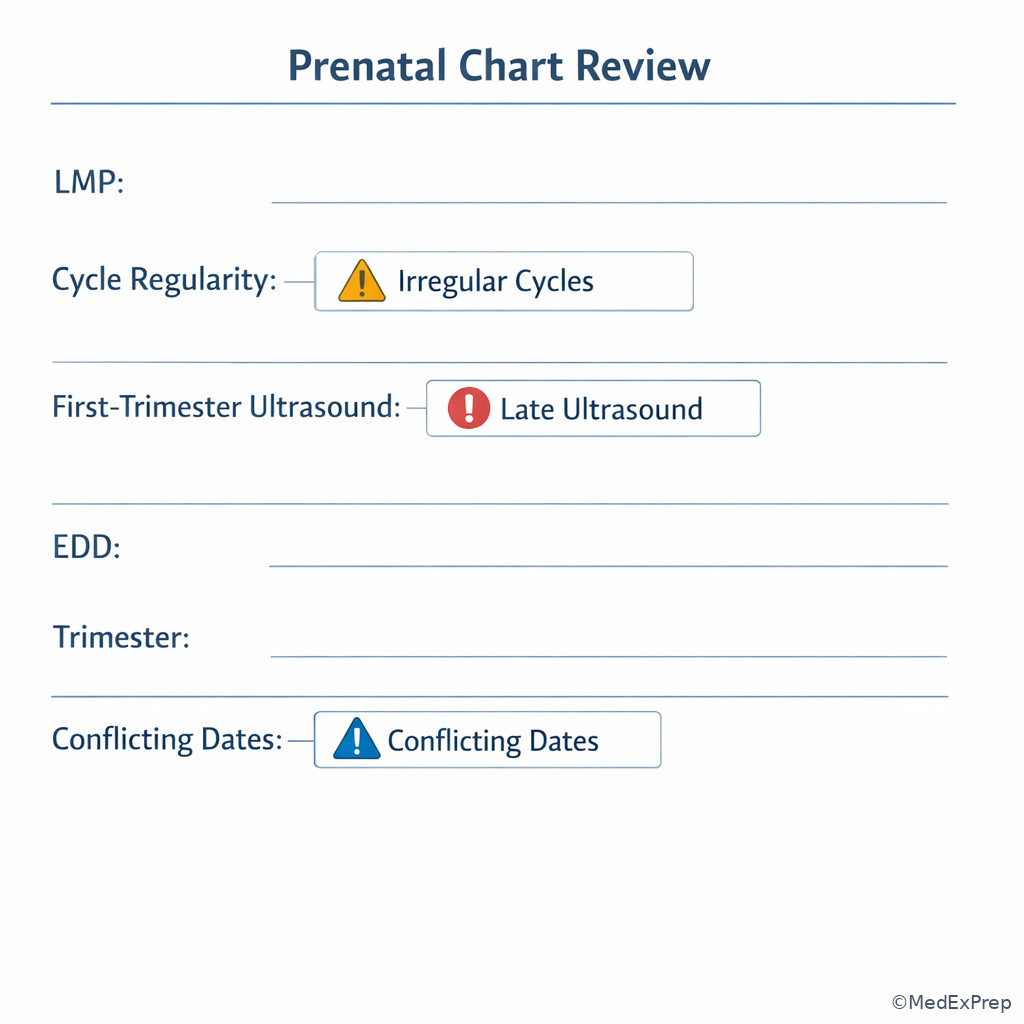
Most common wrong answer and why: using the reported LMP even when the stem quietly tells you it is unreliable. This is tempting because OB dating often starts with LMP, but the single clue that changes the answer is irregular cycles, uncertain recall, postpartum bleeding, or recent hormonal contraception.
| Trap pair | Why they look alike | What separates them |
|---|---|---|
| LMP-based EDD vs ultrasound-based EDD | Both provide gestational age estimates | First-trimester ultrasound is more accurate when dates conflict meaningfully |
| Conception age vs gestational age | Both sound like pregnancy duration | Gestational age is about 2 weeks longer and is used for OB decisions |
| Term vs full term | Both imply near delivery | 37 weeks is term broadly but specifically early term, not full term |
| Late fetal size discrepancy vs wrong dates | Both can make the fetus seem smaller or larger than expected | Later scans are less accurate; do not erase growth pathology by redating too late |
| Late dating estimate vs precise EDD | Both end with a due date on the chart | No early confirmation means the pregnancy is suboptimally dated |
- If the stem says “certain conception date,” think add about 2 weeks to get gestational age.
- If the stem says “irregular cycles” or “stopped hormonal contraception recently,” think LMP may be unreliable.
- If the stem says “first-trimester CRL,” think strongest dating evidence.
- If the stem says “third-trimester ultrasound only,” think suboptimally dated pregnancy and greater uncertainty.
- If the stem says “37 weeks,” think early term, not full term.
- If the stem says “late scan suggests smaller fetus,” think do not reflexively redate; consider growth issues.
Exam takeaway: Visual cross-checking of menstrual history, ultrasound timing, and trimester labels prevents the most common shelf dating errors.
High-Yield Connection: Dating traps are commonly paired with later topics on fetal growth restriction, antepartum testing, and labor induction. A wrong due date can make a correct management option look wrong — or vice versa.
Algorithm / Approach
Exam takeaway: Pick one best dating source early, assign a single EDD, and use that date consistently for all subsequent prenatal decisions.
Use this framework whenever a stem gives more than one possible gestational age. The practical NBME sequence is: identify the dating source → judge reliability → prefer earliest ultrasound when needed → assign one EDD → answer the management question using that date. See Fig 6.
Rapid Review
- Gestational age → measured from first day of LMP, not conception.
- Conception date → add about 2 weeks to convert to OB gestational age.
- Naegele rule → add 7 days, subtract 3 months, add 1 year.
- Reliable LMP → regular cycles and certain recall support its use.
- Irregular cycles → weaken LMP-based dating.
- First-trimester ultrasound → most accurate dating method.
- CRL → preferred first-trimester ultrasound metric.
- Later ultrasound → better for estimation than exact dating.
- Redating late pregnancy → avoid reflexive EDD changes when growth pathology is possible.
- 18–22 weeks → classic anatomy scan window.
- 37 0/7 weeks → early term begins.
- 39 0/7 weeks → full term begins.
- 42 0/7 weeks → postterm begins.
- No ultrasound before 22 weeks → suboptimally dated pregnancy.
Self-check quiz
1. A 25-year-old G1 at her first prenatal visit says she is “6 weeks pregnant” because she conceived 6 weeks ago after timed intercourse. She has mild asthma and seasonal allergies. Which gestational age is most appropriate for standard obstetric timing?
- 4 weeks
- 6 weeks
- 8 weeks
- 10 weeks
2. A 29-year-old G2P1 with regular 28-day cycles reports an LMP of July 12. She takes levothyroxine and has no bleeding since then. What is the estimated due date by Naegele rule?
- April 12
- April 19
- May 19
- March 5
3. A 21-year-old primigravid patient with obesity and irregular menses presents with a positive pregnancy test. She reports an LMP 10 weeks ago but says her cycles occur every 40 to 70 days. She recently stopped oral contraceptives and had 2 days of spotting last month. What is the most appropriate next step to establish gestational age?
- Assign the EDD using the reported LMP alone
- Obtain a first-trimester dating ultrasound
- Wait for fundal height at the next visit
- Use serial urine pregnancy tests to estimate gestation
4. A 30-year-old G1 with chronic hypertension transferred care. Her chart lists an LMP-based age of 16 weeks, but a documented ultrasound from 9 weeks sets her at 18 weeks 4 days today. She asks about the most appropriate next prenatal study. Which is best?
- Repeat pregnancy test to confirm viability before further care
- Schedule fetal anatomy ultrasound now
- Delay imaging until 24 weeks because the LMP suggests she is too early
- Schedule post-term surveillance because chronic hypertension increases risk
5. A 34-year-old G3P2 with a certain LMP suggesting 11 weeks and a first-trimester ultrasound suggesting 9 weeks 4 days asks which date will guide her prenatal care. She has well-controlled epilepsy and iron-deficiency anemia. Which is the most appropriate response?
- The LMP should always be used because pregnancy starts with the menstrual period
- The two dates should be averaged to create a compromise EDD
- The first-trimester ultrasound should generally guide the assigned EDD
- A third-trimester ultrasound should decide the final EDD because fetal structures are larger
6. A 23-year-old G1 presents for her first prenatal visit after limited access to care. She has uncertain LMP, recently stopped breastfeeding, and has no prior ultrasound records. A current ultrasound estimates 32 weeks. She has chronic hepatitis B and mild anemia. Which description best applies to this pregnancy?
- Accurately dated because ultrasound is objective regardless of timing
- Suboptimally dated because no confirming ultrasound was obtained before 22 weeks
- Postterm because the exact EDD cannot be known
- Incorrectly dated because breastfeeding prevents ovulation entirely
7. A 28-year-old G2P1 with chronic hypertension and prior preeclampsia presents at a visit labeled 37 weeks 3 days by a documented first-trimester ultrasound. She asks if she is now “full term.” She also notes mild pedal edema and a recent upper respiratory infection. Which classification is most accurate?
- Preterm
- Early term
- Full term
- Late term
8. A 31-year-old G1 with well-controlled type 2 diabetes presents for evaluation of possible fetal growth restriction. Her first-trimester ultrasound established an EDD. A third-trimester ultrasound now estimates fetal size 2 weeks behind that EDD. She also has a small intramural fibroid and gained less weight than expected. What is the most appropriate interpretation?
- The EDD should be changed to match the third-trimester ultrasound because it reflects current fetal size
- The discrepancy may represent true growth restriction, so the established early EDD should generally be retained
- The first-trimester ultrasound is obsolete once fetal biometry is available later in pregnancy
- Fundal height should replace ultrasound as the definitive dating method in late pregnancy
Answer key
1. Correct answer: C. 8 weeks
- A. 4 weeks — Tempting if the learner subtracts instead of adds when converting conception age to gestational age. Incorrect because standard obstetric dating begins about 2 weeks before conception. Single clue: the stem explicitly says conception occurred 6 weeks ago. Source: ACOG Committee Opinion on methods for estimating the due date.
- B. 6 weeks — Tempting because it matches the patient’s wording. Incorrect because this is conception age, not gestational age used in obstetrics. Single clue: “conceived 6 weeks ago.” Source: Cunningham et al., Williams Obstetrics.
- C. 8 weeks — Correct because gestational age is about 2 weeks greater than conception age in standard OB language. Single clue: known conception date must be translated to obstetric dating. Source: ACOG; Williams Obstetrics.
- D. 10 weeks — Tempting because some learners overestimate the difference between conception and gestational age. Incorrect because the offset is approximately 2 weeks, not 4. Single clue: regular OB timing conventions. Source: ACOG.
2. Correct answer: B. April 19
- A. April 12 — Tempting because it preserves the day of the month from the LMP. Incorrect because Naegele rule adds 7 days before shifting months. Single clue: regular cycles and clear LMP make calendar calculation appropriate. Source: ACOG; Beckmann et al., Obstetrics and Gynecology.
- B. April 19 — Correct because July 12 + 7 \(days = July 19\), minus 3 months = April 19. Single clue: reliable LMP in a regular-cycle patient. Source: ACOG Committee Opinion.
- C. May 19 — Tempting if the learner subtracts only 2 months. Incorrect because Naegele rule subtracts 3 months. Single clue: standard formula. Source: Williams Obstetrics.
- D. March 5 — Tempting if the learner attempts an imprecise 40-week mental estimate. Incorrect because the formula yields April 19. Single clue: use exact rule, not a rough month count. Source: ACOG.
3. Correct answer: B. Obtain a first-trimester dating ultrasound
- A. Assign the EDD using the reported LMP alone — Tempting because the stem provides a menstrual date. Incorrect because irregular cycles, recent oral contraceptive cessation, and spotting all weaken LMP reliability. Single clue: cycles every 40 to 70 days. Source: ACOG Committee Opinion No. 700.
- B. Obtain a first-trimester dating ultrasound — Correct because the patient has uncertain dating inputs, and early ultrasound is the most accurate method to establish gestational age. Single clue: irregular menses with uncertain true LMP. Source: ACOG; Williams Obstetrics.
- C. Wait for fundal height at the next visit — Tempting because fundal height is used during prenatal care. Incorrect because it is too imprecise to establish EDD and is influenced by body habitus and fibroids. Single clue: the question asks to establish gestational age. Source: Beckmann et al.
- D. Use serial urine pregnancy tests to estimate gestation — Tempting because test intensity changes early in pregnancy. Incorrect because urine tests are not a dating tool. Single clue: positive test confirms pregnancy, not gestational age. Source: ACOG.
4. Correct answer: B. Schedule fetal anatomy ultrasound now
- A. Repeat pregnancy test to confirm viability before further care — Tempting because transfer of care may feel incomplete. Incorrect because the pregnancy is already dated by a documented ultrasound, and a urine test does not guide next prenatal imaging. Single clue: known ongoing pregnancy with established early ultrasound. Source: ACOG prenatal care recommendations.
- B. Schedule fetal anatomy ultrasound now — Correct because the documented 9-week ultrasound makes her 18 weeks 4 days, which falls in the standard anatomy scan window. Single clue: first-trimester ultrasound age of 18 weeks 4 days today. Source: ACOG; Williams Obstetrics.
- C. Delay imaging until 24 weeks because the LMP suggests she is too early — Tempting because the stem includes a second age estimate. Incorrect because first-trimester ultrasound is more accurate than LMP when they conflict. Single clue: documented ultrasound at 9 weeks. Source: ACOG Committee Opinion No. 700.
- D. Schedule post-term surveillance because chronic hypertension increases risk — Tempting because chronic hypertension increases obstetric risk. Incorrect because 18 weeks is far too early for post-term surveillance and the question asks the next prenatal study. Single clue: gestational age in mid-second trimester. Source: ACOG practice guidance.
5. Correct answer: C. The first-trimester ultrasound should generally guide the assigned EDD
- A. The LMP should always be used because pregnancy starts with the menstrual period — Tempting because gestational age is counted from LMP. Incorrect because the best dating source is the earliest accurate ultrasound when dates conflict meaningfully. Single clue: there is a first-trimester ultrasound. Source: ACOG Committee Opinion No. 700.
- B. The two dates should be averaged to create a compromise EDD — Tempting because averaging feels fair when data disagree. Incorrect because obstetric dating does not average discordant sources. Single clue: EDD assignment relies on the most accurate source. Source: Williams Obstetrics.
- C. The first-trimester ultrasound should generally guide the assigned EDD — Correct because first-trimester sonography has the highest dating accuracy. Single clue: ultrasound is in the first trimester. Source: ACOG; Beckmann et al.
- D. A third-trimester ultrasound should decide the final EDD because fetal structures are larger — Tempting because later structures are easier to visualize. Incorrect because dating accuracy worsens later in gestation. Single clue: later fetal size reflects biologic variation more than exact age. Source: ACOG.
6. Correct answer: B. Suboptimally dated because no confirming ultrasound was obtained before 22 weeks
- A. Accurately dated because ultrasound is objective regardless of timing — Tempting because imaging feels more reliable than history. Incorrect because timing matters; late ultrasound is less accurate for dating. Single clue: current estimate is from a 32-week scan only. Source: ACOG Committee Opinion No. 688/700 concepts.
- B. Suboptimally dated because no confirming ultrasound was obtained before 22 weeks — Correct because the absence of an ultrasound confirmation or revision before 22 weeks defines a suboptimally dated pregnancy. Single clue: no prior records and late first scan. Source: ACOG Committee Opinion on management of suboptimally dated pregnancies.
- C. Postterm because the exact EDD cannot be known — Tempting because uncertainty raises concern for advanced gestation. Incorrect because postterm has a specific threshold of 42 weeks, not simply uncertainty. Single clue: ultrasound estimate is 32 weeks. Source: ACOG.
- D. Incorrectly dated because breastfeeding prevents ovulation entirely — Tempting because lactation can suppress ovulation. Incorrect because ovulation may resume unpredictably during breastfeeding. Single clue: breastfeeding lowers fertility but does not eliminate ovulation. Source: standard OB texts.
7. Correct answer: B. Early term
- A. Preterm — Tempting because the patient is not yet 38 weeks. Incorrect because preterm ends before 37 0/7 weeks. Single clue: 37 weeks 3 days. Source: ACOG definitions of term pregnancy.
- B. Early term — Correct because 37 0/7 to 38 6/7 weeks is early term. Single clue: date falls in the 37th week range. Source: ACOG Committee Opinion on definition of term pregnancy.
- C. Full term — Tempting because many clinicians and patients casually say “term” at 37 weeks. Incorrect because full term starts at 39 0/7 weeks. Single clue: 37 weeks is not 39 weeks. Source: ACOG.
- D. Late term — Tempting because the pregnancy is relatively advanced. Incorrect because late term is 41 0/7 to 41 6/7 weeks. Single clue: she is only 37 weeks 3 days. Source: ACOG.
8. Correct answer: B. The discrepancy may represent true growth restriction, so the established early EDD should generally be retained
- A. The EDD should be changed to match the third-trimester ultrasound because it reflects current fetal size — Tempting because ultrasound looks objective and current. Incorrect because late fetal size variation may reflect pathology such as growth restriction, not wrong dates. Single clue: EDD was established by a first-trimester ultrasound. Source: ACOG; Williams Obstetrics.
- B. The discrepancy may represent true growth restriction, so the established early EDD should generally be retained — Correct because early dating is more accurate, and late size lag should trigger consideration of pathology rather than automatic redating. Single clue: established first-trimester EDD with later smaller biometry. Source: ACOG; standard MFM principles.
- C. The first-trimester ultrasound is obsolete once fetal biometry is available later in pregnancy — Tempting because later scans show more anatomy. Incorrect because early ultrasound remains the strongest dating evidence. Single clue: dating accuracy declines with gestation. Source: ACOG Committee Opinion No. 700.
- D. Fundal height should replace ultrasound as the definitive dating method in late pregnancy — Tempting because fundal height is used to follow growth. Incorrect because it is a screening tool, not a definitive dating method. Single clue: question asks interpretation of discrepancy, not office growth screening. Source: Beckmann et al.
Keep going with the full OB/GYN Shelf Prep Course (OB Shelf)
You just studied the way members do, in the same lesson interface. Full access unlocks every lesson, the question bank and flashcards for a full year.
One payment · 1 year of access · No auto-renewal