1.1.1 - Clinical Task Recognition
Clinical Task Recognition
What you'll learn
- DOMAIN: Exam strategy/task recognition -> Identify the task by distinguishing diagnosis, localization, test selection, stabilization, and management stems.
- DOMAIN: Neurologic localization and examination -> Use clues purposefully by separating findings that localize from findings that are merely distracting.
- DOMAIN: Data interpretation/test selection -> Choose the governing rule that converts a vignette into the best next step.
- DOMAIN: Cerebrovascular disease / seizures / CNS infection / spinal emergencies -> Recognize urgency by spotting when the task is immediate stabilization rather than diagnosis refinement.
- DOMAIN: Exam strategy/task recognition -> Eliminate close distractors using the single clue that changes the answer.
- Exam strategy/task recognition → identify question task type → diagnosis vs localization vs next-best-step
- Neurologic localization and examination → extract actionable neuro clues → cortical vs brainstem vs cord vs peripheral patterns
- Data interpretation/test selection → choose initial vs confirmatory test → CT, MRI, LP, EEG, EMG/NCS at shelf level
- Trauma/neurocritical presentations → recognize emergencies → airway, seizure stabilization, suspected increased intracranial pressure, cord compression
- Cerebrovascular disease → acute stroke evaluation → act before over-localizing
Why it matters
- Many missed shelf questions are not content failures; they are task-recognition failures. Students know the disease but answer a diagnosis question when the stem asks for the best initial test.
- Neurology stems often contain high-noise details: old strokes, diabetes, mild chronic neuropathy, incidental lab abnormalities, or medication lists that tempt a wrong pathway.
- In real clerkship care, recognizing when to stabilize first prevents harmful delay in stroke, status epilepticus, meningitis, cord compression, and increased intracranial pressure.
- Task recognition is the front door to localization. Before deciding where the lesion is, decide whether the exam wants localization, diagnosis, or action.
Exam takeaway: First identify what the question is asking before interpreting the neurologic details.
flowchart TD
A[Read final line first] --> B{Task type?}
B --> C[Most likely diagnosis]
B --> D[Localize lesion]
B --> E[Best initial test]
B --> F[Most appropriate next step]
B --> G[Immediate stabilization]
C --> H[Use syndrome pattern]
D --> I[Use neuro exam clues]
E --> J[Choose initial not confirmatory test]
F --> K[Apply management rule]
G --> L[Airway, stroke, seizure, ICP, cord, meningitis priorities]
Use this lesson-wide map repeatedly. See Fig 1.
Key Terms & Must-Know Facts
1.1.1.1 Key terms
- Task recognition: Identifying what decision the stem actually asks you to make.
- Localization: Assigning symptoms and signs to cortex, subcortex, brainstem, cerebellum, spinal cord, peripheral nerve, neuromuscular junction, or muscle.
- Next best step: The immediate action that is most appropriate now, not eventually.
- Best initial test: First study that safely moves diagnosis forward.
- Confirmatory test: The study that secures a diagnosis after the initial evaluation.
- Red flag: A clue that changes urgency or contraindicates delay.
- Noise: Realistic but non-governing detail that should not drive the answer.
- Discriminator: The single clue that separates the correct answer from the closest distractor.
- Syndrome script: Pattern of onset, symptoms, exam findings, and context that suggests one diagnosis class.
- Stabilization question: A stem in which ABCs or emergency treatment come before etiologic precision.
- Rule-out danger: A scenario where missing a catastrophic condition matters more than naming an exact disease.
- Pattern recognition: Matching stem findings to a common testable neurologic presentation.
1.1.1.2 Must-know facts
- The last line often reveals the true task; read it early.
- Sudden focal deficit with last-known-well timing is a stroke workflow question until proven otherwise.
- Convulsive activity plus persistent impaired awareness may be status epilepticus, not “postictal only.”
- Fever, neck stiffness, and altered mental status change a diagnosis stem into an emergency treatment-and-workup stem.
- Back pain with weakness, sensory level, or bladder symptoms should trigger spinal cord compression thinking.
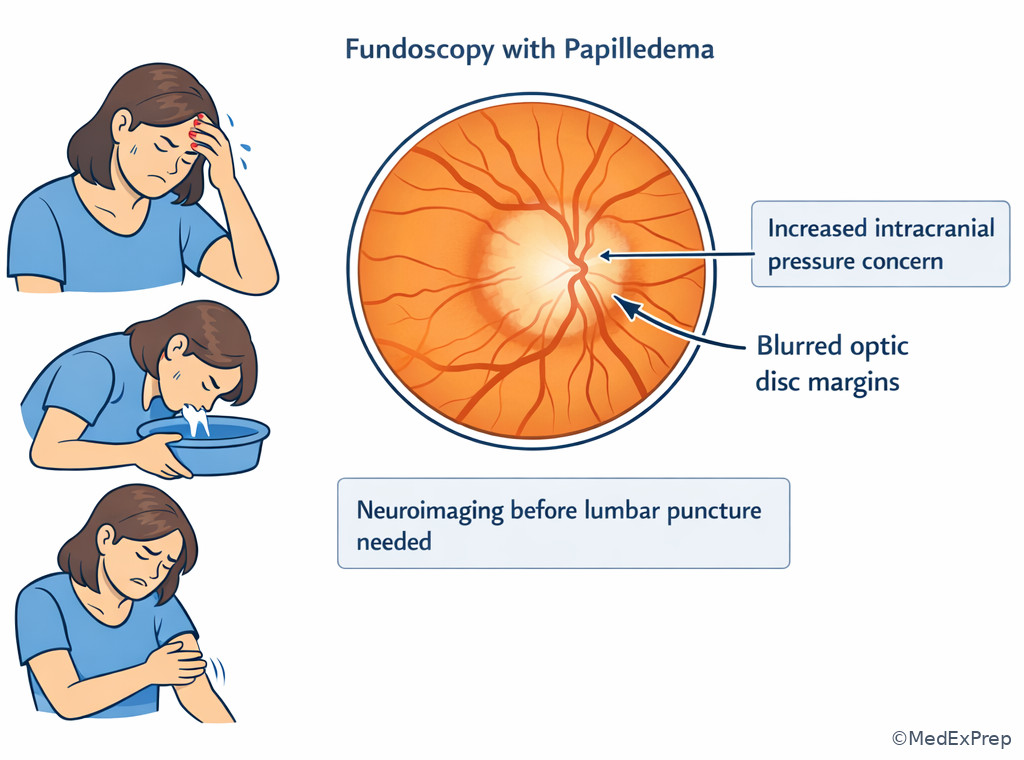
- Papilledema, focal deficit, or immunocompromise may change the order of testing before lumbar puncture.
- A chronic comorbidity is often a distractor unless it explains the current time course and exam.
- The best initial test is often different from the most sensitive test.
- The correct answer is usually the option that fits both the presenting pattern and the timeline.
| Task phrase in final line | What the exam wants | Immediate mental move |
|---|---|---|
| Most likely diagnosis | Name the syndrome/process | Match time course + key findings |
| Most likely site of lesion | Localization | Use neuro exam, not broad risk factors |
| Best initial test | First safe study | Prioritize speed, availability, safety |
| Confirmatory test | Diagnostic certainty | Choose gold-standard-ish test after initial step |
| Most appropriate next step | Management action now | Ask what must happen before anything else |
| Requires immediate clarification | Dangerous missing detail | Find the time-sensitive discriminator |
| Most important to monitor | Complication prevention | Think treatment risk or deterioration marker |
Core content
1.1.1.3 Foundational move: identify the clinical task before solving the vignette
A Explanation
The first choice in a neurology question is not between diagnoses; it is between task types. Are you being asked to diagnose, localize, choose a test, stabilize, or treat? The conflict is usually: Do I keep analyzing the syndrome, or do I stop and act? The single rule that resolves it: the final line outranks the body of the stem. If the last line asks for the most appropriate next step, the answer is an action, even if you feel you can already name the disease.
WHY THIS IS TESTED: Students often know the disorder but miss the intended action. NBME rewards recognition of the decision point, not just factual recall. In neurology, the same clinical syndrome can support four different correct answers depending on the prompt: diagnosis, lesion localization, initial test, or immediate therapy.
Choose-vs-reject framing helps. Choose diagnosis reasoning when the stem asks “most likely diagnosis.” Reject pure diagnosis reasoning if the final line asks “best initial test” or “most appropriate next step.” Choose stabilization when airway compromise, ongoing seizure, acute stroke workflow, or meningitis red flags are present. Reject long differential building if delay would be unsafe.
B Worked example
A 68-year-old man with hypertension, type 2 diabetes, and chronic lumbar stenosis develops sudden right arm and face weakness while eating breakfast 40 minutes ago. He also reports a mild bifrontal headache and had one brief episode of “shaking” in the right hand witnessed by family. Blood glucose is 118 mg/dL. Examination shows expressive aphasia and right lower facial droop. The question asks for the most appropriate next step.
Identify task: not diagnosis, but next-best-step management. Extract key facts: sudden focal deficit, aphasia, last-known-well 40 minutes, normal glucose. The hand shaking is tempting noise because focal motor activity can occur with cortical ischemia and should not pull you immediately to a primary seizure answer. Apply rule: acute focal neurologic deficit inside reperfusion window is stroke evaluation/stabilization first. Eliminate distractors: EEG is not first; lumbar spine MRI is irrelevant despite stenosis; migraine therapy ignores aphasia and abrupt deficit. Verify: the right answer is urgent stroke protocol with noncontrast head CT and team escalation, not leisurely etiologic workup.
C Exam trap
D Checkpoint
Question: A 57-year-old woman with atrial fibrillation and hyperlipidemia presents 25 minutes after sudden left-sided weakness and dysarthria. She has a history of migraine with aura and now reports shimmering lights. Which task is the stem most directly asking you to solve if the final line reads “most appropriate next step”?
- Distinguish migraine aura from stroke before any action — tempting because visual aura is classic, but wrong because sudden focal deficit with vascular risk factors first triggers emergency action rather than leisurely differentiation.
- Begin stroke-oriented acute evaluation and stabilization — correct because the task is immediate management of a possible acute stroke, and the clue is the abrupt focal deficit with precise onset time.
- Localize the lesion to the occipital cortex — tempting because of visual symptoms, but wrong because localization is not the asked task and would not be the safest first move.
- Confirm epilepsy with EEG — tempting because transient positive visual symptoms can resemble focal seizure, but wrong because there is no dominant seizure pattern and the task is immediate next step.
1.1.1.4 Separate governing clues from noise
A Explanation
Once you identify the task, the next conflict is: Which details matter enough to drive the answer, and which details are realistic distractors? The resolving rule is that governing clues are those that change localization, urgency, or management. Everything else is noise unless it meaningfully shifts probability.
In neurology stems, governing clues often include time course, focality, level of consciousness, presence of fever/immunocompromise, headache red flags, cranial nerve findings, sensory level, bladder symptoms, anticoagulant use, toxic exposure, and medication changes. Noise often includes stable chronic comorbidities, mild nonspecific laboratory abnormalities, remote injuries, or a symptom that is vivid but non-decisive.
WHY THIS IS TESTED: NBME uses authentic clinical clutter. Real patients have diabetic neuropathy, old back pain, chronic migraines, mild hyponatremia, and incidental white matter disease. The student must not let a familiar but non-governing detail outrank the one clue that determines the safest answer.
Choose details that resolve the question stem’s conflict. If the conflict is stroke vs mimic, sudden onset and focal exam outweigh a remote migraine history. If the conflict is meningitis vs benign headache, fever plus neck stiffness plus altered mental status dominate. If the conflict is cord compression vs radiculopathy, bilateral deficits with bladder dysfunction outrank degenerative back pain history.
B Worked example
A 34-year-old woman with migraine, hypothyroidism, and generalized anxiety disorder presents with severe headache, photophobia, and vomiting. She took sumatriptan without relief. Temperature is 39.1°C, heart rate 112/min. She is drowsy, answers slowly, and has neck stiffness. A mild chronic hand tremor is noted. The final line asks for the best initial management step.
Identify task: management. Extract key facts: fever, altered mental status, meningismus. Migraine history and triptan use are tempting but non-governing. The chronic tremor is noise. Apply rule: suspected acute bacterial meningitis or meningoencephalitis requires immediate empiric therapy and urgent evaluation; do not wait for perfect diagnostic certainty. Eliminate distractors: routine migraine treatment is unsafe delay; outpatient MRI is too slow; reassurance ignores red flags. Verify: the governing clue is not headache severity but the infectious meningeal syndrome.
C Exam trap
D Checkpoint
Question: A 72-year-old man with diabetes, chronic low back pain, and benign prostatic hyperplasia presents with new severe thoracic back pain, progressive leg weakness, numbness below the umbilicus, and urinary retention. Which clue is most governing?
- Chronic low back pain — tempting because it fits a common benign explanation, but wrong because it is old and does not explain the new bilateral neurologic syndrome.
- Benign prostatic hyperplasia — tempting because it explains retention, but wrong because it does not explain a sensory level and progressive weakness.
- Sensory level with progressive bilateral leg weakness — correct because this localizes to spinal cord pathology and changes the urgency to possible cord compression.
- Diabetes mellitus — tempting because neuropathy is common, but wrong because diabetic polyneuropathy does not cause an acute thoracic sensory level.
- The most important clue in a high-noise stem is the one that changes ___ or ___.
- True or False: A chronic diagnosis should outrank a new focal neurologic finding if it is more common.
- Name the 3 clue categories that most often govern shelf neurology stems: time course, focal exam, and ___.
Exam takeaway: Prioritize details that change urgency, localization, or management and downgrade incidental history.
flowchart LR
A[Stem details] --> B{Does it change answer?}
B -->|Yes| C[Keep: onset, focality, red flags, exam, dangerous context]
B -->|No| D[Downgrade: chronic conditions, remote history, incidental labs]
C --> E[Use as discriminator]
D --> F[Do not anchor on it]
See Fig 2 when you feel yourself anchoring on a vivid but non-decisive clue.
1.1.1.5 Recognize the major neurology task families tested on the shelf
A Explanation
The core exam conflict here is: Which rulebook should I use? A stroke rulebook differs from a seizure rulebook, which differs from a test-selection rulebook. The best solver quickly sorts the question into one of a few recurring neurology task families: diagnosis, localization, initial evaluation, immediate stabilization, confirmatory testing, first-line therapy, complication monitoring, or look-alike discrimination.
WHY THIS IS TESTED: Shelf questions reward pattern-based triage. A student who recognizes “this is a stabilization stem” or “this is a localization stem” instantly narrows the answer space. That is more efficient than generating a long undifferentiated differential for every vignette.
Choose the correct task family using trigger phrases and context. “Most likely site of lesion” means the exam is scoring neuroanatomy. “Best initial test” means the exam is scoring sequencing. “Requires immediate clarification” means there is a missing high-risk detail, often time of onset, anticoagulant use, pregnancy status, fever, trauma, or immunocompromise. “Most important to monitor” usually tests treatment toxicity or neurologic deterioration.
Reject over-precision. In foundational neurology shelf preparation, you rarely need subspecialty nuance. You need the dominant family of decision: what bucket is this question really in? See Fig 3.
B Worked example
A 61-year-old woman with hypertension and prior breast cancer presents with 3 weeks of progressive morning headache, nausea, and subtle left arm clumsiness. She has no fever. Examination shows mild left pronator drift and bilateral papilledema. Sodium is 132 mEq/L. The final line asks for the best initial diagnostic test.
Identify task family: testing sequence, not diagnosis alone. Extract key facts: subacute progression, focal deficit, papilledema, possible mass lesion/increased intracranial pressure. Mild hyponatremia is distracting. Apply rule: choose the initial imaging study that safely evaluates intracranial mass effect. Eliminate distractors: lumbar puncture may be dangerous before imaging when increased intracranial pressure or mass effect is suspected; EEG does not answer the main problem; mammography does not evaluate the acute neurologic presentation. Verify: the question is not “what is the tumor?” but “what test comes first?”
C Exam trap
D Checkpoint
Question: A stem ends with “Which of the following is the most likely site of lesion?” What task family should dominate your reasoning?
- Immediate stabilization — tempting because many neurology cases are urgent, but wrong unless the stem also shows an ABC or emergency treatment issue.
- Lesion localization — correct because the final line explicitly asks you to map findings to neuroanatomy.
- Confirmatory testing — tempting because tests often follow localization, but wrong because the question is not asking for a study.
- Long-term management — tempting because localization can inform therapy, but wrong because treatment is not the asked task.
Exam takeaway: Trigger phrases in the final line should direct you to the correct decision family and prevent solving the wrong problem.
flowchart TD
A[Final line phrase] --> B{Family}
B --> C[Diagnosis]
B --> D[Localization]
B --> E[Initial test]
B --> F[Immediate treatment]
B --> G[Confirmatory test]
B --> H[Monitoring/complication]
C --> I[Pattern match]
D --> J[Map findings to anatomy]
E --> K[Choose fastest safe first study]
F --> L[Act before full certainty if dangerous]
G --> M[Secure diagnosis after initial step]
H --> N[Track deterioration or toxicity] Exam takeaway: Visually sort symptoms into governing clues, red flags, and distractors before choosing an answer.
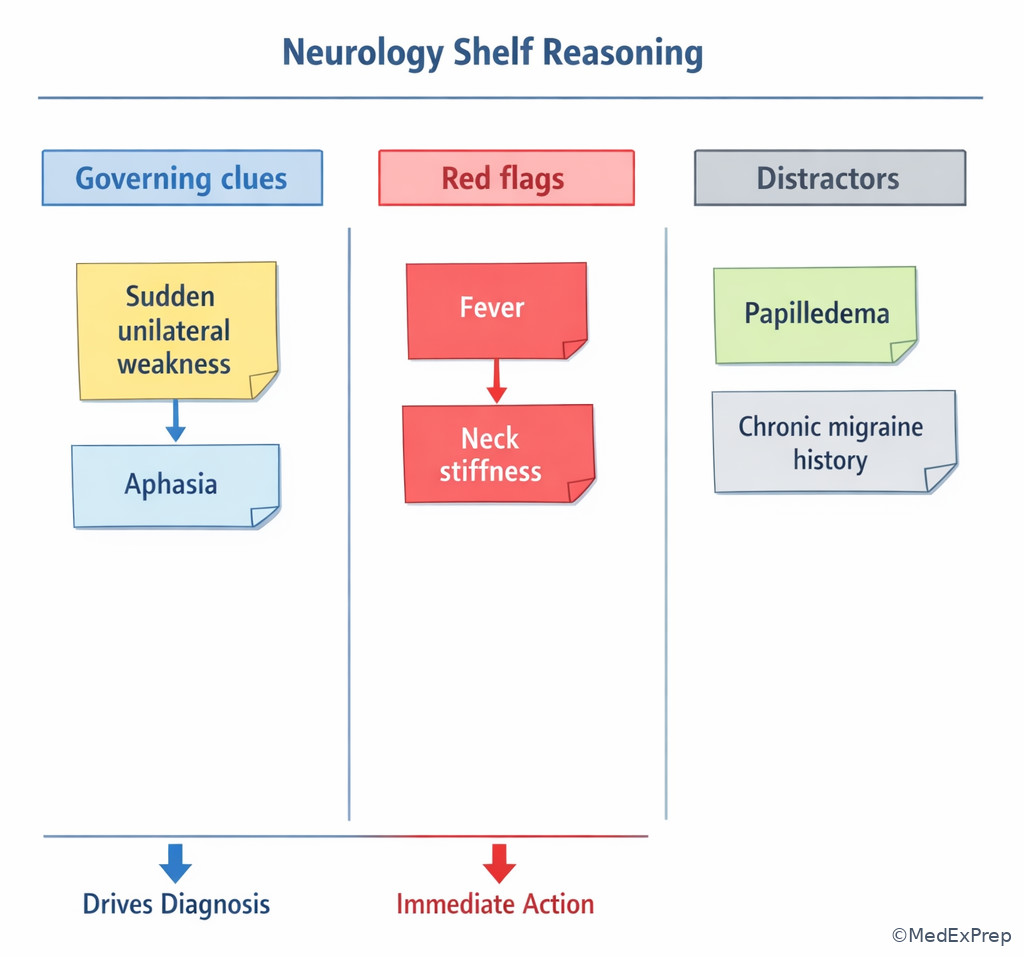
1.1.1.6 Distinguish diagnosis questions from next-best-step and test-selection questions
A Explanation
This is one of the highest-yield conflicts on the shelf: Do I name the disease, or do I choose what to do now? The resolving rule is simple: if the question asks for action, answer with action; if it asks for a test, answer with the first safe test; only give the disease name when diagnosis is asked directly.
WHY THIS IS TESTED: Neurology is full of recognizable syndromes that still require stepwise workup. A classic example is subarachnoid hemorrhage, meningitis, mass lesion, or first seizure. Students can often name the syndrome, but the shelf asks for the next step that changes outcome. In other stems, the best initial test is less sensitive than the eventual confirmatory test, and that difference is exactly what the exam wants.
Choose diagnosis only when the exam wants categorization. Choose initial test when the diagnosis is suspected but workflow matters. Choose next-best-step when treatment or escalation cannot wait. Reject “most sensitive” reflexes if they ignore accessibility, safety, or order of operations. Future lessons on imaging, CSF, and EEG will deepen these distinctions; here you need the frame that tells you which of those tools belongs first.
Forward reference: in Time Course And Patterns, you will learn that abrupt versus subacute onset often determines whether a management pathway must begin before complete testing. See Fig 4 for a practical comparison.
B Worked example
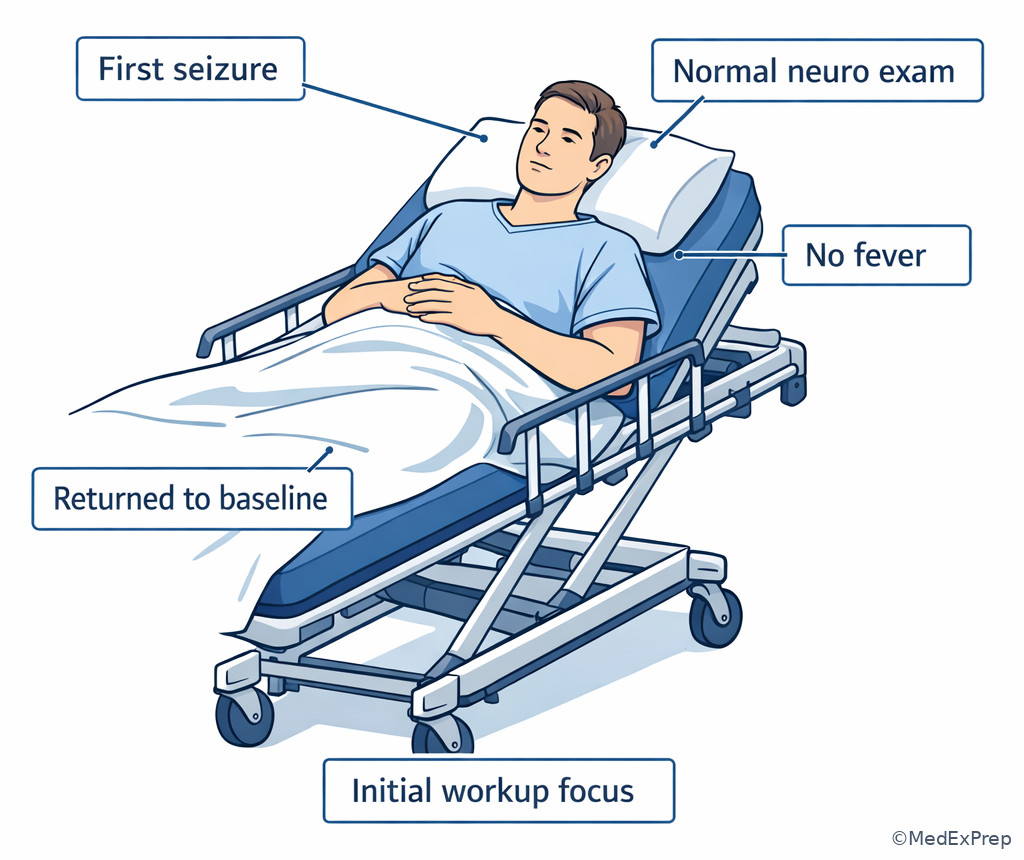
A 23-year-old man with no prior seizures, daily alcohol use, and recent sleep deprivation is brought after a generalized tonic-clonic event. He is now awake, afebrile, and back to baseline. Neurologic examination is normal. Head trauma is denied, but he mentions a remote concussion in high school. The question asks for the best initial evaluation.
Identify task: evaluation/test selection. Extract key facts: first seizure, returned to baseline, no fever or persistent focal deficit. The remote concussion is a tempting but weak detail. Apply rule: a first seizure question usually asks which immediate studies are appropriate, not simply “epilepsy” as the diagnosis. Eliminate distractors: long-term antiseizure medication may be premature; lumbar puncture is not indicated without infectious concern; no action beyond reassurance may miss a serious underlying cause. Verify: the governing issue is initial workup after a first seizure, not naming the seizure type alone.
C Exam trap
D Checkpoint
Question: A 49-year-old woman presents with sudden “worst headache of my life,” vomiting, and photophobia. Noncontrast head CT is negative 8 hours after onset. The final line asks for the best next diagnostic step. Which reasoning frame is correct?
- Name migraine because CT is negative — tempting because headache and photophobia fit migraine, but wrong because the thunderclap pattern keeps hemorrhage on the table despite a negative CT.
- Choose the next test in the subarachnoid hemorrhage workup sequence — correct because the stem asks for next diagnostic step, not most likely diagnosis alone.
- Jump directly to long-term aneurysm management — tempting because SAH raises aneurysm concerns, but wrong because treatment planning follows diagnostic confirmation and specialist evaluation.
- Localize to posterior circulation first — tempting because severe headache can reflect posterior pathology, but wrong because localization is not the asked task.
- The best initial test is not always the most ___ test.
- True or False: If the stem asks for “most appropriate next step,” a disease name is usually sufficient.
- In a dangerous presentation, action outranks diagnostic ___.
Exam takeaway: Use the final line and urgency clues to decide whether to name the disease, order a study, or act immediately.
flowchart TD
A[Recognize syndrome] --> B{What is asked?}
B -->|Diagnosis| C[Name likely disorder]
B -->|Best initial test| D[Choose first safe study]
B -->|Confirmatory test| E[Choose definitive study after initial step]
B -->|Most appropriate next step| F{Danger present?}
F -->|Yes| G[Stabilize or treat immediately]
F -->|No| H[Proceed with stepwise workup] 1.1.1.7 Integration: recognize emergency stems that override routine workup
A Explanation
The final foundational integration skill is deciding when urgent stabilization or escalation overrides ordinary diagnostic sequencing. The conflict is: Do I keep refining the differential, or has the stem crossed into emergency territory? The single rule: when there is an immediately dangerous neurologic process, the answer is the action that prevents irreversible harm first.
WHY THIS IS TESTED: Neurology shelf questions heavily reward early recognition of emergencies. Common emergency buckets are acute ischemic stroke, status epilepticus, bacterial meningitis/encephalitis, spinal cord compression, increased intracranial pressure/mass effect, and rapidly declining consciousness. In these stems, delay is the main error.
Choose emergency framing if you see airway risk, persistent seizure, sudden focal deficit with known onset, fever plus altered mental status, papilledema with focal deficit, or acute bilateral leg weakness with bladder involvement. Reject slower outpatient reasoning. Also reject the instinct to obtain every confirmatory study before starting standard therapy when the disease is time-sensitive and treatment can be initiated safely within team-based care.
This is not asking you to function beyond student scope. On the shelf, the right answer is often to initiate standard first responses, obtain the appropriate urgent initial study, and promptly notify or consult the supervising team. See Fig 5.
B Worked example
A 55-year-old man with metastatic prostate cancer, chronic constipation from opioids, and hypertension presents with 2 days of worsening mid-back pain and new difficulty walking. Today he has bilateral leg weakness, decreased pinprick sensation below the nipples, and urinary retention. He also reports a low-grade fever after a recent viral illness. The question asks for the most appropriate next step.
Identify task: emergency next-best-step. Extract key facts: cancer history, progressive bilateral weakness, sensory level, bladder dysfunction. The viral illness and low-grade fever are tempting distractors toward myelitis, but the compressive red flags dominate. Apply rule: suspected spinal cord compression requires urgent MRI and emergent escalation; do not delay for outpatient follow-up or broad rheumatologic workup. Eliminate distractors: lumbar puncture risks delay and does not address compression; physical therapy referral is unsafe; simple pain control misses a neurologic emergency. Verify: the correct answer is an urgent action pathway, not a descriptive diagnosis alone.
C Exam trap
D Checkpoint
Question: Which presentation most clearly converts a routine diagnostic stem into an emergency-action stem?
- Progressive distal numbness over 8 months in a patient with diabetes — tempting because neuropathy is common, but wrong because the time course is chronic and lacks immediate danger.
- Intermittent unilateral hand paresthesia worsened by typing — tempting because focal symptoms may raise localization questions, but wrong because this suggests entrapment and not emergency deterioration.
- Fever, neck stiffness, and confusion in a patient with severe headache — correct because this combination signals possible meningitis/encephalitis requiring urgent treatment-oriented evaluation.
- Resting tremor and slowness over 1 year — tempting because neurologic disability matters, but wrong because it is not an emergency-action pattern.
Exam takeaway: When a stem contains red-flag neurologic emergencies, immediate stabilization or urgent workup supersedes routine differential refinement.
flowchart TD
A[Neurologic presentation] --> B{Emergency red flag?}
B -->|Sudden focal deficit| C[Stroke pathway]
B -->|Ongoing seizure or persistent impaired awareness| D[Seizure stabilization pathway]
B -->|Fever + AMS + meningismus| E[Meningitis/encephalitis pathway]
B -->|Papilledema/focal deficit/mass effect signs| F[Image before LP; ICP concern]
B -->|Back pain + weakness + bladder symptoms| G[Cord compression pathway]
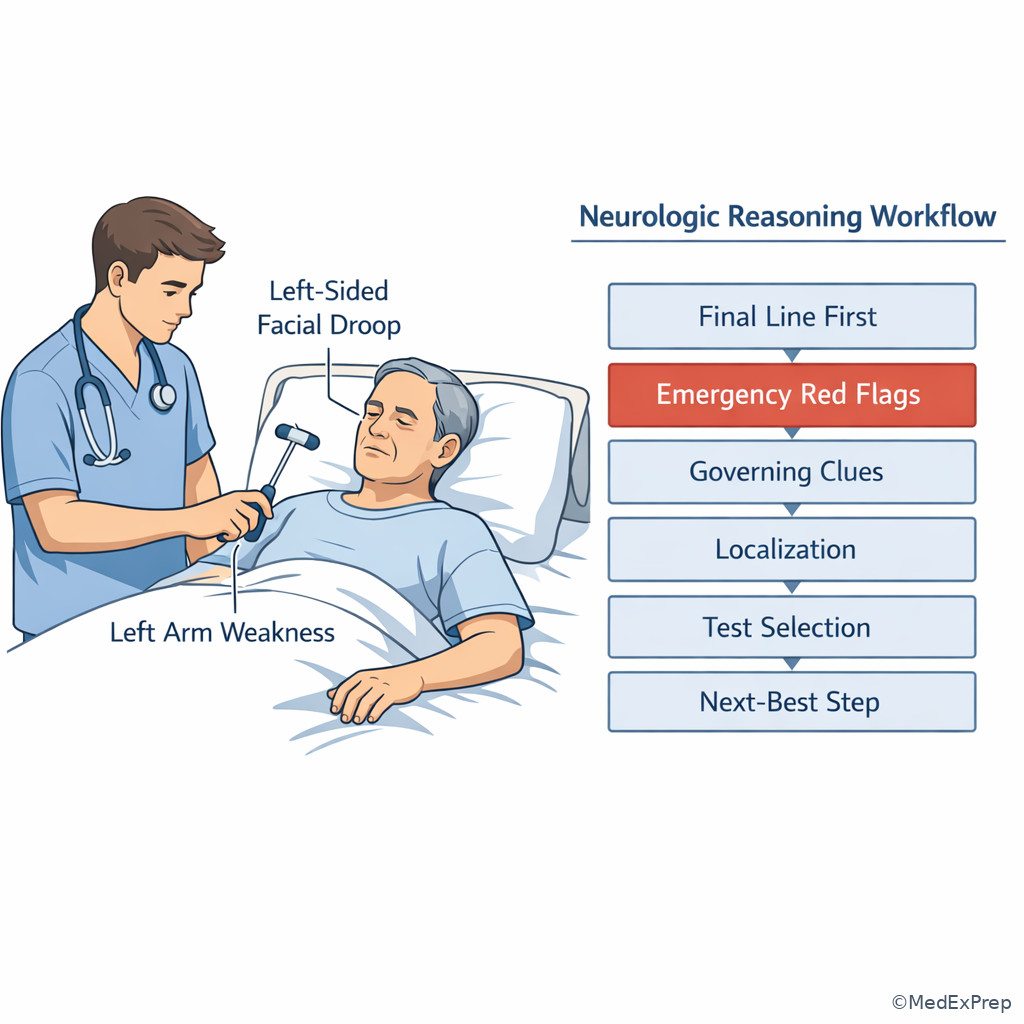
B -->|No| H[Routine diagnostic workflow] Exam takeaway: Sudden face-arm-language deficits with known onset should immediately trigger stroke-oriented evaluation.
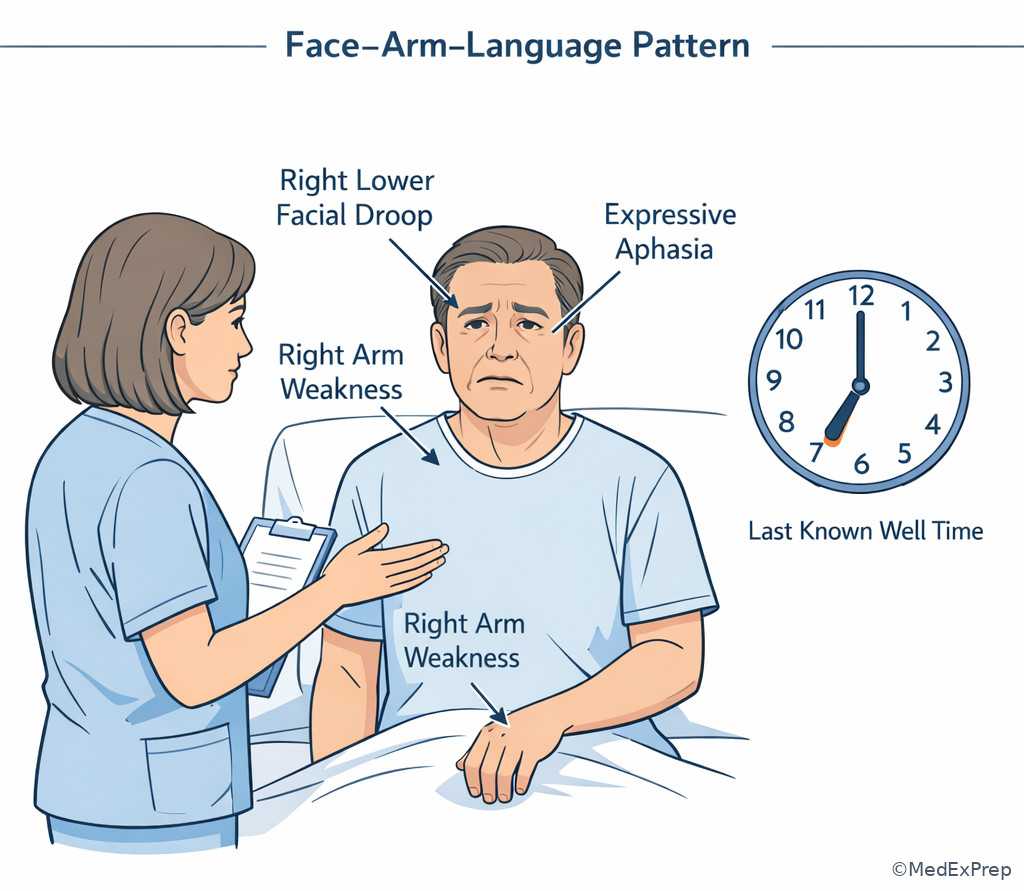
Exam takeaway: Fever, neck stiffness, and altered mental status shift a headache stem toward urgent infectious evaluation and treatment.
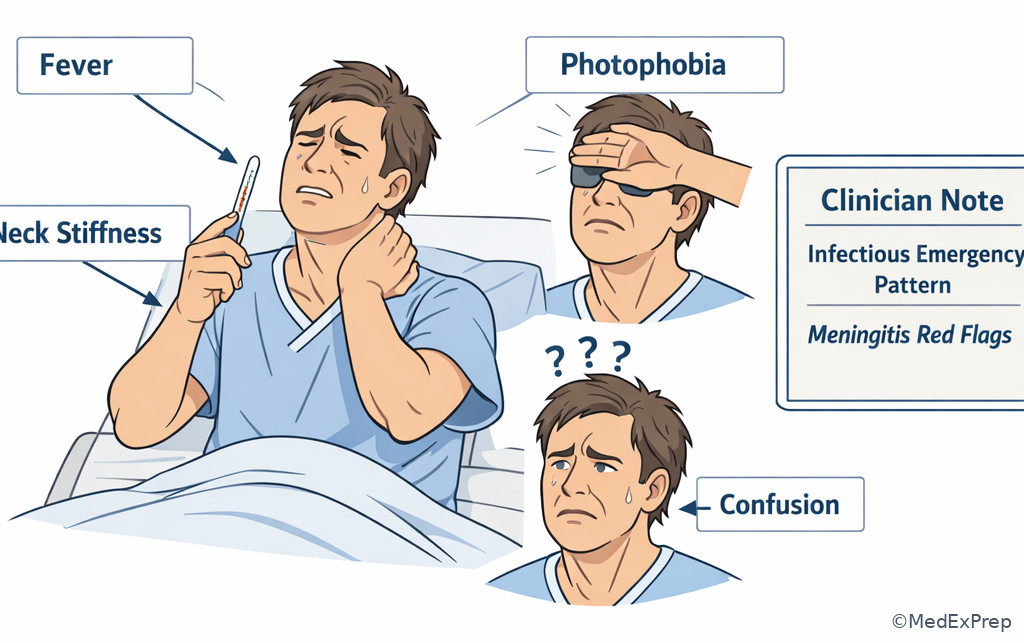
Exam takeaway: Bilateral weakness, a sensory level, and bladder dysfunction should be recognized as a compressive cord emergency until proven otherwise.
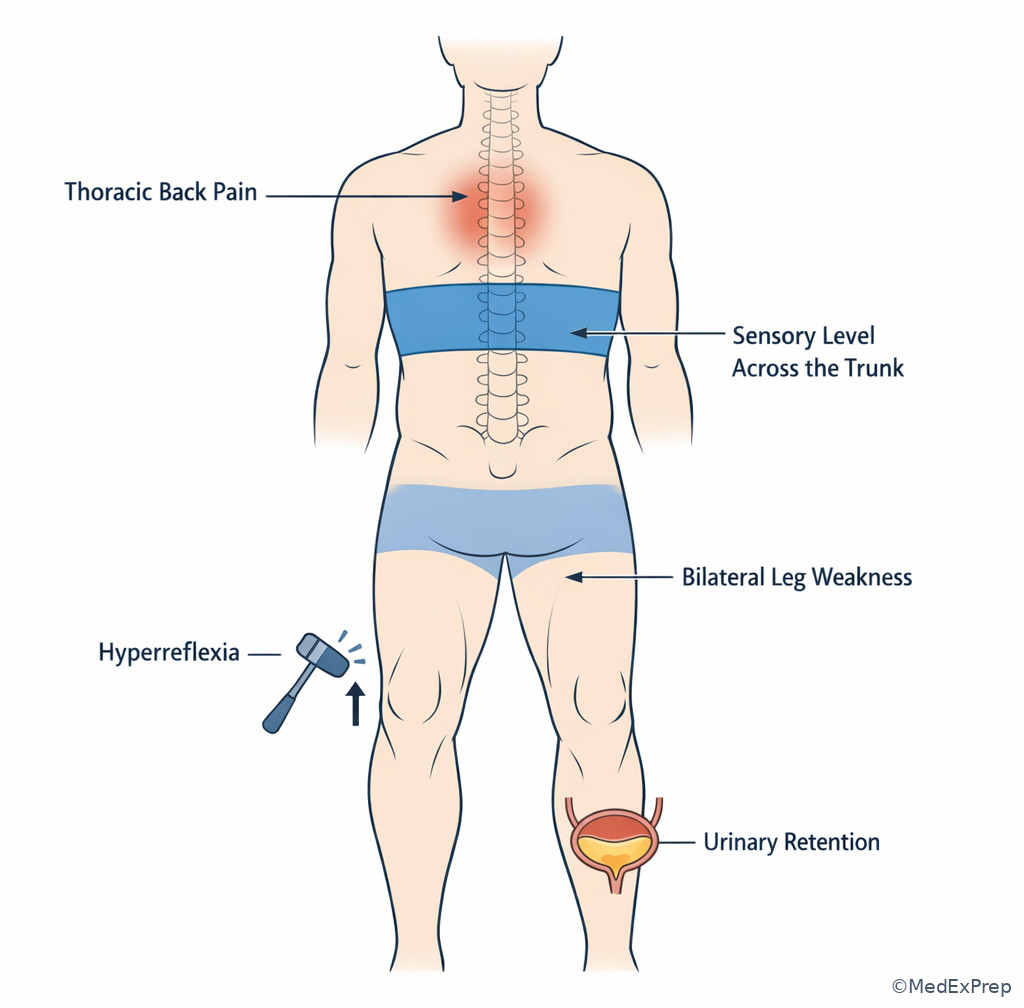
Exam takeaway: Papilledema with focal deficits suggests increased intracranial pressure or mass effect and may change test sequencing before lumbar puncture.
Exam takeaway: A first seizure question usually tests initial evaluation and safety sequencing rather than immediate chronic-label management.
| Question family | What you should think | Common error | Discriminator |
|---|---|---|---|
| Most likely diagnosis | Name the syndrome/process | Ordering tests instead of answering diagnosis | Final line asks for disease label |
| Most likely site of lesion | Map findings to anatomy | Choosing disease name without localizing | Exam findings outweigh epidemiology |
| Best initial test | First safe and useful study | Picking most sensitive but not first | Workflow sequencing matters |
| Confirmatory test | Study that secures diagnosis | Repeating the screening test | Diagnosis is suspected but not yet confirmed |
| Most appropriate next step | Action now | Naming diagnosis only | Urgency and management priority |
| Most important to monitor | Complication or toxicity risk | Choosing unrelated routine labs | Treatment or syndrome-specific hazard |
| Pattern | Looks similar | Why it tempts | Single clue that separates |
|---|---|---|---|
| Acute ischemic stroke workflow | Focal seizure with Todd paralysis | Both can present with unilateral weakness | Sudden persistent focal deficit with clear vascular onset and last-known-well timing |
| Meningitis/encephalitis emergency | Migraine | Headache, photophobia, nausea overlap | Fever, meningismus, or altered mental status |
| Mass effect/increased ICP | Idiopathic headache | Both can cause severe headache and vomiting | Papilledema or focal neurologic deficit |
| Spinal cord compression | Radiculopathy | Back pain and weakness overlap | Bilateral deficits, sensory level, or bladder dysfunction |
| First seizure evaluation | Immediate chronic epilepsy treatment | Convulsion feels definitive | Question asks for initial workup after first event |
| Toxic-metabolic encephalopathy | Primary psychiatric disorder | Agitation or confusion can look behavioral | Fluctuating attention and medical precipitants |
| Red-flag clue | Likely task shift | What to reject |
|---|---|---|
| Known last-known-well with acute focal deficit | Routine diagnosis -> stroke next step | EEG-first or migraine-only reasoning |
| Persistent convulsions or failure to recover | Diagnosis -> seizure stabilization | Outpatient workup framing |
| Fever + neck stiffness + altered mental status | Headache differential -> urgent infectious pathway | Benign headache treatment alone |
| Papilledema or focal deficit with headache | Headache diagnosis -> imaging-safety pathway | Immediate LP without considering mass effect |
| Back pain + sensory level + urinary retention | Back pain workup -> cord compression emergency | Conservative outpatient management |
| Rapidly declining consciousness | Etiology refinement -> airway and emergency escalation | Detailed localization before stabilization |
Exam Traps & Differentiators
Most common wrong answer and why: naming a diagnosis when the exam asks for the next best step. This is tempting because neurology syndromes are pattern-rich and satisfying to recognize. The exam, however, often scores whether you know what to do after recognizing the pattern.
- Stroke vs seizure mimic: tempting because both can cause unilateral deficits; eliminate seizure-first reasoning when there is a precise vascular onset and persistent focal exam.
- Migraine vs meningitis: tempting because headache, photophobia, and nausea overlap; eliminate migraine when fever, neck stiffness, or altered mental status appears.
- Radiculopathy vs cord compression: tempting because back pain is common; eliminate radiculopathy when a sensory level, bilateral deficits, or bladder symptoms are present.
- Psychiatric cause vs toxic-metabolic encephalopathy: tempting because agitation and confusion can be behavioral; eliminate primary psychiatric framing when attention fluctuates and medical triggers are present.
- Most sensitive test vs best initial test: tempting because students memorize definitive studies; eliminate the confirmatory test if another study must safely come first.
Looks similar but isn't:
| If the stem feels like... | But the exam may actually be testing... | Discriminating clue |
|---|---|---|
| A disease-recognition question | Next-best-step management | Final line asks for action, not diagnosis |
| A broad headache differential | Imaging before LP | Papilledema or focal deficit |
| A seizure classification vignette | Emergency stabilization | Ongoing seizure or no recovery of consciousness |
| A chronic back pain complaint | Cord compression emergency | Urinary retention or sensory level |
| A neuroanatomy question | Time-sensitive stroke action | Known last-known-well and acute focal deficit |
If the stem says ___, think ___:
- “Most appropriate next step” → what must happen now, not what the diagnosis eventually will be.
- “Best initial test” → first safe study in the sequence, not the fanciest or most definitive.
- “Most likely site of lesion” → neuro exam and crossed/cord/cortical clues, not epidemiology alone.
- “Requires immediate clarification” → find the missing red-flag detail that changes urgency.
- Sudden focal deficit with onset time → stroke workflow until proven otherwise.
- Fever + AMS + meningismus → infectious emergency logic.
Related future traps from neighboring topics: Time Course And Patterns will make sudden vs subacute vs chronic onset a major differentiator; Localization Decision Rules will make cortical signs, crossed findings, and sensory levels key discriminators when several diagnoses appear plausible.
Algorithm / Approach
Exam takeaway: A structured bedside workflow helps convert noisy neurologic stems into task-focused decisions.
Rapid Review
- Final line → determines the rulebook more reliably than the body of the stem.
- Most likely diagnosis → answer with a disease/process, not a test or therapy.
- Best initial test → first safe study, not necessarily the definitive study.
- Most appropriate next step → action now, especially if delay harms.
- Sudden focal deficit → stroke workflow discriminator is onset time plus persistent findings.
- Fever + AMS + meningismus → infectious emergency, not routine headache reasoning.
- Papilledema + focal deficit → think mass effect/ICP concern before LP.
- Back pain + sensory level → cord process, not isolated radiculopathy.
- Chronic comorbidity → distractor unless it explains current timeline and exam.
- Noise → vivid detail that does not change urgency, localization, or management.
- Discriminator → single clue that separates the right answer from the closest trap.
- Emergency stem → wrong option is often correct later, just not first.
- Localization question → neuro exam outranks broad epidemiology.
- First seizure → often an initial evaluation stem, not immediate chronic epilepsy management.
Self-check quiz
1. A 64-year-old man with hypertension presents with sudden right-sided weakness and aphasia beginning 30 minutes ago. The final line asks for the most appropriate next step. Which mental framework is most appropriate first?
- Long-term secondary stroke prevention planning
- Acute stroke-oriented evaluation and stabilization
- Outpatient dementia assessment
- Peripheral neuropathy localization
2. A 45-year-old woman with recurrent migraines presents with severe headache, fever, neck stiffness, and confusion. Which clue most strongly changes the task from routine headache diagnosis to urgent management-oriented reasoning?
- History of migraines
- Photophobia
- Fever with altered mental status
- Nausea and vomiting
3. A 27-year-old man with alcohol use disorder and insomnia has a first generalized tonic-clonic seizure. He is now awake, afebrile, and neurologically normal. He mentions a remote sports concussion 10 years ago. The question asks for the best initial evaluation. Which approach is most appropriate?
- Treat immediately as chronic epilepsy without further assessment
- Focus on first-seizure workup rather than jumping to a long-term diagnosis
- Assume psychogenic nonepileptic seizure because he recovered quickly
- Ignore the event because the examination is normal
4. A 58-year-old woman with breast cancer presents with 3 weeks of morning headache, vomiting, and mild left arm weakness. Funduscopic examination shows papilledema. The final line asks for the best initial diagnostic test. Which reasoning rule should dominate?
- Lumbar puncture should come before imaging in all headache evaluations
- Imaging-safety sequencing should come before CSF testing when mass effect is possible
- EEG is the best first study for headaches with vomiting
- Outpatient medication adjustment is the best first step because symptoms are subacute
5. A 70-year-old man with metastatic prostate cancer, diabetes, and chronic low back pain presents with new thoracic pain, bilateral leg weakness, numbness below the chest, and urinary retention. Which clue should most strongly govern your answer?
- History of diabetes suggesting neuropathy
- Chronic low back pain suggesting degenerative disease
- Urinary retention with a sensory level and bilateral weakness
- His age suggesting neurodegeneration
6. A 36-year-old woman with migraine history, oral contraceptive use, and anxiety develops flashing lights followed 20 minutes later by persistent left arm weakness and expressive language difficulty. Blood pressure is 162/94 mm Hg, glucose is normal, and symptoms began 50 minutes ago. Which is the most appropriate next step?
- Treat as migraine aura with abortive therapy and observe
- Urgent stroke-oriented evaluation despite the positive visual symptoms
- Schedule outpatient EEG for possible focal seizure
- Reassure because anxiety can cause subjective weakness
7. A 48-year-old man with HIV infection not on therapy presents with headache, fever, and confusion. Examination shows neck stiffness and a left abducens palsy. He is somnolent but arousable. Which task recognition error would be most dangerous?
- Treating this as a routine outpatient headache classification problem
- Recognizing possible CNS infection with mass-effect risk and urgent evaluation needs
- Considering that neuroimaging sequence may matter before lumbar puncture
- Escalating promptly to the supervising team
8. A 62-year-old woman with atrial fibrillation on anticoagulation has abrupt vertigo, vomiting, dysarthria, and inability to walk. She also has chronic diabetic neuropathy and a remote history of benign positional vertigo. The final line asks for the most likely site of lesion. Which reasoning move is best?
- Prioritize her chronic neuropathy because gait symptoms are present
- Answer with a management plan because anticoagulation increases urgency
- Use focal examination findings to localize, because the question asks for lesion site
- Assume peripheral vertigo because she had BPPV in the past
Answer key
1.1.1.8 1. Answer: B
A. Long-term secondary stroke prevention planning is tempting because atrial fibrillation, hypertension, or other vascular risk factors often bring preventive therapy to mind. It is incorrect for this specific scenario because the patient has an acute focal deficit within a known time window, so immediate stroke evaluation comes first. The single stem clue is sudden onset 30 minutes ago. Source: AHA/ASA acute ischemic stroke guidance.
B. Acute stroke-oriented evaluation and stabilization is correct because abrupt focal neurologic deficit with a clear last-known-well time is a stroke-workflow pattern until proven otherwise. This answer fits the stem’s task wording, “most appropriate next step,” and matches mechanism-to-treatment logic: urgent identification of ischemia or hemorrhage changes immediate options. The single stem clue is acute aphasia plus hemiparesis within 30 minutes. Source: AHA/ASA guidelines; Harrison’s Principles of Internal Medicine.
C. Outpatient dementia assessment is tempting only because aphasia can be confused with chronic language dysfunction in less careful reading. It is incorrect because dementia is chronic and progressive, not a sudden focal event. The single stem clue is the abrupt onset. Source: Harrison’s.
D. Peripheral neuropathy localization is tempting because weakness can appear in neuromuscular disorders. It is incorrect because neuropathy does not produce acute aphasia, which localizes centrally. The single stem clue is aphasia. Source: First Aid for the USMLE; Harrison’s.
1.1.1.9 2. Answer: C
A. History of migraines is tempting because it offers a familiar benign framework for headache. It is incorrect because past migraines do not explain the dangerous infectious red flags in the current presentation. The single stem clue against it is confusion with fever. Source: Harrison’s; UpToDate meningitis review.
B. Photophobia is tempting because it is classically associated with meningitis and migraine alike. It is incorrect as the main discriminator because photophobia alone does not establish emergency shift. The single stem clue that matters more is altered mental status. Source: Harrison’s.
C. Fever with altered mental status is correct because these findings transform the stem from routine headache categorization into urgent infectious CNS reasoning. Mechanistically, fever plus meningeal signs raise concern for meningitis or encephalitis, where delayed therapy worsens outcomes. The single stem clue is fever plus confusion. Source: IDSA meningitis guidance; Harrison’s.
D. Nausea and vomiting is tempting because severe headache syndromes commonly include them. It is incorrect because they are nonspecific and do not independently force emergent infectious management. The single stem clue missing here is altered mental status. Source: Harrison’s.
1.1.1.10 3. Answer: B
A. Treat immediately as chronic epilepsy without further assessment is tempting because a generalized tonic-clonic seizure feels definitive and alarming. It is incorrect because one seizure does not automatically equal established epilepsy, and the stem specifically asks for initial evaluation. The single stem clue is first seizure with return to baseline. Source: Harrison’s; UpToDate first seizure evaluation.
B. Focus on first-seizure workup rather than jumping to a long-term diagnosis is correct because the task is the best initial evaluation. Mechanistically, first seizure management requires assessment for provoking causes and structural lesions before chronic labeling or long-term therapy decisions. The single stem clue is “best initial evaluation.” Source: Harrison’s; First Aid.
C. Assume psychogenic nonepileptic seizure because he recovered quickly is tempting because rapid recovery can occur in non-epileptic events. It is incorrect because generalized tonic-clonic seizures may also resolve with return to baseline, and the stem provides no hallmark PNES features. The single stem clue is witnessed generalized seizure activity without alternative defining features. Source: Harrison’s.
D. Ignore the event because the examination is normal is tempting because a normal post-event exam is reassuring. It is incorrect because a first unprovoked or possibly provoked seizure still requires evaluation. The single stem clue is first seizure, not chronic stable disease. Source: Harrison’s; UpToDate.
1.1.1.11 4. Answer: B
A. Lumbar puncture should come before imaging in all headache evaluations is tempting because CSF analysis is important in some CNS diagnoses. It is incorrect here because possible increased intracranial pressure or mass effect may make immediate LP unsafe. The single stem clue is papilledema with focal weakness. Source: Harrison’s; UpToDate increased ICP evaluation.
B. Imaging-safety sequencing should come before CSF testing when mass effect is possible is correct because papilledema, focal deficits, and subacute progression suggest a mass lesion or elevated intracranial pressure. The mechanism-to-treatment logic is safety sequencing: image first, then decide whether LP is appropriate. The single stem clue is papilledema. Source: Harrison’s; IDSA/UpToDate CNS infection diagnostic sequencing principles.
C. EEG is the best first study for headaches with vomiting is tempting because headaches can coexist with seizures or cortical irritation. It is incorrect because EEG does not evaluate suspected mass effect or raised intracranial pressure as the primary issue. The single stem clue is focal arm weakness. Source: Harrison’s.
D. Outpatient medication adjustment is the best first step because symptoms are subacute is tempting because the course is measured in weeks rather than minutes. It is incorrect because subacute progression with papilledema and focal deficit is still high risk and requires urgent imaging. The single stem clue is papilledema, not merely chronicity. Source: Harrison’s.
1.1.1.12 5. Answer: C
A. History of diabetes suggesting neuropathy is tempting because diabetic neuropathy is common and can cause lower-extremity symptoms. It is incorrect because polyneuropathy does not produce a thoracic sensory level and urinary retention in this pattern. The single stem clue is the sensory level. Source: Harrison’s.
B. Chronic low back pain suggesting degenerative disease is tempting because back pain is frequent and may bias readers toward benign explanations. It is incorrect because the new neurologic findings are bilateral, progressive, and associated with bladder dysfunction, which exceeds simple degenerative pain. The single stem clue is urinary retention. Source: Harrison’s; UpToDate spinal cord compression.
C. Urinary retention with a sensory level and bilateral weakness is correct because this combination localizes to spinal cord pathology and strongly suggests compressive myelopathy in the context of malignancy. Mechanistically, cord compression threatens irreversible deficit if not urgently recognized. The single stem clue is bladder dysfunction plus sensory level. Source: Harrison’s; oncology/spinal cord compression guidance.
D. His age suggesting neurodegeneration is tempting only in a vague way because older adults may develop gait disorders. It is incorrect because neurodegenerative disease is not typically this acute or associated with thoracic sensory level and urinary retention. The single stem clue is rapid progression over days. Source: Harrison’s.
1.1.1.13 6. Answer: B
A. Treat as migraine aura with abortive therapy and observe is tempting because flashing lights and migraine history point toward aura. It is incorrect in this specific scenario because the patient has persistent focal weakness and language deficit with recent onset, which requires stroke-oriented evaluation. The single stem clue is persistent expressive language difficulty, not transient aura alone. Source: AHA/ASA stroke guidance; Harrison’s.
B. Urgent stroke-oriented evaluation despite the positive visual symptoms is correct because migraine aura is a classic stroke mimic, yet persistent focal deficits with a vascularly relevant time course must be treated as possible stroke first. Mechanistically, the risk of missing reperfusion opportunity outweighs premature mimic closure. The single stem clue is persistent aphasia and arm weakness 50 minutes after onset. Source: AHA/ASA guidelines; Harrison’s.
C. Schedule outpatient EEG for possible focal seizure is tempting because positive visual symptoms can occur in focal seizures. It is incorrect because outpatient workup is unsafe when acute stroke remains possible now. The single stem clue is the known acute onset within an emergency window. Source: AHA/ASA; Harrison’s.
D. Reassure because anxiety can cause subjective weakness is tempting because anxiety history may bias interpretation. It is incorrect because objective language dysfunction and focal weakness are not explained away by anxiety. The single stem clue is expressive language deficit. Source: Harrison’s.
1.1.1.14 7. Answer: A
A. Treating this as a routine outpatient headache classification problem is correct as the most dangerous task-recognition error because the presentation suggests CNS infection with possible increased intracranial pressure or focal involvement, where delay can be catastrophic. The mechanism-to-treatment logic is that headache plus fever plus confusion and cranial neuropathy demands urgent inpatient-style evaluation and treatment thinking. The single stem clue is fever with confusion and abducens palsy in an immunocompromised patient. Source: Harrison’s; IDSA/UpToDate meningitis/encephalitis evaluation.
B. Recognizing possible CNS infection with mass-effect risk and urgent evaluation needs is tempting to challenge because it sounds more complex, but it is actually appropriate reasoning, not an error. The single stem clue supporting it is immunocompromise with focal neurologic findings. Source: Harrison’s.
C. Considering that neuroimaging sequence may matter before lumbar puncture is tempting to reject if you overlearn “LP for meningitis,” but it is not the dangerous error here. With focal deficits or possible increased intracranial pressure, imaging sequence can matter. The single stem clue is cranial nerve palsy and somnolence. Source: IDSA principles; Harrison’s.
D. Escalating promptly to the supervising team is tempting only if one misreads the student role. It is incorrect as an “error” because escalation is exactly appropriate in this emergency setting. The single stem clue is the patient’s somnolence with infectious red flags. Source: clerkship-level emergency practice norms; Harrison’s.
1.1.1.15 8. Answer: C
A. Prioritize her chronic neuropathy because gait symptoms are present is tempting because diabetic neuropathy is common and can affect balance. It is incorrect because abrupt dysarthria and inability to walk point to an acute central process, not chronic peripheral neuropathy. The single stem clue is sudden dysarthria. Source: Harrison’s.
B. Answer with a management plan because anticoagulation increases urgency is tempting because anticoagulation heightens concern for hemorrhage and urgency. It is incorrect for this exact question because the stem explicitly asks for the most likely site of lesion. The single stem clue is the final line asking for lesion site. Source: Harrison’s.
C. Use focal examination findings to localize, because the question asks for lesion site is correct. Mechanistically, lesion localization relies on symptom pattern and neuro exam; even when the case is urgent, you must answer the specific task asked. The single stem clue is “most likely site of lesion.” Source: Harrison’s; neurology localization principles.
D. Assume peripheral vertigo because she had BPPV in the past is tempting because vertigo history can anchor the reader. It is incorrect because abrupt inability to walk and dysarthria strongly suggest central involvement. The single stem clue is dysarthria. Source: Harrison’s.
Keep going with the full Neurology Shelf Prep Course (Neuro Shelf)
You just studied the way members do, in the same lesson interface. Full access unlocks every lesson, the question bank and flashcards for a full year.
One payment · 1 year of access · No auto-renewal