1.1.1 - ED Triage And Acuity
ED Triage And Acuity
What you'll learn
- RESUSCITATION: Initial prioritization -> decide who needs immediate bed placement, monitoring, and team escalation.
- PRESENTATION: Undifferentiated patient -> recognize acuity from vital signs, appearance, and high-risk complaints before diagnosis is complete.
- SUBSKILL: Triage reasoning -> separate unstable, potentially unstable, and stable-but-high-risk patients.
- DISPOSITION/ESCALATION: Early safety actions -> identify when to notify the senior resident or attending immediately.
- DATA: Vital sign interpretation -> use abnormal numbers in context instead of anchoring on a single complaint.
- Domain: Resuscitation principles -> Triage and initial priorities -> ED acuity recognition
- Domain: Clinical decision-making -> Best initial step -> prioritize life threats before definitive diagnosis
- Domain: Disposition and consultation triggers -> immediate escalation for unstable patients
Why it matters
- The shelf repeatedly tests the safest best next step, and triage is where that decision starts.
- Many wrong answers happen because the learner pursues the diagnosis before recognizing instability, occult shock, or airway risk.
- A patient can look deceptively well while having a high-acuity complaint; triage depends on risk pattern recognition, not comfort level alone.
- Correct triage changes everything that follows: room placement, monitoring, pathway activation, test sequencing, reassessment frequency, and disposition planning.
Key Terms & Must-Know Facts
1.1.1.1 Key terms
- Triage: rapid sorting of patients by urgency and resource need.
- Acuity: immediate risk of deterioration, morbidity, or death.
- Unstable patient: threatened airway, inadequate breathing, shock, severe altered mental status, or active life threat.
- Occult shock: inadequate perfusion despite a blood pressure that may still appear normal.
- Time-sensitive complaint: presentation where delay worsens outcome even before diagnosis is confirmed.
- Immediate bed placement: patient requires monitored setting and rapid physician evaluation.
- Reassessment: repeat vital signs and focused exam after any change or intervention.
- Red flag symptom: symptom pattern associated with serious disease despite nonspecific complaint.
- High-risk vital sign: abnormal measurement suggesting physiologic instability.
- Compensated state: early illness where perfusion is maintained by physiologic reserve.
- Decompensation: loss of compensation with obvious instability.
- Escalation: prompt notification of senior resident, attending, or pathway activation.
1.1.1.2 Must-know facts
- In the ED, sick-not-sick comes before exact diagnosis.
- Appearance + mental status + work of breathing + perfusion often outperform the chief complaint alone.
- Normal blood pressure does not exclude shock.
- Tachycardia, tachypnea, hypoxia, fever, hypothermia, and altered mental status are triage clues, not background noise.
- High-risk complaints include chest pain, dyspnea, syncope, focal neurologic deficit, GI bleeding, severe trauma, poisoning, and vaginal bleeding in pregnancy.
- Elderly, pregnant, immunocompromised, anticoagulated, and pediatric patients may have subtle early findings despite serious disease.
- A distracting history item does not lower acuity when life-threatening signs are present.
- On shelf questions, if the stem suggests instability, the next step is usually resuscitation, monitoring, bedside testing, or escalation rather than outpatient-style workup.
Core content
Exam takeaway: Use this sequence to decide whether to stabilize first, monitor urgently, or proceed with standard evaluation.
flowchart TD
A[Patient arrives] --> B{Immediate threat?}
B -->|Airway compromise| C[Resuscitation bay and immediate escalation]
B -->|Severe breathing problem| C
B -->|Shock or AMS| C
B -->|No obvious instability| D{High-risk complaint or dangerous vitals?}
D -->|Yes| E[Monitored bed and rapid physician evaluation]
D -->|No| F[Standard evaluation with reassessment]
E --> G[Repeat vitals and focused reassessment]
C --> G Exam takeaway: First-look findings such as work of breathing, skin perfusion, and mental status can up-triage a patient before any test returns.
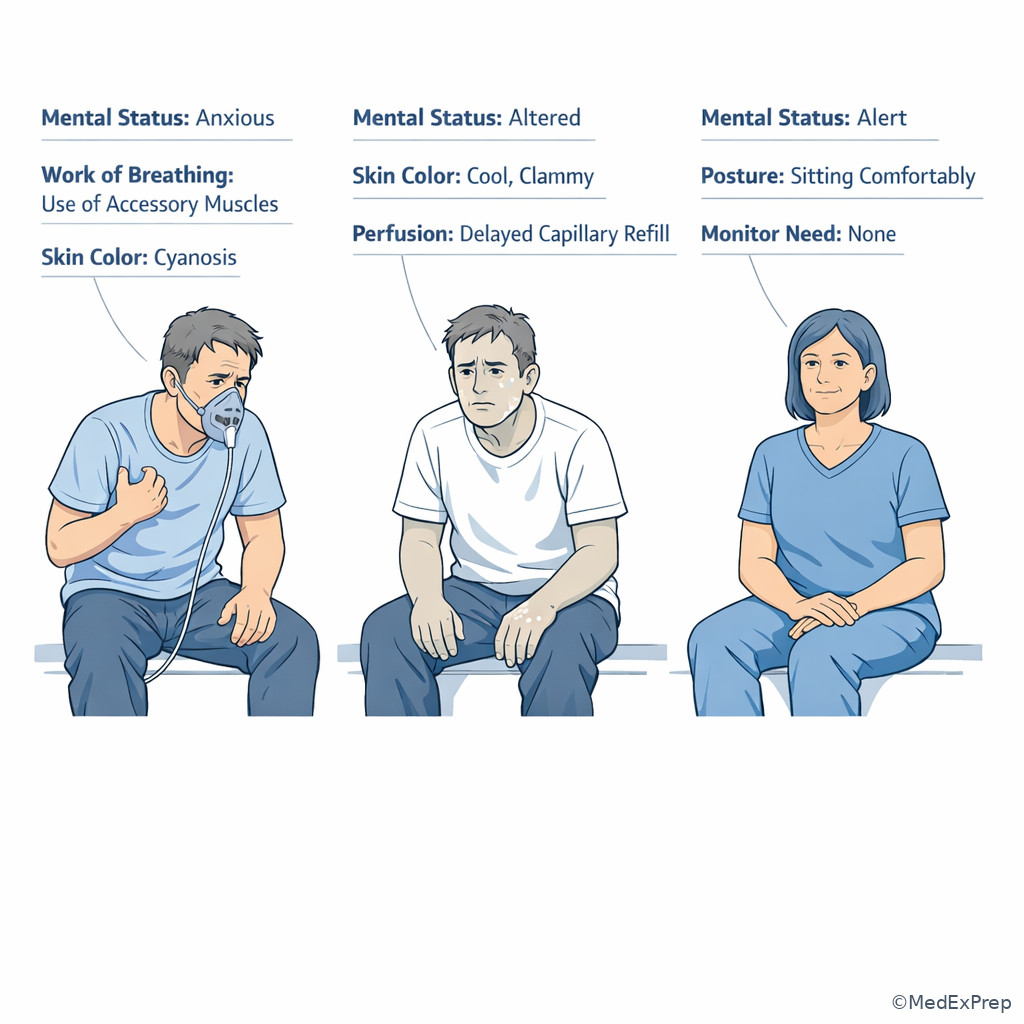
Exam takeaway: Certain chief complaints should immediately trigger a high-acuity mindset even before the diagnosis is confirmed.
flowchart LR
A[High-risk complaint] --> B[Chest pain]
A --> C[Dyspnea]
A --> D[Syncope]
A --> E[Focal neurologic deficit]
A --> F[GI bleed]
A --> G[Pregnancy bleeding]
B --> H[Monitor ECG vitals]
C --> H
D --> H
E --> I[Stroke pathway consideration]
F --> J[Shock assessment]
G --> K[Ectopic concern]
Exam takeaway: Trending abnormal vital signs in context is more testable than memorizing a single cutoff in isolation.
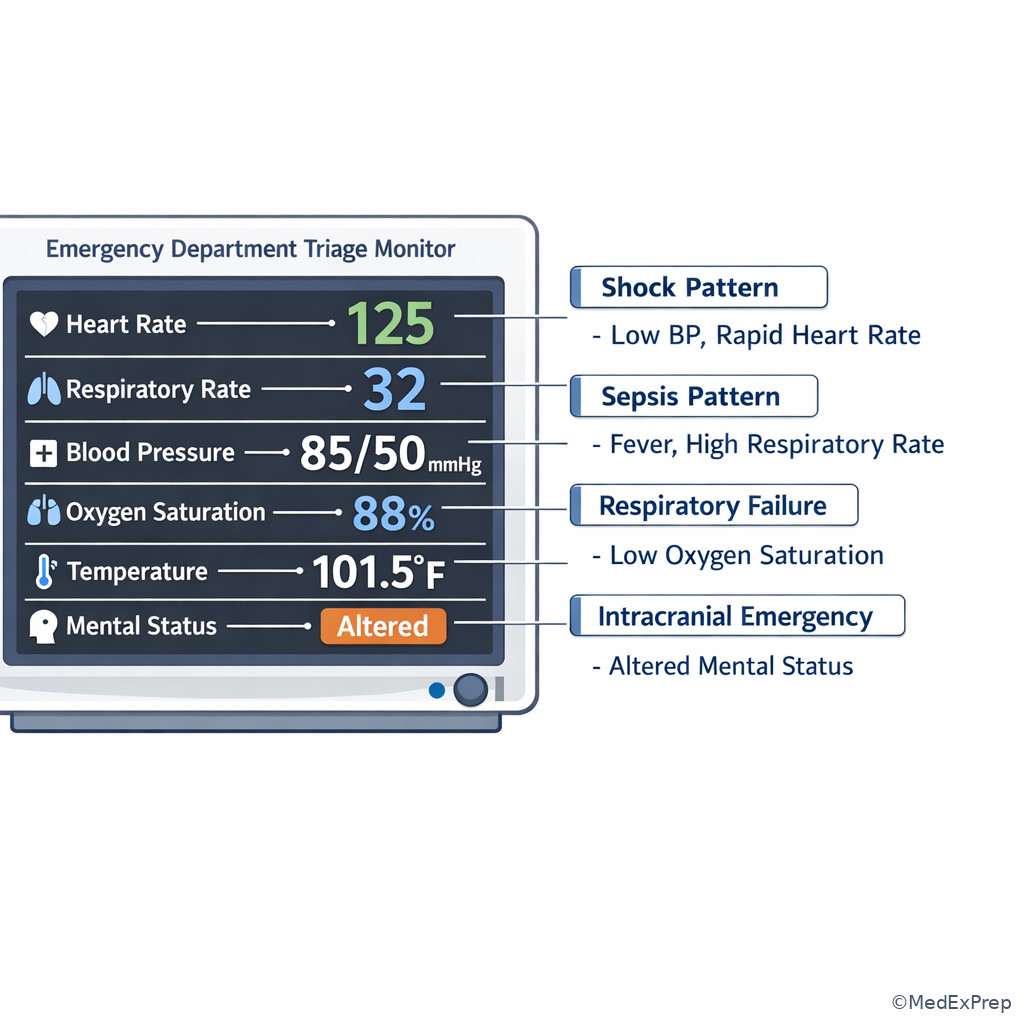
Exam takeaway: Older adults, pregnant patients, children, and immunocompromised patients may have subtle findings despite serious pathology.
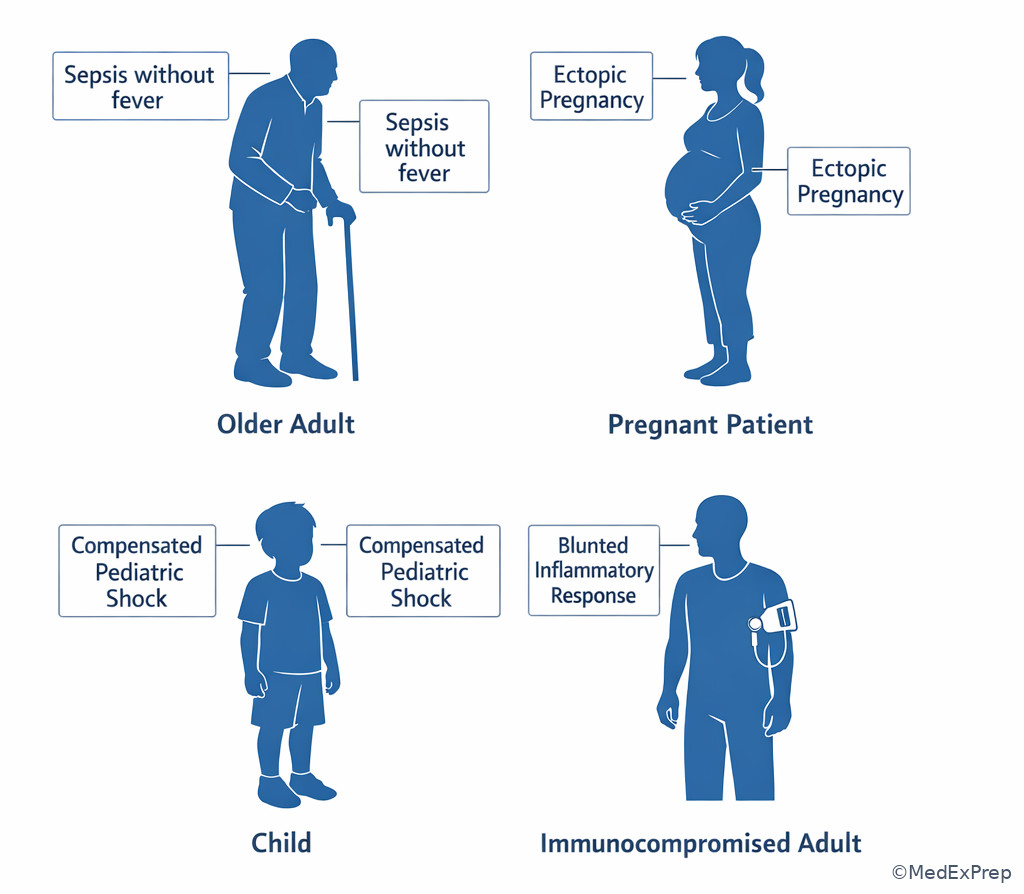
Exam takeaway: When instability or a pathway-triggering complaint appears, notify the senior resident or attending immediately while ongoing stabilization continues.
flowchart TD
A[Triage finding] --> B{Unstable?}
B -->|Yes| C[Immediate attending or senior notification]
B -->|No| D{Trigger pathway?}
D -->|Stroke STEMI trauma sepsis concern| E[Activate pathway per local process]
D -->|No| F[Urgent rooming and focused workup]
C --> G[ABCs monitor IV access bedside tests]
E --> G
F --> H[Reassess for deterioration] Exam takeaway: Monitors, repeat vitals, and bedside glucose are common early next steps in high-acuity undifferentiated patients.
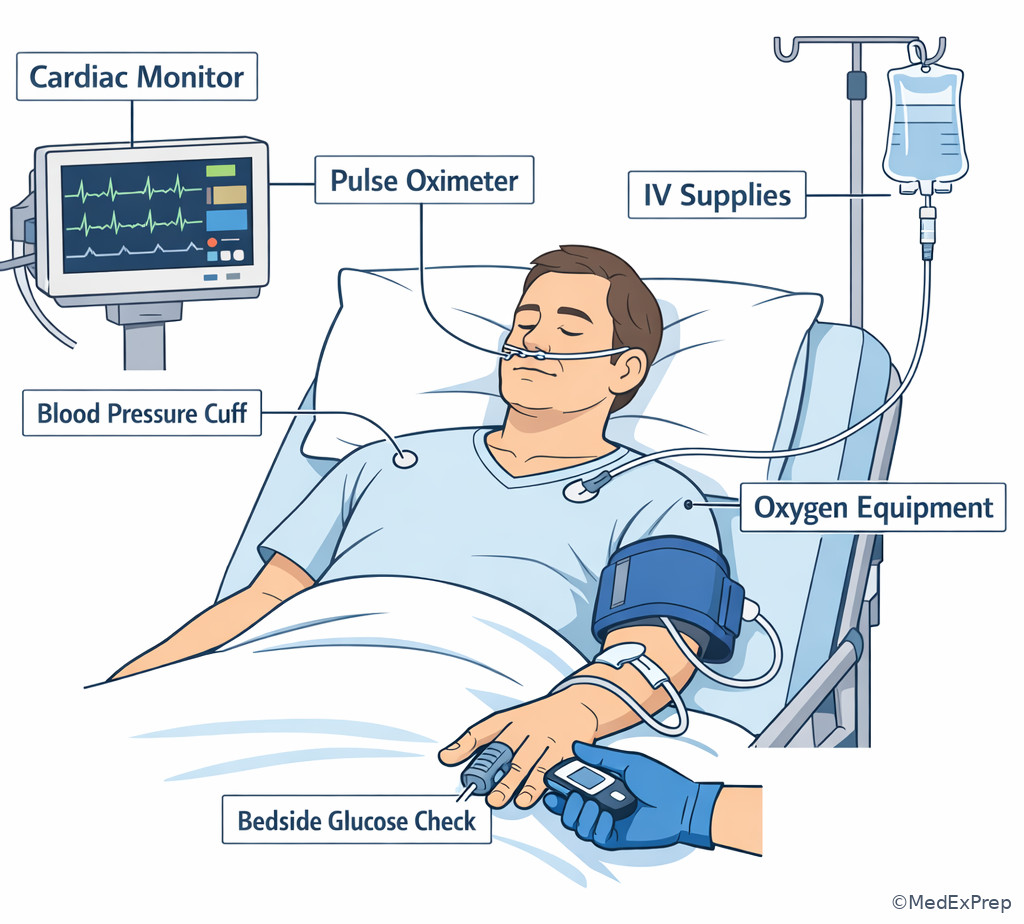
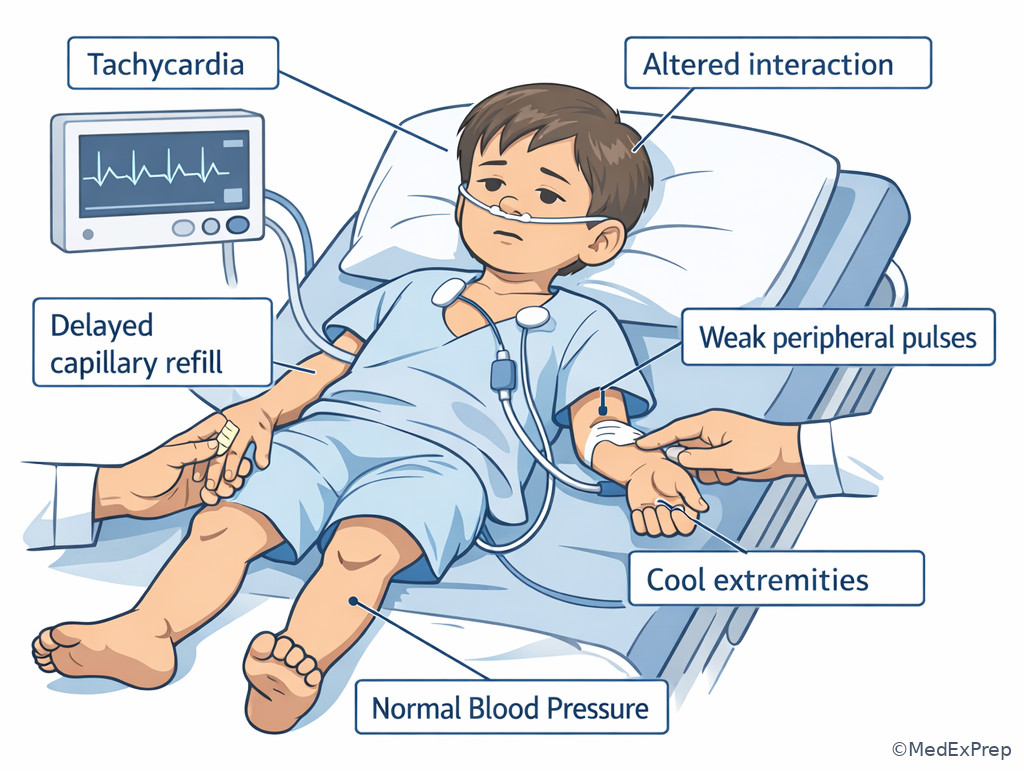
Exam takeaway: Children may maintain blood pressure until late, so tachycardia and poor perfusion carry more triage weight than hypotension alone.
1.1.1.3 Foundational triage question: sick, not sick, or could crash soon?
A Explanation
Triage is not a diagnosis contest. The decision conflict is whether a patient needs immediate stabilization and escalation versus ordinary sequential evaluation. The single rule that resolves the conflict is simple: physiologic threat beats symptom label. A patient with “anxiety” who is hypoxic and using accessory muscles is high acuity; a patient with “chest pain” who is comfortable, normoxic, and hemodynamically stable may still be high risk, but the immediate reason is different. See Fig 1 and Fig 2.
At triage, the highest-yield global assessment is first impression: Can the patient speak normally? Are they pale, mottled, cyanotic, diaphoretic, or obtunded? Is there obvious work of breathing or poor perfusion? These clues often identify illness severity faster than a long history. On shelf questions, the exam may disguise this by giving a dramatic complaint in one patient and subtle physiologic danger in another. Choose the patient with threatened ABCs or evolving shock.
WHY THIS IS TESTED: NBME-style questions reward recognition of unstable physiology before diagnostic certainty. The testable pattern is that a “soft” or nonspecific complaint becomes high acuity if paired with abnormal mental status, respiratory distress, shock signs, or rapidly worsening vitals.
Key rule: Triage acuity is determined by current risk of deterioration, not by whether the final diagnosis sounds dramatic.
Memory anchor: “SICK” = Speech abnormal, Impaired mentation, Circulation poor, Key work of breathing increased. If any part of SICK is present, up-triage.
Recall: This is the first topic in the course, so build the habit now: before asking “What is the diagnosis?” ask “Could this patient lose airway, ventilation, or perfusion in the next few minutes?” In the upcoming topic Primary Survey And ABCs, that instinct becomes a formal sequence.
Clinician Action: DIAGNOSE by recognizing poor appearance, altered mental status, respiratory distress, or perfusion failure. ORDER immediate repeat vitals, monitor placement, bedside glucose when indicated, and focused bedside testing. TREAT supportive measures consistent with ABC priorities while under supervision. REFER/ESCALATE immediately to senior resident or attending if instability is present.
B Worked example
A 67-year-old man presents with “weakness” and dizziness for 1 day. He has diabetes, coronary artery disease, and chronic kidney disease. He says he “probably has a stomach bug” because he had one episode of diarrhea. He is pale and answers slowly. Triage vitals are temperature 36.1 C, heart rate 124/min, blood pressure 96/58 mm Hg, respiratory rate 28/min, oxygen saturation 95% on room air. A family member mentions he skipped breakfast, making hypoglycemia a tempting clue.
Reasoning chain: Identify task -> decide acuity, not final diagnosis. Instability check -> tachycardia, tachypnea, hypotension, slowed mentation. Extract key facts -> poor perfusion pattern with possible occult shock. Apply rule -> immediate monitored bed and physician evaluation; do not leave in low-acuity queue. Eliminate distractors -> “viral gastroenteritis” and “dehydration clinic-style evaluation” are tempting because of diarrhea, but the vital signs exceed that level of reassurance. Verify -> bedside glucose is reasonable, but only after recognizing high acuity and escalating care.
C Exam trap
Common wrong answer: Assign lower acuity because the complaint sounds benign, such as weakness, anxiety, or dizziness.
WHY IT IS TEMPTING: The stem includes a plausible minor explanation or distracting history item, encouraging anchoring on symptom label.
SINGLE CLUE THAT ELIMINATES IT: Abnormal perfusion or mental status always outranks a benign-sounding complaint.
D Checkpoint
Question: Which patient requires the most immediate bed placement and physician evaluation?
- A 24-year-old woman with pleuritic chest pain after a long drive, heart rate 108/min, oxygen saturation 98%, speaking full sentences
- A 72-year-old man with generalized weakness, cool extremities, blood pressure 88/54 mm Hg, and delayed responses
- A 30-year-old man with renal colic, severe pain, vomiting once, blood pressure 146/88 mm Hg
- A 45-year-old woman with fever and dysuria, heart rate 102/min, blood pressure 122/74 mm Hg
Answer: B
- A: Tempting because chest pain after prolonged travel suggests pulmonary embolism, but she is currently oxygenating and perfusing adequately; this is high risk, not the most unstable.
- B: Tempting because weakness can sound nonspecific, but hypotension, cool extremities, and delayed responses identify shock physiology; this is the correct immediate priority.
- C: Tempting because severe pain draws attention, but pain alone without instability is not the highest triage threat.
- D: Tempting because infection can worsen quickly, but this patient lacks immediate signs of shock or respiratory compromise.
If you missed this: Review 1.1.1.1 Foundational triage question: sick, not sick, or could crash soon? — focus on the rule that current physiologic threat outranks chief complaint wording.
1.1.1.4 Vital signs are triage data, not background details
A Explanation
The decision conflict here is whether an abnormal vital sign is incidental, pain-related, or evidence of serious illness. The single rule is that vital sign abnormalities gain meaning from patterns and context, not isolated thresholds. See Fig 4. Tachycardia plus cool skin and dizziness suggests hypoperfusion; tachypnea plus normal oxygen saturation can still be compensation for metabolic acidosis; fever plus altered mental status raises concern for severe infection or CNS pathology. Normal blood pressure does not rescue a patient from concern if other signs indicate compensation.
Respiratory rate is especially underused on exams. A patient with RR 32/min is telling you something significant even if oxygen saturation is 97%. Likewise, pulse oximetry can appear acceptable early in critical illness or when the problem is circulatory rather than pulmonary. Temperature extremes also matter both ways: fever suggests infection or inflammatory stress, while hypothermia in a sick patient may signal sepsis, exposure, endocrine crisis, or severe systemic illness.
WHY THIS IS TESTED: The exam often hides the answer in the vitals. The testable pattern is that the right next step comes from interpreting the physiologic pattern, not chasing the most memorable symptom in the stem.
Key rule: A “normal” blood pressure does not exclude shock if the patient has tachycardia, tachypnea, cool skin, altered mentation, or rising lactate concern.
High-Yield Connection: This concept is tested alongside Shock Type Recognition and Sepsis Recognition And Bundles. Know both the early compensation pattern and the first ED actions, because stems often pair borderline blood pressure with subtle perfusion failure.
Clinician Action: DIAGNOSE by reading vitals as a syndrome rather than isolated numbers. ORDER repeat vitals, continuous pulse oximetry/cardiac monitoring when indicated, point-of-care glucose, and focused labs/imaging guided by the complaint. TREAT the abnormal physiology while workup proceeds. REFER/ESCALATE if abnormal vitals persist, worsen, or fit a time-sensitive pathway.
B Worked example
A 38-year-old woman presents with vomiting and “panic” after a day of abdominal pain. She has type 1 diabetes and asthma. She appears anxious. Vital signs: heart rate 122/min, blood pressure 112/70 mm Hg, respiratory rate 30/min, oxygen saturation 99% on room air, temperature 37.0 C. A nurse note says she is “hyperventilating from anxiety,” which makes a psychiatric explanation tempting.
Reasoning chain: Identify task -> determine acuity and most likely dangerous physiology. Instability check -> not crashing, but marked tachycardia and tachypnea. Extract key facts -> abdominal pain, vomiting, type 1 diabetes. Apply rule -> tachypnea with normal oxygen saturation may reflect metabolic acidosis rather than panic; she needs urgent evaluation, not reassurance alone. Eliminate distractors -> asthma is tempting, but there is no wheeze or hypoxia; panic is tempting, but the metabolic context is stronger. Verify -> bedside glucose and prompt metabolic workup are justified while monitoring continues.
C Exam trap
Common wrong answer: Dismissing tachypnea as anxiety when oxygen saturation is normal.
WHY IT IS TEMPTING: The patient looks anxious and the pulse oximeter is reassuring.
SINGLE CLUE THAT ELIMINATES IT: Tachypnea with diabetes, vomiting, and abdominal pain should trigger concern for metabolic compensation until proven otherwise.
D Checkpoint
Question: Which vital-sign pattern should most strongly increase triage acuity even if the patient is speaking full sentences?
- Heart rate 112/min after severe ankle pain, otherwise normal vitals
- Respiratory rate 32/min with oxygen saturation 98% and new confusion
- Temperature 38.1 C with sore throat and normal hemodynamics
- Blood pressure 150/92 mm Hg during acute renal colic
Answer: B
- A: Tempting because tachycardia can reflect illness, but isolated pain-related tachycardia is less concerning than multisystem respiratory/mental-status findings.
- B: Tempting because normal oxygen saturation may falsely reassure, but tachypnea plus confusion strongly suggests dangerous physiology; this is correct.
- C: Tempting because fever can signal infection, but without hemodynamic or neurologic compromise it is not the strongest acuity trigger here.
- D: Tempting because elevated blood pressure sounds abnormal, but isolated hypertension in pain is usually less urgent than signs of respiratory/metabolic compromise.
If you missed this: Review 1.1.1.2 Vital signs are triage data, not background details — focus on why pattern recognition beats isolated thresholds.
- The most concerning “normal-looking” vital sign on exams is often a very high respiratory rate.
- True or False: Normal blood pressure excludes shock. False.
- Name the 3 high-yield bedside clues of poor perfusion: cool skin, delayed capillary refill, altered mentation.
1.1.1.5 High-risk complaints that deserve immediate respect
A Explanation
The decision conflict is whether a patient with stable-looking vitals can still be high acuity based on the complaint. The single rule is that some complaints carry time-sensitive lethal differentials even when the exam is initially unimpressive. See Fig 3. Chest pain raises concern for ACS, aortic dissection, pulmonary embolism, pneumothorax, or esophageal catastrophe. Dyspnea may hide asthma, heart failure, PE, or impending fatigue. Syncope can represent dysrhythmia or hemorrhage. Focal neurologic deficit implies stroke until proven otherwise. GI bleeding can decompensate quickly. Vaginal bleeding in pregnancy is ectopic pregnancy until excluded.
This does not mean every such patient is in the resuscitation bay. It means you should reject the low-acuity framing. On shelf stems, high-risk complaints often compete against visibly uncomfortable but lower-risk problems like isolated renal colic or migraine without red flags. The best answer frequently involves prompt monitored evaluation, ECG, finger-stick glucose, pregnancy test, pathway consideration, or immediate physician assessment.
WHY THIS IS TESTED: Many emergency questions hinge on recognizing the dangerous differential built into the chief complaint. The stem may not tell you the diagnosis; it expects you to infer that delay itself is unsafe.
Key rule: A complaint earns higher triage priority when the cost of missing the worst-case diagnosis is high and early actions can change outcome.
Forward link: In the upcoming topic Time-Sensitive Pathway Activation, these high-risk complaints become formal triggers for stroke, STEMI, trauma, and sepsis pathways. Triage is where that recognition begins.
Clinician Action: DIAGNOSE by linking complaint to its cannot-miss differential. ORDER focused immediate bedside studies appropriate to the complaint, such as ECG for chest pain or glucose for neurologic symptoms. TREAT supportively while ruling out life threats. REFER/ESCALATE when complaint plus findings suggest stroke, STEMI, trauma, sepsis, ectopic pregnancy, or major hemorrhage.
B Worked example
A 29-year-old woman presents with lower abdominal pain and light vaginal spotting. She has a history of infertility treatment and one prior cesarean delivery. She says the bleeding is “less than a period” and mainly wants pain medication. Vital signs are heart rate 104/min, blood pressure 110/70 mm Hg, and oxygen saturation 99% on room air. A recent urgent care note suggested “possible UTI,” making cystitis a tempting distractor.
Reasoning chain: Identify task -> determine whether this is low-acuity pelvic pain or a high-risk complaint. Instability check -> not crashing, but mild tachycardia. Extract key facts -> reproductive-age patient, abdominal pain, vaginal bleeding, pregnancy risk. Apply rule -> pregnancy-related bleeding and pain are high acuity until ectopic pregnancy is addressed. Eliminate distractors -> UTI and dysmenorrhea can cause discomfort, but neither safely explains the triage concern. Verify -> urgent pregnancy testing and physician evaluation are the appropriate direction.
C Exam trap
Common wrong answer: Treating the complaint as routine because the current bleeding is small volume and the blood pressure is normal.
WHY IT IS TEMPTING: Learners anchor on present appearance rather than worst-case complaint differential.
SINGLE CLUE THAT ELIMINATES IT: Abdominal pain plus vaginal bleeding in a potentially pregnant patient is never trivial at triage.
D Checkpoint
Question: Which chief complaint should remain high-acuity even when the patient appears comfortable and the initial blood pressure is normal?
- Recurrent tension-type headache identical to prior episodes
- Chest pain radiating to the back in a 61-year-old with hypertension
- Localized ankle pain after inversion injury
- Dysuria with urinary frequency and no flank pain
Answer: B
- A: Tempting because headaches can be dangerous, but identical recurrent tension-type pain without red flags is less acute than chest pain with a dissection clue.
- B: Tempting because the patient is comfortable, but chest pain radiating to the back raises time-sensitive vascular concern; this is correct.
- C: Tempting because pain can be severe, but isolated musculoskeletal injury without neurovascular compromise is usually lower acuity.
- D: Tempting because urinary symptoms can progress, but uncomplicated lower urinary symptoms are not the highest-risk complaint here.
If you missed this: Review 1.1.1.3 High-risk complaints that deserve immediate respect — focus on the rule that certain complaints encode cannot-miss diagnoses.
1.1.1.6 Special populations and hidden acuity
A Explanation
The decision conflict is whether a patient with mild symptoms or modest abnormalities can be triaged conservatively when they belong to a high-risk subgroup. The single rule is that special populations have less reliable “reassuring” presentations. See Fig 5. Older adults may have sepsis, ACS, or intracranial pathology with minimal fever or pain. Children maintain blood pressure until late shock. Pregnant patients have altered physiology and two-patient stakes; syncope, bleeding, dyspnea, and abdominal pain deserve lower thresholds for concern. Immunocompromised patients may not mount robust inflammatory responses. Anticoagulated patients with trauma or headache need respect even after minor mechanisms.
This section is especially testable because the stem may appear ordinary until a modifier is mentioned. A low-grade fever in a neutropenic patient, minor head trauma in a patient on anticoagulation, or irritability with tachycardia in a child can represent much higher acuity than the same finding in a healthy adult. The shelf expects you to notice the modifier and change urgency accordingly.
WHY THIS IS TESTED: The exam frequently uses subtle presentations in vulnerable populations to distinguish superficial pattern matching from true emergency reasoning.
Memory anchor: “POP-A” = Pregnant, Older adult, Pediatric, Anticoagulated/immunocompromised. These patients get a lower threshold for up-triage.
High-Yield Connection: This concept overlaps with Pediatric Respiratory Distress, Ectopic Pregnancy And Early Bleeding, and Intracranial Trauma Patterns. On exam day, the modifier changes both diagnostic urgency and disposition thinking.
Clinician Action: DIAGNOSE by identifying vulnerable populations early. ORDER focused tests that address the dangerous version of the complaint, such as pregnancy test, glucose, ECG, or imaging as indicated. TREAT the patient according to physiology, not age stereotypes. REFER/ESCALATE sooner for subtle deterioration, atypical presentations, or anticoagulated trauma.
B Worked example
A 4-year-old boy is brought in for vomiting and decreased energy. He had a mild fever at home. He has no major medical history. In triage he is quiet, tachycardic to 148/min, respiratory rate 34/min, blood pressure normal for age, and capillary refill is 4 seconds. His mother says he “always hates hospitals,” making behavioral explanation tempting.
Reasoning chain: Identify task -> decide whether this is simple gastroenteritis or hidden acuity. Instability check -> not hypotensive, but tachycardic with delayed cap refill and reduced interaction. Extract key facts -> pediatric patient, possible compensated shock. Apply rule -> children can preserve blood pressure until late; normal BP does not lower acuity. Eliminate distractors -> anxiety may affect behavior, but it does not explain delayed perfusion. Verify -> urgent reassessment and physician evaluation are needed.
C Exam trap
Common wrong answer: Reassurance because the pediatric patient is not hypotensive.
WHY IT IS TEMPTING: Learners import adult shock logic and wait for blood pressure to fall.
SINGLE CLUE THAT ELIMINATES IT: Delayed capillary refill with tachycardia in a child suggests compensated shock.
D Checkpoint
Question: Which patient deserves a lower threshold for higher-acuity triage despite relatively mild initial findings?
- A healthy 20-year-old with reproducible chest wall pain after lifting weights
- A 78-year-old with weakness, mild confusion, and temperature 37.8 C
- A 25-year-old with classic migraine identical to prior episodes
- A 32-year-old with isolated ankle swelling after a twist injury
Answer: B
- A: Tempting because chest pain gets attention, but the musculoskeletal trigger and reproducibility lower immediate concern.
- B: Tempting because the fever is only mild, but older adults may have serious infection or other systemic illness with blunted signs; this is correct.
- C: Tempting because headaches can be dangerous, but “identical to prior migraine” without red flags is less concerning.
- D: Tempting because swelling may imply fracture, but this is not the strongest hidden-acuity pattern.
If you missed this: Review 1.1.1.4 Special populations and hidden acuity — focus on why special populations often have deceptively subtle presentations.
- True or False: Pediatric hypotension is usually an early sign of shock. False.
- The most dangerous interpretation of vaginal bleeding plus abdominal pain in a potentially pregnant patient is ectopic pregnancy.
- Name one subgroup that may have serious infection without dramatic fever: older adults or immunocompromised patients.
1.1.1.7 Reassessment, escalation, and what the shelf means by “best next step”
A Explanation
The final triage decision conflict is whether to pursue a full diagnostic sequence first or to take the safe immediate action that buys time and prevents delay. The single rule is that the best next step in emergency medicine is usually the highest-yield safety action that addresses acuity now. See Fig 6. This may be moving the patient to a monitored bed, obtaining immediate ECG, checking bedside glucose, placing oxygen when indicated, repeating vitals, or escalating to the senior resident/attending.
Reassessment is part of the answer, not a passive afterthought. A patient initially categorized as urgent can become emergent after a new blood pressure drop, increasing work of breathing, or changing mental status. Shelf questions often reward dynamic thinking: what changed, what matters most now, and which action cannot wait? The wrong answer is commonly a comprehensive but delayed workup. The right answer is focused, safety-first sequencing.
WHY THIS IS TESTED: The exam wants you to choose the action that changes immediate risk. When operational details vary by site, the principle stays the same: escalate early and continue reassessment while protocols unfold.
Key rule: In acute care, the “best next step” is often a monitored setting, immediate bedside test, or pathway activation rather than a broad confirmatory workup.
Clinician Action: DIAGNOSE triage deterioration by trending appearance and vitals. ORDER the fastest high-yield bedside studies first. TREAT supportive threats before definitive diagnosis is complete. REFER/ESCALATE immediately for unstable patients or when trauma, stroke, STEMI, or sepsis pathways may apply.
B Worked example
A 58-year-old man presents with chest discomfort and nausea. He has hypertension, hyperlipidemia, and tobacco use. He is talking comfortably, but while waiting his repeat vitals show heart rate 118/min and blood pressure 92/60 mm Hg. He says the pain “might just be reflux” after a spicy meal, which is the tempting wrong clue.
Reasoning chain: Identify task -> choose the best immediate next step at triage. Instability check -> new hypotension changes the problem. Extract key facts -> chest pain plus cardiovascular risk factors plus worsening vitals. Apply rule -> monitored bed, immediate ECG, and escalation beat prolonged history-taking or GI treatment. Eliminate distractors -> antacid therapy or low-acuity waiting area are unsafe because a time-sensitive cardiac cause has not been excluded and he is becoming unstable. Verify -> reassessment caused the correct triage upgrade.
C Exam trap
Common wrong answer: Continuing the original lower-acuity plan because the first evaluation seemed reassuring.
WHY IT IS TEMPTING: Once learners anchor on a benign explanation, they underweight new data.
SINGLE CLUE THAT ELIMINATES IT: Repeat vitals showing deterioration always override the earlier reassuring frame.
D Checkpoint
Question: A patient initially triaged as urgent now has increasing dyspnea and oxygen saturation falling from 96% to 89% on room air. What is the most appropriate next step?
- Complete the full review of systems before changing triage category
- Maintain current placement because the initial triage decision was already made
- Move to a monitored setting, reassess immediately, and notify the supervising team
- Order routine outpatient pulmonary function testing
Answer: C
- A: Tempting because more history feels thorough, but delay is unsafe when respiratory status worsens.
- B: Tempting because consistency feels orderly, but triage is dynamic and must change with new data.
- C: Tempting because it may feel like “overreacting,” but worsening hypoxemia requires immediate escalation; this is correct.
- D: Tempting only if the complaint sounds chronic, but this ignores acute deterioration and is inappropriate.
If you missed this: Review 1.1.1.5 Reassessment, escalation, and what the shelf means by “best next step” — focus on how repeat vitals can override the initial triage plan.
Exam Traps & Differentiators
Common traps & distractors: The shelf often gives a benign explanation that fits part of the story. Do not let a plausible minor diagnosis erase shock, hypoxia, altered mentation, dangerous complaint patterns, or special population modifiers.
1.1.1.8 Most common wrong answer and why
The most common wrong answer is delayed definitive workup before stabilization or escalation. It is tempting because students want diagnostic certainty. The single discriminator is this: if the patient could deteriorate during the workup, your next step must first address monitoring, resuscitation, or pathway activation.
1.1.1.9 Looks similar but isn't
| Presentation | Tempting low-acuity explanation | Single clue that up-triages | Safer ED framing |
|---|---|---|---|
| Chest discomfort | GERD or anxiety | Hypotension, diaphoresis, exertional pattern, radiation | Monitored bed, ECG, cardiac concern first |
| Shortness of breath | Hyperventilation/panic | Tachypnea, accessory muscle use, hypoxia, poor air movement | Respiratory distress until proven otherwise |
| Weakness or dizziness | Dehydration or viral illness | Cool skin, hypotension, confusion, tachycardia | Shock/perfusion evaluation first |
| Abdominal pain with spotting | Dysmenorrhea or UTI | Pregnancy possibility | Ectopic concern until excluded |
| Headache after minor trauma | Simple post-traumatic pain | Anticoagulant use or new neurologic change | Higher-risk intracranial concern |
| Child with vomiting | Routine gastroenteritis | Delayed cap refill, lethargy, tachycardia | Compensated shock concern |
| If the stem says... | Think... |
|---|---|
| “Speaking in one-word sentences” | Immediate respiratory acuity |
| “Cool, clammy, delayed cap refill” | Poor perfusion even if BP is not profoundly low |
| “Normal pulse oximetry but RR 30+” | Possible metabolic compensation or early respiratory distress |
| “Chest pain with hypotension” | High-acuity cardiopulmonary/vascular process |
| “Pregnant with bleeding and pain” | Ectopic pathway mindset |
| “Older adult, weak, mildly confused” | Do not dismiss; consider infection, ACS, or other systemic illness |
Related trap from upcoming topics: in Primary Survey And ABCs, the wrong answer will often be detailed diagnosis before ABC intervention. In Time-Sensitive Pathway Activation, the trap becomes waiting for perfect confirmation before escalating trauma, stroke, STEMI, or sepsis pathways.
Review connection: The traps above test dynamic emergency prioritization. If any felt unfamiliar, revisit 1.1.1.2 Vital signs are triage data, not background details and 1.1.1.5 Reassessment, escalation, and what the shelf means by “best next step” before attempting the Self-check quiz.
Tables
| Reference table: triage danger signals | Why it matters | Typical immediate implication |
|---|---|---|
| Airway compromise, stridor, inability to speak | Impending airway failure | Immediate escalation and resuscitation-level evaluation |
| Severe work of breathing, accessory muscle use | Respiratory failure risk | Monitored bed, oxygen/support, urgent physician evaluation |
| Hypotension or narrow pulse pressure | Shock concern | Perfusion-focused evaluation and resuscitation mindset |
| Tachycardia with cool clammy skin | Compensated shock pattern | Do not wait for profound hypotension |
| RR markedly elevated | Early respiratory/metabolic compensation | High acuity even with normal SpO2 |
| Altered mental status | Global brain dysfunction or poor perfusion | Immediate bedside glucose and urgent evaluation |
| Chest pain, syncope, focal deficit, GI bleed | Cannot-miss pathology | Higher triage priority even if outwardly calm |
| Pregnancy with pain or bleeding | Ectopic/obstetric emergency risk | Do not low-acuity label |
| Comparison table | Stable | Potentially unstable | Unstable |
|---|---|---|---|
| Mental status | Alert, appropriate | Fatigued, intermittently confused | Obtunded, agitated from hypoxia, unresponsive |
| Breathing | Normal speech and effort | Tachypnea, mild accessory use | One-word speech, severe distress, cyanosis |
| Perfusion | Warm, normal cap refill | Tachycardic, cool extremities | Hypotension, mottling, delayed refill, weak pulses |
| Complaint category | Low-risk isolated problem | High-risk complaint with reassuring snapshot | High-risk complaint plus deterioration or ABC threat |
| Monitoring need | Routine | Monitored bed and repeat vitals | Immediate resuscitation-level monitoring |
| Escalation | Standard evaluation | Rapid clinician assessment | Immediate senior/attending notification |
| Differential/classification table | Complaint pattern | Benign-seeming distractor | Discriminating clue | Triage implication |
|---|---|---|---|---|
| Dyspnea | Anxiety/panic | Normal SpO2 | Marked tachypnea, poor air movement, fatigue, abnormal perfusion | Up-triage |
| Chest pain | GERD/musculoskeletal pain | Recent meal or lifting | Exertional pattern, diaphoresis, hypotension, radiation | Monitored cardiac evaluation |
| Weakness | Viral illness | Mild GI symptoms | Confusion, cool skin, tachycardia, hypotension | Shock concern |
| Pregnancy bleeding | Routine early pregnancy spotting | Small-volume bleeding | Abdominal pain, dizziness, tachycardia | Ectopic concern |
| Child vomiting | Simple viral gastroenteritis | Normal BP | Delayed cap refill, lethargy, persistent tachycardia | Compensated shock concern |
| Minor trauma headache | Simple concussion | Low-energy mechanism | Anticoagulation, focal deficits, worsening mentation | Higher-risk intracranial concern |
Algorithm / Approach
Rapid Review
- Weakness -> if paired with hypotension or confusion, think shock until proven otherwise.
- Tachypnea -> normal pulse oximetry does not make it benign.
- Chest pain -> comfort level does not rule out aortic or cardiac catastrophe.
- Dyspnea -> one-word speech separates distress from anxiety.
- Normal BP in children -> does not exclude shock.
- Pregnancy + pain/bleeding -> triage with ectopic in mind.
- Older adult with mild confusion -> subtle presentation can still be high acuity.
- Anticoagulated minor trauma -> mechanism may look small, risk is not.
- GI bleeding -> tachycardia may precede hypotension.
- Syncope -> prioritize arrhythmia/hemorrhage risk before benign explanations.
- Reassessment -> repeat vitals can change the answer choice.
- Best next step -> usually the safest action that reduces immediate risk, not the longest diagnostic list.
Memory anchor: “LOOK + NUMBERS + COMPLAINT + MODIFIER” = first impression, vital pattern, dangerous complaint, special population. If any one is concerning, slow down and up-triage.
Self-check quiz
1. A 68-year-old man presents with generalized weakness. He has hypertension and coronary artery disease. He is pale, slow to answer, heart rate 122/min, blood pressure 86/52 mm Hg, oxygen saturation 97% on room air. Which triage category is most appropriate?
- Low acuity because oxygen saturation is normal
- Routine evaluation after full history is completed
- Immediate high-acuity evaluation for shock physiology
- Psychiatric screening because the complaint is nonspecific
2. A 5-year-old girl with vomiting has heart rate 150/min, delayed capillary refill, and normal blood pressure. Which finding most strongly prevents low-acuity triage?
- Normal blood pressure
- Delayed capillary refill
- Age younger than 10 years
- Single episode of emesis
3. A 34-year-old woman presents with shortness of breath and “panic.” She has type 1 diabetes and asthma. Vital signs are heart rate 120/min, respiratory rate 30/min, oxygen saturation 99% on room air, and blood pressure 114/72 mm Hg. Which is the most appropriate next step?
- Reassure and discharge because oxygen saturation is normal
- Treat as isolated anxiety without further evaluation
- Urgently evaluate in a monitored setting because tachypnea may reflect dangerous physiology
- Defer assessment until wheezing develops
4. A 27-year-old woman presents with lower abdominal pain and light vaginal bleeding. She has undergone fertility treatment and does not know if she is pregnant. Heart rate is 106/min and blood pressure is 112/70 mm Hg. Which triage approach is most appropriate?
- Low acuity because bleeding is less than a normal period
- High-risk triage because pain plus bleeding in a potentially pregnant patient may indicate ectopic pregnancy
- Routine follow-up because the blood pressure is normal
- Musculoskeletal pain treatment before pregnancy assessment
5. A 59-year-old man presents with chest discomfort and nausea. He has diabetes and tobacco use. Initial triage seems stable, but repeat vitals 15 minutes later show heart rate 118/min and blood pressure 92/60 mm Hg. Which is the most appropriate next step?
- Keep the original triage category because consistency is important
- Upgrade acuity, move to monitored evaluation, and notify the supervising team
- Wait for a troponin result before changing bed assignment
- Try antacid therapy first because reflux remains possible
6. A 76-year-old woman with dementia and chronic kidney disease presents with weakness and poor oral intake. Temperature is 37.8 C, heart rate 112/min, respiratory rate 24/min, blood pressure 104/62 mm Hg, and she is more confused than baseline. Her daughter thinks it is “just fatigue from not sleeping.” Which factor most strongly supports higher-acuity triage?
- Absence of high fever makes severe illness less likely
- Older adults may have serious infection or systemic illness with subtle vital-sign abnormalities and confusion
- Confusion is expected in dementia and should not affect triage
- Normal oxygen saturation excludes dangerous illness
7. A 42-year-old man presents after a “panic attack” with rapid breathing. He has diabetes, recent vomiting, and diffuse abdominal pain. He is anxious, oxygen saturation is 98%, heart rate 124/min, blood pressure 110/68 mm Hg, and respiratory rate 32/min. Which single detail best argues against low-acuity psychiatric triage?
- Anxiety reported by the patient
- Normal oxygen saturation
- Marked tachypnea with metabolic-risk history
- Age younger than 50 years
8. A 23-year-old pregnant woman at 9 weeks by dates presents with dizziness, shoulder pain, and scant vaginal spotting. She has asthma and says she mainly wants antiemetics because she has also felt nauseated all week. Blood pressure is 100/64 mm Hg, heart rate 112/min, and she appears uncomfortable but alert. Which is the most appropriate triage interpretation?
- Low acuity because the bleeding is minimal
- Moderate acuity only, because nausea is common in early pregnancy
- High-acuity concern for ectopic pregnancy despite limited bleeding
- Routine outpatient obstetric follow-up is the best next step
Answer key
1.1.1.10 1. Answer: C
Why C is correct: This patient has shock physiology: hypotension, marked tachycardia, pallor, and slowed mentation. The mechanism is inadequate perfusion until proven otherwise, so the triage action is immediate high-acuity evaluation and escalation, not symptom categorization. This matches emergency prioritization principles that unstable physiology overrides a vague complaint. Sources: Tintinalli; Rosen's Emergency Medicine; AHA emergency assessment principles.
- A: Tempting because learners overvalue oxygen saturation, but shock may occur with normal SpO2. Discriminator: hypotension with altered mentation.
- B: Tempting because complete history feels organized, but unstable patients are not queued behind extended information gathering. Discriminator: blood pressure 86/52 mm Hg.
- C: Correct because the perfusion findings indicate immediate danger. Discriminator: shock pattern, not the complaint wording.
- D: Tempting only because “weakness” is nonspecific, but psychiatric framing fails when objective instability is present. Discriminator: pallor and slow responses.
If you missed this: Review 1.1.1.1 Foundational triage question: sick, not sick, or could crash soon? — focus on the discriminator that physiologic instability outranks complaint label.
1.1.1.11 2. Answer: B
Why B is correct: Delayed capillary refill is a perfusion clue suggesting compensated pediatric shock. Children may maintain blood pressure until late, so low-acuity triage based on “normal BP” is unsafe. Sources: Tintinalli; Nelson Textbook of Pediatrics emergency assessment sections; American College of Emergency Physicians pediatric emergency principles.
- A: Tempting because BP is often overused as a marker of stability, but pediatric shock can exist before hypotension. Discriminator: delayed refill.
- B: Correct because it signals poor perfusion in a child despite preserved BP. Discriminator: capillary refill abnormality.
- C: Tempting because young age changes thresholds, but age alone does not define acuity. Discriminator: objective perfusion findings matter more.
- D: Tempting because vomiting is common, but one episode alone does not establish acuity. Discriminator: shock signs, not emesis count.
If you missed this: Review 1.1.1.4 Special populations and hidden acuity — focus on the discriminator that normal pediatric blood pressure does not exclude shock.
1.1.1.12 3. Answer: C
Why C is correct: Tachypnea in a patient with diabetes and vomiting may represent metabolic acidosis rather than anxiety, even with normal oxygen saturation. The emergency mechanism is compensation for serious metabolic disturbance, so the safest next step is urgent monitored evaluation. Sources: Tintinalli; ADA hyperglycemic crisis guidance; Harrison's Principles of Internal Medicine.
- A: Tempting because normal pulse oximetry reassures novices, but it does not explain RR 30/min with diabetes. Discriminator: metabolic-risk history.
- B: Tempting because the patient feels panicky, but the physiology may be driving the anxiety. Discriminator: vomiting plus tachypnea.
- C: Correct because monitored urgent evaluation addresses possible dangerous underlying physiology. Discriminator: marked tachypnea despite normal oxygenation.
- D: Tempting if considering asthma only, but waiting for wheeze delays care and ignores other causes. Discriminator: nondiagnostic respiratory symptom pattern.
If you missed this: Review 1.1.1.2 Vital signs are triage data, not background details — focus on why normal oxygen saturation does not neutralize marked tachypnea.
1.1.1.13 4. Answer: B
Why B is correct: Abdominal pain plus vaginal bleeding in a potentially pregnant patient must be triaged as high risk for ectopic pregnancy until excluded. The mechanism is possible extrauterine pregnancy with risk of rupture and hemorrhage; limited bleeding volume does not reduce urgency. Sources: Tintinalli; ACOG guidance on early pregnancy evaluation; First Aid emergency OB/GYN review.
- A: Tempting because scant bleeding sounds mild, but ectopic pregnancy may present with small-volume bleeding. Discriminator: pain plus pregnancy possibility.
- B: Correct because the dangerous diagnosis drives triage. Discriminator: fertility treatment and unknown pregnancy status.
- C: Tempting because BP is normal, but ectopic risk is not excluded by temporary hemodynamic stability. Discriminator: complaint pattern, not BP alone.
- D: Tempting because pelvic pain has many benign causes, but pregnancy assessment cannot wait behind symptomatic treatment alone. Discriminator: bleeding in a potentially pregnant patient.
If you missed this: Review 1.1.1.3 High-risk complaints that deserve immediate respect — focus on the discriminator that pregnancy-related pain plus bleeding encodes a cannot-miss diagnosis.
1.1.1.14 5. Answer: B
Why B is correct: Repeat vitals showing hypotension and tachycardia upgrade acuity. The mechanism is dynamic deterioration, so the correct emergency action is monitored reassessment and immediate team notification rather than preserving the original plan. Sources: Tintinalli; Rosen's Emergency Medicine; ACEP clinical policy principles on chest pain evaluation.
- A: Tempting because consistency feels systematic, but triage is dynamic. Discriminator: new hypotension.
- B: Correct because worsening physiology overrides the earlier impression. Discriminator: repeat vital sign change.
- C: Tempting because biomarkers matter later, but unstable trends must be addressed before waiting on lab confirmation. Discriminator: immediate risk exceeds diagnostic delay tolerance.
- D: Tempting because reflux is common, but chest discomfort plus new hypotension is unsafe to treat as benign. Discriminator: deterioration while awaiting evaluation.
If you missed this: Review 1.1.1.5 Reassessment, escalation, and what the shelf means by “best next step” — focus on the discriminator that worsening repeat vitals change triage category.
1.1.1.15 6. Answer: B
Why B is correct: Older adults often have serious infection or systemic illness with subtle fever and nonspecific symptoms. Confusion is a high-value red flag because the mechanism may be poor perfusion, infection, or metabolic disturbance rather than baseline dementia alone. Sources: Harrison's Principles of Internal Medicine; Tintinalli; IDSA sepsis-related discussions in vulnerable populations.
- A: Tempting because fever is mild, but elderly patients may not mount high fevers despite severe disease. Discriminator: age-related blunted response.
- B: Correct because subtle abnormalities plus confusion in an older adult warrant higher-acuity triage. Discriminator: change from baseline mental status.
- C: Tempting because dementia clouds the picture, but the daughter reports worse-than-baseline confusion. Discriminator: acute change, not chronic impairment.
- D: Tempting because oxygenation is normal, but serious infection or shock can occur without hypoxemia. Discriminator: multisystem nonspecific illness with altered mentation.
If you missed this: Review 1.1.1.4 Special populations and hidden acuity — focus on the discriminator that older adults can have serious illness with muted fever and nonspecific symptoms.
1.1.1.16 7. Answer: C
Why C is correct: Marked tachypnea with diabetes, vomiting, and abdominal pain suggests metabolic compensation, such as diabetic ketoacidosis, rather than isolated panic. The mechanism-to-treatment logic is that dangerous physiology can present as “anxiety,” so triage must favor urgent medical evaluation. Sources: ADA hyperglycemic crisis guidance; Harrison's; Tintinalli.
- A: Tempting because self-described anxiety is common, but psychiatric framing does not explain the metabolic-risk context. Discriminator: associated vomiting and diabetes.
- B: Tempting because normal SpO2 may reassure, but oxygenation does not exclude metabolic acidosis. Discriminator: RR 32/min.
- C: Correct because the history specifically supports dangerous metabolic physiology. Discriminator: tachypnea plus diabetes and GI symptoms.
- D: Tempting because younger patients are often healthier, but age does not cancel severe metabolic disease. Discriminator: physiologic pattern outweighs age.
If you missed this: Review 1.1.1.2 Vital signs are triage data, not background details — focus on the discriminator that tachypnea with metabolic-risk history is not “just panic.”
1.1.1.17 8. Answer: C
Why C is correct: Early pregnancy with dizziness, shoulder pain, tachycardia, and vaginal spotting raises high concern for ectopic pregnancy. Shoulder pain is a discriminator because it can reflect diaphragmatic irritation from intra-abdominal blood; scant bleeding does not exclude life-threatening pathology. Sources: ACOG early pregnancy guidance; Tintinalli; First Aid emergency obstetrics review.
- A: Tempting because bleeding amount feels reassuring, but ectopic pregnancy may bleed minimally vaginally while hemorrhaging internally. Discriminator: shoulder pain and tachycardia.
- B: Tempting because nausea is common in pregnancy, but it is distracting noise here. Discriminator: pain/spotting/dizziness triad.
- C: Correct because the presentation must be treated as high acuity until ectopic pregnancy is excluded. Discriminator: referred shoulder pain with early pregnancy bleeding.
- D: Tempting because outpatient follow-up is common for routine early pregnancy symptoms, but this vignette contains hemorrhagic red flags. Discriminator: symptomatic high-risk complaint pattern.
If you missed this: Review 1.1.1.3 High-risk complaints that deserve immediate respect — focus on the discriminator that minimal vaginal bleeding does not lower concern for ectopic pregnancy when pain and dizziness are present.
Keep going with the full Emergency Medicine Shelf Prep Course (EM Shelf)
You just studied the way members do, in the same lesson interface. Full access unlocks every lesson, the question bank and flashcards for a full year.
One payment · 1 year of access · No auto-renewal