1.1.1 - RNC-MNN Domain Map
RNC-MNN Domain Map
What you'll learn
- DOMAIN: Exam orientation → Blueprint-to-study translation — map broad RNC-MNN domains into learner-ready bedside nursing tasks.
- DOMAIN: Clinical decision-making → Scope-safe answer selection — distinguish RN actions from provider-only decisions.
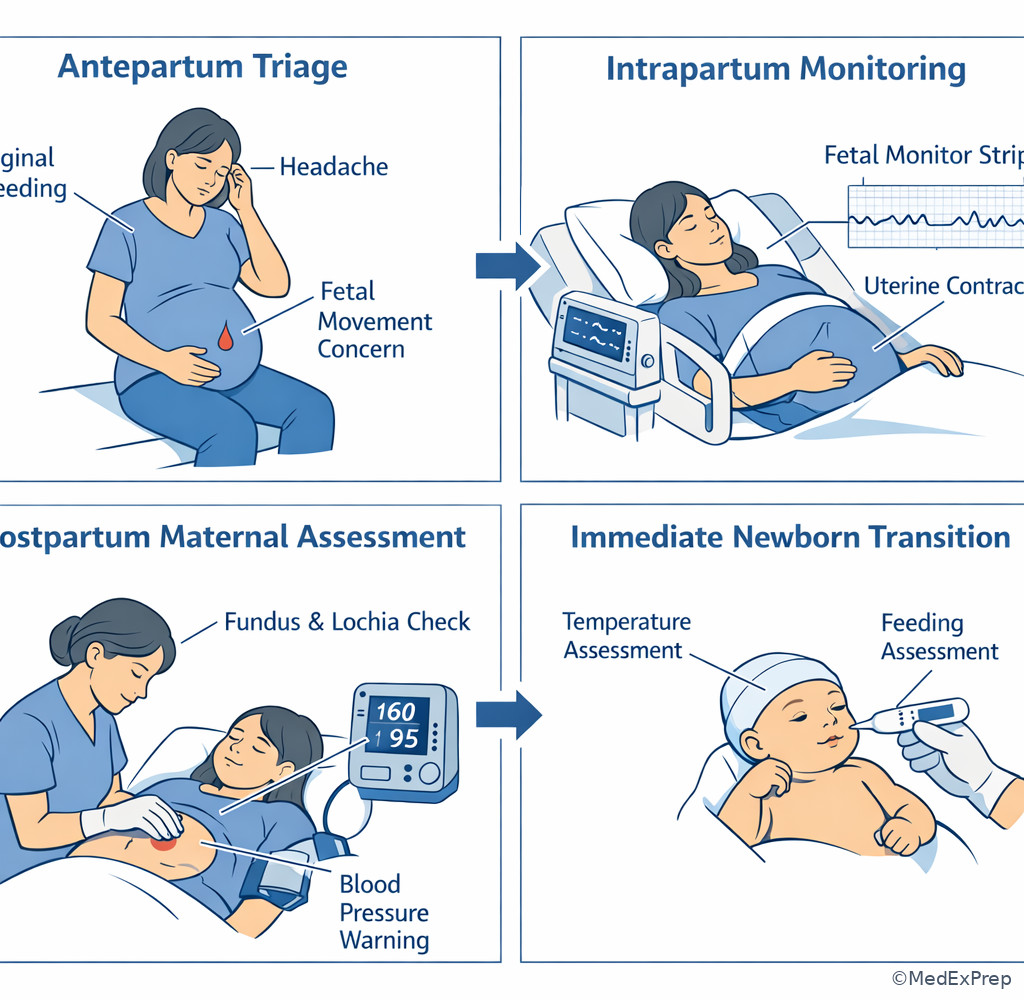
- DOMAIN: Maternal-fetal/newborn assessment → Cue clustering — sort likely exam cues into antepartum, intrapartum, postpartum, newborn, and professional/safety buckets.
- DOMAIN: Prioritization → Safety-first response — identify which domain areas most often generate urgent “see now, act now, escalate now” questions.
- DOMAIN: Test strategy → Item framing — recognize how broad blueprint language becomes specific nursing exam tasks.
- DOMAIN: Antepartum/intrapartum assessment and nursing care → recognizing how maternal and fetal surveillance content appears in questions
- DOMAIN: Labor and birth nursing care → linking progress, monitoring, interventions, and escalation
- DOMAIN: Postpartum maternal care → organizing recovery, hemorrhage, hypertensive, thrombotic, and infection priorities
- DOMAIN: Newborn assessment/basic care → sorting transition, routine care, safety, and escalation cues
- DOMAIN: Professional issues/safety/interprofessional communication → RN scope, documentation, teaching, delegation, and chain of command
Why it matters
- The exam rewards pattern recognition: if you know which domain a cue belongs to, you eliminate distractors faster.
- Blueprint orientation prevents overstudying low-yield trivia and underpreparing for repeated safety themes such as hemorrhage, hypertensive emergencies, fetal compromise, medication monitoring, and newborn transition.
- Many wrong answers are tempting because they are reasonable provider plans or delayed nursing actions; this lesson trains you to stay inside the RN role.
- Domain mapping is the first step in the course-wide reasoning sequence: identify the task → extract key facts → choose the governing rule → act → verify.
Exam takeaway: Use this map to sort question cues into the correct nursing decision bucket before choosing an answer.
flowchart TD
A[RNC-MNN Exam Stem] --> B[Antepartum or Triage]
A --> C[Labor and Intrapartum]
A --> D[Postpartum Maternal]
A --> E[Immediate Newborn]
A --> F[Professional Safety and Communication]
B --> B1[bleeding pain BP movement rupture symptoms]
C --> C1[FHR contractions labor progress medications]
D --> D1[fundus lochia BP pain VTE infection]
E --> E1[transition thermoregulation feeding jaundice security]
F --> F1[scope teaching documentation escalation delegation]
When you read a stem, ask first: “Which decision bucket is this?” That single step often resolves answer conflict. See Fig 1.
Key Terms & Must-Know Facts
1.1.1.1 Key terms
- Blueprint: the public exam outline translated into testable nursing tasks.
- Domain: a broad content area such as intrapartum care or postpartum care.
- Subskill: a learner-ready action within a domain, such as interpreting fetal tracings or prioritizing hemorrhage assessment.
- Cue cluster: related findings that point to one nursing priority.
- RN scope: assessment, intervention, monitoring, teaching, documentation, communication, escalation.
- Out-of-role distractor: a choice requiring diagnosis, prescribing, or independent provider decision-making.
- Priority action: the safest immediate nursing step based on ABCs, circulation, and maternal-fetal safety.
- Escalation: timely provider notification, bedside evaluation request, rapid response, or chain of command activation.
- Intrauterine resuscitation: nursing measures to improve fetal status during concerning intrapartum patterns.
- Immediate newborn transition: first observations and routine stabilization after birth.
- Board-style stem: scenario written to test action choice, not passive recall alone.
- Tempting distractor: a plausible nursing action that is correct in another scenario or at a lower priority.
1.1.1.2 Must-know facts
- On this exam, the best answer is usually the safest immediate RN action, not the most definitive medical plan.
- Unstable maternal circulation or airway issues generally outrank stable discomfort and routine teaching needs.
- Nonreassuring fetal findings often require prompt nursing response plus provider notification.
- Postpartum questions frequently hinge on hemorrhage, hypertension, infection, or VTE warning signs.
- Newborn questions often separate expected transition findings from respiratory, glucose, temperature, feeding, or jaundice concerns.
- Professional issues are testable: documentation, identification, medication safety, communication, delegation, and security all matter.
- A broad domain map helps you decide whether the stem is asking for assessment first, intervention first, or escalation now.
- Provider-only actions are wrong unless the RN answer focuses on assessment, stabilization, communication, or order clarification.
| Domain bucket | Common cue words in stems | Most likely RN task | Typical wrong-answer pattern |
|---|---|---|---|
| Antepartum/triage | Bleeding, headache, decreased fetal movement, leaking fluid, contractions before term | Focused assessment, monitor, safety precautions, notify/escalate | Reassurance before assessment |
| Labor/intrapartum | FHR pattern, variability, decelerations, tachysystole, epidural, progress | Interpret tracing, intervene, reassess, communicate | Waiting for provider before basic nursing measures |
| Postpartum maternal | Fundus, lochia, boggy uterus, BP, headache, calf pain, fever | Recognize red flags, act on circulation/safety, escalate | Routine teaching when instability is present |
| Immediate newborn | Color, tone, respirations, temperature, glucose risk, feeding, bilirubin | Transition assessment, thermoregulation, feeding support, escalation | Assuming all cyanosis or jitteriness is normal |
| Professional/safety | Documentation, identification, consent, delegation, security, communication | Scope-safe nursing action and chain of command | Doing provider-level work or unsafe delegation |
Core content
1.1.1.3 Foundational map: what the exam is really testing
A Explanation
The central decision conflict in this lesson is simple: Should you read the exam as a list of topics, or as a map of nursing decisions? The exam is built from broad maternal-newborn domains, but questions are answered at the bedside-action level. The single rule that resolves this conflict is: translate every domain into an RN task. “Intrapartum care” is not just labor facts; it becomes interpreting fetal heart rate patterns, recognizing tachysystole, supporting labor progress, monitoring medications, and escalating when maternal or fetal status worsens. “Postpartum care” is not just normal recovery; it becomes distinguishing expected findings from hemorrhage, hypertension, infection, thrombosis, and unsafe discharge teaching.
WHY THIS IS TESTED: Candidates often know content but miss questions because they do not identify the task being tested. A stem about headache postpartum may be asking you to choose immediate escalation, not education; a stem about variable decelerations may be asking for intrauterine resuscitation, not diagnosis.
Think of the domain map as a sorting frame: antepartum/triage, intrapartum, postpartum, newborn, and professional safety. Once the stem is sorted, the answer choices become easier to rank. See Fig 1 and Fig 2.
Exam takeaway: Convert broad blueprint labels into specific RN actions before reading answer choices.
flowchart LR
A[Blueprint Domain] --> B[Question Cues]
B --> C[Likely RN Task]
C --> D[Assess first]
C --> E[Intervene first]
C --> F[Teach or document]
C --> G[Escalate now]
D --> H[Choose safest answer]
E --> H
F --> H
G --> H
B Worked example
A 29-year-old G2P1 at 38 weeks is in labor with oxytocin infusing. She has gestational diabetes and obesity. The fetal tracing shows recurrent variable decelerations with moderate variability; contractions are every 2 minutes. Her partner asks whether the nurse thinks a cesarean delivery will be needed. Blood glucose is 104 mg/dL. The question asks for the most appropriate next action.
Identify the task: This is intrapartum surveillance, not counseling about delivery mode. Extract key facts: recurrent variables, frequent contractions, oxytocin running, moderate variability, distracting normal glucose, tempting cesarean clue from partner question. Apply the rule: in intrapartum questions, the RN first addresses reversible fetal stress within scope and communicates as needed. Eliminate distractors: choosing “prepare for cesarean” is provider-level and premature; choosing “reassure and continue monitoring” ignores a treatable pattern. Verify: the best answer will involve intrauterine resuscitative action and appropriate notification if pattern persists.
C Exam trap
D Checkpoint
Question: Which stem is most clearly testing the postpartum maternal domain rather than professional/safety or intrapartum care?
- A patient 2 hours after birth has a boggy fundus, heavy lochia, and tachycardia.
- A laboring patient has recurrent late decelerations after epidural placement.
- A newborn’s ID bands do not match the parent’s band during transfer.
- A triage patient at 33 weeks reports decreased fetal movement and headache.
Answer: A.
- A: Tempting because it may also suggest emergency response, but it is right because the cue cluster centers on postpartum hemorrhage assessment and action.
- B: Tempting because it includes monitoring and urgency, but it is wrong here because it belongs to intrapartum fetal surveillance.
- C: Tempting because it is strongly testable, but it is wrong here because it belongs to safety/identification protocols.
- D: Tempting because headache is urgent, but it is wrong here because the scenario is antepartum triage rather than postpartum care.
1.1.1.4 RN scope and answer-choice filtering
A Explanation
The decision conflict here is: Should you choose the action that solves the medical problem most definitively, or the action the RN can perform safely and immediately? The rule is: stay inside the RN role and prefer the highest-priority nursing action available now. On RNC-MNN items, attractive wrong answers often sound advanced, definitive, or authoritative: diagnosing a condition, deciding on surgery, prescribing therapy, independently changing a provider-directed plan, or providing provider-level informed consent. Those are out-of-role. A correct RN answer focuses on focused assessment, standard nursing interventions, medication administration per order/policy, ongoing monitoring, documentation, communication, and rapid escalation.
WHY THIS IS TESTED: The exam measures safe inpatient obstetric nursing judgment, not physician management. Questions are designed so that a knowledgeable nurse recognizes when the next step is to stabilize and notify rather than decide the medical plan.
Use a two-pass filter for options. First pass: remove clearly out-of-role choices. Second pass: among valid nursing actions, rank by urgency using ABCs, circulation, maternal-fetal safety, and time sensitivity. See Fig 3.
Exam takeaway: Reject provider-only options first, then rank the remaining nursing actions by urgency and safety.
flowchart TD
A[Answer choice] --> B{Within RN scope?}
B -- No --> C[Reject]
B -- Yes --> D{Urgent instability?}
D -- Yes --> E[Assess or stabilize now]
D -- No --> F[Teach monitor document or routine care]
E --> G[Notify or escalate if needed]
F --> H[Proceed per policy and orders] B Worked example
A 36-year-old primipara is 1 hour postpartum after a vaginal birth complicated by prolonged labor. She has chronic hypertension and anemia. Blood pressure is 150/96 mm Hg, pulse 118/min, uterus is boggy, and pads are saturating quickly. A distractingly mild headache is noted. The options include calling for methylergonovine, diagnosing uterine atony, massaging the fundus and assessing bleeding, and scheduling a repeat blood pressure in 30 minutes.
Identify the task: immediate RN postpartum action. Extract key facts: postpartum, boggy uterus, heavy bleeding, tachycardia, chronic hypertension, mild headache distractor. Apply the rule: stay in scope and prioritize circulation. Eliminate distractors: diagnosing uterine atony is outside role; calling specifically for a uterotonic may be part of escalation but comes after immediate assessment/intervention within nursing scope, especially because methylergonovine may be inappropriate in hypertension and the RN does not independently choose it. Verify: fundal massage with bleeding assessment is the best immediate nursing action while mobilizing help per protocol.
C Exam trap
D Checkpoint
Question: Which option is the best example of an out-of-role distractor on this exam?
- Repositioning a laboring patient with recurrent late decelerations
- Clarifying an unclear magnesium sulfate order with the provider
- Deciding that a patient requires operative vaginal delivery now
- Documenting postpartum fundal tone and quantified blood loss
Answer: C.
- A: Tempting because it changes clinical management, but it is wrong as the answer because repositioning is a valid nursing intervention within scope.
- B: Tempting because it involves provider communication, but it is wrong as the answer because clarifying unsafe or unclear orders is an RN responsibility.
- C: Tempting because it sounds decisive and clinically advanced, but it is right because choosing operative delivery is a provider-level decision.
- D: Tempting because documentation is less dramatic than intervention, but it is wrong as the answer because this is a core RN duty and not out-of-role.
- The first answer filter on many RNC-MNN items is ______ before urgency ranking. Answer: RN scope.
- True or False: The most definitive medical plan is usually the best exam answer. Answer: False.
- Name the 3 valid high-level RN response types most often tested. Answer: assess, intervene, escalate/communicate.
1.1.1.5 Foundational content buckets: where high-yield cues live
A Explanation
The decision conflict is: When a stem contains many facts, which cues matter most for domain placement and likely priority? The rule is to look for the cue cluster that signals the most testable nursing risk. In antepartum/triage, high-yield cues include vaginal bleeding, hypertension symptoms, decreased fetal movement, membrane rupture complaints, and preterm contractions. In intrapartum, cue clusters center on fetal heart rate category, variability, decelerations, tachysystole, analgesia/anesthesia monitoring, and labor progress. In postpartum, think fundus, lochia, bladder, blood pressure, pain pattern, fever, calf symptoms, and teaching red flags. In newborn care, transition, respiratory effort, temperature, feeding, glucose risk, elimination, jaundice, and identification/security dominate.
WHY THIS IS TESTED: Exam writers add noise to realistic stems. A distracting lab value, comorbidity, or family concern may be present, but the tested domain usually emerges from a small set of high-yield findings.
This is where your mental map becomes practical: you are not memorizing a blueprint document; you are learning where exam writers hide the clue that changes priority. See Fig 4.
Exam takeaway: Group findings by timing and body system to identify the tested priority faster than by reading details one by one.
B Worked example
A 24-year-old G1P0 at 34 weeks presents to triage with decreased fetal movement, a mild sore throat, and swelling in her hands. She has a history of migraine and asthma. Blood pressure is 166/112 mm Hg, reflexes are brisk, and she reports seeing spots. Urinalysis is pending. The question asks for the priority nursing assessment or action.
Identify the task: antepartum triage prioritization. Extract key facts: 34 weeks, severe-range blood pressure, visual symptoms, hyperreflexia, decreased fetal movement; sore throat and migraine history are noise. Apply the rule: cue cluster beats isolated distractors. This is a hypertensive emergency pattern until proven otherwise, with fetal concern also present. Eliminate distractors: focusing on a sore throat, waiting for urinalysis, or assuming migraine explains symptoms delays care. Verify: the best answer will prioritize maternal stabilization assessment, seizure precautions per policy, fetal evaluation, and immediate provider notification/escalation.
C Exam trap
D Checkpoint
Question: Which cue cluster most strongly places a stem in the immediate newborn domain?
- Boggy fundus, saturating pads, tachycardia
- Jitteriness, temperature instability, poor feeding after birth
- Recurrent late decelerations and tachysystole during oxytocin infusion
- Third-trimester headache, RUQ pain, and elevated blood pressure
Answer: B.
- A: Tempting because it is urgent and maternal, but it is wrong because it clearly belongs to postpartum hemorrhage care.
- B: Tempting because jitteriness may also have multiple causes, but it is right because the cluster centers on newborn transition and stabilization.
- C: Tempting because it uses monitor data, but it is wrong because that cluster belongs to intrapartum fetal surveillance.
- D: Tempting because it includes time-sensitive assessment, but it is wrong because it belongs to antepartum hypertensive triage.
1.1.1.6 Application: predicting the type of nursing decision a question wants
A Explanation
Once you know the domain, the next conflict is: What kind of nursing decision is the stem asking for? The single rule is: identify the action verb hidden in the question. Most RNC-MNN stems ask for one of five things: assess first, intervene now, monitor most closely, teach/reinforce, or notify/escalate. The wording may vary — “most appropriate next action,” “best response,” “requires immediate clarification,” “most important to monitor,” “priority patient,” “which finding requires prompt provider notification” — but the answer type is usually one of these.
WHY THIS IS TESTED: Many questions become difficult only because the candidate answers a different question than the one asked. If the stem asks what requires immediate clarification, a correct technical intervention may still be wrong. If the stem asks what to monitor, a treatment action may be premature.
This step pairs naturally with the next upcoming lesson, Priority Frameworks In Obstetrics, where you will refine urgency ranking. Here, you are building the simpler foundation: identify whether the test writer wants an assessment, intervention, teaching point, or escalation response. See Fig 5.
Exam takeaway: The wording of the ask tells you whether to choose assessment, intervention, monitoring, teaching, or escalation.
flowchart TD
A[Question ask] --> B{What is being tested?}
B --> C[Assess first]
B --> D[Intervene now]
B --> E[Monitor closely]
B --> F[Teach or reinforce]
B --> G[Notify clarify escalate]
C --> H[Pick nursing assessment]
D --> H
E --> H
F --> H
G --> H B Worked example
A 31-year-old multipara is receiving magnesium sulfate for severe preeclampsia after birth. She also has type 2 diabetes and obesity. The stem states that urine output has decreased over the last 2 hours, respirations are 10/min, reflexes are diminished, and her partner asks whether breastfeeding will still be allowed. The question asks which finding requires immediate provider notification.
Identify the task: notification/escalation, not teaching. Extract key facts: magnesium sulfate, low respirations, diminished reflexes, low urine output; breastfeeding question is the tempting-but-wrong conversational hook. Apply the rule: answer the exact ask. Eliminate distractors: providing education about breastfeeding or documenting intake and output addresses secondary issues. Verify: the answer must identify the toxicity concern requiring prompt communication and urgent nursing response per protocol.
C Exam trap
D Checkpoint
Question: A question asks which order requires immediate clarification. Which option best matches the expected answer type?
- A routine comfort measure that can be implemented independently
- An unsafe or unclear medication-related instruction needing provider follow-up
- A stable teaching point for discharge later in the shift
- A normal postpartum finding that only needs documentation
Answer: B.
- A: Tempting because independent actions are common on nursing exams, but it is wrong because clarification questions target safety or order ambiguity.
- B: Tempting because it sounds administrative, but it is right because immediate clarification is about preventing unsafe implementation.
- C: Tempting because teaching is a valid RN role, but it is wrong because delayed education does not fit “requires immediate clarification.”
- D: Tempting because documentation appears in many options, but it is wrong because normal findings do not need order clarification.
- If the ask says “most important to monitor,” do not choose a teaching answer unless ______. Answer: monitoring is embedded in the teaching option, which is uncommon.
- True or False: “Requires immediate clarification” usually signals a medication, order, or safety issue. Answer: True.
- Name the 5 answer categories. Answer: assess, intervene, monitor, teach, notify/escalate.
1.1.1.7 Integration: building a study plan from the domain map
A Explanation
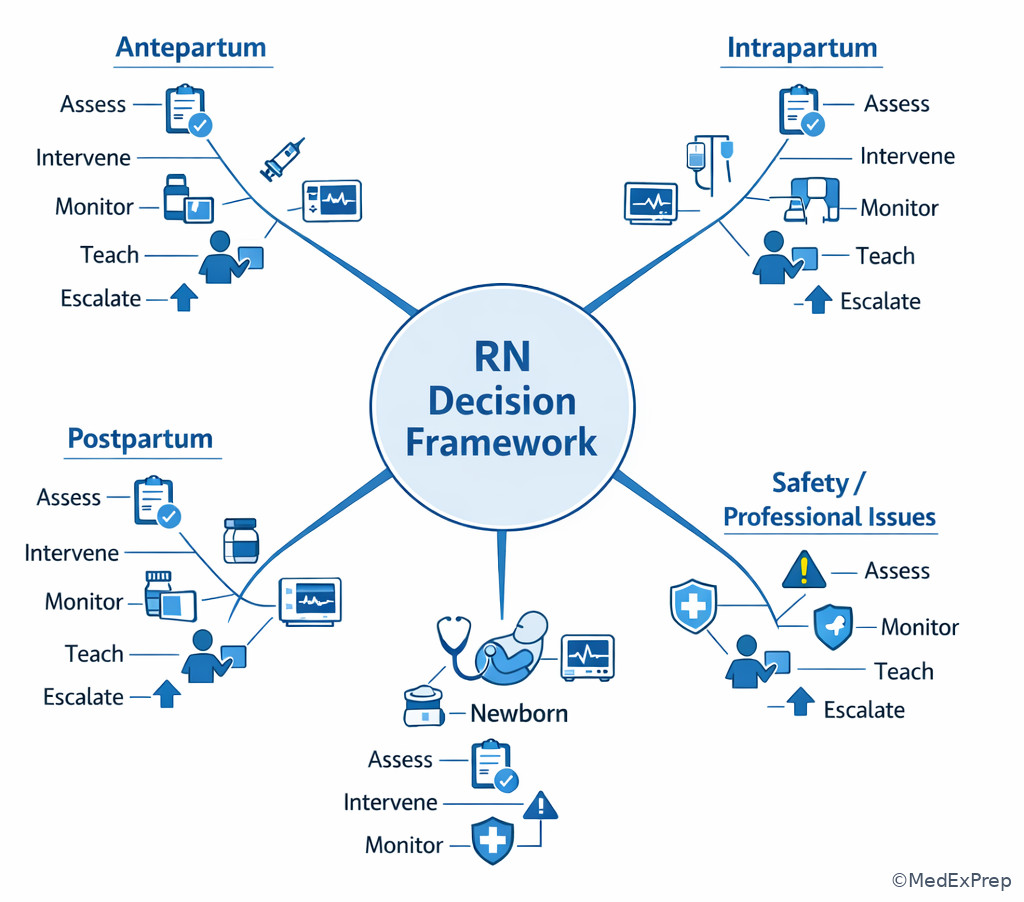
The final conflict is strategic: Should you study by chapter title, or by repeating exam-safe actions across settings? The most effective approach is both, but anchored to recurring actions. The single rule is: study the same nursing behaviors across multiple domains. For example, assessment exists in all domains, but the cues differ: antepartum bleeding, intrapartum fetal pattern change, postpartum heavy lochia, newborn respiratory distress. Escalation also recurs across the course: severe hypertension symptoms, hemorrhage, tachysystole with concerning tracing, magnesium toxicity, newborn temperature or respiratory instability, identification/security mismatch. If you build your review around repeated decision patterns, you retain more and transfer better to board-style stems.
WHY THIS IS TESTED: The exam integrates domains. A question may appear to be about medication, but the real issue is prioritization; it may appear to be about labor, but the tested skill is escalation. Domain mapping is the first layer; repeated decision patterns are the second.
This lesson is foundational, so the goal is not detailed pathology mastery yet. It is to create a scaffold for the entire course: sort the domain, identify the task, filter by scope, then apply priority. The next two lessons deepen exactly those middle steps.
Exam takeaway: Rehearse the same nursing actions across multiple maternal-newborn settings to improve transfer on integrated exam items.
B Worked example
A nurse candidate notices that they keep missing questions about oxytocin, postpartum bleeding, and neonatal temperature. They are considering spending a week memorizing rare obstetric syndromes. A practice item shows a term newborn with jitteriness after prolonged skin-to-skin interruption, a postpartum patient with increasing lochia and dizziness, and a laboring patient with uterine tachysystole; the test asks which patient should be assessed first.
Identify the task: integrated prioritization across domains. Extract key facts: three different domain buckets, all realistic nursing issues, one first-assess decision. Apply the rule: domain mapping is necessary, but the repeated action pattern is priority assessment of instability. Eliminate distractors: memorizing rare syndromes does not fix this type of miss. Verify: the study plan should emphasize repeated decision patterns across common high-yield scenarios.
C Exam trap
D Checkpoint
Question: Which study approach best matches the domain-map strategy from this lesson?
- Memorize uncommon diagnoses before learning how to sort question types
- Study all medication names first without linking them to monitoring or escalation
- Practice sorting stems by domain and action type before deciding the best response
- Skip newborn content early because maternal questions are more urgent clinically
Answer: C.
- A: Tempting because specialty exams can feel detail-heavy, but it is wrong because domain confusion causes more misses early than rare-disease trivia.
- B: Tempting because medications are high yield, but it is wrong because exam questions test nursing use, monitoring, and safety context.
- C: Tempting because it sounds basic, but it is right because correct sorting is the scaffold for later prioritization and management questions.
- D: Tempting because maternal emergencies are common, but it is wrong because newborn transition and safety are clearly part of the exam blueprint.
Exam Traps & Differentiators
Most common wrong answer and why: choosing the most definitive medical plan instead of the safest immediate RN action. This happens when a candidate recognizes the underlying condition but ignores the RN role and the exact question verb.
| Looks similar | But isn't | Discriminator | What the RN should think |
|---|---|---|---|
| Medical diagnosis question | RN priority action question | Stem asks next action, monitor, notify, or clarify | What can I safely do or escalate now? |
| Teaching question | Urgent escalation question | Red flags already present in vitals, bleeding, tracing, or respirations | Stabilize and notify before education |
| Intrapartum tracing interpretation | Medication safety question | Order, infusion, or side-effect wording drives the ask | Clarify or intervene based on medication risk |
| Routine postpartum discomfort | Postpartum emergency | Heavy bleeding, severe headache, dyspnea, chest pain, fever, unilateral leg symptoms | Circulation and safety first |
| Expected newborn transition | Newborn instability | Poor feeding, temperature issues, respiratory findings, persistent abnormal color, lethargy | Assess, support transition, escalate if abnormal persists |
1.1.1.8 If the stem says ___, think ___
- “Most appropriate next action” → first decide whether assessment or immediate intervention is needed now.
- “Requires immediate clarification” → unsafe order, dose, route, timing, or contradiction with maternal-newborn safety.
- “Most important to monitor” → side effect, complication marker, or trend that changes escalation timing.
- “Which patient should the nurse see first?” → unstable circulation, breathing, severe hypertension, nonreassuring fetal status, or newborn compromise outranks stable teaching needs.
- “The partner asks…” → often a distractor if red-flag clinical data are already present.
- “The provider plans…” → stay in RN role unless the question specifically asks about clarifying an unsafe order or preparing the patient.
Exam takeaway: Many wrong answers are correct nursing actions in a different priority tier, so identify the exact task before choosing.
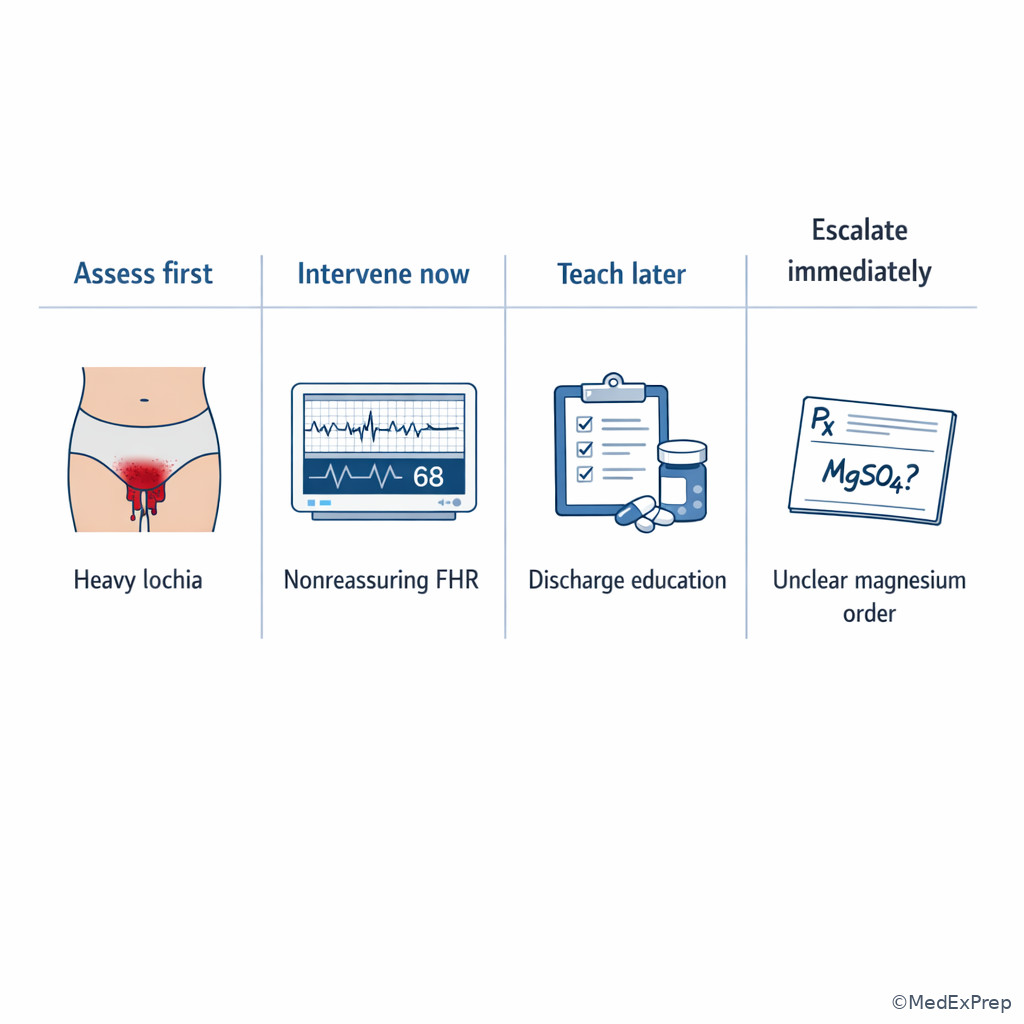
As you move into the upcoming lessons on item logic and obstetric prioritization, note the confusable pair: scope error versus priority error. Scope error means you chose something the RN should not independently decide. Priority error means you chose a real nursing action, but not the most urgent one.
Tables
| Question wording | What it usually wants | Best first mental move |
|---|---|---|
| Most appropriate next action | Assessment or intervention | Ask whether instability is already proven |
| Best response | Teaching or communication | Confirm the patient is stable before education |
| Most important to monitor | Trend, side effect, or complication marker | Connect medication or condition to nursing surveillance |
| Requires immediate clarification | Order or safety problem | Look for dose/route/timing contradiction or scope issue |
| See first / priority patient | Triage of urgency | Use ABCs, circulation, maternal-fetal safety |
| Immediate provider notification | Escalation threshold | Find red-flag worsening signs |
| Valid RN action | Close distractor | Why the distractor fails |
|---|---|---|
| Reassess fetal tracing and reposition | Decide on emergent cesarean delivery | Provider-level decision; RN should stabilize and notify |
| Massage boggy fundus and assess lochia | Diagnose uterine atony | Diagnosis wording is outside the tested RN role |
| Clarify unsafe medication order | Rewrite the order correctly | Prescribing/order entry is not the RN role |
| Initiate seizure precautions per policy | Assume headache is benign until labs return | Dangerous delay despite severe symptom cluster |
| Support newborn thermoregulation and assess feeding | Assume jitteriness is normal transition in all cases | Ignores possible instability or glucose issue |
| Differential bucket | Typical cue cluster | Likely tested nursing priority |
|---|---|---|
| Antepartum hypertensive concern | Severe headache, visual changes, RUQ pain, high BP | Maternal stabilization assessment and urgent escalation |
| Preterm labor/membrane concern | Contractions, pelvic pressure, leaking fluid, gestational age | Focused maternal-fetal assessment and provider communication |
| Intrapartum fetal compromise | Concerning FHR pattern plus contraction context | Intrauterine resuscitation and reassessment |
| Postpartum hemorrhage concern | Boggy uterus, heavy lochia, tachycardia, dizziness | Circulation-focused intervention and escalation |
| Postpartum hypertensive concern | Severe BP symptoms, neuro symptoms, hyperreflexia | Safety precautions, monitoring, prompt notification |
| Newborn transition instability | Respiratory signs, poor feeding, temperature issues, lethargy | Immediate assessment, thermoregulation/support, escalation |
Algorithm / Approach
Exam takeaway: Sort the domain, identify the task, filter for RN scope, then rank options by urgency and safety.
flowchart TD
A[Read the stem] --> B[Find cue cluster]
B --> C[Assign domain bucket]
C --> D[Identify the ask]
D --> E[Filter out provider-only choices]
E --> F{Is instability already present?}
F -- Yes --> G[Assess or stabilize immediately and escalate]
F -- No --> H[Choose focused assessment monitoring or teaching]
G --> I[Verify answer matches RN scope]
H --> I
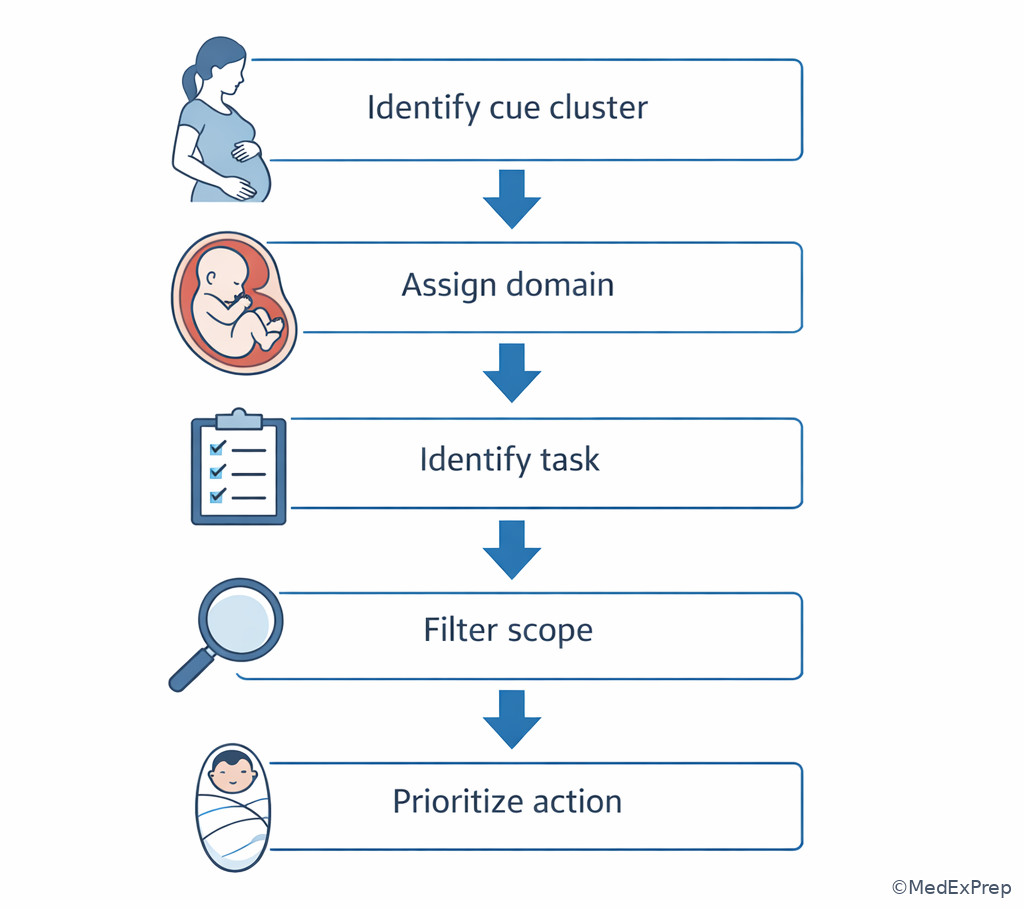
Use this as your first-pass algorithm on nearly every item in this course. See Fig 6.
Exam takeaway: A stepwise visual routine reduces mistakes caused by cue overload and tempting provider-level distractors.
Rapid Review
- Domain map → broad topic label is useful only after you translate it into an RN bedside task.
- Antepartum cues → bleeding, severe BP symptoms, rupture, movement changes, preterm signs.
- Intrapartum cues → FHR pattern plus contraction context beats most other details.
- Postpartum cues → fundus-lochia-vitals cluster separates routine recovery from hemorrhage.
- Newborn cues → transition is about respirations, temperature, feeding, tone, and color persistence.
- Professional/safety cues → identification, documentation, delegation, medication safety, communication.
- Scope filter → reject diagnosis, prescribing, surgery decisions, and independent treatment planning.
- Question verb → “clarify” means safety/order issue; “monitor” means trend marker; “next action” means priority step.
- Tempting distractor → often a correct nursing action at the wrong priority.
- Red-flag pattern → instability outranks education and routine comfort measures.
- Study strategy → practice repeated action types across multiple domains, not isolated trivia lists.
- Partner/family question in stem → often noise if red-flag assessment data are already present.
Self-check quiz
1.1.1.9 Question 1
A postpartum patient 2 hours after birth has a boggy fundus, heavy lochia, and pulse 116/min. Which domain bucket best fits this stem before choosing an action?
- Antepartum triage
- Intrapartum surveillance
- Postpartum maternal care
- Immediate newborn transition
1.1.1.10 Question 2
A laboring patient has recurrent late decelerations after oxytocin increase. Which answer choice type should be rejected first if present?
- Reposition the patient and reassess the tracing
- Notify the provider after initiating nursing measures
- Decide the patient requires cesarean delivery
- Evaluate contraction frequency and uterine resting tone
1.1.1.11 Question 3
A 27-year-old G1P0 at 35 weeks presents with headache, hand swelling, and decreased fetal movement. She has asthma and a recent upper respiratory infection. Blood pressure is 170/110 mm Hg, reflexes are brisk, and she reports visual spots. Which is the most appropriate immediate RN focus?
- Provide oral fluids and repeat kick counts in 1 hour
- Initiate focused maternal-fetal assessment, safety measures, and immediate provider notification
- Teach the patient that edema is expected late in pregnancy
- Wait for urinalysis results before escalating concerns
1.1.1.12 Question 4
A 32-year-old multipara is receiving magnesium sulfate postpartum for severe preeclampsia. She has obesity and gestational diabetes. Respirations are 10/min, reflexes are diminished, urine output has declined, and her mother asks whether the infant can stay in the room. Which question type is this stem most clearly asking you to solve if the prompt says “requires immediate provider notification”?
- Teaching priority
- Routine monitoring documentation
- Escalation of a red-flag finding
- Delegation to assistive personnel
1.1.1.13 Question 5
A term newborn 3 hours after birth is jittery, cool to the touch, and feeding poorly. The mother had prolonged labor and received IV fluids; the family asks whether the baby is “just tired.” Which domain and action pairing is most appropriate?
- Postpartum maternal domain; provide discharge teaching
- Immediate newborn domain; assess transition stability and support thermoregulation/feeding
- Professional issues domain; review ID band policy
- Intrapartum domain; interpret the fetal tracing from earlier labor
1.1.1.14 Question 6
A 30-year-old G2P2 is 45 minutes postpartum after vaginal birth. She has chronic hypertension, asthma, and an epidural that was recently discontinued. Blood pressure is 158/98 mm Hg, pulse 122/min, uterus is boggy, and bleeding has increased rapidly. She reports feeling anxious and mildly short of breath. Which is the best immediate RN action?
- Teach the patient to expect increased bleeding during the recovery phase
- Massage the fundus, assess bleeding and uterine tone, and mobilize hemorrhage support per protocol
- Request an order for the provider’s preferred uterotonic before touching the patient
- Reassess blood pressure in 15 minutes to determine whether anxiety is the cause
1.1.1.15 Question 7
A laboring patient at 39 weeks with oxytocin augmentation, obesity, and meconium-stained fluid develops recurrent late decelerations with minimal variability. Contractions are every 90 seconds. The provider is in another delivery. Which nursing response is most appropriate first?
- Continue current management and document because the provider is unavailable
- Implement intrauterine resuscitative measures within protocol and urgently notify/escalate
- Decide that operative delivery is required and prepare consent documents independently
- Explain to the support person that meconium alone is usually benign
1.1.1.16 Question 8
A nurse preparing for the RNC-MNN exam notices repeated misses on questions involving postpartum bleeding, fetal tracing changes, and newborn temperature instability. She plans a new study strategy. Which approach best reflects the domain-map method from this lesson?
- Memorize rare syndromes first because advanced exams emphasize obscure content
- Group missed questions by domain and repeat action type, then drill scope-safe priority responses
- Study only provider treatment algorithms because they reveal the final diagnosis
- Focus on medication names without linking them to monitoring or escalation cues
Answer key
1.1.1.17 Question 1 Answer: C
A. Antepartum triage: Tempting because bleeding can appear in multiple pregnancy settings, but it is incorrect for this scenario because the patient is already postpartum. The single stem clue is 2 hours after birth. Priority principle: timing defines the domain before the action. Source: NCSBN clinical judgment emphasis; ANA scope-based nursing assessment framework.
B. Intrapartum surveillance: Tempting because labor and immediate recovery can blur together in memory, but it is incorrect because the key findings are uterine tone and lochia, not fetal tracing or labor progress. The single clue is boggy fundus with heavy lochia. Priority principle: use cue clusters, not nearby timeline alone. Source: Saunders Comprehensive Review for the NCLEX-RN; ANA Standards of Practice.
C. Postpartum maternal care: Tempting because it may seem too obvious, but it is correct because the cue cluster signals postpartum hemorrhage assessment within maternal recovery care. The single clue is boggy fundus + heavy lochia + tachycardia. Priority principle: circulation-focused postpartum cues define the domain. Source: Saunders; Lewis Medical-Surgical Nursing.
D. Immediate newborn transition: Tempting because the postpartum period includes newborn care nearby, but it is incorrect because no newborn findings are provided. The single clue is the scenario remains entirely maternal. Priority principle: do not shift domains without matching cues. Source: NCSBN test plan reasoning conventions; ANA nursing process.
1.1.1.18 Question 2 Answer: C
A. Reposition the patient and reassess the tracing: Tempting because it changes the situation immediately, and it is incorrect as the rejected choice because it is actually a valid first-line RN action. The single clue is late decelerations after oxytocin increase, which supports nursing intervention within scope. Priority principle: intervene on reversible fetal stress first. Source: NCSBN; Saunders.
B. Notify the provider after initiating nursing measures: Tempting because communication is critical, and it is incorrect as the rejected choice because notification is appropriate after or alongside nursing stabilization steps. The single clue is the patient has a concerning tracing while on oxytocin. Priority principle: escalation is valid; it is not out-of-role. Source: ANA Standards; obstetric nursing review texts.
C. Decide the patient requires cesarean delivery: Tempting because it sounds definitive and safety-focused, but it is correct because this is a provider-level delivery decision, not an independent RN action. The single clue is decide. Priority principle: reject provider-only choices first. Source: ANA scope of practice; NCSBN role boundaries.
D. Evaluate contraction frequency and uterine resting tone: Tempting because it seems assessment-heavy, and it is incorrect as the rejected choice because assessing uterine activity is an appropriate RN response when oxytocin may contribute to fetal stress. The single clue is after oxytocin increase. Priority principle: assess before additional treatment decisions when medication effect may explain the change. Source: Saunders; ANA assessment standards.
1.1.1.19 Question 3 Answer: B
A. Provide oral fluids and repeat kick counts in 1 hour: Tempting because decreased fetal movement can prompt further assessment, but it is incorrect because severe maternal findings already indicate urgent risk and make delay unsafe. The single clue is BP 170/110 with visual spots. Priority principle: maternal instability outranks routine reassurance. Source: NCSBN priority framework; Saunders maternal-newborn review.
B. Initiate focused maternal-fetal assessment, safety measures, and immediate provider notification: Tempting because it bundles several actions, and it is correct because the cue cluster indicates severe hypertensive concern with fetal implications requiring prompt RN action and escalation. The single clue is severe-range BP plus visual symptoms and hyperreflexia. Priority principle: ABCs/circulation and seizure-risk safety outrank education. Source: ANA standards; obstetric nursing guidelines summarized in NCLEX review sources.
C. Teach the patient that edema is expected late in pregnancy: Tempting because swelling can be common, but it is incorrect because normalizing one symptom ignores the dangerous cluster. The single clue is that edema is not isolated; it accompanies severe neurologic and blood pressure findings. Priority principle: do not teach over instability. Source: Saunders; NCSBN.
D. Wait for urinalysis results before escalating concerns: Tempting because labs can support clinical concerns, but it is incorrect because the patient is already unsafe to delay. The single clue is symptomatic severe hypertension now. Priority principle: severe findings drive escalation before confirmatory data return. Source: ANA nursing judgment principles; NCSBN urgent-safety prioritization.
1.1.1.20 Question 4 Answer: C
A. Teaching priority: Tempting because the family asks a rooming-in question, but it is incorrect because education is not the central ask when toxicity cues are present. The single clue is requires immediate provider notification. Priority principle: answer the explicit verb in the stem. Source: NCSBN item-logic conventions; ANA communication standards.
B. Routine monitoring documentation: Tempting because urine output, respirations, and reflexes are monitoring elements, but it is incorrect because these findings have crossed into a red-flag range needing escalation, not mere charting. The single clue is respirations 10/min with diminished reflexes. Priority principle: worsening monitoring data triggers action, not documentation alone. Source: Saunders; ANA assessment-to-action expectations.
C. Escalation of a red-flag finding: Tempting because it sounds broad, and it is correct because the stem asks the nurse to identify the toxicity pattern that requires prompt provider awareness and urgent nursing response. The single clue is the triad of reduced respirations, low urine output, and diminished reflexes. Priority principle: safety and circulation/respiratory status outrank family teaching. Source: NCLEX review texts; NCSBN prioritization rules.
D. Delegation to assistive personnel: Tempting because bedside workload may be high, but it is incorrect because interpretation of magnesium toxicity and escalation cannot be delegated. The single clue is that this requires RN judgment. Priority principle: unstable assessment and provider notification remain with the RN. Source: ANA delegation principles; NCSBN delegation guidance.
1.1.1.21 Question 5 Answer: B
A. Postpartum maternal domain; provide discharge teaching: Tempting because the mother and baby are both in the postpartum unit, but it is incorrect because the findings are newborn-centered and currently unstable. The single clue is jittery, cool, poor feeding. Priority principle: identify the affected patient and urgency correctly. Source: Saunders newborn review; ANA assessment standards.
B. Immediate newborn domain; assess transition stability and support thermoregulation/feeding: Tempting because it combines multiple newborn actions, and it is correct because the cue cluster fits early newborn instability rather than maternal teaching. The single clue is the newborn’s temperature and feeding pattern in the first hours after birth. Priority principle: support airway/breathing/temperature and feeding-related stability first. Source: NCSBN; newborn nursing review texts.
C. Professional issues domain; review ID band policy: Tempting because newborn safety is a tested area, but it is incorrect because no identification mismatch or security issue is presented. The single clue is the physiological finding cluster, not a systems-safety cue. Priority principle: choose the domain driven by clinical findings, not any newborn-related topic. Source: ANA standards; Saunders.
D. Intrapartum domain; interpret the fetal tracing from earlier labor: Tempting because intrapartum events can influence newborn transition, but it is incorrect because the question asks for the current nursing focus based on present newborn findings. The single clue is 3 hours after birth. Priority principle: present instability outranks retrospective analysis. Source: NCSBN clinical judgment model; ANA nursing process.
1.1.1.22 Question 6 Answer: B
A. Teach the patient to expect increased bleeding during the recovery phase: Tempting because some postpartum bleeding is normal, but it is incorrect because the patient has clear circulation-threatening findings. The single clue is boggy uterus with rapidly increased bleeding and tachycardia. Priority principle: circulation instability outranks education. Source: NCSBN priority rules; Saunders postpartum review.
B. Massage the fundus, assess bleeding and uterine tone, and mobilize hemorrhage support per protocol: Tempting because it may seem incomplete without a medication order, and it is correct because it is the safest immediate RN action within scope for suspected postpartum hemorrhage. The single clue is the hemorrhage cue cluster. Priority principle: use immediate nursing intervention first, then continue escalation. Source: ANA standards of practice; Lewis and Saunders obstetric content.
C. Request an order for the provider’s preferred uterotonic before touching the patient: Tempting because medications may be needed, but it is incorrect because it delays direct nursing action and shifts to provider preference before bedside stabilization. The single clue is the patient is actively bleeding now. Priority principle: assess/intervene before delayed communication when instability is evident. Source: NCSBN; ANA.
D. Reassess blood pressure in 15 minutes to determine whether anxiety is the cause: Tempting because the patient reports anxiety and mild dyspnea, but it is incorrect because the hemodynamic pattern is better explained by hemorrhage until proved otherwise. The single clue is increased bleeding plus tachycardia. Priority principle: do not attribute abnormal vitals to anxiety when circulation red flags exist. Source: Saunders; Lewis Medical-Surgical Nursing.
1.1.1.23 Question 7 Answer: B
A. Continue current management and document because the provider is unavailable: Tempting because provider availability can create hesitation, but it is incorrect because the nurse must not delay intrauterine resuscitative measures during fetal compromise. The single clue is recurrent late decelerations with minimal variability and tachysystole. Priority principle: maternal-fetal safety demands action before passive observation. Source: NCSBN; obstetric nursing review texts.
B. Implement intrauterine resuscitative measures within protocol and urgently notify/escalate: Tempting because it asks the RN to act decisively, and it is correct because it stays within scope while addressing a time-sensitive intrapartum emergency pattern. The single clue is the combined fetal tracing and contraction frequency concern. Priority principle: stabilize within RN scope and escalate promptly. Source: ANA standards; Saunders maternal-newborn review.
C. Decide that operative delivery is required and prepare consent documents independently: Tempting because the pattern is worrisome, but it is incorrect because operative delivery choice and provider-level consent content are outside RN authority. The single clue is decide and independently. Priority principle: reject provider-only actions even in urgent scenarios. Source: ANA scope and role guidance; NCSBN.
D. Explain to the support person that meconium alone is usually benign: Tempting because education can reduce anxiety, but it is incorrect because teaching the support person is the wrong priority while the tracing is nonreassuring. The single clue is late decelerations with minimal variability, not meconium alone. Priority principle: urgent fetal compromise outranks reassurance. Source: Saunders; NCSBN priority framework.
1.1.1.24 Question 8 Answer: B
A. Memorize rare syndromes first because advanced exams emphasize obscure content: Tempting because certification exams feel specialty-focused, but it is incorrect because repeated misses here involve common priority patterns, not rare disease recall. The single clue is the learner’s weak areas are postpartum bleeding, fetal tracings, and newborn temperature instability. Priority principle: fix high-frequency decision errors before low-frequency trivia. Source: NCSBN exam reasoning principles; Saunders review structure.
B. Group missed questions by domain and repeat action type, then drill scope-safe priority responses: Tempting because it sounds methodical rather than content-heavy, and it is correct because it directly applies the domain-map framework from this lesson. The single clue is the misses span several domains but share nursing-priority reasoning. Priority principle: use repeated action patterns across content buckets. Source: ANA nursing process; exam prep best practices aligned with NCSBN clinical judgment model.
C. Study only provider treatment algorithms because they reveal the final diagnosis: Tempting because understanding the medical plan can be helpful, but it is incorrect because the exam asks for RN actions within scope rather than provider final decisions. The single clue is this course is explicitly framed in the RN inpatient obstetric role. Priority principle: scope-safe thinking beats provider-plan memorization. Source: ANA scope statements; NCSBN.
D. Focus on medication names without linking them to monitoring or escalation cues: Tempting because pharmacology is high yield, but it is incorrect because nursing exams test medication safety in context, not isolated name recall. The single clue is the missed items involve action decisions, not recognition alone. Priority principle: connect content to monitoring and escalation. Source: Saunders; Lewis nursing framework.
Keep going with the full RNC-MNN Prep Course (RNC-MNN)
You just studied the way members do, in the same lesson interface. Full access unlocks every lesson, the question bank and flashcards for a full year.
One payment · 1 year of access · No auto-renewal