1.1.1 - Instructional Domain Map
Instructional Domain Map
What you’ll learn
- Exam Framework and Test Strategy: Organize study priorities -> instructional domain mapping
- Prioritization, Safety, Communication, and Escalation Across Maternal-Newborn Care: Select the tested nursing lens -> RN action framing
- Maternal Assessment During Inpatient Obstetric Care: Place maternal findings into the correct study bucket -> expected vs concerning cues
- Normal Newborn Assessment and Transition: Place newborn findings into the correct study bucket -> routine care vs escalation cues
- Maternal-Newborn Education, Discharge, and Safety: Connect teaching content to exam tasks -> discharge and safety priorities
Blueprint mapping
- Instructional mapping for exam prep: Exam Framework and Test Strategy -> domain map literacy
- Instructional mapping for exam prep: Maternal Assessment During Inpatient Obstetric Care -> assessment and abnormal cue recognition
- Instructional mapping for exam prep: Labor and Birth Nursing Care -> surveillance and intrapartum nursing actions
- Instructional mapping for exam prep: Postpartum Maternal Nursing Care -> recovery assessment and urgent findings
- Instructional mapping for exam prep: Normal Newborn Assessment and Transition / Low-Risk Neonatal Care -> transition, feeding, thermoregulation, safety
- Instructional mapping for exam prep: Maternal-Newborn Education, Discharge, and Safety / Prioritization, Safety, Communication, and Escalation -> nursing judgment and scope-safe response
Why it matters
- The exam often feels broad because maternal, postpartum, labor, and newborn content are interleaved; a domain map prevents random studying.
- Many wrong answers are not clinically absurd; they are simply from the wrong domain, wrong priority level, or outside RN scope.
- When you can classify the stem first, you can narrow to the most appropriate nursing action faster and with less second-guessing.
- This map becomes the backbone for the rest of the course: what to assess, what is expected, what is abnormal, and when to escalate.
Exam takeaway: Use the domain first, then the nursing task, to avoid choosing a true fact from the wrong content bucket.
flowchart TD
A[Exam stem] --> B{Who is the patient?}
B -->|Pregnant or laboring| C[Maternal obstetric domain]
B -->|Postpartum patient| D[Postpartum maternal domain]
B -->|Newborn| E[Normal newborn or low-risk neonatal domain]
C --> F{What is being tested?}
D --> F
E --> F
F -->|Assessment cue| G[Expected vs abnormal findings]
F -->|Priority action| H[Nursing intervention and reassessment]
F -->|Teaching| I[Education and discharge]
F -->|Safety concern| J[Escalation and communication]
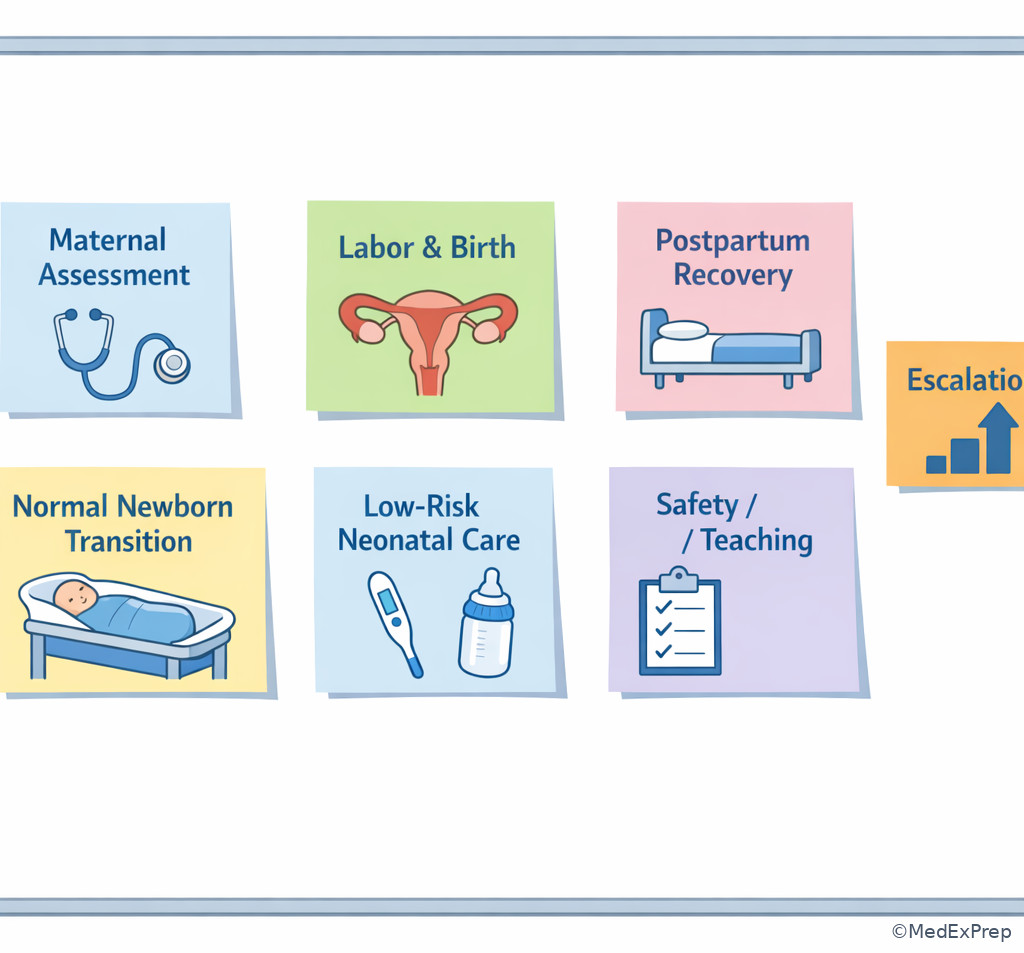
When a question feels crowded, return to this first-pass map. See Fig 1.
Exam takeaway: Visually grouping postpartum, labor, and newborn tasks helps prevent cross-domain answer errors.
Key Terms & Must-Know Facts
1.1.1.1 Key terms
- Instructional domain map: a study framework that groups tested content into logical maternal-newborn buckets.
- Domain: a broad content area such as postpartum care or normal newborn assessment.
- Objective: a teachable exam-relevant task within a domain.
- Subskill: the exact action or distinction being tested, such as expected vs abnormal findings.
- Expected finding: a cue consistent with normal recovery or transition.
- Concerning finding: a cue that requires prompt reassessment, intervention, or escalation.
- Escalation: notifying the provider, activating chain of command, or emergency response when findings exceed routine care.
- RN scope: what the bedside nurse can assess, implement, teach, monitor, document, and report within policy.
- Out-of-role signal: wording that pushes the answer into provider-level diagnosis or independent treatment planning.
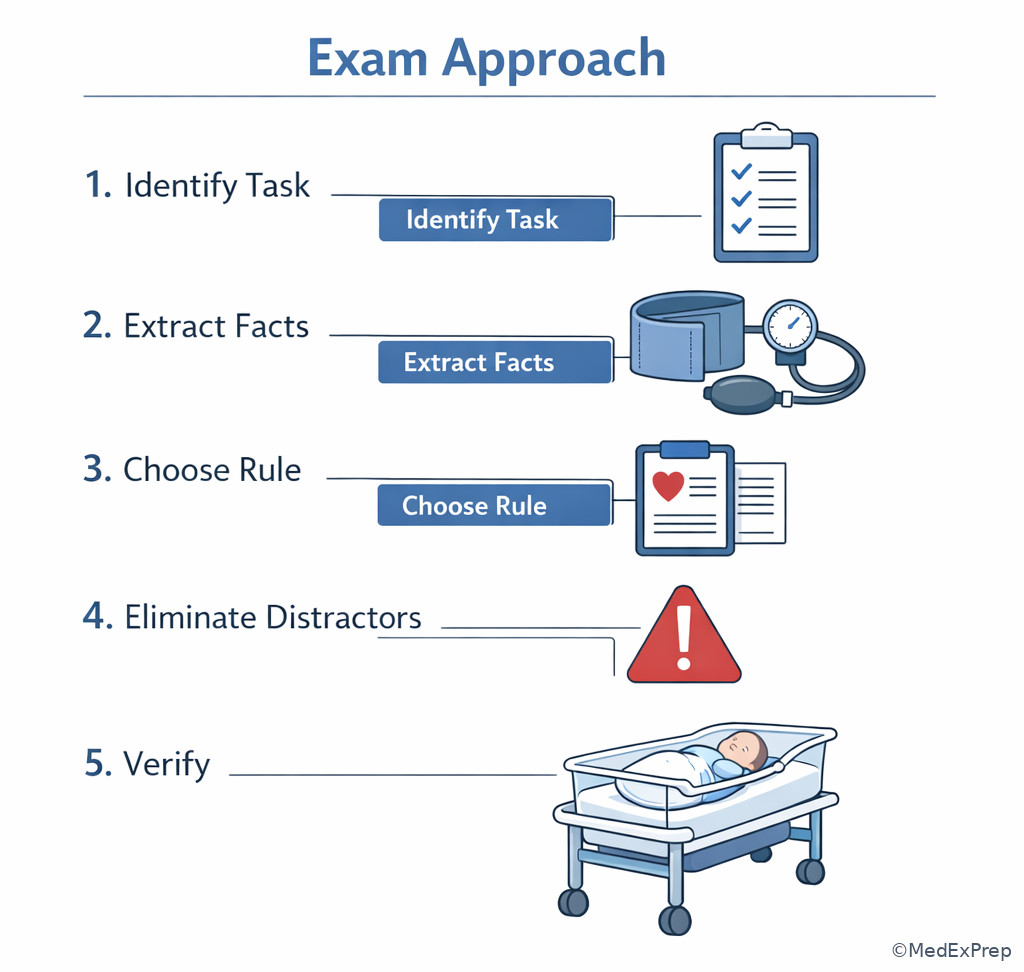
- Task-fact-rule-action: exam method: identify the task, extract facts, apply the nursing rule, choose the action.
- Low-risk newborn: a stable term or near-term infant receiving routine care, feeding support, and surveillance.
- Priority nursing action: the first safest RN step based on ABCs, circulation, safety, and nursing process.
1.1.1.2 Must-know facts
- Do not assume official NCC domain wording when it is not provided; use instructional mappings transparently.
- For this exam family, the tested lens is bedside RN judgment, not independent medical management.
- Most stems can be sorted by patient type first: laboring patient, postpartum patient, or newborn.
- High-yield tasks repeat across domains: assess, identify abnormality, intervene, teach, document, escalate.
- A correct nursing intervention can still be the wrong answer if it is not the priority action.
- Cross-domain confusion is a common trap, such as applying postpartum logic to intrapartum care.
- Newborn and maternal questions often pair safety with teaching and monitoring.
- Local protocols vary; when details differ by institution, choose the safest RN-centered action and follow policy.
| Study bucket | Main patient | Typical test task | Best RN lens |
|---|---|---|---|
| Maternal assessment | Pregnant inpatient | Recognize urgent vs expected cues | Focused assessment and escalation |
| Labor and birth care | Laboring patient | Monitor progress and fetal/maternal status | Surveillance, support, communication |
| Postpartum maternal care | Post-birth patient | Fundus, lochia, pain, bladder, recovery | Hemorrhage, infection, hypertension awareness |
| Normal newborn transition | Immediate newborn | Transition, respirations, temperature | Stabilize, assess, support adaptation |
| Low-risk neonatal care | Stable newborn | Feeding, output, jaundice, safety | Routine care, teaching, trend recognition |
| Safety and discharge | Mother and/or newborn | Teaching, readiness, prevention | Education, verification, documentation |
| Prioritization and escalation | Any maternal-newborn patient | Best first action | ABCs, circulation, safety, chain of command |
Exam takeaway: The same patient journey is tested in separate segments, so identify where in the continuum the stem lives.
{"prompt":"Clean nursing education timeline on white background showing maternal-newborn care continuum: antepartum inpatient assessment, labor monitoring, birth, immediate postpartum checks, newborn transition, feeding support, discharge teaching. Include labels and arrows. Emphasize bedside nursing tasks rather than procedures. No cartoons, no surgery.","caption":"Labeled maternal-newborn care continuum\nExam takeaway: The same patient journey is tested in separate segments, so identify where in the continuum the stem lives.","size":"1024x1024"} Core content
1.1.1.3 Foundational map: how the exam content is organized
A Explanation
The decision conflict here is simple but high-yield: should you study and answer by body system labels, or by bedside nursing tasks in maternal-newborn contexts? Choose the domain map that begins with patient setting and nursing task, and reject a generic med-surg approach that ignores the postpartum/newborn workflow. The single rule that resolves the conflict is this: on this exam, the question is usually asking what the RN should assess, do first, teach, monitor, document, or report in a specific maternal or newborn setting.
WHY THIS IS TESTED: exam items often place a correct fact inside the wrong context. A learner may know what lochia is, for example, but still miss whether the stem is testing postpartum assessment, hemorrhage escalation, or discharge teaching.
Use a three-layer map. First, identify who the patient is: laboring patient, postpartum patient, or newborn. Second, identify what task is being tested: assessment, intervention, teaching, documentation, or escalation. Third, identify what distinction matters: expected vs abnormal, first vs later, RN vs provider-only, or stable vs urgent. See Fig 2.
Exam takeaway: The fastest way to reduce options is to classify the stem by patient type and nursing task before reading choices in detail.
flowchart LR
A[Stem] --> B{Patient type}
B --> C[Labor or antepartum]
B --> D[Postpartum]
B --> E[Newborn]
C --> F{Task}
D --> F
E --> F
F --> G[Assess]
F --> H[Intervene]
F --> I[Teach]
F --> J[Document or escalate]
B Worked example
A 28-year-old G2P2 is 8 hours postpartum after a vaginal birth. She has mild asthma and iron-deficiency anemia. The stem notes a firm fundus at the umbilicus, moderate rubra lochia, fatigue, and a temperature of 37.6°C. The question asks which course domain the RN should use first to organize the response. A distracting clue is the history of anemia, which may push the learner toward a hematology mindset. Another tempting clue is fatigue, which can sound like general medical recovery.
Reasoning chain: identify the task: the question asks how to classify the stem. Extract key facts: postpartum timing, fundal finding, lochia, maternal recovery cues. Apply rule: classify by patient setting first. Eliminate distractors: not labor care, not newborn care, not standalone medical-surgical anemia management. Verify: this belongs primarily to postpartum maternal nursing care, with secondary attention to expected vs abnormal recovery findings.
C Exam trap
D Checkpoint
Question: A nurse is reading a practice stem about a 2-hour-old term newborn with transient acrocyanosis, temperature stabilization needs, and a parent asking about first feeding. Which domain map should the nurse apply first?
- Normal Newborn Assessment and Transition — tempting because acrocyanosis and first feeding both appear in early newborn care; this is correct because the stem centers on immediate newborn adaptation and routine bedside RN assessment.
- Postpartum Maternal Nursing Care — tempting because the baby is with the mother after birth; this is wrong because the assessment target is the newborn, not maternal recovery.
- Labor and Birth Nursing Care — tempting because the newborn is only 2 hours old; this is wrong because the question has moved beyond intrapartum management into newborn transition.
- Documentation and Escalation — tempting because every newborn assessment must be documented; this is wrong because documentation is the task layer, not the primary content domain.
1.1.1.4 Foundational map: the recurring nursing tasks across all domains
A Explanation
Once you know the content bucket, the next conflict is whether the stem is testing knowledge about a condition or the RN action within that condition. Choose the action framework and reject answer choices that are descriptive but not operational. The single rule: this exam rewards what the bedside RN does next within scope.
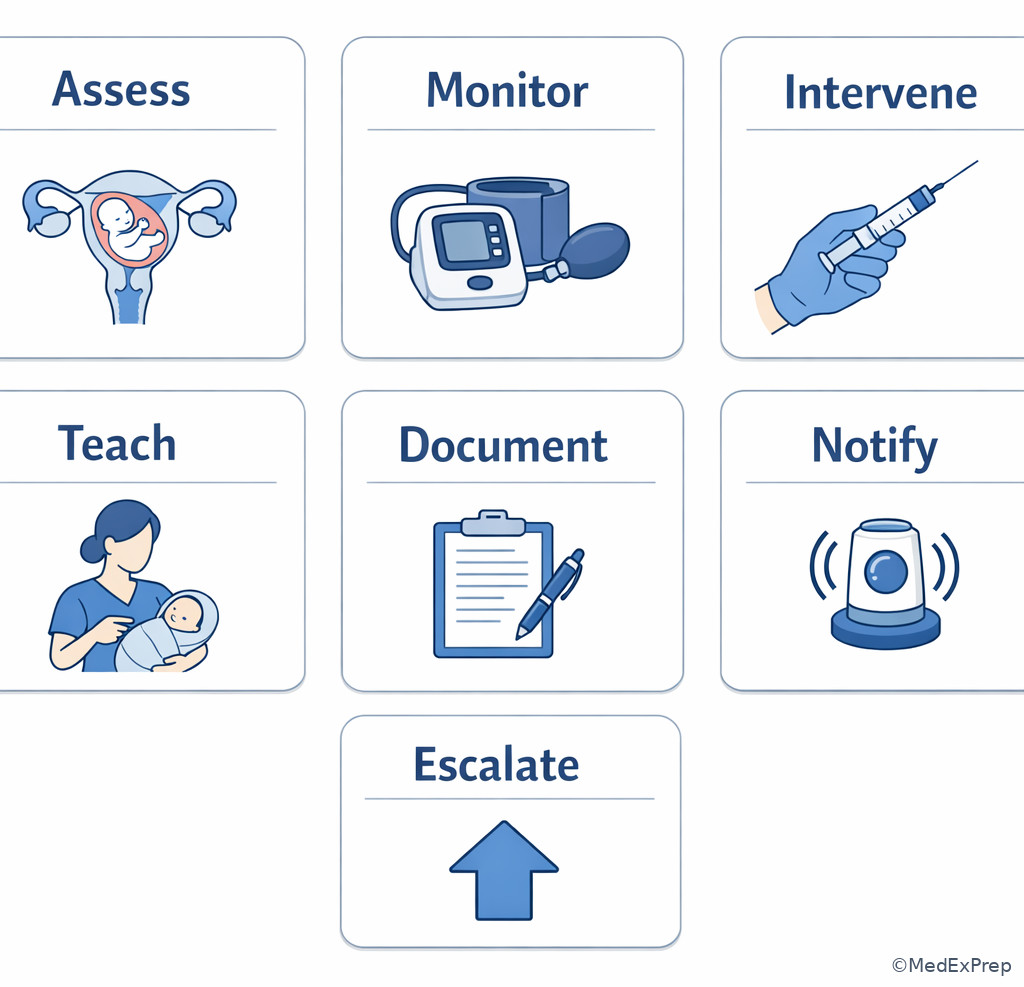
The recurring tasks are stable across the course: assess, recognize expected vs concerning findings, intervene within protocol, teach, document, and escalate. This repeating structure is why the same prioritization habits work in labor, postpartum, and normal newborn care. See Fig 3.
WHY THIS IS TESTED: many stems hide the task in the last line: “best initial response,” “most important to monitor,” “requires immediate clarification,” or “most appropriate teaching.” If you do not identify the task, you may choose a true statement that does not answer the question.
Exam takeaway: Across all maternal-newborn domains, the same tested loop is assess, interpret, intervene, reassess, document, and escalate when needed.
flowchart TD
A[Assess] --> B[Interpret cue]
B --> C[Expected?]
C -->|Yes| D[Routine care and teaching]
C -->|No| E[Priority nursing action]
E --> F[Reassess response]
F --> G[Document and notify per protocol]
B Worked example
A term newborn, 14 hours old, is rooming in with the mother. The infant has fed twice, voided once, and has intermittent sleepy periods. The parents ask whether the baby should be awakened for feeding. The stem asks for the most appropriate nursing response. Noise includes maternal gestational diabetes history and a grandmother saying the baby “looks a little yellow,” though the infant appears otherwise stable.
Reasoning chain: identify task from the last line: teaching. Extract facts: low-risk newborn, early feeding period, parent question. Apply rule: choose a bedside teaching response, not a medical diagnosis, lab order, or generalized reassurance without assessment. Eliminate distractors that leap to jaundice workup or provider-level management without supporting cues. Verify: the correct response is the teaching-focused nursing action consistent with feeding readiness and institutional guidance.
C Exam trap
D Checkpoint
Question: A stem asks, “Which finding requires immediate escalation?” What should the test-taker identify before comparing options?
- The patient’s gravida and parity — tempting because obstetric context matters; wrong because the tested task is escalation, not classification by obstetric history alone.
- The exact lab reference range — tempting because abnormal values can trigger escalation; wrong because many such items can be solved without lab memorization if the escalation cue is obvious.
- The nursing task word: immediate escalation — tempting because it feels too simple; correct because it determines which option type can be right.
- The diagnosis most likely being considered — tempting because diagnosis-oriented thinking feels advanced; wrong because the RN exam lens prioritizes nursing action over independent diagnosis.
- The first classification step in most stems is patient type: maternal labor, postpartum maternal, or newborn.
- True or False: A true clinical statement can still be the wrong answer if it does not perform the task asked in the stem. True.
- Name the repeating RN task loop: assess, interpret, intervene, reassess, document/escalate.
1.1.1.5 Application: mapping the major maternal-newborn domains to likely exam decisions
A Explanation
The conflict here is deciding whether a finding belongs to the right domain-specific decision set. Choose the domain that matches both the patient and the timing of care, and reject choices that belong to a neighboring phase. For example, contraction pattern assessment belongs in antepartum/intrapartum monitoring, not postpartum recovery; fundus and lochia belong in postpartum maternal care, not labor progress; thermoregulation and feeding cues in a term stable infant belong in normal newborn or low-risk neonatal care.
WHY THIS IS TESTED: exam writers frequently place near-neighbor topics side by side because they share vocabulary. “Bleeding,” “temperature,” and “pain” can all appear in multiple settings, but the nursing meaning changes by phase of care.
Use timing words as anchors: during labor, immediately after birth, postpartum day 1, 2-hour-old newborn, discharge teaching. These words narrow the applicable rules quickly. See Fig 4.
Exam takeaway: Timing words in the stem tell you which rule set applies, even when symptoms sound similar across phases.
flowchart TB
A[Labor] --> A1[Contractions]
A --> A2[Fetal surveillance]
A --> A3[Birth support]
B[Postpartum] --> B1[Fundus and lochia]
B --> B2[Bladder and pain]
B --> B3[Hemorrhage and infection cues]
C[Newborn] --> C1[Respiratory transition]
C --> C2[Thermoregulation]
C --> C3[Feeding and safety]
B Worked example
A 32-year-old primipara with obesity and treated hypothyroidism delivered vaginally 1 hour ago after a long induction. She reports cramping and vaginal bleeding. Her uterus is boggy and slightly above the umbilicus. The stem also mentions a healthy newborn rooting at the bedside, which is a tempting but wrong shift in attention. The question asks for the best domain and likely nursing focus.
Reasoning chain: identify task: classify the problem to determine response. Extract key facts: postpartum timing, boggy uterus, bleeding, uterine position. Apply rule: postpartum maternal care with hemorrhage-focused nursing assessment and intervention logic. Eliminate distractors involving newborn feeding support or intrapartum contraction management. Verify: postpartum maternal domain is primary, with concern for abnormal recovery requiring immediate nursing action and escalation per protocol.
C Exam trap
D Checkpoint
Question: A term infant is 30 minutes old, pink centrally, mildly acrocyanotic, intermittently tachypneic without retractions, and cool to the touch. Which study bucket best frames the next nursing decision?
- Immediate postpartum maternal recovery — tempting because the birth just occurred; wrong because the assessment target is the newborn.
- Normal newborn assessment and transition — tempting because early respiratory and thermal adaptation are classic newborn transition issues; correct because the infant’s immediate adaptation drives the nursing response.
- Low-risk neonatal discharge teaching — tempting because the infant seems otherwise stable; wrong because the time point is too early and the issue is transition, not discharge readiness.
- Labor progress assessment — tempting because tachypnea could reflect birth stress; wrong because labor has ended and the nursing decision concerns neonatal adaptation.
1.1.1.6 Application: using the domain map to answer within RN scope
A Explanation
Now the conflict becomes sharper: should the nurse choose the definitive medical plan or the best bedside nursing action? Choose stabilize-monitor-notify logic when a stem presents concerning maternal or newborn findings, and reject options that require provider-only diagnosis or independent treatment planning. The single rule: if the patient is deteriorating and the option asks the RN to act outside scope, that option is wrong even if the underlying medical concern is real.
WHY THIS IS TESTED: nursing certification exams routinely place provider-level language beside appropriate nursing actions. The exam is not asking you to pretend to be the obstetrician or neonatologist. It is asking what the bedside RN does first, within policy, while protecting maternal-newborn safety.
This topic is a bridge to the upcoming lessons RN Scope Boundaries and Out-Of-Role Signals. Here, you only need the map-level rule: when the stem suggests hemorrhage, infection, respiratory compromise, hypoglycemia risk, or neurologic warning signs, the RN’s answer is usually focused reassessment, immediate supportive intervention within protocol, notification/escalation, and documentation.
Exam takeaway: When a stem turns urgent, choose RN stabilization and escalation over provider-only diagnosis or treatment planning.
flowchart TD
A[Concerning cue] --> B{Within RN protocol?}
B -->|Yes| C[Immediate nursing intervention]
B -->|No or partly| D[Focused reassessment and notify provider]
C --> E[Reassess response]
D --> E
E --> F[Document and continue escalation if unresolved] B Worked example
A 25-year-old patient is 12 hours postpartum after a vaginal delivery. She has a history of migraine and anxiety. She reports a severe headache and visual spots. Blood pressure is elevated compared with earlier readings. The stem adds that she is worried because the newborn has not fed well in the last hour, which is a tempting competing issue. The question asks for the most appropriate nursing action.
Reasoning chain: identify task: nursing action. Extract key facts: postpartum patient, neurologic warning signs, elevated blood pressure. Apply rule: urgent maternal finding in postpartum domain requiring focused assessment, safety measures, prompt provider notification/escalation, and protocol-based care as available. Eliminate distractors such as offering routine analgesia first, independently diagnosing preeclampsia, or prioritizing newborn feeding before maternal stabilization. Verify: the best answer remains a scope-safe urgent maternal response.
C Exam trap
D Checkpoint
Question: Which option best reflects the scope-safe use of the domain map when a stable term newborn has poor feeding and low axillary temperature?
- Assess feeding effectiveness, support thermoregulation, recheck temperature, and notify per protocol if concerns persist — tempting because it is thorough; correct because it stays within RN role and addresses likely immediate needs.
- Diagnose neonatal sepsis and prepare independent treatment orders — tempting because poor feeding and temperature instability can be serious; wrong because diagnosing and ordering treatment are outside bedside RN scope.
- Delay intervention until the next scheduled assessment to avoid overstimulating the infant — tempting because newborns need rest; wrong because a low temperature with poor feeding requires prompt nursing response.
- Teach discharge jaundice instructions before reassessing the infant — tempting because parent education is always important; wrong because teaching is not the priority over immediate physiologic concerns.
- When an answer choice asks the RN to diagnose or prescribe, treat it as an out-of-role signal.
- True or False: A correct medical concern can still produce a wrong nursing answer if the action exceeds RN scope. True.
- The default urgent RN framework is stabilize, monitor, notify, document, reassess.
1.1.1.7 Integration: building a study plan from the domain map
A Explanation
The final conflict is practical: should you study by random topic lists or by a structured map that repeats priority rules across the course? Choose the structured map. The single rule is that exam retention improves when each topic is attached to a domain, a patient setting, and a recurring nursing action pattern.
WHY THIS IS TESTED: candidates often know isolated facts but miss integrated questions because they have not built a retrieval framework. The domain map is not just an outline; it is a way to predict what kind of decision each chapter will test.
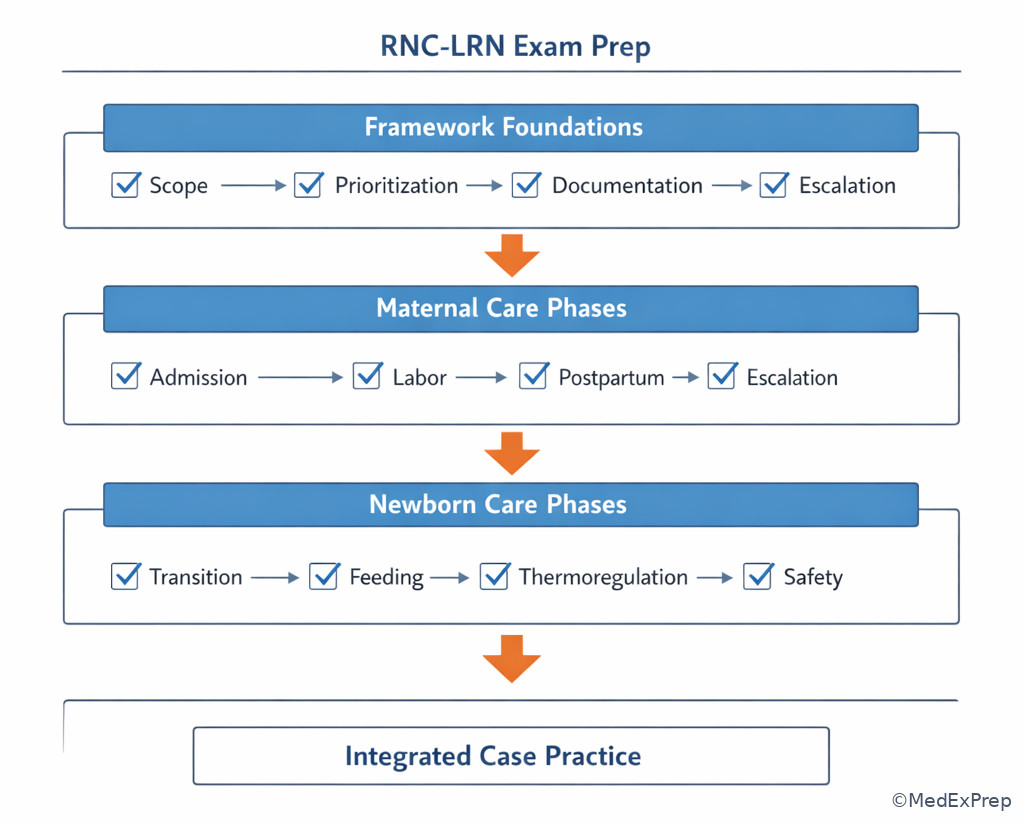
Study in tiers. Tier 1: framework topics in this chapter—domain map, RN scope boundaries, out-of-role signals, prioritization, documentation, and escalation. Tier 2: major care phases—maternal assessment, labor, postpartum, newborn transition, low-risk neonatal care. Tier 3: synthesis—teaching, safety, delegation, and integrated cases. If you know where each future lesson belongs, you will recognize cross-topic confusions more quickly. See Fig 6.
Exam takeaway: Study framework topics first, then care phases, then mixed prioritization cases to build reliable retrieval under exam pressure.
B Worked example
A nurse preparing for the exam says, “I keep missing questions even when I know the content.” On review, the missed items include one postpartum hemorrhage question, one newborn temperature question, and one teaching question about safe discharge. The nurse also has ED experience and tends to overprioritize diagnosis labels. The question asks which study change is most likely to improve performance fastest.
Reasoning chain: identify task: choose best study strategy. Extract key facts: errors occur across several content areas, so the issue is not one isolated topic. Apply rule: use a domain map plus repeating nursing-task framework. Eliminate distractors such as memorizing more isolated facts, skipping fundamentals, or focusing only on pharmacology. Verify: the best change is to organize review by domain and recurring task patterns so the nurse can classify stems and choose scope-safe actions more consistently.
C Exam trap
D Checkpoint
Question: Which study plan best uses the instructional domain map for this course?
- Memorize scattered facts from postpartum and newborn chapters without linking them to task words — tempting because fact review feels productive; wrong because it does not improve prioritization or domain sorting.
- Start with framework topics, then progress through maternal and newborn care phases, then mixed prioritization cases — tempting because it seems slower at first; correct because it builds retrieval structure and transfer across question types.
- Skip scope and documentation topics because they are common-sense nursing skills — tempting because these topics appear nonclinical; wrong because wrong-scope and communication distractors are common exam traps.
- Study only abnormal findings because expected findings are easy — tempting because complications seem more testable; wrong because many questions ask the nurse to distinguish normal recovery or transition from urgent change.
Exam Traps & Differentiators
Most common wrong answer and why: choosing an option that is clinically reasonable but belongs to the wrong domain or wrong task level. Example: selecting parent teaching when the stem is really asking for urgent maternal reassessment.
| Looks similar | Actually means | Discriminator | Test-day implication |
|---|---|---|---|
| Birth just happened | Could be postpartum or newborn transition | Who is being assessed? | Choose maternal recovery vs newborn adaptation rules |
| Bleeding in stem | Labor-related or postpartum hemorrhage concern | Timing and uterine findings | Do not apply labor logic to postpartum fundus/lochia questions |
| Poor feeding | Routine feeding support or urgent newborn concern | Temperature, tone, respirations, glucose-risk context | Assess stability before teaching alone |
| Teaching option | May be correct but wrong priority | Is there an unstable cue first? | Stabilize before education when physiology is abnormal |
| Definitive treatment option | Often provider-level management | Does it require diagnosis/prescribing? | Reject out-of-role actions |
If the stem says...
- “2-hour-old term newborn” -> think transition, thermoregulation, respirations, feeding readiness
- “boggy fundus” -> think postpartum maternal circulation priority, not routine newborn care
- “best initial response” -> think earliest safe RN action, not the full care plan
- “requires immediate clarification” -> think scope, safety, or incorrect teaching
- “most important to monitor” -> think which cue changes immediate risk, not which fact is most interesting
- provider-level language in an option -> think reject unless the action is limited to notification or carrying out policy-based orders
As you move into upcoming lessons on RN Scope Boundaries and Out-Of-Role Signals, expect confusable pairs such as notify provider versus independently decide treatment, or perform focused reassessment versus delay while teaching.
Tables
| Key framework cue | Ask yourself | Why it matters |
|---|---|---|
| Patient type | Is this laboring maternal, postpartum maternal, or newborn? | Chooses the correct domain rules |
| Time marker | What phase of care is this? | Separates labor from postpartum or transition from discharge |
| Task word | Assess, intervene, teach, monitor, document, or report? | Prevents choosing a true but irrelevant option |
| Priority cue | Is there bleeding, breathing, temperature, neurologic, or feeding instability? | Moves unstable physiology ahead of routine care |
| Scope cue | Does the option stay within RN authority? | Rejects provider-only management |
| Comparison | Domain-focused thinking | Random-fact thinking |
|---|---|---|
| Study order | Framework -> phase of care -> integration | Whichever chapter feels urgent |
| Question approach | Classify patient and task first | Jump to the option that sounds familiar |
| Handling distractors | Eliminate wrong domain, wrong priority, wrong scope | Debate isolated facts without structure |
| Retention | Pattern-based retrieval | Fragmented memorization |
| Performance under pressure | More consistent | More vulnerable to noisy stems |
| Differential classification problem | Choice A | Choice B | Single discriminator |
|---|---|---|---|
| Labor vs postpartum | Contractions, labor progress, fetal surveillance | Fundus, lochia, bladder, postpartum recovery | Has birth already occurred? |
| Postpartum maternal vs newborn | Maternal pain, bleeding, BP, fundus | Respirations, temperature, feeding, output | Who is the patient being assessed? |
| Transition vs discharge teaching | Immediate physiologic adaptation | Safety, feeding, follow-up education | Is there current instability or only planning? |
| Routine care vs escalation | Expected finding, stable trend | Concerning cue, worsening status | Does the cue threaten circulation, breathing, temperature, or neurologic safety? |
| RN action vs provider action | Assess, implement protocol, teach, notify | Diagnose, prescribe, independently decide treatment | Is the option within bedside RN scope? |
Exam takeaway: Similar timing after birth does not mean the same assessment domain, so identify who owns the cue.
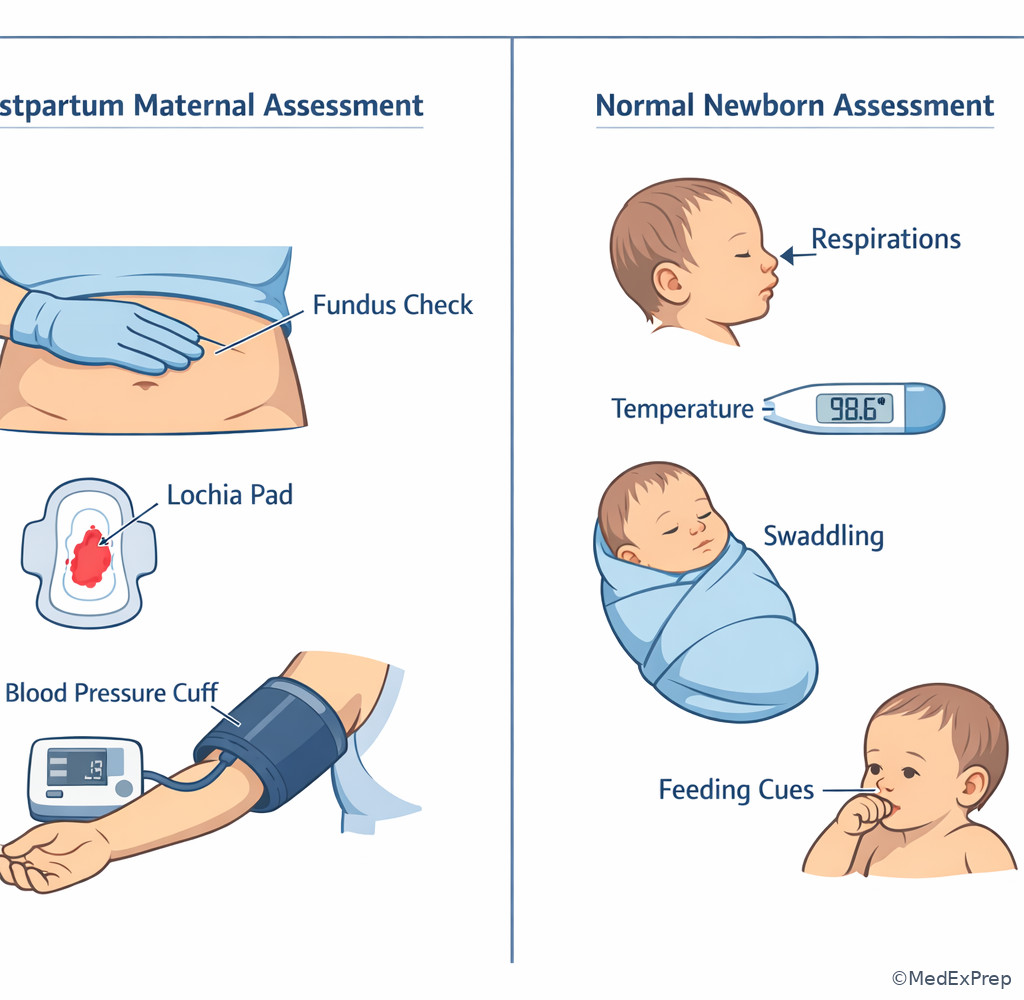
Exam takeaway: Task words such as assess, intervene, teach, and escalate signal the option type that can be correct.
Algorithm / Approach
Exam takeaway: A consistent five-step approach reduces errors caused by noisy stem details and tempting but nonpriority options.
Rapid Review
- Patient type -> first sorting move in most stems
- Time marker -> separates labor, postpartum, transition, and discharge questions
- Task word -> determines which option type can be correct
- Postpartum cue -> fundus/lochia/bladder language points away from labor content
- Newborn transition -> respiratory and thermal adaptation outrank routine teaching
- Teaching option -> wrong if unstable physiology appears in the stem
- Provider-level wording -> likely wrong-scope distractor for bedside RN items
- Correct intervention -> still wrong if not the priority action
- Noisy comorbidity -> often distracts from the actual maternal-newborn task
- Documentation -> usually follows assessment/intervention, not replaces it
- Escalation -> triggered by concerning change, not by routine expected findings
- Study sequence -> framework before content-heavy care phases
- Mixed-case improvement -> depends on domain map, not just more memorization
Self-check quiz
1. A nurse reads a stem about a 6-hour-old newborn with feeding cues, temperature monitoring, and parent questions about swaddling. Which first classification is most appropriate before reviewing options?
- Normal newborn assessment and transition
- Postpartum maternal recovery
- Labor progress assessment
- Operative birth management
2. A question asks for the most appropriate nursing action for a postpartum patient with increased bleeding and a boggy fundus. Which thinking step should the nurse use first?
- Identify the task word and the maternal care phase
- Predict the provider’s final diagnosis
- Focus on discharge teaching priorities
- Review newborn screening policy
3. A 29-year-old G1P1 is 10 hours postpartum after vaginal birth. She has obesity and gestational hypertension history. She reports a severe headache and blurred vision. Her partner asks whether the baby’s latch can be checked now because feeding has been inconsistent. Which action is most appropriate?
- Assess the maternal neurologic and blood pressure status immediately and escalate per protocol
- Complete a full newborn feeding session first because infant nutrition is time-sensitive
- Provide routine postpartum discharge teaching to reduce maternal anxiety
- Document the report and reassess both patients at the next scheduled rounding time
4. A term newborn is 1 hour old, cool to touch, sleepy, and feeding poorly. The mother had a prolonged labor and is now asking about peri-care supplies. Which nursing action is most appropriate?
- Support thermoregulation, assess feeding effectiveness, and recheck the newborn promptly
- Teach the mother postpartum peri-care because her question was asked first
- Prepare discharge paperwork while waiting for the next newborn assessment time
- Independently diagnose hypoglycemia and begin definitive medical treatment
5. A practice item describes a laboring patient with recurrent contractions, cervical change, and fetal monitoring data. The answer choices include postpartum fundal massage, newborn safe sleep teaching, maternal position changes with continued surveillance, and home jaundice education. Which option most likely fits the domain map?
- Postpartum fundal massage
- Newborn safe sleep teaching
- Maternal position changes with continued surveillance
- Home jaundice education
6. A 31-year-old postpartum patient 2 hours after cesarean birth has increased drainage on the dressing, tachycardia, and reports dizziness. She also has type 2 diabetes and asks when she can begin breastfeeding again after nausea improves. Which response best reflects correct domain sorting and priority?
- Assist with breastfeeding now because bonding should begin as early as possible
- Focus first on possible maternal instability, perform urgent reassessment, and notify the provider per protocol
- Teach incision care because postoperative education prevents complications
- Delay further assessment until the next scheduled vital signs because postoperative discomfort is expected
7. A stable term newborn is preparing for discharge. The infant has fed adequately, maintained temperature, and voided. One option says to reinforce safe sleep teaching; another says to independently clear the infant for discharge; another says to prescribe follow-up bilirubin testing; another says to review the family’s car seat positioning and institutional discharge steps. Which is the best RN action?
- Reinforce safe sleep teaching only
- Independently clear the infant for discharge
- Prescribe follow-up bilirubin testing
- Review car seat positioning and complete nursing discharge education within policy
8. A learner misses questions across postpartum hemorrhage, newborn temperature instability, and parent teaching. The learner says, “I think I need to memorize more lab values.” Which recommendation is most appropriate?
- Study only emergency complications because they are highest yield
- Rebuild preparation around the instructional domain map and recurring RN task framework
- Skip scope topics and focus only on disease content
- Prioritize provider treatment plans to understand what happens after escalation
Answer key
1.1.1.8 Question 1: A
A. Normal newborn assessment and transition — tempting because feeding cues, temperature, and swaddling are classic newborn topics; correct because the stem centers on a stable early newborn and asks for first classification by patient type and phase of care. Single stem clue: “6-hour-old newborn.” Source support: NCSBN prioritization principles and maternal-newborn review texts emphasize identifying the client and clinical context before choosing nursing action.
B. Postpartum maternal recovery — tempting because the newborn is likely rooming in with the mother; incorrect because no maternal recovery cue is being assessed. Single stem clue: all findings belong to the infant.
C. Labor progress assessment — tempting because the infant is recently born; incorrect because labor has ended and the cues concern neonatal adaptation. Single stem clue: the patient is already a newborn.
D. Operative birth management — tempting only if the learner overgeneralizes “birth-related” content; incorrect because this is outside the stem and outside many bedside RN decision targets here. Single stem clue: no procedural management issue appears. Sources: NCSBN Clinical Judgment framework; ANA Standards of Practice.
1.1.1.9 Question 2: A
A. Identify the task word and the maternal care phase — tempting because it seems basic; correct because “most appropriate nursing action” plus postpartum bleeding/boggy fundus identifies a postpartum priority-action item. Single stem clue: “postpartum patient with increased bleeding and a boggy fundus.” Sources: Saunders Comprehensive Review for NCLEX-RN; NCSBN prioritization guidance.
B. Predict the provider’s final diagnosis — tempting because postpartum hemorrhage may be suspected; incorrect because nursing exams prioritize immediate RN action over independent diagnostic framing. Single stem clue: the task asks for nursing action, not diagnosis.
C. Focus on discharge teaching priorities — tempting because teaching is always part of nursing care; incorrect because circulation-related instability outranks routine teaching. Single stem clue: increased bleeding.
D. Review newborn screening policy — tempting because maternal-newborn care is paired; incorrect because the stem clearly concerns maternal postpartum status. Single stem clue: boggy fundus is a maternal postpartum cue. Sources: ANA Standards; maternal-newborn nursing texts.
1.1.1.10 Question 3: A
A. Assess the maternal neurologic and blood pressure status immediately and escalate per protocol — tempting because it directly addresses the alarming cues; correct because ABCs/circulation and maternal neurologic safety outrank newborn latch concerns. The nursing process supports immediate focused assessment and escalation. Single stem clue: severe headache and blurred vision postpartum. Sources: NCSBN priority framework; ANA Standards.
B. Complete a full newborn feeding session first because infant nutrition is time-sensitive — tempting because feeding support matters in mother-baby care; incorrect because it is the right action at the wrong priority. Maternal warning signs come first. Single stem clue: maternal neurologic symptoms.
C. Provide routine postpartum discharge teaching to reduce maternal anxiety — tempting because anxiety and education are common postpartum needs; incorrect because teaching is not the priority over possible maternal deterioration. Single stem clue: blurred vision with headache.
D. Document the report and reassess both patients at the next scheduled rounding time — tempting because documentation is required; incorrect because delayed reassessment violates safety prioritization. Single stem clue: urgent maternal symptoms require immediate action. Sources: NCSBN; ANA.
1.1.1.11 Question 4: A
A. Support thermoregulation, assess feeding effectiveness, and recheck the newborn promptly — tempting because it bundles several bedside actions; correct because the infant has immediate physiologic needs and the RN should assess and intervene within scope first. Single stem clue: cool, sleepy, poor feeding at 1 hour of life. Sources: NCSBN prioritization; neonatal nursing review sources.
B. Teach the mother postpartum peri-care because her question was asked first — tempting because patient questions should be answered; incorrect because maternal teaching is a correct action at the wrong priority when the newborn shows concerning cues. Single stem clue: symptomatic newborn.
C. Prepare discharge paperwork while waiting for the next newborn assessment time — tempting because workflow efficiency matters; incorrect because delaying reassessment is unsafe. Single stem clue: low temperature with poor feeding.
D. Independently diagnose hypoglycemia and begin definitive medical treatment — tempting because the findings may suggest metabolic instability; incorrect because independent diagnosis and definitive treatment planning exceed RN scope in this framing. Single stem clue: the role tested is bedside RN action. Sources: ANA Standards; NCSBN.
1.1.1.12 Question 5: C
A. Postpartum fundal massage — tempting because it is a real maternal nursing intervention; incorrect because it belongs to postpartum recovery, not active labor surveillance. Single stem clue: recurrent contractions with cervical change.
B. Newborn safe sleep teaching — tempting because patient education is always important; incorrect because a laboring patient with fetal monitoring data is not in a discharge-teaching scenario. Single stem clue: the patient is still laboring.
C. Maternal position changes with continued surveillance — tempting because it fits intrapartum nursing care; correct because it matches the labor domain and stays within bedside RN action. Single stem clue: labor plus fetal monitoring data. Sources: maternal-newborn nursing texts; NCSBN priority framework.
D. Home jaundice education — tempting because it is a common newborn teaching topic; incorrect because it belongs to low-risk neonatal discharge content, not labor care. Single stem clue: cervical change indicates labor context.
1.1.1.13 Question 6: B
A. Assist with breastfeeding now because bonding should begin as early as possible — tempting because early breastfeeding is beneficial and cesarean patients need support; incorrect because it is the right intervention at the wrong priority when maternal instability is possible. Single stem clue: tachycardia, dizziness, increasing drainage.
B. Focus first on possible maternal instability, perform urgent reassessment, and notify the provider per protocol — tempting because it follows ABCs/circulation and immediate postoperative safety; correct because circulation concerns outrank teaching and routine support. The RN remains within scope by assessing, stabilizing, and escalating. Single stem clue: signs suggesting worsening maternal condition. Sources: NCSBN priority and safety standards; ANA Standards.
C. Teach incision care because postoperative education prevents complications — tempting because education is important before discharge; incorrect because teaching is not first when a current instability cue exists. Single stem clue: dizziness and tachycardia.
D. Delay further assessment until the next scheduled vital signs because postoperative discomfort is expected — tempting because postoperative recovery includes discomfort; incorrect because trending signs suggest a potentially urgent change that requires immediate reassessment. Single stem clue: increased drainage plus tachycardia. Sources: maternal-postpartum nursing references; NCSBN.
1.1.1.14 Question 7: D
A. Reinforce safe sleep teaching only — tempting because safe sleep is essential discharge education; incorrect because “only” is too narrow when the RN must complete broader discharge education and verification steps. Single stem clue: preparing for discharge requires a fuller nursing teaching review.
B. Independently clear the infant for discharge — tempting because the newborn appears stable; incorrect because independently clearing discharge exceeds bedside RN decision authority in this framing and depends on institutional/provider processes. Single stem clue: “independently” signals scope risk.
C. Prescribe follow-up bilirubin testing — tempting because follow-up planning matters; incorrect because prescribing follow-up testing is provider-level planning. Single stem clue: prescribe.
D. Review car seat positioning and complete nursing discharge education within policy — tempting because it stays within routine nursing discharge role; correct because it matches a stable discharge scenario and remains squarely within RN scope. Single stem clue: stable infant preparing for discharge. Sources: NCSBN; ANA; standard newborn discharge teaching references.
1.1.1.15 Question 8: B
A. Study only emergency complications because they are highest yield — tempting because emergencies feel memorable and important; incorrect because the learner’s misses span emergencies and routine teaching, suggesting a framework problem rather than a complication-only knowledge gap. Single stem clue: errors cross multiple domains.
B. Rebuild preparation around the instructional domain map and recurring RN task framework — tempting because it is more strategic than content-heavy; correct because cross-domain misses are best corrected by organizing content by patient, phase, task, and scope. Single stem clue: misses include hemorrhage, newborn temperature, and teaching. Sources: NCSBN clinical judgment approach; structured review methodology in nursing exam prep texts.
C. Skip scope topics and focus only on disease content — tempting because disease content feels concrete; incorrect because wrong-scope choices are a major source of missed nursing questions. Single stem clue: the learner’s issue is decision framing, not just disease facts.
D. Prioritize provider treatment plans to understand what happens after escalation — tempting because downstream management can seem helpful; incorrect because exam success here depends first on the bedside RN action, not provider-only planning. Single stem clue: this is an RN certification context. Sources: ANA Standards; NCSBN.
Keep going with the full RNC-LRN Prep Course (RNC-LRN)
You just studied the way members do, in the same lesson interface. Full access unlocks every lesson, the question bank and flashcards for a full year.
One payment · 1 year of access · No auto-renewal