1.1.1 - RMA Scope Boundaries
RMA Scope Boundaries
What you’ll learn
- Define the practical boundaries of the entry-level medical assistant role in ambulatory care.
- Distinguish allowed delegated tasks from actions that require provider clarification, escalation, or refusal.
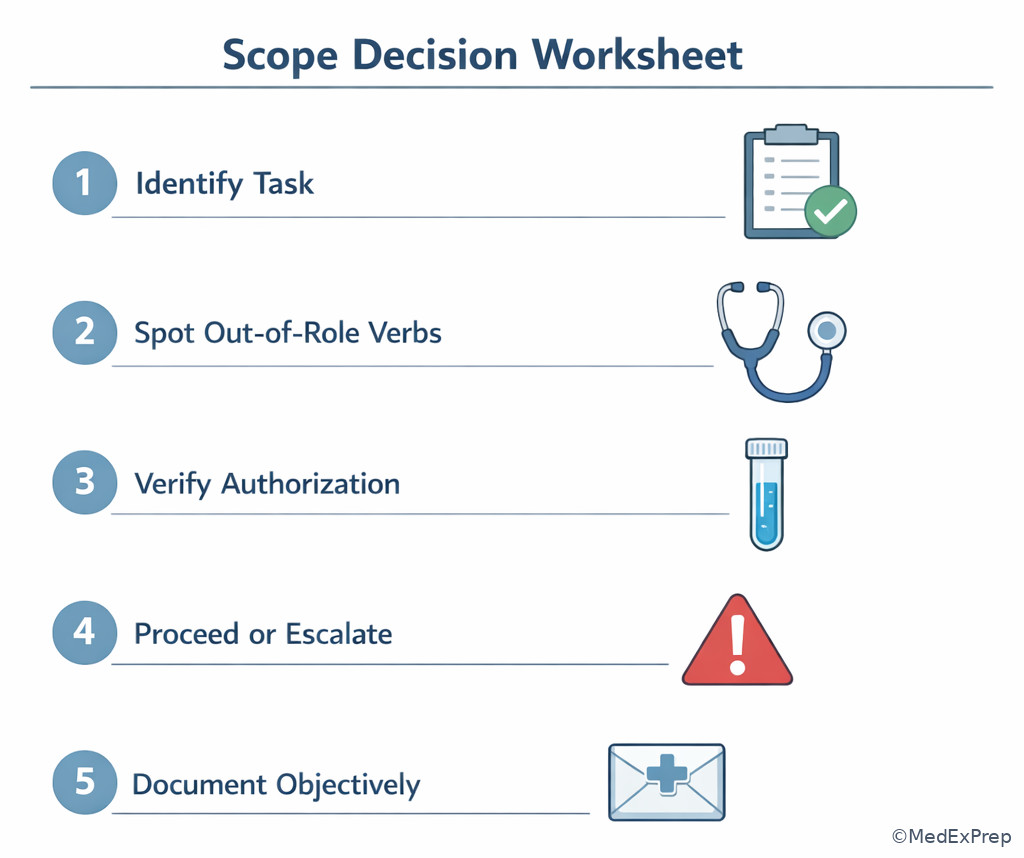
- Use a safe exam framework: identify task → confirm scope → verify order/policy → act or escalate → document.
- Recognize out-of-role wording in test stems and eliminate answers that require diagnosis, prescribing, or independent clinical judgment.
- Choose the most appropriate next step when findings are abnormal, orders are unclear, or the patient appears unstable.
- Law, Ethics & Professionalism → Scope, supervision, professional boundaries
- Clinical Assisting → Safe delegated duties in intake, testing support, medication-related tasks
- Administrative Assisting → Documentation, communication, escalation, chain of command
- Laboratory & Diagnostic Procedures → Perform only authorized tests and report abnormalities per protocol
Why it matters
- Scope questions are heavily tested because the safest answer is often not the most “active” answer; it is the one that protects the patient and stays within role.
- In real outpatient care, many errors begin with a small boundary violation: giving advice beyond instructions, changing an order, or failing to escalate an abnormal finding.
- On the exam, distractors often sound efficient or helpful but require provider-level judgment. Your advantage is recognizing the boundary faster than the wording tries to push you past it.
- Strong scope awareness improves both clinical safety and documentation quality: what you do, what you report, and what you must not independently decide.
Key Terms & Must-Know Facts
1.1.1.1 Key terms
- Scope of practice: The tasks permitted by law, training, employer policy, and supervision.
- Delegation: Assignment of an allowable task by an authorized licensed provider or supervisor.
- Supervision: Required oversight level for delegated tasks; rules vary by jurisdiction and employer.
- Chain of command: The reporting pathway used when a task is unclear, unsafe, or beyond role.
- Clarification: Stopping and confirming an order or instruction before proceeding.
- Escalation: Promptly reporting urgent findings or out-of-scope issues to the appropriate licensed person.
- Standard precautions: Routine infection-prevention measures used for all patients.
- Two-identifier verification: Confirming patient identity using accepted identifiers before care tasks.
- Authorized test: A test the MA is trained and permitted to perform under office protocol.
- Provider order: A direction from an authorized clinician that the MA may carry out only within scope.
- Abnormal finding: A value or observation outside expected limits that requires reporting per protocol.
- Independent clinical judgment: Diagnostic, prescribing, or treatment-selection decision-making outside MA role.
- Reinforcement of instructions: Repeating or clarifying established provider directions, not creating new advice.
1.1.1.2 Must-know facts
- An RMA supports care; the RMA does not independently diagnose, prescribe, or select treatment regimens.
- If an order is unclear, incomplete, or appears unsafe, the best next step is to stop and clarify.
- If a patient appears unstable or findings are urgent, report immediately and follow emergency protocol.
- Being trained in a task does not automatically make it allowed; employer policy and applicable law still govern.
- Documentation must reflect what you observed, what you did, who you notified, and when.
- Complex interpretation for medical decision-making belongs to licensed clinicians, not the MA.
- Patient confidentiality applies even when information-sharing feels convenient or helpful.
- Exam stems that say “change,” “decide,” “diagnose,” or “prescribe” often signal an out-of-scope distractor.
| High-yield trigger | Best RMA action | Why it matters |
|---|---|---|
| Clear routine order within training/policy | Proceed using protocol and document | Delegated care is appropriate when authorization is clear |
| Order is incomplete or contradictory | Clarify before acting | Prevents unsafe execution of a misunderstood order |
| Abnormal urgent vital sign or acute distress | Report immediately; activate emergency process per protocol | Delay is the error, not lack of independent treatment selection |
| Patient asks for diagnosis or medication change | Do not answer independently; route to provider | Requires licensed clinical judgment |
| Test result outside normal office reporting threshold | Follow reporting protocol and notify licensed clinician | MAs may obtain/report results but not make treatment decisions |
| Task varies by state law or office policy | Confirm policy and supervision requirements | Scope is not identical in every setting |
Core content
1.1.1.3 Foundational boundary: what the RMA may do versus may not decide
A Explanation
The central decision conflict in scope questions is not “Can this task happen in the office?” It is “Can the medical assistant perform this task within delegated authority, or does this task require provider-level judgment?” The single rule that resolves most questions is this: an RMA may carry out authorized, protocol-based tasks but may not independently make diagnostic, prescribing, or treatment-selection decisions. That means intake, vital signs, specimen collection, ECG support, room prep, documentation, and certain medication-related tasks may be appropriate when policy, training, and supervision allow. By contrast, diagnosing the condition, choosing the medication, changing the dose, deciding whether surgery is indicated, or interpreting complex results for treatment decisions is outside role.
WHY THIS IS TESTED: exam writers routinely place a clinically attractive answer next to a scope-safe answer. The test is whether you choose the action that protects both patient safety and legal boundaries.
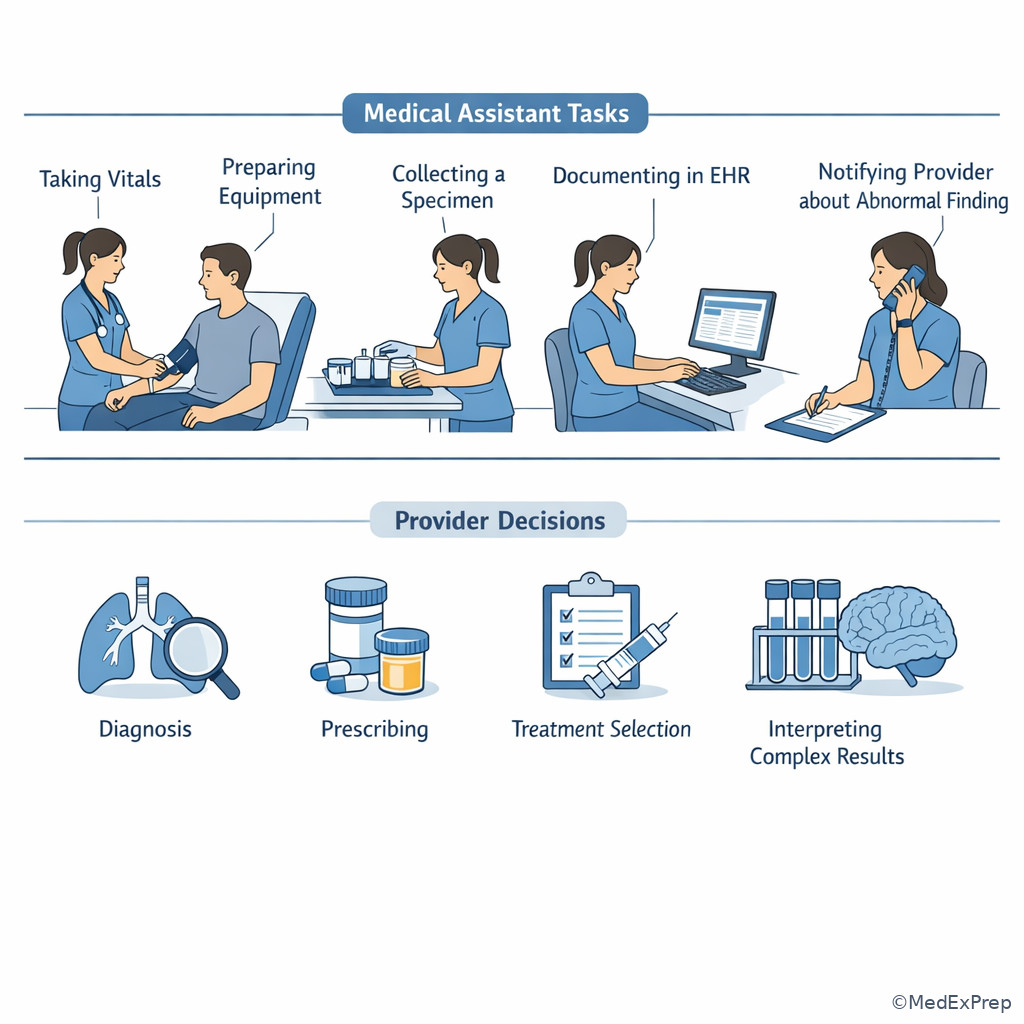
Use choose-versus-reject framing. Choose actions that are procedural, delegated, verifiable, and documentable. Reject actions that require independent judgment, especially if the stem asks you to decide what the condition is, adjust a treatment plan, or give advice beyond existing instructions. See Fig 1.
Exam takeaway: Separate delegated task performance from provider-only clinical judgment to eliminate unsafe answer choices.
flowchart TD
A[Task appears in clinic workflow] --> B{Does it require diagnosis
prescribing or treatment selection?}
B -->|Yes| C[Out of RMA scope
Stop and escalate]
B -->|No| D{Is there authorization,
training, policy, supervision?}
D -->|No| E[Clarify before proceeding]
D -->|Yes| F[Perform delegated task]
F --> G[Document findings, actions, notification] Exam takeaway: Visual labels help separate routine ambulatory tasks from provider-only decisions commonly tested in stems.
B Worked example
A 54-year-old patient with type 2 diabetes and hypertension presents for a follow-up. While rooming the patient, you obtain a blood pressure of 188/104 mm Hg and note a complaint of severe headache. The patient also mentions that he skipped breakfast and says, “My old doctor told me to double my pressure pill if this happened.” A tempting clue is the past self-management comment. The task is to decide the most appropriate next step for the medical assistant.
Reasoning chain: Identify the task: this is not about choosing therapy; it is about recognizing an urgent abnormal finding and responding within role. Extract key facts: markedly elevated BP, severe headache, outpatient setting, patient requests medication adjustment. Apply rule: the RMA must not independently direct medication changes; urgent abnormal findings require immediate reporting per protocol. Eliminate distractors: telling the patient to double the medication is out of scope; sending the patient home to rest delays care; documenting only without notifying misses urgency. Verify: report immediately to the provider/supervisor, stay with the patient per office emergency protocol, and document the value, symptoms, time, and notification.
C Exam trap
D Checkpoint
Question: During intake, a patient asks the medical assistant which antibiotic would work best for a new sinus infection and whether the dose should be stronger because of obesity. What is the most appropriate response?
- A. Suggest a broad-spectrum antibiotic commonly used in adults because delayed treatment could worsen infection.
- B. Tell the patient to use the same antibiotic they received last year because it worked previously.
- C. Explain that antibiotic selection and dose decisions require provider evaluation, then relay the concern to the licensed clinician.
- D. Recommend doubling the usual dose only if the patient has no drug allergies.
Best answer: C.
- A: Tempting because it sounds practical and timely; wrong because selecting an antibiotic is prescribing judgment.
- B: Tempting because past effectiveness seems relevant; wrong because reusing a prior prescription without evaluation is unsafe and outside role.
- C: Correct because it keeps the RMA within scope, routes the issue to the provider, and does not delay evaluation.
- D: Tempting because it uses an allergy check; wrong because dosage selection still requires authorized clinical judgment.
1.1.1.4 Delegated tasks: when authorization makes the difference
A Explanation
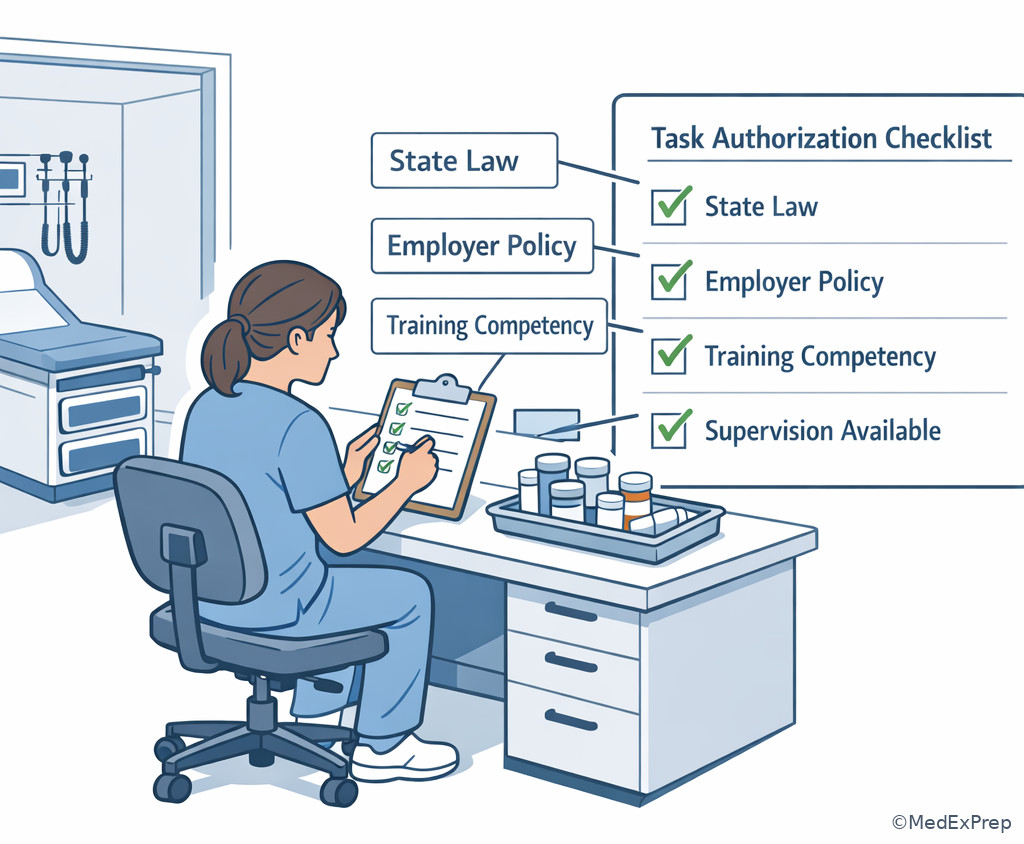
Many scope questions are not about the task itself but about whether the task is properly authorized. Giving an injection, performing a waived test, removing a dressing, obtaining an ECG, or calling a patient with approved scheduling information may be appropriate in some offices and prohibited in others, depending on state law, employer policy, training, and required supervision. The deciding rule is simple: do not assume that common equals permitted. A task becomes appropriate only when all four boxes are checked: the task is allowed by law, allowed by employer policy, within your training/competency, and performed under the required level of supervision.
WHY THIS IS TESTED: the exam wants you to resist “I’ve seen this done before” logic. Test stems often describe an office under time pressure and invite you to act first, verify later. That is backwards. Verify first.
Choose “clarify the order/policy/supervision requirement” when any of those elements are missing. Reject answer choices that use speed or convenience to justify acting without verification. See Fig 2.
Exam takeaway: A task is appropriate only when law, employer policy, training, and supervision all support it.
flowchart LR
A[Requested task] --> B{Allowed by state law?}
B -->|No or unsure| X[Clarify or decline and escalate]
B -->|Yes| C{Allowed by employer policy?}
C -->|No or unsure| X
C -->|Yes| D{You are trained and current?}
D -->|No or unsure| X
D -->|Yes| E{Required supervision available?}
E -->|No or unsure| X
E -->|Yes| F[Proceed safely and document] Exam takeaway: Picture the four authorization checks before performing a common office task under pressure.
B Worked example
A 23-year-old patient with asthma and generalized anxiety disorder arrives for an immunization-only visit. The supervising provider is running late in another suite. A coworker says, “Just give the vaccine now; we always do these.” The patient adds that she once felt dizzy after a shot, and a mildly elevated heart rate of 108/min is documented. The distracting clue is the common nature of vaccines in outpatient settings. The task is to determine whether the MA should administer now or verify first.
Reasoning chain: Identify task: medication administration support. Extract facts: common task, but supervision availability is uncertain; there is a prior possible reaction history; coworker encouragement is not authorization. Apply rule: the MA proceeds only when the task is permitted by law/policy, within training, and under required supervision. Eliminate distractors: acting because the office “always does these” ignores policy; canceling the visit outright may be premature; independently deciding whether prior dizziness was vasovagal or allergic would be provider-level interpretation. Verify: confirm the order, required supervision, screening process, and office protocol before administration; escalate any concerning reaction history per policy.
C Exam trap
D Checkpoint
Question: A provider’s order for an in-office medication is in the chart, but the MA has never been trained on that specific office protocol and the supervising clinician has not yet arrived. What is the most appropriate next step?
- A. Administer the medication because a written order is present.
- B. Ask another MA to explain the task quickly, then proceed to stay on schedule.
- C. Hold the task and clarify training/supervision requirements before proceeding.
- D. Ask the patient whether they have received the medication before and use that as authorization.
Best answer: C.
- A: Tempting because written orders matter; wrong because order presence alone does not override missing training or supervision requirements.
- B: Tempting because peer help feels efficient; wrong because informal coaching does not prove competency or satisfy policy requirements.
- C: Correct because any missing authorization element requires pause and clarification before action.
- D: Tempting because patient history may reassure; wrong because patient report does not define staff scope.
- The four authorization checks are ___, ___, ___, and ___.
- True or False: A common office task is automatically within every MA’s scope.
- If supervision required by policy is absent, the next step is to ___.
1.1.1.5 Abnormal findings and urgent changes: report, do not independently manage
A Explanation
A classic RMA boundary test asks what to do when a finding is abnormal. The correct move is often not treatment selection but rapid recognition, immediate reporting, and protocol-based support. The key decision conflict is between doing something medically decisive versus doing something operationally correct. The rule that resolves it: the RMA identifies and reports urgent abnormalities but does not independently diagnose the cause or choose definitive treatment.
WHY THIS IS TESTED: urgent findings create pressure, and exam stems use that pressure to lure you into provider-level actions. Your job is to recognize red flags, stay within protocol, summon help, support the patient, and document the chain of events.
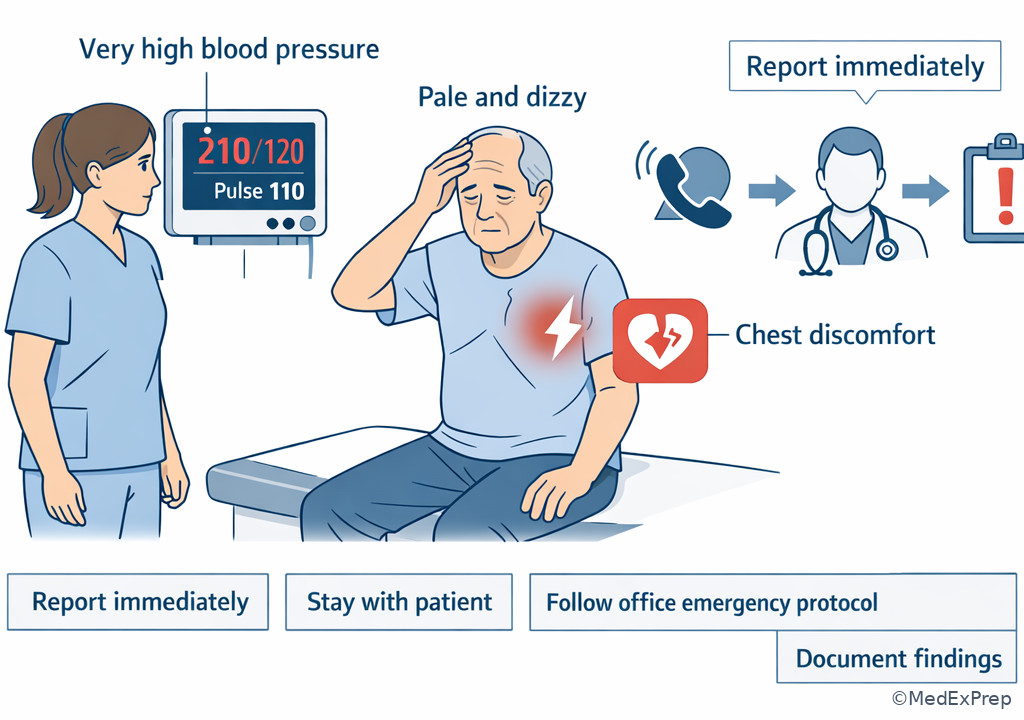
Choose answers that include immediate notification, emergency activation per office policy, repeat verification when appropriate, patient safety positioning if indicated by protocol, and accurate documentation. Reject answers that leap to interpretation or medication/treatment changes without provider direction. See Fig 3.
Exam takeaway: Urgent values and unstable appearance trigger reporting and protocol activation, not independent treatment decisions.
flowchart TD
A[Abnormal finding detected] --> B{Patient unstable
or value critically concerning?}
B -->|Yes| C[Immediate notification and emergency protocol]
B -->|No| D[Report per office protocol]
C --> E[Remain with patient and support provider workflow]
D --> E
E --> F[Document finding, time, symptoms, notification] Exam takeaway: Recognize unstable appearance, abnormal vital signs, and the need for immediate escalation rather than independent management.
B Worked example
A 67-year-old patient with COPD and coronary artery disease presents for routine follow-up. During intake, the patient becomes diaphoretic and says, “I feel pressure in my chest.” Pulse oximetry is 89% on room air, respiratory rate is 28/min, and the patient also mentions missing a lunch break. The tempting but wrong clue is the missed meal, which could make a less serious answer seem attractive. The question is the most appropriate next action for the MA.
Reasoning chain: Identify task: recognize an urgent clinical change in clinic, not determine whether this is angina, COPD exacerbation, or hypoglycemia. Extract key facts: chest pressure, diaphoresis, low oxygen saturation, tachypnea, high-risk history. Apply rule: urgent findings require immediate reporting and emergency protocol; diagnosis and definitive management are not MA decisions. Eliminate distractors: offering food assumes a diagnosis; advising the patient to rest and recheck later delays care; interpreting the pulse oximetry and deciding treatment independently exceeds role. Verify: alert the provider immediately, activate emergency procedures per office protocol, remain with the patient, and document time, symptoms, values, and notification.
C Exam trap
D Checkpoint
Question: During rooming, a patient becomes pale, reports chest tightness, and has an oxygen saturation of 90% on room air. Which action is most appropriate for the medical assistant?
- A. Determine whether the symptoms are more likely cardiac or respiratory before calling the provider.
- B. Immediately notify the provider and follow office emergency protocol while staying with the patient.
- C. Ask the patient to complete the health history form first so the provider has more detail.
- D. Advise the patient to use any home medications they usually take for similar discomfort.
Best answer: B.
- A: Tempting because pattern recognition matters clinically; wrong because independent differential diagnosis is outside the MA role in an urgent event.
- B: Correct because it addresses urgency, patient safety, and scope-appropriate escalation.
- C: Tempting because history helps care; wrong because documentation gathering should not delay emergency response.
- D: Tempting because patient familiarity may sound efficient; wrong because directing medication use in this acute scenario is not the MA’s independent decision.
1.1.1.6 Patient questions, education, and communication: reinforce, don’t invent
A Explanation
Another frequent boundary issue is patient communication. Patients often ask the MA what a result means, whether a symptom is serious, whether they should change a medication, or whether a planned test is really necessary. The decision conflict is between being helpful and staying within role. The rule: an RMA may reinforce established provider instructions and explain office procedures, but must not create new medical advice, interpret complex results for decision-making, or independently counsel on treatment changes.
WHY THIS IS TESTED: communication distractors sound compassionate and efficient. But test writers know that learners want to reassure patients. On exam day, helpfulness must still be bounded by role.
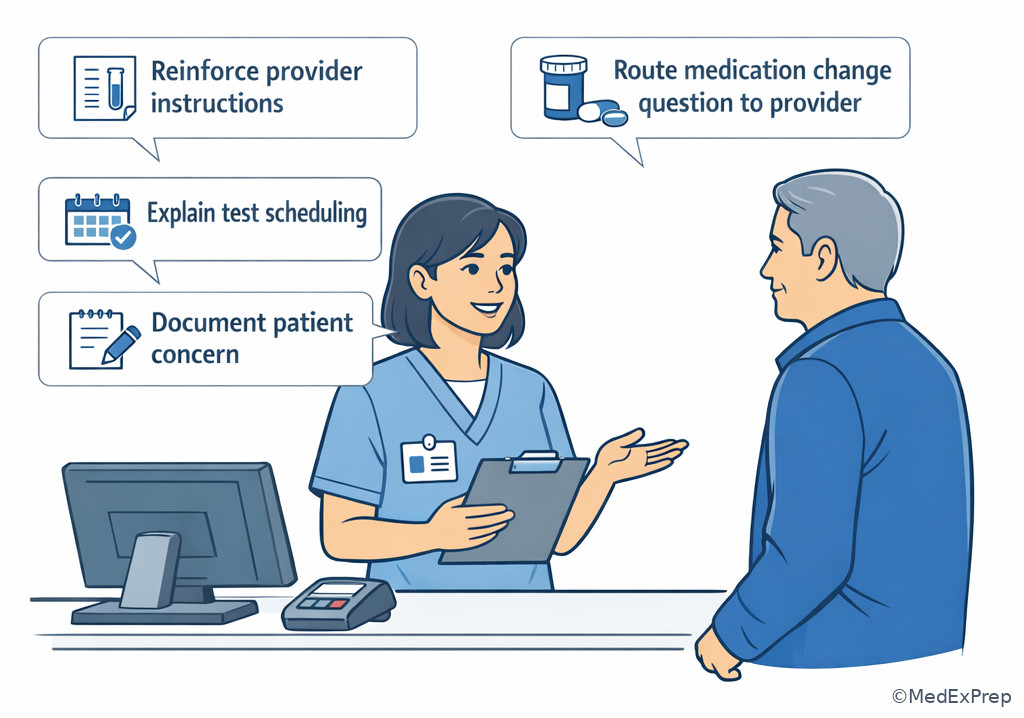
Choose answers that restate provider-approved instructions, explain logistics, encourage provider follow-up, or route questions to the licensed clinician. Reject answers that interpret pathology, imaging, or treatment significance; tell the patient to start, stop, or change medicines; or promise an outcome. See Fig 4.
Exam takeaway: Reinforce approved instructions and office logistics, but route interpretation and treatment questions to the provider.
flowchart TD
A[Patient asks a question] --> B{Is it logistics or approved instructions?}
B -->|Yes| C[Reinforce existing directions]
B -->|No| D{Does it ask what a result means
or whether to change treatment?}
D -->|Yes| E[Route to provider]
D -->|No| F[Use neutral language and clarify office process]
C --> G[Document if required]
E --> G
F --> G Exam takeaway: Distinguish approved instruction reinforcement from new medical advice when answering patient questions.
B Worked example
A 46-year-old patient with hypothyroidism and migraine returns after recent laboratory work. She says, “My portal says my thyroid level is abnormal. Should I double my medicine now? I have a vacation next week.” She also reports mild fatigue and mentions starting a new multivitamin. The tempting clue is the abnormal result displayed in the portal, which makes treatment adjustment seem urgent and concrete.
Reasoning chain: Identify task: patient communication about a result and medication plan. Extract key facts: lab result is visible, patient requests dose change, there is a plausible symptom, and a new supplement is noise. Apply rule: the MA may acknowledge the patient concern, relay the question, and reinforce previously documented instructions if present, but may not interpret the result for treatment decisions or recommend a dose change. Eliminate distractors: advising a dose increase is prescribing-level action; telling the patient the result is probably unimportant is interpretation; recommending stopping the multivitamin is still treatment advice. Verify: communicate the question to the provider per office workflow and document the contact.
C Exam trap
D Checkpoint
Question: A patient asks the MA, “My test result says positive. Does that mean I definitely have the disease and need treatment today?” What is the best response?
- A. Explain that a positive result usually confirms the diagnosis and treatment is probably needed.
- B. State that the provider will interpret the result and decide next steps, then route the question appropriately.
- C. Tell the patient not to worry because many positive tests are false alarms.
- D. Recommend starting over-the-counter treatment until the provider reviews the chart.
Best answer: B.
- A: Tempting because positive results often matter; wrong because it converts a raw result into a diagnostic/treatment conclusion.
- B: Correct because it uses role-appropriate communication and appropriate routing.
- C: Tempting because reassurance feels kind; wrong because minimizing the result is still interpretation.
- D: Tempting because it sounds practical; wrong because even OTC treatment advice can exceed the MA role when not provider-directed.
- True or False: An MA may explain what an abnormal lab means if the patient already saw it in the portal.
- The safest response to a medication-change question is to ___ the concern to the licensed clinician.
- Name two categories of questions an MA can usually handle within role: ___ and ___.
1.1.1.7 Documentation, refusal to overreach, and the safest exam framework
A Explanation
The last integration step is knowing what to do after you decide a task is out of scope or unclear. The correct answer is not passive. It usually includes refusing the unsafe action, escalating through the proper chain, and documenting objectively. The decision conflict is between “I can’t do this” and “What do I do next?” The resolving rule is: when a task exceeds role, the RMA should not perform it; instead, clarify, notify the proper person, support the workflow within scope, and document the event accurately.
WHY THIS IS TESTED: exam writers often place a bold but incorrect action next to an incomplete but safer action. The best answer usually includes both a boundary decision and a follow-through step.
Choose answers that mention objective charting, exact findings, exact patient statements when relevant, time of notification, and to whom the concern was escalated. Reject answers that either perform the unsafe task or hide the issue by failing to document. See Fig 5.
Exam takeaway: When the task is unclear or beyond scope, stop, notify the right person, and document objective facts.
flowchart TD
A[Task or request arises] --> B{Within scope and clearly authorized?}
B -->|Yes| C[Perform safely and document]
B -->|No| D{Urgent patient risk present?}
D -->|Yes| E[Immediate escalation/emergency process]
D -->|No| F[Clarify with provider or supervisor]
E --> G[Document objective findings and notifications]
F --> G
C --> G Exam takeaway: The safest response to an out-of-scope or unclear request is stop, notify, support, and chart objective facts.
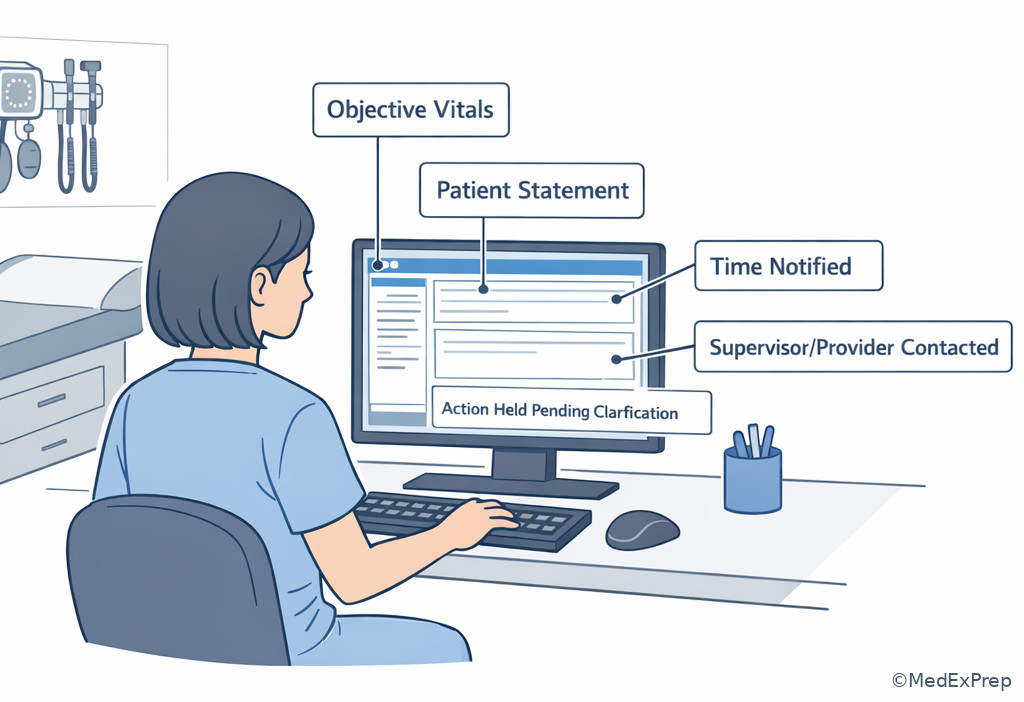
B Worked example
A 72-year-old patient with chronic kidney disease and atrial fibrillation calls after hours to say the pharmacy says the refill dose on file looks different from last month. The patient has mild confusion, and the caregiver mentions the patient recently had a fall. The on-call provider has not yet responded. The tempting wrong move is to compare old bottles and tell the caregiver which dose seems right.
Reasoning chain: Identify task: medication clarification with possible safety risk. Extract key facts: dose discrepancy, high-risk patient, possible confusion, provider not yet reached. Apply rule: the MA must not independently choose the correct dose or alter the order; the task requires clarification through appropriate supervision or on-call protocol. Eliminate distractors: advising use of the old bottle is treatment selection; telling the caregiver to skip all medication until next week may be unsafe and still exceeds role if not protocol-based; documenting only without escalation fails the safety problem. Verify: follow office after-hours escalation protocol, communicate the discrepancy to the appropriate licensed clinician, and document the caller, concern, time, and actions taken.
C Exam trap
D Checkpoint
Question: An MA notices that a chart message asks staff to “increase the patient’s dose if blood pressure is still elevated today.” No specific medication, dose, or provider signature is attached. What is the most appropriate action?
- A. Increase the dose using the last medication list because the intent is obvious.
- B. Ask the patient what dose usually works and use that information.
- C. Hold the change, seek clarification from the authorized clinician, and document the issue.
- D. Remove the message from the chart to avoid confusion until the next visit.
Best answer: C.
- A: Tempting because prior records may suggest intent; wrong because incomplete medication changes require provider clarification.
- B: Tempting because patient experience sounds relevant; wrong because patient preference does not authorize a medication adjustment.
- C: Correct because the order is incomplete and treatment modification is outside the MA’s independent role.
- D: Tempting because it avoids immediate misuse; wrong because deleting/hiding the issue without resolution is unsafe and improper.
Exam Traps & Differentiators
| Looks similar | Actually within RMA role? | Single discriminator | Best next step |
|---|---|---|---|
| Obtain and record blood pressure | Yes | Objective data collection | Measure, record, report abnormal per protocol |
| Decide whether BP means hypertensive emergency | No, independent diagnosis/interpretation | Treatment-level clinical judgment | Notify provider immediately |
| Reinforce a provider’s written wound-care instruction | Yes | Existing approved instruction | Reinforce exactly, document if required |
| Create new wound-care advice based on appearance | No | New clinical recommendation | Route to provider |
| Perform an authorized waived test | Yes, if policy/training allow | Delegated protocol task | Perform QC/protocol, report result |
| Interpret the result and choose treatment | No | Management decision | Report result to clinician |
| Administer medication with proper order and authorization | Sometimes yes | Must satisfy law/policy/training/supervision | Verify all four before proceeding |
| Change the medication dose because symptoms worsened | No | Medication adjustment | Clarify with provider |
If the stem says “the patient asks what this result means,” think provider interpretation, not MA explanation.
If the stem says “the provider order is unclear/incomplete,” think hold and clarify before acting.
If the stem says “the patient appears unstable,” think immediate reporting and emergency protocol.
If the stem says “everyone in the office usually does this,” think policy and authorization still control.
If the stem says “adjust,” “select,” “diagnose,” or “interpret for treatment,” think out-of-scope distractor.
If the stem says “the patient saw the result in the portal,” think visibility does not make interpretation within scope.
| Tempting wrong answer | Why it tempts | Why it fails | Confusable future topic |
|---|---|---|---|
| Change the medication dose | Feels proactive | Requires provider direction | Out-Of-Scope Decision Triggers |
| Interpret an abnormal test result for the patient | Feels helpful and reassuring | Crosses into clinical judgment | Diagnostic Scope Boundaries |
| Perform a common task without checking policy | “We always do this” logic | Authorization can vary by law/policy | Delegation And Chain Of Command |
| Document only and wait | Feels safe and noninvasive | Fails to escalate urgent concerns | Scope-Based Escalation Steps |
| Follow a coworker’s instruction instead of official chain | Convenient under pressure | Peers do not define scope | Delegation And Chain Of Command |
Algorithm / Approach
Exam takeaway: A repeatable stepwise framework helps eliminate distractors that confuse action with clinical judgment.
Rapid Review
- Scope boundary → Task performance may be delegated; diagnosis and treatment selection may not.
- Common task → Not automatically permitted; verify law, policy, training, supervision.
- Abnormal vital sign → Report/escalate per protocol; do not decide definitive management.
- Patient asks what a result means → Route interpretation to provider.
- Existing written instructions → Reinforce allowed; do not create new advice.
- Unclear medication order → Clarify before action.
- Coworker reassurance → Never substitutes for authorization.
- Urgent symptoms in clinic → The safe answer is rapid escalation, not watchful waiting.
- Portal-visible result → Visibility does not make interpretation within scope.
- Documentation → Include objective findings, who was notified, and when.
- Patient request for dose change → Provider decision, not MA decision.
- Complex result interpretation → Report according to protocol; do not convert it into a treatment plan.
Self-check quiz
1.1.1.8 Question 1
A patient asks the medical assistant whether a newly posted abnormal laboratory result means the medication dose should be increased today. What is the most appropriate action?
- A. Recommend a small dose increase until the provider reviews the chart
- B. Tell the patient the result is probably not significant
- C. Route the question to the provider and avoid interpreting the result
- D. Suggest stopping the medication until repeat testing is done
1.1.1.9 Question 2
An MA is asked to perform a routine office task that is common in many clinics, but the MA has not been trained on the office protocol and is unsure whether the required supervision is present. What is the best next step?
- A. Perform the task because it is common in ambulatory care
- B. Ask a coworker for a quick summary and proceed
- C. Clarify authorization, training, and supervision before proceeding
- D. Ask the patient to decide whether they are comfortable with the MA doing it
1.1.1.10 Question 3
A 61-year-old patient with hypertension and chronic kidney disease presents for follow-up. During intake, the blood pressure is 186/102 mm Hg, and the patient reports a severe headache but also says they forgot lunch. Which action is most appropriate for the medical assistant?
- A. Advise the patient to eat first because the symptoms may be from low blood sugar
- B. Notify the provider immediately and follow office escalation protocol
- C. Ask the patient to take an extra blood pressure pill if that worked before
- D. Reassure the patient and recheck at the end of the visit without reporting yet
1.1.1.11 Question 4
A 28-year-old patient with asthma and anxiety arrives for an injection visit. The order is in the chart, but the supervising clinician has not yet arrived and office policy requires a specific level of supervision. A coworker says to give the injection now to keep the schedule moving. What is the best action?
- A. Proceed because the order is present
- B. Wait and verify supervision requirements before administering
- C. Ask the patient whether they have had the injection before and proceed if yes
- D. Decide independently that the injection is low risk and continue
1.1.1.12 Question 5
A 43-year-old patient with hypothyroidism and migraine calls the office after seeing a “high” test result in the portal. The patient asks whether the medication dose should be doubled before an upcoming trip. Which response is most appropriate?
- A. Double the dose until the follow-up visit because travel may delay care
- B. Explain that the provider must interpret the result and decide next steps
- C. Tell the patient the result is likely from missing one pill
- D. Suggest taking the old dose and the new dose on alternating days
1.1.1.13 Question 6
A 70-year-old patient with atrial fibrillation, diabetes, and mild memory impairment calls because the pharmacy bottle label differs from the dose listed on a discharge paper from last month. The caregiver asks the MA which dose to use tonight. The provider is with a patient and has not responded yet. What is the most appropriate action?
- A. Tell the caregiver to use the older discharge dose because it was written by the hospital
- B. Tell the caregiver to skip the medication until the next scheduled office visit
- C. Follow office escalation protocol to obtain licensed clarification and document the discrepancy
- D. Ask the caregiver which dose the patient tolerated better and choose that one
1.1.1.14 Question 7
A 65-year-old patient with COPD and coronary disease becomes pale and diaphoretic during rooming, reports chest pressure, and has an oxygen saturation of 89% on room air. The patient also mentions skipping breakfast. Which action by the MA is most appropriate?
- A. Offer juice first because skipped meals commonly cause these symptoms
- B. Determine whether the symptoms are more likely pulmonary than cardiac before reporting
- C. Immediately alert the provider and activate office emergency protocol as indicated
- D. Ask the patient to rest quietly while completing the intake paperwork
1.1.1.15 Question 8
An electronic chart message states, “Increase medication today if pressure still high,” but no drug name, dose, signature, or timestamp is attached. The patient has hypertension, obesity, and chronic pain and asks whether the office can just follow the note because they are in a hurry. What is the most appropriate action?
- A. Use the most recent medication list to infer the intended change
- B. Hold the change, seek clarification from the authorized clinician, and document the issue
- C. Ask the patient what dose they took previously and use that amount
- D. Delete the message so no one follows it incorrectly
Answer key
1.1.1.16 Question 1: C
A. Tempting because the result is abnormal and delay feels risky; incorrect because recommending a dose increase is medication management, which requires provider judgment. Single clue: the patient is asking what action to take based on a result.
B. Tempting because reassurance feels helpful; incorrect because minimizing the significance of a result is still interpretation. Single clue: the MA would be assigning meaning to the result.
C. Correct because it keeps the MA within scope by routing interpretation and treatment decisions to the provider. Single clue: result interpretation plus dose change request.
D. Tempting because holding a medication can sound safer than increasing it; incorrect because stopping a medication is also a treatment change requiring authorized direction. Single clue: any independent change in regimen exceeds role.
Rationale: Under ambulatory MA role expectations, the MA may relay concerns and reinforce existing instructions but may not independently adjust therapy or interpret test results for treatment decisions. Authoritative role descriptions emphasize provider-directed medication decisions and escalation of clinical questions.
1.1.1.17 Question 2: C
A. Tempting because the task is routine in many offices; incorrect because common practice does not replace authorization checks. Single clue: missing training and uncertain supervision.
B. Tempting because peer teaching seems efficient; incorrect because coworker advice does not establish competency or policy compliance. Single clue: no verified authorization.
C. Correct because the MA must confirm authorization, training, and supervision before proceeding with a delegated task. Single clue: uncertainty about policy and oversight.
D. Tempting because patient comfort matters; incorrect because patient permission does not define staff scope or legal authorization. Single clue: scope is governed by law/policy, not patient preference.
Rationale: The safe framework for delegated tasks is law, employer policy, training, and supervision. If any element is uncertain, the correct action is to clarify before proceeding. This aligns with standard outpatient role expectations and safe delegation principles.
1.1.1.18 Question 3: B
A. Tempting because missed meals can cause symptoms; incorrect because the severe hypertension and headache create an urgent concern that requires reporting, not assumption. Single clue: BP 186/102 with severe headache.
B. Correct because urgent abnormal findings should be reported immediately and handled per office escalation protocol. Single clue: markedly elevated blood pressure plus concerning symptom.
C. Tempting because prior patient experience can sound relevant; incorrect because advising an extra antihypertensive dose is a medication change. Single clue: treatment adjustment request.
D. Tempting because repeat measurement is sometimes appropriate; incorrect because waiting without prompt reporting delays response to a potentially urgent finding. Single clue: symptom severity makes delay unsafe.
Rationale: The MA’s role is to recognize urgent abnormalities, notify the provider, and support emergency workflow. Independent therapy selection remains outside role. Practice standards consistently prioritize rapid reporting of unstable or concerning findings.
1.1.1.19 Question 4: B
A. Tempting because an order exists; incorrect because the required supervision has not been verified. Single clue: policy requires a specific supervision level.
B. Correct because even a common medication task must wait until authorization elements, including supervision, are satisfied. Single clue: supervising clinician absent.
C. Tempting because prior tolerance can reassure staff; incorrect because patient history does not replace supervision requirements. Single clue: authorization problem is about staff role, not patient tolerance.
D. Tempting because the task may appear low risk; incorrect because the MA may not independently redefine the risk threshold to bypass policy. Single clue: office policy already governs the action.
Rationale: Delegated medication-related tasks are allowed only when legal, policy, training, and supervision requirements are met. Workflow pressure or coworker comments do not alter scope. This is a classic exam test of authorization versus routine familiarity.
1.1.1.20 Question 5: B
A. Tempting because travel can complicate follow-up; incorrect because doubling a medication is a provider-level treatment decision. Single clue: the patient is requesting a dose adjustment.
B. Correct because the MA should route result interpretation and medication decisions to the provider. Single clue: abnormal result plus request for action.
C. Tempting because nonadherence can affect labs; incorrect because assigning a cause to the abnormal result is interpretation outside the MA role. Single clue: the response explains the result medically.
D. Tempting because compromise options sound practical; incorrect because alternating doses is still an independent regimen change. Single clue: the MA would be creating a dosing plan.
Rationale: In ambulatory care, the MA can acknowledge the concern, document it, and route it appropriately, but cannot translate results into dose modifications. Safe communication stays within approved instructions and provider-directed plans.
1.1.1.21 Question 6: C
A. Tempting because hospital discharge paperwork seems authoritative; incorrect because choosing between conflicting doses is still a current treatment decision requiring licensed clarification. Single clue: discrepancy between sources.
B. Tempting because avoiding the wrong dose may seem safer; incorrect because telling the patient to skip therapy is also an independent medication management decision unless protocol specifically directs it. Single clue: the MA would still be choosing a regimen.
C. Correct because the safest scope-appropriate action is to escalate through office protocol for licensed clarification and document the discrepancy. Single clue: conflicting medication information in a high-risk patient.
D. Tempting because patient tolerance sounds clinically useful; incorrect because symptom-based dose selection remains outside role. Single clue: choosing a dose based on preference/tolerance is treatment selection.
Rationale: Medication discrepancies are high-risk and require clarification by an authorized clinician. The MA’s responsibility is to identify the discrepancy, use the correct chain of communication, and document objective details. This reflects safe medication practice and scope boundaries in ambulatory settings.
1.1.1.22 Question 7: C
A. Tempting because skipped meals can cause weakness; incorrect because chest pressure, diaphoresis, and low oxygen saturation indicate an urgent problem requiring escalation. Single clue: oxygen saturation 89% with chest pressure.
B. Tempting because distinguishing pulmonary from cardiac causes sounds clinically smart; incorrect because independent differential reasoning is not the MA’s immediate task in an unstable patient. Single clue: unstable presentation demands action, not classification.
C. Correct because the MA should immediately alert the provider and activate emergency protocol as indicated while supporting the patient within scope. Single clue: acute concerning symptoms with abnormal objective findings.
D. Tempting because rest can help some symptoms; incorrect because paperwork completion delays emergency response. Single clue: urgent findings override routine intake workflow.
Rationale: The correct MA response to acute instability is immediate reporting and protocol-based emergency support, not diagnosis or symptom-based guesswork. Ambulatory care standards emphasize escalation of urgent abnormalities and staying within assigned response roles.
1.1.1.23 Question 8: B
A. Tempting because the recent list may suggest intent; incorrect because an unsigned, incomplete medication change cannot be inferred. Single clue: no drug, dose, signature, or timestamp.
B. Correct because the note is incomplete, the action would change treatment, and the MA must seek authorized clarification and document the issue. Single clue: incomplete order for a medication change.
C. Tempting because patient history can add context; incorrect because the patient cannot authorize or define the treatment change. Single clue: patient preference is not prescriptive authority.
D. Tempting because it may prevent misuse; incorrect because removing the message without resolution or reporting is improper and unsafe. Single clue: the problem must be escalated, not hidden.
Rationale: Incomplete or unclear orders should be held and clarified, especially when they involve medication changes. The MA should document the discrepancy and seek input from the authorized clinician rather than infer, delete, or independently alter care.
Keep going with the full RMA (AMT) Prep Course (RMA)
You just studied the way members do, in the same lesson interface. Full access unlocks every lesson, the question bank and flashcards for a full year.
One payment · 1 year of access · No auto-renewal