1.1.1 - RHIT Duties & Limits
RHIT Duties & Limits
What you’ll learn
- Differentiate technician-level RHIT actions from provider, compliance, legal, IT, or leadership actions.
- Choose the safest first operational step when records, requests, or workflows are incomplete or unclear.
- Recognize when verification is sufficient and when escalation is required.
- Protect privacy, data integrity, and information availability at the same time.
- Apply scope limits to documentation, coding-adjacent, ROI, MPI, and EHR workflow scenarios.
High-yield framing
- Board-style RHIT questions often reward verify, review, document, route over guessing or acting beyond policy.
- When law, policy, or authority is unclear, the best RHIT answer is usually confirm requirements and escalate appropriately.
- The exam tests whether you can protect the record without trying to be the physician, attorney, privacy officer, or systems engineer.
Why it matters
- Many RHIT questions are not about memorizing a law citation; they are about choosing the correct technician-level next step.
- Exceeding scope can create privacy breaches, documentation integrity errors, coding risk, and patient identity problems.
- Under-responding is also dangerous: failing to route, document, or report issues can allow incomplete records, incorrect disclosures, or data quality defects to persist.
- On exam day, the winning pattern is to match the problem to the right role, right workflow, and right escalation path.
Exam takeaway: Start with technician actions you can perform directly, then escalate when authority, law, or ambiguity exceeds scope.
flowchart TD
A[Issue appears in HIM workflow] --> B{Can RHIT verify using record, policy, or system?}
B -->|Yes| C[Review facts and validate identifiers or documentation status]
C --> D{Is action routine and within policy?}
D -->|Yes| E[Process, document, and track]
D -->|No or unclear| F[Route to privacy, coding, compliance, legal, supervisor, or IT]
B -->|No| F
F --> G[Document escalation and preserve integrity]
See Fig 1 for the exam-safe sequence that anchors this lesson.
Exam takeaway: Picture the RHIT as the professional who verifies, routes, tracks, and protects information rather than making provider-level judgments.
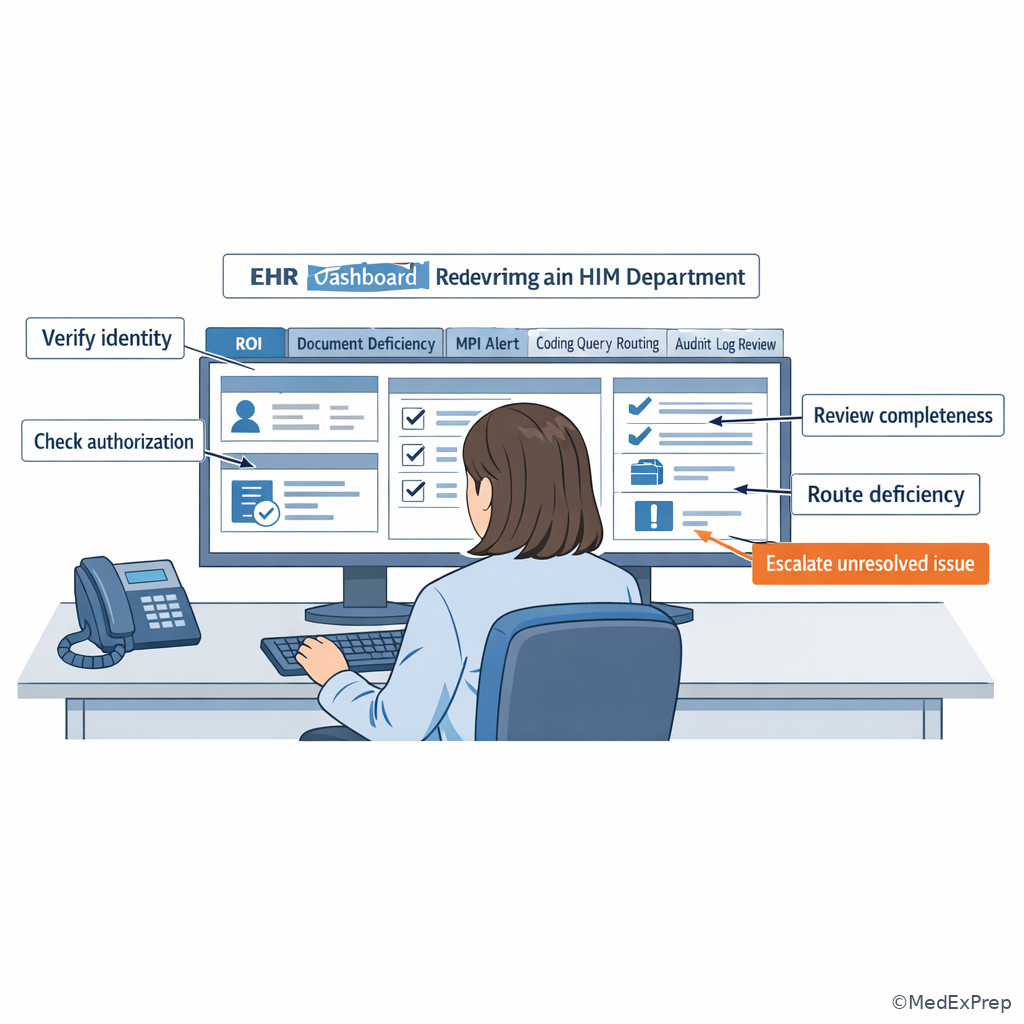
Key Terms & Must-Know Facts
1.1.1.1 Key terms
- Scope of practice/role: the tasks the RHIT may perform within law, policy, and job authority.
- Technician-level judgment: operational decision-making based on records, policy, and workflow.
- Escalation: routing an issue to the appropriate authority when it exceeds RHIT scope or cannot be resolved routinely.
- Verification: confirming identity, authority, documentation status, data source, or system facts before acting.
- Documentation integrity: ensuring record content is complete, timely, authenticated, and reliable.
- MPI integrity: maintaining correct patient identity across records.
- Minimum necessary: disclose or access only what is needed for the permitted purpose.
- Audit trail: system record of access and actions.
- Legal health record: records designated by the organization as the official business record.
- Designated record set: records used to make decisions about individuals, broader than the legal health record in many settings.
- Deficiency analysis: identifying incomplete or missing required documentation elements.
- Authentication: verifying the author of documentation, often by signature or approved electronic method.
- Authorization: a valid permission document for certain disclosures.
- Routing: sending the issue to the correct queue, worklist, or responsible person.
1.1.1.2 Must-know facts
- The RHIT may identify documentation problems but does not independently change clinical meaning.
- The RHIT may verify and process routine disclosures within policy; unclear authority requires escalation.
- The RHIT should not guess when coding or documentation is ambiguous; route through proper query or escalation workflow.
- Patient safety, suspected fraud, conflicting regulations, and system failures are common escalation triggers.
- The best first step is often to verify facts in the record, system, or policy before acting.
- An RHIT protects all three: privacy, integrity, and availability.
- Some answers are wrong not because the action is never done, but because it is done by the wrong role.
- When multiple answers seem plausible, prefer the option that is policy-aligned, documented, and within scope.
| Task type | Usually within RHIT scope | Usually requires escalation or another role |
|---|---|---|
| Record completeness review | Check required elements, deficiency status, signatures, dates | Decide clinical adequacy of treatment documentation |
| Release of information | Verify routine authorization elements and requester identity per policy | Interpret conflicting legal demands or approve exceptions |
| MPI issue | Flag possible duplicate or overlay and route correction workflow | Perform unauthorized merge or unmerge outside approved process |
| Coding-adjacent support | Identify missing specificity or unsigned documentation and route | Assign code by assumption when documentation is unclear |
| Privacy/security | Follow role-based access, minimum necessary, report possible incident | Determine legal breach liability independently |
| Systems issue | Document outage/workflow effect and notify appropriate team | Reconfigure network or security architecture |
Core content
1.1.1.3 Foundational role boundaries: what the RHIT can do directly
A Explanation
The central decision conflict in this topic is simple: Can I perform this action as an RHIT right now, or must I route it? The resolving rule is whether the task is a routine HIM workflow supported by record facts, policy, and technician authority. If the action involves reviewing records for completeness, validating identifiers, checking authorization elements, tracking deficiencies, preparing routine reports, or flagging discrepancies for correction, it is commonly within scope. If the action requires diagnosis, legal interpretation, clinical treatment judgment, independent coding assumptions, or enterprise-level system/security decisions, reject it.
WHY THIS IS TESTED: exam stems often present a realistic task where one option is operationally correct but belongs to another professional role. The exam wants you to choose the answer that is both compliant and within technician scope. See Fig 1.
Key rule: An RHIT can review, verify, route, document, and report within established workflow. An RHIT does not diagnose, practice law, create unsupported clinical meaning, or override policy.
Exam takeaway: The best answer may be wrong if it requires physician, legal, privacy officer, or IT authority instead of RHIT workflow action.
flowchart LR
A[RHIT direct actions] --> A1[Review completeness]
A --> A2[Validate identifiers]
A --> A3[Check routine authorization elements]
A --> A4[Route deficiencies]
A --> A5[Document and track]
B[Out of scope] --> B1[Diagnose patient]
B --> B2[Interpret law independently]
B --> B3[Guess unclear code]
B --> B4[Override security settings]
B --> B5[Approve policy exception]
See Fig 2 when you need a quick choose-versus-reject screen.
B Worked example
A 67-year-old inpatient with diabetes and chronic kidney disease is discharged after treatment for pneumonia. The attending note is signed, but the discharge summary is missing. A payer audit request is pending, and the unit clerk says, “Just upload the draft summary so billing can move.” A mildly elevated potassium value remains in the chart, but that lab is not the operational issue being tested. The task is to choose the most appropriate RHIT action.
Reasoning chain: Identify task: documentation integrity and workflow status. Extract key facts: record is incomplete; draft is not final authenticated documentation; billing pressure is noise; the abnormal potassium is a distracting clinical detail. Apply rule: RHIT may review completeness, identify deficiency, and route for completion, but may not create or substitute final clinical documentation. Eliminate distractors: uploading a draft as if final changes the record status improperly; asking the RHIT to “complete” the summary is out of scope; ignoring the issue to speed billing violates documentation integrity. Verify: route the record through deficiency workflow, document status, and notify the appropriate responsible provider/work queue.
C Exam trap
Common wrong answer: “Finalize the draft discharge summary so the claim can be processed.”
Why it is tempting: It sounds efficient and supports revenue flow, which feels operationally helpful.
Single clue that eliminates it: The draft is not authenticated final documentation; the RHIT cannot convert unfinished provider documentation into completed record content.
D Checkpoint
Question: A clinic RHIT notices that a provider’s unsigned history and physical is blocking chart completion. Which action is most appropriate?
- Sign on the provider’s behalf using a departmental shared credential.
- Mark the document complete because the provider dictated it.
- Route the deficiency according to policy and document follow-up status.
- Interpret whether the unsigned note is clinically sufficient and release it as final.
Answer: C
- A: Tempting because it clears the queue quickly; wrong because shared credentials and signing for a provider violate authentication and security rules.
- B: Tempting because dictation suggests the content exists; wrong because dictated content is not the same as completed authenticated documentation.
- C: Correct because deficiency routing and tracking are technician-level actions within HIM workflow.
- D: Tempting because it sounds like practical judgment; wrong because RHITs do not make provider-level determinations of clinical sufficiency for finalization.
Practitioner Action: ASSESS record status, required elements, and authentication state. INTERVENE by placing the chart into the correct deficiency or follow-up workflow. REFER unresolved authorship, clinical content, or policy-exception questions to the provider, supervisor, or compliance lead. DOCUMENT the deficiency, routing action, and tracking status in the approved system.
1.1.1.4 The source of authority: policy, law, role, and documentation status
A Explanation
When an exam item asks what the RHIT should do, the hidden question is often: Which source controls this decision? Choose between acting from record facts and written workflow versus acting from assumption or convenience. The single rule that resolves the conflict is this: the RHIT should use the most applicable governing source available—law and regulation where relevant, official guidance, organizational policy, and the documented facts in the record or request. Reject actions based only on habit, pressure, or verbal shortcuts.
This matters because two wrong patterns repeatedly appear in RHIT items: first, using policy where law clearly governs; second, bypassing policy because “this is how we usually do it.” If a requester’s authority is unclear, if a retention exception is claimed, if sensitive information is involved, or if documentation ambiguity affects coding or disclosure, verify the governing rule rather than improvise.
Recall: This is the first topic in the course, so there is no prior lesson to review yet. Build this habit now: every RHIT question can be approached as task → facts → governing rule → action → verification. The next topic, First-Step Operational Judgment, will sharpen that sequencing.
Memory anchor: RVPD = Record facts, Valid rule source, Policy-aligned action, Document what you did. If any letter is missing, slow down.
Exam takeaway: When pressure and policy conflict with documented authority requirements, follow the controlling rule and escalate unresolved conflicts.
flowchart TD
A[Operational question] --> B[Check applicable law or regulation]
B --> C[Check official guidance and organizational policy]
C --> D[Verify record/request/system facts]
D --> E{Routine and supported?}
E -->|Yes| F[Process and document]
E -->|No| G[Escalate to appropriate authority]
See Fig 3 for the hierarchy that defeats “we always do it this way” distractors.
B Worked example
A physician practice receives a phone request from a person claiming to be a patient’s adult son seeking the latest laboratory results “for an emergency appointment.” The patient has hypertension and asthma, and the chart shows an old emergency contact listing the son’s name. A receptionist says that because he is listed in the chart, the RHIT should fax the results immediately. The tempting clue is the old emergency contact. The real task is to identify whether routine disclosure authority has been established.
Reasoning chain: Identify task: release of information. Extract key facts: phone requester, family relationship claimed, emergency contact listing present, but no current verified authority for this disclosure is shown. Apply rule: emergency contact status does not automatically equal disclosure authority for all information. Eliminate distractors: faxing based on convenience or prior contact data is not enough; refusing all disclosure without review may be too broad; giving advice about legal rights exceeds role. Verify: follow authorization/identity verification policy, confirm whether a permitted disclosure basis exists, and escalate if authority remains unclear.
C Exam trap
Common wrong answer: “Disclose because the requester is listed as the emergency contact.”
Why it is tempting: Emergency contact status looks like proof of relationship and urgency.
Single clue that eliminates it: The stem gives no verified authority for this disclosure purpose; contact information alone is not blanket authorization.
D Checkpoint
Question: Which source should most directly control an RHIT’s decision when a routine workflow request conflicts with a coworker’s verbal shortcut?
- The coworker’s experience handling similar requests
- The applicable law, official guidance, and organizational policy
- The requester’s insistence that the matter is urgent
- The RHIT’s personal sense of what seems fair
Answer: B
- A: Tempting because experienced staff often know workflows; wrong because informal habit does not override governing requirements.
- B: Correct because RHIT decisions must align with controlling rules and documented workflow.
- C: Tempting because urgency can feel like a reason to act quickly; wrong because urgency alone does not establish authority.
- D: Tempting because professional judgment matters; wrong because exam-safe RHIT judgment is policy-based, not purely personal.
Practitioner Action: ASSESS what rule source governs the task. INTERVENE by applying written policy and verifying needed record or requester facts. REFER legal conflicts, unclear disclosure authority, or policy contradictions to privacy, compliance, legal, or supervisory staff. DOCUMENT the verification steps and the reason the request was processed, held, or escalated.
- The safest first RHIT move when authority is unclear is to verify.
- True or False: A draft provider note can be treated as final if billing is delayed. False.
- Name the four letters in the memory anchor: RVPD = Record facts, Valid rule source, Policy-aligned action, Document.
1.1.1.5 Applied scope in daily HIM workflows: ROI, documentation, MPI, and coding support
A Explanation
Now move from general boundaries to the operational areas that most often appear on the RHIT exam. The decision conflict is no longer “can I act?” but which technician action fits this workflow best? The single rule that resolves most questions is to choose the workflow step that preserves accuracy and compliance without adding unauthorized interpretation.
In ROI, RHITs can verify authorization elements, requester identity, and scope of the request according to policy. They should reject shortcuts such as releasing records on incomplete forms or broad verbal claims of authority. In documentation integrity, RHITs can analyze deficiency status, monitor missing signatures, and route records for completion; they do not author missing clinical content. In MPI integrity, RHITs can identify possible duplicates or overlays and initiate correction workflow; they should not make ad hoc record merges outside approved process. In coding support, RHITs can recognize when documentation is incomplete, conflicting, or insufficiently specific and route through approved channels; they do not guess diagnoses or code assignment from hints.
WHY THIS IS TESTED: stems frequently bundle two valid-seeming actions from different workflows. The best answer is the one that preserves the data source rather than alters it. See Fig 4.
High-Yield Connection: This concept is tested alongside First-Step Operational Judgment and later with Escalation Triggers & Boundaries. Know both the technician action you can take and the point at which the issue must leave your queue.
Exam takeaway: Match the issue to the correct HIM workflow tool rather than solving it by shortcut or unauthorized interpretation.
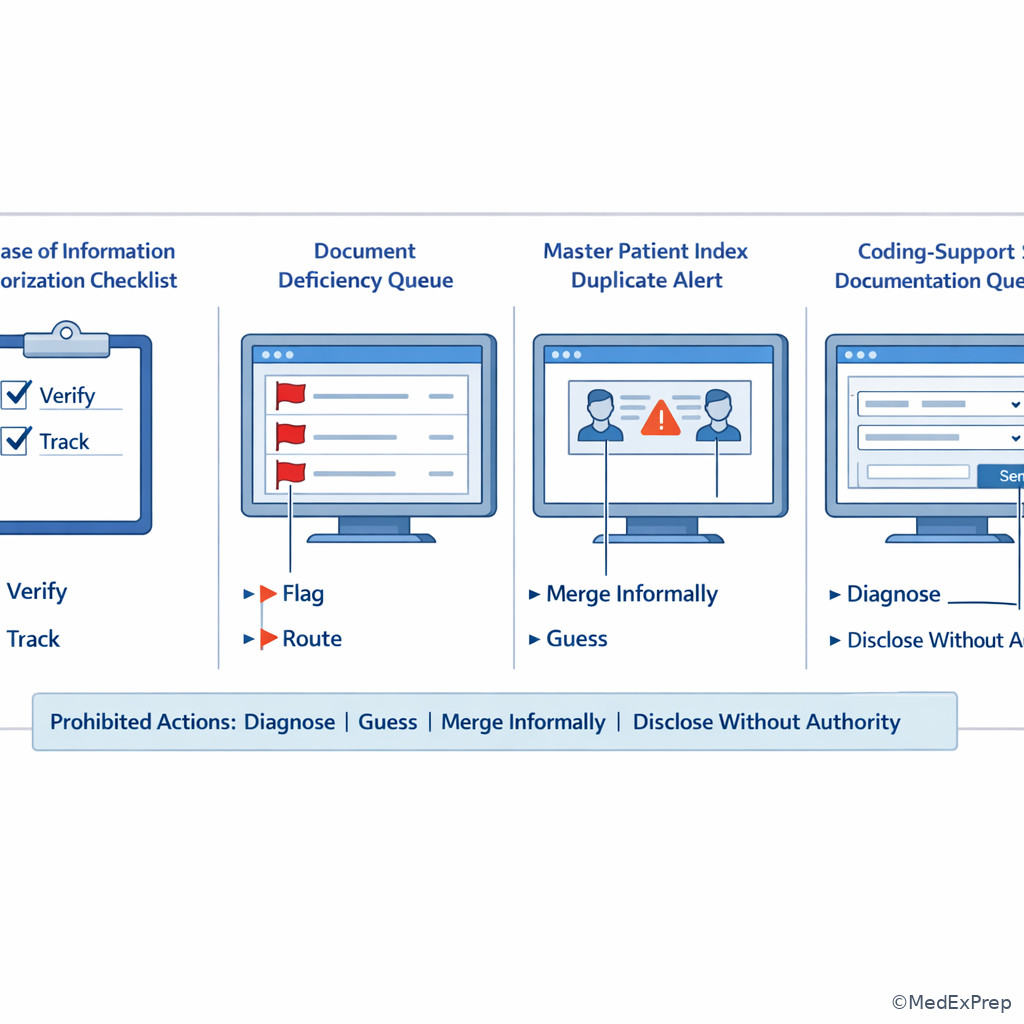
B Worked example
A 58-year-old outpatient with COPD and heart failure has two similar medical record numbers after registration under a nickname at an urgent care visit. The coder also notes that the encounter note lists “possible exacerbation” without final clarification, and a family member calls asking for the urgent care report. The patient’s smoking history and slightly elevated glucose are distracting details. The RHIT must choose the immediate operational action.
Reasoning chain: Identify tasks: possible MPI duplicate, ambiguous documentation, and third-party ROI request. Extract key facts: two records may represent one patient; diagnosis language is not final; family caller authority is unknown. Apply rule: preserve data integrity first by flagging and routing the MPI issue through approved identity correction workflow; do not merge informally. For coding support, route documentation ambiguity appropriately rather than inferring the condition. For ROI, verify requester authority before disclosing. Eliminate distractors: any option that merges records manually, codes the exacerbation based on probability language, or releases the report to family without authority exceeds scope or skips verification. Verify: initiate the proper work queues and document the status.
C Exam trap
Common wrong answer: “Merge the two records now because the date of birth and phone number match.”
Why it is tempting: It seems like a quick data-cleaning fix and some identifiers do match.
Single clue that eliminates it: The issue is only a possible duplicate; approved MPI correction workflow must be followed rather than ad hoc merging.
D Checkpoint
Question: Which action best fits RHIT scope when provider documentation is unclear for coding support?
- Choose the most likely diagnosis based on labs and nursing notes
- Route the issue through approved documentation clarification workflow
- Call the payer and ask which diagnosis would reimburse appropriately
- Edit the provider note to add specificity from prior visits
Answer: B
- A: Tempting because the record may strongly suggest the answer; wrong because RHITs do not code by independent clinical inference when documentation is unclear.
- B: Correct because recognizing ambiguity and routing it through proper workflow is within scope.
- C: Tempting because reimbursement is affected; wrong because payer preference does not substitute for provider documentation and may exceed technician workflow.
- D: Tempting because prior visits may seem to supply context; wrong because altering clinical documentation content is not permitted.
Practitioner Action: ASSESS which HIM workflow the issue belongs to. INTERVENE using the approved queue or checklist for ROI, deficiency, MPI, or coding clarification support. REFER provider-content decisions, disputed identity corrections, or unclear legal authority to the designated responsible role. DOCUMENT the issue type, action taken, and pending handoff.
1.1.1.6 When to stop and escalate: unresolved ambiguity, risk, and wrong-role tasks
A Explanation
The final foundational skill is knowing when continued RHIT action becomes unsafe. The decision conflict is between trying to solve the problem yourself versus recognizing an escalation trigger. The single resolving rule is this: when the issue involves conflicting rules, unclear authority, suspected fraud, patient safety implications, unresolved documentation ambiguity, or system failure beyond routine user workflow, stop routine processing and escalate through the appropriate channel.
This is different from ordinary verification. Verification handles gaps that can be solved by checking required elements. Escalation is for issues that remain unresolved after routine checks or that belong to another authority from the start. Examples include a subpoena that conflicts with policy and you cannot interpret; a suspected overlay affecting patient safety; evidence of inappropriate access in an audit trail; contradictory documentation that changes code selection but lacks clarification; or a system downtime problem involving missing images and failed interface transmission. The RHIT role is to recognize, preserve evidence, follow workflow, and route correctly—not to decide the legal answer, the clinical answer, or the technical root-cause fix.
WHY THIS IS TESTED: exam stems often tempt you with a “helpful” direct action. The better answer is often the one that protects the organization by escalating early. See Fig 5.
Common traps & distractors: urgent request, pressure from a manager, partial matching identifiers, or a clinically obvious diagnosis can all make a wrong direct action look reasonable. The single clue that defeats these distractors is usually unresolved authority or ambiguity.
Exam takeaway: If routine verification cannot resolve the issue or the issue belongs to another authority, escalate instead of improvising.
flowchart TD
A[Issue identified] --> B[Perform routine verification]
B --> C{Resolved within policy and scope?}
C -->|Yes| D[Process and document]
C -->|No| E{Why unresolved?}
E --> F[Conflicting rules or unclear authority]
E --> G[Safety, fraud, or privacy risk]
E --> H[Documentation ambiguity or system failure]
F --> I[Escalate]
G --> I
H --> I
I --> J[Document handoff and preserve integrity]
See Fig 5 for the algorithm that separates routine holds from true escalation.
B Worked example
A long-term care facility RHIT receives a request for the complete chart from someone identifying herself as the resident’s niece. The resident has dementia, hypertension, and recurrent falls. A scanned power of attorney document appears in the chart, but the image is cut off, the effective date is unreadable, and the nurse says, “She always handles everything.” There is also a note suggesting a recent family dispute over finances. The tempting clue is the nurse’s reassurance. The real issue is unclear authority plus possible legal sensitivity.
Reasoning chain: Identify task: ROI authority validation. Extract key facts: family relationship alone is insufficient, scanned document is incomplete, potential dispute exists, and legal authority is not clearly established. Apply rule: unresolved authority is an escalation trigger; do not disclose until authority is verified according to policy and applicable law. Eliminate distractors: disclosing based on unit familiarity is unsafe; refusing forever without routing is incomplete; interpreting the legal document independently may exceed scope. Verify: hold the request, route for appropriate review, and document the reason for delay or escalation.
C Exam trap
Common wrong answer: “Release the chart because staff recognize the niece and the resident has dementia.”
Why it is tempting: The family connection and patient incapacity make the request sound compassionate and routine.
Single clue that eliminates it: Authority is not clearly verified; the power document is incomplete and there may be a dispute.
D Checkpoint
Question: Which scenario most clearly requires escalation rather than routine RHIT processing?
- A required physician signature is missing from an otherwise standard discharge record
- An ROI authorization lacks one routine demographic field but can be corrected through standard callback workflow
- An audit log suggests repeated access by a workforce member with no work-related need
- A duplicate document was indexed to the wrong tab and can be refiled per policy
Answer: C
- A: Tempting because incomplete documentation matters; wrong here because it usually fits routine deficiency workflow rather than higher-level escalation.
- B: Tempting because authorization errors feel risky; wrong here because a standard correction process exists and the issue is potentially resolvable routinely.
- C: Correct because possible inappropriate access raises privacy/security concerns beyond ordinary processing and requires escalation.
- D: Tempting because indexing errors affect the record; wrong here because routine correction workflow generally handles it within scope.
Practitioner Action: ASSESS whether routine verification has fully resolved the issue. INTERVENE by holding processing when needed to prevent unauthorized disclosure or record corruption. REFER privacy incidents, legal conflicts, suspected fraud, unclear authority, or system failures to the designated responsible authority. DOCUMENT the trigger, what was verified, what was not resolved, and where the case was routed.
- The RHIT should not guess when documentation or coding guidance is unclear.
- True or False: A matching phone number is enough to merge possible duplicate MPI records. False.
- Name three escalation triggers: unclear authority, suspected inappropriate access, conflicting rules.
1.1.1.7 Integration strategy for exam stems: choose the safest in-scope next step
A Explanation
By now the content is familiar; what remains is exam execution. The decision conflict in integrated questions is between a bold action that seems to “solve” the problem and a narrower action that preserves compliance. The single rule is to prefer the option that is most compliant, policy-aligned, documentation-based, and within RHIT scope. The best answer often sounds less dramatic because RHIT practice is workflow-centered.
Use this sequence: identify the task; pull out the one operational hinge fact; decide whether the issue is routine or escalatory; choose the lowest-risk in-scope action; confirm that the answer preserves privacy, integrity, and availability. If an option asks you to diagnose, interpret complex law independently, edit clinical meaning, override security, or finalize uncertain documentation, reject it. If another option says verify, hold, route, or document according to policy, it is often correct even if slower.
Memory anchor: V-R-A-D-E = Verify facts, Rule source, Act within scope, Document, Escalate if unresolved. Use this when two choices both sound reasonable.
High-Yield Connection: This concept overlaps with later topics in privacy/security, ROI, MPI, coding foundations, and EHR workflow. On the RHIT exam, one boundary rule is often embedded inside another topic’s content area.
Exam takeaway: In close-call questions, the best answer is usually the policy-based action that protects privacy, integrity, and availability without exceeding scope.
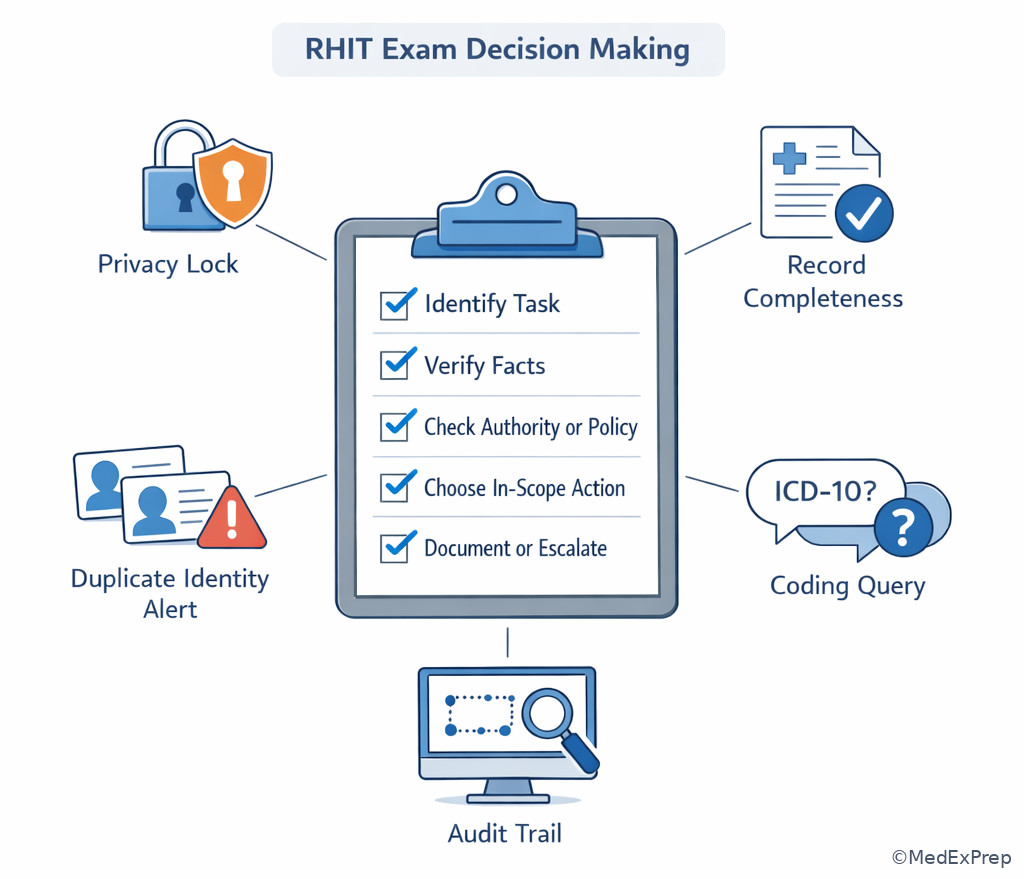
See Fig 6 as a last-pass checklist before you commit to an answer.
B Worked example
A hospital RHIT working a weekend queue sees a chart with an unsigned operative note, a possible duplicate patient entry from pre-op registration, and a call from case management asking for immediate release to an outside rehab facility. The patient is a 74-year-old with heart failure and chronic anemia; a high BNP is listed but irrelevant to the HIM decision. One option says to “send everything now to avoid delaying care.” Another says to “merge the suspected duplicates, complete the op note status, and release.” The correct thinking is narrower.
Reasoning chain: Identify tasks: record completeness, MPI concern, and disclosure workflow. Extract hinge facts: unsigned note means incomplete documentation status; possible duplicate is unresolved identity issue; urgency for rehab transfer is real but does not erase workflow requirements; authority and process for the disclosure must be established under policy. Apply rule: the RHIT should verify disclosure basis and requester requirements, avoid manual record correction outside approved MPI process, and route documentation deficiency appropriately. Eliminate distractors: “solve everything yourself” options exceed scope. Verify: the best answer is the in-scope, policy-based sequence rather than the fastest-seeming one.
C Exam trap
Common wrong answer: “Take the action that prevents any delay in patient transition, even if record issues remain unresolved.”
Why it is tempting: Patient flow feels urgent, and urgency can make shortcut options look humane and efficient.
Single clue that eliminates it: The stem includes unresolved documentation or identity problems; urgency does not authorize the RHIT to bypass governing workflow.
D Checkpoint
Question: In a close-call RHIT exam stem, which answer is usually best when one option is faster but requires unsupported interpretation?
- The faster option, because workflow efficiency is the top priority
- The option that seems most helpful to clinicians, even if policy is not cited
- The option that is policy-aligned, supported by verified facts, and within scope
- The option that uses broad common sense rather than written workflow
Answer: C
- A: Tempting because efficiency matters operationally; wrong because efficiency does not override compliance or scope limits.
- B: Tempting because supporting care is important; wrong because RHIT actions still require proper authority and workflow.
- C: Correct because RHIT exam items reward the safest compliant action within role boundaries.
- D: Tempting because common sense feels practical; wrong because the exam tests rule-based operational judgment, not improvisation.
Practitioner Action: ASSESS the domain, hinge fact, and unresolved risk. INTERVENE with the narrowest compliant in-scope action that keeps the workflow moving safely. REFER any step that requires another role’s authority or expertise. DOCUMENT what was verified, what was held, and why escalation occurred.
Exam Traps & Differentiators
The most common wrong answer in this topic is the option where the RHIT solves the problem too completely. It is tempting because it sounds proactive and efficient. It is wrong because it crosses into provider, legal, privacy-officer, or IT authority.
| Looks similar | Actually within RHIT scope | Not within RHIT scope | Discriminating clue |
|---|---|---|---|
| Correcting chart issue | Flag deficiency and route for completion | Write or finalize missing clinical content | Authorship/clinical meaning belongs to the provider |
| Helping with coding | Identify unclear or missing documentation and route | Infer diagnosis from labs or prior notes | Documentation ambiguity remains unresolved |
| Cleaning MPI | Report possible duplicate/overlay per workflow | Merge records informally | Only a possible match is shown |
| Supporting ROI | Verify authorization elements and identity | Disclose based on relationship assumption | Authority is not clearly documented |
| Responding to security concern | Report potential inappropriate access | Perform forensic system investigation independently | Issue exceeds routine user function |
Exam takeaway: Many distractors look operationally reasonable until you ask whether the action changes meaning, bypasses authority, or belongs to another role.
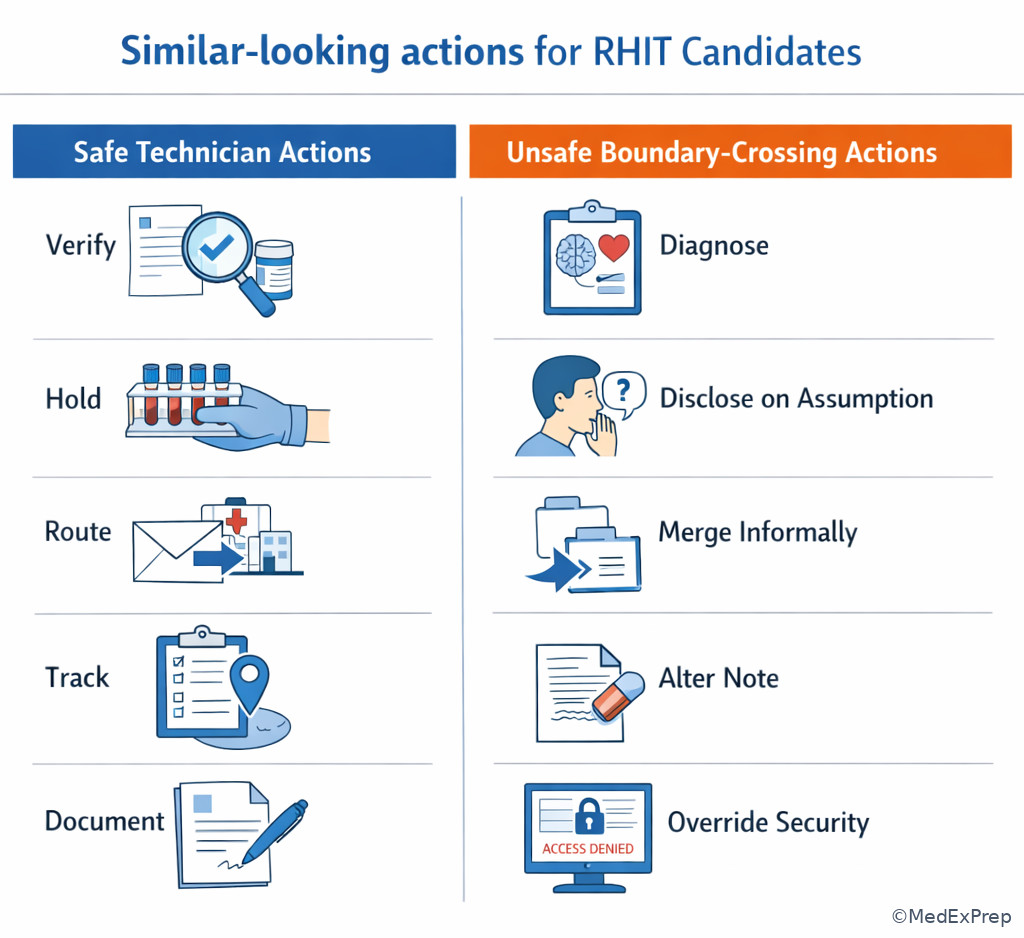
1.1.1.8 If the stem says ___, think ___
- If the stem says “unsigned,” “draft,” or “incomplete”, think deficiency workflow, not finalization.
- If the stem says “family member requests records” without clear authority, think verify identity and authority before disclosure.
- If the stem says “possible duplicate”, think flag and route MPI correction workflow, not manual merge.
- If the stem says “documentation unclear for coding”, think query/clarification workflow, not guesswork.
- If the stem says “audit log shows suspicious access”, think report/escalate privacy-security concern.
- If the stem says “conflicting rules” or “unclear legal authority”, think escalate; do not interpret independently.
Recall: The upcoming topic First-Step Operational Judgment will make these traps even more testable by asking for the best first action, not just the right role. Keep the sequence verify → review → document → route in mind.
Tables
| High-yield reference | Remember this | Why it matters on the exam |
|---|---|---|
| Unsigned note | Incomplete until authenticated per policy | Blocks finalization shortcuts |
| Draft document | Not equivalent to final record content | Do not substitute draft for final documentation |
| Emergency contact | Does not automatically equal disclosure authority for all purposes | Defeats common ROI distractor |
| Possible duplicate record | Needs approved identity correction workflow | Reject informal merge option |
| Ambiguous diagnosis wording | Requires clarification workflow if coding depends on it | Reject code-by-inference option |
| Suspicious audit trail access | Escalate per privacy/security process | Routine processing is not enough |
| Workflow area | Best RHIT first step | Tempting wrong step |
|---|---|---|
| ROI request with unclear authority | Verify identity/authorization elements and hold if unresolved | Disclose based on relationship claim |
| Missing provider signature | Route deficiency and track completion | Sign on provider’s behalf |
| Possible MPI duplicate | Flag and route approved correction workflow | Merge records immediately |
| Documentation unclear for code support | Route through approved clarification process | Assign likely diagnosis from clues |
| Possible inappropriate access | Escalate privacy/security concern and document | Privately warn the employee and close it yourself |
| Scenario type | Routine verification problem | Escalation problem | Key discriminator |
|---|---|---|---|
| Authorization form issue | One missing correctable element | Conflicting legal authority or disputed representative status | Can routine policy-based verification resolve it? |
| Record completeness | Missing signature tracked in standard workflow | Question of false authorship or improper alteration | Is the problem just incomplete, or potentially improper? |
| MPI concern | Possible duplicate flagged for review | Overlay creating patient safety risk or unresolved identity conflict | Does the issue threaten identity integrity beyond routine correction? |
| Coding support | Need for clarification routed appropriately | Documentation contradiction with compliance/fraud concern | Is ambiguity routine, or is there a higher-risk inconsistency? |
| System issue | User workflow delay documented and reported | Security failure or data transmission loss beyond user scope | Does resolution require technical authority? |
Algorithm / Approach
Exam takeaway: The RHIT does not need to solve every problem personally; the tested skill is routing the issue to the correct authority after proper verification.
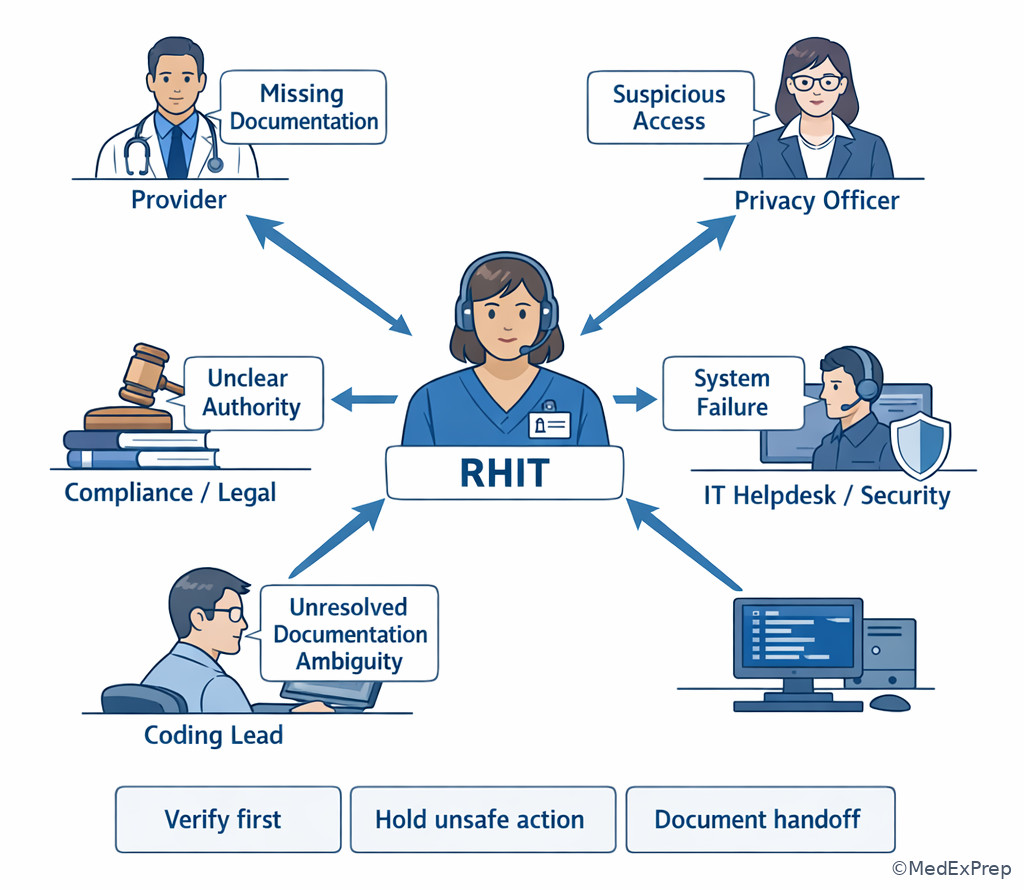
Rapid Review
- Unsigned documentation → deficiency workflow, not final record status
- Draft note → content exists, but authentication status is the discriminator
- Family request → relationship alone does not equal disclosure authority
- Possible duplicate MPI → flag and route, do not manually merge
- Coding ambiguity → clarification workflow, not diagnostic inference
- Audit trail concern → privacy/security escalation, not local quiet fix
- Urgent workflow pressure → does not cancel policy or law
- Routine RHIT action → review, verify, route, track, document
- Out-of-scope clue → diagnose, prescribe, interpret law independently, override policy
- Best exam answer → most compliant in-scope action, not most aggressive action
- Rule-source conflict → controlling authority before coworker habit
- Unresolved authority → hold disclosure and escalate
Self-check quiz
1.1.1.9 Question 1
An RHIT is reviewing an incomplete outpatient record for a 42-year-old patient with migraine and hypothyroidism. The note is dictated but unsigned, and the clinic manager says to close the chart because the patient already returned for follow-up. Which action is most appropriate?
- Route the record through deficiency workflow and track signature completion
- Sign the note under the clinic manager’s approval
- Mark the note final because the visit occurred and dictation is present
- Summarize the visit in a new HIM note so the chart can be completed
1.1.1.10 Question 2
A physician office receives a call from a patient’s adult daughter requesting recent lab results for a specialist visit. The patient has diabetes and hypertension, and the daughter is listed as an emergency contact. Which action is most appropriate for the RHIT?
- Release the results because emergency contacts may receive all medical information
- Verify requester authority and applicable disclosure requirements before releasing any information
- Give only verbal results because verbal disclosure is less formal than faxing records
- Advise the daughter on the legal steps to obtain permanent decision-making power
1.1.1.11 Question 3
A 71-year-old inpatient with heart failure, chronic kidney disease, and atrial fibrillation has two similar medical record numbers after weekend registration. The nurse says both charts are “definitely the same patient,” and case management wants immediate transfer paperwork sent. A mildly abnormal creatinine is present but not the main issue. What is the best next step for the RHIT?
- Merge the records immediately to avoid care delay
- Flag a possible duplicate/overlay and initiate approved MPI correction workflow
- Ignore the MPI issue until discharge to avoid interrupting clinical care
- Ask the physician to decide whether the records belong together
1.1.1.12 Question 4
A coder asks the RHIT to help with an encounter for a 63-year-old patient with COPD and obesity. The provider note says “likely pneumonia versus atelectasis,” and chest imaging is pending final interpretation. The payer deadline is tomorrow, and the billing office requests a “best guess” diagnosis. Which response is most appropriate?
- Select pneumonia because it is the more serious condition
- Use the last similar diagnosis from the patient’s prior visit
- Route the documentation ambiguity through the approved clarification process
- Call the payer to see which diagnosis they prefer for coverage
1.1.1.13 Question 5
An RHIT reviewing audit reports sees repeated overnight chart access by an employee who was not assigned to those patients. One patient has cancer; another has a psychiatric history, which makes the case feel especially sensitive. The employee says she was “just curious.” What action is most appropriate?
- Delete the audit report to protect confidentiality
- Privately warn the employee and take no further action
- Escalate the possible inappropriate access according to privacy/security policy
- Contact the affected patients directly and explain the breach determination
1.1.1.14 Question 6
A long-term care RHIT receives a request for the complete record of an 83-year-old resident with dementia, CHF, and recurrent falls. The requester states she is the resident’s niece and provides a scanned power of attorney, but the signature page is missing and the facility social worker mentions a family dispute. The therapy department wants the record released today for continuity of care. What is the best next step?
- Release the full record because continuity of care requests should not be delayed
- Release only therapy notes because those are the minimum necessary
- Hold the disclosure, verify authority under policy and applicable law, and escalate unresolved authority questions
- Decide the power of attorney is probably valid because staff recognize the niece
1.1.1.15 Question 7
A weekend RHIT in a hospital sees an unsigned operative note, a draft discharge summary, and a request from an outside rehabilitation facility for immediate transfer documents on a 76-year-old patient with stroke, diabetes, and chronic anemia. The case manager says delay will hold a bed. The authorization basis appears routine, but the operative note status is incomplete. Which action is most appropriate?
- Finalize the draft discharge summary and send the full chart packet
- Verify the disclosure basis and release only what policy permits while routing the incomplete documentation through deficiency workflow
- Refuse all disclosure until every document in the chart is complete and signed
- Ask the surgeon to verbally summarize the operation so HIM can create a final note
1.1.1.16 Question 8
An RHIT in an ambulatory system is asked to correct a chart for a 55-year-old patient with asthma and rheumatoid arthritis. A staff member accidentally scanned another patient’s outside consult into the chart, and the provider also documented “probable autoimmune flare” without final confirmation. The clinic supervisor asks the RHIT to remove the wrong scan, update the diagnosis field to match the likely flare, and close the visit before end of day. Which is the best response?
- Correct the misfiled document per policy, but route the diagnostic ambiguity rather than updating the diagnosis by assumption
- Update both the scan and the diagnosis field because the supervisor approved it
- Leave the incorrect scan in place to preserve the original chart history
- Delete the entire encounter and rebuild it from memory with the likely diagnosis
Answer key
1.1.1.17 Question 1 Answer: A
A: Tempting because it is less dramatic than other options, but it is correct because incomplete authenticated documentation belongs in routine deficiency workflow. The single stem clue is dictated but unsigned, which means the note is not final. Source: AHIMA operational HIM practice standards and standard documentation integrity principles support tracking incomplete documentation rather than creating or signing content.
B: Tempting because the clinic manager appears to authorize the shortcut, but it is incorrect because an RHIT cannot sign for a provider or use substitute authentication. The discriminating clue is that the missing action is provider signature/authentication, not clerical approval.
C: Tempting because the patient already returned, suggesting the visit is operationally complete; incorrect because visit completion does not equal documentation authentication. The key clue is unsigned note.
D: Tempting because it sounds helpful and keeps the workflow moving; incorrect because HIM staff do not create new clinical summary content to replace provider documentation. The discriminator is clinical content authorship. Source: AHIMA. Health Information Management: Concepts, Principles, and Practice.
1.1.1.18 Question 2 Answer: B
A: Tempting because family and emergency contact information feel like enough authority, but it is incorrect because emergency contact status alone does not establish blanket disclosure rights. The discriminating clue is listed as emergency contact, not verified disclosure authority. Source: U.S. Department of Health and Human Services, HIPAA Privacy Rule guidance.
B: Correct because the RHIT should verify requester authority and applicable policy or legal basis before disclosure. The stem clue is the absence of clear authorization despite the family relationship.
C: Tempting because verbal disclosure may seem narrower than sending records, but it is incorrect because disclosure authority requirements apply regardless of communication format. The key clue is authority remains unverified.
D: Tempting because it sounds informative and helpful, but it is incorrect because providing legal advice exceeds RHIT scope. The discriminator is that the request asks for records, not legal counseling. Source: HHS HIPAA summaries and AHIMA ROI practice resources.
1.1.1.19 Question 3 Answer: B
A: Tempting because merging seems efficient and may reduce clinical confusion, but it is incorrect because ad hoc merging can worsen identity integrity problems. The key clue is two similar medical record numbers, which signals a possible duplicate/overlay requiring approved workflow. Source: AHIMA MPI integrity guidance.
B: Correct because identifying a possible duplicate/overlay and initiating approved MPI correction workflow is a classic RHIT responsibility. The discriminator is that the records are only suspected to be the same patient.
C: Tempting because clinical care feels more urgent than data correction; incorrect because unaddressed identity issues can directly affect patient safety and downstream record integrity. The stem clue is the possibility of patient identity error.
D: Tempting because physician involvement sounds authoritative, but it is incorrect because MPI correction is an HIM workflow issue, not a physician diagnostic decision. The discriminator is identity management, not clinical judgment. Source: AHIMA data quality and MPI best practices.
1.1.1.20 Question 4 Answer: C
A: Tempting because pneumonia may seem the most likely and clinically important diagnosis; incorrect because severity does not permit coding by assumption when provider documentation remains uncertain. The key clue is likely pneumonia versus atelectasis. Source: AHIMA coding support boundaries and official guideline principles requiring provider-supported documentation.
B: Tempting because prior visits can provide context; incorrect because prior diagnoses cannot replace current encounter documentation. The discriminator is current encounter ambiguity.
C: Correct because RHITs may recognize documentation ambiguity and route it through approved clarification workflow without independently selecting the diagnosis.
D: Tempting because payer timelines create pressure; incorrect because payer preference cannot substitute for clinically documented provider clarification. The key clue is documentation is unresolved. Source: ICD-CM/PCS Official Guidelines general documentation principles and AHIMA education texts.
1.1.1.21 Question 5 Answer: C
A: Tempting because deleting the report might feel protective of privacy, but it is incorrect because audit evidence should be preserved, not destroyed. The stem clue is audit reports show repeated access. Source: HIPAA Security Rule concepts on audit controls and incident reporting.
B: Tempting because local correction and education can seem efficient; incorrect because possible inappropriate access is a formal privacy/security matter requiring escalation, not a private side conversation. The discriminator is repeated access without work-related need.
C: Correct because the RHIT should report or escalate possible inappropriate access according to privacy/security policy and preserve the audit evidence.
D: Tempting because patients may ultimately need notification in some incidents; incorrect because determining breach status and communication steps is not solely the RHIT’s independent role. The key clue is that the question asks for the most appropriate RHIT action now. Source: HHS HIPAA Security and Breach Notification guidance; AHIMA privacy practice resources.
1.1.1.22 Question 6 Answer: C
A: Tempting because continuity of care sounds urgent and beneficial; incorrect because unclear representative authority remains unresolved and cannot be bypassed. The key clue is missing signature page and family dispute. Source: HHS HIPAA Privacy Rule guidance and AHIMA ROI practice standards.
B: Tempting because it invokes minimum necessary, but it is incorrect for this scenario because the threshold issue is not amount of information; it is whether the requester has verified authority at all. The discriminator is authority first, scope second.
C: Correct because the RHIT should hold the disclosure, verify authority under policy and applicable law, and escalate unresolved authority questions. This protects privacy and stays within technician scope.
D: Tempting because staff familiarity can make a representative seem legitimate; incorrect because recognition by staff is not the same as valid documented authority. The key clue is incomplete legal document. Source: HHS HIPAA summaries and AHIMA ROI workflow references.
1.1.1.23 Question 7 Answer: B
A: Tempting because it directly solves the transfer delay; incorrect because the RHIT cannot finalize a draft discharge summary. The stem clue is draft discharge summary. Source: AHIMA documentation integrity principles.
B: Correct because the disclosure basis can be verified and the RHIT can release what policy permits while separately routing incomplete documentation through deficiency workflow. The discriminator is that not every incomplete document blocks every disclosure; the RHIT must follow policy rather than assume all-or-nothing.
C: Tempting because it feels safest to wait for full completion; incorrect because if a proper disclosure basis exists, the RHIT may process the request according to policy without independently finalizing missing documents. The key clue is authorization basis appears routine.
D: Tempting because it seeks clinician input; incorrect because HIM cannot create final operative content from a verbal summary outside approved documentation processes. The discriminator is provider authorship and authentication. Source: AHIMA health record content and documentation completion references; HHS privacy guidance where applicable.
1.1.1.24 Question 8 Answer: A
A: Correct because correcting a misfiled document through approved policy-based workflow is within RHIT scope, while updating a diagnosis field by assumption is not. The discriminating clue is probable autoimmune flare, which remains diagnostically unresolved. Source: AHIMA data integrity and documentation integrity standards.
B: Tempting because supervisor approval may feel like enough authority; incorrect because a supervisor cannot authorize an RHIT to create unsupported clinical meaning. The key clue is that the requested diagnosis change is based on likely, not final provider confirmation.
C: Tempting because preserving history matters; incorrect because leaving another patient’s document in the wrong chart harms data integrity and should be corrected using approved workflow. The discriminator is wrong patient scan, a fixable record integrity error.
D: Tempting only if one thinks a fresh rebuild is cleaner; incorrect because deleting and recreating encounters from memory is unsafe, outside scope, and destroys integrity. The stem clue is request to correct, not recreate. Source: AHIMA health record integrity references.
Keep going with the full RHIT Prep Course (RHIT)
You just studied the way members do, in the same lesson interface. Full access unlocks every lesson, the question bank and flashcards for a full year.
One payment · 1 year of access · No auto-renewal