1.1.1 - RHIA Practice Scope
Why it matters
- RHIA exam distractors often look attractive because they are clinically sensible or legally aggressive, but they are still wrong if they exceed HIM role scope.
- Scope errors in real operations create compliance risk: unauthorized disclosures, undocumented workflow changes, inappropriate record edits, and failed escalation.
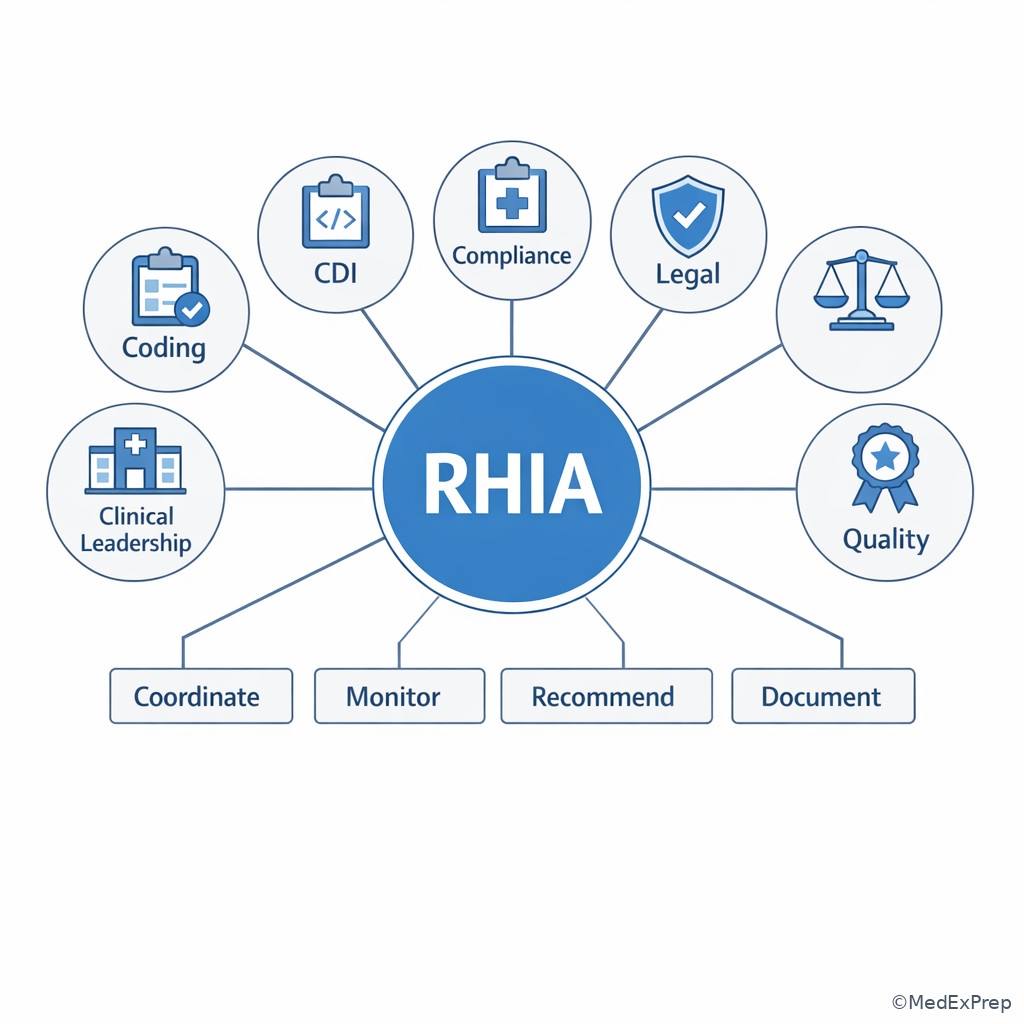
- Role clarity improves cross-functional work with coding, CDI, compliance, legal, IT, finance, and clinical leaders.
- On exam day, scope awareness is a high-yield eliminator when two answers both seem operationally useful.
Exam takeaway: Use a scope-first screen before choosing any operational action in a scenario.
flowchart TD
A[Scenario task] --> B{Is this HIM administrative or data stewardship work?}
B -->|Yes| C[Interpret policy and standards]
C --> D[Choose monitor coordinate recommend document]
B -->|No| E{Is expert input required?}
E -->|Clinical judgment| F[Escalate to provider or clinical leader]
E -->|Legal strategy| G[Escalate to legal counsel]
E -->|Deep system engineering| H[Escalate to IT security or technical team]
E -->|Coding specificity beyond oversight| I[Consult coding leadership]
D --> J[Verify privacy integrity auditability]
Keep this figure in mind throughout the lesson. See Fig 1.
Key Terms & Must-Know Facts
1.1.1.1 Key terms
- Scope of practice — the boundaries of what the RHIA-level professional may appropriately do.
- Administrative judgment — decision-making about policy, workflow, compliance, quality, and information management.
- Information governance — enterprise accountability for information quality, use, retention, privacy, and security.
- Data stewardship — protecting data accuracy, integrity, accessibility, and lawful use.
- Minimum necessary — limit use or disclosure to the least amount needed for the purpose when applicable.
- Record integrity — confidence that the right information is linked to the right patient and remains trustworthy.
- Escalation — referral to the correct discipline when authority or expertise lies elsewhere.
- Corrective action — education, workflow change, policy reinforcement, monitoring, or sanctions as appropriate.
- Auditability — ability to trace who accessed, changed, released, or validated information.
- Operational oversight — monitoring workflows, KPIs, turnaround time, quality, deficiencies, and compliance trends.
- Cross-functional collaboration — coordinated action with coding, CDI, legal, privacy, security, clinical, finance, and IT teams.
- Out-of-role signal — wording that indicates the choice belongs to another licensed or technical discipline.
1.1.1.2 Must-know facts
- RHIA questions are answered from an HIM administrative and managerial perspective, not bedside clinical care.
- The RHIA can interpret, evaluate, monitor, recommend, coordinate, and document within policy and role.
- The RHIA should not diagnose, prescribe, independently practice law, or engineer technical security infrastructure.
- When a scenario crosses scope boundaries, the best RHIA response is often escalate + preserve documentation + maintain compliance.
- Choosing the “most helpful” action is wrong if it violates privacy, authority, auditability, or role limits.
- Many wrong answers are correct actions by the wrong professional.
- Scope questions often hinge on one clue: who owns the decision.
- Requirements may vary by institution or jurisdiction; the RHIA role is to confirm current policy and official source documents.
| Action type | Usually within RHIA scope? | Typical RHIA-level action | Common exam wording |
|---|---|---|---|
| Interpret HIM policy | Yes | Apply policy, explain standard, document rationale | Most compliant response |
| Review data quality issue | Yes | Validate, trend, correct workflow, coordinate follow-up | Best next step |
| Decide medical treatment | No | Refer to provider/clinical leadership | Outside scope |
| Give legal advice | No | Escalate to legal counsel | Requires immediate clarification |
| Approve technical firewall design | No | Coordinate with IT/security, state control need | Consult appropriate team |
| Monitor ROI turnaround | Yes | Audit, educate, revise workflow | Most important to monitor |
| Alter documentation outside amendment process | No | Stop process, use approved correction workflow | Compliance risk |
Core content
1.1.1.3 Foundational role boundary: what the RHIA owns versus what the RHIA supports
A Explanation
The core decision conflict is simple: Do I decide this myself, or do I coordinate the right owner? The single rule that resolves most stems is ownership of the underlying judgment. If the task is about information governance, record integrity, documentation workflow, privacy/security operations, data quality, ROI processing, performance monitoring, or policy-based management, it is typically within RHIA scope. If the task requires diagnosing a patient, selecting treatment, rendering legal strategy, or designing deep technical architecture, the RHIA supports the process but does not own the final decision.
WHY THIS IS TESTED: exam stems often include one answer that sounds proactive and one that sounds collaborative. The correct RHIA answer is the one that protects compliance and keeps decisions with the proper discipline. A strong board-style habit is choose-versus-reject framing: choose options that interpret, audit, recommend, monitor, educate, and escalate; reject options that independently diagnose, prescribe, litigate, or engineer.
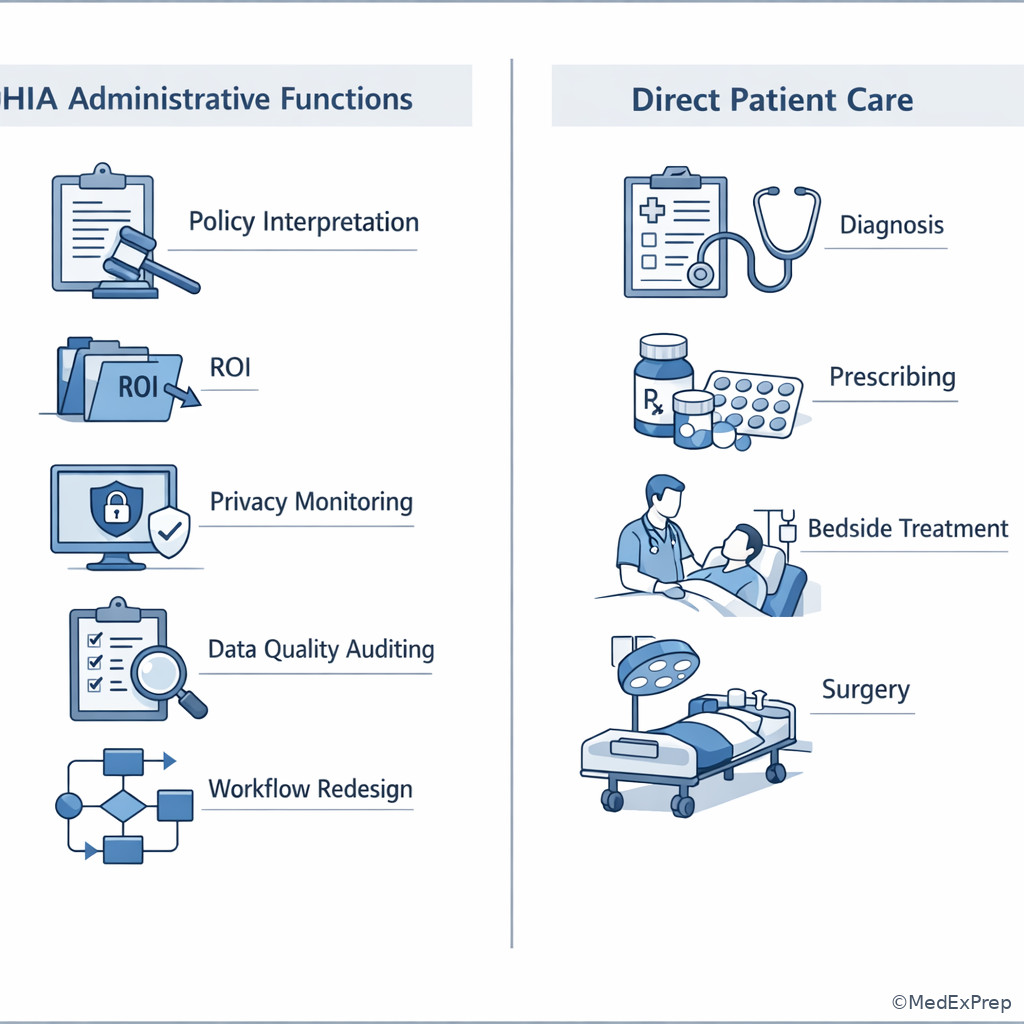
See Fig 1 for the fastest elimination framework. Also see Fig 2 for a comparison of in-scope and out-of-scope activities.
B Worked example
A 240-bed hospital’s HIM manager is asked to “fix the problem” after a cardiologist complains that a scanned outside note appears in the wrong chart. The patient has diabetes and chronic kidney disease, and the complaint arrives during a high-volume ROI backlog after a holiday weekend. The EHR analyst suggests simply moving the document and deleting the audit trail “so clinicians are not confused.” A nurse manager says the RHIA should call the patient and explain the probable diagnosis mentioned in the note.
Reasoning chain: identify task → this is a record integrity problem, not a medical counseling problem. Extract key facts → wrong-chart document, audit trail risk, pressure for quick cleanup, distracting clinical details. Apply rule → RHIA owns record integrity coordination and policy-based correction workflow, but does not erase audit trails or interpret diagnoses for the patient. Eliminate distractors → deleting the audit trail is tempting because it seems efficient, but it destroys traceability; explaining diagnosis is tempting because it sounds patient-centered, but clinical interpretation belongs to the provider. Verify → the best RHIA action is to initiate the approved integrity correction process, preserve auditability, notify appropriate stakeholders, and coordinate remediation.
C Exam trap
D Checkpoint
Question: A department director asks the RHIA to determine whether a patient’s postoperative confusion was caused by medication or stroke because the attending wants the record “cleaned up” before coding review. What is the most appropriate RHIA response?
- Interpret the record and select the most clinically supported diagnosis so coders can proceed.
- Escalate the clinical clarification to the provider/CDI pathway and monitor that documentation is completed through approved workflow.
- Instruct coding staff to assign the less severe condition until the physician confirms the diagnosis.
- Remove conflicting documentation from the chart pending committee review.
- A: Tempting because it appears efficient and helps throughput; wrong because RHIA does not make physician-level diagnostic determinations, and the clue is conflicting clinical documentation.
- B: Tempting because it may seem slower; right because the RHIA coordinates compliant clarification rather than deciding the diagnosis, and the clue is provider ownership of clinical judgment.
- C: Tempting because it sounds conservative; wrong because coding cannot be based on RHIA-selected provisional clinical judgment outside approved documentation support processes.
- D: Tempting because it appears to reduce confusion; wrong because removing documentation outside approved amendment/correction policy threatens record integrity and auditability.
Exam takeaway: The best RHIA answer often keeps the work in policy, oversight, and escalation rather than direct clinical, legal, or engineering action.
flowchart LR
A[In scope] --> A1[Record completeness]
A --> A2[ROI decisions within policy]
A --> A3[Privacy monitoring]
A --> A4[MPI integrity review]
A --> A5[Workflow redesign]
A --> A6[Compliance education]
B[Out of scope] --> B1[Diagnose patient]
B --> B2[Prescribe treatment]
B --> B3[Give legal advice]
B --> B4[Configure firewall]
B --> B5[Alter documentation outside policy]
B --> B6[Override provider judgment]
1.1.1.4 Core RHIA functions: interpret, coordinate, monitor, recommend
A Explanation
Once you know the task belongs in HIM, the next conflict is Which RHIA action is best? Most correct answers fall into one of four buckets: interpret policy/standards, coordinate stakeholders, monitor/audit performance, or recommend corrective action. The single finding that resolves the choice is the problem type. If the issue is uncertainty about rules, interpret policy. If ownership spans teams, coordinate. If there is a recurring pattern or risk trend, monitor and audit. If the problem source is known and remediable, recommend education or workflow change.
WHY THIS IS TESTED: exam items often place several in-scope actions next to each other. The winning answer is not merely allowed; it is the best fit to the operational problem. A one-time anomaly may need targeted correction, but a repeated late-authentication pattern may require trend analysis and physician education. A suspected inappropriate access issue may need privacy review and sanctions process rather than informal coaching alone.
B Worked example
A multispecialty clinic’s release-of-information team meets turnaround benchmarks on most requests, but a spike in delayed behavioral health requests appears after a software update. The privacy officer is on leave, a physician champion is focused on sepsis metrics, and the registrar reports unrelated demographic typo increases. A supervisor asks whether the RHIA should immediately retrain all ROI staff, override the software edit, suspend all sensitive requests, or first analyze the request subtype and workflow path.
Reasoning chain: identify task → operational oversight of ROI workflow. Extract key facts → delays are concentrated in one request subtype after an update; the demographic typo issue is noise; broad retraining or global suspension may overcorrect. Apply rule → when a problem is patterned and specific, the RHIA’s best initial action is targeted monitoring and workflow analysis before broad intervention. Eliminate distractors → retraining all staff is tempting because delays suggest performance issues, but the pattern points to process/system interaction; overriding the software edit may be beyond authority and risk compliance; suspending all requests is disproportionate. Verify → analyze the affected workflow path, coordinate with privacy/IT as needed, then recommend targeted correction.
C Exam trap
D Checkpoint
Question: An HIM director notices a monthly increase in unsigned operative reports limited to one surgical service after a template redesign. Which RHIA action is most appropriate first?
- Recommend immediate sanctions for all surgeons on that service.
- Analyze the workflow change, validate the deficiency pattern, and coordinate with clinical leadership on corrective action.
- Sign the reports on behalf of the physicians to reduce delinquency rates.
- Ask finance to hold all related claims until every deficiency is resolved.
- A: Tempting because accountability matters; wrong because sanctions usually follow validated cause analysis and policy-based escalation, not first-line response to a new pattern.
- B: Tempting because it takes an extra step; right because the clue is a service-specific increase after redesign, suggesting process validation before intervention.
- C: Tempting because it fixes the backlog; wrong because signing for physicians violates authentication standards and role boundaries.
- D: Tempting because deficiencies can affect downstream revenue; wrong because it is broader than needed and may exceed appropriate first-step operational response.
- The most common reason an RHIA answer is wrong is crossing into another discipline’s authority.
- True or False: If an action improves efficiency, it is usually the best answer. False — compliance and scope come first.
- Name the 4 core RHIA action buckets: interpret, coordinate, monitor, recommend.
| Problem pattern in the stem | Best RHIA action type | Why | Tempting but wrong alternative |
|---|---|---|---|
| Rule ambiguity | Interpret policy/standard | Unclear governing requirement must be clarified | Ad hoc workaround |
| Cross-department ownership | Coordinate stakeholders | No single team can resolve alone | Unilateral HIM decision |
| Repeated noncompliance | Monitor, trend, audit | Pattern validation precedes remediation scale | Immediate broad sanction |
| Known workflow defect | Recommend corrective action | Root cause is identified and actionable | Ignore until next quarter |
| Clinical uncertainty | Escalate to provider/CDI path | Clinical interpretation is not RHIA-owned | Choose diagnosis internally |
| Technical control failure | Coordinate with IT/security | RHIA identifies risk but does not engineer the fix | Directly reconfigure system security |
1.1.1.5 Scope limits and escalation triggers: when the best answer is referral, not action
A Explanation
The high-yield conflict here is Should the RHIA act directly, or is immediate escalation the compliant response? The single rule is: when the scenario requires expertise, authority, or licensure outside HIM, escalation is not avoidance; it is the correct professional action. Common triggers include physician-level interpretation of diagnoses, independent legal advice, disciplinary action beyond delegated authority, system engineering decisions, and sensitive disclosures with legal nuance beyond standard policy pathways.
WHY THIS IS TESTED: strong candidates like to solve problems. The exam exploits that instinct by offering an answer that is energetic but overreaching. RHIA-level judgment respects boundaries while maintaining stewardship duties: preserve the record, secure information, document the issue, notify the proper owner, and track resolution. Escalation is strongest when paired with a specific reason and a protected interim action.
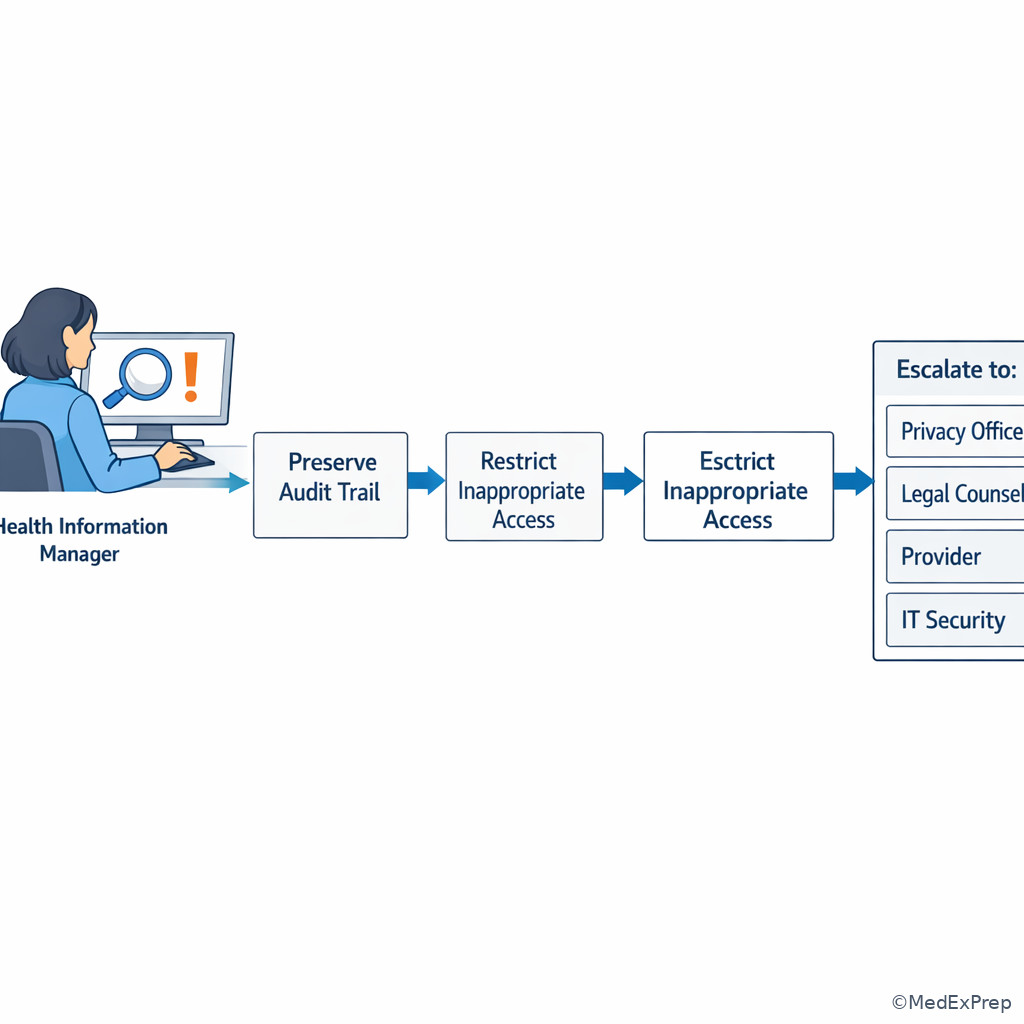
See Fig 3 for the escalation map. This is especially useful when two options both mention “investigate,” but only one routes the issue to the correct owner.
B Worked example
A payer requests a large data set related to a fraud review. The request arrives with a letter from external counsel, but the packet includes no obvious court order. The patient population includes high-profile community members, and the request hits the same week the security team is handling phishing events. A new supervisor asks whether the RHIA should release all requested records immediately to avoid accusations of noncooperation, refuse the request outright, redact items independently based on personal judgment, or route the matter through policy and legal review while preserving the request documentation.
Reasoning chain: identify task → disclosure decision with legal implications. Extract key facts → counsel letter, uncertain legal authority, sensitive data set, distracting cybersecurity issue. Apply rule → legal strategy and legal sufficiency questions require legal/policy review; RHIA can coordinate, validate documentation requirements, and protect records, but should not independently render legal advice. Eliminate distractors → immediate release is tempting because investigations sound urgent; outright refusal is tempting because uncertainty feels risky; independent redaction is tempting because minimum necessary matters, but legal basis must be confirmed first. Verify → route through established policy and legal channels, document the request, and proceed based on validated authority.
C Exam trap
D Checkpoint
Question: A privacy analyst tells the RHIA that a suspected snooping incident may involve a physician, a celebrity patient, and state-law nuances about specially protected information. What is the most appropriate RHIA response?
- Interview the physician and determine whether a reportable breach legally occurred.
- Preserve access logs, initiate the organization’s incident workflow, and escalate to the privacy/compliance/legal pathway per policy.
- Delete the suspicious access entries if the physician states the access was accidental.
- Notify the media relations office first so public messaging is ready.
- A: Tempting because rapid fact-gathering matters; wrong because the RHIA should not independently determine legal sufficiency in a nuanced breach analysis when the clue points to legal/state-law complexity.
- B: Tempting because it may seem procedural; right because it combines preservation, incident workflow, and correct escalation.
- C: Tempting because accidental access may reduce concern; wrong because deleting evidence defeats auditability and incident review.
- D: Tempting because high-profile events carry reputational risk; wrong because operational incident handling and compliance review come before media planning.
Exam takeaway: Match each out-of-scope trigger to the correct collaborating owner rather than solving it alone.
flowchart TD
A[Issue identified] --> B{Primary issue type}
B -->|Clinical interpretation| C[Provider or CDI pathway]
B -->|Legal sufficiency| D[Legal counsel or compliance]
B -->|Privacy incident| E[Privacy officer and security process]
B -->|Technical control design| F[IT security team]
B -->|Employment discipline| G[HR and leadership]
B -->|Coding specificity oversight issue| H[Coding leadership]
C --> I[RHIA documents and tracks]
D --> I
E --> I
F --> I
G --> I
H --> I
1.1.1.6 Scope in common RHIA scenarios: privacy, data integrity, revenue cycle, and workflow
A Explanation
This section moves from role theory to pattern recognition. The decision conflict becomes Which RHIA-owned concern is dominant in the scenario? A single stem may mention privacy, reimbursement, technology, and documentation together. The rule that resolves the stem is to identify the primary HIM risk: unauthorized use/disclosure, inaccurate data linkage, unsupported billing workflow, or unsafe process design. Once you identify the dominant risk, select the RHIA action that protects compliance and information integrity without crossing role lines.
WHY THIS IS TESTED: real HIM work is mixed and noisy. The exam mirrors that by adding distracting details: patient diagnosis, physician frustration, IT backlog, payer pressure, or departmental workload. Those details matter only if they change the governing rule. In many stems, they do not. The RHIA does not become a clinician because the diagnosis is dramatic, nor a systems engineer because the issue followed an upgrade.
B Worked example
A hospital outpatient department faces payer denials for missing signatures on infusion orders. At the same time, an MPI team finds a duplicate record affecting one denied account, and a physician complains that the EHR downtime form is too long. A staff member proposes manually adding missing signatures “based on routine practice” so claims can be rebilled quickly. Another suggests ignoring the duplicate because finance cares only about payment.
Reasoning chain: identify task → choose the primary compliant RHIA response in a mixed operational scenario. Extract key facts → unsupported signatures cannot be added, duplicate record affects record integrity, downtime form complaint is noise unless it causes documented workflow failure. Apply rule → record authenticity and integrity control the next step, not revenue urgency. Eliminate distractors → adding signatures is tempting due to denial pressure but violates documentation standards; ignoring the duplicate is tempting because finance wants speed, but incorrect patient linkage threatens trustworthiness and rebilling validity. Verify → route signature deficiency through approved completion process, address duplicate record per integrity workflow, and then support rebilling once documentation/integrity issues are properly resolved.
C Exam trap
D Checkpoint
Question: A registrar reports that two patients with similar names may have been combined under one medical record number. Meanwhile, billing asks HIM to release the chart for urgent claim appeal, and a service line vice president asks whether the RHIA can “just separate what looks wrong.” What is the best next step?
- Release the chart first because payer deadlines are time-sensitive, then address integrity later.
- Initiate the organization’s duplicate/overlay integrity workflow, restrict inappropriate use as needed, and coordinate downstream stakeholders before release decisions.
- Ask the physician to determine which documents belong to each patient and manually reassign them based on clinical similarity.
- Delete the questionable encounters so the claim can be rebuilt cleanly.
- A: Tempting because appeals have deadlines; wrong because unresolved identity integrity undermines the trustworthiness of any release or claim action.
- B: Tempting because it may delay revenue; right because the clue is a possible combined record, making integrity the dominant risk that controls next steps.
- C: Tempting because clinicians know the care story; wrong because HIM should use approved integrity workflows rather than ad hoc physician assignment of record ownership.
- D: Tempting because it seems like cleanup; wrong because deletion destroys evidence and may worsen record integrity and audit issues.
- The most important first question in a mixed stem is: Which HIM risk governs the next step?
- True or False: Revenue urgency can justify unsupported documentation correction. False.
- Name the four mixed-stem categories in PIRW: Privacy, Integrity, Revenue, Workflow.
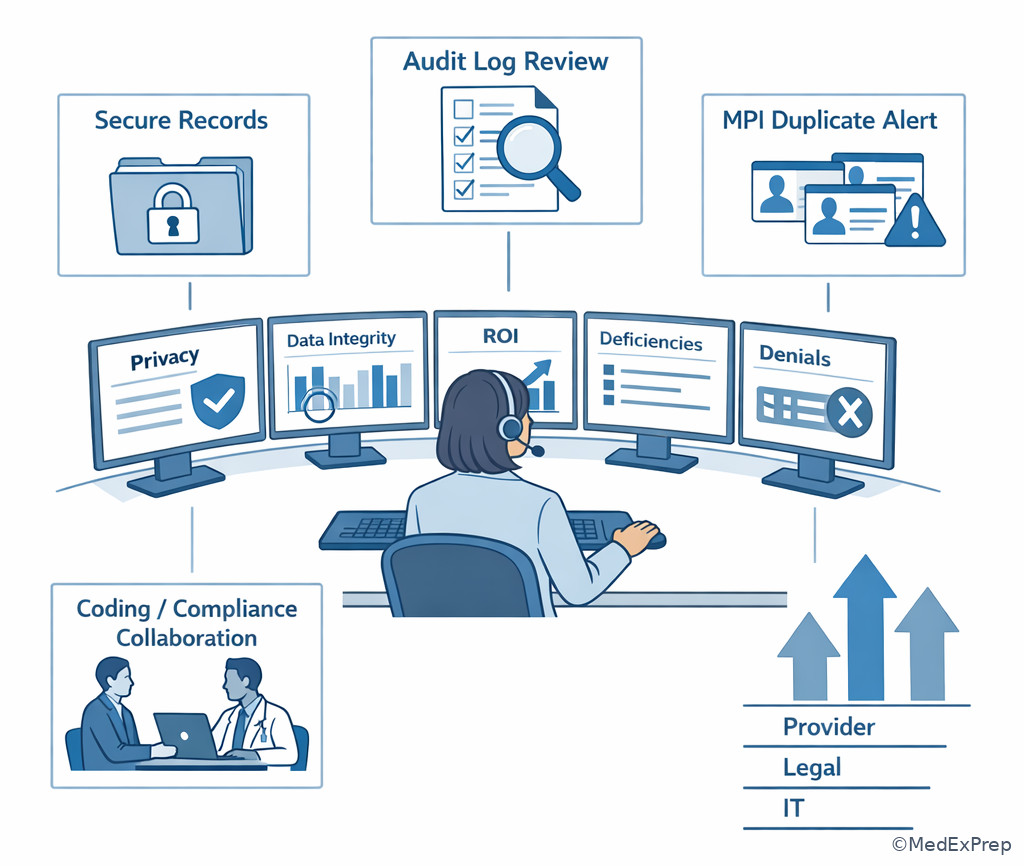
Exam takeaway: Visualize the RHIA as coordinating workflows, dashboards, privacy controls, and record integrity rather than making bedside or legal determinations.
Exam takeaway: Separate direct patient care and independent clinical judgment from RHIA administrative oversight.
1.1.1.7 Exam strategy: eliminating distractors by scope, authority, and compliance
A Explanation
The final integration step is not just knowing scope; it is using scope to eliminate close distractors. The decision conflict is Which answer is the most appropriate next step, not just a possible step? The single resolving rule is to prioritize: law/policy, patient and data protection, record integrity, assigned authority, then efficiency. If one option is faster but less auditable, reject it. If one option solves the issue but depends on authority the RHIA does not have, reject it. If one option escalates vaguely while another escalates through established workflow with interim safeguards, choose the latter.
WHY THIS IS TESTED: RHIA-style questions often present four plausible administrative options. The best answer usually sounds slightly more conservative because it preserves process integrity. That conservatism is not bureaucracy; it is professional stewardship. The exam rewards disciplined action over heroics.
See Fig 5 for a decision tree that compresses this elimination strategy.
B Worked example
An HIM supervisor in a community hospital is reviewing a weekend issue: a resident physician accessed a former coworker’s chart, the ROI queue is behind, the coding manager is out sick, and a vendor patch caused intermittent single sign-on failures. The CEO asks for “the fastest fix by noon.” Options discussed include reassigning all access control decisions to the HIM team, temporarily sharing one generic login, holding all release requests indefinitely, or initiating incident review, preserving logs, limiting ad hoc workarounds, and coordinating with privacy and IT under policy.
Reasoning chain: identify task → best next step in mixed operational pressure. Extract key facts → inappropriate access concern plus technical instability; CEO pressure is noise if it pushes noncompliant shortcuts. Apply rule → scope and security controls dominate. Eliminate distractors → HIM should not seize IT access-control authority wholesale; generic logins destroy accountability; holding all ROI indefinitely may be disproportionate. Verify → protect logs, stop unsafe workarounds, and route through privacy/security/IT workflow while tracking operational impact.
C Exam trap
D Checkpoint
Question: Which answer choice is most likely correct on an RHIA scope question when all four options seem operationally reasonable?
- The fastest option that reduces backlog immediately.
- The option that uses the broadest authority to solve the issue in one step.
- The option that best aligns with policy, preserves integrity, and routes non-HIM decisions to the proper owner.
- The option that relies on informal verbal agreements between departments.
- A: Tempting because operational pressure is common; wrong because efficiency does not outrank compliance, scope, or auditability.
- B: Tempting because decisive leadership sounds strong; wrong because RHIA authority is bounded and broad overreach is a classic distractor.
- C: Tempting because it may feel slower; right because RHIA exam logic prioritizes policy alignment, protected processes, and correct ownership.
- D: Tempting because collaboration matters; wrong because informal agreements without defined workflow/documentation increase risk.
Exam takeaway: Eliminate out-of-scope choices first, then select the option that protects compliance and information integrity.
flowchart TD
A[Read the stem] --> B{Any option outside RHIA authority?}
B -->|Yes| C[Eliminate it]
B -->|No| D{Which remaining option best follows policy?}
C --> D
D --> E{Which option preserves audit trail and data integrity?}
E --> F{Does it escalate non-HIM issues correctly?}
F --> G[Choose best answer]
E --> H[Reject shortcut option]
H --> F Exam takeaway: The safest RHIA action often combines interim controls with referral to the correct discipline.
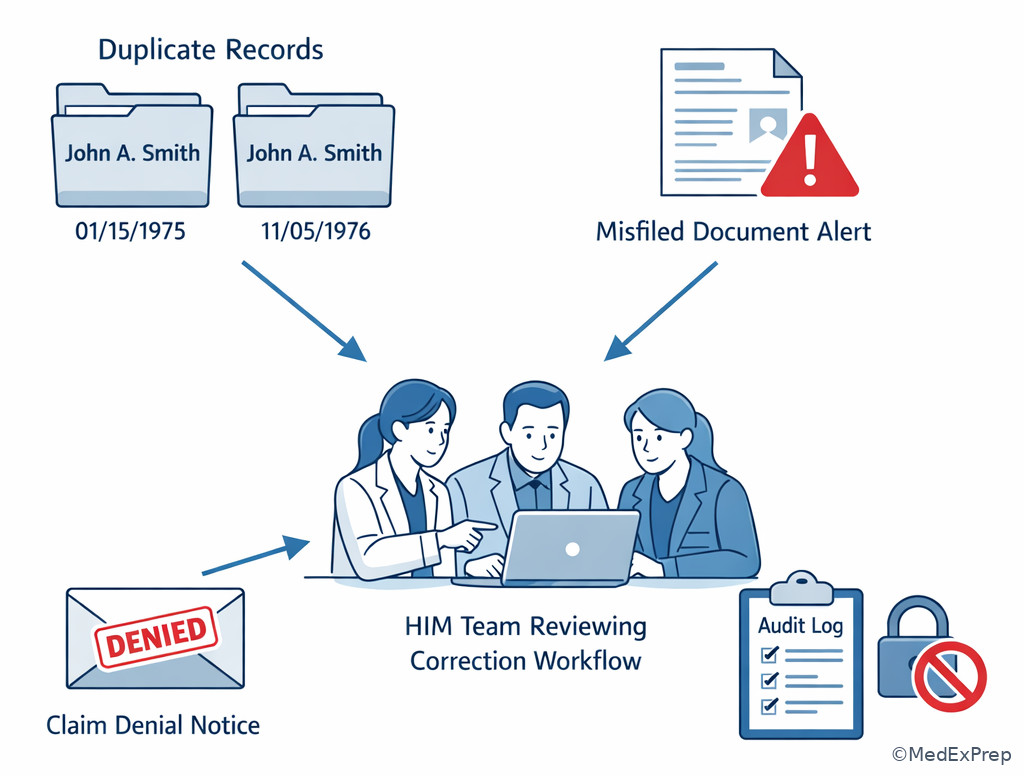
Exam takeaway: Mixed operational pressure does not justify shortcuts that compromise identity management or documentation integrity.
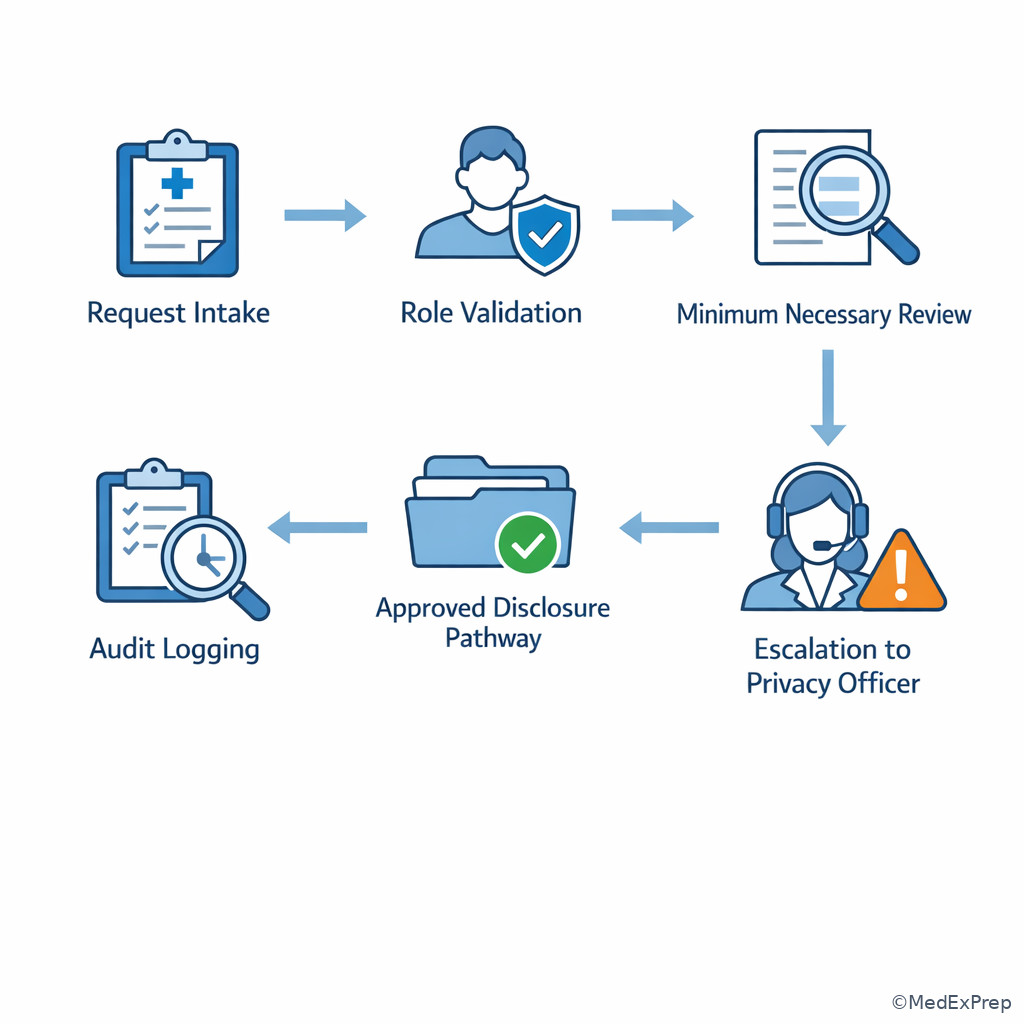
Exam takeaway: RHIA decisions on information use center on lawful purpose, role-based access, and controlled disclosure pathways.
Exam takeaway: RHIA practice depends on coordinated work with coding, compliance, legal, clinical, finance, and IT while maintaining HIM role boundaries.
Exam Traps & Differentiators
Most common wrong answer and why: the most common wrong answer is a choice that solves the operational problem quickly but crosses authority boundaries. It is tempting because it sounds efficient, decisive, or patient-centered. It is wrong because RHIA questions reward compliant stewardship, not unilateral overreach.
| Looks similar | But is different because... | Think RHIA action | Do not choose |
|---|---|---|---|
| Clinical documentation conflict | Needs provider-level clarification, not RHIA diagnosis selection | Route via provider/CDI workflow | Pick the diagnosis yourself |
| Disclosure request with nuance | May require legal review depending on authority and jurisdiction | Validate policy and escalate as needed | Independently give legal advice |
| Security weakness identified | RHIA identifies risk but does not engineer infrastructure | Coordinate with IT/security and document controls | Personally configure technical defenses |
| Revenue pressure from denials | Cannot justify unsupported documentation correction | Use compliant deficiency/correction process | Add or alter documentation informally |
| Possible duplicate/overlay | Integrity risk dominates payment urgency | Initiate MPI integrity workflow | Release/use corrupted record first |
| Privacy incident | Evidence preservation matters before conclusions | Preserve logs and launch incident pathway | Delete entries or rely on verbal explanations |
- If the stem says “determine the diagnosis,” think provider/CDI ownership, not RHIA selection.
- If the stem says “fastest way to clear backlog,” think check whether the shortcut violates policy or auditability.
- If the stem says “software patch,” think workflow and IT coordination, not deep technical reconfiguration by HIM.
- If the stem says “celebrity patient” or “snooping,” think preserve logs, incident workflow, privacy escalation.
- If the stem says “outside counsel requested records,” think confirm authority through policy/legal pathway.
- If the stem says “duplicate or wrong chart,” think record integrity controls before downstream use.
Algorithm / Approach
Exam takeaway: The safest exam approach is scope screen first, dominant risk second, and policy-aligned action third.
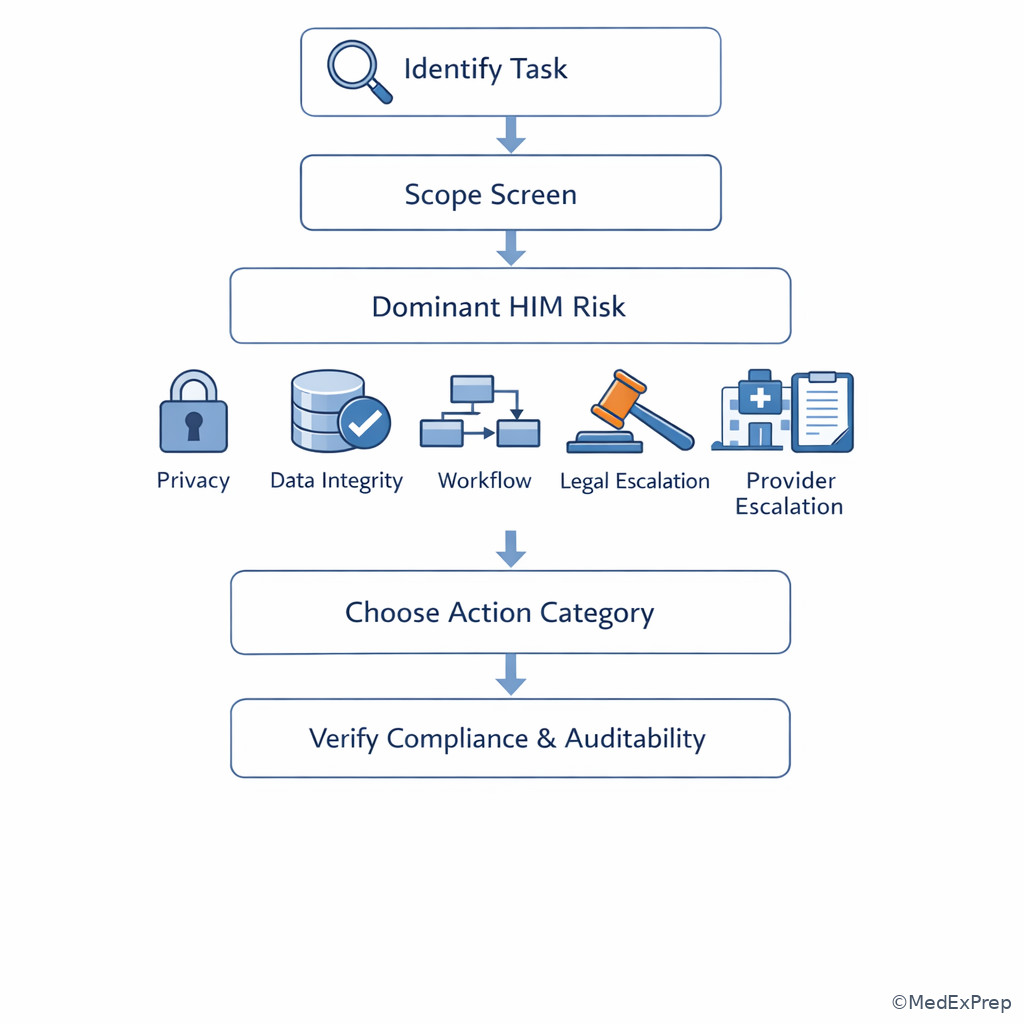
Use this as your exam-day anchor. See Fig 6.
Rapid Review
- Role ownership → ask who owns the underlying judgment before choosing any action.
- Administrative vs clinical → RHIA manages process and documentation, not diagnosis or treatment.
- Legal nuance → RHIA applies policy and routes legal strategy to counsel.
- Technical risk → RHIA identifies and coordinates controls, not deep system configuration.
- Audit trail → shortcuts that erase traceability are almost always wrong.
- Mixed scenario → dominant HIM risk controls the next step, not the loudest stakeholder.
- Revenue pressure → never justifies unsupported record correction.
- Duplicate/overlay concern → integrity comes before billing, reporting, or disclosure use.
- Privacy incident → preserve logs before conclusions.
- Good RHIA answer → interpret, coordinate, monitor, recommend, document.
- Weak distractor pattern → broad authority, informal fix, undocumented cleanup.
- Escalation quality → best answer names the owner and interim safeguard.
- Efficiency conflict → speed loses to policy, integrity, and minimum necessary.
- Competitive distractor → correct action by wrong professional must still be rejected.
Self-check quiz
1. A department head asks the RHIA to select the most accurate diagnosis from conflicting physician notes so coding can proceed before month-end close. What is the most appropriate RHIA response?
- Choose the diagnosis best supported by lab trends in the chart.
- Route the issue through the approved provider clarification/CDI pathway and monitor completion.
- Assign the less severe diagnosis until the physician updates the record.
- Delete the conflicting note from the legal health record.
2. During an EHR outage, a supervisor suggests that staff share one login so release-of-information work can continue. Which response is most appropriate?
- Approve the shared login because downtime requires flexibility.
- Approve it only for senior staff who have annual privacy training.
- Reject the shared login, preserve individual accountability, and coordinate downtime workflow through approved channels.
- Allow it if the team documents who used the login on paper.
3. A clinic sees a sudden increase in unsigned visit notes after a template update. The physicians are high-volume, one service line is preparing for an accreditation survey, and finance is concerned about delayed claims. What is the most appropriate next step for the RHIA?
- Analyze the deficiency pattern and workflow change, then coordinate targeted corrective action.
- Enter signatures based on prior authenticated notes from the same physicians.
- Hold all claims indefinitely until every record in the clinic is signed.
- Ask the vendor to remove all signature controls permanently.
4. A payer sends an urgent request for records tied to a suspected fraud review. The packet includes a letter from outside counsel, but no one is certain whether the request meets the organization’s legal release criteria. The privacy officer is traveling, and the CFO wants the records sent today. What is the most appropriate RHIA action?
- Release the records immediately to show cooperation with the investigation.
- Refuse the request outright because any legal uncertainty means disclosure is prohibited.
- Route the request through established policy and legal/compliance review while preserving documentation and timelines.
- Independently redact what seems unnecessary and release the rest.
5. An HIM analyst identifies a possible duplicate record affecting a denied inpatient claim. The case also includes a complicated sepsis diagnosis, a frustrated physician, and a payer appeal deadline in 48 hours. Which action is most appropriate?
- Proceed with the appeal first because reimbursement risk is the most immediate concern.
- Initiate the duplicate/overlay integrity workflow and coordinate downstream actions before relying on the record for appeal.
- Ask the attending physician to determine which demographic profile is correct and split the chart informally.
- Delete the more recent encounter so the claim can be rebuilt.
6. A celebrity patient’s chart is accessed by a physician with no obvious treatment relationship during the same week the organization updates role-based access rules. The CMO believes the physician may have been “just curious,” and IT notes the access-control update might have expanded visibility unexpectedly. What is the most appropriate RHIA response?
- Conclude no incident occurred because the technical change may explain the access.
- Preserve logs, initiate incident review, and coordinate privacy and IT investigation under policy before conclusions are drawn.
- Interview the physician and personally determine whether a reportable breach occurred.
- Delete the access record if the physician confirms there was no malicious intent.
7. A coding director asks the RHIA to “clean up” several unsupported procedure dates in operative notes before an external audit. The surgeons are at a remote site, legal counsel is unavailable until tomorrow, and the audit file is due at 8 a.m. A senior executive says the dates are obvious from the schedule and should simply be inserted to avoid penalties. What is the best next step?
- Insert the dates from the OR schedule and document the source internally.
- Freeze all affected cases from any review or billing activity for 30 days.
- Use the approved documentation correction/clarification pathway, preserve the records as-is, and escalate the timing risk to leadership.
- Ask coders to select the most likely dates based on anesthesia documentation.
8. After a merger, a new vice president asks the RHIA to standardize patient identifiers by manually merging “near matches” to speed analytics reporting. The MPI team has limited staffing, a public health submission is due, and one physician says clinical review can “sort out mistakes later.” Which response is most appropriate?
- Approve manual near-match merging because reporting deadlines justify temporary efficiency measures.
- Delay all analytics activity until the entire MPI is manually reviewed line by line.
- Maintain approved MPI integrity controls, reject ad hoc merging, and coordinate risk-based prioritization with affected stakeholders.
- Delegate final merge decisions to physicians because they know the patients best.
Answer key
1. Correct answer: B
- A: Tempting because it sounds analytical and helpful; incorrect because selecting the diagnosis based on clinical evidence is provider-level judgment, and the discriminating clue is conflicting physician notes requiring clarification rather than RHIA interpretation. Source support: AHIMA role scope and HIM governance principles emphasize documentation integrity and escalation through approved channels.
- B: Tempting because it may feel less efficient; correct because RHIA practice supports compliant clarification and completion workflows instead of independent diagnosis selection, and the discriminating clue is coding cannot proceed on unresolved conflicting provider documentation.
- C: Tempting because it appears conservative; incorrect because choosing a less severe diagnosis is still unauthorized clinical selection for this scenario, and the clue is that no valid clarification has yet occurred.
- D: Tempting because removing conflict seems to simplify the record; incorrect because deleting documentation outside approved policy undermines record integrity and auditability, and the clue is the request to “clean up” the record before coding.
2. Correct answer: C
- A: Tempting because downtime does require contingency planning; incorrect because shared credentials destroy user accountability, and the discriminating clue is one login for multiple users.
- B: Tempting because senior staff are trusted; incorrect because training status does not solve auditability failure from shared access.
- C: Tempting because it may slow operations; correct because approved downtime processes preserve accountability and the clue is that access control must remain attributable to an individual user.
- D: Tempting because paper tracking seems like a workaround; incorrect because it does not replace secure individual authentication in a system environment and remains weaker than approved downtime controls.
3. Correct answer: A
- A: Tempting because it adds analysis before intervention; correct because a new service-pattern problem after a template update suggests workflow/root cause review first, and the discriminating clue is sudden increase after template update. AHIMA practice standards support monitoring, validation, and corrective action rather than unsupported record alteration.
- B: Tempting because delayed signatures affect claims; incorrect because adding signatures from prior patterns violates authentication standards, and the clue is unsigned notes.
- C: Tempting because deficiencies can affect revenue; incorrect because an all-clinic freeze is broader than needed before root cause validation, and the clue is pattern localized to the update-related issue.
- D: Tempting because system controls can frustrate users; incorrect because removing signature controls permanently would worsen compliance risk and is not a proportional first step.
4. Correct answer: C
- A: Tempting because cooperation with investigations is important; incorrect because legal sufficiency is uncertain, and the discriminating clue is no one is certain whether the request meets release criteria.
- B: Tempting because uncertainty creates caution; incorrect because automatic refusal may also be inappropriate when the correct response is policy-guided validation and escalation rather than instant denial.
- C: Tempting because it seems slower under pressure from the CFO; correct because RHIA practice coordinates review through established legal/compliance pathways while preserving the request record and timelines.
- D: Tempting because minimum necessary is a real standard; incorrect because the RHIA should not independently resolve legal authority by personal redaction judgments when the trigger is uncertain legal criteria.
5. Correct answer: B
- A: Tempting because the appeal deadline is close; incorrect because appeal content should not rely on a possibly corrupted patient identity record, and the discriminating clue is possible duplicate record.
- B: Tempting because it may delay finance; correct because record integrity is the governing risk and must be addressed through approved workflow before downstream use.
- C: Tempting because physicians know the clinical story; incorrect because identity and MPI correction should follow formal integrity processes rather than informal clinician assignment.
- D: Tempting because starting fresh sounds clean; incorrect because deletion destroys evidence and may worsen integrity and audit issues.
6. Correct answer: B
- A: Tempting because the access-control update is a plausible explanation; incorrect because a possible system cause does not eliminate the need for documented incident review, and the discriminating clue is no obvious treatment relationship.
- B: Tempting because it delays immediate judgment; correct because RHIA practice preserves evidence, initiates policy-based review, and coordinates privacy and IT when both human and technical factors are plausible.
- C: Tempting because someone must investigate; incorrect because independently deciding whether a reportable breach legally occurred may exceed RHIA-only authority in this nuanced setting, and policy workflow should govern.
- D: Tempting because malicious intent may matter in sanctions analysis; incorrect because deleting the access record destroys audit evidence, and the clue is celebrity chart access, which heightens the need for evidence preservation.
7. Correct answer: C
- A: Tempting because the OR schedule seems corroborating and the deadline is near; incorrect because inserting unsupported dates changes documentation outside compliant correction process, and the discriminating clue is unsupported procedure dates in operative notes.
- B: Tempting because the records are flawed; incorrect because a blanket 30-day freeze is not the most targeted or operationally sound response for an imminent audit.
- C: Tempting because it acknowledges timing risk without solving it instantly; correct because RHIA practice preserves the record, uses approved correction/clarification channels, and escalates operational consequences rather than falsifying the chart.
- D: Tempting because coders review documentation detail; incorrect because coders also cannot infer unsupported dates for record correction, and the clue is the record itself lacks authenticated support.
8. Correct answer: C
- A: Tempting because analytics deadlines create pressure and near matches may look obvious; incorrect because ad hoc manual merging risks overlays and long-term trust failure, and the discriminating clue is manually merging near matches outside approved control.
- B: Tempting because extreme caution protects integrity; incorrect because halting all analytics until full manual review is broader than necessary and not risk-based.
- C: Tempting because it may frustrate executives; correct because RHIA scope includes maintaining MPI controls, rejecting unsafe shortcuts, and coordinating prioritized remediation under staffing constraints.
- D: Tempting because physicians know patients; incorrect because final MPI merge authority should follow formal integrity workflows, not informal clinical preference.
Keep going with the full RHIA Prep Course (RHIA)
You just studied the way members do, in the same lesson interface. Full access unlocks every lesson, the question bank and flashcards for a full year.
One payment · 1 year of access · No auto-renewal