1.1.1 - Carbohydrate Digestion And Roles
Carbohydrate Digestion And Roles
What you'll learn
- Nutrition Science Foundations: Macronutrients -> Digestion pathway — trace carbohydrate digestion from mouth to absorption.
- Nutrition Science Foundations: Macronutrients -> Functional roles — choose the most testable physiologic roles of carbohydrate in energy metabolism.
- Nutrition Care Process: Assessment -> Data interpretation — interpret symptoms and history that suggest carbohydrate maldigestion or poor tolerance.
- Medical Nutrition Therapy: Intervention -> Diet selection — identify the most appropriate RD-level nutrition response to common carbohydrate-related scenarios.
- Interprofessional Practice: Scope and safety -> Referral decisions — recognize when symptoms require referral rather than independent diet-only management.
- Nutrition science foundations → Macronutrients and energy → carbohydrate digestion, absorption, and physiologic role
- Nutrition assessment and diagnosis → Data collection and interpretation → GI symptom pattern recognition related to carbohydrate intake
- Nutrition intervention → Select appropriate therapeutic diet → carbohydrate distribution, fiber emphasis, and tolerance-based adjustments
- Professional practice → Scope and collaboration → refer when symptoms suggest disease process beyond RD-only management
Why it matters
- Carbohydrate questions are rarely asked as pure memorization; they are tested as digestion site, symptom interpretation, energy source, or appropriate nutrition counseling.
- Many exam distractors exploit confusion between where digestion begins, where most digestion occurs, and where absorption occurs.
- RD practice uses these basics when explaining diet tolerance, planning meals, interpreting GI symptoms, and connecting carbohydrate choices to blood glucose and fiber-related outcomes.
- Foundational carbohydrate knowledge supports later topics in diabetes care, enteral feeding, GI disorders, and energy balance calculations.
Exam takeaway: Separate the start of digestion, main enzymatic breakdown, and final absorptive form to avoid common site-of-action distractors.
flowchart LR
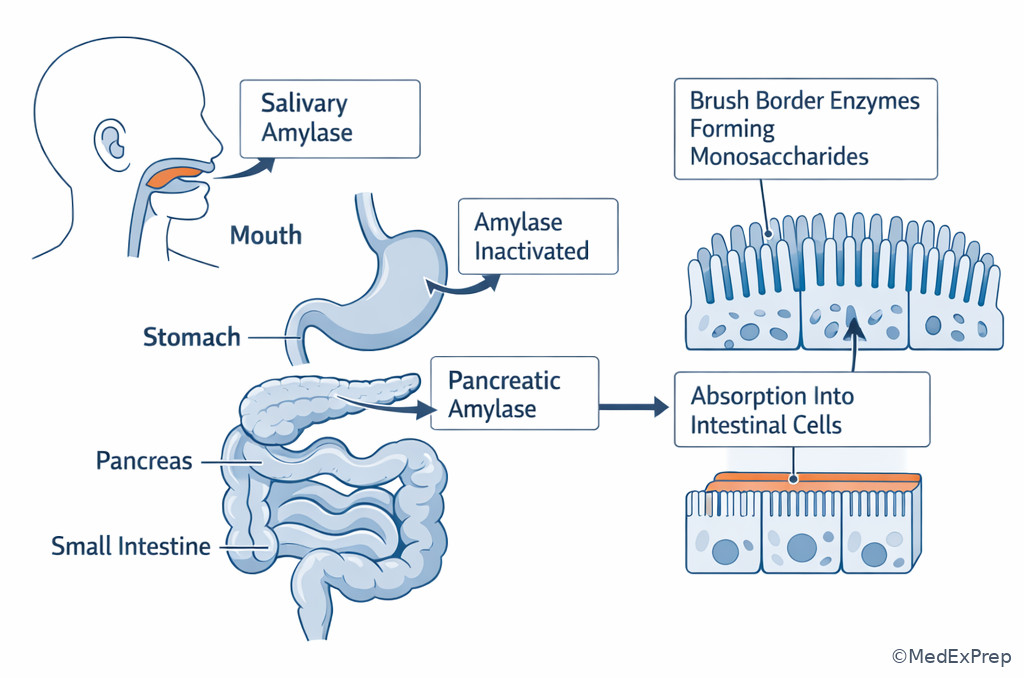
A[Starch disaccharides fiber ingested] --> B[Mouth: salivary amylase starts starch breakdown]
B --> C[Stomach: little carb digestion after acid inactivates amylase]
C --> D[Small intestine lumen: pancreatic amylase breaks starch to oligosaccharides]
D --> E[Brush border enzymes form monosaccharides]
E --> F[Absorption as glucose galactose fructose]
Use this sequence repeatedly throughout the lesson. See Fig 1.
Key Terms & Must-Know Facts
1.1.1.1 Key terms
- Monosaccharide: single sugar unit; absorbable form.
- Disaccharide: two-sugar unit, such as lactose, sucrose, maltose.
- Polysaccharide: long carbohydrate chain, such as starch, glycogen, many fibers.
- Salivary amylase: enzyme that begins starch digestion in the mouth.
- Pancreatic amylase: major enzyme for starch breakdown in the small intestine lumen.
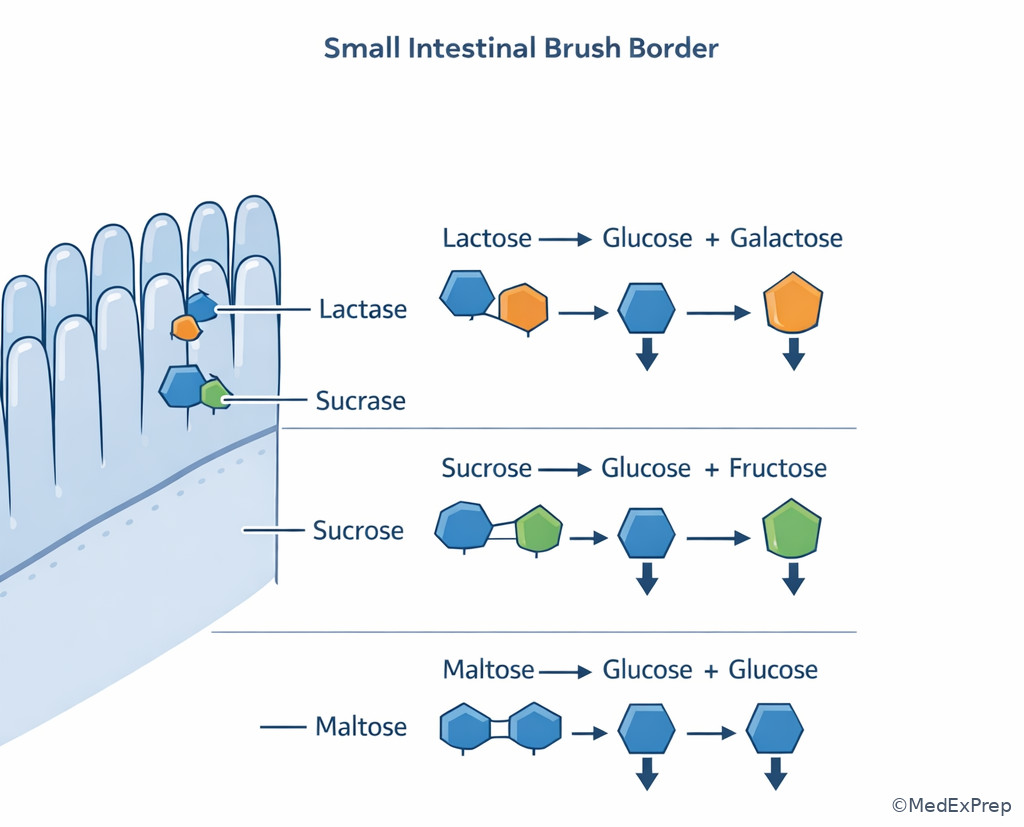
- Brush border enzymes: intestinal enzymes that split disaccharides into monosaccharides.
- Lactase: brush border enzyme that splits lactose into glucose and galactose.
- Maltase: brush border enzyme that splits maltose.
- Sucrase: brush border enzyme that splits sucrose into glucose and fructose.
- Fiber: nondigestible carbohydrate with soluble and insoluble subtypes.
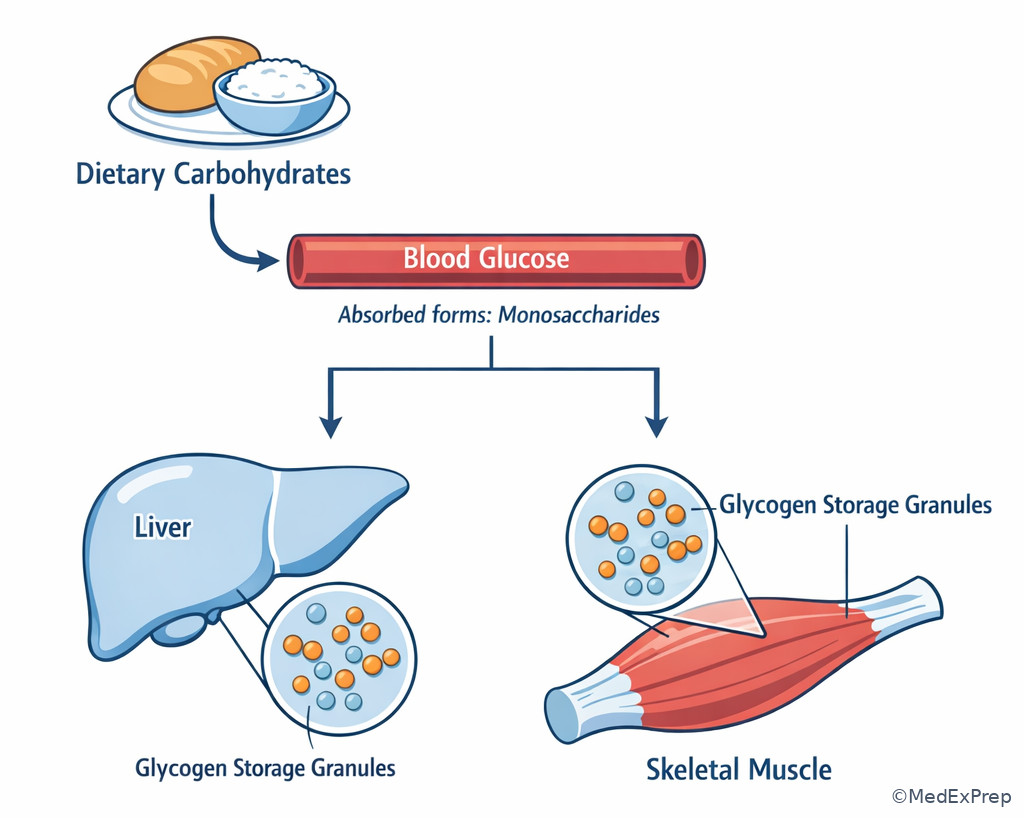
- Glycogen: storage form of carbohydrate in animals.
- Glycemic response: blood glucose change after carbohydrate intake.
- Maldigestion: impaired breakdown of food components.
- Malabsorption: impaired uptake of digested nutrients.
1.1.1.2 Must-know facts
- Carbohydrate digestion begins in the mouth.
- Most enzymatic carbohydrate digestion occurs in the small intestine.
- Carbohydrates are absorbed mainly as glucose, galactose, and fructose.
- The stomach is not the main site of carbohydrate digestion.
- Fiber is not digested by human enzymes in the same way as starch and sugars.
- Glucose is the preferred fuel for the brain under usual conditions.
- Red blood cells rely on glucose because they lack mitochondria.
- Dietary fiber can affect satiety, bowel function, serum lipids, and glycemic response.
- Lactose intolerance reflects reduced lactase, not milk allergy.
- On exam stems, “bloating after milk” points toward lactose maldigestion unless allergy clues appear.
| Item | High-yield point | Exam use |
|---|---|---|
| Salivary amylase | Starts starch digestion in mouth | Choose when asked where digestion begins |
| Pancreatic amylase | Continues starch breakdown in small intestine | Choose when asked main enzyme source |
| Brush border enzymes | Convert disaccharides to monosaccharides | Choose when asked final digestion step |
| Glucose, galactose, fructose | Main absorbed carbohydrate forms | Choose when asked absorptive products |
| Fiber | Nondigestible by human enzymes | Choose when asked why fiber differs from starch |
| Glycogen | Storage carbohydrate in liver and muscle | Choose when asked storage form in humans |
Exam takeaway: Match each organ with its specific carbohydrate function rather than assuming digestion occurs equally throughout the GI tract.
Core content
1.1.1.3 Foundational pathway: where carbohydrate digestion starts, continues, and ends
A Explanation
The first decision conflict on this topic is simple but heavily tested: Does carbohydrate digestion begin in the mouth, stomach, or small intestine? The single rule that resolves it is this: digestion begins in the mouth with salivary amylase, but most digestion and final breakdown occur in the small intestine. Many learners choose the small intestine for “start” because it is the main site of digestion overall. That is partially true, but wrong if the question asks where carbohydrate digestion begins.
Starch digestion starts when salivary amylase contacts food during chewing. In the stomach, low pH limits further salivary amylase activity, so the stomach is not the major carbohydrate digestion site. Once chyme reaches the small intestine, pancreatic amylase breaks starch into smaller carbohydrates, and brush border enzymes complete digestion into monosaccharides that can be absorbed.
WHY THIS IS TESTED: exam items often ask you to choose between “mouth” and “small intestine,” or between “pancreatic amylase” and “brush border enzymes.” The winning move is to identify whether the stem is asking about initial digestion, major luminal digestion, or final enzymatic step before absorption.
For RD practice, these basics matter when educating patients about digestion, interpreting GI symptoms, and building later understanding of carbohydrate counting, fiber tolerance, and nutrition support formulas. See Fig 1.
B Worked example
A 72-year-old woman in long-term care with hypertension, osteoarthritis, and mild cognitive impairment is discussed during interdisciplinary rounds. She eats slowly, prefers toast and oatmeal, and recently started complaining of “food sitting in the stomach.” A nursing assistant reports that “carbs are digested in the stomach, so maybe the diet should change.” Her glucose is normal, and a recent low vitamin D result distracts the team. The RD is asked to provide the best correction.
Reasoning chain: Identify task → this is a site-of-digestion question, not a vitamin issue. Extract key facts → carbohydrate digestion starts in the mouth, not the stomach; most digestion occurs in the small intestine. Apply rule → explain that salivary amylase begins starch digestion before food reaches the stomach. Eliminate distractors → stomach is tempting because food is physically present there, but it is not the main carbohydrate digestion site. Verify → the safest RD action is education and symptom monitoring, with referral if true dysphagia, vomiting, or weight loss appears.
C Exam trap
D Checkpoint
Question: A patient education handout states that carbohydrate digestion begins after food leaves the stomach. Which correction is most appropriate?
- A. Carbohydrate digestion begins in the mouth through salivary amylase.
- B. Carbohydrate digestion begins in the stomach through gastric lipase.
- C. Carbohydrate digestion begins in the jejunum after bile release.
- D. Carbohydrate digestion begins only after brush border absorption is complete.
Answer: A.
- A is tempting and correct: it directly addresses the word begins; salivary amylase is the key initial enzyme.
- B is tempting but wrong: the stomach feels intuitive, but gastric lipase acts on fat, not carbohydrate.
- C is tempting but wrong: the small intestine is the main site of digestion, but not the first site; bile also relates to fat digestion.
- D is tempting but wrong: brush border activity is a late digestion step, not the start, and absorption follows final breakdown.
1.1.1.4 Absorption and carbohydrate forms: what the gut actually takes up
A Explanation
The next decision conflict is what form of carbohydrate is absorbed. The single rule is: carbohydrates are absorbed as monosaccharides, not as intact starch or disaccharides. This resolves many distractors that offer sucrose, lactose, starch, or glycogen as absorbable end products.
Dietary carbohydrate arrives in several forms: monosaccharides, disaccharides, polysaccharides, and nondigestible fiber. Human digestion breaks digestible carbohydrate down stepwise. Pancreatic amylase acts on starch in the intestinal lumen, while brush border enzymes such as lactase, sucrase, and maltase split disaccharides. Final absorbed products are glucose, galactose, and fructose.
The testable distinction is often between digestion and absorption. Digestion means breakdown into smaller molecules; absorption means transport of those end products across the intestinal lining. If the stem asks why a patient gets gas after milk, think insufficient digestion of lactose before absorption. If the stem asks what crosses into the intestinal cell, think monosaccharides.
WHY THIS IS TESTED: many questions place disaccharides next to monosaccharides to see whether you can identify the final absorbable form. Another common move is to mix in glycogen, which is a human storage form, not a dietary absorptive product.
See Fig 2 for the disaccharide-to-monosaccharide summary.
Exam takeaway: Match the named enzyme or sugar pair to the final absorbable monosaccharides, especially for lactose and sucrose questions.
flowchart TD
A[Lactose] --> B[Lactase]
B --> C[Glucose + Galactose]
D[Sucrose] --> E[Sucrase]
E --> F[Glucose + Fructose]
G[Maltose] --> H[Maltase]
H --> I[Glucose + Glucose]
B Worked example
A 24-year-old graduate student with seasonal allergies and irritable bowel symptoms reports bloating, gas, and loose stools after large milkshakes but tolerates aged cheese better. She recently began a high-protein gym plan and worries that “sugar is being absorbed too fast because lactose is a monosaccharide.” A mildly elevated LDL value is included in the chart but is unrelated to the immediate question. What is the best RD explanation?
Reasoning chain: Identify task → clarify the carbohydrate form and digestion step. Extract key facts → lactose is a disaccharide, symptoms occur after milk, cheese may have less lactose. Apply rule → lactose must be split by lactase into glucose and galactose before absorption. Eliminate distractors → fructose is not a lactose product; intact lactose is not absorbed in usual physiology. Verify → this supports lactose maldigestion education and possible tolerance-based food planning.
C Exam trap
D Checkpoint
Question: Which substance is the most appropriate answer when a stem asks for an absorbed end product of carbohydrate digestion?
- A. Sucrose
- B. Starch
- C. Fructose
- D. Glycogen
Answer: C.
- A is tempting but wrong: sucrose is a common dietary sugar, but it must be split before absorption.
- B is tempting but wrong: starch is abundant in food, but it is too large to be absorbed intact.
- C is tempting and correct: fructose is one of the principal monosaccharides absorbed by the intestine.
- D is tempting but wrong: glycogen is a storage carbohydrate, not a final absorbed dietary product.
- The absorbable carbohydrate forms are ___, ___, and ___.
- True or False: Lactose is absorbed intact in healthy adults.
- Name the brush border enzyme needed to digest lactose.
1.1.1.5 Functional roles of carbohydrate: energy, protein sparing, and normal metabolism
A Explanation
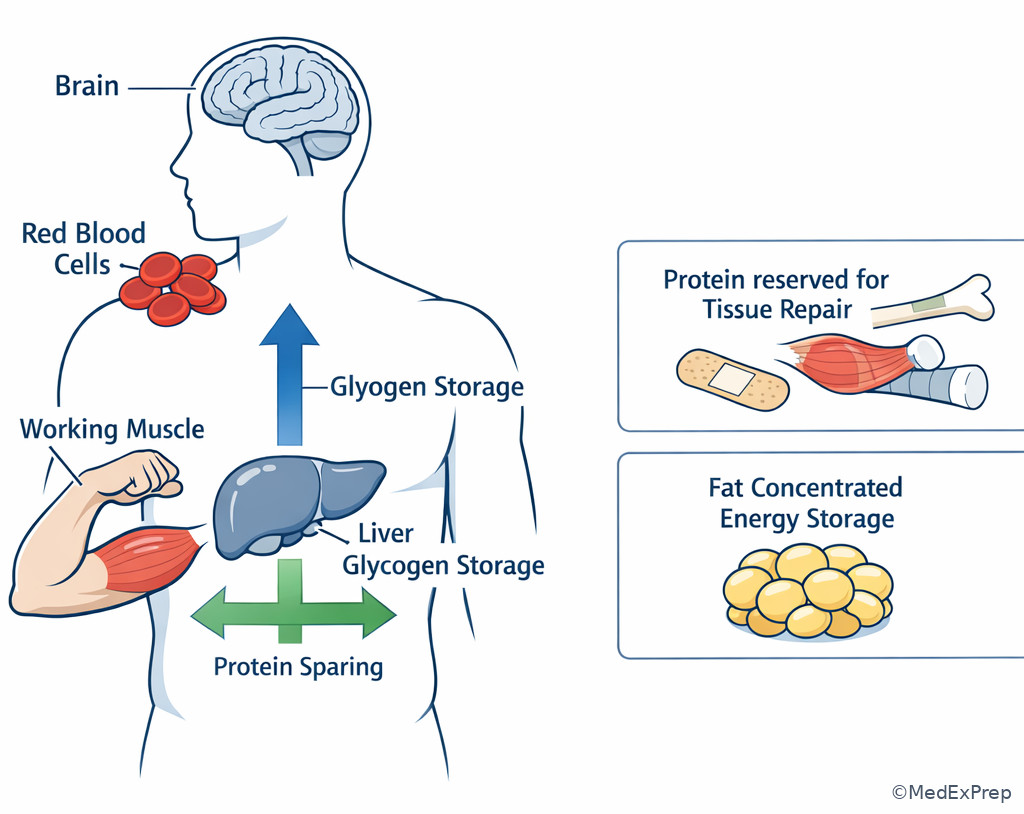
This section shifts from pathway to function. The decision conflict is what role carbohydrate plays when exam options include fat, protein, ketones, and glycogen. The single rule is: carbohydrate is the body’s most accessible energy source and helps spare protein from being used primarily for energy.
Glucose is especially important for tissues with high glucose dependence. The brain typically relies heavily on glucose under usual feeding conditions, and red blood cells require glucose because they lack mitochondria. Carbohydrate also supports normal fat metabolism; inadequate carbohydrate availability can shift metabolism toward greater ketone production. On exam questions, this is often framed as “protein-sparing action” or “primary fuel source under normal conditions.”
In RD practice, the functional role matters when counseling clients who are cutting carbohydrates sharply, when planning meal distribution for glucose control, and when distinguishing the role of carbohydrate from the roles of protein and fat. Protein is not the body’s preferred routine energy source; its important structural and functional tasks make protein-sparing clinically meaningful.
WHY THIS IS TESTED: writers like answer sets that contain true statements about other nutrients. Fat is energy-dense, protein is essential for tissue synthesis, and ketones can fuel the brain in prolonged carbohydrate restriction. But if the stem asks about the usual, first-line, or preferred role of carbohydrate, the winning answer emphasizes rapidly available energy and protein sparing.
See Fig 3 for a comparison of carbohydrate roles versus nearby macronutrient distractors. Also note the forward link: in the upcoming topics on protein and fat, you will compare how protein quality and lipid transport answer different exam questions.
Exam takeaway: When a stem asks for the usual role of carbohydrate, prioritize glucose energy needs and protein-sparing effects over specialty or starvation-state fuel answers.
B Worked example
A 39-year-old office worker with obesity, prediabetes, and recurrent dieting history wants to eliminate nearly all carbohydrate because she believes protein can fully replace carbohydrate’s routine role. She reports fatigue during afternoon work hours and constipation since switching to mostly meat and cheese. Her vitamin B12 is normal, and a family history of celiac disease is mentioned as noise. What is the best RD explanation?
Reasoning chain: Identify task → explain carbohydrate function, not diagnose celiac disease. Extract key facts → fatigue, low fiber pattern, belief that protein can replace carbohydrate’s usual role. Apply rule → carbohydrate supplies readily available energy, supports normal glucose availability, and helps spare protein. Eliminate distractors → protein can provide energy but is not the preferred routine fuel role being tested. Verify → the best intervention is balanced education on carbohydrate quality and distribution rather than endorsing an extreme elimination pattern.
C Exam trap
D Checkpoint
Question: Which statement best explains a key physiologic role of carbohydrate in usual conditions?
- A. It is the principal storage form of amino acids for wound healing.
- B. It provides readily available energy and helps spare protein.
- C. It is the exclusive carrier of fat-soluble vitamins in blood.
- D. It is the main structural component of digestive enzymes.
Answer: B.
- A is tempting but wrong: wound healing links to nutrition, but amino acid storage is not a carbohydrate role.
- B is tempting and correct: this captures both the usual energy role and protein-sparing effect.
- C is tempting but wrong: transport of fat-soluble vitamins relates more to fat and lipoprotein physiology.
- D is tempting but wrong: enzymes are proteins, so this distractor swaps macronutrient functions.
1.1.1.6 Fiber and carbohydrate quality: choosing the right counseling point
A Explanation
The decision conflict here is not “is carbohydrate good or bad?” but which carbohydrate feature matters in a given stem: digestibility, fiber content, glycemic effect, or GI tolerance. The single rule is: fiber is a nondigestible carbohydrate that modifies GI and metabolic outcomes differently from digestible starches and sugars.
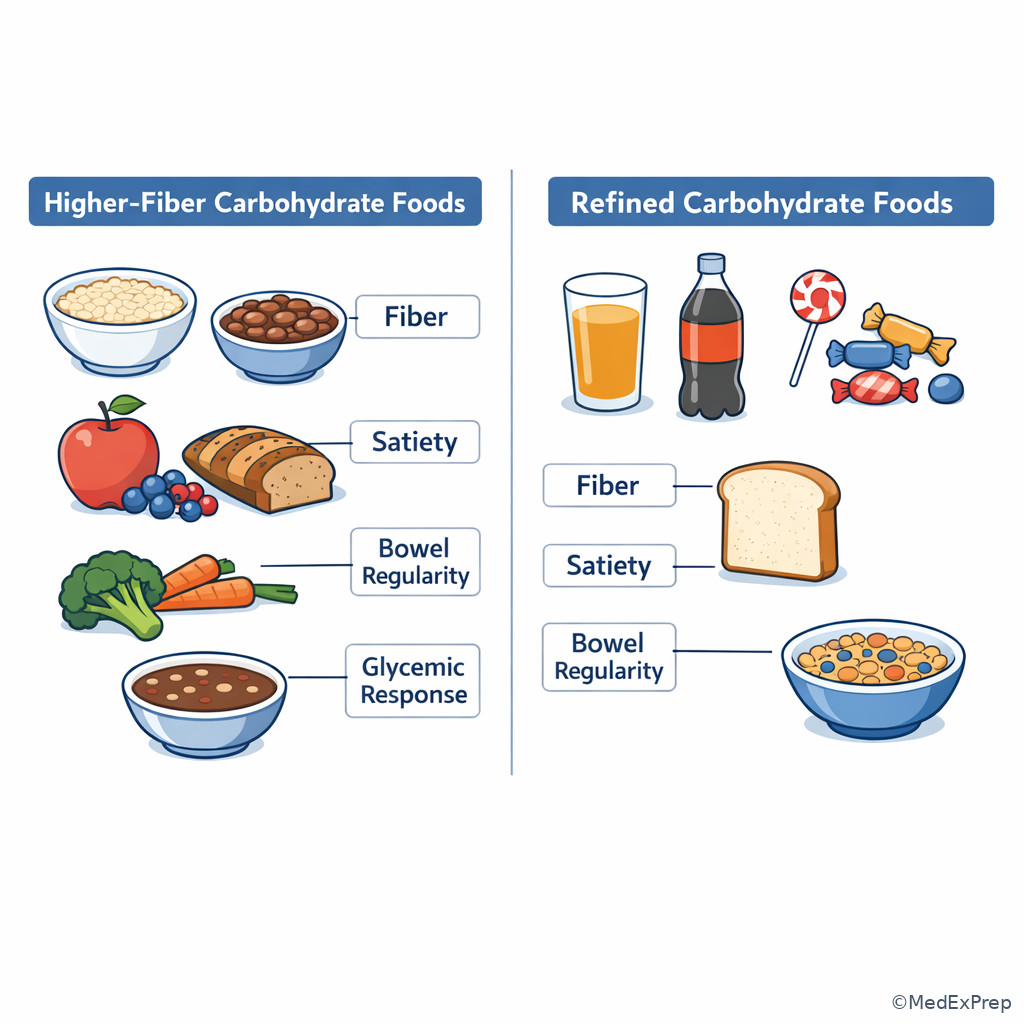
Fiber is often divided into soluble and insoluble forms. Soluble fiber is commonly associated with delayed gastric emptying, improved satiety, and support for healthier serum cholesterol and glycemic response patterns. Insoluble fiber is more closely linked with stool bulk and bowel regularity. Exam items do not always require fine classification, but they often reward recognizing that a high-fiber food has different metabolic and GI effects than a refined carbohydrate source with the same calories.
For entry-level RD practice, the key counseling move is to shift from “all carbs” to carbohydrate quality and tolerance. Whole grains, legumes, fruits, and vegetables often bring fiber and slower glycemic impact compared with highly refined choices. However, high-fiber advice is not universal; some GI conditions or acute symptoms may require temporary modification. That is why stems often include a symptom clue that changes what “healthy” means in context.
WHY THIS IS TESTED: exam writers use fiber to test whether you can choose a nuanced counseling point rather than a simplistic rule. A tempting distractor may say “avoid all carbohydrates for glucose control,” while the better answer is “choose higher-fiber carbohydrates and distribute intake appropriately.” See Fig 4.
Exam takeaway: Match the counseling goal with the fiber effect being tested rather than giving a generic “eat more fiber” answer.
flowchart LR
A[Fiber] --> B[Soluble fiber]
A --> C[Insoluble fiber]
B --> D[Slower gastric emptying]
B --> E[Supports cholesterol and glycemic management]
C --> F[Adds stool bulk]
C --> G[Supports bowel regularity]
B Worked example
A 58-year-old man with hyperlipidemia, type 2 diabetes, and constipation asks whether he should replace oatmeal and beans with fruit juice because “all carbs turn to sugar anyway.” He takes a statin, has a sedentary job, and recently had a normal colonoscopy, which is a distracting reassurance detail. His fasting glucose has improved slightly, but he still struggles with fullness and bowel regularity. What is the best RD response?
Reasoning chain: Identify task → choose the better carbohydrate counseling point. Extract key facts → diabetes, hyperlipidemia, constipation, comparing high-fiber foods with juice. Apply rule → fiber-containing carbohydrate sources offer satiety, bowel benefits, and improved metabolic profile compared with juice. Eliminate distractors → “all carbs are equivalent” is too simplistic; juice lacks the fiber advantage of intact foods. Verify → recommend retaining fiber-rich carbohydrate sources while monitoring glucose response and GI tolerance.
C Exam trap
D Checkpoint
Question: A client wants one carbohydrate change that best supports bowel regularity. Which choice is most appropriate?
- A. Replace beans with sweetened tea
- B. Replace whole fruit with hard candy
- C. Replace oatmeal with clear soda
- D. Replace refined cereal with a higher-fiber whole grain cereal
Answer: D.
- A is tempting but wrong: it is easy to drink, but it removes fiber that supports stool bulk.
- B is tempting but wrong: both are carbohydrate sources, but candy lacks the fiber advantage of whole fruit.
- C is tempting but wrong: soda provides carbohydrate without the fiber-related GI benefits.
- D is tempting and correct: it directly improves carbohydrate quality by increasing fiber content.
- True or False: Fiber is digested and absorbed the same way as starch.
- The fiber type most often linked to stool bulk is ___.
- For constipation plus hyperlipidemia, higher-fiber intact foods are usually better than ___.
1.1.1.7 Application to symptom patterns: lactose intolerance, allergy confusion, and RD scope
A Explanation
This is the most clinically applied carbohydrate section in this lesson. The decision conflict is when bloating after dairy suggests lactose intolerance versus when a stem points toward something more urgent or outside RD-only management. The single rule is: GI symptoms after lactose-containing foods suggest lactase deficiency, but immune-type symptoms or red flags require referral.
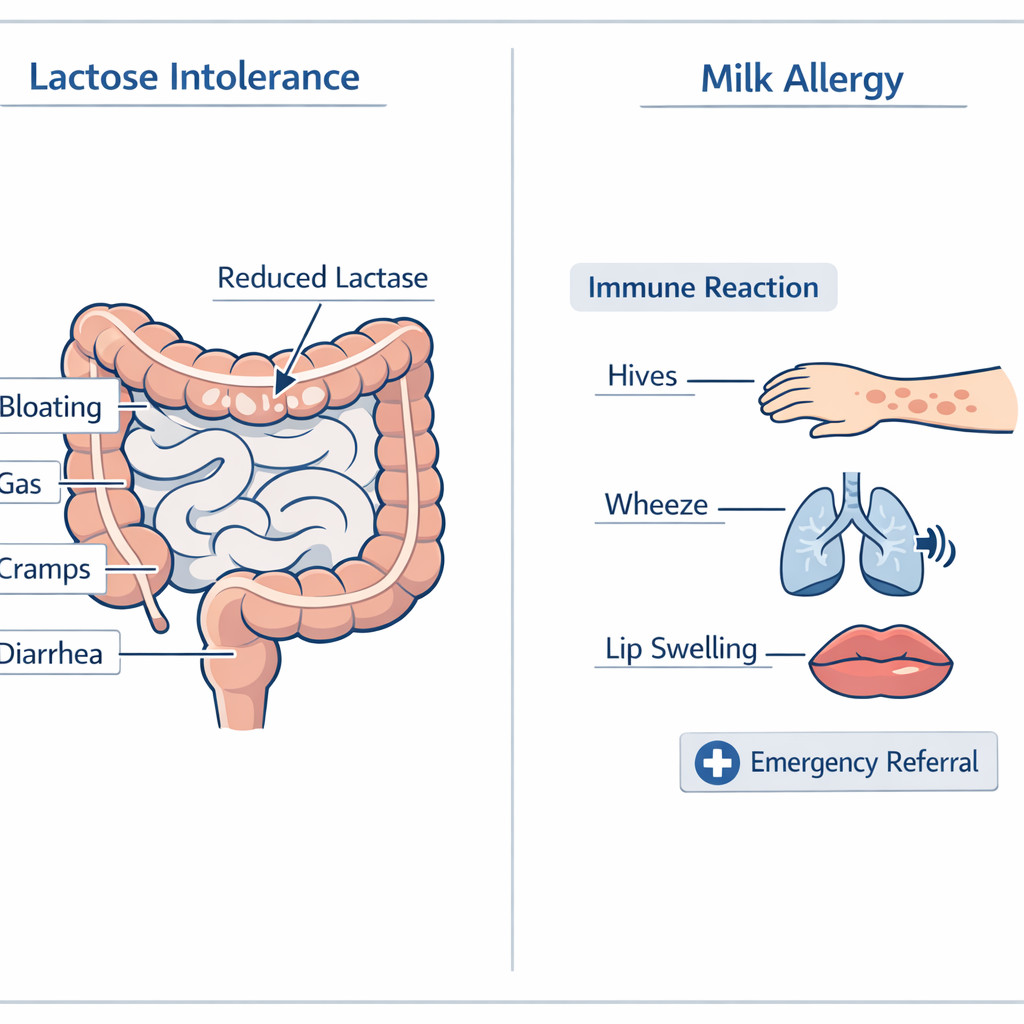
Lactose intolerance results from reduced lactase activity, so lactose is not fully digested into absorbable monosaccharides. Undigested lactose reaches the colon, where it can contribute to gas, bloating, cramping, and diarrhea. In contrast, a milk allergy involves an immune response and may present with hives, wheeze, swelling, or anaphylaxis. On exams, the dairy trigger is the same, but the symptom pattern determines the interpretation.
This distinction matters for RD scope. An RD can assess intake pattern, educate on lactose sources, suggest tolerance-based modifications, and coordinate with the team. However, suspected allergy, persistent unexplained symptoms, dehydration risk, pediatric complexity, or severe weight loss should prompt referral. The safest answer is often not “eliminate dairy forever,” but “evaluate symptom pattern, trial appropriate modifications, and refer when red flags appear.”
WHY THIS IS TESTED: stems frequently include a tempting but wrong clue such as “milk causes symptoms,” pushing learners toward allergy or broad dairy avoidance. The winning move is to read the type of symptom, not just the food trigger.
Exam takeaway: Use the symptom pattern, not just the dairy trigger, to choose diet education versus urgent referral.
B Worked example
A 31-year-old postpartum patient with iron-deficiency anemia and migraine history reports bloating and urgent diarrhea 30–60 minutes after ice cream and regular milk. She tolerates yogurt better. She also mentions one episode of itchy rash after shrimp last year, a tempting but unrelated clue. Vital signs are stable, there is no weight loss, and no blood in stool is reported. What is the most appropriate RD interpretation?
Reasoning chain: Identify task → choose the likely nutrition-related explanation and safe action. Extract key facts → dairy-associated GI symptoms, better yogurt tolerance, no systemic allergic signs, no red flags. Apply rule → lactose intolerance is more likely than milk allergy. Eliminate distractors → the shrimp rash is noise; milk allergy would be more concerning for immune symptoms such as hives or wheeze. Verify → provide lactose-related education, assess intake adequacy, and monitor tolerance while referring if symptoms escalate or become atypical.
C Exam trap
D Checkpoint
Question: Which scenario most strongly supports lactose intolerance rather than milk allergy?
- A. Hives, lip swelling, and wheezing minutes after milk
- B. Bloating, gas, and diarrhea after milk but tolerance of some yogurt
- C. Hematemesis after dairy-containing meals
- D. Progressive dysphagia with unintentional weight loss after all foods
Answer: B.
- A is tempting but wrong: dairy is present, but the symptom pattern points to allergy and urgent medical attention.
- B is tempting and correct: GI symptoms after lactose-containing foods with some yogurt tolerance are classic for lactose intolerance.
- C is tempting but wrong: this indicates a serious GI issue, not lactose maldigestion, and requires medical evaluation.
- D is tempting but wrong: dysphagia and weight loss are red flags beyond simple carbohydrate intolerance.
Exam Traps & Differentiators
- Most common wrong answer and why: choosing small intestine when the stem asks where carbohydrate digestion begins. It is tempting because most digestion occurs there, but the word begins points to the mouth.
- Looks similar but isn’t: lactose intolerance versus milk allergy. Both involve dairy, but GI-only symptoms support lactose maldigestion; hives, wheeze, or swelling support allergy and referral.
- If the stem says “absorbed form,” think monosaccharides, not sucrose, starch, or glycogen.
- If the stem says “protein-sparing,” think carbohydrate availability helping preserve protein for body functions.
- If the stem says “constipation and hyperlipidemia,” think higher-fiber intact carbohydrate sources, not refined liquids.
- If the stem says “red blood cells,” think glucose dependence, not fatty acids as the usual preferred answer.
- If the stem says “bloating after milk with weight loss and dysphagia,” think referral rather than simple lactose education.
| Confusable pair | Why they look similar | Single clue that separates them | Best exam choice |
|---|---|---|---|
| Mouth vs small intestine | Both are involved in carb digestion | “Begins” means mouth; “most digestion” means small intestine | Read the exact verb in the stem |
| Digestion vs absorption | Both happen in the intestine | Absorption asks what enters the body, so choose monosaccharides | Glucose, galactose, fructose |
| Lactose intolerance vs milk allergy | Both can follow dairy intake | GI-only symptoms favor intolerance; immune symptoms favor allergy | Education vs referral |
| Whole fruit vs juice | Both contain carbohydrate | Fiber and intact food matrix favor whole fruit | Choose quality, not just grams |
| Carbohydrate vs protein role | Both can contribute energy | Usual preferred fuel and protein-sparing point to carbohydrate | Choose routine physiology |
Cross-topic note: later, Protein Quality And Turnover will create another high-yield confusable pair: learners may overassign energy roles to protein when the stem is really testing nitrogen balance or essential amino acids. Likewise, Fat Digestion And Transport will test whether you confuse bile- and lipase-related fat issues with carbohydrate enzyme issues.
Tables
| Carbohydrate type | Example | Needs digestion? | Absorbable as is? | High-yield note |
|---|---|---|---|---|
| Monosaccharide | Glucose | No further splitting needed | Yes | Final absorbable form |
| Monosaccharide | Fructose | No further splitting needed | Yes | Also a final absorbable form |
| Disaccharide | Lactose | Yes | No | Requires lactase |
| Disaccharide | Sucrose | Yes | No | Requires sucrase |
| Polysaccharide | Starch | Yes | No | Broken down by amylases then brush border enzymes |
| Nondigestible carbohydrate | Fiber | Not by human enzymes in usual way | No | GI and metabolic effects without standard monosaccharide absorption |
| Feature | Refined carbohydrate choice | Higher-fiber intact carbohydrate choice | When the higher-fiber choice is usually favored |
|---|---|---|---|
| Satiety | Lower | Higher | Weight management counseling |
| Bowel regularity | Less support | More support | Constipation pattern |
| Glycemic effect | Often faster rise | Often steadier response | Glucose management education |
| Nutrient density | Often lower | Often higher | General health promotion |
| Symptom caution | May be easier during some acute GI issues | May need adjustment if not tolerated | Condition-specific counseling |
| Symptom pattern | Most likely interpretation | Why it fits | RD-level next step |
|---|---|---|---|
| Bloating and diarrhea after milk, better tolerance of yogurt | Lactose intolerance | Reduced lactase with GI-only symptoms | Diet education and tolerance assessment |
| Hives and wheeze after milk | Milk allergy | Immune-type reaction | Urgent referral/medical follow-up |
| Constipation with low whole grain and fruit intake | Low fiber pattern | Reduced stool bulk support | Increase tolerated fiber and fluids as appropriate |
| Fatigue after severe carb restriction without other acute red flags | Inadequate balanced carbohydrate intake | Loss of readily available energy source | Counsel on balanced carbohydrate inclusion |
| Dysphagia, GI bleeding, or weight loss after dairy complaints | Potential non-carbohydrate red flag | Beyond simple lactose intolerance | Refer to medical team promptly |
Exam takeaway: Food examples are tested as decision shortcuts for carbohydrate quality, not just as memorized lists.
Exam takeaway: Final carbohydrate digestion occurs at the intestinal brush border, where disaccharidase deficiencies create classic symptom patterns.
Exam takeaway: Glycogen is the storage form of carbohydrate in humans, not the form absorbed from the gut.
Algorithm / Approach
Exam takeaway: Solve carbohydrate questions by identifying whether the stem asks about pathway, product, function, food quality, or symptom pattern before choosing an answer.
Use this algorithm whenever multiple answers seem partially true. The exam often rewards the answer that is most precisely matched to the question type. See Fig 6.
Rapid Review
- Digestion start → mouth, not stomach
- Main carbohydrate digestion site → small intestine, especially with pancreatic amylase and brush border enzymes
- Absorbed carbohydrate form → monosaccharides only
- Lactose → disaccharide requiring lactase
- Glycogen → storage form in humans, not absorbed dietary form
- Usual fuel role → carbohydrate supplies readily available energy
- Protein sparing → adequate carbohydrate helps preserve protein for other functions
- RBC fuel → glucose dependence is the testable pearl
- Fiber → nondigestible by human enzymes in the usual way
- Constipation + poor diet quality → think higher-fiber intact carbohydrate foods
- Dairy + bloating/diarrhea → think lactose intolerance first
- Dairy + hives/wheeze → think allergy and referral
- Whole fruit vs juice → intact food matrix and fiber distinguish the better choice
Self-check quiz
1. A preceptor asks a dietetic intern during orientation which site should be named when a stem asks where carbohydrate digestion begins. Which is the most appropriate answer?
- A. Mouth
- B. Stomach
- C. Colon
- D. Ileum
2. During a community nutrition class, a participant asks which carbohydrate form is absorbed from the small intestine under usual conditions. Which is the best answer?
- A. Starch
- B. Fructose
- C. Lactose
- D. Glycogen
3. A 46-year-old woman with obesity and hyperlipidemia says she replaced breakfast oatmeal with apple juice because “carbs are carbs.” She also reports constipation and low water intake. Which is the most appropriate RD recommendation?
- A. Encourage the juice because liquid carbohydrate is digested faster
- B. Recommend returning to oatmeal or another higher-fiber intact carbohydrate
- C. Eliminate all carbohydrate-containing foods for 2 weeks
- D. Refer immediately to surgery for probable bowel obstruction
4. A 28-year-old teacher with asthma and seasonal allergies develops bloating, gas, and loose stools after regular milkshakes but tolerates small amounts of yogurt. There is no rash, wheezing, or lip swelling. Which is the best interpretation?
- A. Likely lactose intolerance related to reduced lactase activity
- B. Likely milk allergy requiring emergency epinephrine planning
- C. Likely celiac disease triggered only by dairy intake
- D. Likely fat malabsorption caused by absent bile salts
5. A 67-year-old man in rehab after hip fracture has poor intake, fatigue, and a self-imposed very-low-carbohydrate diet because he believes protein should be the sole energy source. He also has mild constipation and hypertension. Which counseling statement is most appropriate?
- A. Protein is the preferred routine fuel, so carbohydrate can be omitted without consequence
- B. Carbohydrate provides readily available energy and helps spare protein for other functions
- C. Fat is the only nutrient that can support the brain under usual conditions
- D. Carbohydrate has no role once glycogen stores are present
6. A 54-year-old woman with type 2 diabetes, hyperlipidemia, and chronic constipation asks for the best breakfast swap. She currently drinks sweetened fruit beverage and eats candy on her commute because it feels “lighter” than breakfast. She has no dysphagia, bleeding, or abdominal pain. Which option is the most appropriate nutrition intervention?
- A. Replace the beverage and candy with oatmeal topped with fruit and nuts if tolerated
- B. Keep the beverage but add more candy to prevent midmorning hunger
- C. Stop all carbohydrates and rely on protein shakes only
- D. Recommend immediate independent medication adjustment for glucose control
7. A 35-year-old man with lactose-related bloating presents for outpatient counseling. He reports new progressive dysphagia, a 12-lb unintentional weight loss over 2 months, and one episode of dark stools. He also says milk worsens symptoms. Which is the best next step for the RD?
- A. Provide lactose-free dairy education only and recheck in 6 months
- B. Recommend an over-the-counter enzyme and no further action
- C. Refer promptly to the medical team because symptoms suggest red flags beyond simple lactose intolerance
- D. Independently order diagnostic imaging of the esophagus
8. A hospitalized 70-year-old patient with COPD, hypertension, and poor dentition asks why toast “starts digesting before it reaches the stomach.” He also has a distracting mildly elevated triglyceride level. Which explanation is most appropriate?
- A. Salivary amylase starts starch digestion in the mouth before gastric acid reduces its activity
- B. Bile in the mouth starts carbohydrate emulsification before swallowing
- C. Gastric lipase initiates starch breakdown in the stomach during chewing
- D. Carbohydrate remains undigested until the colon
Answer key
1. Correct answer: A — Mouth.
- A: Tempting because many learners remember salivary amylase from basic science; it is correct because carbohydrate digestion begins in the mouth. Single stem clue: the word begins. Source support: Mahan and Raymond emphasize oral initiation of starch digestion.
- B: Tempting because the stomach is commonly associated with digestion overall; incorrect because it is not the starting site of carbohydrate digestion. Discriminator: gastric conditions limit rather than initiate major carbohydrate digestion.
- C: Tempting if the learner confuses fermentation with primary digestion; incorrect because the colon is not where carbohydrate digestion begins. Discriminator: this is a pathway-start question, not a fermentation question.
- D: Tempting because the ileum is part of the small intestine; incorrect because the process starts before food reaches the small bowel. Discriminator: again, “begins” points orally.
2. Correct answer: B — Fructose.
- A: Tempting because starch is a common dietary carbohydrate; incorrect because it must be broken down first. Discriminator: absorbed forms are monosaccharides only.
- B: Tempting because it sounds like a simple food sugar; correct because fructose is a monosaccharide absorbed by the intestine. Discriminator: it is already in absorbable form.
- C: Tempting because lactose is familiar and food-based; incorrect because it is a disaccharide needing lactase. Discriminator: disaccharides are not absorbed intact in usual physiology.
- D: Tempting because glycogen is carbohydrate-related; incorrect because it is the storage form in humans, not the absorbable end product. Discriminator: the stem asks about intestinal absorption, not storage.
3. Correct answer: B — Recommend returning to oatmeal or another higher-fiber intact carbohydrate.
- A: Tempting because faster digestion may sound useful; incorrect because the case includes constipation and hyperlipidemia, making fiber quality more relevant than speed. Discriminator: the symptom pattern favors fiber.
- B: Tempting and correct because oatmeal is a higher-fiber intact carbohydrate that better matches the patient’s constipation and cardiometabolic concerns. Discriminator: both constipation and hyperlipidemia point toward better carbohydrate quality.
- C: Tempting because drastic elimination can sound effective; incorrect because the stem asks for the most appropriate RD recommendation, and total elimination ignores quality and practicality. Discriminator: no indication supports universal carbohydrate removal.
- D: Tempting because constipation can trigger concern; incorrect because the case lacks obstruction red flags such as severe pain, vomiting, or acute abdomen. Discriminator: absence of alarm signs.
4. Correct answer: A — Likely lactose intolerance related to reduced lactase activity.
- A: Tempting and correct because GI-only symptoms after milk with some yogurt tolerance fit lactase deficiency. Discriminator: absence of immune symptoms.
- B: Tempting because allergies and asthma can coexist; incorrect because there is no rash, swelling, or wheeze after dairy exposure in this episode. Discriminator: symptom type is GI, not immune.
- C: Tempting because chronic GI complaints can raise broad concerns; incorrect because dairy-specific symptoms do not point specifically to celiac disease. Discriminator: symptom trigger is lactose-containing foods.
- D: Tempting because diarrhea follows food; incorrect because fat malabsorption would not be best explained by isolated lactose-specific triggers and yogurt tolerance pattern. Discriminator: dairy sugar, not fat digestion, fits the case.
5. Correct answer: B — Carbohydrate provides readily available energy and helps spare protein for other functions.
- A: Tempting because protein can contribute calories; incorrect because it is not the preferred usual routine fuel role being tested. Discriminator: the stem asks about best counseling on physiologic role.
- B: Tempting and correct because it states the high-yield function of carbohydrate in usual metabolism and protein sparing. Discriminator: this exactly matches the tested concept.
- C: Tempting because alternative fuels exist in some states; incorrect because under usual conditions the brain depends heavily on glucose. Discriminator: the stem does not describe starvation or specialized metabolic adaptation.
- D: Tempting because glycogen stores are related to carbohydrate; incorrect because carbohydrate remains metabolically important even when storage exists. Discriminator: storage does not eliminate nutrient function.
6. Correct answer: A — Replace the beverage and candy with oatmeal topped with fruit and nuts if tolerated.
- A: Tempting and correct because it addresses diabetes, hyperlipidemia, and constipation with a more balanced, fiber-containing carbohydrate pattern. Discriminator: the case rewards quality and practicality together.
- B: Tempting because it appears to maintain energy intake; incorrect because it doubles down on refined carbohydrate and worsens the nutrition pattern. Discriminator: existing symptoms and comorbidities favor intact foods.
- C: Tempting because carbohydrate restriction is popular; incorrect because total removal is not the most appropriate RD intervention for this mixed clinical picture. Discriminator: the patient benefits from better carbohydrate quality, not elimination.
- D: Tempting because glucose control matters; incorrect because medication adjustment is outside RD independent scope in this context. Discriminator: scope-of-practice boundary.
7. Correct answer: C — Refer promptly to the medical team because symptoms suggest red flags beyond simple lactose intolerance.
- A: Tempting because milk worsens symptoms; incorrect because dysphagia, weight loss, and dark stools are red flags that cannot be managed as routine lactose education alone. Discriminator: alarm symptoms override the familiar dairy clue.
- B: Tempting because enzyme aids may help lactose intolerance; incorrect because the case includes warning signs beyond uncomplicated intolerance. Discriminator: severity and red-flag symptom cluster.
- C: Tempting and correct because the safest RD action is escalation to the medical team when red flags appear. Discriminator: weight loss, melena-like history, and dysphagia.
- D: Tempting because diagnostic evaluation may be needed; incorrect because independently ordering imaging is outside the usual entry-level RD role unless specific institutional authority exists, which the stem does not provide. Discriminator: scope boundary plus need for referral.
8. Correct answer: A — Salivary amylase starts starch digestion in the mouth before gastric acid reduces its activity.
- A: Tempting and correct because it precisely explains oral initiation of starch digestion and what happens afterward in the stomach. Discriminator: “before it reaches the stomach.”
- B: Tempting because bile is involved in digestion elsewhere; incorrect because bile relates to fat digestion and is not present in the mouth. Discriminator: wrong nutrient and wrong location.
- C: Tempting because lipase is a digestive enzyme; incorrect because lipase acts on fat, not starch, and chewing occurs before the stomach. Discriminator: mismatched enzyme and substrate.
- D: Tempting if the learner confuses fermentation with digestion; incorrect because digestion starts well before the colon. Discriminator: the oral clue in the stem.
Keep going with the full RD (CDR) Prep Course (RD)
You just studied the way members do, in the same lesson interface. Full access unlocks every lesson, the question bank and flashcards for a full year.
One payment · 1 year of access · No auto-renewal