1.1.1 - PTCE Domain Map
Why it matters
- The PTCE does not reward random memorization; it rewards choosing the right rule set for the task in front of you.
- Many wrong answers look attractive because they solve the wrong problem domain: legal issue vs workflow issue, safety issue vs medication-recognition issue.
- As a technician candidate, your score depends heavily on recognizing what is within scope and when to stop, document, and escalate.
- A domain map turns a large course into a smaller set of repeatable buckets, which improves recall speed on exam day.
Key Terms & Must-Know Facts
1.1.1.1 Key terms
- Blueprint: the exam content structure that organizes tested knowledge areas.
- Domain: a broad PTCE content category.
- Subskill: a teachable, testable task nested under a domain objective.
- Technician scope: duties permitted under supervision; excludes independent clinical judgment.
- Escalation: stopping workflow and involving the pharmacist when judgment, legality, or safety concerns arise.
- Order entry: receiving, screening, and entering prescription information into the pharmacy system.
- Adjudication: insurance claim processing and rejection handling workflow.
- CQI: continuous quality improvement; structured error review and system correction.
- LASA: look-alike/sound-alike medication confusion risk.
- High-alert medication: product with elevated risk of significant harm if used in error.
- Controlled substance: medication regulated under federal law by schedule and record requirements.
- Final verification: pharmacist responsibility before dispensing.
- REMS: Risk Evaluation and Mitigation Strategy workflow for certain medications.
- NDC: National Drug Code used to identify the specific product package.
1.1.1.2 Must-know facts
- The PTCE primary taxonomy uses four domains: Medications, Federal Requirements, Patient Safety and Quality Assurance, and Order Entry and Processing.
- When public wording changes, the safest study approach is to align to current published PTCB domains and confirm with the current exam outline.
- Technicians can process, prepare, package, label, calculate, document, inventory, and adjudicate under supervision.
- Technicians do not independently diagnose, select therapy, provide pharmacist-level counseling, or perform final clinical verification.
- If a stem requires clinical judgment, suspicious-prescription judgment, or legal interpretation beyond routine processing, escalate to the pharmacist.
- Most PTCE questions can be solved by identifying the task, extracting key facts, applying the governing rule, completing the workflow, and verifying the result.
- Order-entry questions often hide safety or scope issues inside ordinary data-entry tasks.
- Federal law is the floor; applicable state law or site policy may be more restrictive.
Exam takeaway: Choose the domain first, because the right domain determines the safest technician action.
flowchart TD
A[PTCE Question] --> B{What is being tested?}
B --> C[Medications]
B --> D[Federal Requirements]
B --> E[Patient Safety and Quality Assurance]
B --> F[Order Entry and Processing]
C --> C1[Names and classes]
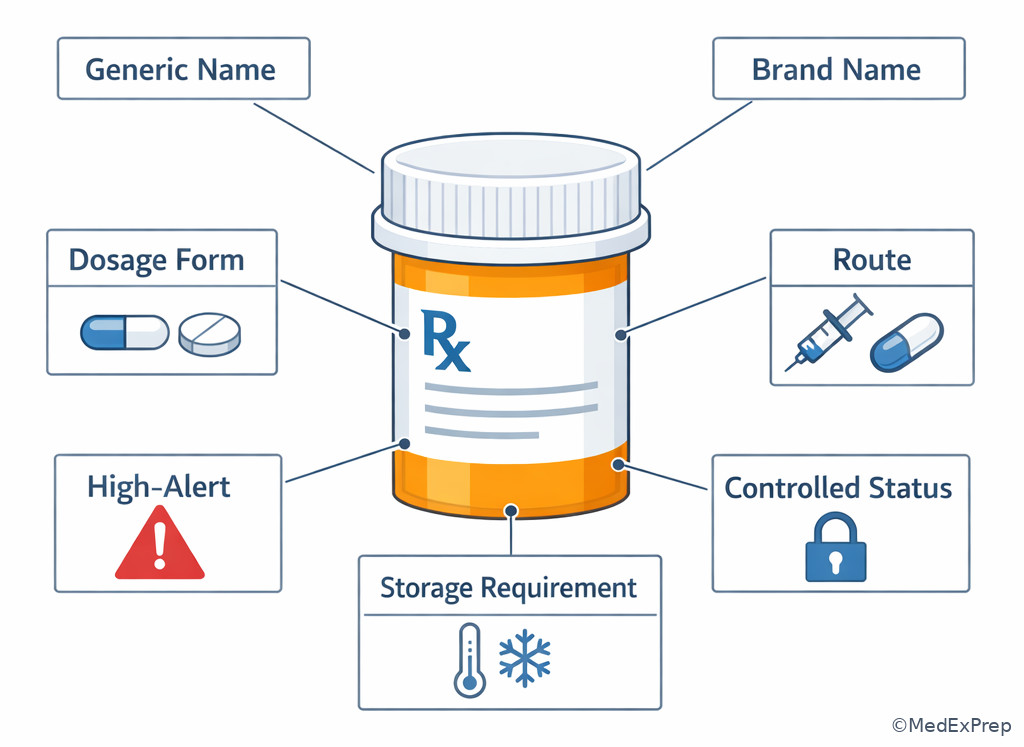
C --> C2[Dosage forms and routes]
C --> C3[Storage and handling]
D --> D1[Controlled substances]
D --> D2[Records and forms]
D --> D3[Validity, privacy, recalls]
E --> E1[Error prevention]
E --> E2[CQI and reporting]
E --> E3[Infection control and PPE]
F --> F1[Intake and screening]
F --> F2[Data entry and adjudication]
F --> F3[Fill-label-dispense workflow] Exam takeaway: If the task crosses from processing into clinical or legal judgment, stop and escalate.
flowchart LR
A[Technician receives task] --> B{Processing or judgment?}
B --> C[Processing task]
B --> D[Judgment task]
C --> C1[Enter data]
C --> C2[Prepare/package]
C --> C3[Document and verify workflow]
D --> D1[Clinical appropriateness]
D --> D2[Counseling need]
D --> D3[Unclear or suspicious order]
D1 --> E[Refer to pharmacist]
D2 --> E
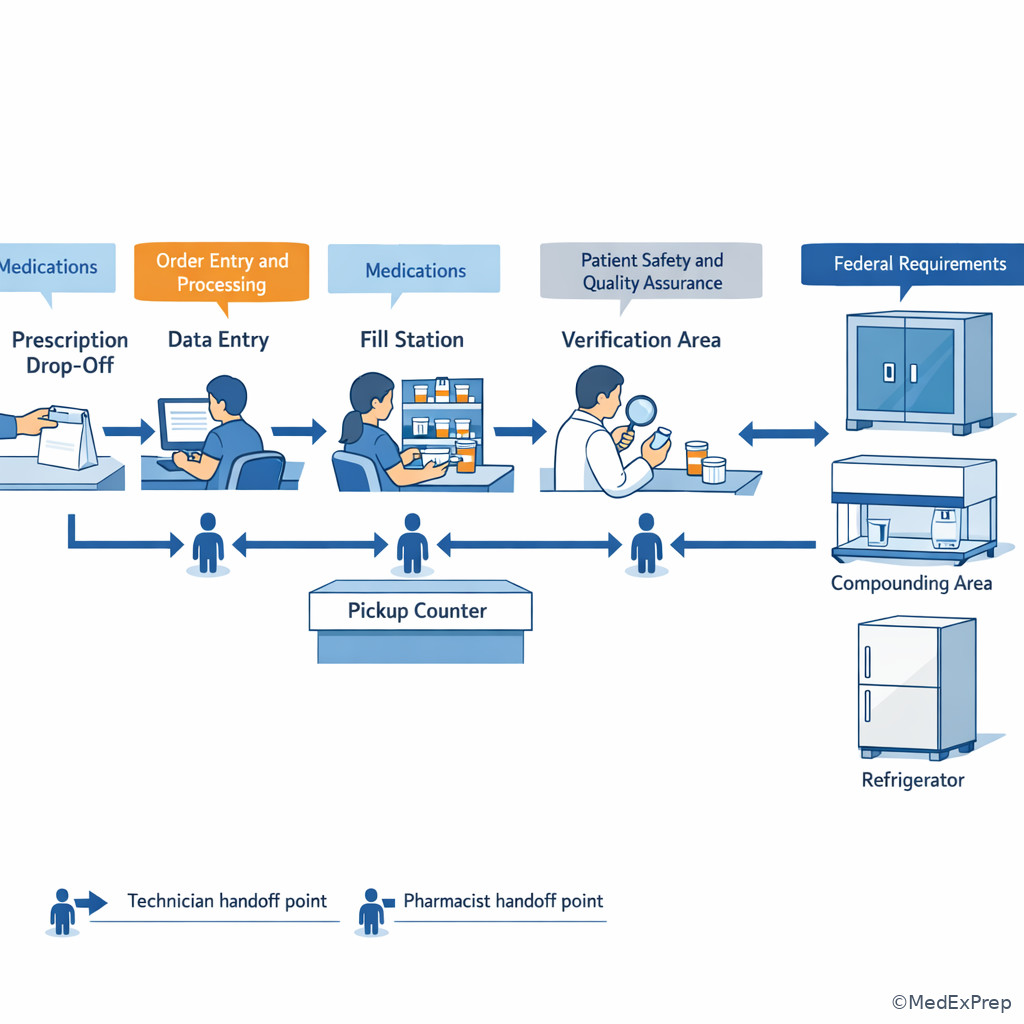
D3 --> E Exam takeaway: Link each workstation task to its tested domain so you can spot what rule applies fastest.
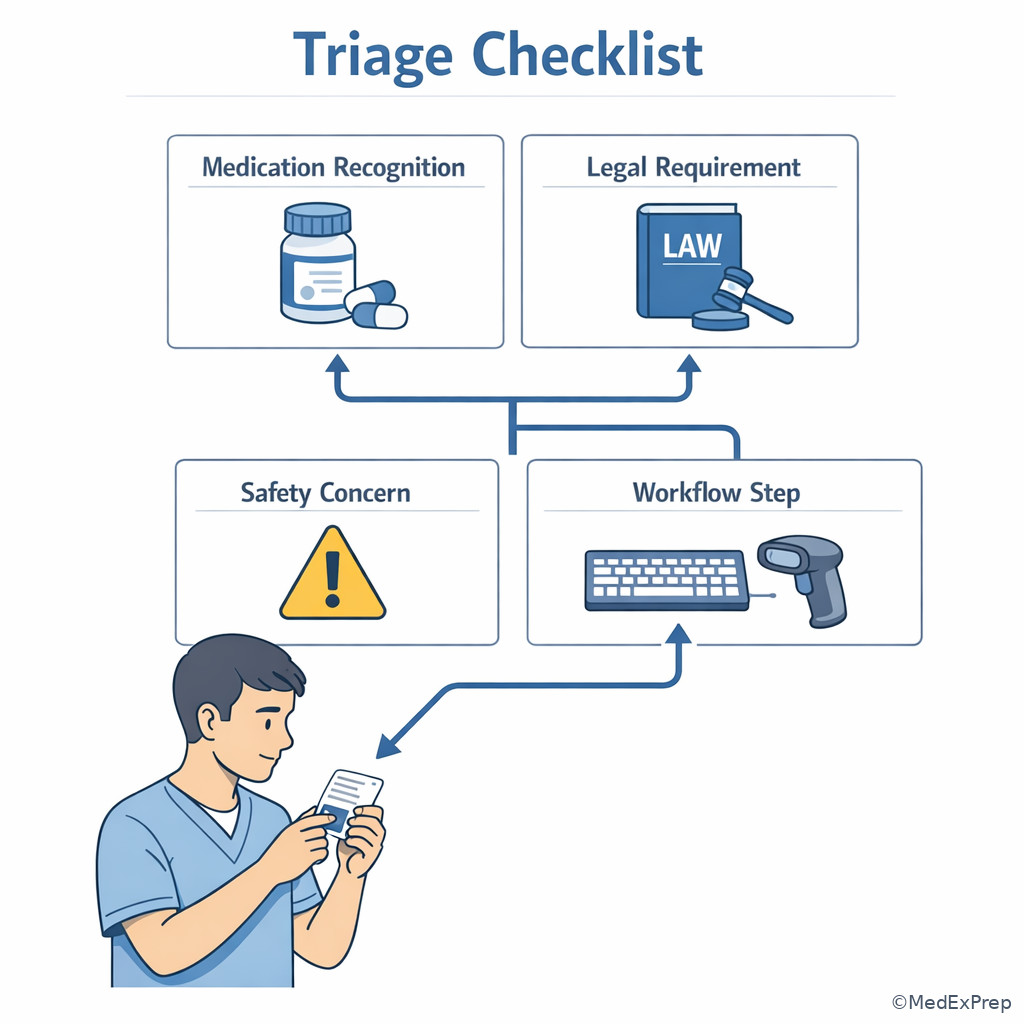
Exam takeaway: Use a short triage sequence to identify whether the question is about medication facts, law, safety, or processing.
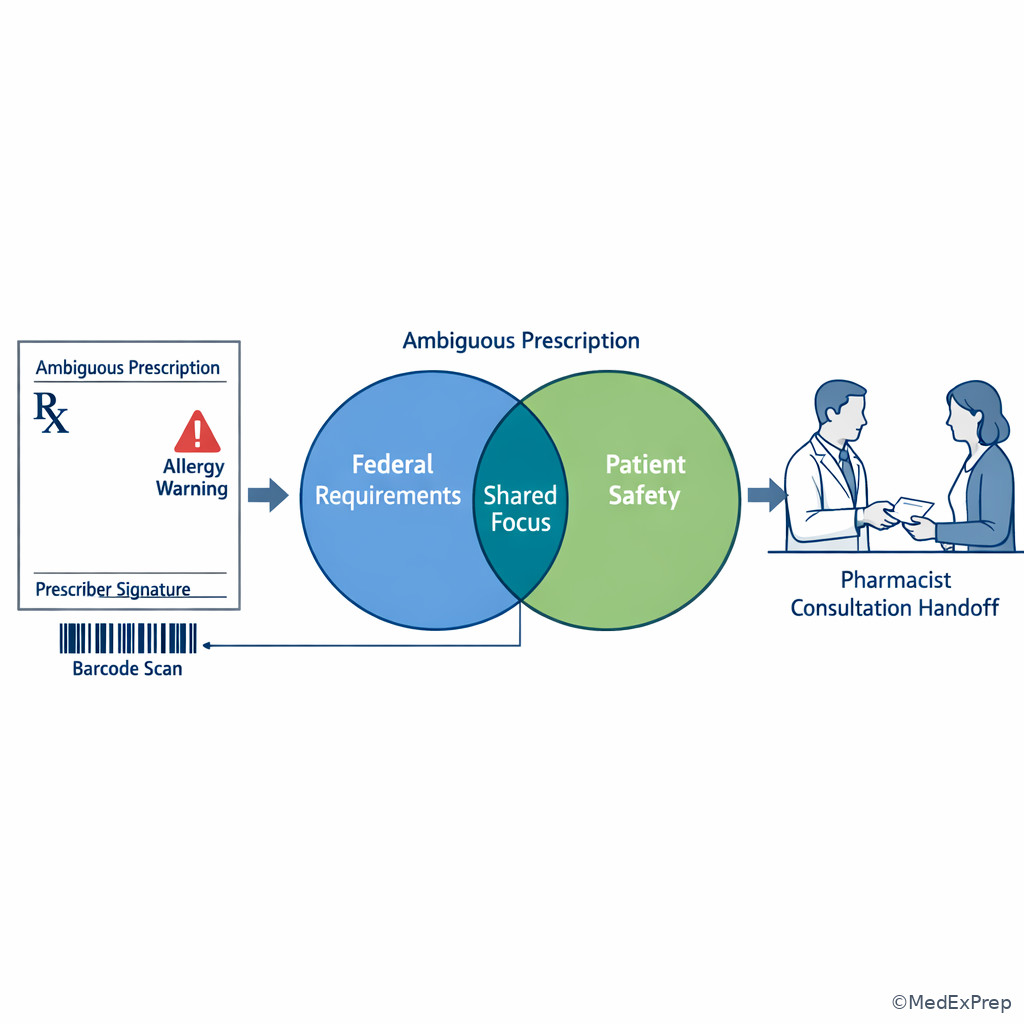
Exam takeaway: Many stems test two domains at once, so notice the single clue that tells you which rule controls the next step.
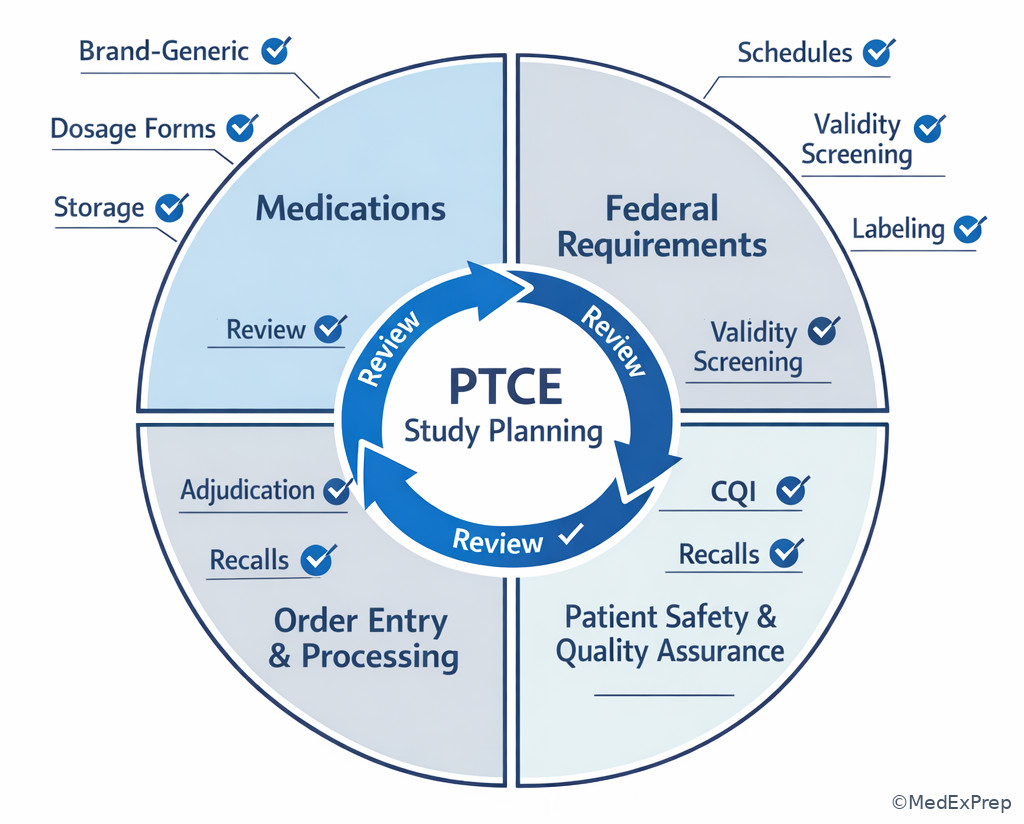
Exam takeaway: Build study balance across all four domains rather than over-studying medications alone.
Exam takeaway: Some stems begin in one domain but are solved by another, especially safety and scope questions.
flowchart TD
A[Prescription for warfarin entered] --> B[Medication domain: brand/generic, dosage form]
B --> C[Order processing: data entry and label]
C --> D[Safety: interaction or duplicate concern]
D --> E[Referral if clinical judgment needed]
Exam takeaway: Medication questions often test recognition clusters rather than isolated facts.
Exam takeaway: Safe processing depends on recognizing when the task should move from technician workflow to pharmacist review.
Core content
1.1.1.3 Foundational map: the four PTCE domains
A Explanation
The first decision on any PTCE item is not “What fact do I remember?” It is “What domain is this testing?” The conflict is usually between two broad choices: a stem may look like medication trivia, but the single clue may make it a safety problem; or it may look like law, but the real task is workflow processing. The rule that resolves this conflict is simple: choose the domain based on the action the technician must take next. If the item asks you to recognize a drug name, dosage form, route, storage issue, or class cue, start with Medications. If it asks about records, schedules, prescription validity, privacy, recalls, or legal handling, start with Federal Requirements. If it centers on preventing harm, avoiding mix-ups, PPE, reporting, or verification safeguards, it belongs to Patient Safety and Quality Assurance. If it asks about intake, data entry, claims, filling, labeling, or staging, it belongs to Order Entry and Processing.
WHY THIS IS TESTED: exam writers use domain confusion to create distractors. The stem often includes extra details from a secondary domain, but only one domain governs the safest next technician step. See Fig 1 and Fig 4.
B Worked example
A 72-year-old patient with hypertension and type 2 diabetes brings in a written prescription for metoprolol tartrate 25 mg PO BID. The patient also asks why the bottle last month looked different, and the profile shows a prior insurance rejection for refill-too-soon. The handwriting is legible, but the date appears smudged. A tempting clue is the different tablet appearance, which may make medication identification seem like the main issue.
Reasoning chain: Identify task → the stem asks for the best technician approach to the prescription. Extract key facts → written prescription, possible date issue, medication appearance concern, refill history noise. Apply rule → the date clarity issue is a Federal Requirements / validity screening concern; the changed tablet appearance is secondary and can be addressed later through pharmacist counseling if needed. Eliminate distractors → choosing an answer focused only on explaining generic substitution misses the immediate validity issue; choosing an insurance-rejection workflow answer also misses the legal screening step. Verify → safest technician action is to pause processing and route the unclear prescription detail to the pharmacist according to policy.
C Exam trap
D Checkpoint
Question: A prescription for amoxicillin 500 mg PO TID arrives electronically. The patient profile displays a prior claim rejection, the bottle is stock-out at one location, and the stem asks which PTCE domain most directly governs entering the order into the system. What is the most appropriate choice?
- Medications — tempting because the drug name and strength are present, but wrong because the core task is system entry workflow rather than drug recognition.
- Federal Requirements — tempting because prescriptions involve legal rules, but wrong because no specific legal or controlled-substance issue is central here.
- Patient Safety and Quality Assurance — tempting because any order can involve safety checks, but wrong because the question asks about the primary workflow domain for entering the order.
- Order Entry and Processing — correct because the stem centers on entering and routing the prescription through the pharmacy system.
1.1.1.4 What each domain really covers in technician workflow
A Explanation
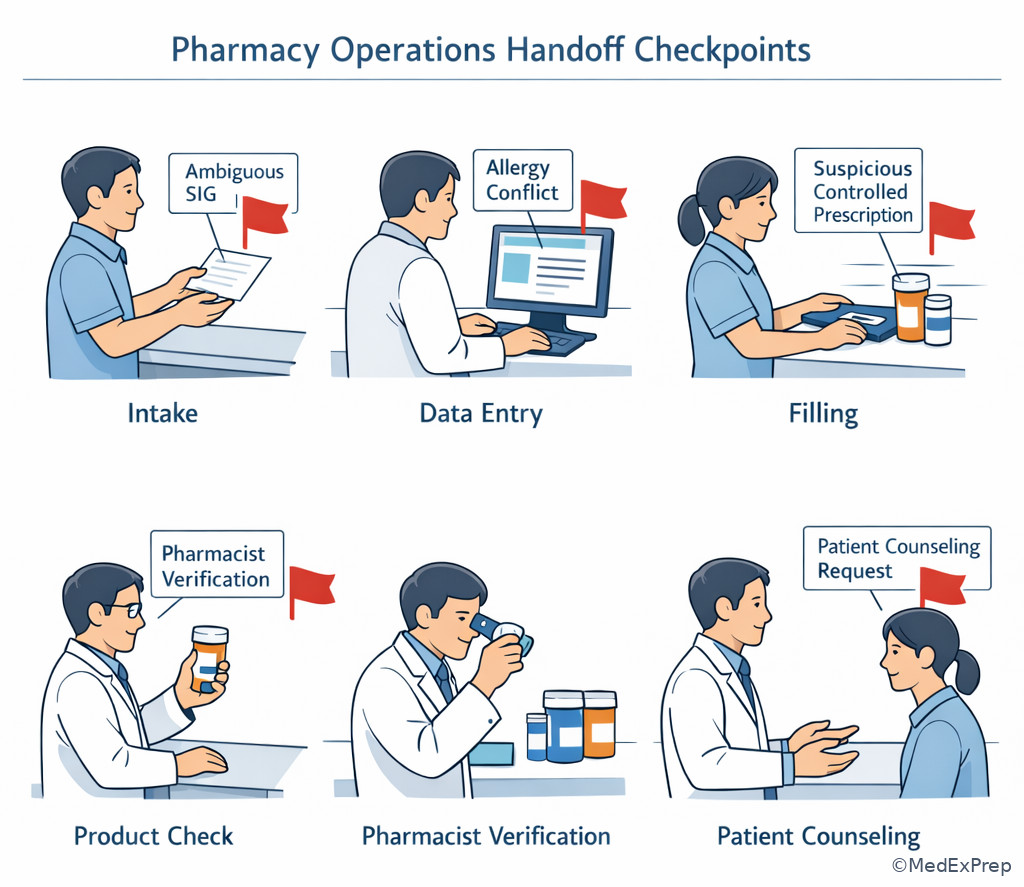
Once you identify the domain, you need a mental picture of what tasks live inside it. The decision conflict here is between surface labels and actual technician work. For example, “Medications” is not only memorizing names; it also includes dosage forms, routes, storage, and risk flags. “Order Entry and Processing” is not only keyboard entry; it includes intake, adjudication, labeling, and handoff sequence. “Patient Safety and Quality Assurance” is broader than error reporting; it includes prevention systems such as barcode checks, LASA safeguards, infection control, and high-alert awareness. “Federal Requirements” covers much more than controlled schedules; it includes records, DEA forms, privacy, prescription requirements, recalls, and variable law-policy interactions.
The single rule that resolves most confusion is this: if the task involves how the pharmacy system should handle the medication-use process, think workflow; if it involves what the product is, think medication; if it involves what rules or records legally govern it, think federal requirements; if it involves how to prevent harm or detect error, think safety. See Fig 3 and Fig 5.
B Worked example
A 66-year-old patient with COPD and hyperlipidemia presents a prescription for albuterol HFA inhale 2 puffs q4-6h PRN. The patient asks whether the inhaler can be stored in a hot car, the insurance card is outdated, and the technician notices the prescriber DEA number is not relevant because the medication is noncontrolled. A tempting wrong path is to focus on billing because the insurance card issue is visible.
Reasoning chain: Identify task → the likely exam target is domain classification. Extract key facts → albuterol inhaler, storage concern, outdated insurance card, noncontrolled product. Apply rule → the storage question belongs primarily to Medications because it tests product storage/handling knowledge; outdated insurance belongs to workflow but is secondary. Eliminate distractors → Federal Requirements is wrong because no controlled-substance or formal legal record issue is central; Safety is too broad unless the stem emphasizes harm prevention or counseling referral. Verify → best classification is Medications, with a likely technician action to defer counseling details to pharmacist if patient-specific advice is requested.
C Exam trap
D Checkpoint
Question: A technician is processing insulin glargine 10 units subcutaneously nightly for a patient with obesity and hypertension. The stem asks which domain most directly covers refrigerator storage and product handling rules. Which answer is best?
- Medications — correct because storage and handling are medication-domain recognition tasks.
- Federal Requirements — tempting because insulin is tightly regulated in workflow, but wrong because the question is not about legal recordkeeping.
- Patient Safety and Quality Assurance — tempting because improper storage can harm patients, but wrong because the primary tested content is product-specific storage knowledge.
- Order Entry and Processing — tempting because the product is being processed, but wrong because the domain is determined by the storage question, not the location in workflow.
- The domain that covers dosage forms, routes, and storage is Medications.
- True or False: Any question with an insurance card automatically belongs to Order Entry and Processing. False.
- Name the 4 PTCE domains: Medications, Federal Requirements, Patient Safety and Quality Assurance, Order Entry and Processing.
1.1.1.5 Application: how to classify mixed stems on test day
A Explanation
Mixed stems are the ones most likely to lower scores because they include details from multiple domains. The choice you must make is between the obvious noun in the stem and the actual decision point. A question that names a controlled substance may still be about order processing. A question that includes a barcode scan may actually be about safety. The single finding that resolves these mixed items is the phrase that defines the technician’s next task: “best action,” “most appropriate next step,” “requires pharmacist referral,” “how should the technician process,” or “most important to verify.” Those verbs tell you which domain is in charge. If the task is to detect a mismatch, hold a suspicious order, or prevent a harmful mix-up, safety or federal requirements may outrank workflow. If the task is simply to continue routine intake or data entry, order processing governs.
Another key test-day pattern: the domain that controls the next step wins, even if another domain is also present. This is why domain triage should happen before you inspect options. See Fig 2 and Fig 5.
B Worked example
A 58-year-old patient with chronic pain and GERD presents a paper prescription for hydrocodone/acetaminophen 5 mg/325 mg PO q6h PRN. The patient reports a new address, asks whether a generic is available, and the pharmacy system shows a prior authorization problem from last month. The quantity line on the prescription appears altered. The generic question and insurance history create tempting distractions.
Reasoning chain: Identify task → best technician next step. Extract key facts → paper controlled substance prescription, possible alteration, address update noise, prior authorization noise, generic question noise. Apply rule → altered quantity on a controlled prescription is a Federal Requirements plus pharmacist referral problem, not an adjudication problem. Eliminate distractors → updating address is routine but not first; discussing therapeutic substitution or product acceptability is beyond technician authority; proceeding to prior authorization workflow misses the controlling issue. Verify → pause, follow policy, and refer the suspicious prescription to the pharmacist.
C Exam trap
D Checkpoint
Question: A technician receives levothyroxine 50 mcg PO daily for a 75-year-old patient with atrial fibrillation and chronic kidney disease. During entry, the patient profile shows a documented allergy mismatch to the selected product, and the stem asks for the domain that controls the immediate next step. Which answer is best?
- Medications — tempting because the task involves product selection, but wrong because the immediate issue is not naming the product; it is the safety conflict.
- Federal Requirements — tempting because documentation matters, but wrong because no legal record or controlled-substance issue is central.
- Patient Safety and Quality Assurance — correct because the allergy mismatch creates a safety red flag that controls the next action.
- Order Entry and Processing — tempting because entry is occurring, but wrong because workflow yields to the safety concern.
1.1.1.6 Integration: blueprint-driven study strategy and score protection
A Explanation
A domain map is useful only if it changes how you study and how you protect points under pressure. The main choice here is between studying by random facts and studying by domain-function pairs. PTCE candidates often over-study medications because drug names feel familiar, then lose points in safety, processing, and law. The rule that resolves this is balance: every study block should ask, “Which domain am I training, what technician action goes with it, and what red-flag trigger changes routine processing into referral?” A strong domain-based study plan links each domain to its common verbs. Medications: identify, classify, store, recognize form/route. Federal Requirements: validate, document, count, transfer, quarantine, protect privacy. Safety: prevent, separate, scan, report, garb, sanitize. Order Processing: receive, enter, adjudicate, fill, label, stage.
On test day, score protection means rejecting answers that are operationally impossible for a technician. If the option asks you to counsel independently, decide clinical appropriateness, adjust therapy, or complete final verification, it is usually outside scope and therefore wrong. See Fig 6 and Fig 2.
B Worked example
A 43-year-old patient with asthma and depression calls about a refill for sertraline 100 mg PO daily. The profile shows no refills remaining, the patient asks whether they can double a leftover 50 mg dose until the prescriber responds, and the insurance plan also rejected the prior fill due to plan limits. The tempting wrong answer is to solve the dosing question because it sounds practical and urgent.
Reasoning chain: Identify task → safest technician response. Extract key facts → no refills remain, patient asks for dosing advice, plan-limit rejection is background noise. Apply rule → dosing advice is outside technician scope; the technician can support refill workflow but must refer counseling or therapeutic questions to the pharmacist. Eliminate distractors → telling the patient to double tablets is independent counseling; overriding the refill issue is unauthorized; focusing only on insurance misses the immediate scope boundary. Verify → best action is to route the clinical question to the pharmacist and continue approved refill-request workflow as allowed by policy.
C Exam trap
D Checkpoint
Question: During processing of warfarin 5 mg PO daily for a patient with atrial fibrillation, the patient asks whether the medication should be stopped before a dental procedure next week. Which answer best reflects the role-based lesson from the PTCE domain map?
- Explain that the patient should stop warfarin 5 days before the procedure — tempting because it sounds clinically informed, but wrong because it is pharmacist- or prescriber-level counseling.
- Tell the patient to skip the next dose only if bleeding occurs — tempting because it sounds cautious, but wrong because it still gives independent therapeutic advice.
- Refer the question to the pharmacist and continue only technician-level workflow tasks — correct because the issue requires clinical judgment outside technician scope.
- Process the refill and avoid mentioning the question to prevent delaying care — tempting because workflow efficiency matters, but wrong because ignoring a clinical question is unsafe.
- The domain map improves scores by helping you choose the governing rule before evaluating answer choices.
- True or False: If an answer choice requires final clinical verification by the technician, it is likely correct. False.
- Name the four common study buckets attached to the domains: product facts, legal rules, safety safeguards, workflow steps.
1.1.1.7 Integration: using the domain map to eliminate distractors
A Explanation
The final level is not just knowing the map but using it to eliminate close distractors. The conflict on many PTCE items is between several answers that all sound useful in a pharmacy. The rule that separates them is: choose the answer that matches the tested domain, the technician role, and the immediate next step at the same time. If one option addresses a later problem while another addresses the current red flag, choose the current red flag. If one answer is technically possible only after pharmacist review, it is not the technician’s immediate step. If a legal defect exists, convenience steps such as billing or stock transfer are secondary. If a safety conflict exists, routine workflow pauses.
This three-filter method works well: Domain filter — does the answer solve the same category of problem? Scope filter — may the technician do it? Sequence filter — is this the next step now, not later? Questions become easier when you force all options through these filters before committing.
B Worked example
A 61-year-old patient with epilepsy and hypothyroidism presents a refill request for levetiracetam 500 mg PO BID. The system shows the medication is too soon to refill, the patient states the tablets were lost during travel, and the profile also contains a note requesting counseling about missed doses. A tempting wrong answer is to explain what to do for missed doses because the patient sounds worried.
Reasoning chain: Identify task → best technician action in workflow. Extract key facts → refill-too-soon problem, lost medication report, counseling note. Apply three filters → domain: processing/adjudication issue; scope: missed-dose counseling exceeds technician role; sequence: resolve refill workflow and refer counseling concern rather than answer it. Eliminate distractors → independently advising on dose timing fails scope; dispensing early without authorization fails process; ignoring the issue fails safety and workflow. Verify → technician should follow site protocol for refill-too-soon/lost medication workflow and refer therapeutic questions to the pharmacist.
C Exam trap
D Checkpoint
Question: A technician receives methylphenidate ER 18 mg PO every morning for a 14-year-old patient with ADHD and asthma. The parent asks whether the dose can be doubled on school testing days, and the prescription image also appears partially cut off in the transmission. Which option best survives the domain, scope, and sequence filters?
- Tell the parent to double the dose only on exam days — tempting because it addresses the parent’s question directly, but wrong because it is pharmacist- or prescriber-level advice.
- Process the prescription normally because the medication and patient are known to the pharmacy — tempting because continuity reduces uncertainty, but wrong because the transmitted order appears incomplete.
- Pause processing and refer the incomplete order and dosing question to the pharmacist — correct because the order defect and therapeutic question both require escalation.
- Update the profile note and leave the issue for pickup counseling — tempting because documentation helps, but wrong because the incomplete order affects processing now.
Tables
| Domain | Core PTCE focus | Common task verbs | Typical technician red flag |
|---|---|---|---|
| Medications | Drug names, classes, dosage forms, routes, storage, handling | Identify, classify, select package, store, recognize | Wrong dosage form, route mismatch, storage problem, LASA product confusion |
| Federal Requirements | Schedules, records, validity, privacy, DEA forms, recalls, REMS awareness | Validate, document, inventory, transfer, quarantine, protect | Unclear or altered prescription, missing required element, privacy breach risk |
| Patient Safety and Quality Assurance | Error prevention, CQI, high-alert safeguards, infection control, PPE | Prevent, separate, scan, report, sanitize, garb | Allergy mismatch, barcode discrepancy, unsafe abbreviation, contamination risk |
| Order Entry and Processing | Intake, demographic data, data entry, adjudication, fill, label, stage | Receive, enter, adjudicate, fill, label, package, stage | Incomplete intake, wrong NDC selection, claim rejection workflow problem |
| Looks like... | But is really... | Single clue | Best frame |
|---|---|---|---|
| Medication question | Safety question | Allergy alert or product mismatch controls the next step | Pause workflow for safety review |
| Order-processing question | Federal requirement question | Altered, missing, suspicious, or unclear prescription element | Validity/legal screening before entry continues |
| Billing question | Scope/referral question | Patient asks clinical or therapeutic advice | Refer to pharmacist; technician handles only allowed workflow |
| Storage question | Medication-domain question | Product handling condition is the tested fact | Use product knowledge, then process appropriately |
| Routine fill question | Safety/CQI question | LASA or barcode discrepancy appears during fill | Resolve mismatch before continuing |
| Question pattern | Most likely domain | Why students miss it | Discriminator |
|---|---|---|---|
| Brand/generic, route, dosage form, refrigeration | Medications | They over-focus on workflow setting | The tested fact is about the product itself |
| DEA record, transfer, refill rule, privacy issue | Federal Requirements | They assume all tasks in pharmacy software are workflow only | The rule is legal/recordkeeping, not operational convenience |
| Unsafe abbreviation, contamination, high-alert separation | Patient Safety and Quality Assurance | They mistake safety systems for general process steps | The aim is harm prevention or quality control |
| SIG entry, claim rejection, label creation, fill sequence | Order Entry and Processing | They get distracted by medication names | The question asks how the order moves through the system |
| Patient asks whether to start, stop, double, or substitute therapy | Scope/referral overlay | They think customer service means answer directly | The correct technician action is pharmacist referral |
| Study strategy | Benefit | Main weakness | Best use |
|---|---|---|---|
| Random flashcards only | Fast fact exposure | Poor mixed-stem classification | Supplemental recall, not primary method |
| Domain-based notes | Strong rule selection | Needs regular retrieval practice | Primary framework for PTCE prep |
| Question bank without review tags | Volume of exposure | Repeats same mistake patterns | Use only with domain/error tracking |
| Mixed-domain review with scope filter | Best exam realism | Harder early on | Ideal once basic domain map is learned |
Exam Traps & Differentiators
- Most common wrong answer and why: choosing the answer that sounds most helpful to the patient instead of the answer that matches technician role and immediate workflow. This is especially dangerous when a patient asks dosing, side-effect, or substitution questions.
- Looks similar but isn’t: a claim rejection is processing; a suspicious alteration is federal/legal; an allergy alert is safety; a storage question is medications.
- If the stem says “best action by the technician” and includes counseling language, think pharmacist referral, not independent advice.
- If the stem says “most important to verify before continuing” and includes a mismatch or alert, think safety before workflow.
- If the stem says “written order appears altered, incomplete, or unclear,” think validity screening and pharmacist escalation before entry.
- If the stem says “how should the prescription be entered, billed, labeled, or staged,” think Order Entry and Processing unless another red flag overrides it.
- If the stem emphasizes route, dosage form, storage, or product handling, think Medications even if the scenario occurs during processing.
| Confusable pair | Why they look similar | Single clue that separates them |
|---|---|---|
| Federal Requirements vs Order Entry | Both involve prescriptions and software workflow | If legality/validity controls the next step, federal rules outrank routine entry |
| Medications vs Safety | Both may involve product details | If the issue is harm prevention from mismatch or alert, safety governs |
| Order Entry vs Scope Boundary | Both can occur during intake calls | If the patient seeks therapeutic advice, referral overrides routine processing |
| Safety vs Federal Requirements | Both may force a hold | Use safety for harm-prevention systems; use federal for validity, records, privacy, or schedule rules |
Algorithm / Approach
Use this algorithm every time you see a mixed stem. It is especially helpful when the prescription details create noise. On the real exam, speed comes from classification, not from rushing. See Fig 1, Fig 2, and Fig 6.
Rapid Review
- Medications → product fact owns the question: name, class, form, route, storage.
- Federal Requirements → legality or record rule controls the next step.
- Patient Safety and Quality Assurance → mismatch, contamination, or harm-prevention system outranks routine workflow.
- Order Entry and Processing → intake-to-label sequence without overriding legal/safety red flags.
- Mixed stems → the controlling clue beats the noisiest detail.
- Patient counseling request → referral trigger, not technician advice.
- Altered quantity on a prescription → validity problem before data entry.
- Claim rejection with no other red flag → processing workflow problem.
- Refrigeration or storage condition → medication-domain cue.
- Allergy conflict or mismatch alert → safety-domain cue.
- Strong distractor → often wrong on role or sequence, not content alone.
- Best technician action → must be allowed, immediate, and safety-first.
- Final verification → pharmacist responsibility, not technician.
Self-check quiz
1. A technician is entering atorvastatin 20 mg PO nightly for a 63-year-old patient with diabetes and hypertension. The stem asks which PTCE domain most directly covers recognizing that atorvastatin is a medication name and matching it to the correct product record. Which answer is best?
- Medications
- Federal Requirements
- Patient Safety and Quality Assurance
- Order Entry and Processing
2. A technician receives insulin lispro 10 units subcutaneously before meals for a patient with obesity and hypertriglyceridemia. The question asks which PTCE domain most directly covers refrigerator storage and handling of this product. Which answer is best?
- Medications
- Federal Requirements
- Patient Safety and Quality Assurance
- Order Entry and Processing
3. A 54-year-old patient with chronic back pain and insomnia presents a paper prescription for tramadol 50 mg PO q6h PRN. The address is current, but the quantity field is difficult to read and appears overwritten. The patient also asks whether the generic works the same. What is the most appropriate next step by the technician?
- Enter the order, then ask the pharmacist to counsel on generic equivalence at pickup
- Pause processing and refer the unclear prescription detail to the pharmacist
- Call the patient’s insurer to resolve any future claim issue before entering the order
- Tell the patient the generic is therapeutically equivalent and continue processing
4. During order entry for amoxicillin/clavulanate 875 mg/125 mg PO BID in a 9-year-old patient with asthma and seasonal allergies, the technician selects a product record and the profile displays an allergy-related warning. The stem asks what should control the immediate next step. Which answer is best?
- Continue data entry because the prescriber already chose the medication
- Treat the issue primarily as a Patient Safety and Quality Assurance concern
- Switch the order to a different antibiotic because the alert appeared
- Ignore the alert and complete labeling first to save time
5. A 71-year-old patient with atrial fibrillation and osteoarthritis calls about a refill for apixaban 5 mg PO BID. There are no refills remaining, and the patient asks whether one extra tablet should be taken tonight after a missed dose yesterday. The insurance plan also recently changed. What is the best technician action?
- Advise the patient to take two tablets tonight, then resume usual dosing
- Transfer the refill to another pharmacy without pharmacist involvement
- Refer the dosing question to the pharmacist and continue only allowed refill-request workflow
- Tell the patient to stop apixaban until the prescriber responds
6. A 39-year-old patient with ADHD and generalized anxiety disorder has a transmitted prescription for amphetamine/dextroamphetamine ER 20 mg PO every morning. The image is partially cut off, the patient asks whether the capsule can be opened and sprinkled, and the profile also shows an old billing rejection. Which is the most appropriate next step by the technician?
- Resolve the prior billing rejection first because adjudication is part of processing
- Tell the patient the capsule may be opened because that is common for extended-release products
- Pause processing and refer the incomplete prescription and product-use question to the pharmacist
- Complete data entry using the last prescription as a guide because the patient is established
7. A 68-year-old patient with seizure disorder, hypothyroidism, and recent hospitalization requests an early refill of levetiracetam 750 mg PO BID. The patient says the bottle was lost, asks whether doses can be doubled tomorrow to catch up, and the system shows a refill-too-soon rejection. Which choice best matches the PTCE domain map and technician scope?
- Advise doubling the next two doses and document the call
- Refer the therapeutic question to the pharmacist and follow site workflow for the refill-too-soon issue
- Override the rejection because a lost medication is an acceptable reason
- Transfer the prescription and let the other pharmacy decide
8. A technician receives morphine sulfate ER 15 mg PO q12h for a 62-year-old patient with metastatic cancer and chronic constipation. The patient profile is complete, but the hard-copy prescription date is smudged and the patient asks whether taking the medication with food will reduce nausea. Which option is the safest next step?
- Explain that taking morphine sulfate ER with food may help and then process the prescription
- Pause for pharmacist review because the prescription validity issue controls the next step, and route the counseling question as well
- Enter the order because the medication and patient are known, then clarify only if the insurer rejects the claim
- Substitute an immediate-release product to avoid delay
Answer key
1.1.1.8 1. Question 1
Correct answer: A. Medications
- A. Medications — tempting because it seems almost too obvious, but it is correct for this scenario because the task is recognizing the drug name and matching the product record, which is a medication-domain skill. Single stem clue: “recognizing that atorvastatin is a medication name.” Authoritative alignment: PTCB outline framing of medication knowledge and product recognition; confirm with current PTCB exam outline.
- B. Federal Requirements — tempting because every prescription exists within legal requirements, but incorrect here because no legal element, record, schedule, or validity issue is being tested. Single discriminating clue: no legal defect is present.
- C. Patient Safety and Quality Assurance — tempting because correct product selection prevents harm, but incorrect because the primary tested skill is product recognition rather than a safety system or mismatch alert. Single discriminating clue: the stem asks about identifying the medication itself.
- D. Order Entry and Processing — tempting because matching the drug to the record occurs during data entry, but incorrect because the domain is chosen by the content being tested, not merely where it happens in workflow. Single discriminating clue: the question centers on recognition, not workflow sequence.
1.1.1.9 2. Question 2
Correct answer: A. Medications
- A. Medications — tempting because improper storage also affects safety, but correct because refrigerator storage and handling are product-specific medication knowledge points. Single stem clue: “covers refrigerator storage and handling.” Source alignment: product storage/handling falls within medication-domain knowledge in PTCE preparation resources and standard pharmacy technician texts.
- B. Federal Requirements — tempting because insulin products are regulated in pharmacy systems, but incorrect because the question is not about legal records or schedule handling. Single discriminating clue: no legal requirement is under discussion.
- C. Patient Safety and Quality Assurance — tempting because poor storage can cause patient harm, but incorrect because the tested skill is knowing the storage rule itself, not operating a safety reporting or prevention system. Single discriminating clue: the question asks which domain “covers storage and handling.”
- D. Order Entry and Processing — tempting because the prescription is being handled operationally, but incorrect because the issue is product knowledge, not entry sequence. Single discriminating clue: route and storage facts are medication-domain cues.
1.1.1.10 3. Question 3
Correct answer: B. Pause processing and refer the unclear prescription detail to the pharmacist
- A. Tempting because entering first can seem efficient and the generic question can be handled later. Incorrect because the overwritten quantity is a validity concern that controls the next step; routine entry should not continue until it is addressed. Single clue: “quantity field is difficult to read and appears overwritten.” Federal and site-policy principles support clarification before routine processing.
- B. Correct because the unclear/possibly altered quantity creates a legal-validity issue, and the technician should pause and route the problem to the pharmacist according to protocol. Single clue: the overwritten quantity.
- C. Tempting because insurance problems commonly delay dispensing. Incorrect because there is no current claim issue in the stem, and billing is secondary to prescription validity. Single clue: no active adjudication problem is described.
- D. Tempting because patients often ask about generic equivalence and the technician may want to be helpful. Incorrect because independently addressing therapeutic equivalence crosses into counseling territory, and it ignores the controlling prescription defect. Single clue: the stem asks for the next step before counseling.
1.1.1.11 4. Question 4
Correct answer: B. Treat the issue primarily as a Patient Safety and Quality Assurance concern
- A. Tempting because the prescriber selected the medication and the technician may feel the order should simply be entered. Incorrect because a warning affecting patient safety controls the immediate next step; the technician does not override such concerns by assumption. Single clue: “profile displays an allergy-related warning.”
- B. Correct because the alert creates a safety-domain issue that must be handled before routine processing continues. Single clue: allergy warning during entry.
- C. Tempting because changing products seems responsive to the alert. Incorrect because the technician does not independently choose an alternate antibiotic; that would require pharmacist or prescriber judgment. Single clue: therapeutic substitution is outside technician role.
- D. Tempting because labels can be completed quickly and workflow efficiency matters. Incorrect because safety alerts are not postponed until after labeling. Single clue: the warning appears before the order should move forward.
1.1.1.12 5. Question 5
Correct answer: C. Refer the dosing question to the pharmacist and continue only allowed refill-request workflow
- A. Tempting because missed-dose questions seem routine and the patient wants a practical answer. Incorrect because advising a patient to double apixaban is therapeutic counseling outside technician scope and could be unsafe. Single clue: “asks whether one extra tablet should be taken.”
- B. Tempting because lack of refills may make transfer sound like a workflow solution. Incorrect because transfer decisions and refill handling depend on legal and pharmacist workflow requirements, and this does not address the immediate therapeutic question. Single clue: the patient is asking for dosing advice now.
- C. Correct because the technician should refer the clinical dosing question to the pharmacist while supporting refill-request steps permitted by policy. Single clue: missed-dose counseling request.
- D. Tempting because “stop until clarified” may sound cautious. Incorrect because it is still independent medication advice. Single clue: any start/stop recommendation is outside technician role.
1.1.1.13 6. Question 6
Correct answer: C. Pause processing and refer the incomplete prescription and product-use question to the pharmacist
- A. Tempting because billing rejections are common and fall within technician workflow. Incorrect because the incomplete transmitted prescription is the controlling issue; adjudication comes later. Single clue: “image is partially cut off.”
- B. Tempting because patients often ask administration questions, and some ER capsules can be opened. Incorrect because technicians should not independently answer product-use questions requiring counseling judgment, and this ignores the incomplete order. Single clue: product-use advice plus incomplete prescription.
- C. Correct because two escalation triggers are present: an incomplete prescription image and a product-use question beyond technician counseling scope. Single clue: both the cut-off image and the “can be opened” question.
- D. Tempting because an established patient may have prior records. Incorrect because using a prior prescription to fill gaps in an incomplete current order is unsafe and improper without clarification. Single clue: current transmission is incomplete.
1.1.1.14 7. Question 7
Correct answer: B. Refer the therapeutic question to the pharmacist and follow site workflow for the refill-too-soon issue
- A. Tempting because it seems to solve the missed-dose concern quickly. Incorrect because advising dose doubling is therapeutic counseling outside technician scope. Single clue: “asks whether doses can be doubled tomorrow.”
- B. Correct because the stem contains both a processing issue (refill-too-soon) and a clinical question (dose catch-up). The technician manages allowed workflow and refers the therapeutic part. Single clue: refill-too-soon plus therapeutic advice request.
- C. Tempting because lost medication can seem like a valid exception. Incorrect because the technician should not independently override the rejection outside approved protocol. Single clue: override authority is not established in the stem.
- D. Tempting because transfer may look like a way around the rejection. Incorrect because it avoids the actual problems and may not be appropriate without proper workflow and pharmacist involvement. Single clue: the key issue is scope plus current refill restriction, not location.
1.1.1.15 8. Question 8
Correct answer: B. Pause for pharmacist review because the prescription validity issue controls the next step, and route the counseling question as well
- A. Tempting because taking with food sounds like basic practical advice and the patient wants symptom relief. Incorrect because the smudged date creates a validity issue that must be addressed first, and food-related counseling is not the technician’s independent role. Single clue: “hard-copy prescription date is smudged.”
- B. Correct because the prescription validity issue controls the immediate next step, and the nausea/food question also requires pharmacist counseling rather than technician advice. Single clue: smudged date on a controlled medication prescription plus counseling request.
- C. Tempting because the patient is known and the profile is complete. Incorrect because familiarity does not cure a potential validity defect on the prescription itself. Single clue: legality depends on the current hard-copy prescription.
- D. Tempting because it seems to avoid delay. Incorrect because substituting immediate-release for extended-release is a therapeutic/product decision outside technician authority. Single clue: independent substitution is not allowed.
Keep going with the full PTCE Prep Course (PTCE)
You just studied the way members do, in the same lesson interface. Full access unlocks every lesson, the question bank and flashcards for a full year.
One payment · 1 year of access · No auto-renewal