1.1.1 - Chief Complaint To Problem List
Chief Complaint to Problem List
What you'll learn
- D1: Diagnosis, Examination, Prognosis, and Comprehensive Treatment Planning → Complaint synthesis: Convert a patient’s stated concern into a prosthodontic problem list without losing biologic, functional, esthetic, and maintenance factors.
- D1: Diagnosis, Examination, Prognosis, and Comprehensive Treatment Planning → Data hierarchy: Distinguish the chief complaint from findings, diagnoses, risk factors, and treatment options.
- D7: Esthetics and Patient-Centered Outcomes → Expectation alignment: Identify when the patient’s stated goal and the prosthodontically defensible objective are not the same.
- D8: Maintenance, Recall, and Complication Management → Burden forecasting: Add hygiene feasibility, repair likelihood, and recall demands to the initial problem list.
- D12: Interdisciplinary Prosthodontic Interfaces → Referral boundary recognition: Recognize when the complaint reveals a non-prosthodontic issue that requires coordinated evaluation before prosthodontic planning.
- Board-prep inferred competency: D1 → Diagnostic synthesis from interview to actionable problem list
- Board-prep inferred competency: D1 → Separate patient concern, clinician findings, and prosthodontic diagnosis
- Board-prep inferred competency: D7 → Integrate patient-centered goals and expectation risk into planning
- Board-prep inferred competency: D8 → Identify maintenance and prognosis implications at intake
- Board-prep inferred competency: D12 → Determine need for interdisciplinary consultation before definitive prosthodontic decisions
Why it matters
- Board stems often start with a patient request such as “I want implants” or “I want to fix my smile,” but the tested skill is whether you can identify the real prosthodontic problem before choosing treatment.
- A weak problem list leads to the wrong sequence, wrong prognosis, and over-treatment of teeth or implants that should first be evaluated for disease control, restorability, or maintenance feasibility.
- In oral/viva and case defense settings, examiners frequently probe whether you can distinguish the patient’s words from your diagnostic synthesis.
- The best answer is rarely the most comprehensive treatment; it is the most defensible plan that fits biology, function, esthetics, hygiene access, prognosis, and patient goals.
Exam takeaway: Use a fixed sequence so patient wishes do not override diagnosis, risk, or sequence.
flowchart TD
A[Patient statement] --> B[Clarify chief complaint]
B --> C[Separate symptoms from goals]
C --> D[Identify objective findings]
D --> E[Convert into prosthodontic problems]
E --> F[Rank by urgency and sequence]
F --> G[Match options only after problem list is complete]
See Fig 1 for the core sequence you should use on nearly every board-style intake scenario.
Key Terms & Must-Know Facts
1.1.1.1 Key terms
- Chief complaint: The patient’s own reason for seeking care, ideally in the patient’s words.
- Concern statement: A clarified version of the chief complaint after brief focused questioning.
- Problem list: Ranked set of prosthodontically relevant problems requiring assessment, control, or planning.
- Finding: An observed clinical or radiographic fact, not yet framed as a problem.
- Diagnosis: Clinical interpretation of findings.
- Risk factor: Variable that worsens prognosis or affects design, sequence, or maintenance.
- Chief request trap: The error of treating the requested solution as though it were the diagnosis.
- Restorability issue: Condition limiting whether a tooth or implant can predictably support the proposed restoration.
- Maintenance burden: Expected hygiene difficulty, repair demands, recall intensity, and patient effort needed to sustain treatment.
- Expectation mismatch: Misalignment between patient goals and clinically achievable outcomes.
- Prosthodontic objective: The functional, biologic, and esthetic target that guides treatment planning.
- Sequencing problem: A problem that changes the order in which treatment must occur.
- Referral trigger: Finding or risk that requires coordination with another discipline before definitive prosthodontics.
1.1.1.2 Must-know facts
- The chief complaint is not the same as the diagnosis.
- “I want implants” is a treatment preference, not a problem list.
- A good problem list includes disease, function, esthetics, structure, occlusion, space, support, and maintenance factors.
- Rank problems by urgency first, then by impact on prognosis and sequencing.
- Findings become problems only when they affect health, function, esthetics, prognosis, or treatment feasibility.
- Patient expectations belong on the problem list when they are unrealistic or poorly aligned with prognosis.
- Board answers favor staged, biologically defensible planning over immediate definitive reconstruction.
- When pathology or specialty disease control dominates the case, the prosthodontic move is consultation or referral, not premature definitive design selection.
| Item type | What it is | Board-style example | Common mistake |
|---|---|---|---|
| Chief complaint | Patient’s stated reason for seeking care | “My lower denture is loose and I cannot chew.” | Treating it as a diagnosis |
| Finding | Observed fact from exam or records | Generalized attrition; reduced posterior support | Ignoring whether it affects planning |
| Diagnosis | Interpretation of findings | Loss of occlusal support with compromised function | Using vague labels only |
| Risk factor | Prognosis modifier | Bruxism, xerostomia, limited dexterity | Leaving it off the problem list |
| Problem list item | Actionable issue affecting care | Poor mandibular denture stability due to severe ridge resorption | Listing treatment instead of problem |
| Treatment option | Possible response to problems | Implant-retained overdenture | Naming it before diagnosis is complete |
Core content
1.1.1.3 Foundational distinction: chief complaint versus prosthodontic problem
A Explanation
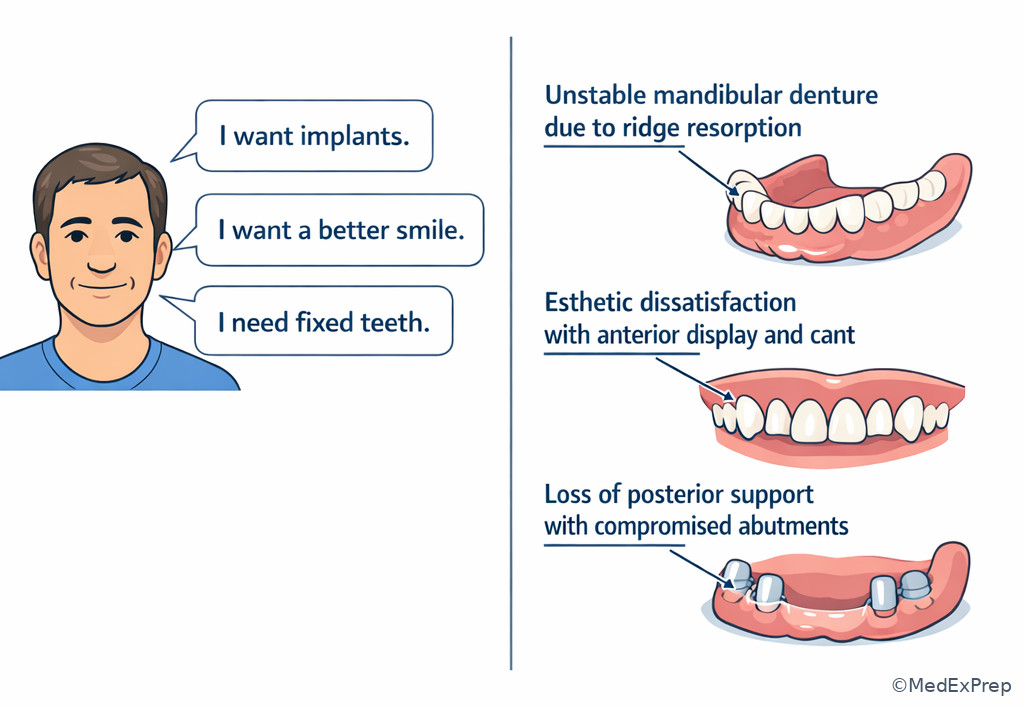
The first board-level decision conflict is simple but heavily tested: Do you treat the patient’s request, or do you translate it into a diagnostic problem? The correct move is to choose the problem list, not the requested solution. The single rule that resolves this is: a chief complaint is the patient’s reason for attendance; a prosthodontic problem is the clinician’s actionable synthesis of what threatens function, biology, esthetics, prognosis, or maintenance. If a patient says, “I want implants,” you should hear a request for a type of treatment, but you still must identify whether the actual problem is unstable removable prostheses, terminal abutments, missing posterior support, esthetic dissatisfaction, or inability to maintain current restorations.
WHY THIS IS TESTED: Exam stems commonly present a strong patient preference early, then hide the decisive finding later. Candidates who anchor on the request instead of the problem list choose overly aggressive or poorly sequenced treatment.
B Worked example
A 64-year-old woman presents stating, “I want all my remaining maxillary teeth replaced with implants because my crowns keep failing.” Her history includes controlled type 2 diabetes, xerostomia from antidepressant therapy, and parafunction reported by her spouse. She brings a recent cosmetic consultation note recommending a “full-arch implant makeover.” Clinical inspection shows recurrent caries at several crown margins, poor plaque control, posterior wear facets, and one fractured post-core tooth. A slightly elevated HbA1c is provided in the chart, which is distracting but not the decisive detail.
Reasoning chain: Identify task: build the initial problem list, not pick the definitive prosthesis. Extract key facts: repeated crown failure, xerostomia, caries activity, bruxism, one non-restorable candidate, and hygiene concerns. Apply rule: patient request for implants is not yet the diagnosis; the governing issue is compromised biologic environment and maintenance risk. Eliminate distractors: “full-arch implant reconstruction” is tempting because prior crowns failed, but it does not solve xerostomia, plaque, or parafunction by itself. Verify: the best initial problem list includes active/recurrent caries risk, possible loss of strategic abutments, parafunctional overload risk, hygiene-related maintenance burden, esthetic expectations, and need to determine which teeth are restorable before discussing implant alternatives.
C Exam trap
D Checkpoint
Question: A 58-year-old man says, “I need implants because my bridge is loose.” He has controlled hypertension, moderate bruxism, and heavy plaque accumulation. Examination shows a failing posterior FDP with recurrent decay on one abutment and a missing contralateral molar. Which is the most appropriate first problem-list entry?
- Need for implant placement in the posterior mandible
- Compromised posterior support with failing abutment-related prosthesis and hygiene risk
- Desire for fixed treatment instead of removable treatment
- Need for extraction of all heavily restored teeth
Answer: B
- A: Tempting because the patient requested implants and the bridge is loose; wrong because it names a solution before defining the actual biomechanical and biologic problem.
- B: Tempting because it feels less definitive; right because it captures function, existing prosthesis failure, abutment status, and maintenance risk in problem language.
- C: Tempting because patient preference matters; wrong because preference alone is not the primary prosthodontic problem.
- D: Tempting because recurrent decay can make extraction seem efficient; wrong because restorability has not yet been fully determined and the stem does not support removal of all heavily restored teeth.
Exam takeaway: Sort every intake statement into symptom, goal, request, or risk before writing the problem list.
flowchart LR
A[Patient statement] --> B{What kind of statement?}
B -->|Symptom| C[Pain, looseness, chewing difficulty]
B -->|Goal| D[Improve esthetics, chew better, fixed teeth]
B -->|Requested treatment| E[Implants, veneers, new denture]
B -->|Context/risk| F[Bruxism, xerostomia, dexterity limits]
C --> G[Problem list candidate]
D --> G
E --> H[Not a problem by itself]
F --> G
See Fig 2 when a stem mixes symptoms, expectations, and requested treatment in one sentence.
1.1.1.4 Building the initial problem list: categories and ranking logic
A Explanation
Once the complaint is clarified, the next decision conflict is: Which items belong on the problem list now, and how do you rank them? The resolving rule is that a prosthodontic problem list should be category-based and sequence-sensitive. At intake, think in categories: disease control, structurally compromised teeth/restorations, support and stability, occlusion and function, esthetics, space and anatomy, maintenance feasibility, patient expectations, and interdisciplinary triggers. The board-relevant skill is not exhaustive note-taking; it is knowing which issue changes treatment first.
Urgent disease and non-restorability outrank esthetics. Inability to maintain hygiene may outrank a technically elegant fixed option. Missing teeth may not be the top problem if the remaining support is compromised. A “problem” should be written in a way that explains why it matters: not “wear,” but “generalized wear with loss of posterior support affecting occlusal predictability.” Not “old crowns,” but “defective crowns with recurrent caries affecting abutment prognosis.”
WHY THIS IS TESTED: Examiners want to see whether your list predicts sequencing. If the ranking would not change treatment order, it is probably not yet specific enough.
B Worked example
A 71-year-old man presents with “I can’t chew on the left and want a new smile.” He has Parkinson disease with reduced dexterity, a history of head and neck radiation, and moderate financial limits. Intraorally he has a unilateral distal-extension edentulous area, several existing crowns, one carious root remnant, xerostomia, and an unaesthetic maxillary anterior cant. The distracting clue is his insistence that the “crooked front teeth” are the main issue.
Reasoning chain: Identify task: create and rank the initial problem list. Extract key facts: reduced dexterity, radiation history, xerostomia, missing posterior support, root remnant, esthetic complaint, and finances. Apply rule: urgent biologic and maintenance-limiting issues outrank esthetic refinement. Eliminate distractors: anterior esthetics matter, but not before disease control and feasibility. Verify: top problems likely include xerostomia-related caries risk, questionable root remnant, loss of posterior support on the left, reduced hygiene capacity affecting design choice, and anterior esthetic dissatisfaction. The ranking predicts conservative, maintainable options rather than the most complex reconstruction.
C Exam trap
D Checkpoint
Question: A 69-year-old woman seeks “better chewing and a prettier smile.” She has rheumatoid arthritis limiting hand function, multiple leaking restorations, and an ill-fitting RPD. Which ranking is most appropriate?
- Esthetics → posterior replacement → maintenance concerns → recurrent decay
- Recurrent decay and structurally compromised units → RPD support/stability issues → hygiene feasibility/hand limitation → esthetic concerns
- Immediate conversion to fixed implant therapy → esthetic recontouring → maintenance planning → disease control
- Patient preference for fixed teeth → esthetics → disease control → hygiene instruction
Answer: B
- A: Tempting because it seems patient-centered; wrong because disease and compromised units must precede esthetic refinement.
- B: Tempting because it appears less glamorous; right because it ranks by biologic control, prosthesis function, and maintenance feasibility before appearance.
- C: Tempting because fixed implant therapy may improve chewing; wrong because definitive replacement cannot outrank diagnosis and disease control.
- D: Tempting because patient preference matters; wrong because preference does not override disease and feasibility.
- The most common early intake error is converting a requested treatment into a diagnosis.
- True or False: Missing teeth are always ranked above maintenance burden. False.
- Name the 3 items that often outrank esthetics at intake: disease control, restorability, and hygiene feasibility.
| Problem-list category | Examples | Why it matters | Typical sequence implication |
|---|---|---|---|
| Disease control | Active caries, inflammation, infection, root remnant | Threatens prognosis of all definitive care | Address early |
| Restorability/structure | Fractured teeth, limited ferrule, defective margins | Determines whether a unit can be maintained as support | Clarify before final design |
| Support/stability | Loss of posterior support, unstable denture base | Affects function and biomechanical design | Major planning driver |
| Occlusion/function | Wear, fremitus, mobility under load, CR-MIP discrepancy suspicion | Influences predictability and failure risk | Requires further records |
| Esthetics | Tooth display, cant, shape, color mismatch | Important to patient-centered outcome | Address after biologic feasibility |
| Maintenance feasibility | Xerostomia, dexterity limits, poor access | Changes best design choice | Can redirect away from complex options |
| Expectation/risk communication | Unrealistic “perfect smile,” low tolerance for maintenance | Affects consent and defensibility | Must be discussed early |
Exam takeaway: A labeled intake scene helps you separate what the patient wants from what the clinician must diagnose.
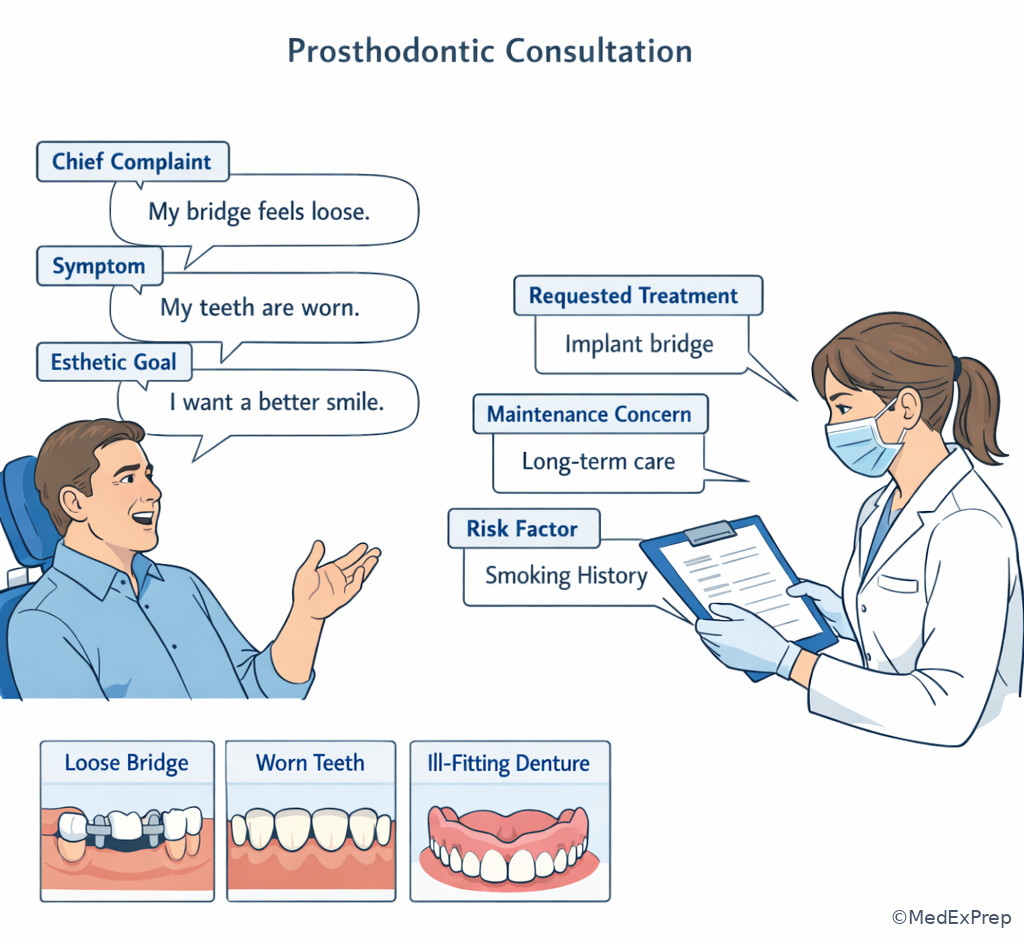
1.1.1.5 Separating findings, diagnoses, risks, and referral triggers
A Explanation
The third decision conflict is: When you observe something important, is it a finding, a diagnosis, a risk factor, or a referral trigger? The rule is that each serves a different purpose in reasoning. Findings are raw observations. Diagnoses interpret those findings. Risks modify prognosis or design. Referral triggers mark boundaries of prosthodontic scope or sequence. Many wrong answers happen because candidates try to solve a referral-trigger problem with a prosthodontic restoration.
For example, “generalized bleeding on probing” is a finding; “active periodontal instability affecting abutment prognosis” is a problem/diagnostic synthesis; “history of bisphosphonate use” is a medical risk modifier; “suspicious radiolucency of uncertain origin” is a referral trigger. Similarly, “fractured cusp” may be a finding, while “questionable remaining tooth structure for predictable fixed abutment use” is the problem-list wording that matters in prosthodontics. This distinction keeps your role appropriate: you integrate, stage, and refer as needed rather than drifting into independent management of another specialty’s core disease process.
WHY THIS IS TESTED: ABP-style cases reward scope awareness. The correct prosthodontic answer is often “obtain consultation/complete disease control before definitive planning,” not “proceed with the restoration I know best.”
B Worked example
A 60-year-old woman seeks replacement of a fractured maxillary anterior bridge before an upcoming family event. She has osteoporosis treated medically, a history of treated periodontitis, and moderate anxiety about “losing more teeth.” Examination reveals mobility on one terminal abutment, bleeding around several posterior teeth, and a poorly defined apical radiolucency on a heavily restored canine. A small midline diastema, which she dislikes, is a tempting esthetic distraction.
Reasoning chain: Identify task: sort observations into problem-list items and decide what requires coordination before definitive planning. Extract key facts: abutment mobility, inflammatory signs, questionable apical lesion, esthetic concern, upcoming event pressure. Apply rule: mobility and periodontal activity affect abutment prognosis; uncertain apical pathology is a referral/clarification trigger; diastema is esthetic but not sequence-dominant. Eliminate distractors: rushing to fabricate a new anterior FDP addresses the patient’s event but ignores the finding that may change whether the canine is even a usable abutment. Verify: the correct synthesis includes questionable abutment prognosis, possible endodontic or structural compromise requiring further evaluation, and need for provisional esthetic management rather than immediate definitive replacement.
C Exam trap
D Checkpoint
Question: During intake for complex rehabilitation, which item is best classified as a referral trigger rather than simply a problem-list diagnosis?
- Loss of posterior support with supraeruption risk
- Generalized attrition with suspected parafunctional loading
- Ill-defined radiolucent area adjacent to a potential abutment of uncertain significance
- Defective margins on multiple full-coverage restorations
Answer: C
- A: Tempting because it changes treatment sequence; wrong because it remains a prosthodontic diagnosis/problem rather than a clear referral trigger.
- B: Tempting because parafunction may need broader management; wrong because it is still primarily a prosthodontic risk/problem at this stage.
- C: Tempting because it might seem like just another radiographic finding; right because uncertain pathology affecting an abutment requires further evaluation before definitive planning.
- D: Tempting because multiple defective margins can feel urgent; wrong because they are prosthodontic findings/problems, not automatically a referral trigger.
Exam takeaway: The planning consequence of an observation determines whether you treat, monitor, or coordinate before proceeding.
flowchart TD
A[Observation] --> B{What does it do?}
B -->|Describes what you see| C[Finding]
B -->|Interprets condition affecting care| D[Diagnosis/problem]
B -->|Modifies prognosis/design| E[Risk factor]
B -->|Requires outside evaluation first| F[Referral trigger]
F --> G[Delay definitive prosthodontics until clarified]
See Fig 3 for the classification rule that prevents scope drift.
1.1.1.6 Application in board-style scenarios: from narrative complaint to ranked synthesis
A Explanation
At this stage, the tested conflict becomes more practical: Which single finding or rule should control your answer when a stem is cluttered with noise? The answer is to search for the governing prosthodontic limiter—the one detail that most strongly affects prognosis, sequence, or design feasibility. In foundational diagnostic cases, that limiter is often one of four things: uncontrolled biologic risk, questionable support/restorability, maintenance infeasibility, or expectation mismatch. Once you identify it, the rest of the problem list becomes easier to rank.
Noise in stems may include finances, deadlines, cosmetic requests, old treatment recommendations, or isolated esthetic details. These matter, but they do not outrank the governing limiter. If a patient wants a fixed full-arch restoration but has severe dexterity limitation and nonadherence history, maintenance feasibility becomes a major problem-list item. If the patient wants a conservative remake of existing crowns but lacks posterior support and shows heavy parafunction, the functional risk may be the limiter. If the patient wants “whiter teeth” but multiple abutments are questionable, structure outranks shade.
WHY THIS IS TESTED: Board questions reward disciplined synthesis under noise. The best candidate does not mention every fact equally; they identify the one that changes the answer.
B Worked example
A 55-year-old attorney requests replacement of several discolored crowns before a public speaking event in 8 weeks. He has GERD, nocturnal bruxism, and a strong preference for “the most durable esthetic material.” Clinical exam shows shortened clinical crowns, posterior wear, multiple crowns with open margins, and a history of repeated nightguard fracture. He is highly motivated and has excellent finances, which is a deliberate distractor.
Reasoning chain: Identify task: move from complaint to a prioritized problem list. Extract key facts: esthetic deadline, bruxism, wear, shortened crowns, failing margins, repeated appliance fracture. Apply rule: find the governing limiter. Here it is functional/structural risk, not finances or material preference. Eliminate distractors: choosing a premium ceramic system or full-mouth definitive esthetic remake now is tempting because of the deadline and finances, but it ignores loss of predictable support and parafunctional load. Verify: the initial problem list should prioritize occlusal risk and structural compromise of existing units, then esthetic dissatisfaction and deadline management, likely with provisional or staged solutions.
C Exam trap
D Checkpoint
Question: A 62-year-old patient requests “a fast cosmetic redo.” She has well-controlled diabetes, severe dry mouth after radiation therapy, and difficulty cleaning under existing fixed prostheses. Which is the governing limiter most likely to control the initial problem list?
- Shade dissatisfaction
- Maintenance feasibility in a xerostomic high-risk environment
- Desire for fixed restorations
- Need for immediate material selection
Answer: B
- A: Tempting because the case is framed cosmetically; wrong because shade does not control prognosis as strongly as dry-mouth-related maintenance risk.
- B: Tempting because it may feel less exciting than esthetics; right because hygiene difficulty plus xerostomia can determine whether the planned prosthesis is sustainable at all.
- C: Tempting because fixed treatment is a common patient request; wrong because preference is not the primary limiter.
- D: Tempting because material choice matters in comprehensive care; wrong because material selection follows diagnosis and problem ranking.
- Fill in the blank: In noisy stems, the best first question is “What detail most changes prognosis or sequence?”
- True or False: High motivation and strong finances can override poor maintenance feasibility. False.
- Name the four common limiters: biology, support, maintenance, expectations.
| Noisy stem feature | Why it distracts | What usually matters more | Better problem-list phrasing |
|---|---|---|---|
| Patient asks for implants | Sounds like a clear solution | Support, bone/restorability context, maintenance burden | Compromised support and prosthesis failure requiring evaluation of replacement options |
| Cosmetic deadline | Pushes urgency | Biologic control and support prognosis | Esthetic dissatisfaction with need for provisional management pending definitive diagnosis |
| High finances | Makes complex care seem feasible | Whether the patient can maintain and biologically tolerate it | Complex reconstruction desire limited by maintenance/prognosis factors |
| Prior outside recommendation | Creates authority bias | Your current diagnostic synthesis | Need to confirm current diagnosis before adopting prior plan |
| Single esthetic complaint | Feels patient-centered to address first | Structural, occlusal, or disease drivers beneath it | Esthetic concern secondary to foundational biologic/functional issues |
Exam takeaway: Visual ranking by urgency, prognosis, and sequence helps defend why one problem comes before another.
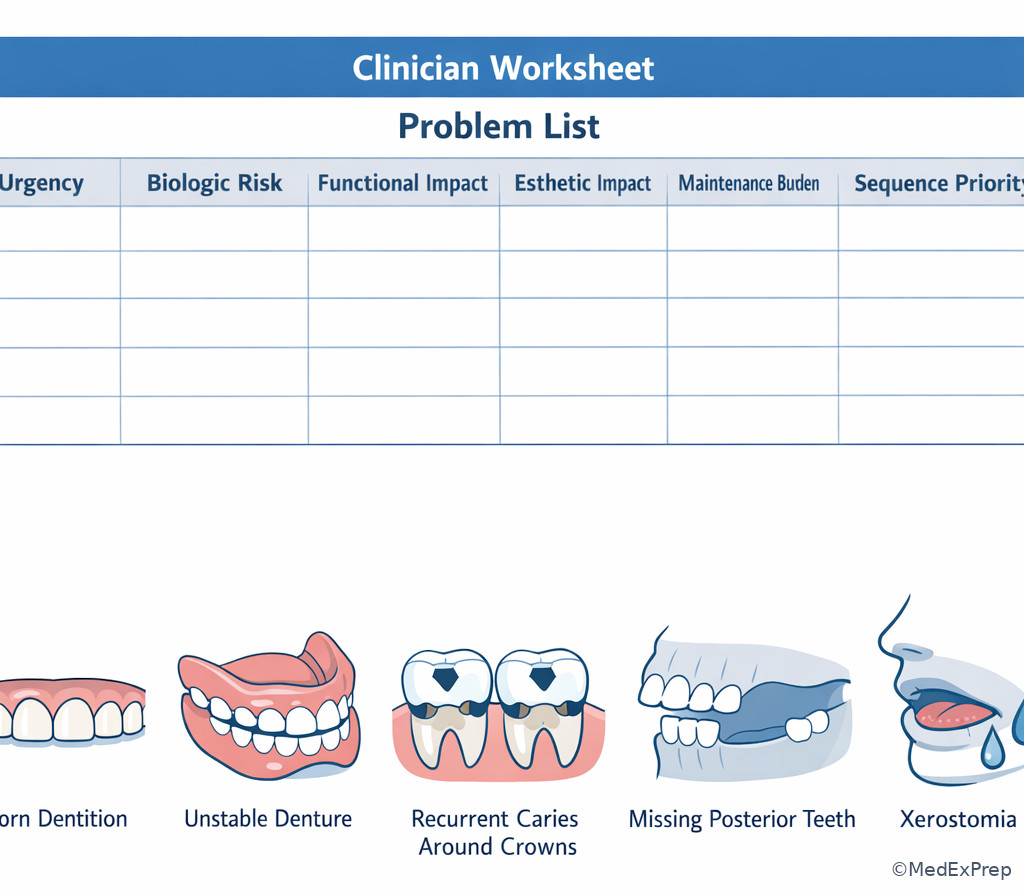
See Fig 4 for a visual model of how ranking logic becomes a defensible worksheet.
1.1.1.7 Integration: expectation alignment, maintenance burden, and provisional planning
A Explanation
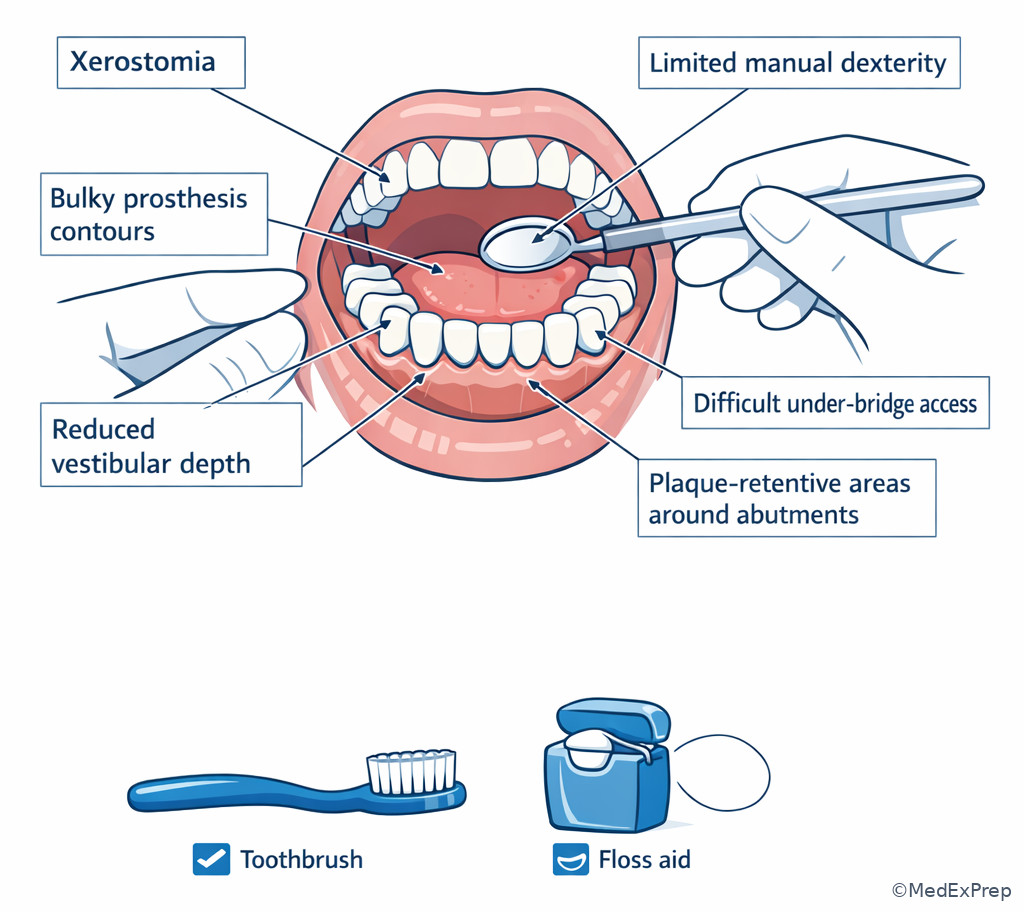
The last major foundational integration step is deciding: When does the complaint itself become a problem because expectations or maintenance demands are unrealistic? The rule is that expectation mismatch and maintenance infeasibility are legitimate problem-list items when they materially affect consent, design choice, or long-term prognosis. Many candidates remember biologic and structural items but forget to document that a patient wants a low-maintenance, highly esthetic, fixed reconstruction while also having severe dexterity limitation, dry mouth, or low tolerance for maintenance visits. That mismatch is not a soft issue; it is central to defensible treatment planning.
Similarly, provisional care may be the best response to the complaint even when the patient wants a final answer immediately. A problem list that includes “need for provisional improvement while definitive prognosis is clarified” is often stronger than forcing a premature irreversible solution. In prosthodontics, the best answer may be a staged plan that controls disease, tests esthetics, evaluates function, and assesses patient adaptation before committing to definitive treatment.
WHY THIS IS TESTED: Examiners want to see whether you can resist overtreatment and incorporate informed consent, maintenance burden, and adaptation into the diagnostic phase. This is especially important in elderly, medically complex, xerostomic, parafunctional, or dexterity-limited patients.
B Worked example
An 80-year-old woman seeks “permanent teeth that I never have to remove again.” She lives independently but has hand arthritis, mild cognitive decline, Sjögren-related dry mouth, and a history of breaking partial dentures. Her daughter reports poor adherence with home care. Examination reveals generalized wear, several retained roots, reduced vestibular depth, and dissatisfaction with appearance in the social smile. The tempting wrong clue is that she strongly rejects removable options.
Reasoning chain: Identify task: write the integrated problem list and identify the best planning direction. Extract key facts: dexterity limitation, cognitive decline, xerostomia, repeated prosthesis breakage, retained roots, reduced anatomy, fixed-only expectation. Apply rule: expectation mismatch and maintenance infeasibility are true problems, not background details. Eliminate distractors: a fixed full-arch concept may match her preference, but not necessarily her maintenance ability or anatomic constraints. Verify: the problem list must include unrealistic fixed-only expectations, high maintenance burden due to dry mouth and dexterity limits, structural/disease issues from retained roots, and functional instability history. A staged approach with expectation counseling and maintainability-focused options is more defensible than immediate definitive fixed conversion.
C Exam trap
D Checkpoint
Question: Which statement is the best problem-list entry in a patient who demands a fixed full-arch solution despite severe xerostomia, poor hygiene, and limited dexterity?
- Patient desires fixed treatment
- Need for immediate implant consultation
- Expectation mismatch and high maintenance burden likely to compromise long-term prosthodontic success
- Unsuitable personality for definitive rehabilitation
Answer: C
- A: Tempting because it reflects patient preference; wrong because it does not capture the planning consequence of the case.
- B: Tempting because implant pathways may be considered; wrong because it jumps to a treatment path without stating the core problem.
- C: Tempting because it sounds broader than the complaint; right because it explicitly identifies the mismatch and maintenance risk affecting plan defensibility.
- D: Tempting because frustration with patient demands is real; wrong because it is nonclinical, imprecise, and not an acceptable prosthodontic problem statement.
Exam takeaway: When the requested option exceeds maintainability, write the mismatch as a problem and stage care.
flowchart TD
A[Patient requests ideal solution] --> B{Biology and support acceptable?}
B -->|No| C[Stabilize disease and reassess]
B -->|Yes| D{Can patient maintain it?}
D -->|No| E[Add maintenance burden to problem list]
E --> F[Discuss alternatives and staged care]
D -->|Yes| G{Expectations realistic?}
G -->|No| H[Add expectation mismatch to problem list]
G -->|Yes| I[Proceed to definitive planning]
See Fig 5 when deciding whether a requested “ideal” plan is actually maintainable and consentable.
Exam takeaway: Visualizing xerostomia, dexterity limits, and cleansability barriers helps explain why maintenance burden belongs in the problem list.
Exam takeaway: The side-by-side visual reinforces that treatment requests must be translated into biologic and functional problems.
Exam Traps & Differentiators
Most common wrong answer and why: Choosing a treatment modality directly from the chief complaint. This is tempting because the patient’s request is concrete and memorable, while the actual diagnostic synthesis requires slowing down and reclassifying facts.
| Looks similar | But it is not | Single differentiator |
|---|---|---|
| “I want implants” | A definitive problem list | It states a preferred treatment, not the underlying functional or biologic issue |
| Generalized wear | Automatically a treatment plan | You still need to state whether wear changes support, VDO reasoning, or failure risk |
| Poor esthetics | The top-ranked problem in every case | Biologic instability, non-restorability, or maintenance barriers may outrank it |
| Questionable radiolucency near an abutment | Just another finding | Uncertain pathology may require consultation before definitive planning |
| Patient refusal of removable treatment | A reason to ignore maintainability | Expectation mismatch itself becomes a problem-list item |
If the stem says...
- “I want implants” → think requested solution, not diagnosis.
- “I need a fast cosmetic fix before an event” → think provisional versus definitive sequence.
- “She cannot clean under current restorations” → think maintenance burden may control the plan.
- “There is a questionable radiographic finding” → think clarify feasibility before definitive prosthodontics.
- “He wants fixed no matter what” → think expectation mismatch if biology or maintenance disagree.
- “Outside consultant already recommended treatment” → think rebuild your own problem list from current findings.
Exam takeaway: Each distractor has a predictable pivot point that returns you to diagnosis, ranking, and sequence.
flowchart LR
A[Patient request] --> B[Clarify goal]
C[Esthetic deadline] --> D[Consider provisional phase]
E[Prior recommendation] --> F[Rebuild from current findings]
G[Financial readiness] --> H[Still test maintainability]
I[Questionable pathology] --> J[Clarify before definitive care]
See Fig 6 for the standard pivots that rescue you from common distractors.
Algorithm / Approach
Rapid Review
- Chief complaint → patient wording, not clinician diagnosis
- Requested treatment → never substitute for the problem list
- Top-ranked problem → the item that changes sequence first
- Finding → observed fact; not yet the full planning consequence
- Risk factor → modifies prognosis or design even if not the chief complaint
- Referral trigger → uncertain pathology or specialty issue that must be clarified before definitive care
- Esthetic complaint → important, but not automatically first
- Maintenance burden → can defeat an otherwise elegant design
- Expectation mismatch → legitimate problem-list item when it affects consent or sustainability
- Noisy vignette → find the governing limiter: biology, support, maintenance, or expectations
- Good problem wording → mechanism plus planning consequence
- Outside recommendation → data point, not your diagnosis
- Deadline case → think provisional first if prognosis is not yet clear
- Best board answer → staged and maintainable beats idealized and premature
Self-check quiz
1.1.1.8 Question 1
A 63-year-old man presents stating, “I want implants instead of this loose lower denture.” He has controlled hyperlipidemia and mild xerostomia. Examination shows an unstable mandibular complete denture and heavy plaque. What is the most appropriate interpretation of “I want implants” at this stage?
- It is the definitive diagnosis
- It is a requested treatment preference
- It is an objective finding
- It is the final treatment plan
1.1.1.9 Question 2
A 70-year-old woman reports, “My bridge broke and I need a prettier smile.” She has osteoarthritis limiting flossing and recurrent decay around several crowns. Which problem should generally be ranked highest initially?
- Esthetic dissatisfaction
- Desire for fixed treatment
- Recurrent decay affecting abutment prognosis
- Shade mismatch of the existing crowns
1.1.1.10 Question 3
A 58-year-old woman requests a maxillary full-arch fixed implant prosthesis because “I never want a denture again.” She has Sjögren-related dry mouth, poor plaque control, and limited hand dexterity after stroke. A prior consultant told her she is “probably a candidate.” What is the most appropriate next step in prosthodontic reasoning?
- Accept the fixed request as the chief diagnostic problem and begin implant planning
- Document expectation mismatch and maintenance burden as core problem-list items before selecting a definitive design
- Reject all implant options immediately because xerostomia is an absolute contraindication
- Select the material system first because maintenance is mostly a hygiene instruction issue
1.1.1.11 Question 4
A 61-year-old man presents for replacement of a failing anterior FDP before his daughter’s wedding in 6 weeks. He has bruxism, controlled reflux, and one abutment with mobility and a questionable periapical radiolucency. Which is the most appropriate initial prosthodontic approach?
- Proceed directly with a definitive replacement FDP because the deadline is short
- List questionable abutment prognosis and need for further evaluation as priority problems, with provisional esthetic management if needed
- Ignore the radiographic uncertainty because the chief complaint is esthetic
- Plan extraction and immediate full-arch implant conversion based only on anterior bridge failure
1.1.1.12 Question 5
A 67-year-old patient says, “I just want my teeth whiter.” He has severe posterior wear, fractured porcelain on two crowns, and repeated nightguard fractures. Which single factor most likely serves as the governing limiter for the initial problem list?
- Shade dissatisfaction
- Functional and biomechanical risk from parafunction
- Age over 65 years
- Desire for rapid cosmetic treatment
1.1.1.13 Question 6
A 76-year-old woman wants “permanent teeth” and refuses removables. She has rheumatoid arthritis, moderate cognitive decline, xerostomia, two retained roots, and a history of breaking prostheses. Her daughter says she misses hygiene appointments. Which problem-list entry most requires immediate clarification because it directly challenges the defensibility of an idealized fixed plan?
- Patient preference for a fixed prosthesis
- Expectation mismatch combined with high maintenance burden
- Advanced age alone
- History of prior prosthesis dissatisfaction alone
1.1.1.14 Question 7
A 59-year-old man seeks comprehensive rehabilitation. He has controlled diabetes, generalized wear, a missing mandibular first molar, and one heavily restored canine with an ill-defined apical radiolucency. He says the missing tooth is “the whole problem.” Which is the most appropriate classification of the radiographic issue in the current diagnostic stage?
- Aesthetic complaint
- Treatment option
- Referral trigger requiring clarification before definitive prosthodontics
- Minor finding with no effect on sequence
1.1.1.15 Question 8
A 65-year-old man presents with a loose posterior bridge and asks for implants. He has Parkinson disease, poor plaque control, xerostomia, and limited manual dexterity. The bridge abutment has recurrent decay, and the patient strongly prefers fixed treatment because his spouse disliked dentures. Which is the most appropriate ranked synthesis?
- Patient preference for fixed treatment first; implant planning second; hygiene concerns third
- Compromised abutment/disease control first; maintenance feasibility and dexterity limits second; replacement preference and modality discussion after that
- Implants first because removable options are emotionally unacceptable
- Esthetic considerations first because the patient is embarrassed by the loose bridge
Answer key
1.1.1.16 Question 1 Answer: B
Correct-answer logic: “I want implants” expresses a treatment preference. The mechanism-to-treatment logic is that diagnosis must precede modality selection; the complaint must be translated into functional, biologic, and maintenance problems before any definitive treatment is chosen.
- A: Tempting because patients often frame the visit around the solution they want. Incorrect because a diagnosis explains the underlying prosthodontic problem; the discriminating clue is that the phrase names a modality, not a condition.
- B: Tempting because it may seem too simple. Correct because the stem gives a requested treatment rather than a diagnostic synthesis; the key clue is the wording “I want implants.”
- C: Tempting because the statement comes directly from the patient interview. Incorrect because an objective finding must be clinician-observed, such as instability or plaque.
- D: Tempting because the visit may ultimately lead to implant discussion. Incorrect because a final treatment plan requires a complete problem list and diagnostic confirmation first.
Source: Zarb and Hobkirk; Rosenstiel, Land, and Fujimoto; ACP position-oriented treatment planning principles.
1.1.1.17 Question 2 Answer: C
Correct-answer logic: Recurrent decay affecting abutment prognosis is a biologic and structural problem that changes sequence and feasibility. That outranks esthetic dissatisfaction because definitive esthetic care depends on stable support.
- A: Tempting because the patient mentions a prettier smile. Incorrect because esthetics does not outrank recurrent decay affecting support in the initial ranking; the discriminating clue is abutment-related disease.
- B: Tempting because fixed treatment is a common desire. Incorrect because preference is not the main biologic limiter in the stem.
- C: Tempting because it sounds less patient-centered than esthetics. Correct because recurrent decay directly threatens prognosis and must be addressed before definitive design.
- D: Tempting because shade mismatch can be visibly important. Incorrect because color discrepancy does not control sequence like decay and abutment compromise do.
Source: Rosenstiel, Land, and Fujimoto; Shillingburg et al.; Stewart’s Clinical Removable Partial Prosthodontics for ranking biologic and support issues before esthetic refinement.
1.1.1.18 Question 3 Answer: B
Correct-answer logic: Xerostomia, poor plaque control, and limited dexterity create a maintenance-heavy environment. The correct next prosthodontic move is to include expectation mismatch and maintenance burden in the problem list before choosing a definitive prosthesis. Mechanistically, a technically possible restoration may still be the wrong answer if the patient cannot maintain it.
- A: Tempting because the patient strongly prefers fixed treatment and already has an outside recommendation. Incorrect because preference and prior recommendation do not replace diagnostic synthesis; the key clue is severe maintenance limitation.
- B: Tempting because it delays what the patient wants. Correct because maintenance feasibility and expectation alignment are central diagnostic problems in this stem.
- C: Tempting because xerostomia clearly worsens prognosis. Incorrect because xerostomia is not an absolute contraindication to every implant option; the discriminating clue is that the question asks for the next reasoning step, not absolute exclusion.
- D: Tempting because material selection is important in implant prosthodontics. Incorrect because design and material follow the problem list; they do not solve poor maintenance capacity by themselves.
Source: Carlsson and Omar on prosthodontic maintenance considerations; Misch for implant prosthodontic planning logic; ACP treatment-planning principles emphasizing patient factors and hygiene feasibility.
1.1.1.19 Question 4 Answer: B
Correct-answer logic: The abutment mobility and questionable periapical finding create uncertainty about support prognosis. The correct reasoning is to prioritize abutment evaluation and, if necessary, provisional esthetic management rather than rushing into a definitive bridge because of the deadline.
- A: Tempting because the wedding creates time pressure. Incorrect because the discriminating clue is uncertain abutment prognosis, which can invalidate the definitive plan.
- B: Tempting because it seems slower and less satisfying. Correct because it matches the prosthodontic sequence: clarify support first, use provisional esthetic care if needed.
- C: Tempting because the chief complaint is anterior esthetics. Incorrect because esthetic urgency does not eliminate the need to clarify a potentially nonviable abutment.
- D: Tempting because anterior failure may invite a more radical “definitive” solution. Incorrect because the stem does not justify full-arch conversion and still contains unresolved diagnostic uncertainty.
Source: Rosenstiel, Land, and Fujimoto; Shillingburg et al.; prosthodontic sequence principles in authoritative fixed prosthodontic texts.
1.1.1.20 Question 5 Answer: B
Correct-answer logic: Repeated nightguard fractures, severe posterior wear, and fractured porcelain indicate parafunctional biomechanical overload. That functional risk is the governing limiter because it shapes prognosis and the type of restorative plan that can succeed.
- A: Tempting because the patient asked for whiter teeth. Incorrect because shade dissatisfaction does not explain repeated fractures and wear; the discriminating clue is parafunctional evidence.
- B: Tempting because it shifts away from the patient’s stated cosmetic goal. Correct because biomechanical risk is the strongest determinant of durable treatment planning in this stem.
- C: Tempting because older patients may have more wear. Incorrect because age alone does not control the answer; the specific functional signs do.
- D: Tempting because time pressure often influences treatment. Incorrect because the rapid-cosmetic desire is noise compared with direct evidence of overload.
Source: Dawson; Okeson for occlusal and parafunctional implications; Rosenstiel, Land, and Fujimoto for biomechanical planning consequences.
1.1.1.21 Question 6 Answer: B
Correct-answer logic: The key issue is not simply that the patient wants fixed treatment; it is that her desire conflicts with severe maintenance limitations and reduced reliability. Mechanistically, long-term prosthodontic success depends on maintainability as much as on initial design.
- A: Tempting because the patient strongly refuses removables. Incorrect because preference alone does not explain why the idealized fixed plan may be indefensible; the key clue is the combined maintenance burden.
- B: Tempting because it sounds broader than a conventional dental diagnosis. Correct because expectation mismatch plus high maintenance burden directly challenges prognosis and informed consent.
- C: Tempting because elderly patients often have more complex care. Incorrect because age itself is not the discriminator; the functional and maintenance limitations are.
- D: Tempting because repeated dissatisfaction predicts future challenges. Incorrect because dissatisfaction alone is less decisive than the actual inability to maintain complex care.
Source: Carlsson and Omar; ACP prosthodontic planning principles; geriatric prosthodontic texts emphasizing maintainability and realistic expectations.
1.1.1.22 Question 7 Answer: C
Correct-answer logic: An ill-defined apical radiolucency adjacent to a potential abutment is not just an incidental finding; it is a referral or clarification trigger because it may alter whether the tooth can serve in the prosthodontic plan. The mechanism is support uncertainty, which directly affects feasibility.
- A: Tempting because the patient may also have cosmetic issues in a comprehensive case. Incorrect because the radiographic issue is not esthetic in nature.
- B: Tempting because eventual treatment options may depend on the tooth. Incorrect because the radiolucency is a diagnostic concern, not a treatment option.
- C: Tempting because it may feel conservative to delay. Correct because uncertain pathology affecting a potential abutment must be clarified before definitive prosthodontics.
- D: Tempting because one lesion can seem secondary to the missing molar. Incorrect because the discriminating clue is that a potential abutment has uncertain status, which changes sequence.
Source: Rosenstiel, Land, and Fujimoto; Shillingburg et al.; interdisciplinary treatment-planning principles for abutment evaluation.
1.1.1.23 Question 8 Answer: B
Correct-answer logic: The bridge abutment with recurrent decay represents disease and support compromise. Parkinson disease, xerostomia, and limited dexterity create major maintenance barriers. Therefore, the defensible ranked synthesis starts with compromised abutment/disease control, then maintainability, and only after that discusses replacement modality and patient preference.
- A: Tempting because the patient strongly prefers fixed care. Incorrect because preference does not outrank disease control and maintainability; the discriminating clue is recurrent decay plus severe hygiene limitations.
- B: Tempting because it delays the modality discussion. Correct because it correctly ranks the case by biologic threat first and patient feasibility second.
- C: Tempting because the patient dislikes removable prostheses and the bridge is loose. Incorrect because implant planning before controlling disease and assessing maintainability is premature.
- D: Tempting because embarrassment may drive treatment seeking. Incorrect because esthetics is not the top-ranked issue when abutment decay and dexterity-limited hygiene dominate prognosis.
Source: Stewart’s Clinical Removable Partial Prosthodontics; Rosenstiel, Land, and Fujimoto; prosthodontic comprehensive treatment-planning texts emphasizing maintenance burden and abutment prognosis.
Keep going with the full Prosthodontics Board Prep Course (Prosth)
You just studied the way members do, in the same lesson interface. Full access unlocks every lesson, the question bank and flashcards for a full year.
One payment · 1 year of access · No auto-renewal