1.1.1 - Early Communication Milestones
Early Communication Milestones
What you'll learn
- D1: Foundations of communication/swallowing and related processes -> Describe typical prelinguistic and early language developmental sequences.
- D2: Communication and swallowing disorders across the lifespan -> Recognize patterns suggesting delayed, atypical, or disordered early communication.
- D3: Assessment, differential considerations, and diagnosis -> Select high-yield observations and case-history clues to interpret early milestones.
- D4: Intervention, management, and counseling -> Recommend appropriate early supports, caregiver coaching priorities, and next steps.
- D5: Professional practice, ethics, and collaboration -> Distinguish when to monitor, when to evaluate, and when to refer to other professionals.
- D1 Foundations → Typical developmental sequence from social reciprocity to symbolic communication
- D2 Disorders → Early delay versus red-flag presentation
- D3 Assessment/Diagnosis → Milestone interpretation using case history, observation, and caregiver report
- D4 Intervention/Management → Early targets for joint attention, gesture, play, comprehension, and first words
- D5 Professional Practice/Ethics → Collaboration, referral, and culturally responsive interpretation
Why it matters
- Praxis items often ask for the best interpretation of a toddler's profile or the most appropriate next step when milestones are late, uneven, or absent.
- Early communication is a classic development vs disorder testing area: one missing skill may justify monitoring, but a pattern of absent social communication skills changes the decision.
- Entry-level SLP candidates must know what they can assess within scope and when to recommend audiology, developmental, medical, or early intervention referral.
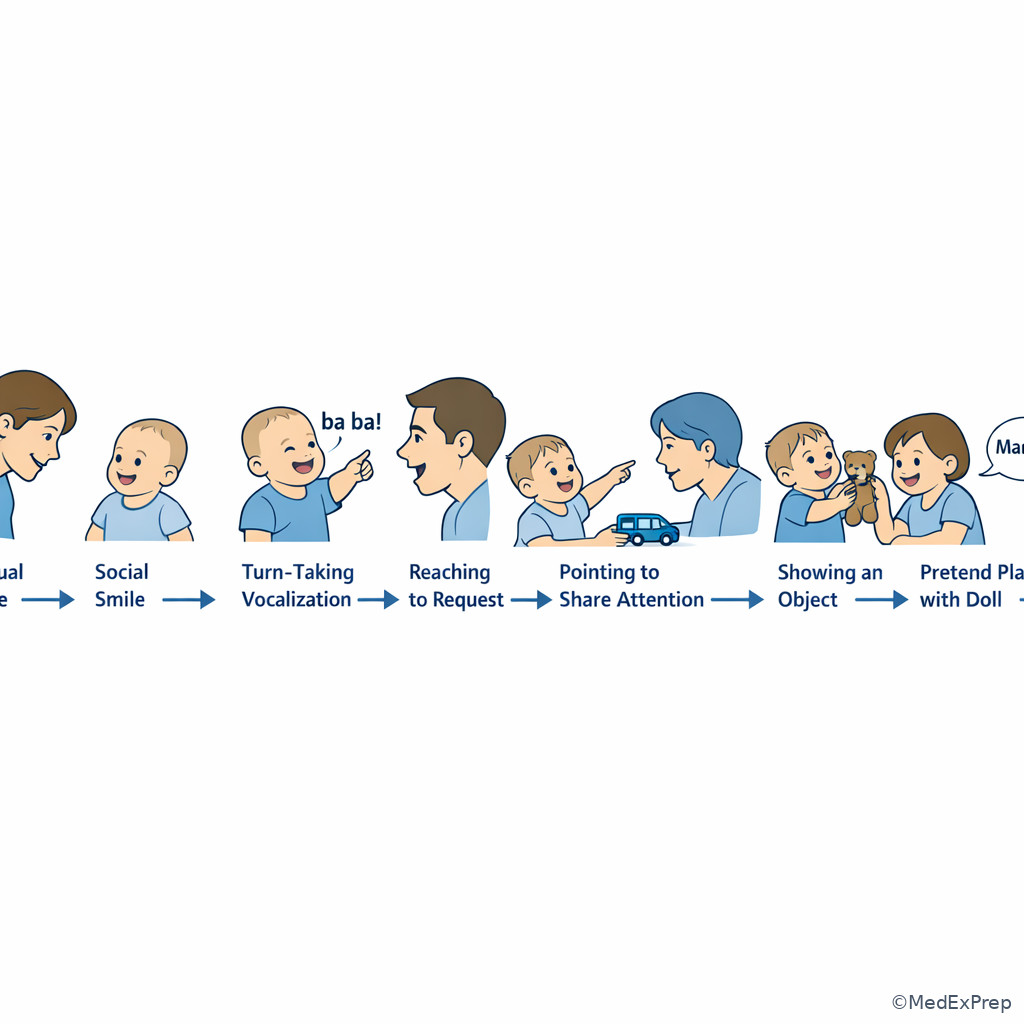
- Mastering milestone sequences makes later topics easier, especially speech sound development and early morphosyntax. See Fig 1.
Key Terms & Must-Know Facts
1.1.1.1 Key terms
- Prelinguistic communication: Communication before conventional words, including eye gaze, affect, gestures, and vocalizations.
- Joint attention: Shared focus between child and partner on an object or event.
- Social reciprocity: Back-and-forth engagement such as smiling, turn-taking, and response to interaction.
- Canonical babbling: Well-formed consonant-vowel syllables such as “bababa.”
- Protodeclarative gesture: Gesture used to share interest, such as pointing to show.
- Protoimperative gesture: Gesture used to request, such as reaching or pointing to obtain.
- Symbolic play: Using objects or actions representationally, such as pretending to feed a doll.
- Receptive language: Understanding words, directions, routines, and messages.
- Expressive language: Communication output through gestures, vocalizations, signs, words, or combinations.
- Intentional communication: Purposeful behavior directed toward a communication partner to affect another person.
- Gesture-word combination: Early multimodal combination such as pointing plus “dog.”
- Language difference: Variation due to bilingual exposure, dialect, or cultural communication pattern; not a disorder by itself.
- Red flag: A finding that raises concern for atypical development and changes the urgency of referral or evaluation.
1.1.1.2 Must-know facts
- Communication starts before first words; absent gestures and poor social reciprocity are more concerning than “late talking” alone.
- Receptive skills typically precede expressive skills.
- Pointing to share interest is more developmentally informative than isolated labeling.
- Lack of response to sound or name requires hearing consideration, even if the child vocalizes.
- Bilingual exposure does not cause language disorder.
- An isolated milestone delay is interpreted differently from a cluster of missing social, play, receptive, and expressive skills.
- Caregiver report is essential, but direct observation of interaction often reveals the deciding clue.
- Loss of previously acquired communication skills is a stronger concern than slow but steady progress.
Exam takeaway: Move from social engagement to joint attention to symbolic language when deciding whether a profile is on track.
flowchart LR
A[Social reciprocity
smiles turns to voice] --> B[Intentional communication
reaches protests requests]
B --> C[Gestures and joint attention
points shows gives]
C --> D[Canonical babble and sound play]
D --> E[First words with meaning]
E --> F[Word combinations and symbolic play]
Exam takeaway: Watch how eye gaze, turn-taking, gesture, and play build the foundation for later words.
Core content
1.1.1.3 Foundational sequence: from social engagement to intentional communication
A Explanation
The first exam conflict is usually choose typical variation vs choose early concern. The resolving rule is this: communication begins with social engagement and intentionality, not with spoken words. A child who is not yet talking but shows strong eye gaze, social smile, turn-taking, anticipation, reaching, giving, and clear communicative intent is different from a child with few words and weak reciprocity or minimal intent.
WHY THIS IS TESTED: Exam items hide the deciding clue in behaviors that are easy to overlook because candidates focus too narrowly on vocabulary count. Praxis-style questions often mention a worried caregiver about “not talking yet,” but the better answer depends on whether prelinguistic skills are present.
Typical early communication moves from regulation and engagement to intentional acts directed toward another person. The SLP candidate should look for orientation to voice, smiling in interaction, back-and-forth vocal play, anticipation of routines, reaching to request, protesting, and using another person as a communication partner rather than only manipulating objects. See Fig 1. When a child uses adults mainly as tools, does not seek shared interaction, or rarely attempts to communicate intentionally, that pattern increases concern.
The exam-relevant choice is not “Does this child have a medical diagnosis?” but rather “What is the most appropriate SLP interpretation and next step?” Within SLP scope, you can document observed communication behaviors, interpret milestone patterns, counsel caregivers about language facilitation, and recommend hearing screening or broader developmental follow-up when indicated.
B Worked example
A 14-month-old child is seen in an outpatient clinic after pediatrician concern for “speech delay.” The child has a history of recurrent otitis media, attends daycare, and is exposed to Spanish at home and English in daycare. The caregiver reports only one clear word, but during play the child smiles, brings a toy to the parent, alternates gaze between a bubble jar and the clinician, reaches to request, and protests when a preferred toy is removed. A distractor detail is that the child does not imitate animal sounds on command.
Reasoning chain: Identify task: best interpretation of early communication profile. Extract key facts: one word only, but strong reciprocity, clear intentional communication, social engagement, and emerging joint attention. Apply rule: prelinguistic foundation matters more than isolated expressive word count. Eliminate distractors: bilingual exposure is not the cause of disorder; failure to imitate animal sounds alone is not decisive; recurrent otitis raises hearing concern but does not erase the strong communication base. Verify: most appropriate answer is to recognize relatively stronger prelinguistic skills with expressive concern, gather more receptive and hearing information, and consider monitoring/evaluation rather than assuming global impairment.
C Exam trap
D Checkpoint
Question: A 13-month-old with mild prematurity history and frequent childcare exposure uses no consistent spoken words. Which finding most strongly supports a decision to monitor communicative development closely but not treat the profile as immediately high concern for absent early communication foundations?
- He does not imitate clapping on request.
Tempting because imitation matters, but wrong because a single missed task is less informative than the broader interaction pattern. - He alternates gaze between a desired toy and his father while reaching and vocalizing.
Tempting because it may seem “too subtle,” but right because this shows intentional communication and emerging joint attention. - He prefers one stuffed animal over others during free play.
Tempting because preference suggests engagement, but wrong because object preference alone does not show communicative intent. - He resists transitioning away from bubbles at the end of the session.
Tempting because protest can involve communication, but wrong because isolated behavioral upset does not demonstrate shared communicative coordination.
Best answer: B
1.1.1.4 Joint attention, gesture, and play: the strongest early predictors
A Explanation
The next testable conflict is choose expressive delay alone vs choose broader social-communication concern. The single resolving rule is: gesture, joint attention, and symbolic play are high-yield discriminators. A child with few words but frequent pointing to show, giving, showing, shared enjoyment, and simple pretend play usually has a different profile from a child with few words plus absent pointing and limited shared attention.
WHY THIS IS TESTED: These nonverbal behaviors predict later language and help differentiate a straightforward late-talker profile from a more concerning communication pattern. On exams, the tempting wrong answer is to overvalue rote labeling, alphabet recitation, or isolated naming without noticing that the child rarely uses communication socially.
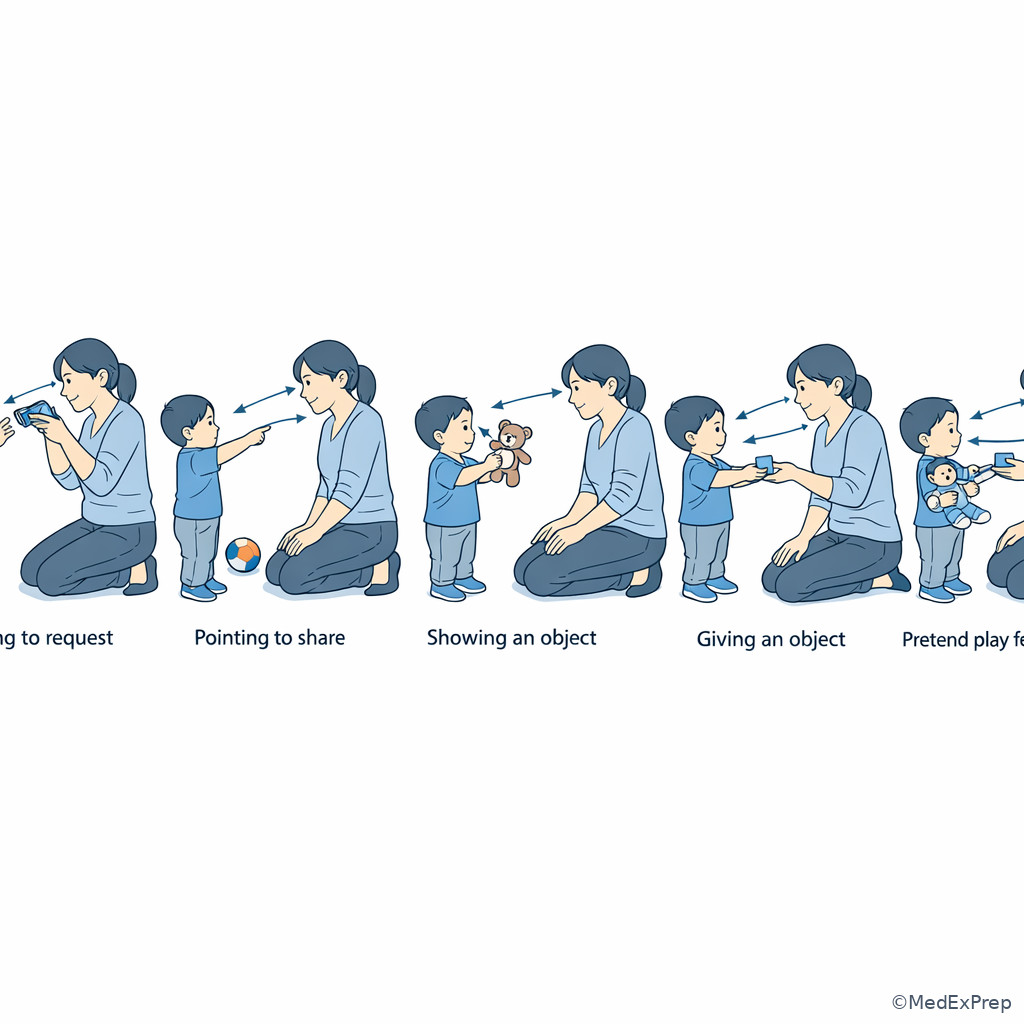
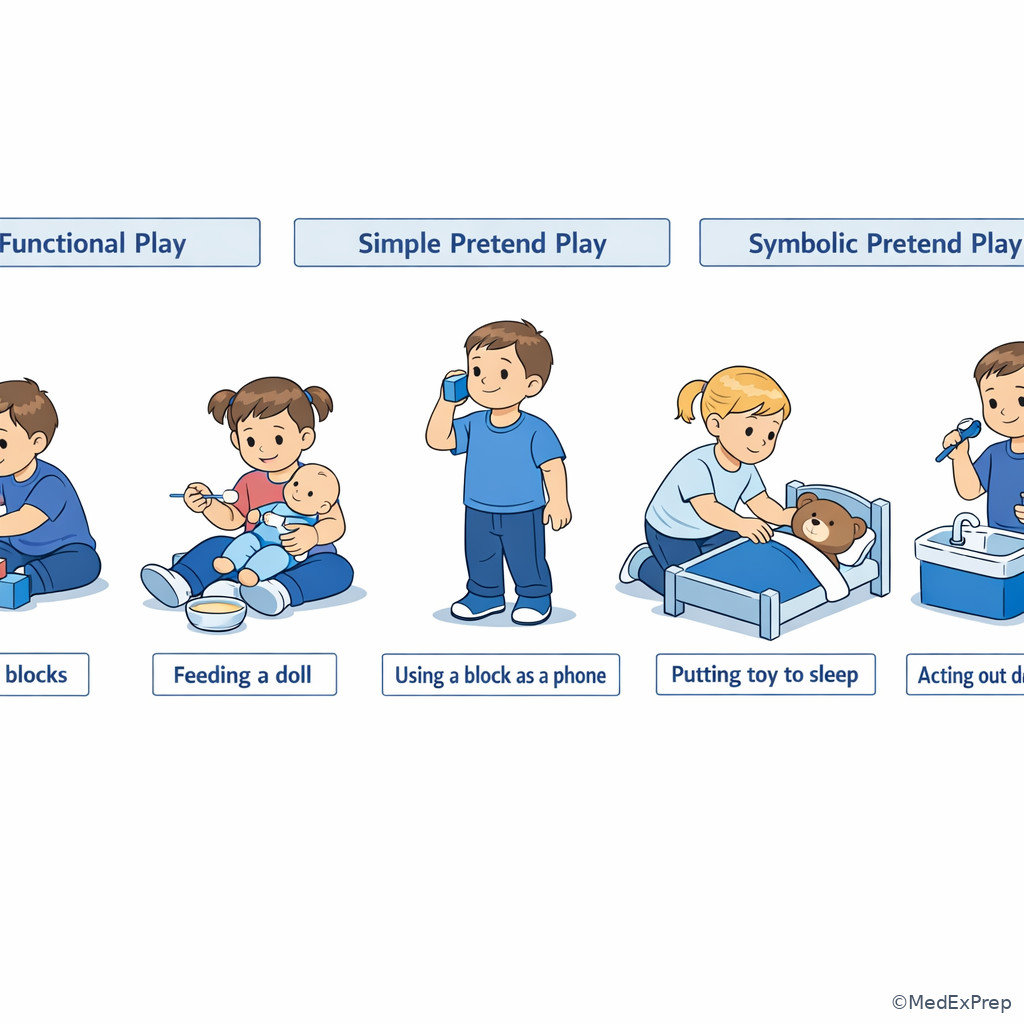
Joint attention includes responding to another person's bid and initiating a shared focus. Both matter. Pointing to request is helpful, but pointing to share interest is especially informative because it reflects social communication, not just instrumental behavior. Similarly, symbolic play signals representational thinking that supports language growth. Pretending to feed a doll, using a block as a phone, or acting out familiar routines suggests a stronger developmental foundation than repetitive object manipulation alone.
Choose gesture and play observations when a question asks what to assess next in a toddler with limited vocabulary. Reject answers that focus only on articulation precision, formal grammar, or academic language, which are later-developing concerns. See Fig 2.
Exam takeaway: Pointing to share, showing, and pretend play carry more diagnostic weight than isolated rote verbal output.
flowchart TD
A[Few spoken words] --> B{Are social gestures present?}
B -->|Yes| C[Check joint attention and pretend play]
C --> D[Likely stronger developmental base]
B -->|No| E[Concern for broader communication difference/disorder]
E --> F[Need fuller assessment and referral consideration] Exam takeaway: Differentiate requesting, showing, and shared attention because they guide interpretation of early profiles.
B Worked example
A 22-month-old in early intervention intake is described as “obsessed with letters.” She can label several letters and hum nursery tunes. She was born at term, has eczema, and recently started part-time preschool. The caregiver is concerned because she does not use many functional words, rarely points to show interesting things, and spends long periods lining up toys. She can pull an adult to desired objects. A tempting wrong clue is the presence of advanced letter labels.
Reasoning chain: Identify task: best interpretation of milestone pattern. Extract key facts: limited functional communication, reduced showing/pointing, repetitive play, adult-as-tool behavior, rote labels that inflate apparent language level. Apply rule: nonverbal social communication and play profile outweigh isolated rote verbal strengths. Eliminate distractors: knowing letters does not rule out communication concern; eczema is irrelevant; preschool entry alone does not explain the pattern. Verify: this profile warrants broader social-communication assessment rather than reassurance based on label knowledge.
C Exam trap
D Checkpoint
Question: A 19-month-old uses about five words. Which additional finding most strongly increases concern and supports a comprehensive communication evaluation rather than simple watchful waiting?
- He enjoys repetitive songs and anticipates the last word.
Tempting because uneven skills can worry candidates, but wrong because anticipation in shared routines can be a relative strength. - He points to request snacks but rarely points to show or share interest.
Tempting because pointing of any kind may seem reassuring, but right because the absence of shared-social pointing is the discriminating clue. - He uses animal sounds more often than real words.
Tempting because symbolic word use matters, but wrong because sound effects can still reflect emerging communication. - He prefers physical play to book sharing.
Tempting because book interest is often discussed in counseling, but wrong because play preference alone does not determine concern level.
Best answer: B
- The stronger nonverbal discriminator than isolated requesting is pointing to share interest.
- True or False: Rote labels automatically outweigh absent joint attention. False.
- Name the 3 key observational targets in toddlers with few words: gesture, joint attention, symbolic play.
1.1.1.5 Receptive, expressive, and multimodal language growth in the first years
A Explanation
The next exam conflict is choose expressive language delay only vs choose broader receptive-expressive concern. The rule that resolves it is: receptive language usually leads expressive language. A toddler with limited spoken output but good understanding of familiar words, routines, and simple directions has a different risk profile from a toddler with limited output and limited comprehension.
WHY THIS IS TESTED: Questions often hide the diagnosis or next-step decision in comprehension. Candidates commonly overfocus on the number of words produced and miss that poor understanding changes prognosis, urgency, and intervention planning. In clinical reasoning, “understands much more than says” tends to be less concerning than “does not reliably understand age-expected routine language.”
Early expressive language is multimodal. Spoken words matter, but so do signs, gestures, vocal approximations, word-like forms, and gesture-word combinations. A child who says few clear words but consistently uses signs or gestures with communicative intent may be farther along functionally than the raw word count suggests. Similarly, comprehension should be sampled through action-based tasks, routine-based directions, object identification, and caregiver report across contexts rather than one decontextualized test item.
As children approach the second year, vocabulary growth, functional word use, and early word combinations become highly relevant. However, the SLP candidate should avoid rigid cutoff thinking when the stem gives limited data. The better answer is usually based on patterns: trajectory, breadth of communicative functions, receptive support, and play/social profile. See Fig 3.
Exam takeaway: Low expressive output with stronger comprehension is not the same pattern as weakness in both systems.
flowchart TD
A[Limited spoken words] --> B{Understands routines and simple language?}
B -->|Yes| C[Profile may be primarily expressive or late-talker pattern]
B -->|No| D[Concern for broader language delay]
C --> E[Check gesture use and play]
D --> F[Prioritize comprehensive evaluation and early support] B Worked example
A 24-month-old boy is referred from daycare for “not talking much.” He has a history of prematurity, mild torticollis resolved in infancy, and a recent move between homes of divorced parents. He says about 20 single words inconsistently. During observation, he follows “give the ball to mom,” identifies body parts, brings books for shared reading, and uses gestures plus vocalizations to request help. A distracting detail is that his cousin of the same age speaks in short sentences.
Reasoning chain: Identify task: determine best interpretation and next priority. Extract key facts: limited expressive output, but clearly stronger receptive language and intentional multimodal communication. Apply rule: receptive strength suggests the profile is not the same as a broad receptive-expressive delay. Eliminate distractors: comparison to a cousin is not diagnostic; family stress can affect routines but does not by itself define disorder; prematurity history matters but current communication evidence is more informative. Verify: appropriate response is to document expressive concern, support intervention/monitoring as needed, and avoid overstating severity as global language impairment.
C Exam trap
D Checkpoint
Question: Which toddler profile most strongly suggests a broader receptive-expressive concern rather than an expressive-only pattern?
- Uses 15 words, points, follows one-step familiar directions, and enjoys simple pretend routines.
Tempting because the vocabulary is small, but wrong because comprehension and play are supportive. - Uses signs and gestures more than words, identifies favorite foods when named, and brings adults to share books.
Tempting because spoken output is limited, but wrong because multimodal communication and receptive skills are present. - Uses several labels, but does not reliably respond to familiar verbal routines or identify common objects on request.
Tempting because labels seem reassuring, but right because weak understanding broadens concern. - Uses animal sounds instead of words and prefers movement play over puzzles.
Tempting because symbolic spoken forms are immature, but wrong because this does not directly indicate receptive weakness.
Best answer: C
1.1.1.6 Red flags, regression, and when an SLP should escalate concern
A Explanation
The fourth conflict is choose monitor vs choose urgent referral/escalation. The single rule: regression, absent core social-communication behaviors, or suspected hearing/medical issues move the case out of routine monitoring territory. Entry-level SLP reasoning centers on safety, scope, and appropriate referral—not independent medical diagnosis.
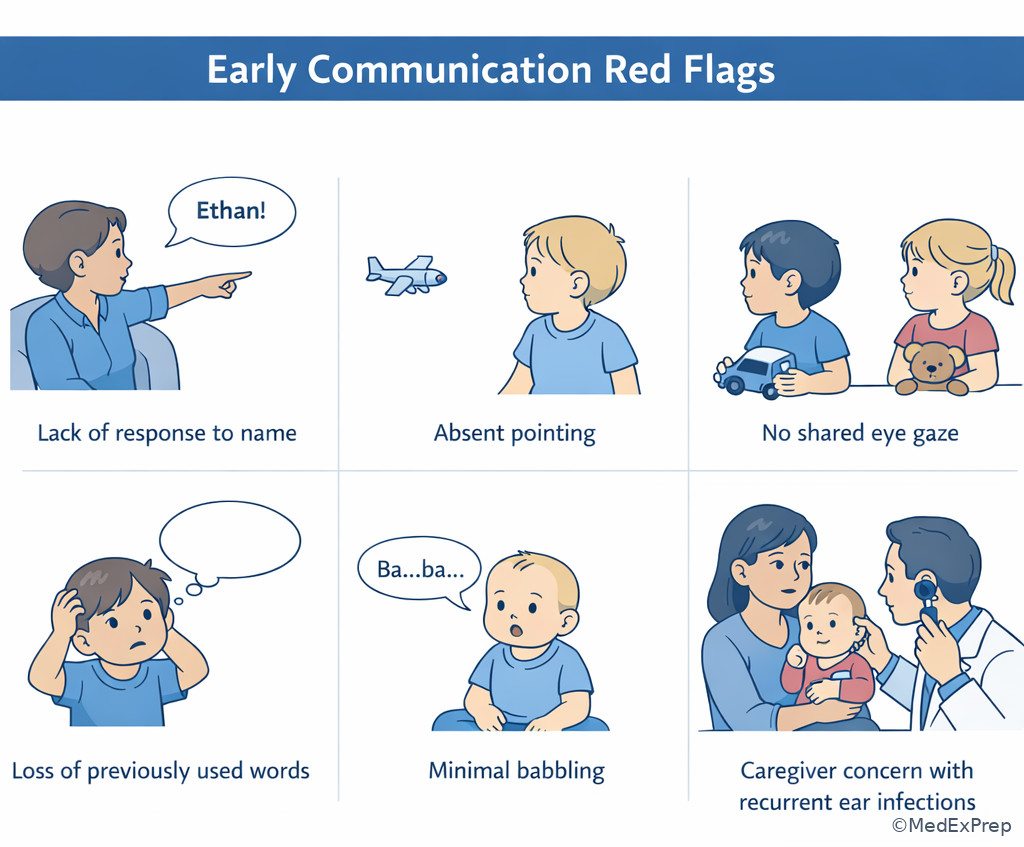
WHY THIS IS TESTED: Board-style items often ask for the most appropriate next step when a child has missing milestones plus another high-risk clue. Red flags include loss of words or social engagement, no response to sound/name, no intentional communication, no meaningful gestures, persistent feeding concerns that affect communication participation, or a plateau combined with broader developmental concerns.
Regression is especially high yield. If a caregiver reports that a child previously used words, gestures, or social routines and then lost them, do not choose simple watchful waiting. Similarly, if a toddler appears not to hear, the SLP should think hearing evaluation, not just speech therapy. If the stem signals broader motor, neurologic, or developmental concern, the correct answer usually involves interdisciplinary referral or consultation while staying within SLP scope.
Reject choices that ask the SLP candidate to diagnose a neurologic disorder, order medical procedures, or guarantee outcomes. Within scope, you can identify the pattern, explain why it is concerning, document it clearly, and recommend audiology, pediatric, developmental, or early intervention pathways. See Fig 4.
Exam takeaway: Regression and absent response to sound or social bids push the answer toward referral and comprehensive evaluation.
flowchart TD
A[Concern about milestones] --> B{Regression present?}
B -->|Yes| C[Escalate: comprehensive evaluation and referral]
B -->|No| D{Responds to name and sound?}
D -->|No| E[Prioritize hearing/audiology pathway]
D -->|Yes| F{Gestures joint attention symbolic play present?}
F -->|No| G[Broader communication concern]
F -->|Yes| H[Consider monitoring plus early support] Exam takeaway: Regression, poor response to sound, and absent gesture clusters should immediately change your next-step decision.
B Worked example
A 20-month-old toddler is seen in a community clinic. The caregiver reports that he previously used “mama,” waved bye, and brought toys to show others, but over the past two months he stopped doing these behaviors. He has chronic congestion, two older siblings, and a recent family move. In the room he wanders, vocalizes, and spins wheels on a toy car. A tempting-but-wrong explanation is stress from the move.
Reasoning chain: Identify task: most appropriate next step. Extract key facts: documented loss of previously acquired words and gestures; reduced social sharing; repetitive play. Apply rule: regression is a red flag that should not be explained away by routine environmental stress. Eliminate distractors: recent move can affect routines but does not justify loss of communication skills; siblings and congestion are secondary details; “wait 6 months” is unsafe reasoning in this pattern. Verify: recommend comprehensive communication evaluation and appropriate referral pathways, including hearing consideration and pediatric/developmental follow-up as indicated.
C Exam trap
D Checkpoint
Question: Which finding most clearly requires escalation beyond routine milestone monitoring?
- A 16-month-old prefers gestures to spoken words but follows familiar routines well.
Tempting because expressive speech is limited, but wrong because gestures with comprehension can be an early relative strength. - A 15-month-old resists sitting for books and prefers active movement play.
Tempting because limited book attention worries caregivers, but wrong because play preference alone is not a decisive red flag. - An 18-month-old previously used several words and now no longer uses them or points to share interest.
Tempting because one could blame temperament or illness, but right because regression changes the urgency. - A 21-month-old uses approximations that unfamiliar listeners rarely understand.
Tempting because intelligibility concerns matter later, but wrong because the key issue in early milestones is not listener accuracy alone.
Best answer: C
- The single milestone pattern that most strongly changes urgency is loss of previously acquired skills.
- True or False: Recurrent ear infections can be ignored if a child babbles. False.
- Name 3 red flags: regression, absent response to sound/name, absent meaningful gesture/joint attention.
1.1.1.7 Assessment and counseling: how the SLP candidate chooses next steps
A Explanation
The final integration conflict is choose the best first assessment target and counseling message. The single resolving rule is: in early communication, assess the communication system as a whole—social, receptive, expressive, play, hearing-related responsiveness, and caregiver interaction—not just isolated vocabulary or speech sounds.
WHY THIS IS TESTED: Exam items often ask what to do next after identifying possible delay. The best answer usually combines functional observation, caregiver interview, dynamic play-based sampling, and appropriate referral consideration. It does not jump immediately to drilling speech sounds or using a formal task that exceeds the child's developmental level.
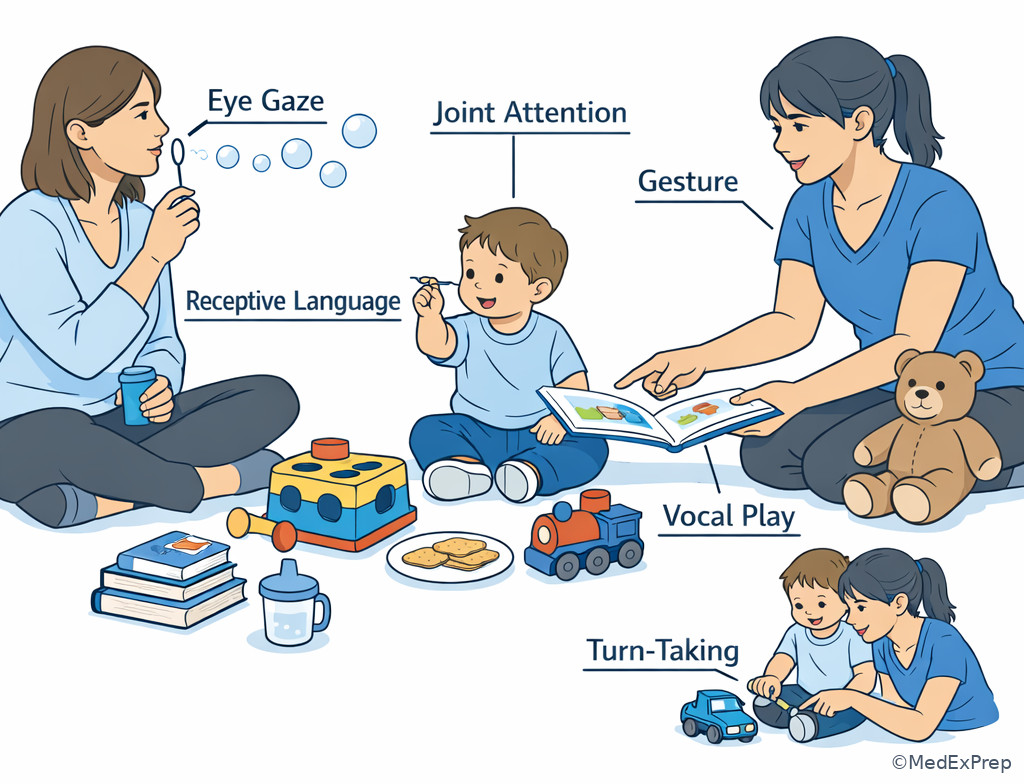
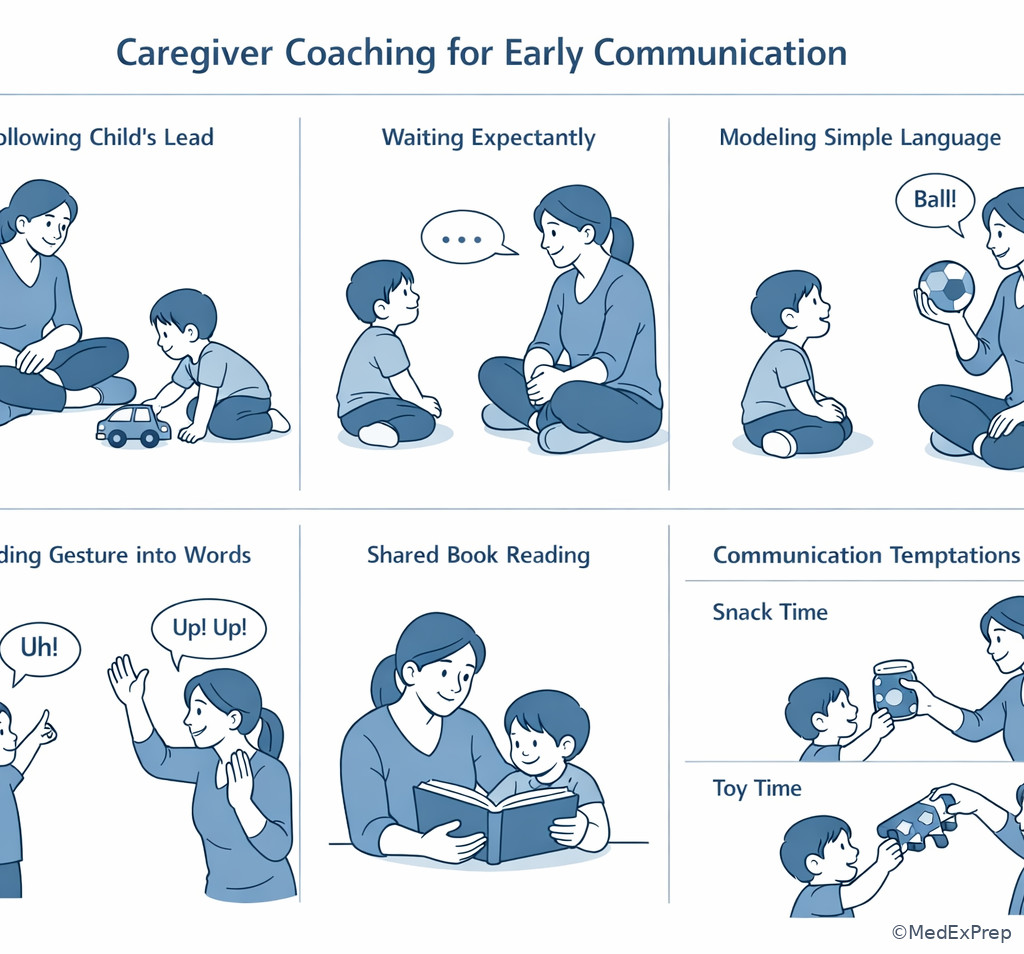
High-yield assessment priorities include caregiver concerns, prenatal/perinatal and health history, feeding/hearing history, language exposure, opportunities for interaction, developmental trajectory, communicative functions, joint attention, gesture inventory, play level, receptive language behaviors, vocal play/babble, and early symbolic use. Counseling priorities include responsive interaction, following the child's lead, expanding communication attempts, creating communication temptations, reading routines, and acknowledging that bilingual exposure is not harmful. Specific workplace procedures may vary; confirm with your program, supervisor, state board, or institution.
Forward connection: in Morphology Syntax And Semantics, the exam focus shifts from prelinguistic foundations to word combinations, grammar, and vocabulary organization. Here, the key is to know which earlier behaviors predict readiness for that next stage. See Fig 5 and Fig 6.
Exam takeaway: The best early assessment samples interaction, gesture, play, comprehension, and vocalizations in natural routines.
Exam takeaway: Responsive interaction, modeling, pausing, and expansion are higher-yield early recommendations than direct correction.
Exam takeaway: Pretend routines often reveal representational language readiness before multiword speech fully emerges.
B Worked example
A 26-month-old multilingual child is referred for “late speech.” Languages at home are Arabic and English. The child was born full term, has seasonal allergies, and attends a grandparent-care setting during the week. The caregiver reports fewer than 40 spoken words total across both languages, but the child points, shows toys, follows familiar directions, and engages in pretend tea party play. The family asks whether they should stop using Arabic at home.
Reasoning chain: Identify task: best recommendation within SLP scope. Extract key facts: multilingual exposure, social communication strengths, receptive support, symbolic play, expressive concern. Apply rule: language difference is not disorder, and families should not be told to drop the home language without evidence-based reason. Eliminate distractors: allergies are not the main issue; total vocabulary across languages matters; social-communication strengths reduce concern for absent foundations. Verify: best next step is play-based language evaluation or monitoring depending on fuller profile, with caregiver counseling to continue rich communication in both languages and assess across languages as feasible.
C Exam trap
D Checkpoint
Question: A 23-month-old has limited spoken vocabulary. Which is the most appropriate next step for the SLP candidate?
- Begin articulation drills for final consonant production.
Tempting because speech clarity matters, but wrong because early communication assessment should first target broader language and social foundations. - Advise the family to use only one language at home until vocabulary increases.
Tempting because it seems to simplify input, but wrong because bilingual exposure is not itself a disorder cause. - Use play-based observation and caregiver interview to sample gesture, joint attention, comprehension, play, and communicative functions.
Tempting because it feels less formal, but right because it captures the most diagnostic early-language information. - Wait until age 3 because milestones before then are too variable to interpret.
Tempting because development varies, but wrong because red flags and functional patterns are interpretable much earlier.
Best answer: C
Exam Traps & Differentiators
- Most common wrong answer and why: overcalling severe language disorder based on low word count alone. This is tempting because expressive delay is visible; it is wrong when gesture, joint attention, play, and comprehension are relatively intact.
- Looks similar but isn't: advanced rote labeling can coexist with weak functional communication. The stem may include letters, songs, or scripted phrases to distract you from absent social use.
- If the stem says “does not respond to name or sound,” think hearing follow-up and broader concern, not just speech therapy.
- If the stem says “lost words or gestures,” think regression red flag and escalation.
- If the stem says “points to request but not to share,” think social communication concern is more significant than the request behavior suggests.
- If the stem says “few words but follows familiar directions and uses pretend play,” think stronger foundation with expressive concern rather than global impairment.
- If the stem says “multilingual exposure,” think assess across the communication system and avoid blaming bilingualism.
| Stem clue | Tempting wrong interpretation | Better interpretation | Single discriminator |
|---|---|---|---|
| Few words at 18–24 months | Severe global language disorder | Need full profile before severity judgment | Check gesture, play, and comprehension |
| Knows letters or songs | Language is normal | Rote skill may mask social-communication weakness | Functional use with others |
| Uses adult's hand to get items | Strong requesting skill | May reflect reduced coordinated social communication | Look for gaze shift and shared intent |
| Recurrent otitis media | Just wait for speech to catch up | Consider hearing as part of interpretation | Response to sound/name |
| Regression | Stress-related temporary delay | Red flag requiring escalation | Loss of previously acquired skills |
| Bilingual home | Use one language only | Assess total communication across languages | Difference is not disorder |
| Look-alike pair | Feature that overlaps | Feature that separates them |
|---|---|---|
| Late talker vs broader social-communication concern | Both may have few spoken words | Joint attention, showing, and symbolic play are stronger in the former |
| Expressive delay vs receptive-expressive delay | Both may show low vocabulary | Routine comprehension and following familiar directions distinguish them |
| Language difference vs disorder | Both may show uneven English output | Assess skills across languages and functional communication, not English only |
| Temperament/shyness vs reduced social reciprocity | Both may limit overt interaction in unfamiliar settings | Across contexts, reciprocity and shared enjoyment remain present in shyness |
Related trap from upcoming topics: in Phonological And Articulation Development, low intelligibility can distract from the fact that communication intent is strong. Here, reverse the logic: strong sounds or rote verbal bits do not cancel weak social communication.
Tables
| Age band | High-yield expected themes | What the exam wants you to notice |
|---|---|---|
| Birth to 6 months | Orientation to voice, social smile, vocal play, reciprocal affect | Communication starts with interaction, not words |
| 6 to 12 months | Babbling growth, turn-taking, intentionality emerging, response to social routines | Look for purposeful acts toward others |
| 9 to 18 months | Joint attention, showing, giving, pointing, first words, routine comprehension | Gesture and shared attention are key discriminators |
| 18 to 24 months | Vocabulary expansion, symbolic play, more communicative functions, early combinations emerging | Interpret word count together with comprehension and play |
| 24 to 36 months | Increasing combinations, broader functions, better routine direction following, richer pretend play | Shift toward structure/content while keeping an eye on foundational gaps |
| Observation target | Why it matters | Choose this over |
|---|---|---|
| Pointing to share | Marks social communication and shared attention | Raw vocabulary count alone |
| Showing/giving objects | Reveals intention to involve another person | Object preference alone |
| Response to name/sound | Raises or lowers hearing concern | Vocal loudness alone |
| Following familiar directions | Separates expressive-only from broader language concern | Imitation on command alone |
| Symbolic play | Signals representational readiness for language growth | Repetitive manipulation |
| Regression history | Changes urgency of action | Single-session shyness |
| Profile type | Typical clue cluster | Best next-step framing |
|---|---|---|
| Stronger prelinguistic base with expressive concern | Few words, but good gesture, joint attention, play, and comprehension | Play-based language evaluation or monitoring with caregiver coaching |
| Broader communication concern | Few words plus weak gesture/joint attention/play or limited understanding | Comprehensive communication evaluation |
| Hearing-related concern | Inconsistent response to sound/name, otitis history, limited language behaviors | Audiology referral plus communication assessment |
| Regression red flag | Loss of previously used words, gestures, or social routines | Escalate; do not choose watchful waiting alone |
| Language difference context | Multilingual exposure, uneven English skills, otherwise functional communication | Assess across languages and avoid deficit assumptions |
Algorithm / Approach
Rapid Review
- Low word count → not enough by itself; check gesture and comprehension first
- Point to share → stronger social-communication marker than request-only pointing
- Receptive > expressive → different from broad language weakness
- Rote labels → can mask weak functional communication
- Symbolic play → signals representational readiness beyond object manipulation
- Regression → raises urgency more than slow progress
- Otitis or poor sound response → think hearing pathway, not speech-only explanation
- Bilingual exposure → difference context, not automatic disorder explanation
- Adult-as-tool behavior → weaker than coordinated gaze-plus-gesture communication
- Caregiver report → essential, but verify with direct observation
- Shyness → may reduce output in clinic, but reciprocity is usually still present across contexts
- Early assessment → play-based, functional, multimodal, and routine-centered
Self-check quiz
1.1.1.8 Question 1
A 17-month-old uses only a few spoken approximations. Which additional finding most strongly supports a stronger early communication foundation?
- Alternates gaze between caregiver and toy while pointing to share interest
- Prefers spinning wheels on toy cars during free play
- Cries during transitions at the end of the visit
- Repeats a song fragment after the clinician
1.1.1.9 Question 2
A 22-month-old multilingual toddler says fewer words in English than same-age peers at daycare. Which is the best interpretation?
- Bilingual exposure alone is sufficient evidence of language disorder
- Total communication across languages and functional use should be assessed before interpreting delay
- Families should reduce home-language use until English vocabulary increases
- English-only standardized scores are enough to rule in disorder in all cases
1.1.1.10 Question 3
A 24-month-old boy with a history of prematurity and recurrent ear infections is referred for limited speech. He uses about 15 words, follows familiar one-step directions, points to request and show, and engages in pretend feeding of a doll. He does not name body parts on command in the clinic. What is the most appropriate interpretation?
- Broader communication foundations appear relatively intact, though expressive language and hearing-related follow-up remain important
- The lack of body-part naming confirms severe receptive-expressive language disorder
- Pretend play is less informative than single-word count and can be ignored
- The SLP should assume otitis media is the sole cause and defer communication assessment
1.1.1.11 Question 4
A 19-month-old girl can label letters and recite parts of songs. She rarely points to share, does not bring toys to adults, and spends long periods lining up objects. She has mild eczema and normal motor milestones. Which is the most appropriate next step?
- Reassure the family because advanced rote skills outweigh the social concerns
- Complete a broader social-communication evaluation rather than relying on the rote verbal strengths
- Start articulation therapy to shape later consonants before language work
- Wait until preschool because repetitive play is typical whenever labeling is advanced
1.1.1.12 Question 5
A 20-month-old toddler says only “mama” and “ball.” He responds inconsistently to his name, has had multiple ear infections, and often watches moving toys without looking back to the caregiver. He smiles during tickle games and eats well. What finding most strongly supports the best next recommendation?
- Good appetite, so communication follow-up can wait
- History of ear infections and inconsistent name response, so hearing referral should be part of the plan
- Smiling during tickle games, so no further evaluation is needed
- Use of two words, so current performance is clearly age-expected
1.1.1.13 Question 6
A 21-month-old previously used “up,” “bye,” and several gestures. Over the last 6 weeks, his caregiver reports that these behaviors disappeared after a family move. He now vocalizes, spins toy wheels, and pulls adults to desired objects. He has seasonal allergies and an older sibling with a history of speech delay. What is the most appropriate next step?
- Provide watchful waiting for 6 months because environmental stress commonly causes temporary language fluctuation
- Recommend comprehensive communication evaluation with referral consideration because regression changes the urgency
- Begin home articulation practice because word loss most likely reflects phonological delay
- Advise the caregiver that sibling history makes the current pattern expected
1.1.1.14 Question 7
A 26-month-old in early intervention uses about 30 total words across Spanish and English. He points, shows, follows routine directions, and engages in pretend cooking. The grandmother reports concern because a cousin the same age speaks in 3-word phrases. The child has a history of mild asthma and one hospitalization for bronchiolitis in infancy. Which recommendation is most appropriate?
- Tell the family to use only English so phrase length can be compared fairly
- Interpret the profile using total communication across both languages and functional interaction, then plan assessment or support accordingly
- Assume the hospitalization caused a persistent global delay without further communication analysis
- Prioritize speech sound testing because phrase length concerns are usually articulation-based at this age
1.1.1.15 Question 8
A 23-month-old is being considered for SLP evaluation. In the clinic, he uses 8 spoken words, waves, points to request, follows “give it to me,” and imitates feeding a doll. At home, the parent says he does not often point to show interesting things and rarely responds when called from another room. He has frequent congestion and attends daycare full time. Which plan is the best interpretation and next step?
- Because some gestures and pretend play are present, no additional concerns need to be addressed
- The mixed profile supports speech-only treatment with no need to ask about hearing
- The profile warrants fuller evaluation, with particular attention to hearing-related factors and social-communication quality across settings
- Daycare exposure explains the inconsistency, so milestone interpretation should be postponed until age 3
Answer key
1.1.1.16 Question 1: A
A. Correct. This is tempting because it may seem like “just a gesture,” but it is actually the highest-yield clue. Coordinated gaze plus pointing to share interest reflects joint attention and intentional social communication, which support a stronger early foundation. The single stem clue is pointing to share interest. Source support: joint attention and gesture are widely recognized early social-communication markers in developmental assessment literature and ASHA practice guidance.
B. Incorrect. Repetitive play can appear developmentally immature or concerning depending on the broader pattern, so it is plausible. However, spinning wheels does not support a stronger communication foundation; if anything, it may increase concern when paired with weak social communication. The discriminating clue is that this behavior is object-focused rather than shared-social.
C. Incorrect. Transition difficulty is common and therefore plausible. It does not specifically index communication readiness. The discriminating clue is that emotional dysregulation at transition is less informative than intentional shared communication behaviors.
D. Incorrect. Repeating a song fragment can look verbally advanced. However, rote imitation is less diagnostic than spontaneous social communication. The single clue that eliminates it is that the question asks about the strongest foundation, which is better captured by shared attention.
1.1.1.17 Question 2: B
A. Incorrect. This distractor is tempting because multilingual exposure can make English output look uneven. It is wrong because bilingual exposure alone is not evidence of disorder. The discriminating clue is multilingual toddler; nonbiased interpretation requires examining total communication.
B. Correct. This option is best because it applies culturally and linguistically responsive reasoning within SLP scope. The single clue is that the child is multilingual, so interpretation must include both languages and functional communication use. ASHA guidance supports assessment across languages and avoidance of deficit assumptions.
C. Incorrect. This sounds practical and is a classic test trap. It is wrong because reducing home-language use is not an evidence-informed default response and may undermine family interaction quality. The discriminating clue is that no evidence in the stem shows home language is the cause.
D. Incorrect. English-only scores may be available and thus feel concrete, but they are not sufficient in all multilingual cases. The clue that eliminates it is the multilingual context, which requires careful interpretation of validity and representativeness.
1.1.1.18 Question 3: A
A. Correct. This is the best interpretation because the child shows pointing to request and show, follows familiar directions, and uses pretend play. Those clues support relatively intact social-communication and receptive foundations, even though expressive language is limited and hearing follow-up remains relevant because of otitis history. The single discriminating clue is the combined presence of gesture, comprehension, and symbolic play.
B. Incorrect. Body-part naming is a tempting benchmark, so candidates may overinterpret its absence. It is wrong because one missed clinic task does not outweigh the broader evidence of receptive and symbolic strengths. The clue that eliminates it is that he follows directions and engages socially in play.
C. Incorrect. Pretend play may be undervalued by test-takers who prefer countable language data. It is wrong because symbolic play is highly informative in this age range. The discriminating clue is the pretend feeding behavior, which directly informs developmental interpretation.
D. Incorrect. Otitis history rightly raises hearing concern and makes this choice plausible. However, the SLP should not defer communication assessment entirely; both hearing pathway and communication evaluation matter. The clue that eliminates it is that the stem already provides meaningful communicative behaviors that can and should be interpreted.
1.1.1.19 Question 4: B
A. Incorrect. The rote skills make this option very tempting. It is wrong because labeling letters and reciting songs do not outweigh reduced pointing to share, absent bringing-to-show, and repetitive play. The single stem clue that discriminates is limited social communication despite rote verbal strengths.
B. Correct. This is the most appropriate next step because the social-communication profile requires broader evaluation. The SLP candidate remains within scope by assessing communication and recommending referral or further follow-up as needed, rather than making an independent medical diagnosis. The discriminating clue is the cluster of weak shared-social behaviors.
C. Incorrect. Articulation therapy sounds action-oriented, which makes it plausible. It is wrong because the primary issue presented is not speech sound accuracy but foundational social communication. The clue that eliminates it is the emphasis on pointing, sharing, and play—not consonant errors.
D. Incorrect. Waiting is tempting because some toddlers have uneven profiles. It is wrong because the stem includes multiple concerning social-communication indicators rather than a narrow expressive lag. The discriminating clue is the cumulative pattern, not any single advanced rote skill.
1.1.1.20 Question 5: B
A. Incorrect. Appetite and feeding stability can reassure candidates, so this feels plausible. It is wrong because the key decision point is communication and hearing-related concern, not nutritional status. The discriminating clue is inconsistent response to name plus multiple ear infections.
B. Correct. This is best because hearing-related referral should be part of the plan when name response is inconsistent and otitis history is present. This remains within SLP scope: identify the pattern, recommend follow-up, and continue communication assessment. The single clue is inconsistent name response with ear infection history.
C. Incorrect. Smiling during games suggests some social engagement and makes this answer tempting. It is wrong because one area of social strength does not eliminate the hearing concern. The discriminating clue is that inconsistent auditory responsiveness remains unresolved.
D. Incorrect. Two words may look like progress, but it is not sufficient to declare the profile age-expected in this context. The single clue that eliminates it is the broader concern cluster, especially hearing-related signs.
1.1.1.21 Question 6: B
A. Incorrect. Environmental stress can affect participation, so this distractor is competitive. It is wrong because the stem describes loss of previously acquired words and gestures, not just reduced performance. The single clue that eliminates it is regression.
B. Correct. Regression in communication behaviors warrants comprehensive evaluation and referral consideration. This answer fits SLP scope by emphasizing assessment and interdisciplinary coordination rather than independent medical diagnosis. The discriminating clue is the disappearance of former words and gestures over 6 weeks.
C. Incorrect. Home articulation practice is tempting because words were lost. It is wrong because the problem is not framed as sound production accuracy; the issue is broader communication regression. The clue that eliminates it is the simultaneous loss of gestures and social communication behaviors.
D. Incorrect. Family history can raise awareness of developmental risk, making this plausible. It is wrong because sibling speech delay does not make regression expected or benign. The discriminating clue is that regression always carries more weight than family history alone.
1.1.1.22 Question 7: B
A. Incorrect. This is tempting because families often seek a simple, actionable change. It is wrong because English-only restriction is not the appropriate evidence-informed response for a multilingual child. The discriminating clue is the multilingual context with preserved functional interaction.
B. Correct. This option uses culturally responsive milestone interpretation: consider total words across both languages, social communication, comprehension, and play. The single clue is that the child points, shows, follows routines, and engages in pretend play, which supports the developmental foundation while still allowing concern about expressive growth.
C. Incorrect. Prior hospitalization makes this choice superficially medical and serious. It is wrong because the remote bronchiolitis event does not by itself explain the current communication profile. The clue that eliminates it is the absence of evidence for current global impairment tied to that history.
D. Incorrect. Speech sound testing seems concrete and clinically active, but it is premature as the primary focus here. The discriminating clue is that the concern is phrase length and early language growth, not a sound-error pattern.
1.1.1.23 Question 8: C
A. Incorrect. Some gestures and pretend play are indeed reassuring, so this option is highly tempting. It is wrong because the stem also includes inconsistent response when called and limited pointing to show across contexts. The single clue that eliminates it is the mixed profile with unresolved hearing/social-quality concerns.
B. Incorrect. Speech-only treatment feels efficient because spoken word count is low. It is wrong because hearing-related factors and social-communication quality must be assessed in the presence of frequent congestion and inconsistent auditory response. The discriminating clue is poor response when called from another room.
C. Correct. This is the best answer because it integrates reassuring and concerning data rather than overreacting to one side. The child has some foundational strengths, but the pattern still warrants fuller evaluation with attention to hearing-related issues and cross-setting social communication. This is classic Praxis reasoning: identify the mixed profile and choose the most comprehensive safe next step within scope.
D. Incorrect. Daycare exposure can influence behavior and makes this answer superficially reasonable. It is wrong because milestone interpretation should not be postponed when meaningful concerns are already present. The single clue that eliminates it is the combination of inconsistent response and limited showing behavior.
Keep going with the full Praxis SLP (5331) Prep Course (Praxis SLP)
You just studied the way members do, in the same lesson interface. Full access unlocks every lesson, the question bank and flashcards for a full year.
One payment · 1 year of access · No auto-renewal