1.1.1 - PMHS Role Boundaries
PMHS Role Boundaries
What you'll learn
- Ethics, Legal, Confidentiality, and Cultural Responsiveness: Choose actions that stay within PMHS role expectations -> scope-aware decision-making
- Risk, Safety, and Crisis Response: Distinguish routine follow-up from immediate escalation -> safety-first triage
- Care Coordination and Systems Collaboration: Select when to consult, refer, or coordinate rather than act independently -> team-based care planning
- Assessment and Developmental Context: Identify what the pediatric-focused primary care clinician should assess first -> role-appropriate data gathering
- Intervention and Management: Match brief primary care intervention to severity and scope -> stepped care within role
- Ethics, Legal, Confidentiality, and Cultural Responsiveness → scope limits, consent/confidentiality guardrails, mandated action boundaries
- Risk, Safety, and Crisis Response → urgent escalation for suicidality, psychosis, abuse/neglect, inability to maintain safety
- Care Coordination and Systems Collaboration → referral, consultation, handoff, collaboration with caregivers, school, and specialists
- Assessment and Developmental Context → developmentally informed, role-appropriate information gathering
Why it matters
- Many PMHS questions are not testing rare diagnoses; they are testing whether you choose the safest in-scope next step.
- Wrong answers often sound clinically useful but are incorrect because they require authority outside the candidate's role, setting, or protocol.
- On exam stems, urgent safety threats override routine education, routine screening, and delayed referral.
- Role boundaries protect patients: when risk is high, the best answer is usually escalate, consult, involve caregivers/protocol, and maintain safety.
Key Terms & Must-Know Facts
1.1.1.1 Key terms
- Scope of practice: Actions permitted by licensure, training, protocol, and setting
- Role-appropriate assessment: Focused pediatric mental/behavioral health data gathering within primary care
- Stepped care: Matching intervention intensity to severity, safety, and function
- Immediate escalation: Same-visit action for imminent risk or inability to maintain safety
- Consultation: Seeking supervising or specialty input when a presentation exceeds role or complexity
- Care coordination: Connecting family, school, community, and specialty supports
- Mandated reporting: Required reporting of suspected abuse/neglect according to law/protocol
- Confidentiality: Protection of health information, limited by safety and legal requirements
- Assent/consent: Developmentally appropriate youth involvement plus legally authorized permission rules
- Collateral information: Input from caregivers, school, and other settings
- Red flag: Finding that raises urgency or changes the next step
- Best next step: Safest, highest-priority, role-appropriate action now
1.1.1.2 Must-know facts
- Safety threats come before routine management.
- The PMHS exam tests pediatric primary care reasoning, not subspecialty psychiatry practice.
- Do not choose options that require independent prescribing if authority is not given.
- Do not delay action for suicidal intent, psychosis, abuse/neglect concerns, or inability to maintain safety.
- Family-centered care remains standard unless immediate safety or law/protocol requires a different sequence.
- When laws or institutional rules vary, the safe exam move is to follow local protocol while protecting safety and confidentiality.
- Care coordination is often the correct answer when long-term therapy, school services, or specialty evaluation is needed.
- Primary care clinicians often assess, educate, monitor, reinforce, consult, and refer; they do not automatically provide specialist treatment.
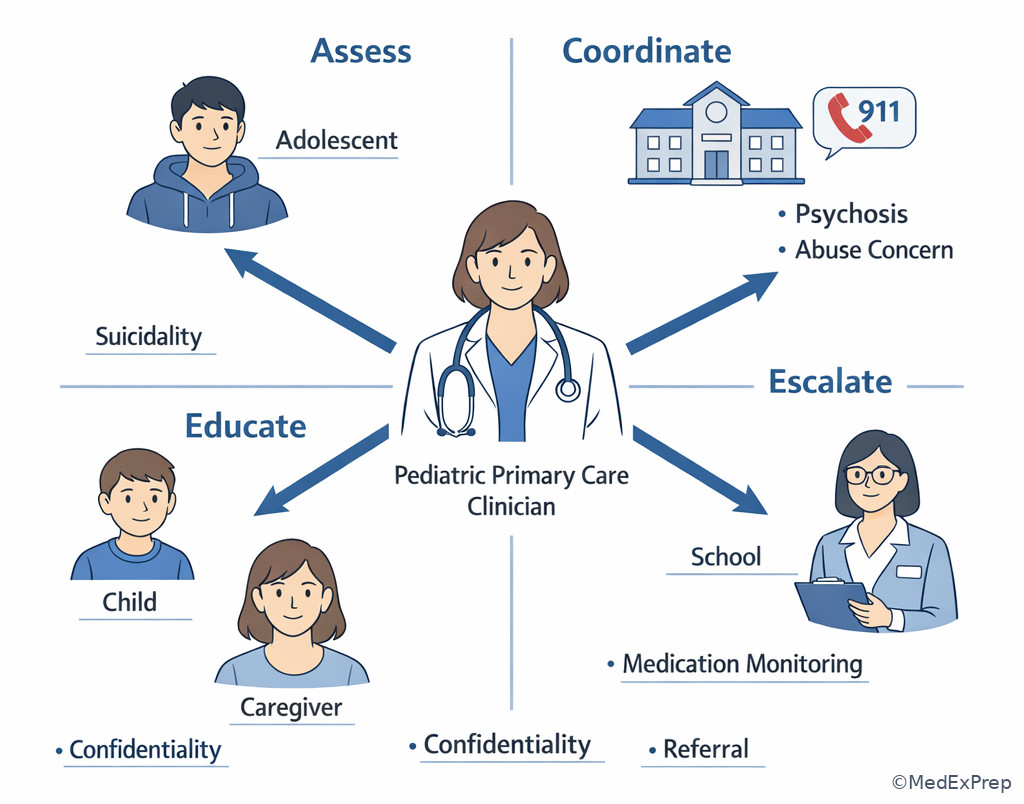
Exam takeaway: Use this map to separate assess, educate, coordinate, and escalate from out-of-role actions.
flowchart TD
A[Child or adolescent presents with mental or behavioral concern] --> B{Immediate safety threat?}
B -->|Yes| C[Maintain safety now]
C --> D[Activate urgent protocol and supervising resources]
D --> E[Involve caregiver and emergency supports as appropriate]
B -->|No| F{Within primary care role?}
F -->|Yes| G[Assess, screen, educate, brief intervention, monitor]
G --> H[Coordinate with family, school, therapist, PCP team]
F -->|No or unclear| I[Consult, refer, or co-manage]
I --> J[Do not independently exceed authority] Exam takeaway: Visual anchors help separate assessment, intervention, coordination, and emergency escalation.
Core content
1.1.1.3 Foundational boundary: what the PMHS candidate should do vs reject
A Explanation
The central decision conflict in this topic is simple: Should I act directly, or should I consult/refer/escalate? The single rule that resolves it is whether the action is within pediatric primary care mental health scope and current authority. Choose actions such as focused assessment, screening, brief psychoeducation, family guidance, monitoring, coordination, and referral planning. Reject actions that assume specialist, legal, or unauthorized prescriptive authority.
WHY THIS IS TESTED: Exam writers build attractive options that sound proactive, such as “start treatment,” “make the diagnosis final,” or “determine school placement.” The testable pattern is whether you notice that the candidate role is supportive, screening-focused, safety-aware, and collaborative rather than unrestricted specialty practice.
In practical terms, choose answers that keep the clinician in a primary care lane: gather targeted history, assess developmental context, identify risk, provide brief evidence-informed support within role, and connect the patient to the right level of care. Reject answers that require functioning “as the child psychiatrist,” giving legal advice, independently authorizing involuntary treatment, or performing formal forensic or neuropsychological evaluations.
See Fig 1 for the high-yield boundary split between in-scope actions and actions that require consultation or referral.
Exam takeaway: First decide whether the action is in-scope before deciding how helpful it sounds.
B Worked example
A 13-year-old with asthma and migraine presents for worsening irritability and school refusal. Her caregiver asks the clinic clinician to “diagnose bipolar disorder today and start the right medication because our wait for psychiatry is months.” The patient has poor sleep, increased conflict at home, and a recent move. A sports physical from last month was normal. She denies suicidal thoughts. A tempting clue is the caregiver’s statement that “her uncle has bipolar disorder, so this must be the same thing.”
Reasoning chain: Identify task → the question is testing the most appropriate primary care role response, not specialist treatment selection. Extract key facts → chronic irritability, stressor, family history, no current suicide disclosure, no emergency symptoms given. Apply rule → within role, gather focused mood/sleep/history data, screen, assess function and safety, provide family guidance, and arrange appropriate referral/co-management. Eliminate distractors → do not independently provide definitive psychiatric diagnosis or initiate unauthorized medication management simply because access is delayed. Verify → the best answer is role-appropriate assessment plus coordination, not specialist-only treatment.
C Exam trap
D Checkpoint
Question: A 10-year-old with ADHD history, eczema, and recent bullying is seen for escalating anger outbursts. The caregiver asks the clinician to “write a letter deciding he needs a different school placement immediately.” What is the most appropriate response?
- Complete the school placement determination because behavior is impairing learning.
- Perform a focused assessment of safety, triggers, function, and supports, then coordinate with the family and school while recommending formal educational evaluation through the proper process.
- Tell the caregiver the clinic cannot discuss school issues because they are outside health care.
- Advise the caregiver to wait until the next routine follow-up because school decisions take time anyway.
Correct answer: B.
- A: Tempting because school impairment is clinically relevant; wrong because the clinician does not serve as the final authority for special education or placement decisions.
- B: Tempting because it feels slower; right because it stays within scope: assess, document, coordinate, and direct the family into the appropriate school evaluation pathway.
- C: Tempting because it avoids role confusion; wrong because care coordination with schools is part of pediatric behavioral health practice.
- D: Tempting because systems issues are complex; wrong because current impairment requires active assessment and coordination now.
1.1.1.4 Safety overrides routine scope decisions
A Explanation
The next decision conflict is: Should I continue usual outpatient workflow, or does this presentation require immediate escalation? The single finding that resolves it is the presence of a safety threat such as suicidal intent, psychosis, severe agitation with inability to maintain safety, abuse/neglect concern, or marked functional deterioration that cannot wait.
WHY THIS IS TESTED: Learners often over-focus on diagnosis and under-focus on urgency. Exam stems add distracting chronic symptoms, family conflict, or previous diagnoses to pull you toward routine counseling. The tested pattern is that acute risk changes the priority order: safety, supervision, escalation, handoff, then later diagnostic refinement.
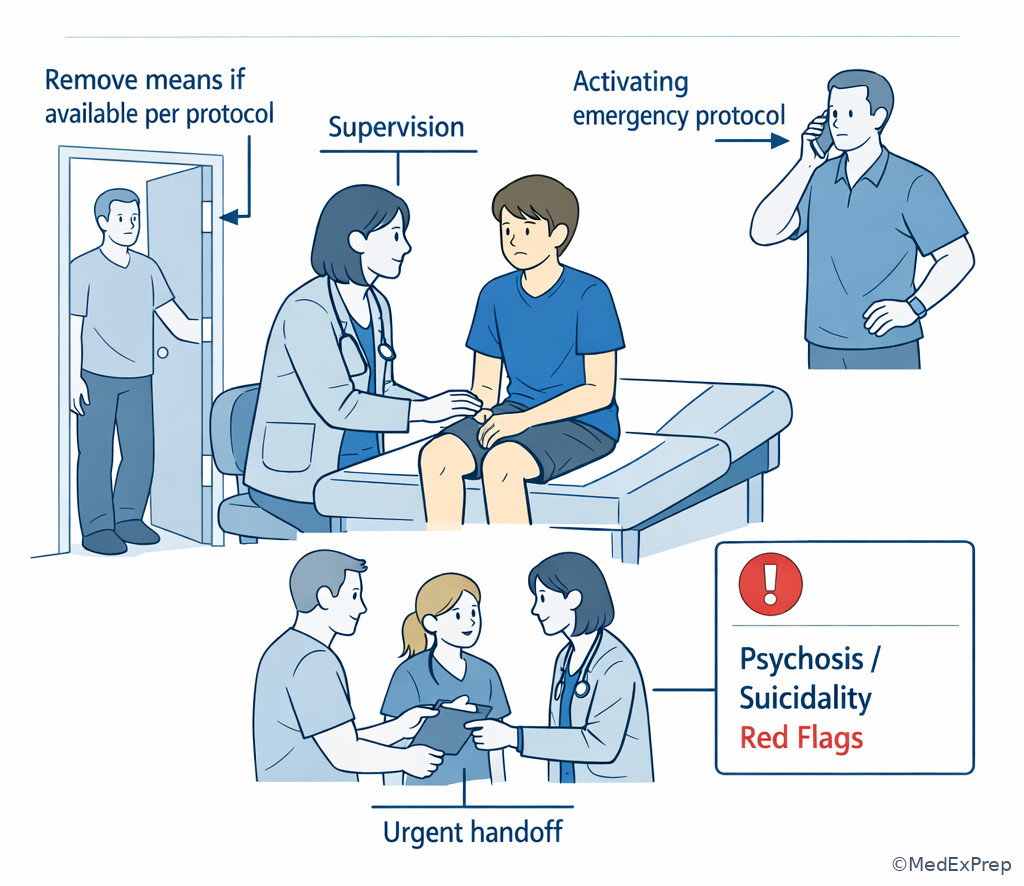
In PMHS logic, a clinician does not need to “solve” the psychiatric diagnosis before acting on danger. The in-scope action is to recognize the emergency, maintain immediate safety, activate local protocol, involve supervising or emergency resources, and communicate clearly with caregivers as appropriate. Routine resource handouts, future therapy referral, and symptom tracking may all be useful later, but they are not the best next step when danger is active.
See Fig 2 for a decision tree that separates urgent escalation from standard outpatient follow-up.
Exam takeaway: A current safety threat moves the answer from routine care to immediate escalation.
B Worked example
A 16-year-old with type 1 diabetes and generalized anxiety presents with “panic attacks” before exams. During the visit, she says, “Sometimes I think everyone would be better off without me,” then admits she searched online last night for how many insulin units would be fatal. Her mother is in the waiting room. A distracting detail is that her GAD-7 was elevated at a previous visit and the family mainly asked for a therapy referral. Another tempting clue is that the patient now says, “I probably wouldn’t do it.”
Reasoning chain: Identify task → most appropriate next step in pediatric primary care. Extract key facts → suicidal thinking plus specific lethal-means research in a youth with direct access to insulin. Developmental context → adolescent confidentiality matters, but safety overrides routine confidentiality limits. Apply rule → immediate safety escalation is required. Eliminate distractors → do not simply offer a crisis number, book outpatient counseling, or continue anxiety screening first. Verify → the clinician should maintain safety, involve appropriate emergency/supervising resources, and bring in caregivers per safety protocol.
C Exam trap
D Checkpoint
Question: A 14-year-old with obesity, chronic insomnia, and recent family conflict reports hearing a voice saying he is “evil” and should hurt himself. He appears frightened and asks that the clinician not tell his father. What is the most appropriate next step?
- Respect confidentiality and schedule a psychiatry referral within 1 week.
- Provide a grounding worksheet and reassess at the next visit.
- Maintain immediate safety, notify the appropriate supervising/emergency resources, and involve the caregiver according to safety protocol and local law.
- Ask the school counselor to monitor him tomorrow because school sees him daily.
Correct answer: C.
- A: Tempting because adolescent confidentiality is important; wrong because active self-harm command hallucinations create a safety exception.
- B: Tempting because coping tools can help distress; wrong because supportive techniques do not replace emergency escalation when psychosis and self-harm risk are present.
- C: Tempting because it seems disruptive; right because safety and urgent escalation outrank routine outpatient processes.
- D: Tempting because school collaboration is useful; wrong because next-day monitoring is too delayed and insufficient for current danger.
- The safest first move when suicidal intent is present is immediate safety escalation, not routine referral.
- True or False: Adolescent confidentiality always prevents caregiver involvement. False.
- Name 3 red flags that override routine workflow: suicidal intent, psychosis, abuse/neglect concern.
Exam takeaway: If a current safety threat is present, urgent protocol replaces routine outpatient management.
flowchart TD
A[Behavioral health concern identified] --> B{Current danger or inability to maintain safety?}
B -->|Yes| C[Keep patient supervised]
C --> D[Notify supervising clinician or emergency resource]
D --> E[Involve caregiver per safety protocol]
E --> F[Transfer or urgent evaluation]
B -->|No| G{Mild to moderate and within role?}
G -->|Yes| H[Assess, educate, monitor, follow up]
G -->|No or unclear| I[Consult or refer for higher level care] Exam takeaway: Visualizing supervision and handoff helps anchor the safest next step during crisis.
1.1.1.5 Collaboration, referral, and co-management are active clinical actions
A Explanation
Another major exam conflict is: Should I “do more myself,” or should I coordinate care? The single rule is that referral or consultation is not passive when the problem exceeds role, resources, or severity. In PMHS questions, coordination is often the most clinically mature answer because pediatric mental health rarely happens in only one setting.
WHY THIS IS TESTED: Learners may interpret referral as giving up. Exam stems instead reward clinicians who gather useful data, provide immediate supportive steps within role, and then connect the patient to the proper system: behavioral health, psychiatry, crisis services, school supports, social work, or developmental evaluation.
High-yield distinction: choose routine referral for nonurgent but beyond-scope needs, urgent referral/escalation for time-sensitive risk, and co-management when the child can remain in primary care with specialty input. Coordination includes explaining the reason for referral, addressing barriers, documenting urgency, arranging follow-up, and integrating caregiver and school information. This is still active clinical management.
See Fig 3 for a comparison map of routine management, consultation, and emergency transfer.
Exam takeaway: When a case exceeds role but is not emergent, consultation and referral become the right next clinical action.
B Worked example
An 8-year-old with language delay and chronic constipation is brought for meltdowns at school, sensory sensitivity, and rigid routines. The teacher suspects autism; the caregiver asks the clinician to “do the full formal autism testing now so we can skip the waitlist.” The child is not suicidal, sleeps poorly, and has missed several school days. A tempting clue is that the clinician has experience using developmental screeners.
Reasoning chain: Identify task → choose the most appropriate action within PMHS role. Extract key facts → developmental concerns across settings, no immediate safety emergency, need for multi-disciplinary evaluation. Apply rule → the clinician can gather collateral, screen, educate, and coordinate referral for formal developmental/diagnostic evaluation; they should not claim to complete formal neuropsychological or specialist diagnostic testing outside role. Eliminate distractors → “make the diagnosis today” and “tell the school he definitely has autism” both exceed scope. Verify → best next step is structured assessment support plus referral and care coordination.
C Exam trap
D Checkpoint
Question: A 12-year-old with anxiety, learning difficulty, and frequent abdominal pain has persistent school refusal despite routine clinic support. There is no suicidality or psychosis. Which action is most appropriate?
- Stop further assessment and tell the caregiver only the school can address attendance.
- Provide a definitive legal determination that the child qualifies for special education services.
- Coordinate collateral information, support a behavioral health referral, communicate with school supports as permitted, and arrange follow-up to reassess function and barriers.
- Delay action until symptoms become severe enough for emergency services.
Correct answer: C.
- A: Tempting because school attendance involves educational systems; wrong because pediatric primary care still has a care-coordination role.
- B: Tempting because impairment may justify services; wrong because legal/school eligibility decisions are not made unilaterally by the clinic clinician.
- C: Tempting because it requires multiple steps; right because it combines in-scope assessment support, referral, communication, and follow-up.
- D: Tempting because the case is not emergent; wrong because nonemergent does not mean no action.
1.1.1.6 Confidentiality, caregiver involvement, and mandated action boundaries
A Explanation
This section tests a different conflict: Should I keep information confidential, involve caregivers, or report/disclose? The single resolving rule is that confidentiality is important but not absolute. It is limited by safety threats, abuse/neglect obligations, and local consent/assent laws and institutional policies.
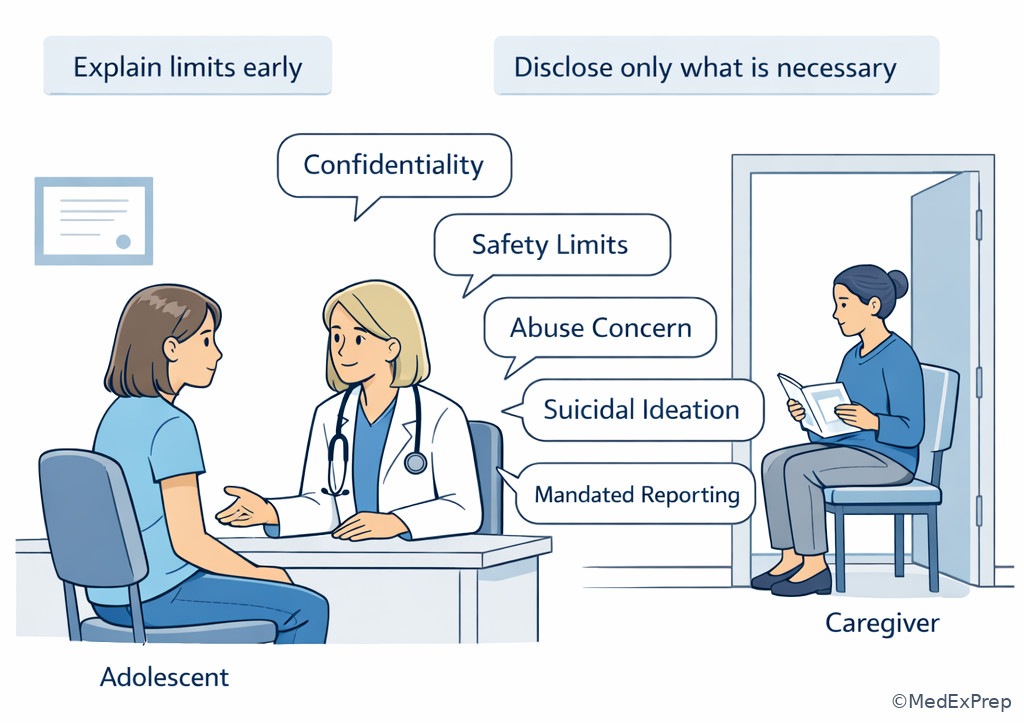
WHY THIS IS TESTED: Exam stems often create tension between adolescent trust and clinician duty. The wrong answers usually take an extreme position: disclose everything automatically, or keep everything secret regardless of risk. The correct answer is usually narrower and more disciplined: explain confidentiality limits up front, preserve privacy as much as possible, and disclose only what safety or law requires.
Within PMHS role boundaries, you should discuss confidentiality in developmentally appropriate language, encourage caregiver involvement when therapeutically helpful, and follow local rules. However, if the patient reports abuse, suicidal intent, or another safety-critical issue, the clinician must act despite the youth’s request for secrecy. Likewise, you should not provide legal advice or make definitive legal judgments; your role is recognition, documentation, reporting/consultation per protocol, and safety planning.
See Fig 4 for a high-yield privacy-versus-safety branching framework.
Exam takeaway: Preserve privacy when possible, but safety and legal duties create required exceptions.
B Worked example
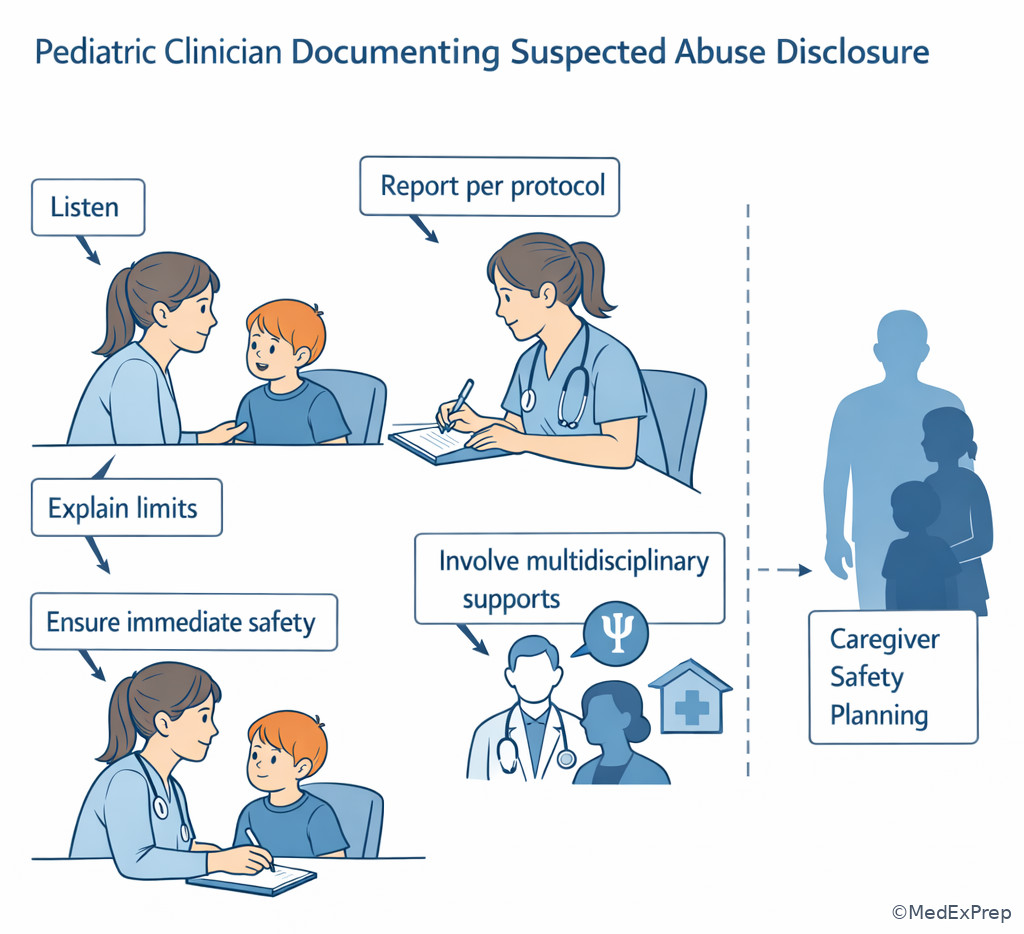
A 15-year-old with depression history and obesity asks to speak alone. She discloses that her mother’s boyfriend “sometimes grabs me and comes into my room at night,” then begs the clinician not to tell anyone because she is afraid of being blamed. She denies current suicidal ideation. A distracting clue is that she also wants contraception information and asks about confidentiality for reproductive health. The tempting wrong answer is to focus only on adolescent privacy rights and delay disclosure until she is ready.
Reasoning chain: Identify task → most appropriate immediate response within PMHS role. Extract key facts → suspected abuse with ongoing access to the alleged perpetrator. Apply rule → mandated reporting and safety action override a promise of secrecy. Eliminate distractors → do not investigate as a forensic interviewer, do not provide legal advice, and do not delay because the youth requested confidentiality. Verify → explain limits, ensure safety, follow reporting protocol, involve appropriate parties per law and policy.
C Exam trap
D Checkpoint
Question: A 17-year-old with ADHD and cannabis use tells the clinician he sometimes drives after using marijuana and last week thought about crashing his car when upset. He says, “You can’t tell my parents because this visit is confidential.” What is the most appropriate response?
- Assure him nothing will be shared under any circumstances because confidentiality is essential for adolescent care.
- Explain that confidentiality has safety limits, assess immediate risk further, and involve appropriate caregivers or emergency supports according to local protocol if danger is present.
- Document the statement but wait for a future visit to avoid damaging rapport.
- Call the school immediately and ask them to suspend his parking privileges without discussing safety planning first.
Correct answer: B.
- A: Tempting because adolescent confidentiality should be respected when possible; wrong because self-harm risk creates an exception.
- B: Tempting because it may upset the adolescent; right because it balances confidentiality with safety assessment and required disclosure.
- C: Tempting because delaying may seem relationship-preserving; wrong because possible imminent danger cannot wait.
- D: Tempting because driving risk involves public safety; wrong because the clinician must first follow appropriate safety and caregiver/protocol pathways rather than improvising a unilateral school action.
- True or False: A youth request for secrecy always overrides clinician duty to report abuse. False.
- The best exam phrase when rules vary is: follow local law and institutional protocol while protecting safety.
- Name the 3-step order: clarify disclosure, check exception, disclose narrowly as required.
Exam takeaway: Match the level of coordination to urgency, scope, and functional impact.
flowchart LR
A[Concern identified] --> B{Safety threat now?}
B -->|Yes| C[Urgent escalation]
B -->|No| D{Within role and manageable in primary care?}
D -->|Yes| E[Co-manage with monitoring]
D -->|No| F[Routine referral or consultation]
E --> G[Track symptoms, function, family barriers]
F --> H[Closed-loop handoff and follow-up]
C --> I[Immediate transfer or crisis evaluation] Exam takeaway: Privacy is preserved unless safety or mandated reporting duties require limited disclosure.
flowchart TD
A[Adolescent shares sensitive information] --> B{Safety risk or abuse concern?}
B -->|Yes| C[Explain confidentiality limits]
C --> D[Share required information per protocol]
D --> E[Protect patient and document]
B -->|No| F{Local law allows confidential care?}
F -->|Yes| G[Preserve privacy and encourage supportive caregiver involvement]
F -->|No| H[Follow consent and disclosure rules narrowly] Exam takeaway: Pair privacy-respecting communication with explicit safety exceptions.
1.1.1.7 Monitoring, documentation, and the edge of scope
A Explanation
The final foundational conflict is: When does a case remain in primary care follow-up, and what must the clinician monitor? The single rule is that continued monitoring is appropriate only when the child is reasonably safe, the concern is manageable within role, and there is a clear plan for follow-up, consultation, or escalation if worsening occurs.
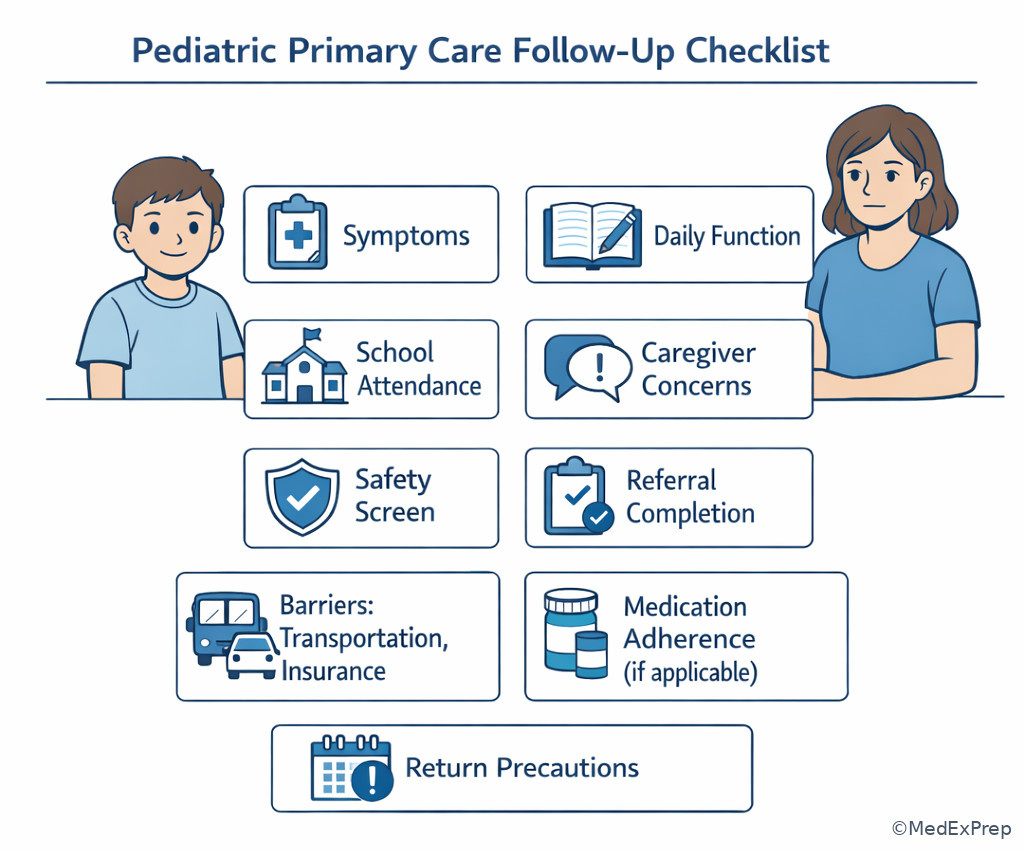
WHY THIS IS TESTED: Exam stems often include partial improvement, family barriers, missed appointments, or medication questions. Candidates must recognize that monitoring is an active decision with defined targets: symptoms, function, safety, adherence if applicable, caregiver understanding, school impact, and whether the child is actually reaching the intended services.
Documentation is part of safe role practice. Document the concern, key facts, risk screen, rationale for next steps, who was informed, and when follow-up will occur. Primary care mental health support does not end when a referral is placed. Closed-loop follow-up is especially important when access barriers exist. However, if repeated worsening, diagnostic complexity, or treatment resistance exceeds role capacity, the answer shifts from “continue current plan” to “consult or escalate.”
See Fig 5 for a visual checklist of what to monitor when care remains in primary care or co-management.
Exam takeaway: Monitoring is correct only when safety is stable and follow-up targets are explicit.
B Worked example
A 9-year-old with anxiety, allergic rhinitis, and parental divorce stress was given sleep routine counseling and referred for therapy 3 weeks ago. Today the caregiver reports slightly improved bedtime resistance but worsening school avoidance. The therapist intake is still 6 weeks away because transportation is unstable. The child denies self-harm thoughts. A tempting wrong clue is that “some improvement” may suggest the plan is working well enough to simply continue.
Reasoning chain: Identify task → choose the best next outpatient action. Extract key facts → no immediate danger, but function is worsening and access barriers threaten treatment delay. Apply rule → monitoring must be active and closed-loop. The clinician should reassess function and safety, address transportation/resource barriers, coordinate school and behavioral health support, and set earlier follow-up rather than passively wait. Eliminate distractors → not emergency transfer, but also not hands-off continuation. Verify → best answer is enhanced coordination plus specific monitoring targets.
C Exam trap
D Checkpoint
Question: A 15-year-old with depression symptoms, obesity, and family transportation barriers was referred to therapy 1 month ago but has not connected. She reports ongoing low mood, missing school twice weekly, and no suicidal thoughts. What is the most appropriate next step?
- Assume the referral is sufficient and wait until the specialist visit occurs.
- Reassess symptoms, function, and safety; troubleshoot access barriers; reinforce interim supports within role; and set a defined follow-up plan.
- Discharge from behavioral follow-up because there is no acute crisis.
- Authorize inpatient psychiatric admission to speed up mental health services.
Correct answer: B.
- A: Tempting because referral has already been made; wrong because closed-loop follow-up is needed when access barriers persist.
- B: Tempting because it requires extra work; right because ongoing monitoring and barrier reduction are in-scope and high-yield.
- C: Tempting because outpatient symptoms may seem mild; wrong because functional impairment remains active.
- D: Tempting because it escalates access problems; wrong because inpatient admission is not indicated without emergency criteria and exceeds role assumptions.
Exam Traps & Differentiators
- Most common wrong answer and why: Choosing the most aggressive-seeming intervention because it feels thorough. The test usually wants the highest-priority in-scope action, not the most dramatic one.
- Looks similar but isn't: Referral vs abandonment. A real referral answer includes rationale, urgency, barriers, communication, and follow-up.
- Looks similar but isn't: Confidentiality vs secrecy. Confidentiality protects privacy when safe; secrecy despite danger is wrong.
- Looks similar but isn't: Screening vs emergency assessment. When a red flag appears, routine scales become secondary.
- Related future trap: In Best Next Step Logic, you will see answer choices that are individually reasonable but in the wrong sequence. This topic gives the boundary rule that helps reject them.
| Stem says... | Think... | Reject... |
|---|---|---|
| “Can you start the medication today?” | Check role and prescribing authority first | Independent prescribing if authority is not given |
| “Please don't tell my parent” plus self-harm risk | Safety exception to confidentiality | Promises of complete secrecy |
| “The waitlist is long” | Coordinate, support barriers, monitor actively | Doing nothing until specialty access occurs |
| “School wants a letter deciding placement” | Clinical documentation and coordination, not final legal/educational determination | Acting as final school authority |
| Psychosis, suicidal intent, or abuse disclosure | Immediate safety action and protocol | Routine follow-up or delayed referral |
| Complex developmental concern across settings | Screen, gather collateral, refer for formal evaluation | Claiming formal specialist testing was completed in clinic |
| Confusable pair | What makes them look alike | Single clue that separates them |
|---|---|---|
| Routine referral vs urgent escalation | Both involve outside help | Current safety threat = urgent escalation |
| Confidentiality vs mandated disclosure | Both involve patient trust | Safety or abuse concern triggers exception |
| Screening support vs definitive diagnosis | Both use structured data | Formal diagnosis may require authority or specialty pathway not provided in stem |
| Care coordination vs legal advice | Both address systems issues | Clinician coordinates services but does not act as legal decision-maker |
| Monitoring vs passive waiting | Both may avoid immediate escalation | True monitoring includes targets, timing, and return precautions |
If the stem says...
- “The patient searched how to die” → think immediate safety escalation
- “The family wants a diagnosis today to get services” → think screen/support/referral within role
- “The adolescent begged you not to tell” → think clarify confidentiality limits and check for safety/reporting exceptions
- “Specialty access is delayed” → think closed-loop coordination, not passive waiting
- “The school asks you to decide placement” → think clinical documentation and coordination, not final eligibility/placement authority
Tables
| Role-appropriate action | What it includes | What it does not include |
|---|---|---|
| Focused assessment | Symptoms, function, safety, developmental context, family/school history | Formal forensic or subspecialty evaluation beyond role |
| Screening interpretation | Use of validated tools to support next steps | Automatic definitive diagnosis from a screener alone |
| Brief intervention | Psychoeducation, coping support, family guidance, monitoring | Unauthorized specialist psychotherapy or complex treatment outside role |
| Medication support | Education, adherence counseling, adverse-effect monitoring within licensure | Independent prescribing/change if authority is not provided |
| Care coordination | Referral, consultation, school communication, barrier reduction | Final legal, educational, or custody determinations |
| Emergency response | Recognize danger, maintain safety, activate protocol, handoff | Operating as inpatient psychiatrist or independently authorizing involuntary treatment beyond authority |
| Situation | Best lane | Priority nursing action | Why not the close distractor? |
|---|---|---|---|
| Mild anxiety, no safety risk, family requests help | Primary care support + monitoring | Assess, educate, brief coping plan, follow-up | Urgent transfer is wrong priority |
| Complex developmental concerns across settings | Referral/co-management | Gather collateral and coordinate formal evaluation | Definitive diagnosis in clinic exceeds role |
| Suicidal intent with means access | Immediate escalation | Maintain safety and activate emergency protocol | Routine screening or therapy referral is too delayed |
| Abuse disclosure | Mandated action | Explain limits, report per protocol, protect safety | Secrecy to preserve trust is unsafe |
| Missed therapy referral with worsening function | Active monitoring + coordination | Reassess, remove barriers, set close follow-up | Passive waiting ignores deterioration |
| Presentation | Classification | Best next step |
|---|---|---|
| Teen requests privacy for stress discussion, no danger disclosed | Confidential outpatient conversation | Preserve privacy within local law; encourage supportive caregiver involvement |
| Teen requests privacy and reports suicide plan | Safety exception | Escalate, involve caregivers/resources per protocol |
| Caregiver requests school placement letter | Systems coordination issue | Document function, coordinate evaluation pathway |
| Family requests immediate psychiatric medication without authority provided | Out-of-role treatment request | Assess, educate, consult/refer appropriately |
| Ongoing symptoms despite placed referral and access barriers | Monitoring/co-management gap | Closed-loop follow-up and barrier troubleshooting |
| Command hallucinations and self-harm content | Psychiatric emergency indicator | Immediate safety escalation |
Exam takeaway: Follow-up is active only when you track safety, function, barriers, and handoff completion.
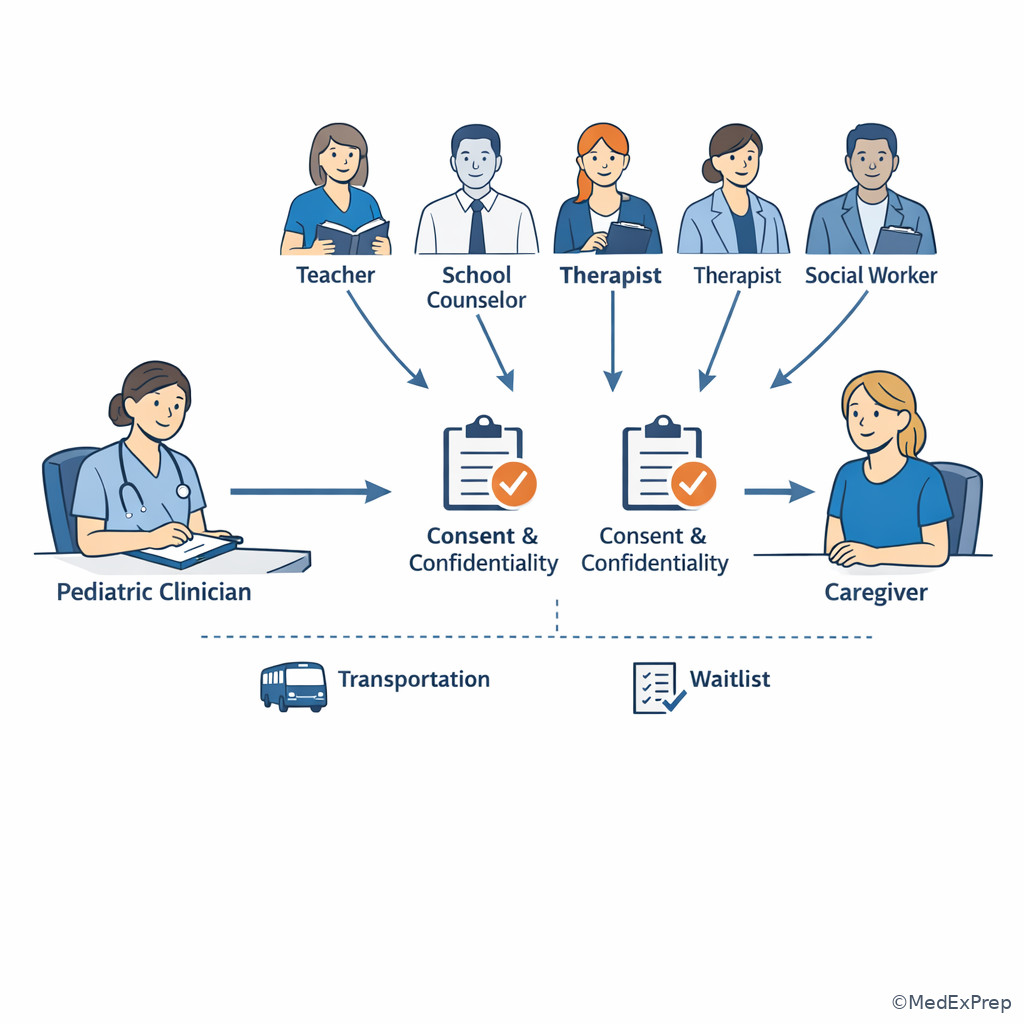
Exam takeaway: Coordination with caregivers and schools is part of care, not a separate optional task.
Exam takeaway: Suspected abuse shifts the task from private counseling to protected reporting and safety action.
Algorithm / Approach
Exam takeaway: Use this sequence to choose the safest in-scope action before being distracted by lower-priority options.
Use this algorithm exactly as a filter. On board-style questions, the wrong answer is often not absurd; it is simply one step too early, too late, or outside scope. See Fig 6. Also note the forward link to the next lesson, Best Next Step Logic, where this algorithm becomes the general solving framework for PMHS stems.
Rapid Review
- Scope of practice → choose assess/educate/coordinate/escalate before any specialist-only action
- Long waitlist → active barrier reduction and follow-up, not passive waiting
- Adolescent privacy → respected unless safety or reporting exception applies
- Positive screener → supports next step; does not automatically equal definitive diagnosis
- School impairment → coordinate with school systems; do not become the final placement authority
- Abuse disclosure → report/protect per protocol; do not investigate as a forensic specialist
- Suicidal intent with means → immediate safety escalation beats routine counseling
- Psychosis in clinic → urgent evaluation/handoff, not delayed referral
- Co-management → correct when condition is nonemergent but exceeds solo primary care comfort or resources
- Monitoring → track safety, function, barriers, and referral completion
- Out-of-role signal → “write the prescription,” “give legal advice,” “authorize commitment”
- Best next step → safest, highest-priority, feasible action within role now
Self-check quiz
1.1.1.8 Question 1
A 12-year-old with eczema and school stress asks the clinic clinician to “officially decide” whether she should be moved to a different classroom because of anxiety. Which action is most appropriate?
- Make the final educational placement decision based on the visit today.
- Assess symptoms and function, document concerns, and coordinate with caregivers and school through the appropriate evaluation pathway.
- Refuse to address school concerns because they are outside the health setting.
- Wait for the next annual well visit before discussing school supports.
1.1.1.9 Question 2
A 15-year-old with acne and test anxiety says, “I want to talk privately, but promise you will not tell anyone no matter what I say.” Which response is most appropriate first?
- Promise complete confidentiality before hearing any details.
- Explain that privacy is respected as much as possible, but safety and reporting rules may require limited disclosure.
- Refuse to speak privately because all adolescent visits require full caregiver presence.
- Ask the caregiver to answer the questions instead because minors cannot discuss mental health independently.
1.1.1.10 Question 3
A 14-year-old with asthma and recent bullying presents for low mood. During the visit he says he searched online last night for ways to hang himself, but now says he is “probably fine.” His caregiver is in the lobby. What is the most appropriate next step?
- Complete a depression screener first to quantify severity before deciding on action.
- Provide a crisis hotline number and ask him to call if feelings return.
- Maintain supervision, activate urgent safety protocol, and involve the caregiver and appropriate emergency resources per local policy.
- Schedule a therapy referral within 1 week because he denied current intent.
1.1.1.11 Question 4
A 9-year-old with language delay, sensory sensitivity, and school meltdowns has concern for autism spectrum disorder. The caregiver requests that the pediatric primary care mental health clinician “perform the full formal testing today so the school must accept it.” What is the most appropriate response?
- Use available screening information to declare a final diagnosis and send it directly to the school as definitive.
- Gather developmental and cross-setting information, support screening within role, and coordinate referral for formal evaluation through the appropriate pathway.
- Tell the caregiver nothing can be done until a child psychiatrist sees the child.
- Advise home-schooling until formal testing is completed.
1.1.1.12 Question 5
A 16-year-old with anxiety and chronic headaches was referred for counseling 1 month ago, but transportation barriers prevented intake. She denies suicidal thoughts but is now missing school twice weekly. What is the most appropriate next step?
- Assume the original referral is enough and wait until the family solves transportation.
- Reassess symptoms, function, and safety; troubleshoot barriers; reinforce interim supports within role; and arrange close follow-up.
- Discontinue behavioral follow-up because there is no emergency.
- Send her directly for inpatient psychiatric admission because outpatient access is delayed.
1.1.1.13 Question 6
A 17-year-old with ADHD, daily cannabis use, and recent family conflict asks to speak alone. He reports driving after using marijuana and says that after a breakup he briefly thought about crashing his car but “would never actually do it.” He refuses caregiver involvement. Which action is most appropriate?
- Maintain strict confidentiality because he is nearly an adult and has not described a current plan.
- Explore immediate risk further, explain confidentiality limits related to safety, and involve caregivers or emergency supports according to local protocol if danger cannot be safely managed.
- Call the school first so they can remove his parking pass before speaking with family.
- Document the statement and reassess at the next routine visit to preserve rapport.
1.1.1.14 Question 7
A 13-year-old with obesity, insomnia, and new social withdrawal reports hearing a voice at night saying he is worthless. His caregiver asks the clinician to “just start something for psychosis today because psychiatry is months away.” The child appears frightened and says the voice told him last night to cut himself, though he did not act. Which action is most appropriate?
- Begin antipsychotic treatment in clinic because the symptom pattern is highly concerning.
- Complete a detailed sleep hygiene plan first because insomnia can worsen perceptual experiences.
- Maintain safety and arrange urgent emergency or specialty evaluation per protocol rather than independently managing the case as routine outpatient care.
- Schedule a routine follow-up in 2 weeks while awaiting psychiatry because he did not self-harm.
1.1.1.15 Question 8
A 15-year-old with depression history reveals that her mother’s partner enters her room at night and grabs her, then begs the clinician not to tell anyone because “it will ruin my family.” She denies suicidal ideation and asks instead for help sleeping. Which action is most appropriate?
- Keep the disclosure confidential and focus on sleep counseling to preserve trust.
- Ask the patient to confront the adult at home first and report back if it happens again.
- Explain the limits of confidentiality, ensure immediate safety, and follow mandated reporting and institutional protocol.
- Provide legal advice about how to seek a restraining order before telling any other adult.
Answer key
1.1.1.16 Question 1: B
A: Tempting because school impairment is real and urgent to the family. Incorrect because final educational placement decisions are not made unilaterally by the clinician; the single stem clue is “officially decide,” which signals a school/legal authority problem outside role. Sources: NCSBN Clinical Judgment guidance; ANA standards on scope and collaboration.
B: Tempting because it feels less decisive than giving the family what they want. Correct because it follows the nursing process: assess first, document functional concerns, and coordinate through the proper pathway; the clue is the need for role-appropriate school collaboration rather than final determination. Sources: ANA Scope and Standards of Practice; NCSBN safety and collaboration principles.
C: Tempting because it avoids overreach. Incorrect because school functioning is relevant to pediatric mental health care and coordination is within role; the clue is that health care can support school planning without becoming the final authority. Sources: ANA standards for coordination of care.
D: Tempting because school systems move slowly. Incorrect because active impairment needs timely assessment and coordination now; delaying violates priority assessment and follow-up principles. Sources: NCSBN prioritization framework.
1.1.1.17 Question 2: B
A: Tempting because trust matters in adolescent care. Incorrect because promising absolute secrecy before hearing the concern can block required safety action; the discriminating clue is “no matter what I say,” which should trigger explanation of limits first. Sources: ANA ethics and confidentiality standards; pediatric confidentiality guidance.
B: Tempting because it may feel formal. Correct because it balances rapport with legal and safety duties; nursing priority is to set expectations before sensitive disclosure. Sources: ANA Code of Ethics; pediatric confidentiality principles.
C: Tempting because involving caregivers is often helpful. Incorrect because many adolescent conversations appropriately begin privately; the clue is that privacy is often allowed, but not unlimited. Sources: pediatric primary care confidentiality guidance.
D: Tempting because caregivers are often historians. Incorrect because adolescents can and should often participate directly in mental health discussions; the clue is that the question asks for the best first response to the adolescent. Sources: ANA patient-centered communication standards.
1.1.1.18 Question 3: C
A: Tempting because using a screener seems systematic and evidence-based. Incorrect on priority grounds: safety outranks routine quantification; the clue is online search for hanging methods, indicating acute suicide risk. Sources: NCSBN prioritization and safety principles; pediatric suicide risk guidance.
B: Tempting because crisis resources are useful. Incorrect because giving a hotline alone is an implementation step at the wrong priority when the patient is currently high risk. The discriminating clue is recent method-seeking behavior. Sources: NCSBN safety/ABCs analogy for immediate risk response.
C: Tempting because it is resource-intensive. Correct because the nursing priority is immediate safety, supervision, and escalation; the clue is a potentially lethal method search plus current disclosure in clinic. Sources: ANA standards on safety; pediatric suicide emergency protocols.
D: Tempting because he minimized current intent. Incorrect because denial after a high-risk disclosure does not downgrade priority enough for routine referral. The clue is the high-risk behavior described the night before. Sources: pediatric suicide assessment guidance.
1.1.1.19 Question 4: B
A: Tempting because screening data may strongly support concern for autism. Incorrect because the stem asks for “full formal testing” and a definitive school-facing conclusion, which exceeds routine screening support. Sources: ANA scope standards; developmental assessment guidance.
B: Tempting because it requires coordination rather than immediate closure. Correct because it keeps the clinician within role: gather history across settings, support screening, and coordinate formal evaluation. The single clue is the request for definitive formal testing today. Sources: pediatric developmental evaluation frameworks; ANA coordination standards.
C: Tempting because the case may need specialty input. Incorrect because useful action can still occur now through assessment support and referral; “nothing can be done” is lower-quality care. Sources: NCSBN clinical judgment model.
D: Tempting because school distress is significant. Incorrect because home-schooling is not the priority nursing action and is outside the immediate role decision. Sources: ANA scope and care planning standards.
1.1.1.20 Question 5: B
A: Tempting because the referral has already been placed. Incorrect because waiting ignores worsening school function and access barriers; the clue is missed school twice weekly despite failed referral completion. Sources: ANA care coordination standards; NCSBN follow-up and evaluation principles.
B: Tempting because it is more work than passive observation. Correct because it follows the nursing process: reassess, analyze barriers, support within role, and plan follow-up. The clue is no emergency but clear functional deterioration. Sources: NCSBN clinical judgment framework; ANA Standards.
C: Tempting because there is no suicidality. Incorrect because lack of acute crisis does not justify stopping care when function is worsening. Sources: NCSBN prioritization principles.
D: Tempting because inpatient care can seem like a shortcut around access barriers. Incorrect because there is no indication for emergency admission in this scenario, and it is the wrong priority action. Sources: pediatric mental health triage guidance.
1.1.1.21 Question 6: B
A: Tempting because adolescent confidentiality is important and he denies a current plan. Incorrect because driving after substance use plus recent suicidal vehicular thought may signal active safety risk; the clue is the potentially lethal behavior tied to self-harm thoughts. Sources: ANA confidentiality and safety standards; pediatric risk assessment guidance.
B: Tempting because it may strain rapport. Correct because priority is further immediate risk assessment with clear confidentiality limits and escalation if safety cannot be maintained. The discriminating clue is the recent thought of crashing the car, which raises the case above routine confidential counseling. Sources: NCSBN safety prioritization; ANA duty to protect.
C: Tempting because school driving access is relevant. Incorrect because calling the school first is not the priority nursing action; first assess and manage immediate safety through appropriate family/protocol channels. Sources: NCSBN nursing process hierarchy.
D: Tempting because preserving rapport matters with adolescents. Incorrect because delay is unsafe when potentially lethal behavior and impaired driving are involved. Sources: pediatric suicide/substance risk guidance.
1.1.1.22 Question 7: C
A: Tempting because rapid treatment feels compassionate when psychosis is suspected. Incorrect because independent medication initiation is outside role unless authority is explicit, and the patient also has self-harm command content requiring urgent evaluation. The clue is command hallucinations to self-harm. Sources: ANA scope standards; pediatric psychiatric emergency guidance.
B: Tempting because insomnia can worsen perception and is a real contributor. Incorrect because sleep counseling is a correct action at the wrong priority; command hallucinations with self-harm content require urgent safety response first. Sources: NCSBN prioritization hierarchy.
C: Tempting because it shifts care away from clinic management. Correct because safety and urgency dominate, and the case exceeds routine outpatient primary care management. The single discriminator is the voice instructing self-harm. Sources: pediatric emergency mental health protocols; ANA safety standards.
D: Tempting because he did not act on the command. Incorrect because nonaction does not neutralize the emergency significance of psychosis plus self-harm command content. Sources: pediatric psychosis risk guidance.
1.1.1.23 Question 8: C
A: Tempting because preserving trust and treating sleep symptoms may feel trauma-informed. Incorrect because suspected ongoing abuse triggers mandated action; the clue is repeated nighttime grabbing by the caregiver’s partner. Sources: mandated reporting guidance; ANA ethics and safety obligations.
B: Tempting because empowering the adolescent seems supportive. Incorrect because asking her to confront the alleged perpetrator may increase danger and delays required reporting. The clue is current access to the alleged abuser. Sources: child maltreatment response standards.
C: Tempting because it may upset the family system. Correct because nursing priority is safety first, clear explanation of confidentiality limits, and mandated reporting per protocol. The discriminating clue is suspected ongoing abuse. Sources: child protection reporting requirements; ANA duty to protect.
D: Tempting because legal protection may eventually matter. Incorrect because giving legal advice is outside role and not the first action; reporting and safety planning come first. Sources: ANA scope of practice standards.
Keep going with the full PMHS Prep Course (PMHS)
You just studied the way members do, in the same lesson interface. Full access unlocks every lesson, the question bank and flashcards for a full year.
One payment · 1 year of access · No auto-renewal