1.1.1 - PMHNP Practice Scope
PMHNP Practice Scope
What you'll learn
- PROFESSIONAL/LEGAL/ETHICAL PRACTICE: Role accountability -> Define what actions are within entry-level PMHNP scope on board-style questions.
- ASSESSMENT: Clinical reasoning -> Distinguish psychiatric evaluation and risk assessment tasks the PMHNP should perform directly.
- PLANNING & MANAGEMENT: Treatment planning -> Choose medication, psychotherapy, monitoring, referral, and follow-up decisions that fit PMHNP scope.
- SAFETY: Crisis response -> Prioritize emergency escalation when safety or medical instability exceeds routine outpatient management.
- COLLABORATION: Consultation/care coordination -> Identify when the best answer is consult, refer, transfer, or co-manage rather than continue solo management.
- PROFESSIONAL/LEGAL/ETHICAL PRACTICE -> Role boundaries and jurisdiction-sensitive practice
- ASSESSMENT -> Psychiatric interview, differential framing, and safety screening within PMHNP role
- PLANNING & MANAGEMENT -> Evidence-based psychopharmacologic and psychotherapeutic planning
- SAFETY -> Suicide, violence, psychosis, intoxication/withdrawal, delirium, and severe medication reaction escalation
- COLLABORATION -> Interprofessional referral and consultation decisions
Why it matters
- Many PMHNP board items are not testing obscure facts; they are testing whether you choose a safe action within role rather than an idealized but unsafe or out-of-scope plan.
- The same clinical stem can change answers depending on whether the patient needs psychiatric treatment, medical escalation, emergency transfer, or consultation.
- Early in exam prep, role confusion causes avoidable misses: choosing psychiatrist-only actions, nonpsychiatric specialty management, or delayed escalation in emergencies.
- Scope clarity improves every later topic in this course, especially psychopharmacology, safety, documentation, consent, and differential diagnosis.
Key Terms & Must-Know Facts
1.1.1.1 Key terms
- Scope of practice: The professional activities appropriate to the PMHNP role, training, standards, and jurisdiction.
- Entry-level PMHNP: Board-exam perspective focused on safe, standard, generalist advanced practice psychiatric care across the lifespan.
- Risk assessment: Structured evaluation of suicide, self-harm, violence, psychosis-related danger, abuse/neglect, and inability to care for self.
- Differential diagnosis: Comparing psychiatric, substance-induced, medication-induced, and medical causes before selecting treatment.
- Disposition: Determining outpatient follow-up, urgent referral, emergency evaluation, inpatient level of care, or consultation.
- Consultation: Asking another clinician or service to assist when complexity exceeds PMHNP scope or setting capacity.
- Referral: Directing the patient to another service or specialist for ongoing evaluation or treatment.
- Co-management: Shared treatment planning between PMHNP and another clinician, such as primary care, OB, neurology, or therapy.
- Informed consent: Discussion of risks, benefits, alternatives, and limits of treatment appropriate to role and setting.
- Capacity concern: Possible inability to understand, appreciate, reason about, or communicate a treatment choice.
- Medical mimic: A medical condition presenting with psychiatric symptoms, such as delirium, thyroid disease, seizure disorder, or medication toxicity.
- Jurisdiction-dependent rule: A legal or regulatory detail that varies by state or institution and should not be assumed universally.
1.1.1.2 Must-know facts
- The PMHNP exam rewards the safest next step, not the most ambitious intervention.
- When a stem includes delirium, severe intoxication/withdrawal, unstable vitals, or a severe medication reaction, medical escalation comes before routine psychiatric management.
- PMHNPs do perform comprehensive psychiatric assessment, differential reasoning, common lab interpretation, medication selection, monitoring, psychoeducation, and safety planning.
- PMHNPs do not provide definitive specialty medical management outside role; they recognize the problem and consult or transfer.
- If the answer depends on local law, the exam usually favors the option that is safest, ethical, documented, and collaborative.
- Out-of-role wording often appears as a trap; reject answers that require psychiatrist-only, ICU-level, forensic, or specialty medical duties.
- Psychiatric treatment planning must account for age, pregnancy/postpartum status, substance use, trauma, medical comorbidity, and social context.
- The PMHNP must prioritize imminent safety concerns over long-term psychotherapy or medication fine-tuning.
Exam takeaway: Use a role-first lens to decide whether the next step is treat, monitor, consult, or transfer.
flowchart TD
A[Patient presents] --> B{Immediate safety or medical instability?}
B -->|Yes| C[Emergency evaluation or higher level of care]
B -->|No| D{Psychiatric task within PMHNP role?}
D -->|Yes| E[Assess diagnose plan monitor educate]
D -->|No or unclear| F[Consult refer or co-manage]
E --> G{Jurisdiction or setting limit?}
G -->|Yes| F
G -->|No| H[Proceed with evidence-based PMHNP care] Exam takeaway: Board stems often test the same scope principle across outpatient, inpatient, emergency, telehealth, and consultation-liaison settings.
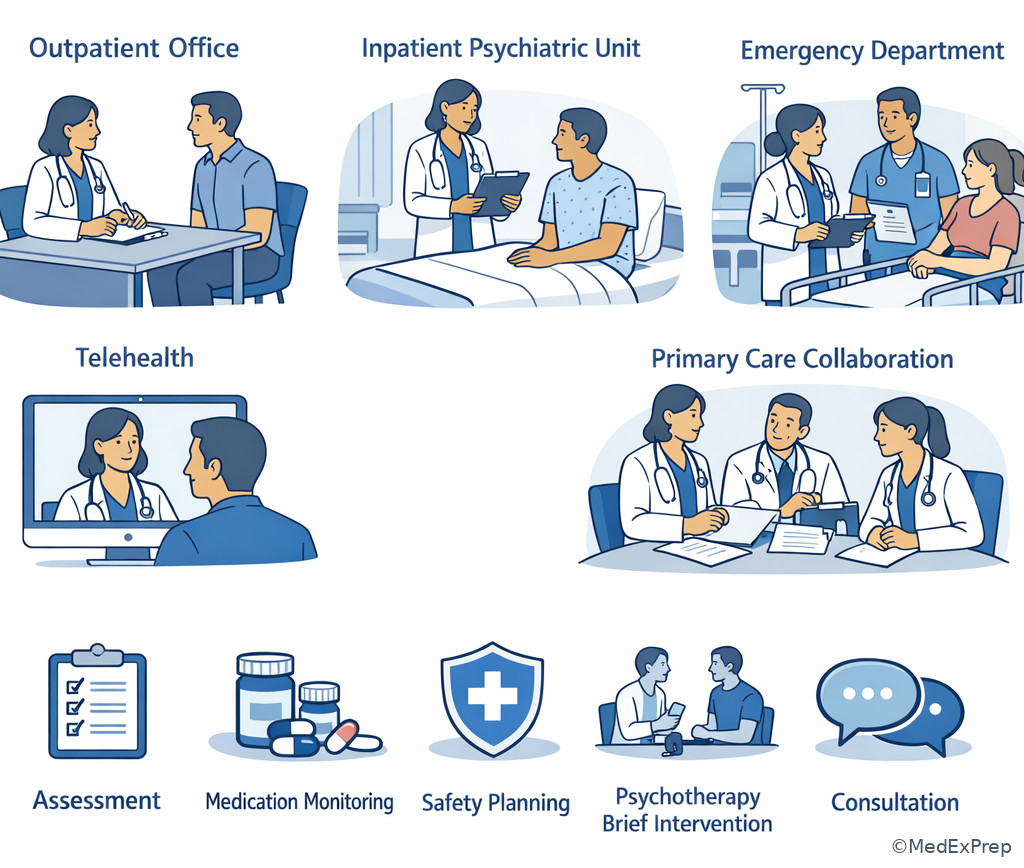
Core content
1.1.1.3 Foundational scope: what the PMHNP is expected to do
A Explanation
The first board-style conflict is simple: Is this a standard PMHNP task, or is the stem asking you to act outside role? The resolving rule is whether the action involves advanced psychiatric assessment, psychopharmacology, psychotherapy integration, monitoring, safety planning, and coordination of care within accepted PMHNP standards. A PMHNP should perform comprehensive psychiatric interviews, mental status exams, risk assessments, formulation, common differential diagnosis, ordering and interpreting commonly relevant tests, initiating or adjusting psychotropics consistent with role and jurisdiction, providing psychoeducation, and arranging follow-up.
WHY THIS IS TESTED: The exam repeatedly places a correct clinical idea next to an incorrect role assumption. For example, recognizing catatonia is within scope; personally managing a medically unstable patient without transfer is not. Choosing an antidepressant may be within scope; ignoring pregnancy or bipolar risk is not. The test is not asking whether you know everything in medicine. It is asking whether you recognize what the PMHNP should do next.
Choose the answer when it keeps the PMHNP in a lane of assessment -> psychiatric differential -> safe treatment plan -> monitoring -> collaboration. Reject the answer when it requires ICU-style management, definitive neurologic/endocrine workup beyond routine psychiatric relevance, forensic judgment, or legally final determinations. See Fig 1.
B Worked example
A 29-year-old woman with generalized anxiety disorder, migraine, and recent postpartum status presents to an outpatient psychiatric clinic with panic symptoms, insomnia, and depressed mood. She also reports palpitations and a 15-pound unintentional weight loss over 6 weeks. She wants “the strongest anxiety medicine today.” A distracting lab in the chart shows mildly low vitamin D. A tempting clue is her history of panic disorder. The task is the most appropriate next step within PMHNP scope.
Reasoning chain: Identify task: not just medication selection, but role-appropriate psychiatric assessment with medical differential awareness. Extract key facts: postpartum, weight loss, palpitations, anxiety-like symptoms. Apply rule: the PMHNP should recognize a possible medical mimic such as thyroid disease and order/coordinate common relevant evaluation rather than reflexively intensify anxiolytic treatment. Eliminate distractors: high-dose benzodiazepine initiation is tempting because symptoms sound like panic, but the systemic signs widen the differential. Deferring everything to primary care without any psychiatric risk assessment is also wrong because the PMHNP still must assess mood, safety, and functioning. Verify: safest in-scope action is psychiatric assessment plus appropriate medical screening/coordination, not definitive endocrine management.
C Exam trap
D Checkpoint
Question: A PMHNP evaluates a 67-year-old man in a primary care behavioral health clinic for new visual hallucinations, sleep reversal, fluctuating attention, and agitation after treatment for pneumonia. Which action is most appropriate within PMHNP scope?
- A. Complete a focused psychiatric and delirium-oriented assessment and arrange urgent medical evaluation for suspected delirium.
- B. Diagnose primary psychotic disorder and begin routine outpatient antipsychotic management.
- C. Reassure the family that hallucinations are common in aging and schedule follow-up in 4 weeks.
- D. Personally manage the patient’s medical workup for infection recurrence and electrolyte correction.
Answer: A
- A is tempting and correct because the PMHNP should assess, recognize probable delirium, and escalate urgently; fluctuating attention after infection is the discriminator.
- B is tempting but wrong because hallucinations suggest psychosis, yet the acute fluctuating course points away from primary psychotic disorder.
- C is tempting but wrong because older adults may have sensory phenomena, but inattention and recent infection make reassurance unsafe.
- D is tempting but wrong because the patient needs medical evaluation, but definitive management of the medical instability is not the PMHNP’s standalone role.
1.1.1.4 Foundational limits: what should trigger consultation, referral, or transfer
A Explanation
The second foundational conflict is continue managing vs consult/transfer now. The single rule that resolves it is whether patient safety, medical stability, or complexity exceeds what can be safely handled in the current PMHNP setting. This topic matters because many incorrect options are not absurd; they are simply too slow or too narrow. If a patient has severe agitation with unstable vitals, probable serotonin syndrome, severe alcohol withdrawal, new catatonia with dehydration, postpartum psychosis, or delirium, you do not win points for crafting a thoughtful outpatient medication plan. You win points for urgent escalation.
Consultation is appropriate when the problem is real but not necessarily emergent: perinatal medication planning with obstetric coordination, possible seizure disorder affecting psychiatric symptoms, abnormal movement disorder requiring neurology input, or complicated substance use needing addiction specialty linkage. Transfer or emergency referral is appropriate when immediate safety or medical risk dominates. Refer for psychotherapy when the modality needed exceeds brief PMHNP management or when the patient needs structured therapy beyond routine medication visits.
WHY THIS IS TESTED: Test writers place subtle cues in the stem that turn a routine psychiatric visit into an escalation scenario. A correct answer often sounds less impressive than a wrong one because it uses words like arrange emergency evaluation, obtain urgent medical assessment, or consult. See Fig 2.
Exam takeaway: When danger, delirium, severe reaction, or major medical instability appears, escalate before refining the psychiatric plan.
flowchart TD
A[Psychiatric presentation] --> B{Any red flag?}
B -->|Suicidal intent or violence| C[Emergency safety intervention]
B -->|Delirium or fluctuating consciousness| D[Urgent medical evaluation]
B -->|Severe intoxication or withdrawal| E[Medical or emergency transfer]
B -->|Severe medication reaction| F[Stop suspect agent and urgent medical escalation]
B -->|None of these| G[Routine PMHNP management with follow-up] Exam takeaway: Visual red flags such as confusion, autonomic instability, severe agitation, and inability to care for self should push you toward higher level of care.
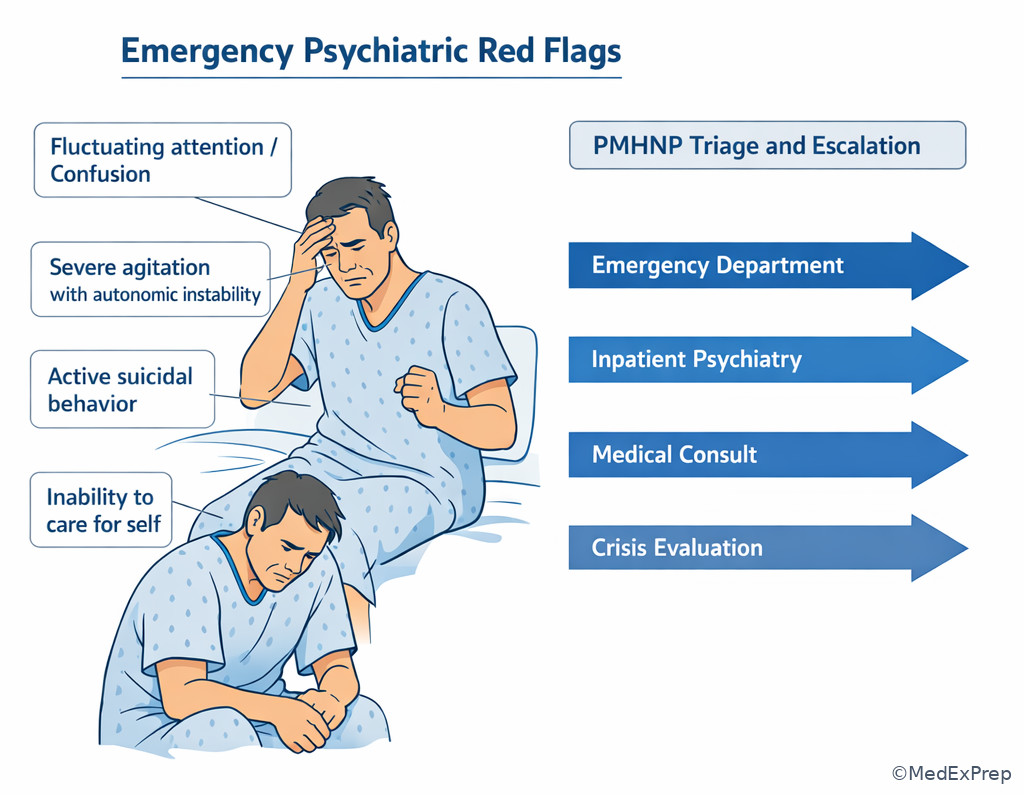
B Worked example
A 41-year-old man with major depressive disorder, alcohol use disorder, and hypertension presents for an urgent same-day visit after stopping drinking 24 hours ago. He is anxious, diaphoretic, tremulous, mildly disoriented, and says he sees “bugs on the wall.” He asks for a refill of his antidepressant because he thinks withdrawal is making him depressed. A distracting detail is a recent breakup. The tempting clue is his known mood disorder. The task is the most appropriate PMHNP action.
Reasoning chain: Identify task: determine disposition, not depression management. Extract key facts: recent cessation of heavy alcohol use, tremor, diaphoresis, hallucinations, disorientation. Apply rule: possible severe alcohol withdrawal or delirium tremens requires urgent medical management; outpatient antidepressant adjustment is wrong priority. Eliminate distractors: supportive counseling alone is inadequate; referral to therapy next week is too delayed; directly managing severe withdrawal in a nonmedical outpatient setting exceeds safe routine management. Verify: emergency transfer or urgent medical evaluation is the safest next step.
C Exam trap
D Checkpoint
Question: A 23-year-old woman with bipolar disorder, asthma, and recent delivery 10 days ago presents with no sleep for 4 nights, grandiose statements, disorganized behavior, and beliefs that her infant is divinely protected from harm. What is the most appropriate next step?
- A. Provide sleep hygiene education and close outpatient follow-up within 72 hours.
- B. Arrange immediate emergency psychiatric evaluation for likely postpartum psychosis/mania.
- C. Start an SSRI for postpartum mood symptoms and reassess in 2 weeks.
- D. Ask the pediatrician to monitor the infant while psychiatric treatment is deferred.
Answer: B
- A is tempting but wrong because sleep loss matters in mania, yet psychosis and impaired judgment make outpatient watchful waiting unsafe.
- B is tempting and correct because postpartum psychosis is a psychiatric emergency requiring immediate higher-level evaluation.
- C is tempting but wrong because postpartum depression is common, but SSRI-first thinking ignores manic psychosis.
- D is tempting but wrong because infant safety matters, yet deferring urgent maternal psychiatric evaluation is unsafe.
- True or False: A PMHNP should independently manage severe delirium in an outpatient office. False.
- The most important first question in a scope stem is: Is there immediate safety or medical instability?
- Name 3 escalation triggers: delirium, severe withdrawal/intoxication, active suicidal intent.
1.1.1.5 Applied role in assessment, diagnosis, and treatment planning
A Explanation
Once a case is safe enough to manage, the PMHNP is expected to perform psychiatric work at an advanced practice level. The conflict becomes treat now vs clarify first. The single resolving rule is whether enough information exists to choose a safe, evidence-based plan. This includes psychiatric history, developmental and trauma context, substance use, medication history, medical comorbidity, prior responses, family history, mental status exam, and focused testing when relevant. The PMHNP should build a practical differential and decide whether medication, psychotherapy, combined treatment, or further clarification is best.
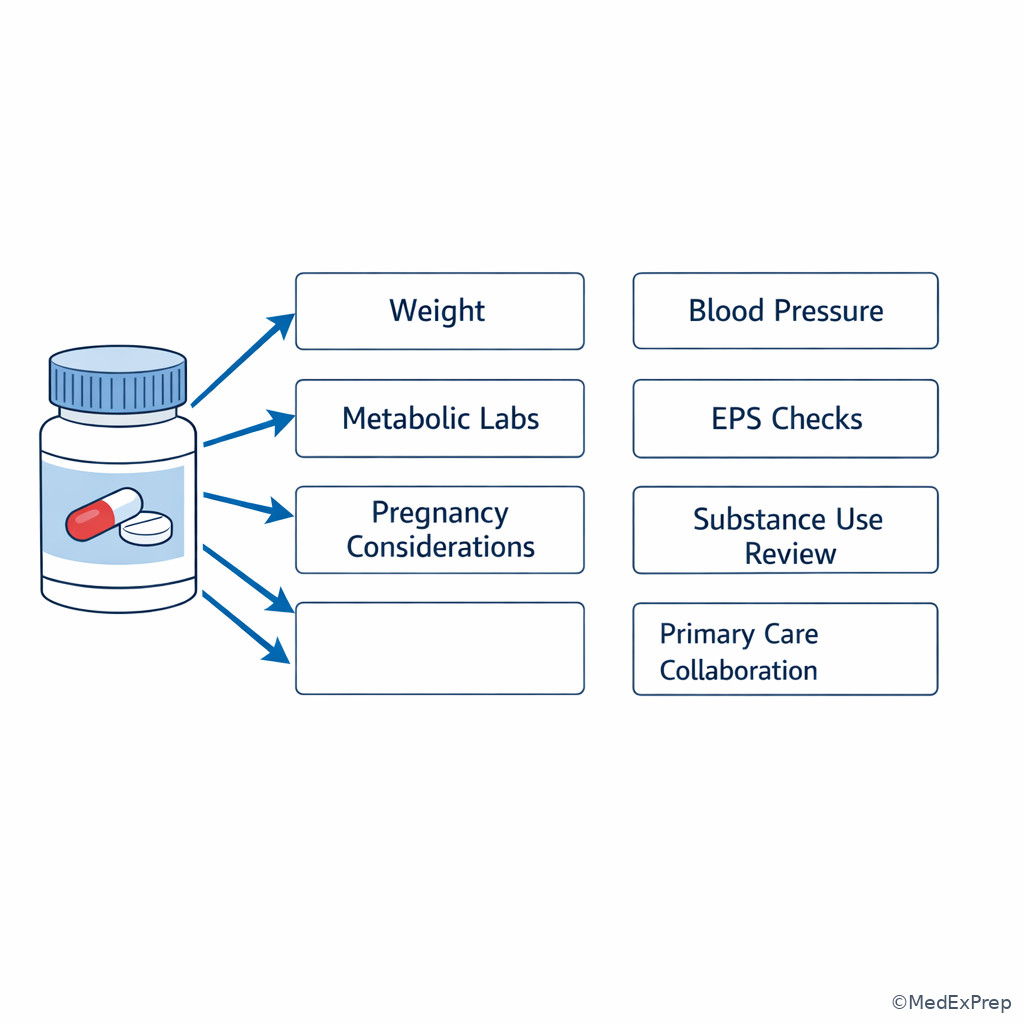
This means the PMHNP is not limited to “screen and refer.” Board-style questions expect you to identify likely bipolar spectrum symptoms before starting an antidepressant, check for substance use when anxiety suddenly worsens, consider ADHD mimics in children, and integrate pregnancy, lactation, older adult vulnerability, and medical comorbidity into treatment choice. The PMHNP should order and interpret commonly relevant data within practice, such as pregnancy testing when clinically relevant, thyroid screening when symptoms suggest it, metabolic monitoring for antipsychotics, and drug levels or safety labs where standard psychopharmacology requires them.
WHY THIS IS TESTED: The exam wants a clinician who can think broadly but act safely. Wrong answers often fail because they either overreach into specialty medicine or underperform by avoiding legitimate PMHNP responsibilities. See Fig 3.
Exam takeaway: Board items often reward the clinician who gathers the missing discriminator before committing to the wrong treatment pathway.
flowchart LR
A[Chief psychiatric concern] --> B[History MSE risk assessment]
B --> C[Check substance medical developmental context]
C --> D{Enough clarity for safe plan?}
D -->|Yes| E[Medication psychotherapy or both]
D -->|No| F[Order relevant tests obtain collateral or consult]
E --> G[Monitor response adverse effects and safety] Exam takeaway: A complete PMHNP assessment integrates psychiatric, medical, developmental, substance-related, and social domains before treatment selection.
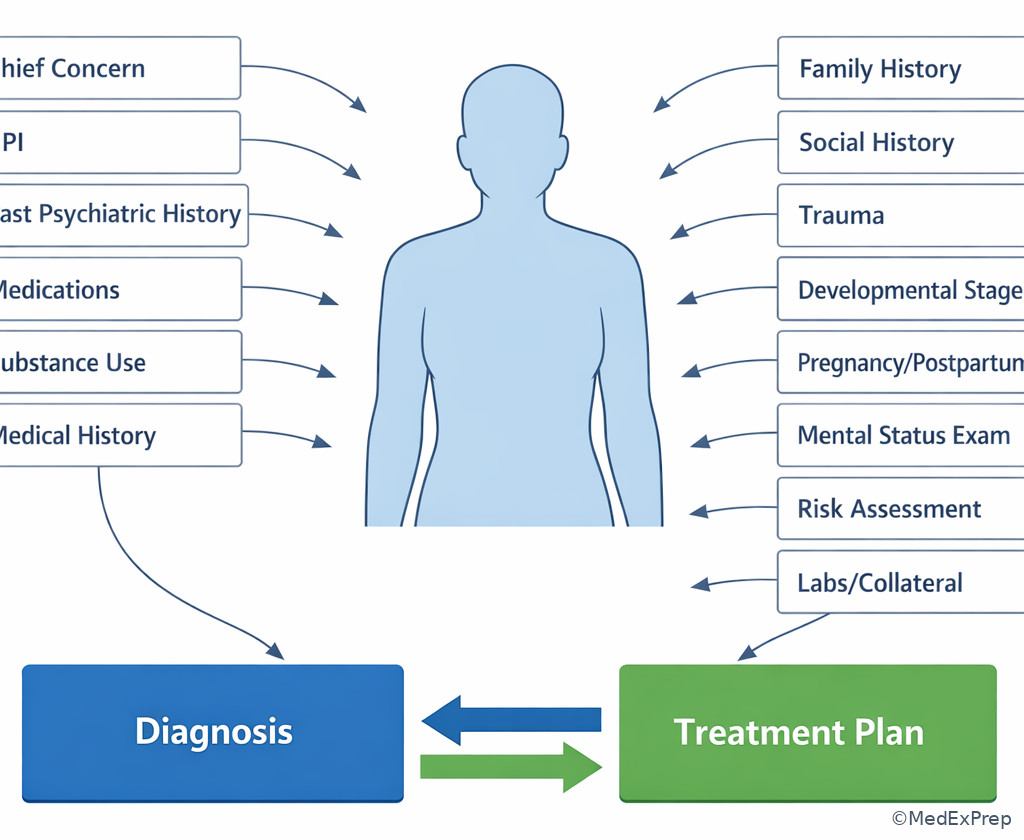
B Worked example
A 16-year-old adolescent presents with declining grades, irritability, and poor concentration. He has asthma, chronic insomnia, and recent cannabis use on weekends. His mother requests stimulant treatment “because his cousin improved right away.” A distracting detail is a family history of ADHD in a sibling. A tempting-but-wrong clue is fidgeting in the office. The task is the most appropriate PMHNP action.
Reasoning chain: Identify task: not immediate stimulant selection; first determine whether ADHD is the most likely explanation. Extract key facts: sleep deprivation, cannabis exposure, academic decline, irritability. Apply rule: the PMHNP should assess developmental history, symptom onset, impairment across settings, sleep, trauma, substance use, and collateral before labeling ADHD. Eliminate distractors: starting a stimulant now is tempting because there is family history and inattention, but the time course and confounders are insufficiently clarified. Sending the case away without assessment is also wrong because this evaluation is within scope. Verify: comprehensive psychiatric evaluation with collateral and clarification of sleep/substance contributors is the correct in-scope next step.
C Exam trap
D Checkpoint
Question: A 34-year-old woman with recurrent depression, obesity, and family history of bipolar disorder seeks treatment for low mood, fatigue, and hopelessness. She recalls two past episodes of needing very little sleep while feeling unusually productive and impulsive. What is the most appropriate PMHNP action?
- A. Begin an SSRI immediately because depressive symptoms are current and severe.
- B. Further assess for bipolar spectrum disorder before selecting antidepressant monotherapy.
- C. Reassure her that brief periods of productivity are unrelated to mood disorders.
- D. Refer her to neurology because decreased sleep always suggests a seizure disorder.
Answer: B
- A is tempting but wrong because current depression invites treatment, yet possible hypomanic history changes medication safety.
- B is tempting and correct because past decreased need for sleep with impulsivity and family history are bipolar red flags that require clarification.
- C is tempting but wrong because many patients minimize hypomania, but dismissing it can lead to unsafe treatment.
- D is tempting but wrong because neurology may matter in selected cases, but the presented clue pattern is mood-based, not primarily seizure-based.
1.1.1.6 Integration: balancing autonomy, collaboration, and documentation
A Explanation
The final integration conflict is act independently within role vs collaborate because the case complexity requires shared care. The single finding that resolves it is whether another discipline contributes information or management that materially changes safety or treatment success. PMHNP practice is not isolated practice. Even when the psychiatric plan is in scope, many cases are best handled through coordinated care: pregnancy/postpartum with OB input, cardiac disease affecting stimulant or antipsychotic decisions, dementia concerns with neurology or primary care, school-based concerns in children, therapist collaboration for OCD or trauma therapy, and family coordination when safety planning depends on supervision.
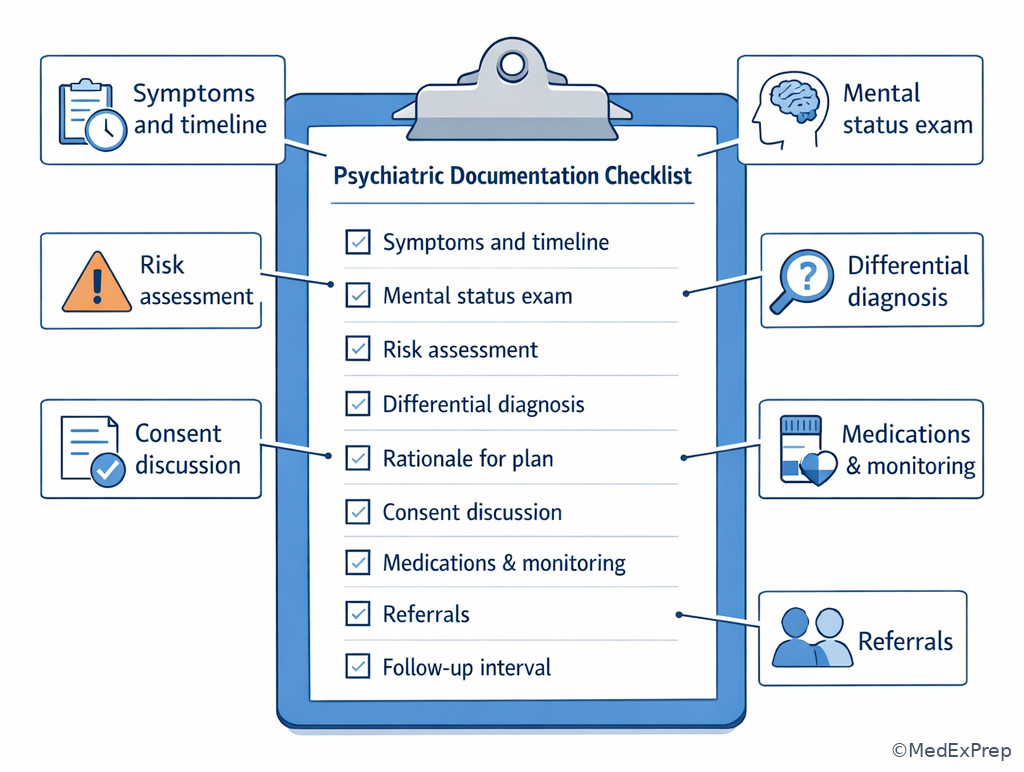
Documentation is part of scope. The PMHNP should document reasoning, risk level, discussion of options, informed consent, monitoring plan, referrals, and follow-up. On board-style stems, the wrong answer may fail not because the medication is wrong, but because it ignores communication, collateral, safety planning, or follow-up. Collaboration also protects against overreach. If a problem is beyond routine PMHNP management, you do not disappear from care; you identify the issue, take immediate safety steps, and coordinate the right handoff.
WHY THIS IS TESTED: Entry-level certification emphasizes safe, ethical, team-based advanced nursing care. The best answer often combines patient care with consultation and documentation rather than choosing one or the other. See Fig 4 and Fig 5.
Exam takeaway: The strongest PMHNP answer often includes both immediate psychiatric action and targeted coordination with the right service.
flowchart TD
A[PMHNP identifies problem] --> B{Safe to manage in setting?}
B -->|Yes| C[Treat and monitor]
C --> D{Another discipline affects safety or outcomes?}
D -->|Yes| E[Consult or co-manage]
D -->|No| F[Continue PMHNP follow-up]
B -->|No| G[Transfer or urgent referral]
E --> H[Document rationale plan and communication]
G --> H Exam takeaway: Safe practice includes documenting risk, communication, and follow-up whenever care crosses disciplines or settings.
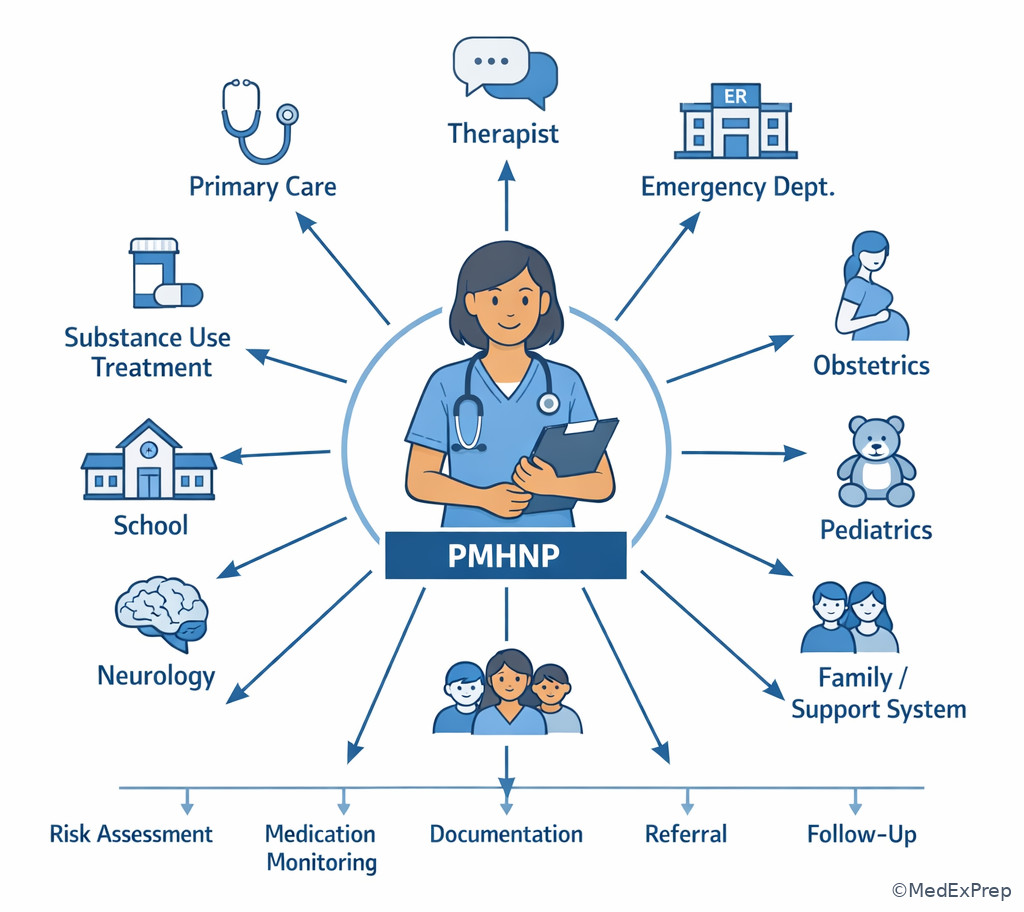
Exam takeaway: Documentation points often separate a merely plausible answer from the best practice answer.
B Worked example
A 74-year-old man with depression, Parkinson disease, type 2 diabetes, and mild cognitive complaints is referred for worsening visual hallucinations and insomnia. He was recently hospitalized for a urinary tract infection. A distracting clue is a remote history of bereavement after his spouse died 2 years ago. The tempting wrong move is to manage this as routine psychotic depression. The task is the most appropriate PMHNP next step.
Reasoning chain: Identify task: determine whether solo outpatient psychiatric treatment is safe. Extract key facts: older adult, Parkinson disease, cognitive symptoms, recent infection, hallucinations. Apply rule: this presentation may reflect delirium, medication effects, neurocognitive disorder, or Parkinson-related psychosis; the PMHNP should assess urgently, coordinate with medical/neurologic care, and avoid simplistic psychiatric labeling. Eliminate distractors: starting a standard antipsychotic without broader evaluation is unsafe; deferring because neurology is involved is also wrong because the PMHNP still must assess safety and psychiatric symptoms. Verify: collaborative, documented evaluation with appropriate medical/neurologic consultation is the best in-scope answer.
C Exam trap
D Checkpoint
Question: A PMHNP starts an antipsychotic for a patient with schizophrenia and obesity in an outpatient clinic. Which follow-up action best reflects appropriate PMHNP scope?
- A. Monitor response, adverse effects, and relevant metabolic parameters while coordinating with primary care as needed.
- B. Ignore weight and metabolic issues because those belong only to internal medicine.
- C. Personally manage all diabetes treatment changes without primary care involvement.
- D. Stop documenting monitoring rationale after the first follow-up because ongoing notes are unnecessary.
Answer: A
- A is tempting and correct because psychotropic monitoring is within PMHNP scope, and collaboration with primary care is appropriate.
- B is tempting but wrong because metabolic monitoring is directly relevant to antipsychotic safety and cannot be ignored.
- C is tempting but wrong because integrated care is good, but definitive diabetes management alone exceeds routine psychiatric role.
- D is tempting but wrong because documentation is part of safe practice, especially for ongoing efficacy and adverse-effect monitoring.
- Fill in the blank: Collaboration is best when another discipline changes safety or treatment success.
- True or False: Documentation is peripheral to scope questions. False.
- Name 3 common collaborators in PMHNP practice: primary care, therapist, emergency/medical services.
Exam Traps & Differentiators
- Most common wrong answer: choosing the most aggressive treatment answer instead of the safest role-appropriate answer. Why it is tempting: it feels decisive. Why it is wrong: it ignores instability, missing diagnostic clarification, or the need for consultation.
- Looks similar but isn't: recognizing a medical syndrome is within PMHNP scope; definitively managing that syndrome without appropriate medical collaboration may not be.
- Forward trap from upcoming Board-Style Clinical Priorities: multiple answers can be in scope, but only one is the priority. Scope alone does not guarantee correctness.
- Forward trap from upcoming Scope Limits And Consultation: if the stem includes ICU-level instability, forensic determination, or specialist medical decision-making, do not “play specialist.” Stabilize, assess within role, and escalate.
If the stem says fluctuating attention after infection, think delirium and urgent medical evaluation rather than primary psychosis.
If the stem says postpartum psychosis or mania, think emergency psychiatric evaluation, not routine outpatient follow-up.
If the stem says apparent anxiety with weight loss, tremor, or other systemic clues, think medical mimic and appropriate screening/coordination.
If the stem says depressive symptoms plus prior decreased need for sleep and impulsivity, think bipolar clarification before antidepressant monotherapy.
If the stem says severe withdrawal, unstable vitals, or suspected medication toxicity, think transfer/escalation before psychotherapy or routine medication adjustments.
If the stem says the action depends on state law or institutional rule, think safest ethical collaborative choice and acknowledge that local laws/protocols vary.
| Stem clue | Choose | Reject | Single discriminator |
|---|---|---|---|
| Acute confusion, fluctuating attention | Urgent medical evaluation + psychiatric assessment | Routine outpatient psychosis treatment | Fluctuating cognition suggests delirium |
| Postpartum, insomnia, grandiosity, disorganization | Emergency psychiatric evaluation | SSRI start with routine follow-up | Psychosis/mania postpartum is emergent |
| Depression with hypomanic clues | Clarify bipolar spectrum first | Immediate antidepressant monotherapy | History changes medication safety |
| New psychiatric symptoms plus systemic signs | Medical mimic screening/coordination | Assume primary psychiatric relapse | Systemic findings widen differential |
| Antipsychotic management in obesity/diabetes risk | Monitor metabolic effects and collaborate | Ignore monitoring because PCP handles it | Psychotropic monitoring remains PMHNP work |
| Looks similar | Actually in scope | Actually outside routine solo PMHNP scope |
|---|---|---|
| Recognize serotonin syndrome | Hold suspect meds, assess severity, arrange urgent medical care | Provide full critical-care medical management alone |
| Evaluate suspected ADHD | Psychiatric assessment, collateral, differential reasoning, treatment planning | Ignore sleep/trauma/substance confounders and label immediately |
| Manage bipolar depression | Select evidence-based psychiatric treatment and monitoring | Overlook mania risk or medical contraindications |
| Address capacity concern | Recognize impairment, document findings, involve appropriate supports/consultation | Make a sweeping final legal determination beyond setting/jurisdiction process |
| Handle abuse concern | Assess safety, document, follow reporting/consult pathways | Conduct a forensic adjudication as the primary role |
Tables
| PMHNP task area | Usually within scope | Board-style note |
|---|---|---|
| Psychiatric evaluation | Yes | Includes history, MSE, risk assessment, formulation, and differential reasoning |
| Psychotropic selection and titration | Yes | Within role and jurisdiction; must account for safety, monitoring, and comorbidity |
| Brief psychotherapy/psychoeducation | Yes | PMHNP may integrate brief evidence-based modalities and refer for specialty therapy when needed |
| Common relevant lab interpretation | Yes | Used to support safe psychiatric care and identify common mimics/monitoring needs |
| Emergency disposition decision | Yes | Recognize when higher level of care is necessary |
| Definitive ICU-level medical management | No | Recognize and escalate rather than manage alone |
| Forensic legal determination | No | Assess/document concerns and use appropriate legal/institutional pathways |
| Specialty nonpsychiatric disease management | No as solo definitive care | Coordinate with the relevant service rather than substitute for it |
| Decision type | Best PMHNP stance | Common wrong stance | Why boards test it |
|---|---|---|---|
| Routine depression follow-up | Assess risk, review history, choose evidence-based treatment | Delay all decisions to another clinician | Tests underreach vs appropriate autonomy |
| Possible bipolar depression | Clarify mania/hypomania before monotherapy plan | Treat as uncomplicated unipolar depression | Tests diagnostic safety |
| Older adult with fluctuating confusion | Assess and escalate for delirium workup | Label primary psychosis or dementia only | Tests medical mimic recognition |
| Pregnancy/postpartum medication question | Psychiatric planning plus obstetric coordination | Ignore pregnancy context or overreach medically | Tests collaborative care |
| Severe withdrawal/toxicity | Emergency or urgent medical escalation | Routine outpatient symptom management | Tests priority and safety |
| Presentation category | Most likely disposition | What makes it different |
|---|---|---|
| Stable outpatient anxiety without red flags | Routine PMHNP evaluation and treatment | No acute safety threat or strong medical mimic signal |
| Possible medical mimic of anxiety/depression | Psychiatric assessment plus focused medical screening/coordination | Systemic signs or abrupt atypical change |
| Active suicidal intent or violent intent | Emergency safety intervention/higher level of care | Imminent danger overrides routine treatment planning |
| Delirium/intoxication/severe withdrawal | Urgent medical evaluation or transfer | Consciousness, cognition, or autonomic instability |
| Complex but nonemergent overlap case | Co-management/consultation | Another discipline meaningfully changes safe care |
Exam takeaway: Psychopharmacology monitoring stays within PMHNP scope even when medical comorbidity requires shared follow-up.
Algorithm / Approach
Exam takeaway: Solve scope questions by checking safety first, then role fit, then need for clarification, collaboration, and follow-up.
flowchart TD
A[Read the stem] --> B[Identify the task]
B --> C{Immediate danger or medical instability?}
C -->|Yes| D[Emergency action or urgent transfer]
C -->|No| E{Is the action within PMHNP psychiatric scope?}
E -->|No| F[Consult refer or co-manage]
E -->|Yes| G{Is a treatment-changing fact missing?}
G -->|Yes| H[Clarify with assessment labs collateral]
G -->|No| I[Start or adjust evidence-based plan]
I --> J[Monitor document educate follow up]
F --> J
D --> J
Use this five-step rule on scope questions:
- Identify the task: Is the question asking for assessment, diagnosis support, treatment, monitoring, or disposition?
- Check safety first: If the patient is dangerous, delirious, intoxicated, withdrawing, medically unstable, or unable to care for self, escalate.
- Check role fit: If the action is standard psychiatric advanced practice care, it may be yours. If it is specialty medical, forensic, or jurisdiction-dependent beyond the stem, collaborate.
- Clarify missing discriminators: Ask whether bipolarity, substance use, medical mimic, developmental context, or pregnancy changes the plan.
- Close the loop: Document rationale, provide education, arrange follow-up, and communicate with the right clinician or support system.
Rapid Review
- Scope question → safest next step beats most comprehensive long-term plan
- Delirium clue → fluctuating attention separates it from primary psychosis
- Postpartum psychosis → emergency evaluation, not routine follow-up
- Bipolar red flag in depression → decreased need for sleep changes antidepressant logic
- Medical mimic → systemic signs make pure psychiatric relapse less likely
- Consultation answer → often right when another discipline changes safety or outcomes
- Underreach trap → PMHNP should assess and plan, not simply “refer out” everything
- Overreach trap → PMHNP recognizes specialty problems but does not solo-manage all of them
- Psychotropic monitoring → remains PMHNP work even with primary care involvement
- Documentation → rationale, risk, consent, monitoring, and follow-up matter
- Jurisdiction-dependent stem → choose ethical, collaborative, safety-first action
- Child/adolescent inattention → sleep, trauma, and substance use can mimic ADHD
- Older adult hallucinations → infection, medications, and neurocognitive disease may be the key separators
Self-check quiz
1. A PMHNP evaluates a 38-year-old woman with panic symptoms, GERD, and insomnia in an outpatient clinic. She also reports new heat intolerance, tremor, and weight loss. Which action is most appropriate?
- A. Start a benzodiazepine because panic symptoms are present
- B. Complete psychiatric assessment and arrange relevant medical screening/coordination for a possible medical mimic
- C. Delay any evaluation and refer all care back to primary care
- D. Provide definitive endocrine treatment while postponing psychiatric follow-up
2. A 70-year-old man with hypertension and recent hospitalization for infection presents with fluctuating attention, reversed sleep cycle, and visual hallucinations. Which PMHNP action best fits scope?
- A. Routine outpatient antipsychotic management for primary psychosis
- B. Reassurance that aging commonly causes hallucinations
- C. Focused psychiatric assessment with urgent medical evaluation for suspected delirium
- D. Independent inpatient-level medical management of delirium
3. A 32-year-old woman with obesity, generalized anxiety disorder, and recurrent depression reports low mood and anergia. She also describes two prior periods of unusually high energy, overspending, and only 3 hours of sleep nightly without fatigue. She wants “an antidepressant refill today,” and a distracting detail is recent work stress. What is the most appropriate next step?
- A. Restart SSRI monotherapy because depressive symptoms are current
- B. Clarify bipolar spectrum symptoms before choosing treatment
- C. Refer her to dermatology because decreased sleep can be caused by skin irritation
- D. Defer all psychiatric care until a therapist completes an evaluation
4. A 17-year-old student with asthma, chronic sleep restriction, and weekend cannabis use is referred for poor concentration and declining grades. His parent requests stimulant medication immediately. Which action is most appropriate?
- A. Start stimulant treatment because school impairment is present
- B. Complete ADHD-focused psychiatric assessment with collateral and evaluate confounders before medication selection
- C. Refuse further evaluation because substance use excludes ADHD assessment
- D. Ask the school alone to diagnose ADHD before any PMHNP involvement
5. A 45-year-old man with alcohol use disorder, depression, and atrial fibrillation presents 18 hours after stopping heavy alcohol intake. He is diaphoretic, tremulous, anxious, and intermittently sees insects on the wall. A recent divorce is noted in the chart. What is the most appropriate PMHNP action?
- A. Increase his antidepressant and reassess after withdrawal resolves
- B. Arrange urgent medical evaluation for severe alcohol withdrawal risk
- C. Begin outpatient trauma therapy referral only
- D. Provide reassurance that hallucinations are expected and self-limited
6. A 26-year-old woman, 9 days postpartum, with prior bipolar disorder and hypothyroidism presents with no sleep for 4 nights, pressured speech, grandiosity, and belief that her infant has a special mission. She denies suicidal thoughts. Her partner says she attempted to leave the house with the infant at 3 AM “to meet an angel.” Which action is most appropriate?
- A. Arrange immediate emergency psychiatric evaluation because impaired judgment and postpartum psychosis/mania are present
- B. Schedule urgent psychotherapy within 48 hours because she denies suicidality
- C. Start SSRI treatment for postpartum depression and ask the family to watch her closely
- D. Manage solely as thyroid disease until endocrine workup is completed
7. A 76-year-old man with Parkinson disease, type 2 diabetes, mild cognitive impairment, and recent medication changes presents with new hallucinations and nighttime agitation. He had a urinary tract infection 1 week ago and now seems variably attentive during the visit. Which next step is most appropriate?
- A. Diagnose schizophrenia because hallucinations are present
- B. Start routine outpatient psychiatric treatment without collaboration because psychosis is within scope
- C. Perform urgent psychiatric assessment and coordinate medical/neurologic evaluation because the cause may not be primary psychiatric illness
- D. Decline involvement because any hallucination in Parkinson disease is outside PMHNP scope
8. A 52-year-old man with schizophrenia, obesity, hyperlipidemia, and prediabetes is improving on an antipsychotic started by the PMHNP. He asks whether he still needs labs because his primary care clinician also follows him. Which response/action is most appropriate?
- A. Continue psychiatric symptom monitoring only because medical labs belong exclusively to primary care
- B. Stop monitoring once symptoms improve because the medication is clearly effective
- C. Continue relevant antipsychotic safety monitoring and collaborate with primary care rather than assuming one discipline covers everything
- D. Take over all cardiometabolic management without involving primary care so treatment stays streamlined
Answer key
1. Correct answer: B
- A: Tempting because panic symptoms are obvious and benzodiazepines can provide rapid relief. Incorrect because the priority is to assess a possible medical mimic signaled by tremor, weight loss, and heat intolerance; treating presumed panic first risks anchoring bias. The single stem clue is the cluster of systemic hyperadrenergic symptoms.
- B: Tempting because it requires more work than simply prescribing, but it is correct because the PMHNP should complete psychiatric assessment and arrange relevant medical screening/coordination when symptoms may not be purely psychiatric. The single stem clue is new systemic symptoms accompanying anxiety.
- C: Tempting because primary care often evaluates medical problems. Incorrect because the PMHNP should not abandon psychiatric assessment; the appropriate action is integrated psychiatric evaluation plus coordination, not total deferral. The single stem clue is that the question asks for the PMHNP’s action, not a handoff without assessment.
- D: Tempting because endocrine disease may be in the differential. Incorrect because definitive endocrine treatment is outside routine PMHNP scope; recognition and coordination are the proper role-based response. The single stem clue is possible thyroid-like symptoms without an established medical diagnosis.
2. Correct answer: C
- A: Tempting because hallucinations can suggest psychosis. Incorrect because fluctuating attention after recent infection points toward delirium, which requires urgent medical evaluation rather than routine outpatient psychiatric treatment. The single stem clue is fluctuating attention.
- B: Tempting because sensory changes can occur in older adults. Incorrect because the acute fluctuating course with recent hospitalization is unsafe to dismiss as normal aging. The single stem clue is recent infection and sleep-wake reversal.
- C: Tempting and correct because it combines in-scope psychiatric assessment with the right escalation for suspected delirium. The single stem clue is the acute cognitive fluctuation pattern.
- D: Tempting because delirium is urgent and serious. Incorrect because solo inpatient-level medical management exceeds routine PMHNP scope; the PMHNP recognizes and escalates. The single stem clue is that medical stabilization is needed.
3. Correct answer: B
- A: Tempting because the patient is currently depressed and requests an antidepressant. Incorrect because prior decreased need for sleep, overspending, and high energy suggest bipolar spectrum illness, so immediate SSRI monotherapy may be unsafe. The single stem clue is past hypomanic-like episodes.
- B: Tempting and correct because the PMHNP should clarify bipolar symptoms before finalizing treatment. This is a core diagnostic-safety task within scope. The single stem clue is the history of high energy with little sleep and impulsive behavior.
- C: Tempting only if one overinterprets sleep issues broadly. Incorrect because the symptom cluster is psychiatric, not dermatologic, and the stem gives no evidence for a skin-driven sleep disorder. The single stem clue is the mood-congruent behavioral history.
- D: Tempting because therapy is useful in depression. Incorrect because the PMHNP should not defer all psychiatric treatment planning to another clinician when the needed next step is diagnostic clarification within scope. The single stem clue is that treatment depends on mood-spectrum assessment now.
4. Correct answer: B
- A: Tempting because academic impairment and inattention sound like ADHD, and stimulant treatment is often effective. Incorrect because sleep restriction and cannabis use are active confounders that must be evaluated first. The single stem clue is chronic sleep restriction plus weekend cannabis use.
- B: Tempting and correct because comprehensive ADHD-focused assessment with collateral is squarely within PMHNP scope and is the safest next step before medication. The single stem clue is the presence of confounders that can mimic ADHD.
- C: Tempting because substance use complicates evaluation. Incorrect because substance use does not eliminate the PMHNP’s responsibility to assess; it means the differential must be more careful. The single stem clue is a request for diagnosis/treatment despite mixed contributors.
- D: Tempting because school reports are helpful. Incorrect because schools provide collateral, not a substitute for psychiatric diagnostic assessment. The single stem clue is that a PMHNP evaluation is being requested.
5. Correct answer: B
- A: Tempting because depression is part of the history and withdrawal can worsen mood. Incorrect because hallucinations with autonomic symptoms after alcohol cessation suggest severe withdrawal risk, which outranks routine antidepressant management. The single stem clue is visual hallucinations after stopping heavy alcohol use.
- B: Tempting and correct because severe alcohol withdrawal can become medically dangerous; the PMHNP should arrange urgent medical evaluation rather than manage this as ordinary outpatient depression/anxiety. The single stem clue is diaphoresis, tremor, and hallucinations within a withdrawal timeline.
- C: Tempting because psychosocial stress is present and therapy helps substance use recovery. Incorrect because therapy referral does not address the immediate medical/safety priority. The single stem clue is acute withdrawal physiology.
- D: Tempting because some withdrawal symptoms can be transient. Incorrect because hallucinations and autonomic signs make reassurance unsafe. The single stem clue is possible progression to severe withdrawal/delirium tremens.
6. Correct answer: A
- A: Tempting and correct because postpartum psychosis/mania with impaired judgment around infant care is a psychiatric emergency requiring immediate higher-level evaluation. Even without stated suicidality, risk is high. The single stem clue is postpartum status plus grandiosity, no sleep, and unsafe behavior with the infant.
- B: Tempting because psychotherapy is supportive and she denies suicidal thoughts. Incorrect because denial of suicidality does not make psychotic postpartum mania safe for outpatient follow-up. The single stem clue is impaired judgment and bizarre behavior involving the infant.
- C: Tempting because postpartum depression is common and family supervision sounds protective. Incorrect because the syndrome is manic/psychotic, not uncomplicated depression, and outpatient SSRI management is wrong priority. The single stem clue is pressured speech and grandiosity.
- D: Tempting because hypothyroidism can affect mood. Incorrect because the acute psychotic manic presentation with unsafe behavior requires emergency psychiatric action regardless of endocrine contribution. The single stem clue is psychosis with impaired judgment in the postpartum window.
7. Correct answer: C
- A: Tempting because hallucinations are a hallmark psychotic symptom. Incorrect because late-life onset, Parkinson disease, medication changes, recent infection, and fluctuating attention make primary schizophrenia much less likely. The single stem clue is variable attention.
- B: Tempting because psychiatric treatment may eventually be needed and hallucinations fall within psychiatric care. Incorrect because routine solo outpatient management ignores strong medical/neurologic contributors and potential delirium. The single stem clue is recent infection plus fluctuating attention.
- C: Tempting and correct because the PMHNP should assess urgently and coordinate medical/neurologic evaluation when the cause may be delirium, Parkinson-related psychosis, medication effect, or neurocognitive disorder rather than a primary psychiatric illness. The single stem clue is mixed neuropsychiatric context with fluctuating attentiveness.
- D: Tempting because Parkinson-related psychosis is complex. Incorrect because complexity does not remove the PMHNP from the case; the right answer is collaborative involvement, not refusal. The single stem clue is that psychiatric assessment and disposition remain needed.
8. Correct answer: C
- A: Tempting because primary care commonly follows metabolic disease. Incorrect because antipsychotic safety monitoring is directly tied to the PMHNP’s treatment and cannot be delegated away conceptually. The single stem clue is ongoing antipsychotic treatment started by the PMHNP.
- B: Tempting because symptom improvement feels like success. Incorrect because efficacy does not remove the need for adverse-effect and metabolic monitoring. The single stem clue is obesity, hyperlipidemia, and prediabetes.
- C: Tempting and correct because the PMHNP should continue relevant medication safety monitoring while coordinating with primary care rather than assuming one discipline covers everything. The single stem clue is high metabolic risk in a patient taking an antipsychotic.
- D: Tempting because unified care can seem efficient. Incorrect because taking over all cardiometabolic management alone overreaches beyond routine psychiatric scope. The single stem clue is the presence of an established primary care relationship.
Keep going with the full PMHNP-BC Prep Course (PMHNP)
You just studied the way members do, in the same lesson interface. Full access unlocks every lesson, the question bank and flashcards for a full year.
One payment · 1 year of access · No auto-renewal