1.1.1 - Infant And Toddler Milestones
Infant and Toddler Milestones
What you'll learn
- DOMAIN: Child development/psychology → Developmental assessment → Milestone-based behavior expectations
- DOMAIN: Behavior guidance → Technique selection → Match communication to infant/toddler developmental level
- DOMAIN: Diagnosis/treatment planning → Age-appropriate examination → Sequence knee-to-knee exam, tell-show-do alternatives, and caregiver involvement
- DOMAIN: Prevention → Anticipatory guidance → Identify age-linked oral risk behaviors and counseling targets
- DOMAIN: Ethics/informed consent/patient safety → Safe decision-making → Recognize developmental red flags that require referral or modified dental planning
- Child development foundations → Developmental milestones and behavior → board-relevant age-specific reasoning
- Behavior guidance → Communication and desensitization → preverbal and early verbal patient management
- Diagnosis and treatment planning → Age-appropriate assessment → infant/toddler exam setup, sequencing, and expectations
- Prevention → Anticipatory guidance → feeding, oral habits, injury prevention, and home care timing
Why it matters
- Board questions often hide the answer in the child’s developmental stage, not the dental finding alone.
- The same crying, resistance, or limited speech can be normal at one age and a red flag at another.
- Appropriate behavior guidance depends on what the child is capable of understanding, tolerating, and remembering.
- Early prevention counseling works only if it matches feeding patterns, sleep habits, motor skills, and caregiver control typical for the age.
Key Terms & Must-Know Facts
1.1.1.1 Key terms
- Social smile: expected early reciprocal smiling response
- Separation anxiety: distress with caregiver departure, prominent in later infancy
- Stranger anxiety: fearfulness around unfamiliar people
- Object permanence: understanding that objects exist when out of view
- Parallel play: plays beside, not truly with, other children
- Negativism: oppositional “no” behavior common in toddlers
- Autonomy: toddler drive for independence and control
- Regressive behavior: temporary return to earlier behavior under stress
- Knee-to-knee examination: infant/toddler positioning method with caregiver support
- Preverbal communication: behavior, gestures, and tone matter more than complex words
- Anticipatory guidance: proactive counseling before a developmental stage creates risk
- Developmental red flag: milestone delay or atypical pattern suggesting referral need
1.1.1.2 Must-know facts
- Infants and toddlers are judged by developmental age, not chronologic age alone.
- Crying during the dental visit can be normal and does not automatically indicate pain or failed behavior guidance.
- Later infancy commonly brings stranger anxiety; this changes how the examiner should approach.
- Toddlers want control but have limited self-regulation; brief choices often work better than long explanations.
- Complex verbal reasoning is usually ineffective in children under 3 years.
- Parent presence is generally helpful for infants and many toddlers during examination.
- Loss of previously attained skills is more concerning than a mild isolated delay.
- Milestone concerns should modify dental expectations and may trigger pediatric referral rather than repeated coercive attempts.
- Oral health counseling in this age group focuses heavily on feeding, sleep-associated bottle use, fluoride, brushing, trauma prevention, and habit review.
Core content
Exam takeaway: Match your behavior expectation to developmental stage before choosing guidance or judging cooperation.
flowchart TD
A[Infant 0 to 12 months] --> B[Preverbal communication]
A --> C[Stranger anxiety common]
A --> D[Best exam: caregiver-supported knee-to-knee]
E[Toddler 12 to 36 months] --> F[Autonomy and negativism]
E --> G[Short commands and simple choices]
E --> H[Brief visit with concrete routines]
B --> I[Use tone touch pacing]
F --> I
C --> J[Do not expect relaxed separation]
G --> J[Do not expect sustained reasoning]
Exam takeaway: Proper positioning with caregiver involvement improves visualization, safety, and realistic cooperation expectations.
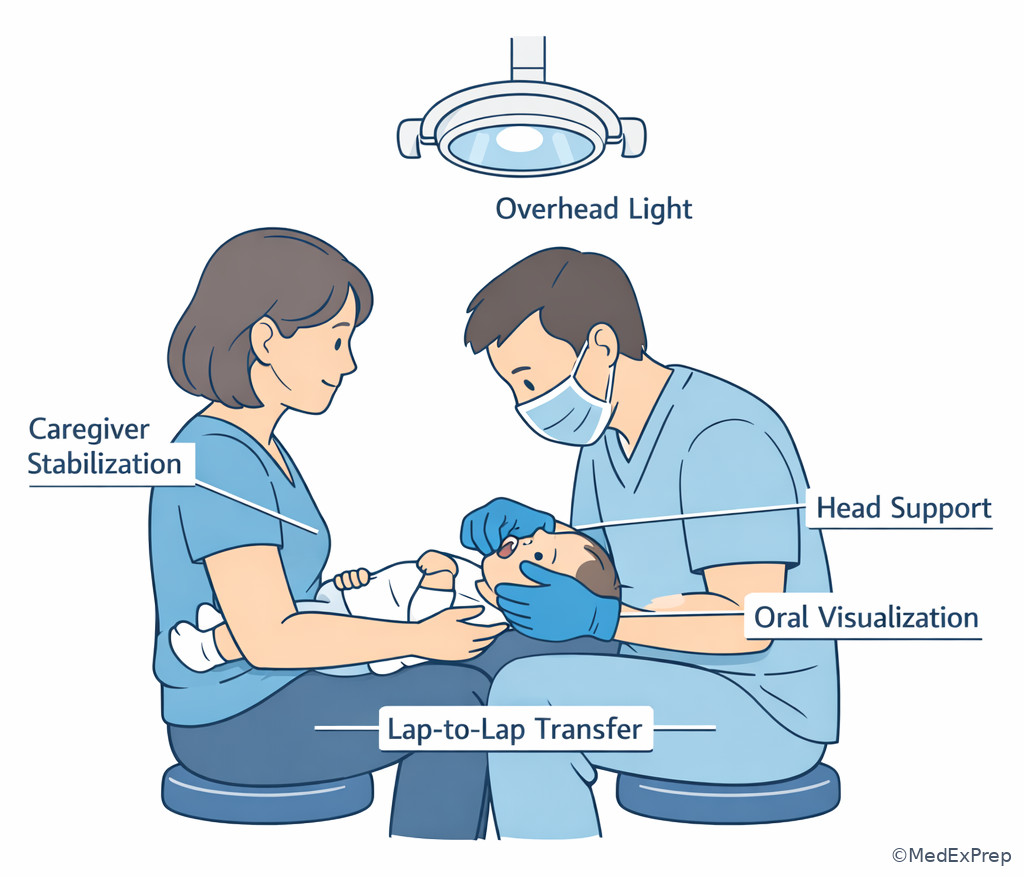
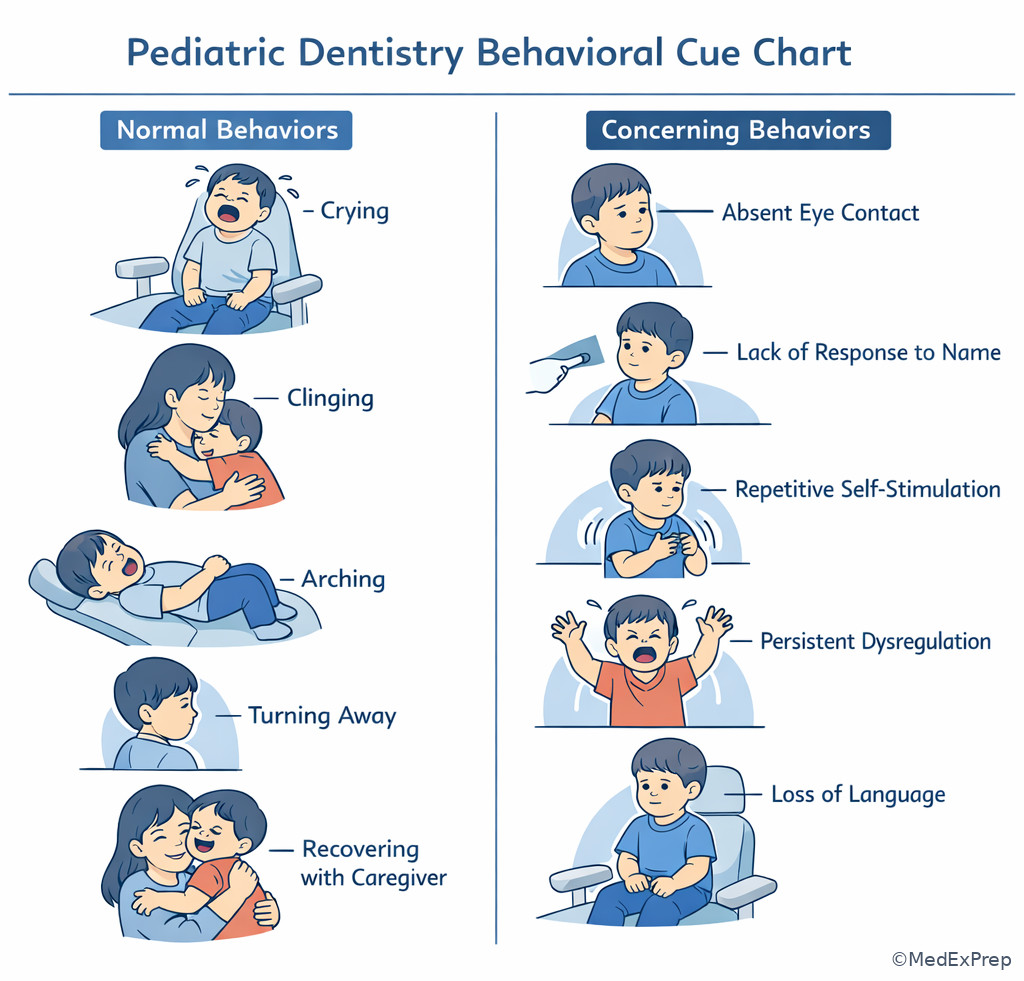
Exam takeaway: Distinguish expected distress from developmental red flags by looking for pattern, persistence, and skill loss.
flowchart TD
A[Child resists exam] --> B{Age-expected?}
B -->|Yes| C[Brief crying, clinging, recovers with caregiver]
B -->|No| D[No eye contact, no response to name, skill loss, extreme sensory dysregulation]
C --> E[Modify approach and continue]
D --> F[Adjust dental plan and recommend medical/developmental evaluation]
E --> G[Document normal developmental behavior]
F --> H[Document red flag and referral rationale] Exam takeaway: Anchor expected communication, motor, and social milestones to what the child can tolerate and understand in the operatory.
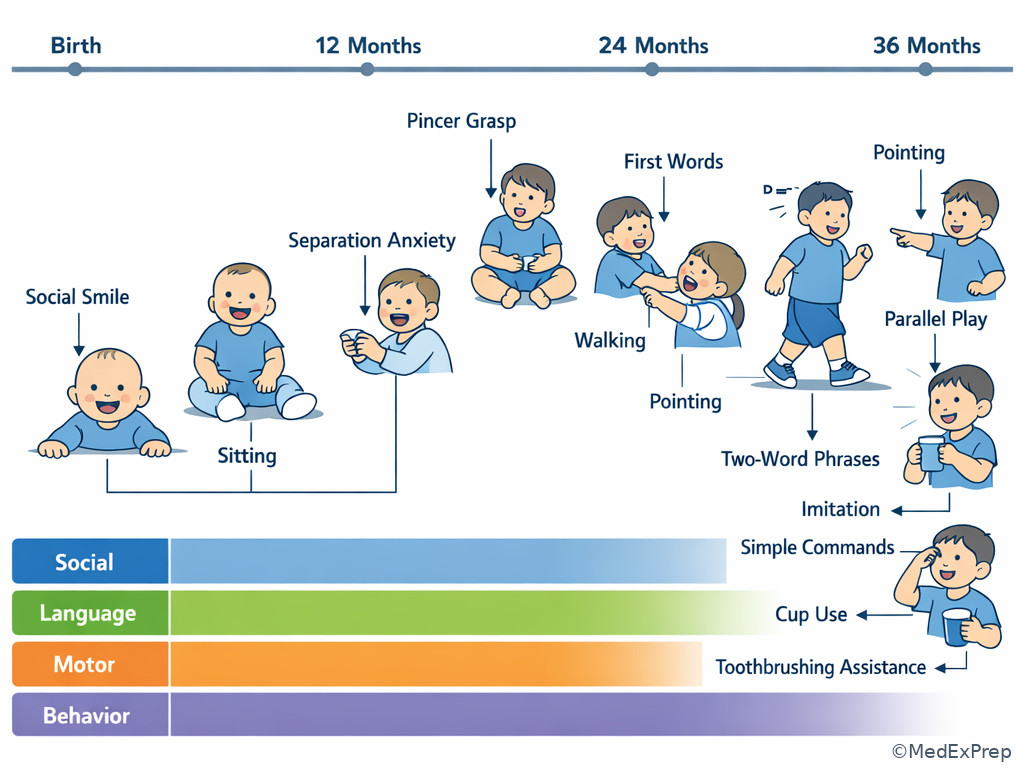
Exam takeaway: Developmental feeding transitions drive prevention counseling, especially for bottle use, brushing timing, and caries risk.
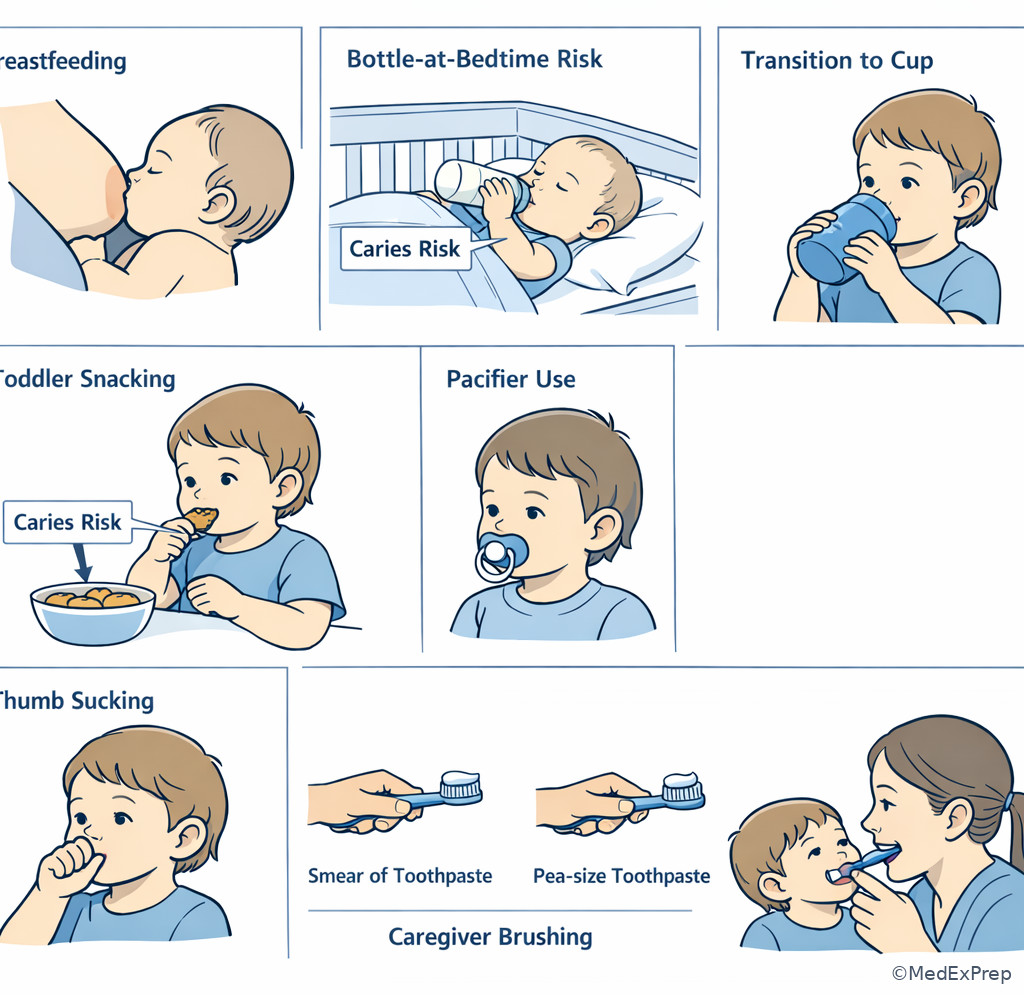
Exam takeaway: Read body language, caregiver seeking, and recovery pattern to choose the safest and most effective next step.
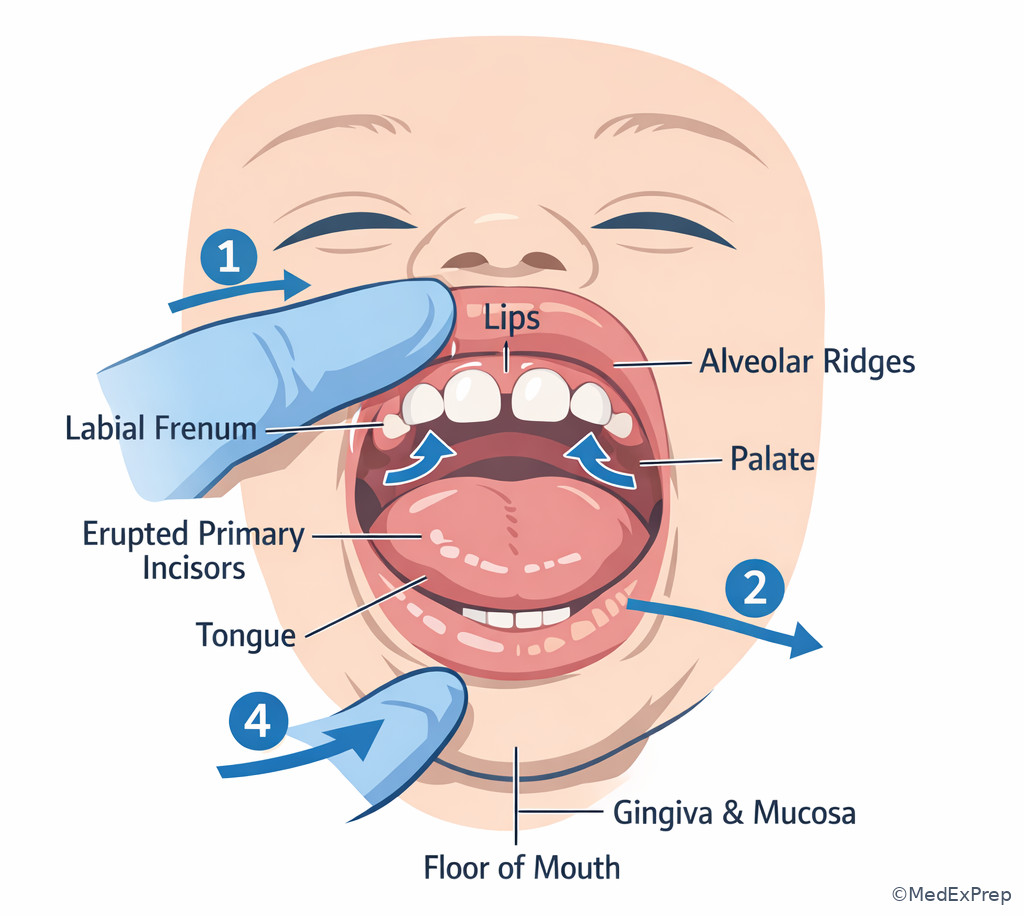
Exam takeaway: A labeled visual helps you perform a quick systematic exam even when cooperation is brief.
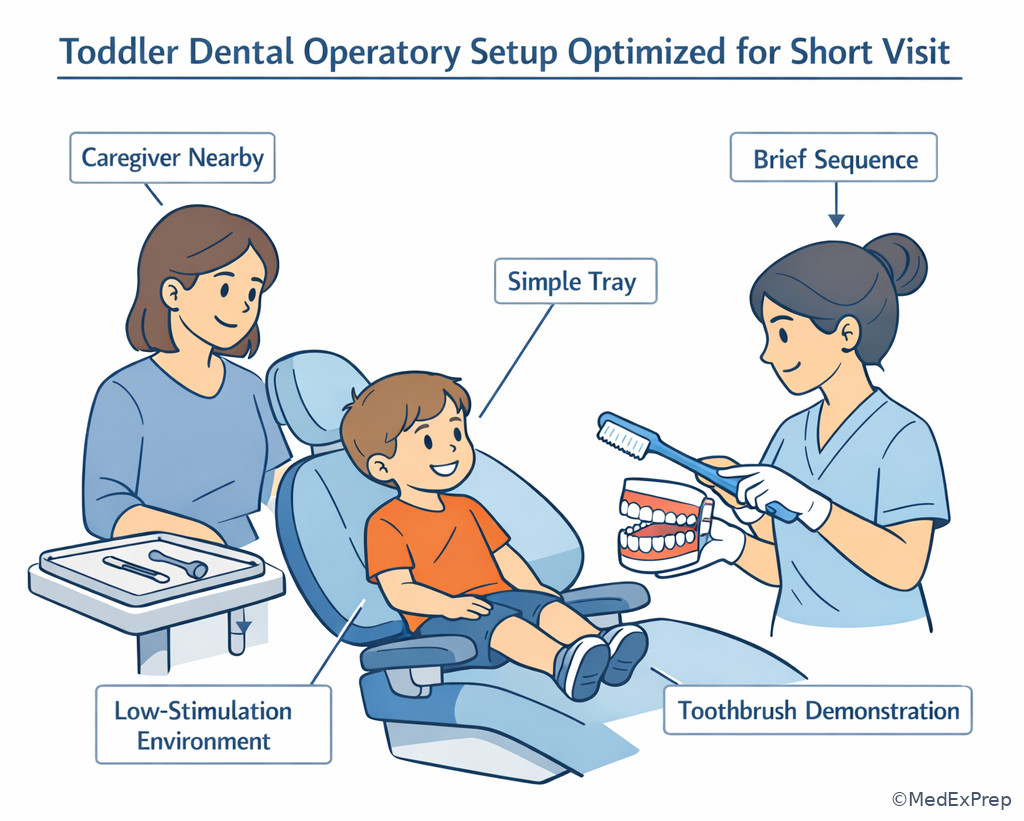
Exam takeaway: Environmental simplification reduces overload and helps preserve limited toddler attention.
| Age range | Expected developmental features | Dental implication | Most testable mistake to avoid |
|---|---|---|---|
| 0–6 months | Preverbal, soothing by voice/touch, limited purposeful resistance | Very brief visual exam; caregiver-centered counseling | Expecting command following |
| 6–12 months | Stranger anxiety, sits with support/independently, increasing curiosity | Use caregiver presence; quick knee-to-knee exam | Interpreting crying as pathology by itself |
| 12–18 months | Walking emerges, strong attachment, first words, limited impulse control | Short direct phrases; examine first, then counsel | Using long explanations before exam |
| 18–24 months | Negativism, imitation, pointing, simple commands | Offer binary choices that do not affect safety | Arguing with “no” behavior |
| 24–36 months | Two-word phrases, parallel play, autonomy, variable cooperation | Concrete routine, praise, demonstration, brief transitions | Expecting preschool-level symbolic reasoning |
1.1.1.3 Foundational milestones that change dental expectations
A Explanation
The core decision conflict is this: should the clinician interpret the child’s behavior as normal for age or as evidence that a different strategy, further assessment, or referral is needed? The single rule that resolves many exam stems is to anchor behavior to developmental capacity. An infant is not choosing to be “noncompliant”; the infant is responding to sensory input, unfamiliar faces, and attachment needs. A toddler is not failing reasoning-based guidance; the toddler often lacks mature impulse control and seeks autonomy through refusal. See Fig 1 and Fig 4.
WHY THIS IS TESTED: board items often present crying, clinging, turning away, or “won’t open” behavior and ask for the most appropriate next step. The correct answer usually comes from recognizing what is expected in infancy versus toddlerhood, then choosing the least intrusive effective approach.
For infants, the governing pattern is preverbal regulation: tone of voice, pace, touch, positioning, and caregiver proximity matter more than explanation. For toddlers, the governing pattern is autonomy with limited self-control: give simple one-step commands, concrete routines, praise immediately, and do not over-negotiate. This is where candidates miss questions by applying preschool methods too early. Tell-show-do in a fully verbal, symbolic sense works better later; infants and younger toddlers often need show-do with caregiver containment, not abstract telling.
Key rule: In children under 3 years, behavior guidance succeeds when it matches regulation and attachment needs first, not when it relies on logic or delayed rewards.
Memory anchor: I-TAP for infant/toddler visit planning: Interaction level, Tone and touch, Attachment to caregiver, Pacing kept brief.
Recall: This is the first topic in the course, so build a habit now: before answering any developmental stem, ask “What can this age realistically understand, tolerate, and do?” That question will carry forward into preschool, school-age, and adolescent topics.
Practitioner Action: ASSESS developmental age, attachment behavior, language level, and motor control. INTERVENE with age-matched communication and positioning. REFER if behavior is clearly discordant with developmental expectations or associated with broader red flags. DOCUMENT observed behavior, caregiver participation, and modifications used.
B Worked example
A 10-month-old boy is brought for his first dental visit because the mother noticed white areas on the maxillary incisors. He was born at term, has mild eczema, and had one prior emergency department visit for bronchiolitis. He cries when the dentist approaches, clings to his mother, and turns his head away from the light. The mother adds that he “acts fine at home” and has recently begun pulling to stand. A medical student in the room comments that the child may be “too uncooperative for examination” and suggests deferring until he is older.
Reasoning chain: Identify task: choose the most appropriate next step for an infant first visit. Extract key facts: 10 months old, stranger distress, otherwise age-consistent motor development, caregiver available, limited but urgent need to inspect early lesions. Apply rule: later infancy commonly includes stranger anxiety; crying and clinging are not by themselves contraindications to examination. Eliminate distractors: deferring the exam ignores an active preventive need; forcing prolonged separation would worsen distress; lengthy verbal explanation will not solve a preverbal problem. Verify: a brief caregiver-assisted knee-to-knee examination with rapid visual assessment and caregiver counseling is the best next step. See Fig 2.
C Exam trap
Common wrong answer: Delay examination because crying means the child cannot be assessed.
Why it is tempting: Candidates equate visible distress with inability to complete any useful exam.
Single clue that eliminates it: The child is 10 months old with classic attachment-based stranger anxiety, which makes brief caregiver-assisted examination appropriate rather than deferral.
D Checkpoint
Question: A 20-month-old girl with recurrent otitis media and mild speech delay says “no” repeatedly, turns away from the mirror, and reaches for her father during an exam. Which is the most appropriate interpretation?
- Her behavior is most consistent with toddler autonomy and limited self-regulation, so the visit should shift to brief commands and structured choices.
- Her behavior proves severe dental fear, so all nonurgent care should be postponed until preschool age.
- Her behavior indicates pain from occult pathology until proven otherwise, even if there are no oral findings.
- Her behavior shows she is capable of reasoning through a full tell-show-do sequence if the clinician explains longer.
Answer: A
- A: Tempting because it matches common toddler behavior; correct because negativism and caregiver seeking at 20 months usually call for brief concrete guidance, not abstract persuasion.
- B: Tempting because repeated refusal looks like fear; wrong because age-expected autonomy does not justify blanket postponement of care.
- C: Tempting because turning away can occur with discomfort; wrong because no oral red flag or pain-specific clue is given, and the pattern fits normal toddler resistance.
- D: Tempting because explanation feels supportive; wrong because toddlers often cannot process long verbal sequences well enough for that strategy to be primary.
1.1.1.4 Social, language, and motor milestones in the operatory
A Explanation
The decision conflict here is whether a finding in social, language, or motor behavior should change the dental interaction only or should also raise concern for broader developmental risk. A single practical rule helps: use each milestone domain to predict what the child can participate in. Social development predicts tolerance of unfamiliar people. Language predicts the maximum complexity of instructions. Motor skills predict movement risk and the child’s ability to resist or grab instruments.
In later infancy, social reciprocity and caregiver referencing should be present even if the child is distressed. In toddlerhood, single words and then simple phrases support one-step commands like “open,” “show teeth,” or “all done,” but not lengthy explanations about future benefits. Motor progress matters because a mobile toddler can suddenly lunge, twist, or reach; this is a safety planning issue as much as a behavior issue. See Fig 6.
WHY THIS IS TESTED: exam stems often include one milestone detail that changes the answer. A child who cannot separate from the caregiver but seeks comfort from that caregiver is different from a child who does not orient, does not respond to name, or has lost words previously used.
Choose age-appropriate dental strategies when the pattern is normal: caregiver lap exam, minimal instruments in sight, direct wording, rapid transitions, praise tied to immediate behavior. Reject age-inappropriate strategies: asking a 15-month-old to tolerate prolonged explanation, or assuming a 2-year-old can self-monitor the way a 5-year-old can. When milestones appear broadly delayed or atypical, the dental plan may still proceed in modified form, but the pediatric dentist should recognize the need for developmental discussion and possible medical referral rather than labeling the child “difficult.” See Fig 3.
Exception/edge case: Mild isolated delay in one domain does not automatically mean a developmental disorder, but regression, absent reciprocity, or multiple-domain delay should raise concern and alter your expectations immediately.
High-Yield Connection: This concept is tested alongside Age-Appropriate Examination Selection and later with Autism and Sensory Considerations. Know both the normal developmental limit and the red-flag pattern that pushes you toward adaptation and referral.
Practitioner Action: ASSESS social reciprocity, language level, and motor control before opening instruments. INTERVENE with simplified commands and safe positioning matched to those skills. REFER to the child’s physician or early intervention pathway when broad delay or regression is suspected. DOCUMENT observed milestones relevant to dental behavior and any referral recommendation discussed.
B Worked example
A 26-month-old boy presents for evaluation of brown anterior lesions. He was born prematurely at 34 weeks, has a history of iron supplementation, and attends daycare. His father reports he uses about 15 words, follows simple directions at home, and runs well. In the operatory he refuses the chair, repeatedly says “mine,” grabs for the mirror, and cries when the examiner tries to look without warning. A brown coating on the tongue from an iron-containing vitamin distracts the new resident, who wonders whether oral discomfort is driving the behavior.
Reasoning chain: Identify task: choose the best interpretation and exam approach. Extract key facts: 26 months, some expressive language, good gross motor activity, strong ownership/negativism, active grabbing. Apply rule: toddler autonomy plus mobility means short commands, environmental control, and instrument safety are central. Eliminate distractors: the tongue staining is noise; there is no focal pain clue. A full reclined chair approach from the start is less likely to succeed than caregiver-assisted transition. Verify: brief lap-based or parent-assisted exam, one instrument at a time, simple commands, and immediate praise is most appropriate.
C Exam trap
Common wrong answer: Attribute the child’s resistance to pain because he cries when the mirror approaches.
Why it is tempting: The candidate sees crying and oral lesions and assumes the behavior is lesion-driven.
Single clue that eliminates it: The pattern includes possessiveness, grabbing, and refusal during approach, which is classic toddler autonomy and motor impulsivity rather than pain-specific behavior.
D Checkpoint
Question: Which developmental detail most strongly supports using one-step commands rather than verbal explanation during a toddler dental exam?
- Parallel play and use of two-word phrases
- Ability to recognize letters and count to three
- Understanding of delayed consequences and future rewards
- Stable peer cooperation during group activities
Answer: A
- A: Tempting because it describes typical toddler development; correct because limited language and early social play support simple, immediate instructions rather than complex reasoning.
- B: Tempting because some older toddlers can rote count; wrong because symbolic academic skills are not the key driver in this age band and are not expected broadly.
- C: Tempting because it would help behavior management; wrong because delayed consequence reasoning is immature in toddlers.
- D: Tempting because peer behavior can imply social maturity; wrong because stable cooperative group participation is more characteristic of later developmental stages.
- The most useful communication style for an infant is _______ support plus tone/touch regulation.
- True or False: A 2-year-old should generally be managed with lengthy explanations about future dental benefits.
- Name the 3 milestone domains that most directly change operatory expectations: ______, ______, and ______.
1.1.1.5 Behavior guidance for infants and toddlers: choose the right tool
A Explanation
The decision conflict is not “which technique is generally good,” but “which technique fits this developmental stage and this clinical task?” For infants and toddlers, the highest-yield rule is to start with nonpharmacologic guidance that respects short attention, attachment needs, sensory sensitivity, and poor time horizon. If the goal is examination and counseling, the most effective tools are often caregiver presence, positioning, simple narration, distraction, voice tone, immediate praise, and visit compression. If the goal is urgent treatment, the decision shifts toward whether the planned care is realistically achievable in-office at this developmental stage or whether staged care, referral, or another setting is safer.
WHY THIS IS TESTED: exam questions often make an incorrect option sound attractive because it is a valid behavior technique in older children. The trick is developmental mismatch. A toddler may benefit from choice, but only if the choices are concrete and limited, such as “toothbrush first or mirror first?” not “Would you like us to fix the cavity today?”
Choose techniques that reduce conflict without surrendering necessary care. Reject techniques that demand cognitive skills the child does not have. For infants, immediate exam with caregiver support often precedes long counseling because cooperation window is short. For toddlers, praise must be immediate and specific. Waiting for perfect stillness is unrealistic; instead, plan short success points. When even a modified approach is unsafe or ineffective for necessary treatment, the pediatric dentist should recognize limits and plan referral or alternate behavior support within scope and guidelines rather than repeatedly escalating distress.
Key rule: The best behavior technique is the one that matches both the developmental level and the clinical objective; a correct technique used at the wrong age becomes a wrong answer.
Memory anchor: SHORT for toddlers: Simple words, Hold caregiver nearby, Offer tiny choices, Reward immediately, Trim visit length.
High-Yield Connection: This concept overlaps with upcoming Preschool and School-Age Development. On exam day, know when tell-show-do becomes truly verbal and when it should remain mostly demonstration plus pacing.
Practitioner Action: ASSESS the child’s regulation, task urgency, and caregiver ability to assist. INTERVENE with developmentally matched communication, positioning, and short success steps. REFER when needed care exceeds safe tolerance in the office setting. DOCUMENT chosen guidance techniques, child response, caregiver consent, and rationale for modification or referral.
B Worked example
An 18-month-old girl with repaired ventricular septal defect, eczema, and high caries risk presents for evaluation of smooth-surface demineralization. She slept poorly the night before, arrives clutching a pacifier, and screams when placed in the chair. The caregiver reports she “understands everything” and asks whether the dentist can simply explain why opening is important. A new assistant suggests trying a long friendly conversation first because the child said “bye-bye” in the waiting room.
Reasoning chain: Identify task: choose the best behavior guidance approach for brief exam and counseling. Extract key facts: 18 months, tired, attached to pacifier, some expressive language but not mature reasoning, preventive urgency present. Apply rule: at this age, symbolic comprehension is limited; caregiver-supported brief exam with rapid transitions is more effective than extended verbal persuasion. Eliminate distractors: long explanation overestimates language capacity; delaying because of screaming loses a preventive opportunity; using a full operatory setup before gaining access may increase distress. Verify: knee-to-knee or lap exam first, quick visualization, then caregiver counseling and risk-based preventive plan.
C Exam trap
Common wrong answer: Use lengthy tell-show-do because the toddler can say a few words.
Why it is tempting: Early expressive language makes the child seem more cognitively available than she really is.
Single clue that eliminates it: The clinical need is a brief exam in an 18-month-old with distress and limited regulation, so rapid caregiver-supported access is more appropriate than prolonged explanation.
D Checkpoint
Question: A 14-month-old requires a brief oral evaluation after the parent noticed a chipped incisor. Which behavior strategy is most appropriate as the initial approach?
- Caregiver-assisted knee-to-knee positioning with a rapid visual exam
- Detailed explanation to the child using future-oriented language about dental health
- Separating the child from the caregiver to reduce reinforcement of crying
- Postponing evaluation until the child can sit independently in the dental chair without crying
Answer: A
- A: Tempting because it is practical and age-matched; correct because it fits infant-toddler developmental needs and allows efficient assessment.
- B: Tempting because explanation feels compassionate; wrong because future-oriented verbal reasoning exceeds typical 14-month developmental capacity.
- C: Tempting because separation may seem to reduce attention to crying; wrong because attachment-based distress usually worsens with unnecessary separation.
- D: Tempting because it avoids immediate conflict; wrong because age-expected crying does not justify delaying indicated evaluation.
1.1.1.6 Anticipatory guidance tied to infant and toddler milestones
A Explanation
The decision conflict in prevention stems is deciding which counseling point matters most now. The child’s milestone stage resolves that. Anticipatory guidance should be timed just before or during the developmental transition that creates risk. For an infant with erupting incisors, focus on brushing initiation, fluoride toothpaste amount, feeding patterns, and early lesion recognition. For a toddler gaining independence and snacking access, shift toward cup transition, meal versus grazing structure, supervised brushing, injury prevention, and habit monitoring. See Fig 5.
WHY THIS IS TESTED: board questions may present multiple true counseling statements, but only one is the most appropriate next step for that age and risk profile. The best answer is usually the one that prevents the next predictable problem, not the one with the most general oral health value.
Choose counseling that is concrete, caregiver-directed, and stage-specific. Reject counseling that assumes self-care by the child. For infants, the caregiver controls exposure; for toddlers, the caregiver still controls routine but must now manage resistance and emerging autonomy. This is why “brush twice daily with fluoridated toothpaste by the caregiver” remains correct even when the toddler wants to hold the brush. Development changes how you counsel, not who remains responsible. When bottle at bedtime, frequent carbohydrate exposure, or visible demineralization are present, your recall planning becomes more intensive and your counseling more urgent.
Key rule: Anticipatory guidance is strongest when it predicts the next development-linked oral risk: eruption, sleep feeding, mobility trauma, grazing, or brushing resistance.
Forward link: In the upcoming topic on Preschool and School-Age Development, the counseling target shifts from caregiver-only control toward habit shaping, peer influence, and attention-span-based instruction.
Practitioner Action: ASSESS feeding frequency, bedtime practices, eruption status, brushing routine, habits, and injury risk. INTERVENE with stage-specific anticipatory guidance and preventive therapy planning. REFER when feeding issues, growth concerns, or suspected developmental problems extend beyond routine dental counseling. DOCUMENT risk factors discussed, caregiver instructions, fluoride/home-care recommendations, and recall interval rationale.
B Worked example
A 30-month-old girl with mild asthma and a history of prematurity presents for her first dental visit. She drinks from a cup during the day but still receives a milk bottle to sleep, snacks on crackers while watching videos, and resists toothbrushing. The grandmother reports that the child “likes to do everything herself,” and the family is proud that she can hold the brush. On exam, there are chalky white lesions on the maxillary primary incisors. The mother asks whether they should mainly work on teaching the child independence with brushing.
Reasoning chain: Identify task: choose the highest-yield counseling priority. Extract key facts: toddler, bottle at sleep, frequent carbohydrate exposure, visible early lesions, autonomy causing brushing resistance. Apply rule: anticipatory guidance should target the next and current risk drivers under caregiver control. Eliminate distractors: promoting independent brushing sounds developmentally positive but is not the top preventive move because the child lacks reliable self-care skill. Verify: prioritize elimination of bedtime bottle exposure, structured diet counseling, caregiver-performed brushing with fluoride toothpaste, and risk-based recall.
C Exam trap
Common wrong answer: Encourage the toddler to brush independently because autonomy is developmentally important.
Why it is tempting: Developmental language makes independence sound like the right growth-supportive answer.
Single clue that eliminates it: Active white-spot lesions and sleep bottle use mean caregiver-controlled disease reduction is the priority, not child independence.
D Checkpoint
Question: Which counseling point is the most appropriate next step for a 12-month-old with newly erupted incisors and no visible caries?
- Begin caregiver-performed brushing with fluoridated toothpaste and counsel against sleep-associated bottle exposure
- Wait until all primary incisors erupt before starting brushing to avoid oral aversion
- Encourage the infant to hold the toothbrush independently to develop motor planning before caregiver assistance
- Delay oral hygiene counseling until the child can spit reliably after brushing
Answer: A
- A: Tempting because it is preventive and age-linked; correct because brushing starts with eruption and feeding counseling should begin before risk behaviors become entrenched.
- B: Tempting because fewer erupted teeth may seem lower risk; wrong because hygiene should begin as soon as teeth erupt.
- C: Tempting because it supports motor development; wrong because infants cannot perform effective oral hygiene independently.
- D: Tempting because spitting is associated with brushing in older children; wrong because spitting is not required to begin age-appropriate fluoridated toothbrushing.
- The most common behavioral pattern that complicates toddler oral hygiene is _______.
- True or False: Because toddlers seek autonomy, independent brushing should replace caregiver brushing once the child resists.
- Name 3 milestone-linked prevention targets in this age band: ______, ______, and ______.
1.1.1.7 Developmental red flags, differential thinking, and referral thresholds
A Explanation
The final foundational conflict is deciding when behavior is still within the broad range of infant/toddler normal versus when it should trigger a broader clinical concern. The single best discriminator is pattern quality, especially regression or absent social reciprocity. Normal resistance usually still includes some caregiver attachment, variable recovery, or age-consistent communication attempts. Concerning patterns include loss of language, poor eye contact across settings, lack of response to name, failure to use caregiver for co-regulation, or extreme dysregulation that is not explained by the immediate situation. See Fig 3 and Fig 6.
WHY THIS IS TESTED: board items may ask for the most appropriate next step when a child’s behavior complicates care. The correct answer is often not to force completion or label the child defiant, but to recognize a developmental red flag, adapt the dental plan, and recommend referral within the pediatric dentist’s scope.
Choose modified care plus referral discussion when broader concern exists. Reject unsupported definitive medical diagnosis by the dentist; your role is to identify concern, explain why it affects care, recommend evaluation, and document clearly. Also avoid the opposite error: dismissing all atypical behavior as “too young to tell.” In pediatric board logic, red flags matter because they influence behavior guidance, safety, informed consent discussion with caregivers, and treatment setting decisions later in the course.
Common pitfall: A child who cries intensely during the exam but recovers with the caregiver is not the same as a child who shows persistent absence of social reciprocity or loss of previously acquired communication skills.
High-Yield Connection: Developmental red-flag recognition later overlaps with Special Health Care Needs, Behavior Assessment and Prognosis, and Comprehensive Care Setting Decisions. Early recognition changes both communication strategy and referral planning.
Practitioner Action: ASSESS whether the behavior pattern is expected, situational, or atypical across domains. INTERVENE by reducing demands and completing only feasible needed dental assessment or prevention. REFER to the child’s pediatrician or developmental services for concerning patterns beyond routine age variation. DOCUMENT objective observations, caregiver discussion, and referral recommendation without making unsupported definitive medical diagnoses.
B Worked example
A 22-month-old boy with no significant medical history presents for a first visit after a fall. His caregiver reports he previously said several words but “stopped using them” over the last few months. In the operatory he does not respond to his name, avoids eye contact with both parent and clinician, and becomes intensely dysregulated when the overhead light is turned on. He does not seek comfort from the parent in a typical way, but there is no obvious oral swelling or fracture requiring immediate operative care. The caregiver asks if this is just normal toddler stubbornness.
Reasoning chain: Identify task: determine best next step within pediatric dental scope. Extract key facts: language regression, absent response to name, atypical social pattern, sensory dysregulation, no urgent oral emergency. Apply rule: regression and absent reciprocity are red flags, not typical toddler negativism. Eliminate distractors: labeling this as routine stubbornness misses the key clue; demanding full routine exam is unnecessary and likely counterproductive; making a definitive neurologic diagnosis exceeds scope. Verify: perform only minimal needed trauma assessment as tolerated, adapt environment, discuss developmental concern, recommend pediatric evaluation, and document observations objectively.
C Exam trap
Common wrong answer: Reassure the parent that refusal and lack of eye contact are normal at this age.
Why it is tempting: Candidates know toddlers can resist and may overgeneralize normal autonomy.
Single clue that eliminates it: Loss of previously used words is regression, which is not explained by routine toddler negativism.
D Checkpoint
Question: Which finding most strongly requires the pediatric dentist to consider developmental referral rather than attributing behavior to normal toddler resistance?
- Loss of previously used words over several months
- Crying during mirror examination with a new provider
- Saying “no” repeatedly and reaching for the caregiver
- Turning away from the light during a first visit
Answer: A
- A: Tempting because language can vary in toddlers; correct because regression is a major red flag and should not be dismissed as normal developmental variation.
- B: Tempting because crying can seem dramatic; wrong because this is common in unfamiliar infant/toddler dental settings.
- C: Tempting because repeated “no” feels oppositional; wrong because it fits classic toddler autonomy and attachment behavior.
- D: Tempting because sensory sensitivity can matter; wrong because isolated turning from the light during a first visit is nonspecific and often normal.
Exam Traps & Differentiators
| Looks similar | Actually suggests | Single discriminator | Board-style next step |
|---|---|---|---|
| Crying when examiner approaches | Normal stranger anxiety in infancy | Seeks comfort from caregiver and pattern is situational | Proceed with brief caregiver-assisted exam |
| Saying “no,” grabbing instruments | Normal toddler autonomy/negativism | Age-consistent language and social engagement otherwise present | Use short commands, limit choices, control environment |
| Avoids eye contact, does not respond to name | Possible developmental concern | Persistent atypical social reciprocity, not just situational distress | Modify care and recommend pediatric/developmental evaluation |
| Few spoken words | May be within range or delayed | Interpret in context of comprehension, gesture use, and progression | Do not overcall alone; watch for broader pattern |
| Cannot brush independently | Expected developmental limitation | Fine motor immaturity at this age | Reinforce caregiver brushing, not child self-care |
| Resistance to chair positioning | Developmentally predictable in toddlers | Brief tolerance improves with lap exam or simplified setup | Change positioning rather than ending visit immediately |
Most common wrong answer and why: choosing a guidance technique that is valid in older children but developmentally mismatched here. The tempting logic is “supportive explanation is always better.” The flaw is that infants and toddlers often cannot use explanation the way preschoolers can.
Looks similar but isn’t: normal separation anxiety versus concerning social disengagement. The differentiator is not the amount of crying; it is whether the child still shows age-expected attachment, reciprocity, and recovery.
- If the stem says “10 months, clings to parent, cries with examiner,” think stranger anxiety and caregiver-assisted exam.
- If the stem says “2-year-old says no, grabs mirror, wants control,” think toddler autonomy and brief structured choices.
- If the stem says “few words but follows simple commands,” think simplify language; do not expect verbal reasoning.
- If the stem says “lost words previously used,” think regression and referral concern.
- If the stem says “white-spot lesions plus bedtime bottle,” think caregiver-driven prevention, not child independence training.
- If the stem says “behavior severe only in the operatory but normal reciprocity with caregiver,” think situational distress before global developmental disorder.
| Confusable pair | Why the wrong answer is tempting | What rules it out |
|---|---|---|
| Deferral of exam vs quick knee-to-knee exam | Crying seems to make examination impossible | Brief visual exam is often feasible and indicated in infancy/toddlerhood |
| Long tell-show-do vs one-step command | Some toddlers use words, making them sound “ready” for reasoning | Expressive words do not equal mature symbolic understanding |
| Independent brushing training vs caregiver brushing | Autonomy is developmentally appropriate | Disease control still depends on caregiver performance |
| Normal resistance vs developmental referral | Many toddlers resist care | Regression or absent reciprocity changes the category entirely |
Algorithm / Approach
| Step | Ask yourself | Best-answer action |
|---|---|---|
| 1 | What is the child’s developmental age? | Set expectations before choosing guidance |
| 2 | Is the behavior situational or atypical? | Use caregiver, not labels, to interpret distress |
| 3 | What can the child realistically understand? | Simplify language to one-step concrete commands |
| 4 | What safety issue does motor level create? | Control instruments and choose stable positioning |
| 5 | Which prevention message matters most now? | Target the next milestone-linked risk |
| 6 | Is there a developmental red flag? | Modify care and recommend referral within scope |
Rapid Review
- Stranger anxiety → later infancy crying with unfamiliar examiner is often normal
- Toddler negativism → “no” behavior reflects autonomy, not mature refusal reasoning
- Infant communication → tone, touch, and caregiver proximity outperform explanation
- Toddler commands → one-step concrete requests beat future-oriented persuasion
- Normal distress vs red flag → recovery with caregiver favors normal; regression does not
- Expressive words → do not equal preschool-level understanding
- Motor maturity → grabbing and twisting drive instrument-safety planning
- Preventive counseling → target the next developmental risk, not generic advice
- Brushing responsibility → caregiver remains primary in infants and toddlers
- Bedtime bottle + white spots → disease-control counseling outranks independence training
- Chair refusal in toddler → reposition and simplify before considering deferral
- Loss of language → developmental referral clue, not routine operatory behavior
Memory anchor: AGE decides GUIDE — Assess developmental stage, Gauge reciprocity, Expect age-normal behavior; then Give matched guidance, Use caregiver, Identity red flags, Document, Escalate if needed.
Self-check quiz
1. A 9-month-old infant with mild reflux and no prior dental visit cries when the clinician leans in and immediately buries her face in her mother’s shoulder. The mother reports the infant smiles and babbles normally at home. What is the most appropriate next step?
- Proceed with a brief caregiver-assisted knee-to-knee examination
- Delay examination until the infant can separate calmly from the mother
- Use an extended verbal tell-show-do explanation before attempting any exam
- Recommend neurologic evaluation before any dental assessment
2. A 28-month-old boy with eczema and recurrent upper respiratory infections says “no” repeatedly, grabs the mirror, and tries to choose the toothbrush himself during a preventive visit. Which behavior strategy is most appropriate?
- Offer two small structured choices and use one-step commands
- Insist on complete passive compliance before beginning any interaction
- Provide a long explanation of future cavity risk to increase insight
- Transfer the child immediately for comprehensive orthodontic consultation
3. A 16-month-old girl with repaired cleft lip, iron supplementation, and recent teething discomfort presents for a first exam. She cries in the operatory but watches her father, reaches back to him, and settles briefly when he sings. Which finding most strongly supports proceeding with an age-modified exam rather than stopping the visit?
- She uses her caregiver for co-regulation and shows situational distress
- She has a history of teething discomfort noted at home
- She is taking an iron supplement that can stain the mouth
- She cried immediately when the overhead light was turned on
4. A 31-month-old child with early white-spot lesions, frequent cracker snacks, and nighttime milk in a bottle is proud of brushing “all by myself.” The caregiver asks for the most appropriate next counseling point. Which is best?
- Prioritize caregiver-performed brushing and elimination of sleep-associated bottle exposure
- Encourage full independence with brushing to support autonomy
- Focus first on teaching the child to spit before changing feeding habits
- Delay counseling until a formal speech evaluation is completed
5. A 24-month-old boy born at term has normal motor activity but only one spoken word. He follows simple commands, points to request objects, makes eye contact with his caregiver, and protests the exam by saying “no” and turning away. Which is the most appropriate dental interpretation?
- Use simplified language and monitor the broader pattern rather than assuming severe developmental pathology from the dental visit alone
- Document definitive autism spectrum disorder and refer urgently to psychiatry
- Assume the resistance proves occult dental pain requiring operative treatment
- Expect preschool-level reasoning because he follows commands
6. A 22-month-old boy presents for a trauma follow-up. He previously used several words, but the caregiver reports he stopped using them over the past 3 months. In the operatory he does not respond to his name, avoids eye contact with both caregiver and examiner, and remains dysregulated despite caregiver comfort attempts. There is no urgent oral injury requiring immediate treatment. What is the most appropriate next step?
- Complete only minimal needed dental assessment as tolerated, discuss developmental concern, and recommend pediatric evaluation
- Reassure the caregiver that this is typical toddler negativism and schedule routine recall
- Proceed with a full comprehensive examination using repeated verbal coaching until the child adapts
- Write the formal developmental diagnostic report and treatment plan independently
7. A 14-month-old with repaired congenital heart disease, recent otitis media, and a fractured primary incisor is screaming in the chair. He reaches toward his mother and calms briefly when held. The resident suggests postponing because “he is too upset for useful assessment.” What is the best answer?
- Proceed with a rapid caregiver-assisted visual exam because age-expected distress does not preclude indicated assessment
- Postpone all examination until the child can remain quiet for several minutes independently
- Remove the caregiver from the operatory to reduce reinforced crying
- Begin with a lengthy explanation directed to the infant about the need for trauma evaluation
8. A 27-month-old girl with sensory sensitivity, chronic constipation, and high caries risk has smooth-surface demineralization. She speaks in two-word phrases, says “mine,” grabs instruments, and resists reclining. She responds to her name, seeks comfort from her father, and recovers between short attempts. Which is the most appropriate management plan?
- Use parent-assisted positioning, limit visible instruments, give one-step choices, complete a brief exam, and provide caregiver-centered preventive counseling
- Classify the behavior as a developmental red flag requiring termination of the dental visit and neurologic diagnosis
- Persist with a prolonged chair-based exam until she accepts the routine without modification
- Refer immediately for comprehensive fixed appliance treatment because cooperation is poor
Answer key
1. Correct answer: A
- A: Tempting because it is the standard infant exam setup; correct because situational stranger anxiety at 9 months with normal social behavior at home supports a brief caregiver-assisted exam rather than deferral. Discriminating clue: cries with clinician approach but seeks mother normally. Source: AAPD behavior guidance and infant oral health guidance support age-appropriate, caregiver-assisted examination.
- B: Tempting because calm separation might seem to improve cooperation; incorrect because infants commonly cannot separate calmly, and waiting would inappropriately delay indicated assessment. Discriminating clue: age is 9 months, not preschool age.
- C: Tempting because explanation sounds gentle; incorrect because extended verbal tell-show-do depends on cognitive skills not yet developed in infancy. Discriminating clue: preverbal age.
- D: Tempting because unusual crying can raise concern; incorrect because the infant has normal smiling and babbling at home, making immediate neurologic referral unsupported based on this stem alone. Discriminating clue: normal home reciprocity reported.
2. Correct answer: A
- A: Tempting because it seems simple; correct because structured choices and one-step commands fit toddler autonomy while preserving clinician control of the visit. Discriminating clue: 28 months, says “no,” grabs objects, wants control. Source: AAPD behavior guidance guidance favors developmentally appropriate communication and positive behavior shaping.
- B: Tempting because firm expectations can help older children; incorrect because demanding complete passive compliance before engagement escalates conflict in toddlers. Discriminating clue: toddler developmental stage.
- C: Tempting because education matters; incorrect because future-oriented reasoning is not the best initial tool for a 28-month-old during active resistance. Discriminating clue: real-time oppositional toddler behavior.
- D: Tempting only if one confuses poor cooperation with specialty orthodontic need; incorrect and outside the present scope issue because cooperation does not indicate orthodontic referral. Discriminating clue: preventive visit, no occlusal problem presented.
3. Correct answer: A
- A: Tempting because it directly addresses regulation; correct because using the caregiver for co-regulation and showing situational rather than global distress supports a modified but reasonable exam. Discriminating clue: settles briefly when father sings. Source: AAPD infant oral health and behavior guidance recommendations emphasize caregiver involvement and developmental fit.
- B: Tempting because discomfort can affect cooperation; incorrect because teething discomfort does not specifically distinguish normal distress from a red-flag pattern here. Discriminating clue: social regulation with father matters more.
- C: Tempting because iron staining can distract; incorrect because supplement history is unrelated to whether the child’s behavior is age-expected. Discriminating clue: staining is noise.
- D: Tempting because sensory response may seem concerning; incorrect because isolated crying at the light is nonspecific and common in young children. Discriminating clue: broader normal caregiver-directed behavior outweighs this isolated reaction.
4. Correct answer: A
- A: Tempting because it targets current disease drivers; correct because active white-spot lesions plus nighttime bottle exposure make caregiver-controlled brushing and feeding change the highest-yield intervention. Discriminating clue: lesions plus sleep-associated bottle. Source: AAPD caries-risk and infant/toddler preventive guidance emphasize caregiver brushing and feeding counseling.
- B: Tempting because autonomy is developmentally valued; incorrect because independent brushing by a 31-month-old is not sufficient for disease control. Discriminating clue: existing demineralization demands effective caregiver action.
- C: Tempting because spitting is often associated with brushing routines; incorrect because spitting is not the priority barrier in this age group. Discriminating clue: feeding risk and lesion activity are more urgent.
- D: Tempting because some clinicians worry about language before counseling; incorrect because prevention counseling should not wait for unrelated evaluation when active caries risk is present. Discriminating clue: immediate oral disease risk.
5. Correct answer: A
- A: Tempting because it avoids overcalling disease; correct because one spoken word alone does not establish severe pathology in the dental setting when pointing, command following, eye contact, and toddler protest are present. Discriminating clue: preserved reciprocity and gesture use. Source: Developmental screening principles and AAPD patient management guidance support pattern-based interpretation rather than single-observation diagnosis.
- B: Tempting because limited language can raise developmental concern; incorrect because the pediatric dentist should not make a definitive diagnosis from this dental encounter, and the broader pattern here is not strongly red-flagged. Discriminating clue: good eye contact and command following.
- C: Tempting because turning away could imply pain; incorrect because the stem offers classic toddler protest without pain-specific oral findings. Discriminating clue: saying “no” and turning away in context of otherwise normal interaction.
- D: Tempting because following commands suggests understanding; incorrect because toddlers who follow simple commands still do not have preschool-level reasoning. Discriminating clue: developmental stage remains 24 months.
6. Correct answer: A
- A: Tempting because it is cautious and within scope; correct because regression, absent response to name, poor reciprocity, and lack of caregiver-mediated recovery are developmental red flags requiring modified dental care and referral, not dismissal. Discriminating clue: loss of previously used words. Source: AAPD behavior guidance principles and general pediatric developmental surveillance standards support recognition and referral of red flags while staying within scope.
- B: Tempting because toddlers commonly resist care; incorrect because regression is not explained by routine negativism. Discriminating clue: 3-month language loss.
- C: Tempting because persistence sometimes yields access; incorrect because repeated demands ignore the developmental concern and may worsen distress without urgent dental need. Discriminating clue: no urgent oral injury requiring forced completion.
- D: Tempting because someone must diagnose eventually; incorrect because independently issuing the formal developmental diagnosis exceeds pediatric dental scope. Discriminating clue: scope boundary in the candidate role.
7. Correct answer: A
- A: Tempting because it preserves needed trauma assessment; correct because a 14-month-old with age-expected distress and caregiver calming can often undergo a rapid visual exam. Discriminating clue: calms briefly with mother and injury requires assessment. Source: AAPD trauma and infant examination guidance support prompt age-appropriate assessment rather than deferral for expected distress.
- B: Tempting because quiet conditions seem preferable; incorrect because waiting for independent stillness is unrealistic and delays indicated trauma evaluation. Discriminating clue: 14-month developmental stage.
- C: Tempting because the caregiver might seem to reinforce crying; incorrect because unnecessary separation typically worsens infant distress. Discriminating clue: attachment-based calming response.
- D: Tempting because explanation is usually respectful; incorrect because lengthy verbal explanation to a 14-month-old is developmentally mismatched and inefficient in a trauma context. Discriminating clue: infant age and urgent exam task.
8. Correct answer: A
- A: Tempting because it combines multiple practical techniques; correct because the child shows typical toddler autonomy with preserved reciprocity and recovery, so parent-assisted positioning, reduced stimulation, one-step choices, brief exam, and caregiver-focused counseling are appropriate. Discriminating clue: responds to name, seeks father, recovers between attempts. Source: AAPD behavior guidance and caries prevention policies support developmentally matched behavior strategies plus caregiver-directed disease prevention.
- B: Tempting because sensory sensitivity can raise concern; incorrect because the broader pattern still shows age-appropriate attachment and recovery rather than a clear red-flag profile requiring diagnostic labeling. Discriminating clue: preserved response to name and caregiver seeking.
- C: Tempting because persistence may appear efficient; incorrect because prolonged unmodified demands ignore known toddler limits and increase distress. Discriminating clue: resists reclining but can recover with short attempts, signaling need for adaptation rather than endurance contest.
- D: Tempting only if one confuses behavior challenge with orthodontic need; incorrect because there is no interceptive orthodontic indication and such referral is outside the problem presented. Discriminating clue: issue is caries-risk management and behavior guidance, not occlusion.
Keep going with the full Pediatric Dentistry Board Prep Course (Pedo)
You just studied the way members do, in the same lesson interface. Full access unlocks every lesson, the question bank and flashcards for a full year.
One payment · 1 year of access · No auto-renewal