1.1.1 - Adult Progressive Care Scope
Adult Progressive Care Scope
What you'll learn
- DOMAIN: Clinical Judgment → Scope recognition — choose the safest RN action that stays within adult progressive care scope.
- DOMAIN: Clinical Judgment → Recognition of deterioration and escalation — identify when bedside assessment and protocol-based nursing action are sufficient versus when immediate provider or rapid response escalation is required.
- DOMAIN: Professional Caring and Ethical Practice → Role boundaries — separate advocacy, monitoring, teaching, and communication duties from provider-only decisions.
- DOMAIN: Clinical Judgment → Prioritization framework — distinguish urgent instability from expected findings in telemetry, step-down, and intermediate care settings.
- DOMAIN: Professional Practice → Safe collaboration — apply chain-of-command, delegation, and documentation principles for adult progressive care patients.
- Clinical Judgment → recognition of deterioration, monitoring, escalation, prioritization
- Professional Caring and Ethical Practice → advocacy, scope boundaries, delegation, communication
- Cardiopulmonary/Multisystem relevance → adult progressive care context for telemetry, respiratory decline, post-procedure changes, sepsis cues
Why it matters
- PCCN questions often look like diagnosis or treatment questions, but the correct answer is usually the safest nursing action within RN scope.
- Many distractors are tempting because they are clinically reasonable in another role or at a lower priority than airway, breathing, circulation, or new instability.
- Progressive care sits between routine care and ICU-level instability, so exam items reward early recognition, close monitoring, and timely escalation.
- Scope clarity improves both scores and bedside safety: assess, intervene within protocol, reassess, communicate, and escalate without delay.
Key Terms & Must-Know Facts
1.1.1.1 Key terms
- Progressive care: adult setting for acutely ill patients needing frequent assessment, monitoring, and rapid response to change.
- RN scope: what the bedside nurse may independently assess, implement, monitor, educate, document, and escalate.
- Escalation: timely notification to provider, charge nurse, rapid response, or code team when deterioration exceeds bedside management.
- Clinical judgment: identifying the task, extracting clues, determining urgency, applying a nursing rule, and choosing the safest next step.
- Trend: change over time; often more important than one isolated value.
- Expected finding: predictable result of diagnosis, therapy, or recovery phase.
- Unexpected finding: new or worsening cue that may signal instability or complication.
- Delegation: transfer of selected tasks, not nursing judgment.
- Chain of command: structured escalation pathway when urgent concerns are not addressed.
- Protocol-based action: nursing intervention allowed by institutional policy or standing protocol.
- Provider-only action: prescribing, diagnosing independently, or performing restricted procedures.
- Rapid response activation: urgent team-based evaluation for significant clinical deterioration before arrest.
1.1.1.2 Must-know facts
- The PCCN lens is adult progressive care RN practice, not physician management and not ICU-only procedural autonomy.
- If a stem asks for an action outside RN authority, the safe answer is usually recognize, stabilize within scope, and notify/escalate.
- New instability outranks routine care, chronic abnormalities, and expected post-treatment findings.
- ABCs guide first action, but progressive care exam items also reward recognition of deteriorating trends.
- The nurse may implement oxygen adjustments, monitoring, safety measures, and protocol-based responses within institutional policy.
- Delegation applies to tasks; assessment, interpretation, initial teaching, and unstable patients stay with the RN.
- When protocol details vary, the safest wording is follow your institution’s protocol.
- Many wrong answers are tempting because they are eventually appropriate, but not the highest-priority immediate step.
Core content
Exam takeaway: Use this sequence to separate bedside nursing action from provider-only management and choose the safest next step.
flowchart TD
A[Patient cue appears] --> B{Immediate threat to airway breathing circulation?}
B -->|Yes| C[Stabilize within RN scope and call for help]
B -->|No| D{Expected and stable?}
D -->|Yes| E[Monitor trend and continue plan]
D -->|No| F[Focused reassessment]
F --> G{Needs provider or rapid response escalation?}
G -->|Yes| H[Escalate using chain of command]
G -->|No| I[Implement ordered or protocol-based intervention and reassess] Exam takeaway: New instability and worsening trends outrank routine tasks, chronic findings, and delayed documentation.
flowchart LR
A[New respiratory distress] --> P1[Highest priority]
B[New dysrhythmia with symptoms] --> P1
C[Post-procedure change] --> P2[Urgent]
D[Stable chronic abnormality] --> P3[Lower priority]
E[Routine teaching or discharge task] --> P4[Deferred if instability present]
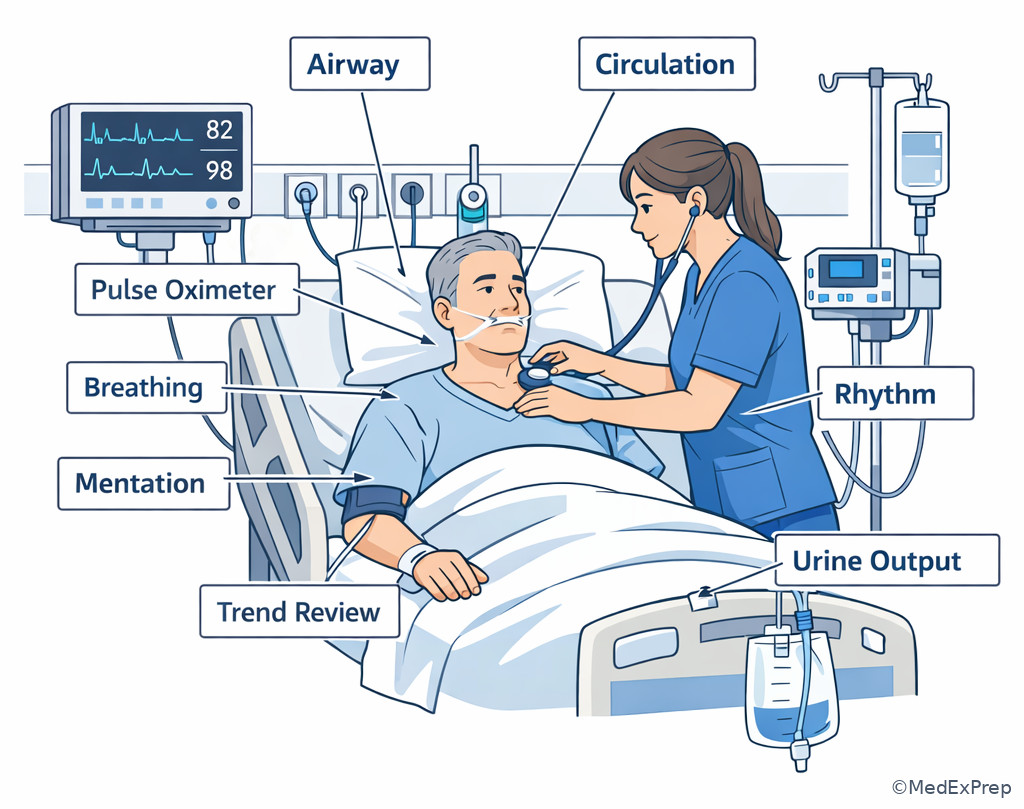
Exam takeaway: Visualize the progressive care RN's role as continuous assessment, monitoring, device safety, and escalation readiness.
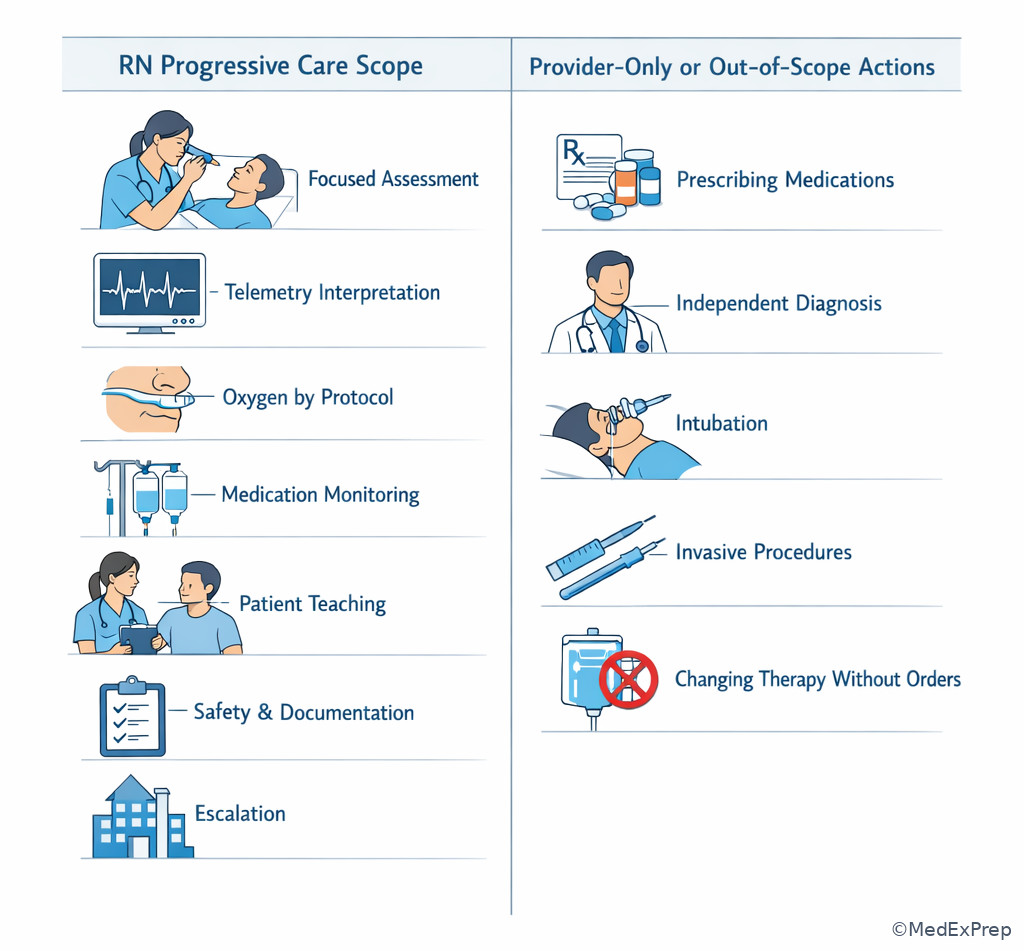
Exam takeaway: If the answer crosses into prescribing, diagnosing independently, or restricted procedures, reject it and choose assessment plus escalation.
1.1.1.3 Foundational role: what the PCCN candidate is being tested on
A Explanation
The first decision conflict in this topic is not “What disease is this?” but “What is the safest best nursing action for this adult progressive care patient?” The exam tests whether you can choose between actions that are all clinically relevant but differ in scope, urgency, and priority. In progressive care, you are expected to perform focused assessment, interpret monitoring and common lab data, identify deterioration, implement ordered or protocol-based interventions, evaluate response, educate patients and families, and communicate significant changes promptly.
The single rule that resolves many stems is this: if an answer requires independent diagnosing, prescribing, or performing provider-only procedures, reject it. Instead, choose the action that keeps the patient safe right now: assess, stabilize within RN scope, follow protocol, notify the provider, or activate rapid response when indicated. See Fig 1 and Fig 3.
WHY THIS IS TESTED: board-style nursing questions commonly hide the scope boundary inside an attractive treatment option. The learner must choose nursing judgment and escalation over provider management.
B Worked example
A 67-year-old man on a telemetry step-down unit is admitted for acute decompensated heart failure. He has type 2 diabetes and chronic kidney disease. During rounds he reports “feeling more short of breath,” his respiratory rate rises from 18 to 28/min, oxygen saturation decreases from 95% to 89% on 2 L/min nasal cannula, and he now needs to sit upright. His potassium is 5.3 mEq/L from earlier this morning, and his daughter asks whether he should receive a different diuretic. Which action is most appropriate?
Reasoning chain: Identify the task: immediate nursing action. Extract key facts: new respiratory deterioration, increased work of breathing, falling saturation, heart failure history. Distractors/noise: mildly elevated potassium and family question about medication choice may tempt medication-management thinking. Apply rule: the nurse should address breathing first within scope, then escalate. Eliminate distractors: choosing a new diuretic or changing medication regimen exceeds RN authority; patient teaching can wait until stable. Verify: increase oxygen per protocol if allowed, position upright, assess lung sounds and work of breathing, and notify provider or rapid response based on severity.
C Exam trap
D Checkpoint
Question: A 59-year-old woman on an adult progressive care unit after pneumonia treatment has new confusion, pulse oximetry 86% on 2 L/min nasal cannula, and increased accessory muscle use. Which action is the best immediate nursing response?
- Review the morning CBC and compare white blood cell trends.
- Increase oxygen and perform a focused respiratory assessment while preparing to escalate per protocol.
- Call the pharmacy to discuss whether bronchodilator dosing should be changed.
- Document the change and recheck the patient in 30 minutes.
- A: Tempting because infection trends matter in pneumonia, but wrong because it delays action for current hypoxemia.
- B: Tempting because it may feel too simple, but right because it addresses breathing first within RN scope and prepares for timely escalation.
- C: Tempting because medication review may eventually help, but wrong because it is not the first priority for acute oxygenation decline.
- D: Tempting because trending is useful, but wrong because a 30-minute delay is unsafe with new hypoxemia and confusion.
1.1.1.4 Foundational boundaries: what stays with the RN and what requires escalation
A Explanation
A second high-yield decision conflict is choosing between independent bedside nursing care and necessary escalation. Not every abnormality requires a rapid response, but not every abnormality is safe to “watch.” The progressive care RN owns focused ongoing assessment, interpretation of clinically relevant monitoring data, implementation of ordered care, recognition of danger signs, patient advocacy, and escalation when the patient exceeds the unit’s safe bedside management window.
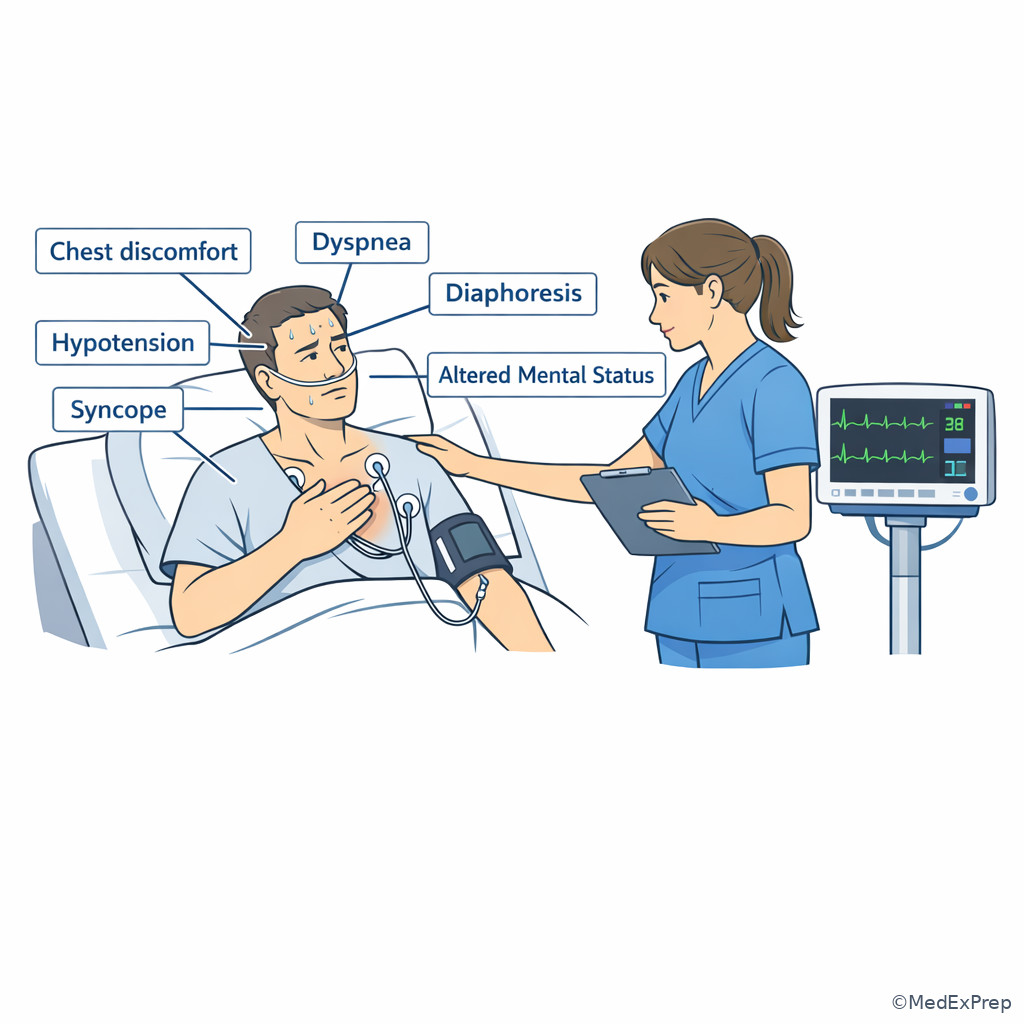
The single rule here is: stable expected findings can be monitored; new, worsening, or unexplained instability requires escalation. See Fig 2. Examples that generally stay with the RN include routine medication monitoring, reinforcement of standard teaching, safety precautions, and protocol-based oxygen adjustments. Examples that require provider or team involvement include rapidly worsening respiratory effort, chest pain with instability, symptomatic dysrhythmias, significant mental status change, post-procedure complications, suspected sepsis progression, or failure to respond to initial nursing interventions.
WHY THIS IS TESTED: exam items often pair a correct nursing action with a delayed escalation error. The learner must decide not only what to do, but also whether doing it alone is enough.
B Worked example
A 73-year-old woman is 6 hours post bronchoscopy on a progressive care unit. She has COPD and atrial fibrillation. Her blood pressure is 132/74 mm Hg, heart rate 104/min, and oxygen saturation is 93% on baseline 3 L/min nasal cannula. She has a mild sore throat and scant blood-tinged sputum. Thirty minutes later, she develops increasing dyspnea, restlessness, respiratory rate 30/min, oxygen saturation 87% despite 4 L/min, and diminished breath sounds on one side. A family member says, “She always gets anxious after procedures.”
Reasoning chain: Identify task: determine bedside response versus escalation. Extract key facts: post-procedure patient, worsening dyspnea, unilateral breath sound change, desaturation, restlessness. Noise: baseline COPD, chronic atrial fibrillation, and family attribution to anxiety. Apply rule: new unexplained deterioration after a procedure requires immediate escalation after quick stabilizing actions. Eliminate distractors: treating anxiety, waiting for scheduled respiratory therapy, or assuming COPD baseline is unsafe. Verify: apply oxygen within protocol, focused assessment, call provider/rapid response according to severity, prepare for urgent evaluation of post-procedure complication.
C Exam trap
D Checkpoint
Question: Which adult progressive care finding most clearly requires immediate escalation rather than routine continued monitoring?
- Chronic COPD patient with oxygen saturation 91% at known baseline and no increased work of breathing.
- Post-cardiac catheterization patient with stable mild groin tenderness and unchanged dressing.
- Telemetry patient with new chest discomfort, diaphoresis, and blood pressure drop from 138/82 to 96/58 mm Hg.
- Heart failure patient with bilateral ankle edema that is unchanged from admission assessment.
- A: Tempting because the oxygen level looks low, but wrong because it is baseline and not worsening.
- B: Tempting because post-procedure issues deserve attention, but wrong because the described finding is mild and stable.
- C: Tempting because all options warrant observation, but right because new ischemic symptoms plus hypotension indicate instability requiring immediate escalation.
- D: Tempting because edema matters in heart failure, but wrong because unchanged chronic findings do not outrank new instability.
- The safest default when an option exceeds RN authority is to assess, stabilize within scope, and escalate.
- True or False: A chronic abnormality usually outranks a new worsening trend. False.
- Name the 3 key cues that favor escalation: new, worsening, unexplained.
1.1.1.5 Application in progressive care settings: common unit scenarios and role-safe choices
A Explanation
In PCCN-style stems, the safest answer often depends on the unit context: telemetry, step-down, direct observation, post-procedure recovery, or multisystem monitoring. You are not expected to independently manage advanced ICU devices or make provider-level treatment decisions. You are expected to identify meaningful changes, apply unit-safe actions, and communicate early.
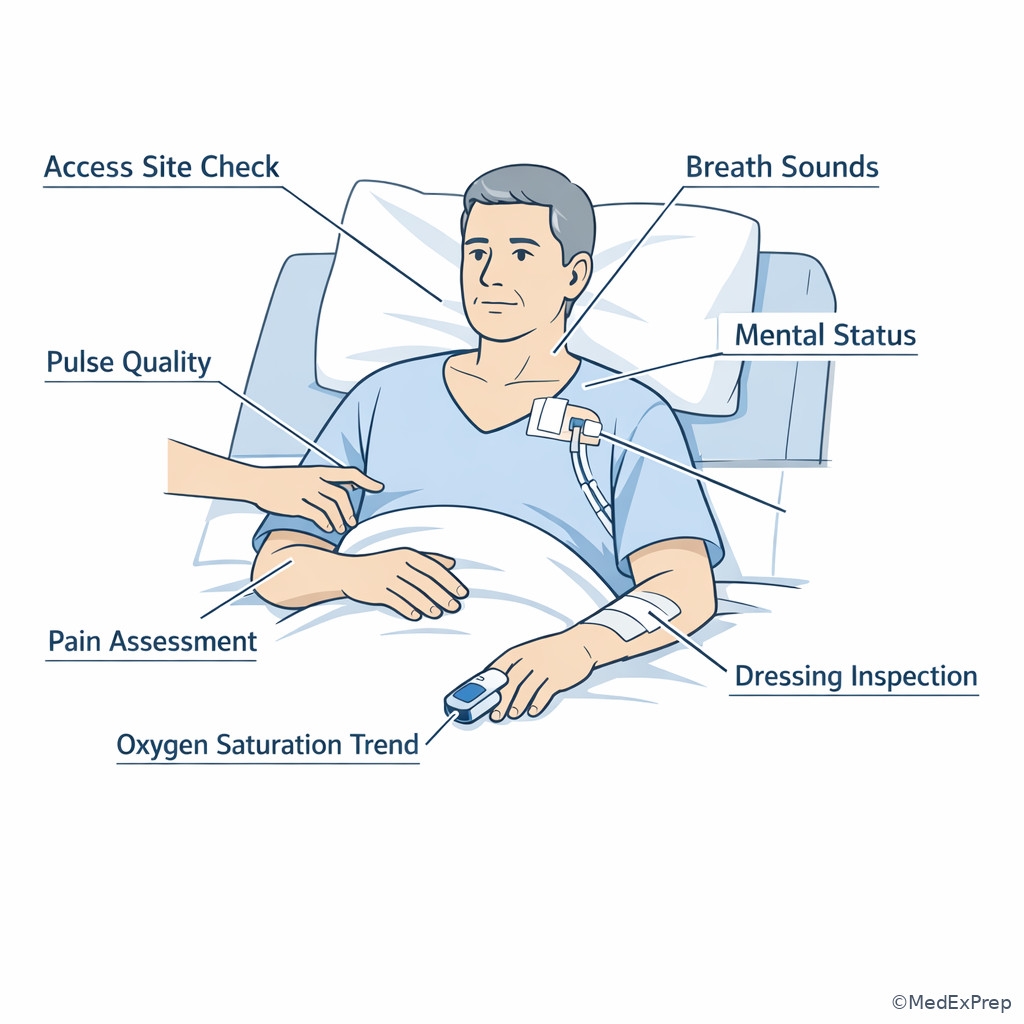
The decision conflict is usually choose-versus-reject: choose the action that directly addresses the current instability within nursing scope; reject the action that sounds comprehensive but delays patient safety. See Fig 1 and Fig 2. In telemetry, new symptomatic rhythm changes, syncope, hypotension, or ischemic symptoms require urgent action. In respiratory care, rising work of breathing, altered mentation, and falling saturation matter more than an isolated prior lab. In post-procedure care, the change from baseline is crucial: new bleeding, altered perfusion, dyspnea, or neurologic change may signal complication. In suspected sepsis or multisystem decline, trending deterioration and failure to respond to initial measures are escalation triggers.
WHY THIS IS TESTED: items are designed to make you chase the diagnosis instead of protecting the patient. The exam rewards pattern recognition linked to the first nursing step.
Exam takeaway: Symptomatic rhythm change, hypotension, chest discomfort, and altered mentation require action based on patient status, not monitor appearance alone.
Exam takeaway: Compare current findings with baseline to spot bleeding, respiratory decline, perfusion change, or neurologic complication early.
B Worked example
A 64-year-old man admitted for NSTEMI rule-out is on telemetry. He has hypertension, obesity, and obstructive sleep apnea. He tells the nurse he feels “a little lightheaded.” Telemetry now shows a wide-complex tachyarrhythmia at 148/min. Blood pressure has fallen from 128/76 to 88/52 mm Hg. He also reports chronic knee pain rated 8/10 and asks for his next opioid dose. The monitor technician asks whether the tracing could be artifact.
Reasoning chain: Identify the task: best immediate nursing action. Extract key facts: symptomatic rhythm change, hypotension, lightheadedness. Noise: knee pain, sleep apnea history, and possible artifact suggestion. Apply rule: treat the patient, not the monitor alone; symptomatic hemodynamic compromise requires immediate bedside assessment and escalation. Eliminate distractors: giving opioid for pain, waiting for a repeat strip without assessing the patient, or focusing on chronic comorbidities delays action. Verify: assess responsiveness and perfusion, ensure safety, call for help/provider or rapid response per policy, prepare for urgent intervention.
C Exam trap
D Checkpoint
Question: A nurse on a step-down unit is caring for four adult patients. Which situation most clearly reflects the intended PCCN scope response?
- Independently adjust the prescribed antiarrhythmic infusion rate based on rhythm interpretation alone.
- Recognize new symptomatic tachycardia, assess the patient, follow unit protocol, and notify the provider promptly.
- Delay communication until complete laboratory data are available to avoid unnecessary calls.
- Document the rhythm strip and ask the next shift to watch for recurrence.
- A: Tempting because rapid treatment matters, but wrong because independent medication titration without order or protocol exceeds scope.
- B: Tempting because it may feel less definitive than changing therapy, but right because it matches bedside RN role and patient-safety priority.
- C: Tempting because complete data improve communication, but wrong because unstable symptoms should not wait.
- D: Tempting because documentation matters, but wrong because charting is never the priority over symptomatic deterioration.
1.1.1.6 Integration: delegation, advocacy, chain of command, and safe exam strategy
A Explanation
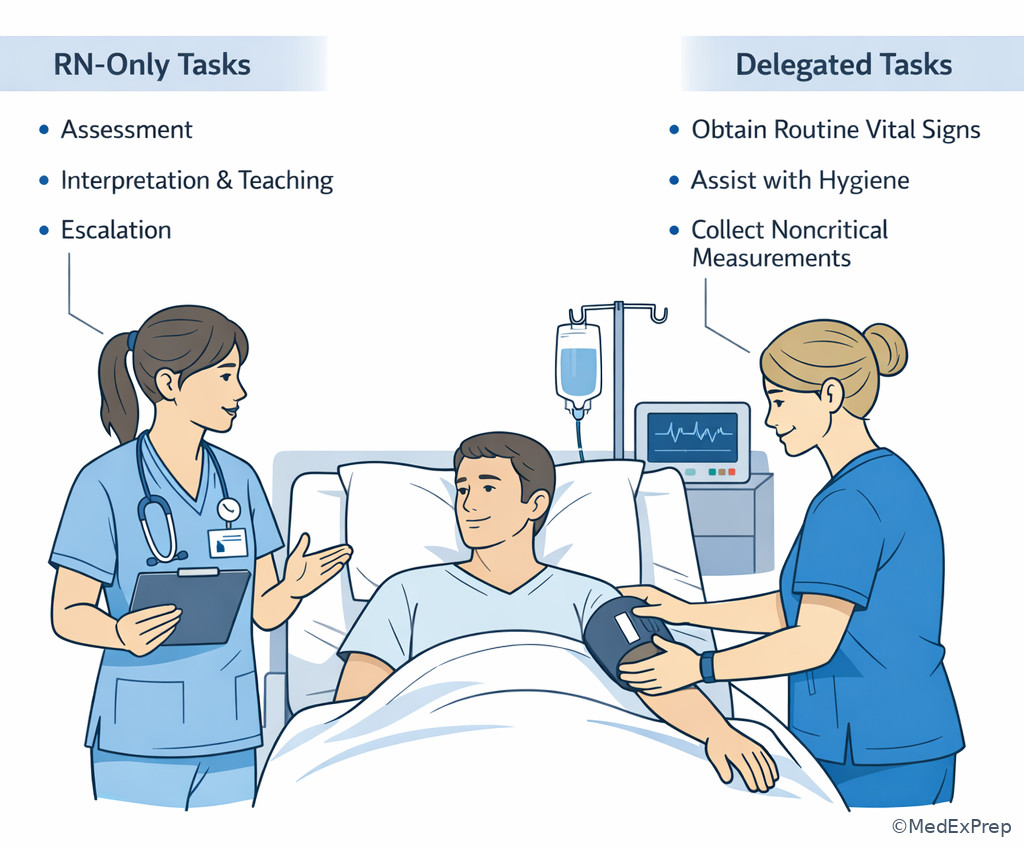
The final foundational integration skill is deciding who should do what, and when the RN must escalate beyond the first contact. Delegation is not merely task sharing; it is a patient-safety decision. Unstable patients, initial assessments, interpretation of data, care planning, and patient teaching that requires nursing judgment remain with the RN. Selected routine tasks may be delegated according to role, competency, and policy, but the RN remains accountable for supervision and evaluation.
The decision conflict is often between doing everything personally and delegating unsafely. The single rule: delegate tasks, not clinical judgment. If a patient is unstable, newly symptomatic, or requires interpretation, the RN must keep the task. If a concern is urgent and not addressed, use the chain of command. This is an advocacy issue as much as a scope issue. See Fig 3 and Fig 4. On the exam, answers that “wait until rounds,” “avoid bothering the provider,” or “ask a less qualified team member to assess” are often unsafe.
WHY THIS IS TESTED: AACN-style items evaluate judgment under pressure—especially whether you protect the patient despite workload, hierarchy, or incomplete data.
Exam takeaway: Unstable patients and judgment-heavy tasks stay with the RN, while unresolved urgent concerns move up the chain of command.
flowchart TD
A[Task identified] --> B{Needs assessment interpretation teaching or unstable patient care?}
B -->|Yes| C[RN keeps task]
B -->|No| D[Delegate routine task per policy and competency]
C --> E{Urgent concern addressed?}
E -->|No| F[Charge nurse -> provider -> rapid response/chain of command]
E -->|Yes| G[Continue reassessment and documentation] Exam takeaway: Routine predictable tasks may be delegated, but unstable assessment and interpretation remain RN responsibilities.
B Worked example
A 70-year-old man with heart failure and chronic atrial fibrillation is admitted to progressive care for volume overload. He now reports increased dyspnea and fatigue. Blood pressure is 92/58 mm Hg, heart rate 118/min irregular, respiratory rate 26/min, oxygen saturation 90% on 3 L/min nasal cannula. The unit is busy, and an experienced UAP is available. The charge nurse suggests having the UAP “check on him and get another set of vitals” while the RN finishes an admission assessment on another stable patient.
Reasoning chain: Identify task: delegation decision. Extract key facts: unstable trend, symptomatic patient, hypotension, dyspnea, oxygenation concern. Noise: chronic atrial fibrillation and busy unit workload. Apply rule: unstable assessment stays with the RN; delegation may support but cannot replace RN judgment. Eliminate distractors: sending only the UAP delays assessment of a potentially deteriorating patient; finishing routine admission work first is lower priority. Verify: the RN should assess the patient now, direct support staff for limited tasks if appropriate, and escalate if instability is confirmed.
C Exam trap
D Checkpoint
Question: Which action best reflects safe RN advocacy in adult progressive care?
- Wait until the next scheduled provider round to report new hypotension if the patient is still awake and talking.
- Ask a UAP to decide whether the patient’s increased work of breathing is worse than earlier.
- Perform a focused assessment, initiate unit-allowed safety measures, and use the chain of command if urgent concerns are not addressed.
- Hold all concern until laboratory results are back so the report will be more complete.
- A: Tempting because the patient is not yet crashing, but wrong because new hypotension requires timely reporting.
- B: Tempting because support staff can gather data, but wrong because evaluating worsening breathing is RN judgment.
- C: Tempting because it may seem assertive, but right because advocacy includes assessment, immediate safety action, and chain-of-command escalation when needed.
- D: Tempting because organized communication matters, but wrong because waiting for more data can be unsafe when instability is already present.
- Fill in the blank: Delegate tasks, not clinical judgment.
- True or False: A symptomatic hypotensive patient can be left to routine reassessment if the provider is busy. False.
- Name 3 RN-only functions commonly tested here: assessment, interpretation, escalation/initial teaching.
Exam Traps & Differentiators
- Most common wrong answer and why: choosing the treatment you think the patient needs instead of the nursing action you can safely do now. This is tempting because it shows disease knowledge, but the exam asks for bedside RN judgment.
- Looks similar but isn’t: an expected chronic low oxygen saturation is not the same as a new drop with increased work of breathing.
- Looks similar but isn’t: obtaining more data is not always wrong; it becomes wrong when it delays action for ABC compromise or hemodynamic instability.
- Related trap from upcoming prioritization topics: routine documentation, scheduled medications, and complete chart review are real tasks, but they lose priority when a patient has new instability.
| Stem says... | Think... | Reject... |
|---|---|---|
| “Most appropriate next step” with acute dyspnea or desaturation | ABCs first, oxygen/support within protocol, focused assessment, escalate | Lengthy chart review before bedside action |
| “Patient becomes newly confused” | Possible deterioration; reassess and trend vitals/oxygenation | Assuming baseline dementia without verification |
| “Telemetry change with symptoms” | Treat the patient response and perfusion, not only the strip | Waiting only for diagnostic confirmation |
| “Post-procedure change from baseline” | Potential complication until proven otherwise | Attributing changes to anxiety or routine recovery too quickly |
| “Busy unit with available UAP” | Keep unstable assessment with the RN | Delegating judgment-heavy reassessment |
| Confusable pair | Why they look alike | Discriminator |
|---|---|---|
| Stable chronic abnormality vs new deterioration | Both may have “abnormal” numbers | Trend and symptoms |
| Assessment first vs intervention first | Both are nursing actions | If ABC threat is obvious, support immediately while assessing |
| Provider notification vs rapid response activation | Both are escalation routes | Severity and immediacy of instability per policy |
| Delegation vs abandonment of RN judgment | Both involve sharing work | Does the task require interpretation, teaching, or instability assessment? |
If the stem says worsening work of breathing, think breathing outranks paperwork.
If the stem says symptomatic rhythm change, think assess perfusion and escalate promptly.
If the stem says post-procedure new unilateral or bleeding-related finding, think complication until evaluated.
If the stem says “what should the nurse do,” think nursing process and scope before disease treatment.
If the stem says another team member has not addressed an urgent concern, think chain of command and advocacy.
Tables
| Role element | Usually within progressive care RN scope | Requires provider order/policy or escalation |
|---|---|---|
| Assessment | Focused ongoing assessment, trend review, telemetry interpretation | Independent medical diagnosis |
| Oxygenation support | Apply and adjust per protocol, position, monitor response | Advanced airway placement outside emergency RN policy |
| Medication management | Administer ordered medications, monitor effects/adverse effects | Prescribe or change regimens independently |
| Procedures | Prepare, monitor, provide post-procedure care | Provider-only invasive procedures |
| Communication | Notify provider, charge nurse, rapid response; document and advocate | Delay escalation when unstable |
| Teaching | Patient/family education and reinforcement | Obtaining procedural consent as proceduralist |
| Finding type | Examples | Usual nursing response |
|---|---|---|
| Expected and stable | Baseline COPD oxygen saturation, unchanged chronic edema | Monitor, trend, continue plan |
| New but mild | Minor expected discomfort, predictable fatigue | Focused assessment, intervene, reassess |
| New and worsening | Increasing dyspnea, hypotension, confusion | Immediate assessment, support ABCs, escalate |
| Post-procedure change | New bleeding, unilateral breath sound loss, perfusion change | Treat as complication until evaluated; escalate promptly |
| Failure to respond | No improvement after oxygen or positioning | Escalate further per policy |
| Task | Delegate? | Why or why not |
|---|---|---|
| Initial assessment of a newly dyspneic patient | No | Requires RN judgment and instability recognition |
| Routine hygiene for a stable patient | Yes, per policy | Predictable, low-risk task |
| Repeat noncritical vital signs on stable patient | Yes, per policy | Data collection may be delegated; interpretation stays with RN |
| Teaching a patient about a new high-risk medication | No | Requires assessment of learning and nursing teaching |
| Obtaining supplies and assisting with positioning during deterioration | Yes, directed by RN | Supports care without transferring judgment |
| Determining whether chest pain is worsening | No | Interpretive assessment must stay with the RN |
Exam takeaway: In progressive care, rapid bedside reassessment and trend comparison drive the correct next action.
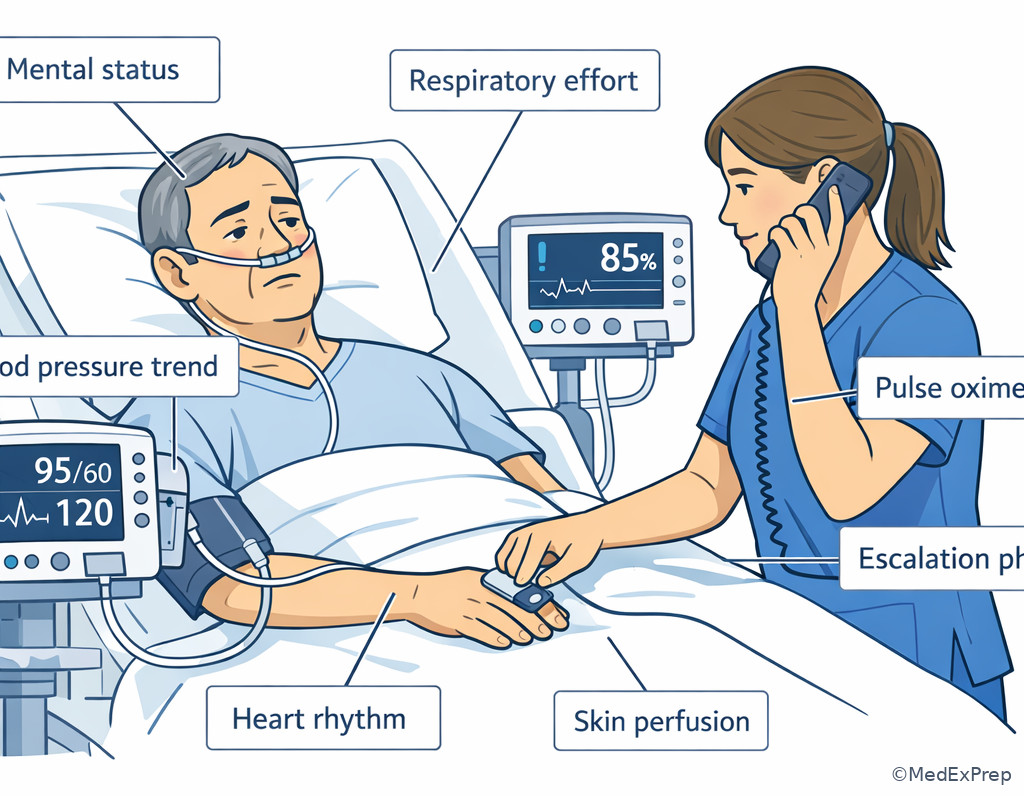
See Fig 5 for the delegation and chain-of-command pathway, and see Fig 6 for the bedside reassessment lens used before and during escalation.
Algorithm / Approach
Exam takeaway: If initial RN measures do not reverse worsening instability, move up the escalation pathway without delay.
flowchart TD
A[New finding] --> B[Focused RN reassessment]
B --> C{ABC compromise or hemodynamic instability?}
C -->|Yes| D[Immediate help / rapid response per policy]
C -->|No| E[Protocol-based intervention]
E --> F{Improving?}
F -->|Yes| G[Continue monitoring and document]
F -->|No| H[Notify provider / charge nurse and escalate further] Rapid Review
- Progressive care scope → monitor, interpret, intervene within policy, escalate; do not prescribe or independently diagnose.
- Best next step stem → choose the first safe RN action, not the full medical plan.
- New dyspnea → breathing support and reassessment outrank chart review.
- Telemetry abnormality → patient symptoms and perfusion outrank strip appearance alone.
- Post-procedure change → compare with baseline; unexpected worsening suggests complication.
- Trend interpretation → worsening over time beats isolated borderline values.
- Delegation → routine predictable task may go; unstable assessment stays.
- Escalation → required for new, worsening, unexplained, or nonresponsive instability.
- Provider not responding → use chain of command; advocacy is a nursing duty.
- Expected chronic abnormality → lower priority than new symptomatic change.
- Wrong-priority distractor → often a reasonable action done too late or before ABC stabilization.
- Scope clue → if answer changes orders independently, reject it.
- Protocol variation → follow your institution’s protocol.
Self-check quiz
1. A 62-year-old woman on a step-down unit after treatment for heart failure has oxygen saturation 95% on her baseline 2 L/min nasal cannula, mild chronic ankle edema, and no new symptoms. Which nursing action best fits adult progressive care scope?
- Independently change her diuretic dose because the edema persists.
- Continue focused monitoring, compare trends, and report new worsening findings if they develop.
- Request transfer to ICU because all heart failure patients need higher-level monitoring.
- Ask the UAP to determine whether the edema represents worsening perfusion.
2. A 68-year-old man with COPD on an adult progressive care unit remains at his documented baseline oxygen saturation of 90% on 2 L/min nasal cannula and denies increased shortness of breath. Which finding most strongly supports continued monitoring rather than immediate escalation?
- Baseline low oxygen saturation without increased work of breathing
- New confusion and accessory muscle use
- Drop in blood pressure from 134/78 to 92/56 mm Hg
- Sudden chest discomfort with diaphoresis
3. A 71-year-old post-cardiac catheterization patient with diabetes and peripheral vascular disease reports new groin pain. The dressing now has expanding drainage, blood pressure fell from 144/80 to 102/64 mm Hg, and the patient says he feels weak. A mildly elevated glucose from earlier is on the chart. Which is the most appropriate next nursing action?
- Review the catheterization report before touching the dressing so the assessment is complete.
- Perform focused assessment of the site and perfusion, apply immediate unit-allowed measures, and notify the provider promptly.
- Ask the UAP to recheck vital signs in 20 minutes while finishing another patient’s discharge teaching.
- Reassure the patient that soreness is expected after procedures and continue routine monitoring.
4. A 65-year-old telemetry patient with hypertension and chronic kidney disease develops palpitations, lightheadedness, and a heart rate of 146/min. Blood pressure is 86/50 mm Hg. The monitor technician wonders whether the tracing could be artifact. Which action is best?
- Assess the patient immediately, verify leads if feasible without delay, and escalate because the patient is symptomatic and hypotensive.
- Wait for a formal 12-lead ECG before contacting anyone.
- Administer the next scheduled antihypertensive to reduce cardiac workload.
- Document the strip and repeat the blood pressure in 30 minutes.
5. A 74-year-old woman with pneumonia, obesity, and atrial fibrillation becomes increasingly restless and confused over 1 hour. Respiratory rate rises from 20 to 30/min and oxygen saturation falls from 94% to 88% on 2 L/min nasal cannula. She also asks repeatedly for water because her mouth is dry. Which response is most appropriate?
- Provide oral care first because dryness is likely causing the restlessness.
- Increase oxygen per protocol, perform focused respiratory reassessment, and prepare to escalate for worsening respiratory status.
- Complete a detailed delirium screening tool before changing anything else.
- Encourage the patient to rest quietly and reassess at the next scheduled vital sign time.
6. A 69-year-old man with heart failure and chronic atrial fibrillation is more short of breath, with blood pressure 94/58 mm Hg and oxygen saturation 89% on 3 L/min nasal cannula. The RN is also caring for a newly admitted stable patient. Which task is safest to delegate?
- Have the UAP determine whether the patient’s work of breathing is worse than 30 minutes ago.
- Have the UAP obtain supplies and assist with positioning while the RN performs immediate focused assessment.
- Have the LPN decide whether rapid response criteria are met.
- Have the UAP provide initial teaching about why the oxygen level is dropping.
7. A 63-year-old woman 4 hours after bronchoscopy has COPD and anxiety disorder. She becomes restless, respiratory rate 32/min, oxygen saturation 86% despite increased oxygen, and breath sounds are markedly decreased on the right. The provider has not yet returned the page. Which nursing action requires immediate clarification or escalation?
- Continue close bedside monitoring, maintain oxygen support, and activate the chain of command/rapid response according to policy.
- Assume anxiety is the primary cause because the patient has a known psychiatric history.
- Prepare concise SBAR communication including procedure time, new assessment findings, and trend deterioration.
- Keep the patient upright and reassess frequently while awaiting a response.
8. A 72-year-old man with sepsis under treatment on progressive care has diabetes and chronic kidney disease. Over 2 hours he becomes more somnolent, urine output drops, respiratory rate rises, and blood pressure trends from 118/70 to 92/54 mm Hg. The charge nurse says, “Let’s wait for the next lactate before we call again.” Which is the best nursing response?
- Agree to wait because laboratory confirmation should come before another escalation.
- Perform focused reassessment, support ABCs within protocol, and escalate now because clinical deterioration is already present.
- Delegate the reassessment to assistive staff so the RN can finish medication reconciliation.
- Document the trends and plan to discuss them at shift handoff if they continue.
Answer key
1.1.1.7 1. Answer: B
A: Tempting because persistent edema can suggest insufficient therapy, and nurses monitor treatment response. It is incorrect because independently changing a diuretic dose exceeds RN scope. The single clue is that the patient is stable and the question asks what fits nursing scope, not what medical therapy should be prescribed. Priority principle: scope and safety over independent treatment change. Sources: ANA Standards of Practice; NCSBN clinical judgment guidance.
B: Tempting because it may seem too passive, but it is correct because stable patients in progressive care require focused monitoring, trend comparison, and reporting of change. The single clue is baseline status without new symptoms. Priority principle: nursing process—assess and monitor appropriately for current stability. Sources: ANA Standards of Practice; Lewis Medical-Surgical Nursing.
C: Tempting because heart failure can deteriorate, and higher-level monitoring sounds safe. It is incorrect because there is no evidence of current instability requiring ICU transfer. The single clue is stable oxygenation and no new symptoms. Priority principle: avoid overtriage when ongoing monitoring is appropriate. Sources: Lewis Medical-Surgical Nursing.
D: Tempting because UAP help is valuable, but it is incorrect because deciding whether edema reflects worsening perfusion requires nursing judgment. The single clue is interpretive assessment. Priority principle: delegate tasks, not judgment. Sources: ANA Standards of Practice; NCSBN delegation principles.
1.1.1.8 2. Answer: A
A: Tempting because 90% looks concerning, but it is correct because the value is baseline and not paired with increased work of breathing. The single clue is “documented baseline” plus no new symptoms. Priority principle: chronic stable abnormality is lower priority than new deterioration. Sources: Lewis Medical-Surgical Nursing; Saunders Comprehensive Review for the NCLEX-RN.
B: Tempting because mental status changes can occur for many reasons, but it is incorrect here because it clearly supports escalation rather than continued monitoring. The single clue is new confusion with respiratory effort. Priority principle: breathing and neurologic deterioration require urgent action. Sources: NCSBN clinical judgment guidance.
C: Tempting because a pressure change may be measurement error, but incorrect because new hypotension suggests circulatory instability. The single clue is the significant downward trend. Priority principle: circulation decline outranks stable chronic oxygen values. Sources: Lewis Medical-Surgical Nursing.
D: Tempting because chest discomfort may not always be cardiac, but incorrect because diaphoresis plus sudden chest discomfort demands urgent evaluation. The single clue is symptomatic acute change. Priority principle: possible ischemia is higher priority than routine monitoring. Sources: Saunders Comprehensive Review for the NCLEX-RN.
1.1.1.9 3. Answer: B
A: Tempting because understanding procedure details can refine assessment. It is incorrect because reviewing the report first delays response to probable post-procedure bleeding or vascular complication. The single clue is expanding drainage with hypotension and weakness. Priority principle: circulation and active complication recognition outrank chart completeness. Sources: Lewis Medical-Surgical Nursing; NCSBN clinical judgment guidance.
B: Tempting because it combines several steps, but it is correct because it addresses immediate circulation risk, focused reassessment, unit-allowed interventions, and timely escalation. The single clue is changing access-site drainage with hemodynamic decline. Priority principle: ABCs and post-procedure complication response. Sources: Lewis Medical-Surgical Nursing; ANA Standards of Practice.
C: Tempting because repeat vitals are relevant and discharge teaching is a real duty. It is incorrect because unstable post-procedure assessment cannot be delegated and the discharge task is lower priority. The single clue is falling blood pressure in a symptomatic patient. Priority principle: unstable assessment stays with RN. Sources: NCSBN delegation principles.
D: Tempting because some soreness is expected after procedures. It is incorrect because expanding drainage and hemodynamic change make this more than routine soreness. The single clue is the trend toward hypotension. Priority principle: unexpected worsening after procedure requires escalation. Sources: Lewis Medical-Surgical Nursing.
1.1.1.10 4. Answer: A
A: Tempting because it requires simultaneous thinking, but it is correct because symptomatic tachyarrhythmia with hypotension is an immediate patient problem. Verifying leads may be appropriate only if it does not delay care. The single clue is lightheadedness plus blood pressure 86/50 mm Hg. Priority principle: treat the patient’s instability first. Sources: Lewis Medical-Surgical Nursing; Saunders Comprehensive Review for the NCLEX-RN.
B: Tempting because rhythm confirmation is valuable. It is incorrect because waiting for formal diagnostics delays response to hemodynamic compromise. The single clue is symptomatic hypotension already present. Priority principle: ABCs/circulation over confirmatory data gathering. Sources: NCSBN clinical judgment guidance.
C: Tempting because reducing cardiac workload sounds physiologically logical. It is incorrect because giving a scheduled antihypertensive to a hypotensive patient is unsafe. The single clue is blood pressure 86/50 mm Hg. Priority principle: do not worsen circulation compromise. Sources: Lewis Medical-Surgical Nursing.
D: Tempting because documentation and repeat vitals are part of nursing care. It is incorrect because the patient is already unstable and cannot wait 30 minutes. The single clue is symptomatic rapid rate plus hypotension. Priority principle: urgent reassessment and escalation outrank delayed reevaluation. Sources: ANA Standards of Practice.
1.1.1.11 5. Answer: B
A: Tempting because dry mouth is real and comfort care matters. It is incorrect because the priority problem is worsening oxygenation and increased work of breathing, not oral discomfort. The single clue is saturation falling with rising respiratory rate and confusion. Priority principle: breathing before comfort. Sources: Saunders Comprehensive Review for the NCLEX-RN; NCSBN guidance.
B: Tempting because it may seem like a standard response, but it is correct because it addresses breathing decline within RN scope and prepares for timely escalation. The single clue is trend deterioration over 1 hour with neurologic change. Priority principle: ABCs plus trend recognition. Sources: Lewis Medical-Surgical Nursing; ANA Standards of Practice.
C: Tempting because confusion can suggest delirium and screening tools are useful. It is incorrect because the patient has active respiratory deterioration that must be addressed first. The single clue is oxygenation decline. Priority principle: assess and stabilize physiologic threat before secondary screening. Sources: NCSBN clinical judgment guidance.
D: Tempting because rest and scheduled reassessment are common nursing measures. It is incorrect because delaying action in a worsening respiratory patient is unsafe. The single clue is rising respiratory rate and falling saturation. Priority principle: acute deterioration cannot wait for routine intervals. Sources: Lewis Medical-Surgical Nursing.
1.1.1.12 6. Answer: B
A: Tempting because repeat observation is a real task and UAPs can gather data. It is incorrect because deciding whether work of breathing is worsening requires clinical judgment in an unstable patient. The single clue is active dyspnea with hypotension and low oxygen saturation. Priority principle: unstable assessment remains with the RN. Sources: ANA Standards of Practice; NCSBN delegation principles.
B: Tempting because it may seem indirect, but it is correct because it uses support staff for routine assistance while the RN keeps immediate assessment and decision-making. The single clue is that supplies and positioning assistance are task-based, not judgment-based. Priority principle: delegate supportive tasks, not assessment. Sources: NCSBN delegation principles; ANA Standards.
C: Tempting because experienced team members may notice deterioration. It is incorrect because determining whether rapid response criteria are met in an unstable patient is an RN/provider judgment issue under policy, not something to hand off casually. The single clue is the escalation decision itself. Priority principle: escalation responsibility stays with the RN. Sources: NCSBN guidance.
D: Tempting because teaching is a core nursing role. It is incorrect because initial teaching about acute instability is inappropriate in the middle of worsening symptoms and requires RN assessment of readiness. The single clue is current instability. Priority principle: physiologic stability before education. Sources: ANA Standards of Practice.
1.1.1.13 7. Answer: B
A: Tempting because bedside monitoring alone may feel insufficient. It is correct because maintaining oxygen support, staying at the bedside, and using rapid escalation pathways when the provider does not respond are appropriate advocacy steps. The single clue is significant post-procedure respiratory deterioration despite initial support. Priority principle: maintain safety and escalate up the chain when unresolved. Sources: ANA Standards of Practice; Lewis Medical-Surgical Nursing.
B: Tempting because the patient has known anxiety and restlessness can be psychogenic. It is the action requiring immediate clarification or rejection because it misattributes likely physiologic deterioration to psychiatric history. The single clue is markedly decreased unilateral breath sounds after bronchoscopy. Priority principle: do not anchor on history when acute respiratory compromise is present. Sources: NCSBN clinical judgment guidance.
C: Tempting because communication may feel secondary. It is actually appropriate because clear SBAR supports rapid escalation and accurate handoff during deterioration. The single clue is the need for urgent concise communication. Priority principle: communication supports patient safety during escalation. Sources: ANA Standards of Practice.
D: Tempting because it sounds like “just waiting,” but it can be correct as part of continued bedside support while escalation is in progress. It is not the unsafe choice. The single clue is that it does not replace escalation; it complements it. Priority principle: maintain breathing support while higher-level help is being obtained. Sources: Lewis Medical-Surgical Nursing.
1.1.1.14 8. Answer: B
A: Tempting because sepsis care uses laboratory trends and lactate is clinically important. It is incorrect because the patient is already showing multisystem clinical deterioration, which is enough to act on. The single clue is worsening mentation, urine output, respiratory rate, and blood pressure trend. Priority principle: clinical deterioration outranks waiting for confirmatory data. Sources: Lewis Medical-Surgical Nursing; NCSBN clinical judgment guidance.
B: Tempting because it may seem repetitive if prior calls were made, but it is correct because worsening perfusion and mental status require immediate reassessment, ABC support within protocol, and renewed escalation. The single clue is progressive decline across multiple systems. Priority principle: act on current instability and advocate persistently. Sources: ANA Standards of Practice; Lewis Medical-Surgical Nursing.
C: Tempting because workload pressure can make delegation attractive. It is incorrect because reassessment of deteriorating perfusion and mentation requires RN judgment. The single clue is somnolence plus hypotensive trend. Priority principle: unstable reassessment cannot be delegated. Sources: NCSBN delegation principles.
D: Tempting because documentation and handoff are important. It is incorrect because deferring discussion until shift change abandons urgent advocacy. The single clue is ongoing worsening within a short time frame. Priority principle: current instability requires immediate action, not delayed reporting. Sources: ANA Standards of Practice.
Keep going with the full PCCN Prep Course (PCCN)
You just studied the way members do, in the same lesson interface. Full access unlocks every lesson, the question bank and flashcards for a full year.
One payment · 1 year of access · No auto-renewal