1.1.1 - Chief Concern And Problem List
Why it matters
- Board-style cases rarely test isolated findings; they test whether you can organize findings into the right problem list.
- A weak problem list leads to flawed extraction decisions, incorrect camouflage choices, and missed interdisciplinary referrals later.
- The chief concern can be real, incomplete, misleading, or cosmetic-only; the orthodontist must respect it without letting it replace diagnosis.
- Many distractors become easy once you ask: What is the governing discrepancy, and where does it belong on the problem list?
Key Terms & Must-Know Facts
1.1.1.1 Key terms
- Chief concern — the complaint or goal stated by the patient or parent, ideally in their words.
- Problem list — prioritized set of diagnosable findings relevant to orthodontic treatment planning.
- Governing discrepancy — the main problem most likely to determine treatment approach.
- Diagnostic synthesis — combining history, exam, photos, models, radiographs, and cephalometrics into one coherent case summary.
- Skeletal discrepancy — jaw relationship or growth-pattern problem, not explained by tooth position alone.
- Dental discrepancy — tooth position, inclination, eruption, or arch-length issue.
- Soft-tissue concern — profile, lip competence, smile display, or facial balance issue relevant to planning.
- Functional shift — occlusal interference causing mandibular displacement from centric relation into habitual bite.
- Interdisciplinary modifier — periodontal, restorative, surgical, pediatric, or medical factor that changes orthodontic options.
- Problem prioritization — ranking findings by impact on diagnosis, risk, timing, and treatment decisions.
- Noise — extra information in a vignette that is true but not governing.
- Red-flag finding — issue requiring referral, clarification, or modification before routine orthodontic treatment.
1.1.1.2 Must-know facts
- The chief concern is not the same as the diagnosis.
- A good problem list uses specific findings, not vague labels like “bad bite” or “needs braces.”
- Orthodontic problems are usually grouped into skeletal, dental, soft tissue, functional, and other modifying factors.
- Prioritize findings that change treatment pathway, timing, anchorage, or stability.
- A patient’s cosmetic complaint may hide a larger skeletal or periodontal limitation.
- Board questions often include a tempting surface finding that is less important than the source of discrepancy.
- Problem lists should be objective, exam-ready, and treatment-relevant.
- If a finding affects scope or safety, it must be elevated in priority even if it is not the patient’s chief concern.
Exam takeaway: Start with the patient’s words, then convert them into categorized, treatment-relevant problems rather than repeating the complaint.
flowchart TD
A[Patient or parent statement] --> B[Clarify exact concern]
B --> C[Collect exam and record findings]
C --> D[Sort findings by category]
D --> E[Prioritize by treatment impact]
E --> F[Write concise orthodontic problem list]
Exam takeaway: The chief concern begins in conversation, but the problem list must be built from records and examination.
Core content
1.1.1.3 Foundational frame: chief concern versus orthodontic diagnosis
A Explanation
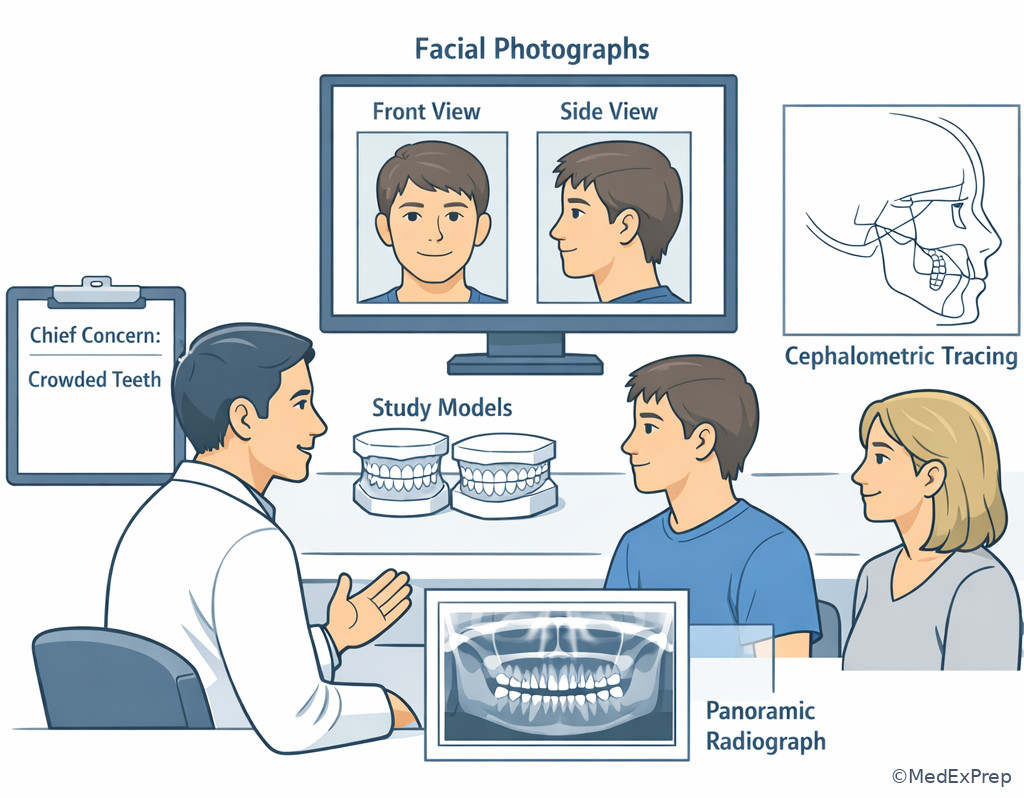
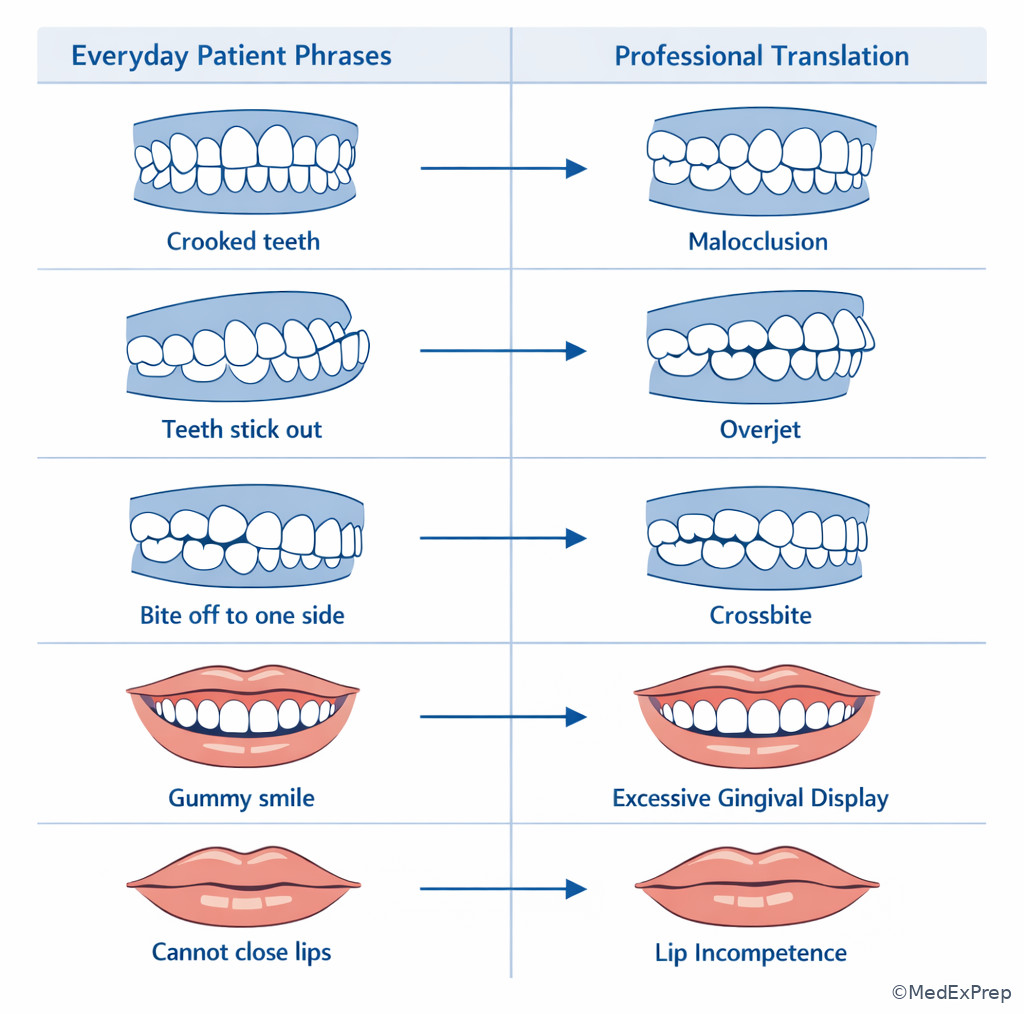
The first decision conflict is simple but heavily tested: Should you let the chief concern define the case, or should you treat it as one input into the diagnosis? The correct choice is to respect the chief concern, document it clearly, and then decide whether it reflects the actual governing discrepancy. A patient may say “my front teeth stick out,” but the case may really be driven by skeletal Class II pattern, lip incompetence, deep overbite, or incisor protrusion. A parent may say “crooked teeth,” while the real board-relevant issue is a unilateral posterior crossbite with functional shift.
WHY THIS IS TESTED: board stems often give a persuasive complaint that points toward the wrong level of analysis. The single resolving rule is: the chief concern states motivation; the problem list states diagnosis. Choose the answer that translates complaint into objective orthodontic language. Reject answers that merely rewrite the patient’s words without identifying the discrepancy source.
In practice, capture the chief concern in the patient’s own terms when possible, then ask clarifying questions: duration, who is bothered, esthetic versus functional impact, and whether any prior dental advice shaped the complaint. Next, compare the complaint with your findings. If they align, good. If they do not, your job is not to force agreement but to document both: “Chief concern: crowded upper teeth” and “Problem list: skeletal Class III tendency with anterior crossbite, mild maxillary crowding, reduced overjet.” See Fig 1.
For ABO-style reasoning, a chief concern is useful only when it is converted into decision-ready language. “Doesn’t like smile” is not yet usable. “Excessive maxillary incisor protrusion with lip incompetence” is.
B Worked example
A 13-year-old girl presents with her mother stating, “We just want the two front teeth straightened before high school.” She has mild seasonal allergies, a history of early loss of lower primary E’s, and good oral hygiene. Clinical findings show lip incompetence at rest, 7 mm overjet, full-step Class II molar relationship, 100% deep overbite, mild upper crowding, and a convex profile. The panoramic radiograph is otherwise unremarkable except for slightly delayed eruption of a mandibular second premolar. The delayed premolar is the distracting finding; it is real, but it does not govern the case.
Reasoning chain: identify task → determine whether the mother’s concern is the diagnosis. Extract key facts: large overjet, deep bite, convex profile, Class II relationship, lip incompetence. Apply rule: chief concern is “front teeth straightening,” but the governing discrepancy is broader than mild alignment. Eliminate distractors: delayed eruption of one premolar does not explain the facial and occlusal pattern; isolated upper crowding is too narrow. Verify: a defensible opening summary is “Chief concern is anterior alignment; diagnostic problem list includes Class II sagittal discrepancy, increased overjet, deep bite, lip incompetence, and mild crowding.”
C Exam trap
D Checkpoint
Question: A 12-year-old boy presents with the statement, “My teeth stick out.” Records show 8 mm overjet, Class II canine relationship, incompetent lips, and mild spacing. Which is the most appropriate way to handle the chief concern in the diagnostic summary?
- List “protrusive upper incisors” as both chief concern and complete diagnosis.
- Ignore the chief concern because objective findings are more important.
- Document the chief concern in the patient’s words, then write a separate problem list based on the diagnostic findings.
- Replace the chief concern with “needs comprehensive orthodontic treatment.”
- A: Tempting because protrusive incisors appear to explain the complaint, but wrong because it collapses symptom and diagnosis into one incomplete label.
- B: Tempting because board cases prioritize objective findings, but wrong because the patient’s concern remains a required and clinically relevant part of the record.
- C: Correct because it preserves the patient perspective while allowing diagnostic synthesis to remain objective and complete.
- D: Tempting because it sounds formal and comprehensive, but wrong because it is nonspecific and does not document either the complaint or the actual problem list.
1.1.1.4 Building the problem list: what belongs, what does not, and how to prioritize
A Explanation
The second decision conflict is: Should every abnormal finding go on the problem list, or only those that influence diagnosis and treatment planning? The correct answer is the latter. A useful problem list is not a dump of observations; it is a prioritized, treatment-relevant summary. Include findings that affect pathway, timing, difficulty, risk, or stability. Reject trivia and redundant wording.
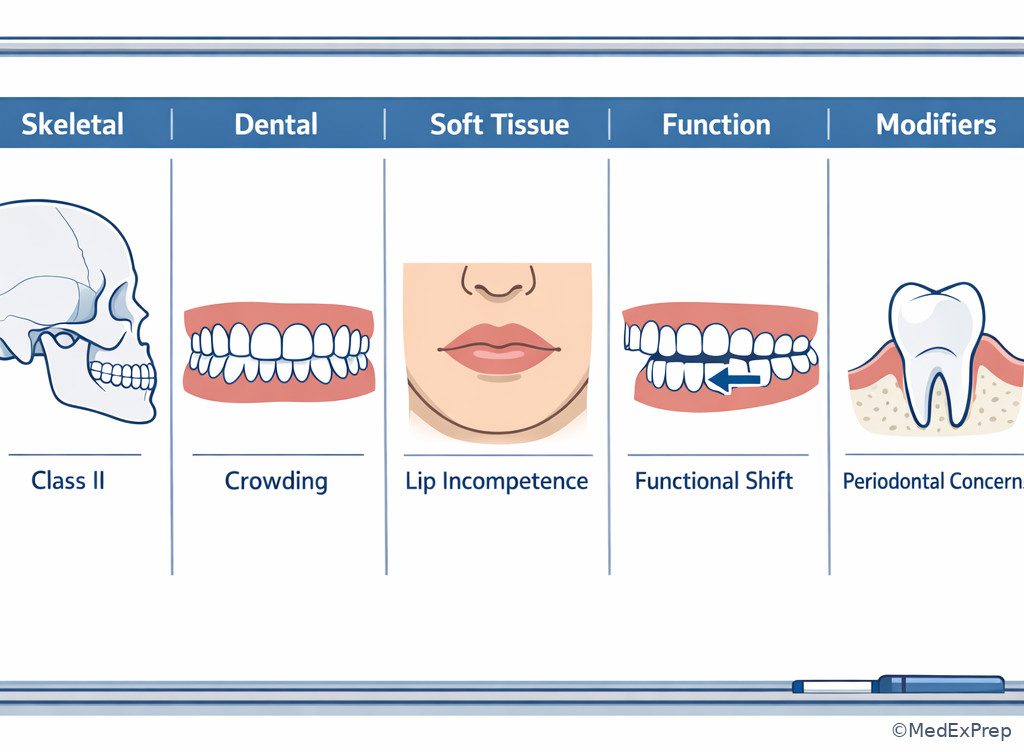
The cleanest framework for a foundational topic is the S-D-S-F-M structure: skeletal, dental, soft tissue, function, modifiers. Skeletal problems include sagittal, vertical, transverse, or asymmetry patterns. Dental problems include crowding, spacing, incisor inclination, overbite, overjet, eruption disturbances, and arch coordination. Soft-tissue problems include profile protrusion or retrusion, lip incompetence, smile display issues, or soft-tissue strain relevant to planning. Functional problems include shifts, traumatic bite, speech-related habits when documented, or functional interferences. Modifiers include periodontal compromise, missing teeth, restorations, caries risk, poor compliance, root resorption risk, age/growth status, and interdisciplinary needs.
WHY THIS IS TESTED: when students over-list minor findings, they lose the governing discrepancy; when they under-list, they miss risk modifiers. The single resolving rule is: prioritize findings that change treatment decisions first. A 2 mm midline deviation may be real, but it should not outrank a skeletal open bite tendency or thin periodontal support.
Good problem-list language is specific and non-duplicative. “Severe overjet” and “Class II malocclusion” may both belong if each adds something different; “crowding present” and “insufficient space” often duplicate the same issue unless arch-specific detail matters. See Fig 2.
B Worked example
A 15-year-old male seeks orthodontic treatment “because lower teeth are crowded.” He has controlled asthma, generalized mild fluorosis, and a bonded restoration on tooth 8 from prior trauma. Records show bilateral half-step Class III molars, anterior crossbite on one central incisor, lower crowding of 5 mm, mild maxillary crowding of 2 mm, slightly concave profile, reduced overjet, and no periodontal loss. A small maxillary midline deviation is present. The tempting but wrong clue is the lower crowding because it matches the patient’s complaint and is numerically easy to write down first.
Reasoning chain: identify task → construct a prioritized problem list, not a cosmetic summary. Extract key facts: Class III tendency, reduced overjet, anterior crossbite, concave profile, lower crowding. Apply rule: list the discrepancy that most affects treatment pathway before localized alignment issues. Eliminate distractors: fluorosis and a bonded restoration matter as modifiers but do not govern the malocclusion; the small maxillary midline deviation is minor. Verify: a stronger list begins with “sagittal Class III tendency with reduced overjet/anterior crossbite,” followed by lower arch crowding, mild upper crowding, and restorative history as a modifier.
C Exam trap
D Checkpoint
Question: Which finding should generally be placed higher on an orthodontic problem list when it is present with mild crowding and minor midline discrepancy?
- Generalized mild fluorosis without structural compromise
- Skeletal transverse discrepancy with functional posterior crossbite
- Small diastema distal to a mandibular canine
- Noncontributory history of prior routine prophylaxis
- A: Tempting because enamel appearance may affect esthetics, but wrong because it usually does not govern orthodontic pathway unless restorative planning is implicated.
- B: Correct because a transverse discrepancy with functional shift changes diagnosis, timing, and mechanics and therefore belongs high on the problem list.
- C: Tempting because space findings are orthodontically relevant, but wrong because a small isolated spacing issue is usually lower priority than a skeletal-functional discrepancy.
- D: Tempting only because it is part of the chart, but wrong because it has no problem-list value.
- The problem-list bucket most likely to change timing early is skeletal or functional discrepancy.
- True or False: Every charted abnormality belongs on the orthodontic problem list. False.
- Name the 5 buckets in S-D-S-F-M: Skeletal, Dental, Soft tissue, Function, Modifiers.
Exam takeaway: Rank findings by how strongly they alter treatment pathway, not by how obvious they look or how loudly they are reported.
flowchart LR
A[Raw findings] --> B[Skeletal]
A --> C[Dental]
A --> D[Soft tissue]
A --> E[Function]
A --> F[Modifiers]
B --> G[High priority if pathway changes]
C --> H[Priority varies by severity and source]
D --> I[Important if profile or lip competence affected]
E --> G
F --> J[Elevate if risk or referral needed]
Exam takeaway: Visual grouping into skeletal, dental, soft tissue, function, and modifiers prevents random listing and missed priorities.
1.1.1.5 Distinguishing governing discrepancy from noise in board-style cases
A Explanation
Now move from listing to interpretation. The decision conflict is: When several findings coexist, which one should drive your summary and later planning? The answer is the governing discrepancy — the finding that most changes whether you choose growth modification, camouflage, extraction, expansion, surgery consideration, anchorage strategy, or interdisciplinary sequencing. This is not always the most visible feature and not always the patient’s complaint.
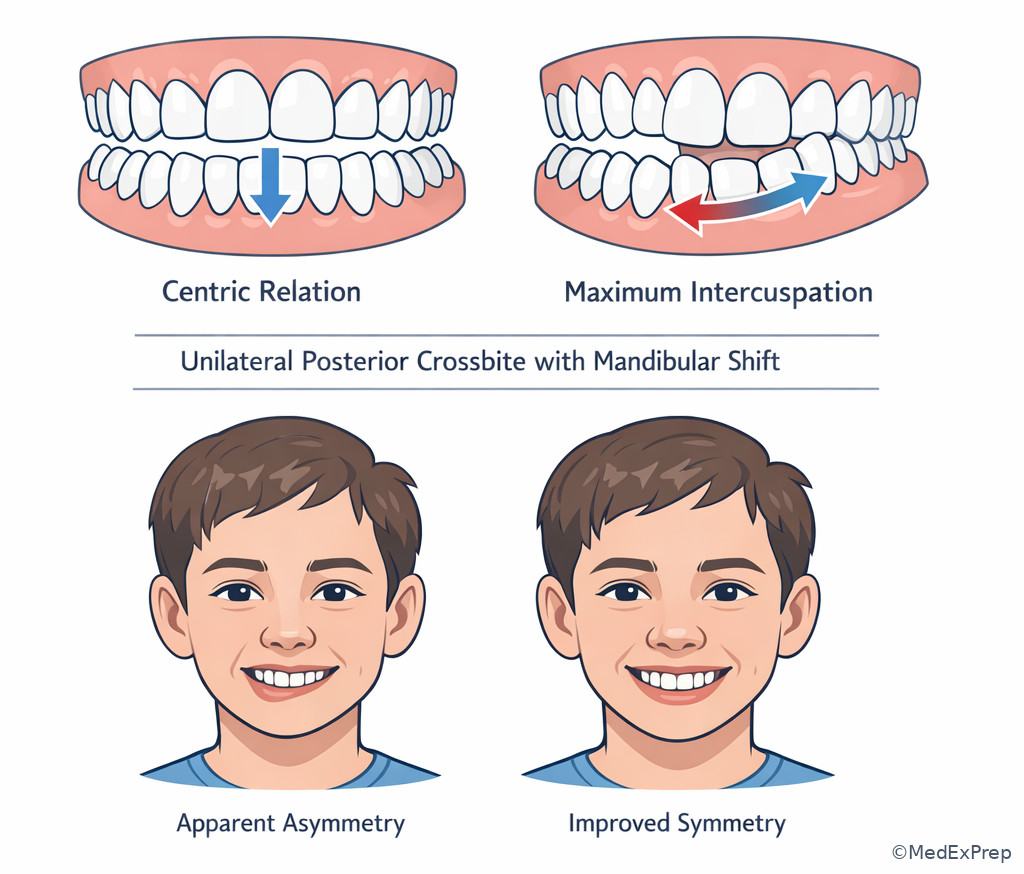
WHY THIS IS TESTED: ABO-style stems often include a tempting detail that is true but secondary: mild mandibular crowding, a dental midline, one retained primary tooth, a small Bolton issue, or a pleasing smile. The single rule that resolves the conflict is: choose the finding that explains the case pattern, not just one local manifestation of it. If protrusive incisors are secondary to skeletal Class II pattern and lip incompetence, the sagittal discrepancy governs. If crossbite is caused by a functional shift from transverse constriction, the transverse problem governs.
Ask three questions: What finding explains the most downstream findings? What finding would change treatment options if it were absent? What finding creates the greatest risk if ignored? The best governing discrepancy usually answers at least two of the three.
This is also where orthodontic scope matters. If the “governing discrepancy” appears to be a pathology, trauma sequela, severe periodontal issue, or nonroutine airway/TMJ concern, your role is to recognize its relevance and refer or co-manage rather than force an orthodontic-only explanation. See Fig 3.
B Worked example
A 10-year-old mixed-dentition patient is referred for “an upper tooth biting inside.” He has allergic rhinitis, mouth-open posture, and no caries. Findings include unilateral posterior crossbite, mandibular shift on closure, mild upper crowding, 2 mm lower crowding, and a relatively symmetric face in centric relation but asymmetric appearance in maximum intercuspation. A tempting but wrong clue is the mild upper crowding because it seems easy to fix with alignment.
Reasoning chain: identify task → decide the governing discrepancy. Extract key facts: unilateral posterior crossbite, shift on closure, apparent asymmetry dependent on bite position. Apply rule: the finding that explains the asymmetry and changes timing/mechanics is the transverse discrepancy with functional shift. Eliminate distractors: mild crowding does not explain the mandibular displacement; allergic rhinitis may be a modifier but does not itself define the orthodontic problem list. Verify: place “maxillary transverse deficiency with unilateral posterior crossbite and functional shift” above alignment issues.
C Exam trap
D Checkpoint
Question: A patient has lower crowding, a 6 mm overjet, deep bite, convex profile, and lip incompetence. Which finding most likely represents the governing discrepancy for case framing?
- Lower incisor irregularity
- Mild posterior rotation of one premolar
- Sagittal discrepancy associated with Class II pattern
- Small maxillary midline discrepancy
- A: Tempting because crowding is measurable and common, but wrong because it does not explain the full facial and occlusal pattern.
- B: Tempting because rotation can complicate finishing, but wrong because it is a local dental detail rather than the case driver.
- C: Correct because the combination of overjet, convex profile, and lip incompetence indicates a broader sagittal problem that will drive planning decisions.
- D: Tempting because midlines are important in board cases, but wrong because a small midline issue rarely outweighs a major sagittal discrepancy.
Exam takeaway: The correct top problem is the one that best explains the case pattern and changes management if present.
flowchart TD
A[Multiple abnormal findings] --> B{Which explains most of the pattern?}
B -->|One local detail only| C[Lower priority]
B -->|Changes treatment pathway| D[Promote in problem list]
D --> E{Any safety or scope modifier?}
E -->|Yes| F[Elevate and refer or co-manage]
E -->|No| G[Use to anchor diagnostic summary] Exam takeaway: If asymmetry appears only in habitual closure, think functional shift before fixed skeletal asymmetry.
1.1.1.6 Turning findings into an exam-ready written summary
A Explanation
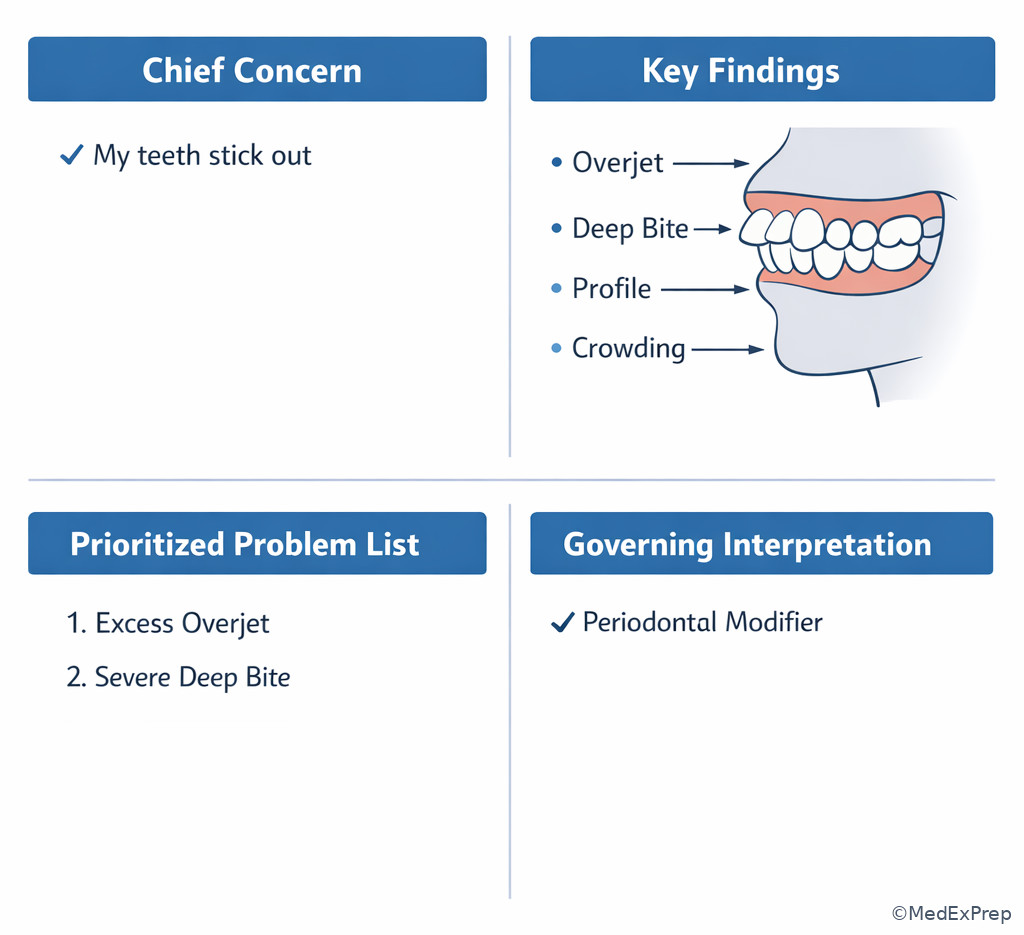
The next decision conflict is practical: Should the diagnostic summary read like a chart note with everything included, or like a concise board-style synthesis? For exam prep, choose concise synthesis. A strong summary usually has four parts: chief concern, key diagnostic findings, prioritized problem list, and one-sentence governing interpretation. The summary should be short enough to review quickly but specific enough to support the next planning decision.
WHY THIS IS TESTED: many candidates either underwrite with vague labels or overwrite with every observation from the exam. The single rule is: include enough specificity to justify decisions, but no detail that does not change interpretation. “Class II” alone is weak. “Class II pattern with increased overjet, deep bite, convex profile, and lip incompetence” is useful.
Use board-safe language: “patient presents with,” “records demonstrate,” “problem list includes,” and “governing discrepancy appears to be.” Avoid promising treatment decisions too early. The problem list is not the treatment plan. Do not write “requires extraction” inside the problem list; instead write “bimaxillary protrusion,” “severe crowding,” or “incisor protrusion with lip incompetence,” which later may support extraction reasoning.
When records are incomplete, state the limitation. If a concern suggests specialist input, document the modifier and refer. Orthodontists should recognize periodontal, surgical, or pathology-related significance but not overstep by giving definitive management beyond scope. See Fig 4.
B Worked example
A 17-year-old female presents with “my smile is gummy and my bite is deep.” She has mild gingival inflammation, one porcelain crown on a maxillary lateral incisor, and no TMJ symptoms. Findings include increased lower facial height, excessive incisor display on smile, deep overbite clinically despite vertical maxillary excess features, mild upper spacing, and bilateral Class II canine relationship. The crown is a tempting but secondary modifier.
Reasoning chain: identify task → write an exam-ready summary, not a full consultation note. Extract key facts: gummy smile, increased incisor display, vertical skeletal concern, deep overbite, Class II tendency, restorative modifier. Apply rule: keep concern and problem list separate; use specific diagnostic wording. Eliminate distractors: “esthetic concern” is too vague; “porcelain crown on lateral incisor” belongs as a modifier but not the leading problem. Verify with a concise summary: “Chief concern: gummy smile and deep bite. Problem list: vertical soft-tissue/skeletal excess with excessive smile display, deep overbite, Class II canine relationship, mild spacing, restorative crown on maxillary lateral incisor as treatment modifier.”
C Exam trap
D Checkpoint
Question: Which problem-list entry is written in the best board-style format?
- Needs extractions because the teeth are too crowded
- Bad profile and crooked teeth
- Mandibular crowding, increased overjet, convex soft-tissue profile, and lip incompetence
- Would benefit from headgear if compliant
- A: Tempting because it links diagnosis to treatment, but wrong because it states a plan rather than an objective problem.
- B: Tempting because it resembles what patients say, but wrong because it is vague and non-analytic.
- C: Correct because it lists specific treatment-relevant findings in diagnostic language without prematurely selecting therapy.
- D: Tempting because it anticipates management, but wrong because appliance choice belongs after diagnosis and objectives are established.
- Fill in the blank: The problem list should contain findings, not treatment choices.
- True or False: “Needs braces” is an acceptable problem-list item. False.
- One-sentence governing interpretation should explain the overall case pattern.
Exam takeaway: The strongest case summary separates concern, findings, prioritized problems, and interpretation in a reproducible order.
1.1.1.7 Safety, scope, and interdisciplinary modifiers in the early problem list
A Explanation
The final integration step is deciding when a modifier should be elevated because it changes safety, scope, or sequencing. Orthodontic board prep is not just about ideal tooth movement. If periodontal support is compromised, if there is a missing lateral incisor with restorative implications, if impacted teeth need surgical coordination, or if a history suggests pathology or trauma sequelae, those facts must enter the problem list in a way that changes how you think about treatment.
WHY THIS IS TESTED: stems often tempt you toward a mechanically attractive answer that ignores biology, restorative reality, or scope boundaries. The single resolving rule is: if a finding materially affects safety, feasibility, referral, or long-term stability, it is not a footnote. Promote it on the problem list even if it was not the chief concern.
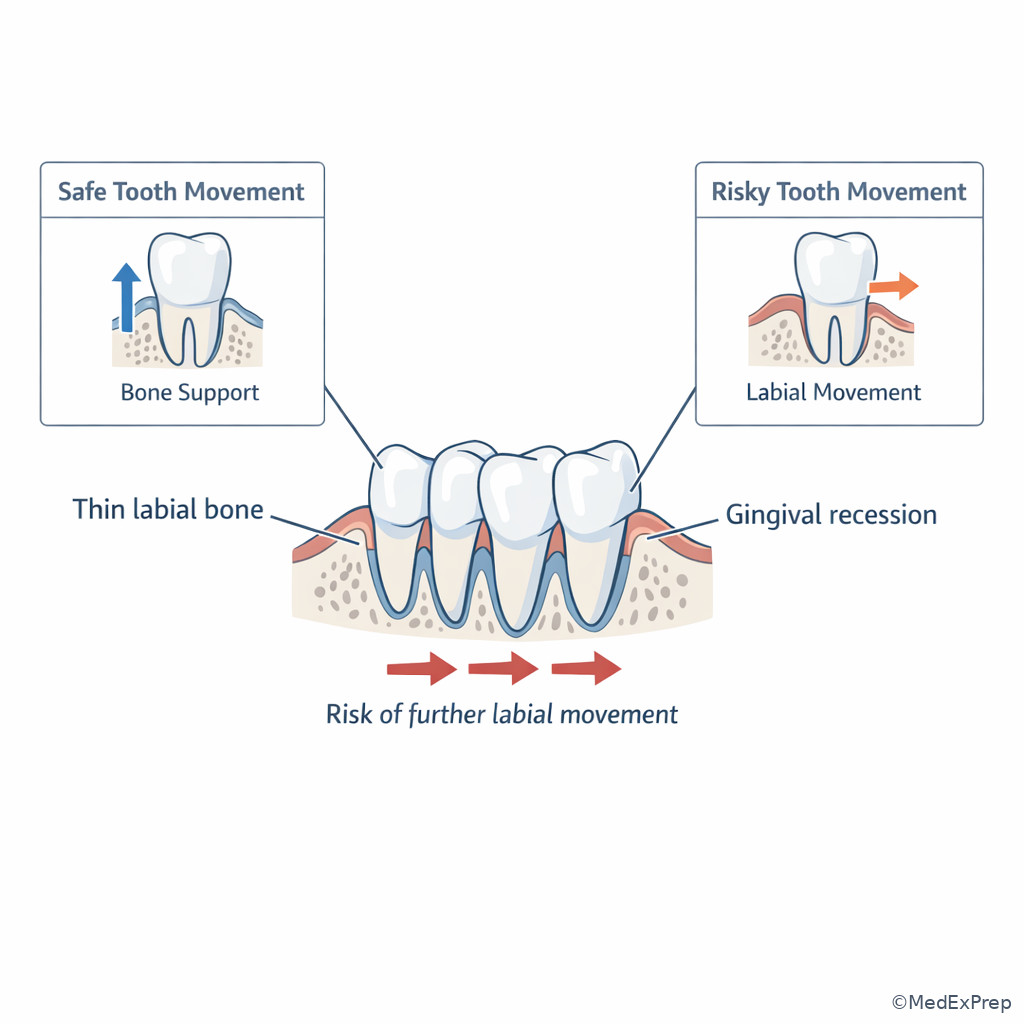
Examples: thin periodontal support in an adult with proclined incisors; retained primary tooth masking congenital absence; gingival recession risk limiting decompensation; impacted canines requiring interdisciplinary planning; suspected ankylosis; extensive restorations affecting bracket placement and finishing decisions. Your role is to identify the modifier, assess orthodontic implications, and coordinate appropriate referral or co-management. Do not overstep into definitive medical or surgical management.
This also sets up future topics. In Extraoral And Intraoral Findings, you will gather these data more systematically. In Record-Based Diagnostic Synthesis, you will integrate them when findings conflict. See Fig 5.
B Worked example
A 34-year-old woman presents with “crowded lower front teeth.” She has a history of periodontal maintenance, two ceramic crowns, and controlled type 2 diabetes managed by her physician. Exam shows mild mandibular anterior crowding, gingival recession around lower incisors, thin labial periodontal phenotype, reduced attached tissue in one segment, and mild Class I molar relationship. The tempting but wrong answer is to frame the case only as mild crowding because the occlusion appears simple.
Reasoning chain: identify task → determine whether a modifier should be elevated in the problem list. Extract key facts: adult, periodontal maintenance history, recession, thin phenotype, lower crowding. Apply rule: if biology and safety limit movement, that modifier must rise in priority. Eliminate distractors: controlled diabetes is relevant medical history but not the primary orthodontic modifier here; Class I occlusion does not erase periodontal risk. Verify: the problem list should include lower incisor crowding and periodontal limitations/recession risk as a major modifier requiring careful mechanics and possible periodontal co-management.
C Exam trap
D Checkpoint
Question: Which modifier most strongly warrants elevation on the orthodontic problem list because it may alter mechanics or require co-management?
- Patient prefers clear appliances
- History of occasional cheek biting without tissue damage
- Thin periodontal phenotype with existing lower incisor recession
- One small nonesthetics-focused posterior composite restoration
- A: Tempting because patient preference matters for appliance selection, but wrong because it does not itself represent a diagnostic risk modifier.
- B: Tempting because habits can affect treatment, but wrong because occasional minor cheek biting without consequences is usually not a governing modifier.
- C: Correct because existing recession and thin phenotype directly affect biologic limits, risk, and need for careful planning or co-management.
- D: Tempting because restorations affect bonding, but wrong because an isolated small posterior restoration rarely changes the overall pathway.
Exam takeaway: A biologic or interdisciplinary factor belongs high on the list when it changes safety, sequence, or stability.
flowchart TD
A[Modifier identified] --> B{Does it change safety or biologic limits?}
B -->|Yes| C[Elevate in problem list]
B -->|No| D{Does it change sequence or referral?}
D -->|Yes| C
D -->|No| E[Keep as lower modifier]
C --> F[Plan co-management or monitoring] Exam takeaway: Mild crowding is not a simple case when thin periodontal support and recession are already present.
Tables
| Problem-list category | Typical findings | Why it matters on exam day | Common wording pitfall |
|---|---|---|---|
| Skeletal | Class II or III pattern, vertical excess or deficiency, constriction, asymmetry | Often determines treatment pathway, timing, and surgery/camouflage boundary | Using dental terms only and missing the jaw discrepancy |
| Dental | Crowding, spacing, rotations, incisor inclination, overjet, overbite, eruption issues | Drives alignment, mechanics, and arch coordination details | Listing every small tooth detail without prioritization |
| Soft tissue | Convex/concave profile, lip incompetence, smile display, strain | Shapes extraction, incisor position, and esthetic risk reasoning | Ignoring profile because occlusion seems straightforward |
| Function | Functional shift, traumatic bite, interference pattern | May change timing and chief diagnosis despite mild static findings | Calling it “asymmetry” without testing closure path |
| Modifiers | Periodontal compromise, restorations, missing teeth, compliance, impactions | Changes safety, sequence, referral, and stability | Leaving major biologic limits as minor footnotes |
| Chief concern statement | Tempting but weak translation | Stronger orthodontic translation |
|---|---|---|
| “My teeth stick out.” | Protrusive teeth | Increased overjet with sagittal Class II pattern and soft-tissue protrusion or lip incompetence if present |
| “My teeth are crooked.” | Needs alignment | Arch-specific crowding/rotation with note of any underlying skeletal or transverse source |
| “My bite feels off to one side.” | Asymmetry | Possible transverse discrepancy with unilateral crossbite and functional shift if closure-dependent |
| “I show too much gum.” | Gummy smile | Excessive smile display with vertical soft-tissue or skeletal considerations |
| “I can’t close my lips easily.” | Bad lips | Lip incompetence associated with incisor protrusion and/or sagittal skeletal pattern |
| “One tooth is in the wrong place.” | Erupted wrong | Eruption disturbance, ectopic eruption, impaction risk, or local displacement depending on records |
| Finding pair that looks similar | Key discriminator | Higher-priority diagnosis | Why the distractor is appealing |
|---|---|---|---|
| Mild crowding vs sagittal discrepancy | Profile and overjet pattern | Sagittal discrepancy if it changes pathway | Crowding is easy to see and measure |
| Dental crossbite vs transverse deficiency with shift | Mandibular displacement on closure | Transverse deficiency/functional shift | The bite looks like a single-tooth issue at first glance |
| Chief concern vs diagnosis | Patient words versus objective records | Diagnosis/problem list | The complaint sounds clinically descriptive |
| Minor restorative finding vs major modifier | Effect on safety, sequence, or referral | Biologic/interdisciplinary modifier if treatment-limiting | All charted findings seem equally record-worthy |
| Apparent asymmetry vs functional shift | Face or bite changes between CR and habitual closure | Functional shift if closure-dependent | Static photographs may make it look skeletal |
Exam takeaway: Patients describe symptoms; orthodontists translate them into objective categories that guide planning.
Exam Traps & Differentiators
- Most common wrong answer and why: selecting the patient’s complaint as the entire diagnosis. It is tempting because the complaint usually points to a visible feature, but the single clue against it is the presence of broader skeletal, functional, or biologic findings.
- Looks similar but isn’t: “crooked teeth” versus a transverse discrepancy with functional shift. The latter changes timing and mechanics far more than alignment alone.
- If the stem says “the parent wants teeth straightened,” think document concern but still identify whether crowding is local, skeletal, or functional in origin.
- If the stem says “asymmetry appears when patient bites together,” think test for functional shift before labeling fixed skeletal asymmetry.
- If the stem says “adult with mild crowding and recession,” think periodontal modifier may outrank the crowding itself.
- If the stem says “large overjet with convex profile and lip incompetence,” think governing sagittal discrepancy, not just protrusive incisors.
- If the stem says “restorative crown or missing tooth in esthetic zone,” think interdisciplinary modifier that belongs in the problem list, not an afterthought.
| Stem clue | Think | Reject |
|---|---|---|
| Complaint and records do not match | Separate chief concern from diagnosis | Rewriting the complaint as the whole case |
| One finding explains several others | Governing discrepancy | Equal priority for every abnormality |
| Closure-dependent asymmetry | Functional component | Static skeletal asymmetry label without testing |
| Adult recession/thin phenotype | Biologic modifier elevated in list | Simple alignment framing only |
| Plan language appears in answer choice | Look for diagnosis wording instead | Problem list that already prescribes treatment |
Algorithm / Approach
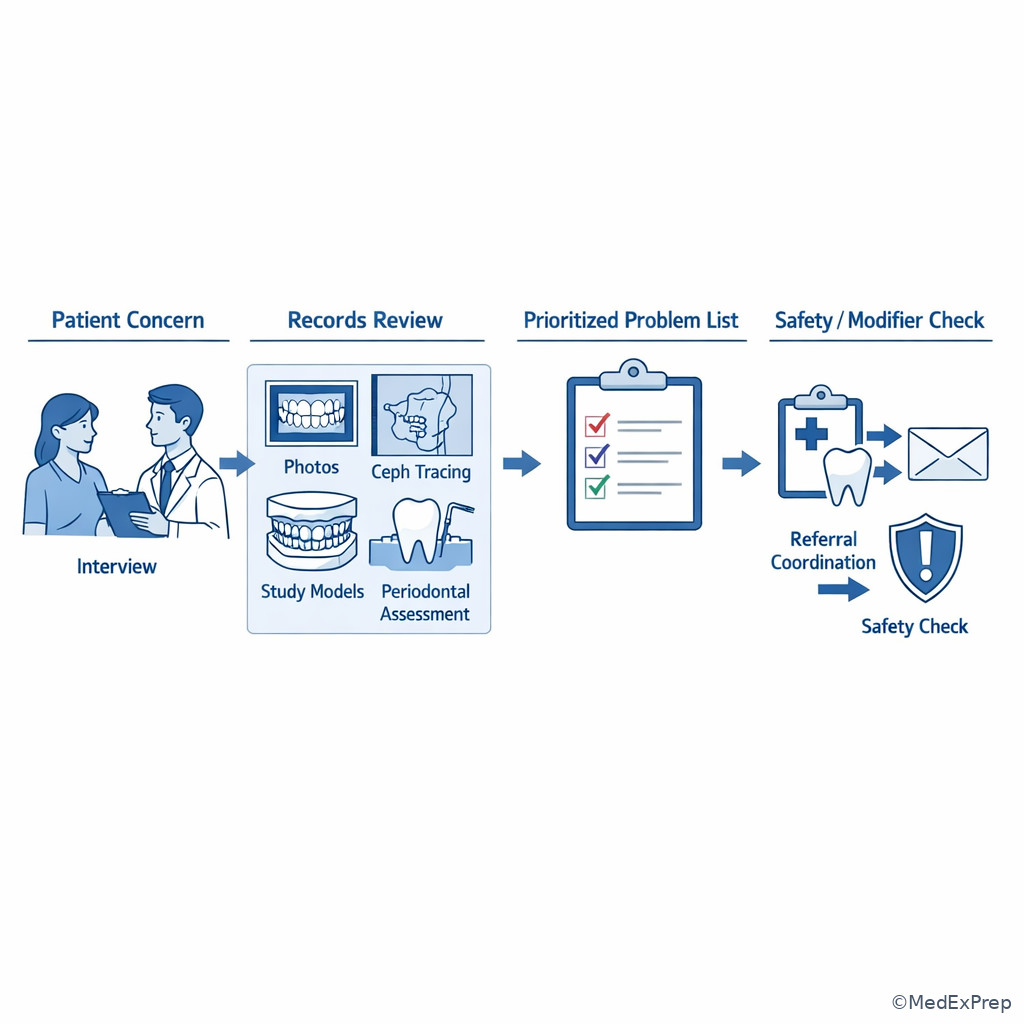
Exam takeaway: Move from complaint to categorized findings to prioritized problems before making any treatment choice.
Exam takeaway: A reproducible diagnostic workflow reduces the chance of choosing a cosmetic-only or mechanics-first distractor.
Rapid Review
- Chief concern → patient motivation, not complete diagnosis
- Problem list → prioritized findings that change planning, not all chart details
- Governing discrepancy → explains the broadest pattern and shifts treatment pathway
- Crowding → do not let it outrank sagittal, transverse, or biologic drivers automatically
- Functional shift → asymmetry that changes with closure
- Soft tissue → profile and lip competence can outrank purely dental alignment
- Modifier → elevate if it changes safety, sequence, referral, or stability
- Board-style wording → diagnostic findings, not treatment recommendations
- Noise in stems → true but secondary fact that does not govern the case
- Interdisciplinary issue → identify and co-manage; do not overstep scope
- Case summary → concern, key findings, prioritized problems, interpretation
- Most common trap → repeating the complaint instead of diagnosing the source
Self-check quiz
1. A 12-year-old patient says, “My teeth are crooked.” The records show mild upper and lower crowding, but also a unilateral posterior crossbite with mandibular shift on closure. Which finding should most strongly influence the top of the problem list?
- Mild maxillary crowding
- Unilateral posterior crossbite with functional shift
- Patient dislike of smile photographs
- Routine history of sealants on molars
2. Which entry is the best problem-list item for a board-style orthodontic summary?
- Needs braces because esthetics are poor
- Consider headgear if patient cooperates
- Increased overjet, deep overbite, convex profile, and lip incompetence
- Mother wants teeth straightened before school starts
3. A 14-year-old boy presents with “crooked lower teeth.” He has controlled asthma and one restored maxillary incisor after childhood trauma. Exam shows half-step Class III molars, reduced overjet, mild concave profile, 4 mm lower crowding, and anterior crossbite of one central incisor. Which is the most appropriate opening interpretation of this case?
- Localized lower crowding is the primary diagnosis because it matches the chief concern
- Restorative history on the maxillary incisor is the governing discrepancy
- Sagittal Class III tendency should lead the problem list because it changes the treatment pathway more than the crowding does
- The case should be summarized only after treatment objectives are selected
4. A 16-year-old female presents with a chief concern of “gummy smile.” She has a ceramic crown on a maxillary lateral incisor, mild spacing, increased smile display, lip incompetence, and deep overbite. Which problem-list approach is most appropriate?
- List the ceramic crown first because restorative findings always outrank occlusal findings
- Write “gummy smile” alone because it captures the patient concern and esthetic issue
- List excessive smile display and associated soft-tissue/vertical concerns, then deep bite, then restorative modifier
- Skip the problem list and go directly to whether surgery will be required
5. A 10-year-old mixed-dentition child is referred for “facial asymmetry.” The child has allergic rhinitis, bilateral caries-free dentition, unilateral posterior crossbite, and the chin point shifts on closure. Which is the best next diagnostic framing?
- Document a fixed skeletal asymmetry as the top problem
- Identify a likely functional shift associated with transverse discrepancy and elevate it on the problem list
- Focus first on the allergic rhinitis because it explains the bite
- List the case as minor crowding until cephalometrics are obtained
6. A 33-year-old woman presents with “crooked lower front teeth.” She has a history of periodontal maintenance, mild controlled hypertension managed by her physician, thin periodontal phenotype, and existing lower incisor recession. Occlusion is otherwise mild Class I with 3 mm lower crowding. Which is the most appropriate prioritized problem-list entry?
- Lower incisor crowding only, because occlusion is Class I
- Periodontal limitation with existing recession as a major modifier together with lower incisor crowding
- Hypertension management plan before any orthodontic diagnosis
- Immediate periodontal surgery recommendation as the orthodontist’s definitive treatment step
7. A 13-year-old female presents because “my top teeth stick out.” She has mild upper spacing, 8 mm overjet, full-step Class II relationship, convex profile, lip incompetence, and a delayed eruption of one mandibular second premolar. Which option best reflects the governing discrepancy versus noise distinction?
- The delayed premolar eruption is the top problem because eruption findings always outrank sagittal relationships
- Mild upper spacing is the top problem because it is most visible in the smile
- The sagittal Class II pattern with associated overjet and soft-tissue findings is the governing discrepancy; delayed eruption is a modifier/noise relative to the main pathway
- The chief concern should replace the problem list because it already identifies the front teeth as the problem
8. A 17-year-old male presents with “my bite is off and my lower teeth are crowded.” He has a repaired composite on tooth 9, mild lower crowding, unilateral posterior crossbite, a shift into occlusion, and apparent chin deviation only when he bites together. Which is the best summary statement?
- Primary dental crowding with minor esthetic concerns
- Possible transverse discrepancy with functional shift causing apparent asymmetry, with lower crowding as a secondary dental problem
- Restored maxillary central incisor is the primary problem because it affects bonding
- Fixed skeletal asymmetry is established regardless of closure pattern
Answer key
1. Correct answer: B
- A: Tempting because crowding is a common orthodontic complaint and often listed early. Incorrect here because the single discriminating clue is the mandibular shift on closure, which signals a functional transverse problem that changes timing and mechanics more than mild crowding does. Source support: Proffit and Fields emphasize that functional crossbite/transverse discrepancies must be recognized as major diagnostic drivers.
- B: Correct because unilateral posterior crossbite with functional shift is a higher-priority diagnostic problem than mild crowding. The shift is the stem clue that elevates this finding. This is within orthodontic assessment and management scope, including recognition and planning. Source support: Proffit et al.; Graber, Vanarsdall, Vig, and Huang.
- C: Tempting because patient-perceived esthetics matter and should be documented as chief concern. Incorrect because the question asks what should influence the top of the problem list, which must be based on diagnostic findings rather than subjective dislike alone. Source support: standard orthodontic diagnostic frameworks in Proffit.
- D: Tempting only because chart details can feel official. Incorrect because routine sealants do not affect diagnosis, safety, sequence, or stability. Source support: mainstream orthodontic diagnostic record principles.
2. Correct answer: C
- A: Tempting because it sounds practical and mirrors patient motivation. Incorrect because “needs braces” is a treatment conclusion, and “esthetics are poor” is too vague for a diagnostic problem list. The discriminating clue is that the question asks for a problem-list item. Source support: Proffit’s diagnostic sequence emphasizes objective findings before treatment planning.
- B: Tempting because appliance decisions are part of orthodontics. Incorrect because this is a mechanics choice, not a diagnosis. The key clue is that headgear is a treatment option, not a problem-list entry. Source support: Graber text on treatment planning sequence.
- C: Correct because it states specific diagnostic findings using objective orthodontic language and avoids premature treatment selection. The discriminator is the use of findings rather than plans or patient wishes. Source support: Proffit et al.
- D: Tempting because chief concern is part of the record. Incorrect because it documents motivation, not the diagnostic problem list. Source support: standard orthodontic clinical examination frameworks.
3. Correct answer: C
- A: Tempting because it matches the patient’s complaint and lower crowding is obvious. Incorrect because the stem clue is the half-step Class III molars, reduced overjet, and mild concave profile, which indicate a broader sagittal discrepancy more likely to change treatment pathway. Source support: Proffit et al. on integrating profile and occlusion.
- B: Tempting because prior trauma/restoration can affect bracketing and esthetics. Incorrect because this is a modifier, not the governing discrepancy in a case with clear sagittal Class III tendency. Source support: Graber comprehensive treatment planning chapters.
- C: Correct because the sagittal pattern explains more of the case and is more likely to govern planning than the localized crowding complaint. The discriminating stem clue is the combination of reduced overjet and concave profile. Source support: Proffit and Fields.
- D: Tempting because treatment objectives do follow diagnosis. Incorrect because the problem list and case summary must come before selecting objectives or treatment mechanics. Source support: standard orthodontic diagnostic workflow.
4. Correct answer: C
- A: Tempting because restorative findings may affect brackets, esthetics, or interdisciplinary planning. Incorrect because the ceramic crown does not automatically outrank the primary soft-tissue/vertical findings unless it is the factor changing safety or sequence most. The discriminating clue is the presence of excessive smile display, lip incompetence, and deep overbite. Source support: Proffit; interdisciplinary considerations in Graber.
- B: Tempting because “gummy smile” matches the chief concern directly. Incorrect because it is incomplete and does not translate the complaint into the full diagnostic pattern. Source support: mainstream orthodontic diagnostic synthesis.
- C: Correct because it prioritizes the major esthetic/vertical diagnostic issues, includes the bite problem, and retains the crown as a modifier rather than the main diagnosis. The key discriminator is problem hierarchy. Source support: Proffit et al.
- D: Tempting because vertical smile-display problems can raise surgery questions later. Incorrect because jumping directly to surgery skips diagnostic synthesis and exceeds what the stem is asking at this stage. Source support: accepted treatment-planning sequencing.
5. Correct answer: B
- A: Tempting because the referral mentions “facial asymmetry,” and asymmetry sounds serious. Incorrect because the single discriminating clue is that the chin point shifts on closure, indicating a likely functional shift rather than fixed skeletal asymmetry. Source support: Proffit discussions of crossbite and functional displacement.
- B: Correct because unilateral posterior crossbite plus closure shift should prompt framing as a transverse problem with functional displacement. This is well within orthodontic diagnostic scope and affects timing and mechanics. Source support: Proffit; Graber.
- C: Tempting because allergic rhinitis can coexist with mouth-breathing patterns and craniofacial concerns. Incorrect because it does not by itself explain the crossbite and closure shift, and definitive airway management would be outside orthodontic scope. The orthodontist should note it as a modifier if relevant and refer appropriately when indicated. Source support: orthodontic scope guidance and interdisciplinary principles.
- D: Tempting because full records are often helpful. Incorrect because the stem already provides the critical discriminator — closure shift — so reducing the case to minor crowding misses the main problem. Source support: standard diagnostic synthesis principles.
6. Correct answer: B
- A: Tempting because Class I cases with mild crowding are often straightforward. Incorrect because the stem clue is the thin periodontal phenotype with existing recession, which changes biologic limits and must be elevated in the problem list. Source support: Proffit and contemporary interdisciplinary orthodontic-periodontal principles.
- B: Correct because periodontal limitation is a major modifier affecting safety, feasibility, and mechanics; lower crowding remains part of the list but not in isolation. The discriminator is the existing recession. Source support: Graber; orthodontic-periodontal co-management principles in peer-reviewed literature.
- C: Tempting because medical history matters. Incorrect because hypertension management belongs to the patient’s physician and is outside the orthodontist’s independent role unless clearance issues arise; it is not the governing orthodontic problem here. Source support: scope-of-practice guidance and dental-medical coordination norms.
- D: Tempting because periodontal issues may need specialist care. Incorrect because the orthodontist should identify the modifier and refer or co-manage rather than make a definitive surgical recommendation as the treating surgeon or periodontist. The key clue is the scope boundary. Source support: interdisciplinary care standards in orthodontic texts.
7. Correct answer: C
- A: Tempting because eruption disturbances can matter greatly, especially in growing patients. Incorrect because the stem clue is the 8 mm overjet, full-step Class II, convex profile, and lip incompetence, which together indicate the governing sagittal discrepancy. The delayed premolar is important but secondary to the main pathway. Source support: Proffit et al.
- B: Tempting because spacing is visible and smile-related. Incorrect because mild upper spacing does not explain the broad sagittal and soft-tissue pattern. Source support: standard diagnostic hierarchy.
- C: Correct because it distinguishes the main driver from a secondary modifier/noise item. The discriminating clue is the cluster of sagittal and soft-tissue findings. Source support: Proffit; Graber treatment-planning logic.
- D: Tempting because the chief concern does point toward the anterior region. Incorrect because the chief concern cannot replace the objective problem list. Source support: orthodontic diagnostic documentation standards.
8. Correct answer: B
- A: Tempting because lower crowding is real and part of the patient’s complaint. Incorrect because the unilateral posterior crossbite with shift into occlusion explains the apparent asymmetry and has greater diagnostic weight. Source support: Proffit’s crossbite and functional shift principles.
- B: Correct because it captures the governing transverse-functional diagnosis and places lower crowding in the proper secondary role. The discriminator is the apparent chin deviation only when biting together. Source support: Proffit; Graber.
- C: Tempting because restorations matter for appliance placement and esthetics. Incorrect because a repaired composite on tooth 9 is a local modifier, not the principal diagnostic issue. Source support: interdisciplinary modifier principles.
- D: Tempting because chin deviation can suggest skeletal asymmetry. Incorrect because the closure-dependent nature of the deviation argues for functional shift rather than fixed asymmetry. Source support: standard orthodontic diagnostic examination methods.
Keep going with the full Orthodontics Board Prep Course (Ortho)
You just studied the way members do, in the same lesson interface. Full access unlocks every lesson, the question bank and flashcards for a full year.
One payment · 1 year of access · No auto-renewal