1.1.1 - ONC Exam Scope
Why it matters
- The ONC exam tests RN judgment, not surgeon-level diagnosis or operative planning.
- Many distractors are attractive because they describe a true orthopaedic intervention but are outside nursing authority or are the right action at the wrong priority.
- Scope and prioritization are linked: the best answer often starts with focused assessment, stabilization, and concise escalation.
- Mastering exam scope early makes every later topic easier because it tells you what role you are playing in every vignette.
Exam takeaway: Use this sequence to keep every question anchored to adult orthopaedic RN scope.
flowchart TD
A[Read stem task] --> B[Identify orthopaedic nursing problem]
B --> C[Assess for immediate threat: airway breathing perfusion neurovascular safety]
C --> D[Choose RN action: assess monitor intervene teach protect]
D --> E[Escalate if provider decision or deterioration]
E --> F[Reject surgeon or prescriber options]
For the rest of this lesson, keep the framework in Fig 1 in mind. It is the simplest way to avoid being pulled into provider-only decisions on test day.
Key Terms & Must-Know Facts
1.1.1.1 Key terms
- Scope of practice: the legal and professional boundaries of RN care.
- Assessment: collecting relevant subjective and objective data.
- Reassessment: checking response after an intervention or change in status.
- Escalation: timely notification of the appropriate clinician or team.
- Neurovascular check: circulation, motion, sensation, pain, temperature, capillary refill, pulses as appropriate.
- Perfusion: adequacy of blood flow to tissue.
- Immobilization: cast, splint, brace, traction, or postoperative restriction used to protect healing structures.
- Weight-bearing restriction: ordered limit on how much load the extremity may take.
- Standing order/protocol: preapproved institutional action pathway.
- Interdisciplinary communication: concise transfer of findings to the surgeon, APP, therapy, hospitalist, pharmacy, or rapid response team.
- Priority framework: ABCs, perfusion, pain, safety, and function.
- Out-of-role signal: wording that asks the nurse to diagnose, prescribe, reduce, or independently change the plan of care.
1.1.1.2 Must-know facts
- The ONC exam is centered on the adult orthopaedic registered nurse.
- When deterioration is suspected, assess first unless an immediate lifesaving action is obvious.
- The RN does not independently reduce fractures, choose implants, prescribe medications, or decide operative candidacy.
- Many correct answers combine focused assessment + protective intervention + escalation.
- Orthopaedic nursing priorities commonly include neurovascular status, pain, mobility, skin integrity, fall prevention, infection prevention, and VTE prevention.
- If a stem asks for a provider-only action, the exam-safe RN response is often to stabilize, gather critical findings, and notify/escalate.
- Institution-specific details vary; broad principles tested are safety, scope, monitoring, documentation, and communication.
- Board-style distractors often differ by a single clue: unstable vs stable, RN vs provider role, assess-first vs implement-first.
| Exam cue in the stem | What it usually means | Best RN framing |
|---|---|---|
| Increasing pain out of proportion | Possible urgent perfusion problem | Focused neurovascular assessment, protect limb, escalate promptly |
| New numbness, pallor, weak pulse | Possible impaired circulation | Assess, compare bilaterally when possible, report urgent findings |
| Consent questions about operative risks | Provider explanation required | Clarify, reinforce general teaching, notify provider to address specifics |
| Request to change weight-bearing status | Order-dependent decision | Protect current restriction, communicate concern, obtain clarification |
| Distracting imaging interpretation | Formal diagnosis is not the RN role | Use assessment findings and symptoms to guide action |
| Questions about discharge readiness | Function, safety, teaching, and support are being tested | Assess mobility, understanding, home needs, and warning-sign knowledge |
Core content
1.1.1.3 Foundational role: what the ONC exam expects from the adult orthopaedic RN
A Explanation
The first decision conflict on this exam is not “What is the diagnosis?” but “What is the nurse expected to do next?” ONC items are written from the bedside, clinic, perioperative, rehab, or care-coordination RN perspective. That means you are expected to gather focused musculoskeletal and neurovascular findings, recognize deterioration, carry out nursing interventions, evaluate response, reinforce precautions, and escalate when the situation requires a provider decision. The single rule that resolves most scope conflicts is this: if the action requires independent medical diagnosis, prescribing, procedural performance, or changing the plan of care beyond nursing authority, reject it.
WHY THIS IS TESTED: many stems include one answer that sounds decisive but is actually outside RN role, such as changing a weight-bearing order, interpreting MRI results as the official diagnosis, or deciding the patient should return to the operating room. The exam rewards the nurse who recognizes the urgent finding and communicates it effectively, not the nurse who crosses professional boundaries.
See Fig 1 for the overall sequence that supports this reasoning.
Exam takeaway: Sort answer choices by authority before deciding which one has the highest priority.
flowchart LR
A[Answer choice] --> B{Within RN scope?}
B -->|Yes| C[Assess monitor intervene teach document escalate]
B -->|No| D[Reject option]
C --> E{Highest priority?}
E -->|Yes| F[Select]
E -->|No| G[Keep as plausible distractor]
B Worked example
A 71-year-old man is postoperative day 1 after open reduction and internal fixation of a tibial fracture. He has type 2 diabetes, chronic kidney disease, and hypertension. He reports increasing pain despite prescribed analgesia. The dressing is dry, and the family says, “He probably just needs a stronger opioid.” A tempting clue is that the operative note mentioned a “complex comminuted fracture,” which may push you toward thinking only about pain management. Identify task: most appropriate nursing action. Extract key facts: worsening pain after fracture surgery, comorbidities, possible vascular vulnerability. Apply rule: RN should first perform and compare a focused neurovascular assessment and assess pain characteristics before requesting changes to medication. Eliminate distractors: increasing the opioid dose independently is out of scope; reassuring the family without reassessment delays identification of complications; interpreting the fracture type does not change the nurse’s first action. Verify: reassessment produces the critical findings needed for escalation if perfusion is threatened.
C Exam trap
D Checkpoint
Question: A postoperative orthopaedic patient reports new severe lower-leg pain and tingling. Which action is the most appropriate next step for the RN?
- A. Perform a focused neurovascular assessment and compare findings with prior documentation.
- B. Request an immediate increase in opioid dose from the provider.
- C. Explain that severe pain is expected after fracture fixation and reassess in 2 hours.
- D. Document the complaint and wait for physical therapy to evaluate function.
- A: Tempting because it may feel slower than calling the provider, but it is right because assessment comes first and provides the data needed for safe escalation.
- B: Tempting because uncontrolled pain deserves treatment, but wrong here because it skips the priority assessment needed to exclude perfusion compromise.
- C: Tempting because postoperative pain is common, but wrong because tingling plus new severe pain requires prompt evaluation, not routine reassurance.
- D: Tempting because function matters in orthopaedics, but wrong because delayed evaluation risks missing an urgent neurovascular change.
1.1.1.4 Foundational task language: what verbs signal safe nursing actions
A Explanation
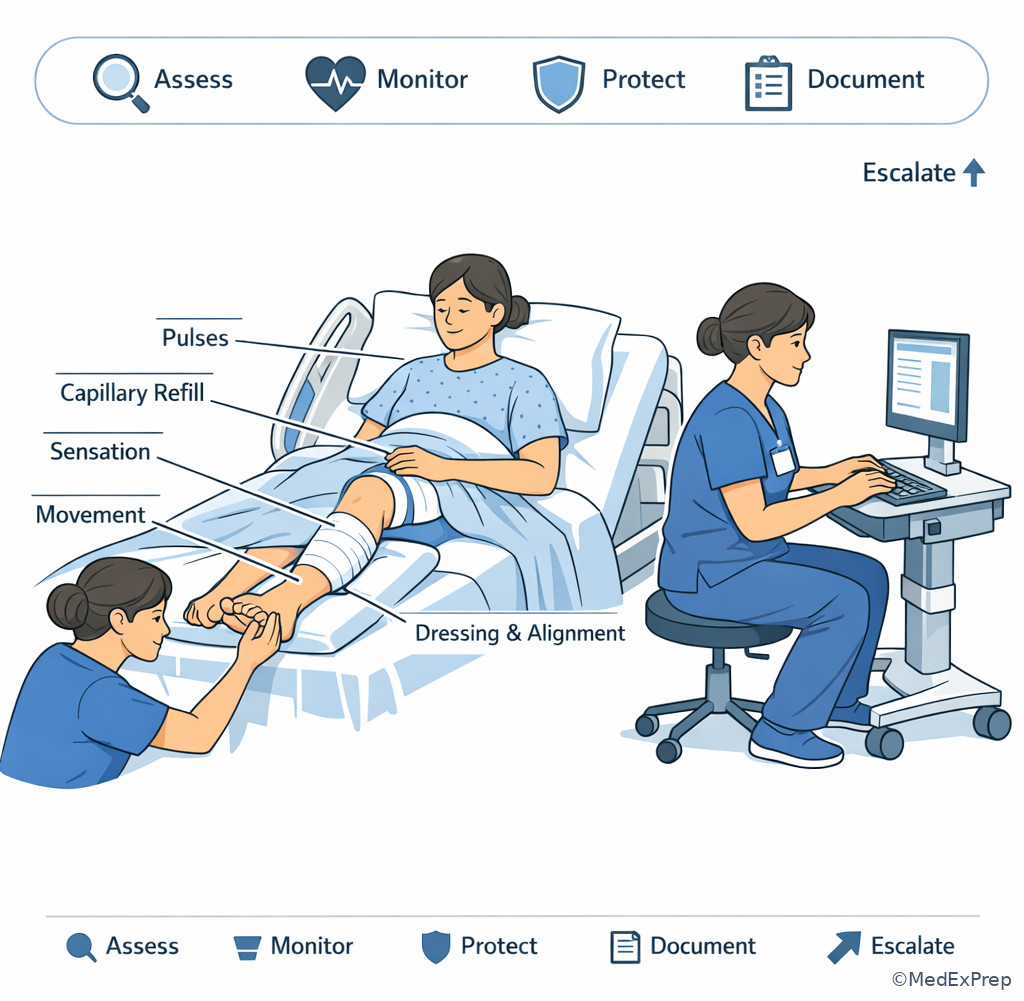
ONC questions often hide the correct answer in the verb. The exam favors verbs that match nursing process and adult orthopaedic practice: assess, monitor, reinforce, administer prescribed therapy, position, protect, document, teach, coordinate, and notify. In contrast, verbs such as diagnose, prescribe, reduce, decide operative plan, change restriction, interpret imaging as final decision-maker signal a role mismatch. The decision conflict is often between a technically useful action and a legally appropriate one. The rule that resolves it is: choose the action that advances patient safety within RN authority and produces better information for the team.
WHY THIS IS TESTED: the exam mirrors real practice, where the nurse is often the first to detect change. You are expected to recognize concerning findings, initiate nursing measures, and communicate clearly. You are not expected to become the orthopedic surgeon in the stem. See Fig 2.
Exam takeaway: Visualize nursing-scope actions as assessment, monitoring, patient protection, and communication rather than provider-only treatment selection.
B Worked example
A 66-year-old woman with obesity, osteoarthritis, and chronic venous insufficiency is 8 hours after total knee arthroplasty. She says the calf feels “tight,” and the UAP reports the patient looks anxious. Her oxygen saturation is normal, and a distracting finding is mild nausea from opioids. One option says to “order a venous duplex study,” which sounds medically appropriate. Identify task: choose the best nursing action. Extract key facts: postoperative calf complaint, VTE risk context, anxiety is nonspecific, nausea is noise. Apply rule: the RN should assess the leg, pain, swelling, warmth, neurovascular status, mobility tolerance, and review trend data, then notify the provider with concise findings. Eliminate distractors: ordering a study is outside RN scope; teaching alone is premature; ambulating first may be unsafe if the patient is unstable. Verify: the chosen action keeps within nursing role and advances urgent evaluation.
C Exam trap
D Checkpoint
Question: Which option contains the best exam-safe verb for an ONC nursing action?
- A. Diagnose postoperative compartment syndrome.
- B. Change the patient to weight bearing as tolerated.
- C. Perform a focused reassessment and notify the provider of concerning changes.
- D. Decide the patient requires return to the operating room.
- A: Tempting because nurses recognize urgent patterns, but wrong because formal diagnosis is not the nurse’s independent role.
- B: Tempting because mobility progression is important, but wrong because weight-bearing status requires an order.
- C: Tempting because it may seem less decisive, but it is right because it matches nursing process and patient safety.
- D: Tempting because it escalates urgency, but wrong because the operative decision belongs to the provider team.
- The most exam-safe default action when deterioration is suspected is focused reassessment.
- True or False: Changing weight-bearing status independently is within RN scope. False.
- Name the 4 A-M-T-E buckets: Assess, Monitor, Teach, Escalate.
1.1.1.5 Application: how ONC questions prioritize orthopaedic risk
A Explanation
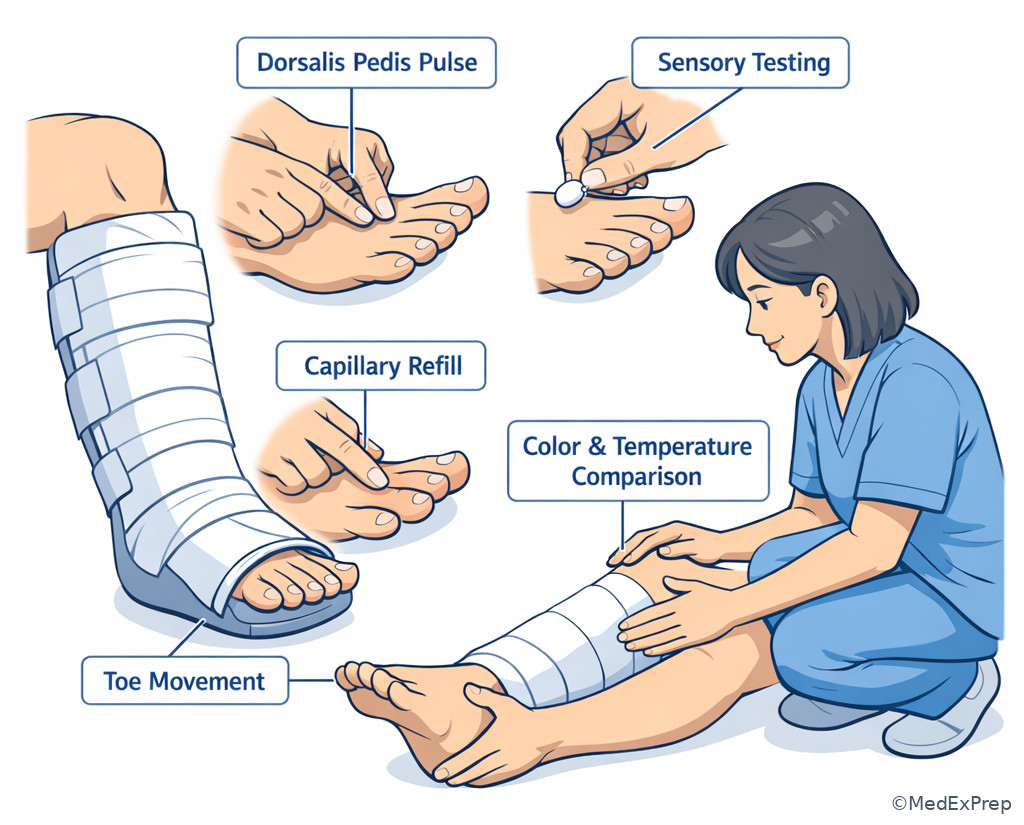
Once you know the role, the next conflict is choosing which in-scope nursing action comes first. ONC stems commonly ask you to rank priorities across pain, perfusion, neurovascular status, airway, bleeding, mobility, safety, and education. The single resolving rule is: unstable physiology and threatened limb perfusion outrank routine comfort and teaching. Within orthopaedics, that often means watching for airway or hemodynamic issues after surgery, then neurovascular compromise, then uncontrolled pain, then safety/function/teaching. See Fig 3.
WHY THIS IS TESTED: orthopaedic patients are often recovering, mobilizing, and learning precautions at the same time they remain vulnerable to acute deterioration. The exam wants you to recognize when a seemingly routine complaint is actually the earliest sign of a limb- or life-threatening complication.
Exam takeaway: When options are all within scope, choose the one addressing airway, hemodynamics, or limb perfusion before comfort or teaching.
flowchart TB
A[Immediate threat?] --> B[Airway breathing circulation]
B --> C[Neurovascular perfusion and bleeding]
C --> D[Pain and symptom control]
D --> E[Mobility safety skin]
E --> F[Teaching discharge coordination]
Exam takeaway: The exam favors focused limb perfusion checks when pain or sensory changes raise concern for deterioration.
B Worked example
A 74-year-old woman with atrial fibrillation, osteoporosis, and chronic back pain is 6 hours after hip fracture repair. She has nausea, requests water, and rates pain 8/10. The UAP also reports that the operative leg feels cooler than earlier. A tempting wrong clue is the patient’s severe pain score, which may lead you to treat pain before reassessing perfusion. Identify task: most appropriate priority nursing action. Extract key facts: new limb coolness after orthopaedic surgery can indicate neurovascular compromise; nausea and thirst matter but are not first; chronic pain history may distract. Apply rule: perfusion concern outranks routine symptom management. Eliminate distractors: offering antiemetics or water first delays recognition of possible ischemia; teaching hip precautions is lower priority. Verify: focused neurovascular reassessment is the best first step and determines whether immediate escalation is needed.
C Exam trap
D Checkpoint
Question: An adult orthopaedic patient has postoperative pain, mild nausea, and new numbness in the operative foot. Which nursing action has the highest priority?
- A. Administer the ordered antiemetic.
- B. Perform a focused neurovascular reassessment of the operative limb.
- C. Reinforce discharge teaching about home safety.
- D. Encourage the patient to ambulate to improve circulation.
- A: Tempting because nausea should be treated, but wrong because numbness may indicate a more urgent limb threat.
- B: Tempting because it fits assess-first reasoning, and it is right because neurovascular change outranks symptom management and teaching.
- C: Tempting because early teaching is helpful, but wrong because unstable concerns take priority.
- D: Tempting because mobility is usually beneficial, but wrong because ambulation before reassessment may worsen an unsafe situation.
1.1.1.6 Application: scope-safe communication, documentation, and escalation
A Explanation
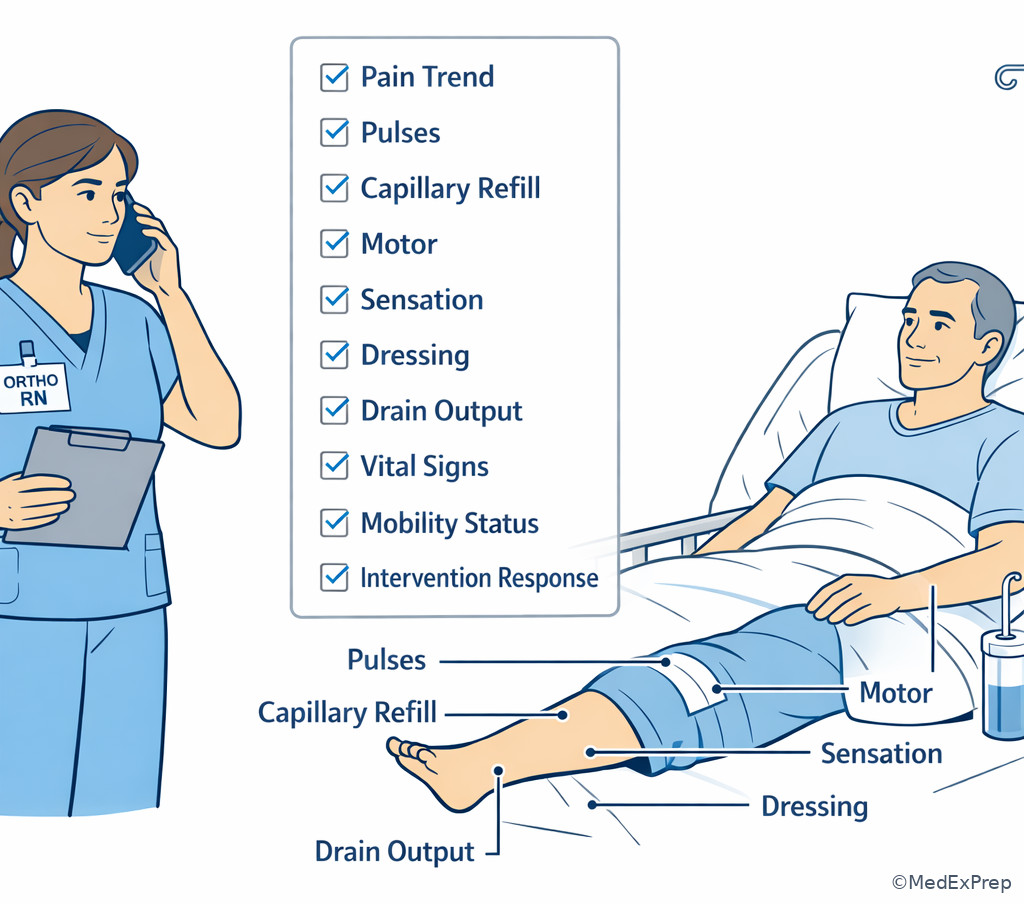
Another major ONC pattern is recognizing that good nursing judgment includes what you say, what you document, and when you escalate. The conflict is often between “keep watching” and “report now with organized findings.” The resolving rule is: when a concerning change could affect perfusion, neurologic status, respiratory status, infection risk, bleeding, or safety, the RN should document objective findings and escalate with concise clinically relevant data. The exam is not looking for vague statements like “patient seems worse.” It is looking for communication such as pain increase from 4/10 to 9/10, tense swelling, diminished toe movement, cool skin, capillary refill delay, or inability to participate in mobility because of acute change.
WHY THIS IS TESTED: orthopaedic care is team-based. Nurses protect patients not only by bedside actions but by recognizing when the interdisciplinary plan must be updated. See Fig 4.
Exam takeaway: Escalate with objective reassessment data when the next safe step requires provider evaluation or urgent team response.
flowchart LR
A[New concerning finding] --> B[Focused reassessment]
B --> C[Document objective data]
C --> D{Urgent threat?}
D -->|Yes| E[Immediate escalation per policy]
D -->|No| F[Notify provider in routine but timely manner]
E --> G[Continue monitoring and patient protection]
F --> G - Fill in the blank: Escalation should use objective findings, not vague impressions.
- True or False: The RN should wait for therapy to confirm a new neurovascular deficit before notifying the provider. False.
- Name 3 data points that strengthen an orthopaedic escalation call: trend, focused assessment findings, response to prior intervention.
Exam takeaway: Organized communication with objective findings is a tested nursing intervention, not just an administrative task.
B Worked example
A 59-year-old man with obesity, obstructive sleep apnea, and peripheral vascular disease is 10 hours after ankle fixation. He now reports more pain and “pins and needles” in the foot. Dressing strike-through is minimal; a distracting lab value is a mildly elevated glucose of 178 mg/dL. A wrong answer says, “Document that compartment syndrome is likely and call for fasciotomy,” which sounds urgent. Identify task: choose the best RN response. Extract key facts: worsening pain and paresthesia are concerning; vascular disease increases concern; mild hyperglycemia is noise. Apply rule: the RN should reassess objectively and escalate findings, not declare the diagnosis or operative plan. Eliminate distractors: labeling the condition is outside nursing role; waiting until the next scheduled neurovascular check is unsafe; extra teaching is irrelevant. Verify: a concise escalation with assessment data is the correct exam move.
C Exam trap
D Checkpoint
Question: Which report to the provider best reflects ONC exam-safe orthopaedic RN communication?
- A. “I think the patient has compartment syndrome and should go back to surgery.”
- B. “The patient seems uncomfortable, so I wanted to let you know.”
- C. “Pain increased from 5/10 to 9/10 in 1 hour; the foot is cooler with decreased sensation compared with earlier assessment.”
- D. “Therapy has not seen the patient yet, so I cannot describe the problem fully.”
- A: Tempting because it is urgent, but wrong because it oversteps into diagnosis and definitive management.
- B: Tempting because it communicates concern, but wrong because it lacks objective findings.
- C: Tempting because it is data-heavy, and it is right because objective reassessment findings support timely provider action.
- D: Tempting because interdisciplinary input can help, but wrong because urgent nursing escalation should not wait for therapy.
1.1.1.7 Integration: common ONC stem patterns, look-alike options, and safe answer selection
A Explanation
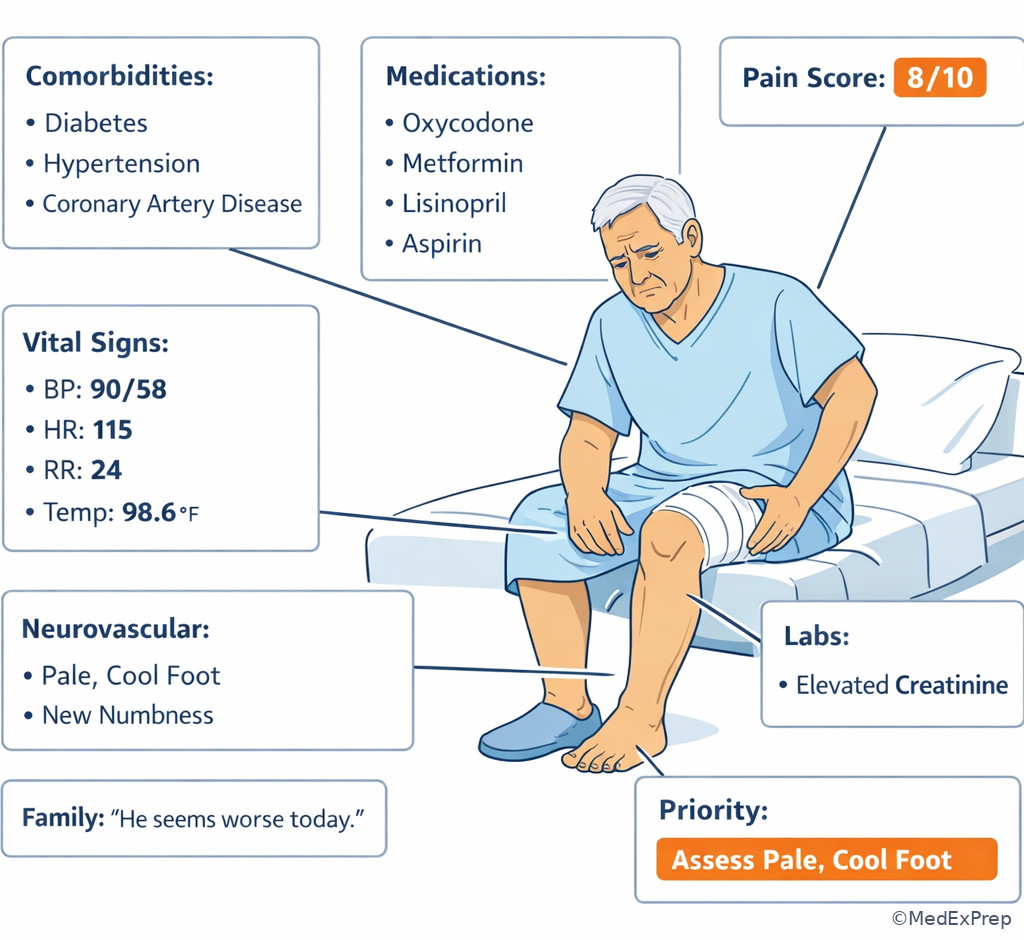
At integration level, ONC questions mix scope, urgency, and noise. A stem may include comorbidities, a distracting medication side effect, a family request, a procedure term, and one subtle clue pointing to the real priority. The decision conflict becomes: Which plausible nursing action best protects the patient now without crossing role boundaries? The resolving rule is to use a two-pass filter: first remove out-of-scope options, then rank the remaining actions by immediate threat and nursing process. If two choices are both in scope, the better one usually produces more safety-relevant information or addresses a more urgent physiologic risk.
WHY THIS IS TESTED: real orthopaedic nursing rarely presents as a neat textbook list. Board-style stems reward nurses who can stay disciplined when the question includes “noise.” See Fig 5.
Exam takeaway: First reject out-of-role choices, then choose the in-scope action that addresses the greatest immediate risk.
flowchart TD
A[All answer choices] --> B[Remove out-of-scope actions]
B --> C[Compare remaining choices]
C --> D[Which addresses greatest immediate risk?]
D --> E[Choose assessment/protection/escalation action]
E --> F[Verify patient safety and RN authority]
Exam takeaway: Board stems often add distracting findings, but the correct nursing action hinges on one priority clue.
B Worked example
A 68-year-old woman with rheumatoid arthritis, obesity, and chronic opioid use is 1 day after shoulder arthroplasty. She reports increased pain and numb fingers after returning from radiology. A family member says, “She always has a high pain tolerance problem.” The dressing is intact; a distracting detail is that she missed lunch and feels weak. One option says to remove and replace the immobilizer for comfort; another says to review the radiology report for implant position. Identify task: best nursing action. Extract key facts: pain plus numbness after movement/transport could reflect neurovascular or positioning issue; family comment and missed meal are noise. Apply rule: first reassess circulation, sensation, movement, alignment, and device fit, then escalate abnormal findings. Eliminate distractors: independent device adjustment beyond protocol may be unsafe; formal report interpretation is not the RN role; feeding the patient is lower priority. Verify: focused reassessment stays in scope and addresses the acute risk.
C Exam trap
D Checkpoint
Question: Which strategy best answers a difficult ONC vignette with several plausible nursing options?
- A. Choose the answer with the most advanced medical terminology.
- B. Eliminate out-of-scope options first, then prioritize the remaining nursing actions by immediate threat.
- C. Pick the action that would be most helpful if the nurse were also the surgical decision-maker.
- D. Focus on the longest answer because it usually includes the most detail.
- A: Tempting because sophisticated wording can sound authoritative, but wrong because scope and priority, not terminology, determine the best answer.
- B: Tempting because it feels systematic, and it is right because it mirrors ONC decision logic under uncertainty.
- C: Tempting because it aims at definitive care, but wrong because the exam is not testing the RN as surgeon.
- D: Tempting because detail can feel safer, but wrong because answer length does not determine correctness.
1.1.1.8 Integration: preparing for the rest of the ONC course and exam
A Explanation
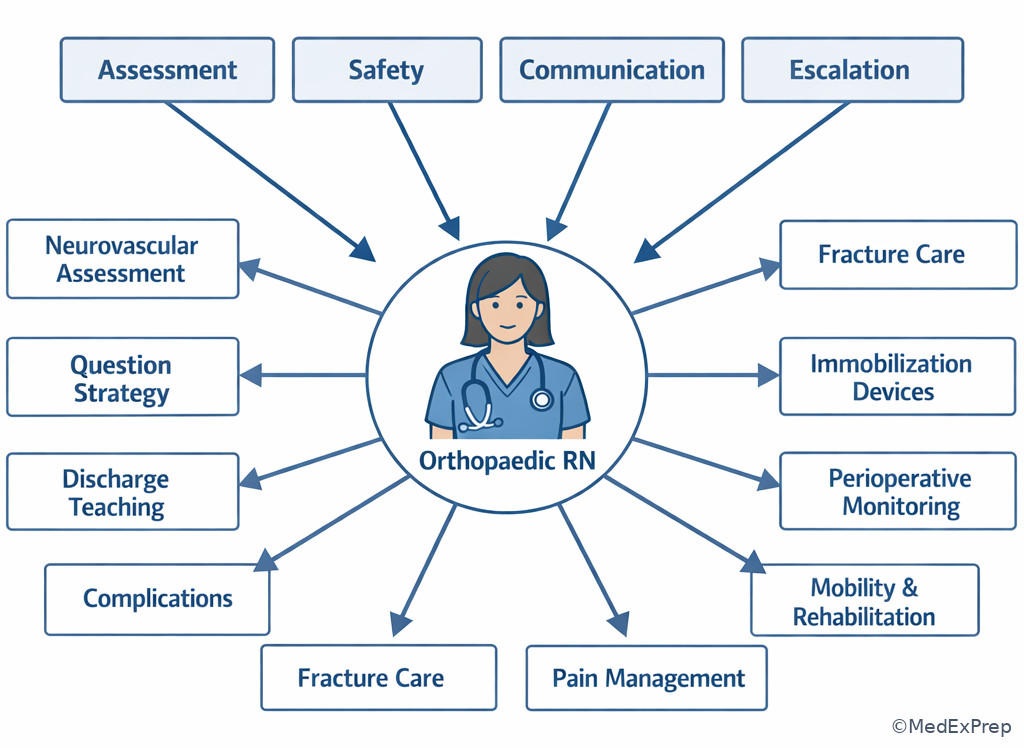
This lesson is the operating system for the rest of the course. Every future topic—neurovascular checks, fractures, traction, perioperative care, mobility, complications, discharge, and question strategy—sits inside this same scope framework. The conflict you must resolve on every future stem is whether you should continue routine orthopaedic care or interrupt the routine because a higher-priority concern or scope limit has appeared. The single rule is: do the highest-priority nursing action you are authorized to do, then escalate clearly when the situation requires more. See Fig 6.
WHY THIS IS TESTED: foundational exam scope allows test writers to build complex cases without changing the role. If you keep this frame constant, later disease- and procedure-specific content becomes easier to reason through.
Exam takeaway: Every later ONC topic builds on the same RN framework of assessment, protection, monitoring, and escalation.
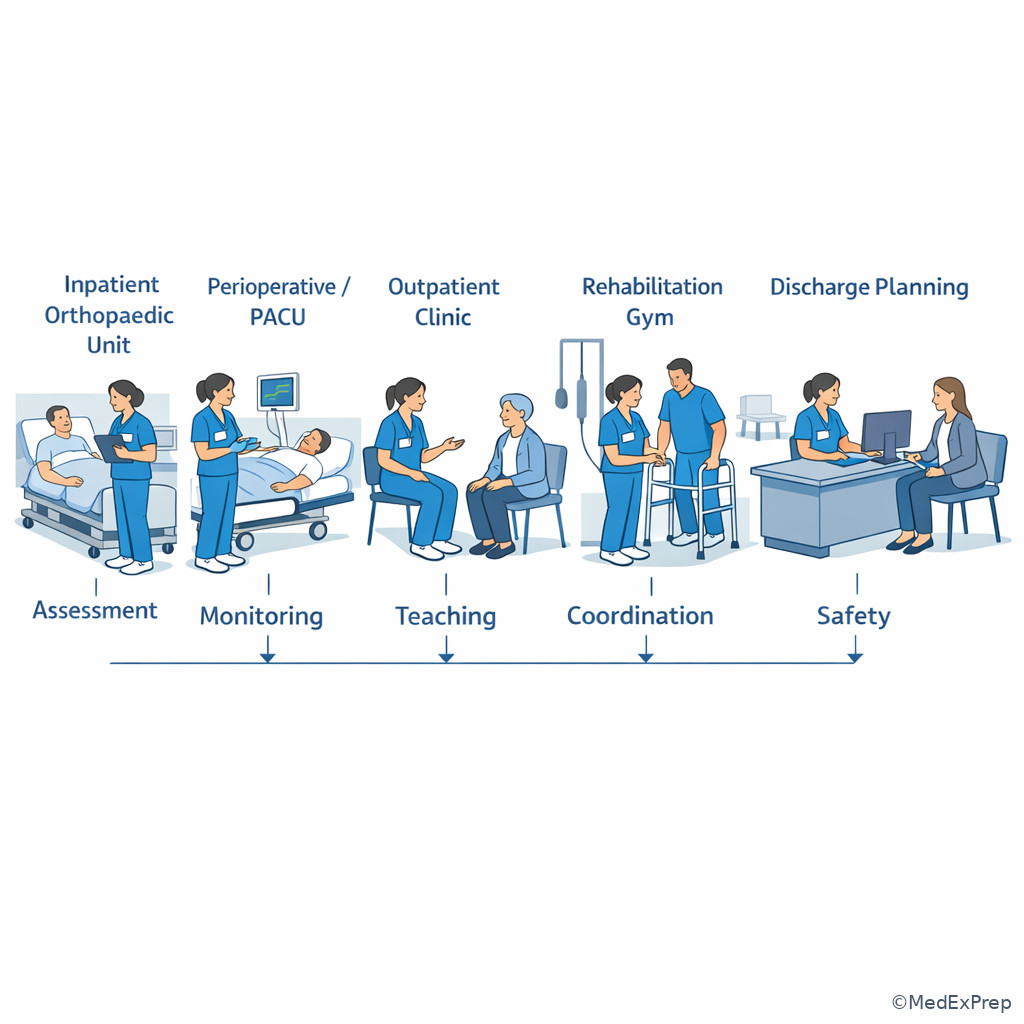
Exam takeaway: Expect questions from inpatient, outpatient, perioperative, rehabilitation, and care-coordination settings, all within the RN role.
B Worked example
A 63-year-old man with obesity and coronary artery disease is being prepared for discharge after knee surgery. He asks whether he can stop using the walker and begin full stairs without supervision because “I feel fine today.” A distractor option says to update the weight-bearing status based on observed gait. Another says to tell him to do whatever is comfortable at home. Identify task: nursing discharge action. Extract key facts: the patient is asking about activity progression, which may be order-dependent and safety-sensitive. Apply rule: reinforce current restrictions, assess understanding and safe technique, and coordinate clarification if the patient’s question exceeds existing instructions. Eliminate distractors: changing activity restrictions is out of scope; casual reassurance is unsafe. Verify: teaching within the current plan plus clarification as needed is the correct RN-centered answer.
C Exam trap
D Checkpoint
Question: Which statement best summarizes the ONC exam’s overall expectation of the orthopaedic RN?
- A. Independently diagnose complications and decide definitive procedural management.
- B. Perform focused assessment, implement nursing interventions, reinforce teaching, monitor trends, and escalate concerning findings.
- C. Base decisions primarily on imaging interpretation rather than bedside assessment.
- D. Change restrictions and treatment plans whenever patient function improves.
- A: Tempting because expertise is valued, but wrong because definitive diagnosis and procedural management exceed RN scope.
- B: Tempting because it sounds broad, and it is right because it captures the tested RN role across orthopaedic settings.
- C: Tempting because imaging matters in orthopaedics, but wrong because bedside nursing decisions begin with assessment and monitoring.
- D: Tempting because functional recovery is important, but wrong because restriction changes require the interdisciplinary treatment plan.
- The ONC exam role is the adult orthopaedic RN, not the surgeon or prescriber.
- True or False: If a patient appears stronger, the RN may independently change weight-bearing restrictions. False.
- Most difficult ONC stems are solved by combining scope filter + priority filter.
Exam Traps & Differentiators
| Looks similar | But isn't | Discriminator |
|---|---|---|
| Notify provider immediately | Assess first, then notify with data | If the patient is not in obvious collapse, the RN usually needs focused findings before escalation |
| Increase pain treatment now | Reassess for neurovascular compromise first | New pain plus numbness, pallor, coolness, or tense swelling shifts priority to perfusion |
| Advance mobility because patient feels ready | Reinforce existing restriction and clarify orders | Functional improvement does not authorize changing restrictions |
| Interpret test or imaging | Use bedside findings to guide communication | Formal diagnostic interpretation is provider territory |
| Provide teaching later | Teach after urgent risk is stabilized | Education is important but lower priority than airway, bleeding, perfusion, or acute neurologic change |
If the stem says “new numbness, coolness, or pain out of proportion,” think focused neurovascular reassessment before routine comfort measures.
If the stem says “the patient asks to change restriction or treatment plan,” think reinforce current orders and obtain clarification rather than independently changing the plan.
If the stem says “the family wants details of surgical risk or definitive treatment,” think reinforce general teaching and notify the provider for procedure-specific consent discussion.
If the stem says “order imaging,” “diagnose,” or “take back to OR,” think out-of-role signal.
If the stem says “several options are all real nursing tasks,” think choose the one that addresses the greatest immediate threat using ABCs and perfusion first.
| Answer choice type | Usually right when... | Usually wrong when... |
|---|---|---|
| Assess / reassess | A new symptom or concerning change is introduced | A prior focused assessment already identified a clear urgent action and delay is harmful |
| Implement prescribed therapy | The patient is stable and the priority problem is already identified | The therapy would mask a worsening complication before assessment |
| Teach / reinforce | No immediate instability exists and the issue is understanding or adherence | The stem includes acute deterioration or urgent safety concerns |
| Notify / escalate | The nurse has objective concerning findings or a plan question requiring provider input | The nurse has skipped a needed assessment that could be done immediately and safely |
Algorithm / Approach
| Step | Ask yourself | Best exam habit |
|---|---|---|
| 1. Task ID | What exactly is being asked? | Underline “next step,” “priority action,” or “requires immediate clarification” mentally |
| 2. Scope screen | Is this action authorized for the RN? | Remove surgeon, prescriber, and independent diagnostic choices |
| 3. Threat screen | What could harm airway, circulation, limb perfusion, or safety first? | Promote assess-first reasoning when acute change is present |
| 4. Action selection | Which choice best protects the patient now? | Prefer focused assessment plus escalation over assumption |
| 5. Verification | Would this be the safest nursing action in real practice? | Reject options that are true but not first, or right but out of role |
Rapid Review
- RN role → assess, monitor, teach, protect, document, escalate
- Provider-only cue → diagnose, prescribe, operate, change restriction independently
- New symptom after orthopaedic procedure → reassess before assuming expected recovery
- Neurovascular clue → perfusion outranks routine pain treatment
- Objective escalation → trends and findings beat vague concern
- Order-dependent request → reinforce current plan and clarify, do not improvise
- Imaging distractor → bedside assessment drives the RN’s next step
- Teaching question with instability → stabilize first, teach second
- Several plausible nursing answers → choose greatest immediate threat first
- Noise variable in stem → do not let chronic comorbidity overshadow acute change
- Family pressure → does not change scope or priority
- Discharge readiness → function plus safety plus understanding, not just willingness
- Hard vignette → use scope filter, then priority filter
Self-check quiz
1. A 70-year-old patient 1 day after ankle surgery asks whether the nurse can change the weight-bearing order because walking “felt easy” during the last transfer. The patient also has hypertension and obesity. Which response is the most appropriate?
- A. Reinforce the current restriction and contact the provider or therapy team for clarification if needed.
- B. Change the patient to weight bearing as tolerated because function improved.
- C. Tell the patient to try full weight bearing only when family is present.
- D. Delay any response until discharge teaching is complete.
2. A postoperative patient with diabetes and peripheral vascular disease reports new tingling in the toes under a splint. The patient also mentions mild nausea after pain medication. Which nursing action is the best initial response?
- A. Perform a focused neurovascular assessment of the affected limb.
- B. Administer the antiemetic and reassess later.
- C. Ask physical therapy to evaluate before further nursing action.
- D. Reassure the patient that tingling is expected after splinting.
3. A 65-year-old man with obesity, sleep apnea, and osteoarthritis is 6 hours after total knee arthroplasty. He reports calf tightness and appears anxious; oxygen saturation is 96% on room air, and he has mild opioid-related itching. Which action is the most appropriate next step for the RN?
- A. Assess the operative extremity and compare swelling, pain, warmth, pulses, and neurovascular findings with earlier assessments.
- B. Request a venous duplex study immediately.
- C. Administer antipruritic medication first because itching is the likely cause of restlessness.
- D. Encourage vigorous ambulation to prevent thrombosis before additional assessment.
4. A 58-year-old woman after wrist fixation says, “My fingers feel more numb than an hour ago.” She has rheumatoid arthritis and chronic anemia. The cast is dry and intact, and she is worried because her cousin once had nerve damage. Which action requires immediate clarification if suggested in report?
- A. “I will reassess capillary refill, motion, sensation, color, temperature, and pain right now.”
- B. “I will document the change and notify the provider with objective findings.”
- C. “I will loosen or bivalve the cast on my own because numbness is worsening.”
- D. “I will compare current findings with prior neurovascular documentation.”
5. A 72-year-old hip-fracture patient with chronic kidney disease and atrial fibrillation becomes more confused and reports severe operative-leg pain. Vital signs are stable, and the family asks for discharge planning updates. Which nursing action has the highest priority?
- A. Provide discharge teaching while the family is present.
- B. Perform a focused reassessment of mental status, pain characteristics, and neurovascular status.
- C. Ask case management to begin equipment arrangements.
- D. Offer routine nonpharmacologic comfort measures and reassess at the next scheduled round.
6. A 61-year-old patient 4 hours after tibial fixation has escalating pain despite prescribed analgesia, increasing anxiety, and new decreased toe sensation. The patient also has diabetes and peripheral arterial disease. Which nursing action is the best priority response?
- A. Administer the next PRN opioid dose first, then complete reassessment after pain improves.
- B. Perform a focused neurovascular reassessment immediately and escalate concerning changes with objective findings.
- C. Remove the dressing and inspect the incision completely without an order.
- D. Ask the UAP to repeat the pain score while the RN calls radiology for results.
7. A 69-year-old patient after shoulder arthroplasty asks whether the immobilizer can be removed at night because it is uncomfortable. The patient has obesity, chronic pain, and mild postoperative nausea. The current order specifies continuous immobilizer use except during prescribed therapy and hygiene. Which action is the most appropriate nursing response?
- A. Remove it at night because comfort promotes rest and healing.
- B. Reinforce the current order, assess fit and skin concerns, and request clarification if the device is causing a safety or skin problem.
- C. Tell the patient to decide based on pain level once at home.
- D. Rewrite the plan in the chart as nighttime use optional.
8. A 76-year-old patient with heart failure and chronic venous disease is 1 day after fracture repair. During handoff, an LPN says, “I told the provider the patient has compartment syndrome and needs emergent surgery.” The patient had increasing pain, a cool foot, and delayed capillary refill. Which RN action is best?
- A. Support the statement because calling the likely diagnosis speeds care.
- B. Reassess the patient immediately, document objective neurovascular findings, and escalate using those data rather than a definitive diagnosis label.
- C. Wait for imaging before communicating further because the diagnosis is uncertain.
- D. Focus on correcting the chart language later because the provider has already been called.
Answer key
1. Correct answer: A
- A: Tempting because it may feel less decisive than simply advancing activity, but it is correct because the RN reinforces existing restrictions, assesses safety, and seeks clarification when the patient requests a change in ordered activity. The discriminating clue is “change the weight-bearing order”, which is not an independent RN decision. Source basis: ANA Standards of Nursing Practice; Lewis Medical-Surgical Nursing.
- B: Tempting because improved transfer performance suggests readiness, but it is incorrect because functional improvement does not authorize unilateral change in weight-bearing status. The discriminating clue is the existing order. Source basis: ANA; NCSBN scope principles.
- C: Tempting because supervision sounds safer than unsupervised activity, but it is incorrect because it still bypasses the ordered restriction. The discriminating clue is that family presence does not replace provider authorization. Source basis: ANA; Lewis.
- D: Tempting because teaching matters before discharge, but it is incorrect because the patient’s question needs immediate clarification within the current plan. The discriminating clue is the patient is asking now about changing restrictions. Source basis: NCSBN prioritization; ANA communication standards.
2. Correct answer: A
- A: Tempting because it follows assess-first reasoning, and it is correct because new tingling under a splint can signal neurovascular compromise. The discriminating clue is “new tingling in the toes”, which elevates perfusion assessment above nausea management. Source basis: Lewis; Saunders Comprehensive Review for the NCLEX-RN.
- B: Tempting because nausea is a real medication side effect needing treatment, but it is incorrect as first priority because tingling may represent a threatened limb issue. The discriminating clue is new neurovascular symptom. Source basis: NCSBN priority frameworks; Lewis.
- C: Tempting because therapy contributes to orthopaedic recovery, but it is incorrect because acute neurovascular reassessment is the RN’s responsibility and should not wait for therapy. The discriminating clue is the complaint is acute. Source basis: ANA; Lewis.
- D: Tempting because some postoperative paresthesias can be transient, but it is incorrect because reassurance without assessment is unsafe when a new neurovascular complaint is present. The discriminating clue is new symptom after immobilization. Source basis: Saunders; NCSBN.
3. Correct answer: A
- A: Tempting because it seems less definitive than ordering a test, yet it is correct because assessment comes before provider-directed diagnostics and provides the data needed for escalation. The discriminating clue is the task asks for the RN’s most appropriate next step. Source basis: ANA nursing process; Lewis.
- B: Tempting because calf symptoms raise concern for thrombosis, but it is incorrect because ordering a study is outside RN authority in this exam framework. The discriminating clue is scope of action. Source basis: NCSBN; ANA.
- C: Tempting because itching can accompany opioids and may cause restlessness, but it is incorrect because it treats a distracting problem before assessing the potentially more significant extremity complaint. The discriminating clue is calf tightness after arthroplasty. Source basis: Lewis; Saunders.
- D: Tempting because ambulation helps prevent VTE in stable patients, but it is incorrect because the patient must be assessed before being encouraged to ambulate with a new concerning symptom. The discriminating clue is new symptom prior to assessment. Source basis: Lewis; NCSBN.
4. Correct answer: C
- A: Tempting because it is a thorough nursing reassessment, and it is incorrect to flag because it is actually appropriate. The discriminating clue is that worsening numbness requires focused neurovascular reassessment. Source basis: Lewis; ANA.
- B: Tempting because documentation and provider notification are essential, and it is incorrect to flag because it remains within RN role when based on objective findings. The discriminating clue is report with data. Source basis: ANA; NCSBN.
- C: Tempting because loosening a restrictive device sounds like rapid relief, but it is correct as the option requiring immediate clarification because unilateral cast alteration is outside standard RN authority unless a specific protocol/order exists. The discriminating clue is “on my own”. Source basis: ANA scope; Lewis orthopaedic nursing principles.
- D: Tempting because comparison with baseline is fundamental, and it is incorrect to flag because this is appropriate nursing assessment behavior. The discriminating clue is compare current with prior findings. Source basis: ANA nursing process; Saunders.
5. Correct answer: B
- A: Tempting because family presence can support discharge learning, but it is incorrect because acute confusion plus severe pain may indicate a higher-priority complication or deterioration. The discriminating clue is change in mental status. Source basis: NCSBN priority frameworks; Lewis.
- B: Tempting because it delays discharge teaching, and it is correct because reassessment of mental status, pain, and neurovascular status addresses the most immediate patient risk. The discriminating clue is new confusion with severe pain. Source basis: Lewis; ANA.
- C: Tempting because equipment planning is important for hip-fracture recovery, but it is incorrect because care coordination is lower priority than evaluating acute change. The discriminating clue is current instability concern. Source basis: NCSBN; ANA.
- D: Tempting because comfort measures are often appropriate, but it is incorrect because waiting until the next round delays investigation of potentially serious change. The discriminating clue is more confused. Source basis: Saunders; Lewis.
6. Correct answer: B
- A: Tempting because the patient has escalating pain and PRN analgesia is a real nursing intervention, but it is incorrect as the first action because analgesia could mask an urgent neurovascular complication before reassessment. The discriminating clue is new decreased toe sensation. Source basis: Lewis; NCSBN prioritization.
- B: Tempting because it may feel less immediately therapeutic, and it is correct because focused neurovascular reassessment followed by escalation addresses the highest-priority threat within RN scope. The discriminating clue is the combination of escalating pain + sensory change. Source basis: ANA; Lewis.
- C: Tempting because inspecting the site sounds thorough, but it is incorrect because removing postoperative dressings or altering the plan without order/protocol may exceed the appropriate role and is not the first priority over neurovascular assessment. The discriminating clue is scope and priority. Source basis: ANA scope standards; Lewis.
- D: Tempting because delegating the pain score and seeking more data may seem efficient, but it is incorrect because the RN must personally reassess the acute neurovascular change; radiology results do not replace bedside assessment. The discriminating clue is acute limb symptoms. Source basis: NCSBN; ANA.
7. Correct answer: B
- A: Tempting because comfort and sleep are important postoperative goals, but it is incorrect because it contradicts the existing order and could compromise protection of the repair. The discriminating clue is the order specifies continuous immobilizer use except during prescribed exceptions. Source basis: Lewis; ANA.
- B: Tempting because it seems conservative, and it is correct because the RN should reinforce current orders, assess fit and skin integrity, and seek clarification when needed rather than unilaterally change device use. The discriminating clue is ordered restriction already exists. Source basis: ANA standards; Lewis.
- C: Tempting because shared decision-making and home adaptation matter, but it is incorrect because it delegates order changes to the patient without clarification. The discriminating clue is home discretion does not replace prescribed precautions. Source basis: NCSBN; ANA.
- D: Tempting because chart clarity is useful, but it is incorrect because the RN cannot rewrite the plan to make nighttime use optional without a new order. The discriminating clue is changing the treatment plan. Source basis: ANA scope; Lewis.
8. Correct answer: B
- A: Tempting because rapid naming of a likely emergency can seem to accelerate care, but it is incorrect because the RN’s best action is to communicate objective findings and urgent concern rather than endorse a definitive medical label. The discriminating clue is definitive diagnosis wording. Source basis: ANA communication standards; Lewis.
- B: Tempting because it requires more bedside work before further communication, and it is correct because the RN must reassess, document objective neurovascular findings, and escalate using those data. The discriminating clue is increasing pain, cool foot, delayed capillary refill, which require urgent objective communication. Source basis: ANA; NCSBN; Lewis.
- C: Tempting because diagnostic certainty feels safer, but it is incorrect because urgent bedside changes should not wait for imaging before escalation. The discriminating clue is acute concerning findings already present. Source basis: NCSBN priority frameworks; Saunders.
- D: Tempting because chart accuracy matters, but it is incorrect because patient reassessment and urgent communication take priority over later documentation refinement alone. The discriminating clue is current possible perfusion compromise. Source basis: ANA; Lewis.
Keep going with the full ONC Prep Course (ONC)
You just studied the way members do, in the same lesson interface. Full access unlocks every lesson, the question bank and flashcards for a full year.
One payment · 1 year of access · No auto-renewal