1.1.1 - Carcinogenesis And Tumor Terms
Carcinogenesis And Tumor Terms
What you'll learn
- DOMAIN: Cancer Continuum → Foundational oncology concepts → Define core carcinogenesis terms
- DOMAIN: Assessment and Recognition → Pattern recognition → Distinguish benign, premalignant, malignant, primary, and metastatic terminology
- DOMAIN: Patient Education and Coordination → Education → Explain basic cancer biology in accurate RN-scope language
- DOMAIN: Clinical Decision-Making → Interpretation → Recognize which tumor descriptors imply urgency, invasiveness, or spread
- DOMAIN: Professional Practice → Scope-safe communication → Separate nursing explanation from provider-level diagnosis and staging
Blueprint mapping
- DOMAIN: Cancer Continuum → Foundational concepts → Carcinogenesis, growth behavior, and tumor terminology
- DOMAIN: Assessment and Recognition → Clinical interpretation → Identify language linked to progression, invasion, and metastasis
- DOMAIN: Patient Education and Coordination → Teaching → Reinforce understandable explanations of cancer development and common tumor terms
Why it matters
- OCN stems often hide the answer inside terminology: one word such as in situ, anaplasia, or metastatic changes the nursing priority and patient teaching.
- Accurate tumor language improves triage, documentation, education, and handoff safety across inpatient, ambulatory, infusion, and radiation settings.
- Understanding how normal cells become malignant helps you connect later topics such as risk factors, screening, treatment toxicities, and oncologic emergencies.
- Nurses do not independently diagnose or stage cancer, but they must recognize what provider language means and respond appropriately within scope.
Key Terms & Must-Know Facts
1.1.1.1 Key terms
- Carcinogenesis: multistep process by which normal cells acquire malignant behavior.
- Mutation: change in DNA sequence.
- Initiation: early genetic injury that creates a potentially abnormal cell.
- Promotion: selective growth of initiated cells.
- Progression: additional changes leading to increasingly aggressive behavior.
- Oncogene: activated growth-promoting gene.
- Tumor suppressor gene: gene that normally restrains cell growth or repairs damage.
- Apoptosis: programmed cell death.
- Differentiation: how closely tumor cells resemble normal cells.
- Anaplasia: poor differentiation; primitive-appearing malignant cells.
- Dysplasia: abnormal cellular development; may be premalignant.
- Hyperplasia: increased cell number; not necessarily cancer.
- Neoplasia: new, abnormal proliferation of cells.
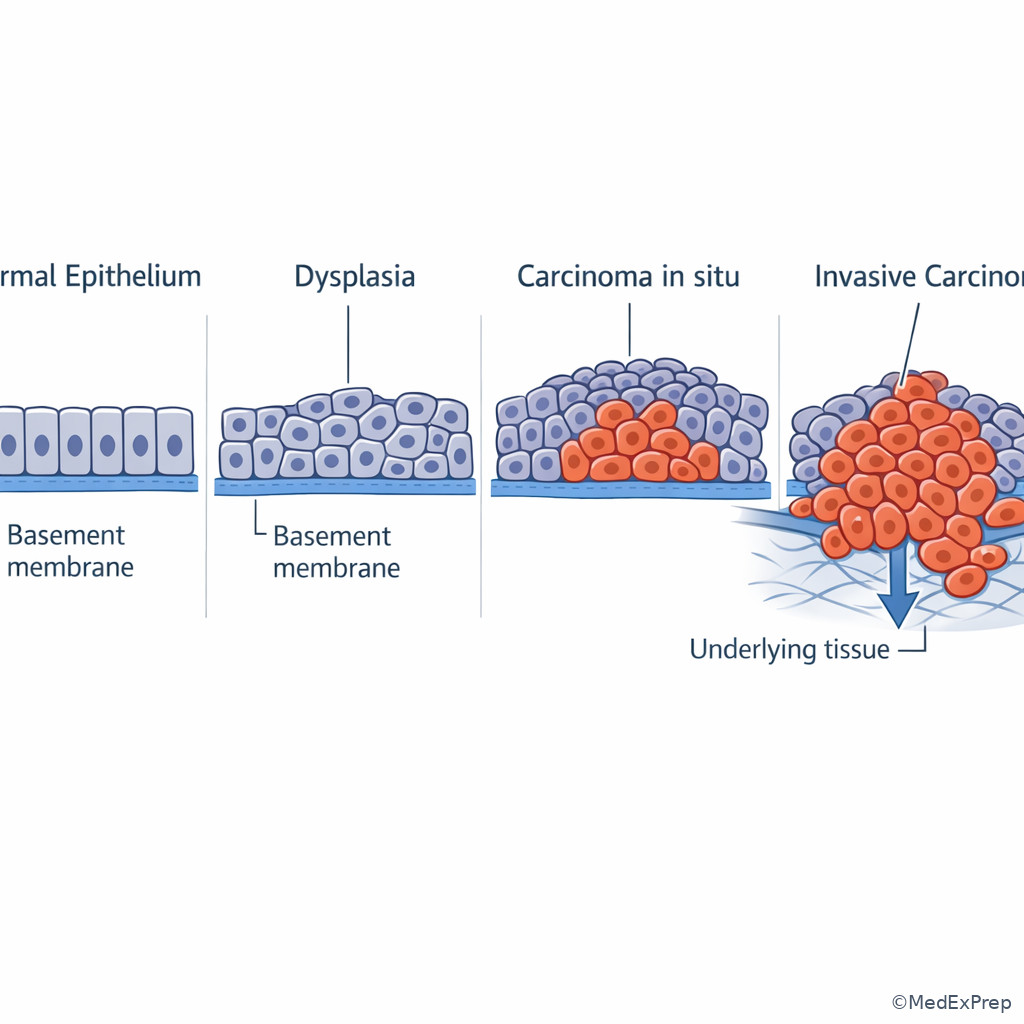
- In situ: malignant cells confined to the epithelium, without invasion through the basement membrane.
- Invasion: extension into surrounding tissue.
- Metastasis: spread to distant sites via lymphatic, blood, seeding, or other routes.
- Primary tumor: original site where malignancy began.
- Benign tumor: noninvasive growth lacking metastatic potential.
- Malignant tumor: invasive growth with potential to metastasize.
- Grade: histologic appearance/aggressiveness.
1.1.1.2 Must-know facts
- All cancers are neoplasms, but not all neoplasms are malignant.
- In situ means noninvasive; metastatic means distant spread.
- Poor differentiation generally signals more aggressive behavior.
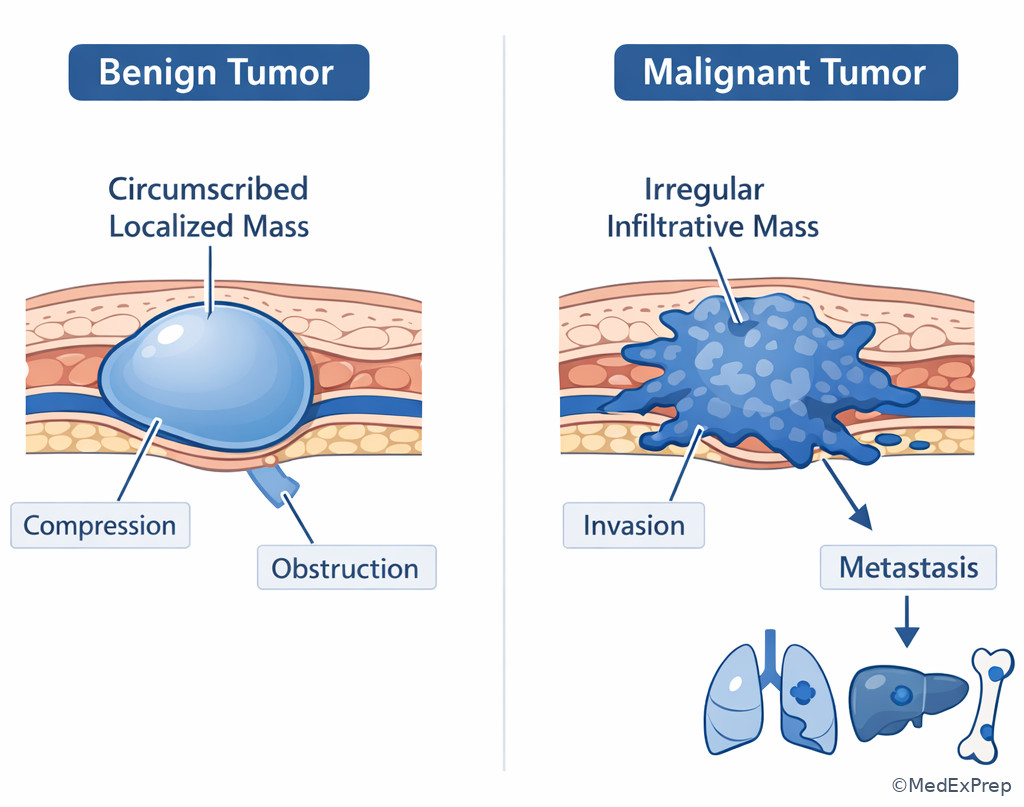
- Benign tumors can still cause harm by compression, bleeding, obstruction, or hormone production.
- Metastatic tumors are named for the primary site, not the destination site.
- Dysplasia is abnormal growth; invasion is the key step that makes epithelial cancer frankly invasive.
- Initiation alone is not enough; promotion and progression drive clinical malignancy.
- RN exam questions may test whether patient education stays within scope: explain terminology, not independently diagnose stage.
Exam takeaway: Track where the cell is in the process because exam stems often hinge on whether change is premalignant, invasive, or metastatic.
flowchart LR
A[Normal cell] --> B[DNA injury or mutation]
B --> C[Initiation]
C --> D[Promotion]
D --> E[Progression]
E --> F[Invasive cancer]
F --> G[Metastasis]
B --> H[DNA repair or apoptosis]
H --> I[No malignant clone]
Exam takeaway: The basement membrane is the line that separates in situ disease from invasive disease.
Core content
1.1.1.3 Foundational language: neoplasia, benign vs malignant, and what exam stems are really asking
A Explanation
The first decision conflict is usually simple on the surface but easy to miss under pressure: Is the stem asking you to recognize any abnormal growth, or specifically malignant behavior? The resolving rule is this: malignancy is defined by invasive potential and the ability to metastasize, not merely by abnormal proliferation. A neoplasm is an abnormal new growth. That term alone does not tell you whether the lesion is harmless, premalignant, or cancerous. Benign tumors are generally well differentiated, slower growing, localized, and nonmetastatic. Malignant tumors are more likely to show rapid growth, atypia, invasion, and metastatic capability.
WHY THIS IS TESTED: testable pattern = the wrong answer often treats any “tumor” or “mass” as synonymous with “cancer.” On the OCN exam, the best answer usually depends on the single clue that separates localized noninvasive growth from invasive malignancy. Nursing implications follow from that distinction. A benign brain tumor, for example, may still be clinically dangerous because of compression. A malignant lesion may be small yet high risk because it invades and spreads.
Choose malignant when the stem mentions invasion, metastasis, poor differentiation, destructive growth, or recurrence risk tied to invasive biology. Reject malignant when the only clue is increased size or presence of a mass without evidence of invasion. Within RN scope, you can explain that “tumor” means abnormal growth and that the care team uses pathology and imaging to determine the exact diagnosis and extent. See Fig 1 for the process language that later turns a normal cell into an invasive clone.
B Worked example
A 58-year-old patient with obesity, type 2 diabetes, and chronic hypertension is admitted for evaluation of abnormal uterine bleeding. The chart states “endometrial neoplasm,” and the patient asks the nurse, “So I definitely have invasive cancer, right?” A distracting note in the chart mentions iron-deficiency anemia, and a tempting-but-wrong clue is the word neoplasm, which sounds malignant. The task is to choose the most appropriate nursing response.
Reasoning chain: Identify task → patient education within RN scope. Extract key facts → the chart says neoplasm, not invasive carcinoma; no pathology detail confirming invasion is provided. Apply rule → neoplasm means new abnormal growth, not automatically malignant. Eliminate distractors → do not reassure falsely that it is benign; do not diagnose invasive cancer; do not discuss stage. Verify → best RN response explains that the word means abnormal tissue growth and that pathology determines whether it is benign, premalignant, or malignant.
C Exam trap
Why it is tempting: In everyday language, patients and even clinicians sometimes use these words loosely as synonyms for cancer.
Single clue that eliminates it: The stem does not mention invasion, metastasis, or malignant pathology.
D Checkpoint
Question: A pathology note describes a lesion as a “benign neoplasm.” Which interpretation is most appropriate for the oncology nurse to use in teaching?
- The lesion is noncancerous and lacks metastatic potential, although it can still cause local problems.
- The lesion is premalignant and will inevitably progress to invasive cancer.
- The lesion has already spread beyond the original tissue but is not aggressive.
- The term confirms a low-grade invasive malignancy.
- A: Tempting because “benign” may sound trivial; right because benign tumors do not metastasize but may still compress or obstruct.
- B: Tempting because some benign-appearing changes can precede cancer; wrong because benign neoplasm does not mean inevitable progression.
- C: Tempting because spread sounds compatible with any tumor; wrong because metastasis is not a benign feature.
- D: Tempting because low-grade malignancies can be slow; wrong because benign and invasive malignancy are different categories.
1.1.1.4 How cancer develops: initiation, promotion, progression, and the genes that fail
A Explanation
The next decision conflict is which step explains risk versus which step explains clinically apparent cancer. The single rule is that carcinogenesis is a multistep process: initiation creates the genetically injured cell, promotion expands it, and progression produces more aggressive malignant traits. Initiation usually involves irreversible DNA injury. Promotion favors proliferation of that altered clone. Progression adds instability, heterogeneity, invasiveness, treatment resistance, and metastatic capability. See Fig 1.
Exam questions also test whether you can distinguish the major gene categories. Proto-oncogenes normally support controlled growth; when activated abnormally, they become oncogenes and push proliferation. Tumor suppressor genes act as brakes, cell-cycle checkpoints, or repair supports; when lost or inactivated, restraint is removed. DNA repair genes help preserve genomic integrity. If DNA damage is severe, apoptosis should remove the cell. Cancer emerges when enough growth-promoting signals accumulate and enough protective mechanisms fail.
WHY THIS IS TESTED: testable pattern = the exam wants you to connect exposures, inherited syndromes, and cell behavior without needing molecular detail beyond nursing relevance. If a question asks what concept explains how a carcinogen “starts” the process, choose initiation. If a stem describes clonal expansion after exposure to growth-promoting conditions, think promotion. If it describes increasing aggressiveness, heterogeneity, invasion, or resistance, think progression.
From the RN perspective, this framework supports accurate teaching: not every exposure causes immediate cancer, and cancer usually reflects accumulated injury over time. This also prepares you for upcoming risk-factor content. See Fig 2 for the key structural step where noninvasive epithelial change becomes invasive disease.
B Worked example
A 66-year-old patient with COPD, hyperlipidemia, and a 40-pack-year smoking history asks during a lung biopsy workup, “Did smoking just flip a switch and give me cancer all at once?” He also mentions that his brother had colon cancer, which is a distracting clue pulling you toward hereditary syndromes. The board-style task is to identify the best teaching point.
Reasoning chain: Identify task → patient education about carcinogenesis. Extract key facts → tobacco exposure is relevant, but the question asks about process, not inherited syndrome. Apply rule → carcinogenesis is multistep; initiation damages DNA, promotion/progression allow abnormal clones to expand and become more aggressive. Eliminate distractors → reject one-time all-or-none explanations and oversimplified statements that every smoker develops cancer. Verify → explain that repeated exposure can contribute to DNA injury over time, while additional failures in repair and growth control allow malignant transformation.
C Exam trap
Why it is tempting: Many learners remember the words but not what each step adds.
Single clue that eliminates it: If the stem emphasizes increasing aggressiveness or metastatic capability, that is progression, not initiation.
D Checkpoint
Question: Which statement best matches the concept of tumor promotion?
- It is the initial irreversible DNA injury that creates the first abnormal cell.
- It is the selective growth of previously initiated cells under favorable conditions.
- It is the confirmed spread of cancer to distant organs.
- It is the restoration of normal apoptosis after mutation.
- A: Tempting because DNA injury is central to cancer; wrong because that describes initiation.
- B: Tempting because it sounds less dramatic than progression; right because promotion expands the initiated clone.
- C: Tempting because growth and spread are related; wrong because distant spread is metastasis, a later malignant behavior.
- D: Tempting because apoptosis matters in cancer control; wrong because restored apoptosis would oppose, not promote, carcinogenesis.
- The step that creates the first genetically altered cell is initiation.
- True or False: Promotion usually means distant metastasis. False.
- Name the 3 protective systems often lost in cancer: growth restraint, DNA repair, apoptosis.
1.1.1.5 Cell appearance and growth behavior: differentiation, anaplasia, dysplasia, hyperplasia, and grading language
A Explanation
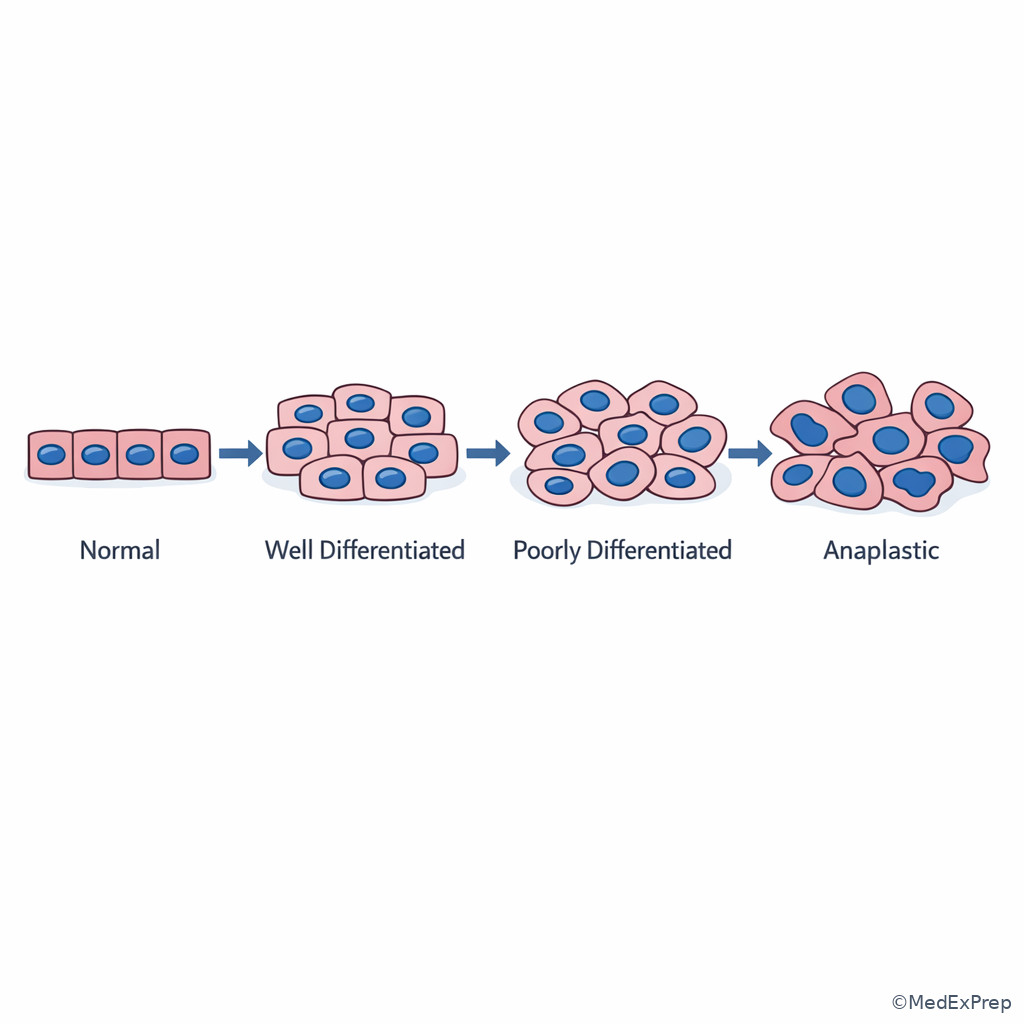
This section asks you to choose between terms that all sound like “abnormal growth” but do not mean the same thing. The rule that resolves most stems is: appearance and organization tell you where the lesion sits on the spectrum, but invasion is still the critical malignant threshold. Hyperplasia means increased cell number; it can be physiologic or pathologic and is not itself cancer. Dysplasia means disordered cell growth and maturation, often in epithelium; it is concerning because it may precede invasive malignancy, but it is not synonymous with invasion. Anaplasia means lack of differentiation, a hallmark of aggressive malignancy. Differentiation refers to how closely tumor cells resemble their original tissue. Better differentiated tumors more closely resemble normal cells; poorly differentiated or anaplastic tumors look primitive and usually behave more aggressively.
Grading uses histologic features, not simply size or location. On exams, if the stem asks which finding suggests aggressive biology, choose poor differentiation, marked pleomorphism, abnormal mitoses, or anaplasia over a vague statement like “the tumor is large.” Large size may matter clinically, but grade speaks to cell appearance and growth characteristics. See Fig 3 for the side-by-side comparison that compresses these terms.
WHY THIS IS TESTED: testable pattern = learners confuse dysplasia with cancer and hyperplasia with neoplasia. The exam often inserts a pathology word as the single clue. Choose dysplasia when the process is abnormal precancerous architecture without confirmed invasion. Reject anaplasia if the stem is describing disorganized but still noninvasive epithelial change.
B Worked example
A 47-year-old patient with rheumatoid arthritis, obesity, and a history of smoking receives a pathology result reading “high-grade cervical dysplasia.” She tells the infusion clinic nurse caring for her unrelated iron infusion, “So I already have invasive cervical cancer.” A distracting detail is recent weight loss from dieting, and a tempting wrong clue is the phrase high-grade, which sounds overtly malignant.
Reasoning chain: Identify task → education and terminology clarification. Extract key facts → the report says dysplasia, not invasive carcinoma. Apply rule → dysplasia is disordered growth and may be premalignant; invasion through the basement membrane would be needed to define invasive epithelial cancer. Eliminate distractors → do not minimize the finding as harmless; do not label it invasive cancer. Verify → best response explains that it is a serious abnormal precancerous change requiring follow-up, but the wording does not itself confirm invasion.
C Exam trap
Why it is tempting: “High-grade” sounds severe, and severe often gets mentally translated to invasive cancer.
Single clue that eliminates it: The report never says the cells crossed the basement membrane.
D Checkpoint
Question: Which pathology term most strongly suggests aggressive malignant behavior rather than merely abnormal but noninvasive growth?
- Hyperplasia
- Dysplasia
- Anaplasia
- Metaplasia
- A: Tempting because increased cell number can worry patients; wrong because hyperplasia alone does not imply aggressive malignancy.
- B: Tempting because dysplasia is precancerous; wrong because it does not by itself indicate aggressive invasive behavior.
- C: Tempting because it sounds unfamiliar; right because anaplasia reflects very poor differentiation and aggressive malignancy.
- D: Tempting because altered cell type is abnormal; wrong because metaplasia is an adaptive change and not the best marker of aggressive cancer here.
1.1.1.6 Local invasion, metastasis, and naming the cancer correctly
A Explanation
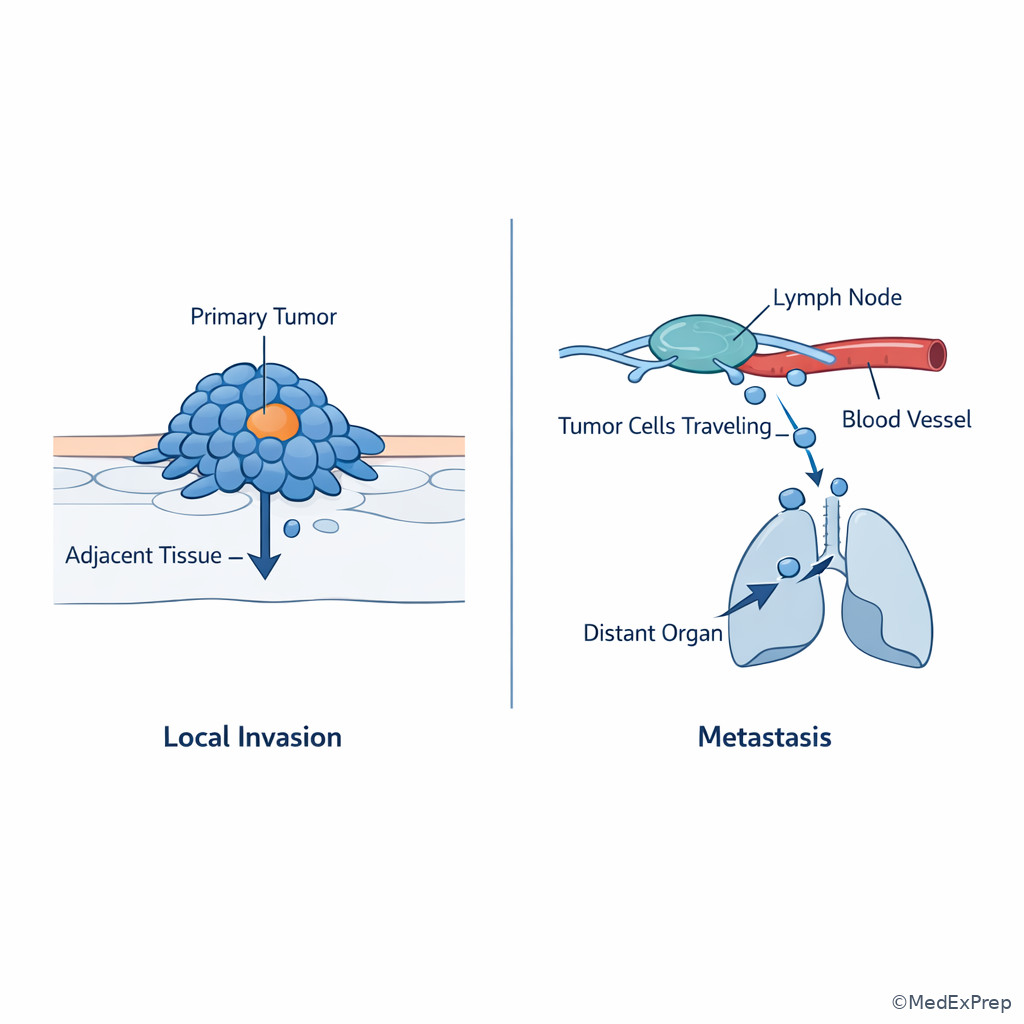
The most tested conflict in basic oncology terminology is local extension versus distant spread. The single resolving rule is: invasion means penetration into adjacent tissue; metastasis means spread to a noncontiguous distant site. Carcinoma in situ remains above the basement membrane. Once malignant cells breach it and infiltrate nearby tissue, the lesion is invasive. Metastasis requires transport and implantation elsewhere, commonly through lymphatic channels, the bloodstream, or body-cavity seeding. See Fig 4.
Another favorite exam point is naming. A cancer found in the liver is not automatically liver cancer. If breast cancer spreads to the liver, it is metastatic breast cancer to the liver, because the primary site determines the name. This matters because stems may test whether you interpret documentation correctly or explain it accurately to patients. The nurse does not independently determine staging, but should understand that “metastatic” implies advanced spread and may shift symptom vigilance, goals-of-care discussions, and coordination needs.
WHY THIS IS TESTED: testable pattern = the exam hides the right answer in one location word. “Adjacent tissues” supports invasion; “distant organs” supports metastasis. Another pattern is when learners misread any second site as a new primary. Choose metastatic disease when the site is clearly seeded from a known origin. Reject a new primary unless the stem specifically supports separate origin.
B Worked example
A 63-year-old patient with known colon adenocarcinoma, chronic kidney disease, and atrial fibrillation has a new liver lesion on imaging. He says, “So now I have liver cancer and colon cancer?” A distracting detail is mildly elevated AST/ALT from statin use, and the tempting wrong clue is the new organ site. The nursing task is to choose the best explanation.
Reasoning chain: Identify task → explain terminology without diagnosing independently. Extract key facts → known colon primary; new liver lesion in the context of existing cancer. Apply rule → tumors are named for the primary site, so disease in the liver from colon cancer is metastatic colon cancer. Eliminate distractors → do not say “two cancers” unless the stem supports a second independent primary. Verify → explain that the care team will interpret the full workup, but spread to the liver from the colon primary is usually described as metastatic colon cancer to the liver.
C Exam trap
Why it is tempting: Learners anchor to the organ where the lesion was found rather than the tissue of origin.
Single clue that eliminates it: The stem gives a known primary and frames the new lesion as spread.
D Checkpoint
Question: Which finding most clearly indicates metastasis rather than local invasion?
- Malignant cells extending from a breast lesion into adjacent chest wall tissue
- Malignant cells confined to the epithelial layer of the cervix
- Malignant cells from a lung primary found in the brain
- Increasing pleomorphism within the primary tumor
- A: Tempting because spread is occurring; wrong because extension into nearby tissue is local invasion.
- B: Tempting because cancer language is present; wrong because confinement to epithelium indicates in situ disease.
- C: Tempting because a distant organ is involved; right because spread from the lung to the brain is metastasis.
- D: Tempting because more abnormal cells may mean worsening cancer; wrong because this reflects progression/aggressiveness, not distant spread by itself.
- The word that means spread to a distant site is metastasis.
- True or False: Carcinoma in situ has crossed the basement membrane. False.
- If breast cancer spreads to bone, it is called metastatic breast cancer, not primary bone cancer.
1.1.1.7 Tumor classification terms nurses see often: carcinoma, sarcoma, leukemia, lymphoma, and common suffix rules
A Explanation
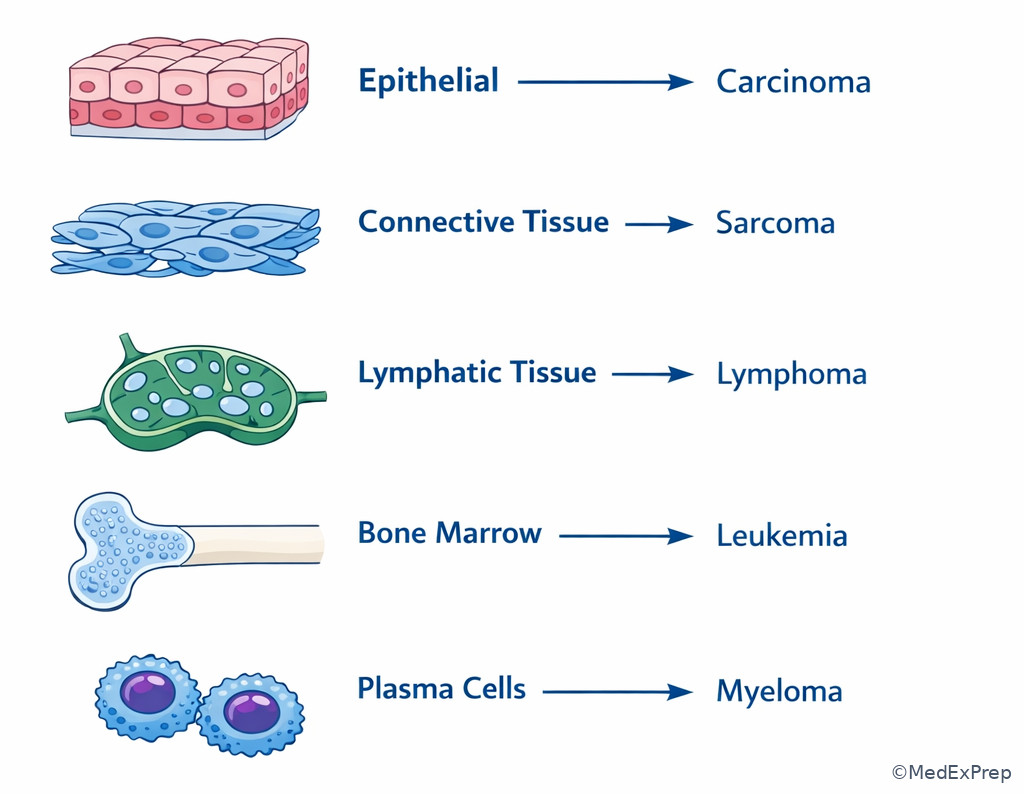
The next decision conflict is classification by tissue of origin. The rule is: the tumor family usually tells you what tissue it arose from. Carcinomas arise from epithelial tissues and are the most common solid malignancies. Sarcomas arise from connective or mesenchymal tissues such as bone, muscle, fat, or cartilage. Leukemias involve blood-forming tissues and circulating marrow-derived cells. Lymphomas arise from lymphatic tissues. Myeloma involves plasma cells. On exam questions, these labels are often used to orient you to general behavior, body systems involved, and later treatment patterns—not to test specialist-level pathology.
Suffixes can help but are not perfect. The suffix -oma often suggests benignity, as in lipoma or adenoma, but there are major exceptions such as lymphoma, melanoma, myeloma, and seminoma, which are malignant. Therefore, never use suffix alone when the stem supplies stronger clues. In nursing communication, use the exact charted term and avoid “translating” it into a more definite diagnosis than the record supports.
WHY THIS IS TESTED: testable pattern = a stem asks what broad tumor class best matches the tissue of origin or asks which term is an exception to the benign-sounding -oma pattern. Choose carcinoma for epithelial origin, sarcoma for mesenchymal/connective tissue origin, and be cautious with suffix shortcuts. See Fig 5 for the comparison map.
B Worked example
A 39-year-old patient with sickle cell trait and well-controlled asthma asks whether her newly diagnosed osteosarcoma is “a carcinoma of the bone.” She also has a benign uterine leiomyoma, which is a distracting clue because both terms end in -oma. The task is to choose the best teaching response.
Reasoning chain: Identify task → classify by tissue of origin. Extract key facts → osteosarcoma arises from bone/connective tissue; leiomyoma is benign smooth muscle tumor; the suffix pattern is not enough. Apply rule → \(carcinoma = epithelial origin\); \(sarcoma = connective/mesenchymal origin\). Eliminate distractors → reject any answer relying only on -oma or calling all bone cancers carcinoma. Verify → teach that osteosarcoma is a malignant sarcoma arising from bone-forming tissue.
C Exam trap
Why it is tempting: Many introductory examples use lipoma or adenoma, which build an overgeneralized rule.
Single clue that eliminates it: Classic malignant exceptions include lymphoma, melanoma, and myeloma.
D Checkpoint
Question: A malignant tumor arising from epithelial tissue is best classified as which of the following?
- Sarcoma
- Carcinoma
- Lymphoma
- Leukemia
- A: Tempting because it is a major malignant class; wrong because sarcomas arise from connective or mesenchymal tissues.
- B: Tempting because it is the commonest solid-tumor category; right because epithelial origin defines carcinoma.
- C: Tempting because lymphoid tissue can form masses; wrong because lymphoma arises from lymphatic tissue, not epithelium.
- D: Tempting because marrow malignancies are common oncology terms; wrong because leukemia is a hematologic malignancy, not epithelial.
1.1.1.8 RN-scope communication: what nurses explain, what nurses clarify, and what belongs to the provider/pathology team
A Explanation
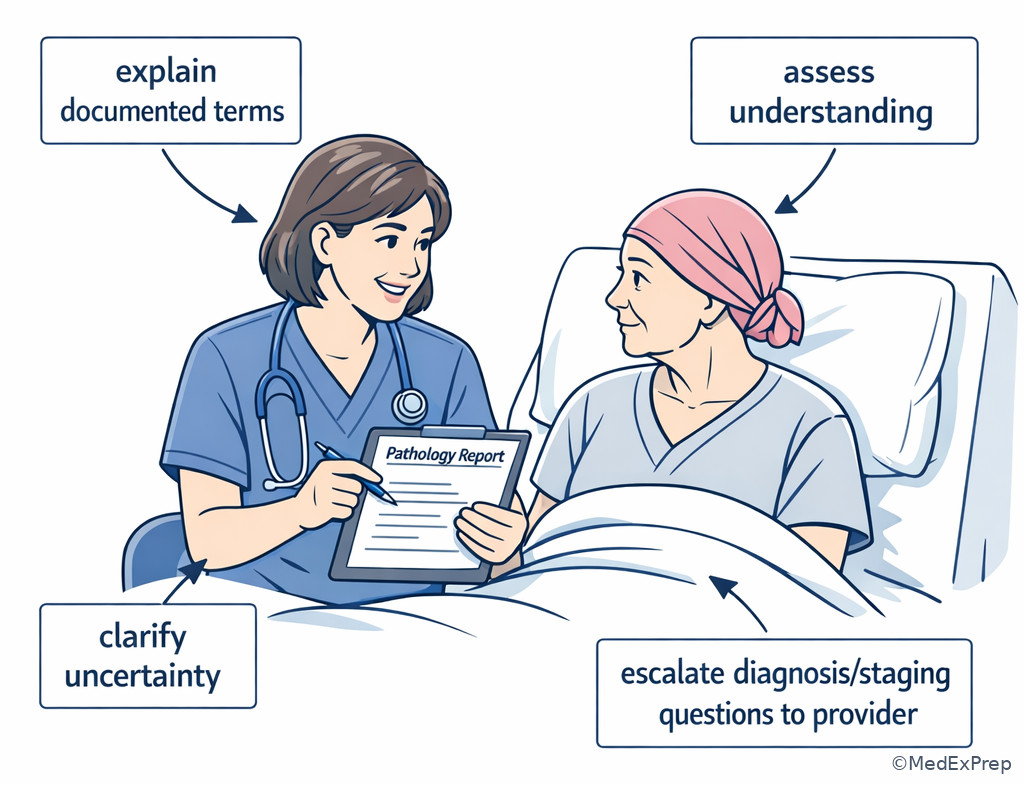
Foundational oncology terms are not just vocabulary; they directly shape safe communication. The final decision conflict is when to educate using known terminology versus when to hold the line and seek clarification because the answer would exceed RN scope. The single resolving rule is: the nurse may explain documented terms and reinforce general concepts, but must not independently diagnose, assign stage, interpret pathology beyond the documented findings, or choose treatment plans.
On exam day, many distractors are unsafe because they push the RN into provider-level decisions. A patient may ask, “Does this mean metastatic stage IV cancer?” if the chart only says “suspicious lesion.” The correct nursing frame is to acknowledge concern, explain what is known, state that the care team will interpret the full findings, and escalate for clarification when needed. Conversely, if the chart already documents “metastatic breast cancer to bone,” it is appropriate to use that documented term in teaching and care coordination. This is where terminology knowledge protects both patient understanding and professional boundaries.
WHY THIS IS TESTED: testable pattern = multiple options may be factually adjacent, but only one stays within RN scope and priority. Choose the response that explains documented terms, assesses understanding, and refers diagnostic or treatment-defining questions to the provider team. Reject options that independently label new metastasis, stage disease, or alter the plan.
Forward reference: in the upcoming lessons on Cancer Risk Factors and Primary And Secondary Prevention, the same communication rule applies. Nurses teach risks and prevention strategies, but do not independently determine genetic diagnoses or screening plans outside protocol.
B Worked example
A 71-year-old patient with metastatic prostate cancer, heart failure, and chronic back pain presents for clinic follow-up. A new imaging report in the chart says “suspicious vertebral lesion; correlation recommended.” He asks, “So this definitely means my cancer is now in my spine and I’m paralyzed soon, right?” A distracting clue is his chronic pain baseline, and the tempting wrong action is to overinterpret the report.
Reasoning chain: Identify task → scope-safe communication with symptom triage. Extract key facts → suspicious lesion is not the same as confirmed diagnosis; however, spine-related symptoms may imply urgency if neurologic findings are present. Apply rule → explain that the report needs provider interpretation, assess for red-flag neurologic symptoms, and escalate if deficits are present. Eliminate distractors → do not independently confirm metastasis or stage; do not dismiss concern. Verify → best action combines assessment of weakness/numbness/bowel-bladder changes with timely provider notification as indicated.
C Exam trap
Why it is tempting: Words like “suspicious” and a patient’s known cancer history create strong diagnostic momentum.
Single clue that eliminates it: The report has not confirmed pathology or final interpretation, so the RN must clarify and escalate rather than diagnose.
D Checkpoint
Question: A patient asks the nurse whether a newly noted “suspicious pulmonary nodule” proves metastatic disease. Which response is most appropriate?
- “Yes, a new nodule in someone with cancer confirms metastasis.”
- “It may represent several possibilities; your oncology team will interpret the findings, and I can review what the report says so far.”
- “No, nodules are usually benign, so there is no need for concern.”
- “I cannot discuss imaging results with you.”
- A: Tempting because a cancer history raises suspicion; wrong because it exceeds RN scope and overstates the finding.
- B: Tempting because it is balanced rather than definitive; right because it stays within scope, explains uncertainty, and supports follow-up.
- C: Tempting because reassurance may feel supportive; wrong because it minimizes a potentially significant finding without evidence.
- D: Tempting because nurses should avoid diagnosis; wrong because the RN can discuss documented information and provide supportive clarification within scope.
Tables
| Term | High-yield meaning | Exam discriminator | Nursing implication |
|---|---|---|---|
| Neoplasm | New abnormal cell growth | Not automatically malignant | Use exact term; avoid overcalling cancer |
| Benign | Localized, nonmetastatic growth | May still compress or obstruct | Assess symptoms, not just label |
| Malignant | Invasive growth with metastatic potential | Invasion/spread are the key clues | Prioritize symptom surveillance and escalation |
| In situ | Confined to epithelium | No basement membrane penetration | Do not equate with invasive disease |
| Invasive | Extension into nearby tissue | Local tissue penetration | Recognize greater clinical significance |
| Metastatic | Distant spread from primary site | Noncontiguous organ involvement | Use primary-site naming |
| Dysplasia | Disordered growth/maturation | Premalignant pattern, not invasion | Reinforce follow-up importance |
| Anaplasia | Poor differentiation | Aggressive malignant behavior | Expect more concerning biology |
| Comparison point | Benign tumor | Malignant tumor |
|---|---|---|
| Growth pattern | Often slow, circumscribed | Often rapid, disordered, infiltrative |
| Differentiation | Usually well differentiated | Variable; may be poorly differentiated/anaplastic |
| Local invasion | Absent | Present or possible |
| Metastatic potential | Absent | Present |
| Clinical harm | Compression, bleeding, obstruction, hormone effects | Tissue destruction, organ failure, spread |
| RN teaching point | Benign does not always mean harmless | Malignant does not automatically reveal stage or prognosis |
| Look-alike term | What it means | What it does not mean | Single clue |
|---|---|---|---|
| Hyperplasia | Increased cell number | Automatic malignancy | Quantity increases; invasion not implied |
| Dysplasia | Abnormal maturation/architecture | Confirmed invasive cancer | Precancerous concern without tissue penetration |
| Anaplasia | Poor differentiation | Simple premalignant change | Primitive malignant appearance |
| In situ | Localized above basement membrane | Local invasion | Basement membrane intact |
| Invasion | Spread into adjacent tissue | Distant metastasis | Nearby structures involved |
| Metastasis | Distant spread | Just larger local disease | Separate organ/site involved |
| Tumor class | Tissue of origin | Example term | Common confusion |
|---|---|---|---|
| Carcinoma | Epithelial tissue | Adenocarcinoma, squamous cell carcinoma | Misclassified as “any solid tumor” |
| Sarcoma | Connective/mesenchymal tissue | Osteosarcoma | Mistaken for carcinoma because it is malignant |
| Leukemia | Blood-forming tissues | Acute leukemia | Assumed to be a solid tumor |
| Lymphoma | Lymphatic tissue | Hodgkin lymphoma | Wrongly assumed benign because of “-oma” |
| Myeloma | Plasma cells | Multiple myeloma | Wrongly assumed benign because of “-oma” |
Exam takeaway: Separate increased cell number, disordered maturation, and poor differentiation because stems often offer these as close distractors.
flowchart TD
A[Abnormal finding] --> B{What is abnormal?}
B --> C[More cells only -> Hyperplasia]
B --> D[Disordered maturation -> Dysplasia]
B --> E[Primitive poorly differentiated malignant cells -> Anaplasia]
D --> F[May be premalignant]
E --> G[Suggests aggressive malignancy] Exam takeaway: Adjacent spread is invasion, while a distant noncontiguous site indicates metastasis.
Exam takeaway: Match the tissue of origin to the tumor family before you interpret the rest of the stem.
flowchart LR
A[Tissue of origin] --> B[Epithelial]
A --> C[Connective or mesenchymal]
A --> D[Lymphatic tissue]
A --> E[Blood-forming tissue]
A --> F[Plasma cells]
B --> G[Carcinoma]
C --> H[Sarcoma]
D --> I[Lymphoma]
E --> J[Leukemia]
F --> K[Myeloma]
Exam takeaway: Use tissue origin rather than suffix alone when classifying tumor families.
Exam takeaway: A benign label does not rule out local harm, but malignant behavior is defined by invasion and metastatic potential.
Exam takeaway: The less the cells resemble the original tissue, the more aggressive the pathology language usually becomes.
Exam takeaway: Nurses may explain documented terms and assess understanding, but diagnosis and staging decisions must be clarified with the provider team.
Exam Traps & Differentiators
- Most common wrong answer and why: treating any tumor, mass, or neoplasm as invasive cancer. This is tempting because common speech uses them interchangeably, but the discriminating clue is whether invasion or metastasis is actually stated.
- Looks similar but isn’t: dysplasia versus carcinoma in situ versus invasive carcinoma. The key separator is whether malignant cells remain above or cross the basement membrane; this confusion will matter again in upcoming screening and prevention topics.
- Looks similar but isn’t: invasion versus metastasis. Adjacent spread is not the same as distant spread.
- Looks similar but isn’t: carcinoma versus sarcoma. The tissue of origin, not the organ name alone, resolves the choice.
- Looks similar but isn’t: explaining charted terminology versus independently diagnosing or staging. Scope is the deciding rule.
| If the stem says... | Think... | Reject... |
|---|---|---|
| “Confined to epithelium” | In situ | Invasive disease |
| “Crossed basement membrane” | Invasion | Still in situ |
| “Known breast primary with bone lesion” | Metastatic breast cancer | Primary bone cancer unless separately supported |
| “Poorly differentiated” or “anaplastic” | Aggressive malignant biology | Simple benign overgrowth |
| “Epithelial origin” | Carcinoma | Sarcoma |
| “Suspicious lesion” without final diagnosis | Clarify and escalate within scope | Definitive RN diagnosis/staging |
Related confusable pairs from neighboring topics: In the upcoming Cancer Risk Factors lesson, the distractor may shift from terminology to causation. In Primary And Secondary Prevention, expect stems to mix premalignant language with screening decisions. Knowing whether a lesion is risk, premalignant change, or established invasion prevents category errors across all three topics.
Algorithm / Approach
Exam takeaway: Most wrong answers fail because they ignore the single discriminator or push the RN outside scope.
flowchart TD
A[Read the stem] --> B{What clue is present?}
B --> C[Basement membrane intact]
B --> D[Adjacent tissue involved]
B --> E[Distant site involved]
B --> F[Tissue of origin stated]
B --> G[Patient asking for meaning of charted term]
C --> H[Think in situ or noninvasive]
D --> I[Think invasion]
E --> J[Think metastasis]
F --> K[Classify tumor family]
G --> L[Explain within RN scope]
L --> M[Escalate if diagnosis or stage is not confirmed] Rapid Review
- Neoplasm → abnormal growth, not automatically malignant
- Benign tumor → nonmetastatic but may still compress or obstruct
- Malignant tumor → invasion and metastatic potential are the key separators
- Initiation → first genetic injury creating the abnormal clone
- Promotion → expansion of initiated cells, not distant spread
- Progression → increasing heterogeneity, aggressiveness, and invasive behavior
- Tumor suppressor loss → removes growth brakes
- Apoptosis failure → damaged cells survive when they should die
- Dysplasia → abnormal maturation, often premalignant, not synonymous with invasion
- Anaplasia → poor differentiation and aggressive biology
- Carcinoma in situ → malignant cells confined above basement membrane
- Invasion → local tissue penetration
- Metastasis → distant noncontiguous spread
- Carcinoma → epithelial origin
- Sarcoma → connective/mesenchymal origin
- Metastatic naming → name follows the primary site, not the destination organ
- RN scope → explain documented terms; do not independently diagnose or stage
Self-check quiz
1. A 54-year-old patient with obesity and GERD asks about a biopsy report that says “carcinoma in situ.” She has no metastatic workup yet and is anxious because her aunt died of metastatic cancer. Which nursing interpretation is most appropriate?
- The malignant cells are confined and have not invaded through the basement membrane.
- The cancer has already spread to regional lymph nodes.
- The lesion is benign and cannot progress.
- The pathology confirms a poorly differentiated metastatic tumor.
2. A patient with a newly diagnosed skin lesion asks which tumor class arises from epithelial tissue. Which answer is most appropriate?
- Sarcoma
- Carcinoma
- Lymphoma
- Leukemia
3. A 62-year-old patient with a history of treated breast cancer, hypertension, and osteoarthritis has new imaging that shows lesions in the liver. She asks the infusion nurse whether this means she now has primary liver cancer. Which is the most appropriate nursing response?
- Explain that spread from a known breast primary to the liver is typically described as metastatic breast cancer to the liver.
- Tell her any lesion in the liver is classified as primary liver cancer until surgery confirms otherwise.
- Reassure her that liver lesions after breast cancer are usually benign cysts.
- Avoid answering because discussion of cancer location is outside nursing scope.
4. A 45-year-old patient with lupus and tobacco use asks why a carcinogen does not always cause immediate cancer after one exposure. Which teaching point best answers the question?
- Cancer usually develops through multiple steps including initiation, promotion, and progression.
- Any DNA injury instantly creates metastatic disease.
- Carcinogenesis occurs only when tumor suppressor genes are completely absent from birth.
- Promotion and progression are synonyms for apoptosis.
5. A 49-year-old patient with obesity, iron-deficiency anemia, and abnormal uterine bleeding reads “endometrial neoplasm” in the portal and asks the clinic nurse what it means. Which action is most appropriate?
- Explain that neoplasm means abnormal new growth and that pathology determines whether it is benign, premalignant, or malignant.
- Tell the patient the term confirms invasive endometrial cancer.
- Reassure the patient that neoplasm is another word for a benign polyp.
- State that nurses cannot discuss pathology terminology at all.
6. A 68-year-old patient with known metastatic prostate cancer, chronic back pain, and diabetes calls the ambulatory oncology clinic after seeing a report that says “suspicious vertebral lesion.” He also reports new leg weakness since this morning and one episode of urinary retention. Which is the most appropriate nursing action?
- Explain that the report proves spinal metastasis and advise routine follow-up at the next scheduled visit.
- Assess the new neurologic symptoms as an urgent priority and notify the provider immediately while avoiding definitive independent interpretation of the report.
- Focus teaching on the meaning of “suspicious lesion” and postpone escalation until pathology confirms the diagnosis.
- Delegate the call to unlicensed assistive personnel because the patient already has chronic pain and known cancer.
7. A 51-year-old patient with ulcerative colitis, smoking history, and cervical pathology reading “high-grade dysplasia” asks whether she should tell her family she has invasive cancer. Which response is the most appropriate?
- “Yes; high-grade dysplasia and invasive carcinoma mean the same thing.”
- “High-grade dysplasia is a serious abnormal change, but the term itself does not confirm invasion.”
- “No; dysplasia is always benign and never progresses.”
- “I cannot explain pathology terms because that would be diagnosing.”
8. A 36-year-old patient with a new diagnosis of osteosarcoma, mild asthma, and anxiety asks whether her cancer is a carcinoma because it is a malignant tumor. Which answer is most appropriate?
- Yes; any malignant solid tumor is a carcinoma.
- No; osteosarcoma is classified as a sarcoma because it arises from connective or bone-forming tissue.
- Yes; the suffix “-oma” indicates the lesion is benign, so the classification does not matter.
- No; carcinoma is the term used only for metastatic tumors.
Answer key
1. Correct answer: A
- A: Tempting because it directly uses pathology language; correct because carcinoma in situ means malignant cells are confined above the basement membrane. The single clue is in situ. Sources: Lewis; NCSBN clinical judgment principles.
- B: Tempting because cancer often spreads; incorrect because nothing in the stem mentions nodal involvement, and in situ disease is noninvasive. The discriminator is absence of invasion/spread language. Sources: Lewis; Saunders.
- C: Tempting because noninvasive can sound harmless; incorrect because in situ lesions are not benign even though they have not invaded. The clue is the word carcinoma. Sources: Lewis; Saunders.
- D: Tempting because malignant terminology can trigger thoughts of advanced disease; incorrect because metastatic spread and poor differentiation are not established by in situ alone. The discriminator is basement membrane confinement. Sources: Lewis; NCSBN.
2. Correct answer: B
- A: Tempting because sarcoma is also malignant; incorrect because it arises from connective or mesenchymal tissue. The discriminator is tissue origin. Sources: Lewis; Saunders.
- B: Tempting because it is the most common solid-tumor family; correct because epithelial origin defines carcinoma. The key clue is epithelial tissue. Sources: Lewis; Saunders.
- C: Tempting because lymphomas can involve tissue masses; incorrect because they arise from lymphatic tissue. The discriminator is not lymphoid origin. Sources: Lewis; Saunders.
- D: Tempting because hematologic cancers are common oncology terms; incorrect because leukemia arises from blood-forming tissues rather than epithelium. Sources: Lewis; Saunders.
3. Correct answer: A
- A: Tempting because it uses existing history to interpret the new finding; correct because cancers are named by primary site, so liver involvement from breast cancer is metastatic breast cancer to the liver. The discriminator is history of treated breast cancer plus new liver lesions. Priority-wise, it supports accurate education within RN scope. Sources: Lewis; ANA Standards of Practice.
- B: Tempting because the lesion is in the liver; incorrect because organ location alone does not define a new primary. The priority principle is accurate interpretation before teaching. Sources: Lewis; Saunders.
- C: Tempting because benign hepatic lesions exist; incorrect because the stem specifically tests naming of spread from a known primary, not reassurance. Safety eliminates minimization. Sources: NCSBN; Lewis.
- D: Tempting because nurses should not independently diagnose; incorrect because the RN can explain documented terminology and general concepts within scope. The discriminator is that the nurse is clarifying existing oncology language, not prescribing or staging. Sources: ANA; NCSBN.
4. Correct answer: A
- A: Tempting because it is broad rather than overspecific; correct because carcinogenesis usually occurs through multiple steps including initiation, promotion, and progression. The clue is the patient asking why one exposure does not always cause immediate clinical cancer. Priority-wise, this is the best educational intervention. Sources: Lewis; Saunders.
- B: Tempting because DNA injury is central; incorrect because DNA injury does not instantly equal metastatic disease. Safety reasoning rejects oversimplification. Sources: Lewis; Saunders.
- C: Tempting because hereditary syndromes are real; incorrect because carcinogenesis is not limited to congenital total absence of tumor suppressor genes. The discriminator is the general mechanism across patients. Sources: Lewis; peer-reviewed oncology biology texts.
- D: Tempting because the terms are often memorized poorly; incorrect because apoptosis is programmed cell death, not a synonym for promotion or progression. The clue is process vocabulary. Sources: Lewis; Saunders.
5. Correct answer: A
- A: Tempting because it seems less definitive than some choices; correct because neoplasm means abnormal new growth and does not by itself prove benignity or malignancy. The key clue is the isolated term endometrial neoplasm. Priority-wise, this is accurate education within scope. Sources: ANA Standards; Lewis.
- B: Tempting because abnormal uterine bleeding raises concern for malignancy; incorrect because the term provided does not confirm invasion. Safety and scope eliminate overdiagnosis. Sources: NCSBN; Lewis.
- C: Tempting because some uterine lesions are benign; incorrect because the word neoplasm is not equivalent to benign polyp. The discriminator is lack of pathology detail. Sources: Saunders; Lewis.
- D: Tempting because nurses should not diagnose; incorrect because the RN can explain the meaning of documented terminology and reinforce that pathology determines exact classification. The clue is that the patient is asking for word meaning, not a treatment plan. Sources: ANA; NCSBN.
6. Correct answer: B
- A: Tempting because the patient already has metastatic cancer and the report sounds suspicious; incorrect because the RN should not independently confirm the diagnosis, and routine follow-up is unsafe given new weakness and urinary retention. ABCs and safety prioritize urgent neurologic assessment. Sources: NCSBN; Lewis oncology emergency principles.
- B: Tempting because it does two things at once; correct because the priority is urgent assessment and escalation for possible spinal cord compression while staying within RN scope regarding the report. The single discriminator is new leg weakness and urinary retention. Sources: Lewis; ANA; NCSBN.
- C: Tempting because teaching is appropriate in many ambulatory calls; incorrect because teaching is the right action at the wrong priority when red-flag neurologic symptoms are present. Maslow/safety place urgent escalation first. Sources: NCSBN; Saunders.
- D: Tempting because chronic pain calls may involve routine follow-up; incorrect because new neurologic deficits require RN assessment and urgent provider notification. Delegation is unsafe. Sources: ANA delegation standards; NCSBN.
7. Correct answer: B
- A: Tempting because “high-grade” sounds severe; incorrect because dysplasia does not itself confirm invasion. The discriminator is the term dysplasia, not carcinoma. Priority reasoning rejects false certainty. Sources: Lewis; Saunders.
- B: Tempting because it balances seriousness with accuracy; correct because high-grade dysplasia is significant abnormal change but not the same as confirmed invasive cancer. The key clue is absence of invasion language. Sources: ANA; Lewis.
- C: Tempting because not all dysplasia progresses; incorrect because it minimizes a serious premalignant change. Safety eliminates false reassurance. Sources: Saunders; Lewis.
- D: Tempting because nurses avoid diagnosis; incorrect because explaining documented pathology terminology is within RN scope. The discriminator is that the patient is asking about the meaning of an existing report. Sources: ANA Standards; NCSBN.
8. Correct answer: B
- A: Tempting because carcinoma is a common malignant term; incorrect because not all malignant solid tumors are carcinomas. Tissue origin rules here. Sources: Lewis; Saunders.
- B: Tempting because it relies on classification rather than suffix; correct because osteosarcoma arises from bone/connective tissue and is therefore a sarcoma. The discriminator is osteo- and connective/bone origin. Sources: Lewis; Saunders.
- C: Tempting because many benign tumors end in -oma; incorrect because osteosarcoma is malignant and suffix shortcuts are unreliable. The single clue is the named class sarcoma. Sources: Lewis; Saunders.
- D: Tempting because carcinoma is associated with serious disease; incorrect because carcinoma refers to epithelial origin, not metastatic status. The discriminator is tissue type, not spread. Sources: Lewis; Saunders.
Keep going with the full OCN Prep Course (OCN)
You just studied the way members do, in the same lesson interface. Full access unlocks every lesson, the question bank and flashcards for a full year.
One payment · 1 year of access · No auto-renewal