1.1.1 - Scene Safety & PPE
Scene Safety & PPE
What you'll learn
- EMS Operations: Scene hazard recognition — identify unsafe scene features before patient contact.
- EMS Operations: PPE selection — choose the most appropriate personal protective equipment for blood, droplet, airborne, and hazardous exposure risks.
- Patient Assessment & Clinical Decision-Making: Sequencing — apply the rule that scene safety comes before patient assessment and treatment.
- EMS Operations: Resource escalation — determine when to stage, retreat, request law enforcement, fire, hazmat, or additional EMS resources.
- EMS Operations: Exposure management — recognize when contamination risk changes the safest next step for the crew and patient.
- EMS Operations → Scene size-up, safety, infection control, hazardous scene awareness
- Patient Assessment & Clinical Decision-Making → Safest best immediate next step before patient contact
- Trauma / Medical Emergencies crossover → Recognize when mechanism, illness pattern, or environment increases crew risk
Why it matters
- The exam often hides the correct answer in the first operational decision, not the most dramatic patient finding.
- A technically correct medical intervention becomes wrong if the scene is unsafe or the PPE choice is inadequate.
- Scene safety questions test prioritization: protect crew, protect bystanders, then reach the patient as safely as possible.
- Many distractors are attractive because they reward urgency; the safer answer wins when a threat to responders is still uncontrolled.
Key Terms & Must-Know Facts
1.1.1.1 Key terms
- BSI — body substance isolation precautions used to reduce exposure to blood and body fluids.
- PPE — personal protective equipment such as gloves, eye protection, gown, mask, or respirator.
- Scene safety — determination that conditions permit approach without unacceptable risk.
- Stage — remain at a safe distance until hazards are controlled.
- Hot zone — contaminated or immediately dangerous area; not for routine EMS entry.
- Warm zone — transition/decontamination area.
- Cold zone — safe support area for EMS operations.
- Standard precautions — infection-control practices used for all patients.
- Droplet precautions — protection against larger respiratory particles.
- Airborne precautions — protection against particles that remain suspended; higher respiratory protection is needed.
- Hazmat — hazardous materials incident involving chemical, biologic, radiologic, or similar contamination risk.
- Mechanism of injury — traumatic force pattern suggesting injury and often scene risk.
- Nature of illness — medical complaint pattern that may suggest infectious or toxic exposure risk.
1.1.1.2 Must-know facts
- Do not become the next patient.
- Scene safety is assessed on arrival and reassessed continuously.
- Gloves alone are not enough when splash, aerosol, or respiratory spread is likely.
- Violence risk changes the answer from “approach now” to “stage and request law enforcement.”
- Hazmat scenes require specialized resources; routine entry-level EMS care starts in the safe zone.
- Patient urgency does not cancel crew safety.
- If the stem includes unknown powder, fumes, leaking containers, multiple sick patients, or dead animals, think contamination risk first.
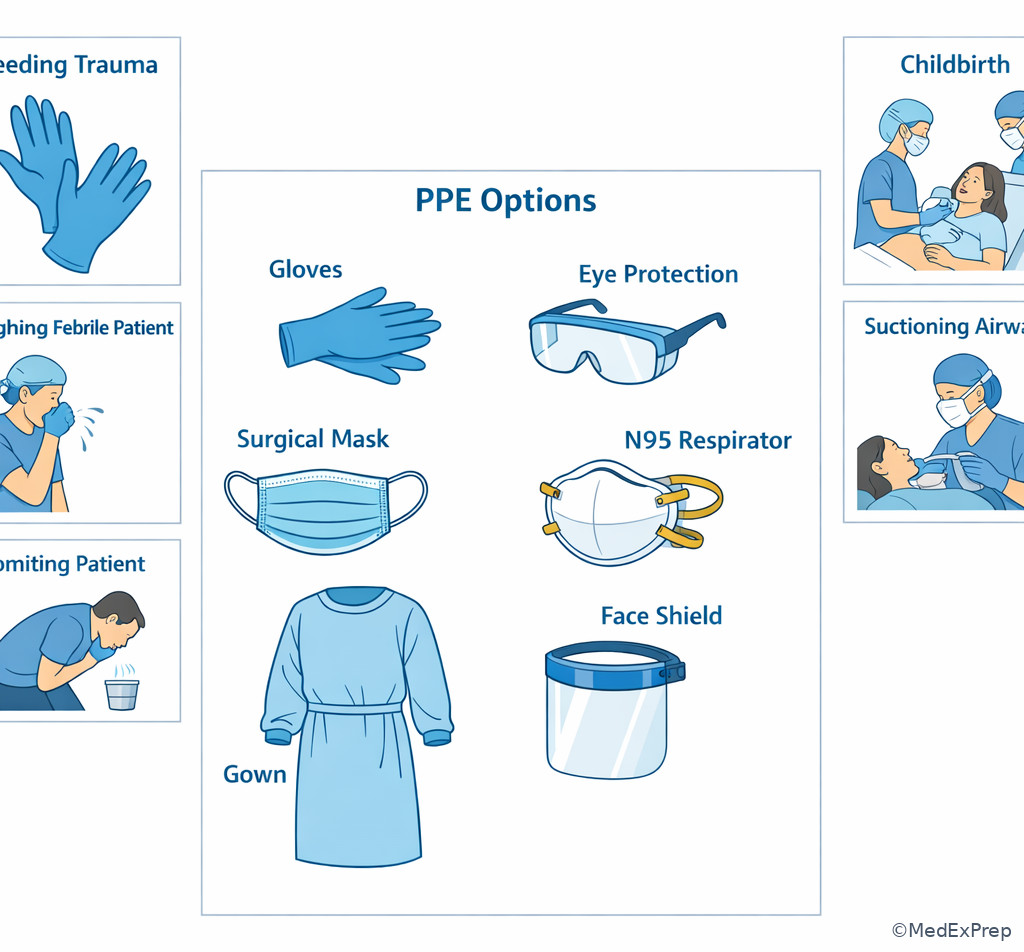
- If the stem includes coughing blood, vomiting, suctioning, childbirth, or arterial bleeding, think splash protection.
- Local protocols vary; confirm with your program, agency, or medical director.
Exam takeaway: Use this sequence to decide whether to enter, stage, or retreat before patient contact.
flowchart TD
A[Arrive near scene] --> B{Any uncontrolled hazard?}
B -->|Yes| C[Do not enter]
C --> D[Stage uphill/upwind when relevant]
D --> E[Request appropriate resources]
E --> F[Enter only after hazard control]
B -->|No obvious hazard| G[Select PPE for likely exposure]
G --> H[Approach and reassess continuously]
See Fig 1 for the core sequence that resolves most early scene-size-up questions.
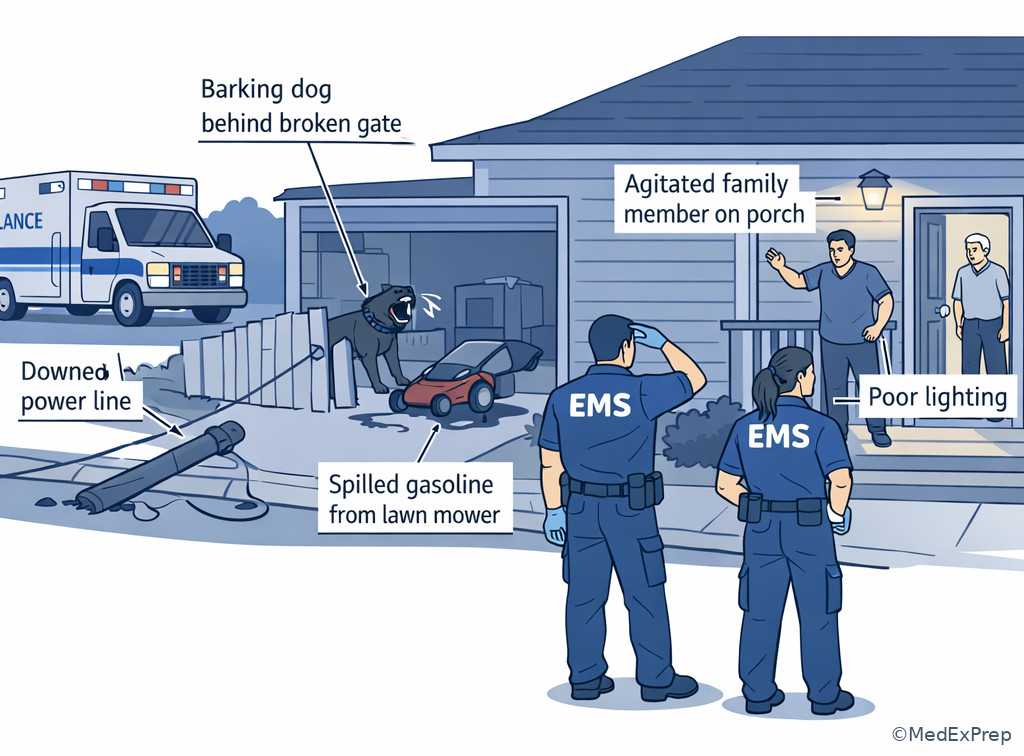
Exam takeaway: Scan for violence, traffic, wires, animals, spills, and unstable structures before approaching.
Exam takeaway: Match glove-only, splash protection, and respiratory protection to the actual exposure pattern in the stem.
Core content
1.1.1.3 Foundational priority: scene safety before patient contact
A Explanation
The first decision conflict is simple but heavily tested: approach the patient now versus delay contact because the scene is not safe. The single rule that resolves the conflict is this: uncontrolled danger to responders outranks immediate patient contact. On NREMT-style items, the patient may look critically ill, but if the stem includes gunfire, weapons, unstable traffic, fire, electrical hazards, aggressive crowds, chemical release, or structural collapse risk, the safest best answer is to stage, retreat, or request the correct resource.
WHY THIS IS TESTED: Candidates often overvalue treatment urgency and undervalue operational safety. The exam rewards the paramedic who protects crew safety first because an injured or contaminated crew cannot provide care.
Choose entry when hazards are controlled or reasonably absent. Reject immediate entry when a hazard is active, unknown, or worsening. Scene safety is not a one-time checkbox; it is a repeated scan as conditions change. If traffic starts moving toward you, an agitated bystander escalates, smoke thickens, or a patient suddenly becomes violent, the correct move may change after arrival.
See Fig 1 as a compact decision map for when urgency tempts you to move too early.
B Worked example
A 44-year-old man is reported unconscious on a convenience store sidewalk. Dispatch adds, “possible overdose.” On arrival, you see two bystanders kneeling near him, one crying loudly and one pacing angrily. There is shattered glass near the curb, traffic passing close to the scene, and a small crowd filming. A needle cap is visible, but there is no obvious syringe in the patient’s hand. One bystander yells, “He’s not breathing — do something now!” The patient appears cyanotic from 20 feet away.
Reasoning chain: Identify task: safest immediate next step before patient contact. Extract key facts: crowd agitation, glass, close traffic, possible sharps risk, unknown scene control. Apply rule: responders must first create a safe operating space. Eliminate distractors: jumping straight to airway management is tempting because the patient may be apneic, but it ignores uncontrolled hazards. Verify: the best next move is to ensure traffic protection, control the scene, don appropriate PPE, and approach once the area is reasonably safe. If the angry bystander escalates or a weapon appears, stage and request law enforcement.
C Exam trap
D Checkpoint
Question: You arrive first to a reported stabbing outside a bar. A 28-year-old man is supine on the sidewalk with heavy bleeding from the abdomen. Two people are fighting nearby, and a crowd is shouting. Which action is most appropriate first?
- Stage and request law enforcement while continuing scene assessment. Tempting because it delays care in a hemorrhaging patient, but it is right because active violence makes the scene unsafe for immediate entry.
- Approach quickly with a tourniquet and trauma bag. Tempting because hemorrhage control is lifesaving, but it is wrong here because uncontrolled interpersonal violence threatens responders.
- Direct bystanders to hold pressure while you move in. Tempting because it combines action and distance, but it is wrong because it still places you into an unsecured violent scene.
- Enter only if your partner accompanies you. Tempting because two providers feel safer than one, but it is wrong because two exposed providers are not safer than one in an uncontrolled assault scene.
1.1.1.4 Choosing PPE: standard, splash, droplet, and airborne risk patterns
A Explanation
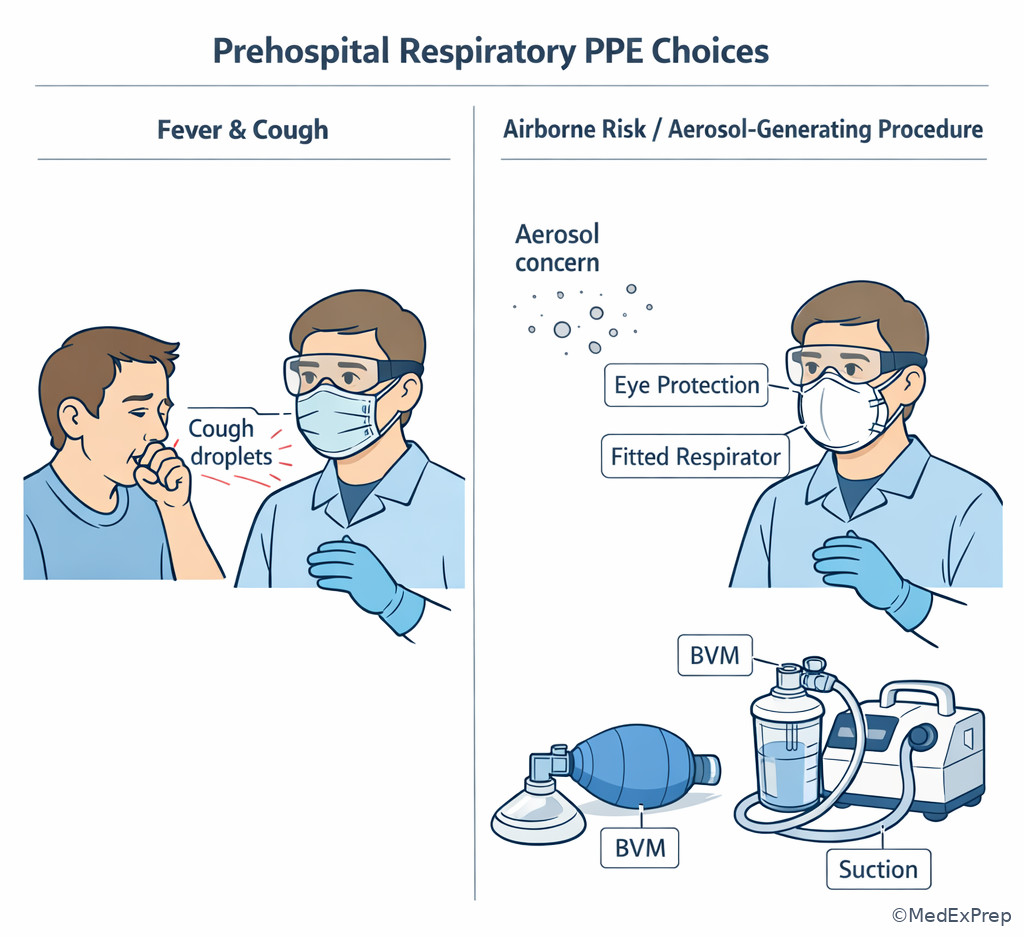
The second decision conflict is minimal PPE for speed versus adequate PPE for the likely exposure route. The single finding that resolves it is the expected mode of exposure: blood/body fluid contact, splash, droplets, aerosols, or contamination. Gloves are baseline, but the exam will test when gloves alone are insufficient. If the stem includes childbirth, major bleeding, vomiting, suctioning, coughing blood, intubation attempts, or bag-mask ventilation, think eye and face splash risk. If the stem includes febrile cough or suspected transmissible respiratory illness, think mask or respirator based on the scenario. If the stem implies airborne risk, higher respiratory protection is safer than a simple surgical mask.
WHY THIS IS TESTED: PPE questions are really route-of-exposure questions. The exam wants you to match the barrier to the threat, not to memorize gear lists in isolation.
Choose more protection when fluid projection or respiratory spread is likely. Reject under-protection because the task feels urgent or routine. Also reject overconfidence based on distance; airway procedures, suction, and vomiting can turn a low-risk encounter into a splash exposure within seconds.
B Worked example
A 71-year-old woman in a skilled nursing facility has fever, productive cough, and increasing shortness of breath. She also has COPD, heart failure, and chronic kidney disease. Staff mention that “several residents have a bad respiratory bug,” but they also report she vomited once after coughing. Her oxygen saturation is 84% on room air, and she is speaking in short phrases. A nurse hands you a nebulizer setup and says, “Can you start treatment immediately?”
Reasoning chain: Identify task: choose the safest immediate preparation before care. Extract key facts: respiratory illness cluster, active cough, vomiting episode, aerosol-generating treatment may be considered. Apply rule: choose PPE based on likely respiratory exposure and splash risk before initiating care. Eliminate distractors: immediate nebulizer treatment is tempting because of low oxygen saturation, but it should not precede proper PPE selection. Verify: don appropriate respiratory and splash protection, then proceed with oxygenation/ventilatory support per local protocol and patient condition.
C Exam trap
D Checkpoint
Question: Which patient encounter most clearly requires adding eye/face protection to gloves before contact?
- A calm patient with isolated ankle pain after a fall. Tempting because any patient can deteriorate, but it is wrong because there is no specific splash risk described.
- A diabetic patient requesting glucose check with dry skin and no vomiting. Tempting because lancet use involves blood, but it is wrong because splash exposure is not the main anticipated risk.
- A postpartum patient with active bleeding and impending delivery of the placenta. Tempting because it feels like “extra” PPE might slow care, but it is right because fluid splash is highly likely.
- A patient with chronic back pain asking for lift assist only. Tempting because close contact occurs, but it is wrong because no fluid or splash exposure is suggested.
- The first priority before patient contact is scene ______.
- True or False: A critically ill patient always justifies entering an active violent scene.
- Name the 3 exposure patterns that commonly force PPE escalation beyond gloves: blood/body fluid contact, fluid ______, and respiratory ______.
Exam takeaway: Choose PPE by the way exposure occurs, not by diagnosis name alone.
flowchart LR
A[Patient contact planned] --> B{Primary exposure risk}
B -->|Contact only| C[Gloves]
B -->|Splash or spray| D[Gloves + eye/face + consider gown]
B -->|Droplet respiratory illness| E[Gloves + mask + eye protection]
B -->|Airborne concern| F[Gloves + respirator level protection]
D --> G[Proceed and reassess]
E --> G
F --> G
C --> G
See Fig 2 when you need a quick exposure-route shortcut under time pressure.
Exam takeaway: A coughing febrile patient and an aerosol-generating procedure should trigger higher respiratory protection thinking.
1.1.1.5 Recognizing unsafe scenes: violence, environmental hazards, and contamination clues
A Explanation
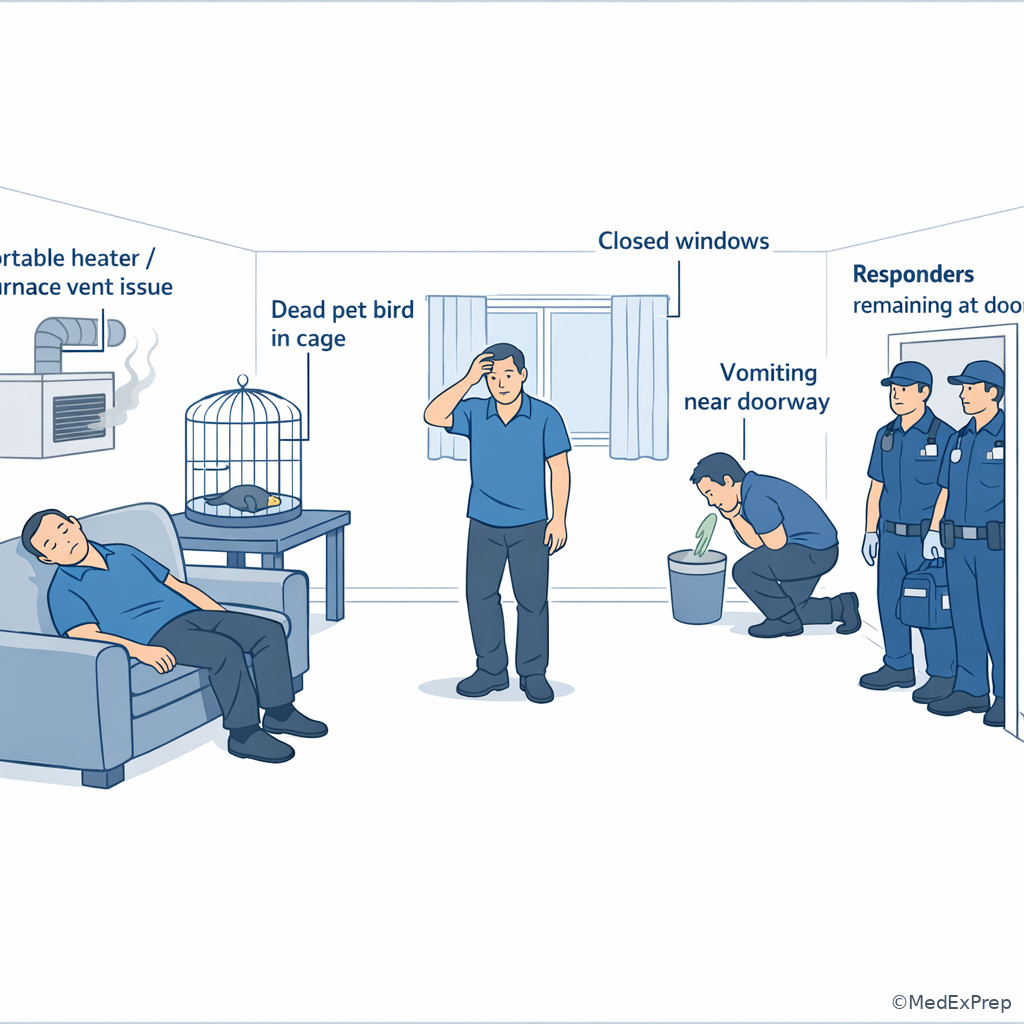
This section moves from definitions to pattern recognition. The decision conflict is treat the visible patient problem versus interpret the scene clues that predict hidden danger. The single finding that resolves it is the presence of hazard indicators that imply EMS should not proceed normally. Some clues are obvious: active fight, smoke, fire, exposed wires, unstable vehicle, or gunfire. Others are indirect: multiple collapsed people in the same room, strange odor, pesticide containers, workers down in an enclosed area, birds or animals dead nearby, unknown powder, or family saying “we all got dizzy at once.” Those are classic contamination or toxic-environment cues.
WHY THIS IS TESTED: NREMT items reward operational pattern recognition. You are not expected to perform advanced hazmat operations; you are expected to recognize when routine patient approach is unsafe and when specialized resources are needed.
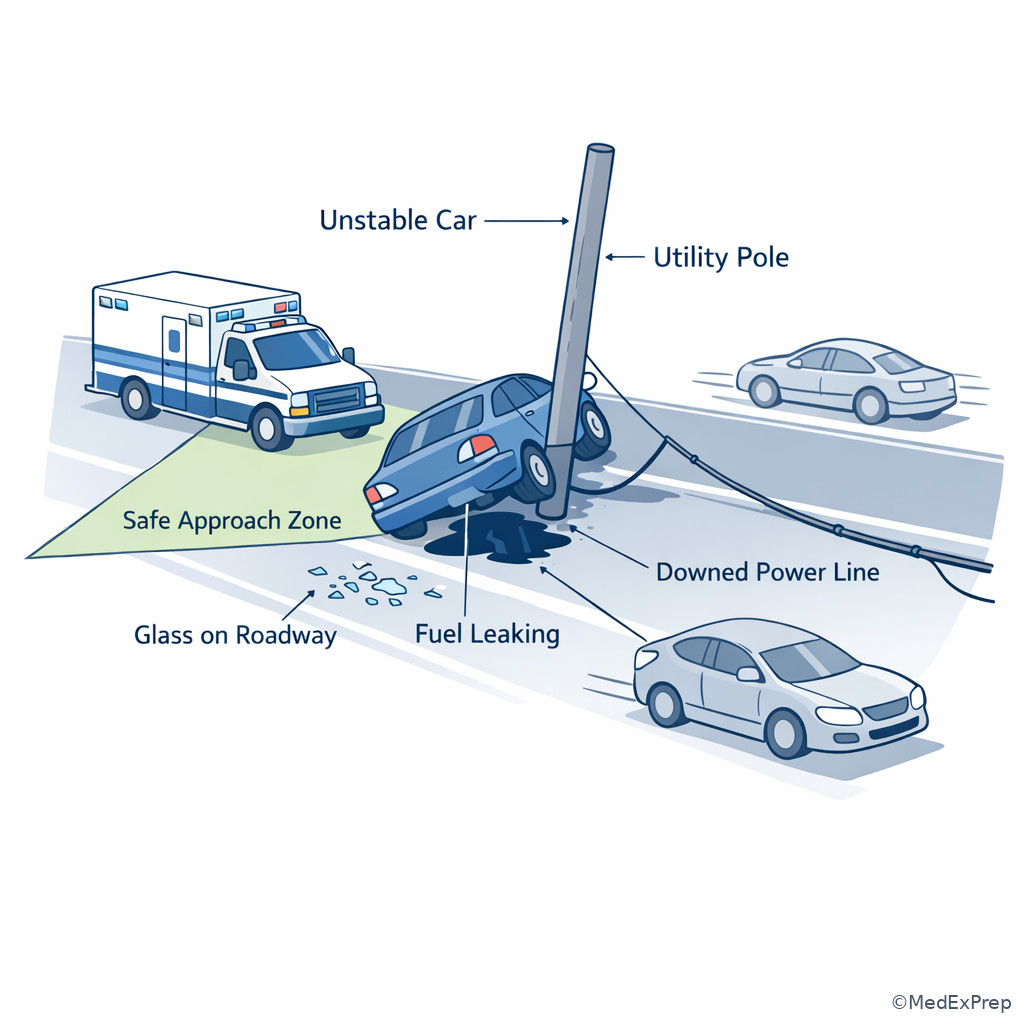
Choose staging, retreat, and hazmat/fire response when the scene suggests chemical or environmental exposure. Reject routine entry and immediate airway intervention in the hot zone. For possible carbon monoxide or toxic inhalation, your first field decision is not a diagnosis label; it is to avoid becoming another exposed victim. Similarly, at vehicle incidents, leaking fuel, traffic flow, unstable wreckage, and downed lines can matter more in the first 30 seconds than the exact injury pattern.
B Worked example
You are dispatched to a “sick person” at a small apartment. A 63-year-old man is reportedly dizzy and vomiting. On arrival, a neighbor says the patient’s wife and adult son are also “acting confused.” The family history includes hypertension and diabetes. A pet bird is dead in a cage by the kitchen window. You notice no fire, but several people inside appear weak. One family member says the furnace has been “making a weird smell,” but another insists the patient only has the flu.
Reasoning chain: Identify task: determine safest best next step before entering. Extract key facts: multiple symptomatic occupants, possible environmental source, dead bird, indoor setting, nonspecific symptoms that could mimic illness. Apply rule: multiple patients with shared symptoms in one environment suggest toxic exposure risk. Eliminate distractors: bringing in oxygen and walking straight to the patient is tempting because dizziness/vomiting are medical complaints, but the cluster pattern and environmental clues make routine entry unsafe. Verify: stage appropriately, request fire or appropriate specialized response, and avoid becoming another victim.
C Exam trap
D Checkpoint
Question: Which scene clue most strongly suggests you should suspect a hazardous environmental exposure rather than a routine isolated illness?
- One patient with a history of diabetes feels dizzy after skipping lunch. Tempting because dizziness is common in EMS, but it is wrong because the pattern suggests an individual medical issue.
- Two elderly roommates both have chronic COPD and mild cough. Tempting because two people are involved, but it is wrong because chronic illness alone does not strongly imply scene contamination.
- Several occupants in one home have sudden headache, nausea, and confusion at the same time. Tempting because the symptoms are nonspecific, but it is right because the cluster pattern points toward a shared environmental exposure.
- A patient with gastroenteritis has vomited twice in the bathroom. Tempting because body fluids raise PPE concerns, but it is wrong because this does not by itself imply a toxic scene hazard.
Exam takeaway: Multiple patients, shared symptoms, unusual odors, or contamination signs should trigger staging and specialty resource requests.
flowchart TD
A[Dispatch says sick person] --> B{Scene pattern}
B -->|Single patient, no hazard clues| C[Routine safe approach]
B -->|Multiple patients same symptoms| D[Suspect shared exposure]
B -->|Unknown odor or leaking container| D
B -->|Smoke, wires, fire, collapse risk| E[Do not enter]
D --> F[Stage and request fire/hazmat]
E --> F
F --> G[Care begins from safe zone after control]
See Fig 3 for the “shared-pattern means shared-risk” shortcut.
Exam takeaway: Several sick occupants in one enclosed space should prompt environmental hazard thinking before patient contact.
Exam takeaway: Traffic, fuel, unstable vehicles, and downed wires may matter before the injury details do.
- The pattern “multiple patients in one location with sudden similar symptoms” should make you think ______ exposure.
- True or False: An unknown odor in an enclosed space is enough to justify a more cautious approach.
- Name 3 nonmedical scene clues that can override immediate patient contact: active violence, traffic hazard, and ______.
1.1.1.6 Integration: when to stage, retreat, or request additional resources
A Explanation
Now the tested conflict becomes operational decision-making: manage with your current crew versus escalate resources because the scene exceeds your immediate capability. The single rule is this: when the hazard cannot be controlled rapidly and safely by routine EMS actions, request the resource that solves the hazard. Law enforcement controls violence and unsecured scenes. Fire manages suppression, stabilization, rescue, and many environmental dangers. Hazmat handles contamination. Utilities may be needed for electrical or gas hazards. Additional EMS may be needed for manpower, multiple patients, or prolonged extrication.
WHY THIS IS TESTED: Entry-level paramedics are expected to recognize limits, not exceed them. The exam does not reward heroic improvisation beyond scope or scene capability.
Choose staging when the threat is ahead of you and access should be delayed. Choose retreat when conditions worsen after entry. Choose resource request early when the stem already shows the scene exceeds EMS alone. Reject answers that imply you must solve every scene problem personally. In NREMT logic, asking for the right help is a sign of good judgment, not weakness.
B Worked example
You respond to a rollover crash on a rural road. A 19-year-old driver is trapped, crying, and appears confused. He has a visible scalp laceration and is trying to move. There is a small fuel leak, the vehicle is on its side, and a live power line is draped across the rear of the car. A family member with asthma is screaming for you to “pull him out now.” Your partner notes that the patient’s breathing appears rapid, but you cannot safely reach him.
Reasoning chain: Identify task: best immediate action. Extract key facts: entrapment, unstable vehicle, live wire, fuel leak, emotional pressure from bystanders. Apply rule: hazards that EMS cannot control require specialized resources and no immediate patient contact. Eliminate distractors: rapid extrication is tempting because the patient may have head trauma, but the live wire is the single detail that stops entry. Verify: keep everyone away, stage in a safe area, request fire/utilities/rescue as appropriate, and begin care only after the hazards are controlled.
C Exam trap
D Checkpoint
Question: Which scenario most clearly requires staging and law enforcement before EMS entry?
- A patient with chest pain in a locked office building. Tempting because access is limited, but it is wrong because the issue is entry logistics, not active safety threat.
- A combative intoxicated patient throwing objects inside a residence. Tempting because some crews try verbal de-escalation first, but it is right because active violence makes the scene unsafe.
- A child with fever and barking cough in a small apartment. Tempting because airway complaints create urgency, but it is wrong because no active safety threat to responders is described.
- A diabetic patient in a cluttered home with poor lighting. Tempting because environmental clutter adds risk, but it is wrong because this does not automatically require law enforcement staging.
Exam takeaway: Match violence, contamination, and rescue problems to the agency that can actually make the scene safe.
flowchart TD
A[Unsafe or uncertain scene] --> B{Main problem}
B -->|Violence or weapons| C[Stage and request law enforcement]
B -->|Fire, rescue, collapse, wires| D[Request fire/rescue or utilities]
B -->|Unknown chemical or contamination| E[Request hazmat/fire]
B -->|Multiple patients or manpower limit| F[Request additional EMS]
C --> G[Enter after scene control]
D --> G
E --> G
F --> G
See Fig 4 when options differ only by which resource is requested.
1.1.1.7 Exposure events, contamination, and documentation after the scene is controlled
A Explanation
The final integration conflict is move on after patient care versus treat exposure management and documentation as part of the clinical job. The single rule: if a responder may have been exposed to blood, body fluids, respiratory secretions, or contamination, the event requires immediate protective action, reporting, and documentation according to agency process. On the exam, this is less about administrative detail and more about safe follow-through.
WHY THIS IS TESTED: Good prehospital care includes post-exposure action, decontamination awareness, and clear communication. Candidates often stop thinking once the patient is loaded, but scene safety extends beyond initial contact.
Choose decontamination, gear removal in proper sequence, hand hygiene, reporting, and receiving-facility communication when exposure or contamination may have occurred. Reject the impulse to continue routine tasks with contaminated gloves, equipment, or clothing. If the crew’s PPE fails during a high-risk exposure, act promptly to reduce spread and report it. Documentation should include the hazard, PPE worn, what happened, actions taken, and who was notified. The exam is not looking for agency-specific paperwork names; it is looking for the principle that safety incidents must be managed and communicated.
B Worked example
A 32-year-old trauma patient with a forearm laceration becomes briefly combative during packaging after alcohol use and anxiety. He also has psoriasis and hepatitis C noted in his history, and the scene includes multiple family members talking over each other. During movement to the stretcher, blood splashes around the patient’s arm and your eye protection is found to be lifted above your face. Your partner says, “We’re almost loaded — just deal with it later.”
Reasoning chain: Identify task: most appropriate action after a likely exposure. Extract key facts: blood splash, PPE breach, ongoing patient movement, distracting family noise, infectious risk not fully defined in the field. Apply rule: reduce further exposure, restore proper protection, report, and document. Eliminate distractors: ignoring the event because transport is nearly complete is tempting, but it fails crew safety follow-through. Verify: address the exposure per safe practice, replace or reapply appropriate PPE, continue care safely, and report/document according to agency process.
C Exam trap
D Checkpoint
Question: After a vomiting patient splashes emesis onto your unprotected eye during transport, which action is most appropriate?
- Finish the call without interruption and mention it later if symptoms develop. Tempting because transport is busy, but it is wrong because potential exposure requires immediate action and reporting.
- Reduce further exposure, perform appropriate immediate post-exposure steps, notify the appropriate chain, and document the event. Tempting because it adds work during a busy call, but it is right because exposure management is part of safe EMS practice.
- Ask the receiving nurse to handle all follow-up since the patient is now hospital responsibility. Tempting because the hospital can assist, but it is wrong because EMS still must follow agency reporting and exposure procedures.
- Discard the eye protection and continue care bare-faced to avoid delay. Tempting because replacement seems time-consuming, but it is wrong because it increases ongoing risk.
Exam takeaway: A likely exposure requires immediate mitigation, reporting, and documentation rather than delayed informal follow-up.
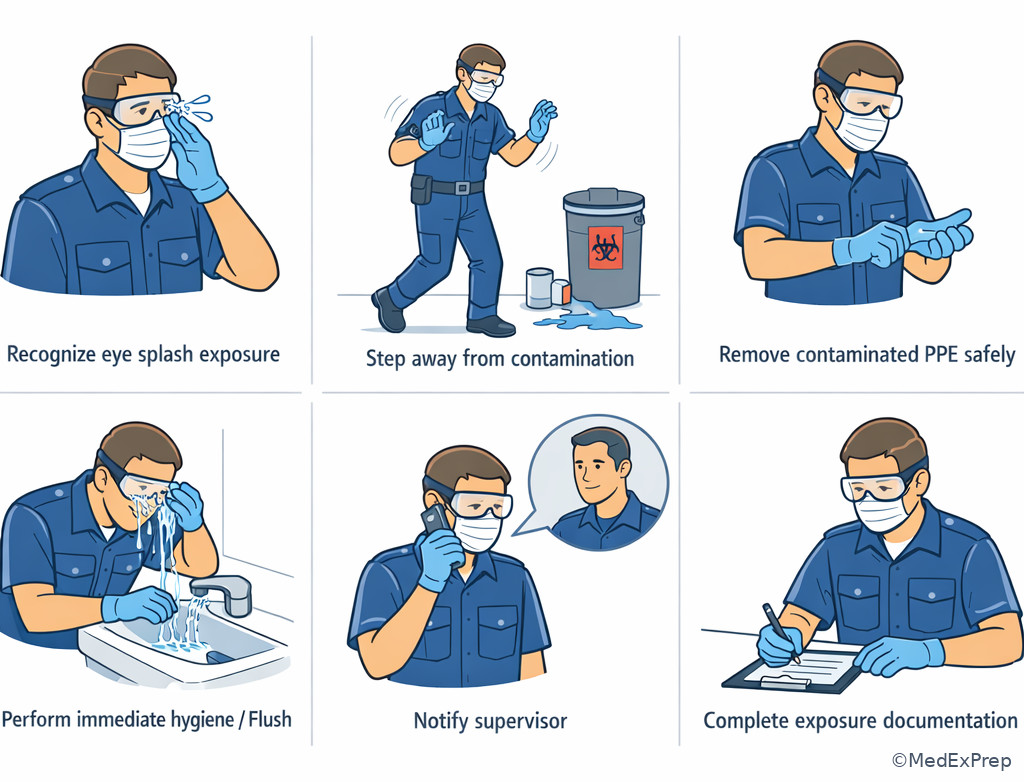
See Fig 5 for the tested “recognize-mitigate-report-document” sequence.
Exam Traps & Differentiators
- Most common wrong answer and why: Immediate airway or hemorrhage treatment. Tempting because it addresses the visible life threat, but wrong if violence, electricity, traffic, contamination, or collapse risk is still active.
- Looks similar but isn't: A messy scene is not automatically an unsafe scene. Clutter, low light, and emotional family members require caution, but active violence, toxins, and electrical threats require staging or retreat.
- If the stem says “multiple patients with sudden similar symptoms in one room,” think shared exposure and specialty resource request.
- If the stem says “weapon, fight, combative person, crowd hostility,” think stage and law enforcement before entry.
- If the stem says “downed wires, fuel leak, smoke, structural instability,” think fire/rescue/utilities and no immediate entry.
- If the stem says “vomiting, childbirth, suctioning, coughing blood,” think splash protection, not gloves only.
- If the stem says “febrile cough, respiratory cluster, aerosol-generating procedure,” think respiratory PPE escalation before intervention.
Related trap from upcoming topics: in MOI, NOI, & Resources, a dramatic mechanism may tempt you to focus only on injuries; remember that mechanism also predicts rescue needs and scene instability. In C-Spine & Extrication Triggers, spinal concerns never override an immediately unsafe electrical, fire, or violent scene.
| Stem clue | Tempting wrong move | Correct discriminator | Best operational answer |
|---|---|---|---|
| Active fight near patient | Rush in because bleeding is severe | Violence is uncontrolled | Stage and request law enforcement |
| Several family members dizzy in same house | Enter to check glucose on first patient | Cluster symptoms imply environmental exposure | Stage and request fire/hazmat support |
| Childbirth with heavy fluid exposure expected | Gloves only to save time | Splash risk is high | Add eye/face protection and appropriate barriers |
| Patient coughing with febrile respiratory illness | Start nebulizer before PPE | Respiratory spread risk is present | Don appropriate respiratory PPE first |
| Live wire on crashed vehicle | Rapid extrication for altered patient | Electrical hazard is immediately lethal | Keep distance and request utility/fire support |
| Looks similar | Actually means | Key clue |
|---|---|---|
| One ill patient in a home | Usually a routine medical scene | No shared symptom cluster or hazard signs |
| Several ill people in a home | Possible environmental or toxic exposure | Shared sudden symptoms in same space |
| Emotional bystanders | Manageable noise if not threatening | Upset but not violent |
| Agitated bystanders advancing on crew | Unsafe scene requiring staging | Threat behavior toward responders |
| Blood on patient | Baseline contact risk | Gloves required |
| Actively spraying blood or vomiting | Splash risk beyond glove-only care | Face/eye exposure likely |
Tables
| Exposure pattern | Minimum high-yield PPE response | Typical examples |
|---|---|---|
| Routine contact with possible blood/body fluid touch | Gloves | Most patient contacts, IV setup, glucose checks |
| Splash or spray risk | Gloves + eye/face protection; consider gown | Childbirth, major bleeding, vomiting, suctioning |
| Droplet respiratory spread concern | Gloves + mask + eye protection | Febrile cough, respiratory illness cluster |
| Airborne concern | Gloves + respirator-level protection; eye protection as indicated | Scenario suggests higher-level respiratory spread risk |
| Hazmat/contamination | Do not rely on routine PPE alone | Unknown chemical, leaking container, multiple exposed victims |
| Hazard type | Choose | Reject | Reasoning shortcut |
|---|---|---|---|
| Violence/weapons | Stage; request law enforcement | Immediate entry for patient contact | Unsecured violence beats medical urgency |
| Traffic/roadway risk | Scene protection, safe positioning, reassess traffic flow | Standing unprotected in live lanes | Secondary collisions injure crews |
| Electrical hazard | Keep distance; request fire/utilities | Touch vehicle or patient near live line | Electricity makes rapid rescue incorrect |
| Chemical contamination | Stage/retreat; request hazmat/fire | Routine EMS entry into hot zone | Do not become another victim |
| Fluid splash risk | Eye/face protection | Gloves only | Route of exposure determines PPE |
| Scene pattern | Most likely classification | Immediate implication |
|---|---|---|
| Single patient, no hazards, cooperative environment | Routine safe scene | Approach with standard precautions |
| One critical patient plus active assault nearby | Unsafe violent scene | Stage and await control |
| Multiple occupants with sudden same symptoms indoors | Possible environmental exposure | Request fire/hazmat; avoid routine entry |
| Roadway incident with unstable wreckage and fuel leak | Rescue/environmental hazard scene | Use protective positioning and request fire/rescue |
| Coughing febrile patient requiring airway support | Respiratory PPE escalation scene | Don respiratory protection before intervention |
| PPE breach during care | Exposure-management event | Mitigate, report, and document |
Algorithm / Approach
Exam takeaway: The safest best answer follows a fixed order: hazard scan, PPE choice, resource request, then patient contact.
See Fig 6 for the overall exam-ready approach that links the lesson’s major decisions.
Rapid Review
- Unsafe scene → responder threat outranks immediate patient contact.
- Active violence → stage for law enforcement, not partner-assisted entry.
- Multiple sudden similar illnesses indoors → think shared exposure, not isolated medical complaint.
- Live wire on vehicle → no rapid extrication until hazard control.
- Major bleeding with spray → face/eye protection separates correct from glove-only distractor.
- Febrile cough plus airway procedure → respiratory PPE choice becomes part of the intervention.
- Hazmat clue → routine EMS care begins in the safe zone, not the hot zone.
- Cluttered home → caution; not the same as an actively unsafe scene.
- Angry crowd → threat behavior, not volume alone, changes the answer to staging.
- PPE breach → active safety event requiring mitigation and reporting.
- Resource request → good judgment, not delayed care.
- Scene safety → reassessed continuously, not only at arrival.
Self-check quiz
1. You arrive to a reported collapse at a bus stop. A 58-year-old man is seated on the ground, pale and diaphoretic. There are no visible hazards, no crowd issues, and traffic is separated by a barrier. Which action is most appropriate before touching the patient?
- Perform a rapid trauma assessment
- Confirm the scene is safe and don appropriate PPE
- Apply oxygen immediately
- Request law enforcement for crowd control
2. A 26-year-old postpartum patient is actively bleeding after delivery at home. She has no violent behavior, no contamination clues beyond body fluids, and family is cooperative. Which PPE addition beyond gloves is most appropriate?
- Eye/face protection
- Hearing protection
- Cervical collar
- Reflective traffic vest only
3. You are called for a 67-year-old woman with weakness in an apartment. She has hypertension and COPD. On arrival, you learn her husband and adult daughter both developed headache and nausea in the same room, and a neighbor says the heater has been malfunctioning. A grandchild is crying but appears well. What is the most appropriate next step?
- Enter quickly with oxygen and remove the weakest patient first
- Stage and request fire or appropriate hazardous-environment support before routine entry
- Ask dispatch to have the family ventilate the apartment while you begin care inside
- Begin a stroke assessment because weakness is the lead complaint
4. A 73-year-old nursing home resident with CHF and diabetes has fever, productive cough, and severe dyspnea. She vomited once and may need suctioning. Staff say several residents have similar symptoms. Which preparation is most appropriate before initiating close-contact airway care?
- Gloves only, because oxygen saturation is the priority
- Gloves and eye protection only, because vomiting is the only exposure risk
- Appropriate respiratory and splash protection based on likely exposure
- Delay all care until a physician evaluates the patient
5. You respond to a 34-year-old intoxicated man with a hand laceration. He has bipolar disorder, recent methamphetamine use per friends, and is yelling that responders should stay back. He throws a glass bottle toward the doorway. Which action is most appropriate?
- Enter with your partner and attempt manual restraint immediately
- Stage and request law enforcement because the scene is actively unsafe
- Approach slowly while preparing a bandage to show you can help
- Ignore the patient’s behavior because the bleeding complaint is minor
6. A 21-year-old driver is trapped in a vehicle after striking a utility pole. He is tachypneic, confused, and has visible facial blood. The car is on its side, gasoline is leaking, and a line is draped over the rear of the vehicle. A bystander says, “It’s probably just a cable line.” Which is the most appropriate action?
- Perform rapid extrication because altered mental status suggests impending airway failure
- Approach from the front and manually stabilize the head and neck
- Keep clear, prevent others from approaching, and request fire/utilities/rescue
- Send one provider in while the second provider stands back for safety
7. During transport of a 49-year-old patient with hematemesis, your partner’s glove tears while wiping blood from the stretcher rail. The patient also has cirrhosis and confusion, and family keeps asking whether he has “something contagious.” The patient remains hypotensive but airway is intact. Which action is most appropriate for your partner?
- Continue care with the torn glove because replacing PPE wastes time
- Remove the damaged glove safely, replace PPE, reduce further exposure, and report/document the event if exposure occurred
- Transfer all patient care to the hospital and skip EMS reporting because the receiving staff can manage it
- Stop the ambulance immediately and terminate transport to complete paperwork first
8. You arrive at a private residence for a 6-year-old with severe shortness of breath. The child has asthma and eczema; the father has influenza-like symptoms and is coughing continuously. The child is cyanotic and the mother is panicked but cooperative. There is no violence, no environmental hazard, and no contamination clue beyond respiratory illness. Which action is most appropriate?
- Refuse entry until law enforcement secures the home
- Enter without PPE because pediatric respiratory distress overrides infection-control concerns
- Don appropriate respiratory PPE promptly and begin airway/oxygenation care
- Wait outside for a hazmat team because multiple family members may be sick
Answer key
1. Correct answer: B — Confirm the scene is safe and don appropriate PPE.
- A. Tempting because a collapsed patient may have trauma, but incorrect for this scenario because no trauma clues are provided and the first operational step remains scene safety plus PPE. Single stem clue: “No visible hazards” tells you to confirm safety, then proceed normally rather than jump to a secondary exam. Source: AAOS, Emergency Care and Transportation of the Sick and Injured; National EMS Education Standards.
- B. Tempting because it seems basic, and it is correct because scene confirmation and PPE selection always precede patient contact. Single stem clue: “Before touching the patient.” Source: National Highway Traffic Safety Administration (NHTSA), National EMS Education Standards; CDC standard precautions guidance.
- C. Tempting because pallor and diaphoresis suggest serious illness, but incorrect because oxygen is a patient intervention that comes after the scene/PPE step. Single stem clue: the question asks for the action before contact. Source: AAOS text; NHTSA standards.
- D. Tempting because public scenes can become chaotic, but incorrect because the stem specifically says there are no crowd issues. Single stem clue: “No crowd issues.” Source: EMS operations principles in NHTSA standards.
2. Correct answer: A — Eye/face protection.
- A. Tempting because it may feel slower in an urgent obstetric scene, but correct because childbirth and active bleeding create major splash risk. Single stem clue: “Actively bleeding after delivery.” Source: CDC standard precautions; AAOS paramedic/EMS obstetric care principles.
- B. Tempting only because scenes can be loud, but incorrect because hearing protection does not address the exposure route tested here. Single stem clue: fluid exposure, not noise, is the problem. Source: CDC PPE guidance.
- C. Tempting if candidates confuse equipment categories, but incorrect because a cervical collar is not PPE. Single stem clue: the question asks for PPE addition. Source: NHTSA standards.
- D. Tempting because roadway operations use high-visibility garments, but incorrect because this is a home obstetric scene and the tested risk is splash. Single stem clue: “at home” and “actively bleeding.” Source: CDC PPE guidance; EMS operations standards.
3. Correct answer: B — Stage and request fire or appropriate hazardous-environment support before routine entry.
- A. Tempting because oxygen and removal sound lifesaving, but incorrect because the scene suggests environmental exposure and routine entry may expose the crew. Single stem clue: multiple occupants with headache and nausea in the same room. Source: NHTSA standards; EMS hazardous-scene awareness principles.
- B. Tempting because it delays individual patient treatment, but correct because the cluster pattern and malfunctioning heater suggest shared environmental hazard. Single stem clue: several household members symptomatic together. Source: National EMS Education Standards; AAOS EMS operations chapters.
- C. Tempting because it seems like partial hazard control, but incorrect because remote layperson ventilation does not make the environment safe for EMS entry and may be inadequate. Single stem clue: suspected hazardous indoor environment. Source: EMS hazardous materials awareness principles.
- D. Tempting because weakness is a focal symptom in one patient, but incorrect because the scene pattern outweighs isolated diagnostic thinking. Single stem clue: husband and daughter share symptoms too. Source: NHTSA scene size-up standards.
4. Correct answer: C — Appropriate respiratory and splash protection based on likely exposure.
- A. Tempting because hypoxemia demands prompt action, but incorrect because close-contact airway care in a coughing, vomiting patient increases both respiratory and splash exposure risk. Single stem clue: cough plus vomiting plus possible suctioning. Source: CDC infection-control guidance; AARC airway/aerosol procedure safety principles.
- B. Tempting because vomiting clearly raises splash risk, but incorrect because it underestimates the respiratory spread concern in a clustered febrile illness. Single stem clue: “several residents have similar symptoms.” Source: CDC respiratory precautions guidance.
- C. Tempting because it requires a quick pause before intervention, and correct because PPE should match both splash and respiratory exposure routes. Single stem clue: severe dyspnea with cough, vomiting, and possible suctioning. Source: CDC PPE guidance; NHTSA standards.
- D. Tempting only if candidates confuse scope, but incorrect because delaying lifesaving EMS care for physician evaluation is outside appropriate field decision-making. Single stem clue: this is an EMS treatment decision, not a physician-only step. Source: NREMT paramedic scope perspective; National EMS Education Standards.
5. Correct answer: B — Stage and request law enforcement because the scene is actively unsafe.
- A. Tempting because restraint may eventually be required in some systems, but incorrect because entering during active assaultive behavior is unsafe and may exceed the safest immediate EMS role. Single stem clue: the patient throws a bottle toward the doorway. Source: NHTSA EMS operations and scene safety principles.
- B. Tempting because it delays bleeding care, but correct because an actively threatening patient makes the scene unsafe. Single stem clue: “stay back” plus thrown object. Source: National EMS Education Standards; AAOS scene safety chapters.
- C. Tempting because verbal de-escalation is clinically reasonable in some situations, but incorrect because the active projectile behavior already marks the scene as unsafe for entry. Single stem clue: violence has moved beyond verbal agitation. Source: EMS safety standards.
- D. Tempting because the wound itself may be minor, but incorrect because ignoring the patient is not the same as scene management; the question asks for the most appropriate action. Single stem clue: active safety threat requires staging and resource request. Source: NHTSA standards.
6. Correct answer: C — Keep clear, prevent others from approaching, and request fire/utilities/rescue.
- A. Tempting because altered mental status and tachypnea can justify rapid trauma intervention, but incorrect because a possible live electrical line makes approach unsafe. Single stem clue: line draped over the vehicle. Source: EMS roadway and electrical hazard safety guidance; NHTSA standards.
- B. Tempting because spinal stabilization is often tested in vehicle trauma, but incorrect because no patient contact should occur until the electrical hazard is controlled. Single stem clue: possible energized line. Source: AAOS trauma scene safety guidance.
- C. Tempting because it feels less active than rescue, but correct because electrical, fuel, and entrapment hazards require specialty resources before EMS contact. Single stem clue: gas leak plus wire plus unstable vehicle. Source: National EMS Education Standards; fire/rescue scene safety principles.
- D. Tempting because splitting roles feels safer, but incorrect because one exposed provider is still one preventable casualty. Single stem clue: uncontrolled lethal hazard remains unchanged. Source: NHTSA scene safety principles.
7. Correct answer: B — Remove the damaged glove safely, replace PPE, reduce further exposure, and report/document the event if exposure occurred.
- A. Tempting because hypotension creates pressure to stay hands-on, but incorrect because a torn glove creates ongoing exposure risk. Single stem clue: glove tear during blood contact. Source: CDC standard precautions; EMS occupational exposure principles.
- B. Tempting because it adds steps during transport, and correct because PPE failure requires immediate mitigation and follow-through. Single stem clue: active blood contact with damaged barrier. Source: CDC PPE guidance; NHTSA standards.
- C. Tempting because the hospital will continue care, but incorrect because EMS still owns its exposure reporting process. Single stem clue: EMS crew experienced the breach during transport. Source: EMS occupational exposure policy principles.
- D. Tempting because it sounds thorough, but incorrect because it inappropriately interrupts necessary transport for a hypotensive patient; exposure management should occur while maintaining safe care and transport priorities. Single stem clue: patient remains hypotensive. Source: NREMT field-priority framework; CDC exposure management principles.
8. Correct answer: C — Don appropriate respiratory PPE promptly and begin airway/oxygenation care.
- A. Tempting because homes can be unpredictable, but incorrect because no violence or security threat is described. Single stem clue: mother is panicked but cooperative; no violence. Source: NHTSA scene safety standards.
- B. Tempting because the child is cyanotic and treatment is urgent, but incorrect because urgency does not cancel infection-control precautions when respiratory exposure is likely. Single stem clue: father is coughing continuously with influenza-like symptoms. Source: CDC respiratory precaution guidance.
- C. Tempting because it requires balancing two priorities, and correct because the scene is otherwise safe but respiratory PPE is indicated before close-contact airway care. Single stem clue: severe pediatric respiratory distress in a home with active respiratory illness, but no environmental hazard. Source: CDC PPE guidance; National EMS Education Standards.
- D. Tempting because more than one household member may be ill, but incorrect because there is no evidence of hazmat or environmental contamination; this is a respiratory PPE problem, not a hazmat scene. Single stem clue: no contamination clue beyond respiratory illness. Source: NHTSA standards; CDC guidance.
Keep going with the full NREMT-Paramedic Prep Course (Paramedic)
You just studied the way members do, in the same lesson interface. Full access unlocks every lesson, the question bank and flashcards for a full year.
One payment · 1 year of access · No auto-renewal