1.1.1 - EMT Scope And Limitations
EMT Scope And Limitations
What you'll learn
- Distinguish what an entry-level EMT should do immediately versus what requires ALS, medical control, or receiving-facility resources.
- Choose the best EMT-level action when exam stems tempt you with advanced or hospital-based care.
- Recognize scope boundaries in airway, medications, assessment, transport, and legal/operational decisions.
- Apply a simple decision rule: treat life threats, act within scope, request appropriate help, and reassess.
- Document and communicate findings in a way that supports safe transfer of care.
45–60 minutes
- EMS Operations → Professional roles and safe practice boundaries
- Patient Assessment → Primary assessment before detailed or advanced care
- Airway/Respiration/Ventilation → EMT-level intervention selection versus ALS escalation
- Medical/Trauma → Scope-aware prioritization, transport, and communication
None formally. Forward links for continuity: Clinical Reasoning Framework and Provider Wellness And Safety
You should be able to choose the most appropriate immediate EMT action, reject out-of-scope distractors, request ALS appropriately, and explain your decision.
Why it matters
- NREMT questions often hide the correct answer behind a tempting ALS or hospital-level option; passing depends on choosing the best EMT action first.
- In the field, scope errors can delay life-saving BLS care, create legal risk, and harm patients.
- Knowing your limits improves scene efficiency: you treat what you can now, request more help early, and transport without unnecessary delay.
- Scope awareness is not passivity; it is active, disciplined decision-making under protocol and medical direction.
Exam takeaway: Choose immediate BLS care first, then escalate when the problem exceeds EMT scope or resources.
flowchart TD
A[Scene and patient contact] --> B[Identify life threat]
B --> C{Can EMT treat now with BLS?}
C -->|Yes| D[Intervene immediately]
D --> E[Reassess and transport]
C -->|No or only partly| F[Request ALS or additional resources]
F --> G[Continue BLS supportive care]
G --> E
E --> H[Document and communicate handoff]
See Fig 1 for the basic exam pattern: first do what is within EMT scope and immediately beneficial, then escalate appropriately.
Key Terms & Must-Know Facts
1.1.1.1 Key terms
- Scope of practice: What EMT education, regulation, protocol, and medical direction authorize you to do.
- Standard of care: The expected level of care a similarly trained EMT would provide.
- Medical direction: Physician oversight, online or offline, guiding EMT care.
- BLS: Basic life support interventions within EMT-level training.
- ALS intercept: Requesting a higher-level unit when patient needs exceed EMT scope or available resources.
- Primary assessment: Immediate identification and treatment of life threats.
- Protocol: Agency or system-approved care steps; local details vary.
- Delegated medication assistance: Helping with or administering certain medications if authorized.
- Rapid transport: Prioritizing movement to an appropriate facility when time-sensitive threats exist.
- Reassessment: Repeat evaluation after interventions or condition changes.
- Handoff report: Structured transfer of patient information and care performed.
- Out-of-role signal: Stem wording that points to paramedic, nursing, or physician tasks rather than EMT tasks.
1.1.1.2 Must-know facts
- EMTs do not independently perform invasive ALS procedures such as IV/IO access, endotracheal intubation, or needle thoracostomy.
- The correct exam answer is often supportive BLS care + request ALS + transport, not advanced definitive treatment.
- Do not delay airway support, bleeding control, CPR/AED, or rapid transport while waiting for ALS.
- EMTs can assess, recognize, support, and communicate; they do not make physician-level disposition or definitive diagnosis decisions.
- If protocol details vary, choose the safest general EMT principle and note that local protocols vary.
- Scene safety and standard precautions come before patient contact.
- When multiple actions are possible, choose the one that addresses the most immediate life threat.
- Documentation should record findings, interventions, response, times, communications, and changes in patient status.
| Area | Usually within EMT scope | Usually outside EMT scope | Best exam response |
|---|---|---|---|
| Airway | Positioning, suction, OPA/NPA, BVM, oxygen | Surgical airway, endotracheal intubation | Open airway, ventilate as needed, request ALS if inadequate |
| Circulation | Bleeding control, CPR, AED, shock care | IV fluids, vasoactive drips | Treat shock signs, rapid transport, ALS intercept if indicated |
| Medications | EMT-approved assist/admin per protocol | Unauthorized medication administration | Use protocol-approved meds only; otherwise supportive care |
| Cardiac | AED use, CPR, chest pain support | Advanced ECG-driven treatment decisions | Manage ABCs, aspirin assist if allowed, transport appropriately |
| Trauma | Bleeding control, splinting, motion restriction considerations | Chest decompression, surgical intervention | Control life threats first and transport promptly |
| Disposition | Transport priority and destination within protocol | Hospital admission/discharge decisions | Choose appropriate transport and notify receiving facility |
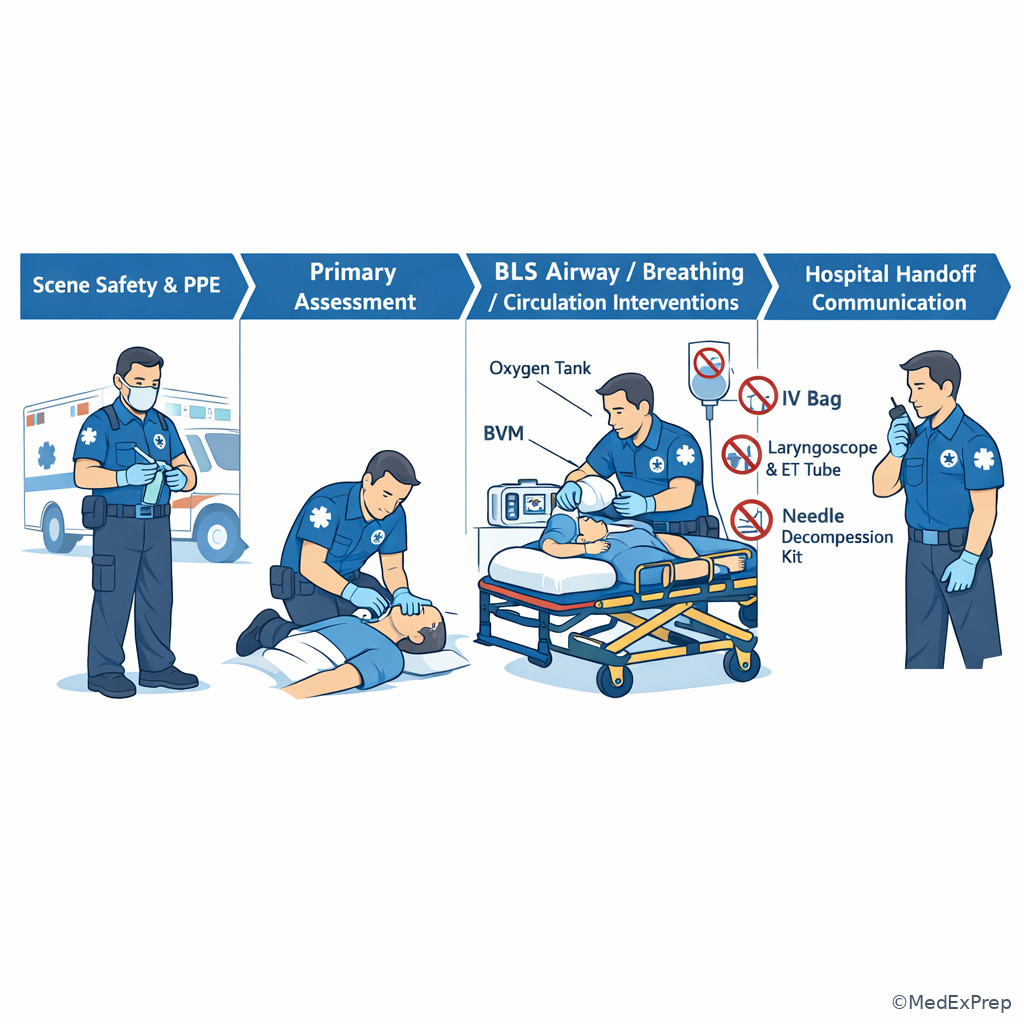
Exam takeaway: Visualize how EMT decisions cluster around safety, BLS interventions, reassessment, and communication rather than invasive care.
Core content
1.1.1.3 Foundational rule: what the EMT role includes and excludes
A Explanation
The first scope decision on exam day is a conflict between doing something helpful now and reaching for a more advanced action that feels definitive. The rule that resolves it is simple: if the patient has a life threat that can be treated by BLS, the EMT treats it immediately; if the problem exceeds EMT capability, the EMT requests appropriate resources while continuing supportive care. WHY THIS IS TESTED: many stems offer a technically helpful intervention that is correct in a hospital or ALS context but wrong for an EMT as the first or independent action.
Think of EMT scope in four buckets: assess, intervene, escalate, document. Assess means scene size-up, primary assessment, focused exam, vital signs, history, and reassessment. Intervene means airway positioning, suction, adjuncts, oxygen, BVM, CPR/AED, hemorrhage control, splinting, shock care, selected medication assistance or administration per protocol, packaging, and transport. Escalate means ALS intercept, medical control, law enforcement, fire/rescue, specialty destination, or rapid transport. Document means what you found, what you did, how the patient responded, and whom you notified.
Reject answer choices that assume physician or paramedic authority: “intubate,” “start an IV,” “interpret the 12-lead for treatment,” “give vasoactive medication,” or “discharge home.” Those options test whether you recognize that good EMT practice includes knowing when not to overstep. See Fig 1 and Fig 2.
Exam takeaway: If an option bypasses immediate BLS care or requires ALS authority, reject it unless the stem asks what resource to request.
flowchart LR
A[Answer choice] --> B{Immediate life threat?}
B -->|Yes| C{BLS can help now?}
C -->|Yes| D[Choose EMT intervention first]
C -->|No| E[Request ALS or transport priority]
B -->|No| F{Within EMT protocol?}
F -->|Yes| G[Proceed and reassess]
F -->|No| H[Reject option and escalate appropriately] B Worked example
A 67-year-old man with COPD and hypertension is found seated in a recliner, speaking one-word sentences. His daughter says, “He probably just needs his lungs drained like last time.” He has labored respirations, diffuse wheezing, cyanosis around the lips, and an SpO2 of 82% on room air. A prescription nitroglycerin bottle is on the table, and his ankles are swollen. The task asks for the most appropriate next step.
Identify task: choose the immediate EMT action, not a definitive diagnosis. Extract key facts: severe respiratory distress, hypoxemia, poor speech, possible respiratory failure risk. Apply rule: airway and breathing threats within EMT scope must be addressed immediately. Eliminate distractors: nitroglycerin is tempting because edema suggests CHF, but the immediate issue is oxygenation/ventilation, and nitroglycerin assistance depends on protocol, blood pressure, medication verification, and presentation. “Perform endotracheal intubation” is outside EMT scope. “Wait for ALS before treating” delays care. Verify: the best next step is high-concentration oxygen or assisted ventilation if indicated, positioning, request ALS, and rapid transport.
C Exam trap
Common wrong answer: Start the advanced treatment that matches the likely diagnosis.
Why it is tempting: Board-style stems often include clues toward pulmonary edema, MI, sepsis, or tension pneumothorax, making the learner want to choose the definitive treatment.
Single clue that eliminates it: The question asks for the EMT next step, and the patient has an immediate BLS-manageable life threat right now.
D Checkpoint
Question: An EMT crew arrives for a 54-year-old woman with severe shortness of breath, accessory muscle use, and altered speech. Which action is most appropriate first?
- Perform endotracheal intubation because she may tire out.
- Begin BVM support as indicated, provide oxygen, and request ALS.
- Obtain a full medication list before starting treatment.
- Wait for paramedics because advanced airway control may be needed.
Correct answer: B.
- A: Tempting because airway failure is possible; wrong because intubation is outside EMT scope and delays immediate BLS support.
- B: Tempting because it seems less definitive; right because it treats the current breathing threat within EMT scope while escalating appropriately.
- C: Tempting because history matters; wrong because treatment of an immediate breathing problem comes before detailed medication review.
- D: Tempting because ALS may be needed; wrong because EMTs must not delay indicated BLS care while waiting.
1.1.1.4 Authority, protocols, and medical direction
A Explanation
Scope is not just a list of skills; it is shaped by state regulation, local protocols, agency policy, and medical direction. On the exam, when protocol details vary, the safest national principle wins: follow approved EMT-level care, contact medical control when needed, and do not invent permission for borderline actions. The conflict is often between “I know a treatment that could help” and “Am I authorized to do it here, this way, under this protocol?” The rule that resolves it is authorization plus patient need. A helpful action without authorization is still the wrong exam answer.
Medical direction is your clinical safety net. Offline medical direction appears in standing orders and protocols. Online medical direction means real-time consultation. If a patient refuses care, requests a nonstandard action, has a medication issue outside your usual standing orders, or the situation has legal complexity, contacting medical control may be the best next step after immediate threats are addressed. This matters because NREMT tests professional judgment under supervision, not independent physician decision-making.
Local protocols vary in medication assistance, destination rules, and some operational details. Nationally safe wording is: give only EMT-approved medications per protocol, or assist with the patient’s prescribed medication if authorized and indicated. If a stem requires a jurisdiction-specific choice not stated, choose supportive care, communication, and consultation rather than guessing.
B Worked example
A 45-year-old man with diabetes and chronic back pain is awake but confused after skipping meals. His wife says he “always perks up after insulin,” and she hands you his insulin pen. Glucose is low on your meter. He is able to swallow but answers slowly. He also complains of chronic lumbar pain from a recent strain. The task asks what action requires immediate clarification.
Identify task: not which therapy helps diabetes in general, but which action is authorized and appropriate for an EMT. Extract key facts: symptomatic hypoglycemia, oral route may be possible, insulin pen offered by family, distracting back pain. Apply rule: EMTs give only approved medications per protocol; insulin administration is not standard EMT self-initiated care in this context. Eliminate distractors: oral glucose may be appropriate if the patient can protect the airway and local protocol allows; oxygen is supportive if indicated; ALS request is reasonable if mental status worsens. The unsafe action is giving insulin because the patient is hypoglycemic and the medication is outside the intended intervention here.
C Exam trap
Common wrong answer: Help the patient with a medication simply because it belongs to the patient.
Why it is tempting: Learners overgeneralize “assist with prescribed medication” and forget that indication, patient status, and protocol still control the decision.
Single clue that eliminates it: The medication must match the patient’s current problem and your protocol; a prescribed drug can still be wrong right now.
D Checkpoint
Question: Which situation most strongly indicates contacting medical control after immediate threats are addressed?
- A patient with chest pain requests transport to a facility outside your usual destination pattern despite protocol concerns.
- A patient with minor ankle pain asks for an ice pack.
- A patient with epistaxis improves after direct pressure.
- A patient with a simple arm fracture requests padding under the splint.
Correct answer: A.
- A: Tempting because destination issues can seem operational; right because nonstandard destination/refusal-type complexity may require protocol review and medical direction.
- B: Tempting because it involves a request; wrong because it usually does not create significant protocol or legal complexity.
- C: Tempting because bleeding can be serious; wrong because the immediate problem is controlled and no unusual authorization issue is present.
- D: Tempting because splinting has technique variation; wrong because this remains routine EMT care.
- Fill in the blank: A treatment can be clinically helpful yet still be wrong if it is outside your ______ and protocol.
- True or False: If ALS is en route, the EMT should delay indicated BLS treatment.
- Name the 3 common triggers for calling medical control: unclear authorization, refusal/legal complexity, and ______.
Exam takeaway: Know when the next correct move is to call for authorization or support rather than improvise beyond protocol.
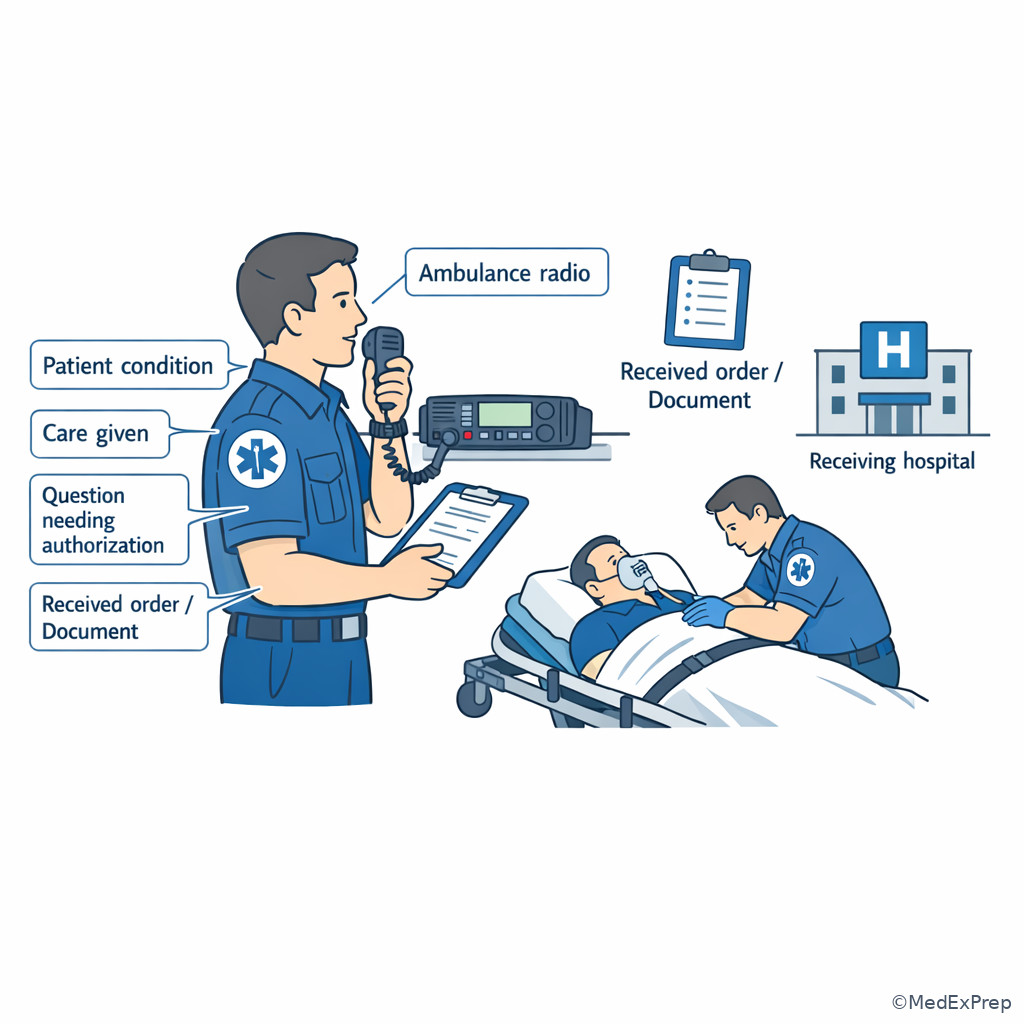
See Fig 3 when deciding whether the exam wants an intervention or a communication/authorization step.
1.1.1.5 Scope in patient assessment: what EMTs must decide before advanced thinking
A Explanation
Assessment itself is within EMT scope, but the exam tests which part of assessment comes first. The conflict is between detailed investigation and immediate prioritization. The single rule: primary assessment and life threats come before diagnostic curiosity. EMTs are expected to recognize patterns that suggest serious conditions, but not to delay care chasing the exact diagnosis. WHY THIS IS TESTED: learners often choose a technically useful detailed step instead of the immediate prehospital priority.
In scope-aware assessment, the EMT determines: Is the scene safe? Is the patient responsive? Is the airway open? Is breathing adequate? Is circulation adequate? Is there uncontrolled bleeding? What is the transport priority? Only after those questions are addressed do detailed history, focused exam, and trending vitals expand the picture. This is why “obtain a 12-lead and interpret ischemic changes” is not the right EMT answer, but “apply AED pads if pulseless,” “assist ventilation,” or “rapid transport for stroke concern” can be.
Pattern recognition is still essential. You must recognize shock, stroke, respiratory failure, anaphylaxis, overdose, and trauma red flags early enough to act. But your role is to support, package, transport, notify, and reassess. See Fig 4 for how a primary assessment branches toward BLS actions and transport.
Exam takeaway: When time pressure exists, answer choices that treat airway, breathing, circulation, or transport priority beat detailed diagnostics.
flowchart TD
A[Initial contact] --> B[General impression and responsiveness]
B --> C[Airway]
C --> D[Breathing]
D --> E[Circulation and major bleeding]
E --> F{Stable enough for details?}
F -->|No| G[Immediate intervention and rapid transport]
F -->|Yes| H[Focused history, exam, vitals, reassessment] B Worked example
A 72-year-old woman with atrial fibrillation and prior stroke presents with sudden slurred speech and right arm drift at a church event. Her friend insists she “just needs sugar” because she missed breakfast. The patient is anxious, slightly diaphoretic, and asks repeated questions. A bag of candy is visible nearby. The question asks for the best initial EMT action.
Identify task: initial EMT action. Extract key facts: focal neurologic deficit, likely time-sensitive stroke, distracting glucose-related possibility without confirming evidence. Apply rule: primary assessment and time-critical transport decisions outrank detailed speculation. Eliminate distractors: giving oral glucose immediately is tempting because of missed breakfast, but swallowing may be unsafe and stroke symptoms demand rapid assessment and transport. “Provide definitive stroke diagnosis” is outside role. “Delay transport for a detailed neurologic exam” wastes time. Verify: manage ABCs, assess glucose if feasible without delay, recognize stroke pattern, and expedite transport per protocol.
C Exam trap
Common wrong answer: Perform the most detailed assessment step first because it seems thorough.
Why it is tempting: Thoroughness feels safe, especially when the stem offers several data-gathering options.
Single clue that eliminates it: A time-sensitive or unstable presentation makes primary assessment and rapid intervention higher priority than detail gathering.
D Checkpoint
Question: A 30-year-old trauma patient is alert but has noisy respirations and active oral bleeding after a motorcycle crash. What is the most appropriate next step?
- Obtain a detailed allergy history before moving the patient.
- Suction the airway and address airway patency immediately.
- Ask the patient to rate pain so you can prioritize splinting.
- Wait for ALS to secure the airway definitively.
Correct answer: B.
- A: Tempting because history matters in trauma; wrong because airway contamination is the immediate threat.
- B: Tempting because it seems basic; right because airway clearing is an EMT-level life-saving intervention.
- C: Tempting because fractures can distract; wrong because pain scoring does not outrank threatened airway.
- D: Tempting because the patient may need advanced care; wrong because EMTs must manage the airway now with BLS methods.
1.1.1.6 Scope in interventions: airway, meds, trauma care, and transport decisions
A Explanation
This section asks a practical question: once you have identified the problem, what EMT intervention is actually available to you? The conflict is often between definitive treatment and best available EMT treatment. The rule is to use the highest-yield intervention within scope that changes outcome now. In airway cases, that may be suction, airway positioning, OPA/NPA, oxygen, or BVM. In cardiac arrest, it is CPR and AED. In hemorrhage, it is direct pressure, tourniquet when indicated, and shock care. In medication cases, it is approved administration or assistance only when indicated and authorized.
Transport is itself an intervention. When the needed definitive care is not in your toolbox, rapid transport to the right facility becomes part of the treatment plan. NREMT frequently rewards “load and go after immediate BLS stabilization” over prolonged scene time. The exam also tests restraint: do not give medications without the right indication, route, patient ability, authorization, or verification. A patient owning a medication does not automatically make it your next step.
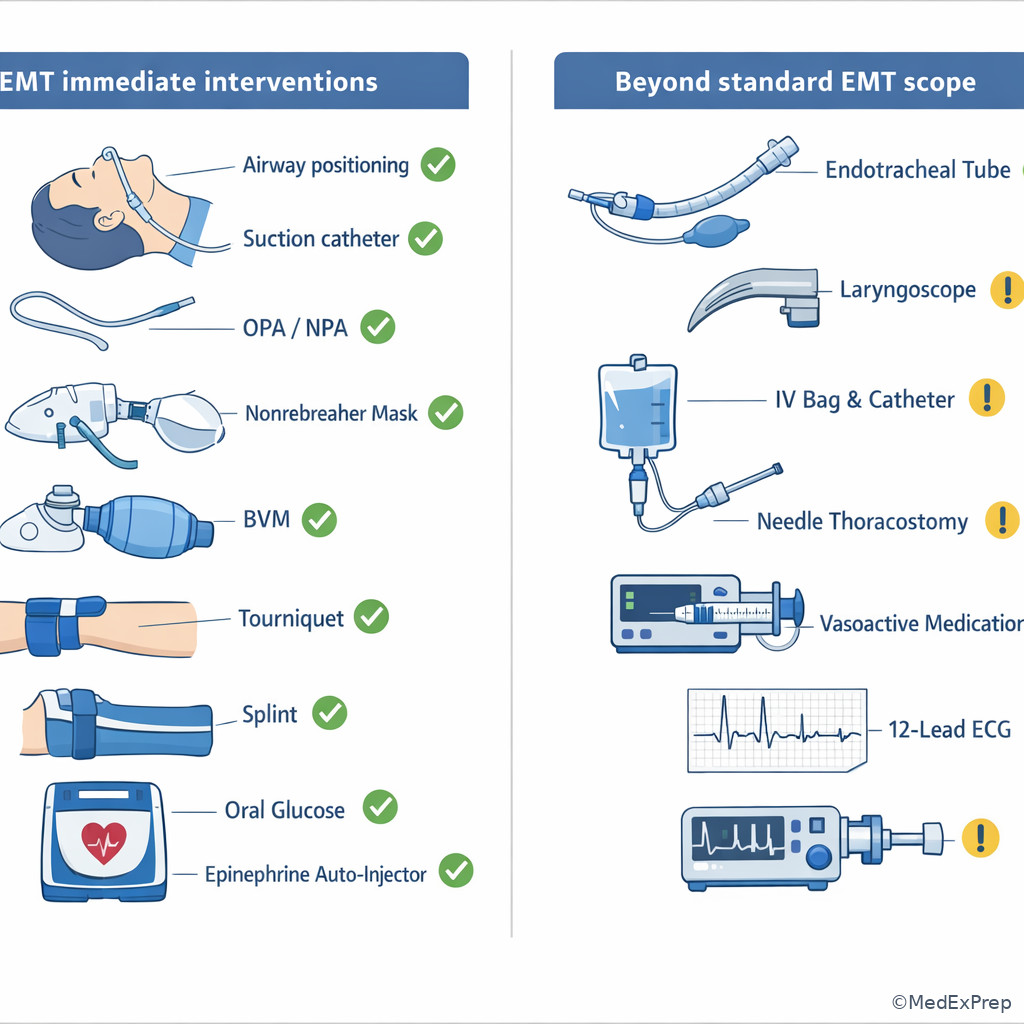
Within trauma, EMTs should control what kills early: airway compromise, breathing compromise, exsanguination, shock, and unsafe movement. Within medical emergencies, EMTs should support oxygenation, ventilation, perfusion, and timely destination. See Fig 5 for a comparison visual of common within-scope versus beyond-scope choices.
Exam takeaway: Separate the EMT toolbox from advanced procedures so you can choose the best immediate action under exam pressure.
B Worked example
A 23-year-old man with asthma and peanut allergy is wheezing after eating at a restaurant. He is anxious, tachypneic, and has hives. His roommate says, “He had a bad reaction last year and needed a breathing tube.” A half-empty albuterol inhaler is in his pocket, and there is also a borrowed nitroglycerin spray in the bag from another diner. The question asks for the priority intervention.
Identify task: choose the immediate EMT action. Extract key facts: allergic reaction with respiratory involvement, likely anaphylaxis pattern, distracting inhaler and irrelevant nitroglycerin. Apply rule: use authorized EMT interventions that directly address the life threat; for anaphylaxis that may include epinephrine auto-injector per protocol and airway/oxygen support. Eliminate distractors: nitroglycerin is unrelated; intubation is outside scope; waiting to see whether albuterol alone works may delay life-saving care. Verify: support airway/breathing, assist/administer epinephrine per protocol, request ALS, and transport rapidly.
C Exam trap
Common wrong answer: Choose the medication that matches one symptom rather than the one that treats the overall life threat.
Why it is tempting: Wheezing makes bronchodilator answers attractive even when the stem also shows systemic allergic signs.
Single clue that eliminates it: Hives plus respiratory compromise after allergen exposure points toward anaphylaxis management, not isolated asthma care.
D Checkpoint
Question: Which option best reflects an EMT-level intervention decision?
- For suspected tension pneumothorax, perform needle decompression before transport.
- For severe respiratory failure, apply oxygen, assist ventilations as needed, request ALS, and transport promptly.
- For unstable tachycardia, interpret the 12-lead and choose antiarrhythmic therapy.
- For shock from internal bleeding, delay transport until complete secondary assessment is done.
Correct answer: B.
- A: Tempting because it is definitive for the problem; wrong because it is beyond standard EMT scope.
- B: Tempting because it feels less definitive; right because it is the correct BLS response while escalating.
- C: Tempting because rhythm treatment sounds clinically sophisticated; wrong because definitive ECG-based therapy is outside EMT scope.
- D: Tempting because more information seems useful; wrong because unstable patients need rapid transport after immediate stabilization.
- The most appropriate EMT response to an ALS-only need is supportive care + ______.
- True or False: A patient’s own medication is always appropriate to assist if the patient requests it.
- Name the 3 early prehospital priorities in a major trauma patient: airway, hemorrhage control, and ______.
1.1.1.7 Integration: communication, handoff, refusal boundaries, and when to ask for help early
A Explanation
The final scope question is not just “Can I do this?” but “Who else needs to be involved, and what must I communicate?” The conflict is between trying to solve the whole case yourself and activating the system appropriately. The rule: if the patient, scene, or legal context exceeds safe single-crew EMT management, request resources early and communicate clearly. This includes ALS intercept, law enforcement, fire/rescue, extra lifting help, specialty destination notification, or medical control.
Communication is part of patient care. A concise report should cover age, sex, chief concern, critical findings, mental status, vital signs trend, treatment given, response, and ETA. For refusals or uncertain capacity, the EMT should not simply accept a refusal because the patient is talking. Capacity concerns, intoxication, hypoxia, hypoglycemia, head injury, severe stress, or confusion can affect decision-making. The EMT’s job is not to make a final legal ruling but to recognize concerns, use medical control and protocol, and document carefully.
Asking for help early is also an operations skill. If you need law enforcement for scene safety, extra manpower for safe lifting, or ALS for a deteriorating airway, early request is better than late recognition. This lesson connects directly forward to Provider Wellness And Safety, where fatigue, unsafe lifting, and delayed resource requests are shown to impair judgment and patient safety.
Exam takeaway: When the case exceeds EMT resources, activate help early, continue BLS care, and give a focused handoff.
flowchart TD
A[Patient or scene problem identified] --> B{Within current EMT crew resources?}
B -->|Yes| C[Provide BLS care and transport]
B -->|No| D[Request ALS, law enforcement, fire rescue, or manpower]
D --> E[Continue supportive care]
E --> F[Notify receiving facility if time sensitive]
F --> G[Structured handoff and documentation] B Worked example
A 58-year-old man with alcohol use disorder and type 2 diabetes is found outside a convenience store after a fall. He smells of alcohol, insists he is “fine,” and tries to refuse transport. He has a forehead hematoma, unsteady gait, slurred speech, and a glucose value that is low-normal rather than clearly abnormal. Bystanders report a brief loss of consciousness. The stem asks for the most appropriate EMT action.
Identify task: not to decide legal competency in the abstract, but to choose the safest EMT response. Extract key facts: head injury, possible LOC, intoxication, unreliable history, refusal attempt. Apply rule: questionable decision-making capacity and potential head injury require careful protocol-based management, likely involving medical control and law enforcement as needed, rather than simple acceptance of refusal. Eliminate distractors: immediately honoring refusal is tempting because the patient is speaking; sedating him is outside scope; ignoring the scene and dragging him to the stretcher is unsafe. Verify: continue assessment, protect the patient, involve appropriate resources, and document findings and communications.
C Exam trap
Common wrong answer: Accept a refusal because the patient can state a preference.
Why it is tempting: Speech and apparent orientation can fool learners into assuming decisional capacity is intact.
Single clue that eliminates it: Intoxication, head injury, hypoxia, hypoglycemia, or confusion can undermine capacity and require further support and consultation.
D Checkpoint
Question: Which situation most strongly supports requesting additional resources early?
- A calm patient with a small finger laceration asks whether a bandage is needed.
- An obese patient with chest pain is on the third floor with no elevator and increasing dyspnea.
- A patient with a mild headache wants the lights dimmed.
- A patient with a healed ankle sprain asks for advice on returning to jogging.
Correct answer: B.
- A: Tempting because all scenes require planning; wrong because this does not strongly indicate extra resources.
- B: Tempting because the problem seems logistical; right because safe lifting, time-sensitive symptoms, and likely transport difficulty require early help.
- C: Tempting because comfort matters; wrong because no clear operational escalation need is present.
- D: Tempting because advice requests can create communication tasks; wrong because this is not a resource-intensive emergency scenario.
Exam Traps & Differentiators
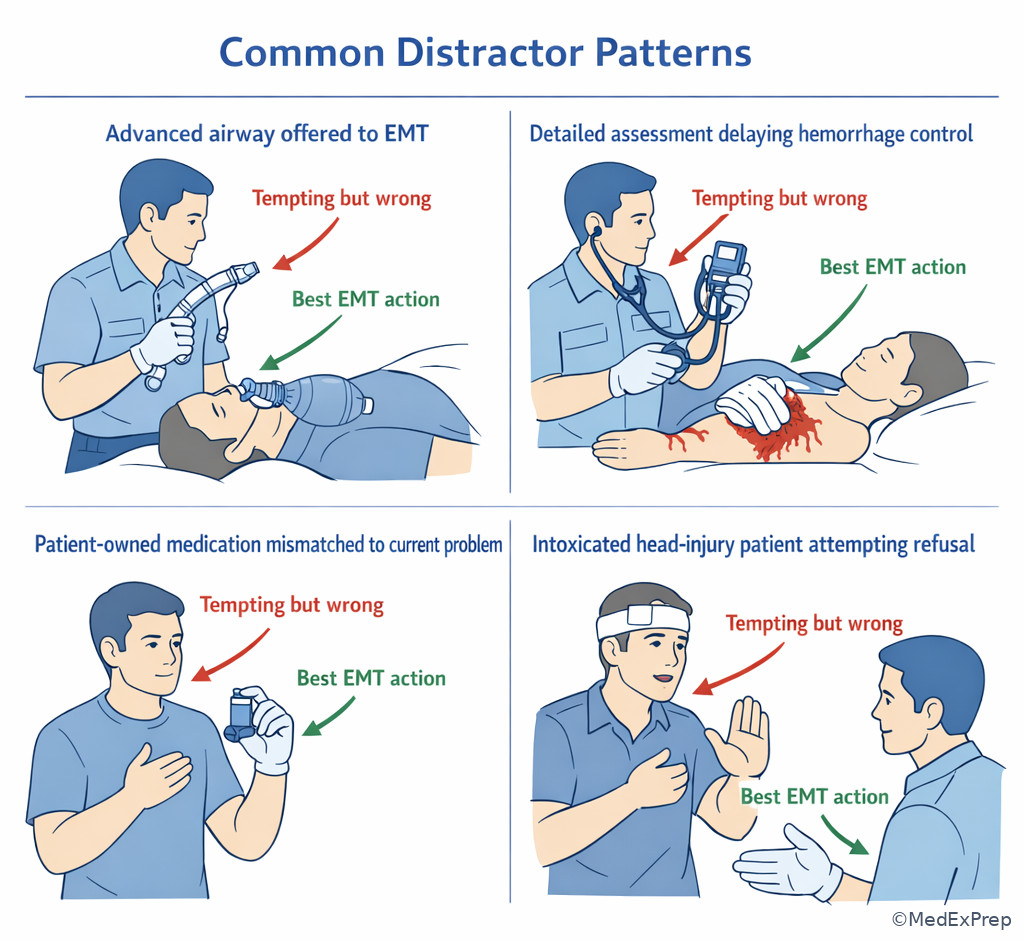
Common traps & distractors: The most common wrong answer is the advanced intervention that would be correct for a paramedic, nurse, or physician but not as the EMT’s first move. Another frequent trap is the detailed assessment step that delays treatment of an ABC problem. A third is accepting patient-owned medication or refusal at face value without checking indication, ability, protocol, or capacity.
| Looks similar | Actually think | Discriminator | Best EMT framing |
|---|---|---|---|
| Definitive airway procedure | BLS airway support | ETT/surgical airway is outside EMT scope | Position, suction, adjunct, oxygen, BVM, request ALS |
| Medication patient asks for | Medication that is indicated and protocol-approved | Ownership is not enough | Verify indication, route, ability, authorization |
| Detailed history first | Primary assessment first | Airway/breathing/circulation threat present | Treat threat, then gather detail |
| Wait for ALS | Immediate BLS + ALS request | Delay harms patient | Do what you can now |
| Patient speaking = capacity | Capacity may still be impaired | Intoxication, head injury, hypoxia, confusion | Use protocol, medical control, careful documentation |
| Hospital disposition choice | Transport priority and destination within protocol | EMT does not make admission/discharge decisions | Notify, transport, handoff |
If the stem says “perform endotracheal intubation,” think outside EMT scope; support airway with BLS methods instead.
If the stem says “most appropriate next step” in an unstable patient, think primary assessment and life threat treatment before detail.
If the stem says “the patient has his own medication,” think verify indication, protocol, and patient ability first.
If the stem says “wait for paramedics,” think do not delay indicated EMT care.
If the stem says “refuses transport” with intoxication or head injury, think capacity concern, medical control, and documentation.
If the stem says “choose the best definitive treatment,” think the exam may be baiting you away from the best EMT action.
Exam takeaway: Many wrong answers are clinically attractive because they belong to a higher scope, later step, or wrong patient state.
| Commonly tested pair | Why confused | How to separate them |
|---|---|---|
| EMT next step vs paramedic next step | Both may help the patient | Choose the highest-yield action the EMT can perform now |
| Supportive care vs definitive hospital care | Definitive care sounds more complete | Prehospital scope emphasizes stabilization and transport |
| Refusal acceptance vs capacity concern | Talking patient appears competent | Look for intoxication, injury, hypoxia, hypoglycemia, confusion |
| Medication assistance vs unauthorized administration | Patient has prescription in hand | Indication, protocol, route, and ability must all fit |
| Secondary assessment vs primary threat | Data gathering feels thorough | ABCs and major bleeding always outrank detail |
Related confusions will recur in upcoming topics. For example, in Clinical Reasoning Framework you will see how “identify the task” prevents answering a physician-level question with a paramedic-level action or an EMT-level question with a hospital-level solution. In Provider Wellness And Safety, delayed requests for manpower become an operational trap rather than a medical one.
Tables
| High-yield scope reference | Yes / No | Exam note |
|---|---|---|
| Use suction for blood/vomit compromising airway | Yes | Immediate BLS airway action |
| Insert OPA/NPA when indicated and not contraindicated | Yes | Airway adjuncts are core EMT tools |
| Assist ventilations with BVM | Yes | Do not wait for ALS |
| Perform CPR and use AED | Yes | Time critical, high yield |
| Control severe bleeding with pressure or tourniquet as indicated | Yes | Priority trauma intervention |
| Start IV fluids for shock | No | Request ALS, rapid transport, continue BLS care |
| Needle decompression for suspected tension pneumothorax | No | ALS/higher scope procedure |
| Choose hospital admission order | No | Outside prehospital role |
| Assist with approved medications per protocol | Yes | Authorization and indication both matter |
| Accept refusal without assessing capacity | No | Use protocol and medical control when needed |
| Comparison | EMT-level immediate action | Wrong but tempting alternative | Why wrong here |
|---|---|---|---|
| Severe respiratory distress | Oxygen/BVM as indicated, position, request ALS | Intubate | Outside scope |
| Uncontrolled extremity bleeding | Pressure/tourniquet, shock care, transport | Delay for full exam | Life threat first |
| Chest pain with stable vitals | Assess, oxygen if indicated, aspirin assist if allowed, transport | Interpret 12-lead for definitive treatment | Beyond EMT decision role |
| Suspected stroke | Primary assessment, glucose check if feasible, rapid transport | Lengthy neurologic exam before moving | Time-sensitive transport matters |
| Anaphylaxis | Airway support, epinephrine per protocol, transport | Only observe after albuterol | Misses systemic allergic threat |
| Differential / classification issue | Classify as | Best EMT response |
|---|---|---|
| Procedure needs invasive access or advanced airway | Beyond standard EMT scope | Provide supportive BLS care and request ALS |
| Question asks for immediate support of airway, breathing, circulation | Within EMT core role | Act without delay |
| Medication is prescribed but current indication is doubtful | Do not assist yet | Reassess, verify, follow protocol, contact medical control if needed |
| Refusal with intoxication or head injury | Capacity concern | Use protocol, involve medical control/law enforcement as appropriate |
| Patient stable, no life threat, routine complaint | Standard EMT assessment/transport decision | Proceed with focused history, exam, and routine care |
| Scene unsafe or manpower insufficient | Operational escalation need | Stage, secure scene, request additional resources early |
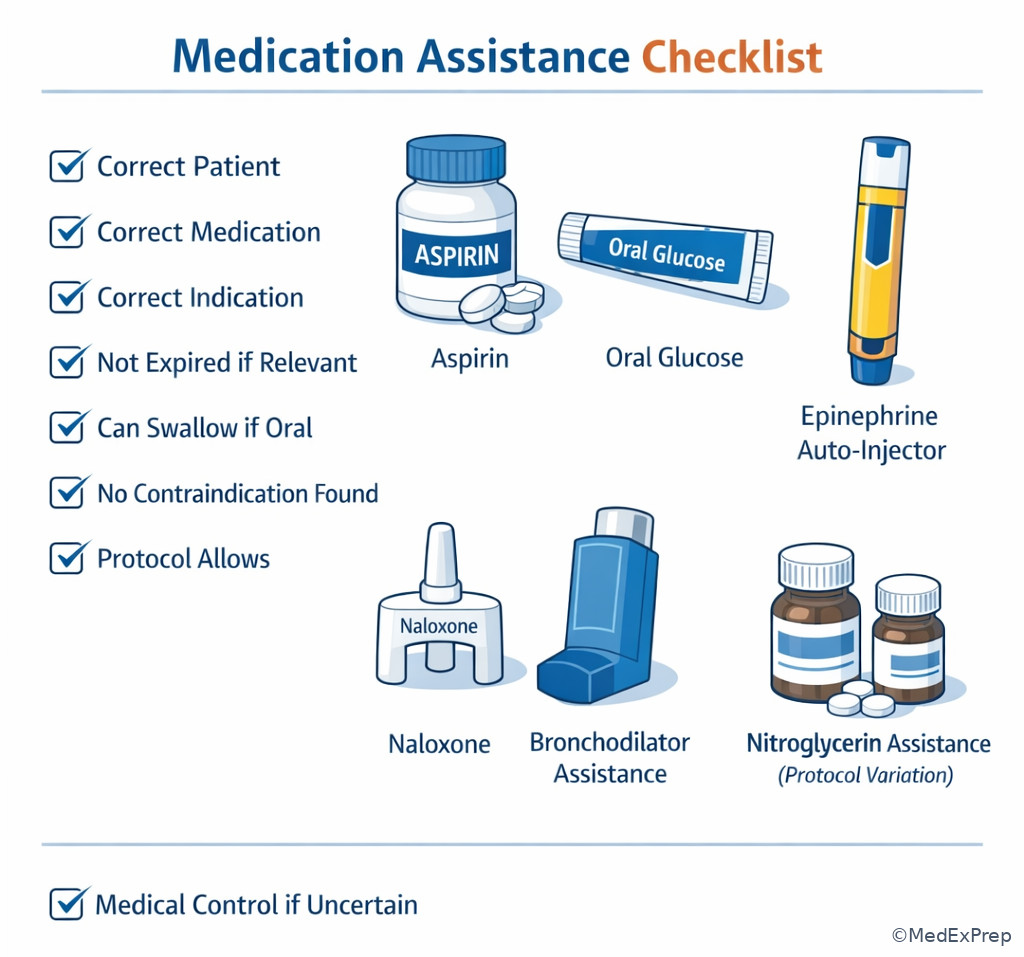
Exam takeaway: Medication assistance requires the right patient, right problem, right authorization, and a protected airway when oral administration is involved.
Algorithm / Approach
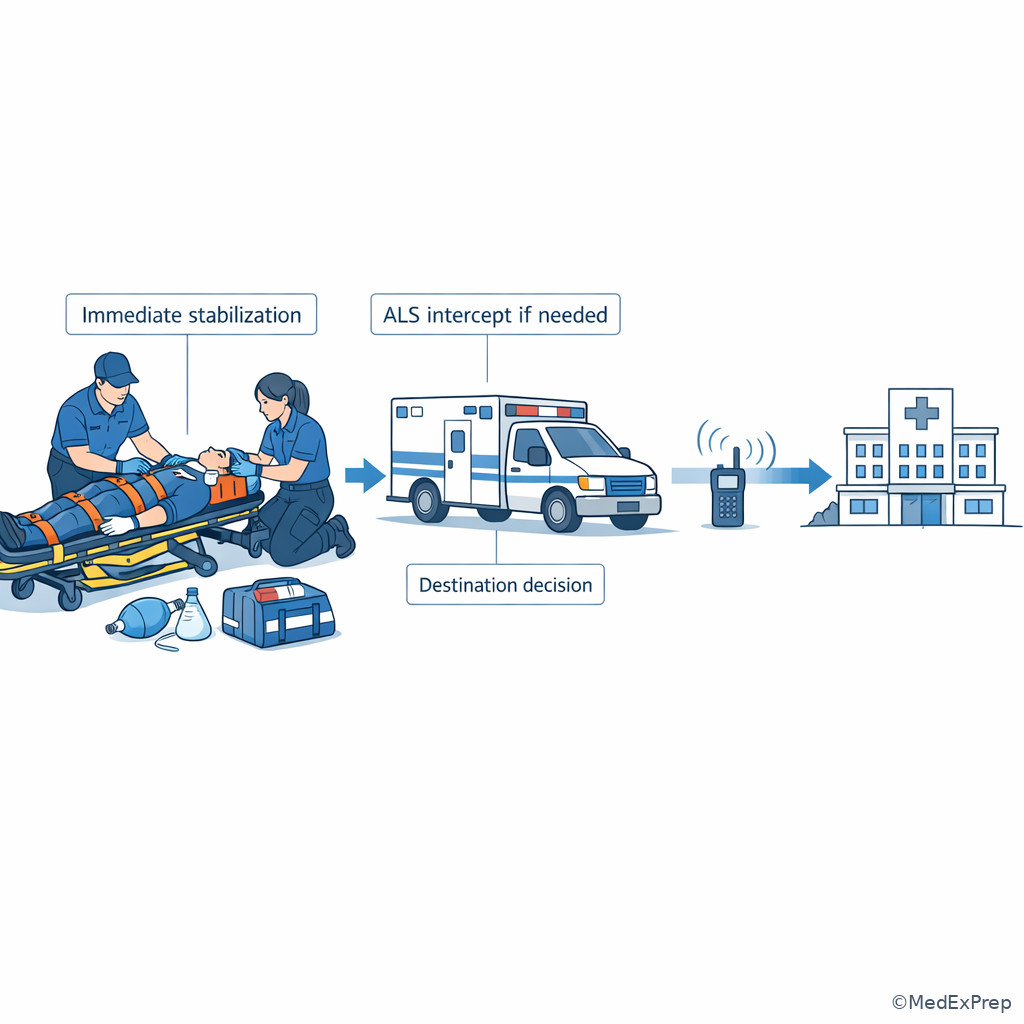
Use this algorithm whenever answer choices include one EMT action, one ALS-only procedure, one detailed-but-delaying assessment step, and one passive option. The correct choice is usually the intervention that helps now and stays within scope.
Exam takeaway: Rapid transport is itself a treatment decision when definitive care lies beyond EMT scope.
Rapid Review
- Scope filter → choose what the EMT can do now, not what the hospital can do later.
- ALS intercept → request early when needed, but never delay indicated BLS care.
- Primary assessment → beats detailed history when ABCs or major bleeding are threatened.
- Patient-owned medication → not enough; indication and protocol must match.
- Talking patient → not proof of decisional capacity.
- Transport decision → when definitive care is elsewhere, rapid transport is part of treatment.
- Medical control → think unclear authorization, refusal complexity, or unusual protocol issue.
- Airway problem → suction/position/adjunct/BVM before advanced-airway fantasies.
- Shock care → BLS support and rapid movement, not IV-based definitive resuscitation.
- Stroke suspicion → time-sensitive transport outranks prolonged scene exam.
- Anaphylaxis vs isolated wheeze → systemic allergic clues point beyond simple bronchodilator logic.
- Scene resources → early help request prevents unsafe delays and crew injury.
Self-check quiz
1. A conscious 61-year-old man with COPD and hypertension has severe dyspnea, cyanosis, and one-word speech. His daughter asks whether you will “put in a breathing tube now.” What is the most appropriate EMT response?
- Perform endotracheal intubation because respiratory failure is likely.
- Provide oxygen or assisted ventilation as indicated, request ALS, and transport.
- Delay treatment until a complete medication history is obtained.
- Wait for paramedics because airway interventions should start only once ALS arrives.
2. During an assessment of a confused diabetic patient, the spouse hands you the patient’s insulin pen and asks you to give it because “it always helps.” Which action requires immediate clarification?
- Checking the patient’s mental status trend
- Following local protocol for oral glucose if indicated and safe
- Administering the insulin pen for confusion without confirming indication
- Requesting ALS if mental status worsens
3. A 74-year-old woman with atrial fibrillation, prior stroke, and hyperlipidemia has sudden facial droop and slurred speech at a senior center. She missed lunch, and a bystander insists she only needs candy. She is awake, protecting her airway, and has no active bleeding. What is the most appropriate next step?
- Give oral glucose immediately before any further assessment because she skipped a meal.
- Perform primary assessment, check glucose if feasible without delaying care, and expedite stroke transport.
- Delay transport until a full neurologic examination is completed and documented.
- Call the receiving hospital for a definitive diagnosis before moving the patient.
4. A 28-year-old man with asthma and eczema becomes acutely short of breath after eating dessert containing peanuts. He has hives, wheezing, and increasing hoarseness. A friend offers him a borrowed nitroglycerin spray because “it opens things up.” Which is the best initial EMT action?
- Assist with the borrowed nitroglycerin because it may improve chest tightness.
- Support airway and breathing, administer or assist with epinephrine per protocol, request ALS, and transport.
- Wait to see whether his wheezing improves on its own before treating.
- Attempt a surgical airway if hoarseness continues.
5. A 36-year-old motorcycle crash patient is alert but has blood in the mouth, gurgling respirations, and a deformed femur. Friends keep telling you the leg injury is his “real problem.” What is the most appropriate next step?
- Splint the femur immediately to reduce pain and blood loss.
- Suction the airway and manage airway patency before focusing on the extremity injury.
- Obtain a detailed SAMPLE history while your partner observes breathing.
- Wait for ALS because the airway may require advanced management.
6. A 57-year-old man with alcohol use disorder, diabetes, and coronary artery disease fell outside a store. He smells strongly of alcohol, has a forehead hematoma, briefly lost consciousness per bystanders, and now says he refuses transport. He can state his name but is unsteady and repeats himself. What is the most appropriate EMT action?
- Accept the refusal because he can verbalize a preference and appears awake.
- Sedate him for transport because head injury patients should not refuse.
- Continue assessment, recognize possible impaired decision-making, involve medical control and other resources as indicated, and document carefully.
- Leave the scene once he signs any paper because the legal risk ends with a signature.
7. A 63-year-old obese patient with chest pain, diaphoresis, and increasing dyspnea is on the third floor of an apartment building with no elevator. He also has chronic knee pain and requests extra time to gather belongings. Vitals suggest possible instability. Which choice is most appropriate?
- Delay movement until he is emotionally ready so you can maintain rapport.
- Request additional manpower early, begin appropriate BLS care, and prioritize safe but timely transport.
- Start an IV before moving him because transport may worsen hypotension.
- Cancel transport and advise him to see his primary physician if the pain improves.
8. A 48-year-old woman with COPD, heart failure, and chronic anxiety has severe shortness of breath at home. She is pale, speaks in two-word phrases, and has accessory muscle use. Her husband says she “really needs Lasix and a tube,” and there is a bottle of nitroglycerin on the table. Which is the most appropriate EMT priority?
- Determine whether pulmonary edema or COPD is the exact diagnosis before beginning treatment.
- Provide immediate airway and breathing support within EMT scope, consider protocol-appropriate medication assistance only if indicated, request ALS, and transport.
- Perform needle decompression because severe dyspnea can indicate chest pressure.
- Wait to see whether her anxiety settles before intervening.
Answer key
1.1.1.8 1. Answer: B
A: Tempting because impending respiratory failure makes an advanced airway sound definitive. Incorrect for this scenario because endotracheal intubation is outside standard EMT scope; the discriminating clue is that the question asks for the EMT response to severe dyspnea, so immediate BLS oxygenation/ventilation is required. Authoritative support: EMT education standards and standard BLS scope emphasize basic airway management, oxygenation, and ventilation rather than invasive advanced airway procedures.
B: Tempting because it may feel less “complete” than intubation. Correct because it matches EMT scope and treats the immediate life threat now; the single clue is severe dyspnea with cyanosis and poor speech, which demands BLS airway/breathing support plus ALS request and transport. Sources: National EMS Education Standards; AHA BLS-focused emergency care principles.
C: Tempting because medication history may matter in COPD. Incorrect because detailed history cannot precede management of a threatened breathing problem; the key clue is cyanosis and one-word speech.
D: Tempting because ALS may be needed shortly. Incorrect because EMTs should not delay indicated BLS care while waiting for higher-level providers; the key clue is an immediately treatable airway/breathing issue.
1.1.1.9 2. Answer: C
A: Tempting because trending mental status is clinically useful. Incorrect as the answer because reassessment is appropriate and does not itself require clarification; the clue is that the stem asks which action is problematic.
B: Tempting because oral glucose is commonly tested and can be correct in selected hypoglycemia scenarios. Incorrect as the answer because following local protocol for a safe indicated medication is appropriate; the clue is “if indicated and safe.”
C: Tempting because the medication belongs to the patient and confusion may make family requests seem urgent. Correct because insulin would worsen hypoglycemia and is not the appropriate EMT intervention here; the single discriminating clue is confusion in a likely low-glucose scenario plus lack of confirmation that insulin is indicated. Sources: National EMS Education Standards; standard EMT medication assistance principles.
D: Tempting because ALS request is not always necessary. Incorrect as the answer because requesting ALS for worsening mental status is reasonable and within safe escalation practice.
1.1.1.10 3. Answer: B
A: Tempting because missed meals can cause hypoglycemia and candy is a common bystander suggestion. Incorrect here because focal neurologic deficits and time-sensitive stroke concern mean swallowing safety and transport priority matter more than immediate oral intake; the discriminating clue is sudden facial droop and slurred speech with stroke risk factors.
B: Tempting because it balances two possibilities. Correct because EMTs should perform primary assessment, check glucose if feasible without delaying care, and prioritize transport for suspected stroke; the single clue is sudden focal neurologic deficit. Sources: AHA stroke systems-of-care guidance; EMT primary assessment priorities.
C: Tempting because neurologic detail seems thorough. Incorrect because prolonged on-scene evaluation delays time-sensitive stroke care; the clue is the need for rapid transport.
D: Tempting because receiving hospitals need stroke notification. Incorrect because EMTs do not wait for a definitive diagnosis before transport; the clue is prehospital prioritization rather than physician-level confirmation.
1.1.1.11 4. Answer: B
A: Tempting because chest tightness and dyspnea can make nitroglycerin sound broadly helpful. Incorrect because borrowed nitroglycerin is not indicated for allergen-triggered hives, wheezing, and hoarseness; the discriminating clue is systemic allergic reaction after peanut exposure.
B: Tempting because bronchodilator-only thinking is common in wheezing cases. Correct because airway compromise plus hives and allergen exposure suggests anaphylaxis, making epinephrine per protocol and airway support the priority; the single clue is wheezing plus hoarseness plus hives after peanuts. Sources: anaphylaxis emergency care guidance and EMT medication protocols principles.
C: Tempting because some mild allergic symptoms improve with time. Incorrect because progression to airway compromise can be rapid; the clue is increasing hoarseness.
D: Tempting because airway swelling sounds catastrophic. Incorrect because surgical airway is outside EMT scope; the clue is the exam’s focus on EMT-level care.
1.1.1.12 5. Answer: B
A: Tempting because femur fractures can bleed significantly and are painful. Incorrect because the airway is actively threatened by blood and gurgling respirations; the discriminating clue is noisy, contaminated airway sounds.
B: Tempting because it seems basic compared with the dramatic leg deformity. Correct because suction and airway management address the immediate life threat before extremity care; the single clue is gurgling respirations with blood in the mouth. Sources: EMT trauma assessment standards; airway-first trauma priorities.
C: Tempting because history gathering is standard. Incorrect because detailed history cannot come before threatened airway management.
D: Tempting because definitive airway support may eventually be required. Incorrect because EMTs must begin BLS airway care immediately rather than wait.
1.1.1.13 6. Answer: C
A: Tempting because the patient is awake and verbally refusing. Incorrect because intoxication, repetitive speech, and possible head injury raise concern for impaired decision-making capacity; the discriminating clue is brief loss of consciousness plus unreliable mentation.
B: Tempting because forced transport can seem safer in a head injury. Incorrect because sedation is outside EMT scope; the clue is the exam’s prehospital EMT frame.
C: Tempting because it requires more work than simply accepting refusal. Correct because the EMT should recognize capacity concerns, continue assessment, involve medical control and other resources as appropriate, and document carefully; the single clue is intoxication combined with head trauma and repetitive responses. Sources: EMS legal/ethical practice standards, refusal principles, and EMT scope guidance.
D: Tempting because signatures are often taught in refusal processes. Incorrect because a signature alone does not resolve a refusal when capacity is questionable; the clue is unsafe reliance on paperwork over clinical judgment.
1.1.1.14 7. Answer: B
A: Tempting because patient rapport and cooperation matter. Incorrect because possible instability and major movement barriers require timely transport planning; the discriminating clue is third-floor carry with no elevator plus chest pain and dyspnea.
B: Tempting because resource requests can feel operational rather than clinical. Correct because safe lifting needs, likely time-sensitive symptoms, and worsening dyspnea support early manpower request while BLS care begins; the single clue is the combination of possible instability and transport difficulty. Sources: EMS operations and patient movement safety guidance.
C: Tempting because hypotension and chest pain may need advanced treatment. Incorrect because IV access is outside standard EMT scope; the clue is scope boundary, not lack of severity.
D: Tempting because chronic pain and anxiety can muddy the presentation. Incorrect because chest pain with diaphoresis and dyspnea requires emergency evaluation, not cancellation of transport.
1.1.1.15 8. Answer: B
A: Tempting because COPD and heart failure can require different definitive treatments. Incorrect because the EMT should first address the immediate breathing threat, not solve the exact diagnosis; the discriminating clue is severe dyspnea with poor speech and accessory muscle use.
B: Tempting because it does not commit to a single diagnosis. Correct because it reflects EMT practice: immediate airway/breathing support, medication assistance only if specifically indicated and protocol-approved, ALS request, and transport. The single clue is severe respiratory distress in a patient with multiple possible causes but one immediate BLS priority. Sources: National EMS Education Standards; respiratory emergency BLS care guidance.
C: Tempting because severe respiratory distress can make learners think of tension pneumothorax. Incorrect because no stem clue supports that diagnosis, and needle decompression is outside EMT scope; the clue is both missing diagnosis-specific findings and scope mismatch.
D: Tempting because chronic anxiety is present. Incorrect because anxiety is a distractor when objective respiratory distress signs are severe.
Keep going with the full NREMT-EMT Prep Course (EMT)
You just studied the way members do, in the same lesson interface. Full access unlocks every lesson, the question bank and flashcards for a full year.
One payment · 1 year of access · No auto-renewal