1.1.1 - Examination Evaluation Prognosis Sequence
Examination Evaluation Prognosis Sequence
What you'll learn
- Map the PT management sequence from examination to evaluation to prognosis to plan-of-care thinking within entry-level PT scope.
- Choose the safest next step when patient findings support treatment, modification, consultation, or referral.
- Distinguish raw findings from interpreted meaning, and interpreted meaning from predicted outcome.
- Use examination data to build a problem-focused evaluation without drifting into physician-level diagnosis.
- Identify prognosis factors that change visit frequency, expected rate of progress, and need for re-examination.
Blueprint mapping
- NONSYSTEM / Professional Responsibilities → PT scope, documentation logic, safety-centered decision sequencing
- Patient Management Across Systems → examination findings to evaluation and prognosis reasoning
- NONSYSTEM / Equipment and Functional Mobility → selecting safest action based on tolerance and movement findings
- General Medical Screening → identifying red flags that require consultation or referral before intervention
Why it matters
- NPTE stems often hide the real task: not “name the condition,” but “what step comes next in PT management?”
- Many wrong answers mix correct facts into the wrong phase of decision-making; separating examination from evaluation is a major test skill.
- Entry-level PTs are expected to interpret findings, prioritize safety, and recognize when findings exceed PT treatment readiness.
- A clean sequence prevents unsafe care: gather data first, interpret meaning second, forecast outcome third, then build the plan.
Key Terms & Must-Know Facts
1.1.1.1 Key terms
- Examination: The process of collecting tests, measures, history, systems review, and observation data.
- Evaluation: The PT’s clinical judgment about the meaning of examination findings.
- PT diagnosis: A movement-related classification within PT scope, not a physician-level medical diagnosis.
- Prognosis: Predicted optimal level of improvement and time needed to reach expected outcomes.
- Plan of care: The treatment framework informed by evaluation and prognosis.
- Impairment: Problem in body structure or function.
- Activity limitation: Difficulty executing a task or action.
- Participation restriction: Problem with life-role involvement.
- Red flag: Finding suggesting medical instability or non-PT primary management need.
- Contraindication: A reason treatment should not proceed.
- Precaution: A factor requiring modification, monitoring, or graded exposure.
- Re-examination: Follow-up collection of data to assess change and revise care.
- Clinical pattern recognition: Matching key findings to a tested management rule.
1.1.1.2 Must-know facts
- Examination asks, “What do I know?” Evaluation asks, “What does it mean?” Prognosis asks, “Where can this patient reasonably go?”
- A finding by itself is not an evaluation; interpretation is required.
- Prognosis depends on severity, irritability, chronicity, comorbidities, support, cognition, and response potential.
- PT management starts with safety and medical stability before functional progression.
- Referral is correct when findings are inconsistent with a routine PT presentation or indicate unstable status.
- The most defensible NPTE answer is often the least risky effective action.
- Plan of care decisions should come after evaluation and prognosis, not before.
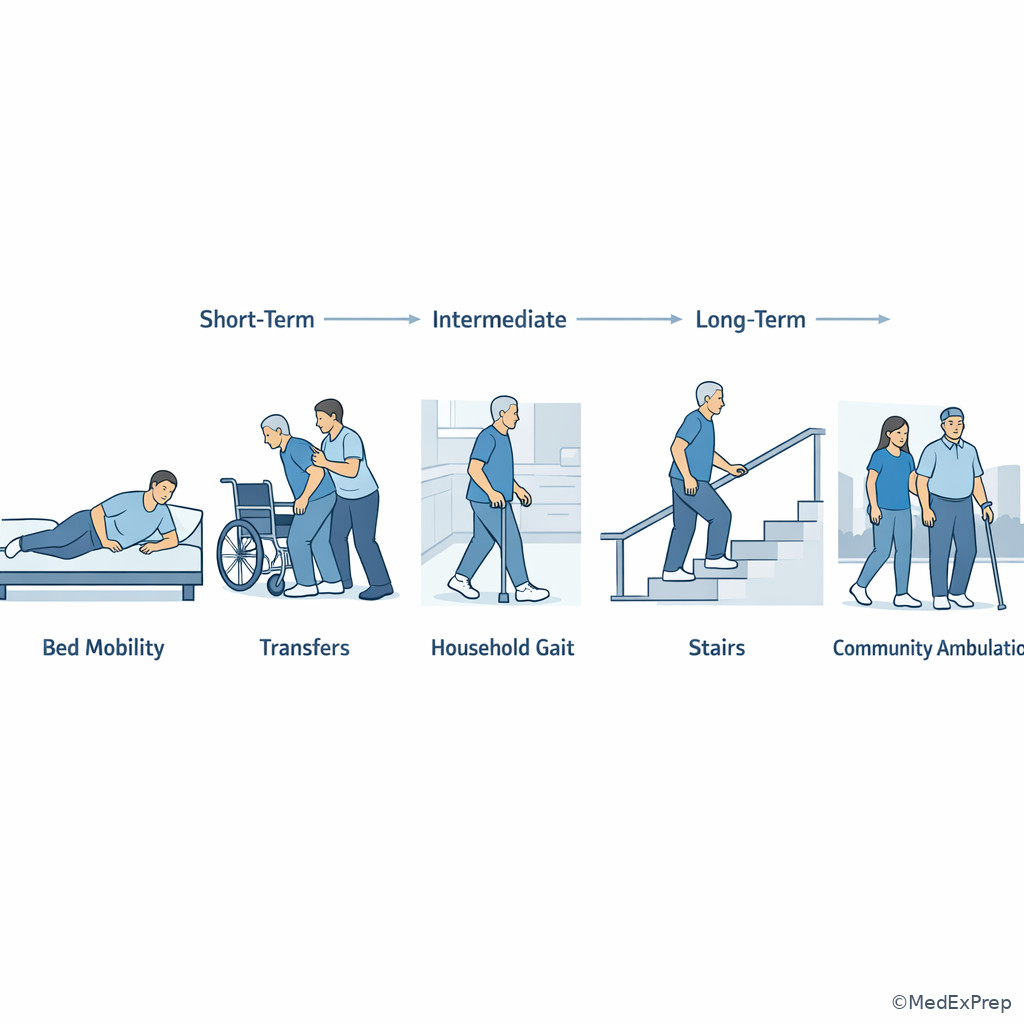
- Functional goals should connect impairments to activity and participation outcomes.
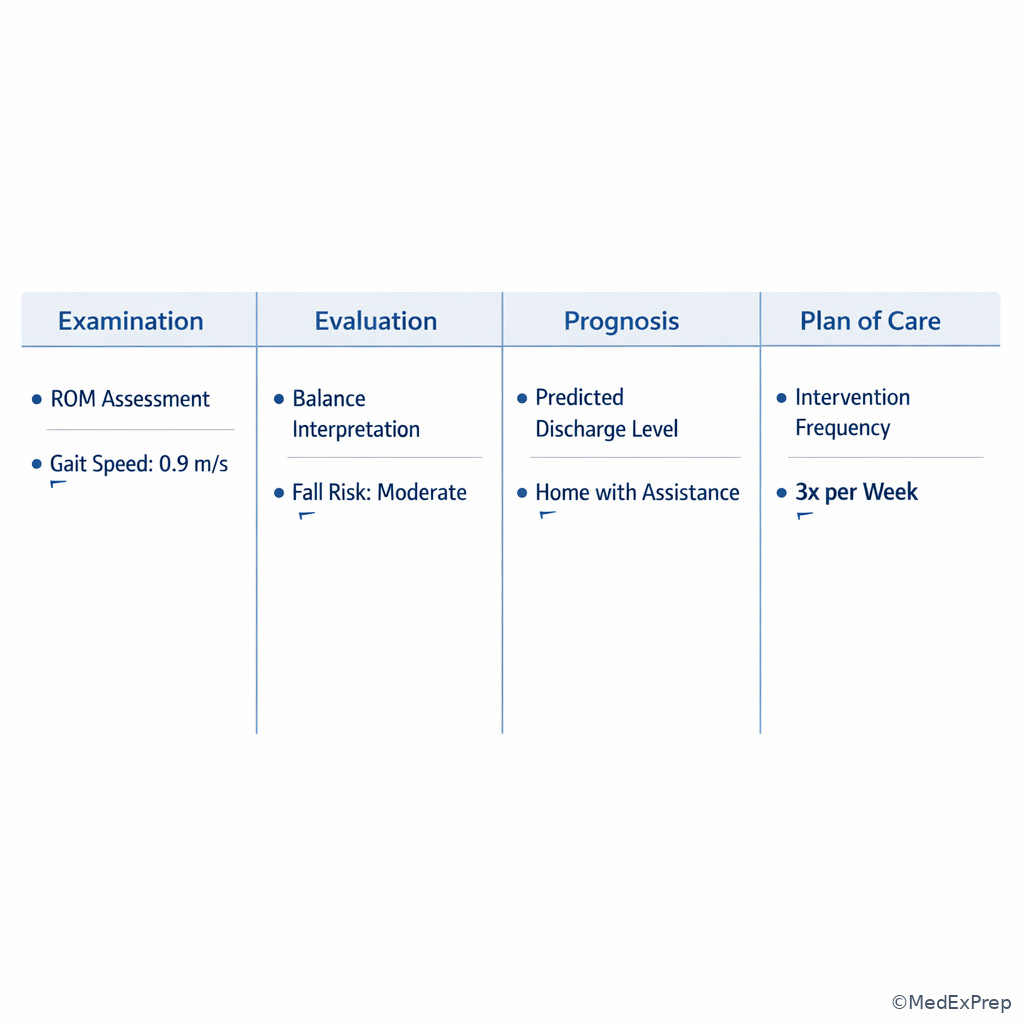
| Term | Core question | Typical PT output | Common exam error |
|---|---|---|---|
| Examination | What information is present? | History, systems review, tests, measures | Jumping straight to treatment choice |
| Evaluation | What do the findings mean for PT? | Movement diagnosis, priorities, safety interpretation | Repeating raw data without interpretation |
| Prognosis | What outcome and timeline are realistic? | Expected improvement, discharge expectations | Ignoring comorbidities and baseline function |
| Plan of care | What should PT do and how often? | Frequency, duration, interventions, goals | Writing plan before clarifying prognosis |
Exam takeaway: Move from data collection to interpretation to predicted outcome before choosing intervention intensity.
flowchart LR
A[History and systems review] --> B[Tests and measures]
B --> C[Examination dataset]
C --> D[Evaluation: meaning for PT]
D --> E[Prognosis: expected improvement and timeline]
E --> F[Plan of care and intervention choices]
C --> G[Red flags or instability]
G --> H[Hold, consult, or refer]
See Fig 1 for the exam-safe sequence that should organize your reasoning on almost every patient-management question in this chapter.
Core content
1.1.1.3 Foundational sequence: what belongs to examination, evaluation, and prognosis?
A Explanation
The central decision conflict is whether a stem is asking you to collect more data, interpret data already gathered, or predict outcome and treatment course. The single rule that resolves this is: if the answer choice is a test or measure, it belongs to examination; if it interprets the significance of findings for PT management, it belongs to evaluation; if it forecasts expected progress, goals, or episode length, it belongs to prognosis.
WHY THIS IS TESTED: NPTE items frequently place one correct statement from the wrong phase beside three wrong statements from the right phase. Students miss these because the content sounds clinically true, but the question is asking about sequence, not factual correctness.
Use choose-vs-reject logic. Choose examination when key information is still missing and treatment safety depends on it. Choose evaluation when the data set is already sufficient and the task is to identify the main PT problem. Choose prognosis when the patient’s likely recovery trajectory, expected independence, or discharge potential is being estimated. Reject premature intervention choices if the problem has not yet been interpreted. Reject prognosis language if no usable examination findings exist yet.
In NPTE terms, the PT does not stop at describing deficits. The PT connects impairments to activity limitations and participation restrictions, then determines whether PT is indicated, what the likely pace of change is, and whether another provider must be involved. See Fig 1 and Fig 2.
B Worked example
A 67-year-old patient is seen in outpatient PT 4 weeks after a total knee arthroplasty. The patient has hypertension and type 2 diabetes, reports “the incision feels tight,” uses a rolling walker, and says a neighbor told him to “just push through pain.” Knee flexion is 78 degrees, extension lag is 8 degrees, quadriceps strength is 3+/5, gait speed is slow, and resting heart rate is mildly elevated after a rushed trip from the parking lot. The question asks for the best evaluation statement.
Identify task: The stem asks for an evaluation statement, not a new test or treatment. Extract key facts: ROM loss, weakness, gait limitation, recent surgery, comorbid diabetes, but no obvious emergent red flag in the given data. Apply rule: Evaluation should interpret the movement problem and functional impact. Eliminate distractors: “Measure girth at mid-patella” is examination. “Patient will ambulate independently in 6 weeks” is prognosis. “Begin aggressive high-load strengthening” is plan/intervention. Verify: The best answer would be something like: “The patient presents with postoperative knee mobility and quadriceps performance deficits contributing to limited gait efficiency and transfer ability.” That is interpreted meaning within PT scope.
C Exam trap
D Checkpoint
Question: A PT examines a patient with dizziness, reduced gait speed, impaired balance reactions, and difficulty turning in crowded environments. Which option is the best example of an evaluation statement?
- Perform the Dynamic Gait Index and measure blood pressure in sitting and standing.
- The patient demonstrates balance and mobility deficits that increase fall risk during community ambulation.
- The patient is expected to return to independent shopping within 4 weeks.
- Initiate habituation exercises and progressive gait training with head turns.
Correct answer: B.
- A: Tempting because those are appropriate actions, but they are examination tasks, not interpretation.
- B: Correct because it synthesizes findings into a PT-relevant meaning and functional risk statement.
- C: Tempting because it sounds goal-oriented, but it is prognosis, not evaluation.
- D: Tempting because it may be appropriate next, but it is intervention planning, not evaluation.
Exam takeaway: Match the answer choice to the task in the stem before deciding whether the content is correct.
flowchart TD
A[Question stem] --> B{What is being asked?}
B -->|Need more information| C[Examination]
B -->|Meaning of findings| D[Evaluation]
B -->|Expected outcome and timeline| E[Prognosis]
C --> F[Choose tests, measures, history, systems review]
D --> G[Choose PT diagnosis, priority deficits, safety meaning]
E --> H[Choose expected improvement, discharge level, time course] Exam takeaway: Grouping findings into history, systems review, impairments, activity limits, and participation limits prevents incomplete PT reasoning.
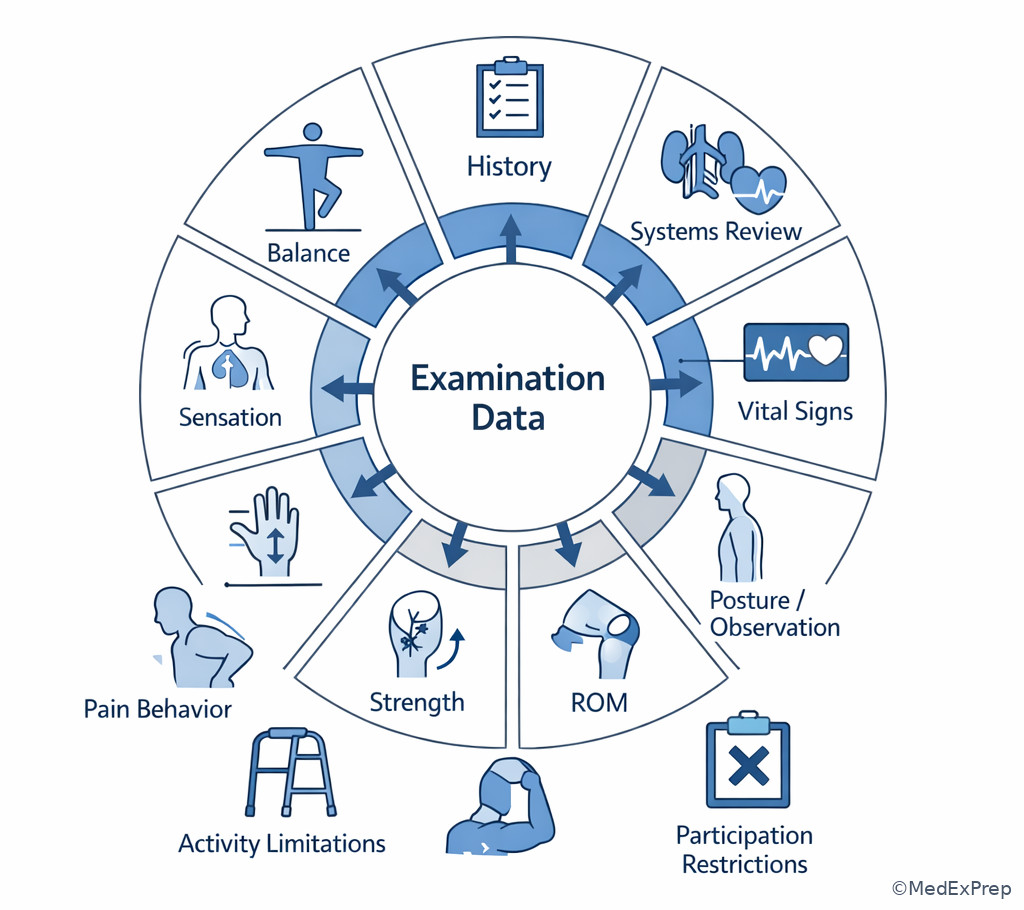
1.1.1.4 Building the evaluation: from findings to PT diagnosis and problem framing
A Explanation
The key decision conflict is whether the PT should frame the case as a movement-system problem manageable in PT or recognize that the findings are too inconsistent, unstable, or medically concerning to be fully owned as a routine PT case. The single rule: the evaluation must explain how the collected findings fit together into impairments, activity limitations, participation restrictions, and safety priorities within PT scope.
WHY THIS IS TESTED: Board-style questions often present many findings and ask for the “primary problem,” “best interpretation,” or “most appropriate PT diagnosis.” Students lose points when they simply list every deficit or select a medical diagnosis statement outside PT scope.
A strong evaluation is selective, not exhaustive. It names the most limiting or most dangerous issue first. For example, a patient may have weakness, pain, reduced ROM, and poor endurance, but if orthostatic hypotension causes near-syncope during transfers, the immediate PT evaluation must prioritize tolerance and safety. Likewise, if severe night pain, unexplained weight loss, and unremitting symptoms dominate, the evaluation should identify that findings are inconsistent with a routine mechanical presentation and warrant referral.
This is where the PT diagnosis lives: not “herniated disc” as a physician-level diagnosis, but a movement-related statement such as impaired trunk mobility with directional preference, or impaired aerobic capacity limiting functional mobility, or balance dysfunction with high fall risk. See Fig 3 for how to sort impairments from activity and participation. This section sets up the next two topics, where you will translate these priority findings into a problem list and plan of care.
B Worked example
A 54-year-old warehouse worker is referred for “low back pain.” He has obesity and controlled hyperlipidemia, reports pain for 3 weeks after lifting, and also mentions recent fatigue and night pain that does not change with position. Lumbar flexion is limited, but repeated movement testing does not clearly change symptoms. Straight leg raise is negative. He says a heating pad helps “a little,” which makes a musculoskeletal answer look tempting.
Identify task: Determine the best PT evaluation statement. Extract key facts: Back pain exists, but night pain and non-mechanical symptom behavior are disproportionate; repeated movement does not establish a clear mechanical pattern. Apply rule: The evaluation should identify that the presentation is not yet a routine mechanical PT case. Eliminate distractors: “Impaired lumbar flexion causing lifting limitations” ignores the red flags. “Begin core stabilization” skips interpretation. “Good prognosis for rapid improvement” is unsupported. Verify: The best evaluation is that the symptom pattern is inconsistent with a straightforward mechanical lumbar disorder and requires medical consultation before routine PT progression.
C Exam trap
D Checkpoint
Question: A patient with recent hospitalization for pneumonia presents to PT with marked deconditioning, low endurance, and desaturation during short ambulation. Which evaluation statement is best?
- Administer a 6-minute walk test and a stair-climbing assessment.
- The patient demonstrates reduced aerobic capacity and activity tolerance that limit safe household ambulation.
- The patient is likely to return to independent community mobility in 2 weeks.
- Initiate resisted lower-extremity strengthening at moderate intensity.
Correct answer: B.
- A: Tempting because further testing is useful, but it remains examination rather than interpretation.
- B: Correct because it synthesizes functional impact and safety from the collected findings.
- C: Tempting because prognosis matters, but the option predicts outcome instead of evaluating the current problem.
- D: Tempting because strengthening may eventually help, but it is an intervention choice and ignores oxygen tolerance.
- The PT phase that interprets meaning from findings is evaluation.
- True or False: A realistic discharge timeline belongs in the evaluation. False.
- Name the 3 linked levels used to frame impact: impairment, activity limitation, participation restriction.
Exam takeaway: The best evaluation links body-system findings to functional loss and participation limits rather than listing isolated deficits.
flowchart LR
A[Impairments: pain weakness ROM loss balance deficit] --> B[Activity limits: transfers gait stairs reach]
B --> C[Participation limits: work school home roles community]
A --> D[Safety modifiers: red flags tolerance precautions]
D --> E[PT evaluation and priority problem]
Exam takeaway: Visualizing the ladder helps you choose the deficit that matters most for function and safety.
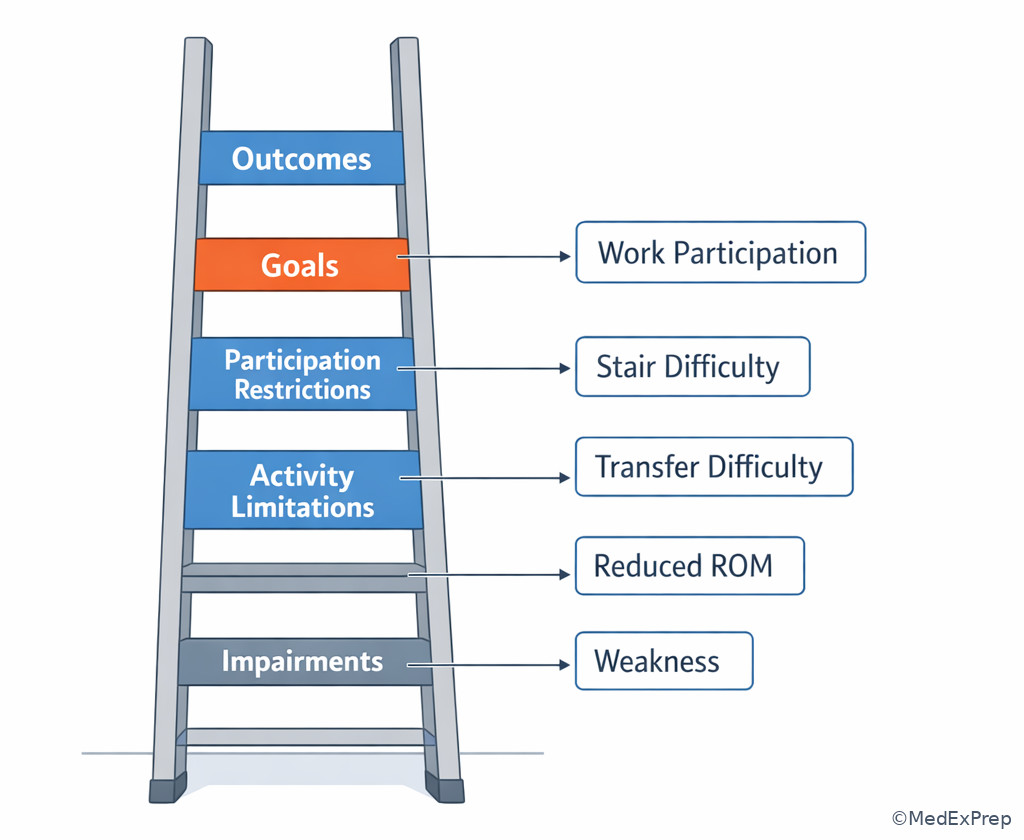
1.1.1.5 Prognosis: predicting expected outcome, timeline, and resource needs
A Explanation
The decision conflict here is whether the patient has a good, guarded, or poor prognosis for PT goals, and what variables truly drive that judgment. The single rule: prognosis is not based on diagnosis label alone; it is based on severity, baseline function, chronicity, medical stability, cognition, motivation, support, environmental barriers, and response potential.
WHY THIS IS TESTED: NPTE questions love to pair a favorable diagnosis with unfavorable context, or a serious diagnosis with unusually strong recovery factors. The learner must resist predicting outcome from one headline feature.
In practical PT reasoning, prognosis addresses likely level of improvement, estimated time needed, need for assistance, likely discharge destination, and intensity of follow-up. A younger patient with strong support and mild deficits may have a good prognosis despite multiple comorbidities. A medically fragile patient with poor carryover, cognitive impairment, recurrent falls, and limited caregiver support may have guarded prognosis even when impairments seem modifiable. Prognosis is therefore a synthesis step that influences goals, visit frequency, and how aggressively the PT expects to progress function.
Choose prognosis statements that are realistic, not optimistic. Reject answers that promise independence despite severe safety barriers. Reject pessimistic answers when the patient has strong recovery drivers and modifiable deficits. See Fig 4 for a comparison of prognosis drivers.
B Worked example
A 79-year-old patient is admitted to home health after hospitalization for heart failure exacerbation and a fall. She has mild cognitive impairment, chronic kidney disease, and osteoarthritis. Before hospitalization, she walked household distances independently with a cane. Now she requires contact guard assist for transfers and becomes fatigued after 40 feet. Her daughter visits weekly, but she lives alone on the second floor. A floral-scented oxygen cannula from the hospital supply bag is present in the room, a distracting detail that does not itself determine prognosis.
Identify task: Determine prognosis for PT. Extract key facts: Recent decline from a previously independent baseline, cardiovascular deconditioning, mild cognition issue, limited support, environmental barrier of stairs. Apply rule: Prognosis must integrate baseline plus barriers. Eliminate distractors: “Excellent prognosis for rapid independent community ambulation” ignores fatigue and support limits. “Poor prognosis because of age alone” is overly simplistic. “No PT indicated” is incorrect because deficits are modifiable. Verify: The best prognosis would be guarded-to-fair for return to modified household independence, with timeline influenced by tolerance, safety on stairs, and caregiver availability.
C Exam trap
D Checkpoint
Question: Which patient factor most strongly supports a more favorable prognosis for regaining independent household mobility after an acute decline?
- Advanced age with multiple chronic conditions
- High pain rating at initial evaluation
- Independent functional level before hospitalization with strong caregiver support
- Use of a rolling walker during the examination
Correct answer: C.
- A: Tempting because age and comorbidities matter, but they do not outweigh strong baseline independence.
- B: Tempting because pain can limit progress, but pain alone is less predictive than prior level and support.
- C: Correct because prior independence plus support are major positive prognosis factors.
- D: Tempting because assistive device use reflects current need, but it does not by itself determine long-term potential.
Exam takeaway: Predict outcome from the whole context—especially baseline, safety, support, and response potential—not from diagnosis alone.
flowchart TD
A[Baseline function] --> G[Prognosis]
B[Severity of current deficits] --> G
C[Medical stability and comorbidities] --> G
D[Cognition and carryover] --> G
E[Support and environment] --> G
F[Response to initial activity] --> G
Exam takeaway: A visual checklist of recovery drivers helps prevent overreliance on one dramatic stem detail.
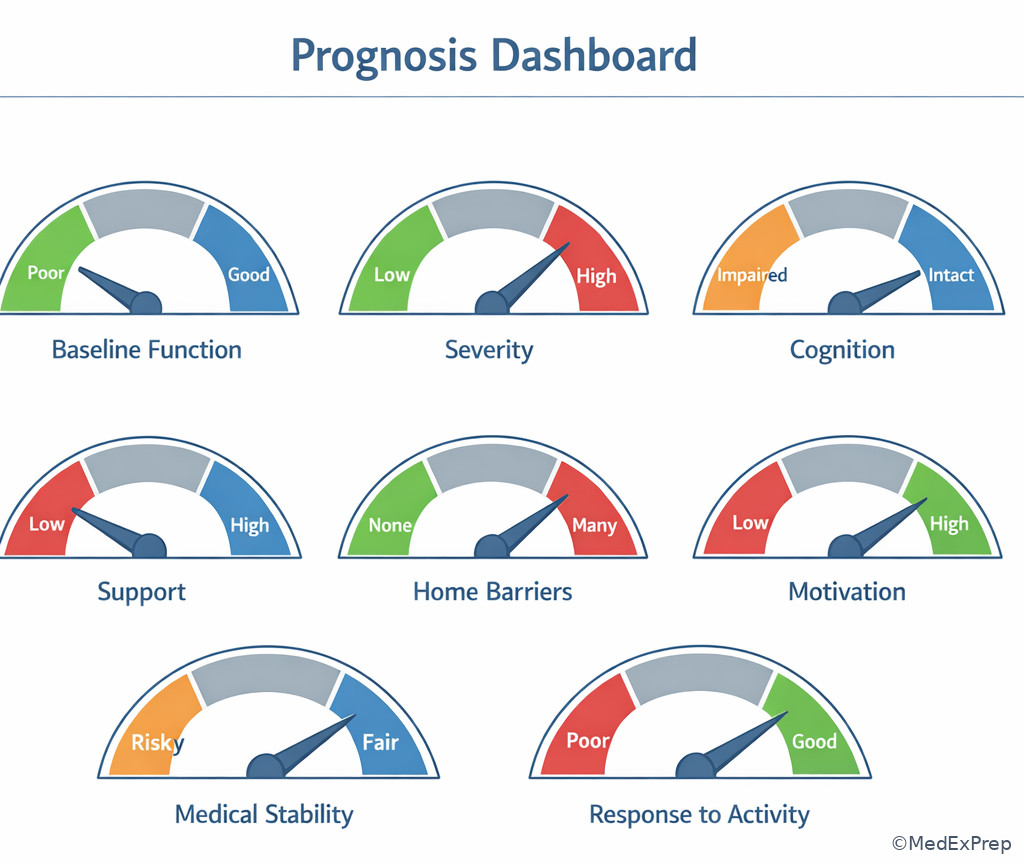
1.1.1.6 When the sequence changes the action: proceed, modify, hold, consult, or refer
A Explanation
The decision conflict is not always which intervention to pick; often it is whether PT should move forward at all. The single rule is: if examination findings reveal instability, concerning symptom behavior, or contraindications, the PT must modify, hold, consult, or refer before advancing routine treatment.
WHY THIS IS TESTED: NPTE stems often reward the safest action, not the most aggressive rehab answer. Students commonly over-treat because the patient was “referred to PT,” but referral does not erase red flags.
Within the examination-evaluation-prognosis sequence, safety checkpoints can interrupt progression. If the patient develops chest pain with minimal exertion, new neurologic deficits, unexplained calf swelling, syncope, severe blood pressure abnormalities, or oxygen desaturation beyond safe treatment parameters, the PT does not simply continue and document. Instead, the PT recognizes that the sequence redirects: the examination has discovered a finding that changes the evaluation from “treat” to “medical concern,” which then alters prognosis and plan entirely.
This is where entry-level scope matters. A PT can recognize concerning patterns, withhold unsafe treatment, communicate objective findings, and refer to the appropriate provider. A PT should not independently medically clear the patient or manage issues outside PT authority. See Fig 5.
B Worked example
A 63-year-old patient in inpatient rehabilitation is being evaluated after a hip fracture repair. The patient has atrial fibrillation, COPD, and anemia. During transfer training, she reports sudden chest pressure and becomes pale. Oxygen saturation drops from 95% to 88%, heart rate rises sharply, and she says, “Maybe I just need to push through because I skipped breakfast,” a tempting but wrong clue that suggests a benign explanation.
Identify task: Choose the most appropriate next PT action. Extract key facts: Sudden chest pressure, pallor, oxygen drop, sharp HR response, multiple cardiopulmonary comorbidities. Apply rule: Safety override interrupts treatment. Eliminate distractors: Continuing gait for endurance is unsafe. Providing rest and then resuming as tolerated is insufficient because symptoms are concerning. Asking the patient to rate hip pain misses the primary issue. Verify: Hold treatment immediately, position safely, monitor, and notify the appropriate medical team per facility protocol.
C Exam trap
D Checkpoint
Question: During an initial PT evaluation, which finding most strongly indicates the need to hold routine intervention and seek immediate medical input?
- Mild delayed-onset soreness after resisted testing
- Transient increase in knee pain during stair practice that resolves with rest
- New onset shortness of breath and chest pressure during minimal activity
- Fatigue after a 6-minute walk in a patient with deconditioning
Correct answer: C.
- A: Tempting because soreness can worry new clinicians, but this is common and expected if otherwise stable.
- B: Tempting because pain matters, but it resolves with rest and does not signal immediate systemic instability.
- C: Correct because new cardiopulmonary symptoms during minimal exertion are a medical red flag.
- D: Tempting because fatigue requires dosage adjustment, but isolated expected fatigue is not the same as acute instability.
- If the patient becomes medically unstable during examination, the next PT step is to hold and escalate.
- True or False: Being referred to PT means routine treatment should continue unless the physician says otherwise. False.
- Name 3 broad reasons to stop and seek input: red flags, contraindications, unstable physiologic response.
Exam takeaway: The correct PT action changes when examination findings show instability, contraindication, or a nonroutine symptom pattern.
flowchart TD
A[Examination in progress] --> B{Stable and expected response?}
B -->|Yes| C[Continue and monitor]
B -->|Needs caution| D[Modify intensity or position]
B -->|No: red flag or instability| E[Hold treatment]
E --> F[Notify appropriate provider]
F --> G[Document findings and action] Exam takeaway: Recognize how symptom change, monitoring equipment, and patient appearance combine to drive the safest next step.
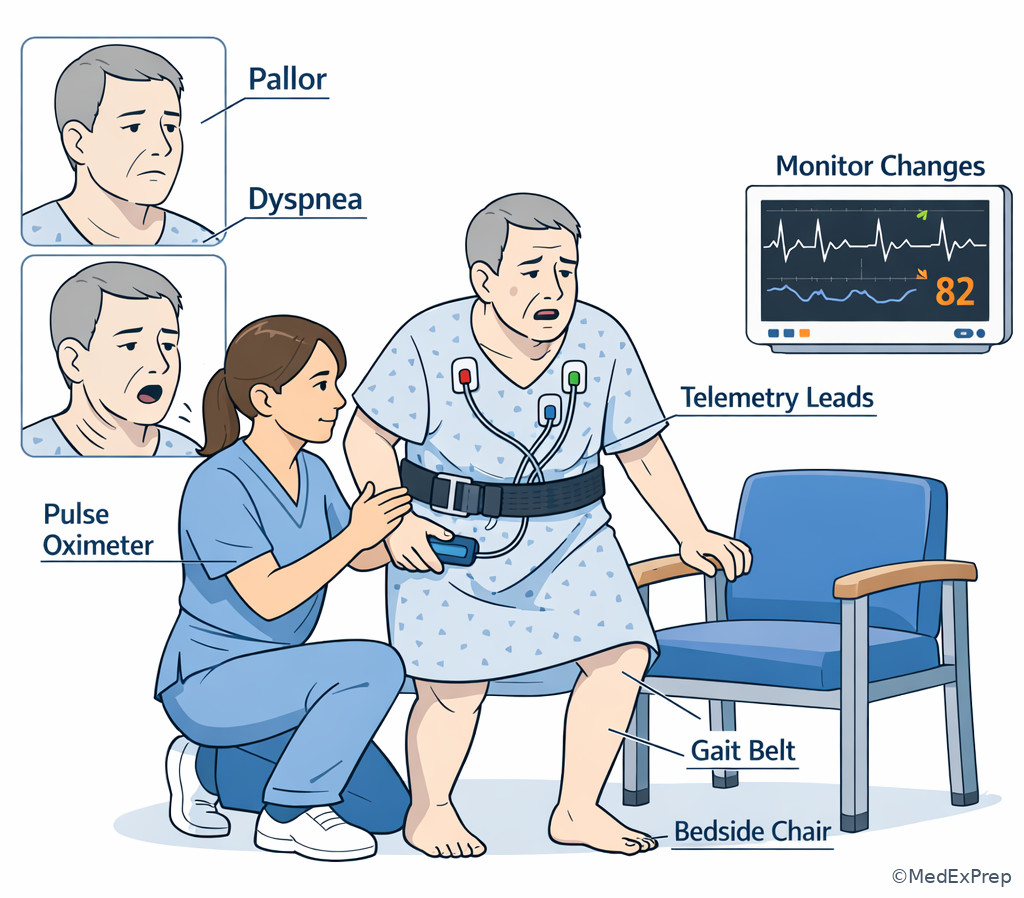
1.1.1.7 Integrating the sequence into documentation, re-examination, and forward planning
A Explanation
The final decision conflict is how to organize PT documentation and follow-up thinking without blending categories. The single rule: document objective findings under examination, interpret them under evaluation, justify expected progress under prognosis, and revise the sequence again during re-examination when status changes.
WHY THIS IS TESTED: NPTE items may ask which statement belongs in a given documentation section or what the PT should update after a change in status. Candidates often know the content but put it in the wrong place.
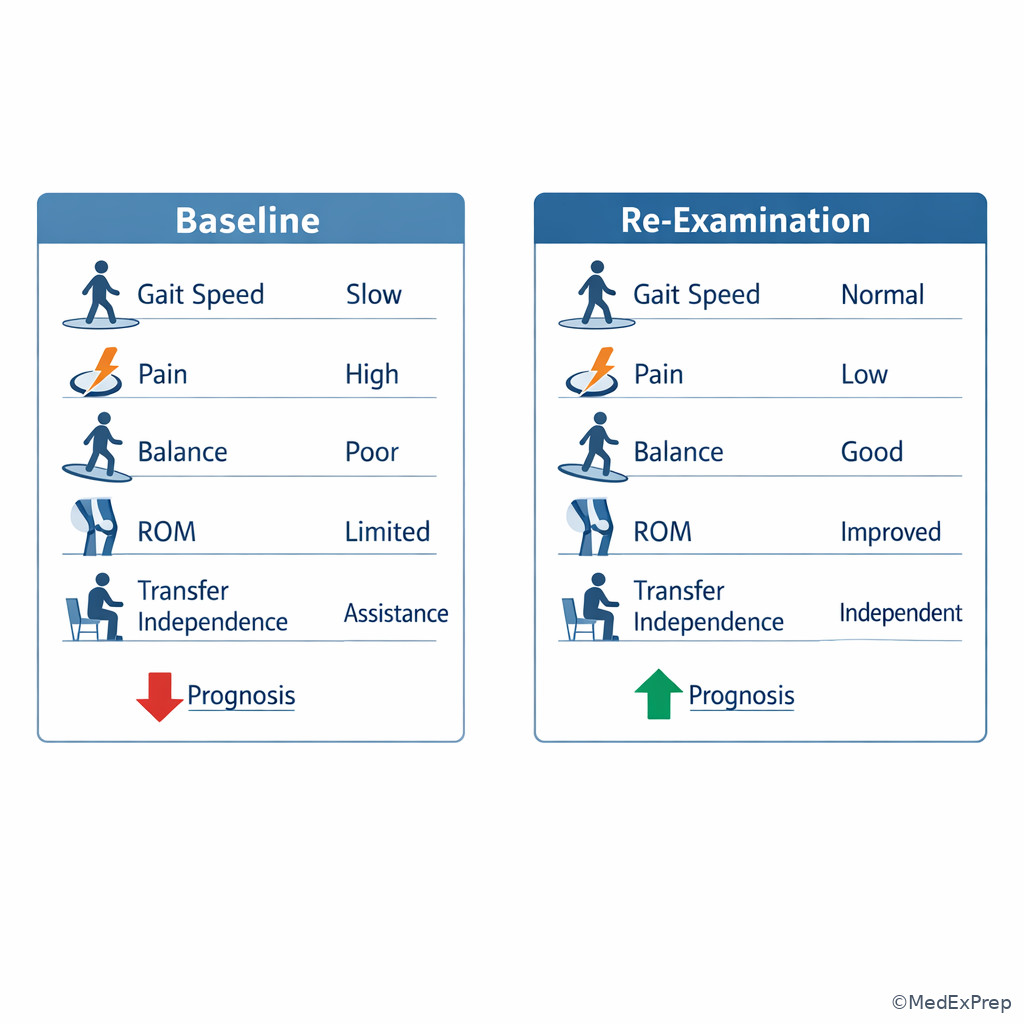
Documentation mirrors clinical reasoning. Examination includes measurable findings such as ROM, MMT, gait distance, transfers, pain behavior, vitals, balance scores, and patient-reported history. Evaluation explains why these findings matter for function, safety, and PT diagnosis. Prognosis estimates realistic outcomes and time course. Re-examination repeats selected tests/measures to determine whether the original evaluation and prognosis remain accurate. If the patient improves faster than expected, prognosis may be upgraded and plan intensity advanced. If plateau or medical decline appears, the PT must reconsider the driver of limited progress before simply adding more exercises.
This is also where upcoming course topics connect directly. Problem Lists And Priorities will show how to rank findings after evaluation. Plan Of Care Decisions will show how prognosis affects frequency, duration, and intervention emphasis. In board questions, the winning answer often reflects this exact chain rather than any isolated fact.
B Worked example
A 46-year-old office worker with lateral ankle sprain began PT 2 weeks ago. She has asthma and migraine history, both stable. At the re-examination visit, edema is improved and pain is lower, but single-leg balance remains poor and she still cannot descend stairs without fear. A new colorful kinesiology tape pattern from social media is on the ankle, a tempting visual distraction. The question asks which documentation statement best reflects re-examination and updated prognosis.
Identify task: Determine what belongs in re-examination/prognosis reasoning. Extract key facts: Some impairments improved, but an important activity limitation persists. Apply rule: Re-examination compares present findings with baseline and updates forecast. Eliminate distractors: “Continue current plan” lacks analysis. “Initial edema was moderate” is old examination data only. “Patient has ankle pain” is too raw. Verify: The best answer states that edema and pain have improved, balance deficits remain the primary limiter for stair descent, and prognosis for return to full community mobility remains good with continued progression focused on dynamic control.
C Exam trap
D Checkpoint
Question: Which documentation statement best reflects prognosis rather than examination or evaluation?
- Hip abductor strength is 3/5 and gait speed is 0.6 m/s.
- The patient’s reduced frontal-plane stability contributes to unsafe single-limb support during gait.
- With consistent attendance and caregiver support, the patient is expected to progress to modified independent household ambulation within 3 weeks.
- Perform transfer training and lateral hip strengthening during each session.
Correct answer: C.
- A: Tempting because it uses objective numbers, but this is examination data.
- B: Tempting because it sounds clinical, but it is an evaluation statement.
- C: Correct because it predicts expected function and timeline using supporting context.
- D: Tempting because it is practical, but it belongs to intervention planning.
Exam takeaway: Separating findings, interpretation, and forecast in your note mirrors the reasoning expected on NPTE questions.
Exam takeaway: Board questions reward comparing change over time rather than repeating static baseline data.
Exam takeaway: Expected outcomes in prognosis should be tied to functional milestones, not isolated impairments.
Exam Traps & Differentiators
- Most common wrong answer: A good intervention chosen when the stem asks for evaluation. This is tempting because PTs think in treatments, but the single discriminator is the task word: interpret vs intervene.
- Looks similar but isn't: Objective findings with numbers are examination, not prognosis. Prognosis requires future-oriented functional prediction with timeline.
- Red-flag confusion: A mechanical impairment may coexist with instability. The presence of a treatable impairment does not cancel a need to hold or refer.
- Scope confusion: PT diagnosis is movement-based. A physician-level disease label may be medically accurate, but if the item asks what the PT should conclude within scope, choose the functional movement interpretation.
- Documentation trap: Re-examination is not merely re-listing previous data; it must show change and its effect on reasoning.
| If the stem says... | Think... | Reject... |
|---|---|---|
| Best test, measure, or additional information needed | Examination | Evaluation or treatment statements |
| Best interpretation, primary problem, PT diagnosis | Evaluation | Raw data or future predictions |
| Expected recovery, likely discharge level, time needed | Prognosis | Testing options or current findings only |
| New chest pain, sudden dyspnea, acute neurologic change | Hold and seek medical input | Continue routine exercise |
| Progress plateaus or status changes | Re-examination and revise reasoning | Blindly continue same plan |
| Look-alike pair | How they differ | Single discriminator |
|---|---|---|
| Evaluation vs prognosis | Current meaning vs future expectation | Timeline language belongs to prognosis |
| Examination vs re-examination | Initial data collection vs follow-up comparison | Re-exam must show change over time |
| Precaution vs contraindication | Modify and monitor vs do not proceed | Contraindication stops the intervention |
| Routine fatigue vs medical instability | Expected exertional response vs dangerous physiologic pattern | Concerning symptoms plus abnormal response override treatment |
Related traps from upcoming topics matter here. In Problem Lists And Priorities, you will learn that not every deficit belongs at the top of the list; safety and primary functional limit come first. In Plan Of Care Decisions, you will use prognosis to choose dosage and frequency, but not before the evaluation is sound.
Algorithm / Approach
Exam takeaway: A fast if/then sequence helps you eliminate attractive answers that belong to the wrong PT management phase.
flowchart TD
A[Read stem] --> B{What is the task?}
B -->|Test or measure| C[Examination answer]
B -->|Interpret findings| D[Evaluation answer]
B -->|Predict function and timeline| E[Prognosis answer]
A --> F{Any red flag or instability?}
F -->|Yes| G[Hold, consult, refer]
F -->|No| H[Proceed within PT scope] Rapid Review
- Examination → raw data collection, not interpretation
- Evaluation → meaning of findings for PT management
- Prognosis → expected outcome level plus timeline
- PT diagnosis → movement-system framing within PT scope
- Red flag during exam → hold and escalate before routine treatment
- Baseline independence → stronger prognosis driver than age alone
- Re-examination → compares change over time, not static restatement
- Activity limitation → task difficulty such as stairs or transfers
- Participation restriction → role disruption such as work or community activity
- Best NPTE answer → least risky effective action matched to the task word
- Objective numbers only → examination, unless interpreted or forecasted
- Timeline language → prognosis, not evaluation
- Nonmechanical symptom behavior → reconsider routine PT pathway
- Referral to PT → does not override contraindications or instability
Self-check quiz
1.1.1.8 Question 1
A PT note states, “The patient is expected to progress to independent transfers within 10 days if current tolerance continues.” This statement best belongs to which phase?
- Examination
- Evaluation
- Prognosis
- Systems review
1.1.1.9 Question 2
A 58-year-old patient with obesity and hypertension presents for initial outpatient PT after shoulder pain began while lifting boxes. Which action is most clearly part of the examination phase?
- Concluding that scapular muscle performance deficits are limiting overhead reach
- Predicting return to full work duties in 3 weeks
- Measuring active ROM, pain behavior, and functional reach tolerance
- Determining that prognosis is fair because of job demands
1.1.1.10 Question 3
A 72-year-old patient in home health after pneumonia has COPD and type 2 diabetes. During the initial visit, the patient requires frequent rest breaks, ambulates 30 feet with contact guard assist, and shows mild oxygen desaturation with exertion. Which is the most appropriate evaluation statement?
- The patient should receive gait training and breathing exercises three times per week.
- The patient demonstrates impaired aerobic capacity and activity tolerance limiting safe household mobility.
- The patient will likely resume independent community ambulation in 2 weeks.
- The PT should measure stairs, gait speed, and pulse recovery.
1.1.1.11 Question 4
A 65-year-old patient in outpatient PT for knee pain has coronary artery disease and chronic kidney disease. During warm-up on a recumbent bike, the patient develops new chest heaviness and unusual shortness of breath after 2 minutes. Which is the most appropriate next step?
- Reduce the resistance and continue while monitoring symptoms
- Switch to seated knee strengthening to avoid aerobic stress
- Stop treatment, reassess, and notify the appropriate medical provider immediately
- Document the symptoms and resume treatment next visit if pain resolves
1.1.1.12 Question 5
A 43-year-old patient with ankle sprain, asthma, and a history of anxiety completed 2 weeks of PT. Pain and swelling have improved, but descending stairs remains difficult because of poor single-leg control. Which statement best reflects re-examination with updated evaluation?
- Initial edema was moderate and inversion ROM was limited at the first visit.
- Persistent dynamic balance deficits are now the main limitation affecting stair descent despite improvement in pain and edema.
- The patient is expected to return to recreational running by next month.
- Continue current treatment program without changes.
1.1.1.13 Question 6
A 76-year-old patient in inpatient rehab after stroke has hypertension, atrial fibrillation, and mild expressive aphasia. Before admission, the patient lived with a spouse and walked independently in the home. At evaluation, the patient needs minimal assist for transfers and walks 40 feet with a hemiwalker but follows one-step commands well. Which prognosis is most appropriate?
- Poor prognosis because age and stroke diagnosis make independent mobility unlikely
- Fair-to-good prognosis for improved household mobility because prior function and support are favorable despite current deficits
- Excellent prognosis for full independent community ambulation within 1 week because the patient already walks 40 feet
- No prognosis can be made until all aphasia resolves
1.1.1.14 Question 7
A 61-year-old patient referred for lumbar pain has hyperlipidemia and well-controlled asthma. The patient reports severe night pain, recent unexplained weight loss, and symptoms that do not change with position; lumbar ROM is mildly limited. Which PT conclusion is most appropriate at this stage?
- The primary evaluation should emphasize mobility restriction as the key PT problem
- The findings suggest a routine mechanical disorder and support immediate trunk stabilization
- The presentation is inconsistent with a straightforward musculoskeletal pattern and warrants medical consultation before routine PT progression
- The prognosis is excellent because ROM loss is mild
1.1.1.15 Question 8
A 69-year-old patient in SNF after hip fracture repair has anemia, CHF, and mild dementia. At baseline, the patient needed supervision for household mobility and lived with a daughter. During re-examination one week later, transfers improve from moderate assist to minimal assist, but gait distance remains limited by marked exertional fatigue. Which is the best documentation interpretation?
- The patient has not improved because gait distance is still limited
- The patient demonstrates measurable transfer progress, but prognosis for full mobility remains constrained by endurance and medical burden
- The patient should immediately begin high-intensity interval gait training to accelerate recovery
- The initial evaluation was incorrect because the patient is now performing better
Answer key
1.1.1.16 Question 1 Answer: C. Prognosis
- A: Tempting because notes often place many objective details together, but examination reports current findings, not predicted future transfer ability. Discriminator: “Expected to progress” plus a time estimate signals prognosis.
- B: Tempting because it sounds interpretive, but evaluation explains current meaning rather than future outcome and timeline. Discriminator: Forecast language moves it beyond evaluation.
- C: Correct because it predicts expected functional improvement over a stated period. Discriminator: The timeline of 10 days makes it a prognosis statement. Source: APTA Guide to Physical Therapist Practice; O’Sullivan et al.
- D: Tempting because systems review occurs early in the visit, but it concerns broad screening of physiologic systems rather than projected transfer progress. Discriminator: This statement is future-oriented, not screening-oriented.
1.1.1.17 Question 2 Answer: C. Measuring active ROM, pain behavior, and functional reach tolerance
- A: Tempting because it is clinically useful, but it interprets the meaning of findings and therefore belongs to evaluation. Discriminator: It explains what the deficits mean functionally.
- B: Tempting because return-to-work is a common PT concern, but this is a future forecast and belongs to prognosis. Discriminator: Time-to-return language.
- C: Correct because these are tests and measures collected during the examination. Discriminator: It is pure data acquisition. Source: APTA Guide to Physical Therapist Practice; Magee.
- D: Tempting because prognosis may indeed be fair, but the item asks for the examination phase. Discriminator: “Determining prognosis” is a higher-order step after data collection.
1.1.1.18 Question 3 Answer: B. The patient demonstrates impaired aerobic capacity and activity tolerance limiting safe household mobility.
- A: Tempting because frequency and intervention choices are appropriate plan-of-care elements, but the question asks for evaluation. Discriminator: This option prescribes treatment rather than interpreting findings.
- B: Correct because it integrates exertional findings into a PT-relevant functional interpretation. Discriminator: It links impairment to household mobility and safety. Source: APTA Guide to Physical Therapist Practice; ACSM Guidelines for Exercise Testing and Prescription.
- C: Tempting because recovery prediction matters, but this is prognosis and may be too optimistic given the data. Discriminator: Future-oriented outcome timeline.
- D: Tempting because additional measures may help, but this remains examination, not evaluation. Discriminator: It asks for more data rather than stating the meaning of existing data.
1.1.1.19 Question 4 Answer: C. Stop treatment, reassess, and notify the appropriate medical provider immediately
- A: Tempting because dosage adjustment is often correct for routine intolerance, but new chest heaviness with dyspnea indicates possible acute instability. Discriminator: The symptoms are new and concerning, not expected exertional fatigue.
- B: Tempting because seated exercise seems safer, but changing exercise mode does not address a potential cardiopulmonary event. Discriminator: Acute symptoms require escalation, not exercise substitution.
- C: Correct because the PT must prioritize safety, stop activity, reassess, and initiate appropriate medical communication. Discriminator: New chest symptoms during minimal exertion override routine PT progression. Source: APTA Guide; ACSM Guidelines; facility emergency response standards.
- D: Tempting because documentation is necessary, but documentation without immediate action is unsafe. Discriminator: The urgency of symptoms demands action now, not next visit.
1.1.1.20 Question 5 Answer: B. Persistent dynamic balance deficits are now the main limitation affecting stair descent despite improvement in pain and edema.
- A: Tempting because objective baseline data matter, but the question asks for re-examination with updated evaluation. Discriminator: This option lacks comparison and current interpretation.
- B: Correct because it compares change over time and identifies the current limiting factor. Discriminator: It updates the evaluation based on what remains functionally relevant. Source: APTA Guide; O’Sullivan et al.
- C: Tempting because return-to-running may be a valid long-term goal, but this is prognosis, not re-examination/evaluation.
- D: Tempting because continuity is common, but it provides no analytical update and ignores the shift in main impairment.
1.1.1.21 Question 6 Answer: B. Fair-to-good prognosis for improved household mobility because prior function and support are favorable despite current deficits
- A: Tempting because age and stroke increase complexity, but prognosis should not be determined from diagnosis and age alone. Discriminator: Prior independence and spouse support improve expected outcome.
- B: Correct because it integrates baseline independence, current assist level, preserved command-following, and support. Discriminator: Prognosis depends on the full context, not the label alone. Source: O’Sullivan et al.; APTA Guide; stroke rehabilitation principles.
- C: Tempting because 40 feet of ambulation sounds promising, but the one-week timeline is unrealistically aggressive for the full outcome stated. Discriminator: Overly optimistic timeline.
- D: Tempting because communication affects rehab, but mild expressive aphasia does not prevent reasonable prognosis estimation when command-following is intact. Discriminator: Functional cognition for participation is sufficient.
1.1.1.22 Question 7 Answer: C. The presentation is inconsistent with a straightforward musculoskeletal pattern and warrants medical consultation before routine PT progression
- A: Tempting because ROM limitation is present, but it ignores the more important red-flag pattern. Discriminator: Night pain, weight loss, and nonmechanical behavior outrank mild mobility loss.
- B: Tempting because stabilization is a common lumbar intervention, but routine treatment is not the safest first action here. Discriminator: Symptoms do not behave like a straightforward mechanical disorder.
- C: Correct because the PT should recognize concerning features and seek medical consultation before routine progression. Discriminator: The nonmechanical cluster changes the evaluation pathway. Source: APTA screening principles; Goodman and Fuller; Guide to PT Practice.
- D: Tempting because mild ROM loss sounds favorable, but prognosis cannot be optimistically framed when red flags remain unresolved. Discriminator: Safety uncertainty precedes optimistic forecasting.
1.1.1.23 Question 8 Answer: B. The patient demonstrates measurable transfer progress, but prognosis for full mobility remains constrained by endurance and medical burden
- A: Tempting because gait is a valued outcome, but it ignores meaningful change in transfer status. Discriminator: Re-examination should recognize partial improvement.
- B: Correct because it integrates objective improvement with realistic ongoing prognosis limits from endurance and comorbidity. Discriminator: Balanced interpretation of change plus remaining barriers. Source: APTA Guide; O’Sullivan et al.; geriatric rehab principles.
- C: Tempting because intensity can improve endurance, but the stem emphasizes marked fatigue in a medically complex patient, so aggressive progression is not yet justified. Discriminator: One clinical detail—marked exertional fatigue—makes this too aggressive now.
- D: Tempting because change may prompt revision, but improvement does not mean the initial evaluation was wrong; it means the patient responded. Discriminator: Re-examination updates reasoning rather than invalidating the initial assessment.
Keep going with the full NPTE-PT Prep Course (NPTE-PT)
You just studied the way members do, in the same lesson interface. Full access unlocks every lesson, the question bank and flashcards for a full year.
One payment · 1 year of access · No auto-renewal