1.1.1 - Nursing Informatics Definition
Why it matters
- Many NI-BC items hide the definition inside a workflow, documentation, privacy, or implementation scenario rather than asking for a direct definition.
- The safest answer often depends on recognizing that nursing informatics combines nursing science with information management and technology support, not independent technical authority.
- Misreading the role leads to predictable errors: choosing a legal ruling, a technical build action, or a provider-level clinical decision instead of collaboration, analysis, education, or escalation.
- This topic is the foundation for later distinctions such as data versus information, governance versus operations, and implementation versus optimization.
Key Terms & Must-Know Facts
1.1.1.1 Key terms
- Nursing informatics - Specialty integrating nursing science with information and analytical sciences to manage and communicate data, information, knowledge, and wisdom in nursing practice.
- Nursing science - The clinical and professional nursing knowledge base that anchors informatics decisions to patient care and workflow.
- Information science - Organizing, managing, retrieving, and using information meaningfully.
- Computer science - Technology tools and systems that support data capture, processing, and exchange.
- Workflow - Sequence of work performed by clinicians and teams in real settings.
- Clinical decision support - Technology-enabled prompts, reminders, rules, or displays that aid decisions.
- Data stewardship - Responsible handling of data quality, definitions, access, and use.
- Usability - How effectively and safely users complete tasks in a system.
- Governance - Formal decision structure for standards, priorities, and change control.
- Optimization - Post-implementation improvement of systems and workflows.
- Interoperability - Ability of systems to exchange and use information.
- Standardized terminology - Controlled clinical language that improves documentation consistency and reporting.
1.1.1.2 Must-know facts
- Nursing informatics is not just charting faster; it is improving how nursing information supports care, quality, and decisions.
- The nurse informaticist thinks like a nurse first: patient safety, workflow, quality, privacy, and usable systems.
- The role commonly influences through collaboration, testing, training, analysis, and governance participation rather than unilateral technical control.
- When a stem crosses into firewall configuration, database redesign, or legal determination, the exam-safe action is usually collaborate or escalate.
- The definition includes data, information, knowledge, and wisdom; later topics will separate these terms in detail.
- Technology alone is not informatics; meaningful use in clinical context is the core idea.
- Workflow fit matters as much as system capability on exam questions.
- Good informatics supports clinicians and patients at the point of care, not just leaders reviewing reports.
| Core element | What it means on exam day | Common wrong simplification |
|---|---|---|
| Nursing science | Clinical context, care processes, safety, documentation reality | “Any clinician can do this without nursing perspective” |
| Information science | Turning captured facts into usable information for decisions | “This is just data storage” |
| Computer science | Technology tools enabling capture, display, exchange, and support | “The nurse informaticist must code or engineer the system” |
| Integration | The specialty sits at the intersection of all three | “Informatics equals whichever one is most visible in the stem” |
| Role-appropriate action | Analyze, recommend, educate, monitor, collaborate, escalate | “Directly perform every technical or executive task” |
Core content
1.1.1.3 Foundational definition: what nursing informatics actually integrates
A Explanation
The central decision conflict in this topic is whether to define nursing informatics by technology or by clinical nursing use of information and technology. The correct choice is the second one. Nursing informatics is tested as the integration of nursing science with information and analytical sciences to identify, define, manage, and communicate data, information, knowledge, and wisdom in nursing practice. On the exam, reject answer choices that reduce the field to software support, hardware maintenance, or generic data reporting without a nursing practice context.
WHY THIS IS TESTED: The testable pattern is a stem that sounds technical but is really asking whether the nurse informaticist can connect technology to patient care, workflow, documentation, decision-making, and outcomes. The single resolving rule is: if the action improves the use of clinical information in nursing practice, it fits the definition; if it is purely technical or purely provider-level clinical decision making, it does not.
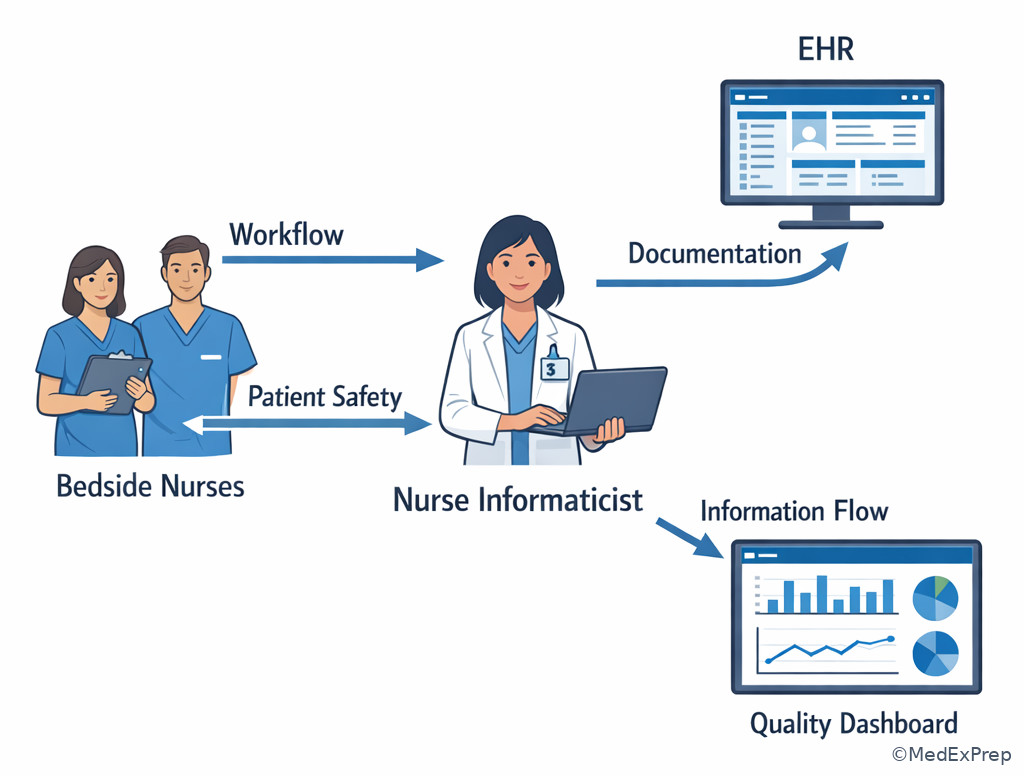
See Fig 1. That definition matters because the role begins with nursing problems: incomplete documentation, unsafe workarounds, inconsistent terminology, low adoption, or a mismatch between workflow and the EHR. The technology matters only because it affects how clinicians capture, retrieve, interpret, and act on information. A board-style stem may describe a charting burden, a poorly designed alert, or conflicting stakeholder requests. The best answer usually reflects the nursing informatics lens: clarify workflow, identify the information need, standardize the data element, involve stakeholders, and recommend a safe, usable process.
B Worked example
A 430-bed hospital is preparing to revise a falls-risk documentation tool. A staff nurse says the current form takes too long, the quality director wants cleaner reporting, and the analyst asks whether the nurse informaticist can “just decide the build.” The medical-surgical unit also reports a recent rise in catheter-associated infection rates, which is a distracting quality issue but unrelated to the immediate task. Another manager argues that the best solution is to buy a faster workstation-on-wheels.
Reasoning chain: Identify task: define the informatics function in the scenario. Extract key facts: this is a nursing documentation problem involving workflow burden and reporting needs. Apply rule: nursing informatics integrates nursing workflow knowledge with information management and technology support. Eliminate distractors: buying hardware alone does not address documentation design; independently deciding technical build exceeds the role as stated; chasing the unrelated infection metric shifts away from the actual requirement. Verify: the best next step is to analyze current nursing workflow and documentation requirements with stakeholders, then translate those needs into recommendations.
C Exam trap
D Checkpoint
Question: A nurse informaticist is asked to define the specialty during new analyst orientation. Which statement is the most appropriate?
- A. Nursing informatics is the management of hardware, software, and network performance for clinical units.
- B. Nursing informatics is the integration of nursing science with information and analytical sciences to improve the management and communication of clinical information.
- C. Nursing informatics is the bedside nurse’s ability to document accurately in the EHR.
- D. Nursing informatics is the leadership team’s use of dashboards to track quality metrics.
Answer: B
- A: Tempting because technology is visible in many stems; wrong because it narrows the role to IT operations rather than integrated nursing practice support.
- B: Tempting because it sounds broad; right because it captures the core integration at the heart of the specialty.
- C: Tempting because documentation is central to informatics; wrong because bedside documentation is one activity, not the full definition.
- D: Tempting because reporting is part of informatics; wrong because dashboards are one information use case, not the specialty itself.
Exam takeaway: Choose answers that integrate nursing practice needs with information use and technology support rather than reducing the role to only one domain.
flowchart LR
A[Nursing science
patient care
workflow
safety] --> D[Nursing informatics]
B[Information and analytical sciences
data organization
meaning
communication] --> D
C[Technology tools
EHR
CDS
reports
exchange] --> D
D --> E[Better documentation]
D --> F[Safer workflow]
D --> G[Useful information for decisions]
Exam takeaway: Visualize the nurse informaticist as the bridge between bedside workflow, documentation, and system design.
1.1.1.4 Foundational boundaries: what nursing informatics is not
A Explanation
The next decision conflict is choose-versus-reject: should the nurse informaticist directly perform the technical, legal, executive, or provider-level action described in the options? Usually, no. Nursing informatics practice is broad, but it is not unlimited. The single finding that resolves these questions is role fit. If the option asks the RN in informatics to translate needs, recommend, educate, evaluate, or escalate through policy and governance, it is likely correct. If it asks the RN to configure the firewall, rewrite a database schema, make a legal ruling, or independently approve enterprise budget, reject it as out of role.
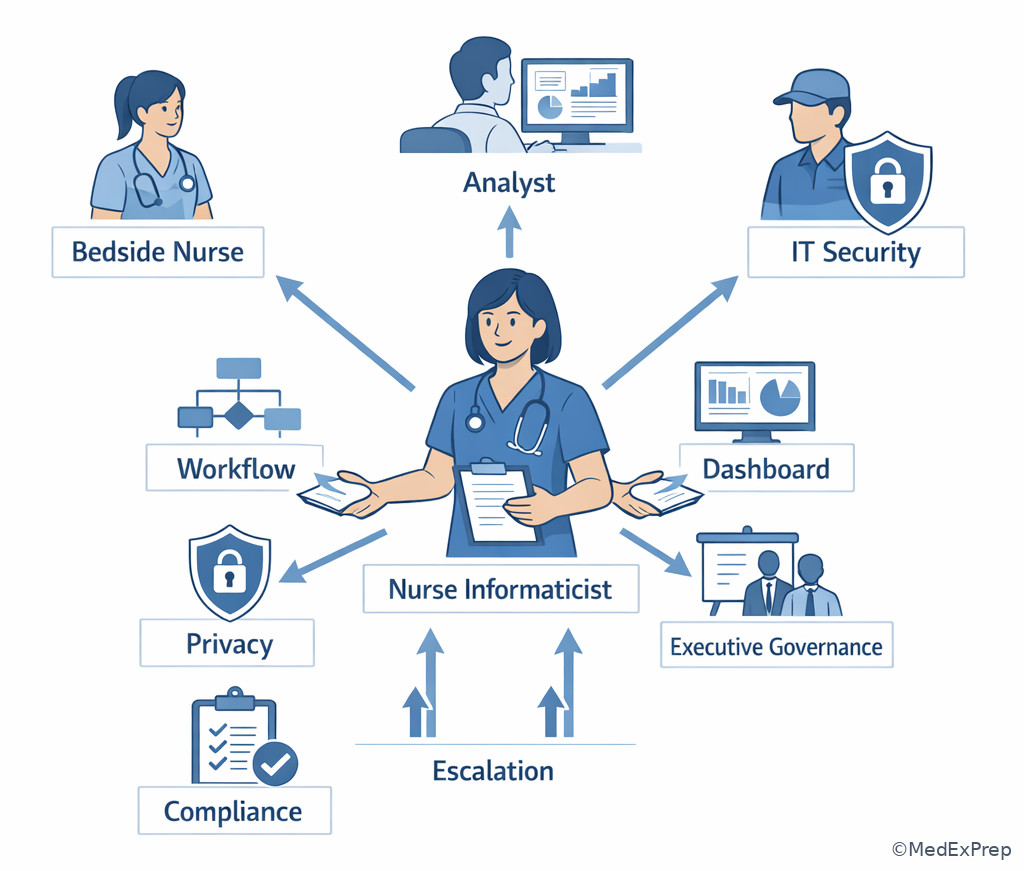
WHY THIS IS TESTED: Test writers commonly place one answer that sounds decisive and powerful but ignores scope. NI-BC favors role-appropriate collaboration, safe escalation, and interdisciplinary governance. See Fig 2. This boundary is not a limitation of importance; it is a mark of professional judgment. The nurse informaticist influences system design and use by bringing clinical workflow expertise, evidence, data interpretation, and change management to the table.
This topic also prevents confusion with the upcoming Nurse Informaticist Scope lesson. Here, you only need the foundational boundary: nursing informatics does not replace bedside nursing, IT engineering, compliance law, or executive governance. It intersects with all of them. Organizational policies and workflows may vary, but the exam-safe answer is the one that supports standardized workflow, secure information handling, patient safety, and appropriate stakeholder engagement.
B Worked example
A nurse informaticist in an ambulatory system learns that users are sharing logins during a hectic vaccine clinic. The site manager wants the nurse informaticist to immediately disable all workstation access and rewrite the authentication process. A physician also complains about delayed lab routing, which is a real problem but not the immediate role-boundary issue. The organization has an information security team and a documented incident-reporting pathway.
Reasoning chain: Identify task: select the role-appropriate response to a security-related workflow concern. Extract key facts: shared logins threaten confidentiality and accountability; there is an existing security structure; the requested fix involves technical access control redesign. Apply rule: the nurse informaticist should advocate for safe practice, stop unsafe workflow through policy-aligned steps, report and collaborate, but not independently perform security engineering. Eliminate distractors: rewriting authentication exceeds scope; ignoring the issue because it is “IT’s problem” fails patient and data stewardship. Verify: the best action is to report through the security/incident pathway, reinforce policy, and collaborate with security and operational leaders on workflow-safe correction.
C Exam trap
D Checkpoint
Question: Which action most clearly falls outside the usual nurse informaticist role on the NI-BC exam?
- A. Mapping nursing documentation workflow before a form redesign
- B. Recommending training after identifying frequent barcode scanning workarounds
- C. Independently reconfiguring the organization’s firewall after a suspected phishing event
- D. Presenting data-quality concerns to an interdisciplinary governance committee
Answer: C
- A: Tempting because workflow work can seem operational; wrong to reject because workflow analysis is core informatics work.
- B: Tempting because education may seem secondary; wrong to reject because training and adoption support are standard informatics contributions.
- C: Tempting because security matters in informatics; right because firewall configuration is specialized technical work outside the nurse informaticist role.
- D: Tempting because governance sounds administrative; wrong to reject because informatics commonly participates in governance and data stewardship.
Exam takeaway: Select options centered on analysis, recommendation, education, monitoring, and escalation rather than independent technical or legal authority.
flowchart TD
A[Action in option] --> B{Role fit?}
B -->|Analyze workflow or data| C[Likely in role]
B -->|Educate users or support adoption| C
B -->|Recommend through governance| C
B -->|Perform firewall or database engineering| D[Out of role]
B -->|Issue legal ruling or executive approval| D
C --> E[Choose or strongly consider]
D --> F[Reject and collaborate or escalate] Exam takeaway: Picture the nurse informaticist coordinating among clinicians, IT, compliance, and leaders rather than replacing any one of them.
- The most testable scope error in NI-BC stems is choosing an answer with independent technical or legal authority.
- True or False: A nurse informaticist should bypass governance if a requested change seems beneficial. False.
- Name the 3 role-safe verbs: analyze, recommend, escalate.
1.1.1.5 Application: using the definition to interpret workflow and documentation scenarios
A Explanation
Once you know the definition and boundaries, the next exam task is applying them to realistic scenarios. The decision conflict is often: is the core problem a user complaint, a technology complaint, or a workflow-information mismatch? The single rule that resolves it is to trace how information is captured, communicated, and used in nursing care. If the system creates duplicate entry, hides needed information, disrupts timing, or produces unusable outputs, the informatics issue is not merely user resistance; it is a workflow-information design problem.
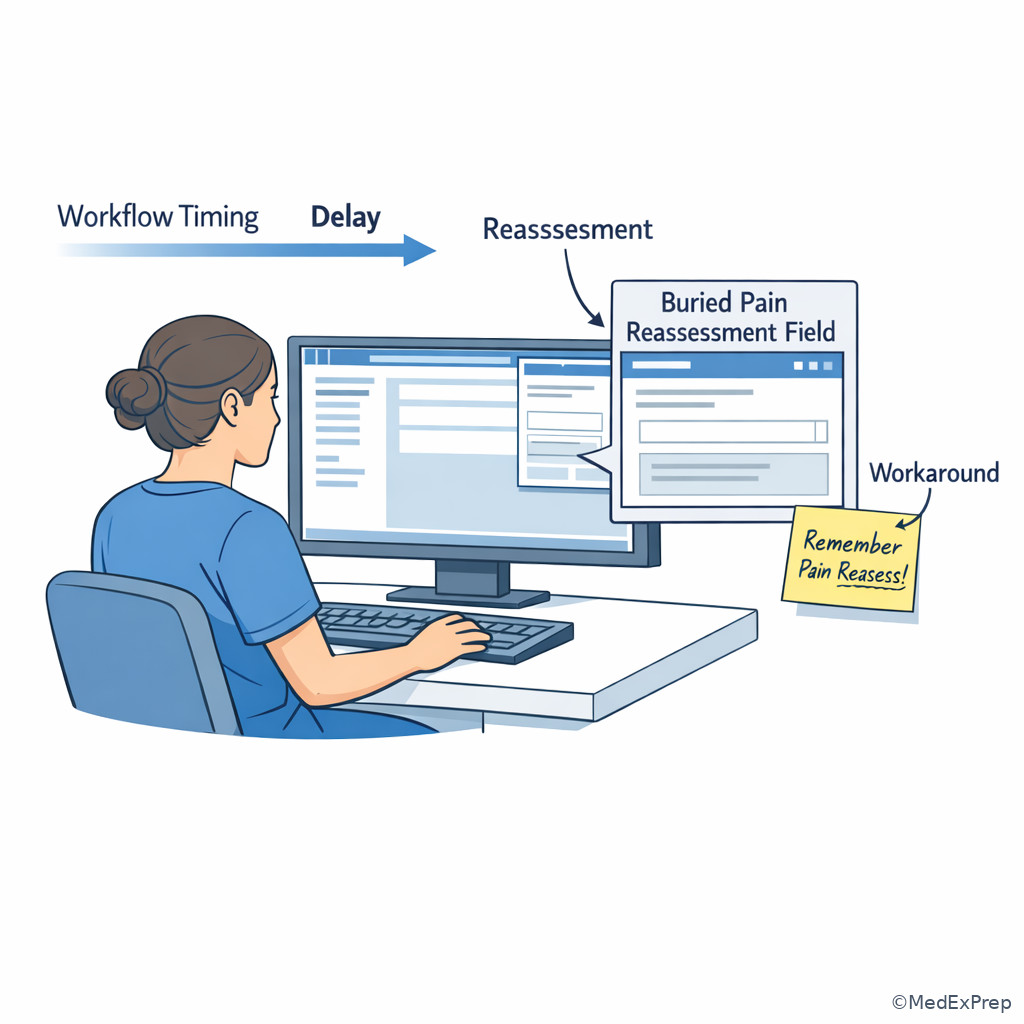
WHY THIS IS TESTED: NI-BC questions rarely stop at pure definitions. They embed the definition inside documentation burden, alert fatigue, downtime confusion, inconsistent terminology, or poor adoption. See Fig 3. The best answer is usually not “tell nurses to try harder.” Instead, it is to assess the current state, identify where the information flow breaks down, and recommend a safer, more usable standard.
This is also where nursing perspective matters. A technically complete field is not enough if it appears at the wrong time in workflow, duplicates prior documentation, or causes clinicians to create unsafe workarounds. The nurse informaticist asks: Who documents? When? Why? What downstream use depends on that field? Which data element needs standardization? What patient safety or quality risk follows if it is omitted or delayed?
B Worked example
An inpatient unit reports that nurses chart pain reassessment late because the reassessment field is buried in a separate screen. The EHR analyst notes that the field already exists, and the unit educator suggests a reminder email. A recent drop in patient-portal logins is also mentioned, which is distracting and not central to the problem. The charge nurses say they sometimes leave paper notes to remember reassessments during a busy shift.
Reasoning chain: Identify task: determine the informatics interpretation of the problem. Extract key facts: the field exists, but workflow placement is poor; nurses are using memory aids outside the system; the quality issue is delayed reassessment documentation. Apply rule: nursing informatics focuses on how information is captured and used in workflow, not only whether a field exists. Eliminate distractors: sending an email treats this as motivation alone; focusing on portal logins addresses the wrong metric; assuming noncompliance ignores the workflow barrier. Verify: the best next step is to assess current workflow and usability, then recommend redesign or relocation of the reassessment task to better fit nursing work.
C Exam trap
D Checkpoint
Question: A documentation field exists in the EHR, but nurses repeatedly miss it because it appears after several unrelated screens. Which response best reflects the nursing informatics definition?
- A. Recommend a workflow and usability review to align the field with clinical documentation timing.
- B. Tell unit managers to audit nurses more aggressively for missed charting.
- C. Remove the field because any difficult field is unnecessary.
- D. Wait for the vendor to identify the issue during the next annual update.
Answer: A
- A: Tempting because it requires more work than simple education; right because it applies nursing workflow knowledge to information management and system usability.
- B: Tempting because accountability matters; wrong because it treats a workflow-design issue as a surveillance issue.
- C: Tempting because simplification can help; wrong because the field may be clinically necessary, and the issue is placement, not existence alone.
- D: Tempting because vendors influence design; wrong because local workflow analysis is the appropriate first step.
Exam takeaway: When users create workarounds, look for poor alignment between information capture and clinical workflow before blaming training alone.
flowchart LR
A[Required nursing task] --> B[Field exists in system]
B --> C{Fits workflow timing?}
C -->|Yes| D[Higher completion and cleaner data]
C -->|No| E[Missed charting]
E --> F[Workarounds]
F --> G[Safety and quality risk] Exam takeaway: Visual cues such as sticky notes, duplicate entry, or delayed charting often signal workflow-design problems.
1.1.1.6 Application to data, information, and decision support: why context matters
A Explanation
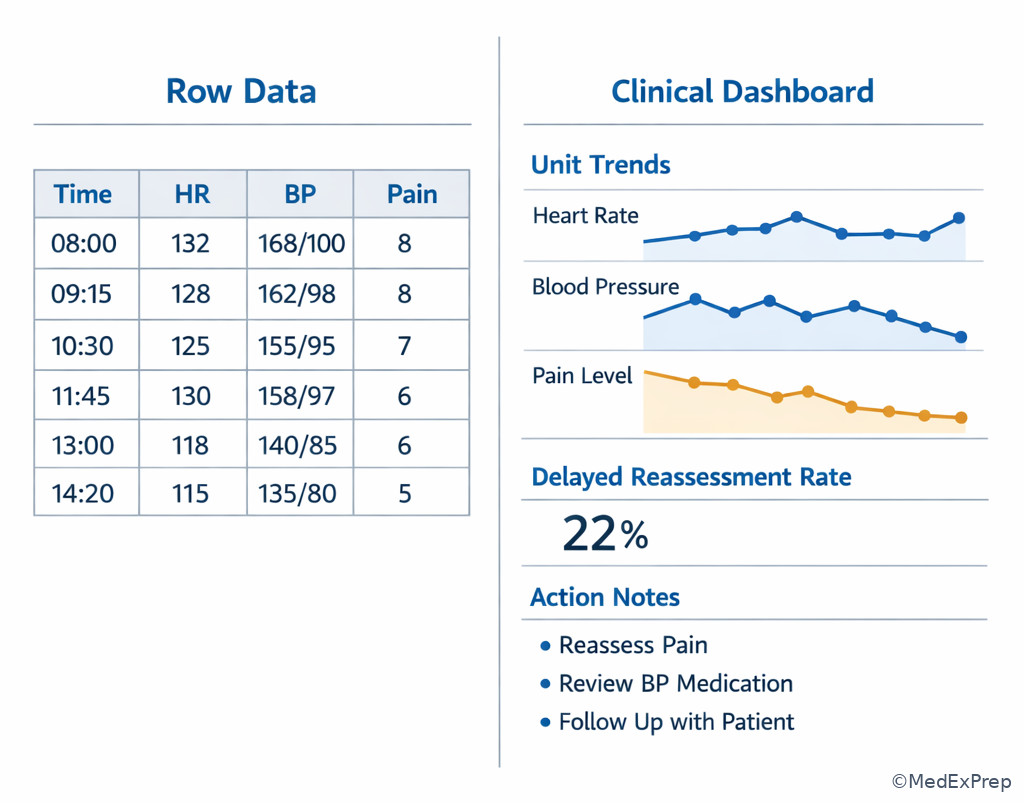
This subsection prepares you for the upcoming Data Information Knowledge Wisdom topic. The decision conflict here is whether captured facts are useful by themselves. The answer is no: in nursing informatics, value comes from transforming raw facts into meaningful information that supports action. The single clue is context. A list of timestamps or vital entries is data; a trend showing delayed sepsis screening by unit is information; a recommendation to change screening workflow based on that trend reflects knowledge use and judgment.
WHY THIS IS TESTED: Many stems mention dashboards, reports, alerts, or extracted fields. The exam wants to know whether you understand that informatics is not mere data collection; it is purposeful information use. See Fig 4. A nurse informaticist does not stop at generating a report. The role includes deciding whether the data are clinically meaningful, timely, comparable, and suitable for improving workflow, documentation, safety, or quality.
This is also where clinical decision support enters the picture. A rule, alert, or dashboard becomes informatics-relevant only when it delivers the right information to the right person in the right workflow moment. A technically accurate report that arrives too late or is impossible to interpret has low informatics value. Nursing informatics asks whether information supports practice and outcomes, not just whether the system can display it.
B Worked example
A nurse informaticist receives a monthly report showing 92% completion of discharge education documentation. Leaders want to declare the project successful. A staff nurse reports that the discharge teaching section is often completed before the patient’s caregiver arrives, and many patients with limited English proficiency later call with medication questions. The pharmacy turnaround time is also longer this month, which is a tempting but separate operational detail.
Reasoning chain: Identify task: determine whether the available data are sufficient as meaningful information. Extract key facts: documentation completion is high, but timing and comprehension may be poor; a vulnerable subgroup is affected. Apply rule: nursing informatics values context and actionability, not just completion counts. Eliminate distractors: celebrating completion alone ignores workflow quality; focusing on pharmacy turnaround addresses a different process. Verify: the best next step is to interpret the metric in context and evaluate whether documentation reflects effective, timely education and patient understanding.
C Exam trap
D Checkpoint
Question: Which example best reflects the nursing informatics concept that information requires clinical context?
- A. A spreadsheet listing all blood pressure entries from one month with no unit labels
- B. A dashboard showing delayed pain reassessment trends by unit and shift to guide workflow redesign
- C. A list of all users who logged in during the last week
- D. A file of discharge forms stored in alphabetical order
Answer: B
- A: Tempting because it contains clinical data; wrong because the entries lack contextual interpretation for action.
- B: Tempting because it sounds analytical; right because data are organized by meaningful context to support workflow decisions.
- C: Tempting because audit data matter; wrong because it is a raw list without nursing practice interpretation in the scenario.
- D: Tempting because organization seems informational; wrong because filing order alone does not create clinically meaningful information.
Exam takeaway: Choose answer choices that move beyond data collection to clinically meaningful interpretation and workflow-guided action.
flowchart LR
A[Raw data
entries
timestamps
counts] --> B[Information
organized by context]
B --> C[Knowledge use
identify pattern]
C --> D[Practice action
redesign
educate
monitor]
Exam takeaway: A useful informatics display shows trend, timing, and comparison, not just an isolated number.
- The step that turns raw entries into something usable is adding context.
- True or False: A high completion rate always means the workflow is effective. False.
- Name the three steps in the memory anchor: Capture, Context, Action.
1.1.1.7 Integration: the nurse informaticist as translator, advocate, and evaluator
A Explanation
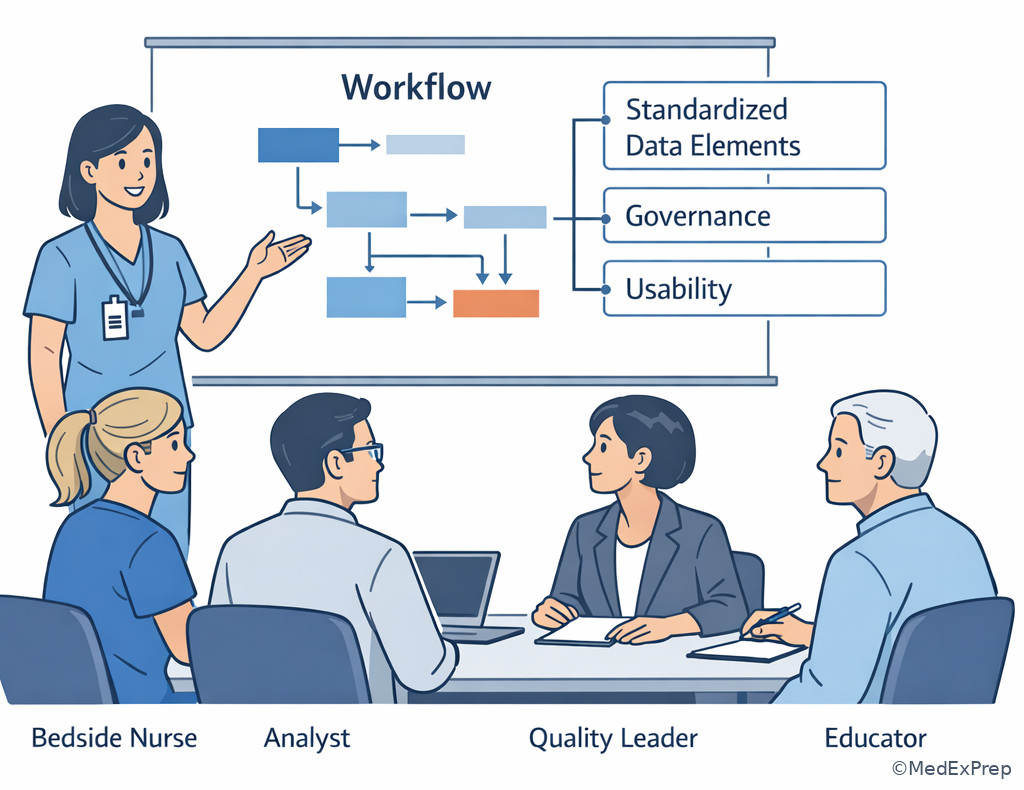
At the integration level, the definition becomes a practical identity: the nurse informaticist is a translator between clinical care, information needs, and system capabilities. The decision conflict is whether the best next step is to pick a technical solution immediately or first clarify the practice need and stakeholders. The single rule is this: in nursing informatics, sustainable solutions begin with the clinical problem, affected users, and intended outcomes.
WHY THIS IS TESTED: Exam questions often describe competing stakeholder demands. One group wants more required fields, another wants less documentation, leadership wants better metrics, and IT wants standardized builds. The correct answer usually acknowledges all four but starts with translation: define the nursing need, evaluate workflow impact, identify the data requirement, and take recommendations to the right governance structure. See Fig 5.
The nurse informaticist also advocates for usability and safety. If a system change adds clicks but does not improve care, the nurse informaticist should question it. If a metric seems clean but is built on inconsistent documentation, the nurse informaticist should surface data-quality risk. If a requested change affects enterprise standards, the nurse informaticist should route it through governance rather than solving it informally. This role is influential even without unilateral control.
Forward reference: the upcoming Nurse Informaticist Scope lesson will detail responsibilities such as workflow support, documentation improvement, training, quality, and interdisciplinary recommendations. This current topic gives the conceptual frame those tasks rest on.
B Worked example
A health system wants to standardize wound documentation across inpatient, home health, and ambulatory settings. The chief nursing officer wants comparable quality reports. Bedside nurses worry about extra clicks. An analyst proposes copying the inpatient template everywhere. A recent increase in outpatient no-show rates is mentioned in the meeting notes, but it does not drive this decision. The nurse informaticist is asked for the best recommendation.
Reasoning chain: Identify task: choose the role-appropriate informatics recommendation. Extract key facts: cross-setting standardization is desired, but workflows differ; leaders need reporting; nurses need usability; a one-size-fits-all template may create burden. Apply rule: the nurse informaticist translates nursing and information needs into standardized yet workflow-sensitive recommendations. Eliminate distractors: copying one template everywhere ignores setting differences; focusing on no-shows distracts from documentation design; refusing standardization ignores enterprise reporting needs. Verify: the best recommendation is to define core standardized data elements for all settings, then adapt workflow presentation with stakeholder input and governance review.
C Exam trap
D Checkpoint
Question: In a meeting about improving nurse handoff documentation, which action best demonstrates the integrative role of nursing informatics?
- A. Select the final software design independently to save time.
- B. Clarify the handoff workflow, identify required information elements, and bring recommendations to the appropriate interdisciplinary group.
- C. Tell end users to follow the current process until leadership decides next year.
- D. Focus only on reducing clicks, regardless of whether critical handoff data are lost.
Answer: B
- A: Tempting because decisive action feels efficient; wrong because unilateral final design selection bypasses collaboration and governance.
- B: Tempting because it takes more coordination; right because it translates clinical workflow into structured information needs and role-appropriate recommendations.
- C: Tempting because stability can reduce disruption; wrong because it ignores an identified workflow problem needing structured analysis.
- D: Tempting because usability matters; wrong because usability must be balanced with patient safety and essential information continuity.
Exam takeaway: The strongest answer often starts with clarifying the clinical need, then translating it into information requirements, stakeholder engagement, and evaluation.
flowchart TD
A[Clinical problem] --> B[Clarify workflow and stakeholders]
B --> C[Define information need]
C --> D[Recommend through collaboration and governance]
D --> E[Implement or optimize]
E --> F[Evaluate adoption, data quality, outcomes]
Exam takeaway: The informatics nurse adds value by converting bedside workflow concerns into structured system recommendations.
1.1.1.8 Integration: how the definition predicts the best next step on NI-BC questions
A Explanation
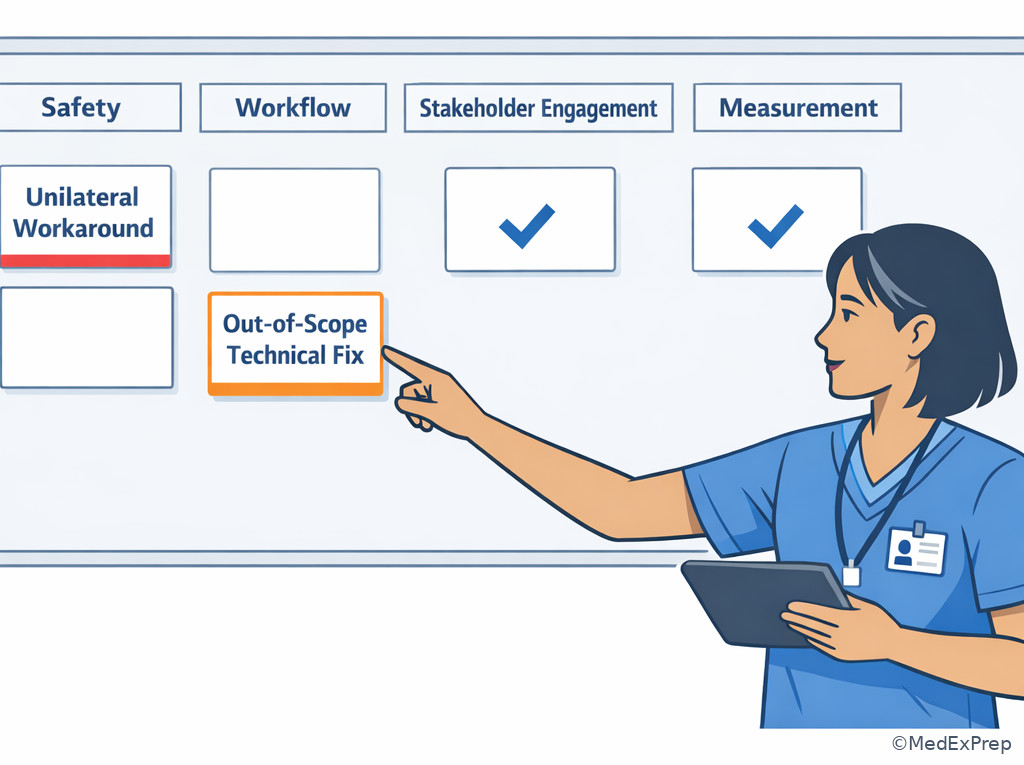
The final level is exam synthesis. The decision conflict is which answer best matches the nurse informaticist’s first move when faced with ambiguity. The single rule is: choose the option that best supports standardized workflow, accurate documentation, secure information handling, measurable improvement, and appropriate stakeholder engagement. This rule converts the definition into a test-taking framework.
WHY THIS IS TESTED: The NI-BC exam rewards not just knowledge of the definition, but its use as a filter. When two options both sound reasonable, the better answer is usually the one that is safer, more collaborative, more workflow-grounded, and more measurable. See Fig 6. For example, if a report shows poor compliance, the best next step is often to assess workflow and data quality before implementing punitive monitoring. If users request a local workaround, the best answer often routes the issue through governance and standardization rather than approving a one-off fix.
You can summarize the exam posture this way: nurse first, systems-aware second, team-based always. That means protecting patient care, supporting clinicians, using information meaningfully, and acting within role boundaries. When stems are vague, choose the answer that clarifies requirements, brings the right stakeholders in, and preserves safety and data integrity.
B Worked example
After go-live of a new intake form, an emergency department reports longer triage times. Leadership wants immediate comparison metrics, nurses say the pain score field appears too early in the workflow, and one analyst suggests removing several required elements without review. A parallel rumor about a vendor merger circulates among staff, which is distracting but irrelevant. The nurse informaticist must recommend the best next step.
Reasoning chain: Identify task: determine the best NI-BC-style first action. Extract key facts: workflow timing is affected, leaders want data, proposed changes may alter standards, and the issue began after a form change. Apply rule: start with workflow analysis and stakeholder clarification, not unilateral field removal. Eliminate distractors: chasing the vendor rumor adds no value; instantly removing fields may harm data integrity; reporting metrics alone without root-cause assessment is incomplete. Verify: the best next step is to review current workflow and required information elements with stakeholders, then bring findings and recommendations through the appropriate optimization/governance pathway.
C Exam trap
D Checkpoint
Question: When an NI-BC stem is ambiguous, which default answer pattern is usually safest?
- A. Choose the fastest technical workaround before more delays occur.
- B. Choose the option that clarifies workflow, protects safety, involves stakeholders, and supports standardization.
- C. Choose the option that gives the nurse informaticist the most direct control.
- D. Choose the option that focuses only on end-user satisfaction.
Answer: B
- A: Tempting because speed matters in operations; wrong because unscreened workarounds can harm safety and data integrity.
- B: Tempting because it seems slower; right because it reflects the exam’s role-appropriate, patient-safety, workflow-centered framework.
- C: Tempting because authority can look effective; wrong because NI-BC favors collaboration and governance rather than maximal individual control.
- D: Tempting because usability matters; wrong because user satisfaction alone is not enough if standards, safety, or data quality are compromised.
Exam takeaway: When choices are close, prefer the option that is safer, more collaborative, workflow-grounded, and measurable.
flowchart LR
A[Ambiguous exam stem] --> B[Check patient safety and workflow]
B --> C[Check role fit and stakeholder engagement]
C --> D[Check standardization and data integrity]
D --> E[Choose measurable next step]
Exam takeaway: On exam items, filter choices through safety, workflow, role boundaries, governance, and measurement.
Exam Traps & Differentiators
Most common wrong answer and why: choosing the option that gives the nurse informaticist direct technical authority. It is tempting because informatics is technology-adjacent. It is wrong because the specialty is defined by integrating nursing practice needs with information use, not replacing technical specialists or governance processes.
| Looks similar | But isn’t | Single differentiator |
|---|---|---|
| Nursing informatics | General IT support | Informatics starts with clinical workflow and nursing information needs. |
| Nursing informatics | Bedside charting alone | Informatics includes system design, information flow, analysis, and improvement, not just end-user documentation. |
| Nursing informatics | Data reporting alone | The role interprets information in clinical context and supports action. |
| Nursing informatics | Compliance/legal adjudication | The nurse informaticist collaborates and escalates rather than issuing legal determinations. |
| Nursing informatics | Executive unilateral governance | The role participates in governance but does not override formal approval structures. |
If the stem says...
- “Users are making workarounds” → think workflow mismatch or usability risk before assuming poor motivation.
- “Can the nurse informaticist just change the system today?” → think role boundaries, collaboration, and governance.
- “The report looks good, but frontline staff say care is still disrupted” → think data without adequate context.
- “A technically correct solution increases documentation burden” → think nursing workflow fit and patient-safety tradeoffs.
- “An option sounds strong because it takes control immediately” → think out-of-scope or bypassed governance.
- “Different settings want one standard form” → think standardized core data plus workflow-sensitive implementation.
| Trap pair | Why the wrong answer is tempting | Clue that rules it out |
|---|---|---|
| Train users vs redesign workflow | Education is a real intervention and easy to picture | The stem shows the task is poorly placed in workflow, not merely misunderstood. |
| Pull more data vs interpret existing data | More data feels more objective | The problem is missing context, not missing volume. |
| Approve local workaround vs standardize through governance | Local fixes reduce immediate frustration | The change affects enterprise standards, patient safety, or data comparability. |
| Independent technical fix vs interdisciplinary escalation | Direct action seems efficient | The requested action requires specialized or formal authority outside role. |
Related future confusions include data vs information and governance vs operations. Those later topics sharpen the same pattern introduced here: the correct answer is rarely the most raw, most local, or most unilateral option.
Algorithm / Approach
Rapid Review
- Nursing informatics → integration of nursing science with information and analytical sciences, not technology alone
- Correct role lens → nurse first, workflow-aware, patient-safety anchored
- Wrong reduction → IT support alone misses nursing context
- Wrong reduction → dashboard review alone misses action and workflow meaning
- Best first move → clarify workflow and information need before pushing a solution
- Scope boundary → analyze/recommend/escalate, do not independently engineer enterprise security controls
- Documentation problem → ask where the field sits in workflow, not just whether the field exists
- Good metric use → context and actionability beat raw completion counts
- Standardization question → standardize core data, adapt to setting workflow
- Workaround in stem → suspect usability or process mismatch
- Ambiguous answer choice → prefer collaboration plus governance over unilateral action
- Data mention in stem → ask whether the information is meaningful to nursing care
- Best distractor eliminator → identify whether the action stays within nurse informaticist scope
Self-check quiz
1. A newly hired RN joins the informatics team after years on a telemetry unit. During orientation, the educator asks which action best reflects nursing informatics practice in the first month. The RN notices staff also want new badge reels and a different break-room printer. Which action is most appropriate?
- A. Analyze how nurses document handoff information and recommend workflow-based improvements
- B. Replace unit printers to improve morale before assessing documentation needs
- C. Independently redesign the database tables used by the EHR handoff tool
- D. Decide which provider handoff content physicians should include in their notes
2. In a quality meeting, leaders ask for a one-sentence definition of nursing informatics. One manager mentions recent parking complaints and another references a planned server upgrade. Which statement is the most appropriate?
- A. Nursing informatics is the specialty that manages hospital hardware and network uptime
- B. Nursing informatics is accurate charting by bedside nurses
- C. Nursing informatics integrates nursing science with information and analytical sciences to support practice and decision-making
- D. Nursing informatics is executive use of dashboards to track performance
3. A 62-year-old patient with heart failure and diabetes is admitted to a medical unit. Nurses report that the daily weight documentation field is hidden in a late-shift screen, so weights are often charted after rounds. A recent cafeteria renovation is discussed in the same huddle. As the nurse informaticist, what is the most appropriate next step?
- A. Audit nurses for noncompliance before reviewing the screen design
- B. Map the documentation workflow and evaluate whether field placement fits nursing tasks
- C. Remove the weight field because delayed data are worse than missing data
- D. Wait for the vendor’s next standard update before evaluating the issue
4. In an ambulatory clinic, a 74-year-old patient with COPD and limited English proficiency receives discharge instructions that are documented as complete in the EHR. Staff later report that the patient’s daughter was not present during teaching and multiple medication clarification calls followed. A separate complaint about parking lot traffic is also logged that day. Which nursing informatics interpretation is most appropriate?
- A. High documentation completion means the education workflow is effective
- B. The completion metric needs contextual review because documentation may not reflect effective teaching timing
- C. The best next step is to collect more unrelated operational data before reviewing the metric
- D. The issue is outside informatics because patient teaching is only a bedside concern
5. During a busy flu clinic, staff share login credentials to speed intake for a 5-year-old child with asthma and a mother who asks repeated portal questions. The site manager asks the nurse informaticist to immediately reconfigure authentication rules on all devices. What is the most appropriate action?
- A. Report the practice through the organization’s security pathway and collaborate on a safer workflow response
- B. Reprogram authentication settings independently before the next patient arrives
- C. Ignore the issue because resolving logins belongs only to frontline managers
- D. Tell staff to continue sharing credentials until clinic volume decreases
6. A multihospital system wants one wound documentation template for inpatient, ambulatory, and home health settings. One inpatient nurse worries about extra clicks, a home health manager worries about mobile workflow, and a quality leader wants cross-setting reports. A recent elevator outage at one campus is discussed but is unrelated. Which recommendation is most appropriate?
- A. Use the inpatient template unchanged in every setting to maximize standardization
- B. Define shared core data elements across settings, then tailor workflow presentation with stakeholder input and governance review
- C. Let each setting create any documentation it prefers and compare reports later
- D. Delay the project until every setting agrees on identical screen layout and timing
7. After go-live of a revised triage form, an emergency department sees longer intake times for patients including a 48-year-old with chest pain and hypertension and a 19-year-old with asthma and anxiety. Nurses state one required field appears before the assessment data needed to answer it. An analyst offers to remove the field tonight without review. What is the most appropriate nursing informatics response?
- A. Approve immediate removal of the field to reduce triage time before the next shift
- B. Review the workflow and purpose of the field, then route recommendations through the appropriate optimization/governance process
- C. Keep the design unchanged and re-educate nurses because all required fields must remain exactly where they are
- D. Focus only on collecting staff satisfaction comments because throughput data are less important
8. A nurse informaticist is asked to attend a meeting after a phishing event exposed concerns about role-based access. A patient with metastatic cancer and a new palliative consult is discussed in the same meeting, which makes the room emotionally charged. The chief operating officer asks for an immediate plan. Which action best stays within nursing informatics scope while advancing safety?
- A. Perform penetration testing on the affected network segment and close the event independently
- B. Identify workflow and user-access concerns, reinforce secure practice expectations, and escalate through security and governance channels
- C. Decide legal liability for every user involved before notifying any other team
- D. Suspend all access across the organization without policy review to ensure no further risk
Answer key
1. Correct answer: A
- A: Tempting because it sounds less dramatic than a technical fix, but it is correct because it uses the nursing process to assess workflow first and aligns with the nurse informaticist role of analyzing documentation needs before intervening. The single stem clue is the request tied to handoff information rather than infrastructure. Sources: ANA Scope and Standards of Practice; NCSBN role and safety principles.
- B: Tempting because environmental improvements can support staff satisfaction, but it is incorrect because printer replacement does not address the priority informatics need in the stem. The single clue is that the question asks what reflects nursing informatics practice, not general operational comfort. Sources: ANA; NCSBN.
- C: Tempting because database change sounds technical and decisive, but it is incorrect because independent database redesign falls outside typical nursing informatics scope. The single clue is the phrase indicating direct database redesign. Sources: ANA; NCSBN.
- D: Tempting because handoff content is clinically important, but it is incorrect because deciding provider documentation content independently moves beyond the stated nursing informatics task and role. The single clue is that the option shifts into provider workflow control rather than nursing workflow analysis. Sources: ANA; NCSBN.
Blueprint tag: Foundations of Nursing Informatics Practice: Core concepts and role - Definition framing
2. Correct answer: C
- A: Tempting because informatics interacts with technology, but it is incorrect because hardware and network uptime describe IT operations rather than the integrated nursing specialty. The single clue is the narrow focus on infrastructure. Sources: ANA; McGonigle and Mastrian.
- B: Tempting because charting is central to nursing workflow, but it is incorrect because accurate documentation alone is one activity within the specialty, not the definition itself. The single clue is the overly narrow bedside focus. Sources: ANA; NCSBN.
- C: Tempting because it is broad, and it is correct because it includes nursing science plus information/analytical sciences to support practice and decision-making. The single clue is the integrated framing. Sources: ANA; McGonigle and Mastrian.
- D: Tempting because dashboards are a real informatics output, but it is incorrect because executive dashboard use is only one use case. The single clue is that the option limits the field to leadership reporting. Sources: ANA.
Blueprint tag: Foundations of Nursing Informatics Practice: Core concepts and role - Define nursing informatics in exam-safe language
3. Correct answer: B
- A: Tempting because accountability is part of safe practice, but it is incorrect in priority terms because the nursing process begins with assessment of the workflow barrier before punitive monitoring. The single clue is that the field is hidden in a late-shift screen. Sources: NCSBN; ANA.
- B: Tempting because it requires extra investigation, and it is correct because it assesses the workflow-system fit first, which is the priority informatics action. The single clue is repeated missed documentation tied to field placement. Sources: ANA; Lewis nursing principles on workflow and safe systems.
- C: Tempting because simplification can improve efficiency, but it is incorrect because removing a clinically important field without analysis may worsen data integrity and patient safety. The single clue is that the problem is placement, not proven lack of necessity. Sources: ANA; NCSBN.
- D: Tempting because vendor updates are real, but it is incorrect because waiting delays needed nursing workflow assessment. The single clue is an active local problem affecting current care. Sources: ANA.
Blueprint tag: Systems, Design, and Lifecycle: Workflow and requirements analysis - Link definition to workflow improvement tasks
4. Correct answer: B
- A: Tempting because completion percentages often look like success metrics, but it is incorrect because nursing informatics must interpret data in context, including timing and patient understanding. The single clue is that the daughter was absent during teaching. Sources: ANA; McGonigle and Mastrian.
- B: Tempting because it adds nuance, and it is correct because it prioritizes contextual interpretation of the metric before concluding the workflow is effective. The single clue is the mismatch between documentation completion and follow-up medication confusion. Sources: ANA; NCSBN.
- C: Tempting because broader data collection can be useful, but it is incorrect because unrelated operational data do not address the priority information-context problem. The single clue is the unrelated parking complaint. Sources: ANA.
- D: Tempting because patient teaching happens at the bedside, but it is incorrect because documentation timing and interpretation of the teaching metric are clear informatics concerns. The single clue is the EHR completion metric being used to judge workflow effectiveness. Sources: ANA.
Blueprint tag: Data, Analytics, Quality, and Evaluation: Analytics, metrics, and evaluation - Information use
5. Correct answer: A
- A: Tempting because it may seem less decisive than technical action, but it is correct because it follows safety and security priorities while staying within nursing informatics scope through reporting and collaboration. The single clue is the existing organizational security pathway. Sources: ANA; NCSBN Guidelines.
- B: Tempting because immediate technical action appears protective, but it is incorrect because independent authentication reconfiguration exceeds the usual nursing informatics role. The single clue is the request to reconfigure authentication rules on all devices. Sources: ANA.
- C: Tempting because frontline ownership matters, but it is incorrect because shared credentials create privacy and accountability risk requiring action and escalation. The single clue is active unsafe login sharing. Sources: ANA; NCSBN.
- D: Tempting because clinic flow is busy, but it is incorrect because convenience never outranks secure information handling and policy compliance. The single clue is the unsafe credential-sharing practice. Sources: ANA; NCSBN.
Blueprint tag: Foundations of Nursing Informatics Practice: Core concepts and role - Scope-aware judgment
6. Correct answer: B
- A: Tempting because standardization supports enterprise comparison, but it is incorrect because identical templates across different settings can create workflow burden and reduce usability. The single clue is the presence of inpatient, ambulatory, and home health settings. Sources: ANA; Lewis; NCSBN.
- B: Tempting because it is a balanced compromise, and it is correct because it follows the nursing informatics approach of standardizing core data while adapting to workflow context through stakeholder engagement and governance. The single clue is the dual need for comparable reports and setting-specific workflow fit. Sources: ANA; McGonigle and Mastrian.
- C: Tempting because local ownership can increase adoption, but it is incorrect because fully separate documentation undermines standardization and enterprise reporting. The single clue is the quality leader’s need for cross-setting reports. Sources: ANA.
- D: Tempting because consensus matters, but it is incorrect because requiring identical layout and timing across settings confuses standardization of data with sameness of workflow. The single clue is the legitimate difference in mobile workflow needs. Sources: ANA.
Blueprint tag: Leadership, Education, and Change Management: Leadership and collaboration - Interdisciplinary translation
7. Correct answer: B
- A: Tempting because throughput is important and the field seems to be causing delay, but it is incorrect because ad hoc removal may damage safety, data integrity, or required reporting. The single clue is that the field is required and its purpose has not yet been reviewed. Sources: ANA; NCSBN.
- B: Tempting because it adds steps, and it is correct because the priority nursing-informatics action is to assess workflow and field purpose first, then escalate through appropriate optimization/governance channels. The single clue is the mismatch between field timing and assessment sequence. Sources: ANA; Lewis; NCSBN.
- C: Tempting because education is often part of change management, but it is incorrect because the stem identifies a design-sequencing problem rather than a pure knowledge deficit. The single clue is that nurses cannot answer the field before obtaining the needed assessment data. Sources: ANA.
- D: Tempting because user experience matters, but it is incorrect because staff satisfaction alone does not address the priority issue of triage delay and field purpose. The single clue is longer intake times after go-live. Sources: ANA.
Blueprint tag: Systems, Design, and Lifecycle: Workflow and requirements analysis - Link definition to workflow improvement tasks
8. Correct answer: B
- A: Tempting because cyber incidents feel urgent, but it is incorrect because penetration testing is specialized security work outside the nurse informaticist role. The single clue is the request to perform a technical security operation independently. Sources: ANA; NCSBN.
- B: Tempting because it may seem indirect, and it is correct because it addresses workflow and access concerns while following secure practice and proper escalation pathways. The single clue is the need to stay within nursing informatics scope while advancing safety. Sources: ANA; NCSBN Guidelines.
- C: Tempting because accountability matters after a phishing event, but it is incorrect because legal liability determination is outside the role and delays appropriate multidisciplinary response. The single clue is the legal-adjudication language. Sources: ANA.
- D: Tempting because broad shutdown may appear safest, but it is incorrect because suspending all access without policy review can jeopardize patient care and exceeds individual authority. The single clue is organization-wide action without governance or policy process. Sources: ANA; NCSBN.
Blueprint tag: Foundations of Nursing Informatics Practice: Core concepts and role - Scope-aware judgment
Keep going with the full NI-BC Informatics Prep Course (NI-BC)
You just studied the way members do, in the same lesson interface. Full access unlocks every lesson, the question bank and flashcards for a full year.
One payment · 1 year of access · No auto-renewal