1.1.1 - Standard Precautions Principles
Why it matters
- Most early phlebotomy exam errors come from unsafe shortcuts, not from lack of technical skill.
- Standard Precautions apply before, during, and after every collection; the exam often tests the one moment where a shortcut should trigger a stop.
- Infection-control mistakes can harm both patient and collector, and they also create specimen-quality problems.
- When a stem adds pressure, urgency, or a familiar patient, the correct answer is still the safest standard process.
Key Terms & Must-Know Facts
1.1.1.1 Key terms
- Standard Precautions: baseline infection-control practices used for all patients.
- OPIM: other potentially infectious materials.
- Exposure risk: chance that blood or body fluid contact may occur.
- Hand hygiene: cleansing hands before and after patient contact and glove use.
- PPE: gloves, gown, mask, eye protection, or face shield as indicated by risk.
- Sharps safety: handling needles and lancets to prevent injury.
- Contamination: transfer of microorganisms to hands, equipment, surfaces, or specimens.
- Clean technique: practice that minimizes transfer of organisms during routine care.
- Point-of-use disposal: discarding sharps immediately in an approved sharps container.
- Cross-contamination: transfer of contaminants from one person or item to another.
- Engineering control: device or equipment feature that reduces exposure risk.
- Work practice control: behavior or procedure that reduces exposure risk.
1.1.1.2 Must-know facts
- Use Standard Precautions for every patient, not only patients known to be infectious.
- Gloves do not replace hand hygiene.
- Do not recap, bend, or break contaminated needles unless specific device instructions and policy require a safety step.
- Dispose of sharps immediately after use in an approved container.
- If safety cannot be maintained, the best next step is often to stop and escalate.
- Visible cleanliness does not prove a surface, hand, or specimen is safe.
- Labeling, transport, and cleanup are part of Standard Precautions, not separate from them.
- Patient urgency never justifies bypassing identity, PPE, or sharps safety rules.
Exam takeaway: Use Standard Precautions for every patient encounter and let exposure risk determine added protection.
flowchart TD
A[Every patient encounter] --> B[Assume blood or OPIM may be infectious]
B --> C[Perform hand hygiene]
C --> D[Assess task exposure risk]
D --> E[Use appropriate PPE]
E --> F[Collect and handle specimen safely]
F --> G[Dispose of sharps and contaminated supplies]
G --> H[Clean hands and document per policy]
See Fig 1 for the core rule the exam keeps returning to: universal application first, task-based protection second.
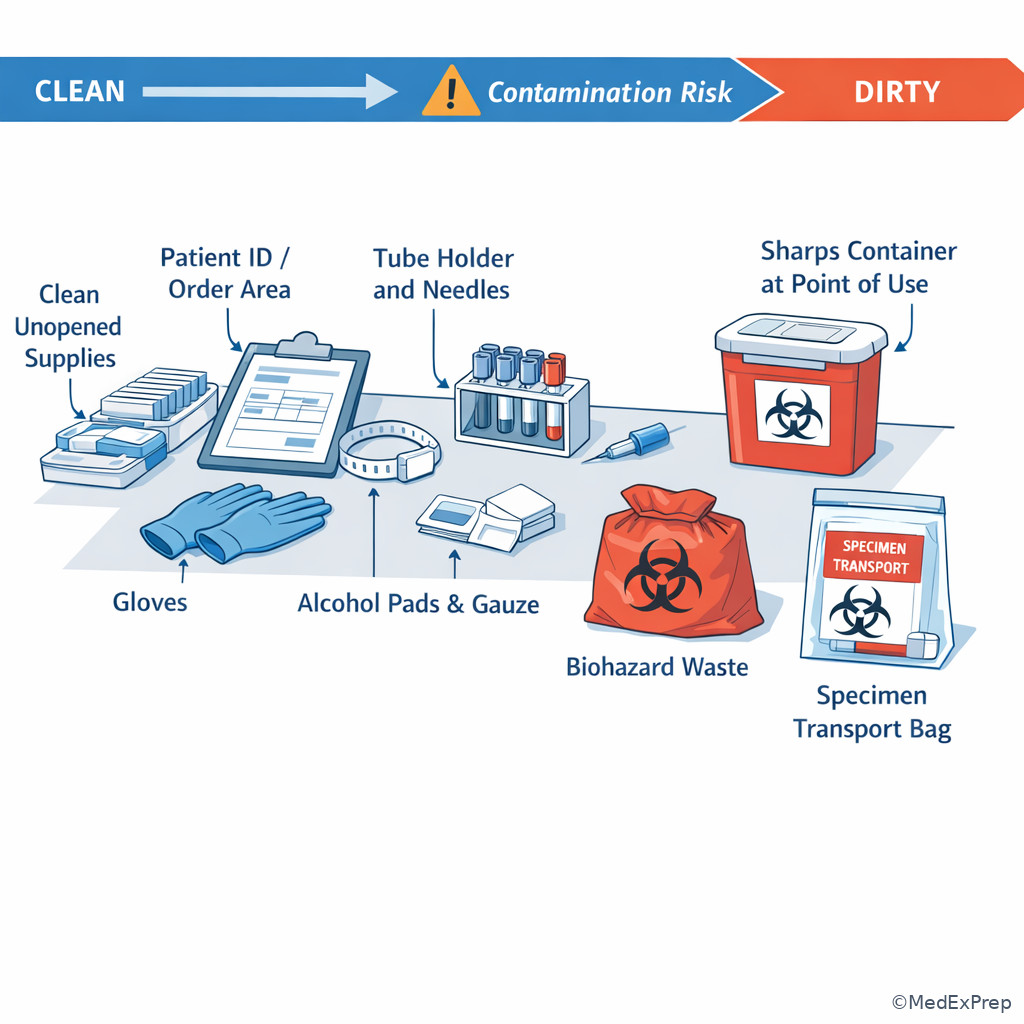
Exam takeaway: Visually separating clean supplies, contaminated items, and sharps disposal helps prevent exam-tested workflow errors.
| High-yield rule | What it means in practice | Common exam shortcut to reject |
|---|---|---|
| Standard Precautions are universal | Apply them to every draw regardless of diagnosis | Skipping PPE because the patient “looks healthy” |
| Risk drives PPE selection | Choose protection based on expected exposure | Using the same PPE plan for every task without thinking |
| Hand hygiene surrounds glove use | Clean hands before donning and after removal | Assuming gloves alone are enough |
| Sharps are disposed immediately | Activate safety device and discard at point of use | Carrying an uncapped needle across the room |
| Unsafe situation requires stop/escalate | Protect patient and staff before continuing | Improvising beyond policy to finish faster |
Core content
1.1.1.3 Foundational rule: what Standard Precautions require you to assume
A Explanation
The main decision conflict is simple: should you adjust infection-control behavior based on what you know about the patient, or should you begin with the same baseline precautions every time? The correct choice is the second one. Standard Precautions mean you treat blood and other potentially infectious materials as potentially infectious in all patients. The single rule that resolves this conflict is: do not wait for a diagnosis, test result, or visible sign of illness before protecting yourself and the patient.
WHY THIS IS TESTED: exam questions often add misleading reassurance such as “the patient is here for routine lab work,” “the patient is well known to the staff,” or “the chart shows no infection history.” None of that changes the Standard Precautions baseline.
For an entry-level phlebotomy technician, Standard Precautions shape the entire encounter: hand hygiene, PPE choice, safe site preparation, specimen handling, sharps disposal, cleanup, and documentation of unusual events. They do not authorize diagnosis or advanced medical judgment. Instead, they give you a consistent safety framework when information is incomplete. If a question asks what to do before knowing whether a patient has an infectious disease, the answer is almost never “proceed with less protection because risk is low.” It is “follow Standard Precautions and then match added barriers to the task.” See Fig 1.
B Worked example
A 37-year-old outpatient with hypertension and seasonal allergies presents for a routine lipid panel. He jokes that he “never gets sick” and says the clinic knows him well. The waiting room is crowded, and another staff member says, “You can skip the extra setup; this will take 30 seconds.” A prior note in the chart mentions normal CBC results from last year. What is the most appropriate next step before venipuncture?
Reasoning chain: Identify task: routine venipuncture. Extract key facts: routine lab draw, familiar patient, normal prior data, time pressure. Apply rule: Standard Precautions do not depend on apparent health or chart history. Eliminate distractors: skipping gloves or hand hygiene because infection risk seems low is wrong; using prior normal labs to downgrade precautions is irrelevant; asking the provider whether the patient is infectious is outside the role and unnecessary for routine safety. Verify: proceed with standard infection-control steps for every patient encounter.
C Exam trap
D Checkpoint
Question: A phlebotomy technician is preparing to collect blood from a patient who appears healthy and is being seen for annual wellness labs. Which action is most appropriate?
- A. Apply Standard Precautions because blood exposure risk exists during any venipuncture.
- B. Omit gloves if the patient denies any infectious history.
- C. Ask the provider to confirm whether the patient is infectious before deciding on precautions.
- D. Use Standard Precautions only if the patient’s diagnosis suggests a bloodborne infection.
Answer: A
- A: Tempting because it sounds broad, and it is right because the baseline rule is universal application with blood exposure anticipated.
- B: Tempting because patient statements feel reassuring, but wrong because self-report does not replace Standard Precautions.
- C: Tempting because it sounds cautious, but wrong because routine precautions do not depend on provider confirmation and this delays care unnecessarily.
- D: Tempting because diagnosis-based isolation thinking seems logical, but wrong because Standard Precautions are not limited to known bloodborne infection.
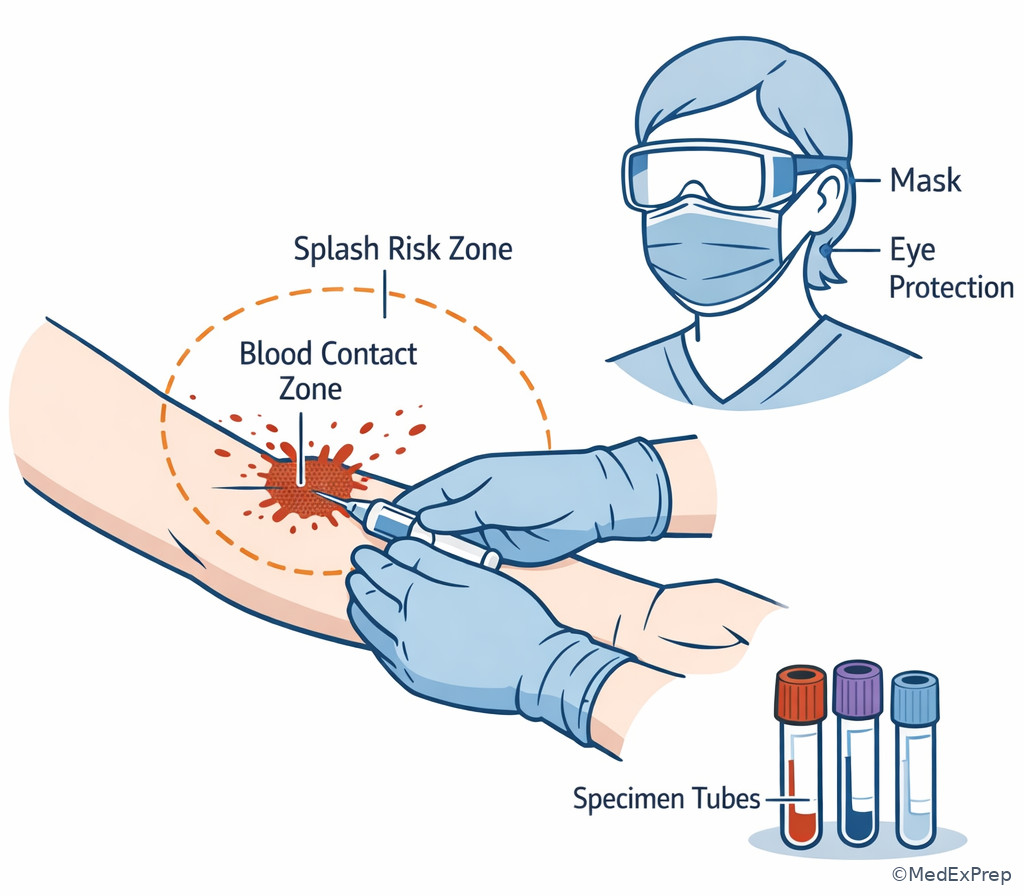
Exam takeaway: The correct barrier choice comes from the task’s splash or contact risk, not the patient’s appearance.
flowchart LR
A[Task planned] --> B{Expected blood contact?}
B -->|Yes| C[Gloves]
B -->|No direct contact| D[Follow facility policy]
C --> E{Splash or spray possible?}
E -->|Yes| F[Add mask and eye/face protection]
E -->|No| G[Proceed with gloves and safe workflow]
F --> H[Dispose and clean hands]
G --> H
See Fig 2 for a better way to think through exam stems that ask what protection is needed: start with task risk, not diagnosis labels.
1.1.1.4 Exposure prevention in routine phlebotomy workflow
A Explanation
The decision conflict here is whether to focus on “getting the blood” or on preventing contact with blood during each step. On the exam, the correct answer nearly always chooses the step that lowers exposure risk without creating a new contamination problem. The single resolving rule is: once an item, glove, or surface may be contaminated, do not use it as if it were clean.
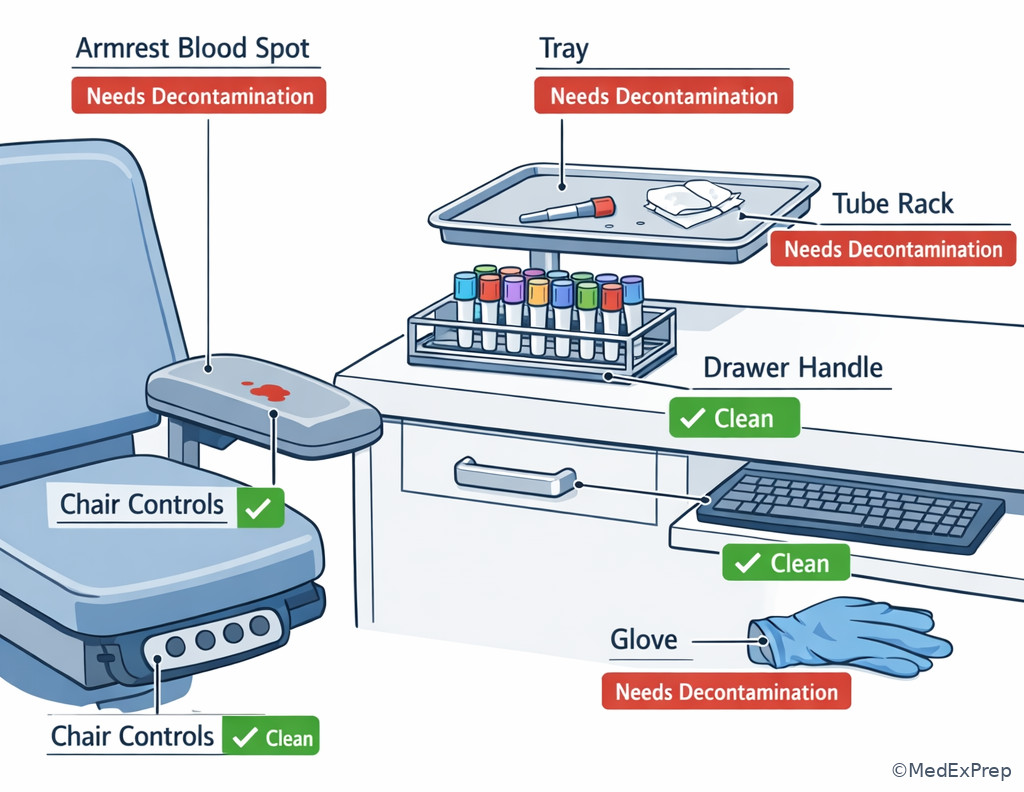
Routine phlebotomy has several contamination transition points: after touching the puncture site, after blood enters tubes, after removing the needle, while labeling, and while cleaning the area. The safest collector mentally separates clean supplies from contaminated equipment and avoids backtracking. For example, touching a computer keyboard, chart, clean tube rack, or supply drawer with contaminated gloves spreads contamination; placing an exposed sharp on a tray “for a moment” creates injury risk; reaching into pockets with used gloves is unsafe. Standard Precautions are therefore not just about wearing gloves — they are about controlling hand and item movement through the workflow.
WHY THIS IS TESTED: many exam stems describe a technically successful draw but ask for the best next action after a contamination shortcut. The testable pattern is recognizing that specimen collection is only one part of the safe sequence. If the safe sequence breaks, the answer often involves stopping, changing gloves, disposing of the sharp, cleaning hands, or obtaining clean supplies again rather than improvising through the error.
B Worked example
A 68-year-old patient with type 2 diabetes and chronic kidney disease is having routine chemistry tests in an outpatient lab. During venipuncture, the draw is successful, but after filling the last tube the technician, still wearing used gloves, reaches to type a quick note into the computer because the patient asks when the results will be ready. The patient also mentions being “hard to draw,” and a small bruise from last week’s draw is visible on the other arm. What is the best next step?
Reasoning chain: Identify task: maintain safe workflow after a completed draw. Extract key facts: gloves have touched blood-collection equipment; technician is about to touch shared equipment; the bruise and difficult-draw comment are distractors because the draw is already done. Apply rule: do not use contaminated gloves on clean shared surfaces. Eliminate distractors: continuing to type first is unsafe; removing gloves and then using contaminated hands without hand hygiene is also incomplete; asking the provider about result timing is outside the key safety issue. Verify: finish sharps and specimen safety steps, remove gloves appropriately, perform hand hygiene, then use the computer with clean hands.
C Exam trap
D Checkpoint
Question: During a venipuncture, a technician wearing used gloves needs an additional alcohol pad from a supply drawer. What is the most appropriate action?
- A. Open the drawer with used gloves because the contact will be brief.
- B. Ask the patient to open the drawer to avoid contaminating it.
- C. Pause, avoid contaminating clean storage, and obtain clean supplies without using contaminated gloves on the drawer.
- D. Finish the draw and reuse the same gloves to restock supplies afterward.
Answer: C
- A: Tempting because it seems efficient, but wrong because brief contact can still contaminate clean storage.
- B: Tempting because it avoids glove contact, but wrong because it shifts workflow duties unsafely to the patient and does not solve contamination planning.
- C: Tempting because it slows things down, and it is right because it preserves clean storage and infection-control sequence.
- D: Tempting because it delays the issue, but wrong because contaminated gloves should not be reused for restocking or clean tasks.
- The safest default for all blood collection encounters is Standard Precautions.
- True or False: Gloves make it acceptable to touch keyboards and supply drawers after handling collection equipment. False.
- Name the 3 key workflow zones: clean supplies, active collection, contaminated disposal/cleanup.
Exam takeaway: Avoid backtracking from contaminated tasks to clean storage or shared surfaces without resetting the safety sequence.
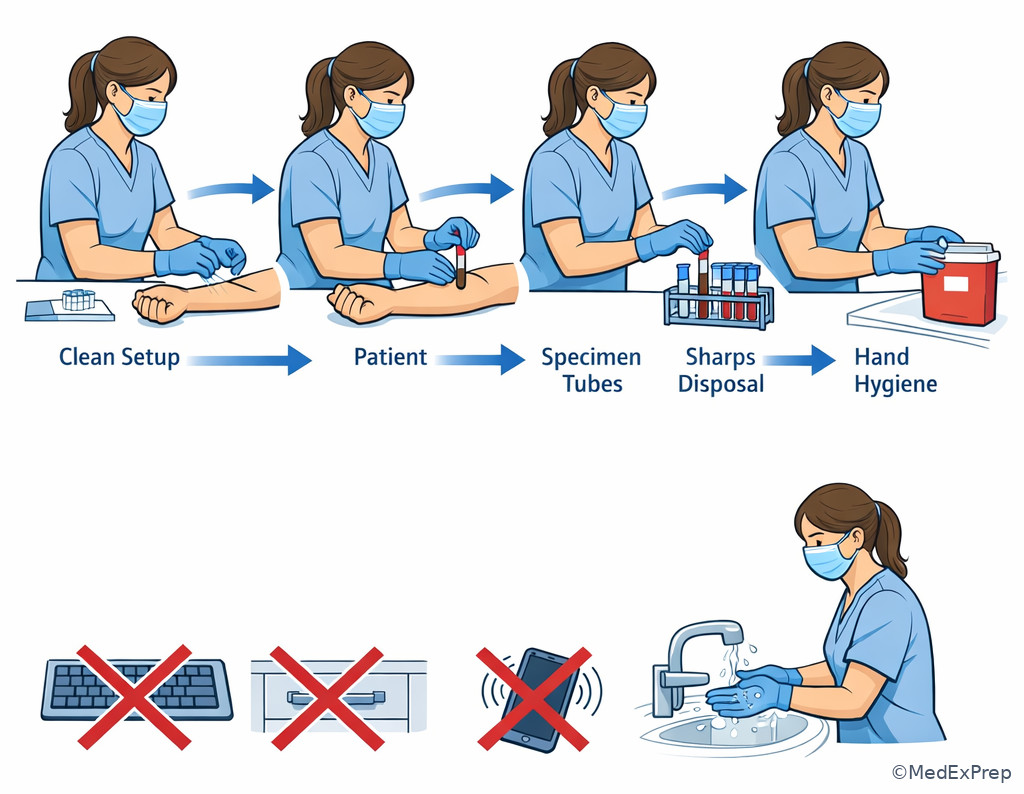
See Fig 3 when you need a visual memory for contamination transitions during a draw.
1.1.1.5 Standard Precautions and equipment, sharps, and environmental safety
A Explanation
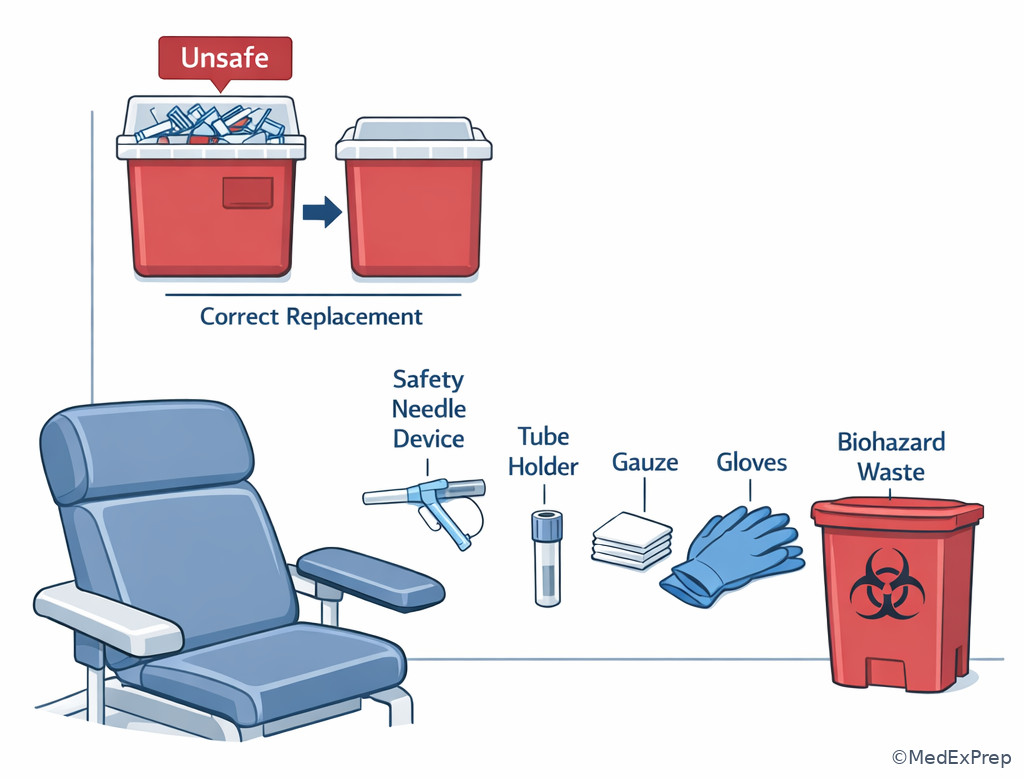
The conflict here is between convenience and engineered safety. A question may present a nearly completed procedure and then insert one unsafe action involving a needle, lancet, holder, tray, or sharps container. The resolving rule is: after use, a sharp is never “temporarily safe” in your hand, pocket, tray, or bed surface; it is safe only when the safety feature is activated as designed and the device is discarded appropriately.
Standard Precautions include work practice controls and engineering controls. In phlebotomy, this means using the approved collection device, activating its safety feature according to manufacturer instructions and facility policy, and disposing of it immediately in a sharps container located as close as practical to the point of use. Environmental safety also matters. Overfilled sharps containers, cluttered work areas, and placing tubes or devices where they can roll or spill all increase exposure risk. The exam often tests whether you recognize that completing labeling or talking to the patient does not come before safe sharps handling.
WHY THIS IS TESTED: students often remember “do not recap” but miss the broader principle: do not create any extra handling step for a contaminated sharp. The correct response prioritizes activation and disposal, then other tasks. If the necessary safety equipment is unavailable or compromised, you stop and obtain what is needed rather than improvising.
B Worked example
A 52-year-old inpatient with obesity and hyperlipidemia is having morning labs drawn. The bedside tray is crowded with tissues, a water cup, and a meal ticket. The sharps container in the room appears full, and another technician says, “Just cap it and drop it at the desk after you label the tubes.” The patient has no symptoms and remains cooperative. What is the most appropriate next step?
Reasoning chain: Identify task: safe completion of venipuncture in a poor environment. Extract key facts: cluttered tray, full sharps container, suggestion to recap and transport the needle, patient stable. Apply rule: do not recap or carry a used sharp; safety equipment problems must be addressed before or during the procedure according to policy. Eliminate distractors: capping and walking the needle elsewhere is unsafe; placing it on the tray is unsafe; finishing labels first delays sharps safety. Verify: follow facility policy to access appropriate sharps disposal safely rather than improvising with the used device.
C Exam trap
D Checkpoint
Question: A technician has just completed a draw and notices the sharps container at the station is overfilled. Which action is most appropriate?
- A. Place the used needle on the tray until housekeeping replaces the container.
- B. Recap the needle carefully and carry it to a container in another area.
- C. Follow facility policy for immediate safe disposal rather than improvising with the contaminated sharp.
- D. Ask the patient to hold still while the technician finishes labeling before dealing with the needle.
Answer: C
- A: Tempting because it keeps the device visible, but wrong because an exposed sharp on a tray is an injury hazard.
- B: Tempting because it appears protective, but wrong because recapping adds avoidable handling risk.
- C: Tempting because it sounds less specific, and it is right because safe disposal must follow approved process when equipment is compromised.
- D: Tempting because labeling is important, but wrong because sharps safety comes first.
Exam takeaway: If a used sharp cannot go directly into approved disposal, the answer is to stop and follow policy, not improvise.
flowchart TD
A[Used sharp after draw] --> B{Approved disposal available?}
B -->|Yes| C[Activate safety and discard immediately]
B -->|No| D[Stop and follow policy for safe disposal access]
D --> E[Do not recap]
D --> F[Do not place on tray]
D --> G[Do not carry loosely in hand or pocket]
C --> H[Continue with labeling and cleanup]
See Fig 4 for the exact decision tested when disposal access is compromised.
Exam takeaway: Point-of-use sharps disposal reduces extra handling and prevents the exam-tested temptation to recap or carry a used needle.
- The first priority after a draw ends is safe sharps handling and disposal.
- True or False: Recapping is acceptable if the sharps container is across the room. False.
- Name one engineering control and one work practice control: safety needle device; immediate disposal after use.
1.1.1.6 When to stop, escalate, and stay within scope
A Explanation
The final foundational skill is not knowing how to “push through” an unsafe situation, but knowing when Standard Precautions require you to stop. The decision conflict is whether to continue for speed or patient convenience versus pause because safety, consent, identity, or exposure control has broken down. The single rule that resolves it is: if you cannot maintain routine safe collection within your scope, stop and notify the appropriate person.
Examples include unclear patient cooperation, active bleeding not controlled as expected, inability to confirm safe setup, missing required protective barriers for the task, exposure incidents, or contamination that compromises specimen integrity. Because you are functioning as an entry-level phlebotomy technician, you do not diagnose conditions, prescribe interventions, reinterpret provider orders, or create your own exposure-response plan. You protect the patient and yourself, then escalate according to policy. Standard Precautions therefore include a boundary rule: safe routine phlebotomy continues only while you can maintain proper identification, infection control, and collection sequence.
WHY THIS IS TESTED: the exam loves “most appropriate next step” stems where multiple technically possible actions exist, but only one stays inside scope and protects safety. The right answer is often not the fastest one. It is the one that recognizes a stop point.
B Worked example
A 74-year-old hospital patient with atrial fibrillation and chronic obstructive pulmonary disease becomes anxious during morning blood collection. The patient repeatedly reaches toward the needle area, says “I want this over fast,” and asks the technician to continue without gloves because “they make people clumsy.” A family member insists the patient has had “hundreds of draws” and that stopping would be unnecessary. The patient’s chart also shows stable vital signs earlier in the morning. What is the most appropriate next step?
Reasoning chain: Identify task: decide whether routine collection can continue safely. Extract key facts: patient is interfering with the procedure, requesting unsafe practice, and creating exposure risk; family pressure and earlier stable vitals are distractors. Apply rule: if routine safe collection cannot be maintained within Standard Precautions, stop and escalate appropriately. Eliminate distractors: continuing without gloves violates safety; restraining the patient independently exceeds routine phlebotomy role; debating diagnosis or anxiety treatment is out of scope. Verify: stop the collection attempt, protect the patient and staff, and notify appropriate nursing or supervisory personnel per policy.
C Exam trap
D Checkpoint
Question: Which situation most clearly requires the phlebotomy technician to stop and escalate rather than continue the collection?
- A. The patient asks how long the collection will take.
- B. The patient requests that the technician skip gloves and keeps reaching toward the venipuncture area.
- C. The patient says they dislike needles but remains still and cooperative.
- D. The patient asks whether the tests include cholesterol.
Answer: B
- A: Tempting because communication issues can distract workflow, but wrong because this alone does not prevent safe routine collection.
- B: Tempting because patient preference may feel important, and it is right because it creates immediate safety and scope concerns.
- C: Tempting because fear can complicate collections, but wrong because a cooperative patient can still be managed within routine practice.
- D: Tempting because discussing tests may feel outside role, but wrong because basic procedural communication is not the same as a safety stop point.
Exam takeaway: If routine phlebotomy cannot be completed safely within Standard Precautions and scope, stop and notify the appropriate person.
flowchart TD
A[Need blood collection] --> B[Verify routine safety conditions]
B --> C{Identity, PPE, equipment, patient cooperation all adequate?}
C -->|Yes| D[Proceed with routine collection]
C -->|No| E[Stop the attempt]
E --> F[Protect patient and staff]
F --> G[Notify nurse, supervisor, or follow facility policy]
G --> H[Document issue]
See Fig 5 for the exam-day rule on scope boundaries and stop points.
1.1.1.7 Integrating Standard Precautions with the full collection sequence
A Explanation
Now integrate the concept across the complete phlebotomy encounter. The decision conflict is whether Standard Precautions are a short opening checklist or a continuous sequence that includes setup, specimen handling, labeling, transport, and cleanup. The correct choice is the second. The single resolving rule is: Standard Precautions end only after contaminated materials are managed, hands are cleaned, and the encounter is safely closed.
This matters because exam questions frequently hide the error after the successful stick. A technician may perform a technically correct venipuncture but then mis-handle the tubes, touch labels with contaminated gloves, carry specimens with contaminated hands, leave blood droplets on the work surface, or remove PPE in a way that spreads contamination. In other words, “I got the sample” is not the same as “I completed the collection safely.” The safe sequence is continuous: prepare correctly, collect correctly, protect the specimen, protect the environment, remove and discard contaminated items correctly, perform hand hygiene, and document any issue according to policy.
WHY THIS IS TESTED: certification questions reward full-workflow thinking. A common distractor is an action that would be acceptable if it occurred earlier or later, but is wrong at the exact moment described. Standard Precautions help you order the steps and spot the broken sequence.
B Worked example
A 45-year-old patient with asthma and hypothyroidism has outpatient tests collected without difficulty. The technician activates the safety device, places the needle in the sharps container, labels the tubes at the chairside, then notices a small blood spot on the armrest and another on the glove. The patient asks for directions to the restroom, and the next patient has already been called. What is the best next step?
Reasoning chain: Identify task: close the encounter safely. Extract key facts: the draw itself is complete, but environmental contamination remains; time pressure and the next patient are distractors. Apply rule: Standard Precautions continue through cleanup and hand hygiene. Eliminate distractors: leaving the area for environmental services without following immediate cleanup policy may be incomplete; greeting the next patient first breaks the safety sequence; discussing test results is outside role and irrelevant. Verify: manage contamination and finish the exit sequence according to policy before starting the next encounter.
C Exam trap
D Checkpoint
Question: Which statement best reflects Standard Precautions during phlebotomy?
- A. They apply mainly during needle insertion and end once the tubes are filled.
- B. They begin after exposure is recognized and end when the specimen reaches the lab.
- C. They include preparation, collection, disposal, cleanup, and hand hygiene for every patient encounter.
- D. They are only necessary when blood visibly contaminates gloves or the work area.
Answer: C
- A: Tempting because insertion feels like the main risk point, but wrong because contamination control extends beyond the stick.
- B: Tempting because exposure response is important, but wrong because Standard Precautions begin before recognized exposure.
- C: Tempting because it sounds comprehensive, and it is right because Standard Precautions span the full encounter.
- D: Tempting because visible blood is memorable, but wrong because absence of visible contamination does not remove the precaution requirement.
1.1.1.8 Integration: choosing the safest answer when several choices look partly correct
A Explanation
Final integration skill: many CPT questions present four actions that all sound useful. The conflict is deciding which one is most appropriate next in sequence. The resolving rule is to rank answers using this order: safety and exposure control first, specimen integrity second, efficiency third. If a choice protects safety but delays the draw, it often beats a faster option. If a choice completes the task but breaks sequence, reject it.
Standard Precautions often decide close-call questions when two answers both seem professionally reasonable. For example, giving patient reassurance is good, but not before securing a contaminated sharp. Labeling tubes is required, but not before controlling an exposure hazard. Asking a nurse for clarification can be correct, but not if the immediate issue is your unsafe environment or inability to maintain Standard Precautions. This ranking system helps when the stem contains noise such as family pressure, time pressure, patient familiarity, or a technically successful draw that tempts you to ignore postdraw safety.
WHY THIS IS TESTED: board-style questions rarely reward memorizing isolated facts; they reward prioritization. In foundational topics, that prioritization begins with Standard Precautions.
B Worked example
A 29-year-old patient with iron-deficiency anemia history and eczema presents for outpatient blood work. After the draw, the patient asks for a bandage, a coworker asks for help with another room, and the technician notices the glove has a blood smear while the labeled tubes remain on the tray. The sharps have already been disposed correctly. A phone at the station is ringing. What is the most appropriate next step?
Reasoning chain: Identify task: choose the best immediate priority among several reasonable actions. Extract key facts: sharps are safe, but blood remains on the glove; patient request and ringing phone are distractors. Apply rule: rank choices using safety, then specimen, then efficiency. Eliminate distractors: answering the phone or helping a coworker is lower priority; giving instructions or extra conversation before managing contamination is out of sequence. Verify: manage contamination and hand hygiene sequence appropriately before moving to secondary tasks.
C Exam trap
D Checkpoint
Question: In a close-call exam item, which priority order best helps select the most appropriate next action under Standard Precautions?
- A. Efficiency, specimen handling, safety
- B. Patient preference, efficiency, documentation
- C. Safety/exposure control, specimen integrity, efficiency
- D. Documentation, labeling, conversation
Answer: C
- A: Tempting because fast workflow is valued in clinics, but wrong because speed never outranks exposure control.
- B: Tempting because patient-centered care matters, but wrong because preference does not override immediate safety steps.
- C: Tempting because it sounds like a test-taking strategy, and it is right because it matches the correct phlebotomy priority sequence.
- D: Tempting because documentation and labeling are essential, but wrong because neither comes before unresolved contamination or exposure risk.
- Fill in the blank: In close-call stems, rank actions by safety first, then specimen integrity, then efficiency.
- True or False: A successful blood draw means Standard Precautions are finished. False.
- One-liner: If you cannot maintain routine safe collection within scope, stop and escalate.
Exam takeaway: Think of Standard Precautions as a continuous sequence from setup through cleanup, not a single step during needle insertion.
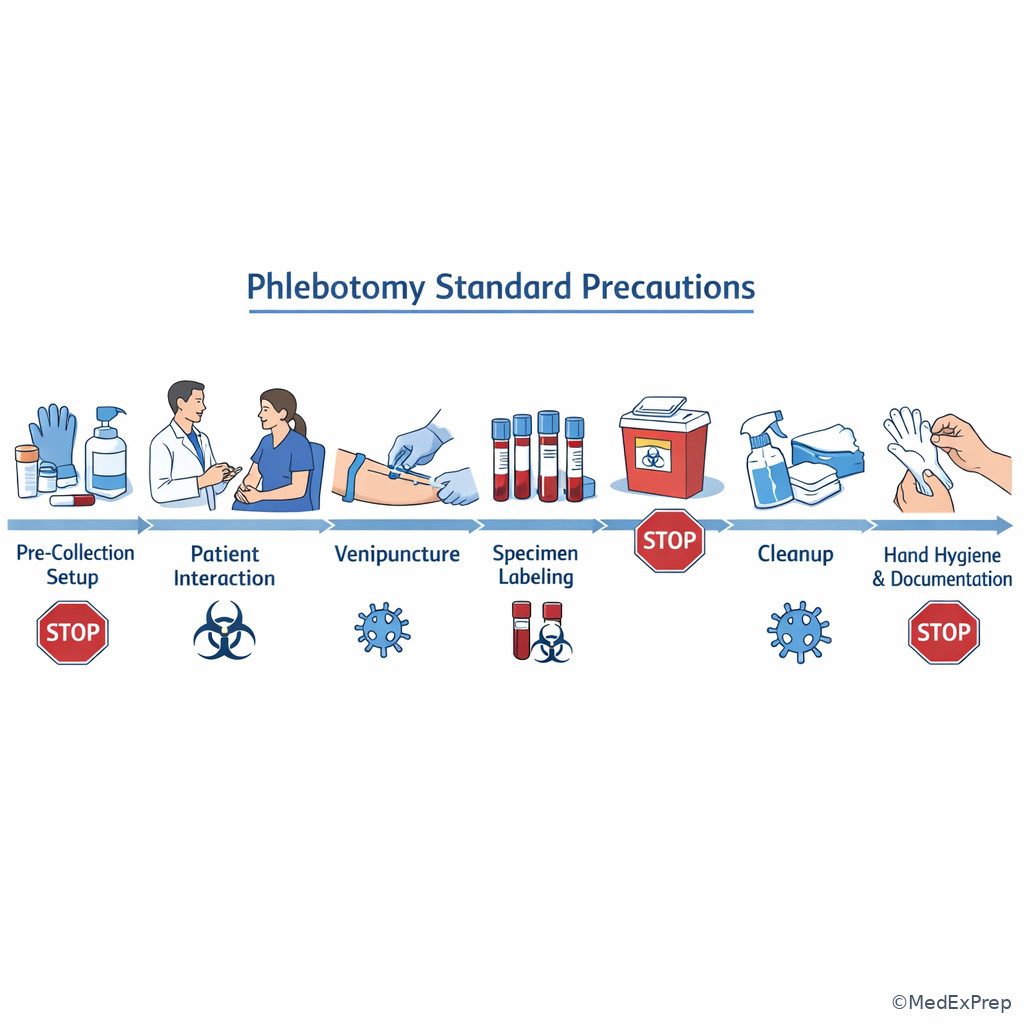
See Fig 6 for the full-sequence mental model that ties the lesson together.
Exam takeaway: PPE selection becomes easier when you picture where blood contact or splash could occur during the procedure.
Exam takeaway: Work surfaces, armrests, trays, and shared devices are common hidden contamination points after an otherwise successful draw.
Exam Traps & Differentiators
| Looks similar | But isn’t | Discriminator |
|---|---|---|
| Routine outpatient draw | Low-precaution encounter | Any venipuncture still involves blood exposure risk |
| Gloves are on | Hands are “clean” for all tasks | Used gloves can contaminate drawers, keyboards, and labels |
| Needle is capped | Used sharp is safe to carry | Recapping adds handling risk and is not the preferred solution |
| Patient wants speed | Permission to skip safety steps | Patient preference never overrides Standard Precautions |
| Draw is technically complete | Encounter is finished | Cleanup, decontamination, glove removal, and hand hygiene still matter |
| Another provider could solve it | Your role is to improvise | If beyond scope, stop and notify the right person |
If the stem says... think...
- “The patient is healthy and well known to staff” → Standard Precautions still apply.
- “The technician quickly touches the keyboard with gloved hands” → contamination of shared equipment.
- “The sharps container is full” → do not recap or improvise; follow policy.
- “The patient asks the technician to skip gloves” → stop unsafe practice; patient preference does not control PPE.
- “The tubes are filled and labeled” → the encounter still needs safe closure and cleanup.
- “A family member or coworker pressures the technician to hurry” → safety outranks efficiency.
| Stem clue | Tempting wrong move | Correct next step | Why |
|---|---|---|---|
| Patient appears healthy | Reduce precautions | Use Standard Precautions | Universal application is the baseline rule |
| Need extra supply mid-draw | Open drawer with used gloves | Protect clean storage from contamination | Clean-to-dirty separation prevents cross-contamination |
| Overfilled sharps container | Recap and transport needle | Stop and follow safe disposal policy | No improvised handling of used sharps |
| Patient reaches toward needle area | Finish quickly anyway | Stop and escalate | Routine safe collection can no longer be maintained |
| Blood spot on glove after labeling | Move to next patient | Complete cleanup and hand hygiene | Precautions continue until encounter closure |
Algorithm / Approach
| Exam-step framework | Ask yourself | Best action pattern |
|---|---|---|
| Universal baseline | Am I applying Standard Precautions to this patient automatically? | Yes before any diagnosis-based thinking |
| Risk-based barrier choice | Could blood contact or splash occur? | Add the needed PPE for the task |
| Clean-to-dirty control | Am I about to touch a clean/shared surface with used gloves? | Stop contamination spread and reset sequence |
| Sharps safety | Is the used device secured and discarded immediately? | Handle sharps before labels, phone calls, or conversation |
| Scope boundary | Can I continue safely within routine phlebotomy practice? | If not, stop and notify the appropriate person |
Rapid Review
- Standard Precautions → apply to every patient, not only known infections
- Routine outpatient draw → still a blood exposure event
- Used gloves → not permission to touch clean or shared surfaces
- Gloves versus hand hygiene → both matter; one does not replace the other
- Contaminated sharp → safe only after proper activation and disposal
- Full sharps container → follow policy, do not recap as a workaround
- Patient preference → cannot override PPE or needle-safety rules
- Successful venipuncture → does not equal complete safe encounter
- Visible blood on glove/surface → finish contamination control before new tasks
- Close-call options → rank safety before specimen before efficiency
- Unclear safe workflow → stop rather than improvise
- Scope boundary question → notify nurse, provider, or supervisor when routine safety fails
Self-check quiz
1.1.1.9 1. Which action best reflects Standard Precautions during routine venipuncture?
A technician prepares to draw blood from a patient seen for annual wellness labs. The patient appears healthy, denies illness, and says the visit is “just routine.” Which action is most appropriate?
- A. Use Standard Precautions because routine venipuncture still involves blood exposure risk.
- B. Reduce precautions because the patient denies infectious illness.
- C. Wait to see if blood exposure occurs before deciding whether precautions are necessary.
- D. Ask the provider to determine whether the patient is infectious first.
1.1.1.10 2. Which action best protects clean storage during a draw?
During a venipuncture on a 61-year-old patient with hypertension and osteoarthritis, a technician realizes an extra alcohol pad is needed. The technician is already wearing used gloves and the patient is stable. What is the most appropriate next step?
- A. Open the supply drawer with used gloves because the contact is brief.
- B. Maintain clean-to-dirty separation and obtain supplies without contaminating clean storage.
- C. Ask the patient to reach into the drawer and hand over the alcohol pad.
- D. Continue the draw and use the same gloves to restock supplies later.
1.1.1.11 3. What is the best next step when sharps disposal is compromised?
A 56-year-old inpatient with diabetes and heart failure has just completed a blood draw. The safety device is available, but the sharps container at the bedside is overfilled. A coworker suggests recapping the needle and carrying it to the hallway container. What is the most appropriate next step?
- A. Recap the needle carefully and carry it to another container.
- B. Place the used needle on the bedside tray while labeling the tubes.
- C. Follow facility policy for immediate safe disposal rather than improvising with the contaminated sharp.
- D. Ask the patient to hold the device while the technician finds another container.
1.1.1.12 4. Which finding most clearly requires stopping the collection?
A 72-year-old patient with COPD and atrial fibrillation is being drawn for morning labs. The patient repeatedly reaches toward the needle area and asks the technician to skip gloves because “they slow you down.” A family member says the patient is always like this and wants the draw completed quickly. What is the most appropriate next step?
- A. Continue quickly because the family member agrees to proceed.
- B. Remove gloves to reassure the patient and finish the collection.
- C. Stop the attempt and notify appropriate staff because routine safety cannot be maintained.
- D. Restrain the patient’s arm independently and complete the draw.
1.1.1.13 5. Which step comes before secondary tasks after visible contamination?
A 43-year-old outpatient with asthma and migraines has a successful draw. The sharps are already discarded, but the technician notices blood on the glove and a small spot on the chair armrest. The patient asks for restroom directions and the phone is ringing. Which action is most appropriate next?
- A. Answer the phone because the draw itself is complete.
- B. Direct the patient to the restroom and return later for cleanup.
- C. Complete contamination control, glove removal, and hand hygiene before secondary tasks.
- D. Walk the labeled tubes to the laboratory immediately.
1.1.1.14 6. Which close-call action should be prioritized first?
A 35-year-old patient with obesity and hypothyroidism completes an uneventful outpatient draw. The tubes are labeled, the patient asks when results will be posted, a coworker requests help in another room, and the technician notices used gloves touched the keyboard during the encounter. Which is the most appropriate next step?
- A. Help the coworker first because another patient is waiting.
- B. Give result-timing instructions before leaving the room.
- C. Address the contamination issue according to policy before moving to other tasks.
- D. Transport the specimen immediately because labeled tubes take priority over all other tasks.
1.1.1.15 7. Which option stays within phlebotomy scope when safety and workflow conflict?
A 67-year-old patient with chronic kidney disease and anemia becomes increasingly anxious during a draw and asks whether the ordered tests mean “kidney failure is getting worse.” At the same time, the patient reaches toward the collection area, and a blood smear is visible on the technician’s glove. Which action is most appropriate?
- A. Explain the likely meaning of the ordered tests so the patient will stay calm.
- B. Continue the draw quickly, then answer questions about the diagnosis afterward.
- C. Control the immediate safety issue, stop if needed, and refer medical questions to the appropriate provider.
- D. Cancel the order independently because the patient is too anxious to continue.
1.1.1.16 8. Which factor most strongly changes the correct answer from “proceed” to “stop and escalate”?
A phlebotomy technician is ready to collect blood from a cooperative outpatient with hyperlipidemia and GERD. All supplies are available and the patient has answered basic questions appropriately. Which additional detail most requires a stop-and-escalate response rather than routine continuation?
- A. The patient says they dislike blood draws but remains still.
- B. The patient asks whether fasting will affect the test results.
- C. The patient requests that the technician skip gloves and begins reaching toward the needle area.
- D. The patient asks how soon the specimen will be transported.
Answer key
1.1.1.17 1. Answer: A
- A: Tempting because it states the broadest safety rule, and it is correct because Standard Precautions apply to every venipuncture due to blood exposure risk. Single stem clue: routine blood collection is still blood collection. Source: CDC Standard Precautions guidance.
- B: Tempting because the patient denies illness, but incorrect because self-reported history does not change the universal baseline. Single stem clue: patient denial is not a substitute for infection-control practice. Source: CDC.
- C: Tempting because it sounds responsive to actual exposure, but incorrect because precautions begin before exposure occurs. Single stem clue: “prepares to draw blood” means risk is anticipated. Source: CDC.
- D: Tempting because provider confirmation sounds cautious, but incorrect because the technician does not need diagnostic confirmation to apply Standard Precautions. Single stem clue: routine precautions are independent of diagnosis. Source: CLSI specimen collection safety principles; CDC.
1.1.1.18 2. Answer: B
- A: Tempting because it seems efficient, but incorrect because used gloves can contaminate clean storage. Single stem clue: the technician is already wearing used gloves. Source: CDC Standard Precautions; phlebotomy procedure texts.
- B: Tempting because it slows the process, and it is correct because maintaining clean-to-dirty separation prevents cross-contamination. Single stem clue: an unopened supply drawer is a clean storage area. Source: CDC; CLSI GP41 collection procedures.
- C: Tempting because it avoids glove contact with the drawer, but incorrect because asking the patient to handle supplies during the procedure is not appropriate workflow control. Single stem clue: the responsibility is the technician’s, not the patient’s. Source: CLSI; standard phlebotomy practice.
- D: Tempting because it delays the issue, but incorrect because contamination of clean supplies later is still contamination. Single stem clue: same used gloves are mentioned. Source: CDC.
1.1.1.19 3. Answer: C
- A: Tempting because recapping feels protective, but incorrect because it adds an unnecessary handling step and is not the preferred response to disposal problems. Single stem clue: the sharps container is overfilled, not absent because the device needs recapping. Source: OSHA Bloodborne Pathogens Standard; CDC.
- B: Tempting because it frees the technician’s hands for labeling, but incorrect because an exposed sharp on a tray is an avoidable injury hazard. Single stem clue: used needle remains unsecured. Source: OSHA.
- C: Tempting because it sounds general, and it is correct because the technician should use approved immediate safe-disposal procedure rather than improvise. Single stem clue: disposal is compromised, creating a safety issue that outranks convenience. Source: OSHA; CLSI GP41.
- D: Tempting because it keeps the technician from carrying the device, but incorrect because patients should never hold contaminated sharps. Single stem clue: the device is contaminated and remains under technician control. Source: OSHA; CDC.
1.1.1.20 4. Answer: C
- A: Tempting because family agreement may sound like practical consent support, but incorrect because family preference does not remove the safety hazard. Single stem clue: the patient keeps reaching toward the needle area. Source: CDC; entry-level phlebotomy safety standards.
- B: Tempting because it appears to calm the patient, but incorrect because removing gloves violates Standard Precautions during a blood collection. Single stem clue: the patient specifically requests an unsafe action. Source: CDC.
- C: Tempting because it may delay care, and it is correct because safe routine collection cannot be maintained within scope. Single stem clue: active interference with the venipuncture area creates immediate risk. Source: CLSI GP41; CDC.
- D: Tempting because it aims to complete the draw, but incorrect because independent restraint is not the proper response for an entry-level phlebotomy technician in routine workflow. Single stem clue: this exceeds routine collection management. Source: role-boundary principles in phlebotomy texts; facility-policy dependent escalation.
1.1.1.21 5. Answer: C
- A: Tempting because phones feel urgent, but incorrect because visible contamination means the encounter is not safely closed. Single stem clue: blood remains on the glove and chair armrest. Source: CDC; routine environmental contamination control guidance.
- B: Tempting because patient service matters, but incorrect because deferring contamination control leaves an active safety issue unresolved. Single stem clue: visible contamination is present now. Source: CDC.
- C: Tempting because it postpones other tasks, and it is correct because Standard Precautions continue through cleanup, glove removal, and hand hygiene. Single stem clue: both glove and environment are contaminated. Source: CDC; CLSI GP41.
- D: Tempting because specimen handling is important, but incorrect because transport does not outrank unresolved contamination at the collection area. Single stem clue: the hazard is immediate and visible. Source: CDC.
1.1.1.22 6. Answer: C
- A: Tempting because helping coworkers supports workflow efficiency, but incorrect because contamination control outranks staffing convenience. Single stem clue: used gloves touched the keyboard. Source: CDC Standard Precautions.
- B: Tempting because patient communication is appropriate, but incorrect because secondary conversation does not come before contamination management. Single stem clue: contamination has already occurred. Source: CDC; CLSI.
- C: Tempting because it appears less patient-centered in the moment, and it is correct because safety and contamination control are the immediate priority. Single stem clue: the keyboard contact identifies a cross-contamination event. Source: CDC.
- D: Tempting because specimen transport is important, but incorrect because safety closure must occur first if contamination is unresolved. Single stem clue: the problem is not the specimen; it is the contaminated workflow. Source: CLSI GP41.
1.1.1.23 7. Answer: C
- A: Tempting because patient reassurance is valuable, but incorrect because interpreting the meaning of the tests is outside phlebotomy scope and the immediate hazard remains uncontrolled. Single stem clue: the patient is reaching toward the collection area while blood is on the glove. Source: scope guardrails in course profile; CDC.
- B: Tempting because completing the draw quickly may seem practical, but incorrect because safety and contamination control outrank speed, and diagnosis discussion remains out of scope. Single stem clue: active safety threat is present now. Source: CDC; CLSI.
- C: Tempting because it requires stopping other tasks, and it is correct because it addresses immediate exposure risk while keeping medical interpretation with the appropriate provider. Single stem clue: both safety and scope issues are in the stem. Source: CDC; CLSI; phlebotomy role-boundary standards.
- D: Tempting because anxiety can affect the procedure, but incorrect because independently canceling orders exceeds entry-level phlebotomy authority. Single stem clue: the role is to protect safety and escalate, not alter orders. Source: role-boundary principles; facility policy framework.
1.1.1.24 8. Answer: C
- A: Tempting because needle dislike can create a difficult draw, but incorrect because a cooperative patient can still be managed within routine precautions. Single stem clue: the patient remains still. Source: standard phlebotomy patient-interaction practice.
- B: Tempting because test-preparation questions matter, but incorrect because this can usually be answered within routine communication or referred without stopping for safety. Single stem clue: no active hazard is present. Source: phlebotomy communication standards.
- C: Tempting because it combines preference and movement, and it is correct because the request violates Standard Precautions and the reaching behavior threatens needle safety. Single stem clue: the patient both requests no gloves and reaches toward the needle area. Source: CDC; CLSI.
- D: Tempting because transport timing is important, but incorrect because it does not create a stop-and-escalate safety trigger. Single stem clue: question is informational, not a hazard. Source: routine workflow standards.
Keep going with the full NHA CPT Prep Course (CPT)
You just studied the way members do, in the same lesson interface. Full access unlocks every lesson, the question bank and flashcards for a full year.
One payment · 1 year of access · No auto-renewal