1.1.1 - Clinical Decision Framework
Clinical Decision Framework
What you’ll learn
- Decision sequence: Apply the exam-ready order of thinking: identify the task → extract key facts → prioritize safety → apply counselor role/scope → choose the best next step.
- Blueprint mapping: Translate broad counseling competency prompts into practical subskills for intake, assessment, risk, treatment planning, referral, and documentation.
- Scope protection: Separate counselor actions from physician, psychiatry, emergency, forensic, and jurisdiction-specific legal functions.
- Least-restrictive safe care: Choose between immediate crisis action, further assessment, routine intervention, consultation, or referral.
- Distractor control: Reject answers that are technically possible later but premature, unsafe, or outside the counselor role.
Blueprint mapping
- Assessment and Intake → identify the counseling task in a stem → extract clinically relevant facts
- Risk and Crisis Evaluation → prioritize safety before nonurgent intervention
- Diagnostic Reasoning within Counselor Competence → gather data without overstating certainty
- Treatment Planning and Intervention Selection → choose the most appropriate next action for stage and setting
- Ethical and Legal Judgment → protect confidentiality while acting on danger, abuse, neglect, and other exceptions
- Documentation, Referral, and Care Coordination → consult, refer, and document when needs exceed counselor scope
Why it matters
- NCMHCE questions often reward the best next counselor action, not the most complete long-term plan.
- Many wrong answers are attractive because they are good ideas at the wrong time or belong to a different professional role.
- A reliable decision framework improves performance across intake, crisis, diagnosis, treatment planning, ethics, and care coordination.
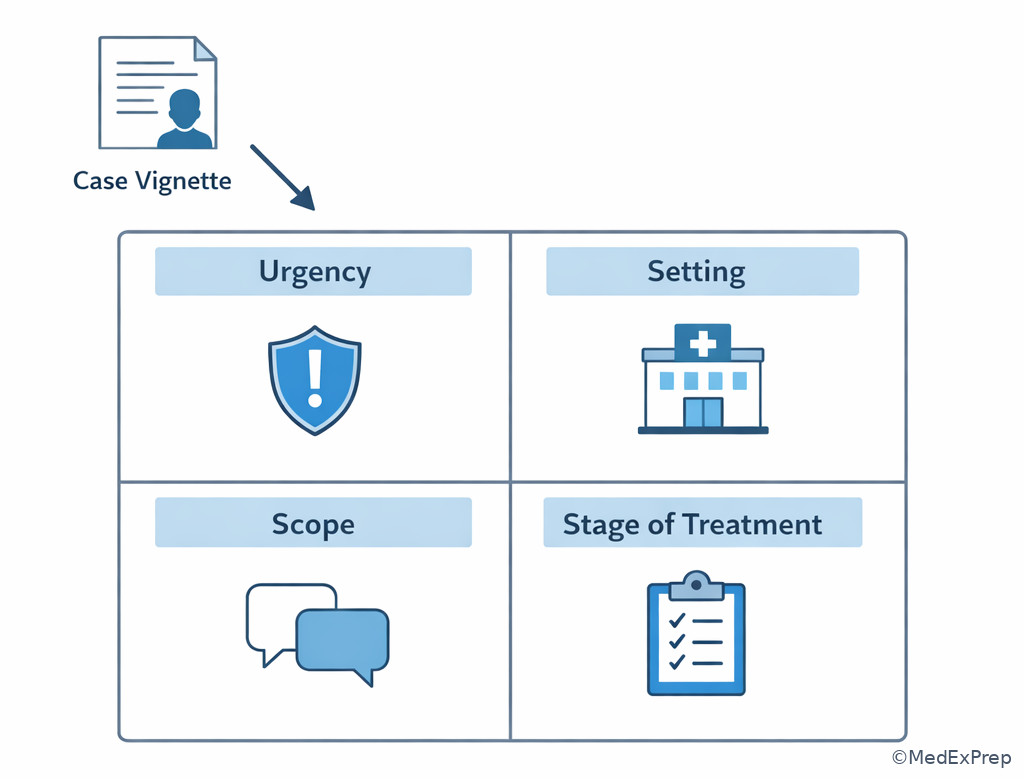
- When the stem is noisy, the framework helps you find the one fact that determines urgency, scope, or sequencing. See Fig 1.
Key Terms & Must-Know Facts
1.1.1.1 Key terms
- Best next step: the single action that most safely and efficiently advances care now
- Least-restrictive safe option: lowest-intensity intervention that still manages current risk
- Imminent risk: near-term danger requiring immediate protective response
- Working diagnosis: provisional clinical formulation used within counselor competence
- Scope of practice: what the counselor may appropriately assess, treat, document, and refer
- Clinical noise: distracting but nondecisive details in a vignette
- Discriminator: the single clue that separates the correct answer from close distractors
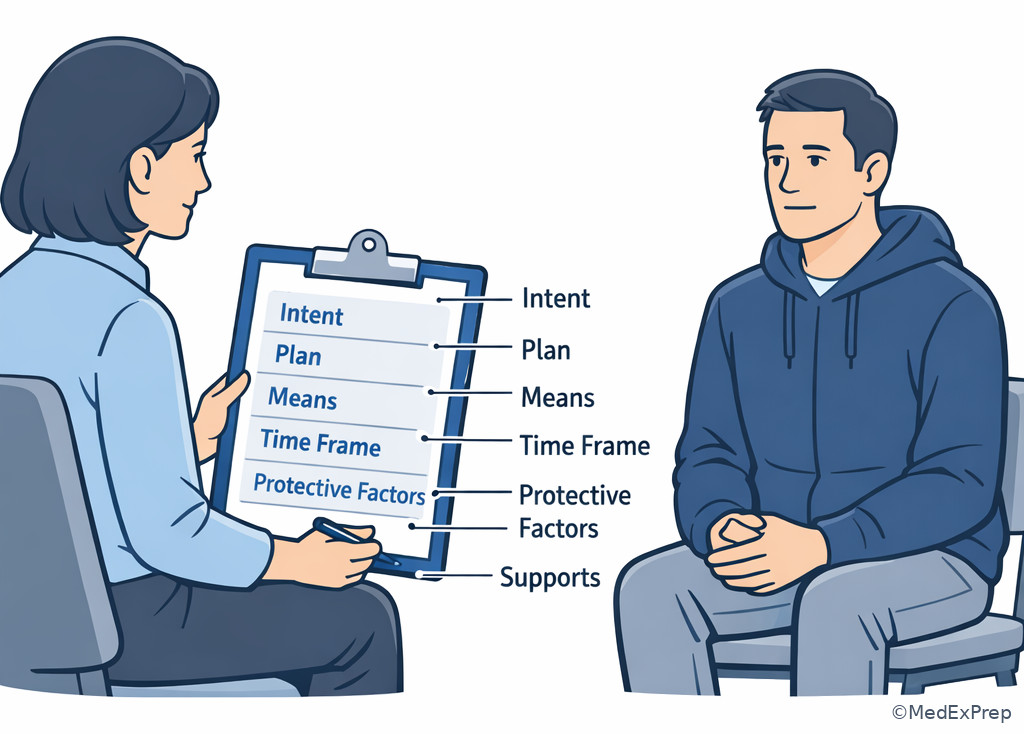
- Risk clarification: focused follow-up questions about intent, plan, means, time frame, past attempts, and protective factors
- Consultation: seeking guidance from supervisor/colleague within role
- Referral: directing client to psychiatry, medical, substance treatment, emergency care, or specialty services
- Mandated reporting: reporting required by law for abuse, neglect, or other protected situations
- Tarasoff-style duty principles: jurisdiction-dependent obligations related to serious threat toward identifiable others
- Trauma-informed stance: approach emphasizing safety, choice, collaboration, empowerment, and cultural responsiveness
1.1.1.2 Must-know facts
- On NCMHCE-style reasoning, safety outranks symptom management.
- If the client may be medically unstable, substance-intoxicated, withdrawing, delirious, or neurologically impaired, the counselor assesses, documents, and refers/collaborates; the counselor does not medically clear the client.
- When the stem asks for the first, next, or most appropriate action, sequence matters as much as content.
- A strong answer is often gather more essential information first when risk is unclear and no immediate emergency cue is present.
- Active suicidal intent, plan, access, inability to commit to safety, or rapidly escalating behavior can shift the answer to immediate crisis action.
- Never choose an answer that guarantees confidentiality when danger, abuse, neglect, or court/legal exceptions apply.
- Do not select medication changes, lab orders, imaging, or definitive medical conclusions; those are out-of-role.
- When law varies, the safest exam answer includes protective action, consultation, and verification of local requirements.
| Signal in stem | What it usually means | Default counselor priority |
|---|---|---|
| “Immediate,” “urgent,” “now,” “brought by police,” “won’t promise safety” | High acuity / crisis pathway | Protect safety before routine exploration |
| “Initial session,” “intake,” “limited information” | Assessment stage | Clarify essentials before interpreting deeply |
| “Follow-up after prior plan failed” | Need plan revision | Reassess risk, barriers, adherence, and fit |
| “Requests medication advice” | Scope boundary test | Psychoeducation plus psychiatry/medical referral |
| “Possible abuse/neglect” | Ethical/legal action may be triggered | Assess safety, document facts, report/consult per law |
| “Confused, disoriented, tremulous, hallucinating after stopping alcohol” | Possible medical/substance emergency | Emergency referral; do not manage as routine therapy |
Exam takeaway: Start with task and safety, then choose the least-restrictive safe action within scope.
flowchart TD
A[Read the task word: first, next, immediate, best] --> B[Extract decisive facts: risk, setting, stage, supports]
B --> C{Any immediate safety or medical instability?}
C -- Yes --> D[Protective action: crisis response, emergency referral, supervision, documentation]
C -- No --> E{Enough data for a counselor action?}
E -- No --> F[Clarify with targeted assessment]
E -- Yes --> G[Choose best next counseling, referral, or care coordination step]
G --> H[Reject premature, out-of-scope, or overly restrictive answers] Exam takeaway: When risk is not yet clarified, focused assessment usually comes before treatment technique.
flowchart LR
A[Client presents with symptoms] --> B{Missing decisive information?}
B -- Yes --> C[Ask targeted questions on risk, timing, impairment, substances, supports]
B -- No --> D{Immediate danger present?}
D -- Yes --> E[Emergency / crisis pathway]
D -- No --> F[Proceed with treatment planning or intervention]
F --> G[Document rationale and follow-up] Exam takeaway: Organize the stem by urgency, setting, scope, and stage before choosing an answer.
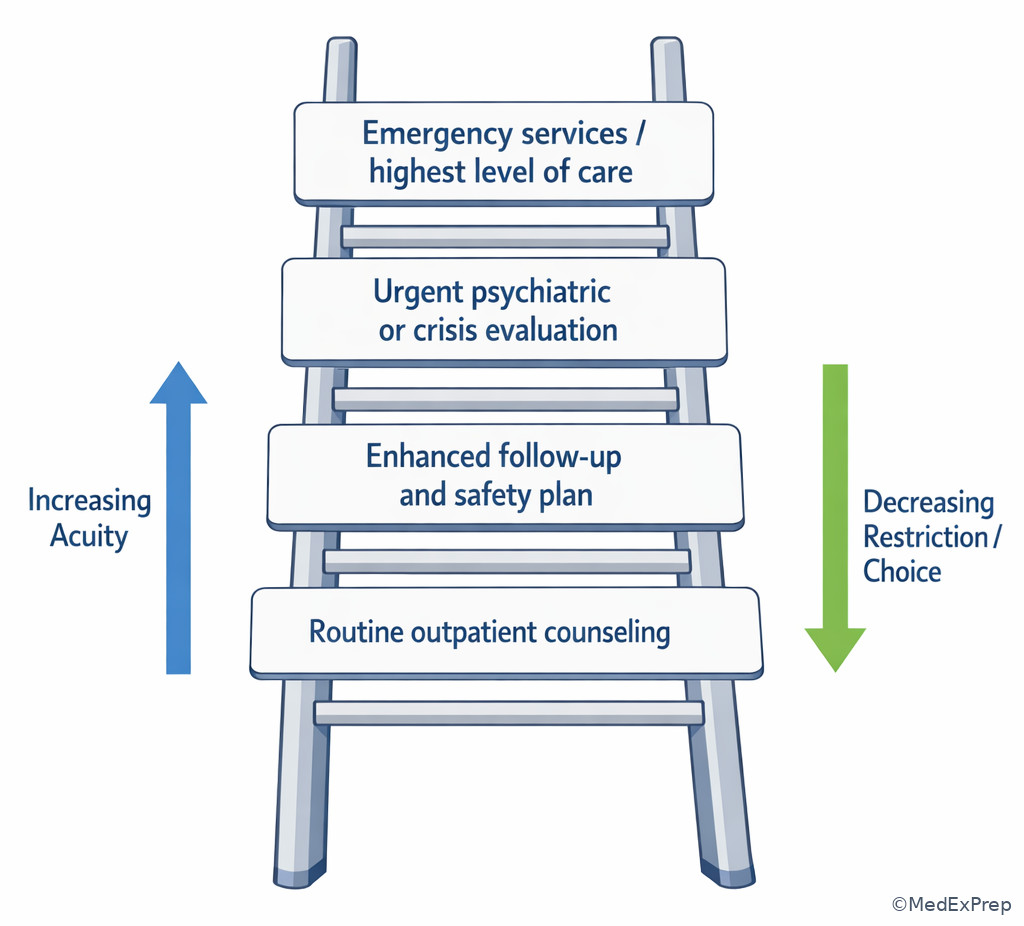
Exam takeaway: Match acuity to the lowest safe level of care rather than reflexively escalating or minimizing.
Core content
1.1.1.3 Foundational sequence: identify the task before reading for content
A Explanation
The first decision conflict on this exam is not diagnosis versus treatment. It is task recognition versus content overload. Many candidates read every fact with equal weight and then pick the answer that sounds most clinically sophisticated. The exam rewards the opposite: identify what the question is asking you to do, then read for facts that control that decision. If the stem asks for the most appropriate next step, you are solving a sequencing problem. If it asks for the best initial counselor action, you are likely in intake, rapport-building, risk clarification, or early-stage planning. If it asks what requires immediate clarification, one missing high-risk variable matters more than the rest.
WHY THIS IS TESTED: Candidates often know many interventions but miss the order in which a counselor should use them. The testable pattern is whether you can choose what comes first when several reasonable actions are available.
Choose answers that match the task word exactly. Reject answers that are correct eventually but premature now. For example, a full CBT thought record may be useful later, but not before clarifying active suicidal intent. A referral to family therapy may be appropriate eventually, but not before assessing domestic violence safety. The rule that resolves the conflict is: the stem’s action word defines the level of response.
B Worked example
A 22-year-old graduate student presents for an intake at a college counseling center after a breakup. She has asthma and migraines, reports drinking heavily on weekends, and says, “Sometimes I think everyone would be better off without me.” She is tearful, has missed classes for 2 weeks, and mentions she once took “a bunch of pills” at age 16 but was not hospitalized. A tempting clue is that she asks whether mindfulness exercises could help her sleep. The question asks for the most appropriate next counselor action.
Reasoning chain: Identify task: this is a next-step question, not a treatment-technique question. Extract key facts: passive/possibly active suicidal statement, prior overdose, current impairment, substance use. Apply rule: safety clarification precedes skills training. Eliminate distractors: sleep hygiene and mindfulness are reasonable eventually, but premature. Verify: the best answer is to conduct a focused suicide risk assessment now, including intent, plan, means, time frame, protective factors, and current capacity for safety.
C Exam trap
Why it is tempting: The client is distressed, insomnia is present, and counseling techniques feel empathic and helpful.
Single clue that eliminates it: The unresolved suicidal statement plus prior overdose means risk clarification comes before routine symptom management.
D Checkpoint
Question: A counselor in outpatient practice meets a 35-year-old client for an initial session. The client reports panic symptoms, recent job loss, hypertension, and “sometimes wishing I wouldn’t wake up,” but then laughs and says, “I’m probably just being dramatic.” Which is the most appropriate next step?
- Teach diaphragmatic breathing and schedule weekly CBT sessions.
- Ask focused follow-up questions about suicidal ideation, intent, plan, means, and protective factors.
- Refer immediately for medication management because panic symptoms are severe.
- Reassure the client that passive death wishes are common during stress.
- A: Tempting because panic treatment is appropriate in many outpatient cases; wrong because unresolved suicide risk must be clarified first.
- B: Tempting because it may feel abrupt early in rapport; right because the death-wish statement changes priority to risk assessment.
- C: Tempting because symptoms are impairing and psychiatry may help; wrong because referral can follow after immediate risk clarification unless the stem shows acute emergency or explicit medication question.
- D: Tempting because the client minimized the comment; wrong because minimization does not rule out risk and should not substitute for assessment.
1.1.1.4 Foundational priority: safety, acuity, and least-restrictive safe care
A Explanation
The second major conflict is underreacting versus overreacting. NCMHCE stems often test whether you can recognize when immediate protective action is necessary and when careful outpatient assessment is sufficient. The resolving rule is not “always hospitalize” or “always de-escalate in session.” The resolving rule is: choose the least-restrictive option that is still safe given current risk. See Fig 4.
High-acuity cues include active suicidal or homicidal intent, a specific plan, access to means, command hallucinations directing harm, inability or unwillingness to maintain safety, acute intoxication or withdrawal with instability, severe disorganization, or rapidly escalating aggression. Lower-acuity cases may still be serious, but if the client denies intent, has no plan, has protective factors, is future-oriented, and can engage in a safety plan and follow-up, the best answer may be enhanced outpatient support rather than emergency escalation.
WHY THIS IS TESTED: Many candidates pick dramatic options because they fear missing danger, or pick minimally restrictive options because they dislike escalation. The testable pattern is whether one stem detail crosses the threshold from “clarify and plan” to “act now.” See Fig 2.
Reject two common extremes: minimizing clear danger and choosing the highest level of care without evidence that current outpatient strategies are unsafe. In exam logic, crisis action is justified by present indicators of imminent risk, not by diagnosis label alone.
B Worked example
A 47-year-old man in community mental health treatment for depression and alcohol use disorder presents after losing housing. He has diabetes, chronic pain, and recent separation from his partner. He says, “I bought a gun yesterday. I’m tired of this.” He is guarded, smells of alcohol, and says he does not want anyone contacted. A distracting detail is that he also requests help applying for disability benefits. The question asks for the best initial counselor action.
Reasoning chain: Identify task: initial action in a high-acuity scenario. Extract key facts: recent firearm purchase, suicidal intent language, intoxication, multiple stressors, poor engagement. Apply rule: imminent risk plus means access overrides routine problem-solving. Eliminate distractors: discussing benefits, housing referrals, or next-week follow-up are all premature. Verify: initiate immediate safety procedures according to setting protocol, involve supervision/crisis resources, and arrange emergency evaluation or higher level of care rather than relying on a standard outpatient safety discussion alone.
C Exam trap
Why it is tempting: Safety planning is usually best practice and preserves autonomy.
Single clue that eliminates it: Recent gun access plus active hopeless language and intoxication make outpatient-only management unsafe.
D Checkpoint
Question: A 29-year-old client with PTSD and cannabis use reports, “I think about disappearing sometimes,” but denies intent, denies a plan, agrees to remove extra medications from home, identifies her sister as support, and asks for help coping before a court hearing next week. Which is the most appropriate next step?
- Call emergency services because any suicidal statement requires highest-level intervention.
- Continue risk assessment, develop a collaborative safety plan, and arrange close follow-up.
- Begin trauma exposure work immediately to reduce distress before the hearing.
- Tell the client to promise she will not harm herself and move on to other intake questions.
- A: Tempting because clinicians do not want to miss risk; wrong because the stem lacks imminent danger markers and supports less restrictive safe care.
- B: Tempting because it may seem less dramatic; right because denial of intent/plan plus engagement and supports favor outpatient safety management with monitoring.
- C: Tempting because PTSD treatment is relevant; wrong because stabilization and safety planning come before trauma processing in an acute stress window.
- D: Tempting because a “promise” sounds protective; wrong because no-suicide contracts are not a substitute for structured risk assessment and planning.
- The most important first branch in many NCMHCE cases is ___ versus ___.
- True or False: Any suicidal thought automatically means emergency hospitalization.
- Name 3 cues that push a case toward immediate crisis action.
Exam takeaway: Escalate for imminent danger, but use enhanced outpatient care when risk is present without emergency markers.
flowchart TD
A[Risk statement or concerning behavior] --> B{Intent, plan, means, inability to stay safe, severe instability?}
B -- Yes --> C[Immediate crisis pathway: supervision, emergency services, higher level of care]
B -- No --> D{Risk present but manageable outpatient?}
D -- Yes --> E[Focused risk assessment + collaborative safety plan + rapid follow-up]
D -- No / unclear --> F[Clarify further, consult supervisor, reassess setting fit]
E --> G[Document protective factors, barriers, and follow-up]
C --> G Exam takeaway: The discriminating details are intent, plan, means, time frame, and ability to engage in safety steps.
1.1.1.5 Application: separate counselor-role actions from out-of-role actions
A Explanation
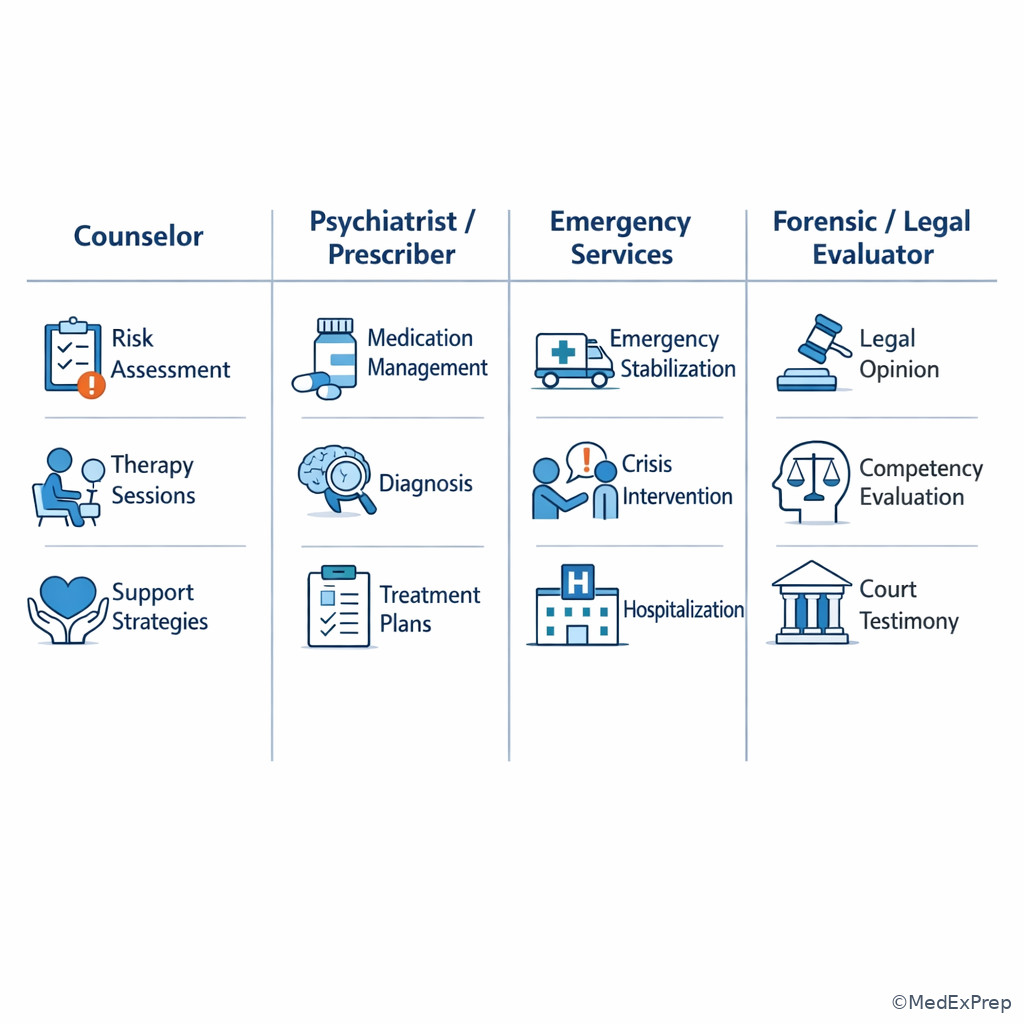
A third common decision conflict is helpful action versus role-appropriate action. NCMHCE questions frequently include distractors that could be appropriate if performed by another professional. A counselor can assess, document, provide psychoeducation, plan within counseling scope, consult, and refer. A counselor cannot prescribe, adjust medication dosage, medically clear a confused client, order labs, interpret imaging as a physician substitute, or issue forensic opinions outside authorization.
WHY THIS IS TESTED: The exam is not only testing clinical knowledge; it is testing whether the candidate can act safely within the entry-level counselor role. The testable pattern is whether an attractive answer crosses a scope boundary.
The single rule that resolves many items is: if the problem may be medical, neurologic, substance-induced, medication-related, or otherwise outside counselor competence, your next action is to assess what you can, document what you observe, and refer/collaborate appropriately. This does not mean ignoring the issue. It means responding to it through the correct professional channel.
Examples: If a client reports new confusion and visual hallucinations after stopping alcohol, the counselor does not “monitor withdrawal symptoms in outpatient therapy” as though this were routine counseling. The counselor recognizes possible emergency withdrawal and arranges urgent medical evaluation. If a client asks whether to double an antidepressant dose, the counselor provides supportive response and refers to the prescriber; the counselor does not advise on dose adjustment. See Fig 5.
B Worked example
A 40-year-old client in telehealth reports severe anxiety, insomnia, and “brain fog” after a recent medication change by a primary care provider. She has lupus, obesity, and a history of panic disorder. During session she asks, “Should I stop the pills tonight or just double them tomorrow?” A distracting clue is that she also reports catastrophic thoughts about an upcoming job interview. The question asks for the best response within the counselor’s role.
Reasoning chain: Identify task: response within counselor role. Extract key facts: medication question, possible side effects, telehealth setting, underlying anxiety, but no immediate danger stated. Apply rule: do not advise dose changes; assess severity and safety, encourage prompt prescriber contact, and escalate if concerning symptoms suggest urgent medical attention. Eliminate distractors: medication advice is out-of-role; starting CBT techniques without addressing the medication issue misses the immediate task. Verify: advise the client to contact the prescriber promptly, assess for urgent symptoms, and document the concern and referral guidance.
C Exam trap
Why it is tempting: It sounds practical, compassionate, and medically modest.
Single clue that eliminates it: Any recommendation to change a prescribed regimen is outside the counselor role.
D Checkpoint
Question: A 51-year-old client with depression, hypertension, and chronic kidney disease appears newly confused, misstates the date, and says he “sees insects on the wall.” His spouse reports he has barely slept and recently stopped drinking “cold turkey.” Which is the most appropriate next counselor action?
- Begin grounding techniques to reduce anxiety and continue the session.
- Arrange urgent emergency/medical evaluation and follow agency crisis protocol.
- Interpret the presentation as psychosis and document a primary psychotic disorder.
- Advise the spouse to monitor symptoms overnight and report back tomorrow.
- A: Tempting because agitation can improve with grounding; wrong because possible severe withdrawal or delirium requires medical escalation.
- B: Tempting because it may feel “too medical” for a counselor; right because the counselor’s role includes recognizing instability and referring urgently rather than managing it as routine therapy.
- C: Tempting because hallucinations suggest psychosis; wrong because recent alcohol cessation and confusion raise medical/substance causes, which the counselor should not definitively diagnose beyond scope.
- D: Tempting because spouse support exists; wrong because delay risks harm in a potentially emergent presentation.
1.1.1.6 Application: when to gather more data versus act immediately
A Explanation
Another high-yield conflict is diagnostic uncertainty versus dangerous delay. Entry-level counselors should not overstate certainty. At the same time, “I need more data” is not always safe. The exam often asks you to decide whether focused assessment is the right next step or whether the current evidence already requires action.
WHY THIS IS TESTED: Strong candidates tolerate uncertainty while still acting decisively when thresholds are crossed. The testable pattern is whether missing information is truly necessary before action.
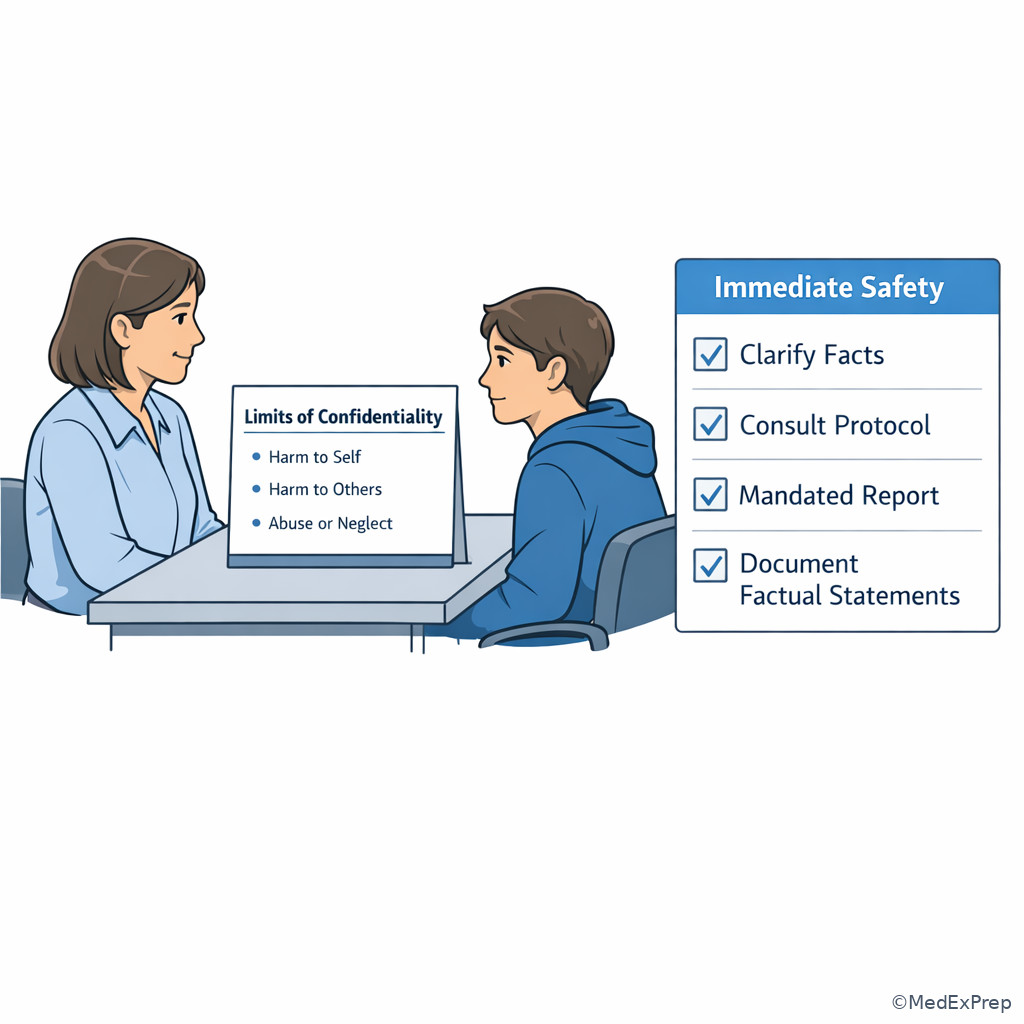
Choose more assessment when the stem lacks a discriminator and the client is stable enough for clarification. Examples: unclear suicidal severity, incomplete trauma history, ambiguous substance use pattern, uncertain onset of manic symptoms, or vague abuse indicators without immediate safety threat stated. Reject endless information gathering when the stem already gives enough danger data. If there is a specific plan and access to means, you do not need a full psychosocial history before intervening. If a child discloses potentially ongoing abuse, you do not wait for perfect proof before protective action according to law and protocol.
The rule that resolves the conflict is: clarify when the missing fact changes the plan; act when the plan is already determined by available risk information. See Fig 3.
B Worked example
A 16-year-old seen in a school-based setting reports sadness, poor appetite, and declining grades. She has ADHD, chronic headaches, and family conflict. Mid-interview, she says her mother’s boyfriend “gets weird” when they are alone and recently came into her room at night. She avoids eye contact and asks the counselor not to tell anyone because it will “make everything worse.” A distracting detail is that she also worries about failing chemistry. The stem asks for the most appropriate next step.
Reasoning chain: Identify task: next step in a possible abuse case. Extract key facts: minor, concerning sexualized boundary violation, possible ongoing risk, request for secrecy. Apply rule: do not promise confidentiality; clarify immediate safety and follow mandated reporting/workplace protocol. Eliminate distractors: completing depression screening first or exploring study habits is premature. Verify: the counselor should assess immediate safety, explain limits of confidentiality, consult/report per law and protocol, and document factual statements.
C Exam trap
Why it is tempting: Counselors want accurate information and may fear overreacting.
Single clue that eliminates it: Possible ongoing abuse of a minor shifts priority to protection and mandated procedures, not exhaustive fact-finding before action.
D Checkpoint
Question: During an intake, a 33-year-old client with generalized anxiety disorder and recent divorce says, “Sometimes I think it would be easier not to deal with any of this,” then denies intent and quickly changes the subject. There is no plan mentioned, no prior attempt disclosed, and she is calm and future-oriented. What is the most appropriate next step?
- Move on because the client denied intent.
- Initiate emergency hospitalization due to any suicidal content.
- Ask targeted follow-up questions to clarify suicidal ideation, history, means, and protective factors.
- Interpret the statement as purely metaphorical and begin anxiety psychoeducation.
- A: Tempting because the client denied intent; wrong because the statement still requires clarification before dismissal.
- B: Tempting because safety matters; wrong because the stem does not yet establish imminent risk and further focused assessment is indicated first.
- C: Tempting because it may interrupt rapport; right because the missing information directly changes the plan.
- D: Tempting because anxiety is the presenting problem; wrong because reinterpretation without clarification risks missing danger.
- True or False: When the stem already states plan and access to means, a full biopsychosocial history should come before crisis action.
- The best next question is the one that changes the ___.
- Name one scenario where you should not wait for perfect certainty before acting.
Exam takeaway: Ask one targeted question when the missing fact changes care, but act immediately once a safety threshold is already met.
flowchart TD
A[Uncertain case] --> B[What missing fact would change the next step?]
B --> C{Threshold already met for emergency or report?}
C -- Yes --> D[Act now: protect safety, report, consult, refer]
C -- No --> E[Ask focused clarification question]
E --> F{Clarified risk or role issue?}
F -- Yes --> G[Choose next counselor action]
F -- No --> H[Consult and gather limited additional data] Exam takeaway: With possible ongoing child abuse, protect safety and follow reporting protocol rather than promise secrecy.
1.1.1.7 Integration: build the best next step from setting, stage, and follow-up needs
A Explanation
The highest-yield integration skill is deciding what the counselor should do now in this setting at this stage. The same symptoms can lead to different answers depending on whether the client is in intake, follow-up, telehealth, school-based care, community mental health, or a crisis setting. Stage matters too: early sessions prioritize assessment and alliance; mid-treatment may prioritize intervention adjustment; relapse or deterioration may require reassessment, consultation, or stepped-up care.
WHY THIS IS TESTED: NCMHCE stems are contextual. The testable pattern is whether you can integrate setting, stage, acuity, and scope into one coherent next step rather than selecting a generic “good counseling” answer.
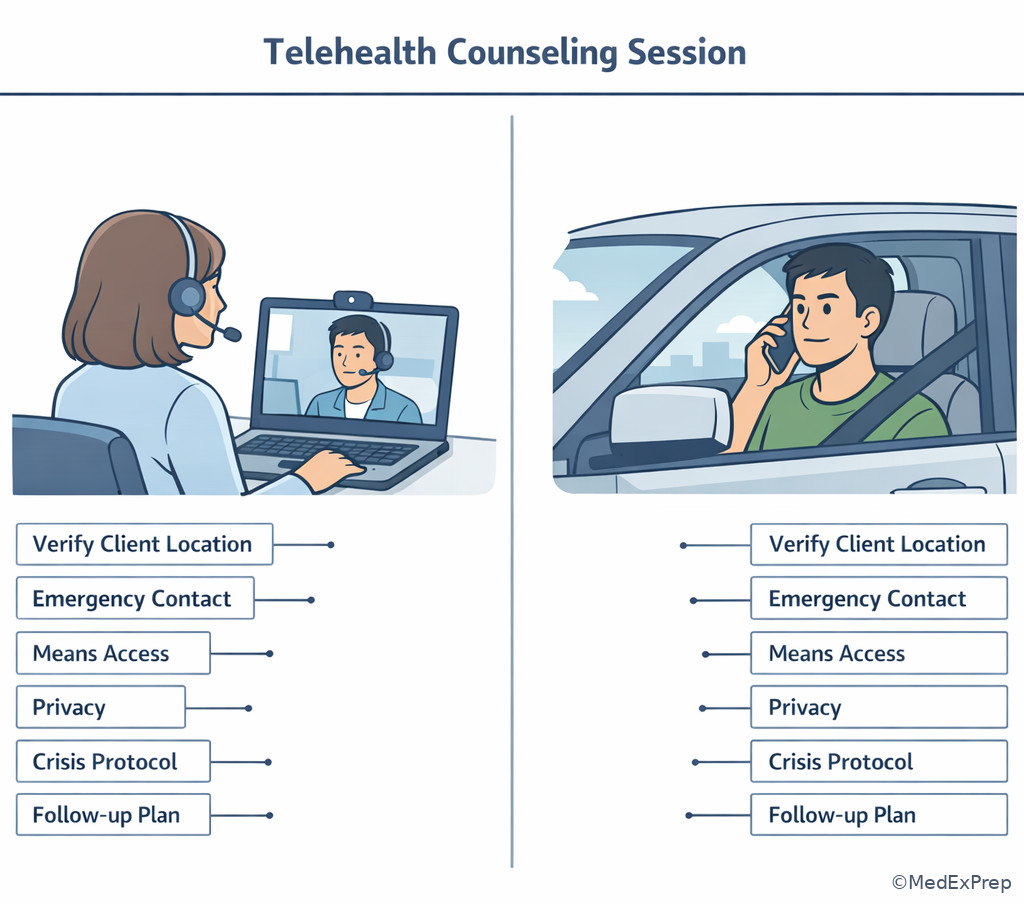
For example, telehealth adds location verification and emergency contact planning when risk rises. School-based settings add minor status, parent/guardian involvement rules, and mandated reporting pathways. Integrated care may make medical coordination especially relevant. Outpatient follow-up after a failed intervention requires not simply repeating the original plan, but reassessing barriers, adherence, fit, and risk before revising treatment.
The resolving rule is: best next step = safest action that fits the current setting, current stage, and current information. See Fig 6. Answers that ignore setting logistics or stage-of-treatment timing are often wrong even if the clinical idea is otherwise sound.
B Worked example
A 28-year-old client in telehealth follow-up for panic disorder logs in from a parked car after an argument with her partner. She has postpartum history, hypothyroidism, and recent missed sessions. She says she is “falling apart,” is crying, and admits to thoughts of crashing the car but says, “I don’t think I’d actually do it.” A distracting detail is that she wants a work excuse letter for the day. The question asks for the most appropriate next counselor action.
Reasoning chain: Identify task: telehealth, follow-up, possible acute risk. Extract key facts: current vehicle access, self-harm imagery, unstable location, poor recent engagement. Apply rule: setting logistics matter; verify location, assess risk, support immediate environmental safety, and escalate if risk cannot be safely managed. Eliminate distractors: breathing exercises, work note discussion, or routine CBT review ignore telehealth-specific safety steps. Verify: confirm exact location and emergency contacts, instruct client to secure safety immediately, continue focused risk assessment, and activate crisis/emergency supports per protocol if needed.
C Exam trap
Why it is tempting: Panic disorder is the known diagnosis and she softened the suicidal thought.
Single clue that eliminates it: She is in a car during telehealth and expressed crash-related self-harm imagery, making immediate location and safety management the priority.
D Checkpoint
Question: A client in the third outpatient session for alcohol recovery and depression says he relapsed over the weekend, missed work, and argued with his partner. He denies suicidal intent, denies a plan, is fully oriented, and asks to “just restart what we were doing.” Which is the most appropriate next step?
- Resume the original treatment plan without discussion to preserve momentum.
- Reassess current risk, triggers, barriers, and treatment fit before revising the plan.
- Discharge the client for nonadherence and instruct him to return when sober.
- Call emergency services because relapse alone indicates acute danger.
- A: Tempting because consistency is helpful; wrong because relapse is a change in clinical status that warrants reassessment before simply resuming.
- B: Tempting because it may feel slower; right because stage-of-treatment plus worsening symptoms call for plan revision based on current barriers and risk.
- C: Tempting because accountability matters; wrong because relapse should prompt treatment adjustment and support, not automatic punitive discharge.
- D: Tempting because substance use increases risk; wrong because the stem does not indicate imminent danger or medical instability requiring emergency activation.
Exam takeaway: Assess, document, consult, and refer when symptoms suggest medical, prescribing, or forensic functions outside counselor scope.
flowchart LR
A[Client concern] --> B{Within counselor role?}
B -- Counseling / risk / planning --> C[Assess and intervene within competence]
B -- Medication question --> D[Refer to prescriber; assess urgency]
B -- Medical instability concern --> E[Emergency or medical referral]
B -- Forensic/legal conclusion request --> F[Clarify role limits; consult and redirect]
C --> G[Document]
D --> G
E --> G
F --> G Exam takeaway: The best answer is the one that fits current setting, treatment stage, and safety logistics—not merely the most appealing intervention.
flowchart TD
A[Case details] --> B[Identify setting]
B --> C[Identify treatment stage]
C --> D[Check safety and role]
D --> E{What action advances care now?}
E --> F[Focused assessment]
E --> G[Counseling intervention]
E --> H[Consult / referral]
E --> I[Emergency escalation]
F --> J[Document + follow-up]
G --> J
H --> J
I --> J Exam takeaway: In remote care, verify location and emergency contacts before relying on routine de-escalation.
Exam takeaway: Distinguish counselor tasks from prescriber, emergency, and forensic functions to eliminate close distractors.
Exam Traps & Differentiators
- Most common wrong answer: a helpful intervention offered too early. Why: it sounds therapeutic. Eliminating clue: risk, abuse, or medical concern is still unresolved.
- Second common wrong answer: the most restrictive option. Why: candidates fear underreacting. Eliminating clue: no imminent danger markers, client engaged, supports available, safety plan feasible.
- Third common wrong answer: a correct action by the wrong professional. Why: it would solve the problem. Eliminating clue: prescribing, medical clearance, or legal determination exceeds counselor scope.
- Fourth common wrong answer: broad information gathering when one focused question is enough. Why: it feels clinically thorough. Eliminating clue: the stem already points to the one discriminator needed.
| Looks similar | Actually means | Discriminator | Best next move |
|---|---|---|---|
| Passive death wish | May be lower acuity but not ignorable | No intent/plan yet known | Clarify suicide risk |
| Active suicidal plan with means | Imminent risk concern | Specificity and access | Immediate crisis action |
| Panic symptoms after medication change | Possible medication issue plus anxiety | Request for dosing advice | Assess urgency and refer to prescriber |
| Hallucinations in oriented client with chronic psychosis history | Psychiatric management question | No acute confusion or withdrawal signs | Risk assess and coordinate routine psychiatric care |
| Hallucinations with confusion after alcohol cessation | Possible medical/substance emergency | Disorientation plus withdrawal context | Urgent medical evaluation |
| Minor requests secrecy about concerning adult behavior | Possible abuse/neglect issue | Mandated reporting trigger | Explain limits, assess safety, follow protocol |
If the stem says...
- “Most appropriate next step” → think sequence, not ultimate treatment package.
- “Requires immediate clarification” → think one missing high-yield fact that changes safety or disposition.
- “Client asks whether to change medication” → think scope boundary and prescriber referral.
- “Denies intent but has not been asked about plan/means” → think incomplete risk assessment, not reassurance.
- “Telehealth from unknown location” with rising risk → think location verification and emergency planning.
- “Minor reports concerning adult behavior” → think safety, limits of confidentiality, and mandated process.
| Answer type | Why it tempts candidates | When to reject it |
|---|---|---|
| Teach coping skill now | Feels supportive and practical | Risk, abuse, or instability not yet clarified |
| Hospitalize/call 911 immediately | Feels safest | No imminent risk indicators; outpatient safety is feasible |
| Advise dose change | Seems efficient | Always; prescribing decisions are out-of-role |
| Collect more history first | Seems thorough | Threshold for emergency/reporting already met |
| Promise confidentiality to preserve alliance | Sounds empathic | Danger, abuse, neglect, or legal exceptions apply |
Related trap from upcoming topics: Case Stem Signal Words will sharpen how qualifiers such as “first,” “next,” and “immediate” change the correct answer; Best Next Step Logic will further train you to reject correct-but-premature interventions.
Algorithm / Approach
| Step | Question to ask yourself | Typical answer forms |
|---|---|---|
| 1. Task | What exactly is being asked? | First/next/immediate/best response |
| 2. Risk | Is anyone unsafe now? | Risk clarification, crisis response, emergency referral |
| 3. Scope | Can a counselor do this? | Counsel, assess, consult, refer, document |
| 4. Context | What setting/stage changes the answer? | Telehealth logistics, intake priorities, minor protections |
| 5. Sequence | What must happen before the tempting intervention? | Clarify first, then intervene |
| 6. Verification | Which option is least restrictive and still safe? | Avoid under- and overreaction |
Rapid Review
- Task word → controls the answer level more than diagnosis labels
- Best next step → first safe move, not the full treatment package
- Passive death wish → requires clarification, not immediate reassurance
- Plan + means → emergency/crisis threshold rises sharply
- Diagnosis label → does not determine disposition without current risk data
- Medication question → assess urgency and refer to prescriber, never dose-adjust
- Confusion + hallucinations + withdrawal context → think medical/substance emergency, not routine therapy
- Minor requesting secrecy about possible abuse → limits of confidentiality and protection process
- Telehealth risk case → verify location and emergency contacts before routine intervention
- Relapse in follow-up → reassess barriers and treatment fit before restarting old plan
- Most attractive distractor → often correct later but premature now
- Most dramatic distractor → often too restrictive when imminent danger is absent
- Focused follow-up question → best when one missing fact would change care
- Documentation → include observed facts, rationale, consultation, referral, and follow-up
Self-check quiz
1. During a first outpatient session, a client with anxiety says, “Sometimes I wish I could disappear,” then quickly says she is late for work. The question asks for the most appropriate next step. Which answer best fits the clinical decision framework?
- Provide immediate coping skills for anxiety to maintain rapport.
- Ask focused follow-up questions to clarify suicide risk.
- Refer the client for psychiatric hospitalization.
- Assure the client many stressed people say things like that.
2. A client in routine counseling asks whether she should double her antidepressant because it is “not working fast enough.” Which is the best response within the counselor’s role?
- Recommend increasing the dose until the next medical appointment.
- Tell her to stop taking it if side effects occur.
- Assess urgency and direct her to contact the prescriber for medication guidance.
- Explain that counselors can make temporary medication recommendations in urgent cases.
3. A 31-year-old client in community mental health with depression, chronic pain, and recent eviction says, “I bought pills online and I’m done,” while staring at the floor. He has missed two prior appointments and smells of alcohol. Which is the most appropriate next action?
- Begin motivational interviewing about substance use and revisit suicidality next session.
- Initiate immediate crisis procedures and arrange emergency evaluation.
- Ask about childhood trauma before deciding on disposition.
- Create an outpatient safety plan and ask him to return tomorrow.
4. A 14-year-old in a school setting says her mother’s boyfriend enters her bedroom late at night and “touches my blanket and hair.” She asks the counselor to keep it secret because she is afraid of being removed from home. Which is the most appropriate next step?
- Promise confidentiality to preserve trust, then explore feelings further.
- Assess immediate safety, explain limits of confidentiality, and follow reporting protocol.
- Wait until she describes a clearly criminal act in detail before acting.
- Call the boyfriend directly to hear his side before deciding whether to report.
5. A 45-year-old telehealth client with panic disorder, diabetes, and recent marital conflict joins session from a moving car and says, “I can’t do this anymore.” He denies a plan but is crying and driving erratically. Which is the best initial counselor action?
- Begin paced breathing to reduce panic symptoms.
- Verify location, direct the client to stop driving and secure safety, and continue risk assessment.
- Reschedule because telehealth risk assessment is unreliable.
- Interpret the comment as emotional expression because he denied a plan.
6. A 52-year-old outpatient client with bipolar disorder history, hypertension, and insomnia presents restless, pressured, and grandiose. He says he has not slept in four days and spent a large amount of money, but denies suicidal or homicidal intent. He also appears mildly disoriented and his spouse reports he stopped heavy daily drinking yesterday. Which is the most appropriate next step?
- Finalize a working diagnosis of mania and start behavioral sleep planning.
- Recommend that he restart alcohol use briefly to avoid withdrawal.
- Arrange urgent medical/emergency evaluation because withdrawal or medical instability may be present.
- Schedule an urgent psychiatry referral for later this week and continue outpatient counseling today.
7. A 26-year-old client in the second session for depression reports she still feels hopeless despite one week of journaling. She has asthma, past self-injury in high school, and recent job rejection. She says, “I wrote a goodbye note last night,” but then adds, “I probably wouldn’t do anything because my dog needs me.” Which is the most appropriate next step?
- Increase behavioral activation homework because the current plan needs more time.
- Conduct immediate, more intensive suicide risk assessment and determine whether emergency action is required.
- Reassure her that protective factors make suicide unlikely.
- Refer for medication management before discussing the note further.
8. A 38-year-old client in integrated care follow-up for alcohol misuse and anxiety says he relapsed after 60 days sober. He denies suicidal intent, denies hallucinations, is oriented, and asks to continue therapy. His hands are mildly tremulous, but he reports no seizures, no confusion, and last drank 10 hours ago. Which is the most appropriate next step?
- Call emergency services because any post-relapse tremor requires ED transfer.
- Resume the prior plan unchanged because he is motivated.
- Reassess withdrawal risk, current safety, and treatment barriers, then revise the plan and coordinate a higher level of SUD care if indicated.
- Advise a benzodiazepine taper and follow up tomorrow.
Answer key
1.1.1.8 1. Answer: B
- A: Tempting because coping skills are often the right first counseling move in anxiety cases. Incorrect here because the stem includes a possible suicide signal that must be clarified before symptom-focused intervention. Discriminating clue: “wish I could disappear.” Source support: suicide risk assessment begins with clarification of ideation and related risk factors, not reassurance alone.
- B: Tempting because it may feel abrupt in an initial session. Correct because the framework prioritizes focused risk clarification when a death-related statement appears and imminent risk has not yet been ruled out. Discriminating clue: ambiguous suicidal content requiring immediate clarification.
- C: Tempting because safety is paramount. Incorrect because emergency hospitalization is too restrictive without evidence of intent, plan, means, or inability to maintain safety. Discriminating clue: no imminent risk markers stated.
- D: Tempting because normalization can reduce shame. Incorrect because normalization before assessment risks minimizing clinically meaningful suicidal content. Discriminating clue: the comment has not been assessed yet.
1.1.1.9 2. Answer: C
- A: Tempting because it appears practical and client-centered. Incorrect because recommending a dose increase is outside counselor scope. Discriminating clue: direct request for medication advice.
- B: Tempting because stopping a medication can sound safer than increasing it. Incorrect because telling a client to stop a prescribed medication is also outside counselor scope unless directed by emergency protocol and medical providers. Discriminating clue: medication management belongs to the prescriber.
- C: Tempting because it may feel less “active” than giving advice. Correct because the counselor should assess whether any urgent adverse effects are present and direct the client to the prescriber for medication decisions. Discriminating clue: scope boundary with preserved counselor role in assessment and referral.
- D: Tempting if the candidate confuses crisis support with prescribing authority. Incorrect because counselors do not make temporary medication recommendations. Discriminating clue: out-of-role statement.
1.1.1.10 3. Answer: B
- A: Tempting because alcohol use is clinically relevant and MI is a strong intervention. Incorrect because immediate suicidal danger supersedes motivational work. Discriminating clue: pills already obtained plus “I’m done.”
- B: Tempting because it is the highest-intensity option. Correct because the client has likely active suicidal intent, means access, substance use, and poor reliability, all pointing to immediate crisis procedures and emergency evaluation. Discriminating clue: acquired lethal means and intent language.
- C: Tempting because trauma history can inform formulation. Incorrect because it does not change the immediate need for safety action. Discriminating clue: threshold already met without further history.
- D: Tempting because safety planning is standard outpatient practice. Incorrect because outpatient-only planning is insufficient when imminent-risk markers are already present. Discriminating clue: purchased pills plus alcohol use and poor follow-through.
1.1.1.11 4. Answer: B
- A: Tempting because preserving alliance matters, especially with minors. Incorrect because confidentiality cannot be promised where abuse or danger reporting obligations may apply. Discriminating clue: possible ongoing sexual boundary violation by caregiver figure.
- B: Tempting because it may feel less emotionally comfortable than continuing rapport-building. Correct because the counselor must assess immediate safety, explain limits of confidentiality, and follow legal/protocol reporting steps. Discriminating clue: minor status plus possible ongoing abuse.
- C: Tempting because counselors want accurate facts. Incorrect because mandated reporting generally does not require full proof or exhaustive detail before action. Discriminating clue: protection threshold, not courtroom certainty.
- D: Tempting because collateral information can be valuable. Incorrect because contacting the alleged perpetrator is unsafe and outside proper protective process. Discriminating clue: potential abuse investigation should follow agency/legal channels.
1.1.1.12 5. Answer: B
- A: Tempting because breathing skills often help panic rapidly. Incorrect because a moving car plus suicidal wording creates an immediate environmental safety issue that must be addressed first. Discriminating clue: driving erratically during telehealth.
- B: Tempting because it may seem logistically complex. Correct because telehealth crisis management starts with location verification and immediate environmental safety, followed by risk assessment and escalation if needed. Discriminating clue: remote setting with current vehicle access.
- C: Tempting because telehealth has limitations. Incorrect because rescheduling abandons the client at the precise moment safety action is needed. Discriminating clue: acute risk concern cannot wait.
- D: Tempting because the client denied a plan. Incorrect because denial of a plan does not neutralize acute safety concerns created by current dangerous driving and emotional dysregulation. Discriminating clue: behavior itself is hazardous now.
1.1.1.13 6. Answer: C
- A: Tempting because the presentation resembles mania and sleep planning sounds reasonable. Incorrect because disorientation and abrupt alcohol cessation raise concern for withdrawal or medical instability that must be urgently evaluated. Discriminating clue: mild disorientation plus stopped heavy drinking yesterday.
- B: Tempting only if the candidate fixates on withdrawal prevention. Incorrect because advising alcohol use is unsafe and outside counselor scope. Discriminating clue: substance-management recommendation outside role.
- C: Tempting because it shifts away from the apparent psychiatric diagnosis. Correct because counselors must recognize when a seemingly psychiatric presentation may be medically or substance-related and arrange urgent evaluation. Discriminating clue: withdrawal-context confusion overrides routine outpatient planning.
- D: Tempting because urgent psychiatry follow-up would be appropriate for uncomplicated mania. Incorrect because “later this week” is too slow when possible withdrawal or delirium is present now. Discriminating clue: acute instability indicators.
1.1.1.14 7. Answer: B
- A: Tempting because treatment adherence has been brief and behavioral activation is evidence-aligned. Incorrect because a goodbye note is a high-risk signal that must be evaluated before adjusting routine homework. Discriminating clue: wrote a goodbye note last night.
- B: Tempting because it may feel more intense than the client’s mixed message suggests. Correct because the note materially increases suicide concern and requires immediate fuller risk assessment, with emergency determination based on resulting data. Discriminating clue: preparatory behavior outweighs simple hopelessness.
- C: Tempting because attachment to a pet is a protective factor. Incorrect because protective factors do not eliminate the need to assess high-risk warning signs. Discriminating clue: protective factor present, but not dispositive.
- D: Tempting because depression treatment can include medication referral. Incorrect because referral may be appropriate later, but the immediate task is risk clarification and safety determination. Discriminating clue: sequencing—safety first.
1.1.1.15 8. Answer: C
- A: Tempting because tremor after relapse can signal withdrawal risk. Incorrect because the stem lacks current emergency markers such as confusion, seizures, severe autonomic instability, or hallucinations; immediate ED transfer may be too restrictive. Discriminating clue: oriented, no hallucinations, no seizures.
- B: Tempting because the client wants to continue treatment and motivation matters. Incorrect because relapse changes clinical status and requires reassessment rather than automatic continuation of the old plan. Discriminating clue: post-relapse reevaluation is needed.
- C: Tempting because it is more nuanced than either extreme. Correct because the counselor should reassess withdrawal risk and safety, identify barriers and relapse triggers, and coordinate more intensive SUD care if indicated while staying within scope. Discriminating clue: some concern is present, but not enough for automatic emergency escalation.
- D: Tempting because it addresses withdrawal symptoms directly. Incorrect because recommending a benzodiazepine taper is a prescribing action outside counselor scope. Discriminating clue: medication management boundary.
Keep going with the full NCMHCE Prep Course (NCMHCE)
You just studied the way members do, in the same lesson interface. Full access unlocks every lesson, the question bank and flashcards for a full year.
One payment · 1 year of access · No auto-renewal