1.1.1 - Word Parts And Abbreviations
Word Parts And Abbreviations
What you’ll learn
- Foundational Knowledge: Medical terminology foundations -> Break down prefixes, roots, suffixes, and combining vowels to infer meaning safely.
- Clinical Medical Assisting: Documentation and provider communication -> Recognize high-yield abbreviations used in outpatient charts, orders, histories, and procedure support.
- Administrative Medical Assisting: Records workflow -> Use only approved abbreviations and reject unclear, unsafe, or prohibited shorthand.
- Law, Ethics, and Professionalism: Scope and documentation integrity -> Identify when an abbreviation or word part requires clarification rather than assumption.
- Safety and Quality: Error prevention -> Prevent medication, specimen, scheduling, and charting errors caused by look-alike or ambiguous abbreviations.
Blueprint mapping
- Foundational Knowledge: Anatomy/physiology language -> word-building rules for medical terms
- Clinical Medical Assisting: Patient intake and clinical documentation -> interpret common chart shorthand accurately
- Administrative Medical Assisting: Health records and workflow -> use standardized abbreviations and clarify unsafe entries
- Law, Ethics, and Professionalism: Scope of practice and chart integrity -> avoid guessing, altering, or independently interpreting unclear documentation
- Safety and Quality: Error prevention -> recognize abbreviation-related safety risks and escalation points
Why it matters
- NCMA items often hide the answer in terminology: if you know the word parts, you can identify the body system, direction, procedure, or safety issue even when the full term looks unfamiliar.
- Abbreviation errors cause real outpatient mistakes in medication timing, specimen labeling, charting, scheduling, and provider messages.
- The medical assistant is expected to document accurately, recognize unclear orders, and escalate rather than guess.
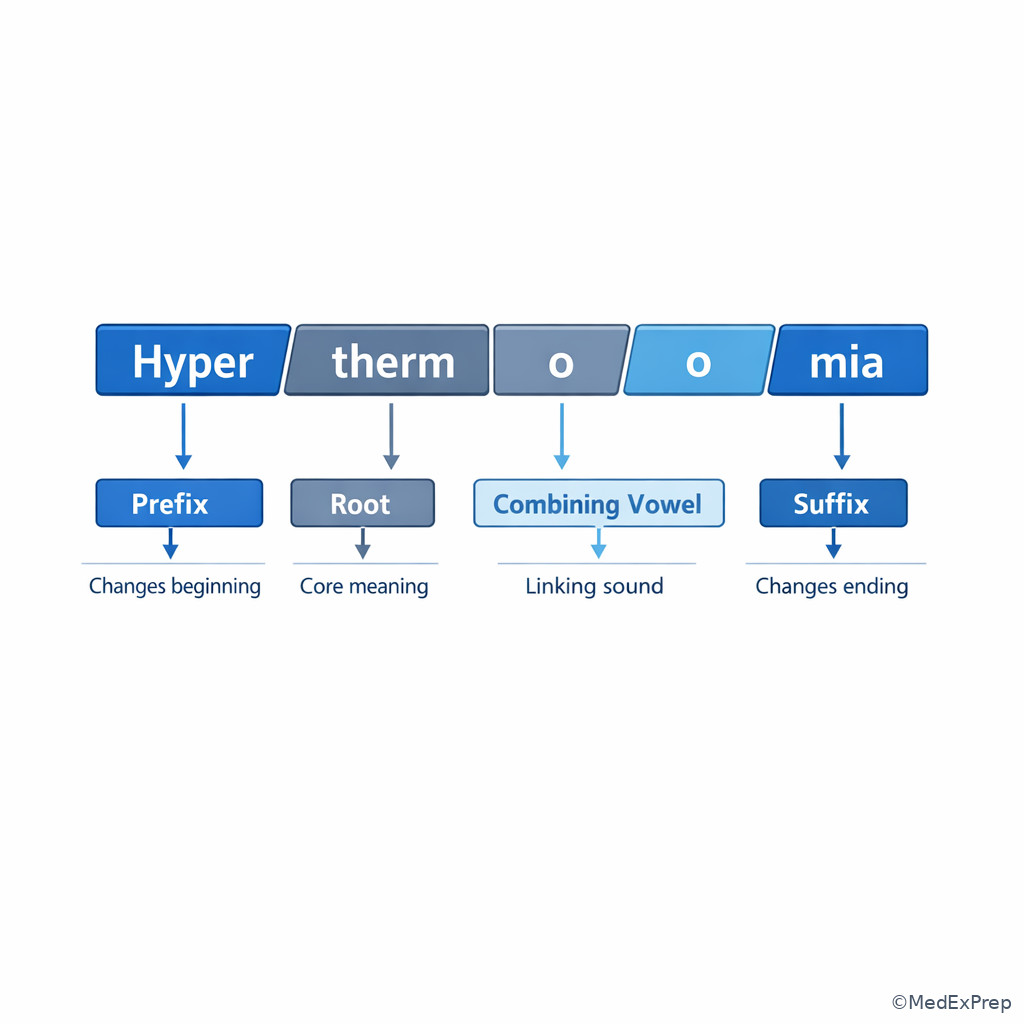
- This topic builds the language base for anatomy, procedures, pharmacology, and documentation lessons that follow. See Fig 1.
Key Terms & Must-Know Facts
1.1.1.1 Key terms
- Prefix: word part placed before a root to modify meaning
- Root: core meaning, often body part or system
- Suffix: ending that indicates condition, procedure, or specialty
- Combining vowel: usually “o,” used to join parts for pronunciation
- Combining form: root plus combining vowel, such as cardi/o
- Abbreviation: shortened form of a term used in records or communication
- Acronym: abbreviation pronounced as a word, such as AIDS
- Bidirectional abbreviation risk: shorthand that can be misread or have multiple meanings
- Clarification: seeking confirmation from the ordering provider or authorized source before acting
- Approved abbreviation list: facility-accepted shorthand for documentation
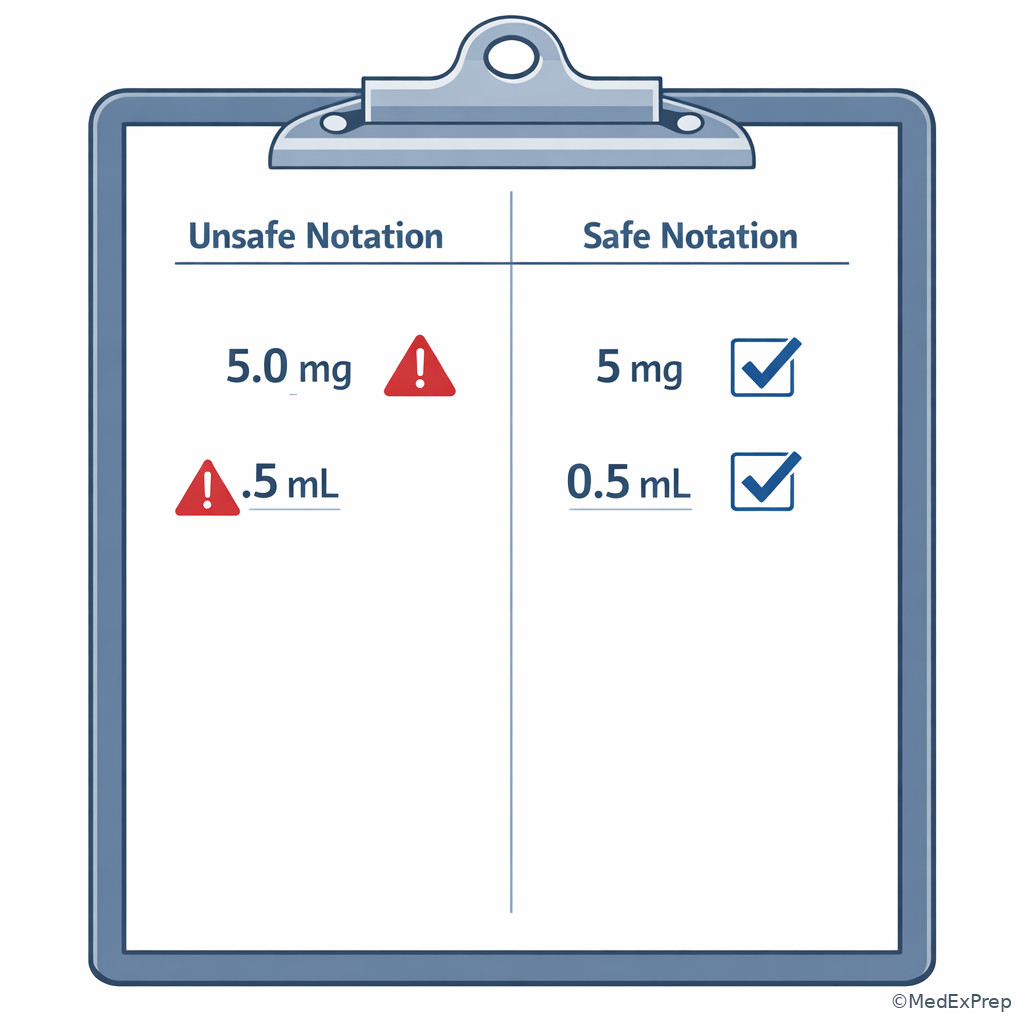
- Trailing zero error: unsafe notation such as 5.0 mg
- Leading zero: required before decimal amounts less than 1, such as 0.5 mL
- Objective charting: documenting observable facts without diagnosis or interpretation
1.1.1.2 Must-know facts
- Break unknown terms into prefix + root + suffix before guessing meaning.
- The suffix often tells you whether the term is a condition, procedure, or specialist.
- A combining vowel is usually dropped before a suffix that begins with a vowel.
- One abbreviation can mean different things in different settings; context decides, but unsafe ambiguity requires clarification.
- Do not invent abbreviations in the chart if your facility does not approve them.
- Medical assistants may document accurately and report concerns, but should not independently interpret unclear clinical orders.
- Unsafe medication shorthand is a patient-safety issue, not a spelling issue.
- If a label, order, or message is unclear, stop and verify before proceeding.
| Word part type | Usual location | What it tells you | Example | Meaning |
|---|---|---|---|---|
| Prefix | Beginning | Number, time, position, amount | brady- | slow |
| Root | Middle/core | Body part/system | cardi | heart |
| Suffix | Ending | Condition/procedure/specialty | -itis | inflammation |
| Combining vowel | Between parts | Pronunciation aid | o | joins root and suffix/root |
| Combining form | Root + vowel | Ready-to-join unit | neur/o | nerve |
Exam takeaway: Break the term into parts in order so you choose meaning from structure rather than memory alone.
flowchart LR
A[See unfamiliar term] --> B[Check suffix first]
B --> C[Find root or roots]
C --> D[Add prefix meaning]
D --> E[Use context from chart or task]
E --> F[If still unclear, clarify before acting]
Exam takeaway: Visual grouping of prefix, root, combining vowel, and suffix makes decoding faster on test day.
Core content
1.1.1.3 Foundational term structure: how to build and decode words
A Explanation
The decision conflict is simple but heavily tested: Should you infer the meaning from word structure, or should you guess from a familiar-looking fragment? The rule that resolves it is to decode in sequence. Start with the suffix because it usually tells you whether the word is a condition, procedure, specialist, or study. Next identify the root or roots, then add the prefix. This method is safer than starting from the first syllable because many terms share similar openings but end very differently.
WHY THIS IS TESTED: exam items often present an unfamiliar term and expect you to identify the body system or action. If you know that -ectomy means surgical removal, -scopy means visual examination, and -itis means inflammation, you can reject distractors that confuse diagnosis, procedure support, and anatomy.
Choose structure-based decoding when the term is new. Reject sound-alike guessing when one syllable seems familiar but the suffix changes the category. Example: gastritis is inflammation of the stomach, while gastrectomy is surgical removal of part or all of the stomach. Same root, different suffix, completely different clinical action.
See Fig 1 for the basic decoding workflow.
B Worked example
A 67-year-old woman with hypertension and osteoarthritis presents for a gastroenterology follow-up. The provider’s note mentions a prior colonoscopy, current concern for possible gastritis, and a family history of colon cancer. Her chart also lists seasonal allergies and a mildly elevated fasting glucose from last month. A new MA is asked what body system and type of term gastritis represents.
Identify task: decode the term, not diagnose the patient. Extract key facts: gastr- relates to stomach; -itis means inflammation. Apply rule: suffix first, then root. Eliminate distractors: it is not a procedure like -scopy, not removal like -ectomy, and not a specialist like -logist. Verify: the meaning “inflammation of the stomach” fits the GI context.
C Exam trap
D Checkpoint
Question: A provider note lists arthralgia. What is the most appropriate interpretation for the medical assistant documenting the visit?
- Inflammation of a joint
- Pain in a joint
- Surgical repair of a joint
- Visual examination of a joint
Correct answer: B.
- A: Tempting because joint terms often involve inflammation; wrong because -itis, not -algia, signals inflammation.
- B: Tempting because it matches the root and suffix; right because arthr- means joint and -algia means pain.
- C: Tempting because orthopedic words often end in procedure suffixes; wrong because surgical repair uses -plasty.
- D: Tempting because joints may be scoped; wrong because visual examination uses -scopy.
1.1.1.4 High-yield prefixes, roots, and suffixes used in outpatient care
A Explanation
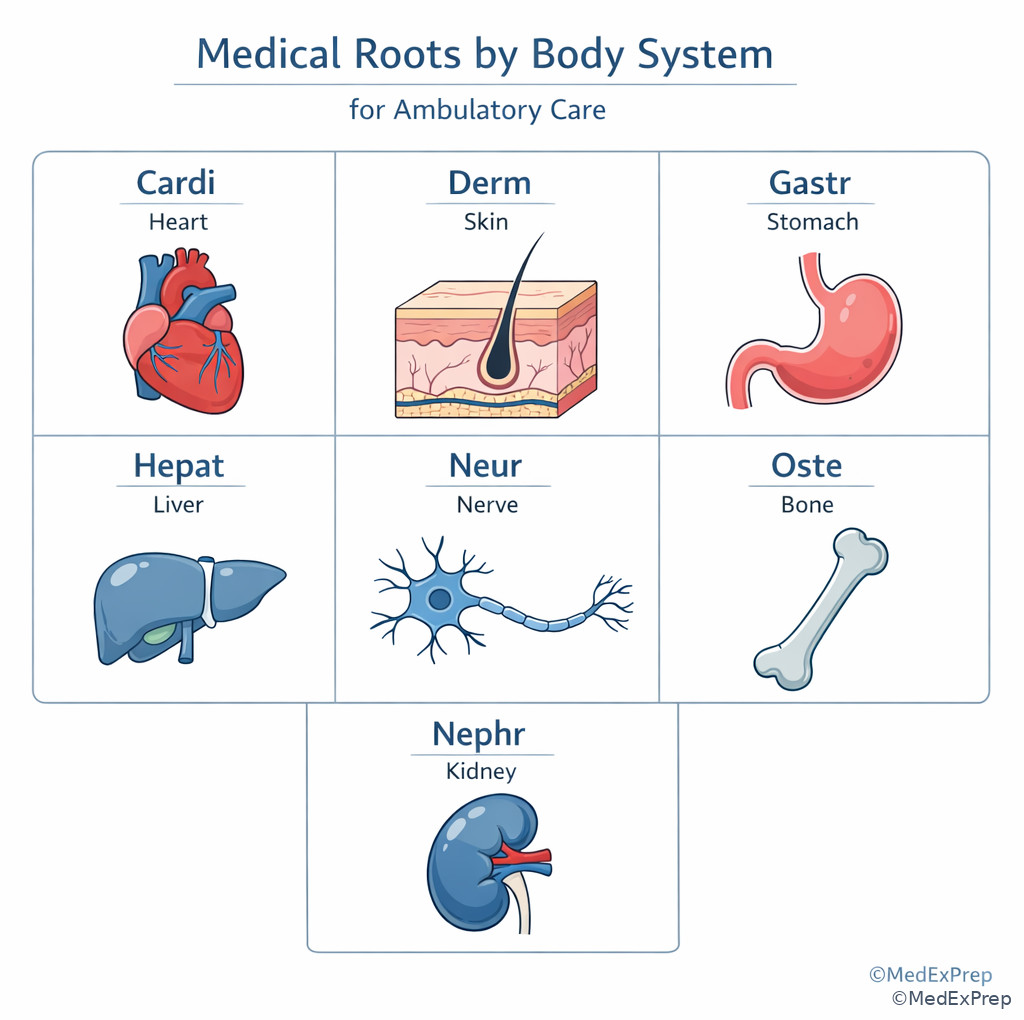
The decision conflict here is which word part carries the testable clue. In outpatient stems, the answer usually turns on a small set of repeated pieces: time and rate prefixes such as brady- and tachy-; body roots such as cardi, derm, hepat, and neur; and suffixes such as -emia, -uria, -megaly, -penia, and -osis. The single rule is to ask which part changes the action you would take or the section of the chart where the item belongs.
WHY THIS IS TESTED: NCMA-style questions may ask you to prepare the correct room, specimen, or screening support based on terminology alone. For example, if a patient is scheduled for dermatology, the root points to skin; if the chart says hematuria, the suffix and root point to blood in urine, placing the issue in urinary documentation.
Choose the body-system interpretation when the root is clear. Reject distractors based only on similar prefix sounds. A common example is confusing hypo- with hyper-; one means low, the other high. In vitals, symptoms, or lab-support tasks, that difference changes urgency and the need to report findings promptly.
| Word part | Meaning | Common example | Exam use |
|---|---|---|---|
| brady- | slow | bradycardia | vital sign terminology |
| tachy- | fast | tachypnea | vital sign terminology |
| hemo-/hemat- | blood | hematoma | lab/procedure support |
| derm-/dermat- | skin | dermatitis | specialty or complaint identification |
| gastr- | stomach | gastroscopy | GI context |
| cardi- | heart | cardiology | specialty identification |
| -itis | inflammation | otitis | condition |
| -algia | pain | neuralgia | symptom |
| -megaly | enlargement | cardiomegaly | condition description |
| -uria | urine condition | hematuria | urinary documentation |
Exam takeaway: The same root can pair with different suffixes, and the suffix usually determines whether the term is a symptom, condition, procedure, or specialty.
graph TD
A[Root: cardi] --> B[cardiology - specialty]
A --> C[carditis - inflammation]
A --> D[cardiomegaly - enlargement]
A --> E[cardiogram - record]
F[Prefix: tachy] --> G[tachycardia - fast heart rate]
H[Prefix: brady] --> I[bradycardia - slow heart rate]
B Worked example
A 54-year-old man with type 2 diabetes and hyperlipidemia checks in for a urology follow-up. He mentions chronic knee pain from old sports injuries and asks whether “hematuria” means infection. The chart also notes a recent normal chest x-ray, which is not relevant to the task. The MA must route the question appropriately and document the symptom term accurately.
Identify task: understand the word, not interpret diagnosis for the patient. Extract key facts: hema/hemat = blood; -uria = urine condition. Apply rule: decode the term and recognize it belongs to urinary documentation. Eliminate distractors: do not tell the patient it means infection; do not assume kidney stone or UTI. Verify: the safe response is to document the concern and notify the provider or nurse per office protocol if needed.
C Exam trap
D Checkpoint
Question: A chart note states tachypnea. Which interpretation best supports accurate intake documentation?
- Rapid breathing
- Painful breathing
- Slow heart rate
- Enlarged lung tissue
Correct answer: A.
- A: Tempting because tachy- is a familiar vital-sign prefix; right because it means fast and -pnea relates to breathing.
- B: Tempting because respiratory complaints often involve pain; wrong because pain is typically conveyed by -algia or a specific symptom description.
- C: Tempting because tachy- and heart-rate terms are often paired; wrong because -pnea refers to respiration, not heart rate.
- D: Tempting because lung pathology may affect breathing; wrong because enlargement would require a different suffix such as -megaly.
- The suffix for inflammation is -itis.
- True or False: hyper- means low. False.
- Name the 3 decoding steps after spotting an unfamiliar term: suffix, root, prefix.
Exam takeaway: Grouping roots by body system helps you match unfamiliar terms to the correct clinical context quickly.
1.1.1.5 Common abbreviations in charting, orders, histories, and office workflow
A Explanation
Now the decision conflict shifts from decoding long words to handling shorthand: Should you accept the abbreviation as routine, or should you stop because it is unclear or unsafe? The resolving rule is to use only approved, standard abbreviations and to clarify any abbreviation that could change patient care, timing, route, or documentation meaning.
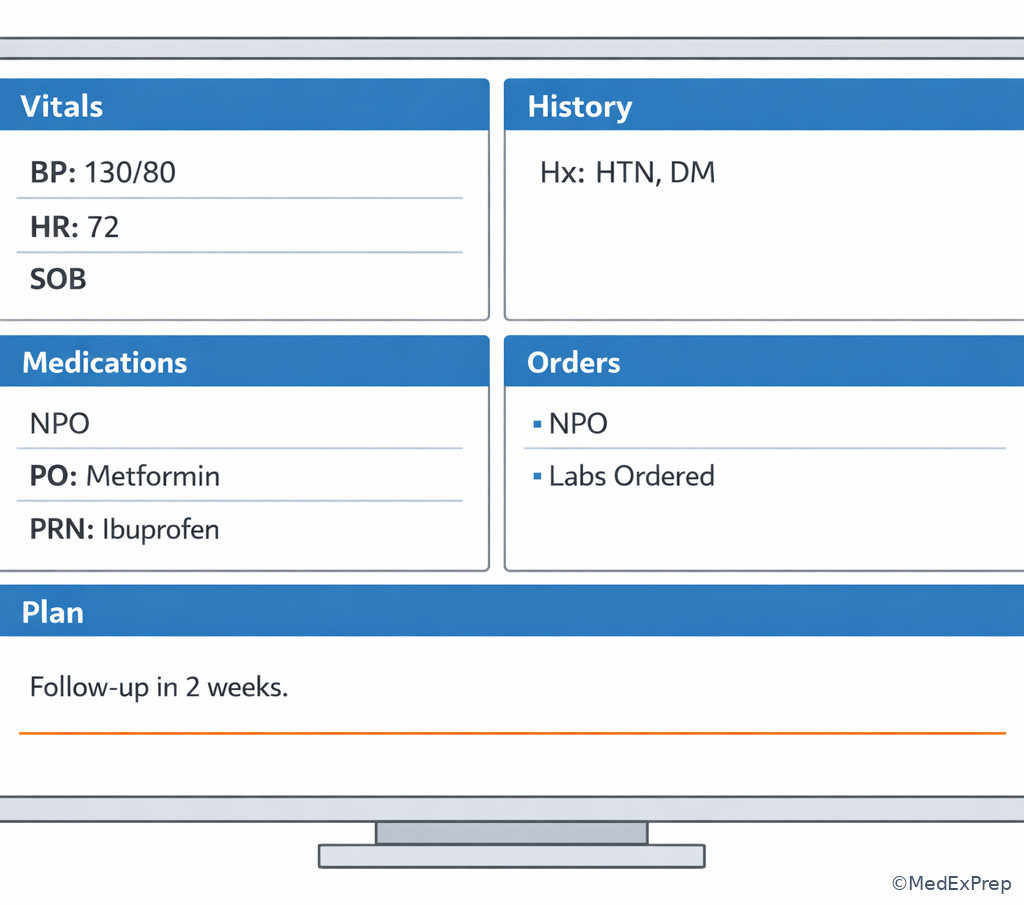
WHY THIS IS TESTED: abbreviations appear everywhere in ambulatory care — chief complaint, history, medication list, provider messages, appointment notes, procedure support, and lab requisitions. The MA must recognize common ones such as BP, HR, PRN, PO, NPO, hx, Dx, qid, bid, tid, Rx, and SOB, but must also know that context matters. For example, SOB usually means shortness of breath in clinical notes, but the wording should be handled carefully in patient-facing communication.
Choose clarification when an abbreviation is nonstandard, unreadable, or dangerous. Reject the impulse to “fill in the blank” because guessing can become a chart error. Also, abbreviations may vary by institution. The safest broadly accepted test answer is: follow the approved abbreviation list, employer policy, and applicable state law.
See Fig 3 for a chart-facing summary of common abbreviation categories.
| Abbreviation | Usual meaning | Common setting | MA action |
|---|---|---|---|
| BP | blood pressure | vitals | measure/document objectively |
| HR | heart rate | vitals | measure/document objectively |
| Hx | history | intake/chart review | use context to identify type of history |
| Dx | diagnosis | provider documentation | do not create independently |
| Tx | treatment | plan/procedure area | support per order/policy |
| NPO | nothing by mouth | pre-procedure instruction | reinforce provider-approved instructions |
| PO | by mouth | medication route | verify order/route |
| PRN | as needed | medication instructions | use only per authorized order |
| SOB | shortness of breath | symptom notes | document/report appropriately |
| c/o | complains of | subjective history | quote patient complaint accurately |
Exam takeaway: Sort abbreviations by workflow area so you know whether to document, clarify, or escalate.
flowchart TD
A[Abbreviation seen] --> B{Where is it used?}
B --> C[Vitals: BP HR RR]
B --> D[History: Hx c/o SOB]
B --> E[Orders/meds: PO NPO PRN]
B --> F[Plan: Dx Tx]
C --> G[Measure and document]
D --> H[Record patient statement accurately]
E --> I[Verify meaning and authorization]
F --> J[Support plan; do not diagnose independently]
B Worked example
A 39-year-old woman with asthma and migraine arrives for an urgent clinic visit. The appointment note says “c/o SOB x 2 days.” The patient also mentions she skipped breakfast for lab work and asks whether the staff thinks she has pneumonia. The MA notices a historical note about ankle pain from a prior sports injury, which is distracting. The task is to room the patient, collect intake data, and document the complaint accurately.
Identify task: interpret the abbreviation for workflow, not diagnose. Extract key facts: \(c/o = complains of\); \(SOB = shortness of breath\). Apply rule: use common approved abbreviation meaning in clinical context. Eliminate distractors: do not chart “severe obstruction breathing” or tell the patient the condition is pneumonia. Verify: document the complaint, obtain vital signs per protocol, and report concerning findings per office procedure.
C Exam trap
D Checkpoint
Question: A medication instruction in the chart includes PO. What is the safest interpretation for the MA supporting medication documentation?
- By mouth
- Postoperative
- Ointment applied to skin
- Observe only; route not specified
Correct answer: A.
- A: Tempting because it is a common medication abbreviation; right because PO is the standard route meaning by mouth.
- B: Tempting because postoperative is also common in charts; wrong because that meaning is not the routine medication-route use of PO.
- C: Tempting because medication instructions often include topical products; wrong because topical routes use different wording.
- D: Tempting because clarification is often safest; wrong here because PO is a standard route abbreviation in a medication context, assuming it is facility-approved and otherwise clear.
Exam takeaway: Reading the abbreviation in the correct chart section prevents history, medication, and order mix-ups.
1.1.1.6 Unsafe, prohibited, or high-risk abbreviations: when clarification is required
A Explanation
This section is about the most important safety conflict: When should the MA stop instead of continuing the workflow? The single rule is that any abbreviation or notation that can change dose, route, frequency, patient identity, specimen identity, or legal meaning must be clarified before action. The test is not whether you can “probably figure it out.” The test is whether a reasonable person could misread it.
WHY THIS IS TESTED: the NCMA exam emphasizes safe sequencing, documentation integrity, and scope boundaries. Dangerous shorthand includes trailing zeros, missing leading zeros, unclear frequency abbreviations, and handwritten notes that could be confused with different drugs, routes, or times. Even when the intended meaning seems obvious, the safe action is to clarify.
Choose stop-and-verify for unclear or unsafe notation. Reject proceeding based on habit, prior patient history, or what a coworker thinks the provider “meant.” This is especially important with medication and specimen workflows, where one character error can become a patient-harm event.
See Fig 4 for a decision tree on whether to proceed or clarify.
| Risky notation | Why it is unsafe | Safer form | MA response |
|---|---|---|---|
| 5.0 mg | trailing zero may be read as 50 mg | 5 mg | clarify/correct per policy before action |
| .5 mL | missing leading zero may be read as 5 mL | 0.5 mL | clarify/correct per policy before action |
| Unreadable frequency | wrong timing changes therapy | clearly written frequency | verify with authorized source |
| Unclear patient label initials only | wrong-patient/specimen risk | full required identifiers | relabel per policy; do not guess |
| Nonapproved shorthand | multiple interpretations | approved abbreviation or full word | avoid using it |
Exam takeaway: If shorthand could change patient care or documentation meaning, the safest next step is clarification before action.
flowchart TD
A[Abbreviation or notation seen] --> B{Approved and clear?}
B -- Yes --> C[Proceed per policy]
B -- No --> D{Could it affect dose route time patient or specimen?}
D -- Yes --> E[Stop and clarify]
D -- No --> F[Use full term or approved wording]
E --> G[Document clarified entry]
G --> C
B Worked example
A 72-year-old man with atrial fibrillation and chronic kidney disease is in clinic for medication reconciliation. The handwritten note appears to read “.5 mg” of a medication, and the patient also reports seasonal allergies and mild shoulder soreness after gardening. A coworker says, “It probably means 5 mg; that doctor writes fast.” The MA is preparing the chart for provider review.
Identify task: determine the safest next step with ambiguous notation. Extract key facts: missing leading zero creates dose ambiguity; medication safety is involved; coworker opinion is not authorized clarification. Apply rule: stop and verify with the authorized source per office policy. Eliminate distractors: do not rewrite the dose from memory, do not ask the patient to choose, do not leave it unaddressed. Verify: clarification protects against a tenfold dosing error.
C Exam trap
D Checkpoint
Question: The chart shows a handwritten medication dose as .25 mL. What is the most appropriate next step for the MA?
- Administer 0.25 mL because the intended dose is obvious
- Rewrite the order as 0.25 mL and proceed without notifying anyone
- Clarify the notation with the authorized provider or per office protocol before proceeding
- Ask the patient what dose was taken last time and use that amount
Correct answer: C.
- A: Tempting because many clinicians would infer the missing leading zero; wrong because ambiguous medication notation requires clarification.
- B: Tempting because it seems to fix the formatting issue; wrong because the MA should not alter an order independently without authorized clarification.
- C: Tempting because it may delay workflow; right because missing leading zero is a recognized safety hazard.
- D: Tempting because the patient may remember prior dosing; wrong because patient recollection does not replace a valid clarified order.
- True or False: A trailing zero after a whole-number dose is safe. False.
- The safest response to unreadable medication shorthand is clarify before action.
- Name two high-risk areas for abbreviation ambiguity: medications and specimen labels.
Exam takeaway: Seeing leading-zero and trailing-zero errors side by side helps you recognize when to stop and clarify.
1.1.1.7 Using terminology and abbreviations safely in real MA workflow
A Explanation
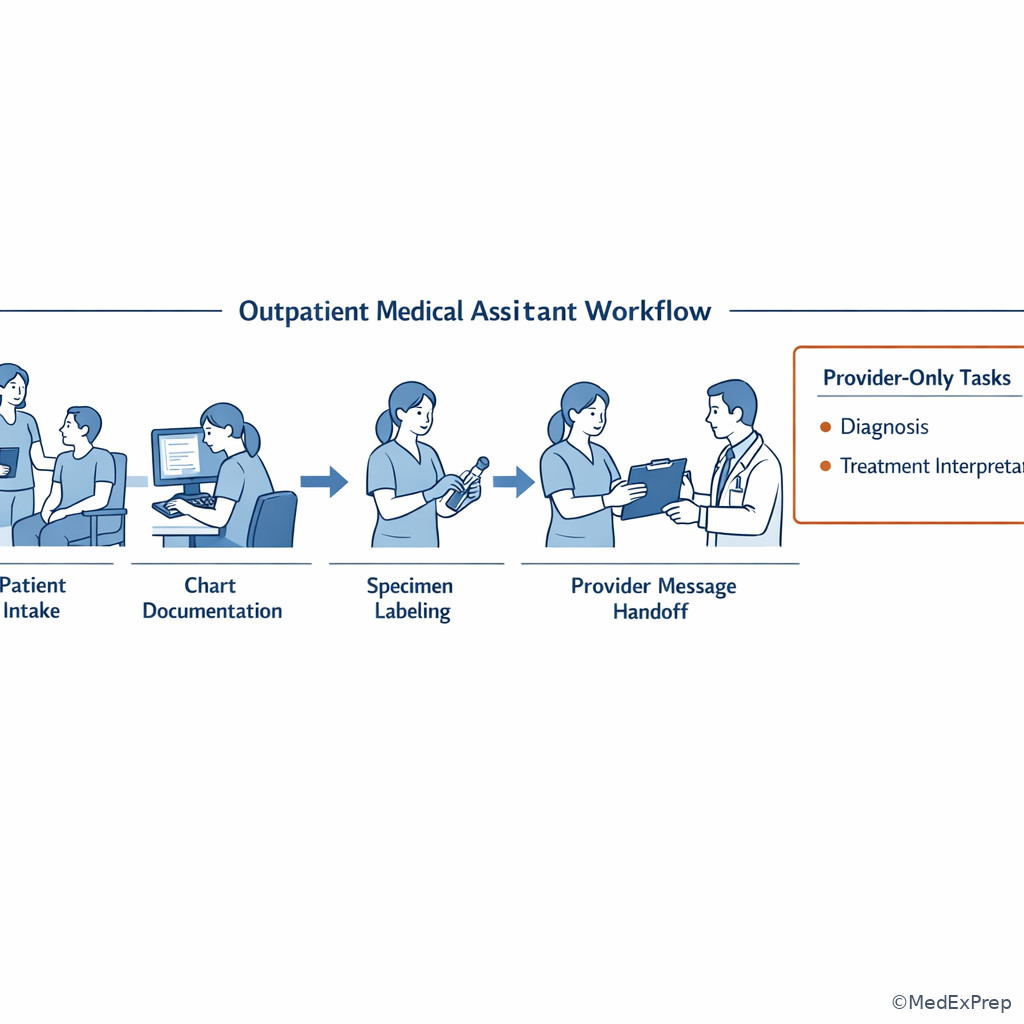
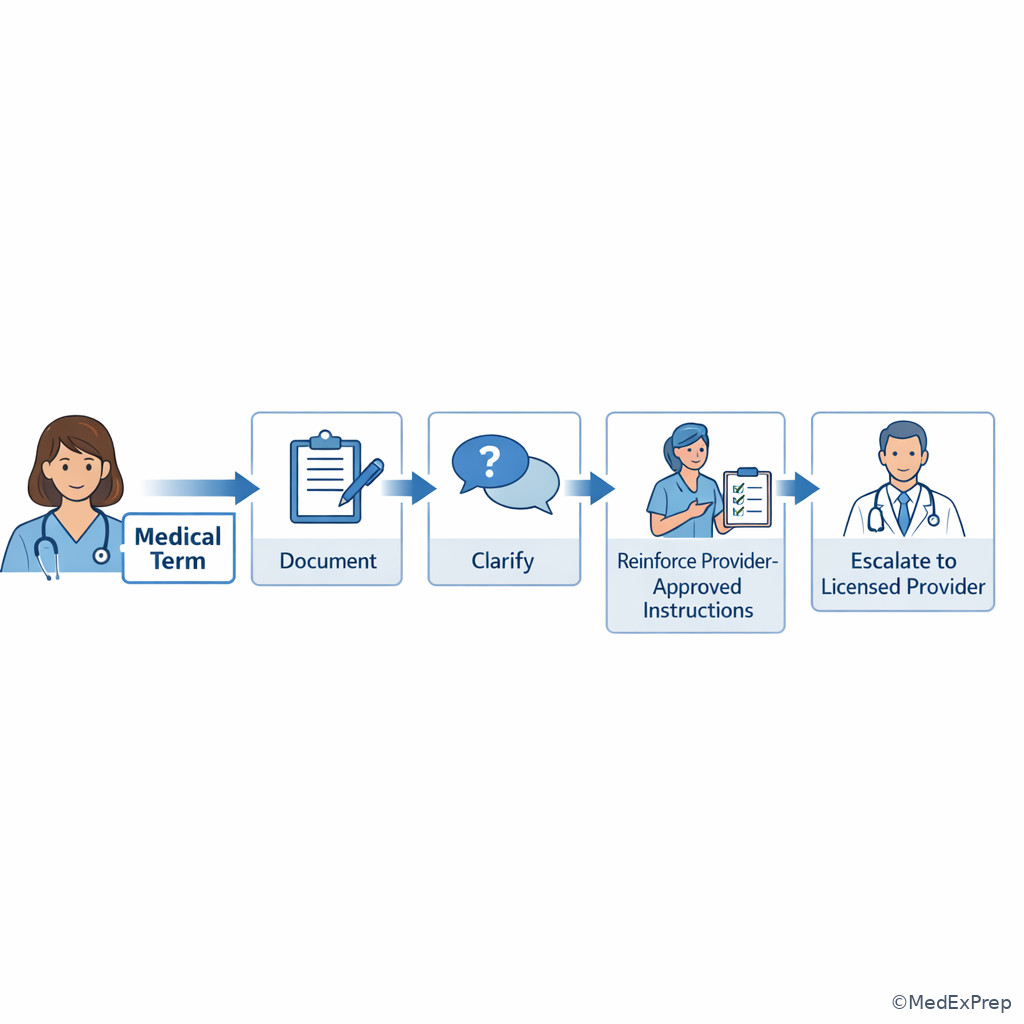
The final integration question is what should the MA do with terminology knowledge during actual workflow? The correct approach is not merely to know definitions but to connect language to safe action: room preparation, intake wording, specimen labeling, provider messages, patient instruction reinforcement, and documentation. The single rule is to use terminology for accuracy and escalation, not for independent diagnosis or treatment decisions.
WHY THIS IS TESTED: many exam items combine vocabulary with workflow and scope. Example: a patient asks, “What does hematuria mean? Do I have cancer?” The MA may understand the term but must respond within role: document the question, provide only approved reinforcement, and refer diagnostic interpretation to the provider. Another example is a requisition containing abbreviations that affect specimen handling; terminology knowledge helps detect mismatch and prevent error.
Choose objective documentation. Reject translating the chart into diagnostic conclusions for the patient. Use exact patient statements when documenting symptoms, and use exact clarified provider wording for orders. This protects legal integrity and clinical accuracy.
Exam takeaway: The MA uses terminology to support safe workflow and communication, but diagnosis and treatment interpretation stay with the licensed provider.
B Worked example
A 46-year-old woman with obesity and GERD arrives for follow-up after an outside urgent care visit. The outside summary says “c/o epigastric pain, NPO after midnight, possible cholecystitis.” She also mentions a recent rash on her arm and asks whether the gallbladder is in the lower left abdomen. The MA must update intake, reinforce only approved instructions, and route the location question appropriately because anatomy teaching is limited and upcoming lessons cover quadrants.
Identify task: use terminology for safe workflow. Extract key facts: \(c/o = complains of\); \(NPO = nothing by mouth\); possible cholecystitis is provider-level diagnostic language. Apply rule: document and reinforce provider-approved fasting instruction, but do not diagnose or independently explain the full significance. Eliminate distractors: do not tell her she definitely has gallbladder disease; do not reinterpret outside records as a new diagnosis. Verify: accurate documentation plus provider referral stays within MA role. This also previews the next topic on body quadrants.
C Exam trap
D Checkpoint
Question: A patient asks, “My paper says hematuria. Does that mean I have a kidney infection?” What is the most appropriate MA response?
- “Yes, that definitely means infection.”
- “It means blood in the urine; the provider will interpret what is causing it.”
- “It probably means kidney stones, so drink more water.”
- “Ignore that word because it is only a billing term.”
Correct answer: B.
- A: Tempting because infection is a common cause patients may have heard about; wrong because the MA should not diagnose cause.
- B: Tempting because it uses terminology knowledge without overstepping; right because it gives neutral meaning and appropriately defers interpretation.
- C: Tempting because stones are another known cause; wrong because suggesting a cause and advice crosses into provider-level interpretation.
- D: Tempting because some terms appear on administrative paperwork; wrong because hematuria is a clinical term, not something to dismiss.
Exam takeaway: Link terminology to the correct workflow action—document, clarify, reinforce approved instructions, or escalate.
Exam Traps & Differentiators
1.1.1.8 Most common wrong answer and why
The most common wrong answer is choosing the clinically specific interpretation instead of the safest role-appropriate action. Learners often know enough terminology to recognize the likely meaning, then overreach into diagnosis, medication interpretation, or order correction without clarification. The test rewards safety, not confidence.
1.1.1.9 Looks similar but isn’t
| Looks similar | But means | Why learners confuse them | Discriminator |
|---|---|---|---|
| -scopy vs -scope | procedure vs instrument | same root and sound | the y ending marks the procedure |
| -itis vs -oma | inflammation vs mass/tumor | both appear in specialty notes | inflammation always points to -itis |
| hyper- vs hypo- | high/excess vs low/deficient | one-letter contrast | direction of change determines action |
| PO vs postoperative | oral route vs surgery status | same letters, different context | medication section usually means oral route |
| Dx vs Tx | diagnosis vs treatment | both appear in plan areas | MA may support Tx, but not create Dx |
| .5 vs 0.5 | unsafe vs safe notation | same value mathematically | leading zero prevents tenfold misread |
1.1.1.10 If the stem says ___, think ___
- If the stem says unfamiliar term, think suffix first, then root, then prefix.
- If the stem says patient asks what it means, think give neutral term meaning only if appropriate, then defer cause/diagnosis to provider.
- If the stem says handwritten medication notation is unclear, think clarify before proceeding.
- If the stem says abbreviation appears in medications, think route/frequency safety and approved list.
- If the stem says charting or labeling shortcut, think documentation integrity and wrong-patient risk.
- If the stem says upcoming anatomy location question, think this terminology base will pair with body planes, directions, cavities, and quadrants.
Algorithm / Approach
Rapid Review
- Suffix-first decoding → fastest way to separate condition from procedure.
- -itis → inflammation, not pain and not removal.
- -algia → pain, not inflammation.
- -ectomy → surgical removal, not visual exam.
- -scopy → procedure; -scope → instrument.
- hyper- → high/excess; hypo- → low/deficient.
- tachy- → fast rate; brady- → slow rate.
- -uria → urine-related finding; use urinary context.
- PO → by mouth when used as a medication route.
- NPO → nothing by mouth; reinforce only approved instructions.
- Dx → provider diagnosis; MA does not create it independently.
- Trailing zero → unsafe because it can multiply dose.
- Missing leading zero → unsafe because decimal can be missed.
- Ambiguous abbreviation → clarify before action.
- Patient asks for diagnosis meaning → give neutral support within scope, then refer.
Self-check quiz
1. During chart prep for a 58-year-old patient with hypertension and chronic back pain, the MA sees the term dermatitis in a prior note. Which interpretation is most appropriate?
- Inflammation of the skin
- Pain in the muscle
- Surgical repair of the skin
- Study of the skin
2. A medication list for a 33-year-old patient with asthma and allergic rhinitis includes the abbreviation PRN. Which meaning is most appropriate for routine medication instructions?
- Immediately after meals
- As needed
- By mouth
- Nothing by mouth
3. A 61-year-old man with diabetes and chronic kidney disease arrives for follow-up. A handwritten medication instruction appears as .5 mL PO. He also mentions a mild old shoulder strain, and his blood pressure today is stable. What is the most appropriate next step for the MA?
- Proceed because the intended dose is clearly 0.5 mL
- Clarify the notation with the authorized provider or per office protocol before proceeding
- Ask the patient what dose he usually takes and document that amount
- Rewrite the order with a leading zero and continue without notification
4. A 47-year-old woman with GERD and obesity checks in with the note “c/o epigastric pain, NPO after midnight.” She also reports a chronic rash on her hand and asks whether she can drink coffee before her test. What is the most appropriate MA action?
- Tell her NPO only applies to solid food, so coffee is fine
- Document the complaint and reinforce the provider-approved NPO instruction per office policy
- Tell her the note proves she has gallbladder disease
- Ignore the abbreviation because only providers need to understand it
5. A 29-year-old patient with migraine and seasonal allergies asks, “My note says tachypnea. Is that the same as a fast heart rate?” The patient also mentions a normal skin biopsy from last year. Which response is most appropriate?
- “Yes, tachypnea means your heart is beating fast.”
- “It refers to rapid breathing; the provider can explain what caused it in your case.”
- “It means chest pain, so you probably need emergency treatment.”
- “That term is only used for billing and has no clinical meaning.”
6. A 70-year-old patient with atrial fibrillation, heart failure, and poor vision presents for medication review. The chart contains two handwritten entries: one says 5.0 mg, another looks like qd, and the patient says, “That is what I always take.” A coworker offers to interpret the handwriting from memory. What action requires immediate clarification before the MA continues the workflow?
- The patient’s verbal confirmation of usual dosing
- The coworker’s memory of the provider’s usual writing style
- The trailing-zero dose notation and unclear frequency abbreviation
- The patient’s report of heart failure history
7. A 52-year-old woman with recurrent urinary complaints and anxiety asks about a printed after-visit summary that lists hematuria. She also has a distant history of kidney stones and mentions that her sister had a UTI last week. Which is the most appropriate MA response?
- “That definitely means you have an infection.”
- “That means blood in the urine; the provider will interpret the cause based on your evaluation.”
- “That is probably from kidney stones, so you should increase fluid intake today.”
- “It is an administrative term and does not relate to your symptoms.”
8. A 44-year-old man with hypertension and sleep apnea presents for a pre-procedure visit. The outside document includes gastroscopy, while a sticky note on the chart says scope to remove stomach lesion. He also asks whether the procedure means part of his stomach will be removed. Which action is most appropriate for the MA?
- Explain that gastroscopy means surgical removal of the stomach lesion
- Assure him the procedure is definitely minor because a scope is always noninvasive
- Recognize that -scopy usually indicates visual examination and refer the procedural interpretation question to the provider
- Document that the patient is scheduled for gastrectomy because the note mentions removal
Answer key
1.1.1.11 1. Answer: A
- A: Tempting because the root dermat- clearly signals skin; correct because -itis means inflammation, so the term means inflammation of the skin. The single stem clue is the suffix -itis. Source: Ehrlich and Schroeder; Taber’s.
- B: Tempting because pain terms are common in ambulatory care; incorrect because muscle pain would involve a different root and often -algia. The discriminating clue is that dermat- is skin, not muscle. Source: Ehrlich and Schroeder.
- C: Tempting because skin procedures are common; incorrect because surgical repair uses suffixes such as -plasty, not -itis. The key clue is the ending. Source: Taber’s.
- D: Tempting because dermatology involves study of skin; incorrect because a study/specialty term would use -logy. The key clue is the suffix mismatch. Source: Ehrlich and Schroeder.
1.1.1.12 2. Answer: B
- A: Tempting because meal timing instructions are common on medication labels; incorrect because PRN does not refer to meals. The discriminating clue is that PRN is a frequency-as-needed abbreviation. Source: Joint Commission safety language on abbreviation clarity; facility-approved documentation standards.
- B: Tempting because it is a standard medication instruction; correct because PRN means as needed in medication context. The clue is the medication list setting. Source: Taber’s; common clinical documentation standards.
- C: Tempting because route abbreviations are common; incorrect because PO, not PRN, means by mouth. The clue is the letters themselves. Source: Taber’s.
- D: Tempting because NPO is another frequent abbreviation; incorrect because NPO means nothing by mouth. The clue is that PRN and NPO belong to different instruction categories. Source: Taber’s.
1.1.1.13 3. Answer: B
- A: Tempting because many staff would infer the intended decimal amount; incorrect because a missing leading zero is a high-risk notation error. The discriminating clue is .5 mL. Source: Institute for Safe Medication Practices; Joint Commission “Do Not Use” principles.
- B: Tempting because it may delay rooming or medication reconciliation; correct because ambiguous dosing notation requires authorized clarification before action. The clue is that the notation could change care. Source: ISMP; safety-based outpatient medication standards.
- C: Tempting because patient recall may seem practical; incorrect because patient memory does not replace a valid clarified order. The clue is that the issue is order safety, not patient habit. Source: AMA/ambulatory medication safety best practice principles.
- D: Tempting because it corrects formatting; incorrect because the MA should not independently rewrite and act on an ambiguous order without clarification. The key clue is scope and authorization. Source: Documentation integrity standards; NCMA-safe role boundaries.
1.1.1.14 4. Answer: B
- A: Tempting because patients commonly ask whether coffee counts; incorrect because the MA should not independently redefine NPO instructions unless a provider-approved protocol specifically says so. The discriminating clue is the need to reinforce approved instructions only. Source: Ambulatory care pre-procedure instruction standards; scope-safe patient education practice.
- B: Tempting because it stays simple and workflow-focused; correct because c/o should be documented accurately and NPO should be reinforced per provider order or office policy. The clue is the combination of abbreviation recognition and safe role boundaries. Source: NCMA-safe scope language; standard ambulatory documentation practice.
- C: Tempting because epigastric pain may suggest a GI diagnosis; incorrect because diagnosis is outside MA role. The clue is that the note contains provider-level possibility language, not a confirmed patient-facing explanation. Source: Scope-of-practice guidance for medical assistants.
- D: Tempting because providers ultimately interpret the condition; incorrect because MAs do need to understand common abbreviations to carry out safe instructions and documentation. The clue is workflow responsibility. Source: Administrative and clinical documentation standards.
1.1.1.15 5. Answer: B
- A: Tempting because tachy- often appears with cardiac terms; incorrect because -pnea refers to breathing, not heart rate. The discriminating clue is the suffix/root combination. Source: Ehrlich and Schroeder.
- B: Tempting because it uses accurate terminology without overstepping; correct because tachypnea means rapid breathing, and cause interpretation belongs to the provider. The clue is both the word part and scope boundary. Source: Taber’s; NCMA-safe communication standards.
- C: Tempting because respiratory symptoms may be urgent; incorrect because tachypnea is not the same as chest pain, and the MA should not independently declare emergency treatment unless office emergency criteria are actually met. The clue is vocabulary mismatch. Source: Fundamental clinical terminology references.
- D: Tempting because patients may see terms on administrative documents; incorrect because tachypnea is a clinical term. The clue is the symptom context. Source: Taber’s.
1.1.1.16 6. Answer: C
- A: Tempting because medication reconciliation often uses patient report; incorrect because patient confirmation does not solve unsafe notation in the written order. The discriminating clue is that the notation itself remains hazardous. Source: ISMP medication-safety recommendations.
- B: Tempting because experienced coworkers may know provider habits; incorrect because coworker memory is not authorized clarification. The clue is documentation validity. Source: Documentation integrity and medication safety standards.
- C: Tempting because it identifies the actual safety hazard; correct because trailing-zero notation and unclear frequency abbreviation can directly change dose timing and amount. The single clue is the risky shorthand itself. Source: Joint Commission “Do Not Use” abbreviation principles; ISMP.
- D: Tempting because comorbidities matter clinically; incorrect because the question asks what requires immediate clarification in the workflow, and the dangerous notation is the immediate safety issue. The clue is the order-related ambiguity. Source: Ambulatory medication safety best practice.
1.1.1.17 7. Answer: B
- A: Tempting because infection is a common patient association; incorrect because the MA should not declare cause from a term alone. The discriminating clue is the scope boundary. Source: Scope-of-practice guidance; objective patient communication standards.
- B: Tempting because it balances helpfulness and safety; correct because hematuria means blood in the urine, while cause interpretation belongs to the provider. The clue is that this answer explains the term but not the diagnosis. Source: Taber’s; ambulatory communication standards.
- C: Tempting because stone history is present in the stem; incorrect because that history is the distracting detail and does not authorize the MA to attribute cause or give treatment advice. The clue is the tempting-but-wrong past history. Source: NCMA-safe role framework.
- D: Tempting because after-visit summaries can contain administrative language; incorrect because hematuria is a clinical symptom term. The clue is the term meaning itself. Source: Taber’s.
1.1.1.18 8. Answer: C
- A: Tempting because the sticky note mentions removal and the patient asks directly; incorrect because gastroscopy usually refers to visual examination, and procedural interpretation belongs to the provider. The discriminating clue is the suffix -scopy. Source: Ehrlich and Schroeder; procedural terminology standards.
- B: Tempting because endoscopy is often less invasive than surgery; incorrect because the MA should not assure procedural severity or specifics beyond approved instructions. The clue is scope. Source: Ambulatory procedure communication standards.
- C: Tempting because it uses exact terminology logic; correct because -scopy indicates visual examination, and questions about what will actually be done should go to the provider. The clue is the suffix-category distinction. Source: Taber’s; NCMA-safe patient communication guidance.
- D: Tempting because the note mentions removal; incorrect because documenting gastrectomy would substitute a different procedure based on assumption. The clue is that -ectomy and -scopy are not interchangeable. Source: Documentation integrity principles.
Keep going with the full NCMA (NCCT) Prep Course (NCMA)
You just studied the way members do, in the same lesson interface. Full access unlocks every lesson, the question bank and flashcards for a full year.
One payment · 1 year of access · No auto-renewal