1.1.1 - Counselor Roles And Settings
Counselor Roles and Settings
What you'll learn
- PROFESSIONAL COUNSELING ORIENTATION AND ETHICS: Professional identity → Distinguish counselor roles across practice settings
- PROFESSIONAL COUNSELING ORIENTATION AND ETHICS: Scope awareness → Choose counselor-appropriate actions versus out-of-role actions
- HELPING RELATIONSHIPS: Service planning → Match client needs to the most appropriate counseling setting
- SOCIAL AND CULTURAL FOUNDATIONS: Access and context → Recognize how culture, systems, and barriers shape setting choice
- PROFESSIONAL COUNSELING ORIENTATION AND ETHICS: Interprofessional practice → Identify when consultation, referral, and collaboration are required
- Professional Counseling Orientation and Ethics → Professional identity and settings → Role differentiation
- Professional Counseling Orientation and Ethics → Scope and responsibility → Appropriate next action
- Helping Relationships → Service delivery context → Matching setting to presenting need
- Social and Cultural Foundations → Systems and access → Contextualizing care environment
Why it matters
- NCE stems often test the single best counselor action, not the most comprehensive action by another professional.
- Many wrong answers are tempting because they sound helpful but fall outside counselor role, competence, or setting authority.
- Role-and-setting questions are the foundation for later ethics, referral, supervision, documentation, assessment, and crisis items.
- When two options both seem reasonable, the correct answer usually fits client welfare + counselor scope + the realities of the setting.
Key Terms & Must-Know Facts
1.1.1.1 Key terms
- Professional counselor: A helping professional trained to provide counseling services within competence and ethical standards.
- Practice setting: The environment in which counseling services are delivered, such as school, community agency, college, private practice, career center, or integrated care.
- Scope of practice: The boundaries of what a counselor may appropriately do based on training, competence, credentials, and setting.
- Competence: The knowledge and skill required to perform services safely and effectively.
- Referral: Directing a client to another professional or service when needs exceed counselor role or competence.
- Consultation: Seeking professional input to improve case decisions while retaining appropriate responsibility.
- Collaboration: Coordinated work with other professionals, systems, or supports for client welfare.
- Case conceptualization: Organizing client information into a meaningful framework to guide counseling goals and interventions.
- Informed consent: Explaining the nature of counseling, roles, limits, risks, and client rights.
- Multidisciplinary setting: A practice environment involving multiple professions with different roles.
- Counselor identity: Understanding the profession’s values, functions, ethics, and contribution across settings.
- Advocacy: Action to reduce barriers affecting client access, equity, or development.
1.1.1.2 Must-know facts
- The NCE tests best next counselor response, not what a physician, attorney, or administrator might do.
- Counselors work across mental health, school, college, career, agency, and community settings.
- The setting changes logistics and role emphasis, but client welfare, competence, ethics, and appropriate boundaries remain constant.
- If the client’s needs exceed counselor competence or setting capacity, the best answer often includes consultation, referral, collaboration, or supervision.
- Do not choose answers involving prescribing medication, legal rulings, or medical procedures.
- School, college, agency, and private practice counselors may share helping skills, but their primary functions and stakeholders differ.
- When safety risk appears, the counselor’s role is to assess, protect, consult, document, and escalate appropriately.
- Local rules vary, so avoid answer choices that depend on unstated jurisdiction-specific law.
Exam takeaway: Match the client need first, then choose the setting-specific counselor function that stays within scope.
flowchart TD
A[Client presents with a need] --> B{Primary need?}
B -->|Mental health symptoms| C[Community or clinical mental health counseling]
B -->|Academic and school functioning| D[School counseling]
B -->|College adjustment and development| E[College counseling or student support]
B -->|Career choice and work transition| F[Career counseling]
B -->|Complex risk or medical instability| G[Refer/collaborate with higher level care]
C --> H[Counseling, case conceptualization, referral, coordination]
D --> I[Academic, social-emotional, career support in school system]
E --> J[Developmental, adjustment, crisis support, referral]
F --> K[Assessment-informed career planning and decision support] Exam takeaway: When an option sounds helpful but requires another profession’s authority, reject it and choose consultation, referral, or collaboration.
flowchart LR
A[Counselor considers action] --> B{Within training, role, and setting?}
B -->|Yes| C[Proceed ethically and document]
B -->|No| D{Can it be supported by supervision or consultation?}
D -->|Yes| E[Consult and act within limits]
D -->|No| F[Refer or collaborate]
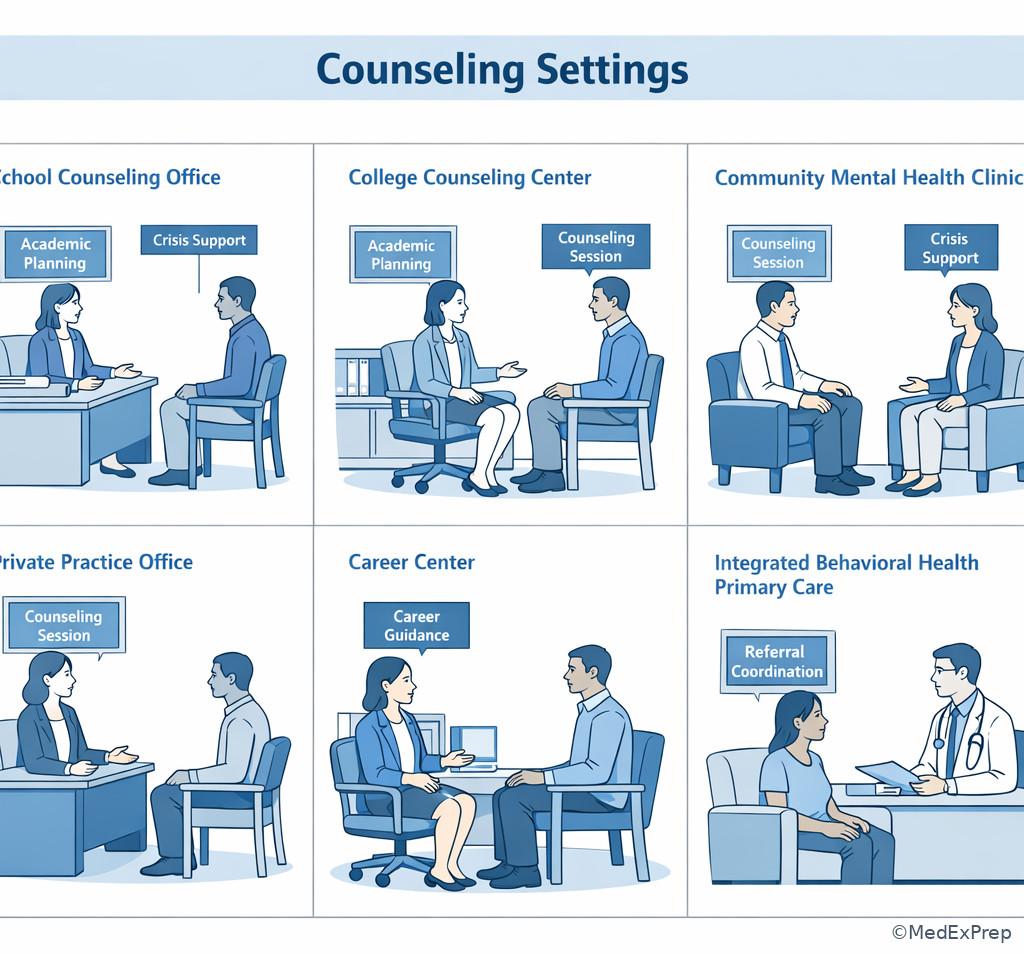
F --> G[Do not prescribe, rule legally, or perform medical procedures] Exam takeaway: Visualize how counseling roles shift by setting while core ethical duties remain constant.
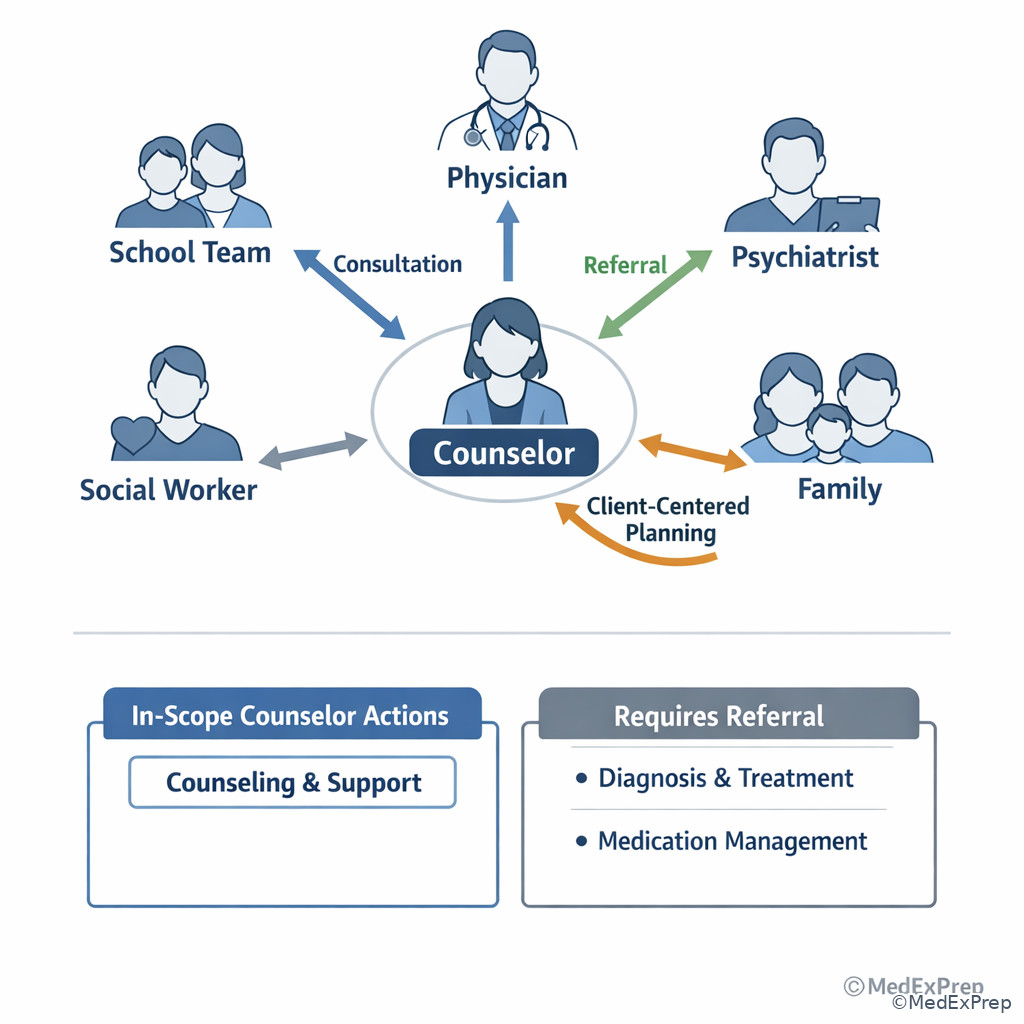
Exam takeaway: Counseling exam items often reward the option that coordinates care without leaving counselor scope.
Core content
1.1.1.3 Foundational roles: what counselors do across settings
A Explanation
The first decision conflict on NCE items is often simple but easy to miss: Is the question asking what counselors generally do, or what some other professional does? The rule that resolves this is to identify the core counselor function: facilitating growth, coping, decision-making, behavior change, wellness, and referral when needed. Across settings, counselors use helping skills, case conceptualization, goal setting, psychoeducation, crisis response within role, and coordination of care. They do not prescribe, perform medical procedures, or make legal determinations simply because a client problem is serious.
Setting changes emphasis. In school settings, counselors support academic, career, and social-emotional development within an educational system. In community or clinical settings, counselors often focus more on treatment planning, symptom-related functioning, case management, and referral. In college settings, developmental transition, identity, stress, relationships, and crisis support are common. In career settings, decision-making, interests, values, barriers, and work adjustment are central.
WHY THIS IS TESTED: Exam writers want to know whether you can choose the answer that fits both professional identity and setting realities, especially when a distractor sounds more decisive but belongs to a different role.
Key rule: When a stem asks for the most appropriate counselor action, choose the option that advances client welfare through counseling, assessment within scope, consultation, referral, or collaboration—not the option that assumes another profession’s authority.
B Worked example
A 15-year-old student with asthma and ADHD is referred to the school counselor after repeated absences, irritability, and declining grades. His mother recently lost her job. The teacher adds that the student “probably just needs medication adjusted,” and the student mentions wanting to quit school and get a job. The question asks for the most appropriate initial counselor response.
Identify the task: This is not asking for a medical or legal solution; it asks for the counselor’s initial role in a school setting.
Extract key facts: Adolescent; school setting; attendance, mood, and academic decline; family stressor; distracting clue is medication adjustment; tempting clue is immediate job focus.
Apply the rule: The school counselor should assess academic, social-emotional, and contextual factors; build rapport; clarify risk; coordinate supports; and refer if concerns exceed school counseling scope.
Eliminate distractors: Reject “advise medication changes” because that is outside counselor role. Reject “tell him to stay in school because graduation is important” because it is premature advice without assessment. Reject “determine whether he meets a medical diagnosis” because the item is about counselor action, not diagnostic authority.
Verify: The best answer is to begin with a counseling assessment of mood, functioning, attendance barriers, and safety, then collaborate with caregivers and school supports as needed. See Fig 1.
C Exam trap
Common wrong answer: “Recommend that the student’s physician adjust medication.”
Why it is tempting: ADHD and irritability make medication sound relevant, and exams often include a medical clue to pull you away from the counselor’s actual role.
Single clue that eliminates it: The item asks for the initial counselor response in a school setting, so assessment, support, and coordination come before any out-of-role medical recommendation.
D Checkpoint
Question: A client in a college counseling center reports homesickness, panic before exams, and conflict with roommates after moving away from home for the first time. Which response is the most appropriate counselor role?
- A. Prescribe a short-term anxiolytic to reduce panic symptoms.
- B. Provide developmental counseling, assess risk and functioning, and refer if symptoms exceed campus resources.
- C. Determine whether the student meets legal disability criteria for housing reassignment.
- D. Advise immediate withdrawal from the semester to prevent academic failure.
Answer: B
- A: Tempting because panic symptoms may need treatment, but prescribing is outside counselor role.
- B: Correct because it matches the developmental and counseling function of a college setting while preserving referral when indicated.
- C: Tempting because disability support may matter, but determining legal status is not the counselor’s primary role in this item.
- D: Tempting because it sounds protective, but it is premature and bypasses assessment and collaborative problem-solving.
1.1.1.4 Matching counselor role to setting and population
A Explanation
The next common decision conflict is: Several answers are in scope, but which one best fits this setting? The single resolving rule is to ask, Who is the primary client and what is the mission of the setting? A school counselor works within an educational mission and often serves students in a systemic environment involving teachers, caregivers, and school data. A community mental health counselor may work with broader psychosocial impairment, resource barriers, crisis follow-up, and community referrals. A college counselor often focuses on developmental transition, identity, adjustment, and crisis triage. A career counselor emphasizes vocational development, work values, interests, aptitudes, and decision barriers.
This does not mean the same client concern belongs to only one setting. Anxiety may present in school, college, agency, or private practice. The testable distinction is not the symptom itself but how the counselor appropriately responds within the setting’s purpose and resources. School counseling leans toward academic, career, and social-emotional student success. Career counseling does not become psychotherapy just because work stress is emotional; it still centers on career development unless a referral is indicated. Community settings often include more case management and systems navigation than a narrowly defined private practice role.
WHY THIS IS TESTED: NCE distractors often pair a real counseling skill with the wrong setting emphasis. The best answer is the one that fits both client need and institutional mission.
Recall: This is the first topic in the course, so build a habit now: identify setting mission before choosing the best next response. In the upcoming topic on Scope of Practice Boundaries, you will refine this by learning when even an in-scope action must be rejected because it exceeds competence.
B Worked example
A 37-year-old client with hypertension and recent divorce seeks help at a workforce development center after being laid off. She reports hopelessness about work, shame about needing family support, and trouble choosing between retraining and returning to a prior field. She casually mentions “sometimes I don’t even get out of bed,” but denies suicidal intent when asked. The stem asks for the most appropriate primary counselor focus.
Identify the task: Choose the best role within a career-oriented setting.
Extract key facts: Workforce center; job loss; decision paralysis; mood symptoms present but no current suicidal intent; distracting medical condition is hypertension; tempting wrong answer is full psychotherapy focus.
Apply the rule: In a career counseling context, the counselor’s primary focus is career decision-making, barriers, values, interests, and action planning while also screening for risk and referring for additional mental health treatment if needed.
Eliminate distractors: Reject a purely psychodynamic exploration of childhood unless the item specifically shifts to long-term therapy. Reject “ignore mood and only administer aptitude testing” because the client’s functioning and distress matter. Reject “tell her exactly which career to choose” because counselors facilitate decision-making rather than dictate choices.
Verify: The best answer integrates career counseling tasks with appropriate mental health screening and referral awareness, not all-or-none thinking. See Fig 2.
C Exam trap
Common wrong answer: “Provide long-term treatment for major mood symptoms as the sole focus in the career center.”
Why it is tempting: The client sounds distressed, and test takers may overcorrect toward the most emotionally intense detail.
Single clue that eliminates it: The stem places the counselor in a workforce development setting, so career barriers and decision support remain the primary role unless risk or severity requires referral.
D Checkpoint
Question: A middle school counselor is asked to spend the year providing weekly long-term therapy to one student with chronic family conflict. Which response best reflects the counselor’s role?
- A. Accept because individual treatment of one student is the central mission of school counseling.
- B. Decline all student counseling because therapy belongs only in community agencies.
- C. Provide appropriate school-based counseling support and coordinate referral if the student needs services beyond the school role.
- D. Transfer the case immediately to a teacher because classroom staff know the student best.
Answer: C
- A: Tempting because school counselors do counsel students, but the item asks about role fit, and exclusive long-term treatment is usually too narrow for the school mission.
- B: Tempting because it protects scope, but it is too rigid; school counselors do provide direct counseling services.
- C: Correct because it balances direct school-based support with referral when needs exceed the setting’s function or resources.
- D: Tempting because teachers are involved stakeholders, but counseling responsibility cannot simply be delegated to non-counseling staff.
- The key question when choosing among settings is: What is the mission of the setting?
- True or False: The same client symptom always leads to the same counselor role regardless of setting. False.
- Name 3 common settings for counselors: school, community/agency, college, career, private practice.
Exam takeaway: When multiple settings seem possible, choose the one whose mission most directly matches the presenting need and required level of support.
flowchart TD
A[Presenting concern] --> B{Main functional domain}
B -->|Academic/social-emotional in K-12| C[School counseling]
B -->|College adjustment/identity/crisis| D[College counseling]
B -->|Career indecision/work transition| E[Career counseling]
B -->|Persistent symptoms/psychosocial impairment| F[Community mental health]
F --> G{Risk or specialized need?}
G -->|Yes| H[Refer/collaborate with specialized or emergency services]
G -->|No| I[Provide counseling within competence] Exam takeaway: Compare the mission, stakeholders, and typical counselor tasks for the most tested settings.
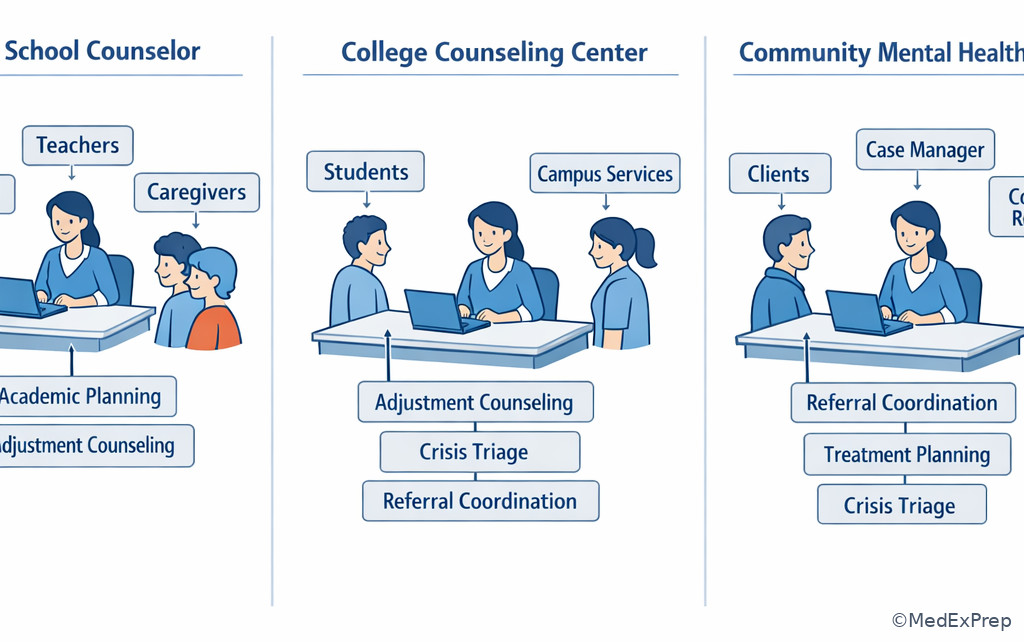
Memory anchor: S-M-A-R-T settings = School for student success, Mental health agency for broader treatment needs, Academic campus for adjustment, Roles vary by mission, Triage and refer when needs exceed the setting.
1.1.1.5 Role boundaries: choose counselor action versus reject out-of-role action
A Explanation
This is the highest-yield foundational rule in the lesson: Even when a client need is real, the counselor does not solve it by stepping outside role. On NCE items, wrong answers often sound more active, more expert, or more immediately decisive. The test is whether you can reject those answers. Out-of-role actions include prescribing medication, performing medical procedures, making legal rulings, offering forensic conclusions without proper role and data, or independently handling specialized issues without consultation or referral.
The resolving rule is: Assess what is happening, intervene within counselor competence, refer or collaborate for what lies beyond counselor scope, and document. This does not mean “do nothing.” It means do the counselor’s job well. If a client shows possible psychosis, the counselor can assess safety, orient to reality-based support, consult, refer for psychiatric evaluation, and coordinate care. If a client reports abuse, the counselor addresses protection and reporting obligations according to broadly accepted principles and local requirements as applicable. If a client wants medication advice, the counselor can explore concerns and refer to a qualified prescriber.
WHY THIS IS TESTED: Board-style stems frequently include a correct action by the wrong provider. The right answer often preserves counselor responsibility without claiming another profession’s authority.
Key rule: “Helpful” is not enough. The answer must be helpful and within counselor role.
High-Yield Connection: This concept is tested alongside the upcoming topics Credentialing, Licensure, and Certification and Scope of Practice Boundaries. Know both the professional identity piece here and the formal boundary/referral rules there—they are frequently paired in ethics stems.
B Worked example
A 29-year-old community agency client with diabetes and recent job loss says, “My antidepressant makes me feel numb, so I stopped taking it yesterday.” He has insomnia and low appetite but denies suicidal intent. The case manager is out sick. A distractor in the stem mentions that the client “read online that a natural supplement might work faster.” The question asks for the most appropriate counselor response.
Identify the task: Choose a counselor response to a medication-related disclosure.
Extract key facts: Medication concern; client stopped on own; no acute suicidality reported; agency setting; tempting clue is alternative supplement advice.
Apply the rule: The counselor should explore the client’s experience, assess safety and symptom change, encourage communication with the prescribing provider, and coordinate referral or consultation.
Eliminate distractors: Reject “advise restarting at half-dose” because that is prescribing guidance. Reject “approve the supplement” because it still exceeds role and may be unsafe. Reject “ignore the medication issue and continue counseling as planned” because the disclosure affects care and risk.
Verify: The best answer is to respond within scope: assess, support, refer/collaborate, and document. See Fig 2.
C Exam trap
Common wrong answer: “Recommend that the client restart the medication at a lower dose and monitor symptoms.”
Why it is tempting: It sounds practical and client-centered, especially when the client reports a side effect.
Single clue that eliminates it: Adjusting or advising medication use is outside counselor scope; the counselor’s task is referral/collaboration with the prescriber, plus risk assessment and documentation.
D Checkpoint
Question: During career counseling, a client says, “I need someone to tell the court my ex is unfit so I can get full custody and move for a new job.” What is the best next counselor response?
- A. Provide the requested custody recommendation because it would help the client’s career transition.
- B. Explain role limits, maintain counseling focus, and discuss referral to an appropriate legal resource if needed.
- C. Contact the court directly to clarify the client’s legal options.
- D. End counseling immediately because legal matters are never relevant to counseling.
Answer: B
- A: Tempting because it appears supportive, but forensic or legal conclusions exceed the counselor role in this scenario.
- B: Correct because it addresses the request ethically, sets boundaries, and redirects to appropriate referral.
- C: Tempting because it sounds collaborative, but the stem does not support direct legal action by the counselor.
- D: Tempting because it protects boundaries, but it is overly rigid and abandons the counseling relationship.
1.1.1.6 Collaboration, consultation, and referral across settings
A Explanation
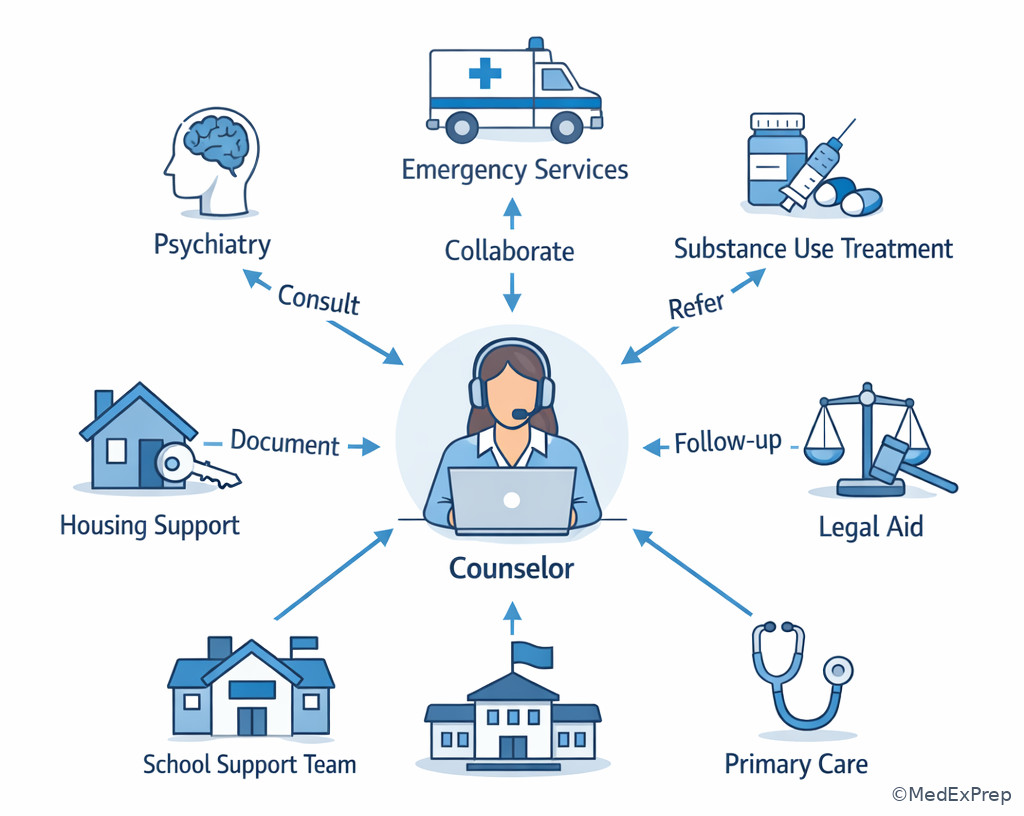
A frequent integration problem on the NCE is not whether to help, but how to help when the counselor cannot do it alone. The resolving rule is to choose the least restrictive action that still protects client welfare: consult when you need guidance, collaborate when coordinated care improves outcomes, and refer when the need exceeds your competence or setting capacity. In practice, these often overlap.
Consultation is inward or peer-directed: discussing a case with a supervisor, experienced colleague, or team member to improve decision-making. Collaboration is shared care: working with teachers, advisors, physicians, case managers, disability support staff, or family systems as ethically appropriate. Referral is transfer or addition of services: psychiatric evaluation, specialized substance treatment, trauma specialty care, legal aid, housing support, or emergency services. The best answer depends on severity, urgency, and fit. Mild career indecision may not require outside referral. Active suicidal intent requires immediate protective action and possibly emergency referral. Persistent panic in a college student might warrant counseling plus medical evaluation only if symptoms or impairment justify it.
WHY THIS IS TESTED: Exam questions often present an attractive false choice between “handle it yourself” and “send the client away.” Strong answers preserve counselor involvement while bringing in the right level of support.
High-Yield Connection: This concept overlaps with later lessons on Referral and Collaborative Care, Suicide Risk Response Principles, and Documentation and Recordkeeping. Exams often combine the decision to refer with what to assess and document first.
B Worked example
A 20-year-old college student with a history of migraines and social anxiety presents to the campus counselor after a breakup, missed classes, and panic episodes in lecture halls. She denies suicidal intent, but reports drinking more on weekends and says she “might just drop out.” Her roommate wants updates about appointments. The stem asks for the most appropriate next step.
Identify the task: Select the best counselor action in a college setting with distress, impairment, and outside-party pressure.
Extract key facts: Campus setting; panic and academic impact; increased alcohol use; no active suicidality; roommate request is a distracting confidentiality issue; tempting wrong answer is either overreacting to hospitalization or underreacting by doing nothing beyond supportive listening.
Apply the rule: The counselor should continue assessment of functioning and risk, provide counseling support, consider collaboration or referral for additional care if symptoms impair functioning, and protect confidentiality unless an exception applies.
Eliminate distractors: Reject disclosing to the roommate without proper basis. Reject immediate emergency hospitalization absent supporting risk information. Reject “only give study tips” because the panic, alcohol increase, and dropout thoughts require broader clinical attention.
Verify: The best answer is counseling plus appropriate assessment and referral/collaboration based on severity, while maintaining boundaries. See Fig 3.
C Exam trap
Common wrong answer: “Update the roommate because she is concerned and involved in the student’s care.”
Why it is tempting: The roommate sounds supportive, and collaboration is often correct in other contexts.
Single clue that eliminates it: A worried roommate is not automatically entitled to confidential counseling information; collaboration must still respect confidentiality and role boundaries.
D Checkpoint
Question: A community counselor feels uncertain about a client whose trauma history, dissociation, and housing instability exceed the counselor’s experience. Which option is the best next step?
- A. Continue treatment alone to avoid harming rapport with referral discussions.
- B. Seek supervision or consultation, assess immediate needs, and arrange referral or collaborative services as indicated.
- C. Tell the client that no counseling can continue until all outside services are completed.
- D. Diagnose the client with a specialized trauma disorder and begin advanced treatment protocols immediately.
Answer: B
- A: Tempting because continuity matters, but competence concerns require support and possible referral.
- B: Correct because it balances client welfare, competence, and coordinated care.
- C: Tempting because it prioritizes services, but it is unnecessarily rigid and may disrupt needed support.
- D: Tempting because it sounds clinically thorough, but the stem specifically signals limits in experience and scope.
- Need guidance on a case → consultation.
- Need shared coordinated care → collaboration.
- Need a service beyond your scope or setting → referral.
Exam takeaway: Distinguish getting help for your decision, sharing care with others, and connecting the client to services beyond your scope.
flowchart TD
A[Client need identified] --> B{Can counselor address it within competence and setting?}
B -->|Yes, but guidance helpful| C[Consult]
B -->|Yes, and other systems involved| D[Collaborate]
B -->|No| E[Refer]
C --> F[Retain role and document]
D --> F
E --> G[Support transition, document, follow up]
G --> H{Safety risk?}
H -->|Yes| I[Urgent protective action/emergency referral]
H -->|No| J[Routine referral pathway] Exam takeaway: Remember that referral usually adds or transfers care while the counselor still manages communication and continuity ethically.
1.1.1.7 Professional identity in practice: client welfare, access, and systems awareness
A Explanation
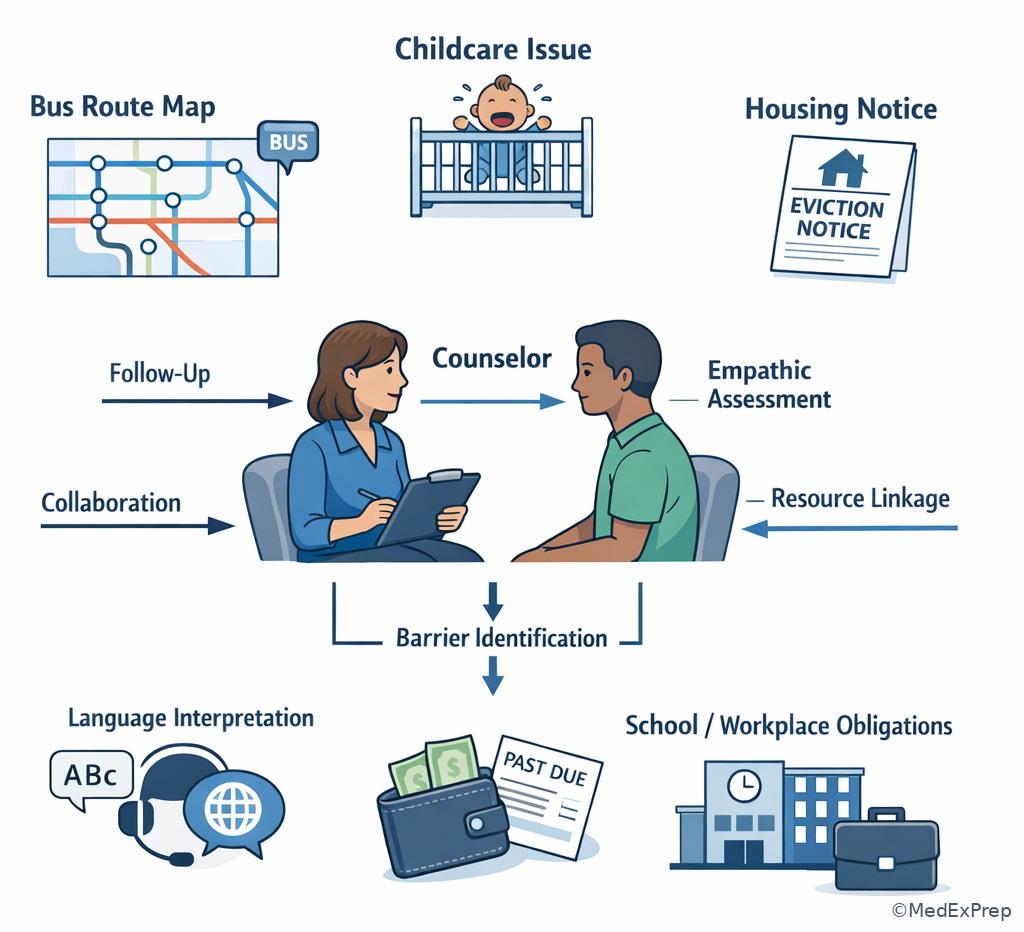
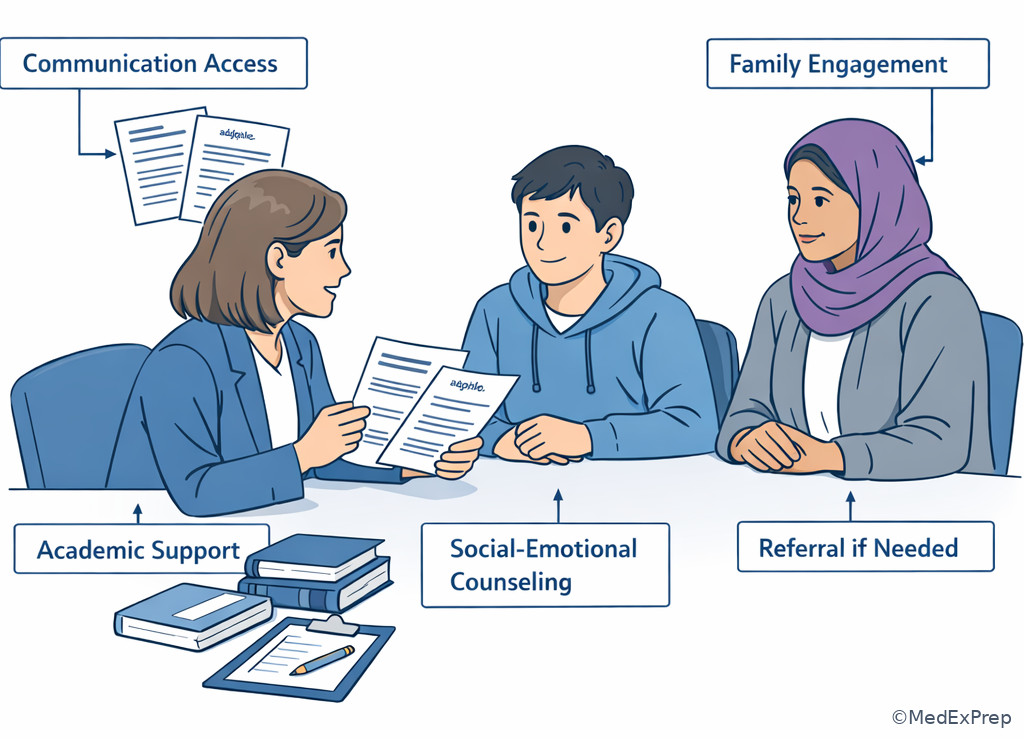
The most integrated version of this topic asks you to combine role, setting, culture, and systems. The decision conflict becomes: Should the counselor focus only on the individual problem, or also consider barriers in the environment? The best answer usually includes both. Professional counselor identity includes direct helping and advocacy-oriented systems awareness when barriers block access or functioning. In school counseling, that may mean coordinating supports for attendance or academic access. In community work, it may mean linking clients to transportation, housing, or community resources. In college settings, it may involve referral coordination for disability accommodations or campus supports. In career settings, it may include addressing structural barriers, discrimination, or access to training opportunities.
This is not a cue to become a policy maker in every question. It is a cue to notice when the barrier is not purely intrapsychic. If a client misses appointments because of childcare, language barriers, transportation, or housing instability, the strongest counselor response may include problem-solving and connection to supports alongside counseling. If a client’s distress is shaped by cultural context, identity, oppression, or institutional barriers, the best answer will not ignore those factors. At the same time, avoid stereotype-driven conclusions; stick to the information in the stem.
WHY THIS IS TESTED: NCE items increasingly reward context-sensitive judgment. The correct answer is often the one that preserves counseling identity while recognizing real-world barriers and culturally responsive care.
Recall: In the upcoming topic Credentialing, Licensure, and Certification, you will distinguish professional structures around the counselor role. Here, the emphasis is different: not “what title do I hold?” but “what function do I ethically perform in this setting right now?”
B Worked example
A 43-year-old single parent in a community agency presents with depressed mood after eviction risk, reduced work hours, and conflict with a teen child. She has well-controlled thyroid disease and says, “Maybe I’m just lazy.” She misses every other appointment because the bus route changed and childcare is inconsistent. The stem asks for the most appropriate counselor response.
Identify the task: Choose the best counselor action when both emotional and systems barriers are present.
Extract key facts: Depression symptoms; housing and work stress; attendance barriers; self-blame; distracting medical history is thyroid disease; tempting wrong answer is insight-only counseling without addressing access.
Apply the rule: The counselor should provide supportive counseling and case-focused problem-solving around practical barriers, while collaborating or referring for needed community resources.
Eliminate distractors: Reject “interpret the client’s missed sessions as resistance” because the stem provides transportation and childcare barriers. Reject “focus only on resource referral and postpone counseling” because emotional support remains needed. Reject “advise the client to take a second job immediately” because it is directive and ignores context.
Verify: The best answer integrates counseling with systems-aware support. See Fig 4.
C Exam trap
Common wrong answer: “Interpret inconsistent attendance as poor motivation and confront the client’s resistance.”
Why it is tempting: Some counseling theories discuss resistance, so this sounds clinically sophisticated.
Single clue that eliminates it: The stem clearly identifies transportation and childcare barriers, so a systems-aware counselor does not pathologize access problems.
D Checkpoint
Question: A school counselor notices that an English-learning student repeatedly misses morning advisory because the student interprets the schedule differently than staff expected and the family has not received translated communication. What is the best next response?
- A. Label the student as oppositional and recommend disciplinary consequences.
- B. Explore the communication barrier, coordinate culturally and linguistically appropriate support, and address the student’s school adjustment needs.
- C. Tell the family they must adapt immediately because school policy is the same for everyone.
- D. Refer the student for psychiatric medication evaluation due to repeated noncompliance.
Answer: B
- A: Tempting because repeated absence can look behavioral, but the stem points to a systems and language barrier.
- B: Correct because it integrates counseling role, cultural responsiveness, and school-based coordination.
- C: Tempting because consistency matters in schools, but it ignores access and culturally responsive practice.
- D: Tempting because nonattendance may be linked to distress, but the stem gives a much more direct explanation.
Exam takeaway: When the stem includes transportation, language, housing, or childcare barriers, integrate resource coordination with direct counseling.
Exam takeaway: The strongest answer addresses the client’s context without stereotyping and uses the school system to improve access.
Tables
| Setting | Primary mission | Common counselor tasks | Common exam clue |
|---|---|---|---|
| School counseling | Student academic, career, and social-emotional success | Short-term counseling, support planning, consultation with school stakeholders, referral | Grades, attendance, behavior, schedule, caregiver-school coordination |
| College counseling | Developmental adjustment and mental health support in campus context | Counseling, crisis triage, referral to campus/community services, student support coordination | Homesickness, identity, roommates, academic stress, campus resources |
| Community mental health | Accessible counseling and psychosocial support | Counseling, case conceptualization, referral, case management collaboration | Resource barriers, impairment, multiple stressors, agency team |
| Career counseling | Vocational development and work decision-making | Interest/value exploration, decision support, career planning, referral if mental health severity dominates | Layoff, indecision, retraining, job search, vocational fit |
| Private practice | Counseling services within counselor competence | Assessment, counseling, treatment planning, referral/collaboration as needed | Autonomy, outpatient therapy, boundaries, informed consent |
| Action | When to choose it | Why it is often confused | Discriminator |
|---|---|---|---|
| Consultation | You need professional guidance but remain involved | Looks like referral because another professional is involved | The counselor is asking for input, not transferring care |
| Collaboration | Client care improves through coordinated roles | Looks like consultation because multiple professionals communicate | The providers share ongoing involvement in care |
| Referral | Need exceeds counselor competence or setting capacity | Looks like abandonment when test takers overread the option | The service needed lies outside current role or resources |
| Direct counseling intervention | Need fits counselor role and competence | Looks too simple compared with dramatic distractors | The action is both therapeutic and in scope |
| If the stem says... | Think... | Reject... |
|---|---|---|
| “Most appropriate initial counselor response” | Assess, clarify, support, and orient to next steps | Premature advice or drastic action without assessment |
| “Within a school counseling setting” | Educational mission and student success | Exclusive long-term therapy as the only role |
| “Client asks about medication changes” | Explore concerns and refer/collaborate with prescriber | Any dosing or prescribing guidance |
| “Needs exceed counselor experience” | Consultation, supervision, referral | Acting alone to avoid discomfort |
| “Repeated no-shows due to bus/childcare/language” | Systems barriers and access planning | Pathologizing as resistance without evidence |
| “Court, custody, or legal opinion requested” | Role limits and appropriate referral | Providing legal or forensic conclusions |
Exam takeaway: Use setting mission as the fastest way to distinguish otherwise similar counselor responses.
flowchart LR
A[School] --- B[Academic/social-emotional/career student success]
C[College] --- D[Transition, identity, campus adjustment]
E[Agency] --- F[Mental health support plus resource linkage]
G[Career] --- H[Work decision-making and vocational development]
I[Private practice] --- J[Outpatient counseling within competence]
Exam Traps & Differentiators
- Most common wrong answer and why: Choosing the most authoritative-sounding option. NCE items reward the most appropriate counselor response, not the most powerful intervention by any professional.
- Looks similar but isn’t: Consultation versus referral. Consultation keeps the counselor engaged while seeking guidance; referral connects the client to services beyond current role or resources.
- Looks similar but isn’t: School counseling versus community mental health counseling. Both may address anxiety, but the school setting keeps the mission tied to student functioning and school systems.
- Looks similar but isn’t: Career counseling versus psychotherapy. Emotional distress may appear in both, but the primary task in career counseling remains vocational decision support unless the mental health need dominates and requires referral.
| Confusable pair | Why both seem plausible | Single clue that separates them |
|---|---|---|
| Assess first vs advise immediately | Both can sound helpful | If the item says initial response, assessment usually comes first |
| Counsel within setting vs refer out | Both protect client welfare | Severity, competence limits, and setting capacity determine the better choice |
| Collaboration vs confidentiality breach | Both involve others | Only ethical/authorized information-sharing is collaboration |
| Systems barrier vs client resistance | Missed appointments can fit either | Concrete access details favor systems explanation |
1.1.1.8 If the stem says ___, think ___
- If the stem says “best next counselor response”, think helping skill + scope fit + setting mission.
- If the stem says “the client asks what medication to take”, think explore concern and refer to prescriber.
- If the stem says “the counselor is unsure or inexperienced”, think consultation/supervision before overreaching.
- If the stem says “barriers include language, transportation, housing, or childcare”, think resource coordination, not resistance labeling.
- If the stem says “school setting”, think student success within an educational system.
- If the stem says “court, custody, legal determination”, think role limits and appropriate referral.
Common traps & distractors: The exam may pair this lesson with upcoming confusion points from Credentialing, Licensure, and Certification and Scope of Practice Boundaries. A title or credential does not automatically authorize every action in a stem; the setting, competence, and role still control what the counselor should do next.
Algorithm / Approach
Exam takeaway: Solve these stems in order: identify setting, define the counselor task, reject out-of-scope options, then choose consult/collaborate/refer only if needed.
Use this sequence on exam day: setting → task → scope → mission → escalation level. See Fig 6. This prevents two common errors: selecting an answer that is too broad for the setting or selecting one that exceeds counselor role.
Rapid Review
- School counseling → educational mission is the discriminator
- College counseling → developmental transition and campus context separate it from K-12
- Career counseling → vocational decision support, not “tell the client what job to choose”
- Community mental health → counseling plus resource linkage and system coordination
- Consultation → counselor seeks guidance but remains involved
- Collaboration → multiple helpers share ongoing care tasks
- Referral → chosen when need exceeds role, competence, or setting capacity
- Out-of-role option → reject if it requires prescribing, medical procedure, or legal ruling
- Initial response question → assessment beats premature advice
- Missed sessions with concrete barriers → think access problem before resistance
- Confidentiality pressure from roommate/teacher/family → concern alone does not equal access to information
- Best next counselor response → choose the action that is both helpful and authorized
Memory anchor: R-S-C-R-D for tough role questions: Role, Setting, Competence, Referral/consultation need, Document. If an answer skips the first three, it is often a trap.
Self-check quiz
1. A high school student asks the school counselor to help with declining grades, peer conflict, and uncertainty about future plans. Which option best reflects the most appropriate counselor role?
- A. Provide academic, career, and social-emotional counseling support within the school setting
- B. Prescribe medication for concentration problems during exams
- C. Rule on whether the student legally qualifies for special education
- D. Provide exclusive long-term psychiatric treatment as the school’s only service
2. A client in a career center reports frustration choosing between retraining programs after a layoff and asks the counselor, “Just tell me which field to enter.” Which is the best counselor response?
- A. Choose the highest-paying field for the client to reduce anxiety quickly
- B. Facilitate exploration of interests, values, barriers, and options to support informed career choice
- C. Contact employers directly and accept a position on the client’s behalf
- D. End counseling because career decisions are too practical for counseling work
3. A 19-year-old college student with asthma and recent breakup-related distress presents to the campus counselor after panic episodes and missed classes. She denies suicidal intent, reports increased weekend drinking, and says her roommate wants updates about treatment. Which is the most appropriate next step?
- A. Update the roommate because she is concerned and closely involved
- B. Continue assessment of risk and functioning, provide counseling support, and consider referral or collaboration based on severity
- C. Recommend a specific anti-anxiety medication to help her stay enrolled
- D. Require immediate withdrawal from the semester before any counseling can occur
4. A community agency counselor works with a 31-year-old client who has depression symptoms, transportation problems, and unstable childcare. The client has missed several appointments but remains engaged when present. Which interpretation is the most appropriate?
- A. The missed appointments primarily indicate unconscious resistance that should be confronted first
- B. The missed appointments suggest a systems barrier that should be addressed alongside counseling
- C. The missed appointments require immediate discharge from services for noncompliance
- D. The missed appointments mean counseling should stop until a psychiatrist evaluates the client
5. A school counselor is asked by a teacher to “handle everything” for a student with persistent trauma-related symptoms, frequent absences, and possible family instability. The counselor has limited trauma-specific training. What is the best next step?
- A. Begin advanced trauma treatment independently to avoid delaying care
- B. Provide school-based support, seek consultation or supervision, and coordinate referral for needs beyond the school setting
- C. Refuse any involvement because trauma cases do not belong in schools
- D. Ask the teacher to counsel the student daily because the teacher sees the student most often
6. A 42-year-old client in career counseling reports severe job stress, recent divorce, insomnia, and difficulty concentrating. She says, “Sometimes I wonder if everyone would be better off without me,” but denies plan or intent when asked and agrees to continue talking. Which is the best next counselor action?
- A. Ignore the statement because the client denied plan and the session is focused on career issues
- B. Continue risk assessment, address immediate safety, and determine whether referral or higher-level support is needed while maintaining counselor role
- C. Prescribe a sedative so the client can sleep before making career decisions
- D. Shift immediately into detailed job-interest testing and postpone discussion of safety to avoid reinforcing crisis language
7. A private practice counselor sees a 27-year-old client with panic symptoms who recently stopped prescribed medication due to side effects. The client has diabetes, reports online supplement use, and asks, “Should I restart at half-dose?” Which response is the most appropriate?
- A. Recommend the half-dose approach because it balances risk and benefit
- B. Encourage discussion with the prescribing provider, assess current symptoms and safety, and continue counseling within scope
- C. Advise replacing the medication with an over-the-counter supplement
- D. Decline to discuss the concern at all because medication is never relevant to counseling
8. A bilingual middle school student is repeatedly late to first period. Staff describe the student as oppositional. The school counselor learns that schedule instructions were not translated clearly for the family, the bus route changed, and the student has become embarrassed about asking for help. Which is the best interpretation and response?
- A. Treat the behavior primarily as defiance and recommend disciplinary action to improve compliance
- B. Recognize contextual and language-access barriers, support the student’s adjustment, and coordinate appropriate school-based assistance
- C. Refer immediately for medication evaluation because repeated lateness signals likely psychiatric disorder
- D. Tell the family that equal treatment requires the school to avoid any language accommodation
Answer key
1. Correct answer: A
- A: Tempting because it may seem broad, and it is correct because school counselors commonly address academic, career, and social-emotional needs within the educational setting. Single stem clue: high school student with grades, peers, and future plans points directly to school counseling mission.
- B: Tempting because concentration problems can invite medical thinking, but prescribing medication is outside counselor scope. Single stem clue: the question asks for counselor role, not medical treatment.
- C: Tempting because school personnel may be involved in educational planning, but legal determinations are not the primary counselor function in this item. Single stem clue: the presenting need is counseling support, not legal eligibility adjudication.
- D: Tempting because the student has multiple concerns, but exclusive long-term psychiatric treatment does not fit the school counseling role. Single stem clue: the setting is school, not an inpatient or psychiatric service.
2. Correct answer: B
- A: Tempting because clients often want certainty, but choosing the field for the client bypasses counseling process and autonomy. Single stem clue: the client asks for direction in a career center, where facilitation—not deciding for the client—is key.
- B: Tempting because it may feel less decisive, and it is correct because career counselors help clients explore interests, values, barriers, and options. Single stem clue: laid-off client seeking retraining decision support fits career counseling.
- C: Tempting because action sounds helpful, but accepting employment on the client’s behalf is outside the counselor’s role. Single stem clue: the task is counseling and decision support, not acting as an employment agent.
- D: Tempting because the problem is practical, but career counseling is a recognized counseling function. Single stem clue: the setting itself is a career center.
3. Correct answer: B
- A: Tempting because roommates can be important supports, but concern alone does not justify disclosure of confidential counseling information. Single stem clue: the roommate wants updates, not the client.
- B: Tempting because it seems less dramatic, and it is correct because the student has distress and impairment but no reported suicidal intent, so continued assessment, support, and possible referral fit best. Single stem clue: panic, missed classes, increased drinking, but denial of suicidal intent.
- C: Tempting because panic may call for medication from another provider, but recommending a specific medication exceeds counselor role. Single stem clue: the question asks for campus counselor next step.
- D: Tempting because missed classes raise academic concern, but mandatory withdrawal is premature and outside the supportive sequence indicated. Single stem clue: the client is still appropriate for counseling assessment and support.
4. Correct answer: B
- A: Tempting because missed sessions can resemble resistance, but this item gives concrete external barriers. Single stem clue: transportation and childcare are explicitly stated.
- B: Tempting because it expands the frame beyond symptoms, and it is correct because a systems-aware counselor addresses access barriers alongside treatment. Single stem clue: engagement remains present when the client attends.
- C: Tempting because attendance matters, but immediate discharge ignores contextual realities and client welfare. Single stem clue: the client remains engaged and barriers are identified.
- D: Tempting because depression may require broader care, but nothing in the stem says counseling must stop pending psychiatric evaluation. Single stem clue: the item focuses on interpretation of missed appointments, not medical instability.
5. Correct answer: B
- A: Tempting because it avoids delay, but the stem specifically signals limited trauma-specific training. Single stem clue: the counselor has limited experience.
- B: Tempting because it requires multiple steps, and it is correct because it balances school-based support with consultation and referral for needs beyond competence or setting. Single stem clue: persistent trauma symptoms plus limited training in a school setting.
- C: Tempting because it protects boundaries, but it is too absolute; school counselors still provide support. Single stem clue: the counselor can offer appropriate school-based services even if specialized referral is needed.
- D: Tempting because the teacher sees the student frequently, but counseling cannot be handed off to non-counseling staff as a substitute for professional care. Single stem clue: the task asks for the counselor’s next step.
6. Correct answer: B
- A: Tempting because the client denied plan or intent and the setting is career counseling, but the statement still requires more assessment. Single stem clue: “everyone would be better off without me” is a safety-relevant cue.
- B: Tempting because it seems more complex, and it is correct because counselors must assess safety further and determine the proper level of support while staying within role. Single stem clue: passive self-harm language plus ongoing engagement supports further assessment rather than dismissal.
- C: Tempting because insomnia is present, but prescribing is outside counselor scope. Single stem clue: the item asks for counselor action.
- D: Tempting because career testing fits the setting, but it ignores a more urgent safety-related disclosure. Single stem clue: the safety statement outranks the vocational task for sequencing.
7. Correct answer: B
- A: Tempting because it sounds like a balanced middle-ground recommendation, but dose advice still exceeds counselor role. Single stem clue: the client asks specifically about restarting medication at a dose.
- B: Tempting because it may appear less immediately useful, and it is correct because it addresses the concern, assesses safety, and directs medication decisions to the prescriber. Single stem clue: medication side effects with self-discontinuation require referral/collaboration, not silence.
- C: Tempting because the client already mentioned supplements, but recommending one is still outside scope and may be unsafe. Single stem clue: online supplement use is a distractor, not permission.
- D: Tempting because it protects scope, but counselors should still discuss concerns that affect treatment and risk. Single stem clue: the medication issue is directly relevant to counseling and client functioning.
8. Correct answer: B
- A: Tempting because repeated lateness can look oppositional, but the stem gives a more direct contextual explanation. Single stem clue: translation problems and bus route changes.
- B: Tempting because it broadens the lens, and it is correct because the counselor should address access barriers, student embarrassment, and school support needs. Single stem clue: the behavior is linked to language-access and systems issues.
- C: Tempting because school problems can accompany mental health concerns, but the stem does not support medication evaluation as the best first response. Single stem clue: practical barriers explain the lateness more directly.
- D: Tempting because schools value consistency, but equal treatment does not mean ignoring meaningful access barriers. Single stem clue: lack of clear translated instructions is central to the problem.
Keep going with the full NCE Prep Course (NCE)
You just studied the way members do, in the same lesson interface. Full access unlocks every lesson, the question bank and flashcards for a full year.
One payment · 1 year of access · No auto-renewal