1.1.1 - Scenario Phases And Tasks
Scenario Phases And Tasks
What you'll learn
- CSE DOMAIN: Scenario Phase - Task Recognition → Identify whether a simulation prompt is asking for data gathering, data interpretation, intervention, reassessment, or escalation.
- CSE DOMAIN: Clinical Decision-Making - Best Next Step Framing → Separate “collect more information” tasks from “act now” tasks without overtesting or delaying care.
- CSE DOMAIN: Patient Safety - Priority Sequencing → Rank airway, oxygenation, ventilation, monitoring, and scope-of-practice priorities during evolving scenarios.
- CSE DOMAIN: Data Gathering/Selection - Indicated Inputs → Choose only the data needed for the current phase rather than selecting every available option.
- CSE DOMAIN: Evaluation Of Response - Reassessment Loop → Recognize when the next phase is reassessment after a respiratory intervention.
- Domain: Scenario Phase → Subdomain/Objectives: task recognition, sequence awareness, action vs information gathering
- Domain: Clinical decision-making → Subdomain/Objectives: best next step selection, avoiding redundant or harmful choices
- Domain: Patient safety → Subdomain/Objectives: urgent deterioration recognition, scope-safe escalation
- Domain: Evaluation of response → Subdomain/Objectives: reassessment after therapy, identifying ineffective interventions
Why it matters
- The CSE does not reward “doing more”; it rewards choosing the single indicated action for the current phase.
- Many wrong answers are tempting because they are good respiratory actions at the wrong time.
- Most simulation failures come from phase errors: treating before assessment, escalating before basic correction, or failing to reassess after intervention.
- Task recognition is the foundation for the next two topics: deciding what data are relevant and then choosing the best next step.
Exam takeaway: First identify the phase of the scenario before selecting any data or treatment.
flowchart LR
A[New scenario information] --> B{What phase am I in?}
B --> C[Need more assessment data]
B --> D[Have enough data to act]
B --> E[After intervention: reassess]
B --> F[Outside RT scope or deterioration: escalate]
C --> G[Choose targeted data only]
D --> H[Choose best RT action]
H --> E
E --> I{Improved?}
I --> J[Continue and monitor]
I --> K[Modify therapy or escalate] Exam takeaway: Use bedside priorities—airway, oxygenation, ventilation, monitoring—to decide whether to gather data or intervene.
Key Terms & Must-Know Facts
1.1.1.1 Key terms
- Scenario phase: The current step in the simulation workflow.
- Task recognition: Determining what the item is really asking you to do.
- Data gathering: Selecting targeted assessment information before acting.
- Data interpretation: Using provided findings to determine significance.
- Best next step: The single most indicated action now.
- Immediate intervention: Action required before additional nonessential assessment.
- Reassessment: Objective check of response after therapy.
- Escalation: Notify, consult, or obtain orders when outside RT authority or when the patient worsens.
- Noise data: Details that do not change respiratory management.
- Indicated selection: Choice supported by the presented findings.
- Redundant action: Repeats information or therapy without changing management.
- Harmful delay: Spending time on extra data when the patient needs immediate support.
- RT scope: The respiratory therapist’s authorized clinical role within protocol and orders.
1.1.1.2 Must-know facts
- The first question is often not “What disease is this?” but “What phase am I in?”
- If airway or severe oxygenation/ventilation failure is present, stabilization outranks broad data gathering.
- If the scenario is missing a decision-critical fact, gather that fact only.
- After any therapy, the next appropriate phase is usually reassessment.
- A correct action can still be wrong if it is premature, redundant, or outside RT scope.
- Noise commonly appears as chronic comorbidities, old diagnoses, or irrelevant labs.
- The exam rewards choosing actions that are necessary, timely, and safe.
- If a decision exceeds RT authority, the safe answer is usually to notify or recommend to the provider, not to act independently.
| Scenario cue | Likely phase | What you should think |
|---|---|---|
| Minimal objective data provided | Data gathering | What missing finding would change management now? |
| ABG, vital signs, breath sounds, device already given | Interpretation/action | I probably have enough to choose the next RT step. |
| Therapy just started or changed | Reassessment | What should improve, and what do I monitor first? |
| Severe distress, absent airflow, unstable oxygenation | Immediate intervention | Stabilize first; do not delay for nonessential testing. |
| Decision requires provider authority | Escalation | Recommend, notify, or obtain orders. |
Core content
1.1.1.3 Foundational phase recognition: what kind of task is the scenario asking for?
A Explanation
CSE items are easiest when you stop reading them as fact-recall questions and start reading them as workflow questions. The central decision conflict is: Do I need more information, or do I already have enough to act? The single rule that resolves this is whether a missing piece of information would actually change the next respiratory care decision. If yes, gather that data. If no, act on the findings already provided. WHY THIS IS TESTED: candidates often choose a reasonable treatment before confirming that the scenario has reached the intervention phase.
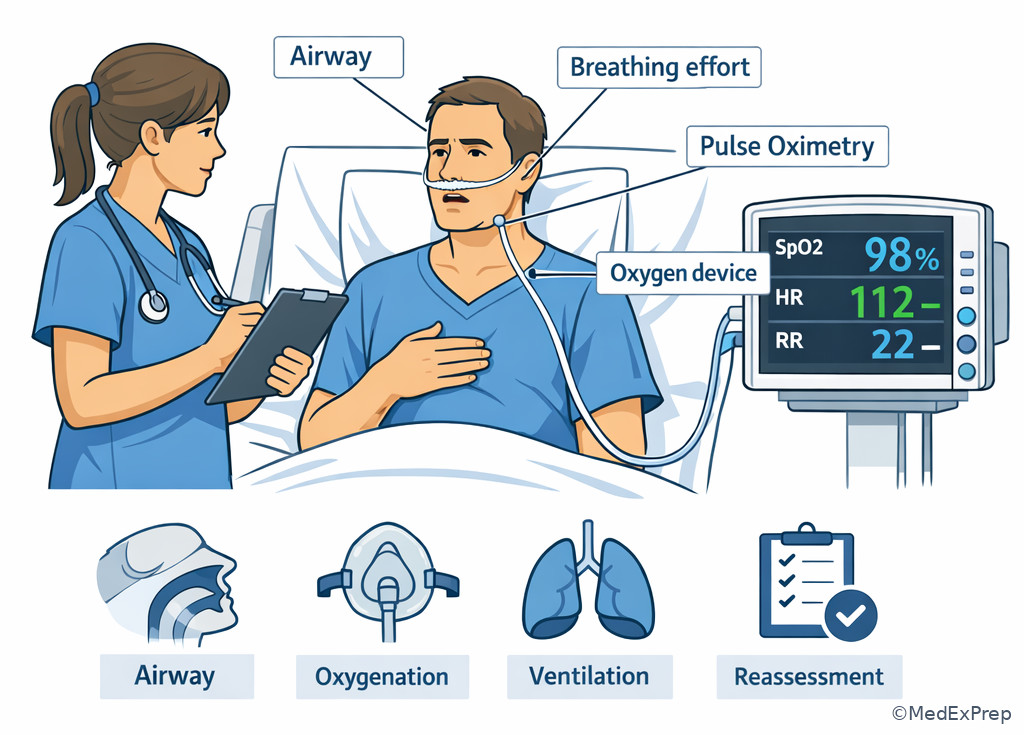
In practical terms, phase recognition usually falls into five buckets: data gathering, interpretation, intervention, reassessment, and escalation. An item that gives only a complaint and a few surface facts is often testing whether you know what to assess first. An item that already gives pulse oximetry, respiratory rate, work of breathing, breath sounds, and current oxygen device is often moving you to treatment selection. An item that says “after 20 minutes on therapy” is almost always a reassessment task. See Fig 1.
The exam wants a disciplined sequence: identify the task, collect only needed facts, choose the best RT-scope action, then reassess objectively. If you ignore the phase, you will overselect diagnostics, jump to invasive steps too early, or fail to monitor response.
B Worked example
A 68-year-old man with COPD, hypertension, and remote colon cancer resection presents to the ED with dyspnea. He is on 2 L/min nasal cannula at home. Current findings: respiratory rate 30/min, heart rate 118/min, accessory muscle use, diffuse expiratory wheezes, SpO2 84% on room air. His potassium is 3.4 mEq/L, and the chart mentions chronic low back pain. The stem asks for the most appropriate next step.
Reasoning chain: Identify task → this is not a diagnosis question and not yet a long reassessment phase. Extract key facts → hypoxemia and increased work of breathing are already documented. Apply rule → because immediate oxygenation support is needed, you do not delay with unnecessary tests first. Eliminate distractors → serum potassium and chronic back pain are noise here; a complete sputum workup may matter later, but not before correcting oxygenation. Verify → initiate indicated oxygen therapy and continue focused assessment.
The attractive wrong answer is “obtain extensive diagnostics before starting therapy” because COPD exacerbations often need more data. But the phase is immediate stabilization, not shotgun evaluation.
C Exam trap
D Checkpoint
Question: A 54-year-old woman with obesity, OSA, and community-acquired pneumonia is receiving 4 L/min nasal cannula. She remains tachypneic, with SpO2 86%, crackles, and increasing work of breathing. The stem asks for the most appropriate next step. Which task phase is most likely being tested?
- A. Data gathering only — Tempting because more information is always useful, but incorrect because the stem already provides enough to justify immediate oxygenation-focused action.
- B. Interpretation with intervention — Correct because objective signs show inadequate oxygenation and the candidate should act rather than collect broad extra data first.
- C. Long-term discharge planning — Tempting if you think ahead to chronic management, but wrong because the patient is in an acute bedside phase.
- D. Pure escalation outside RT scope — Tempting because worsening pneumonia may require physician management, but wrong as the first move because indicated RT support can still be initiated within scope.
1.1.1.4 The gather-or-act decision: when assessment must come first and when delay is harmful
A Explanation
The second foundational conflict is choose versus reject more data. On the CSE, not every missing fact needs to be filled in before treatment. The single rule is this: gather additional data first only if the patient is stable enough and the missing information would direct different respiratory actions. Reject extra assessment if the patient has clear immediate needs or if the additional test would not change the next step.
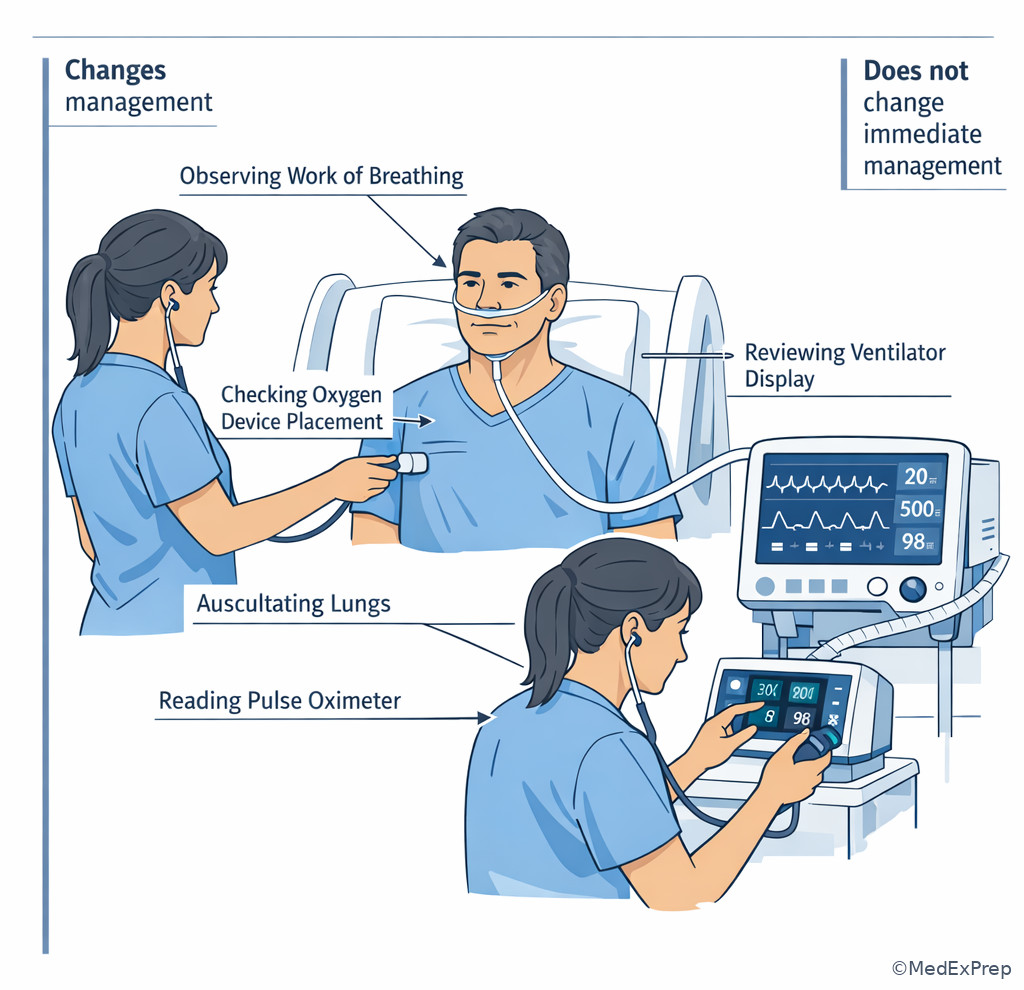
Examples of assessment-first situations include mild symptoms with incomplete context, uncertain secretion burden, unclear device performance, or a ventilated patient with a nonurgent alarm pattern that needs structured troubleshooting. Examples of action-first situations include obvious oxygenation failure, severe bronchospasm with distress, absent chest rise after airway placement concern, or a dislodged interface causing obvious therapy failure. See Fig 2.
This is where candidates often confuse thoroughness with accuracy. In simulation logic, broad assessment is not automatically better. A focused pulse oximetry check, work-of-breathing assessment, device inspection, or breath sound exam may be enough. A battery of ABGs, imaging, and cultures may be excessive if the immediate respiratory priority is not in doubt.
Exam takeaway: Choose assessment first only when the patient is stable and the missing fact changes management.
flowchart TD
A[Respiratory scenario] --> B{Immediate threat to airway, oxygenation, or ventilation?}
B -->|Yes| C[Act now with indicated RT support]
B -->|No| D{Is a key fact missing that changes therapy choice?}
D -->|Yes| E[Gather targeted data]
D -->|No| F[Proceed with best next step]
C --> G[Reassess response]
E --> F
F --> G Exam takeaway: The best assessment is the one that changes the next respiratory action, not the longest checklist.
B Worked example
A 6-year-old child with asthma and eczema presents with wheezing after exercise and viral symptoms. Respiratory rate is mildly increased, SpO2 94% on room air, the child is speaking in full sentences, and faint expiratory wheezes are present. The mother mentions a peanut allergy, and the child had a healed forearm fracture last year. The stem asks for the most indicated assessment or action.
Reasoning chain: Identify task → likely gather-or-act. Extract key facts → mild symptoms, preserved oxygenation, no severe distress. Apply rule → because the child is stable, a focused additional respiratory assessment such as peak expiratory flow when feasible or treatment response baseline may be appropriate before escalation. Eliminate distractors → immediate high-intensity escalation is tempting because asthma can worsen quickly, but current severity markers do not justify skipping the assessment phase. Verify → a targeted pre-treatment assessment is reasonable, followed by indicated bronchodilator therapy and reassessment.
C Exam trap
D Checkpoint
Question: A 72-year-old woman with CHF, CKD, and chronic atrial fibrillation has mild dyspnea on the floor. SpO2 is 92% on 2 L/min nasal cannula, respiratory rate 22/min, and breath sounds are diminished at the bases. The stem asks for the most indicated next selection. Which principle is best?
- A. Gather broad diagnostics before any bedside assessment — Tempting because comorbidities make the case complex, but wrong because bedside respiratory assessment is more efficient and immediately relevant.
- B. Act first with maximal oxygen escalation regardless of current status — Tempting because dyspnea feels urgent, but incorrect because the patient is not clearly in immediate respiratory failure.
- C. Choose the one missing bedside respiratory fact that would change management — Correct because stable presentations favor targeted assessment rather than shotgun testing or premature escalation.
- D. Notify the provider before any RT assessment — Tempting due to multiple medical conditions, but wrong because initial respiratory evaluation remains within RT scope.
- The missing fact should be gathered only if it will ______ management. Answer: change
- True or False: Unstable hypoxemia should usually be fully worked up before oxygen support. Answer: False
- Name the 3 words in the gather-or-act rule: Stable, missing, changes.
1.1.1.5 Application: mapping common simulation phases to common RT tasks
A Explanation
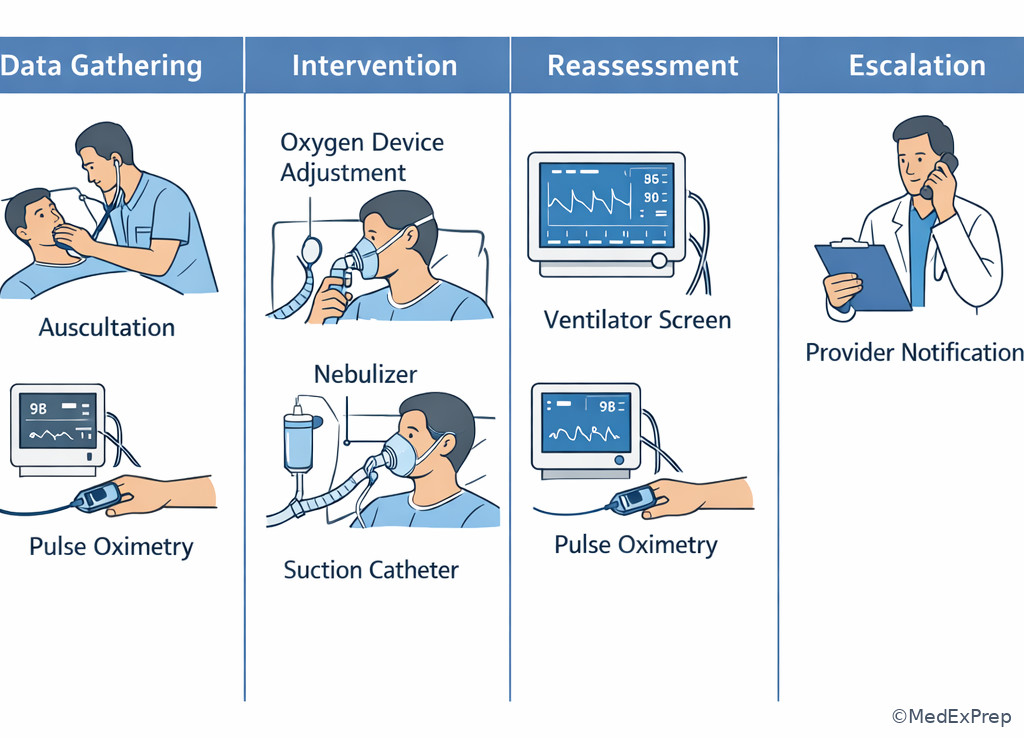
Once you recognize the phase in the abstract, the next skill is matching that phase to the kind of RT action the exam usually expects. The conflict here is choosing among several reasonable respiratory tasks. The single rule: choose the task that fits this phase, this urgency, and this scope. For example, data-gathering phases often call for assessing oxygen device function, breath sounds, work of breathing, ventilator parameters, sputum characteristics, or ABG need. Action phases often call for oxygen titration, aerosol delivery, suctioning, airway care, bronchial hygiene, noninvasive support, ventilator adjustment, or recommending escalation. Reassessment phases call for repeat SpO2, improved breath sounds, lower work of breathing, better ventilator synchrony, or ABG follow-up if clinically indicated.
The exam frequently places a correct RT intervention next to another correct RT intervention that belongs to a different phase. For instance, suctioning may be appropriate in a secretion-heavy intubated patient, but not before first confirming signs of retained secretions or airway obstruction. NIV may be appropriate in hypercapnic distress, but not if the patient is obtunded or unable to protect the airway. The phase determines what task is right now.
See Fig 3. In later course sections, each therapy family will get its own detailed decision rules. Here, focus on sequence logic.
Exam takeaway: Many answer choices are appropriate respiratory tasks, but only one matches the current scenario phase.
flowchart TB
A[Data gathering] --> A1[Assess work of breathing]
A --> A2[Check device/interface]
A --> A3[Review SpO2 or ABG need]
B[Action] --> B1[Initiate or titrate oxygen]
B --> B2[Give aerosol therapy]
B --> B3[Perform airway care]
C[Reassessment] --> C1[Check objective response]
C --> C2[Trend vitals and comfort]
C --> C3[Decide continue vs modify]
D[Escalation] --> D1[Notify provider]
D --> D2[Recommend higher support]
D --> D3[Call for urgent help if deteriorating]
Exam takeaway: Pair each phase with its typical task family to avoid choosing a good action at the wrong time.
B Worked example
A 59-year-old man is intubated after abdominal surgery and has COPD and diabetes. The ventilator high-pressure alarm sounds repeatedly. SpO2 is 95%, respiratory rate is set at 14/min, and coarse rhonchi are heard bilaterally. The nurse notes that urine output has also been low. The stem asks for the most appropriate next respiratory care action.
Reasoning chain: Identify task → action/troubleshooting phase. Extract key facts → high-pressure alarm, coarse rhonchi, intubated patient, oxygenation currently acceptable. Apply rule → the task family is airway/ventilator troubleshooting, not renal evaluation and not immediate ventilator mode overhaul. Eliminate distractors → low urine output is noise for the immediate respiratory task; changing every ventilator setting is premature without addressing likely secretion burden or tube issues. Verify → a focused airway assessment and indicated secretion management step fit the phase best.
C Exam trap
D Checkpoint
Question: A patient with acute asthma receives a bronchodilator treatment. Fifteen minutes later the stem asks for the most important information to obtain next. Which phase is being tested?
- A. Initial data gathering — Tempting because assessment is still occurring, but wrong because treatment has already been given.
- B. Reassessment — Correct because the question follows a respiratory intervention and is asking whether the patient improved.
- C. Long-term prevention counseling — Tempting because asthma education matters, but wrong in the immediate post-treatment window.
- D. Out-of-role medical diagnosis — Tempting if you start thinking about the full disease workup, but not the phase being tested.
1.1.1.6 Integration: reassessment, response checking, and moving to the next phase safely
A Explanation
Reassessment is not a courtesy step; it is its own high-value phase. The decision conflict is whether to continue the current plan, modify it, or escalate beyond it. The single resolving rule is objective response: if the measured respiratory problem improves, continue and monitor; if it does not improve or worsens, change course or escalate. WHY THIS IS TESTED: many candidates choose a correct intervention, then forget that the simulation immediately expects evaluation of its effect.
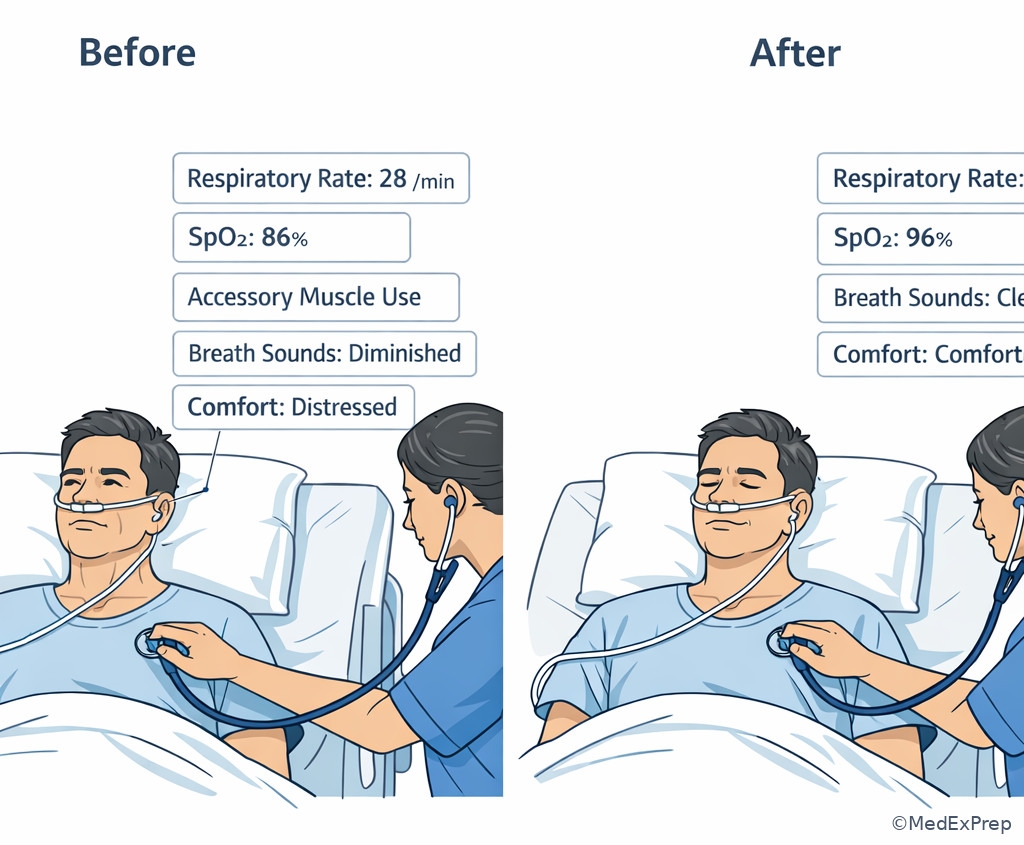
Good reassessment is specific to the problem you treated. If you treated hypoxemia, reassess oxygen saturation, device performance, and work of breathing. If you treated bronchospasm, reassess breath sounds, respiratory rate, dyspnea, and peak flow when appropriate. If you intervened for secretion retention, reassess aeration, secretion clearance, airway pressures, and breath sounds. If you adjusted ventilator support, reassess comfort, synchrony, exhaled volumes, gas exchange markers, and alarms. See Fig 4.
One subtle exam distinction: reassessment is not the same as repeating every earlier step. You recheck what is most likely to show response and what determines whether the therapy worked. Redundant repeat testing without decision value is a distractor.
Exam takeaway: After treatment, measure the targeted response and use it to decide continue, modify, or escalate.
flowchart LR
A[Intervention given] --> B[Check targeted response]
B --> C{Improved?}
C -->|Yes| D[Continue and monitor]
C -->|Partial| E[Adjust therapy]
C -->|No or worse| F[Escalate or notify provider]
D --> G[Document response]
E --> G
F --> G Exam takeaway: Reassessment should match the problem treated and rely on objective bedside changes.
B Worked example
A 44-year-old woman with obesity, anxiety, and postoperative atelectasis receives incentive spirometry coaching and an increase in mobilization efforts. Her initial SpO2 was 90% on room air. Twenty minutes later, the stem asks for the most important next evaluation. She also reports incision pain, and her sodium is 133 mEq/L.
Reasoning chain: Identify task → reassessment. Extract key facts → a lung-expansion intervention was just performed; the immediate issue is whether oxygenation and breathing pattern improved. Apply rule → reassess the targeted respiratory outcome rather than drifting toward unrelated electrolytes or broad diagnostics. Eliminate distractors → sodium and generalized anxiety do not answer whether the intervention worked. Verify → recheck SpO2, inspiratory effort, breath sounds, and work of breathing.
C Exam trap
D Checkpoint
Question: An intubated patient with retained secretions is suctioned. Breath sounds improve slightly, but the high-pressure alarm persists and SpO2 remains 88%. What is the best phase-based interpretation?
- A. Stay in the same plan indefinitely because one intervention was attempted — Tempting because some improvement occurred, but wrong because persistent hypoxemia requires further reassessment and likely next-step modification.
- B. The patient is in reassessment, and persistent problems may require a different action or escalation — Correct because response was incomplete and objective instability remains.
- C. Discharge planning is now appropriate — Tempting only if you ignore the immediate instability; clearly wrong for the current bedside context.
- D. No further respiratory monitoring is needed if suctioning was technically successful — Tempting because the procedure was done, but incorrect because the patient’s physiologic response remains inadequate.
- After oxygen therapy for hypoxemia, the first focused reassessment is usually ______. Answer: SpO2 and work of breathing
- True or False: Reassessment means repeating every previous diagnostic test. Answer: False
- Name 3 possible decisions after reassessment: Continue, modify, escalate.
1.1.1.7 Integration: scope-safe task selection and escalation triggers
A Explanation
The final integration step is recognizing when the right task is not an independent RT action but a scope-safe escalation. The decision conflict is choose-versus-reject independent action when the patient clearly needs something beyond RT authority. The single rule: if the needed next step requires provider-level authorization or exceeds standard RT practice, the correct CSE move is to notify, recommend, or obtain orders—not to act as the physician. WHY THIS IS TESTED: the exam deliberately includes attractive answers that solve the clinical problem but violate candidate role boundaries.
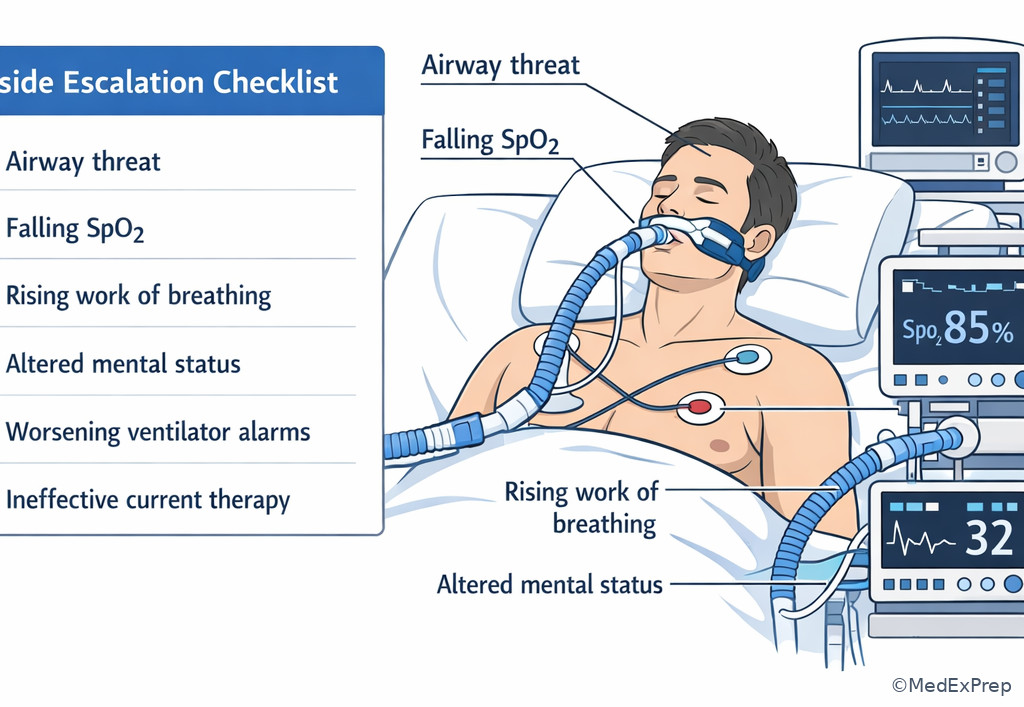
Examples include independently prescribing medications outside protocol, deciding invasive procedures reserved to others, or making definitive nonrespiratory treatment plans. Within RT scope, you can assess, initiate indicated respiratory care per orders/protocols, troubleshoot equipment, titrate oxygen when allowed, and recommend escalation. Outside scope, you notify the provider or rapid response team as appropriate. Severe deterioration, failure of current support, inability to maintain airway, or inability to correct oxygenation/ventilation with available RT measures should trigger escalation.
Local protocols vary; confirm with your institution. For exam purposes, the safe principle is consistent: do what RTs should do, then escalate when the next needed step belongs to someone else or when the patient is failing current support. See Fig 5.
Exam takeaway: When the next needed action exceeds RT authority or the patient fails current support, escalate rather than acting outside scope.
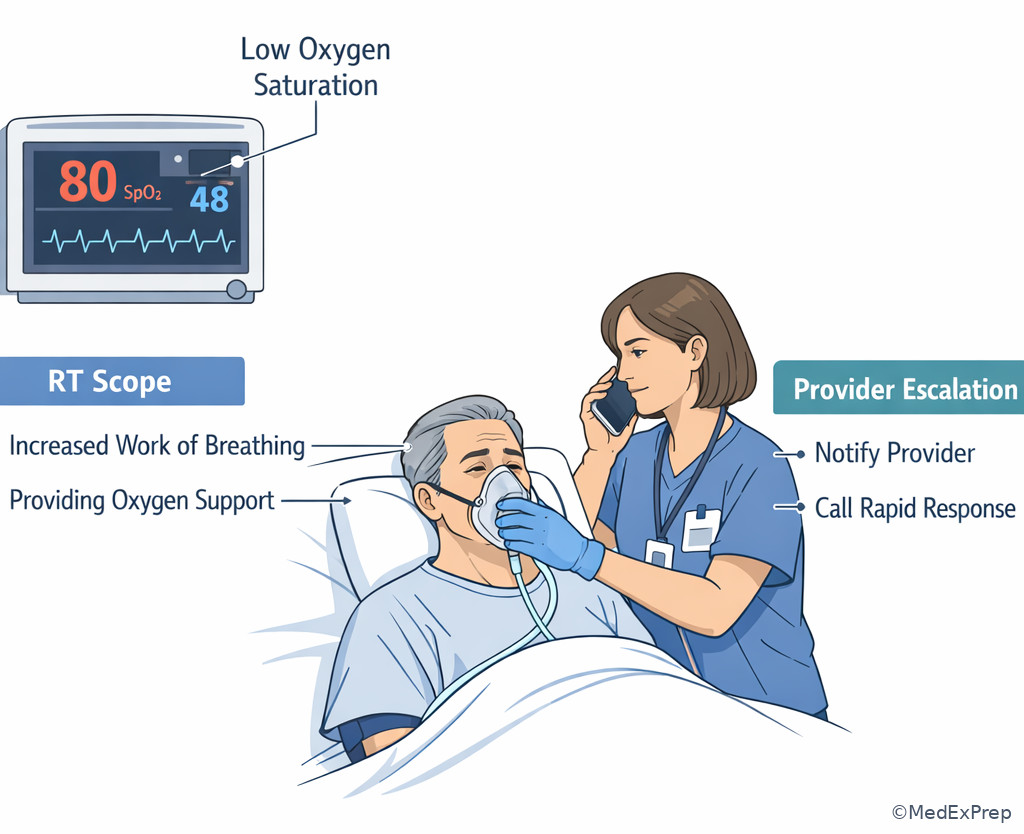
Exam takeaway: Rising distress, failing oxygenation, ineffective therapy, and airway threat are common cues to notify or escalate promptly.
B Worked example
A 73-year-old woman with severe COPD, CHF, and dementia becomes progressively somnolent on BiPAP. Respiratory rate falls from 28/min to 10/min, SpO2 is 89% despite increasing support, and she cannot cooperate with the mask. The stem mentions chronic anemia and a remote hip fracture and asks for the most appropriate next step.
Reasoning chain: Identify task → escalation decision. Extract key facts → failing noninvasive support, declining mental status, poor mask tolerance, worsening respiratory adequacy. Apply rule → the need now may exceed routine RT bedside management alone, so provider notification and escalation for advanced airway consideration are indicated; the RT continues supportive measures within scope. Eliminate distractors → simply tightening the mask or repeating routine education is tempting because NIV problems often involve interface issues, but the key clue is somnolence with falling respiratory effort. Verify → support, monitor, and escalate promptly.
C Exam trap
D Checkpoint
Question: A patient on a general care floor becomes cyanotic with absent breath sounds over the tracheostomy after copious secretions were noted earlier. The RT cannot restore airflow with initial bedside measures. Which answer best reflects the correct task selection?
- A. Continue routine reassessment without notifying anyone — Tempting because reassessment is often appropriate, but wrong because the patient is in acute airway danger.
- B. Independently perform any invasive rescue procedure regardless of scope — Tempting because the situation is urgent, but wrong if the action exceeds standard RT authority.
- C. Provide indicated in-scope airway support and urgently escalate — Correct because airway threat plus failure of initial measures requires immediate escalation while continuing RT support.
- D. Delay action until all prior chart data are reviewed — Tempting if you fear missing context, but incorrect because airway compromise demands immediate bedside response.
Exam Traps & Differentiators
- Most common wrong answer and why: selecting “more data” when the patient already shows clear respiratory instability. It feels safe, but it delays indicated support.
- Second common wrong answer: choosing a dramatic intervention too early in a stable patient with incomplete targeted assessment. It feels decisive, but it ignores the assessment-first phase.
- Third common wrong answer: forgetting reassessment after an intervention. It feels like the problem was addressed, but the exam wants proof of response.
- Fourth common wrong answer: acting outside RT scope rather than notifying or recommending. It feels clinically aggressive, but it violates candidate role logic.
| Looks similar | But is different because... | Think instead |
|---|---|---|
| Need more data | Patient already has severe hypoxemia/distress | Immediate support first |
| Need more treatment | Therapy was just given and response is unknown | Reassess first |
| Need provider action | There is still an indicated in-scope RT step available | Do the RT step, then reassess |
| Need RT action | Next necessary move exceeds RT authority | Notify/recommend/escalate |
| Need every test | Only one bedside finding actually changes management | Select targeted data only |
If the stem says “after treatment,” think reassessment.
If the stem says “most indicated assessment” with limited severity, think targeted data gathering, not broad testing.
If the stem says “increasing distress, falling oxygenation, current therapy ineffective,” think modify support or escalate.
If the stem says “requires physician order” or implies a provider-only action, think notify/recommend rather than independently perform.
If the stem says “obvious device problem” or “interface displaced,” think basic bedside correction before advanced diagnostics.
If the stem says “stable patient, incomplete context,” think one missing fact that changes management.
| Trap answer | Why it is tempting | Single clue that rejects it |
|---|---|---|
| Order many tests first | Thoroughness feels safe | Immediate oxygenation/ventilation threat already documented |
| Escalate to maximal therapy immediately | Candidate fears missing deterioration | Patient is stable and key severity data are still missing |
| Repeat another treatment right away | Doing more feels active | First therapy has not yet been objectively reassessed |
| Take provider-only action | Would solve the clinical problem | Falls outside RT scope in the scenario |
| Ignore simple bedside cause | Advanced settings or tests seem more sophisticated | Stem gives a straightforward airway/device clue |
Algorithm / Approach
| Step | Main question | Wrong habit to avoid |
|---|---|---|
| 1. Identify task | What phase is this? | Jumping to diagnosis labels |
| 2. Check urgency | Is there immediate airway/oxygenation/ventilation danger? | Delaying support for nonessential data |
| 3. Gather targeted data | What missing fact changes management? | Shotgun testing |
| 4. Act in scope | What is the best RT step now? | Choosing provider-only actions |
| 5. Reassess | Did the target problem improve? | Skipping objective response checks |
| 6. Escalate | Is support failing or outside scope? | Persisting with ineffective care |
Rapid Review
- Task recognition → first discriminator is phase, not diagnosis label
- Data gathering → choose only findings that change the next respiratory action
- Immediate intervention → airway/oxygenation/ventilation threats override broad testing
- Stable patient → focused assessment often beats premature escalation
- Post-treatment prompt → usually signals reassessment, not new therapy
- Reassessment → monitor the same problem you treated
- Incomplete improvement → modify or escalate, do not passively continue
- Provider-only action → convert to notify/recommend/obtain orders
- Noise data → comorbidities matter only if they alter the current respiratory decision
- Alarm troubleshooting → bedside cause before major setting overhaul
- Good answer, wrong time → still incorrect on the CSE
- Broad testing → wrong if it does not narrow immediate management
- Scope safety → urgent support within scope plus escalation when needed
- Best next step → one indicated action, not a full management plan
Self-check quiz
1.1.1.8 Question 1
A 63-year-old man with COPD and hypertension presents with dyspnea. He is tachypneic with SpO2 83% on room air and visible accessory muscle use. The stem asks for the most appropriate next step. Which scenario phase is most likely being tested?
- A. Immediate intervention
- B. Discharge planning
- C. Long-term reassessment after stabilization
- D. Administrative chart review
1.1.1.9 Question 2
A 10-year-old child with mild asthma symptoms is speaking in full sentences, has SpO2 95% on room air, and faint wheezes. The stem asks for the most indicated assessment before escalating therapy. Which principle best applies?
- A. Gather only the missing data that would change management
- B. Order every available respiratory test immediately
- C. Skip assessment and assume severe deterioration
- D. Notify the provider before any RT evaluation
1.1.1.10 Question 3
A 58-year-old postoperative patient with obesity and OSA is started on oxygen for SpO2 88% on room air. Fifteen minutes later, the stem asks for the most important information to obtain next. She also reports incisional pain and has a glucose of 182 mg/dL. What is the best next phase-based action?
- A. Reassess oxygenation and work of breathing
- B. Obtain a full infectious workup immediately
- C. Discontinue oxygen because treatment has already been started
- D. Plan home oxygen needs for discharge
1.1.1.11 Question 4
A 66-year-old ventilated man with COPD, CAD, and thick secretions develops repeated high-pressure alarms. SpO2 is 94%, breath sounds reveal coarse rhonchi, and the chart also mentions chronic anemia. Which is the most appropriate next respiratory care action?
- A. Assess for airway secretion burden and address it
- B. Immediately overhaul all ventilator settings
- C. Focus first on the chronic anemia
- D. Ignore the alarm because oxygenation is acceptable
1.1.1.12 Question 5
A 71-year-old woman with CHF, CKD, and chronic atrial fibrillation has mild dyspnea on 2 L/min nasal cannula. SpO2 is 92%, respiratory rate 22/min, and there is no severe distress. Which selection best fits the scenario phase?
- A. Maximal oxygen escalation without further bedside assessment
- B. A targeted assessment that clarifies the immediate respiratory plan
- C. Provider-only treatment selected independently by the RT
- D. No further respiratory evaluation is needed
1.1.1.13 Question 6
A 73-year-old woman with severe COPD, CHF, and dementia is on BiPAP for acute ventilatory failure. Over 30 minutes she becomes increasingly somnolent, her respiratory rate falls from 28/min to 10/min, SpO2 is 89% despite support, and she repeatedly removes the mask. Her hemoglobin is 9.8 g/dL. What is the most appropriate next step?
- A. Continue routine NIV adjustments only
- B. Provide in-scope support and urgently escalate to the provider/team
- C. Delay action until a complete chart review is finished
- D. Independently initiate any provider-level advanced airway plan
1.1.1.14 Question 7
A 45-year-old man with pneumonia, diabetes, and obesity is on supplemental oxygen. He is tachypneic with SpO2 85%, but the stem also notes mild chronic back pain and a slightly low magnesium level. Which choice best demonstrates correct CSE task handling?
- A. Prioritize unrelated chronic details before bedside support
- B. Recognize the current phase as urgent intervention rather than broad data collection
- C. Assume the oxygen device is effective without reassessment
- D. Focus on discharge teaching because pneumonia is already diagnosed
1.1.1.15 Question 8
An intubated patient with copious secretions is suctioned after desaturation and high-pressure alarms. Breath sounds improve somewhat, but SpO2 remains 88% and the alarm continues. The patient has hypertension and a remote history of nephrolithiasis. Which is the best next step?
- A. Continue the same plan without further evaluation because partial improvement occurred
- B. Enter the reassessment phase and determine whether modification or escalation is needed
- C. Conclude the respiratory issue is resolved because secretions were removed
- D. Shift immediately to nonrespiratory chart concerns
Answer key
1.1.1.16 Question 1: A. Immediate intervention
A. Immediate intervention is tempting because the patient is clearly unstable, and it is correct because severe hypoxemia with visible work of breathing indicates the scenario has moved beyond routine data gathering. The single discriminating clue is SpO2 83% with accessory muscle use. This follows bedside respiratory prioritization supported in Egan’s and AARC guidance on urgent assessment and support.
B. Discharge planning is tempting only if the learner drifts into chronic disease management, but it is incorrect because the patient has an active acute respiratory problem requiring immediate attention. The discriminating clue is the current unstable physiology, not long-term planning.
C. Long-term reassessment after stabilization is tempting because reassessment is important in all respiratory care, but it is incorrect because no stabilizing intervention has yet occurred. The discriminating clue is the absence of a prior treatment step.
D. Administrative chart review is tempting if one mistakes completeness for priority, but it is incorrect because chart review does not address the urgent bedside problem. The discriminating clue is severe immediate oxygenation failure.
1.1.1.17 Question 2: A. Gather only the missing data that would change management
A. Gather only the missing data that would change management is tempting because it sounds modest, and it is correct because the child is stable enough for focused assessment before escalation. The single discriminating clue is speaking in full sentences with SpO2 95%, which argues against immediate high-intensity escalation. This matches targeted assessment principles in pediatric respiratory care references.
B. Order every available respiratory test immediately is tempting because asthma can worsen and broad information feels safe, but it is incorrect because blanket testing is not phase-appropriate in a stable mild presentation. The discriminating clue is the lack of severe distress.
C. Skip assessment and assume severe deterioration is tempting because wheezing can precede worsening, but it is incorrect because current severity markers do not support that assumption. The discriminating clue is preserved speech and oxygenation.
D. Notify the provider before any RT evaluation is tempting if one overestimates complexity, but it is incorrect because initial respiratory assessment is within RT scope. The discriminating clue is that no out-of-scope decision is yet required.
1.1.1.18 Question 3: A. Reassess oxygenation and work of breathing
A. Reassess oxygenation and work of breathing is tempting because it is simple, and it is correct because any question asked shortly after oxygen initiation is usually testing the reassessment phase. The single discriminating clue is fifteen minutes later after oxygen was started. This matches standard respiratory care workflow in Egan’s Fundamentals of Respiratory Care.
B. Obtain a full infectious workup immediately is tempting because postoperative hypoxemia may have multiple causes, but it is incorrect because the immediate question is whether the oxygen intervention improved the targeted problem. The discriminating clue is the post-treatment timing.
C. Discontinue oxygen because treatment has already been started is tempting only if one assumes any intervention should be brief, but it is incorrect because continuation depends on response data. The discriminating clue is that no improved oxygenation result is yet provided.
D. Plan home oxygen needs for discharge is tempting in chronic respiratory disease contexts, but it is incorrect because the patient remains in an acute postoperative monitoring phase. The discriminating clue is the immediate bedside timeline.
1.1.1.19 Question 4: A. Assess for airway secretion burden and address it
A. Assess for airway secretion burden and address it is tempting because the alarm and rhonchi point toward a bedside fix, and it is correct because coarse rhonchi with high-pressure alarms most directly suggests secretion-related resistance. The single discriminating clue is coarse rhonchi. This reflects ventilator troubleshooting logic described in critical care respiratory texts and AARC practice concepts.
B. Immediately overhaul all ventilator settings is tempting because alarm management often involves ventilator changes, but it is incorrect because the stem gives a more direct airway clue that should be addressed first. The discriminating clue is secretion evidence rather than gas exchange failure from a setting problem.
C. Focus first on the chronic anemia is tempting because anemia can affect oxygen delivery, but it is incorrect because it does not explain the acute high-pressure alarm pattern. The discriminating clue is the ventilator alarm plus rhonchi.
D. Ignore the alarm because oxygenation is acceptable is tempting because SpO2 is currently 94%, but it is incorrect because persistent alarms indicate unresolved mechanical or airway problems that can worsen quickly. The discriminating clue is the repeated alarm signal itself.
1.1.1.20 Question 5: B. A targeted assessment that clarifies the immediate respiratory plan
B. A targeted assessment that clarifies the immediate respiratory plan is tempting because the patient is symptomatic, and it is correct because mild dyspnea without severe instability favors focused bedside clarification rather than automatic escalation. The single discriminating clue is SpO2 92% on low-flow oxygen without severe distress. This fits the gather-first principle for stable patients.
A. Maximal oxygen escalation without further bedside assessment is tempting because dyspnea can deteriorate, but it is incorrect because current findings do not show immediate respiratory failure. The discriminating clue is the absence of marked instability.
C. Provider-only treatment selected independently by the RT is tempting because medical complexity feels beyond routine care, but it is incorrect because initial targeted respiratory assessment remains within RT scope. The discriminating clue is that no provider-only action has yet become necessary.
D. No further respiratory evaluation is needed is tempting if one overvalues the current oxygen saturation alone, but it is incorrect because the patient is symptomatic and still needs focused bedside assessment. The discriminating clue is ongoing dyspnea.
1.1.1.21 Question 6: B. Provide in-scope support and urgently escalate to the provider/team
B. Provide in-scope support and urgently escalate to the provider/team is tempting because the patient is worsening, and it is correct because NIV failure with somnolence, falling respiratory rate, poor tolerance, and persistent hypoxemia requires escalation while the RT continues supportive care within scope. The single discriminating clue is progressive somnolence with falling respiratory effort on BiPAP. This is consistent with NIV failure concepts in critical care practice guidance.
A. Continue routine NIV adjustments only is tempting because many NIV problems are interface or setting issues, but it is incorrect because the patient is showing failure markers beyond simple optimization. The discriminating clue is mental-status decline.
C. Delay action until a complete chart review is finished is tempting because comorbidities matter, but it is incorrect because deterioration is ongoing and urgent. The discriminating clue is current worsening gas exchange and cooperation failure.
D. Independently initiate any provider-level advanced airway plan is tempting because the patient may need invasive support, but it is incorrect because independent provider-level airway decision-making exceeds standard RT authority unless covered by specific protocol; on the exam, the safe action is escalation and recommendation. The discriminating clue is the scope boundary.
1.1.1.22 Question 7: B. Recognize the current phase as urgent intervention rather than broad data collection
B. Recognize the current phase as urgent intervention rather than broad data collection is tempting because the oxygen saturation is clearly low, and it is correct because tachypnea with SpO2 85% signals a current oxygenation problem that should not be delayed by irrelevant details. The single discriminating clue is SpO2 85% with tachypnea. This aligns with acute respiratory stabilization priorities in standard respiratory care texts.
A. Prioritize unrelated chronic details before bedside support is tempting because learners fear missing hidden contributors, but it is incorrect because chronic back pain and mildly low magnesium do not explain or direct the immediate respiratory response. The discriminating clue is that those details do not change the next respiratory action.
C. Assume the oxygen device is effective without reassessment is tempting if oxygen has already been applied, but it is incorrect because the stem is still describing active hypoxemia and urgency. The discriminating clue is persistently low SpO2.
D. Focus on discharge teaching because pneumonia is already diagnosed is tempting only if one forgets phase logic, but it is incorrect because bedside stabilization comes first. The discriminating clue is acute instability.
1.1.1.23 Question 8: B. Enter the reassessment phase and determine whether modification or escalation is needed
B. Enter the reassessment phase and determine whether modification or escalation is needed is tempting because there was partial improvement, and it is correct because persistent hypoxemia and ongoing alarm burden mean the first intervention was not fully successful. The single discriminating clue is SpO2 remains 88% and the high-pressure alarm continues. This reflects the continue-modify-escalate model after therapy.
A. Continue the same plan without further evaluation because partial improvement occurred is tempting because some secretion burden was relieved, but it is incorrect because the objective respiratory problem has not resolved. The discriminating clue is the remaining hypoxemia and alarm.
C. Conclude the respiratory issue is resolved because secretions were removed is tempting because suctioning addressed a likely cause, but it is incorrect because the patient’s measured response remains inadequate. The discriminating clue is the persistent abnormal physiology.
D. Shift immediately to nonrespiratory chart concerns is tempting if one is distracted by chronic history, but it is incorrect because the active respiratory issue is still present. The discriminating clue is the unresolved bedside instability.
Keep going with the full NBRC CSE Prep Course (CSE)
You just studied the way members do, in the same lesson interface. Full access unlocks every lesson, the question bank and flashcards for a full year.
One payment · 1 year of access · No auto-renewal