1.1.1 - Self-Assessment Purpose And Limits
Self-Assessment Purpose and Limits
What you'll learn
- ORIENTATION: Exam use -> Purpose recognition — identify what a self-assessment is designed to estimate and what it is not designed to prove.
- MULTISYSTEM: Test taking -> Diagnostic use of results — use performance data to guide study choices without overreading small differences.
- TASK: Clinical reasoning -> Error source identification — distinguish knowledge gaps from interpretation, pacing, or distractor errors.
- ORIENTATION: Exam use -> Limits and uncertainty — reject unsupported conclusions about exact score conversion, hidden weighting, or guaranteed readiness.
- MULTISYSTEM: Test taking -> Next-step planning — choose the safest follow-up action after a strong, weak, or mixed self-assessment result.
- ORIENTATION → Exam use → self-assessment purpose, scope, limits
- MULTISYSTEM → Test taking → diagnostic interpretation of performance patterns
- MULTISYSTEM → Clinical reasoning → identifying whether misses reflect knowledge vs process failures
- MULTISYSTEM → Laboratory and data interpretation → reading score/performance summaries cautiously
Why it matters
- A self-assessment is most useful when treated as a diagnostic snapshot, not a verdict on future performance.
- Many learners waste study time by reacting to the total score alone instead of the pattern of misses.
- NBME-style forms test reasoning under uncertainty; the value is not just the number, but the error signal it reveals.
- Misinterpreting limits leads to two common harms: false reassurance after one strong form, or unnecessary panic after one weak form.
Key Terms & Must-Know Facts
1.1.1.1 Key terms
- Self-assessment — a practice tool intended to estimate current performance and reveal weaknesses.
- Snapshot — a time-limited sample of performance, not a complete picture of readiness.
- Diagnostic use — using results to guide remediation rather than to seek certainty.
- Signal — a repeated, meaningful performance pattern.
- Noise — random variation from fatigue, form mix, pacing, or chance.
- Domain pattern — relative strengths and weaknesses across systems or task types.
- Single-best-answer reasoning — choosing the most supported option among plausible competitors.
- Calibration — matching confidence to actual performance.
- Overinterpretation — drawing conclusions the data cannot support.
- Form-dependent emphasis — topic emphasis may vary between self-assessments.
- Readiness estimate — an approximate indicator, not a guarantee.
- Error taxonomy — categorizing misses by mechanism: knowledge, interpretation, management logic, pacing, or distractor selection.
1.1.1.2 Must-know facts
- One form cannot fully represent all content you may see later.
- Small score differences are often less meaningful than repeated weak domains.
- A strong total score can still hide a dangerous blind spot in a high-yield system or reasoning task.
- A weak form does not prove inability; it often reveals what to fix next.
- Do not infer exact official blueprint weight, conversion formula, or pass probability from a self-assessment.
- Use results to prioritize, not to narrow study prematurely.
- The best follow-up question after a miss is “why did I miss it?” rather than “what was the number?”
- Repeated misses in the same mechanism or task are more actionable than isolated misses.
Exam takeaway: Use the form as a diagnostic signal for study planning, not as proof of exact readiness or future score.
flowchart TD
A[Take self-assessment] --> B[Get total score and item experience]
B --> C[Look for broad patterns]
C --> D[Strengths by system or task]
C --> E[Weaknesses by system or task]
D --> F[Maintain with mixed review]
E --> G[Target remediation]
B --> H[Do NOT infer exact official blueprint]
B --> I[Do NOT guarantee final exam outcome]
B --> J[Do NOT overread tiny differences]
Exam takeaway: Read the total result alongside domain bars and missed-question categories rather than in isolation.
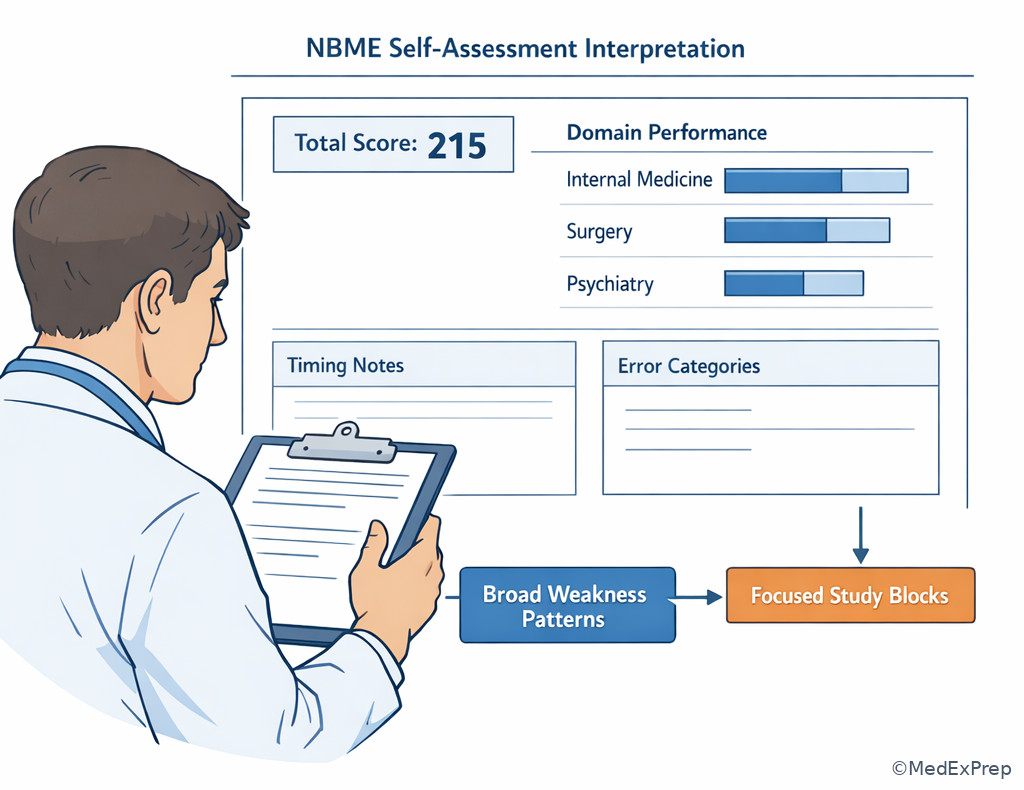
Core content
1.1.1.3 Foundational purpose: what the self-assessment is actually for
A Explanation
The first decision conflict is simple but heavily tested: Should you treat the self-assessment as a prediction tool or a diagnostic tool? For exam purposes, choose diagnostic tool. Reject “crystal ball” thinking. A self-assessment samples how you currently perform on a limited set of NBME-style items. That makes it useful for detecting patterns in reasoning, content gaps, and endurance, but not for proving exact future performance.
WHY THIS IS TESTED: learners routinely overgeneralize from one data point. NBME-style reasoning rewards disciplined interpretation under uncertainty. The tested pattern is recognizing that the purpose of a self-assessment is to guide next steps: what to review, what to maintain, and what not to conclude.
Choose “use it to map strengths and weaknesses” over “use it to declare yourself ready or not ready forever.” A strong result means your current study approach is producing many correct decisions under one set of sampled conditions. It does not mean every organ system, discipline, and task is equally secure. A weak result means your current approach is leaving points on the table. It does not mean you are incapable of improvement or that the form has exposed your permanent ceiling.
Key rule: Treat every self-assessment as a sampling instrument for current performance. Use it to identify study targets, not to claim exact prediction, hidden blueprint knowledge, or guaranteed outcome.
Because form emphasis varies, the safest interpretation is broad: it reflects performance across a subset of commonly tested knowledge and reasoning tasks. See Fig 1.
Clinician Action: Diagnose the result as a broad readiness snapshot, not a final verdict. Order a structured review of missed items by system and reasoning task. Treat with targeted study plus mixed review blocks. Refer/Escalate by seeking faculty or advisor input if repeated forms show persistent severe underperformance despite focused remediation.
B Worked example
A 25-year-old medical student with migraine history and recent sleep restriction completes an NBME self-assessment after two overnight call shifts. She has strong performance in cardiology and renal items but misses several endocrinology and biostatistics questions. She also notices that two stems she missed were on topics she “usually gets right.” Her friend says, “Your total number proves you’re definitely ready; stop reviewing weak areas.”
Identify the task: determine the most appropriate interpretation of the self-assessment’s purpose.
Extract key facts: one form, sleep deprivation, mixed domain performance, a few atypical misses, and some recurring weaknesses. Apply rule: a self-assessment is for diagnostic planning, not absolute proof. Eliminate distractors: reject “ignore weak areas because total score is okay”; reject “all misses are random because she was tired”; reject “two unusual misses cancel the repeated endocrine/biostatistics signal.” Verify: the correct use is to preserve strong systems, investigate whether timing/fatigue contributed, and target the recurring weak domains.
C Exam trap
Common wrong answer: “A strong total score means broad mastery, so domain-level review is low yield.”
Why it is tempting: learners naturally anchor on the biggest visible number and want emotional closure.
Single clue that eliminates it: the stem gives patterned weaknesses in specific domains or tasks; once a repeated pattern appears, the total score alone is insufficient.
D Checkpoint
Question: A trainee takes one NBME-style self-assessment and performs well overall but shows repeated misses in acid-base interpretation and biostatistics. Which interpretation is most appropriate?
- The total score overrides all domain patterns. Tempting because high overall performance feels reassuring, but wrong because repeated task-specific misses still require targeted review.
- The self-assessment should be used to identify broad strengths and repeated weaknesses for remediation. Tempting because it is less emotionally satisfying than a single verdict, but right because this matches the tool’s diagnostic purpose.
- The result proves the intended exam will emphasize acid-base and biostatistics. Tempting because recent experience feels predictive, but wrong because form emphasis may vary.
- The domain pattern is uninterpretable unless the official scoring formula is known. Tempting because uncertainty can make learners freeze, but wrong because broad study-planning signal is still usable without exact conversion details.
Answer: B
1.1.1.4 Core limits: what conclusions you must reject
A Explanation
The second foundational decision conflict is what can be inferred versus what must be rejected. The single finding that resolves it is whether the conclusion exceeds the data. If it does, reject it. You may conclude that your current preparation shows certain strong and weak patterns. You may not conclude an exact final score conversion, an official domain weighting, a guaranteed pass probability, or that one form fully sampled everything important.
WHY THIS IS TESTED: NBME-style items often present one legitimate inference surrounded by attractive but overconfident claims. The tested skill is respecting uncertainty while still acting on useful information.
Common unsupported conclusions include: “I improved by a few points, so I am definitely safe,” “this form proves biochemistry is low yield,” or “my exact readiness threshold is now known.” Those conclusions confuse precision with utility. The form is useful because it can change your behavior intelligently; it is not precise enough to justify grand claims from small differences or one administration.
Another limit is context. Fatigue, test-day conditions, timing decisions, recent study focus, and ordinary random variation influence performance. These factors do not make the form worthless; they simply mean you should combine scores with item review, trends, and repeated sampling.
Common pitfall: confusing a numerical result with a fully explained result. A number tells you where you landed on that form; it does not automatically explain whether misses came from content gaps, misreads, pacing, or fatigue.
See Fig 2 for a decision map that separates safe from unsafe conclusions.
Exam takeaway: Accept broad study-planning signals, but reject exact predictions, hidden blueprint claims, and guaranteed outcomes.
flowchart LR
A[One self-assessment result] --> B[Safe inferences]
A --> C[Unsafe inferences]
B --> B1[Current broad strengths]
B --> B2[Current broad weaknesses]
B --> B3[Need for targeted review]
B --> B4[Need for repeat sampling]
C --> C1[Exact final score prediction]
C --> C2[Guaranteed pass or fail]
C --> C3[Official hidden weighting]
C --> C4[Topic is low yield because it appeared less]
Recall: This is the first topic in the course, so there is no earlier lesson to build from. Keep this rule in mind because the next topic, Score Report Interpretation, will apply it directly to domain patterns and score-report caution.
Memory anchor: SAFE = Sample, Actionable patterns, Form-dependent emphasis, Exact prediction rejected. If your conclusion violates SAFE, it is too strong.
Clinician Action: Diagnose whether your interpretation stays within the data. Order review of the score report plus missed-item audit. Treat overconfidence or despair by replacing unsupported claims with specific remediation targets. Refer/Escalate if repeated poor results coexist with major timing, burnout, or exam-anxiety issues that require structured support.
B Worked example
A 28-year-old trainee with type 1 diabetes, chronic insomnia, and recent dedicated-study fatigue scores slightly higher on one self-assessment than on the previous form taken two weeks earlier. He concludes, “The upward change proves I will hit my target on the real exam, and I can stop reviewing microbiology because there were fewer such questions this time.” A mentor asks whether that conclusion is justified.
Identify task: determine which parts of the conclusion exceed the evidence. Extract key facts: small increase, only two forms, varying topic frequency. Apply rule: safe inference = broad trend plus next-step planning; unsafe inference = exact guarantee or blueprint assumption. Eliminate distractors: reject “all improvement is meaningless” because repeated trend can matter; reject “reduced microbiology count proves low yield” because form content varies. Verify: he may say his recent performance trend is improving, but he must continue broad review and avoid guarantee language.
C Exam trap
Common wrong answer: “Any numerical improvement between forms means the study plan is validated and can now narrow aggressively.”
Why it is tempting: upward movement feels objective and encourages premature closure.
Single clue that eliminates it: the stem emphasizes small change and different form content, so the safest interpretation is trend-aware but not overconfident.
D Checkpoint
Question: Which conclusion from a single NBME-style self-assessment is most defensible?
- The exact final exam score can be estimated precisely from this result alone. Tempting because learners want certainty, but wrong because a single sample cannot support exact prediction.
- The result suggests broad current strengths and weaknesses that should guide study priorities. Tempting because it is conservative, and right because it stays within the data.
- Topics with fewer questions on this form are officially low-weight topics. Tempting because visible frequency seems meaningful, but wrong because one form’s sampling does not reveal official weighting.
- If the result is strong, additional mixed review is unnecessary. Tempting because it reduces workload, but wrong because strong performance still requires maintenance and blind-spot detection.
Answer: B
- The most useful question after a self-assessment is not “What does this guarantee?” but “What pattern does this reveal?”
- True or False: A small score change between forms always proves real improvement. False.
- Name the 3 unsafe claims to reject: exact prediction, hidden official weighting, guaranteed outcome.
1.1.1.5 Application: extracting signal from score patterns and misses
A Explanation
Now move from definitions to use. The main decision conflict is signal versus noise. What should you act on, and what should you not overread? The single rule: act on repeated patterns that align across items, domains, or forms; be cautious with isolated anomalies.
WHY THIS IS TESTED: examinees often misclassify one odd miss as a crisis or ignore repeated misses that clearly identify a weak process. NBME-style reasoning prefers pattern recognition over reaction to single outliers.
A useful audit asks four questions for every miss: Was this a knowledge gap? A vignette interpretation error? A management-step confusion? Or a timing/distractor problem? These categories matter because the remedy differs. Knowledge gaps need content repair. Interpretation errors need stem parsing and illness-script practice. Management-step confusion needs algorithm review. Timing and distractor issues need process training.
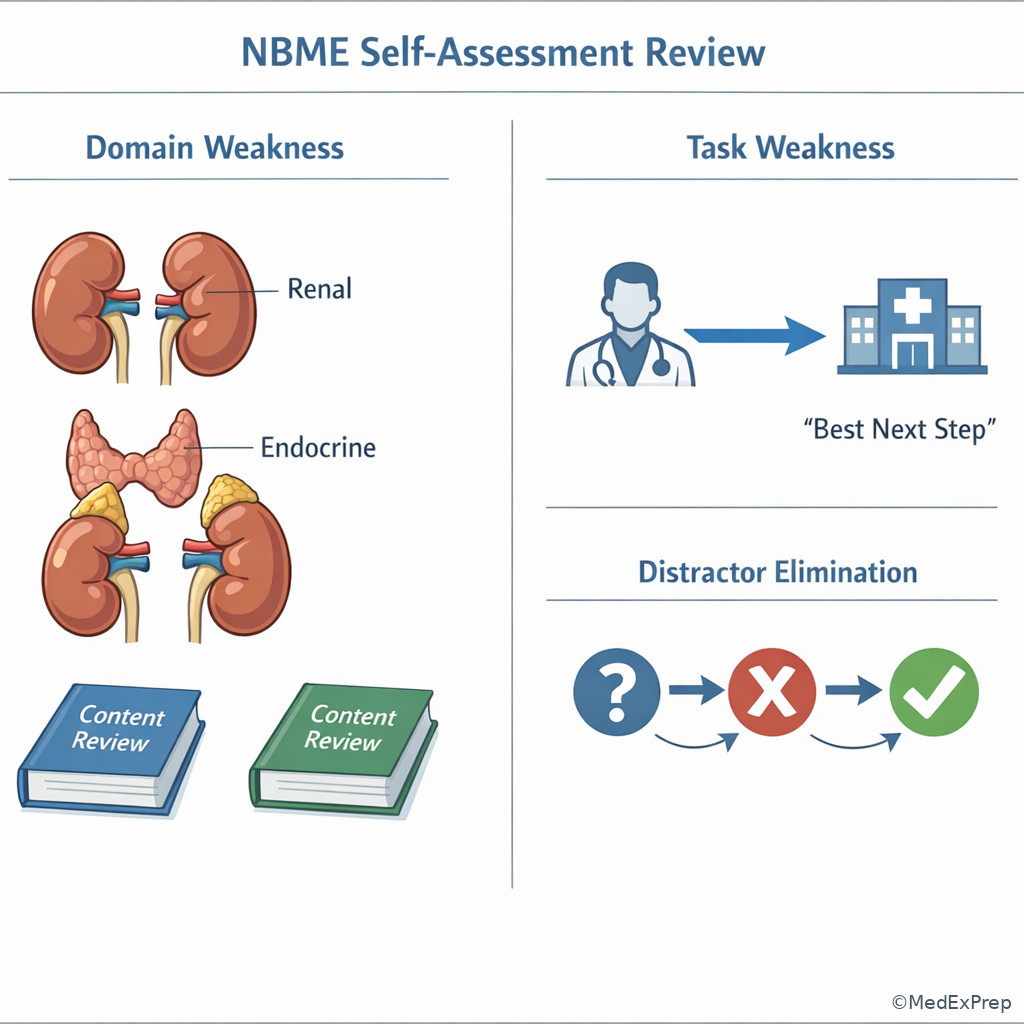
Another distinction is domain weakness versus task weakness. A learner may miss questions across several systems but only when the task is “best next step,” suggesting reasoning structure rather than content deficiency. Conversely, repeated misses in renal physiology across diagnosis and management questions suggest a content-centered weakness. This distinction becomes central in the next lessons on score reports and remediation.
See Fig 3 for a practical miss-classification framework.
Exam takeaway: The best remediation comes from identifying whether the miss reflects knowledge, interpretation, management logic, or timing.
flowchart TD
A[Missed question] --> B{What failed?}
B --> C[Knowledge gap]
B --> D[Stem interpretation]
B --> E[Management rule]
B --> F[Timing or distractor pull]
C --> G[Content review]
D --> H[Illness script and task ID practice]
E --> I[Algorithm and next-step review]
F --> J[Pacing and elimination drills] Exam takeaway: A structured miss review turns a raw score into specific study actions that improve future performance.
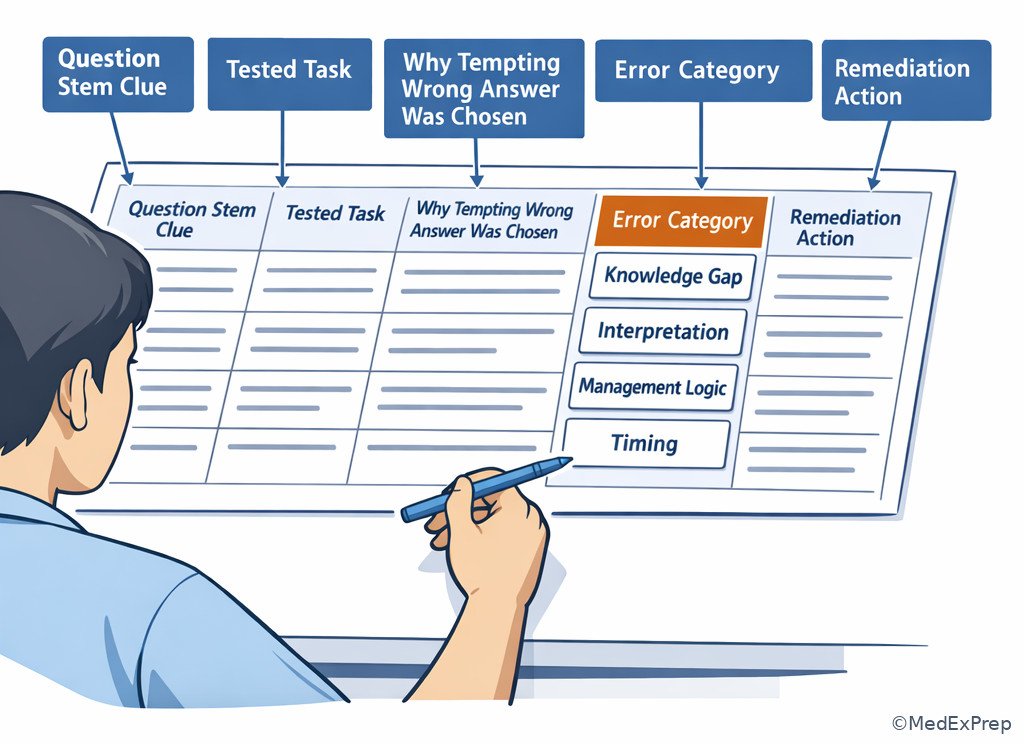
High-Yield Connection: This concept is tested alongside Vignette Task Identification and Distractor Elimination Logic. Know both the error category and the stem task for exam day — they are frequently paired in misses that feel like “content problems” but are actually reasoning problems.
Clinician Action: Diagnose whether misses cluster by system, discipline, or task. Order a miss log with one-row summaries for each incorrect item. Treat the highest-frequency error category first. Refer/Escalate if persistent timing collapse prevents meaningful domain interpretation; pacing failure can mask content signal.
B Worked example
A 24-year-old student with asthma and iron-deficiency anemia takes a self-assessment after a week focused heavily on cardiology. She misses questions in renal, GI, and endocrine systems. At first glance this looks like broad multisystem weakness. However, review shows that most misses occurred when the task was “most appropriate next step,” and she often narrowed prematurely to a diagnosis without asking what the stem was actually requesting. One distractor was especially tempting because it was the correct diagnosis but not the next management step.
Identify task: determine the main actionable weakness. Extract key facts: misses span systems but share a task type; tempting wrong answers were diagnosis labels. Apply rule: classify by repeated task pattern before calling it broad content failure. Eliminate distractors: reject “study all three systems equally first”; reject “cardiology overstudy caused all misses”; reject “the score is too noisy to use.” Verify: her primary deficit is management-step reasoning and task identification, not purely organ-system knowledge.
C Exam trap
Common wrong answer: “Misses across multiple systems always mean broad content weakness.”
Why it is tempting: system labels are visible and easy to tally.
Single clue that eliminates it: the misses share the same task failure — for example, diagnosis chosen when the stem asked for next step.
D Checkpoint
Question: A learner misses questions in neurology, cardiology, and infectious disease, but almost all missed stems ask for the “most appropriate next step.” What is the most useful first conclusion?
- The learner has unrelated weaknesses in three organ systems. Tempting because the system labels differ, but wrong because the repeated task type suggests a cross-system reasoning issue.
- The learner should first classify this as a management-step/task-identification weakness. Tempting because it simplifies the pattern, and right because the common discriminator is the same decision task.
- The pattern is uninterpretable because the missed items are from different disciplines. Tempting because mixed content feels noisy, but wrong because shared task structure creates usable signal.
- The learner should ignore these misses if the total score is acceptable. Tempting because it reduces anxiety, but wrong because repeated process errors can suppress future performance broadly.
Answer: B
1.1.1.6 Integration: choosing the right next step after the result
A Explanation
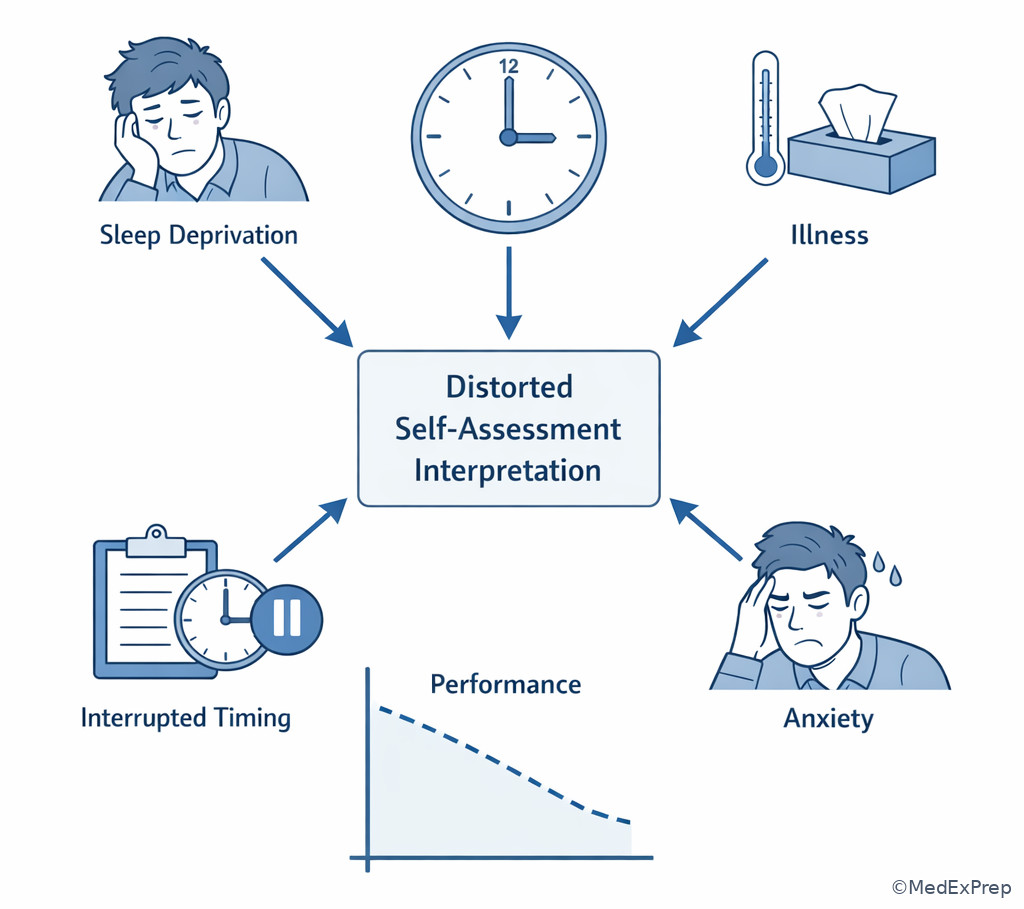
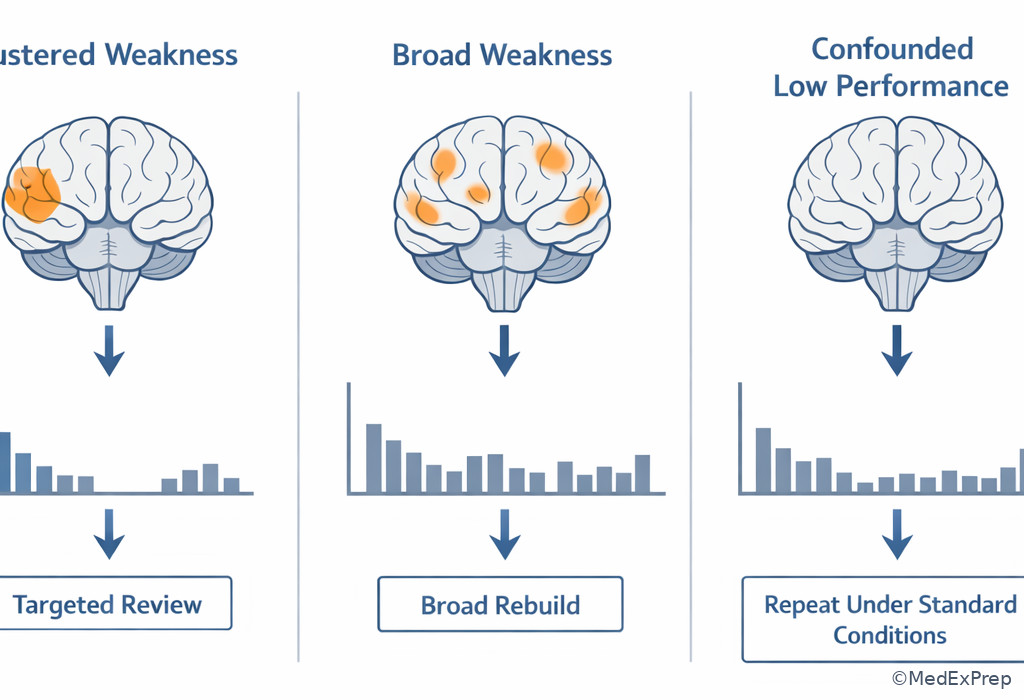
The final integration question is what to do next. The single rule is: match the next step to the type of signal you found. Strong broad performance with no obvious clustering calls for maintenance and mixed review. Strong total performance with one repeated weak domain calls for targeted repair plus maintenance. Weak broad performance requires broader reconstruction before narrow optimization. A confusing result with timing collapse or abnormal testing conditions may require another carefully timed sample after stabilization.
WHY THIS IS TESTED: many stems hide the real task inside the follow-up action. The examinee must not only interpret the result but choose the study response that best fits it.
A rational next-step framework has four parts: preserve strengths, repair high-frequency weaknesses, verify with later sampling, and avoid unsupported emotional conclusions. One especially common error is extreme reaction: either abandoning broad review after one good form or catastrophizing after one poor form. Both responses are miscalibrated. Another error is remediating only content when the signal actually points to pacing, question-task confusion, or distractor seduction.
See Fig 4 for a practical post-form decision tree. This is the core action algorithm for the lesson.
Exam takeaway: Match your study response to the pattern of weakness rather than reacting only to the total score.
flowchart TD
A[Self-assessment result] --> B{Pattern}
B --> C[Strong broad performance]
B --> D[Strong total plus clustered weakness]
B --> E[Weak broad performance]
B --> F[Confounded by timing fatigue or illness]
C --> C1[Maintain mixed review and reassess]
D --> D1[Target weak domain or task plus maintenance]
E --> E1[Rebuild core systems and reasoning framework]
F --> F1[Stabilize conditions and repeat later]
D1 --> G[Track whether weakness persists]
E1 --> G
C1 --> G
F1 --> G Exam takeaway: The highest-yield plan balances maintenance of strengths with targeted repair of repeated weak domains or tasks.
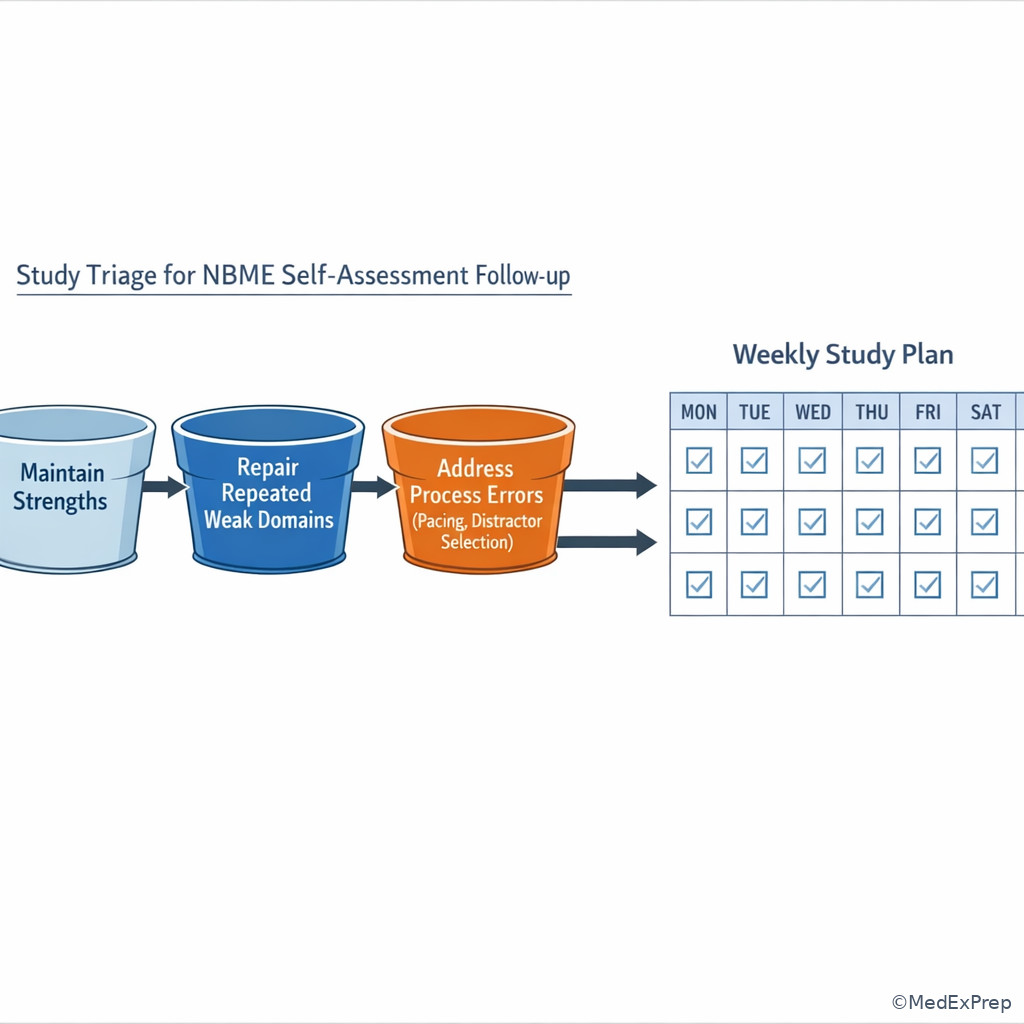
Exam takeaway: Fatigue, illness, or severe timing disruption can distort interpretation, so context must be considered before major study changes.
High-Yield Connection: This concept overlaps directly with the upcoming topics Score Report Interpretation and Targeted Remediation Planning. Know both the pattern-reading step and the study-plan response — they are frequently paired in stems asking what to do after a mixed or disappointing performance.
Memory anchor: PRVR = Preserve strengths, Repair repeated weakness, Verify with later sampling, Reject unsupported certainty.
Clinician Action: Diagnose the pattern as broad, clustered, or confounded. Order either targeted review, broad systems review, or another timed sample under cleaner conditions. Treat by matching intervention intensity to the weakness pattern. Refer/Escalate when persistent low performance suggests the need for structured academic support, counseling for severe test anxiety, or formal advising.
B Worked example
A 27-year-old student with generalized anxiety disorder and recent viral illness takes a self-assessment while febrile and after sleeping four hours. She scores lower than expected, with incorrect answers spread across many systems. Her first impulse is to abandon her exam timeline. On review, she notes several unanswered end-of-block questions and multiple simple misreads, but her prior untimed mixed blocks were steady.
Identify task: choose the most appropriate next step after this result. Extract key facts: confounded testing conditions, broad but possibly artificial weakness, timing collapse, prior steadier baseline. Apply rule: when results are heavily confounded, do not overcommit to catastrophic conclusions; stabilize conditions, repair pacing, then resample. Eliminate distractors: reject “ignore the form entirely” because it still shows timing vulnerability; reject “broadly relearn every system first” because the pattern may be distorted; reject “the low score proves she is not capable.” Verify: the best response is to address confounders and pacing, then repeat under standard conditions before making major strategic decisions.
C Exam trap
Common wrong answer: “A single unexpectedly low form always means broad content deficiency requiring global restart.”
Why it is tempting: low numbers trigger urgency and make broad review feel safer.
Single clue that eliminates it: the stem includes major confounders such as illness, severe sleep loss, or unanswered items from timing collapse.
D Checkpoint
Question: A learner has strong recent mixed-block performance but one poor self-assessment taken during illness with several unanswered end-of-block questions. What is the best next step?
- Assume broad knowledge failure and restart all content review from the beginning. Tempting because it feels comprehensive, but wrong because the stem suggests confounded performance rather than proven global deficiency.
- Disregard the form completely because conditions were imperfect. Tempting because it reduces stress, but wrong because timing failure is still actionable information.
- Address timing/confounders, then repeat assessment under standard conditions before making major plan changes. Tempting because it delays a dramatic reaction, and right because it matches the confounded pattern.
- Cancel all future self-assessments and rely only on question-bank percentages. Tempting because self-assessments feel stressful, but wrong because repeated standardized sampling remains useful.
Answer: C
- Broad strong result + clustered weakness → maintain broadly, target the cluster.
- True or False: A confounded low form should automatically trigger total study-plan overhaul. False.
- The four-step next-action mnemonic is ___, ___, ___, ___: Preserve, Repair, Verify, Reject unsupported certainty.
Exam Traps & Differentiators
Most common wrong answer and why: The most common wrong answer is the emotionally satisfying one: treating a self-assessment as a near-certainty machine. This is tempting because a single number feels more concrete than a nuanced pattern. The correct move is to ask whether the conclusion is broad and actionable or precise and unsupported.
| Looks similar | Actually means | Single discriminator |
|---|---|---|
| Strong total score | Current broad strength sample | Still check for repeated domain/task weaknesses |
| Small score increase | Possible improvement trend | Not enough for exact prediction or complacency |
| Mixed misses across systems | May reflect task weakness rather than content weakness | Look for a shared stem demand such as “next step” |
| Single poor form | Possible true weakness or confounded performance | Check timing, fatigue, illness, and unanswered items |
| Few questions from one topic | Sampling variation | Does not reveal official weighting |
If the stem says ___, think ___:
- If the stem says “one self-assessment”, think snapshot, not certainty.
- If the stem says “repeated misses in one task type”, think process weakness before broad content weakness.
- If the stem says “strong overall but weak cluster”, think targeted remediation plus maintenance.
- If the stem says “illness, sleep loss, unanswered end-of-block items”, think confounded interpretation; fix conditions and resample.
- If the stem says “fewer questions from topic X”, think form variation, not official low weight.
Common traps & distractors: Trap 1: “High total score means stop broad review.” Why tempting: it gives closure. Single eliminating clue: repeated weakness cluster still appears. Trap 2: “Low score means the learner is not capable.” Why tempting: emotional salience of a bad number. Single eliminating clue: performance occurred under confounded conditions or shows fixable process errors. Trap 3: “Few items from a topic prove low yield.” Why tempting: visible count feels official. Single eliminating clue: one form cannot reveal hidden blueprint weighting.
Recall: In the upcoming topic Score Report Interpretation, we build on these traps by showing how to read domain-level patterns without overcalling tiny differences. In Targeted Remediation Planning, the same signals become an actual study schedule.
Tables
| Key fact / reference point | High-yield meaning | What to do with it |
|---|---|---|
| One form = one sample | Limited representation of current performance | Use for pattern detection, not exact certainty |
| Repeated weak domain | More likely true signal | Prioritize targeted content review |
| Repeated weak task type | Cross-system reasoning/process issue | Practice task ID, next-step logic, and elimination |
| Small score change | May be real or noisy | Interpret with trend and item review |
| Confounded testing conditions | Performance may be distorted | Fix conditions before major conclusions |
| Strong total + narrow weakness | Maintenance plus targeted repair | Do not abandon broad review |
| Interpretation style | Choose | Reject |
|---|---|---|
| Purpose | Diagnostic study-planning tool | Absolute readiness verdict |
| Score meaning | Approximate snapshot of current performance | Guaranteed future score |
| Topic frequency | Form-dependent sampling | Official blueprint disclosure |
| Pattern response | Match study action to weakness type | Use the same response for every result |
| Weakness analysis | Separate content from process errors | Assume all misses are knowledge gaps |
| Observed pattern | Most likely classification | Best initial response |
|---|---|---|
| Incorrects cluster in renal physiology across question types | Domain/content weakness | Focused renal review plus mixed maintenance |
| Incorrects span systems but mostly ask “best next step” | Task/management weakness | Algorithm and stem-task practice |
| Low score with many unanswered final questions | Timing-related confounder | Pacing repair and repeat sampling |
| Unexpectedly low form during illness and sleep loss | Condition-confounded performance | Stabilize conditions before major plan changes |
| Strong total with one recurring weak discipline | Narrow but actionable weakness | Targeted remediation without narrowing too much |
| Few questions from one course topic | Sampling variation | Continue broad coverage until repeated evidence says otherwise |
Exam takeaway: Distinguishing clustered, broad, and confounded patterns prevents both overreaction and underreaction.
Exam takeaway: Separate system-based content gaps from cross-system reasoning failures because the remediation differs.
Algorithm / Approach
Use this algorithm whenever a vignette asks what a learner should conclude or do after a self-assessment. The right answer usually combines humility about limits with specific action. Extreme certainty and extreme dismissal are both wrong.
Rapid Review
- Self-assessment purpose → diagnostic snapshot, not final verdict
- One-form inference → broad pattern only, not exact prediction
- Strong total score → still check clusters of weakness
- Small score increase → trend clue, not guarantee
- Few questions from topic X → sampling variation, not official low weight
- Multisystem misses with same stem task → process weakness before content weakness
- Repeated misses in one organ system → likely domain/content signal
- Unanswered end-of-block items → timing confounder
- Illness or severe sleep loss during form → interpret cautiously before major plan change
- Best response to clustered weakness → targeted repair plus maintenance
- Best response to broad weakness → broader rebuild before fine-tuning
- Best response to confounded low form → fix conditions, then resample
- Most actionable miss review question → why was this missed?
- Score meaning → useful without revealing hidden formula
Memory anchor: SNAP = Sample current performance, Not exact prediction, Act on repeated patterns, Plan next steps.
Self-check quiz
1. A 26-year-old woman takes her first NBME-style self-assessment after two weeks of mixed review. She has no major testing issues and asks what the result is most appropriate for. Which answer is best?
- Determining the exact final exam score she will receive
- Identifying current strengths and repeated weaknesses to guide study
- Revealing the official hidden weighting of every tested discipline
- Replacing all future question-bank and content review work
2. A 24-year-old man with allergic rhinitis and mild insomnia notes that one self-assessment contained very few microbiology items. Which conclusion requires immediate rejection?
- The form may have sampled microbiology less heavily than expected
- He should continue broad review until more evidence accumulates
- Microbiology is officially low yield on all future NBME-style forms
- One form may not reflect the full distribution of tested topics
3. A 25-year-old woman with hypothyroidism and migraine misses questions in cardiology, neurology, and infectious disease. Review shows that most missed stems asked for the “most appropriate next step,” and she often selected the correct diagnosis instead. What is the most appropriate initial study response?
- Restart full content review in all three organ systems equally
- Prioritize task-identification and management-algorithm practice across systems
- Ignore the pattern because the missed items came from different disciplines
- Stop mixed blocks and study only neurology until scores normalize
4. A 27-year-old man with type 1 diabetes and recent sleep deprivation improves slightly between two self-assessments taken two weeks apart. He now wants to stop reviewing biostatistics because fewer such questions appeared on the second form. Which is the best next step?
- Narrow study immediately because any score increase confirms readiness
- Continue broad review while using repeated weak areas, not topic counts from one form, to set priorities
- Disregard both forms because differences between forms make all interpretation impossible
- Assume the second form reveals the official exam blueprint more accurately than the first
5. A 23-year-old woman with asthma and iron-deficiency anemia takes a self-assessment during a viral illness after sleeping three hours. Her score is markedly lower than expected, and she leaves several final questions unanswered. What is the most appropriate interpretation?
- The result proves broad irreversible content deficiency
- The result should be ignored completely because imperfect conditions make all data useless
- The performance is confounded; timing and testing conditions should be addressed before major strategic changes
- The low score means future self-assessments should be abandoned
6. A 26-year-old man with ulcerative colitis and generalized anxiety disorder has a strong overall self-assessment result. However, review shows repeated misses in renal physiology across diagnosis, mechanism, and management questions. He asks for the most appropriate next step. Which option is best?
- Maintain exactly the same broad plan because the total score is strong
- Shift entirely to renal review and stop mixed-question practice
- Add focused renal remediation while continuing maintenance of stronger systems
- Assume the renal cluster is random because the total score was high
7. A 28-year-old woman with depression and recent caffeine overuse takes three self-assessments over six weeks. Her totals fluctuate slightly, but each form shows weakness in data interpretation and “best next step” management items across multiple organ systems. Which conclusion is most appropriate?
- The inconsistent total scores mean there is no usable signal
- The repeated cross-system pattern suggests a task-level reasoning weakness that deserves targeted practice
- The weakest organ system on the first form alone should drive all future study
- The pattern proves that foundational science content is not relevant to her misses
8. A 25-year-old student with eczema and chronic poor sleep takes one excellent self-assessment and concludes that she no longer needs broad review, can skip future standardized practice, and can infer she will perform similarly on any form regardless of conditions. Which single detail most strongly invalidates her conclusion?
- A self-assessment provides a limited sample rather than complete certainty
- Sleep quality can affect performance
- Some future forms may include different disciplines
- Question banks test somewhat different item sets
Answer key
1. Answer: B
- A. Tempting because learners want precision from a single number, but incorrect because a self-assessment is a limited sample, not an exact final score predictor. The discriminating clue is the question asking what the result is most appropriate for, which points to diagnostic use. Source: First Aid for the USMLE; NBME examinee-facing guidance principles.
- B. Tempting because it sounds less dramatic than prediction language, and correct because the best use is identifying broad strengths and repeated weaknesses to guide remediation. The discriminating clue is “first self-assessment” with no special testing issues, making a pattern-based study use most appropriate. Source: First Aid for the USMLE; UpToDate principles of test performance interpretation.
- C. Tempting because topic frequency feels revealing, but incorrect because one form does not disclose official hidden weightings. The discriminating clue is that only one self-assessment has been taken. Source: NBME-style preparation principles; JAMA discussions of assessment interpretation.
- D. Tempting because learners may want one tool to replace all others, but incorrect because self-assessments complement rather than replace question-bank review and content study. The discriminating clue is the broad exam-prep setting, which requires multiple data sources. Source: First Aid for the USMLE; Harrison’s Principles of Internal Medicine for broad exam integration.
2. Answer: C
- A. Tempting because visible topic frequency varies across forms, and this is actually reasonable. The discriminating clue is “very few microbiology items” on one form, which supports sampling variation. Source: NBME-style form variability principles; First Aid for the USMLE.
- B. Tempting because it may feel overly cautious, but it is correct reasoning in broad exam preparation. The discriminating clue is that only one form has been observed. Source: UpToDate educational assessment interpretation principles.
- C. Tempting because learners often equate frequency with importance, but incorrect because one form cannot establish official low yield across all future assessments. The discriminating clue is the unsupported leap from one form to all forms. Source: NBME learner-safe interpretation principles; JAMA assessment literature.
- D. Tempting because it acknowledges uncertainty, and it is also correct as a general statement; however, the question asks which conclusion requires rejection, making C the best answer. The discriminating clue is “requires immediate rejection,” selecting the overconfident claim. Source: First Aid for the USMLE.
3. Answer: B
- A. Tempting because the misses span three systems, but incorrect because the shared failure is selecting diagnosis when the task is next management step. The discriminating clue is repeated “most appropriate next step” stems. Source: First Aid for the USMLE; UWorld-style reasoning principles consistent with NBME tasks.
- B. Tempting because it reframes the issue from content to process, and correct because the cross-system commonality is task-identification and management reasoning. The discriminating clue is that she often chose the correct diagnosis instead of the correct next step. Source: Harrison’s Principles of Internal Medicine for management reasoning integration; First Aid for test-taking frameworks.
- C. Tempting because cross-disciplinary misses can seem noisy, but incorrect because shared task type creates a usable pattern. The discriminating clue is repetition of the same decision demand. Source: UpToDate educational testing principles.
- D. Tempting because neurology is one of the affected systems, but incorrect because the error is not neurology-specific. The discriminating clue is the pattern across multiple systems. Source: First Aid for the USMLE.
4. Answer: B
- A. Tempting because upward movement feels validating, but incorrect because a slight increase does not justify aggressive narrowing, especially based on fewer topic appearances. The discriminating clue is “improves slightly” and fewer biostatistics questions on only one form. Source: UpToDate; First Aid for the USMLE.
- B. Tempting because it preserves uncertainty, and correct because repeated weak areas and broad patterns are more reliable than raw topic counts on one form. The discriminating clue is that the proposed narrowing depends on one form’s topic frequency. Source: JAMA assessment interpretation literature; NBME-style learner-safe guidance.
- C. Tempting because form variation exists, but incorrect because variation does not make all interpretation impossible; it just limits overconfidence. The discriminating clue is that broad trend information still exists. Source: UpToDate educational measurement concepts.
- D. Tempting because the newer form feels more current, but incorrect because no single form reveals the official blueprint more accurately. The discriminating clue is the unsupported leap from one newer sample to official weighting. Source: First Aid for the USMLE.
5. Answer: C
- A. Tempting because the score drop is dramatic, but incorrect because the stem includes strong confounders: viral illness, three hours of sleep, and unanswered end-of-block questions. The discriminating clue is the testing-condition disruption. Source: UpToDate on performance confounders; First Aid for study strategy.
- B. Tempting because imperfect conditions reduce confidence, but incorrect because timing failure and stress effects are themselves actionable findings. The discriminating clue is several final unanswered questions, which still indicate a pacing issue. Source: JAMA assessment literature; First Aid.
- C. Tempting because it avoids both panic and dismissal, and correct because the result is best classified as confounded. The discriminating clue is the combination of illness, severe sleep restriction, and timing collapse. Source: UpToDate educational interpretation principles.
- D. Tempting because the poor experience may make future forms aversive, but incorrect because standardized reassessment remains valuable once conditions improve. The discriminating clue is that the issue is interpretation of this form, not abandonment of the method. Source: First Aid for the USMLE.
6. Answer: C
- A. Tempting because the total score is strong, but incorrect because repeated renal misses across several question types indicate a real cluster worth addressing. The discriminating clue is the repeated renal pattern across diagnosis, mechanism, and management. Source: Harrison’s Principles of Internal Medicine; First Aid.
- B. Tempting because targeted focus sounds efficient, but incorrect because stopping mixed practice risks loss of maintained strengths and ignores the value of broad retention. The discriminating clue is strong overall performance, which argues for maintenance plus repair, not total narrowing. Source: UpToDate educational planning principles.
- C. Tempting because it requires balanced planning, and correct because it matches a narrow but repeated domain weakness within otherwise strong broad performance. The discriminating clue is “strong overall” plus “repeated misses in renal physiology.” Source: First Aid for the USMLE; Costanzo Physiology for domain-specific reinforcement logic.
- D. Tempting because the total score was high, but incorrect because cluster repetition makes random chance less likely. The discriminating clue is consistency of the renal misses across multiple task types. Source: JAMA assessment interpretation literature.
7. Answer: B
- A. Tempting because total scores fluctuate, but incorrect because repeated weakness in the same task categories across forms is the key signal. The discriminating clue is the stable cross-form pattern despite small score variation. Source: UpToDate educational measurement concepts.
- B. Tempting because it highlights a cross-system reasoning issue, and correct because recurrent weakness in data interpretation and best-next-step items across multiple organ systems points to task-level deficits. The discriminating clue is “across multiple organ systems” with the same task categories. Source: First Aid for the USMLE; Harrison’s for integrated reasoning.
- C. Tempting because early weak systems can anchor judgment, but incorrect because one form alone should not outweigh repeated later task-based patterns. The discriminating clue is three forms over six weeks with recurrent task clustering. Source: JAMA assessment literature.
- D. Tempting because management questions feel clinical, but incorrect because foundational science often underlies data interpretation and next-step logic. The discriminating clue is that the task weakness does not exclude content contribution. Source: Robbins & Cotran; First Aid.
8. Answer: A
- A. Tempting because it sounds abstract, and correct because it directly refutes all three overconfident claims: stopping broad review, skipping future standardized practice, and assuming performance generalizes to any form or condition. The discriminating clue is that the conclusion claims excessive certainty from one excellent result. Source: NBME learner-safe interpretation principles; First Aid for the USMLE.
- B. Tempting because poor sleep can affect results, but incorrect as the single best answer because it addresses only one possible confounder rather than the core problem of overgeneralizing from one sample. The discriminating clue is that her claims go beyond sleep alone. Source: UpToDate.
- C. Tempting because different forms do sample different content, but incorrect as the best discriminator because it does not fully address her abandonment of broad review and future practice. The discriminating clue is the breadth of her unsupported inference. Source: JAMA assessment interpretation literature.
- D. Tempting because question banks differ from self-assessments, but incorrect because that fact alone does not most strongly invalidate all parts of her conclusion. The discriminating clue is the universal problem of treating one form as complete certainty. Source: First Aid for the USMLE.
Keep going with the full NBME Self-Assessments Prep Course (NBME)
You just studied the way members do, in the same lesson interface. Full access unlocks every lesson, the question bank and flashcards for a full year.
One payment · 1 year of access · No auto-renewal