1.1.1 - Task Recognition Cues
Task Recognition Cues
What you'll learn
- History and Physical Examination: Identify the question task → recognize whether the stem is asking for diagnosis, next step, safety screen, imaging choice, or referral.
- Case Management and Clinical Decision-Making: Match cue words to action → choose the safest board-style response based on exam intent.
- Contraindications, Red Flags, and Safety: Detect urgency language → separate routine chiropractic management from cases requiring treatment modification or referral.
- Diagnosis and Differential Diagnosis: Distinguish task types → avoid answering a diagnosis question with a treatment rule, or a management question with a label only.
- Calculations, Interpretation, and Clinical Logic: Use a reasoning sequence → identify task, extract facts, apply the governing rule, and verify against safety.
- Case Management and Clinical Decision-Making → Question interpretation and next-best-step selection
- History and Physical Examination → Recognizing what information the stem is testing
- Diagnosis and Differential Diagnosis → Distinguishing diagnosis prompts from management prompts
- Contraindications, Red Flags, and Safety → Recognizing wording that elevates urgency and changes management
- Imaging and Diagnostic Studies → Identifying when the item is testing study selection versus study interpretation
Why it matters
- Many NBCE-style misses happen before clinical reasoning even begins: the candidate answers the wrong question.
- Task recognition cues help you decide whether to diagnose, triage, image, treat conservatively, modify care, or refer.
- In chiropractic board scenarios, the most common high-value distinction is routine care versus unsafe care.
- Recognizing exam intent early reduces distractor pull from noisy details such as old imaging findings, minor comorbidities, or unrelated lab values.
Key rule: Before you interpret symptoms, identify the task category. The same history can support different correct answers depending on whether the item asks for the most likely diagnosis, most appropriate next step, or finding that requires referral.
Key Terms & Must-Know Facts
1.1.1.1 Key terms
- Task recognition cue: wording in the stem or lead-in that tells you what kind of decision is being tested
- Lead-in: the final question sentence directing what answer type to choose
- Next-best-step question: asks for the safest immediate action, not just the diagnosis
- Red flag cue: finding that shifts the answer toward urgent evaluation, imaging, or referral
- Scope cue: wording indicating whether chiropractic management is appropriate, should be modified, or should be avoided
- Diagnosis cue: wording asking for the most likely condition or pain generator
- Management cue: wording asking what to do now
- Interpretation cue: wording asking what a finding means
- Contraindication cue: clue that rules out routine manipulation or adjunctive procedures
- Noise: realistic but non-decisive details included to distract from the true task
- Discriminator: the one clue that separates the correct answer from the strongest distractor
- Exam intent: the most likely skill being tested by the item writer
1.1.1.2 Must-know facts
- If the stem asks for the most appropriate next step, a diagnosis alone is rarely enough.
- If the stem includes progressive neurologic deficit, fracture concern, infection signs, malignancy clues, or vascular warning signs, safety usually outranks routine conservative care.
- Best initial management and most likely diagnosis are different task types and often have different correct answers from the same stem.
- Requires immediate clarification is a safety cue, usually pointing to missing critical risk information.
- When a vignette exceeds chiropractic scope, the correct posture is avoid unsafe treatment and refer appropriately.
- Imaging questions often turn on whether imaging is indicated, not on naming the ideal modality in a vacuum.
- The strongest distractor often matches the symptoms but not the task.
- Lead-in wording usually matters more than one extra noisy detail in the history.
| Lead-in phrase | What the exam is testing | What your answer should look like |
|---|---|---|
| Most likely diagnosis | Pattern recognition | A condition label |
| Most appropriate next step | Immediate clinical judgment | An action: evaluate, image, treat, refer, or modify care |
| Best initial management | First-line care choice | A starting management plan, not a long-term plan |
| Requires immediate referral | Safety and urgency | Escalation, not routine office care |
| Most important finding | Discriminating clue | One decisive fact, not the whole case summary |
| Most appropriate imaging | Test selection | A study choice linked to indication |
Exam takeaway: Match the lead-in to the answer type before analyzing details so you do not solve the wrong problem.
flowchart TD
A[Read lead-in first] --> B{What is being asked?}
B -->|Diagnosis| C[Name the condition]
B -->|Next step| D[Choose immediate action]
B -->|Safety| E[Screen for red flags and contraindications]
B -->|Imaging| F[Decide if imaging is indicated and which study]
B -->|Interpretation| G[Explain what a finding means]
C --> H[Then verify against stem clues]
D --> H
E --> H
F --> H
G --> H
See Fig 1 for the fastest way to classify a question before you get pulled into details.
Core content
1.1.1.3 Foundational cue: identify the task before interpreting the case
A Explanation
In board-style items, the first decision conflict is not which diagnosis fits best; it is whether the item is even asking for a diagnosis. Students lose points by seeing a familiar condition pattern and choosing the disease label when the question actually asks for the safest immediate action. The choose-vs-reject framework is simple: choose a diagnosis answer only when the lead-in asks for a diagnostic label; reject diagnosis-only answers when the lead-in asks for management, imaging, referral, or contraindication reasoning.
WHY THIS IS TESTED: exam writers want to know whether you can function like an entry-level clinician who not only recognizes patterns, but also knows what decision must be made now. In NBCE-relevant outpatient settings, the critical difference is often routine care versus modified care versus referral.
The single resolving rule is this: the lead-in determines the answer category. Read the final sentence first, then scan the stem for the one detail that answers that exact task. If the lead-in says “most appropriate next step,” your brain should immediately shift from label mode to action mode. If it says “most likely diagnosis,” do not over-manage the case in your head unless the diagnosis depends on a safety clue.
Common answer categories include diagnosis, immediate management, need for imaging, contraindication to manipulation, urgent referral, and interpretation of an exam or imaging finding. See Fig 1 and Fig 2.
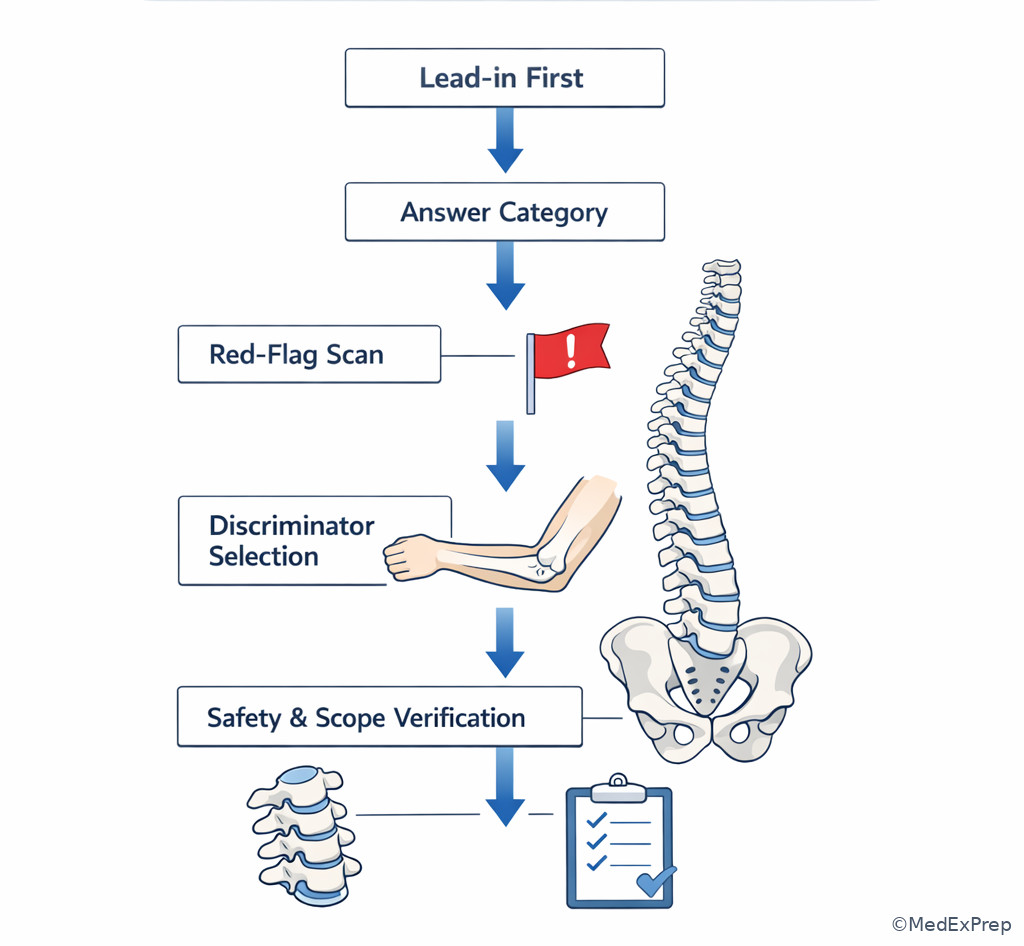
Memory anchor: L-A-S-T = Lead-in first, Answer type next, Safety screen, Then details. Use it every time before reading options.
Clinician Action: Diagnose the task type before the condition; Order further reasoning only after identifying whether the item wants action or label; Treat only when the lead-in asks for management; Refer/Escalate immediately if the task asks about urgent action and the stem contains a red flag.
B Worked example
A 46-year-old man presents with low back pain after lifting boxes three days ago. He has type 2 diabetes and chronic seasonal allergies. Pain radiates to the right posterior thigh, but he denies saddle anesthesia or bladder changes. Straight-leg raise is mildly positive at 60 degrees. A prior lumbar x-ray from two years ago showed mild spondylosis. The lead-in asks: “What is the most appropriate next step in management?”
Identify task: this is not asking for the diagnosis. Extract key facts: recent mechanical trigger, no major red flags, mild radicular findings, old imaging finding is noise. Apply rule: next-step questions require an action choice. Eliminate distractors: a diagnosis-only option such as “lumbar disc lesion” may be true-ish but does not answer the question; urgent referral is not supported because there is no progressive deficit or cauda equina pattern; immediate MRI is tempting because of leg pain but not required in an uncomplicated short-duration case. Verify: the best answer would be conservative initial management with monitoring and safety instructions, assuming that is one of the options.
C Exam trap
Common wrong answer: choose the diagnosis label because it fits the symptom pattern.
Why it is tempting: the stem is rich in disease clues, so naming the condition feels like solving the case.
Single clue that eliminates it: the lead-in asks for the most appropriate next step, which requires an action, not a label.
D Checkpoint
Question: A 39-year-old woman with neck pain after desk work has intermittent hand paresthesia and a normal neurologic exam. The lead-in asks, “Which finding most strongly supports the diagnosis?” What is the key task type?
- Choose the best immediate management plan
- Choose the most likely diagnosis
- Choose the key diagnostic discriminator
- Choose the safest imaging study
Correct answer: C.
- A: tempting because neck pain often leads you into treatment planning; wrong because the lead-in asks for a supporting finding, not management.
- B: tempting because diagnosis is nearby conceptually; wrong because the question assumes a diagnosis and asks what supports it.
- C: right because “most strongly supports” signals a discriminator-type task.
- D: tempting because paresthesia can suggest imaging; wrong because no imaging decision is being asked.
Exam takeaway: Board stems often reward rejecting options from the wrong answer category before debating details within the right category.
flowchart LR
A[Lead-in words] --> B{Cue}
B -->|most likely diagnosis| C[Condition label]
B -->|best initial management| D[First-line action]
B -->|most appropriate next step| E[Immediate action based on safety]
B -->|requires immediate referral| F[Escalate care]
B -->|most appropriate imaging| G[Study choice]
B -->|finding most strongly suggests| H[Discriminating clue]
Exam takeaway: Read the lead-in, patient demographics, timeline, and red-flag cues in that order to reduce distractor pull.
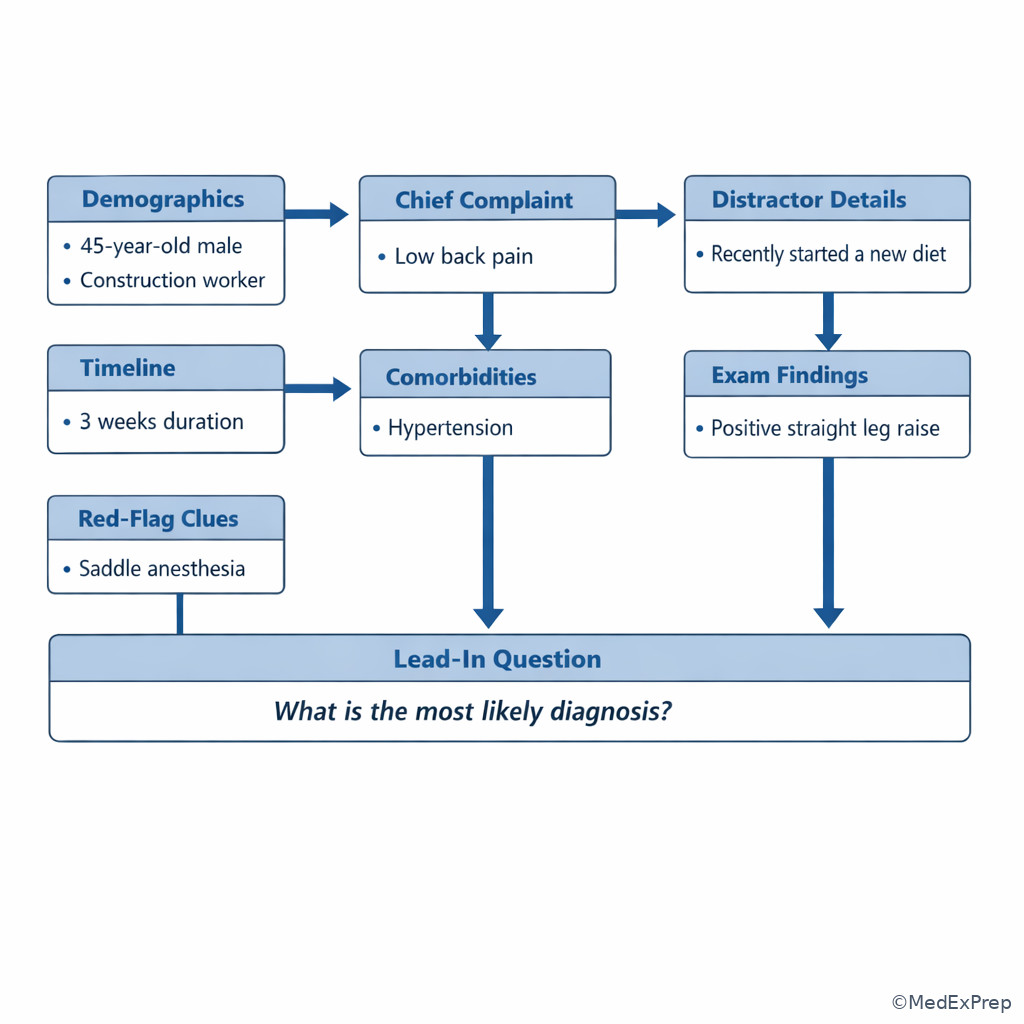
1.1.1.4 Foundational cue: separate diagnosis questions from management questions
A Explanation
Diagnosis and management are tightly linked but not interchangeable. A stem can strongly suggest lumbar radiculopathy, cervical mechanical pain, or rib dysfunction, yet the actual testable decision may be whether to manage conservatively, obtain imaging, avoid manipulation, or refer. The decision conflict is whether to commit to a label or to act on severity and safety. Choose a diagnostic answer when the lead-in asks “most likely diagnosis.” Reject a diagnostic answer when the lead-in asks “best initial therapy,” “most appropriate next step,” “most important to monitor,” or “requires urgent referral.”
WHY THIS IS TESTED: entry-level chiropractic reasoning requires more than pattern naming. You must know when the pattern is enough for routine management and when the same pattern changes because of one high-risk feature. The item writer tests whether you can shift from recognition to decision.
The single finding or rule that resolves the conflict is usually a management-changing clue: duration, progressive deficit, trauma severity, constitutional signs, age, cancer history, anticoagulant use, or failure of expected recovery. Those clues may not change the underlying diagnosis, but they absolutely change the answer if the task is management.
Recall: In the upcoming topic Key Fact Extraction, you will learn which facts to pull first from the stem. Here, we build on that by deciding what kind of answer those facts must support.
See Fig 2 for a compact matcher and Fig 3 for a decision-comparison visual.
Memory anchor: Name is not next step. If the lead-in asks what to do, a diagnosis-only option is usually incomplete.
High-Yield Connection: This concept is tested alongside Safety-First Answer Selection. Know both the likely condition and the finding that makes routine care unsafe; they are frequently paired in stems.
Clinician Action: Diagnose the likely pattern provisionally; Order imaging or added workup only if management-changing features are present; Treat conservatively when the presentation is uncomplicated and the question asks for initial care; Refer/Escalate when the same diagnosis includes red flags or contraindications.
B Worked example
A 67-year-old woman presents with thoracic pain that began gradually over six weeks. She has osteoporosis and a remote history of breast cancer in remission. She also reports mild dyspepsia. There is focal percussion tenderness over the mid-thoracic spine. The lead-in asks: “What is the most appropriate next step?”
Identify task: management, not diagnosis. Extract key facts: older age, gradual pain, osteoporosis, prior cancer, focal bony tenderness. Dyspepsia is distracting noise. Apply rule: even if metastatic disease or compression fracture is not proven, the task is what to do now in a potentially serious presentation. Eliminate distractors: “thoracic mechanical dysfunction” is tempting but does not address safety; routine manipulation is unsafe until serious pathology is excluded; simple home exercise alone underreacts to the risk profile. Verify: urgent imaging and medical referral/co-management is the safer next step.
C Exam trap
Common wrong answer: choose conservative care because pain is musculoskeletal and there is no fever.
Why it is tempting: many thoracic pain cases are benign, and absence of one dramatic red flag can falsely reassure you.
Single clue that eliminates it: the combination of prior cancer plus focal bony tenderness changes management even before a definitive diagnosis is established.
D Checkpoint
Question: A stem strongly suggests uncomplicated cervical radiculopathy. The lead-in asks, “Which intervention is most appropriate initially?” What should you reject first?
- A detailed etiologic diagnosis that names the nerve root
- A first-line conservative care option
- A safety screen for progressive deficit
- A monitoring plan for worsening neurologic symptoms
Correct answer: A.
- A: right because it is the wrong answer type; a diagnosis label alone does not answer an intervention question.
- B: tempting to reject because it may feel nonspecific; wrong to reject because it directly fits the task.
- C: tempting because it is not a “treatment”; wrong to reject because safety screening remains relevant to initial management.
- D: tempting because monitoring sounds secondary; wrong to reject because it can be part of an appropriate initial plan.
- The phrase “most appropriate next step” usually asks for an action, not a label.
- True or False: A correct diagnosis answer is always acceptable on a management question. False.
- Name the one rule that resolves diagnosis-versus-management confusion: the lead-in determines the answer category.
| Task type | Typical lead-in wording | Best answer form | Strong distractor to reject |
|---|---|---|---|
| Diagnosis | Most likely diagnosis | Named condition or syndrome | Appropriate treatment plan |
| Management | Most appropriate next step | Action now | Condition label only |
| Urgency | Requires immediate referral | Escalate care | Routine follow-up |
| Imaging selection | Most appropriate imaging | Study linked to indication | Diagnosis without test reasoning |
| Interpretation | Finding most strongly suggests | One discriminating clue | Broad management plan |
Exam takeaway: A single management-changing clue can make the correct answer referral or imaging even when the diagnosis seems straightforward.
flowchart TD
A[Recognize likely condition] --> B{Lead-in asks for?}
B -->|Diagnosis| C[Choose best-fitting label]
B -->|Management| D{Any red flags or contraindications?}
D -->|No| E[Conservative initial care]
D -->|Yes| F[Modify care, image, or refer]
C --> G[Verify with discriminator]
E --> G
F --> G Exam takeaway: The same symptom pattern may support different correct answers depending on whether the item asks for diagnosis or action.
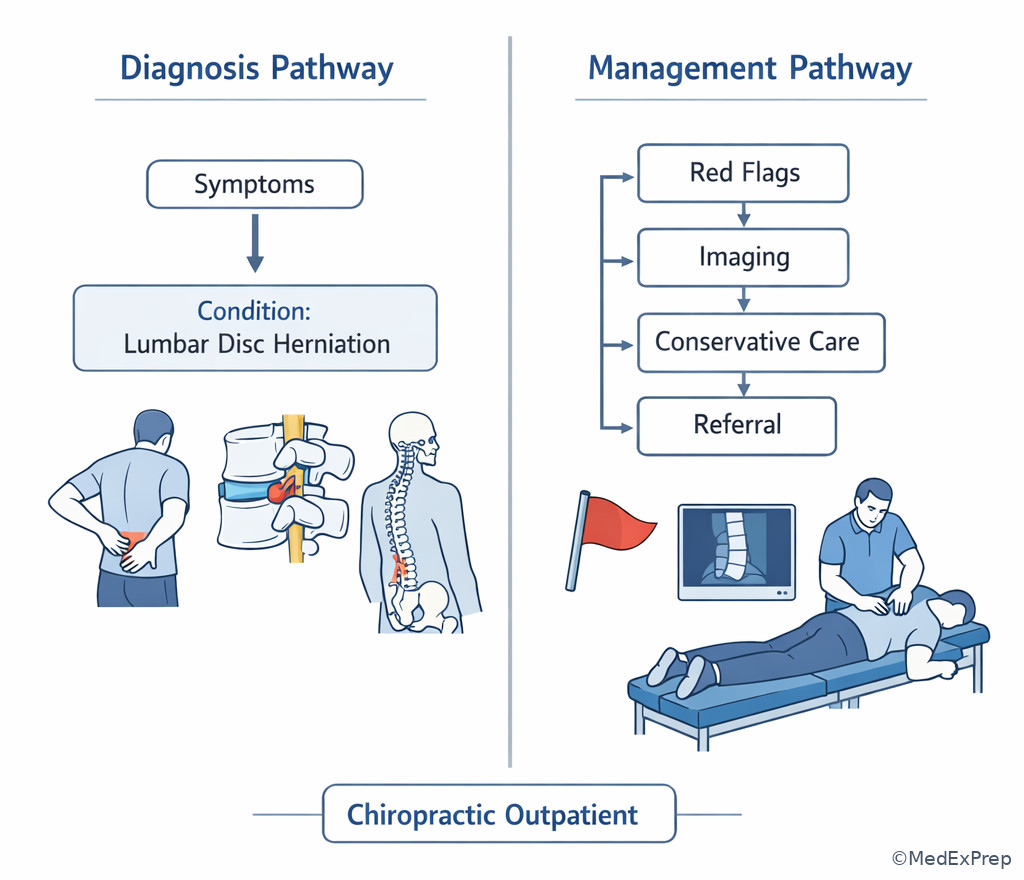
1.1.1.5 Application cue: recognize safety-first wording and urgency language
A Explanation
Safety-first cues are the highest-priority task signals in NBCE-style reasoning. Words such as immediate, urgent, progressive, severe trauma, new neurologic deficit, unexplained weight loss, fever, night pain, saddle anesthesia, bowel/bladder change, anticoagulant use, cancer history, immunosuppression, vascular concern are not just clinical details; they often change the answer category itself. The decision conflict is whether to continue routine chiropractic reasoning or switch into red-flag triage mode. Choose red-flag triage when a safety cue suggests unstable or potentially serious pathology. Reject routine treatment logic until danger has been addressed.
WHY THIS IS TESTED: entry-level candidates must recognize when not to proceed with standard musculoskeletal management. This is especially important in chiropractic board items because unsafe manipulation or delayed referral is a classic exam trap.
The single resolving rule is priority: immediate threats and contraindications outrank favored diagnoses and routine treatment preferences. If the stem asks for the most appropriate next step and includes a red flag that changes management, the correct answer is rarely continued routine care. See Fig 4.
Key rule: A red flag does not have to prove the dangerous diagnosis. It only has to make routine care unsafe until the risk is evaluated.
High-Yield Connection: This concept overlaps directly with Contraindicated Treatment Scenarios and Urgent Referral Syndromes. On exam day, know the clue that changes care from office-based management to immediate referral.
Clinician Action: Diagnose whether a red-flag pattern is plausible; Order urgent imaging or additional evaluation only as appropriate within the vignette; Treat by withholding contraindicated routine care; Refer/Escalate when the stem indicates fracture, infection, malignancy, vascular compromise, or progressive neurologic deficit.
B Worked example
A 58-year-old man presents with new severe neck pain and occipital headache after sudden neck rotation while backing up his car. He has hypertension and hyperlipidemia. He reports transient dizziness and nausea but thinks it is from skipping breakfast. Blood pressure is mildly elevated. The lead-in asks: “What is the most appropriate next step?”
Identify task: management. Extract key facts: sudden neck pain, occipital headache, dizziness after neck movement, vascular risk factors. Skipped breakfast is the tempting-but-wrong clue that points toward a benign explanation. Apply rule: vascular warning signs make routine cervical manipulation unsafe. Eliminate distractors: muscle strain treatment is tempting because the mechanism involves rotation; vestibular self-care misses the neck-pain context; delayed reassessment is unsafe. Verify: urgent medical evaluation is the correct direction.
C Exam trap
Common wrong answer: treat as uncomplicated cervical strain because symptoms started after movement.
Why it is tempting: mechanical onset is common in benign neck pain and can overshadow the associated neurologic or vascular symptoms.
Single clue that eliminates it: occipital headache with dizziness after acute neck pain is a vascular warning pattern, not a routine strain until proven otherwise.
D Checkpoint
Question: Which phrase most strongly signals that the item writer wants safety-first reasoning rather than routine diagnosis refinement?
- Intermittent symptoms for 2 days
- Most likely pain generator
- Requires immediate referral
- Mild tenderness over paraspinals
Correct answer: C.
- A: tempting because timeline matters; wrong because it does not itself signal urgency.
- B: tempting because it asks for interpretation; wrong because it is still a diagnosis task, not a triage task.
- C: right because it explicitly shifts the candidate into urgent escalation logic.
- D: tempting because exam findings often guide management; wrong because it is a routine, non-urgent clue.
Exam takeaway: When red flags are present, the right answer usually becomes modify care, image appropriately, or refer rather than continue routine treatment.
flowchart TD
A[Read stem] --> B{Any red-flag cue?}
B -->|No| C[Continue routine diagnostic or management reasoning]
B -->|Yes| D{Does it change safety today?}
D -->|Yes| E[Avoid contraindicated treatment]
E --> F[Refer urgently or obtain indicated workup]
D -->|Unclear| G[Clarify missing critical information before care]
C --> H[Select best routine answer] Exam takeaway: Progressive neurologic findings, fracture indicators, infection signs, malignancy clues, and vascular symptoms must be recognized before treatment choices.
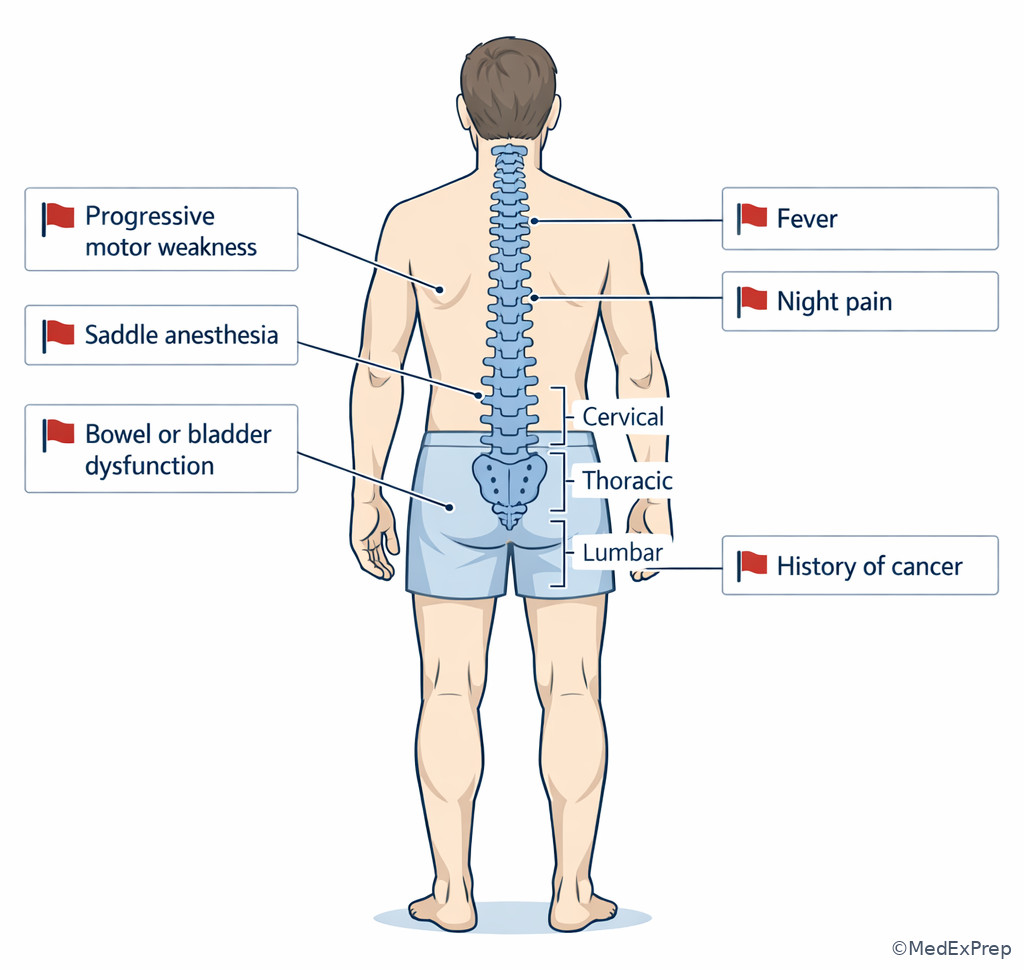
1.1.1.6 Application cue: recognize imaging-selection tasks versus imaging-interpretation tasks
A Explanation
Imaging questions commonly test one of two different skills: whether imaging should be obtained and which study is most appropriate, or what an already-present imaging finding means for management. The decision conflict is whether the vignette is asking you to order a test or interpret one. Choose test-selection logic when the lead-in asks for the most appropriate imaging study, whether imaging is indicated, or the next step in evaluation. Reject image-interpretation logic unless the stem actually provides an imaging result and asks what it suggests or how it changes management.
WHY THIS IS TESTED: chiropractic candidates must reason safely about when imaging helps, when it is unnecessary, and how findings affect management or referral. Exam writers often tempt you with knowledge of imaging modalities even when the real question is whether imaging is needed at all.
The single resolving rule is this: first answer “Is imaging indicated?” before answering “Which image?” If the stem presents uncomplicated recent mechanical pain without red flags, immediate imaging is often not the best next step. If the stem presents major trauma, suspected fracture, malignancy, infection, or progressive neurologic deficit, the imaging decision changes. See Fig 5.
Recall: In the upcoming topic Safety-First Answer Selection, you will apply this same logic to cases where the safest answer is referral rather than in-office care. Imaging questions often sit right at that border.
Memory anchor: I before W = Is imaging indicated? then Which study?
Clinician Action: Diagnose whether the problem is uncomplicated or high-risk; Order imaging only when the stem supports indication; Treat uncomplicated mechanical presentations without over-imaging when appropriate; Refer/Escalate when imaging is needed because serious pathology is plausible or a provided finding changes management.
B Worked example
A 29-year-old woman has acute low back pain after moving apartments yesterday. She has asthma and migraine history. Pain is worse with bending and improved slightly by walking. Neurologic exam is normal. She mentions that her friend had a disc bulge on MRI last year. The lead-in asks: “What is the most appropriate imaging study at this time?”
Identify task: imaging selection. Extract key facts: acute mechanical onset, normal neurologic exam, no red flags. Friend's MRI is pure noise. Apply rule: first ask whether imaging is indicated. Eliminate distractors: MRI is tempting because of fear of disc injury; x-ray is tempting because it feels simpler; CT may sound definitive. But if no imaging is indicated now, the correct answer may be no immediate imaging if offered. Verify: choose the option that reflects no immediate imaging and conservative management in an uncomplicated acute case.
C Exam trap
Common wrong answer: MRI because it is the “best” test for discs.
Why it is tempting: students recall modality superiority without first deciding whether imaging should happen now.
Single clue that eliminates it: normal neurologic exam with acute uncomplicated mechanical onset makes immediate imaging unnecessary.
D Checkpoint
Question: Which clue most strongly converts an imaging-selection item from “no imaging now” to “image promptly”?
- Back pain after one day of lifting
- Prior episode of self-limited sciatica
- New urinary retention with saddle numbness
- Pain improved by walking
Correct answer: C.
- A: tempting because mechanism matters; wrong because minor lifting without red flags usually does not mandate imaging.
- B: tempting because prior sciatica suggests recurrence; wrong because recurrence alone does not create urgency.
- C: right because cauda equina-type features change the imaging and referral urgency immediately.
- D: tempting because activity response helps pattern recognition; wrong because it does not by itself create an imaging indication.
- The first question in any imaging item is: Is imaging indicated?
- True or False: MRI is the best answer whenever radicular pain is mentioned. False.
- Name one finding that changes imaging urgency: progressive neurologic deficit, significant trauma, or cauda equina features.
Exam takeaway: In imaging stems, the decisive move is to determine indication first and modality second.
flowchart TD
A[Imaging lead-in] --> B{Imaging indicated now?}
B -->|No red flags, uncomplicated| C[No immediate imaging]
B -->|Trauma, red flags, progression| D[Choose appropriate study]
D --> E{What is the clinical concern?}
E -->|Fracture/instability| F[Plain films or CT depending on stem context]
E -->|Neurologic/soft tissue concern| G[MRI if indicated]
E -->|Provided image result| H[Interpret impact on management] Exam takeaway: Match the study to the clinical question only after deciding that imaging is actually warranted.
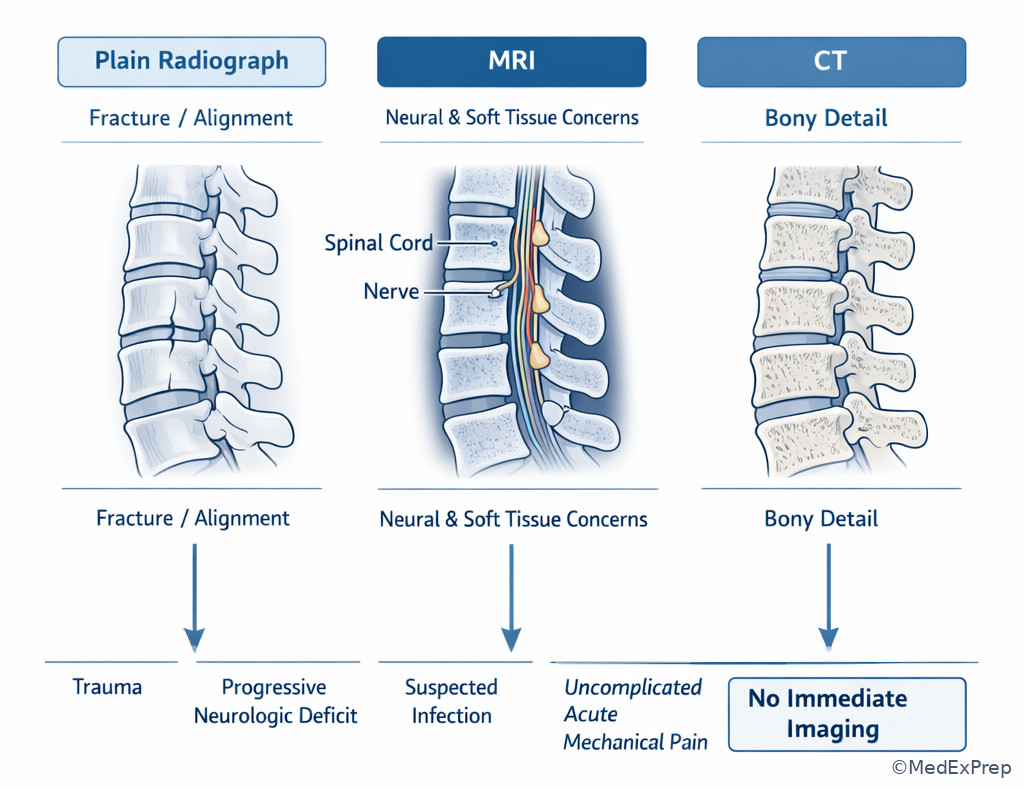
1.1.1.7 Integration cue: identify missing critical information and “clarification” tasks
A Explanation
Some questions do not ask you to diagnose or manage immediately; they ask what requires immediate clarification or which additional detail would most change management. These are information-gap questions. The decision conflict is whether the current data are sufficient for safe care. Choose the missing piece of information that changes safety, contraindication status, or urgency. Reject additional details that are interesting but would not alter the next step.
WHY THIS IS TESTED: safe chiropractic reasoning includes knowing when not enough is known to proceed. On boards, the best answer may be the one question you still need to ask before any treatment recommendation is valid.
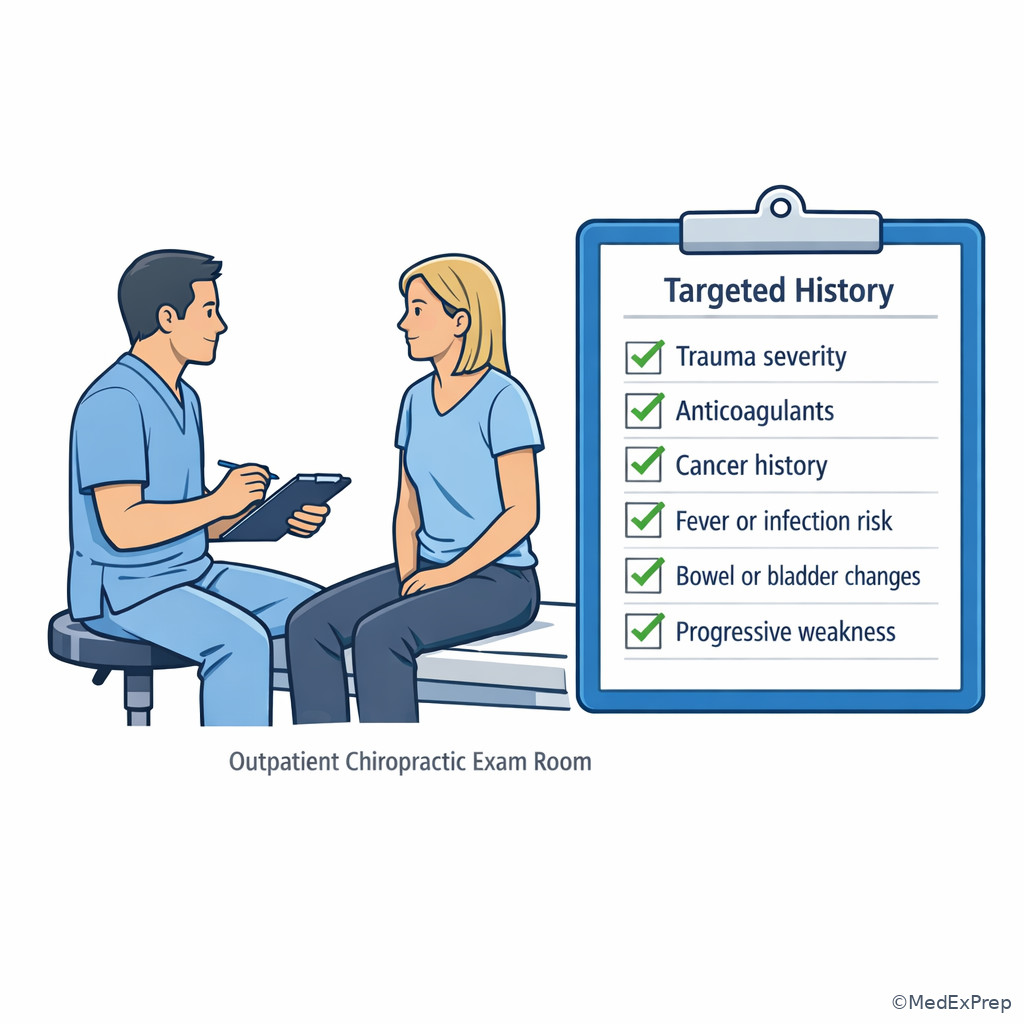
The single resolving rule is this: clarify the fact that could convert routine care into contraindicated care or urgent referral. In musculoskeletal items, the highest-value missing data points usually involve trauma severity, anticoagulant use, cancer history, fever/infection risk, bowel/bladder dysfunction, progressive weakness, and vascular symptoms. See Fig 6.
High-Yield Connection: This concept overlaps with informed consent, documentation of significant findings, and contraindication screening. The exam often pairs a common pain complaint with one missing safety detail that you must clarify before proceeding.
Clinician Action: Diagnose whether the information set is sufficient; Order additional testing only after identifying the missing management-changing fact; Treat only when critical contraindications have been clarified; Refer/Escalate if the missing information itself suggests urgent risk once elicited.
B Worked example
A 72-year-old woman presents with acute thoracolumbar pain after slipping in her kitchen. She has osteoporosis and chronic atrial fibrillation. She says she “feels bruised” but can walk. Exam shows localized tenderness and guarded motion. Her medications are not yet reviewed. The lead-in asks: “Which additional history point requires immediate clarification before treatment planning?”
Identify task: clarification. Extract key facts: older adult, fall, osteoporosis, possible fracture risk, atrial fibrillation. Apply rule: clarify the fact that most changes safety. Eliminate distractors: exact shoe type during fall, whether breakfast was skipped, and prior episodes of back pain are noncritical. Verify: anticoagulant use is the missing management-changing detail because trauma plus osteoporosis plus possible anticoagulation raises concern for significant injury and affects safety.
C Exam trap
Common wrong answer: ask about prior episodes of mechanical back pain.
Why it is tempting: recurrence history helps diagnose many routine spine complaints.
Single clue that eliminates it: this patient has acute trauma with fracture risk, so anticoagulant use or trauma severity changes management far more than recurrence history.
D Checkpoint
Question: A vignette asks which history detail requires immediate clarification before cervical treatment after new headache and neck pain. Which missing detail is highest value?
- Whether the patient has changed pillows recently
- Whether the patient also has diplopia or dysarthria
- Whether the patient prefers heat or ice
- Whether the patient had a similar self-limited episode 5 years ago
Correct answer: B.
- A: tempting because ergonomics matter in benign neck pain; wrong because it does not clarify immediate safety.
- B: right because associated focal neurologic or brainstem symptoms raise vascular concern and change management immediately.
- C: tempting because home care often appears in routine management; wrong because comfort preference does not decide safety.
- D: tempting because recurrence can reassure; wrong because past benign episodes do not exclude current danger.
Exam takeaway: When a stem asks what requires clarification, choose the missing fact that most changes safety or urgency rather than the fact that merely adds diagnostic detail.
flowchart TD
A[Question asks for clarification] --> B[List missing facts mentally]
B --> C{Which fact changes safety now?}
C -->|Trauma severity, anticoagulants, bowel/bladder, fever, cancer, vascular symptoms| D[Clarify first]
C -->|Only refines benign diagnosis| E[Lower priority]
D --> F[Then decide treat, image, or refer] Exam takeaway: The highest-yield follow-up question is the one that changes whether routine chiropractic care is safe to begin.
Exam Traps & Differentiators
The central trap in this topic is answering from the wrong task category. The exam rewards candidates who identify what must be decided now, not candidates who simply recognize a familiar condition. Related upcoming topics deepen this by teaching which facts to extract first and how to make a safety-first final choice.
| Looks similar | But the task is different | Single discriminator |
|---|---|---|
| Most likely diagnosis | Most appropriate next step | One asks for a label; the other asks for an action now |
| Most appropriate imaging | Finding most strongly suggests | One selects a study; the other interprets a clue or result |
| Best initial management | Requires immediate referral | Urgency language overrides routine treatment planning |
| Most important additional history | Most likely diagnosis | Clarification items seek the missing management-changing fact |
| Mechanical onset after movement | Mechanical case safe for routine care | Associated red flags may convert a mechanical story into a referral case |
- If the stem says “most appropriate next step,” think action category first.
- If the stem says “requires immediate referral,” think red-flag triage before differential refinement.
- If the stem says “most appropriate imaging,” think is imaging indicated now?
- If the stem says “requires immediate clarification,” think what missing fact could make care unsafe?
- If the stem says “finding most strongly supports,” think one discriminator, not the whole case summary.
- If the options mix diagnoses and actions, think one whole category is likely wrong before you compare details.
Common traps & distractors: The most common wrong answer is the clinically true but task-mismatched option. It is tempting because it matches the symptoms. The single clue that removes it is the lead-in wording. A second frequent trap is choosing an imaging modality because you know what the modality shows, without first deciding that imaging is indicated. A third trap is continuing routine care after spotting a likely musculoskeletal diagnosis even though one red flag changes safety.
Review connection: The traps above test answer-category recognition. If any felt unfamiliar, revisit 1.1.1.1 Foundational cue: identify the task before interpreting the case and 1.1.1.3 Application cue: recognize safety-first wording and urgency language before attempting the Self-check quiz.
Algorithm / Approach
Exam takeaway: Use a fixed sequence—lead-in, answer category, red flags, discriminator, safety verification—to prevent task-mismatch errors.
Rapid Review
- Most appropriate next step → choose an action, not a diagnosis label.
- Requires immediate referral → urgency language overrides routine conservative care.
- Most strongly supports → pick the single discriminator, not the broadest summary.
- Most appropriate imaging → decide indication before modality.
- Clarification question → choose the missing fact that changes safety today.
- Mechanical onset → does not cancel red flags.
- Old imaging finding → often noise unless it changes current management.
- Prior similar episode → weak reassurance if current presentation has new danger features.
- Mixed option categories → one entire category may be rejectable immediately.
- Progressive neurologic deficit → management-changing clue, not just diagnostic detail.
- Cancer history with focal spine pain → think evaluation/referral before routine manipulation.
- Acute uncomplicated mechanical pain → usually favors conservative care and no immediate imaging.
- Vascular warning pattern in neck pain → routine cervical care becomes unsafe until evaluated.
Memory anchor: Q-C-S-D-V = Question type, Category of answer, Safety scan, Discriminator, Verify scope. Use it as your final pre-answer checklist.
Self-check quiz
1. A 34-year-old man with acute lumbar pain after gardening has normal strength, normal reflexes, and no red flags. The lead-in asks, “What is the most appropriate next step?” Which answer type should you look for first?
- A diagnosis label
- An action-oriented management choice
- An imaging interpretation
- An epidemiologic risk factor
2. A 41-year-old woman with intermittent neck pain and hand tingling has a normal neurologic exam. The lead-in asks, “Which finding most strongly supports the diagnosis?” What task category is being tested?
- Urgent referral
- Management planning
- Diagnostic discrimination
- Imaging modality selection
3. A 63-year-old man presents with thoracic pain for one month. He has osteoporosis and remote prostate cancer, plus mild chronic reflux. Exam shows focal spinous tenderness. The lead-in asks, “What is the most appropriate next step?” Which choice best matches the task recognition cue?
- Provide routine thoracic manipulation and reassess in 2 weeks
- Identify the likely pain generator as thoracic facet dysfunction
- Arrange appropriate evaluation/imaging and referral because the presentation may be serious
- Recommend only postural exercises because reflux may mimic thoracic pain
4. A 27-year-old woman has acute low back pain after lifting furniture yesterday. She has anxiety and mild asthma. Neurologic exam is normal, and there are no constitutional symptoms. The lead-in asks, “What is the most appropriate imaging study at this time?” Which option is best?
- Lumbar MRI now
- Lumbar CT now
- Plain radiographs now
- No immediate imaging
5. A 70-year-old woman presents after a minor fall with thoracolumbar pain. She has osteoporosis and atrial fibrillation. She can walk but has localized tenderness. The lead-in asks, “Which additional history detail requires immediate clarification before treatment planning?” Which choice is best?
- Whether she has tried heat before
- Whether she takes an anticoagulant
- Whether she had back pain 10 years ago
- Whether the fall occurred before breakfast
6. A 56-year-old man reports new neck pain and occipital headache after rotating his head while parking. He has hypertension and hyperlipidemia. He says he also felt briefly dizzy and nauseated, which he attributes to not eating lunch. The lead-in asks, “What is the most appropriate next step?” Which option best reflects correct task recognition?
- Treat as cervical strain with routine manipulation because the onset was mechanical
- Choose a diagnosis label such as cervicogenic headache and begin exercise therapy
- Recognize a vascular warning pattern and arrange urgent medical evaluation
- Observe for one week because dizziness can occur with pain
7. A 48-year-old woman presents with low back pain radiating to the leg for 5 days after moving boxes. She has type 2 diabetes and obesity. Straight-leg raise is positive, strength is full, reflexes are symmetric, and there is no saddle anesthesia or bowel/bladder change. The lead-in asks, “Which option best answers the question?”
- L5 radiculopathy due to disc herniation
- Conservative initial management with monitoring for worsening neurologic symptoms
- Immediate lumbar MRI to confirm the suspected diagnosis
- Emergency referral for cauda equina syndrome
8. A 68-year-old woman presents with mid-thoracic pain, fatigue, and reduced appetite for 6 weeks. She has osteoporosis and prior breast cancer in remission. Examination shows localized thoracic percussion tenderness without fever. The lead-in asks, “Which finding most strongly changes management away from routine chiropractic care?” Which option is best?
- Her pain is worse at the end of the day
- Localized bony tenderness with prior cancer history
- Reduced thoracic rotation on the right
- Mild temporary relief with rest
Answer key
1. Correct answer: B.
- A: Tempting because candidates often jump to the condition name first. Incorrect for this scenario because the lead-in asks for the most appropriate next step, which requires an action. Discriminating clue: “most appropriate next step.” Source: Bickley; Haldeman et al.
- B: Tempting because it may feel less precise than naming a diagnosis, but it is correct because action-oriented management is the correct answer category for a next-step question. Discriminating clue: the item asks what to do now. Source: Bickley; Haldeman et al.
- C: Tempting because some spine cases involve imaging decisions. Incorrect because no imaging result is presented and there are no red flags pushing interpretation. Discriminating clue: uncomplicated acute lumbar pain with normal exam. Source: ACR Appropriateness Criteria; Haldeman et al.
- D: Tempting because risk factors can matter in some stems. Incorrect because epidemiology does not match the requested answer type. Discriminating clue: the lead-in is management-focused, not background-risk focused. Source: Bickley.
2. Correct answer: C.
- A: Tempting because tingling can make candidates think of red flags. Incorrect because the lead-in asks for the finding that best supports the diagnosis, not whether referral is needed. Discriminating clue: “most strongly supports the diagnosis.” Source: Bickley; Magee.
- B: Tempting because diagnosis and management are closely linked. Incorrect because the item asks for a supporting finding, not a treatment plan. Discriminating clue: support-language points to diagnostic discrimination. Source: Magee.
- C: Correct because the item is testing which clue best distinguishes the suspected diagnosis from alternatives. Discriminating clue: it asks for a supporting finding rather than an action. Source: Bickley; Magee.
- D: Tempting because paresthesia can trigger thoughts of MRI or nerve imaging. Incorrect because no imaging decision is being requested. Discriminating clue: the task is interpretation of clinical findings. Source: ACR Appropriateness Criteria.
3. Correct answer: C.
- A: Tempting because many thoracic pain cases are mechanical and respond to manual care. Incorrect because osteoporosis, prior cancer, and focal tenderness are management-changing red flags. Discriminating clue: remote cancer history plus focal spinous tenderness. Source: ACR Appropriateness Criteria; Haldeman et al.
- B: Tempting because thoracic facet dysfunction could explain pain. Incorrect because a diagnosis label does not answer the management task and ignores safety. Discriminating clue: the lead-in asks for the next step, not the diagnosis. Source: Bickley.
- C: Correct because the task is management and the risk profile makes routine care unsafe until serious pathology is evaluated. Discriminating clue: prior cancer plus focal bony tenderness changes management. Source: ACR Appropriateness Criteria; Haldeman et al.
- D: Tempting because reflux can refer discomfort to the thorax. Incorrect because reflux does not explain the focal bony tenderness and does not safely address the red flags. Discriminating clue: localized spinal tenderness in a high-risk patient. Source: Bickley; ACR.
4. Correct answer: D.
- A: Tempting because MRI is highly informative for discs and neural structures. Incorrect because the first question is whether imaging is indicated; this uncomplicated acute case does not require immediate MRI. Discriminating clue: normal neurologic exam and no red flags. Source: ACR Appropriateness Criteria.
- B: Tempting because CT sounds comprehensive. Incorrect because there is no trauma pattern or bony emergency demanding CT. Discriminating clue: simple acute mechanical onset without red flags. Source: ACR Appropriateness Criteria.
- C: Tempting because plain films seem conservative. Incorrect because even radiographs are not routinely indicated in uncomplicated acute low back pain. Discriminating clue: no fracture risk, no cancer history, no infection features, no deficit. Source: ACR Appropriateness Criteria.
- D: Correct because the task is imaging selection and the proper first decision is that no immediate imaging is indicated. Discriminating clue: uncomplicated recent mechanical pain with normal neurologic findings. Source: ACR Appropriateness Criteria; Haldeman et al.
5. Correct answer: B.
- A: Tempting because self-care history can affect conservative planning. Incorrect because it does not meaningfully change immediate safety after trauma in an older osteoporotic patient. Discriminating clue: the question asks what requires immediate clarification. Source: Bickley.
- B: Correct because anticoagulant use after a fall can increase concern for significant injury and changes management urgency. Discriminating clue: trauma plus osteoporosis plus atrial fibrillation history. Source: Bickley; Haldeman et al.
- C: Tempting because prior back pain can influence baseline interpretation. Incorrect because past episodes do not outrank current fracture-risk screening. Discriminating clue: acute injury in a high-risk patient. Source: Bickley.
- D: Tempting because timing details can appear in vignette logic. Incorrect because breakfast timing does not alter safety or contraindication status. Discriminating clue: the item seeks the missing fact that changes management, not trivial context. Source: Bickley.
6. Correct answer: C.
- A: Tempting because the onset followed neck rotation, which resembles a mechanical strain. Incorrect because associated occipital headache and dizziness create a vascular warning pattern that makes routine cervical care unsafe. Discriminating clue: acute neck pain plus neurologic/vascular-type symptoms after neck movement. Source: Haldeman et al.; Biller et al.
- B: Tempting because cervicogenic headache is a plausible label in neck-pain cases. Incorrect because the question asks for the next step, and a label does not resolve the immediate safety issue. Discriminating clue: “most appropriate next step” with vascular warning signs. Source: Bickley; Biller et al.
- C: Correct because the task is management and the associated symptoms raise concern requiring urgent medical evaluation rather than routine office treatment. Discriminating clue: occipital headache plus dizziness in the context of acute neck pain. Source: Biller et al.; Haldeman et al.
- D: Tempting because transient dizziness may seem nonspecific. Incorrect because watchful waiting is unsafe when vascular warning features are present. Discriminating clue: the symptom cluster changes safety immediately. Source: Biller et al.
7. Correct answer: B.
- A: Tempting because the symptom pattern does suggest radicular irritation. Incorrect for this specific question because a diagnosis label alone does not answer the likely management-focused task. Discriminating clue: the vignette supports uncomplicated radicular symptoms without red flags, making the answer about action rather than label. Source: Bickley; Haldeman et al.
- B: Correct because in a short-duration case with no progressive deficit or cauda equina features, conservative initial management with clear monitoring instructions best matches the likely board intent. Discriminating clue: full strength, symmetric reflexes, no bowel/bladder change, no saddle anesthesia. Source: ACR Appropriateness Criteria; Haldeman et al.
- C: Tempting because imaging can confirm the suspected diagnosis. Incorrect because immediate MRI is not the best first step in an uncomplicated recent presentation without red flags. Discriminating clue: benign neurologic exam despite radiating pain. Source: ACR Appropriateness Criteria.
- D: Tempting because leg pain can make candidates think of serious nerve compression. Incorrect because the hallmark clues of cauda equina are absent. Discriminating clue: no saddle anesthesia or bowel/bladder dysfunction. Source: Haldeman et al.; ACR.
8. Correct answer: B.
- A: Tempting because mechanical pain can worsen later in the day. Incorrect because this detail does not outweigh the concerning risk profile. Discriminating clue: timing pattern is weaker than the red-flag history. Source: Bickley.
- B: Correct because prior cancer history plus localized bony tenderness is a management-changing clue that shifts the case away from routine chiropractic care until serious pathology is assessed. Discriminating clue: focal thoracic tenderness in a patient with prior malignancy. Source: ACR Appropriateness Criteria; Haldeman et al.
- C: Tempting because restricted motion is common in benign thoracic complaints. Incorrect because it is nonspecific and does not explain the systemic concern. Discriminating clue: reduced rotation is common noise compared with red flags. Source: Magee.
- D: Tempting because relief with rest often suggests a musculoskeletal source. Incorrect because transient relief does not neutralize the concerning history and exam. Discriminating clue: serious pathology can still have partial positional or rest-related variation. Source: Bickley; ACR.
Keep going with the full NBCE Part III Prep Course (NBCE III)
You just studied the way members do, in the same lesson interface. Full access unlocks every lesson, the question bank and flashcards for a full year.
One payment · 1 year of access · No auto-renewal