1.1.1 - Signalment And Context Clues
Signalment And Context Clues
What you'll learn
- DOMAIN: Cross-species Clinical Reasoning → Signalment interpretation — Use species, breed, age, sex, reproductive status, and use/production role to narrow the most likely disease categories before ordering tests.
- DOMAIN: Cross-species Clinical Reasoning → Context-based differential framing — Recognize how environment, management, herd/flock status, season, and travel/exposure clues change the safest next diagnostic step.
- DOMAIN: Small Animal / Equine / Food Animal → Differential diagnosis — Distinguish pattern-rich signalment clues from tempting but low-value details in NAVLE-style stems.
- DOMAIN: Cross-species Clinical Reasoning → Diagnostic test selection — Choose the next best test or first action by combining signalment with urgency, contagious risk, and food-safety context.
- DOMAIN: Cross-species Clinical Reasoning → Client communication implications — Identify when signalment and context require isolation, residue-awareness, or referral rather than routine outpatient management.
- DOMAIN: Species/Clinical Area → Subskill Cross-species Clinical Reasoning → Extract signalment clues from the stem
- DOMAIN: Species/Clinical Area → Subskill Cross-species Clinical Reasoning → Convert context into ranked differentials
- Species/context tags: canine, feline, equine, bovine, small ruminant, swine/poultry flock, mixed/population-level
- Clinical competency tags: diagnosis, differential diagnosis, diagnostic test selection, diagnostic interpretation, public health/zoonosis, client communication implications
Why it matters
- Many NAVLE stems can be solved before lab interpretation if you correctly weight signalment and management context.
- The exam often hides the answer in one species-specific clue while surrounding it with noisy but tempting details.
- Correct early interpretation improves triage, test selection, client communication, and biosecurity decisions.
- Food-animal and herd-level cases especially depend on context clues because public-health and residue implications change the next step.
Key Terms & Must-Know Facts
1.1.1.1 Key terms
- Signalment — Species, breed, age, sex, reproductive status, and sometimes use or production class.
- Context clue — Any non-laboratory information that changes differential ranking or urgency.
- Chief complaint — Owner-observed concern, not yet converted into a medical problem.
- Production stage — Lactating, dry, periparturient, grower, finisher, layer, broiler, breeding animal.
- Management system — Indoor, pasture, feedlot, barn, multi-cat household, shelter, boarding, herd/flock setting.
- Exposure history — Travel, new additions, wildlife contact, raw diet, toxin access, vector exposure.
- Life stage disease bias — Diseases strongly linked to neonates, juveniles, adults, geriatrics.
- Breed predisposition — A breed-associated increase in likelihood, not a diagnosis by itself.
- Spay/neuter status — A clue that can strongly shift reproductive, endocrine, and behavioral differentials.
- Sentinel clue — One fact in the stem that should dominate your ranking because it sharply changes probability.
- Noise — Details included to mimic real practice or lure you toward a wrong answer.
- Herd problem — A pattern involving multiple animals, requiring population-level thinking.
- Zoonotic flag — A clue that changes PPE, isolation, and client advice priorities.
1.1.1.2 Must-know facts
- Species is usually the highest-value clue; never interpret a sign as if all species behave the same way.
- Age often outranks breed when deciding common versus rare disease categories.
- Intact status matters most when reproductive disease is on the table.
- Production stage is often the key in dairy and small-ruminant cases.
- Herd/flock involvement pushes infectious, toxic, nutritional, and management causes upward.
- A single affected animal in a group does not exclude management disease, but many affected animals strongly supports it.
- Travel, boarding, shows, and new-animal introductions are high-yield infectious exposure clues.
- Breed predisposition should refine a list, not replace lesion localization or basic epidemiology.
- When a stem includes food-animal context, always think about isolation, withdrawal-awareness, and public-health implications.
- On exams, the best answer often comes from asking: “What one clue most changes pretest probability?”
Core content
1.1.1.3 Species, age, and use: the first pass on every stem
A Explanation
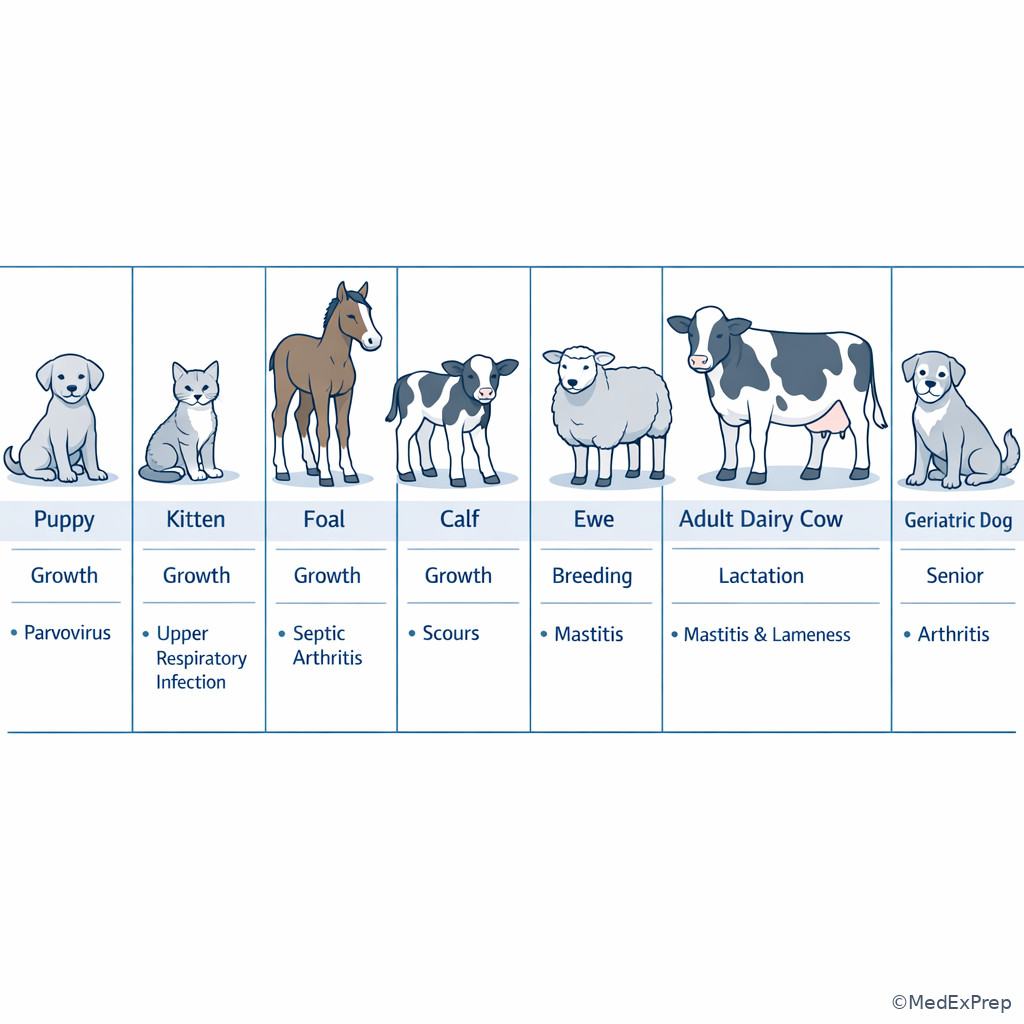
The first decision conflict in a NAVLE stem is not “What is the diagnosis?” It is “Which disease families even belong in this animal?” Species, age, and use immediately remove large portions of the differential. A coughing adult horse, a dyspneic brachycephalic dog, a scouring neonatal calf, and a down fresh dairy cow may all present with vague weakness or poor performance, but the governing rule differs because baseline risk differs. Choose the answer that fits the species-life-stage pattern; reject answers that are only correct in another species or age group. A young animal makes congenital, developmental, parasitic, infectious, and nutrition-related problems more likely. A geriatric patient makes degenerative, neoplastic, endocrine, chronic organ dysfunction, and age-associated immune patterns more likely. Working role or production class adds another layer: performance horse, late-gestation ewe, peak-lactation dairy cow, shelter kitten, and backyard layer each carry different default risks.
WHY THIS IS TESTED: Exam stems reward pretest probability. Before you interpret a lab, the test writer wants to know whether you can avoid impossible or low-probability diagnoses based on signalment alone. See Fig 1.
Key rule: Species narrows the diagnostic universe; age and use rank the options within it.
Exam takeaway: Start with species and life stage before interpreting any additional clue because they create the highest-yield pretest probability shift.
flowchart TD
A[Stem begins] --> B[Identify species]
B --> C[Identify age or life stage]
C --> D[Identify sex and reproductive status]
D --> E[Identify use or production class]
E --> F[Rank likely disease families]
F --> G[Choose next test or action]
Exam takeaway: Compare juvenile, adult, geriatric, and production-stage animals side by side to remember how age shifts default differentials.
B Worked example
A 10-day-old Holstein calf from a dairy with several recent spring calvings is presented for weakness and watery diarrhea. The calf was born unassisted, has a slightly enlarged umbilicus, and the owner also mentions a healed superficial ear notch from farm identification, which is distracting. Temperature is mildly low, suckle reflex is weak, and two other calves in adjacent pens developed diarrhea this week. The task is to choose the most likely disease category and next step, not to name every pathogen. Extract key facts: neonatal bovine, herd context, multiple affected calves, acute diarrhea, weakness. Apply the rule: in neonates, infectious enteric disease and failure-of-transfer–related vulnerability rank high; the ear notch does not localize disease. Eliminate distractors such as abomasal displacement, which fits older calves or adult cattle poorly, and chronic parasitism, which is less likely at 10 days. Verify by asking what is safest now: assess hydration, isolate as indicated, and select fecal/testing strategy or supportive care based on severity rather than chasing an irrelevant detail.
C Exam trap
Common wrong answer: A breed-predisposition diagnosis chosen before species and age are considered.
WHY IT IS TEMPTING: Test takers remember one classic association and jump to it when they see the breed.
SINGLE CLUE THAT ELIMINATES IT: The life stage is wrong. A disease common in middle-aged or older animals should drop in priority in neonates or juveniles even if the breed looks “classic.”
D Checkpoint
Question: A 7-year-old Quarter Horse gelding used for trail riding presents with acute pawing, flank watching, and decreased fecal output after sudden diet change. Which clue most strongly changes the initial differential ranking?
- Species — Tempting because many diseases can cause pain, and this is correct because equine species immediately raises colic syndromes as a primary framework.
- Color — Tempting because owners often emphasize coat changes, but it is wrong because color rarely outranks species for first-pass differential construction.
- Microchip status — Tempting as a unique detail, but it is wrong because identification status does not affect medical probability here.
- Trail-riding use alone — Tempting because exercise and management matter, but it is wrong as the single strongest clue because use refines the list after species has already established the main syndrome group.
Answer: A. Species.
1.1.1.4 Sex, reproductive status, and production stage: clues that can completely reorder the list
A Explanation
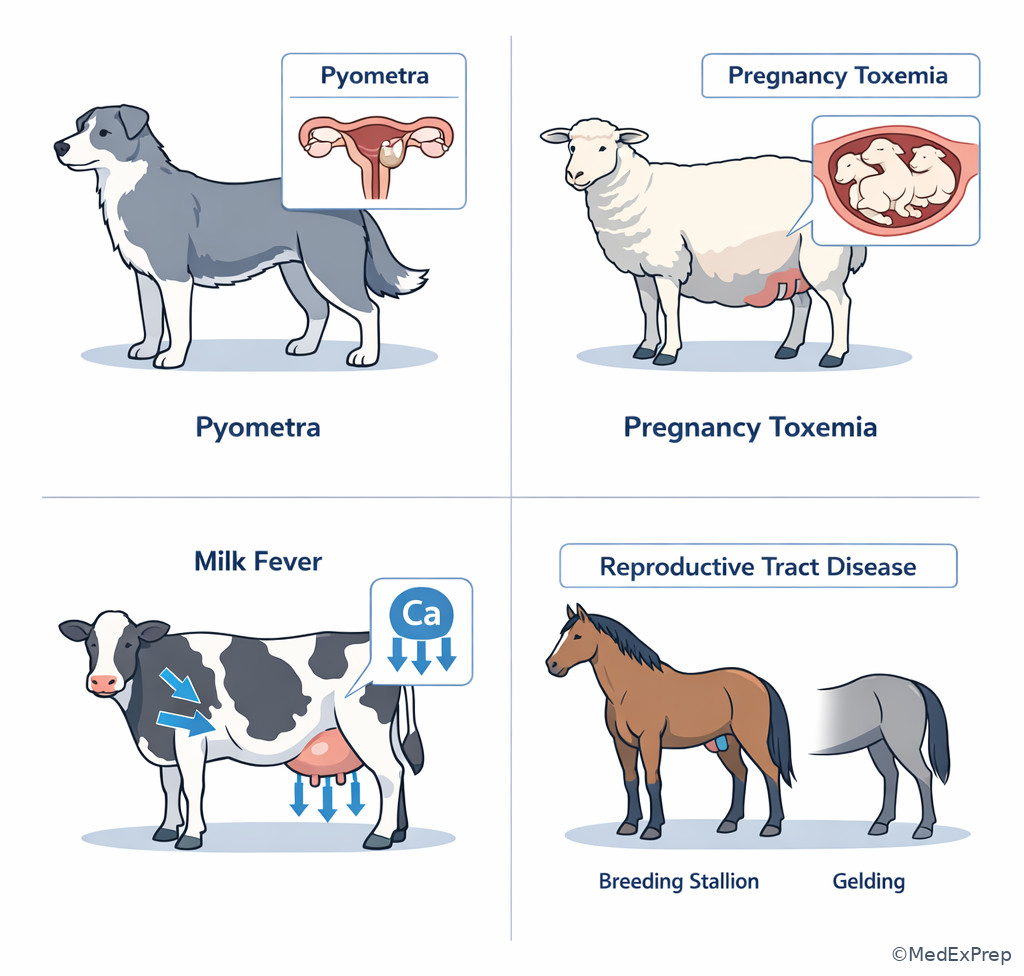
Sex and reproductive status are not decorative details. In many NAVLE stems they are the single finding that resolves the choose-versus-reject conflict. An intact female dog with lethargy, polyuria, and vaginal discharge should trigger a different rule set than a spayed female with similar malaise. A late-gestation ewe off feed differs from a nonpregnant ewe with weight loss. A fresh dairy cow with weakness differs from a dry cow with chronic poor doing. When the stem gives “intact,” “postpartum,” “late gestation,” “peak lactation,” “newly fresh,” or “breeding male,” treat that as a sentinel clue. Reproductive physiology changes disease probability, urgency, and the safest next step. In production animals, stage of lactation or gestation often matters more than breed.
WHY THIS IS TESTED: These clues let the exam test whether you can prioritize common, high-consequence conditions such as pyometra, dystocia-related complications, milk fever, ketosis, pregnancy toxemia, or mastitis-linked systemic illness without needing advanced diagnostics. See Fig 2.
Key rule: If reproductive status changes physiology, it changes pretest probability. Do not treat intact, pregnant, lactating, or recently parturient animals as generic adults.
Exam takeaway: Intact, pregnant, postpartum, and lactating status can outweigh many minor findings when ranking differentials and urgency.
flowchart TD
A[Adult animal] --> B{Sex / reproductive status known?}
B -->|Yes| C[Intact female]
B -->|Yes| D[Pregnant or postpartum]
B -->|Yes| E[Lactating / fresh]
B -->|Yes| F[Intact male]
C --> G[Reproductive and uterine disease rises]
D --> H[Gestation and parturition disorders rise]
E --> I[Metabolic and mammary disease rises]
F --> J[Behavioral, reproductive, obstructive, or prostatic patterns may rise] Exam takeaway: Visualizing intact, pregnant, postpartum, and lactating states helps match physiology to likely disease patterns.
B Worked example
An 8-year-old intact female Labrador Retriever presents with two days of lethargy, decreased appetite, vomiting, and increased drinking. She has mild abdominal discomfort, a history of seasonal allergic dermatitis, and the owner mentions that her breath smells “metallic,” which is distracting. Temperature is \(103.5^\circ\)F, and there is a malodorous vulvar discharge. Identify the task: most likely diagnosis category and next best step. Extract key facts: older intact female, systemic illness, PU/PD, fever, vaginal discharge. Apply the rule: reproductive status plus discharge sharply elevates pyometra. Eliminate gastroenteritis, which fits vomiting but not the reproductive clue cluster; eliminate diabetes mellitus, which can cause PU/PD but not purulent vulvar discharge with fever. Verify by choosing stabilization, diagnostics, and surgical planning consistent with pyometra rather than chasing the metallic-breath comment.
C Exam trap
Common wrong answer: Gastroenteritis in an intact female with vomiting.
WHY IT IS TEMPTING: Vomiting and anorexia are common, familiar, and seem to explain the presentation.
SINGLE CLUE THAT ELIMINATES IT: The vaginal discharge in an older intact female reorders the list toward uterine disease until proven otherwise.
D Checkpoint
Question: A 5-year-old dairy cow is examined 24 hours after calving for weakness, cold ears, and reluctance to rise. Which context clue most strongly raises a metabolic rather than traumatic differential first?
- Recently fresh status — Tempting and correct because early postpartum timing strongly raises milk fever and other periparturient metabolic conditions.
- Black-and-white coat color — Tempting because Holsteins are common in exam stems, but color itself is not the physiologic driver.
- Prior hoof trim — Tempting because lameness can affect rising, but it does not explain the periparturient systemic pattern.
- Adult age alone — Tempting because older cows get more disease, but the immediate postpartum stage is the sharper discriminator.
Answer: A. Recently fresh status.
- The most common signalment clue that sharply changes probability in an adult female is intact versus spayed status.
- True or False: Breed should usually outrank age when they conflict. False.
- Name the 3 high-yield production-stage labels in large animal stems: late gestation, freshly postpartum, peak lactation.
1.1.1.5 Environment, exposure, and management: when context beats individual findings
A Explanation
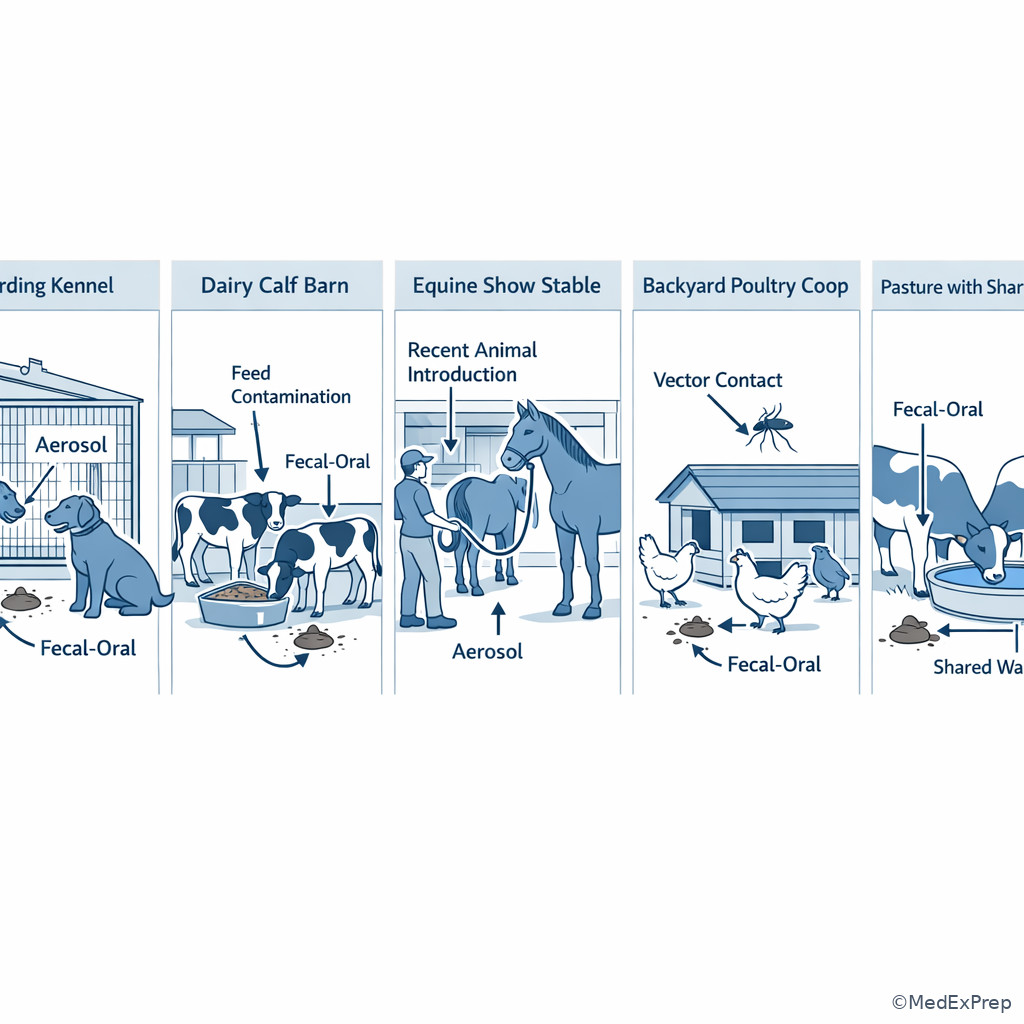
Middle-tier reasoning begins when you ask whether the case is best understood as an individual animal problem or a management/exposure problem. Context clues such as shelter residence, boarding kennel, cattery, recent travel, show exposure, pasture turnout, wildlife access, raw diet, feed change, standing water, poor ventilation, recent herd additions, and multiple affected animals can outrank isolated exam findings. The decision conflict is often choose infection/toxin/nutrition versus reject a sporadic unrelated disease. A coughing dog from a crowded boarding facility is not interpreted the same way as a single indoor dog with no exposure history. A flock with decreased egg production and respiratory signs is not solved by looking for one pet-bird disease. A group of calves scouring after weather stress and commingling demands herd-level framing. Management is not “background”; it is often the stem’s real question.
WHY THIS IS TESTED: NAVLE cases commonly assess whether you can connect population or exposure clues to the correct next step: isolate, sample the right animals, ask about feed, warn about zoonotic risk, or shift from an individual to herd/flock mindset. See Fig 3.
Key rule: If multiple animals share time, place, and exposure, move infectious, toxic, nutritional, and management causes up the list before rare individual disease.
Exam takeaway: When multiple animals share housing or management, think population-level causes before rare individual diagnoses.
flowchart LR
A[Case appears] --> B{One animal or many?}
B -->|One| C[Individual disease still possible]
B -->|Many| D[Shared exposure likely]
D --> E[Infectious]
D --> F[Toxic]
D --> G[Nutritional]
D --> H[Environmental / ventilation / management]
E --> I[Isolation and targeted testing]
F --> I
G --> I
H --> I Exam takeaway: Visual exposure mapping helps you recognize when management history should dominate the initial differential list.
B Worked example
A small backyard flock owner reports that five of 18 laying hens have decreased egg production, mild nasal discharge, and open-mouth breathing over three days. A recent ration change occurred, and a new rooster was introduced from a swap meet last week. One bird also has a healed footpad lesion, a distracting clue. Your task is not to name every avian respiratory pathogen; it is to choose the most appropriate framing and next step. Extract key facts: multiple birds, respiratory signs, drop in production, recent introduction, flock setting. Apply the rule: flock pattern plus introduction makes contagious respiratory disease and biosecurity priorities rise sharply. Eliminate a single-bird traumatic lesion explanation and isolated pododermatitis-related illness. Verify by choosing flock-level assessment, isolation/biosecurity, and appropriate diagnostic sampling rather than treating the footpad lesion as the organizing diagnosis.
C Exam trap
Common wrong answer: Focus on the one unusual lesion in one animal.
WHY IT IS TEMPTING: Unique details feel specific and therefore “testable.”
SINGLE CLUE THAT ELIMINATES IT: Multiple animals are affected in the same time frame, which is much more powerful evidence for shared exposure or contagious disease.
D Checkpoint
Question: A kennel houses 25 dogs. Four developed acute cough within 48 hours of a recent boarding intake. Which history element most strongly shifts the next step toward isolation and contagious respiratory disease workup?
- Several dogs affected after a new arrival — Tempting and correct because temporal clustering after introduction strongly supports contagious exposure.
- One dog is a brachycephalic breed — Tempting because airway disease is common in those breeds, but it does not explain the cluster.
- One dog had a mild heart murmur last year — Tempting because cough can be cardiac, but this clue does not fit the group pattern.
- Most dogs are adults — Tempting because age can influence severity, but the cluster and introduction matter more.
Answer: A. Several dogs affected after a new arrival.
1.1.1.6 Breed, conformation, and species-specific predispositions: useful shortcuts, dangerous anchors
A Explanation
Breed and conformation are high-yield clues, but only when used correctly. The decision conflict is choose predisposition as a probability-adjuster versus reject it as a standalone diagnosis. Breed should never erase stronger clues from age, species, reproductive status, or exposure. Brachycephalic dogs genuinely raise the probability of upper airway problems. Deep-chested dogs raise concern for GDV. Certain cat breeds have known cardiomyopathy patterns. Draft breeds and ponies create different equine expectations than Thoroughbreds or racehorses. Yet breed becomes dangerous when it causes anchoring. An older Boxer with collapse may not have arrhythmogenic disease if the stem screams hypoglycemia or intoxication. A brachycephalic dog with acute respiratory distress could still have aspiration pneumonia or heat stress. Use breed as a tiebreaker among plausible options, not a license to ignore the rest of the stem.
WHY THIS IS TESTED: Board questions often offer one answer that matches breed memory and another that better fits the total pattern. The exam wants the total pattern. See Fig 4.
Key rule: Breed predisposition increases likelihood; it does not overrule contradictory signalment or context.
Exam takeaway: Breed helps rank plausible options, but the correct answer must still fit age, context, and clinical pattern better than alternatives.
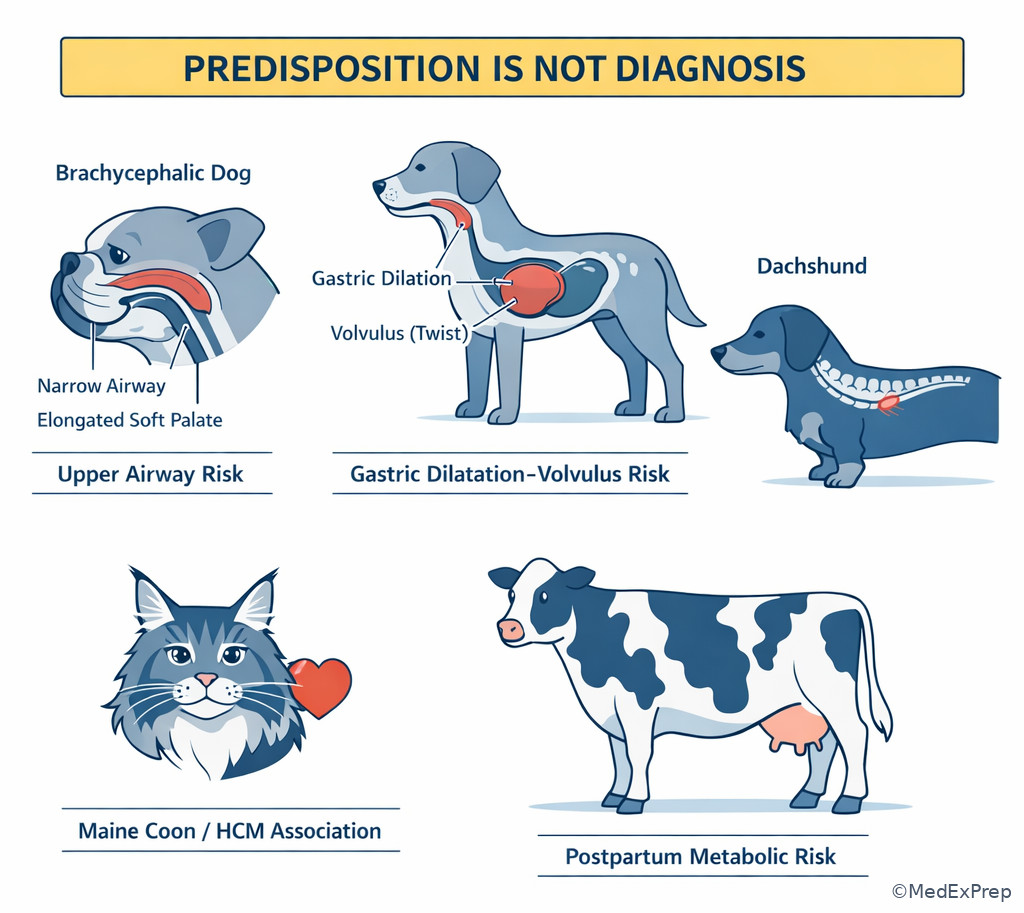
Exam takeaway: Body shape and structure can predict certain syndromes, but only after you confirm the rest of the stem agrees.
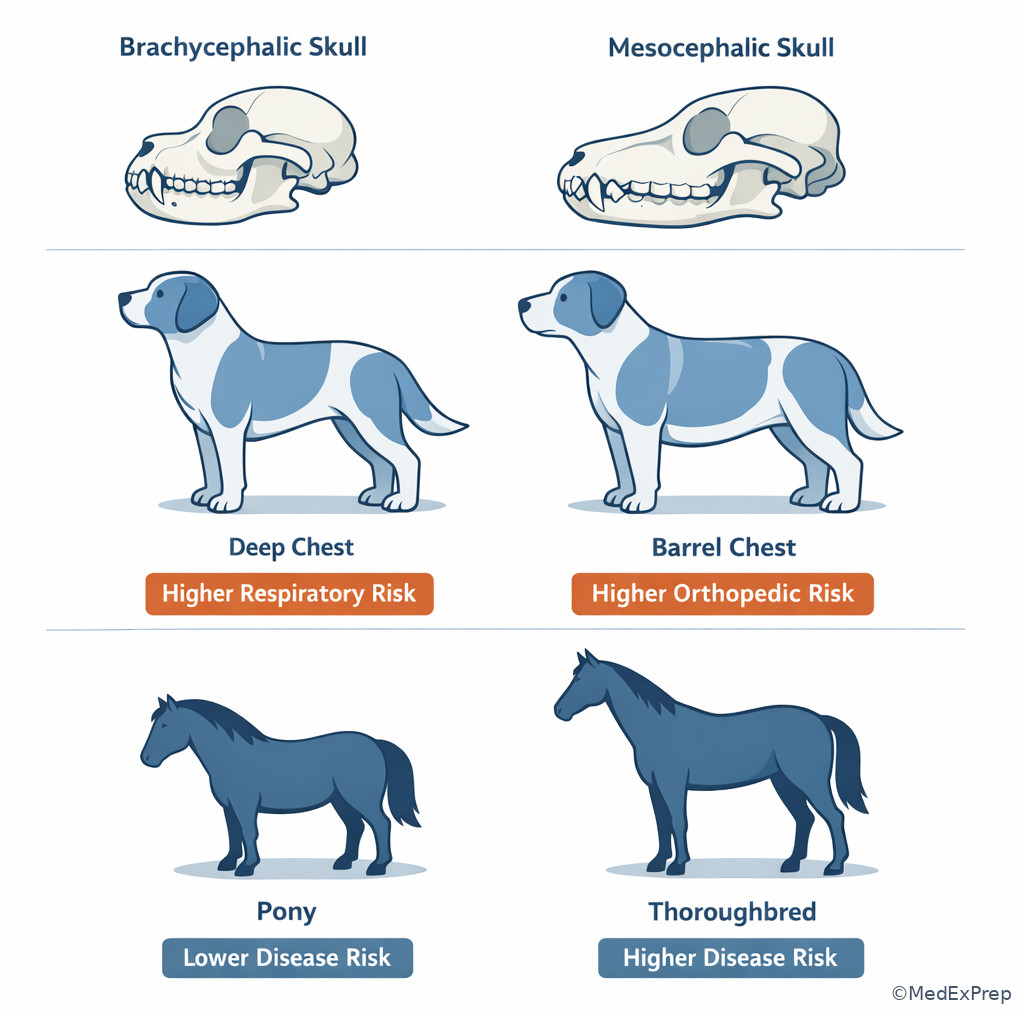
B Worked example
A 4-year-old English Bulldog presents in summer with acute noisy breathing, cyanosis, and collapse after outdoor activity. The owner reports a chronic snoring history, but also mentions the dog ate table scraps the night before, a tempting distractor. Identify task: most likely syndrome and first action. Extract key facts: brachycephalic breed, heat/exertion trigger, upper airway noise, cyanosis. Apply rule: breed/conformation supports upper airway obstruction, and the trigger plus respiratory pattern fits that framework better than GI disease. Eliminate pancreatitis or dietary indiscretion as primary explanation because the respiratory crisis and breed pattern dominate. Verify by selecting airway-focused stabilization and cooling/supportive measures rather than abdominal diagnostics as the first step.
C Exam trap
Common wrong answer: Overcorrecting away from breed clues and dismissing them entirely.
WHY IT IS TEMPTING: Students learn not to anchor, then swing too far and ignore a very meaningful predisposition.
SINGLE CLUE THAT ELIMINATES IT: The major clinical pattern directly matches the breed-linked syndrome, not just the breed name alone.
D Checkpoint
Question: Which statement best reflects the safest exam approach to breed clues?
- Breed should establish the diagnosis when it matches a classic association — Tempting because board prep often emphasizes associations, but it is wrong because whole-stem fit still controls.
- Breed is low value and should usually be ignored — Tempting as an anti-anchoring strategy, but it is wrong because breed can substantially shift probability.
- Breed should be used to refine plausible options after stronger epidemiologic and clinical clues are considered — Tempting and correct because it balances usefulness with anti-anchoring.
- Breed outranks management history in most stems — Tempting in classic breed syndromes, but it is wrong because shared exposure or herd context may be far more important.
Answer: C. Breed should refine plausible options after stronger clues are considered.
- True or False: Breed should overrule a conflicting life-stage clue. False.
- The best use of breed is as a tie-breaker among plausible options.
- Name one conformation clue with high exam value: brachycephalic airway risk or deep-chested dog GDV risk.
1.1.1.7 Putting it together: identify the sentinel clue, ignore noise, and choose the safest next step
A Explanation
Integration starts when multiple clues compete. The examinee must choose which clue should dominate the next step. The rule is to identify the sentinel clue: the single fact that most changes probability or urgency. Sometimes that is species; sometimes it is intact status, group involvement, fresh-cow timing, or a zoonotic exposure. Noise includes colorful but medically weak details, old unrelated diagnoses, minor laboratory abnormalities that do not explain the case, or owner comments that sound dramatic but are nonspecific. The choose-versus-reject framing becomes: choose the answer that best fits the sentinel clue and immediate clinical task; reject the answer that only explains the distracting clue. This is where exam discipline matters. Ask: What is the question asking? Diagnosis? Best next test? Immediate stabilization? Isolation? If the task is urgent triage, choose the safe action linked to the high-risk clue, not the intellectually interesting diagnosis.
WHY THIS IS TESTED: NAVLE stems deliberately mix high-yield clues with irrelevant or secondary details. Success depends on disciplined weighting, not memorizing isolated factoids. See Fig 5.
Key rule: The best answer explains the main pattern and the clinical task; distractors usually explain only one noisy detail.
Exam takeaway: Identify the single clue that changes urgency or probability the most, then reject options built mainly on distracting details.
flowchart TD
A[Read the stem] --> B[What is the task?]
B --> C[Pick the highest-value clue]
C --> D[Ignore weak or unrelated details]
D --> E[Match answer to pattern and safety]
E --> F[Verify species and context fit]
Exam takeaway: Seeing high-value clues highlighted separately from distractors trains faster board-style reasoning.
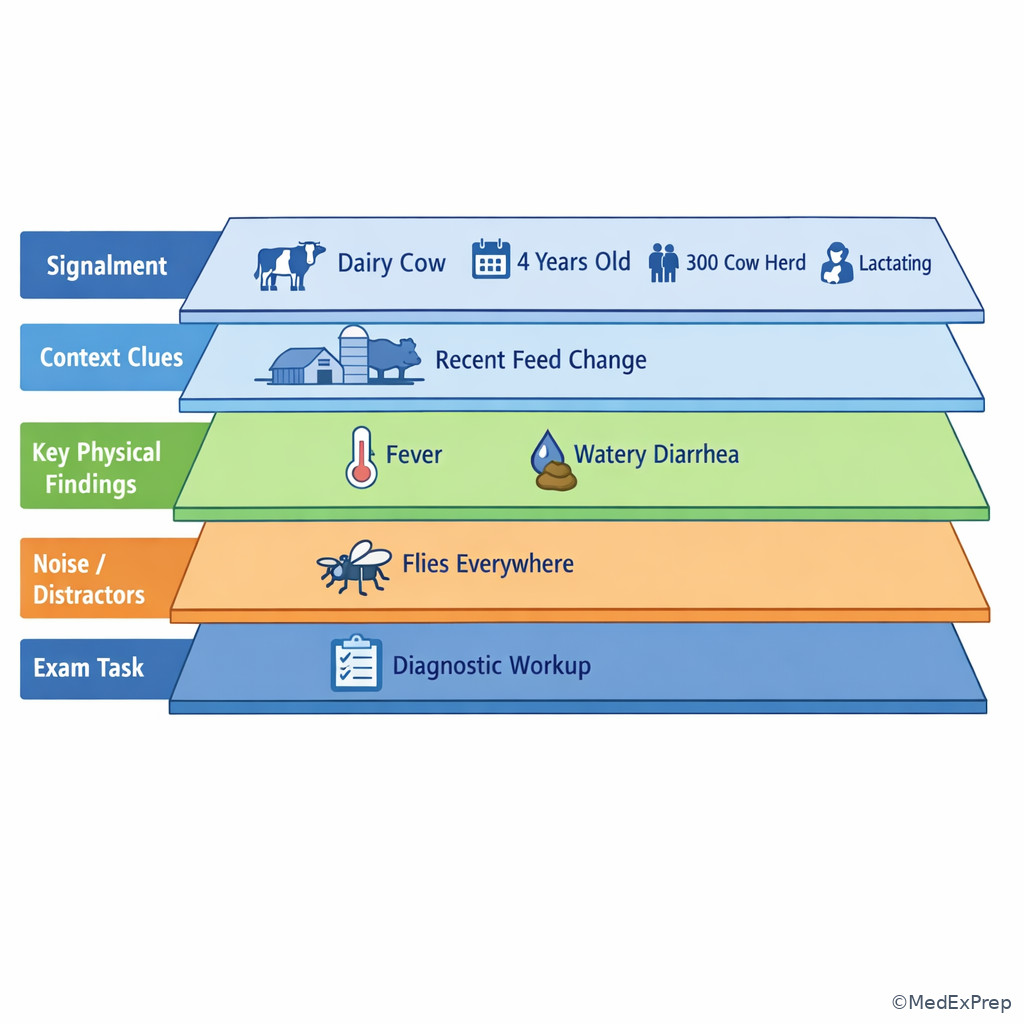
B Worked example
A 3-year-old intact male cat from a multi-cat household is presented for acute stranguria, vocalization in the litter box, and repeated attempts to urinate. He is overweight, stressed by a recent move, and has a mild old corneal scar. The stem asks for the most appropriate next step. Identify task: triage/action, not final subtype diagnosis. Extract key facts: male cat, acute lower urinary signs, repeated unproductive attempts. Sentinel clue: possible urethral obstruction risk. Apply the rule: when the high-risk clue suggests a potentially emergent outflow obstruction, immediate assessment/stabilization outranks deeper classification of feline lower urinary tract disease. Eliminate options centered on chronic diet counseling alone or ophthalmic workup related to the corneal scar. Verify by choosing the action that addresses the potentially life-threatening problem first.
C Exam trap
Common wrong answer: Long-term management advice chosen before emergent stabilization.
WHY IT IS TEMPTING: The case contains true chronic risk factors such as obesity and stress.
SINGLE CLUE THAT ELIMINATES IT: Repeated unproductive attempts to urinate in a male cat make obstruction risk the immediate priority.
D Checkpoint
Question: Which stem detail is most likely to be noise in a case of an older intact female dog with fever, depression, PU/PD, and purulent vulvar discharge?
- Intact status — Tempting to ignore because it is baseline signalment, but it is wrong to call it noise because it is a sentinel clue.
- Purulent vulvar discharge — Tempting to dismiss as nonspecific discharge, but it is wrong because it strongly localizes disease.
- History of mild seasonal pruritus — Tempting because chronic allergy histories are familiar, and this is correct because it does little to explain the current systemic reproductive pattern.
- Fever — Tempting because many diseases cause fever, but it is wrong because it still supports the current serious illness pattern.
Answer: C. History of mild seasonal pruritus.
1.1.1.8 Public health, food-animal, and zoonotic context: when the next step is not just about the patient
A Explanation
The final integration layer is recognizing when signalment and context change obligations beyond the individual animal. Food-animal species, lactation status, herd involvement, abortion storms, neurologic clusters, sudden death patterns, and known zoonotic exposures should trigger broader thinking: isolation, PPE, residue-awareness, milk or meat supply implications, and the need to confirm local reporting requirements. The decision conflict becomes choose patient-only reasoning versus reject it in favor of patient-plus-population safety reasoning. In companion animals, raw diet exposure, shelter clusters, suspected ringworm, leptospirosis risk, or bite wounds may change client counseling and clinic workflow. In livestock, periparturient disease, mastitis patterns, multiple abortions, and diarrheal outbreaks can affect more than one animal and may have food-safety or public-health implications.
WHY THIS IS TESTED: NAVLE expects entry-level veterinarians to recognize when a case requires broader safety framing, even if jurisdiction-specific rules vary. The correct answer often emphasizes safe recognition and appropriate next steps rather than legal specifics. See Fig 6.
Key rule: In food animals and zoonotic scenarios, the safest answer often includes biosecurity, client guidance, and confirmation of local protocols rather than narrow patient treatment alone.
Exam takeaway: Species and management context can make biosecurity and food-safety actions part of the best next step.
flowchart TD
A[Animal case] --> B{Food animal or zoonotic risk?}
B -->|No| C[Routine patient-centered next step]
B -->|Yes| D[Add PPE and isolation thinking]
D --> E[Consider herd/flock impact]
E --> F[Consider food-safety or residue awareness]
F --> G[Confirm local reporting and protocol requirements] Exam takeaway: Visual reminders of PPE, isolation, herd logs, and milk/meat awareness reinforce that some stems extend beyond individual treatment.
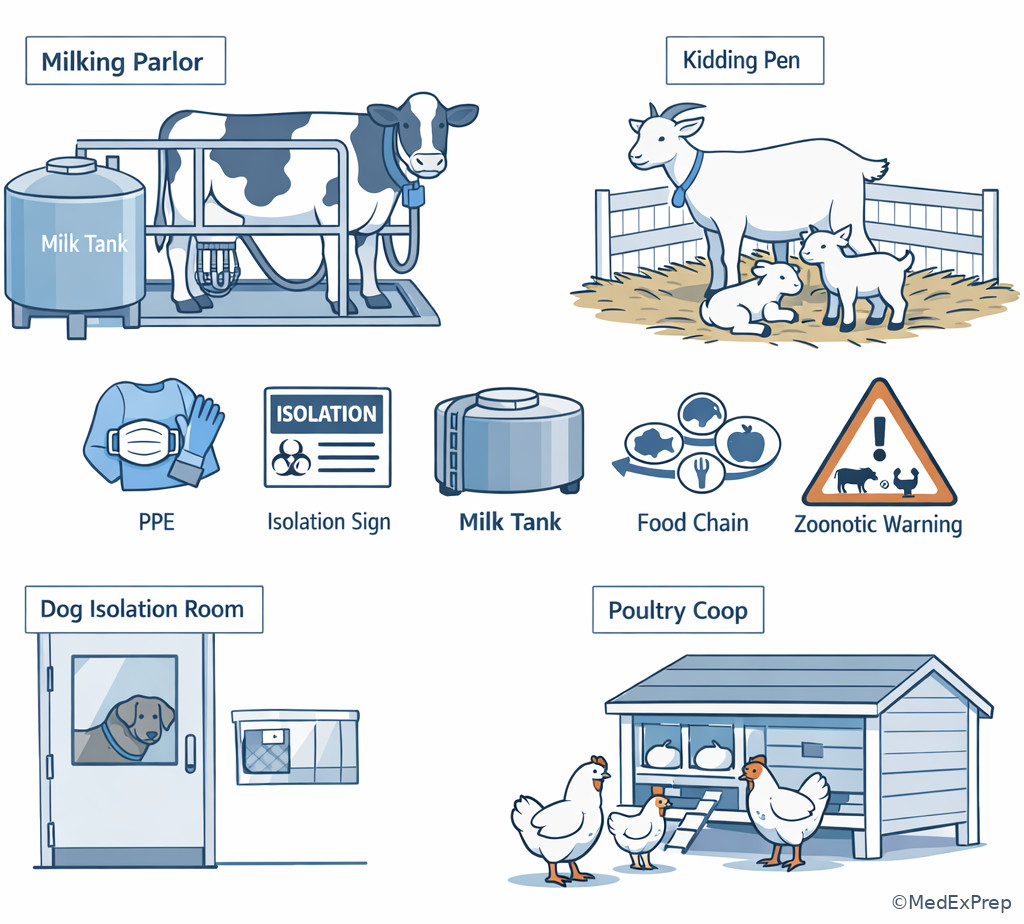
B Worked example
A 2-year-old dairy goat from a small farm is examined for late-gestation abortion. Two does aborted in the same week. The owner’s children handle the goats daily, and raw milk is occasionally consumed on-farm. One doe also has a small chronic callus over the carpus, which is distracting. Identify task: safest next step and communication priority. Extract key facts: multiple abortions, small-ruminant herd context, human exposure, food consumption context. Apply the rule: abortion cluster in a food-producing species raises infectious and zoonotic concern; response must include isolation, careful sample handling, and owner counseling. Eliminate a narrow musculoskeletal workup for the carpal callus or simple symptomatic treatment only. Verify by choosing the answer that protects people and the herd while pursuing diagnosis.
C Exam trap
Common wrong answer: Immediate patient-only treatment without herd or human-safety instructions.
WHY IT IS TEMPTING: The exam often trains students to think about the individual animal first.
SINGLE CLUE THAT ELIMINATES IT: More than one abortion plus human exposure means the case has a population and public-health dimension.
D Checkpoint
Question: Which stem detail most strongly signals that the best next step should include biosecurity and public-health counseling?
- An individual dog with chronic otitis — Tempting because chronic disease still needs management, but it does not inherently trigger a public-health response.
- A horse with a long-standing sarcoid — Tempting because equine lesions can prompt concern, but this is not the strongest public-health trigger.
- Multiple late-gestation abortions in goats with close human contact — Tempting and correct because cluster plus human exposure should broaden the response beyond one patient.
- A cat with one episode of vomiting after diet change — Tempting because diets can implicate food safety, but this is far less compelling than an abortion cluster in small ruminants.
Answer: C. Multiple late-gestation abortions in goats with close human contact.
Exam Traps & Differentiators
Common traps & distractors: The NAVLE often places one classic clue next to a more important contextual clue. Your job is not to recognize every association; it is to rank them correctly.
1.1.1.9 Most common wrong answer and why
The most common wrong answer is the option built around the most memorable but not most important clue. Examples include choosing a breed-linked diagnosis despite the wrong age, choosing an individual disease despite a clear herd outbreak, or choosing chronic management advice when the stem actually signals an emergency. That answer is tempting because it is partially true. It becomes wrong because one stronger clue should dominate.
1.1.1.10 Looks similar but isn't
| Pattern in stem | Tempting interpretation | Correct weighting move | Single clue that decides it |
|---|---|---|---|
| Older intact female dog + PU/PD + discharge | Simple urinary tract disease | Move uterine disease above urinary disease | Intact status plus purulent vulvar discharge |
| Cluster of respiratory cases after new arrival | Several unrelated sick individuals | Think contagious/shared exposure first | Multiple affected animals in a short time frame |
| Brachycephalic dog with acute dyspnea after heat/exercise | Primary GI upset because of dietary indiscretion | Prioritize upper airway crisis framework | Noisy breathing with conformation-linked risk |
| Fresh dairy cow recumbent after calving | Orthopedic injury first | Move metabolic periparturient causes up | Immediate postpartum timing |
| Multiple abortions in small ruminants | One reproductive accident | Add zoonotic and herd-safety response | More than one abortion with human exposure |
1.1.1.11 If the stem says ___, think ___
- If the stem says “intact female”, think reproductive disease must be considered before common medical distractors.
- If the stem says “fresh cow”, think periparturient metabolic disease high on the list.
- If the stem says “multiple animals affected”, think shared exposure, infectious, toxic, nutritional, or management problem.
- If the stem says “recent boarding/show/new herd addition”, think exposure history is a major diagnostic clue.
- If the stem says “male cat straining repeatedly with little urine”, think possible obstruction and triage urgency.
- If the stem says “late gestation abortion cluster”, think biosecurity and zoonotic counseling as part of the next step.
Tables
1.1.1.12 Summary/reference table: high-yield clue hierarchy
| Clue type | Typical exam value | Best use | Common misuse |
|---|---|---|---|
| Species | Very high | Defines plausible disease universe | Ignoring species-specific disease patterns |
| Age/life stage | Very high | Ranks congenital/infectious versus chronic/neoplastic/endocrine categories | Choosing geriatric diseases in neonates |
| Sex/reproductive status | Very high when relevant | Prioritizes reproductive and periparturient disorders | Treating intact and neutered animals as equivalent |
| Production stage/use | High | Explains metabolic and management-linked disease risk | Ignoring fresh/lactating/late-gestation timing |
| Environment/exposure | High | Promotes infectious, toxic, and herd/flock causes | Viewing management history as background only |
| Breed/conformation | Moderate to high | Refines plausible options | Anchoring on a classic breed association |
| Minor chronic unrelated history | Low | Context only if it changes current risk | Confusing noise with the organizing diagnosis |
1.1.1.13 Comparison table: when one clue outweighs another
| Competing clues | Usually stronger clue | Why | Example |
|---|---|---|---|
| Breed vs age | Age | Life-stage epidemiology often excludes whole disease classes | Neonate with “classic breed disease” still more likely has neonatal illness |
| Individual lesion vs cluster of cases | Cluster | Shared timing/exposure implies population cause | Flock respiratory outbreak despite one bird’s foot lesion |
| Chronic risk factor vs acute emergency clue | Emergency clue | Urgency changes the next best step immediately | Male cat with repeated unproductive urination attempts |
| Color/appearance detail vs reproductive status | Reproductive status | Physiology changes disease probability substantially | Fresh cow down after calving |
| One lab oddity vs species-context pattern | Species-context pattern | Exam stems often include mild distractor abnormalities | Mild old murmur in kennel cough cluster |
1.1.1.14 Differential/classification table: common context patterns by species
| Species/context | Signalment clue | Disease categories that rise | Immediate framing question |
|---|---|---|---|
| Canine | Older intact female | Reproductive tract disease, especially uterine disease | Is this systemic illness linked to reproductive status? |
| Feline | Male cat with acute lower urinary signs | Urethral obstruction/FLUTD spectrum | Is there an emergency outflow problem? |
| Equine | Adult horse with acute abdominal pain | Colic syndromes | Medical versus surgical pattern; referral need? |
| Dairy cattle | Fresh postpartum cow | Periparturient metabolic and uterine disease | Does timing after calving explain the syndrome? |
| Calves/lambs/kids | Neonate in group housing | Infectious enteric disease, failure-of-transfer–linked vulnerability | Is this an individual case or herd-management problem? |
| Poultry flock | Production drop with multiple affected birds | Contagious respiratory/enteric/management disease | What flock-level exposure changed recently? |
| Small ruminants | Abortion cluster with human contact | Infectious reproductive disease with zoonotic concern | What biosecurity and safety steps are needed now? |
1.1.1.15 Additional quick-reference table: likely noise versus likely signal
| Likely signal | Likely noise | How to tell |
|---|---|---|
| Fresh postpartum timing | Coat color | One changes physiology; the other rarely changes risk meaningfully |
| Multiple animals affected | Old healed scar | One suggests shared cause; the other often does not fit time course |
| Intact status with discharge | Mild chronic allergy history | One localizes current disease; the other may be unrelated background |
| Recent travel/boarding/introduction | Owner’s dramatic wording without objective signs | Exposure changes probability more than tone of history |
| Repeated unproductive urination | Remote minor abnormality | Urgent syndrome clue outranks remote incidental history |
Algorithm / Approach
Rapid Review
- Species → first-pass filter that defines the diagnostic universe.
- Age → often separates congenital/infectious from chronic/endocrine/neoplastic patterns.
- Intact female + discharge → reproductive disease must rise immediately.
- Fresh cow → metabolic and periparturient disease outrank many orthopedic distractors.
- Cluster of sick animals → shared exposure beats rare individual diagnosis.
- Recent boarding/show/new addition → contagious exposure climbs the list.
- Breed clue → refine plausible options, never overrule contradictory major clues.
- Production drop in flock → think flock disease or management failure, not only one bird.
- Late-gestation anorexia in small ruminant → pregnancy-related metabolic disease jumps upward.
- Male cat with repeated unproductive urination → emergency triage question before long-term subtype discussion.
- Human exposure + abortion cluster → add zoonotic and biosecurity steps to the next action.
- Old scar/chronic mild history → usually noise unless it changes current risk or localization.
Self-check quiz
1. A 9-year-old intact female dog presents with lethargy, vomiting, increased water intake, and malodorous vulvar discharge. Which clue most requires immediate weighting when choosing the most likely diagnosis category?
- Age
- Intact reproductive status
- History of seasonal allergies
- Body condition score of 7/9
2. A 3-day-old lamb from a flock with several weak neonates develops diarrhea and poor suckle reflex. Which context clue most strongly pushes infectious or husbandry-related disease higher than chronic individual disease?
- Neonatal age
- White wool color
- Presence of a small umbilical scab
- One-time owner report of restlessness
3. A 6-year-old Quarter Horse gelding used for pleasure riding is evaluated for acute abdominal pain after a sudden grain increase. He has pawing, flank watching, and reduced manure output; the owner also mentions a superficial old pastern scar. Which is the most appropriate initial framing for the case?
- Primary dermatologic disease causing referred pain
- Colic syndrome prioritized by species and acute abdominal signs
- Neurologic disease because the horse is restless
- Chronic lameness worsened by diet change
4. A kennel has 18 dogs. Three developed cough and nasal discharge within 72 hours after a newly boarded dog arrived. One affected dog is also obese and has a soft left apical murmur. Which is the most appropriate next-step emphasis?
- Isolate and evaluate as a contagious respiratory cluster
- Pursue congestive heart failure as the primary explanation for all dogs
- Delay action until thoracic radiographs are performed on every dog
- Assume obesity is the common cause and start weight-loss counseling first
5. A 5-year-old Holstein cow is examined 12 hours after calving for weakness, muscle tremors, and inability to stand. She had a prior sole ulcer last year, and the owner wonders if this is lameness again. Which clue best determines the most appropriate initial differential ranking?
- Previous hoof problem
- Immediate postpartum timing
- Holstein breed alone
- Adult age without other context
6. A 4-year-old neutered male domestic shorthair cat from a multi-cat household presents with repeated trips to the litter box, vocalization, and only a few drops of urine produced. He is overweight, stressed from a recent move, and has a healed corneal opacity from prior trauma. Which is the most appropriate next step?
- Begin long-term environmental modification and diet discussion at discharge
- Assess urgently for urethral obstruction before classifying the lower urinary disease subtype
- Schedule outpatient ophthalmic recheck because stress can worsen corneal disease
- Treat presumptively for uncomplicated bacterial cystitis and re-evaluate in one week
7. A backyard flock owner reports five of 20 laying hens with decreased egg production, sneezing, and open-mouth breathing after purchase of two birds from a live market. One hen also has a chronic crooked toe. Which stem detail most strongly eliminates a single-bird musculoskeletal diagnosis as the best answer?
- The crooked toe
- The age of the birds
- Multiple birds affected after introduction of new birds
- Backyard rather than commercial ownership
8. A small farm has two late-gestation goat abortions in one week. The owner’s children frequently handle the goats, and raw milk is occasionally consumed at home. One doe also has a chronic pressure sore over the carpus. Which response most requires immediate clarification and action?
- Focus only on the aborting doe because the carpal sore suggests trauma rather than herd disease
- Add isolation, careful sample handling, and zoonotic counseling while pursuing diagnosis
- Ignore the human exposure details because legal reporting rules vary
- Delay any herd-level recommendations until all culture results return
Answer key
1.1.1.16 1. Answer: B — Intact reproductive status
A. Age: Tempting because age raises risk for several disorders, and older intact dogs do have higher pyometra risk. It is incorrect for this specific scenario because age alone does not localize disease as sharply as intact status with discharge. The single discriminating clue is reproductive status linked to vulvar discharge. Source support: reproductive tract disease prioritization in small-animal medicine texts and general-practice standards emphasizes intact status as a major diagnostic discriminator.
B. Intact reproductive status: Tempting because it directly matches a classic pattern, and it is correct because an older intact female with systemic illness and vulvar discharge should push uterine disease high on the list. The single discriminating clue is the intact female plus discharge combination. Source support: Merck Veterinary Manual and Ettinger-style internal medicine references consistently highlight intact status as pivotal for pyometra suspicion.
C. History of seasonal allergies: Tempting because chronic problems can distract and make a stem feel more realistic. It is incorrect because mild allergy history does not explain fever, PU/PD, vomiting, and vulvar discharge. The single discriminating clue is that the allergy history does not fit the current syndrome. Source support: clinical reasoning texts emphasize separating unrelated chronic history from the present problem.
D. Body condition score of 7/9: Tempting because obesity can influence disease risk broadly. It is incorrect because it does not localize the acute illness nearly as well as reproductive status. The single discriminating clue is purulent discharge in an intact female. Source support: small-animal diagnostic prioritization standards weigh syndrome-defining clues over general risk factors.
1.1.1.17 2. Answer: A — Neonatal age
A. Neonatal age: Tempting because it is a basic signalment feature, and it is correct because neonates strongly bias the differential toward infectious, transfer-of-immunity, congenital, and husbandry-related problems. The single discriminating clue is the very young age in a flock with similar weak neonates. Source support: large-animal neonatology references and Merck Veterinary Manual emphasize age-driven ranking in neonatal diarrhea and weakness.
B. White wool color: Tempting because visible descriptors can feel specific. It is incorrect because coat or wool color rarely changes the first-pass disease ranking in neonatal enteric cases. The single discriminating clue is that color does not alter epidemiology meaningfully. Source support: clinical reasoning frameworks prioritize biologically meaningful over cosmetic details.
C. Presence of a small umbilical scab: Tempting because umbilical disease is a recognized neonatal issue. It is incorrect here because a small scab alone is less powerful than age plus flock pattern for setting the initial disease categories. The single discriminating clue is multiple weak neonates in the same management context. Source support: neonatal livestock medicine prioritizes age and cohort pattern early.
D. One-time owner report of restlessness: Tempting because behavior change can precede disease. It is incorrect because it is nonspecific and does not direct the differential as strongly as neonatal age. The single discriminating clue is the age-related disease bias. Source support: veterinary diagnostic reasoning texts emphasize specificity and pretest probability.
1.1.1.18 3. Answer: B — Colic syndrome prioritized by species and acute abdominal signs
A. Primary dermatologic disease causing referred pain: Tempting because the stem includes an old scar and superficial lesions are easy to visualize. It is incorrect because the acute abdominal pain pattern in a horse is far better explained by colic. The single discriminating clue is equine species plus classic acute abdominal behaviors. Source support: equine medicine references and AAEP-oriented clinical guidance place colic at the top for these signs.
B. Colic syndrome prioritized by species and acute abdominal signs: Tempting because it fits the common equine emergency framework, and it is correct because species plus flank watching, pawing, and decreased manure output are high-yield colic clues. The single discriminating clue is the species-pattern fit rather than the old pastern scar. Source support: equine colic triage frameworks emphasize signalment and acute presentation.
C. Neurologic disease because the horse is restless: Tempting because restlessness can appear in neurologic or painful disorders. It is incorrect because the cluster of abdominal signs localizes much more strongly to GI pain. The single discriminating clue is decreased fecal output with classic colic behaviors. Source support: equine differential diagnosis texts prioritize syndrome clusters over isolated nonspecific behavior.
D. Chronic lameness worsened by diet change: Tempting because the horse has a limb scar and management changed recently. It is incorrect because acute abdominal signs are not explained by chronic lameness. The single discriminating clue is the abdominal pain pattern after diet change. Source support: equine practice standards support gastrointestinal framing first.
1.1.1.19 4. Answer: A — Isolate and evaluate as a contagious respiratory cluster
A. Isolate and evaluate as a contagious respiratory cluster: Tempting because it uses the group pattern, and it is correct because several dogs became ill soon after a new boarding arrival, which is classic shared-exposure reasoning. The single discriminating clue is temporal clustering after introduction. Source support: shelter/kennel respiratory disease guidance and Merck Veterinary Manual support isolation and exposure-based assessment.
B. Pursue congestive heart failure as the primary explanation for all dogs: Tempting because one dog has a murmur and cough can be cardiac. It is incorrect because a murmur in one dog does not explain a multi-dog cluster after a new arrival. The single discriminating clue is multiple affected animals. Source support: clinical reasoning standards emphasize that cluster pattern outranks incidental findings.
C. Delay action until thoracic radiographs are performed on every dog: Tempting because diagnostics are valuable. It is incorrect because immediate isolation and practical outbreak framing should not wait on exhaustive imaging of all dogs. The single discriminating clue is the contagious exposure context requiring timely control measures. Source support: entry-level veterinary practice standards support immediate infection-control steps when indicated.
D. Assume obesity is the common cause and start weight-loss counseling first: Tempting because obesity is common in practice. It is incorrect because obesity does not explain a synchronized respiratory cluster after boarding intake. The single discriminating clue is recent introduction with multiple cases. Source support: kennel medicine resources emphasize exposure timing over background comorbidities.
1.1.1.20 5. Answer: B — Immediate postpartum timing
A. Previous hoof problem: Tempting because inability to stand can reflect lameness or pain. It is incorrect because the timing immediately after calving with weakness and tremors points more strongly to a periparturient metabolic process. The single discriminating clue is postpartum physiology. Source support: bovine medicine references emphasize timing after calving for metabolic disease ranking.
B. Immediate postpartum timing: Tempting because fresh-cow disease is a classic board pattern, and it is correct because new postpartum status strongly raises metabolic disorders such as hypocalcemia on the initial list. The single discriminating clue is 12 hours after calving. Source support: current bovine texts and Merck Veterinary Manual identify postpartum timing as key for differential prioritization.
C. Holstein breed alone: Tempting because breed associations exist in dairy medicine. It is incorrect because breed by itself is less powerful than the fresh-cow time anchor. The single discriminating clue is timing relative to calving rather than breed alone. Source support: clinical reasoning frameworks place physiologic stage above predisposition alone.
D. Adult age without other context: Tempting because adults are at risk for production disease. It is incorrect because age lacks the specificity of postpartum status. The single discriminating clue is immediate post-calving timing. Source support: general-practice bovine decision frameworks emphasize stage of production.
1.1.1.21 6. Answer: B — Assess urgently for urethral obstruction before classifying the lower urinary disease subtype
A. Begin long-term environmental modification and diet discussion at discharge: Tempting because obesity, stress, and multi-cat housing are real long-term risk factors for lower urinary disease. It is incorrect because the immediate task is to rule out obstruction, which can be life-threatening. The single discriminating clue is repeated attempts to urinate with minimal output in a male cat. Source support: feline urinary emergency guidance in Merck Veterinary Manual and small-animal emergency references prioritizes obstruction assessment first.
B. Assess urgently for urethral obstruction before classifying the lower urinary disease subtype: Tempting because it focuses on safety and urgency, and it is correct because the stem describes a pattern that requires triage before subtype refinement. The single discriminating clue is repeated unproductive litter-box visits in a male cat. Source support: small-animal emergency standards emphasize immediate obstruction evaluation in male cats with stranguria/oliguria patterns.
C. Schedule outpatient ophthalmic recheck because stress can worsen corneal disease: Tempting because the healed corneal opacity is a concrete physical clue. It is incorrect because it is unrelated to the urgent urinary pattern. The single discriminating clue is that the corneal issue is chronic and nonlocalizing for the current complaint. Source support: diagnostic reasoning texts teach separation of incidental findings from syndrome-defining signs.
D. Treat presumptively for uncomplicated bacterial cystitis and re-evaluate in one week: Tempting because dysuria can suggest cystitis. It is incorrect because obstruction must be excluded first, and uncomplicated bacterial cystitis is not the safest default assumption in this male-cat emergency pattern. The single discriminating clue is possible obstruction risk. Source support: feline lower urinary tract guidelines prioritize stabilization and assessment over presumptive outpatient treatment.
1.1.1.22 7. Answer: C — Multiple birds affected after introduction of new birds
A. The crooked toe: Tempting because visible abnormalities feel concrete and memorable. It is incorrect because it explains only one bird and not the flock respiratory-production problem. The single discriminating clue is the multi-bird temporal cluster after new introductions. Source support: poultry medicine and flock-health reasoning prioritize group pattern over incidental individual abnormalities.
B. The age of the birds: Tempting because age influences susceptibility. It is incorrect because the key eliminator for a single-bird diagnosis is not age but the cluster linked to introduction. The single discriminating clue is several affected hens after live-market additions. Source support: population medicine principles emphasize shared exposure timing.
C. Multiple birds affected after introduction of new birds: Tempting because it uses classic flock medicine logic, and it is correct because clustering after introduction strongly supports contagious or shared management disease over a solitary musculoskeletal problem. The single discriminating clue is several birds becoming ill after new birds were purchased. Source support: poultry biosecurity principles and Merck Veterinary Manual support this reasoning.
D. Backyard rather than commercial ownership: Tempting because management style affects disease risk. It is incorrect because ownership type alone does not eliminate a single-bird musculoskeletal diagnosis as strongly as the flock cluster does. The single discriminating clue is the number affected and timing after introduction. Source support: flock-health frameworks emphasize epidemiologic pattern over ownership label.
1.1.1.23 8. Answer: B — Add isolation, careful sample handling, and zoonotic counseling while pursuing diagnosis
A. Focus only on the aborting doe because the carpal sore suggests trauma rather than herd disease: Tempting because it narrows attention to an individual animal and uses a visible lesion. It is incorrect because two abortions in one week with human exposure create herd and zoonotic concerns. The single discriminating clue is the abortion cluster, not the chronic sore. Source support: food-animal and zoonotic-risk guidance emphasizes broadening the response in abortion clusters.
B. Add isolation, careful sample handling, and zoonotic counseling while pursuing diagnosis: Tempting because it addresses safety first, and it is correct because the case involves repeated abortions, close human contact, and home raw-milk consumption. The single discriminating clue is the combination of cluster plus human exposure. Source support: Merck Veterinary Manual, food-animal practice references, and public-health principles support isolation and counseling pending diagnosis; jurisdiction-specific reporting details should be confirmed locally.
C. Ignore the human exposure details because legal reporting rules vary: Tempting because students worry about memorizing variable regulations. It is incorrect because uncertain legal details do not eliminate the need for prudent zoonotic counseling and biosecurity action. The single discriminating clue is human exposure to potentially infectious reproductive material. Source support: veterinary public-health standards emphasize safe recognition and precautionary guidance even when local legal steps vary.
D. Delay any herd-level recommendations until all culture results return: Tempting because confirmatory diagnosis matters. It is incorrect because waiting can expose more animals and people when a zoonotic or contagious reproductive problem is possible. The single discriminating clue is immediate risk to herd and household members. Source support: outbreak and biosecurity reasoning supports interim precautions before full confirmation.
Keep going with the full NAVLE Prep Course (NAVLE)
You just studied the way members do, in the same lesson interface. Full access unlocks every lesson, the question bank and flashcards for a full year.
One payment · 1 year of access · No auto-renewal