1.1.1 - Assessment Cues And Trends
Assessment Cues and Trends
What you'll learn
- Domain: Clinical judgment and adult assessment → identify relevant cues, cluster findings, and recognize meaningful trends over time.
- Domain: Patient prioritization and safety → distinguish stable findings from deterioration that requires immediate RN action or escalation.
- Domain: Lab and monitoring interpretation → connect abnormal vitals, labs, intake/output, and mental-status changes to likely nursing priorities.
- Domain: Care planning and evaluation → decide which cues are actionable now, which need follow-up, and which are noise.
- Domain: Interprofessional coordination → identify when cue patterns exceed routine nursing management and require provider or rapid response notification.
- Professional Practice → Nursing Process and Priorities → Assessment cue recognition in adult med-surg patients
- Professional Practice → Nursing Process and Priorities → Trending data to detect improvement, worsening, or failure to respond
- Professional Practice → Nursing Process and Priorities → Safe escalation based on instability, safety risk, and RN scope
Why it matters
- Board questions rarely ask for a memorized fact alone; they ask which cue in a noisy stem changes the nursing priority.
- Many wrong answers are reasonable nursing actions performed at the wrong time because the test taker missed the most important trend.
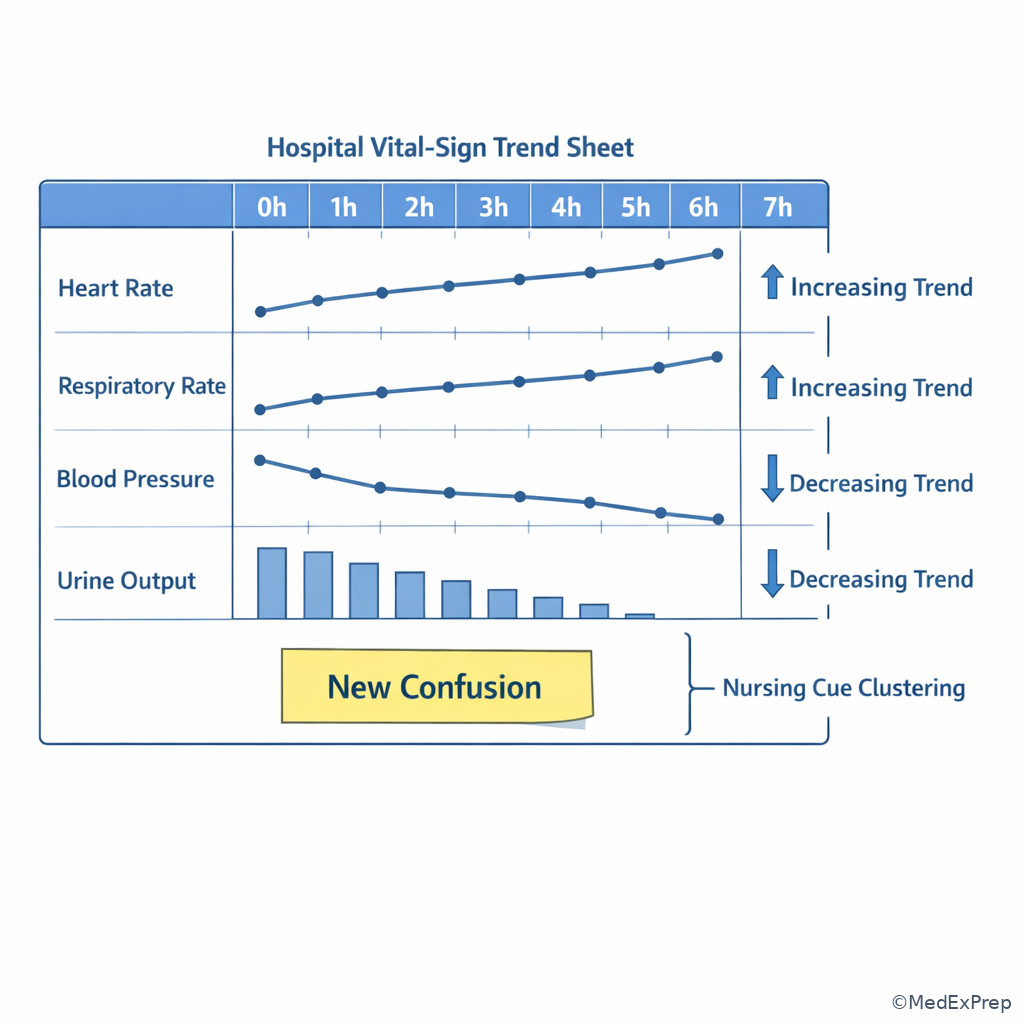
- Adult med-surg deterioration often appears first as a pattern, not a dramatic event: rising respiratory rate, falling urine output, new confusion, or subtle vital-sign drift.
- Safe RN practice depends on recognizing when reassessment and escalation outrank routine tasks, teaching, or documentation.
Key Terms & Must-Know Facts
1.1.1.1 Key terms
- Cue: any subjective or objective patient data point.
- Cue cluster: two or more related findings that point toward the same concern.
- Trend: direction of change over time, not a single isolated value.
- Baseline: the patient’s known usual status for comparison.
- Reassessment: focused follow-up after a finding, intervention, or change in condition.
- Priority cue: the finding most linked to instability, harm, or immediate nursing action.
- Noise: data in the stem that are true but not decisive.
- Red flag: cue that suggests deterioration or urgent safety risk.
- Compensation: physiologic adjustment that can temporarily mask worsening status.
- Decompensation: failure of compensatory mechanisms with worsening perfusion or oxygenation.
- Early warning sign: subtle change that precedes a crisis.
- Focused assessment: targeted exam based on the problem at hand.
- Escalation: notifying provider, activating rapid response, or using chain of command when needed.
1.1.1.2 Must-know facts
- Trend beats single value when deciding whether the patient is improving or deteriorating.
- Tachypnea is often an earlier deterioration cue than hypotension.
- New confusion in an adult med-surg patient is a high-yield sign of hypoxia, infection, perfusion change, medication effect, or metabolic disturbance until proved otherwise.
- Urine output below expected trend can signal poor perfusion before creatinine rises.
- Pain matters, but airway, breathing, circulation, and acute neurologic change outrank routine comfort measures.
- The “normal” value is not always reassuring if it reflects a decline from the patient’s baseline.
- Reassess first when the stem gives incomplete but concerning data, unless an emergency response is clearly required.
- The RN may assess, monitor, intervene within scope, and escalate; the RN should not independently diagnose or prescribe.
| High-yield cue | Why it matters | Usual RN implication |
|---|---|---|
| Rising respiratory rate | Often early sign of hypoxia, acidosis, sepsis, pain, or compensation | Assess work of breathing, oxygenation, trend vitals, escalate if worsening |
| New confusion | May reflect hypoxia, infection, poor perfusion, or medication effect | Assess ABCs, glucose, neuro status, safety, notify provider if acute |
| Falling urine output | May signal decreased renal perfusion or fluid imbalance | Check trend, intake/output, blood pressure, volume status, report persistent decline |
| Tachycardia with cool skin | Possible compensation for low volume or poor perfusion | Look for bleeding, sepsis, dehydration, pain, or hypoxia |
| Oxygen saturation decline from baseline | Worsening gas exchange may precede distress | Reassess oxygen delivery, probe accuracy, breath sounds, and work of breathing |
| Sudden drop in level of consciousness | Potential emergency | Immediate ABC/neuro assessment and rapid escalation |
Exam takeaway: Use cue clustering to decide whether a finding is noise, needs reassessment, or requires urgent escalation.
flowchart TD
A[Patient data arrive] --> B{Single cue or cluster?}
B -->|Single, mild, stable| C[Compare with baseline]
B -->|Multiple related cues| D[Look for oxygenation perfusion neuro risk]
C --> E{Trend worsening?}
E -->|No| F[Monitor and recheck]
E -->|Yes| G[Focused reassessment]
D --> H{Red flag present?}
H -->|Yes| I[Immediate RN action and escalate]
H -->|No| J[Prioritize assessment and follow-up] Exam takeaway: Visual trend recognition helps you spot worsening status before a single value looks extreme.
Core content
1.1.1.3 Foundational cue recognition: what counts as actionable data?
A Explanation
The central exam conflict is not “Can you find an abnormal value?” It is “Can you choose between data that are merely present and data that demand action?” Actionable data are cues that change the nursing plan now: they point to instability, risk of rapid harm, or failure to respond to treatment. A single slightly abnormal finding may not be the priority if it matches the patient’s baseline or lacks a dangerous trend. A modest but worsening pattern often matters more.
WHY THIS IS TESTED: exam stems overload you with medications, history, old diagnoses, and one distracting lab so you must select the cue that changes priority. Choose cues linked to airway, breathing, circulation, acute neurologic change, perfusion, bleeding, infection, or treatment failure. Reject cues that are chronic, expected, explained, or not time-sensitive.
The resolving rule: compare every cue to four anchors—baseline, trend, immediacy, and consequence. Baseline asks whether this is new for the patient. Trend asks whether the finding is stable, improving, or worsening. Immediacy asks whether harm could occur soon. Consequence asks what happens if the nurse delays action. New confusion, increasing work of breathing, dropping urine output, and progressive hypotension score high on all four anchors.
B Worked example
A 68-year-old man is 10 hours post abdominal surgery with hypertension, chronic kidney disease stage 3, and obstructive sleep apnea. He received opioid analgesia 30 minutes ago. Current findings: BP 108/64, down from 138/82 earlier; HR 108, up from 88; RR 26, up from 18; oxygen saturation 93% on 2 L nasal cannula, previously 96%; urine output 20 mL in the last hour after several hours of 35–40 mL/hr; pain 7/10; hemoglobin is unchanged from morning labs. The stem asks for the most appropriate nursing action.
Reasoning chain: Identify task: choose the priority cue/action, not the diagnosis. Extract key facts: rising RR, rising HR, falling BP, declining urine output, and oxygenation drifting down. The opioid is a tempting clue, but opioid oversedation usually produces a lower respiratory rate, not tachypnea. Apply rule: clustered worsening perfusion/oxygenation cues outrank pain management. Eliminate distractors: giving more pain medication or teaching incentive spirometry alone misses the immediate pattern; documenting and reassessing later delays care. Verify: the safest next step is focused assessment with prompt escalation for potential early deterioration, while supporting oxygenation and closely trending status.
C Exam trap
D Checkpoint
Question: A 59-year-old patient with heart failure and diabetes is receiving IV antibiotics for cellulitis. Over 6 hours, HR rises from 84 to 104, RR from 16 to 24, temperature from 37.2°C to 38.2°C, and urine output decreases from 45 mL/hr to 25 mL/hr. Which finding is the highest-priority cue?
- Temperature 38.2°C
- Heart rate 104/min
- Urine output trend downward
- History of heart failure
Answer: C
- A: Tempting because fever can indicate infection progression; wrong because fever alone is less urgent than a perfusion trend showing organ impact.
- B: Tempting because tachycardia is an early warning sign; wrong because it is less specific than falling urine output showing worsening perfusion.
- C: Correct because a declining urine output trend suggests decreasing renal perfusion and progression from abnormal signs to end-organ effect.
- D: Tempting because comorbidity affects risk; wrong because a history does not outrank a current worsening physiologic trend.
1.1.1.4 Trends beat snapshots: how to read change over time
A Explanation
Board questions love the “normal-looking” value that is actually dangerous because it has moved sharply from baseline. A blood pressure of 104/68 may not alarm you until you learn the patient was 148/86 all morning and now has cool skin and low urine output. Trend interpretation asks whether the patient is compensating, stabilizing, or failing. Compensation is high-yield: the patient may maintain blood pressure for a while even as respiratory rate rises, heart rate increases, and mentation changes. Do not wait for dramatic hypotension to decide the patient is getting worse.
WHY THIS IS TESTED: safe nurses detect deterioration early, before the crisis. Choose the option that responds to a pattern of change. Reject options anchored to a single “acceptable” number when the direction is wrong.
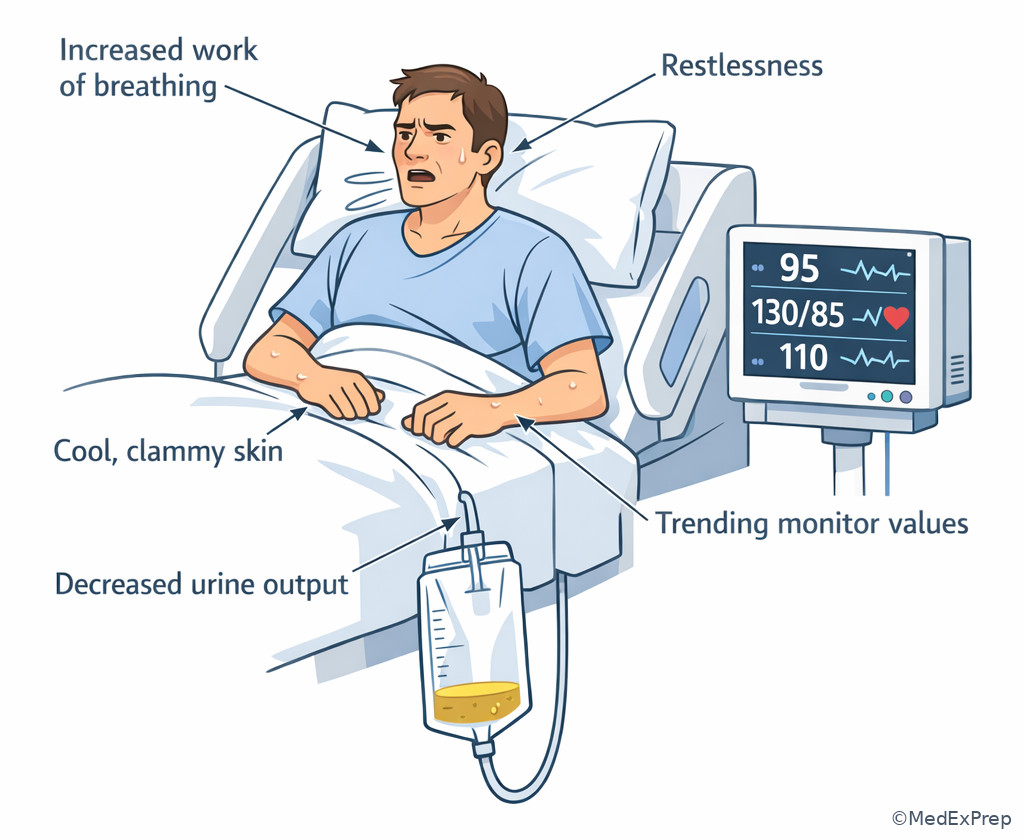
The resolving rule: link trend direction to body system risk. Respiratory trends often worsen first. Perfusion trends show up in skin, mentation, urine output, capillary refill, and pulse quality. Neurologic trends include restlessness, confusion, lethargy, and decreased response. Treatment trends matter too: if oxygen therapy, fluids, or analgesics do not produce the expected response, that nonresponse itself becomes a cue.
See Fig 1 for the cue-sorting framework. See Fig 2 for a trend-first approach to early deterioration.
Exam takeaway: Rising respiratory rate, mental-status change, and falling urine output often identify worsening status before profound hypotension appears.
flowchart LR
A[Baseline stable] --> B[RR rises]
B --> C[HR rises]
C --> D[Restless or confused]
D --> E[Urine output falls]
E --> F{Act now?}
F -->|Yes| G[Focused reassessment and escalation]
F -->|Delay| H[Risk of decompensation] Exam takeaway: Clustered subtle changes are more exam-relevant than any one mildly abnormal vital sign alone.
B Worked example
A 74-year-old woman with COPD, atrial fibrillation, and chronic anemia is admitted with community-acquired pneumonia. She has a productive cough and baseline oxygen saturation of 91% on room air at home. During the shift, saturation remains 92% on 2 L nasal cannula, which looks acceptable at first glance. However, RR rises from 20 to 30, she becomes newly restless, and she now uses accessory muscles. The stem includes a hemoglobin of 9.8 g/dL, tempting the learner to blame chronic anemia.
Reasoning chain: Identify task: determine most appropriate nursing action. Extract key facts: rising respiratory effort and restlessness despite “okay” saturation. Apply rule: work of breathing and mental-status trend beat a single oxygen number, especially in chronic lung disease. Eliminate distractors: documenting the patient’s chronic anemia or waiting for saturation to fall more delays response; encouraging fluids is not wrong, just far lower priority. Verify: immediate focused respiratory assessment, support, and escalation are required because compensation is failing.
C Exam trap
D Checkpoint
Question: A nurse compares data on an adult patient with pancreatitis. Which trend most strongly suggests worsening perfusion rather than simple pain?
- BP 130/78 to 124/76 with pain 8/10
- HR 88 to 110 and urine output 45 mL/hr to 18 mL/hr
- Nausea after opioid administration
- Temperature 37.0°C to 37.6°C
Answer: B
- A: Tempting because pain may raise concern; wrong because the blood pressure change is small and does not show the same organ-perfusion significance.
- B: Correct because tachycardia paired with falling urine output is a meaningful perfusion trend.
- C: Tempting because nausea may follow opioids and illness; wrong because it does not identify circulatory compromise.
- D: Tempting because low-grade temperature changes can signal inflammation; wrong because it is less urgent than evidence of decreased perfusion.
- The earliest vital-sign cue of deterioration is often increasing respiratory rate.
- True or False: A normal blood pressure always means perfusion is adequate. False.
- Name 3 non-vital-sign trend cues of worsening status: urine output, mental status, skin/peripheral perfusion.
1.1.1.5 Foundational application: separate expected findings from red flags
A Explanation
The exam often asks you to choose between an expected finding that should be monitored and a red flag that requires immediate follow-up. The conflict is “monitor versus act now.” Expected findings fit the clinical picture, occur in the anticipated timeframe, and lack signs of instability. Red flags are new, disproportionate, progressive, or paired with threats to oxygenation, perfusion, neurologic status, bleeding, or safety.
WHY THIS IS TESTED: nurses must avoid both overreaction and dangerous delay. The best answer is rarely “ignore this,” but it may be “continue planned monitoring because a more urgent cue needs action first.” Choose action when the finding is new, worsening, system-threatening, or inconsistent with what should be happening. Reject reflex escalation for findings that are expected and stable.
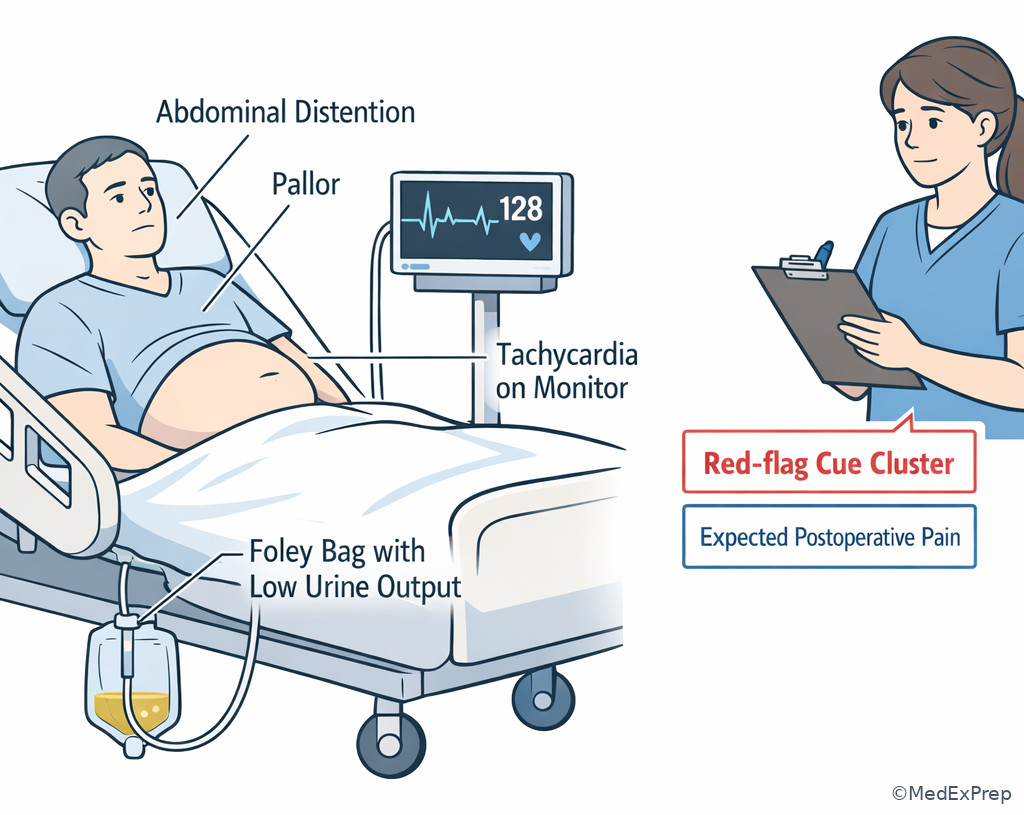
Examples: mild postoperative pain that improves after medication is expected; postoperative pain with rigid abdomen, tachycardia, and hypotension is not. Slight drowsiness after nighttime sedative use may be expected; drowsiness with slowed respirations and difficult arousal is a red flag. Chronic mild edema in a known heart failure patient differs from new unilateral calf swelling with dyspnea.
See Fig 3 for a red-flag sorting scheme nurses can use in board-style stems.
Exam takeaway: A finding becomes urgent when it is new, worsening, and linked to oxygenation, perfusion, neurologic change, bleeding, or safety risk.
flowchart TD
A[New finding] --> B{Fits expected course?}
B -->|Yes| C{Stable and improving?}
C -->|Yes| D[Monitor and document]
C -->|No| E[Focused reassessment]
B -->|No| F{ABCs neuro bleed safety risk?}
F -->|Yes| G[Urgent escalation]
F -->|No| H[Prompt follow-up and trend] Exam takeaway: Pairing abdominal distention, tachycardia, pallor, and decreased urine output should trigger concern beyond routine postoperative discomfort.
B Worked example
A 63-year-old woman with obesity, osteoarthritis, and hypertension is postoperative day 1 after knee arthroplasty. The stem includes moderate incisional pain, slight nausea after breakfast, and a low-grade fever of 37.8°C. She suddenly reports shortness of breath when walking back from the bathroom, appears anxious, and her heart rate rises to 118/min. Oxygen saturation falls from 96% to 90% on room air. The tempting clue is the low-grade fever, making atelectasis look like the answer.
Reasoning chain: Identify task: which cue needs immediate follow-up. Extract key facts: acute dyspnea with tachycardia and oxygen desaturation after ambulation. Apply rule: a new oxygenation/perfusion problem outranks expected postop discomfort or low-grade fever. Eliminate distractors: teaching deep breathing is appropriate but not the first response to sudden dyspnea; giving antiemetics targets a nonpriority cue; documenting anxiety misses physiologic danger. Verify: this is a red-flag cue cluster needing rapid respiratory assessment and escalation.
C Exam trap
D Checkpoint
Question: Which finding in an adult medical-surgical patient is most likely an expected finding rather than a red flag requiring immediate escalation?
- Mild drowsiness 1 hour after a prescribed bedtime hypnotic, arouses to voice, RR 16/min
- New confusion with oxygen saturation 88% on 2 L nasal cannula
- Incisional pain with rigid abdomen and HR 120/min after abdominal surgery
- Restlessness with BP 86/50 after a GI bleed
Answer: A
- A: Correct because the finding fits the timing and medication effect and does not show respiratory compromise.
- B: Tempting because confusion may be attributed to age or hospitalization; wrong because acute confusion plus hypoxemia is a red flag.
- C: Tempting because pain is common after surgery; wrong because rigidity and tachycardia signal a more serious complication.
- D: Tempting because restlessness may seem nonspecific; wrong because hypotension after bleeding is an urgent perfusion problem.
1.1.1.6 Application in noisy board-style stems: filter distractions and choose the RN priority
A Explanation
Now the exam conflict becomes sharper: several actions are reasonable, but one is safest now. Stems may include comorbidities, old labs, or one dramatic symptom that is less important than the patient’s actual risk. Your job is to filter noise and identify the decision cue. Most distractors fall into four groups: the right action for the wrong priority, a chronic finding disguised as acute, a task that should occur after assessment, and a true intervention that ignores a more urgent threat.
WHY THIS IS TESTED: the ANCC-style nursing question rewards clinical judgment, not reflex task completion. Choose the option that matches the highest-risk cue and the RN’s scope. Reject provider-level actions, delayed reassessment, or premature teaching when the patient may be unstable.
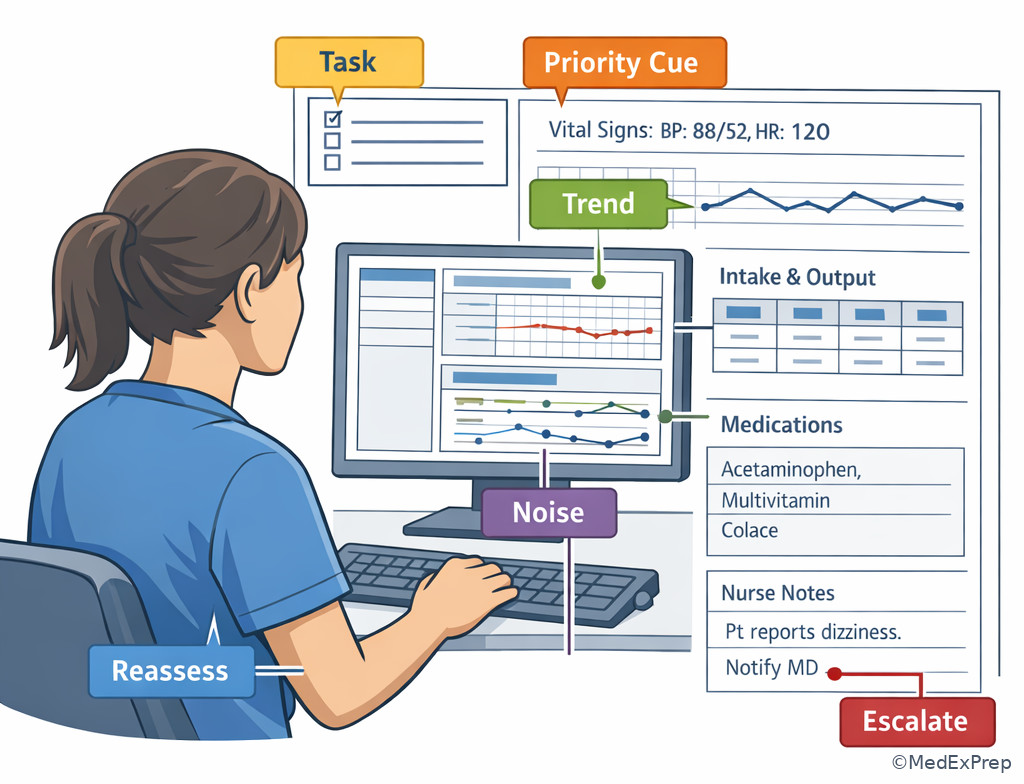
A practical method: first identify what the question is asking—priority assessment, immediate intervention, delegation, monitoring, or escalation. Then remove all information that does not change that answer. After that, find the single clue that best discriminates among options. In many stems that clue is one of the following: worsening work of breathing, new mental-status change, active bleeding, low urine output trend, failure to respond to treatment, or a mismatch between the order and the patient’s current status. See Fig 4.
Exam takeaway: In noisy stems, the best answer is usually the RN action linked to the single most dangerous cue, not the most familiar diagnosis label.
flowchart TD
A[Read the stem] --> B[What is being asked?]
B --> C[Priority action]
B --> D[Monitoring/evaluation]
B --> E[Delegation]
C --> F[Find highest-risk cue]
D --> F
E --> F
F --> G[Remove chronic stable details]
G --> H[Choose RN-scope safest next step]
Exam takeaway: A visual stepwise filter helps separate meaningful assessment data from distracting stem details.
B Worked example
A 70-year-old man with type 2 diabetes, peripheral neuropathy, and chronic heart failure is admitted for infected foot ulcer treatment. He tells the nurse he has not had a bowel movement in 2 days and wants a laxative. The chart also shows potassium 3.5 mEq/L, glucose 214 mg/dL, and a wound culture pending. During rounds he becomes newly drowsy, skin cool, BP 92/58, HR 114, and urine output for the last 2 hours totals 20 mL. The question asks for the most appropriate nursing action.
Reasoning chain: Identify task: immediate priority nursing action. Extract key facts: new drowsiness, hypotension, tachycardia, oliguria. The bowel complaint, potassium, and pending culture are noise here. Apply rule: possible deterioration with impaired perfusion outranks routine symptom management and lab follow-up. Eliminate distractors: administering the ordered bowel regimen, teaching wound care, or documenting glucose trends are all reasonable later but unsafe first priorities. Verify: focused assessment, immediate support, and provider/rapid escalation based on severity are indicated.
C Exam trap
D Checkpoint
Question: A patient with chronic kidney disease, controlled atrial fibrillation, and recent pneumonia treatment is preparing for discharge. Which cue requires the nurse’s immediate clarification before proceeding?
- Creatinine stable at the patient’s baseline
- Patient asks whether the antibiotic should be taken with food
- New dizziness on standing with BP 88/54 and HR 118
- Family requests a printed medication list
Answer: C
- A: Tempting because chronic kidney disease adds risk; wrong because the value is stable at baseline.
- B: Tempting because discharge teaching matters; wrong because teaching does not outrank acute instability.
- C: Correct because orthostatic symptoms with hypotension and tachycardia suggest immediate safety and perfusion concern.
- D: Tempting because care coordination is important; wrong because it can wait until the patient is safe and stable.
- True or False: A chronic abnormality at baseline usually outranks a new acute change. False.
- The best distractor on nursing exams is often the right action at the wrong priority.
- Name 2 common noise items in stems: stable chronic comorbidities, nonurgent patient requests.
1.1.1.7 Integration: reassess, intervene, delegate, or escalate?
A Explanation
After identifying the priority cue, the next conflict is action selection. The correct answer must stay within RN scope and follow the nursing process. Reassess when data are incomplete or need verification. Intervene immediately within scope when the threat is clear and the nursing action is standard and safe, such as applying oxygen per protocol/order, positioning, instituting fall precautions, or stopping an infusion that appears harmful. Delegate only stable, predictable tasks; never delegate initial assessment, interpretation of cues, teaching, or evaluation. Escalate when findings suggest deterioration, the patient is not responding as expected, or a provider-level decision is needed.
WHY THIS IS TESTED: many distractors are good nursing actions performed by the wrong person or in the wrong sequence. Choose reassessment when the answer choices are all interventions but the stem lacks the focused data needed to act safely. Choose escalation when instability exceeds routine nursing management. Reject options that place diagnosis or prescribing on the RN.
A useful hierarchy is: stabilize obvious threats, gather focused confirming data if needed, implement RN-scope actions, then notify with a concise picture of the concerning trend. If the patient is crashing, escalation and emergency response occur immediately alongside nursing support. See Fig 5.
Exam takeaway: The safest answer links cue severity to the correct RN action sequence: reassess, intervene within scope, delegate appropriate tasks, and escalate when needed.
flowchart TD
A[Priority cue identified] --> B{Emergent threat?}
B -->|Yes| C[Immediate support and rapid escalation]
B -->|No| D{Need more focused data?}
D -->|Yes| E[RN reassessment]
D -->|No| F[Implement nursing intervention]
F --> G[Delegate predictable support tasks]
E --> H[Evaluate trend]
G --> H
H --> I{Improving?}
I -->|Yes| J[Continue plan]
I -->|No| K[Notify provider / escalate] Exam takeaway: Visualizing who does what prevents common test mistakes between assessment, task delegation, and provider notification.
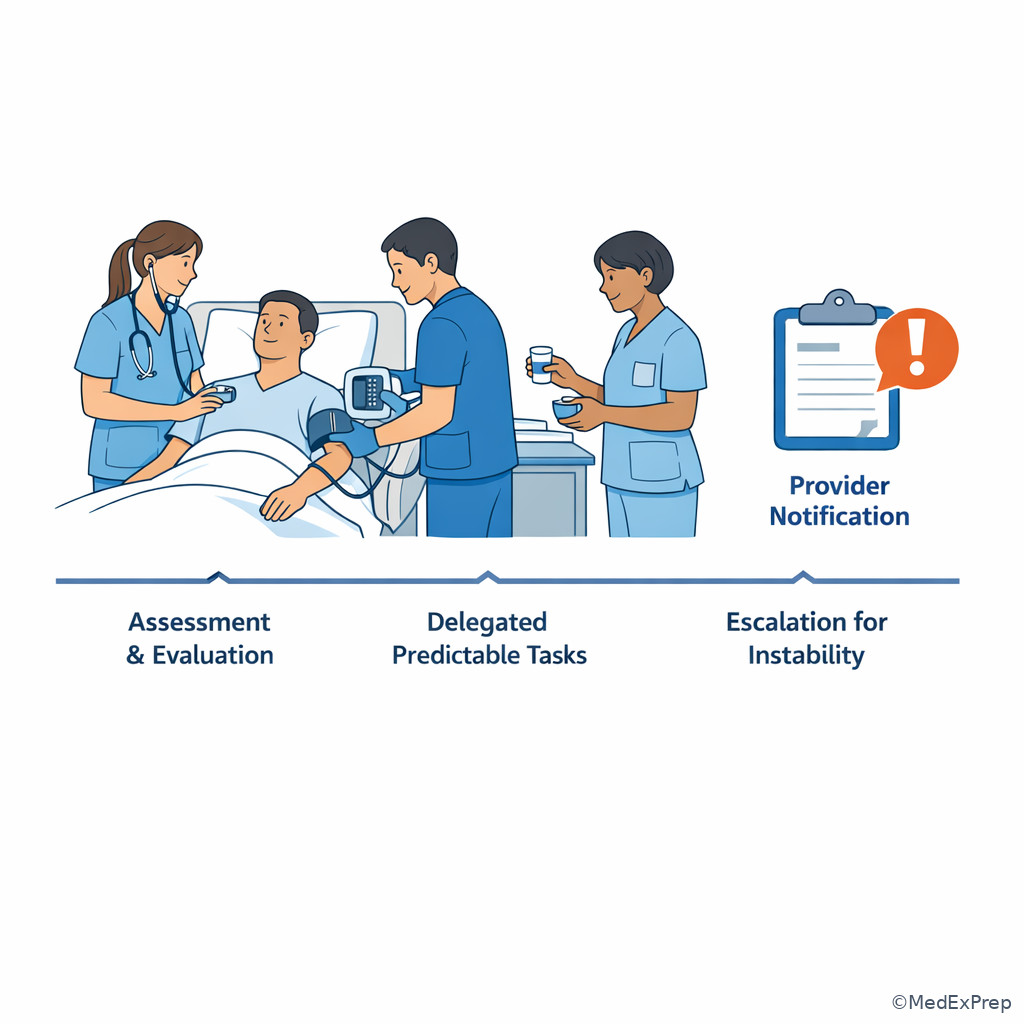
B Worked example
A 66-year-old patient with heart failure, chronic venous insufficiency, and obesity has worsening dyspnea. Vital signs are BP 100/60, HR 112, RR 28, oxygen saturation 89% on room air. The patient is anxious and asks for water. A UAP is available. The question asks for the most appropriate initial nursing action. Options include asking the UAP to complete a respiratory assessment, applying oxygen and elevating the head of bed, calling the provider before seeing the patient, or teaching slow deep breathing first.
Reasoning chain: Identify task: initial RN action. Extract key facts: hypoxemia and tachypnea indicate an airway/breathing priority. Apply rule: the RN should immediately support breathing within scope and perform focused assessment; assessment cannot be delegated. Eliminate distractors: UAP cannot perform the RN assessment; provider notification matters but after immediate support and rapid assessment unless the patient is crashing; teaching is lower priority. Verify: oxygen support per order/protocol and positioning are the safest first actions with simultaneous RN reassessment and likely escalation.
C Exam trap
D Checkpoint
Question: A nurse notes a new trend of lethargy, BP 90/52, HR 116, and urine output 15 mL/hr in an adult patient with sepsis treatment in progress. Which action is most appropriate?
- Delegate reassessment of mental status to the UAP while the RN documents the trend
- Perform focused reassessment, support the patient, and notify the provider or activate rapid response per acuity
- Wait 1 hour to see whether the next urine output improves before acting
- Provide routine teaching on fluid intake to the family
Answer: B
- A: Tempting because repeat data collection is useful; wrong because mental-status assessment and cue interpretation remain RN responsibilities.
- B: Correct because this trend suggests worsening perfusion requiring RN assessment, support, and escalation.
- C: Tempting because trending matters; wrong because the patient already has multiple concerning cues and delay is unsafe.
- D: Tempting because education is part of care; wrong because it is not the priority during active instability.
Exam Traps & Differentiators
Most common wrong answer and why: choosing the intervention that is correct in general but not the safest first priority for the cue pattern. On this topic, that is often pain treatment, routine teaching, or documentation before addressing a worsening respiratory or perfusion trend.
| Looks similar | Actually means | Discriminator | RN implication |
|---|---|---|---|
| Anxiety-related tachypnea | Possible respiratory decline | Objective hypoxemia, increased work of breathing, or declining mentation | Treat as physiologic until proven otherwise |
| Pain-related tachycardia | Possible hypovolemia or sepsis trend | Falling urine output, cool skin, or dropping BP | Assess perfusion before assuming pain alone |
| Expected medication drowsiness | Possible oversedation or hypoxia | Difficult arousal or low respiratory rate/oxygenation | Reassess breathing and safety immediately |
| Chronic baseline abnormality | Acute decompensation | New change from baseline or failure to respond to therapy | Do not anchor on “that’s normal for them” without trend review |
| Routine postop discomfort | Complication cue cluster | Rigid abdomen, severe distention, pallor, hypotension, or dyspnea | Escalate beyond routine comfort care |
If the stem says ... think ...
- “New confusion” → think oxygenation, perfusion, infection, glucose, or medication effect before assuming age-related confusion.
- “Urine output trending down” → think perfusion and kidney response, not just hydration request.
- “Saturation acceptable but RR rising” → think compensation and early deterioration.
- “Pain, but also falling BP or cool clammy skin” → think perfusion problem, not pain alone.
- “Patient request plus unstable vitals” → think address instability first, then comfort/teaching.
- “Provider choice embedded in option” → think out of RN role; choose assessment/intervention/escalation instead.
| Differential cue pattern | More likely stable/expected | More likely urgent |
|---|---|---|
| Post-medication sleepiness | Arousable, normal respirations, stable oxygenation | Difficult arousal, low RR, low oxygenation, pinpoint pupils depending on drug |
| Postoperative discomfort | Pain improves with medication, vitals stable | Pain with rigidity, distention, hypotension, tachycardia |
| Chronic respiratory disease | Baseline low-normal saturation without distress | Increased work of breathing, restlessness, rising RR |
| Dehydration complaint | Thirst with otherwise stable perfusion | Thirst plus hypotension, tachycardia, oliguria, confusion |
| Anxiety | Subjective worry with stable objective findings | Anxiety plus chest symptoms, hypoxemia, or hemodynamic change |
Algorithm / Approach
Exam takeaway: The safest exam answer follows a sequence of cue recognition, trend interpretation, RN action, and escalation when the patient is unstable.
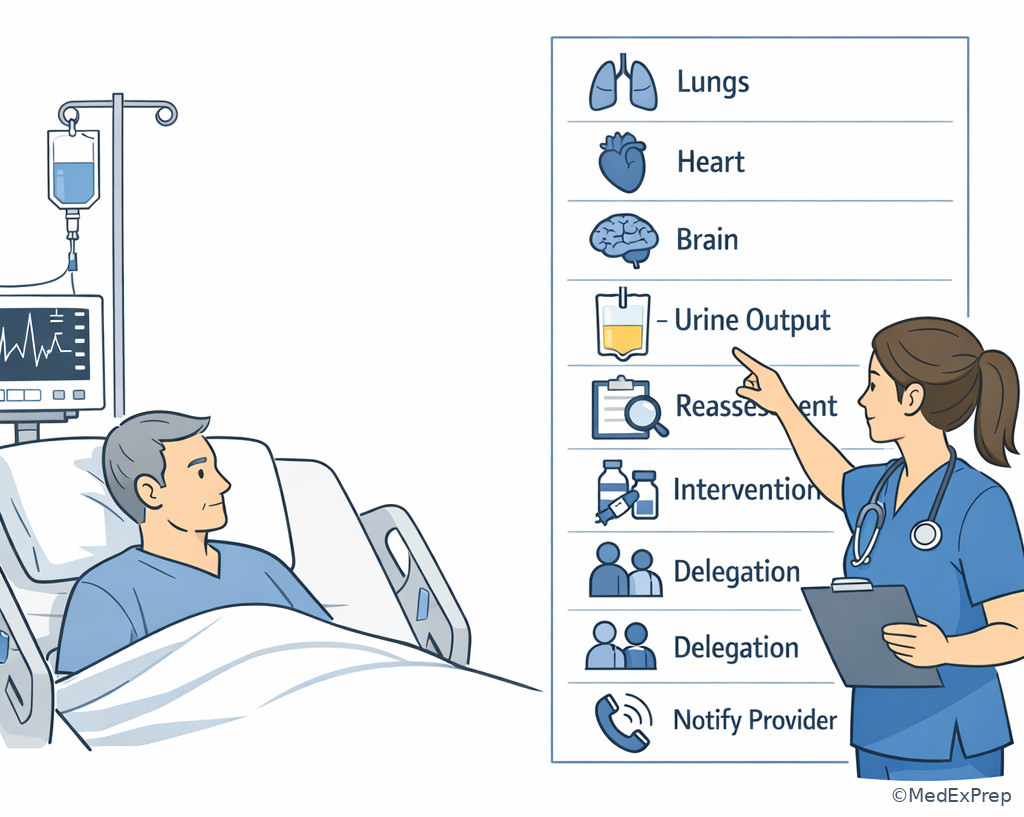
See Fig 5 and Fig 6 as complementary decision tools: Fig 5 helps choose the action category, and Fig 6 helps remember the bedside sequence.
| Situation | Best first RN move | Why |
|---|---|---|
| New concerning cue, incomplete data, patient not crashing | Focused reassessment | Need better data before choosing a targeted intervention |
| Obvious breathing compromise within standard nursing response | Immediate support plus focused assessment | ABCs outrank delayed provider contact |
| Worsening trend with signs of organ hypoperfusion | Support and urgent escalation | Delay risks decompensation |
| Stable predictable task after assessment complete | Delegate appropriate components | Conserves RN judgment for higher-level decisions |
| Finding inconsistent with expected course but not emergent | Prompt follow-up and trend verification | Mismatch may be the first clue of complication |
Rapid Review
- Rising RR → earlier warning sign than late hypotension in many deteriorating adults
- New confusion → think hypoxia/perfusion/infection/glucose/medication effect before “just elderly”
- Urine output trend → stronger perfusion clue than one isolated blood pressure value
- Stable chronic abnormality → less urgent than a new change from baseline
- Normal-looking vital sign → not reassuring if direction is steadily worsening
- Pain with cool clammy skin → not just pain; suspect circulatory stress
- Acceptable oxygen saturation + accessory muscle use → respiratory concern still present
- Teaching request during instability → lower priority than reassessment or support
- Expected finding → must fit context, timing, and stability
- Red flag → new, worsening, disproportionate, or tied to ABC/neuro/bleeding/safety threat
- Assessment vs delegation → initial assessment and cue interpretation stay with the RN
- Provider notification → follows immediate RN support unless the patient requires simultaneous emergency escalation
- Best distractor → correct action at the wrong priority
- Failure to improve after intervention → itself becomes a significant cue
Self-check quiz
1. A 61-year-old patient with stable chronic heart failure and chronic kidney disease has been resting comfortably. Which finding requires the most immediate nursing follow-up?
- Creatinine unchanged from the patient’s usual baseline
- New confusion and restlessness during the last hour
- Reports poor appetite at breakfast
- Mild bilateral ankle edema that is unchanged from admission
2. A 72-year-old patient 1 hour after a prescribed nighttime sedative is sleepy but opens eyes to voice, follows commands, and has RR 16/min and oxygen saturation 95% on room air. Which interpretation is most appropriate?
- This is most consistent with an expected finding that should be monitored
- This requires immediate rapid response activation
- This proves the patient is developing delirium
- This indicates the medication should be independently discontinued by the RN
3. A 65-year-old patient with COPD, hypertension, and chronic anemia is admitted with pneumonia. Over 4 hours, oxygen saturation is 92% on 2 L nasal cannula, RR increases from 20 to 30, and the patient becomes newly restless. Which is the most appropriate nursing action?
- Continue routine monitoring because the oxygen saturation remains above 90%
- Perform focused respiratory reassessment, support breathing, and notify the provider based on worsening trend
- Document that chronic anemia explains the restlessness
- Delay action until the next scheduled respiratory treatment
4. A 58-year-old postoperative patient with obesity and diabetes reports incisional pain 8/10. The patient also has HR 118/min, BP 92/56, cool clammy skin, and urine output 15 mL/hr for the last 2 hours. Which action is the best initial priority?
- Administer PRN pain medication immediately
- Perform focused reassessment of perfusion and notify the provider or rapid response based on acuity
- Teach splinting and deep breathing exercises
- Document pain score and recheck in 1 hour
5. A 69-year-old patient with heart failure, peripheral neuropathy, and cellulitis asks for help to the bathroom. The nurse notes BP 88/54, HR 116, dizziness on standing, and new drowsiness. Which action is most appropriate?
- Assist the patient to the bathroom quickly to prevent incontinence
- Ask the UAP to assess the cause of dizziness
- Keep the patient in bed, perform focused assessment, institute safety measures, and escalate the instability
- Encourage oral fluids and reassess after the patient ambulates
6. A 73-year-old patient with sepsis treatment underway has diabetes, atrial fibrillation, and chronic stage 3 kidney disease. The UAP reports urine output of 10 mL in the past hour; BP is 90/50, HR 118, and the patient is more lethargic than 30 minutes ago. Which action by the RN is most appropriate?
- Delegate a complete neurologic assessment to the UAP and begin charting the abnormal data
- Perform immediate focused reassessment, support ABCs, and notify the provider or activate rapid response per policy
- Wait for the next creatinine result because kidney disease can explain low urine output
- Provide discharge teaching on fluid balance because sepsis patients need education early
7. A 64-year-old patient with COPD, obesity, and osteoarthritis is receiving opioid analgesia after abdominal surgery. Thirty minutes later, the patient is difficult to arouse, RR is 8/min, and oxygen saturation is 89% on 2 L nasal cannula. Which nursing action is the priority?
- Teach incentive spirometry once the patient is more awake
- Immediately support breathing, perform focused assessment, and escalate the acute change
- Document that postoperative fatigue is expected
- Ask the UAP to continue routine vital-sign checks every 4 hours
8. A 67-year-old patient with heart failure, chronic venous insufficiency, and pneumonia has ankle edema that is unchanged from admission, but now has increasing RR, new confusion, and cooler extremities. Which cue should most strongly drive the nurse’s priority decision?
- Chronic ankle edema
- History of heart failure
- Increasing respiratory rate with new confusion
- Need for routine morning weight
Answer key
1. Correct answer: B
- A: Tempting because kidney disease values can signal risk; incorrect because the clue says the creatinine is unchanged from baseline, so it does not explain an urgent new problem. The discriminating clue is stable baseline. Priority principle: new neurologic change outranks chronic stable data. Sources: NCSBN clinical judgment principles; Lewis.
- B: Correct because new confusion and restlessness are acute cues that may indicate hypoxia, perfusion change, infection progression, or medication effect. The discriminating clue is new onset during this hour. Priority principle: ABCs and neurologic status outrank appetite and chronic edema. Sources: ANA Standards of Practice; Lewis.
- C: Tempting because appetite changes are common in illness; incorrect because it does not present an immediate instability cue. The discriminating clue is that it is a routine symptom without acute deterioration markers. Sources: NCSBN; Lewis.
- D: Tempting because edema matters in heart failure; incorrect because it is unchanged from admission and therefore lower priority than an acute cognitive change. The discriminating clue is unchanged. Sources: NCSBN; Lewis.
2. Correct answer: A
- A: Correct because the patient is arousable, follows commands, and has stable respirations and oxygenation, which fits an expected sedative effect requiring monitoring. The discriminating clue is arouses to voice with normal RR. Priority principle: expected, stable findings can be monitored. Sources: Lewis; ANA Standards.
- B: Tempting because sedatives can cause emergencies; incorrect because there is no evidence of respiratory compromise or inability to arouse. The discriminating clue is normal breathing and responsiveness. Sources: NCSBN; Lewis.
- C: Tempting because altered behavior raises concern for delirium; incorrect because the timing and pattern fit the prescribed medication effect better than an acute confusional state. The discriminating clue is recent sedative administration with expected response. Sources: Lewis.
- D: Tempting because nurses monitor medication effects; incorrect because the RN should not independently discontinue therapy outside policy/order authority. The discriminating clue is role scope. Sources: ANA Standards; NCSBN scope principles.
3. Correct answer: B
- A: Tempting because many learners anchor on the oxygen saturation number; incorrect because rising RR and new restlessness show worsening respiratory status despite a seemingly acceptable saturation. The discriminating clue is trend in work of breathing and mentation. Priority principle: breathing trend outranks a single snapshot. Sources: NCSBN; Lewis.
- B: Correct because the nurse should respond to the worsening respiratory trend with focused reassessment, support, and timely notification. The discriminating clue is the combination of tachypnea trend and restlessness. Priority principle: ABCs first. Sources: ANA Standards; Lewis.
- C: Tempting because chronic anemia can contribute to fatigue and dyspnea; incorrect because the acute change is better explained by a current respiratory deterioration trend. The discriminating clue is new worsening over 4 hours. Sources: Lewis.
- D: Tempting because scheduled therapy is part of the plan; incorrect because delaying response to an active worsening trend violates priority nursing action. The discriminating clue is rising RR with new restlessness now. Sources: NCSBN; ANA Standards.
4. Correct answer: B
- A: Tempting because the patient reports severe pain and analgesia may be ordered; incorrect because hypotension, cool clammy skin, and oliguria suggest perfusion compromise that outranks pain treatment. The discriminating clue is urine output 15 mL/hr with circulatory signs. Priority principle: circulation first. Sources: Lewis; NCSBN.
- B: Correct because the nurse must recognize a red-flag perfusion cluster, perform focused reassessment, and escalate based on acuity. The discriminating clue is the cue cluster, not the pain score alone. Priority principle: ABCs/circulation before comfort. Sources: ANA Standards; Lewis.
- C: Tempting because postoperative pulmonary care matters; incorrect because teaching comes after stabilization. The discriminating clue is active instability. Sources: NCSBN.
- D: Tempting because reassessment is important; incorrect because waiting 1 hour in the setting of hypotension and oliguria is unsafe. The discriminating clue is the immediate perfusion threat. Sources: Lewis; NCSBN.
5. Correct answer: C
- A: Tempting because toileting is a common nursing need and preventing incontinence seems patient-centered; incorrect because dizziness, hypotension, and drowsiness create an immediate fall and perfusion risk. The discriminating clue is unstable standing vitals with new drowsiness. Priority principle: safety and circulation first. Sources: NCSBN; ANA Standards.
- B: Tempting because delegation can speed workflow; incorrect because assessment of dizziness cause and instability cannot be delegated to the UAP. The discriminating clue is the need for RN assessment. Sources: ANA Standards; NCSBN delegation rules.
- C: Correct because keeping the patient safe in bed, performing focused assessment, and escalating are the most appropriate RN actions. The discriminating clue is orthostatic instability with altered mentation. Priority principle: safety plus circulation. Sources: Lewis; NCSBN.
- D: Tempting because fluids may help hypotension in some cases; incorrect because ambulation would increase fall risk and the patient needs assessment before routine supportive measures. The discriminating clue is dizziness on standing with drowsiness. Sources: Lewis.
6. Correct answer: B
- A: Tempting because more data are needed and UAPs can report observations; incorrect because a complete neurologic assessment and interpretation of lethargy are RN responsibilities. The discriminating clue is assessment cannot be delegated. Priority principle: unstable patients require RN judgment. Sources: ANA Standards; NCSBN delegation principles.
- B: Correct because the patient shows lethargy, hypotension, tachycardia, and oliguria despite sepsis treatment, indicating a worsening trend requiring immediate reassessment, support, and escalation. The discriminating clue is failure to respond with signs of organ hypoperfusion. Priority principle: ABCs/circulation and rapid escalation. Sources: Lewis; NCSBN.
- C: Tempting because kidney disease can affect urine output; incorrect because chronic kidney disease does not explain a sudden sharp decline paired with hypotension and lethargy. The discriminating clue is acute change from 30 minutes ago. Sources: Lewis.
- D: Tempting because patient education is always part of nursing care; incorrect because education is inappropriate while the patient is unstable. The discriminating clue is active deterioration. Sources: ANA Standards.
7. Correct answer: B
- A: Tempting because postoperative pulmonary hygiene matters; incorrect because teaching incentive spirometry is not the priority in a patient who is difficult to arouse with RR 8/min. The discriminating clue is respiratory depression now. Priority principle: breathing first. Sources: Lewis; NCSBN.
- B: Correct because immediate breathing support, focused reassessment, and escalation are required for likely opioid-related respiratory compromise or other acute deterioration. The discriminating clue is low RR with difficult arousal and falling oxygenation. Priority principle: ABCs. Sources: ANA Standards; Lewis.
- C: Tempting because fatigue is common postoperatively; incorrect because difficult arousal and RR 8/min are not routine fatigue. The discriminating clue is objective respiratory depression. Sources: Lewis.
- D: Tempting because ongoing vital-sign monitoring is needed; incorrect because q4h routine checks are not sufficient for an acute breathing emergency, and UAP monitoring does not replace immediate RN action. The discriminating clue is acuity. Sources: NCSBN; ANA Standards.
8. Correct answer: C
- A: Tempting because edema matters in heart failure assessment; incorrect because it is unchanged from admission and chronic. The discriminating clue is unchanged. Priority principle: chronic stable findings rank below acute deterioration. Sources: Lewis.
- B: Tempting because comorbid heart failure increases risk; incorrect because history informs context but does not outrank the patient’s current acute cue cluster. The discriminating clue is current change, not diagnosis history. Sources: NCSBN.
- C: Correct because increasing respiratory rate with new confusion points to acute worsening oxygenation or perfusion and should drive the priority decision. The discriminating clue is new trend affecting breathing and mentation. Priority principle: ABCs and neurologic change first. Sources: ANA Standards; Lewis.
- D: Tempting because daily weights are appropriate in heart failure; incorrect because routine monitoring is lower priority than an acute change. The discriminating clue is immediate instability. Sources: Lewis.
Keep going with the full Med-Surg ANCC Prep Course (Med-Surg)
You just studied the way members do, in the same lesson interface. Full access unlocks every lesson, the question bank and flashcards for a full year.
One payment · 1 year of access · No auto-renewal