1.1.1 - Medical And Dental Histories
Medical And Dental Histories
What you'll learn
- CONTENT AREA -> Patient assessment and diagnosis -> History gathering: Identify the medical history elements that change dental urgency, safety, anesthesia planning, prescribing, and need for deferral.
- CONTENT AREA -> Treatment planning and case management -> Dental history synthesis: Use past dental experiences, symptoms, and prior treatment patterns to build a focused problem list.
- CONTENT AREA -> Pharmacology and therapeutics -> Medication risk review: Distinguish medication, allergy, and adverse-reaction details that alter routine dental care.
- CONTENT AREA -> Ethics, professionalism, and patient management -> Documentation and informed care: Decide what must be clarified, documented, updated, and communicated before treatment proceeds.
- CONTENT AREA -> Medical emergencies and medically complex care -> Deferral and referral thresholds: Recognize history red flags requiring medical consultation, urgent referral, or emergency activation rather than elective care.
- Patient Assessment -> Medical history review -> Identify conditions, medications, and risks relevant to dental treatment
- Patient Assessment -> Dental history -> Interpret chief concern, symptom course, prior care, and patient experience
- Case Management -> Safety screening -> Decide treat now vs defer vs refer
- Professionalism -> Documentation -> Record relevant history, clarifications, and patient-reported information accurately
Why it matters
- The history often gives the correct answer before the clinical exam: anticoagulants, bisphosphonates, poorly controlled diabetes, pregnancy, immunosuppression, and prior adverse drug reactions can all change the safest next step.
- INBDE stems frequently hide the key discriminator in a single history detail such as “chest pain last week,” “takes warfarin,” “swelling with difficulty swallowing,” or “allergy” that is really an intolerance.
- History drives not only diagnosis but sequencing: routine restorative care, urgent infection management, anesthesia choice, analgesic selection, referral, and documentation all start here.
- For an entry-level dentist, safe care means knowing what to treat, what to postpone, and what is outside routine office management.
Key Terms & Must-Know Facts
1.1.1.1 Key terms
- Chief concern: Patient-stated reason for seeking care, ideally in the patient's own words.
- History of present illness: Symptom onset, location, duration, character, triggers, severity, and associated findings.
- Medical history: Systemic diseases, surgeries, hospitalizations, pregnancy status, allergies, and current care team.
- Medication reconciliation: Active confirmation of prescription, over-the-counter, herbal, and as-needed medications.
- Adverse drug reaction: Harmful medication effect; not all reactions are true allergies.
- True allergy: Immune-mediated reaction such as urticaria, angioedema, bronchospasm, or anaphylaxis.
- Dental history: Prior treatment, pain episodes, recall pattern, home care, fluoride exposure, and prior complications.
- Social history: Tobacco, alcohol, recreational substances, caregiving, diet, and barriers to care.
- Red flag: History feature suggesting instability, spread of infection, airway risk, bleeding risk, or other need to defer routine care.
- Medical consultation: Communication with physician or other provider to clarify risk or optimize care.
- Deferral: Delaying elective care because current risk outweighs benefit.
- Problem list: Organized summary of active findings and risks that directs diagnosis and treatment sequencing.
1.1.1.2 Must-know facts
- A history is never “negative” until allergies, medications, major conditions, and recent changes are actively verified.
- “Penicillin allergy” must be clarified by reaction type, timing, and severity before it changes prescribing.
- Chest pain, recent stroke, uncontrolled bleeding, rapidly progressive swelling, dysphagia, dyspnea, and severe systemic symptoms are treat-now red flags for urgent medical evaluation, not routine dentistry.
- Medication lists must include anticoagulants, antiplatelets, steroids, bisphosphonates, immunosuppressants, insulin or glucose-lowering drugs, and xerostomia-causing drugs.
- Pregnancy status matters for radiographs, medications, timing of elective care, and coordination of urgent treatment.
- Past dental anesthesia complications, syncope, postoperative bleeding, or failure of numbness can change the next appointment plan.
- Social history can explain disease pattern: smoking, high sugar intake, methamphetamine use, alcohol misuse, and limited recall access all change risk.
- Updating the history at every visit is standard, because the key exam clue may be a recent hospitalization or newly started medication.
Exam takeaway: Use a structured history to decide routine care versus clarification, deferral, or referral.
flowchart TD
A[Start: chief concern and reason for visit] --> B[Review medical conditions and recent changes]
B --> C[Review medications allergies and reactions]
C --> D[Review dental history and symptom course]
D --> E{Any red flag?}
E -->|No| F[Proceed to focused exam and routine planning]
E -->|Yes| G[Clarify defer elective care or refer urgently]
G --> H[Document risk communication and next step] Exam takeaway: A complete intake form is useful only if the clinician verifies high-risk answers in conversation.
Core content
1.1.1.3 Foundational structure: what belongs in a complete history
A Explanation
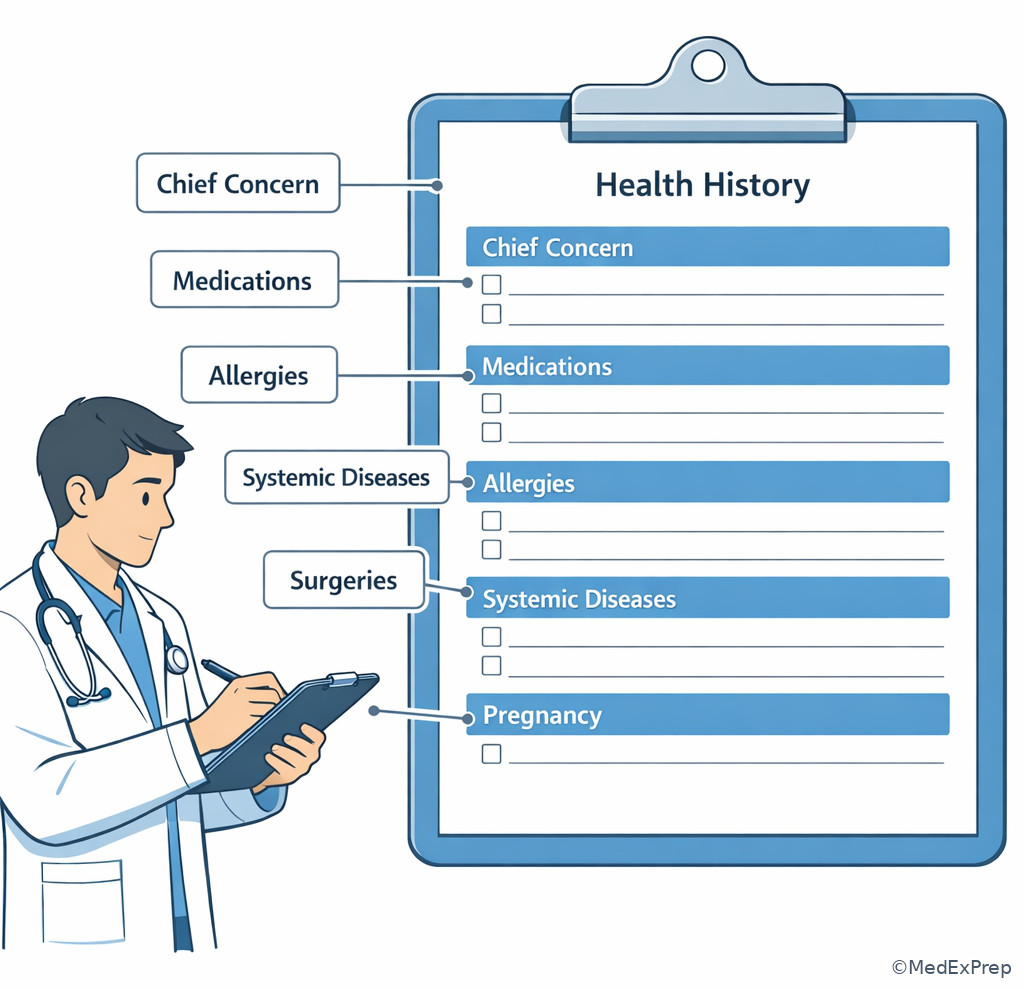
The first decision conflict is simple but heavily tested: Is this just paperwork, or is this the first diagnostic and safety screen? On the INBDE, you should choose the answer that treats the history as a clinical instrument. The governing rule is: every history item must either clarify urgency, change risk, change treatment selection, or change documentation. A complete dental history is not a random list. It has a sequence: chief concern, symptom course, medical conditions, medications, allergies and reactions, prior procedures and complications, dental habits and symptoms, social factors, and update of recent changes.
WHY THIS IS TESTED: exam stems often present several distracting details, but one history element determines whether you proceed, modify, or stop. For example, a patient who wants a filling may actually need medical clarification first because of recent hospitalization or unstable symptoms. Choose the option that identifies the single history domain not yet clarified when that missing information changes safety.
In practical terms, ask: What is the patient here for? What is happening now? What systemic factors could worsen treatment risk? What drugs could change bleeding, infection risk, healing, or anesthesia? What prior dental experiences predict behavior, compliance, or complications? What social habits explain disease activity? These questions create the problem list that later connects to exam findings and risk assessment. See Fig 1.
B Worked example
A 43-year-old man presents for “a broken filling.” He has obesity, hypertension, and seasonal allergies. He casually reports that he was in the emergency department 5 days ago for “pressure in my chest,” but says they “did some tests and sent me home.” He takes lisinopril and over-the-counter ibuprofen for headaches. He also mentions he “hates the dentist because numbness never works.” Panoramic radiograph from 8 months ago is available. The tempting wrong move is to focus on the broken restoration and the anesthesia complaint.
Reasoning chain: Identify task: safest next step before treatment. Extract key facts: recent chest pain evaluation is the dominant issue; lack of details means current cardiovascular status is unclear. Apply rule: recent potentially unstable cardiac symptoms require clarification before elective treatment. Eliminate distractors: changing local anesthetic technique does not solve the larger safety question; the old radiograph is irrelevant to current medical stability; seasonal allergies and obesity matter, but neither outcompetes the unresolved chest pain history. Verify: the best answer is to obtain more medical information and defer elective treatment until status is clarified.
C Exam trap
D Checkpoint
Question: A 29-year-old patient presents for a limited exam for tooth sensitivity. Before any examination, which history element is most important to clarify because it can immediately change the safety of routine dental treatment?
- Favorite whitening toothpaste used for the last month
- Recent hospitalization and any new medical diagnoses or medications
- Whether the patient prefers morning or afternoon appointments
- Which quadrant was restored first as a child
- A: Tempting because it relates to sensitivity, but it rarely determines whether treatment must be deferred immediately.
- B: Correct because recent hospitalization or new medications can reveal unstable disease, anticoagulation, steroid use, or other risks that change treatment now.
- C: Tempting because scheduling affects patient management, but it does not outrank safety screening.
- D: Tempting because prior dental history matters, but it does not typically alter same-day medical safety.
1.1.1.4 Medical history high-risk domains: when one answer changes the whole appointment
A Explanation
The next decision conflict is which medical history findings are routine modifiers and which are stop signs. Foundational topics on the INBDE reward prioritization, not memorizing every disease. The single resolving rule is: choose the history feature that changes urgency, bleeding risk, infection risk, healing, airway safety, or medication choice. High-yield domains include cardiovascular instability, diabetes control, respiratory disease, immunosuppression, bleeding disorders and anticoagulation, pregnancy, renal or hepatic disease, history of radiation or antiresorptive therapy, seizure disorders, and prior adverse events with dental treatment.
Not every positive history means “do not treat.” Well-controlled hypertension, stable asthma, or remote uncomplicated surgery usually lead to routine modifications, not automatic deferral. In contrast, rapidly spreading infection symptoms, recent major cardiovascular symptoms, severe uncontrolled systemic disease, or symptoms suggesting airway compromise move the case out of routine care. The testable skill is choosing between modify and defer. If the patient’s condition is stable and understood, you usually adapt care. If the condition is unstable, poorly characterized, or currently symptomatic, you clarify or defer. See Fig 2.
Exam takeaway: Separate stable chronic disease from unstable symptoms that require deferral or urgent referral.
flowchart TD
A[Positive medical history] --> B{Stable and well characterized?}
B -->|Yes| C[Modify dental care as needed]
B -->|No| D{Urgent symptom?}
D -->|Yes| E[Defer elective care and arrange urgent referral]
D -->|No| F[Obtain clarification or medical consultation]
C --> G[Document precautions]
F --> G
E --> G
B Worked example
A 67-year-old woman presents for extraction of a nonrestorable tooth. She has type 2 diabetes, rheumatoid arthritis, chronic kidney disease, and osteoporosis. Medications include metformin, prednisone, methotrexate, and weekly alendronate. She says, “I bruise easily,” but denies anticoagulants. The distracting detail is her concern about bruising; the tempting wrong answer is to overfocus on bleeding. The real task is to identify which medical-history point most strongly changes risk discussion and surgical planning.
Reasoning chain: Identify task: what history factor requires clarification before extraction. Extract key facts: chronic steroid use suggests impaired healing/infection concerns; methotrexate implies immunomodulation; oral bisphosphonate history raises medication-related osteonecrosis risk discussion; CKD affects drug selection. Apply rule: choose the history element that changes surgical planning and consent most directly. Eliminate distractors: easy bruising without anticoagulant history is incomplete but nonspecific; diabetes matters but no control data are provided; alendronate is the single classic board cue demanding focused history and risk-informed planning. Verify: clarify duration of antiresorptive therapy, symptoms, and overall medical risk before proceeding.
C Exam trap
D Checkpoint
Question: A 58-year-old patient with well-controlled hypertension and hyperlipidemia presents for a crown prep. Which added history detail would most strongly shift the appointment from routine modification to possible deferral and medical clarification?
- He prefers not to receive epinephrine because it makes him “feel shaky”
- He had exertional chest pressure two days ago and has not contacted his physician
- He had a difficult extraction 20 years ago
- He drinks two cups of coffee every morning
- A: Tempting because epinephrine concerns are common, but shakiness alone does not equal instability.
- B: Correct because recent exertional chest pressure suggests potentially unstable cardiovascular status requiring clarification before elective care.
- C: Tempting because prior dental complications matter, but a remote extraction experience does not outweigh recent cardiac symptoms.
- D: Plausible because caffeine can affect anxiety and pulse, but it does not drive deferral here.
- The history clue most likely to trigger deferral of elective care is recent unstable symptoms, not merely a chronic diagnosis label.
- True or False: A positive medical history always means no dental treatment can proceed. False.
- Name the 3 high-yield red-flag categories from history alone: airway/spreading infection, unstable cardiopulmonary symptoms, uncontrolled bleeding/systemic instability.
1.1.1.5 Medications, allergies, and adverse reactions: clarify before you prescribe or inject
A Explanation
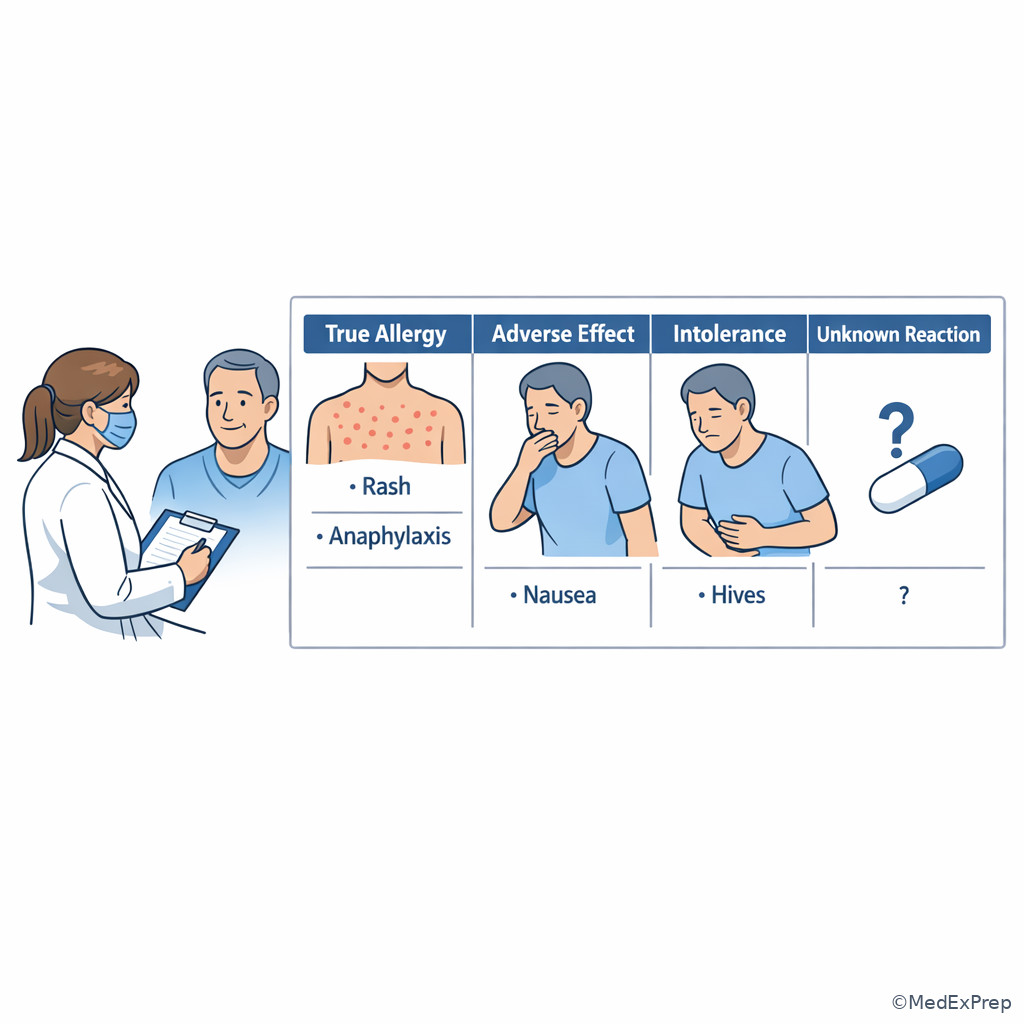
This subsection is one of the most testable because stems often force a choice between taking a listed allergy at face value and clarifying whether it is truly an allergy, side effect, or intolerance. The single resolving rule is: before a medication choice changes, determine the exact agent, reaction, timing, and severity. “I’m allergic to codeine because it made me nauseated” is not the same as anaphylaxis. “I’m allergic to penicillin” must be followed by what happened, when it happened, and whether cephalosporin cross-concern is clinically relevant to the scenario.
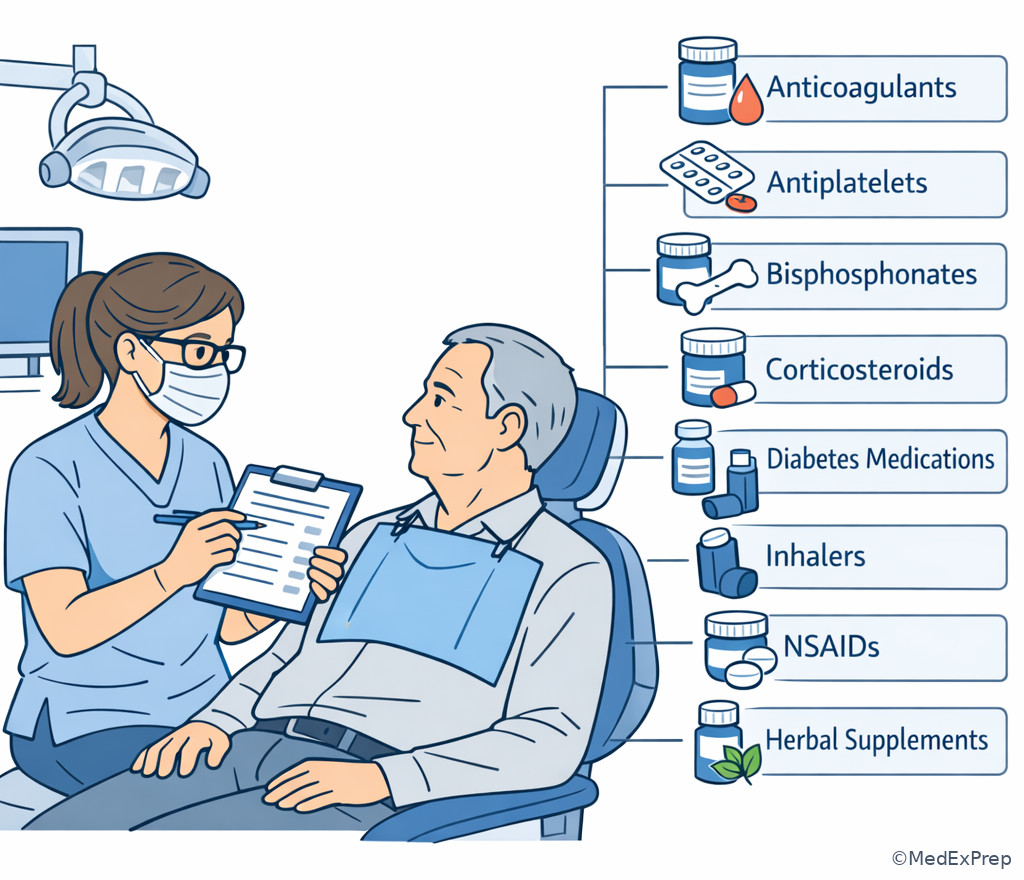
Medication review is broader than prescriptions. Ask about over-the-counter analgesics, aspirin, supplements, herbals, inhalers, anticoagulants, and recent antibiotics. On exam day, the medication list often encodes the diagnosis: nitroglycerin implies ischemic heart disease risk, alendronate suggests antiresorptive exposure, prednisone suggests adrenal and infection considerations, bisphosphonates and denosumab imply surgical relevance, warfarin or DOACs imply bleeding review, and multiple xerogenic drugs help explain caries risk. The point is not to practice medicine outside scope, but to recognize when the regimen changes dental safety.
WHY THIS IS TESTED: medication-allergy confusion creates common wrong answers in dental pharmacology, pain control, and oral surgery questions. Choose the answer that clarifies first when the reaction description is vague. See Fig 3.
Exam takeaway: Distinguish side effects from true allergies before changing dental prescribing or labeling the chart.
Exam takeaway: Over-the-counter drugs and supplements are testable because they can alter bleeding, blood pressure, and analgesic decisions.
B Worked example
A 34-year-old woman presents with irreversible pulpitis symptoms and requests antibiotics because “I’m allergic to everything.” Her history includes asthma and anxiety. She reports allergies to penicillin, codeine, and ibuprofen. On questioning, penicillin caused “a rash as a child, maybe,” codeine caused vomiting, and ibuprofen caused stomach upset. She is afebrile and has no swelling. The distracting detail is the long allergy list.
Reasoning chain: Identify task: determine what history point requires immediate clarification and how it changes care. Extract key facts: pain is pulpal, not infection-driven; codeine and ibuprofen reactions sound like adverse effects/intolerance, not true allergy; penicillin history is vague and remote. Apply rule: clarify reaction details before labeling or choosing alternative drugs. Eliminate distractors: prescribing antibiotics for irreversible pulpitis is not indicated; avoiding all NSAIDs based on dyspepsia is too broad; assuming true anaphylaxis to penicillin without details is unsupported. Verify: the best next step is definitive dental pain management and accurate clarification/documentation of the reported reactions.
C Exam trap
D Checkpoint
Question: A patient reports a “penicillin allergy.” Which follow-up question is most important before this label changes your treatment plan?
- “Which pharmacy do you use most often?”
- “What exactly happened when you took it, and how severe was the reaction?”
- “Did you finish the full course?”
- “Have you ever taken vitamins with it?”
- A: Plausible for medication reconciliation, but it does not distinguish allergy from intolerance.
- B: Correct because reaction pattern and severity determine whether the chart label reflects true allergy, side effect, or uncertain history.
- C: Tempting because adherence matters clinically, but it does not identify the nature of the reaction.
- D: Not useful for this decision; it does not clarify the allergy claim.
1.1.1.6 Dental and social histories: predicting disease pattern, cooperation, and risk
A Explanation
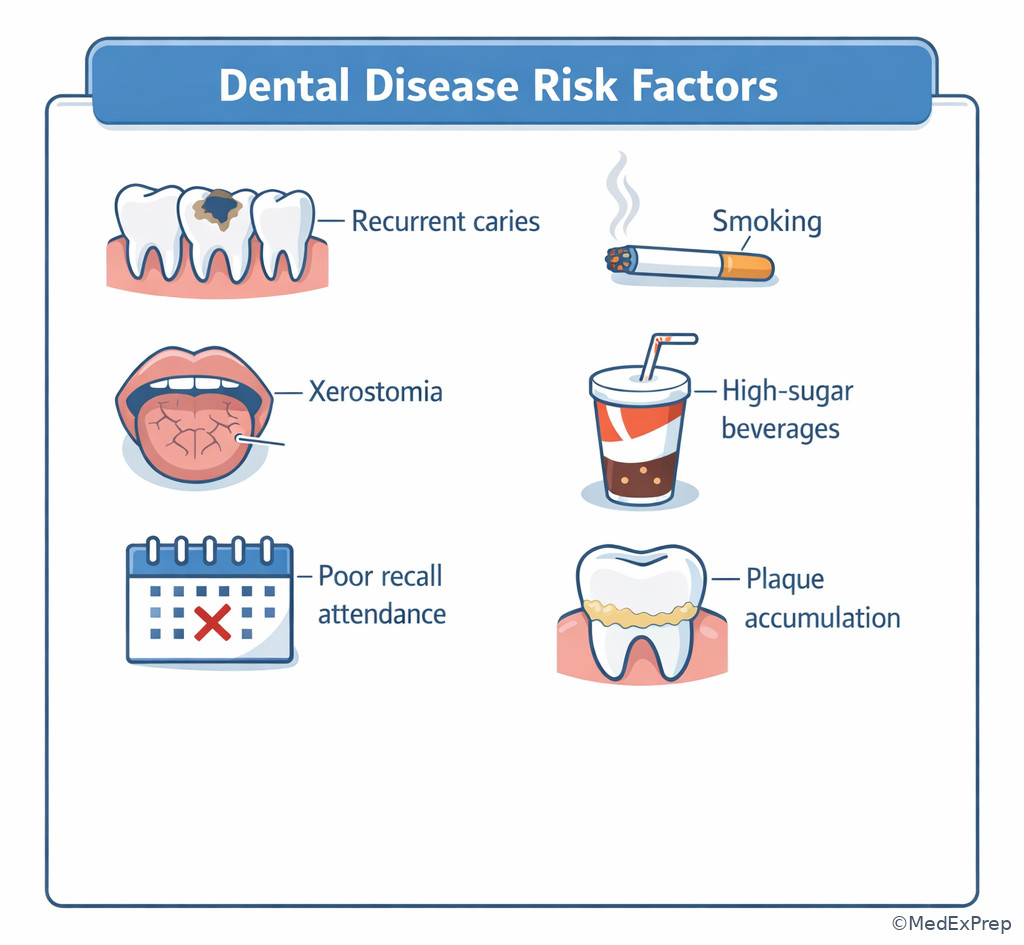
The decision conflict here is whether the dental history is just background or whether it predicts what you will find and how you should plan. The single resolving rule is: dental and social histories are most useful when they explain disease activity, behavior, prior failures, and barriers to successful care. On the INBDE, prior disease experience often predicts future disease better than isolated single findings. A history of repeated restorations, episodic pain, missed recalls, xerostomia-causing medications, smoking, or high-sugar beverage intake should immediately shape how you interpret current complaints and future risk.
Dental history includes frequency of care, reasons for last visits, previous extractions or root canals, periodontal therapy, home care methods, fluoride exposure, bruxism or clenching history, prior postoperative complications, local anesthetic difficulty, dental anxiety, and trauma. Social history includes tobacco, vaping, alcohol, recreational substances, diet pattern, caregiving demands, transportation, insurance access, and ability to return for follow-up. These details do not merely decorate the case. They explain why the patient has recurrent caries, why periodontal disease persists, why treatment compliance may fail, or why certain appointments should be scheduled differently.
WHY THIS IS TESTED: exam items often present a patient with an immediate chief concern, but the best management plan depends on recurrence pattern and barriers. This is also your bridge to the upcoming topic Caries And Periodontal Risk, where these history details become formal risk modifiers. See Fig 4.
Exam takeaway: Prior disease plus habits and access barriers usually predicts future caries and periodontal problems better than a single isolated complaint.
flowchart LR
A[Repeated restorations] --> D[High future caries concern]
B[Smoking and missed recalls] --> E[Higher periodontal concern]
C[Xerostomia causing medications] --> D
F[Dental anxiety or failed anesthesia] --> G[Modify communication and appointment plan]
H[Transport or cost barriers] --> I[Choose realistic sequencing and follow-up]
Exam takeaway: Recurrent restorations, dry mouth, plaque habits, and missed recalls are often more informative than a single symptom description.
B Worked example
A 22-year-old college student presents for “another cavity.” She has ADHD and depression treated with stimulant medication and an SSRI. She drinks energy drinks during night study sessions, vapes nicotine, brushes once daily, and has not seen a dentist in 3 years because of transportation issues. She complains mostly about one posterior tooth but denies spontaneous severe pain. The distracting clue is her age, which may tempt you to think risk is low.
Reasoning chain: Identify task: determine the most important dental/social history factor for treatment planning beyond the single cavity. Extract key facts: stimulant and SSRI use can contribute to dry mouth; energy drinks add frequent sugar/acid exposure; long interval since recall and suboptimal home care suggest ongoing disease activity; vaping is a periodontal risk modifier. Apply rule: prior pattern plus behavior/access barriers predicts future disease and should drive a broader prevention plan. Eliminate distractors: age alone does not protect against active disease; focusing only on the symptomatic tooth misses the recurrence pattern. Verify: the best answer recognizes a high-risk history requiring prevention, disease-control discussion, and realistic follow-up planning.
C Exam trap
D Checkpoint
Question: Which dental/social history pattern most strongly predicts future disease burden and should change prevention planning at the first visit?
- One crown placed 10 years ago with regular recall visits and good home care
- Repeated restorations, missed recalls, dry mouth, and frequent sugared beverage use
- Occasional cold sensitivity after whitening strips
- Preference for evening appointments because of work
- A: Tempting because prior treatment always matters, but this pattern suggests stability rather than active risk escalation.
- B: Correct because clustered history factors strongly predict ongoing caries risk and need for prevention-focused planning.
- C: Plausible because sensitivity is common, but it does not by itself predict broad future disease burden.
- D: Relevant for scheduling, not disease-risk stratification.
- The most common history predictor of future caries is prior caries experience.
- True or False: Dental anxiety is only a comfort issue and does not affect treatment planning. False.
- Name 3 history factors that raise periodontal concern before probing: smoking, diabetes concerns, missed maintenance.
1.1.1.7 Integration: converting the history into treat, modify, defer, or refer
A Explanation
This final section asks you to synthesize. The decision conflict is what the dentist should do next after hearing the history. The single resolving rule is: convert each major history finding into one action category—proceed routinely, proceed with modification, defer for clarification, or refer urgently. This is where board-style reasoning lives. The history is not complete until it changes management.
Proceed routinely when the history reveals no meaningful instability and no special precautions. Proceed with modification when risk is real but stable and manageable within entry-level general practice—such as stress reduction for anxiety, cautious drug selection with CKD history, or bleeding planning with an established medication regimen. Defer for clarification when the relevant information is incomplete and missing details could make treatment unsafe—unclear anticoagulation status, vague recent hospitalization, uncertain pregnancy status where medication choice matters, or unverified severe allergy history. Refer urgently when the history suggests systemic instability or infection spread beyond routine dental scope: dysphagia, dyspnea, rapidly worsening swelling, fever with facial space concern, uncontrolled bleeding, or active chest pain. See Fig 5.
This action framework will recur across the course. In the next topic, vital signs and exam findings confirm or escalate what the history suggested. A strong INBDE candidate does not just collect information; they assign a management consequence to it immediately.
Exam takeaway: The correct answer often depends on assigning the history finding to the right action category.
flowchart TD
A[History finding identified] --> B{Immediate danger or instability?}
B -->|Yes| C[Urgent referral or emergency activation]
B -->|No| D{Information incomplete but could change safety?}
D -->|Yes| E[Defer elective care and clarify]
D -->|No| F{Risk manageable in general practice?}
F -->|Yes| G[Proceed with modification]
F -->|No| H[Proceed routinely] Exam takeaway: The safest exam answer usually matches the risk level rather than the patient’s request for immediate dental treatment.
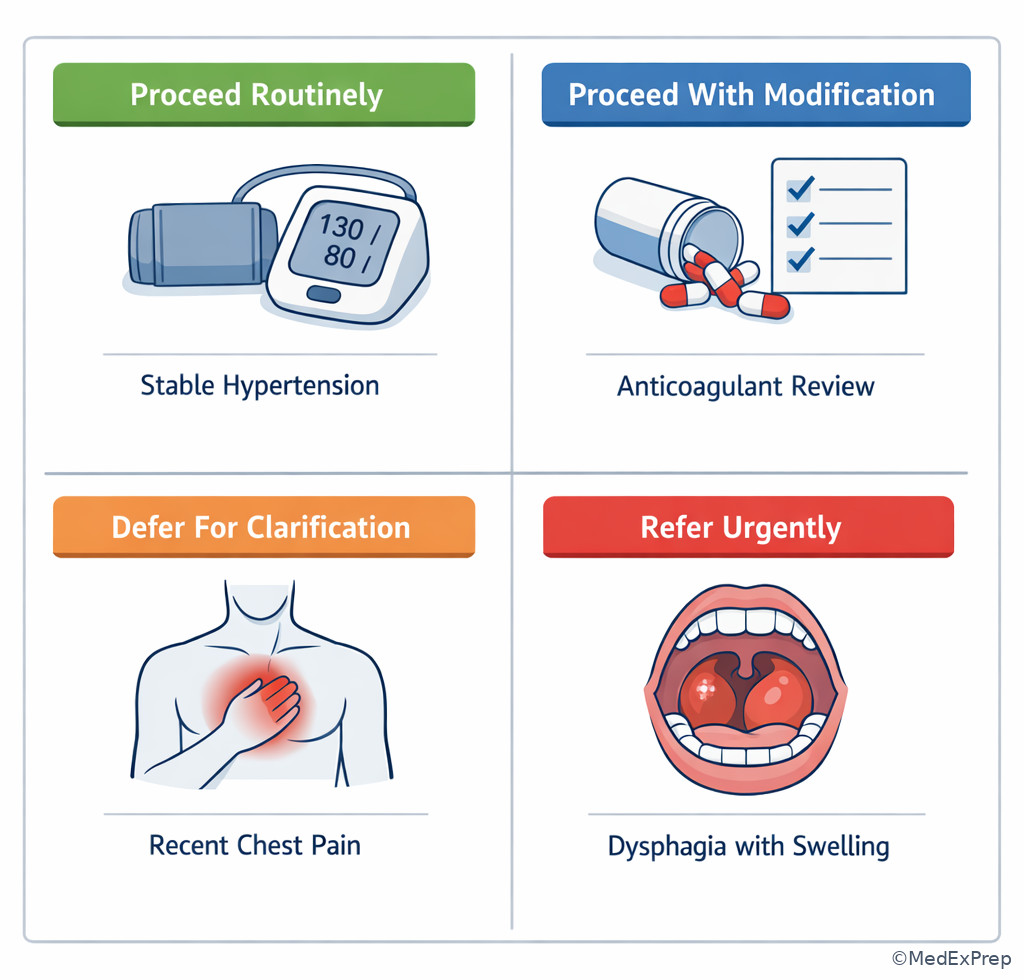
B Worked example
A 51-year-old man presents for emergency treatment of lower molar pain. He has hypertension, obstructive sleep apnea, and type 2 diabetes. He says he developed facial swelling overnight and now has fever, increasing difficulty opening his mouth, and pain swallowing. He took leftover antibiotics from a prior prescription for one day. The distracting clue is the leftover antibiotic use, which may tempt you toward simply prescribing a different antibiotic and dismissing him. The real question is the safest next action.
Reasoning chain: Identify task: routine dental treatment versus urgent referral. Extract key facts: fever, rapidly progressive swelling, trismus, odynophagia/dysphagia are spread-of-infection red flags. Apply rule: airway or deep-space concern moves the case out of routine office management. Eliminate distractors: changing antibiotics in office is insufficient; scheduling later is unsafe; proceeding with extraction without assessing higher-level urgency ignores systemic warning signs. Verify: urgent referral for evaluation and management is the best answer, while stabilizing within scope and deferring elective office treatment.
C Exam trap
D Checkpoint
Question: Which scenario most strongly supports deferring elective dental care for clarification rather than proceeding routinely or making an urgent emergency referral?
- A patient with stable seasonal allergies and no medication use requests a prophylaxis
- A patient with mild anxiety requests shorter appointments for restorative treatment
- A patient reports a new blood thinner but cannot name it and does not know why it was started last week
- A patient with facial swelling has fever and difficulty swallowing
- A: Routine care can typically proceed; this does not create major uncertainty.
- B: Modification is reasonable, but not deferral for unclear safety risk.
- C: Correct because missing anticoagulant details could change bleeding and procedural safety, yet the scenario does not itself imply immediate airway emergency.
- D: Plausible because treatment should not proceed, but this pattern fits urgent referral rather than simple clarification.
Exam Traps & Differentiators
- Looks similar but is not: stable chronic disease versus recent unstable symptoms. A diagnosis label alone usually modifies care; new or worsening symptoms may defer care.
- Looks similar but is not: medication side effect versus true allergy. Nausea and dyspepsia are not the same as urticaria, bronchospasm, or anaphylaxis.
- Looks similar but is not: unclear medication history versus emergency referral. Unknown anticoagulant details often mean clarify and defer; dysphagia and fever mean urgent referral.
- Looks similar but is not: isolated current complaint versus pattern of disease. Recurrent restorations, xerostomia, smoking, and missed recalls point to broader risk.
| Stem says... | Think... | Best exam move |
|---|---|---|
| “Recent chest pressure” | Possible unstable cardiovascular history | Clarify or defer elective care |
| “Difficulty swallowing with swelling” | Airway/deep-space infection risk | Urgent referral, not routine dentistry |
| “Allergic to penicillin” with no details | Reaction type not yet known | Clarify before changing prescribing logic |
| “New blood thinner last week” | Bleeding risk details incomplete | Defer elective invasive care until clarified |
| “Dry mouth, energy drinks, missed recalls” | High future caries risk pattern | Expand planning beyond the single lesion |
| “Numbness never works” | Prior dental complication/anxiety cue | Modify technique and communication after medical safety is cleared |
| Confusable pair | Why the wrong answer is tempting | Single discriminator |
|---|---|---|
| Proceed today vs defer | The dental complaint seems routine | Recent unresolved systemic event |
| Alternative antibiotic vs allergy clarification | The chart says “allergic” | Reaction description is vague or suggests intolerance |
| Office infection treatment vs urgent referral | Many dental infections are treated outpatient | Dysphagia, dyspnea, fever, trismus, rapid progression |
| Single-tooth planning vs risk-based planning | The patient names one problem tooth | Cluster of recurrence and behavior-risk factors |
Related traps from upcoming topics: in Clinical Exam And Vital Signs, the wrong answer will often be ignoring abnormal vitals that confirm the concern raised by the history. In Caries And Periodontal Risk, the trap will be restoring a lesion without addressing the behavior pattern that caused it.
Tables
| History domain | What to ask | Why it matters in dentistry |
|---|---|---|
| Chief concern | Why are you here today? What bothers you most? | Sets urgency and directs focused exam |
| Symptom course | Onset, duration, triggers, severity, swelling, fever | Separates routine pain from urgent infection pattern |
| Cardiovascular history | Recent chest pain, hypertension control, syncope history | Determines stress reduction, deferral, or consultation |
| Respiratory history | Asthma control, inhaler use, sleep apnea | Impacts positioning, sedation caution, emergency readiness |
| Diabetes | Control, hypoglycemia episodes, last meal, medication timing | Affects healing, infection response, and appointment planning |
| Medications | Prescription, OTC, supplements, recent changes | Changes bleeding, xerostomia, interactions, analgesic choices |
| Allergies/reactions | Exact drug, reaction, timing, severity | Prevents false allergy labeling and unsafe prescribing |
| Pregnancy | Status, trimester, obstetric concerns | Affects imaging, meds, timing, consultation needs |
| Dental history | Last visit, prior pain, failed anesthesia, complications | Predicts cooperation, access, and treatment modifications |
| Social history | Tobacco, alcohol, diet, substances, transportation | Explains disease pattern and follow-up barriers |
| Action category | Typical history pattern | Example |
|---|---|---|
| Proceed routinely | No major risk or well-controlled routine history | Healthy patient with seasonal allergies |
| Proceed with modification | Stable known risk within general practice management | Dental anxiety requiring short morning visits |
| Defer for clarification | Information gap that could change safety | New anticoagulant cannot be identified |
| Refer urgently | Potential systemic instability or infection spread | Swelling with dysphagia and fever |
| Differential/classification issue | Choose this when... | Reject this when... |
|---|---|---|
| True allergy | History includes hives, angioedema, bronchospasm, or anaphylaxis | Symptoms were isolated nausea, dyspepsia, or headache |
| Intolerance/adverse effect | Reaction was predictable but unpleasant and nonimmune | Immune-mediated signs were present |
| Stable modifier | Condition is chronic, controlled, and understood | Recent worsening or incomplete history suggests uncertainty |
| Urgent red flag | Symptoms imply airway risk, systemic spread, or instability | Issue is isolated, localized, and patient is systemically well |
| Risk-pattern history | Multiple recurrence and behavior clues cluster together | Only a one-time isolated symptom is present |
Exam takeaway: Visualizing the red-flag cluster helps you prioritize deferral or referral before treatment planning.
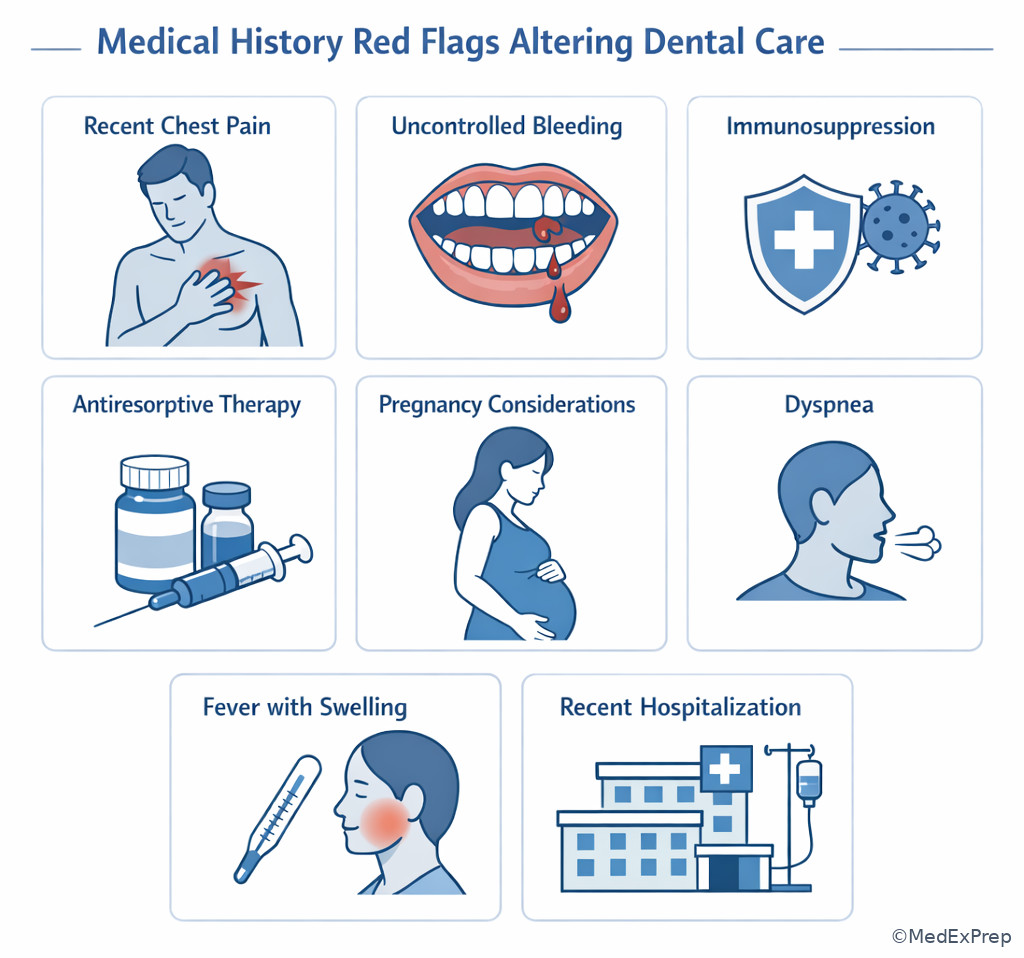
Algorithm / Approach
Exam takeaway: On exam stems, move from chief concern to risk screen to action category rather than jumping directly to treatment.
Use this algorithm when a stem feels busy. First, identify the task. Second, scan for the single history clue that changes safety. Third, classify the case with the P-M-D-R frame from 1.1.1.5. Fourth, ignore attractive but lower-priority dental details until the safety screen is resolved. See Fig 6.
Rapid Review
- Chief concern → patient’s own words beat the chart summary
- Recent hospitalization → more exam-relevant than remote stable disease
- Recent chest pressure → clarification/deferral signal for elective care
- Dysphagia with swelling → urgent referral discriminator
- Medication list → include OTC and supplements, not just prescriptions
- “Penicillin allergy” → reaction details decide whether the label should change care
- Nausea after codeine → adverse effect, not classic true allergy
- New anticoagulant of unknown name → defer invasive elective care until clarified
- Alendronate history before extraction → surgical risk discussion clue
- Repeated restorations + dry mouth → future caries concern, not isolated treatment
- Smoking + missed maintenance → periodontal risk pattern
- Failed local anesthesia history → appointment modification clue after safety is cleared
- Pregnancy status → affects medication and imaging choices more than routine charting alone
- Stable diagnosis label → often modification, not automatic cancellation
- Unclear history with possible major consequence → clarify before proceeding
Self-check quiz
1. A 31-year-old patient presents for a routine recall visit and says, “I’m healthy.” Which follow-up history item is most appropriate because it can still change same-day dental safety?
- Ask whether there have been any recent hospitalizations, new diagnoses, or new medications since the last visit
- Ask which flavor of prophy paste the patient prefers
- Ask whether the patient likes music during treatment
- Ask which childhood dentist they remember best
2. A patient reports “allergy to codeine.” Which clarification is most important before that label changes your pain-management reasoning?
- Which tooth was hurting when codeine was taken
- Whether the reaction was nausea/vomiting or an immune-type reaction such as hives or breathing difficulty
- Whether the codeine tablet was brand or generic
- Whether the patient took it in the morning or at night
3. A 64-year-old man presents for elective scaling and root planing. He has hypertension and hyperlipidemia controlled with medications. During history update, he reports new exertional chest tightness this week and says he has not yet called his physician because it “goes away when I rest.” He also mentions coffee makes him jittery. What is the most appropriate next step?
- Proceed with treatment but avoid epinephrine later if anesthesia is needed
- Shorten the appointment and monitor because anxiety is the most likely cause
- Defer elective care and advise prompt medical evaluation/clarification of possible unstable cardiac symptoms
- Continue with noninvasive periodontal care because no dental pain is present
4. A 26-year-old woman presents with severe lingering pain to cold in a mandibular molar. She has anxiety and mild intermittent asthma. She says she is “allergic” to penicillin because it gave her stomach upset at age 12. She is afebrile with no swelling. Which is the most appropriate interpretation of the history for immediate care planning?
- The penicillin history should be treated as definite anaphylaxis until proven otherwise, and antibiotics are indicated now
- The reaction likely represents intolerance rather than true allergy, and antibiotics are not indicated based on the current presentation alone
- The asthma history means no local anesthetic should be given
- The anxiety history means the pain is probably nonodontogenic
5. A 23-year-old graduate student presents for evaluation of “another cavity.” She takes stimulant medication and an SSRI, drinks sweetened energy drinks daily, vapes nicotine, and has not had a dental visit in 4 years due to transportation issues. She has no fever and no facial swelling. What is the most appropriate use of this history in treatment planning?
- Limit the visit to the visible carious lesion because social factors are outside dental planning
- Recognize a high-risk recurrence pattern and expand planning to include disease-control and prevention strategies
- Assume the stimulant medication fully explains the lesion and no further risk assessment is needed
- Refer immediately to the emergency department because nicotine vaping always requires urgent medical evaluation
6. A 57-year-old woman presents for extraction of a fractured premolar. She has osteoporosis, rheumatoid arthritis, and CKD. Medications include weekly alendronate, prednisone, methotrexate, acetaminophen, and a proton pump inhibitor. She says, “I bruise easily,” but denies any blood thinner. Which history point most requires focused clarification because it most specifically changes extraction counseling and planning?
- History of seasonal allergies in spring
- Weekly alendronate use
- Use of acetaminophen for headaches
- Preference for afternoon appointments
7. A 49-year-old man presents with lower molar pain. He has diabetes and obstructive sleep apnea. Overnight he developed increasing facial swelling, fever, trismus, and painful swallowing. He started leftover amoxicillin from a prior prescription this morning. Which is the most appropriate next step for the entry-level general dentist?
- Prescribe a different oral antibiotic and review in 24 hours
- Proceed with routine definitive treatment in the office because the source is odontogenic
- Urgently refer for higher-level evaluation because the history suggests spread of infection with airway concern
- Ask the patient to continue leftover antibiotics and return after the swelling localizes
8. A 68-year-old patient presents for a crown prep. He has atrial fibrillation, hypertension, and osteoarthritis. He reports that a new medication for “blood thinning” was started 6 days ago after a hospital visit, but he cannot recall the name or indication paperwork. He feels well, denies chest pain, denies swelling, and wants to proceed because he took time off work. Which is the most appropriate management decision based on the history alone?
- Proceed because crown preparation is not surgical and the patient is currently asymptomatic
- Defer elective care until the new anticoagulant/antithrombotic history is clarified and documented
- Send the patient to the emergency department immediately for any anticoagulant use
- Discontinue the unknown medication for 48 hours and proceed at the next visit
Answer key
1. Correct answer: A
- A: Tempting because it feels broad, and it is correct because recent hospitalizations, new diagnoses, or new medications can instantly change dental safety, prescribing, and need for consultation. The single stem clue is that the patient says “I’m healthy,” which still requires verification rather than passive acceptance. Source support: Little, Falace, Miller, and Rhodus emphasize continual medical history review and updates for safe dental care.
- B: Tempting because it is relevant to the visit experience, but it is incorrect because preference questions do not outrank medical risk screening. The discriminating clue is “same-day dental safety.”
- C: Tempting because anxiety management matters in dentistry, but it is incorrect because it does not reveal contraindications or recent medical changes. The clue is that this is a safety question, not comfort planning.
- D: Tempting because prior dental experience can inform management, but it is incorrect because it does not directly screen for current medical risk. The discriminating clue is “most appropriate because it can still change same-day dental safety.”
2. Correct answer: B
- A: Tempting because pain context may help chart review, but it is incorrect because the affected tooth does not distinguish true allergy from side effect. The single clue is “before that label changes your pain-management reasoning.”
- B: Correct because the exact reaction separates intolerance from immune-mediated allergy and directly affects medication planning. The discriminating stem clue is “most important before that label changes your reasoning.” Source support: ADA prescribing principles and oral medicine standards emphasize accurate allergy clarification.
- C: Tempting because drug formulation questions sometimes matter, but it is incorrect because brand versus generic does not establish allergy type.
- D: Tempting because timing can matter for adverse effects, but it is incorrect because morning versus night use does not define immune severity.
3. Correct answer: C
- A: Tempting because epinephrine concerns are common in cardiovascular questions, but it is incorrect because the key issue is recent exertional chest tightness, suggesting potentially unstable symptoms that require clarification before elective care. The single discriminating clue is “this week” with exertional pattern relieved by rest.
- B: Tempting because anxiety can mimic symptoms, and coffee jitteriness is the designed distractor, but it is incorrect because the exertional-rest pattern is more concerning than anxiety. The clue that eliminates it is chest tightness on exertion.
- C: Correct because the safest action is to defer elective care and direct prompt medical clarification of possible unstable cardiac symptoms. This remains within dental scope by prioritizing patient safety rather than independently managing the cardiac condition. Source support: Little et al. and standard dental management guidance for patients with possible unstable cardiovascular disease.
- D: Tempting because periodontal care may seem lower stress than surgery, but it is incorrect because the elective nature of the appointment does not override recent concerning cardiovascular symptoms. The clue is not invasiveness; it is instability risk.
4. Correct answer: B
- A: Tempting because penicillin allergy is a classic board cue and severe reactions matter, but it is incorrect because stomach upset suggests intolerance, not definite anaphylaxis, and the current pulpal pain without swelling does not indicate antibiotics. The single discriminating clue is “afebrile with no swelling.”
- B: Correct because the reaction likely represents intolerance rather than true allergy, and the clinical presentation does not support antibiotic use. The stem clue that separates this from other options is severe lingering cold pain without systemic infection signs. Source support: ADA guidance on urgent management of pulpal/periapical pain and the distinction between allergy and adverse effect in prescribing practice.
- C: Tempting because asthma appears in anesthesia safety discussions, but it is incorrect because mild intermittent asthma does not automatically prohibit local anesthetic use. The clue is absence of any anesthesia-specific contraindication in the stem.
- D: Tempting because anxiety can amplify symptom reporting, but it is incorrect because the thermal history is classic for odontogenic pulpal pain. The discriminating clue is lingering pain to cold.
5. Correct answer: B
- A: Tempting because the chief concern seems localized, but it is incorrect because clustered behavioral and access risks predict ongoing disease and should reshape planning. The key clue is “another cavity” plus multiple recurrence factors.
- B: Correct because stimulant/SSRI-associated dryness, sweetened energy drinks, vaping, and missed care together indicate high recurrence risk and the need for disease-control planning beyond one restoration. Source support: CAMBRA-style risk principles and preventive dentistry standards emphasize prior disease and risk clustering.
- C: Tempting because xerostomia matters, but it is incorrect because a single medication explanation does not replace full risk assessment. The clue is the presence of several additional risk factors.
- D: Tempting because nicotine use is harmful, but it is incorrect because vaping alone does not create an emergency-department indication in this stable outpatient scenario. The discriminating clue is no fever and no swelling.
6. Correct answer: B
- A: Tempting because allergies matter before procedures, but it is incorrect because seasonal allergies do not specifically alter extraction counseling the way antiresorptive therapy can. The single clue is “fractured premolar” requiring extraction.
- B: Correct because weekly alendronate is the most specific history cue that changes extraction discussion and planning due to medication-related osteonecrosis considerations. It does not automatically prohibit treatment, but it requires focused clarification and informed planning. Source support: AAOMS position statements and standard oral surgery risk assessment principles.
- C: Tempting because analgesic use matters in CKD, but it is incorrect because acetaminophen use is not the most specific extraction-planning discriminator here.
- D: Tempting only as an appointment-management preference, but it is incorrect because it does not alter surgical risk counseling.
7. Correct answer: C
- A: Tempting because many odontogenic infections are treated with outpatient antibiotics, but it is incorrect because fever, trismus, increasing swelling, and painful swallowing suggest spread beyond routine office management. The single discriminating clue is dysphagia/trismus with systemic symptoms.
- B: Tempting because definitive source control matters, but it is incorrect because airway and deep-space risk must be addressed first in a higher-level setting. The key clue is not the tooth source but the spread pattern.
- C: Correct because the safest scope-appropriate action is urgent referral for higher-level evaluation when the history suggests serious infection spread and possible airway compromise. Source support: dental infection management standards and AAOMS/OMFS emergency triage principles.
- D: Tempting because patients often self-start leftovers, but it is incorrect because continuing a leftover incomplete regimen delays necessary escalation and is not safe in this presentation. The clue is rapidly progressive swelling with systemic signs.
8. Correct answer: B
- A: Tempting because crown prep is not a surgical extraction and the patient feels well, but it is incorrect because a new unknown antithrombotic started after recent hospitalization is an unresolved medical-history variable that can change planning, local measures, and documentation. The single clue is “cannot recall the name or indication” and it was started only 6 days ago.
- B: Correct because the safest management is to defer elective care until the new medication and indication are clarified and recorded. This is not because all anticoagulants prohibit dentistry; it is because the medication history is incomplete in a way that could alter care. Source support: Little et al. and standard medication-reconciliation expectations in dentistry.
- C: Tempting because blood thinners raise concern, but it is incorrect because the stem does not suggest active emergency symptoms or bleeding; this is a clarification problem, not automatic emergency referral.
- D: Tempting because holding a medication might seem practical, but it is incorrect and outside appropriate dental decision-making without clarification of the drug and indication. The discriminating clue is that the patient may have had a recent significant medical event and medication should not be stopped casually.
Keep going with the full INBDE Prep Course (INBDE)
You just studied the way members do, in the same lesson interface. Full access unlocks every lesson, the question bank and flashcards for a full year.
One payment · 1 year of access · No auto-renewal