1.1.1 - Common HESI A2 Subtests
Why it matters
- The HESI A2 is not one single fixed national subject package; many schools choose different subtests.
- You save study time by knowing the difference between commonly assigned and universally required.
- Many wrong answers on exam-planning questions come from overgeneralizing one school's rules to all schools.
- Knowing the subtests early helps you build a balanced prep plan instead of overstudying one area and neglecting another.
Key Terms & Must-Know Facts
1.1.1.1 Key terms
- Subtest: One subject-specific section of the HESI A2
- Blueprint: The content map showing what a test covers
- Domain: A major subject area, such as Math or Reading
- Academic readiness: Demonstrated preparation for entry into a health professions program
- Reading inference: A conclusion supported by the passage, not directly quoted
- Context clue: Surrounding text that helps determine word meaning
- Ratio/proportion: A common math setup for scaling and conversion
- Unit conversion: Changing a quantity from one unit to another correctly
- Grammar usage: Correct standard English structure and word choice
- Foundational science: Introductory biology, chemistry, anatomy and physiology, and physics concepts
- School-specific requirement: A local program rule that may differ from another school's rule
- Plausible distractor: A wrong option that looks reasonable unless you know the exact rule
1.1.1.2 Must-know facts
- The commonly assigned HESI A2 domains are Math, Reading Comprehension, Vocabulary & General Knowledge, and Grammar.
- Some schools also assign Biology, Chemistry, Anatomy & Physiology, and Physics.
- You should not assume all science subtests are required everywhere.
- You should not assume universal cut scores or fixed section weights.
- Healthcare wording may appear, but the exam primarily tests academic readiness, not licensure-level clinical decisions.
- Strong performance depends on both knowledge and test-direction reading.
- Subtests differ in task type: some emphasize calculation, others passage analysis or language rules.
- The best prep plan begins with confirming what your school actually requires.
Exam takeaway: Separate the core commonly assigned academic areas from the science sections that may be school-specific.
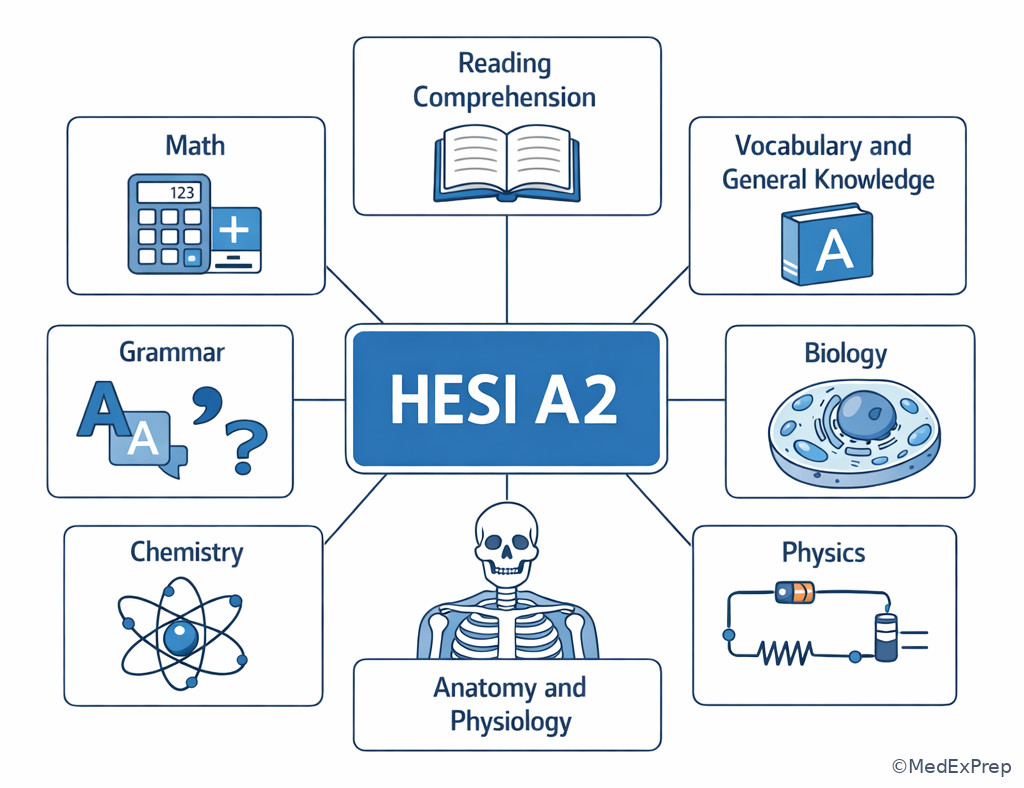
flowchart TD
A[HESI A2] --> B[Math]
A --> C[Reading Comprehension]
A --> D[Vocabulary and General Knowledge]
A --> E[Grammar]
A --> F[Science sections may also be assigned]
F --> G[Biology]
F --> H[Chemistry]
F --> I[Anatomy and Physiology]
F --> J[Physics]
Exam takeaway: Visual grouping helps you remember that the exam is built from separate subject sections rather than one blended content block.
Core content
1.1.1.3 Foundational map: what the common HESI A2 subtests are
A Explanation
The first decision conflict on this topic is simple but high yield: Should you treat every listed subject as universally required, or as commonly assigned domains that may vary by school? The correct choice is the second one. The HESI A2 commonly includes Math, Reading Comprehension, Vocabulary & General Knowledge, and Grammar. Many schools also require one or more science sections such as Biology, Chemistry, Anatomy & Physiology, and Physics. The single rule that resolves the conflict is this: common does not mean universal. That distinction is tested because admissions exams often produce trap thinking in which learners over-assume fixed national rules.
WHY THIS IS TESTED: Students confuse “often tested” with “always required,” then misread planning questions or waste time studying the wrong areas. A stem may ask for the most supported statement, and the best answer will usually use careful language such as “commonly assigned” or “may vary by school.” See Fig 1.
Key rule: Think of the HESI A2 as a menu of subject subtests commonly drawn from a standard pool, not as one identical package for every applicant.
B Worked example
A 19-year-old applicant to a practical nursing program is reviewing a prep guide. She has strong biology coursework, average algebra skills, mild test anxiety, and a distracting note from a friend that “everyone takes all eight sections.” The guide she found online lists Math, Reading Comprehension, Vocabulary & General Knowledge, Grammar, Biology, Chemistry, Anatomy & Physiology, and Physics as common HESI A2 subject areas. Her school website, however, only clearly mentions Math, Reading, Vocabulary, and Grammar, with a separate note to verify additional requirements directly with admissions.
Reasoning chain: Identify the task: determine the most supported interpretation of the subtest list. Extract key facts: the online guide says “common,” while the school site tells applicants to verify specific requirements. Apply the rule: common subject areas are not automatically universal local requirements. Eliminate distractors: reject “all schools require all science sections” because the school did not say that. Reject “science is never tested” because the guide explicitly names science sections as commonly assigned. Verify: the safest conclusion is that the student should prepare around the confirmed core sections first and confirm whether science subtests are required for her program.
C Exam trap
Common wrong answer: “Because these are the common HESI A2 subtests, every school requires all of them.”
Why it is tempting: Students often convert a broad overview into a fixed national rule, especially when the list appears in a prep resource.
Single clue that eliminates it: Any wording like “may require,” “commonly assigned,” or “confirm with your school” means variability is built into the question.
D Checkpoint
Question: Which statement is the most supported by a general HESI A2 overview?
- A. All HESI A2 examinees take exactly the same set of subtests.
Tempting because standardized tests often feel uniform; wrong because HESI A2 section requirements may vary by school. - B. Math, Reading Comprehension, Vocabulary & General Knowledge, and Grammar are commonly assigned core academic areas.
Tempting because it matches typical prep resources; right because it is broad, accurate, and does not overclaim universality. - C. Science sections are never part of the HESI A2.
Tempting if a learner's school only requires academic sections; wrong because some schools also assign science subtests. - D. Section weights and cut scores are fixed nationally for all programs.
Tempting because many exams publish standard scoring frameworks; wrong because you should not assume universal local rules for HESI A2 requirements.
1.1.1.4 What each major academic subtest tends to measure
A Explanation
Now the decision conflict changes: When a question names a subtest, what kind of task should you expect from it? This matters because students often study the right subject in the wrong way. Math emphasizes operations, fractions/decimals/percents, ratios, proportions, conversions, and word-problem setup. Reading Comprehension emphasizes main idea, supporting detail, inference, tone, and author purpose. Vocabulary & General Knowledge emphasizes word meaning, usage in context, roots, prefixes, suffixes, and common academic or health-related terminology. Grammar emphasizes agreement, tense, punctuation, sentence structure, and usage. The single rule that resolves confusion is: match the subtest name to its dominant skill type.
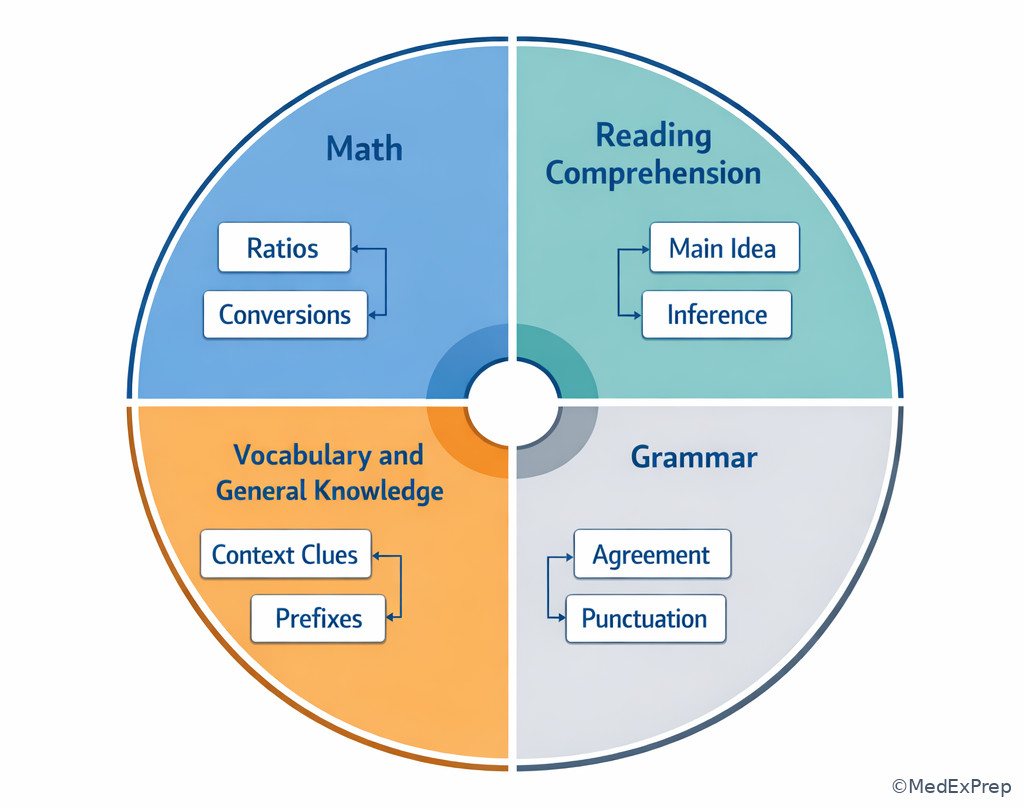
WHY THIS IS TESTED: Many distractors are cross-domain mistakes. For example, a student may approach a reading question like a memory question, or a vocabulary question like a pure grammar rule question. The exam rewards task recognition first, then content knowledge. See Fig 2.
Exam takeaway: Match each section to its main task type before you try to solve the item.
flowchart LR
A[Math] --> A1[Computation]
A --> A2[Fractions decimals percents]
A --> A3[Ratio proportion conversion]
B[Reading] --> B1[Main idea]
B --> B2[Details]
B --> B3[Inference tone purpose]
C[Vocabulary] --> C1[Meaning in context]
C --> C2[Roots prefixes suffixes]
C --> C3[Academic and health terms]
D[Grammar] --> D1[Agreement]
D --> D2[Tense pronouns]
D --> D3[Punctuation and structure]
Exam takeaway: A visual skill wheel helps you separate computation tasks from language-analysis tasks.
B Worked example
A 22-year-old applicant returning to school after working in retail has strong spoken English, a history of average science grades, and a tempting but wrong belief that vocabulary questions are mainly spelling questions. She opens a practice set labeled “Vocabulary & General Knowledge” and sees an item asking for the best meaning of a word in a short health-related sentence. Another choice on the page would be grammatically correct if inserted into the sentence but does not fit the meaning.
Reasoning chain: Identify the task: this is a vocabulary-in-context item, not a grammar correction item. Extract key facts: the section label and the wording “best meaning” point to word sense, not sentence mechanics. Apply the rule: use context clues and semantic fit. Eliminate distractors: reject the grammatically smooth option if it changes the meaning. Verify: the best answer is the option whose meaning matches the sentence's context, even if another option also sounds polished.
C Exam trap
Common wrong answer: Using grammar instincts to answer vocabulary questions or using outside knowledge to answer reading questions.
Why it is tempting: Learners often rely on whatever skill feels strongest rather than the skill the item actually tests.
Single clue that eliminates it: The section label and question verb usually tell you the tool to use: calculate, infer, define, correct, support, or convert.
D Checkpoint
Question: A HESI A2 item asks for the best meaning of the word acute in a sentence about an “acute shortage of supplies.” Which approach is most appropriate?
- A. Focus on whether the word sounds formal enough for academic writing.
Tempting because tone matters in some language tasks; wrong because this is a meaning-in-context question. - B. Decide which option matches the sentence's context, even if the same word has a different meaning in another setting.
Tempting because context can override familiar meanings; right because vocabulary items test contextual meaning. - C. Choose the medically related definition first because the exam is health-focused.
Tempting because health terms appear often; wrong because the sentence context, not the broad exam theme, controls the answer. - D. Select the option with the most precise punctuation.
Tempting if you are thinking about grammar; wrong because punctuation is not the target skill here.
- The most common academic HESI A2 domains are Math, Reading, Vocabulary & General Knowledge, and Grammar.
- True or False: A vocabulary question should be answered primarily by checking punctuation. False.
- Name the 3 major reading skills often tested: main idea, supporting detail, and inference.
1.1.1.5 Where the science subtests fit and how to think about them
A Explanation
The next decision conflict is: Should you treat science sections as advanced professional-school content or as prerequisite-level foundational science? For HESI A2 prep, choose foundational science. Biology, Chemistry, Anatomy & Physiology, and Physics, when assigned, generally test introductory concepts rather than professional licensure judgment. The single rule is: if a science item appears on HESI A2, expect prerequisite knowledge, not advanced clinical reasoning. That means cell basics, atomic structure, body systems, motion, pressure, units, and similar topics are fair targets; independent diagnosis and treatment planning are not.
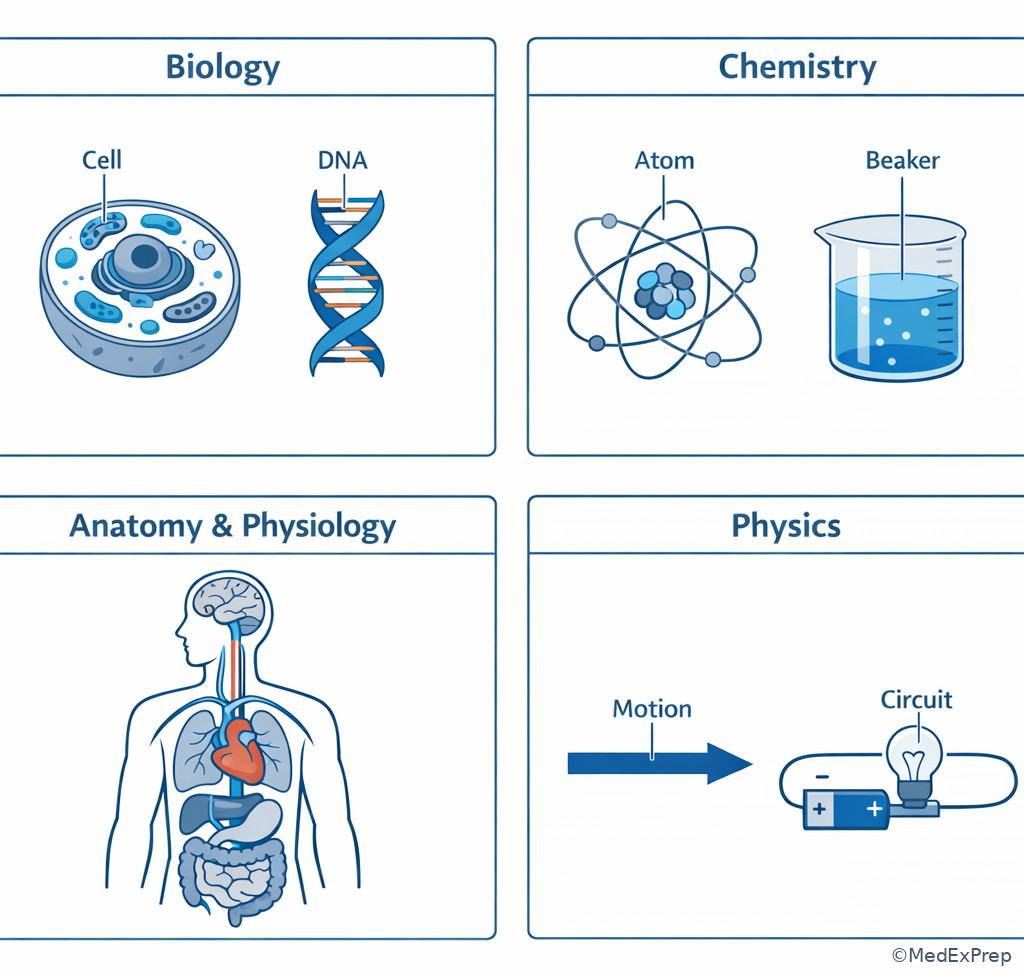
WHY THIS IS TESTED: Learners either underprepare by ignoring science entirely or overcomplicate science by jumping into advanced medical detail. The best-prepared test taker works at the right depth. See Fig 3.
Key rule: Science on HESI A2 is about academic readiness for future coursework, not about functioning like a licensed clinician.
Exam takeaway: When science appears, think foundational concepts by subject rather than advanced professional decision-making.
flowchart TD
A[Science on HESI A2] --> B[Biology]
A --> C[Chemistry]
A --> D[Anatomy and Physiology]
A --> E[Physics]
B --> B1[Cells genes metabolism basics]
C --> C1[Atoms bonds reactions pH]
D --> D1[Systems structure function homeostasis]
E --> E1[Motion force pressure electricity basics]
Exam takeaway: Remember the science sections as four prerequisite-school subjects rather than one advanced medical block.
B Worked example
A 20-year-old applicant with recent coursework in chemistry and anatomy is deciding what to review first. She also has a distracting memory of a cousin saying nursing entrance tests ask you to “interpret patient labs and choose treatment.” A practice item from a science bank asks about the function of the nephron, while another asks about ionic versus covalent bonds. She worries that she has to master bedside care decisions before she can answer science questions correctly.
Reasoning chain: Identify the task: classify the level of science expected. Extract key facts: nephron structure-function and chemical bonds are foundational science topics. Apply the rule: HESI A2 science, when assigned, targets prerequisite knowledge. Eliminate distractors: reject the idea that the exam expects independent clinical management. Verify: the correct study response is to review core science concepts, definitions, and basic relationships, not advanced practice decisions.
C Exam trap
Common wrong answer: “Because applicants plan to enter nursing or allied health programs, the science items will test clinical management.”
Why it is tempting: The healthcare setting makes learners expect bedside-style reasoning.
Single clue that eliminates it: HESI A2 is an admissions assessment of readiness, so science questions stay at foundational academic level.
D Checkpoint
Question: Which statement best reflects how science subtests should be approached on the HESI A2?
- A. They mainly test licensure-level patient care prioritization.
Tempting because the audience is entering health professions; wrong because admissions-test science is foundational. - B. They should be ignored because science is never assigned.
Tempting if a school emphasizes academic sections; wrong because some schools do assign science subtests. - C. They emphasize introductory concepts in subjects such as biology, chemistry, anatomy and physiology, and physics.
Tempting because it sounds broad; right because that is the correct readiness-level framing. - D. They are mainly long passage questions about hospital policy.
Tempting because reading-heavy exams exist; wrong because that does not describe the science domain.
1.1.1.6 How to build a smart study plan from the subtest overview
A Explanation
This is the first application-heavy decision conflict: Should you study everything equally from day one, or should you tier your plan based on confirmed requirements and personal weaknesses? The best answer is a tiered approach. First, confirm what your school requires. Second, prioritize those sections. Third, within required sections, start with your weakest high-yield areas. Fourth, use common domains for backup study if some requirements remain uncertain. The single rule is: confirm, prioritize, then broaden. Random studying feels productive, but targeted studying improves score return per hour.
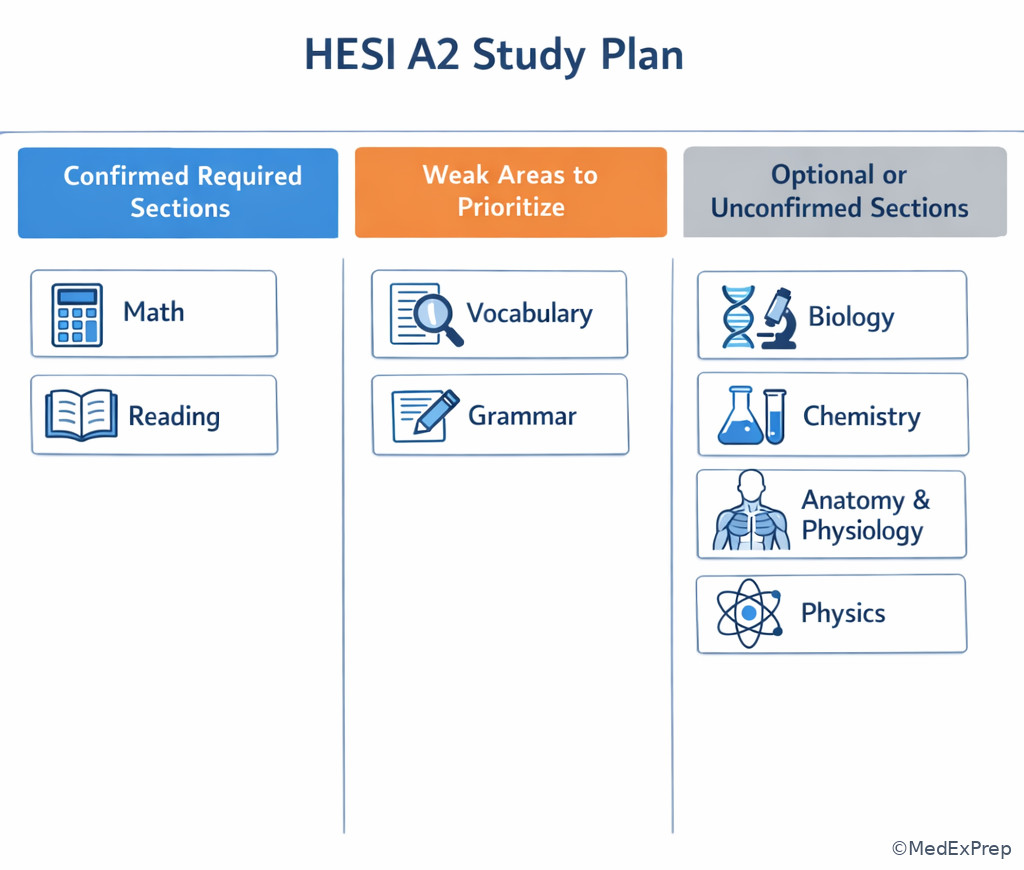
WHY THIS IS TESTED: Planning questions reward disciplined reasoning. The best answer is rarely the most extreme answer. “Study only your favorite section” and “study every possible subject equally” are both usually too rigid. See Fig 4.
Exam takeaway: The best prep order is confirmed required sections first, then weak areas, then unconfirmed extras.
flowchart TD
A[Start study plan] --> B{School lists required sections?}
B -->|Yes| C[Study required sections first]
B -->|No or incomplete| D[Use common domains as temporary baseline]
C --> E[Rank weakest required subjects]
D --> E
E --> F[Practice high-yield skills in each]
F --> G[Add optional or unconfirmed science review if time remains] Exam takeaway: A visual tiered schedule reinforces the sequence of confirmed sections first and optional review second.
B Worked example
A 24-year-old applicant has been out of school for three years. She is strong in reading, weaker in fractions and conversions, and has a distracting note from social media claiming Physics is “always on the exam.” Her school's admissions page clearly names Math, Reading, Grammar, and Vocabulary, but says additional science requirements depend on program track. She has only two weeks to prepare.
Reasoning chain: Identify the task: choose the most appropriate study setup. Extract key facts: confirmed sections are Math, Reading, Grammar, and Vocabulary; math is her weakness; science is program-dependent, not confirmed for her. Apply the rule: confirm, prioritize, then broaden. Eliminate distractors: reject equal-time study across all eight subtests because time is limited and requirements are not confirmed. Reject studying only reading because that is already a strength. Verify: the best plan is to spend most time on weak required math skills, maintain shorter review blocks for required language sections, and only add science review after confirming it is required or if extra time remains.
C Exam trap
Common wrong answer: “When requirements are unclear, split your study time evenly across every possible HESI A2 subject.”
Why it is tempting: It feels fair and comprehensive.
Single clue that eliminates it: Limited study time makes equal distribution inefficient when some sections are confirmed and others are only possible.
D Checkpoint
Question: A student has one week left, confirmed Math and Reading requirements, and uncertain science requirements. What is the best initial study choice?
- A. Spend equal time on all eight common subtests.
Tempting because it seems balanced; wrong because confirmed sections should come first. - B. Focus first on the confirmed sections, especially the weaker one, then add science review if needed.
Tempting because it follows a priority framework; right because it matches efficient exam planning. - C. Ignore Math because it feels harder and spend all time on Reading.
Tempting because confidence can reduce anxiety; wrong because weakness in a confirmed section deserves attention. - D. Start with Physics because science feels more “medical.”
Tempting because healthcare programs use science; wrong because it is not confirmed and does not outrank required sections.
- Fill in the blank: The smartest first step in HESI A2 planning is to confirm your school's required subtests.
- True or False: Equal study time across all possible sections is always the most efficient plan. False.
- Name the three planning steps in order: Confirm, Prioritize, Broaden.
1.1.1.7 How HESI A2 questions create traps from wording, assumptions, and near-miss choices
A Explanation
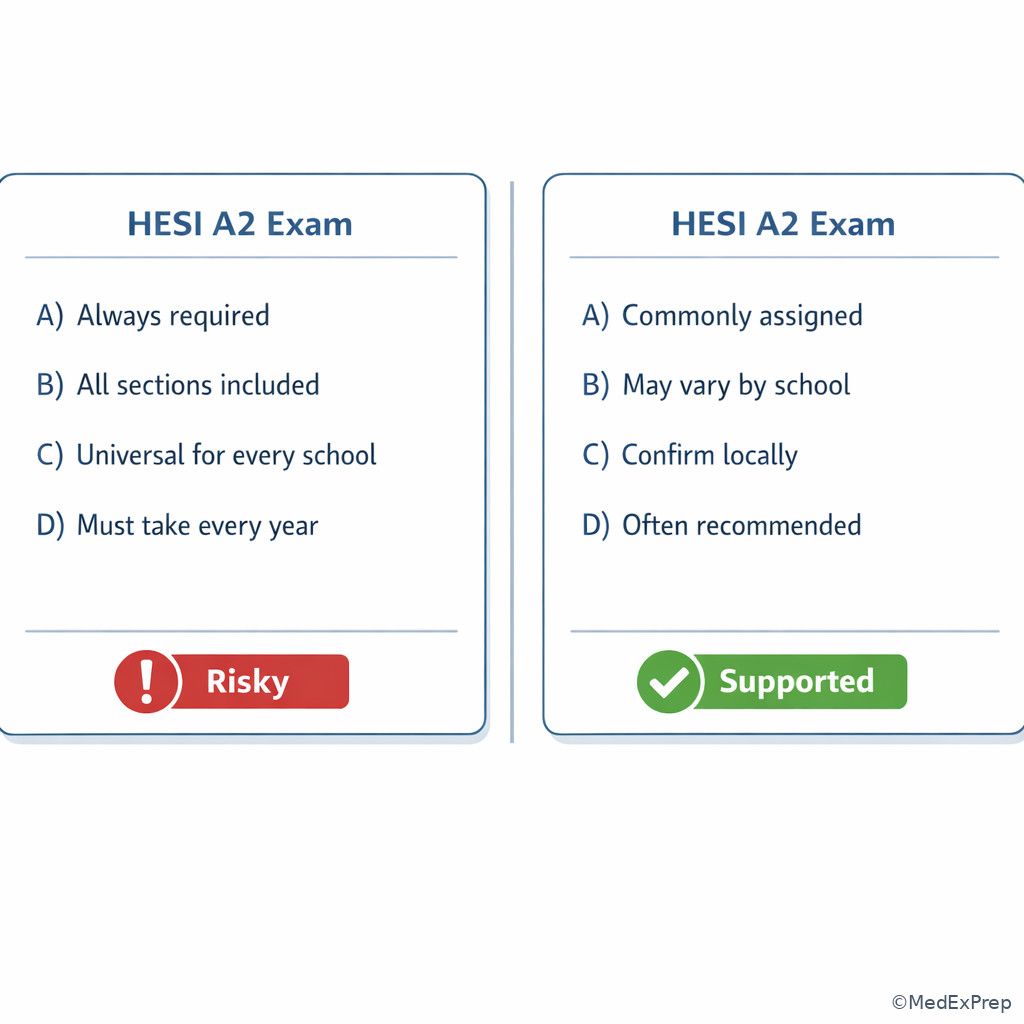
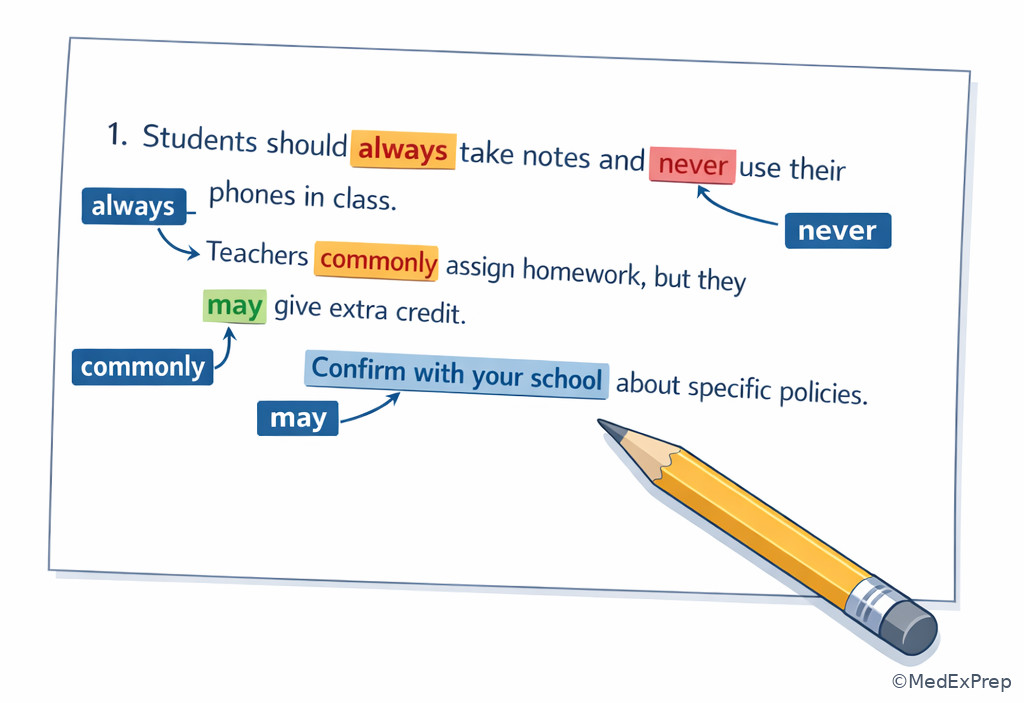
The final integration conflict is: When two answer choices both sound reasonable, how do you choose the one that is actually supported? On this topic, the best answer usually avoids overclaiming. Watch for absolute words such as “all,” “always,” “never,” “fixed,” or “universal.” These words often turn a mostly true statement into a wrong one. Also watch for category drift: a reading answer that sounds like a vocabulary answer, or a broad HESI overview answer that suddenly claims school-specific scoring rules. The single rule is: choose the answer that stays within the evidence and the exam's stated scope.
WHY THIS IS TESTED: Admissions-test questions often reward precision more than memorization. A learner who knows the subject list but misses a single word like “always” can still miss the item. See Fig 5 and Fig 6.
Common distractor pattern: A choice may begin with a true idea, then add a false universal claim. Read the whole sentence before selecting it.
Exam takeaway: Absolute language often turns a plausible HESI A2 statement into a wrong answer.
flowchart LR
A[Option sounds reasonable] --> B{Contains all always never fixed universal?}
B -->|Yes| C[Check for overclaim]
B -->|No| D[Compare with source wording]
C --> E[Often eliminate]
D --> F[Choose answer that stays within evidence] Exam takeaway: The best answer is often the one with careful wording rather than the one that sounds most confident.
Exam takeaway: Highlighting signal words helps you catch overclaiming before you commit to an answer.
B Worked example
A 21-year-old applicant with strong reading skills but weak confidence in testing strategy is choosing between two answer choices on a prep item. She has a distracting habit of picking the option that sounds most decisive. The stem asks which statement about HESI A2 subtests is most supported. Choice A says, “All applicants take the same science sections.” Choice B says, “Science sections may be required depending on the school or program.” A friend tells her the more specific answer is usually better.
Reasoning chain: Identify the task: choose the most supported claim, not the boldest claim. Extract key facts: the lesson overview uses variable language for science requirements. Apply the rule: reject unsupported absolutes. Eliminate distractors: Choice A sounds confident but overclaims; Choice B matches the allowed scope. Verify: the best answer is the statement with careful, evidence-based wording.
C Exam trap
Common wrong answer: Picking the most specific or forceful statement just because it sounds authoritative.
Why it is tempting: Confidence in wording can feel like confidence in correctness.
Single clue that eliminates it: On overview questions, unsupported certainty is a liability, not a strength.
D Checkpoint
Question: Which option is most likely to be wrong on a general HESI A2 overview question?
- A. “Your school may require different HESI A2 sections.”
Tempting because it sounds cautious; wrong to eliminate because this cautious wording is often correct. - B. “Math commonly tests conversions, ratios, and number operations.”
Tempting because it describes a real domain; wrong to eliminate because it stays within common content expectations. - C. “Every school uses the same section package and scoring expectations.”
Tempting because standardized exams feel uniform; right as the option most likely to be wrong because it makes an unsupported universal claim. - D. “Reading items often require passage-based evidence.”
Tempting because it is broad; wrong to eliminate because it accurately describes reading tasks.
Exam Traps & Differentiators
Most common wrong answer and why: “All HESI A2 test takers take the same sections.” This is tempting because many standardized exams are uniform, but HESI A2 requirements can vary by school and program.
Looks similar but isn't: “Commonly assigned” is not the same as “required everywhere.” “Foundational science” is not the same as “clinical management.” “Vocabulary in context” is not the same as “grammar correctness.”
| If the stem says... | Think... |
|---|---|
| “commonly assigned subtests” | Typical domains, not universal local requirements |
| “most supported statement” | Choose the answer that stays closest to the evidence |
| “best meaning in context” | Use sentence clues, not just memorized dictionary definitions |
| “school-specific requirements” | Local confirmation outranks general prep assumptions |
| “science section” | Prerequisite-level concepts, not licensure-level decision-making |
| “all,” “always,” or “never” | Check for an overclaiming trap |
| Common confusion pair | What makes them look alike | Single differentiator |
|---|---|---|
| Reading vs. Vocabulary | Both use words in passages or sentences | Reading asks what the passage supports; Vocabulary asks what the word means |
| Vocabulary vs. Grammar | Both use sentence-based items | Vocabulary tests meaning; Grammar tests correctness of language form |
| Common overview vs. school requirement | Both may list the same subtests | School-specific documentation determines actual local requirements |
| Foundational science vs. clinical decision-making | Both may use health-related wording | HESI A2 stays at prerequisite academic depth |
Related trap from the upcoming topic School-Specific Requirements: learners often confuse an overview resource with an official local admissions rule. Related trap from the upcoming topic Computer Testing Expectations: learners know the content area but miss the item because they skip section directions.
Tables
| Subtest | What it usually measures | High-yield skill examples |
|---|---|---|
| Math | Quantitative accuracy and setup | Fractions, decimals, percents, ratio/proportion, conversions, word problems |
| Reading Comprehension | Passage understanding and evidence use | Main idea, detail, inference, tone, purpose, conclusion |
| Vocabulary & General Knowledge | Word meaning and language familiarity | Context clues, roots, prefixes, suffixes, academic and health-related terms |
| Grammar | Standard English correctness | Agreement, tense, pronouns, punctuation, sentence structure, modifiers |
| Biology | Introductory life science concepts | Cells, genetics, metabolism, classification |
| Chemistry | Introductory chemical concepts | Atoms, bonds, reactions, solutions, acids and bases |
| Anatomy & Physiology | Basic body structure and function | Body organization, systems, homeostasis, structure-function relationships |
| Physics | Basic physical principles | Motion, force, energy, pressure, electricity, unit reasoning |
| Study approach | Best use case | Why it works | When to reject it |
|---|---|---|---|
| Confirmed-sections-first | Your school has published required subtests | Protects study time and reduces wasted effort | Reject only if your official requirement list changes |
| Weakness-first within required areas | Time is limited and one required area is clearly weaker | Raises score potential faster | Reject if it causes total neglect of other required areas |
| Equal coverage of every possible subject | Only when all sections are confirmed and time is abundant | Maintains broad balance | Reject when requirements are uncertain or time is short |
| Science-only focus | Only if science sections are confirmed and academic sections are already strong | Useful for science-heavy local requirements | Reject if confirmed Math/Reading/Grammar/Vocabulary are being ignored |
| Statement type | Likely correct or incorrect? | Why |
|---|---|---|
| “Math commonly includes conversions and proportions.” | Likely correct | Broad, typical, and within standard domain expectations |
| “Every program uses identical science requirements.” | Likely incorrect | Unsupported universal claim |
| “Vocabulary items may use healthcare-related context.” | Likely correct | Matches the admission-test context without overclaiming scope |
| “Science on HESI A2 is mostly advanced bedside judgment.” | Likely incorrect | Exceeds admissions-test scope |
| “Applicants should confirm local requirements with their school.” | Likely correct | Fits the school-specific variability rule |
| “Cut scores are fixed nationally for every HESI A2 program.” | Likely incorrect | Claims universal local policy without support |
Algorithm / Approach
Rapid Review
- Common HESI A2 overview → common domains are not universal local requirements
- Math → calculation setup and unit accuracy separate right from near-miss answers
- Reading Comprehension → passage support separates inference from assumption
- Vocabulary → context meaning separates the right definition from familiar but wrong meanings
- Grammar → language rule correctness separates polished-sounding from actually correct choices
- Science sections → prerequisite-level concepts separate admissions scope from licensure scope
- School confirmation → official local requirements outrank general prep resources
- Absolute wording → “all/always/never” often signals overclaiming
- Best-supported choice → bounded wording beats exaggerated certainty
- Study planning → confirmed required sections beat equal-time random coverage
- Weak-area strategy → weakest required domain usually gives the best return on study time
- Health-related context → still tests academic readiness, not independent clinical decision-making
Self-check quiz
1. A student reads that the HESI A2 commonly includes Math, Reading Comprehension, Vocabulary & General Knowledge, and Grammar, with some schools also assigning science sections. Which conclusion is most appropriate?
- A. Every school requires all listed science sections.
- B. The listed subjects represent common domains, but local requirements may differ.
- C. Science is optional everywhere.
- D. Reading and Grammar are the same subtest under different names.
2. A practice item appears in the Vocabulary & General Knowledge section and asks for the best meaning of a word in a sentence about a hospital volunteer program. Which skill should the student use first?
- A. Sentence punctuation rules
- B. Context clues for word meaning
- C. Long-division setup
- D. Physics formula recall
3. A 23-year-old applicant is preparing for a respiratory therapy program. Her school's website clearly lists Math, Reading, Grammar, and Vocabulary, but says science requirements vary by track. She is weakest in fractions and conversions, strongest in reading, and has only ten days left. Which study plan is most appropriate?
- A. Spend equal time on all common HESI A2 subtests, including all sciences
- B. Focus first on weak required Math skills, maintain review in the other confirmed language sections, and verify science requirements before allocating major time there
- C. Ignore Math because it causes anxiety and spend nearly all time on Reading
- D. Begin with Physics because science feels most related to healthcare training
4. A 20-year-old applicant sees a science practice item asking about the main function of mitochondria. She also has asthma and seasonal allergies, and she is distracted by a friend's comment that entrance exams mainly test clinical treatment choices. Which mindset is most appropriate for this item?
- A. Use prerequisite biology knowledge because HESI A2 science is foundational when assigned
- B. Choose the option that sounds most like a nursing intervention
- C. Skip the question because science is never on HESI A2
- D. Treat the item as a hospital policy reading passage
5. A student is choosing between two answer choices on an overview question. One says, “All HESI A2 examinees complete identical section packages.” The other says, “Programs may require different HESI A2 subtests.” Which answer is best?
- A. The first, because standardized exams always use one national structure
- B. The second, because it avoids an unsupported universal claim
- C. The first, because more confident wording is usually more correct
- D. Neither, because HESI A2 has no recognizable common domains
6. A 26-year-old applicant to an ADN program worked as a medical receptionist for four years and assumes her healthcare exposure means she can minimize language review. Her school confirms Math, Reading, Vocabulary, and Grammar; Anatomy & Physiology is listed only for some applicants. She is strong in terminology but misses punctuation and inference questions, and she has one week before testing. Which approach best matches this lesson?
- A. Study only health terminology because healthcare experience covers the rest
- B. Prioritize confirmed weak language domains such as Reading inference and Grammar, while confirming whether Anatomy & Physiology is required before major review there
- C. Spend the week equally across all eight common subtests to avoid missing anything
- D. Focus mainly on Anatomy & Physiology because it sounds most program-relevant
7. A student answers an overview question incorrectly after choosing a statement with the word “always.” The original study sheet had said schools “may require different sections,” and the missed item asked for the most supported conclusion. Which revision in strategy would best prevent the same error?
- A. Prefer the answer with the strongest tone because exams reward confidence
- B. Eliminate cautious wording because it usually signals uncertainty
- C. Screen answer choices for absolute language and reject any claim that goes beyond the evidence provided
- D. Ignore wording and rely on outside knowledge from friends who already tested
8. A 19-year-old applicant is comparing two prep books. Book A says the HESI A2 “commonly covers” Math, Reading, Vocabulary, Grammar, Biology, Chemistry, Anatomy & Physiology, and Physics. Book B says, “Check with your school because required sections vary.” She has dyslexia, strong conceptual science understanding, and weaker timed reading accuracy. Her school portal has not yet posted final testing details. What is the best immediate conclusion?
- A. Assume all eight sections will definitely appear and divide study time equally today
- B. Ignore both books until the school portal updates and do no studying yet
- C. Use the common list as a planning baseline, but prioritize broad academic readiness and verify official local requirements as soon as possible
- D. Study only science because that is the most difficult material on the common list
Answer key
1.1.1.8 1. Answer: B
A. Tempting because many standardized tests use a uniform format; incorrect because this lesson emphasizes that HESI A2 section requirements may vary by school. Single clue: the phrase “some schools also assigning science sections” directly rejects universality.
B. Tempting because it uses careful wording; correct because it matches the rule that common domains are not identical local requirements everywhere. Single clue: “commonly includes” supports a broad but nonabsolute statement.
C. Tempting if a student has only heard of academic sections; incorrect because science may be required at some schools. Single clue: the stem explicitly says some schools assign science sections.
D. Tempting if a learner groups all language skills together; incorrect because Reading and Grammar are distinct subtests with different task types. Single clue: they are listed separately in the overview.
1.1.1.9 2. Answer: B
A. Tempting because sentence-based items can look like grammar questions; incorrect because the task asks for word meaning, not punctuation. Single clue: “best meaning of a word” signals vocabulary in context.
B. Tempting because context is the standard tool for this type of item; correct because Vocabulary & General Knowledge prioritizes meaning and usage. Single clue: the section label and wording both point to context clues.
C. Tempting only if the learner is thinking about Math by habit; incorrect because no numerical setup is involved. Single clue: the task is language-based, not quantitative.
D. Tempting if the student overthinks cross-subject testing; incorrect because a vocabulary item does not ask for science formula recall. Single clue: the section named is Vocabulary & General Knowledge.
1.1.1.10 3. Answer: B
A. Tempting because it sounds comprehensive; incorrect because equal distribution wastes time when some sections are confirmed and others remain uncertain. Single clue: the student has only ten days and confirmed required areas.
B. Tempting because it targets weakness inside confirmed requirements; correct because it follows the rule “confirm, prioritize, then broaden.” Single clue: Math is confirmed and is her weakest area.
C. Tempting because students often avoid weaker subjects under stress; incorrect because confirmed weaknesses deserve more, not less, attention. Single clue: fractions and conversions are her known weak points.
D. Tempting because science feels program-relevant; incorrect because Physics is neither confirmed nor higher priority than weak required Math. Single clue: science requirements vary by track and are not yet confirmed for her.
1.1.1.11 4. Answer: A
A. Tempting because mitochondria are classic prerequisite biology content; correct because HESI A2 science, when assigned, is approached at foundational level. Single clue: the item asks about organelle function, a basic biology concept.
B. Tempting because the applicant is entering a health field; incorrect because the exam is not testing nursing interventions in this context. Single clue: the stem asks about cell biology, not patient care action.
C. Tempting if the student's school has emphasized other sections; incorrect because science may be assigned and the question already exists in a science practice set. Single clue: the student is actively viewing a science item.
D. Tempting because some exams use passage-based science; incorrect because this specific item is a direct biology concept question. Single clue: “main function of mitochondria” is content recall, not policy reading.
1.1.1.12 5. Answer: B
A. Tempting because standardization suggests uniformity; incorrect because the lesson specifically warns against assuming one identical national section package. Single clue: the second option mirrors the lesson's school-variation rule.
B. Tempting because it sounds measured; correct because it stays within the evidence and rejects overclaiming. Single clue: “may require different subtests” matches the accepted wording pattern.
C. Tempting because confidence can be mistaken for correctness; incorrect because strong wording is not the same as supported wording. Single clue: “identical section packages” is too absolute.
D. Tempting if a student becomes skeptical of all general guidance; incorrect because the HESI A2 does have recognizable common domains. Single clue: the lesson explicitly lists common academic sections.
1.1.1.13 6. Answer: B
A. Tempting because healthcare work experience can boost terminology familiarity; incorrect because experience does not replace review of weak confirmed sections like Reading inference and Grammar. Single clue: she is already strong in terminology but misses punctuation and inference questions.
B. Tempting because it aligns with her actual weakness pattern and confirmed requirements; correct because it prioritizes required weak domains first and delays major A&P review until confirmation. Single clue: A&P is listed only for some applicants, but Reading and Grammar are confirmed.
C. Tempting because broad review feels safe; incorrect because one week is too short for equal high-quality preparation across all possible sections. Single clue: limited time plus confirmed weaknesses demands prioritization.
D. Tempting because A&P sounds central to nursing preparation; incorrect because relevance is not the same as confirmed necessity for her current testing package. Single clue: A&P is conditional, not confirmed.
1.1.1.14 7. Answer: C
A. Tempting because confident options can feel authoritative; incorrect because strong tone often hides overclaiming on overview questions. Single clue: the missed answer contained “always.”
B. Tempting because cautious wording may seem less decisive; incorrect because carefully bounded wording is frequently the supported answer. Single clue: the study sheet itself used “may require.”
C. Tempting because it requires deliberate reading discipline; correct because this exact trap comes from absolute wording that exceeds the evidence. Single clue: the original material used variable language while the wrong answer used “always.”
D. Tempting because peer advice can feel practical; incorrect because outside anecdotes do not override the wording and evidence in the actual item. Single clue: the question asked for the most supported conclusion from the given source.
1.1.1.15 8. Answer: C
A. Tempting because Book A lists many common subjects and equal division feels organized; incorrect because the school has not confirmed all eight sections and the student's weaker reading accuracy deserves targeted attention. Single clue: the portal has not posted final details yet.
B. Tempting because waiting for certainty can reduce wasted effort; incorrect because broad academic readiness can still be built now using the common list as a baseline. Single clue: she can begin with high-yield shared academic domains immediately.
C. Tempting because it balances action with caution; correct because it uses the common overview for planning without falsely treating it as a local mandate. Single clue: one book says “commonly covers” and the other says “check with your school.”
D. Tempting because science can feel intimidating and she is strong conceptually there; incorrect because science-only study ignores the broad academic readiness areas most commonly assigned. Single clue: her weaker timed reading accuracy needs attention regardless of final science requirements.
Keep going with the full HESI A2 Prep Course (HESI A2)
You just studied the way members do, in the same lesson interface. Full access unlocks every lesson, the question bank and flashcards for a full year.
One payment · 1 year of access · No auto-renewal