1.1.1 - Aging Concepts And Heterogeneity
Why it matters
- Many wrong exam answers treat “old age” as the explanation for symptoms that actually require assessment, safety intervention, or escalation.
- Older adults are highly heterogeneous: two patients of the same age can differ dramatically in function, cognition, reserve, medication burden, and goals of care.
- Board questions often test whether the nurse uses baseline function and trajectory, not age alone, to decide what to do first.
- Recognizing heterogeneity prevents ageist care, missed delirium, unsafe discharge plans, and under-treatment of symptoms.
Key Terms & Must-Know Facts
1.1.1.1 Key terms
- Chronological age: Number of years lived; not enough by itself to determine function or care needs.
- Biological age: Functional/physiologic age reflected in reserve, disease burden, and resilience.
- Heterogeneity: Wide variation among older adults in health, function, cognition, and goals.
- Functional status: Ability to perform activities needed for self-care and independent living.
- ADLs: Basic self-care tasks such as bathing, dressing, toileting, transferring, continence, feeding.
- IADLs: More complex tasks such as shopping, finances, transportation, cooking, medications.
- Frailty: Reduced physiologic reserve with increased vulnerability to stressors.
- Homeostatic reserve: Capacity to maintain stability during illness, dehydration, infection, or medication changes.
- Baseline: The patient’s usual cognitive, functional, and symptom status before the current concern.
- Trajectory: Direction and pace of change over time.
- Person-centered care: Care aligned with the older adult’s values, preferences, abilities, and goals.
- Atypical presentation: Illness expressed through nonspecific or subtle changes rather than classic symptoms.
- Geriatric syndrome: Multifactorial condition common in older adults, such as falls, delirium, incontinence, frailty.
1.1.1.2 Must-know facts
- Age alone does not predict function, cognition, symptom severity, or recovery potential.
- A new decline in function is never dismissed as “just aging” until assessed.
- The best interpretation of a finding often depends on comparison with baseline.
- Frailty increases risk from minor stressors such as infection, dehydration, or medication changes.
- Older adults may present with confusion, falls, weakness, or decreased intake instead of textbook symptoms.
- RN priorities remain the same: safety first, assess before intervening when feasible, escalate acute changes promptly.
- Person-centered care means asking what matters to the patient, not assuming goals based on age.
- Sensory deficits, multimorbidity, and polypharmacy can distort assessment unless actively considered.
| Core concept | What it means for nursing decisions | Common exam error |
|---|---|---|
| Chronological age | Context only; does not decide intervention priority | Choosing a passive response because the patient is “elderly” |
| Baseline | Use to detect acute or meaningful change | Ignoring family report that “this is not normal for her” |
| Functional status | Guides safety, discharge planning, teaching, and support needs | Planning care from diagnosis list only |
| Frailty | Signals low reserve and higher risk with small stressors | Underestimating severity of subtle symptoms |
| Person-centered goals | Shape education, pacing, and care coordination | Assuming all older adults prioritize longevity over function or comfort |
Exam takeaway: Use function, baseline, reserve, and goals together rather than age alone to choose the safest nursing action.
flowchart TD
A[Older adult in stem] --> B[Ask baseline function and cognition]
B --> C[Check trajectory: stable or new change]
C --> D[Estimate reserve: robust or frail]
D --> E[Review context: meds, senses, support, comorbidities]
E --> F[Choose nursing priority: monitor, intervene, or escalate]
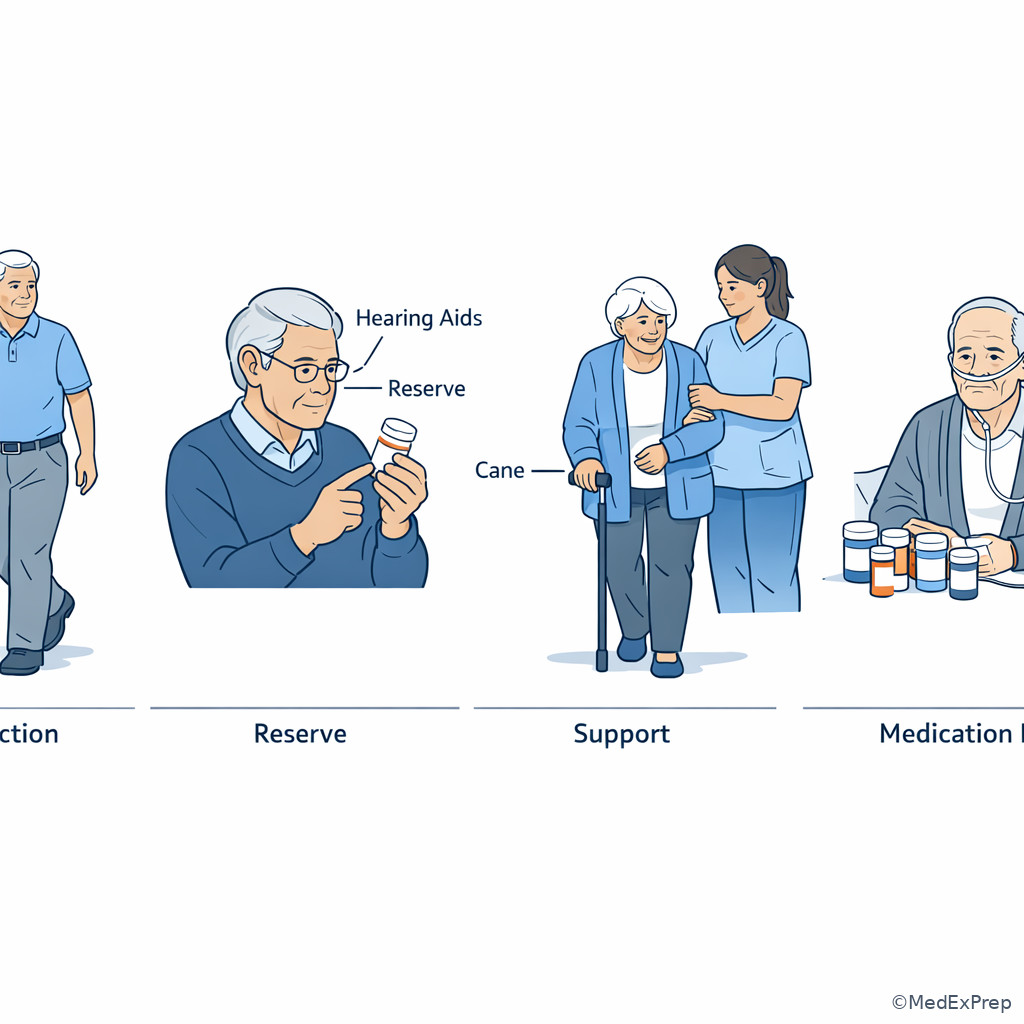
Exam takeaway: Visualize that similar ages can mask very different mobility, sensory, and support needs.
Core content
1.1.1.3 Foundational idea: age is context, not the answer
A Explanation
On exam stems, the first decision conflict is often whether to interpret a finding as expected because the patient is older or to treat it as a nursing concern that needs assessment. The correct move is almost never “do nothing because aging.” Instead, ask: What is the patient’s baseline, and is this finding new, worsening, or unsafe? That single rule resolves many questions.
Healthy aging includes variability. Some older adults are highly active and independent; others live with multimorbidity, sensory loss, and limited reserve. Chronological age does not tell you which patient will tolerate hospitalization, medication changes, dehydration, or sleep disruption poorly. The board exam tests whether you resist age-based shortcuts and use nursing assessment data instead.
WHY THIS IS TESTED: exam writers want to see whether you reject ageist assumptions, especially when a distractor implies that fatigue, falls, confusion, pain, or loss of appetite are “normal for age.”
Choose baseline-focused assessment when the options compete between reassurance and evaluation. Reject age-based minimization when a finding affects safety, function, cognition, intake, mobility, or usual behavior. See Fig 1.
B Worked example
An 84-year-old woman in assisted living is brought to clinic by her daughter for “slowing down.” She has osteoarthritis, hypertension, cataracts, and chronic insomnia. Medications include acetaminophen, lisinopril, calcium/vitamin D, and an over-the-counter nighttime sleep aid. Her daughter says the patient has needed help with dressing for 2 days and skipped lunch yesterday. The patient says, “I’m just getting old.” A tempting clue is the chronic insomnia, which makes fatigue seem expected. The task is to identify the most appropriate nursing response.
Reasoning chain: identify task → decide whether this is expected aging or concerning change. Extract key facts → new assistance needed with dressing, reduced intake, recent decline over 2 days. Apply rule → a new functional decline is not explained by age alone. Eliminate distractors → reassurance is unsafe; generic sleep teaching does not address the acute trajectory; documenting only without further assessment misses risk. Verify → perform focused assessment of cognition, hydration, medication use including the OTC sleep aid, gait safety, and notify the provider if acute change is confirmed.
C Exam trap
D Checkpoint
Question: An 81-year-old man with hearing impairment, diabetes, and benign prostatic hyperplasia tells the nurse, “I’m more tired this week, but that happens when you get old.” Which nursing action is most appropriate first?
- Ask the patient to describe his usual energy level, recent intake, medications, and functional changes.
- Encourage him to rest more during the day and avoid excess walking.
- Provide teaching that fatigue is common in late life and should be expected.
- Document the complaint and recheck at the next routine visit.
- A: Tempting because it takes more time than simple reassurance, but it is right because assessment comes first when a new symptom may reflect illness, medication effect, or decline.
- B: Tempting because rest sounds supportive, but it is wrong because intervention before assessment can miss an acute or reversible cause.
- C: Tempting because fatigue is common, but it is wrong because age alone does not explain a potentially new symptom.
- D: Tempting because follow-up matters, but it is wrong because delaying evaluation may miss a safety issue or early acute change.
1.1.1.4 Heterogeneity in older adults: function, reserve, and goals
A Explanation
The next decision conflict is whether to group older adults together or individualize care according to function, reserve, and goals. On the exam, the right answer usually comes from recognizing heterogeneity. One 78-year-old may still drive, manage finances, and recover quickly from illness; another may have frailty, caregiver dependence, and a narrow margin for dehydration or sedating drugs. Same age, very different nursing priorities.
The single rule here is: Use function and reserve to predict risk, and use goals to shape care. Functional status tells you what support, teaching style, discharge planning, and safety monitoring are needed. Reserve tells you how vulnerable the patient is to stressors. Goals tell you what outcomes matter most to that person. These domains often outperform diagnosis lists alone in predicting nursing needs.
Frailty is especially testable. It does not simply mean “old” or “thin.” It signals vulnerability: minor infection, one missed meal, a mild medication effect, or one night of poor sleep can trigger significant decline. Person-centered goals are equally testable. The nurse should not assume that all older adults want the same level of intervention, independence, or caregiver involvement.
WHY THIS IS TESTED: many stems hide the correct answer inside functional clues such as recent falls, medication management difficulty, weight loss, slowed gait, or dependence in IADLs.
B Worked example
An 89-year-old man arrives on a medical unit after treatment for pneumonia. He has chronic kidney disease, mild hearing loss, and a history of two falls in the past 6 months. He lives alone, uses a walker outdoors, and manages his own medications “most of the time.” He tells the nurse he wants to return home quickly because he cares for his dog. A distracting clue is his strong motivation and pleasant affect, which may make him seem fully independent. The question asks for the best nursing focus before discharge teaching begins.
Reasoning chain: identify task → determine what matters most before routine teaching. Extract key facts → recent hospitalization, falls, partial mobility limitation, possible medication-management difficulty, lives alone. Apply rule → function and reserve, not age or attitude, should drive planning. Eliminate distractors → generic pneumonia education is useful but not first; praising independence misses fall and self-management risk; assuming he cannot go home based on age is also wrong. Verify → assess baseline ADLs/IADLs, current mobility, hearing needs, medication understanding, and available support.
C Exam trap
D Checkpoint
Question: Which assessment finding best supports the idea that two older adults of the same age may need different nursing plans?
- One patient is 82 and the other is 84.
- One patient takes a multivitamin and the other does not.
- One patient manages medications, shops independently, and walks daily; the other needs help with meals and has slowed gait.
- One patient prefers morning appointments and the other prefers afternoons.
- A: Tempting because age difference draws attention, but it is wrong because chronological age alone does not drive care needs.
- B: Tempting because medications matter, but it is wrong because this detail alone does not establish different functional risk profiles.
- C: Tempting because it is information-rich, and it is right because function and reserve directly shape safety, teaching, and discharge planning.
- D: Tempting because preferences matter in person-centered care, but it is wrong because timing preference does not explain major differences in clinical risk.
- The most useful comparator for a current finding in an older adult is the patient’s baseline.
- True or False: Chronological age alone predicts discharge readiness. False.
- Name the 3 key lenses used in this section: function, reserve, goals.
Exam takeaway: When choices seem close, the safest answer is the one that matches care to function, frailty risk, and patient goals.
flowchart LR
A[Older adult assessment] --> B[Function]
A --> C[Reserve]
A --> D[Goals]
B --> E[ADLs IADLs mobility]
C --> F[Frailty falls recovery margin]
D --> G[Independence comfort symptom control]
E --> H[Individualized nursing plan]
F --> H
G --> H
| Dimension | Robust older adult | Frail or low-reserve older adult | Nursing implication |
|---|---|---|---|
| Recovery from minor illness | Usually faster | Often prolonged or destabilizing | Monitor more closely for decline in the frail patient |
| Tolerance of sedating medication effects | Variable but often better | Poor tolerance; high delirium/fall risk | Increase observation and escalate concerning effects |
| Mobility reserve | May stay independent | Small setbacks can impair transfers or gait | Prioritize fall prevention and mobility assessment |
| Nutritional reserve | Short poor intake may be tolerated | Rapid weakness or dehydration may follow | Track intake and weight trends closely |
| Discharge planning | Often simpler | Needs deeper support and coordination review | Assess IADLs, caregivers, environment, and teach-back |
1.1.1.5 Baseline and trajectory: how nurses detect meaningful change
A Explanation
Aging concepts become clinically useful when you compare today’s findings with the patient’s usual state. The decision conflict is whether a symptom reflects chronic baseline variation or a meaningful change requiring action. The resolving rule is: if you do not know the baseline, you do not yet know the significance of the finding.
In gerontological nursing, baseline includes cognition, mobility, continence, appetite, sleep, communication, mood, and ADL/IADL performance. Trajectory asks whether the patient has been stable, gradually declining, or suddenly worse. This matters because acute changes in older adults may appear subtle: reduced appetite, “not acting right,” a new need for help, slower transfers, or increased sleepiness. These nonspecific findings are heavily tested because they are easy to mislabel as normal aging, chronic dementia, or tiredness.
The nurse’s job is not to make a medical diagnosis independently. The nurse’s job is to identify change, assess immediate safety, document objectively, and escalate appropriately. Baseline information often comes from the patient, caregiver, prior records, medication list, and observed function. In exams, caregiver statements such as “she was walking yesterday” or “he usually manages his bills” are high-value clues.
WHY THIS IS TESTED: the exam rewards nurses who recognize that sudden confusion, abrupt functional loss, or sharp intake decline are red flags even when classic disease symptoms are absent.
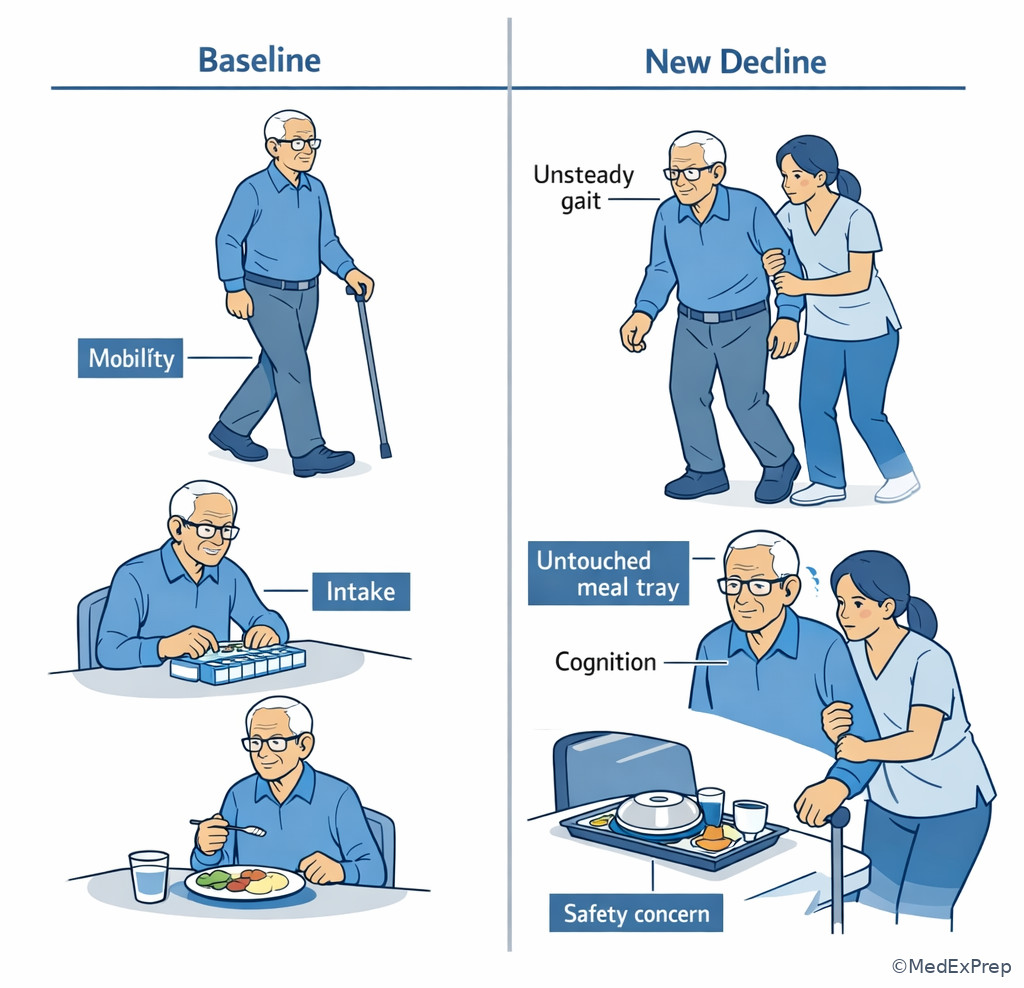
See Fig 2 for how function and reserve shape interpretation, and note that the next topic on abnormal findings will build directly from this baseline-versus-change framework.
Exam takeaway: A side-by-side view of usual function and current decline helps prevent the common error of labeling acute change as normal aging.
B Worked example
A 77-year-old woman in rehabilitation after a hip fracture has heart failure, chronic constipation, and moderate hearing loss. Today she is quieter, ate only a few bites, and required two-person assist for transfer despite transferring with one assist yesterday. Her oxygen saturation is unchanged and she is afebrile. A tempting-but-wrong clue is the recent hip fracture, which may make the reduced mobility seem expected. The stem asks for the best nursing action.
Reasoning chain: identify task → determine whether today’s findings reflect expected recovery or new decline. Extract key facts → sudden change from yesterday, lower intake, reduced participation, increased assistance needed. Apply rule → compare with baseline/trajectory; abrupt deterioration is concerning even without fever or low oxygen saturation. Eliminate distractors → waiting until therapy arrives delays assessment; assuming pain alone explains everything ignores global change; encouraging more food without evaluating misses the real issue. Verify → perform focused assessment including pain, cognition, bowel/bladder status, medication effects, vital sign trends, and notify the provider about the new decline.
C Exam trap
D Checkpoint
Question: An older adult in long-term care is “more sleepy than usual.” Which additional information is most important for the nurse to obtain first?
- Whether the resident usually naps after lunch or has become newly difficult to arouse
- Whether the resident prefers a quiet room
- Whether the resident’s family plans to visit this evening
- Whether the resident likes warm blankets at bedtime
- A: Tempting because it focuses on change over time, and it is right because baseline-versus-acute difference determines urgency.
- B: Tempting because environment affects sleep, but it is wrong because preference does not clarify whether this is a dangerous new change.
- C: Tempting because family can provide history, but it is wrong as phrased because the visit plan is less important than immediate characterization of the symptom.
- D: Tempting because comfort matters, but it is wrong because comfort preferences do not distinguish expected rest from concerning lethargy.
1.1.1.6 Person-centered aging: avoiding ageism and preserving autonomy
A Explanation
The final foundational-to-application shift is from “What is wrong?” to “What matters, and how do we support it safely?” The decision conflict is whether to make assumptions based on age or to individualize the plan around the older adult’s values, preferences, cognition, and function. The resolving rule is: person-centered care means the nurse adapts care to the patient, not the patient to the convenience of the system.
Ageism on exams may appear subtly. Distractors may suggest speaking only to the family, using infantilizing communication, discouraging activity “for safety,” or omitting teaching because the patient is older. These are unsafe or disrespectful when not justified by actual assessment findings. Older adults should be asked directly about priorities, routines, symptoms, and goals unless communication impairment prevents it. Sensory deficits should lead to adaptations—glasses, hearing aids, clear language, adequate lighting—not exclusion from decision-making.
Person-centered care also means balancing autonomy and safety. If the patient values independence, the nurse supports it as far as safely possible. If risk is present, the response is usually least restrictive support, added assessment, and collaboration—not automatic removal of choice. This lesson stays within RN scope: assess preferences, support informed participation, document objectively, involve family appropriately, and escalate concerns about safety or decision-making to the team according to policy.
WHY THIS IS TESTED: exam writers use person-centered stems to see whether the nurse preserves dignity, function, and autonomy while still addressing safety.
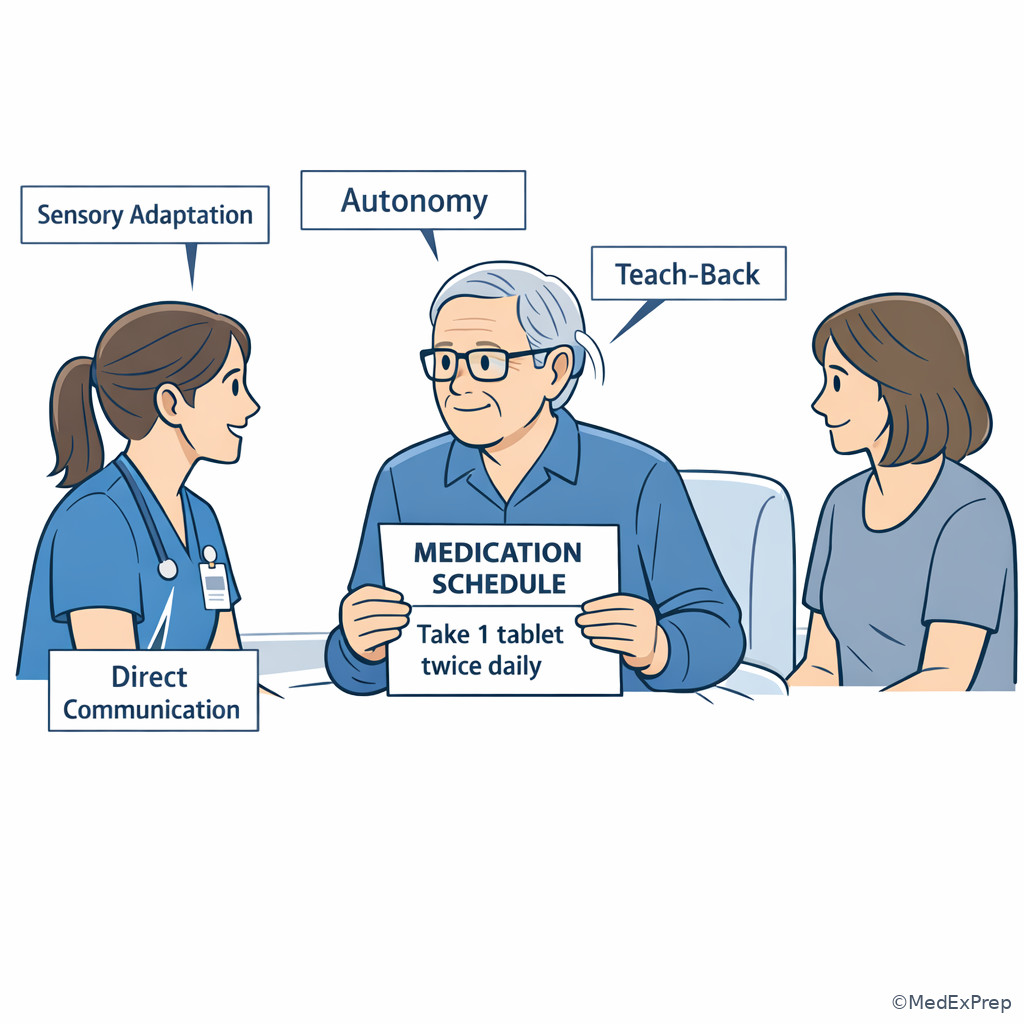
See Fig 3 for why baseline matters before changing a person’s plan of care.
Exam takeaway: The best answer usually preserves independence with supports before moving to restrictive or convenience-based actions.
flowchart TD
A[Older adult preference stated] --> B[Assess cognition and understanding]
B --> C[Assess immediate safety risk]
C --> D{Risk manageable with support?}
D -->|Yes| E[Use least restrictive support]
D -->|No| F[Escalate and collaborate per policy]
E --> G[Teach document reassess]
F --> G Exam takeaway: Sensory accommodations support autonomy and improve assessment accuracy in older adults.
B Worked example
An 86-year-old woman with macular degeneration, heart failure, and mild cognitive impairment is admitted for weakness. Her son answers every question for her and says, “She gets confused, so just tell me everything.” The patient, wearing no glasses, says softly, “I want to know what’s going on.” A distracting clue is the son’s confidence and involvement, which can make the nurse feel justified in bypassing the patient. The stem asks for the best initial nursing response.
Reasoning chain: identify task → decide whether to direct communication to family or patient. Extract key facts → patient expressed desire to participate; visual impairment may be limiting engagement; mild cognitive impairment does not erase autonomy. Apply rule → address the patient first and adapt communication. Eliminate distractors → speaking only to the son is disrespectful and may reduce assessment accuracy; delaying teaching until later ignores the patient’s stated preference; assuming incapacity exceeds RN role. Verify → place glasses if available, reduce environmental barriers, face the patient, speak clearly, assess understanding, and involve the son as support.
C Exam trap
D Checkpoint
Question: Which nursing response best reflects person-centered care in an older adult with hearing loss?
- Speak to the caregiver because repeating information is inefficient.
- Face the patient, reduce background noise, confirm hearing aids are in place, and use teach-back.
- Provide written instructions only because hearing impairment makes discussion unreliable.
- Delay education until a family member is available.
- A: Tempting because caregivers help with history, but it is wrong because bypassing the patient undermines autonomy and can impair assessment.
- B: Tempting because it requires deliberate setup, and it is right because it adapts communication while preserving direct patient involvement.
- C: Tempting because written materials can help, but it is wrong because “written only” ignores interaction and may fail if vision or literacy is limited.
- D: Tempting because family support is useful, but it is wrong because the patient should be engaged directly whenever possible.
- True or False: Mild cognitive impairment automatically means the nurse should speak only to family. False.
- The safest default communication target is the patient first.
- Name one least restrictive support for hearing loss: reduce noise, ensure hearing aids, face the patient, speak clearly.
1.1.1.7 Integration: when heterogeneity changes safety, monitoring, and escalation
A Explanation
Integration questions ask you to combine the concepts above into a practical RN decision. The conflict is often between a low-intensity action that sounds reasonable for “normal aging” and a more targeted action based on heterogeneity, frailty, baseline, or person-centered risk. The single rule is: the more limited the reserve and the newer the change, the lower your threshold for safety actions and escalation.
Heterogeneity affects all core nursing domains. In mobility, two patients with the same diagnosis may need different transfer assistance because of different baseline gait and strength. In medication monitoring, the frail patient with poor vision and many prescriptions is at higher risk for self-administration error. In nutrition, a robust older adult may tolerate a short period of reduced intake, while a frail patient may weaken quickly. In cognition, subtle new inattention or withdrawal can signal acute decline, especially when different from baseline.
The testable skill is prioritization, not diagnosis. The nurse asks: Is there an immediate safety threat? Is the current state different from usual? Are sensory barriers or caregiver assumptions distorting the picture? Which nursing action stays within RN scope while protecting the patient? Often the correct answer is an RN assessment plus a safety intervention plus timely notification—not reassurance, not overstepping into provider-only decisions.
WHY THIS IS TESTED: board questions frequently hide the acuity clue inside functional data, caregiver comments, or a minor-sounding symptom that matters more in a frail older adult.
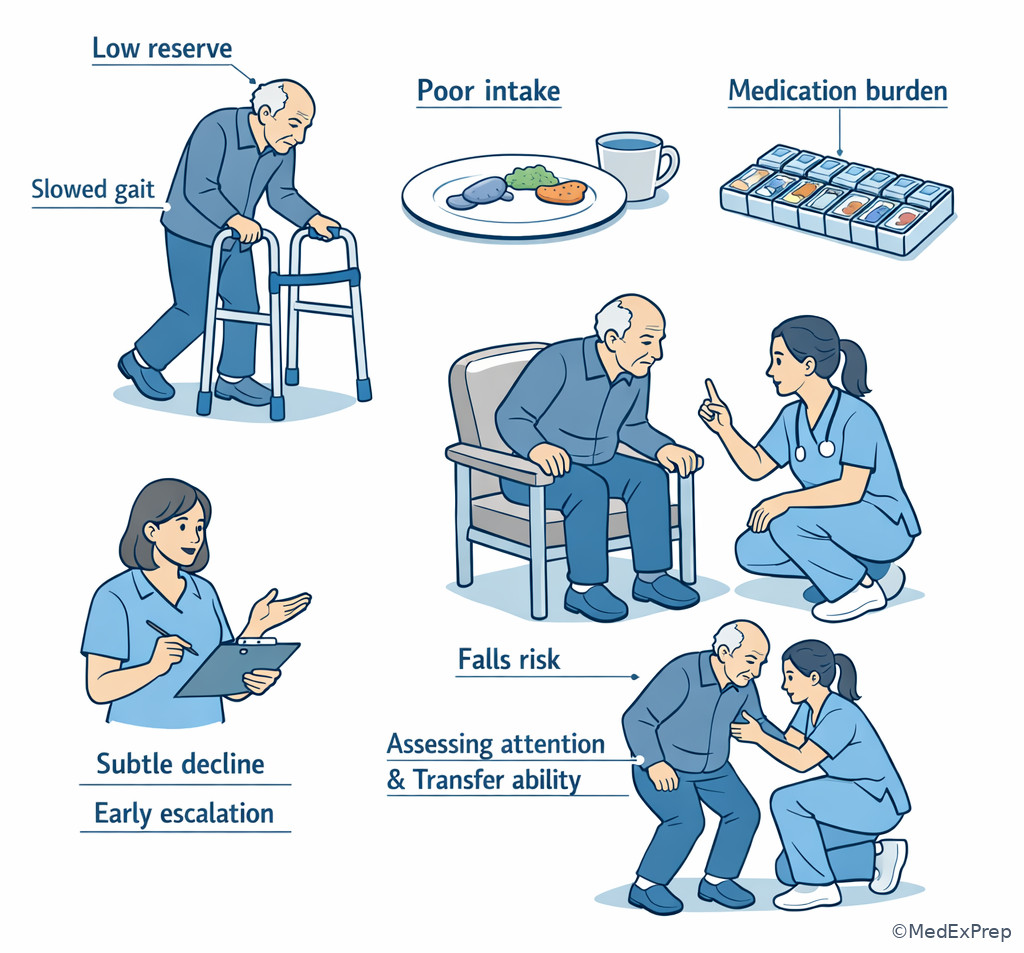
See Fig 4.
Exam takeaway: Frail older adults may show serious illness through subtle changes in mobility, intake, or attention before classic symptoms appear.
B Worked example
An 83-year-old man on a skilled nursing unit has chronic obstructive pulmonary disease, chronic back pain, and mild peripheral neuropathy. He normally ambulates to the bathroom with a walker and standby assist. Today he asks staff to bring the urinal, leaves most of breakfast untouched, and seems “less chatty.” He is afebrile and his oxygen saturation is 94% on his usual oxygen. A tempting clue is the stable oxygen saturation, which may falsely reassure the nurse. The stem asks for the most appropriate nursing action.
Reasoning chain: identify task → choose priority within RN scope. Extract key facts → clear departure from baseline in mobility, intake, and interaction; frailty signals low reserve; stable pulse oximetry does not rule out acute decline. Apply rule → subtle multidomain change in a low-reserve patient warrants prompt focused assessment and likely escalation. Eliminate distractors → bringing the urinal without assessment addresses convenience, not safety; waiting for fever or respiratory distress misses atypical presentation; encouraging breakfast first is the right intervention at the wrong priority. Verify → assess cognition, respiratory effort, pain, orthostasis, elimination, and medication effects; increase safety measures; communicate the objective baseline change to the provider.
C Exam trap
D Checkpoint
Question: Which older adult requires the nurse to have the lowest threshold for early safety intervention and provider notification?
- A 79-year-old who independently manages medications and reports one brief nap after lunch
- An 88-year-old with frailty, poor appetite, slowed gait, and a new need for help transferring
- An 81-year-old with chronic arthritis pain that is unchanged from usual
- An 85-year-old who requests extra time to hear instructions but repeats them correctly
- A: Tempting because sleep changes can matter, but it is wrong because the finding appears isolated and not clearly unsafe.
- B: Tempting because several issues cluster together, and it is right because low reserve plus new functional decline raises immediate concern.
- C: Tempting because chronic pain affects function, but it is wrong because no acute change is described.
- D: Tempting because sensory barriers matter, but it is wrong because the patient understands and no new decline is evident.
1.1.1.8 Integration case: distinguishing variation from abnormality without overcalling either
A Explanation
The highest-yield integration skill in this lesson is balance. Some exam questions punish underreaction; others punish overreaction based on age alone. The decision conflict is whether to overgeneralize “normal aging” or overpathologize every difference. The single rule is: anchor your judgment in baseline, function, reserve, and immediacy of risk.
Variation is common: slower processing speed, different routines, assistive device use, and sensory accommodations can all be compatible with stable health. But variation becomes concerning when it is new, impairs safety, reduces function, or changes behavior or intake from baseline. Nurses should avoid both extremes: dismissing warning signs and stripping autonomy unnecessarily.
This balanced approach also protects RN scope. You are not choosing a definitive diagnosis; you are choosing the best nursing action. That may be to assess further, provide least restrictive support, collect better history, or escalate objectively. When options include diagnosing, prescribing, or legally determining incapacity, reject them. The RN role is to recognize the pattern, protect the patient, and involve the right team members.
WHY THIS IS TESTED: it captures the entire gerontological exam mindset—individualize, compare to baseline, prioritize safety, stay within scope.
See Fig 5.
Exam takeaway: The decisive clue is not age but whether the finding is new, function-limiting, or safety-relevant.
flowchart TD
A[Observed older-adult difference] --> B{Known baseline?}
B -->|No| C[Gather baseline from patient caregiver record]
B -->|Yes| D{New or worsening?}
C --> D
D -->|No| E{Safety impact?}
D -->|Yes| F[Focused assessment and likely escalation]
E -->|Low| G[Individualize care and monitor]
E -->|High| H[Add safety supports and reassess]
F --> I[Document objective change]
H --> I
G --> I
B Worked example
A 90-year-old assisted-living resident with severe kyphosis, glaucoma, chronic urinary urgency, and controlled depression walks slowly with a cane and prefers evening activities. Staff report she is “not as sharp today.” Her granddaughter says the resident always takes extra time to answer questions but normally balances her own checkbook and reads large-print books each morning. Today she left breakfast untouched and asked twice what day it is. A tempting clue is her chronic sensory impairment and slow pace, which can make the change seem baseline. The task is the best nursing action.
Reasoning chain: identify task → decide whether this is stable variation or concerning change. Extract key facts → longstanding slow pace and vision impairment are baseline, but disorientation and skipped breakfast are new. Apply rule → new cognitive and intake changes are safety-relevant and not explained by age. Eliminate distractors → allowing her to rest and checking tomorrow delays recognition; speaking only with the granddaughter skips direct assessment; concluding dementia exceeds RN role and ignores acuity. Verify → assess orientation, vital signs, hydration, elimination, medication timing, and safety; notify the provider about the acute change from baseline.
C Exam trap
D Checkpoint
Question: An older adult’s daughter says, “He’s always slow in the morning.” Which additional finding most strongly shifts the nurse from routine monitoring to urgent focused assessment?
- He asks for help finding his glasses before breakfast.
- He walks with his usual cane and asks for extra time to stand.
- He is newly unable to follow a familiar one-step instruction and has eaten nothing today.
- He prefers to remain in his room until midmorning as he usually does.
- A: Tempting because sensory issues matter, but it is wrong because this can fit baseline without clear acute danger.
- B: Tempting because mobility is important, but it is wrong because the stem states this is usual for him.
- C: Tempting because it combines cognition and intake, and it is right because new failure to follow a familiar command plus poor intake is a meaningful acute change.
- D: Tempting because isolation can be concerning, but it is wrong because the pattern is described as usual baseline.
Exam Traps & Differentiators
| Looks similar | But is actually | Single differentiator | Nursing response |
|---|---|---|---|
| Slow gait in an older adult | Stable baseline variation | Longstanding, unchanged, safe with usual aid | Support usual mobility plan and monitor |
| Slow gait in an older adult | Concerning decline | New need for more assistance or recent near-falls | Focused assessment and fall precautions |
| Quiet or withdrawn behavior | Baseline personality | Consistent pattern without recent change | Use tailored communication |
| Quiet or withdrawn behavior | Potential acute change | New reduction in interaction or intake | Assess and escalate as needed |
| Family speaking for patient | Supportive involvement | Patient still engaged and addressed directly | Include family while centering patient |
| Family speaking for patient | Autonomy risk | Patient wants to participate but is bypassed | Address patient first with adaptations |
If the stem says “this is not like her” or “he usually…” think baseline comparison is the key discriminator.
If the stem says recent fall, poor intake, new confusion, or increased help needed think acute multidomain decline, not age alone.
If the stem says family requests convenience-based restrictions think person-centered care and least restrictive supports.
If the stem says same age but different function think heterogeneity; choose the plan based on ability and reserve.
If the stem says mild sensory impairment or mild cognitive impairment think communication adaptation, not exclusion from teaching.
If the stem says frailty or repeated recent losses in function think low threshold for safety intervention and escalation.
Algorithm / Approach
Exam takeaway: A structured bedside sequence helps the nurse compare baseline, assess safety, and communicate concerns clearly.
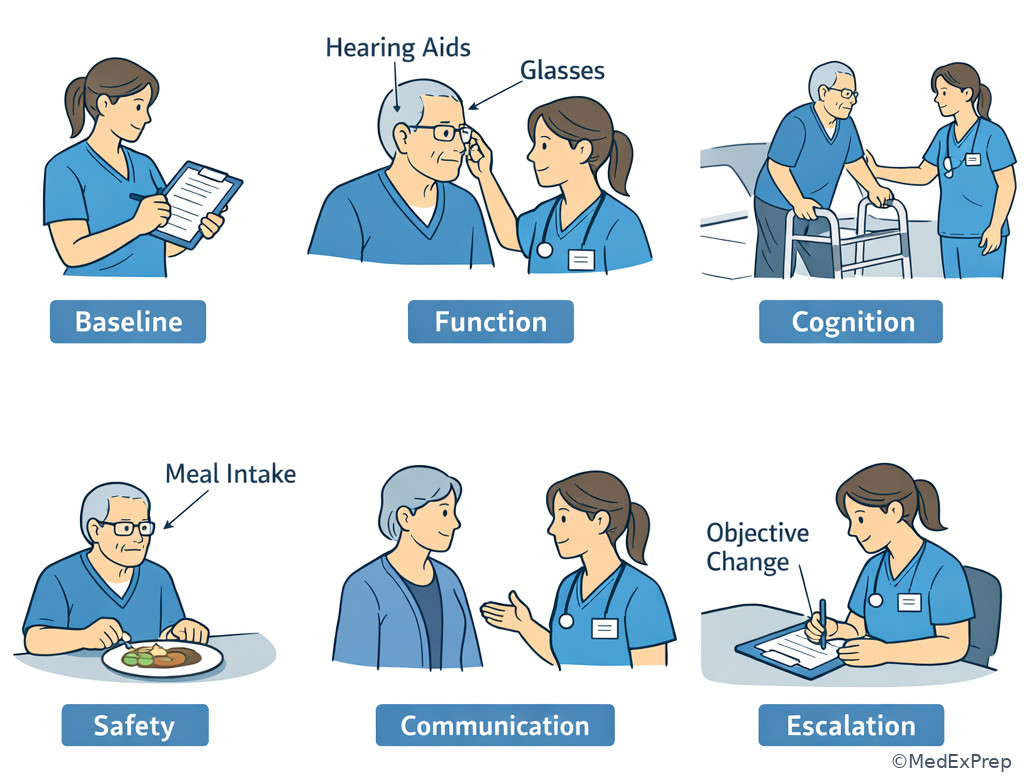
Rapid Review
- Chronological age → context only; never the sole reason for a nursing decision
- Baseline → strongest comparator for judging symptom significance
- Trajectory → sudden decline outranks long-standing stable limitation
- Frailty → low reserve; small stressors can cause large decline
- Function → better guide than diagnosis list for support and discharge needs
- IADL difficulty → early clue to vulnerability despite preserved basic ADLs
- New help with dressing/transfers → think meaningful decline, not “just aging”
- Stable slow pace → may be baseline; new slowed participation is different
- Family report “not herself” → high-yield cue for acute change assessment
- Sensory impairment → adapt communication; do not bypass the patient
- Mild cognitive impairment → does not equal automatic loss of participation
- Least restrictive support → preferred over convenience-based restriction
- Stable chronic symptom → monitor in context; acute multidomain change → escalate
- RN scope → assess, protect, document, notify; do not diagnose or prescribe
Self-check quiz
1. An 80-year-old woman with osteoarthritis and presbyopia says, “I move slower than I used to.” She ambulates safely with her usual cane, manages dressing independently, and her daughter reports no recent change. What is the most appropriate nursing action?
- Document this as likely dementia-related decline and notify the provider.
- Compare her current function with baseline and continue individualized mobility support.
- Institute full fall precautions and bedrest because age predicts sudden decline.
- Direct all questions to the daughter because older adults often underreport deficits.
2. A 78-year-old man with hearing loss, hypertension, and chronic low back pain presents for follow-up. He wears hearing aids and asks the nurse to repeat one instruction. Which action best reflects person-centered older-adult care?
- Face him, reduce background noise, confirm understanding with teach-back, and address him directly.
- Ask his spouse to answer most questions because hearing loss reduces reliability.
- Provide written instructions only and avoid discussion.
- Shorten the visit because older adults fatigue easily.
3. An 85-year-old assisted-living resident with heart failure, urinary urgency, and cataracts is reported to be “sleepier today.” Staff note she needed help putting on a sweater this morning, which is unusual. Her blood pressure is 132/74 mm Hg, pulse 82/min, and oxygen saturation 95% on room air. What is the most appropriate nursing action?
- Reassure staff that fatigue is expected in very old adults and recheck tomorrow.
- Perform focused assessment of cognition, intake, medications, and baseline function, then communicate the new decline.
- Encourage a nap and limit activity for the rest of the day.
- Teach the resident about sleep hygiene before gathering additional data.
4. A 79-year-old man hospitalized for pneumonia has diabetes, mild neuropathy, and a recent 5-lb weight loss. Yesterday he walked to the bathroom with standby assist; today he asks for a urinal and leaves breakfast untouched. Temperature is 37.1°C, pulse 88/min, and oxygen saturation 94% on usual oxygen. What is the best next step within RN scope?
- Wait for fever or respiratory distress before changing the plan.
- Bring the urinal and document that temporary weakness is expected after illness.
- Assess for change from baseline, institute added safety measures, and notify the provider of the decline.
- Encourage more food intake first because nutrition is the main issue.
5. An 87-year-old woman with mild cognitive impairment, glaucoma, and chronic constipation is admitted for weakness. Her son answers every question. The patient says, “Please tell me what is happening.” Which nursing response is most appropriate?
- Address the son only because mild cognitive impairment makes patient teaching ineffective.
- Assess the patient’s understanding directly, use sensory accommodations, and include the son as support.
- Delay all education until the provider determines capacity.
- Ask the son to sign routine education forms before proceeding.
6. An 88-year-old long-term care resident with frailty, chronic kidney disease, hearing loss, and a history of falls is quieter than usual, eats only a few bites of lunch, and now requires two staff to transfer instead of one. A UAP reports this change to the RN. What is the most appropriate RN action?
- Ask the UAP to continue routine observations and report back at the end of the shift.
- Personally assess the resident’s cognition, transfer safety, intake, and recent changes, then escalate as indicated.
- Tell the UAP to encourage more food and fluids first because poor intake is probably the cause.
- Request that the family decide whether the transfer change is serious before intervening.
7. A 90-year-old man in rehabilitation has severe hearing loss, chronic obstructive pulmonary disease, and chronic pain. He normally participates in morning therapy after setup of his hearing aids. Today his daughter says, “He’s always slow,” but staff report he is newly unable to follow a familiar one-step transfer cue and has stayed in bed. What requires immediate clarification by the RN?
- Whether he received pain medication before breakfast
- Whether today’s inability to follow the familiar cue is different from his usual communication pattern
- Whether his daughter can attend therapy tomorrow
- Whether he prefers afternoon therapy sessions
8. A 82-year-old community-dwelling woman with hypertension, osteoarthritis, and mild macular degeneration tells the nurse, “My son thinks I should stop cooking because I’m old.” She states she uses large-print labels, cooks seated at the counter, and has had no burns or near-falls. What is the most appropriate nursing response?
- Support her continued participation with safety review because stable function and adapted technique suggest preserved ability.
- Advise immediate cessation of cooking because advanced age alone increases risk too much.
- Tell the son to make all household decisions because he is the caregiver.
- Notify the provider to document that she lacks capacity for meal preparation.
Answer key
1. Correct answer: B
- A: Tempting because slower movement in an older adult can raise concern about decline, but it is incorrect because the scenario describes safe ambulation with usual aid and no recent change. The discriminating clue is stable baseline function. Priority-wise, assessment and comparison to baseline come before labeling decline. Sources: NCSBN Clinical Judgment framework; ANA Standards of Practice.
- B: Tempting because it seems less dramatic than escalating, and it is correct because the safest RN action is to compare current function with baseline and continue individualized support when the finding appears stable. The discriminating clue is daughter reports no recent change. This follows the nursing process: assess, then support. Sources: NCSBN; Lewis Medical-Surgical Nursing.
- C: Tempting because fall prevention matters in older adults, but it is incorrect because bedrest based on age alone is restrictive and may worsen function. The discriminating clue is she ambulates safely with her usual cane. Safety does not justify unnecessary loss of mobility. Sources: ANA Standards; Saunders Comprehensive Review.
- D: Tempting because family history is useful, but it is incorrect because the patient should be addressed directly unless assessment findings prevent it. The discriminating clue is no evidence of communication inability. Autonomy and direct assessment remain nursing priorities. Sources: ANA Standards; NCSBN.
2. Correct answer: A
- A: Tempting because it requires communication setup, and it is correct because person-centered care preserves direct patient engagement while adapting for hearing loss. The discriminating clue is he uses hearing aids and only asks for repetition. Assess/teach directly first. Sources: ANA Standards; Saunders Comprehensive Review.
- B: Tempting because spouses often assist, but it is incorrect because hearing loss does not make the patient unreliable or remove his role in communication. The discriminating clue is he is participating and communicating. Respect for autonomy outranks convenience. Sources: ANA Standards; NCSBN.
- C: Tempting because written backup can help, but it is incorrect because “written only” may fail to assess understanding and ignores direct interaction. The discriminating clue is hearing loss, not inability to engage. Sources: Lewis Medical-Surgical Nursing; ANA Standards.
- D: Tempting because fatigue is a real geriatric consideration, but it is incorrect because no fatigue barrier is described and shortening the visit undermines assessment. The discriminating clue is single request for repetition. Sources: NCSBN; Saunders.
3. Correct answer: B
- A: Tempting because the vital signs are not alarming, but it is incorrect because new sleepiness and unusual need for dressing help suggest change from baseline. The discriminating clue is needed help putting on a sweater, which is unusual. Nursing priority is assessment of acute functional change. Sources: NCSBN; Lewis Medical-Surgical Nursing.
- B: Tempting because it involves more assessment work, and it is correct because new change in function plus altered alertness requires focused assessment and communication. The discriminating clue is acute functional decline. This follows nursing-process and safety priorities. Sources: NCSBN; ANA Standards.
- C: Tempting because rest sounds supportive, but it is incorrect because intervention before assessment may delay recognition of deterioration. The discriminating clue is new change rather than known fatigue pattern. Sources: Saunders; NCSBN.
- D: Tempting because sleep hygiene is a valid nursing intervention, but it is incorrect because it addresses a presumed cause before determining whether the symptom is acute and unsafe. The discriminating clue is today’s unusual decline. Sources: ANA Standards; Saunders.
4. Correct answer: C
- A: Tempting because classic respiratory decline markers are absent, but it is incorrect because older adults may present atypically. The discriminating clue is new decline in walking and intake compared with yesterday. Safety and assessment outrank waiting. Sources: Lewis Medical-Surgical Nursing; NCSBN.
- B: Tempting because temporary weakness after pneumonia sounds plausible, but it is incorrect because routine accommodation alone ignores new functional decline. The discriminating clue is change from yesterday’s baseline. Sources: Saunders; NCSBN.
- C: Tempting because it combines multiple nursing actions, and it is correct because assessing baseline change, adding safety measures, and notifying the provider are appropriate RN responses to subtle decline in a higher-risk older adult. The discriminating clue is multidomain new change despite near-baseline vital signs. Sources: ANA Standards; NCSBN.
- D: Tempting because nutrition is important, but it is incorrect because encouraging food is the right intervention at the wrong priority. The discriminating clue is overall functional decline, not isolated poor appetite. Sources: NCSBN; Saunders.
5. Correct answer: B
- A: Tempting because family support can help gather history, but it is incorrect because mild cognitive impairment does not justify bypassing the patient. The discriminating clue is the patient asks to be informed directly. Person-centered communication comes first. Sources: ANA Standards; NCSBN.
- B: Tempting because it requires more deliberate communication, and it is correct because the nurse should assess understanding directly, adapt for vision, and then include family support. The discriminating clue is patient desire to participate plus sensory barrier. Sources: ANA Standards; Saunders.
- C: Tempting because capacity concerns can affect teaching, but it is incorrect because delaying all education ignores the patient’s present participation and exceeds what the current data support. The discriminating clue is mild, not severe, cognitive impairment. Sources: NCSBN; ANA Standards.
- D: Tempting because family may assist with care, but it is incorrect because routine teaching does not shift to family signatures by default and this bypasses the patient. The discriminating clue is patient remains engaged. Sources: ANA Standards.
6. Correct answer: B
- A: Tempting because UAP observations are valuable, but it is incorrect because the reported changes involve cognition, mobility, and intake in a frail resident with fall history. The discriminating clue is new two-person transfer need plus reduced intake. RN assessment cannot be deferred. Sources: NCSBN delegation principles; ANA Standards.
- B: Tempting because it requires the RN to reprioritize, and it is correct because multidomain change in a low-reserve resident requires RN assessment and likely escalation. The discriminating clue is frailty and new functional decline. This is the RN’s role under safety and nursing-process priorities. Sources: NCSBN; ANA Standards.
- C: Tempting because poor intake needs intervention, but it is incorrect because treating presumed cause before assessment delays evaluation of the broader decline. The discriminating clue is multiple new changes, not isolated poor intake. Sources: NCSBN; Saunders.
- D: Tempting because family knows baseline well, but it is incorrect because family does not determine urgency of nursing assessment. The discriminating clue is acute change already observed by staff. Sources: ANA Standards; NCSBN.
7. Correct answer: B
- A: Tempting because pain medication can alter alertness or participation, but it is incorrect as the first clarification because the key issue is whether today’s inability is a true change from usual. The discriminating clue is new inability to follow a familiar cue. Baseline comparison comes first. Sources: NCSBN; Lewis Medical-Surgical Nursing.
- B: Tempting because it may seem abstract, and it is correct because distinguishing chronic slowness from new inability to follow a familiar cue determines urgency. The discriminating clue is staff report this is new despite usual hearing-aid setup routine. Sources: NCSBN; ANA Standards.
- C: Tempting because daughter involvement may help therapy planning, but it is incorrect because tomorrow’s attendance does not address today’s acute concern. The discriminating clue is current change in function. Sources: ANA Standards.
- D: Tempting because scheduling preferences can affect participation, but it is incorrect because preference does not explain a new failure to follow a familiar instruction. The discriminating clue is familiar cue no longer followed. Sources: Saunders; NCSBN.
8. Correct answer: A
- A: Tempting because it may feel less protective than forbidding cooking, and it is correct because person-centered care supports retained function when the patient uses effective adaptations and no safety incidents are reported. The discriminating clue is stable safe performance with adaptations. Least restrictive support is the priority. Sources: ANA Standards; NCSBN.
- B: Tempting because safety risk rises with vision change, but it is incorrect because age alone is not enough to remove a meaningful activity when the patient has compensatory strategies and no evidence of unsafe performance. The discriminating clue is no burns or near-falls. Sources: Saunders; ANA Standards.
- C: Tempting because caregivers matter in home safety planning, but it is incorrect because the son does not automatically become the decision-maker for an engaged adult. The discriminating clue is patient states her own preference and describes safe routine. Sources: ANA Standards.
- D: Tempting because capacity concerns may arise in some home-safety cases, but it is incorrect because there is no evidence here supporting such a step and it exceeds the RN’s role to declare incapacity. The discriminating clue is preserved insight and adapted technique. Sources: ANA Standards; NCSBN.
Keep going with the full Gerontological Nursing Prep Course (GERO-BC)
You just studied the way members do, in the same lesson interface. Full access unlocks every lesson, the question bank and flashcards for a full year.
One payment · 1 year of access · No auto-renewal