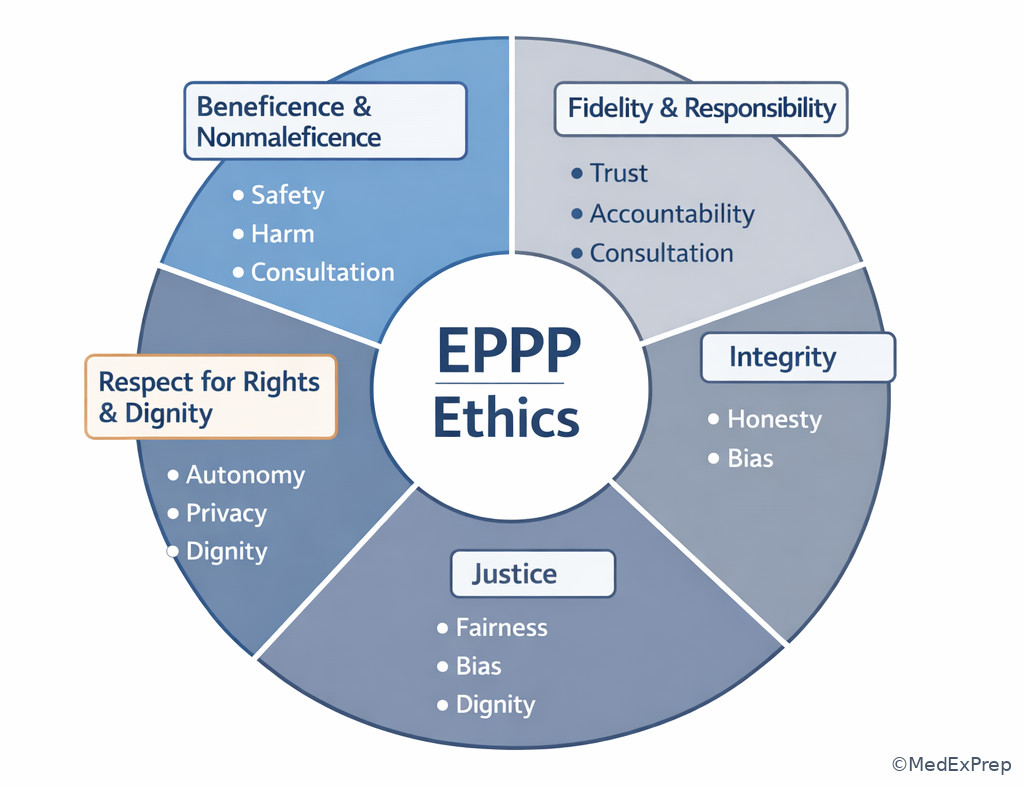
1.1.1 - General Ethical Principles
Why it matters
- EPPP ethics items often test the best first principle, not a memorized statute or obscure board rule.
- When two answers both sound reasonable, the correct answer usually protects welfare, rights, fairness, and role boundaries simultaneously.
- General Principles are aspirational; they guide judgment when a stem is ambiguous or when no enforceable standard cleanly resolves the issue.
- Many high-value distractors misuse a true concept—such as confidentiality, beneficence, or fairness—but apply it too narrowly or outside the psychologist’s role.
Exam takeaway: Use the principle map to identify which value the stem is really testing before choosing an action.
flowchart TD
A[Ethical dilemma stem] --> B{What is most threatened?}
B --> C[Beneficence and Nonmaleficence
Protect welfare and avoid harm]
B --> D[Fidelity and Responsibility
Trust, accountability, consultation]
B --> E[Integrity
Accuracy, honesty, nondeception]
B --> F[Justice
Fair access and unbiased practice]
B --> G[Respect for Rights and Dignity
Privacy, autonomy, diversity]
C --> H[Choose safest protective action]
D --> H
E --> H
F --> H
G --> H
In exam stems, start by asking: What value is under threat? See Fig 1. That question often gets you to the right answer faster than scanning for a specific standard number.
Key Terms & Must-Know Facts
1.1.1.1 Key terms
- General Principles: Broad aspirational values in the APA Ethics Code
- Aspirational: Guides ideal conduct; not itself a disciplinary rule
- Beneficence: Promote client and public welfare
- Nonmaleficence: Avoid causing harm
- Fidelity: Maintain trust and professional responsibility
- Integrity: Accuracy, honesty, and truthfulness
- Justice: Fairness and equal access to quality services
- Dignity: Respect for worth, autonomy, privacy, and rights
- Autonomy: Support informed, voluntary participation
- Role boundary: Limit of professional authority and competence
- Conflict of principles: Situation where more than one principle applies but points in different directions
- Consultation: Seeking professional input when dilemmas are unclear or high risk
- Cultural humility: Ongoing self-evaluation and responsiveness to difference and power
- Foreseeable harm: Harm that a prudent psychologist should reasonably anticipate
1.1.1.2 Must-know facts
- The five General Principles are A-E: Beneficence/Nonmaleficence, Fidelity/Responsibility, Integrity, Justice, Respect for Rights and Dignity.
- General Principles are not enforceable standards by themselves; they provide ethical direction.
- On the EPPP, the best answer often combines client welfare + role responsibility + documentation/consultation.
- Beneficence/Nonmaleficence usually dominates when risk of harm is immediate or substantial.
- Respect for Rights and Dignity commonly appears in confidentiality, informed consent, autonomy, and multicultural respect items.
- Justice is tested through bias, access, appropriate test use, and fairness in service delivery.
- Integrity is tested through truthful representation, accurate documentation, and avoiding misleading statements.
- Fidelity and Responsibility supports consultation, accountability, and managing professional roles responsibly.
- If the stem exceeds a psychologist’s role, the correct action is often consult, refer, coordinate care, or activate protection procedures.
| Principle | Core value | Typical EPPP trigger phrase | Best action tendency |
|---|---|---|---|
| Beneficence & Nonmaleficence | Promote welfare; avoid harm | Risk, safety, foreseeable harm, vulnerable person | Protect first; reduce harm exposure |
| Fidelity & Responsibility | Trust, accountability, consultation | Role conflict, professional duty, teamwork | Clarify role; consult; follow through |
| Integrity | Accuracy, honesty, nondeception | Misleading statement, selective omission, distorted record | Be accurate and transparent |
| Justice | Fairness and equal benefit | Bias, exclusion, invalid testing, unequal access | Use fair processes and appropriate tools |
| Respect for Rights & Dignity | Autonomy, privacy, dignity, diversity | Consent, confidentiality, cultural identity, coercion | Honor rights unless higher safety duty applies |
Core content
1.1.1.3 The five General Principles: what they are and what they are not
A Explanation
The first exam conflict is simple but highly tested: Should you treat the General Principles like enforceable rules, or like ethical compass points? The correct choice is compass points. They are broad aspirational values that guide judgment, especially in dilemmas where no single enforceable standard cleanly answers the question. The key rule is: if the stem asks for the best ethical rationale, broad value, or most defensible principle, think General Principles; if it asks what conduct specifically violates the code, think enforceable standards.
WHY THIS IS TESTED: candidates often overcommit to legalistic thinking and miss that the question is asking for the underlying value behind the action. Choose the answer that best protects welfare, trust, honesty, fairness, or dignity; reject the answer that sounds technical but does not match the level of the question.
For example, a question about an inaccurate brochure may test Integrity, not advertising standards yet. A question about a therapist hesitating to consult may test Fidelity and Responsibility, not competence wording yet. See Fig 2 for the fast distinction.
Exam takeaway: First decide whether the stem asks for a broad value or a rule-like violation before choosing an answer.
flowchart LR
A[Question stem] --> B{What is being asked?}
B --> C[Best ethical rationale
Broad value conflict]
B --> D[Specific code violation
Rule-based conduct]
C --> E[Use General Principles]
D --> F[Use Enforceable Standards]
E --> G[Pick welfare, trust, honesty, fairness, dignity]
F --> H[Pick the specific conduct rule] B Worked example
A 34-year-old psychologist in an outpatient clinic updates the practice website. She lists “board-certified trauma expert” because she completed several continuing education workshops and has treated many trauma-exposed clients. She also supervises practicum students and recently transferred clinics after conflict with administration. A complaint arises after a referred client asks what “board-certified” means. The stem asks which general ethical principle is most directly implicated.
Identify task: The stem asks for a principle, not a standard. Extract key facts: potentially misleading representation, public communication, tempting clue is trauma experience, but the real issue is accuracy of self-presentation. Apply rule: misleading or inflated claims map first to Integrity. Eliminate distractors: Fidelity is tempting because public trust matters, but the single best principle is honesty and accuracy. Justice is less direct because the primary concern is not unfair access. Respect is not central because privacy/autonomy are not the issue. Verify: the most direct principle is Integrity.
C Exam trap
D Checkpoint
Question: A psychologist is asked which broad ethical principle most directly supports obtaining meaningful informed consent before beginning a nonemergency intervention. Which is the single best answer?
- Beneficence and Nonmaleficence
- Fidelity and Responsibility
- Justice
- Respect for People's Rights and Dignity
Answer: D
- A: Tempting because informed consent can prevent harm; wrong because the most direct value tested is autonomy and rights, not harm reduction alone.
- B: Tempting because psychologists owe professional duties; wrong because trust is secondary to the client’s right to make an informed choice.
- C: Tempting because fairness matters in service delivery; wrong because equal treatment is not the main issue in this stem.
- D: Correct because informed consent most directly expresses autonomy, dignity, and respect for personal rights.
1.1.1.4 Beneficence, nonmaleficence, and the priority of harm prevention
A Explanation
The main decision conflict here is: when should protection from harm override competing preferences such as convenience, neutrality, or even ordinary privacy expectations? The answer is when there is a clear, foreseeable, and meaningful risk of harm. Beneficence means actively promoting welfare; nonmaleficence means avoiding actions or omissions that predictably injure clients, students, research participants, or the public. On exam items, this principle usually wins when a stem includes suicidality, severe impairment, exploitation risk, child or vulnerable adult concerns, unsafe competence boundaries, or clear foreseeable harm from inaction.
WHY THIS IS TESTED: EPPP questions often present a tempting answer that honors autonomy or collegial comfort but neglects imminent or substantial harm. Choose the option that reduces risk first; reject the option that preserves appearances while danger continues.
This principle does not justify paternalism in every disagreement. The single finding that resolves the conflict is the presence of meaningful foreseeable harm. Without that, autonomy and dignity may take precedence. With that, protective action moves to the front. See Fig 3.
Exam takeaway: When a stem includes clear foreseeable harm, choose the response that reduces risk before less urgent ethical concerns.
flowchart TD
A[Ethics dilemma] --> B{Foreseeable significant harm?}
B -->|Yes| C[Beneficence/Nonmaleficence leads]
C --> D[Take protective action within role]
D --> E[Consult, refer, document, coordinate]
B -->|No| F[Consider autonomy, fairness, trust, privacy]
F --> G[Choose least restrictive ethical option] B Worked example
A 46-year-old client with chronic pain, alcohol misuse history, and recent divorce tells her psychologist, “Sometimes everyone would be better off if I were gone,” but then says she is “just venting.” She arrived late, laughs at one point, and spends much of session discussing a dispute with her landlord. The psychologist knows the client values privacy and has never previously endorsed suicidal thoughts. The stem asks for the most appropriate ethical principle guiding the next step.
Identify task: governing ethical principle. Extract key facts: self-harm language, stressors, alcohol history, minimizing statement is a tempting clue, distracting landlord dispute adds noise. Apply rule: foreseeable harm elevates Beneficence/Nonmaleficence. Eliminate distractors: Respect for dignity is relevant, but autonomy does not override a need for risk assessment. Fidelity matters, but trust is not the leading principle. Verify: the best guiding principle is protecting welfare and preventing harm.
C Exam trap
D Checkpoint
Question: Which scenario most directly calls for Beneficence and Nonmaleficence to lead the psychologist’s decision?
- A client requests to skip reading the informed consent because she is in a hurry
- A colleague asks for help interpreting a difficult culture-fairness issue in testing
- A supervisee continues seeing clients despite clear cognitive impairment after a recent accident
- A practice website uses outdated office hours
Answer: C
- A: Tempting because consent matters; wrong because the central issue is rights and autonomy, not immediate substantial harm.
- B: Tempting because consultation is good practice; wrong because this is more directly Fidelity/Responsibility and Justice.
- C: Correct because ongoing impaired practice creates foreseeable harm to clients, making harm prevention the leading principle.
- D: Tempting because public misinformation is problematic; wrong because the best fit is Integrity, not harm prevention.
- The principle most likely to lead when there is clear safety risk is Beneficence and Nonmaleficence.
- True or False: Respect for autonomy always overrides risk of harm. False.
- Name the two linked ideas in Principle A: promote welfare and avoid harm.
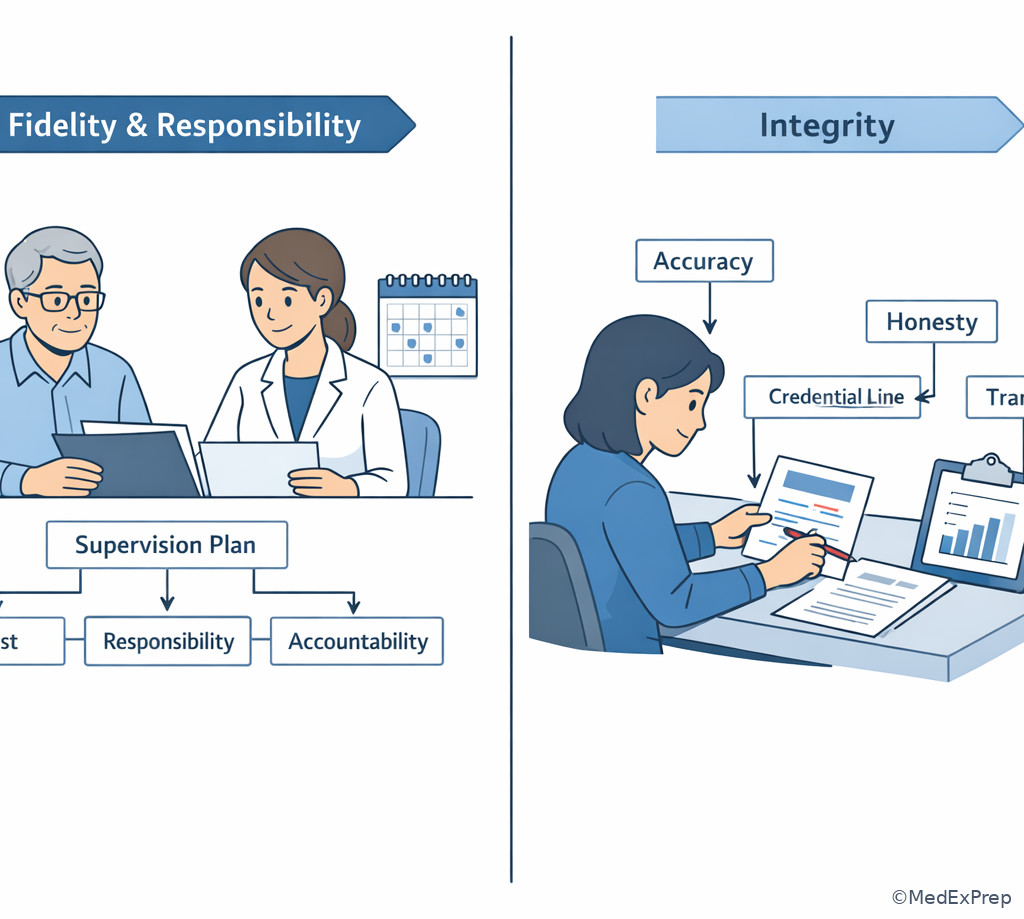
1.1.1.5 Fidelity, integrity, and professional trustworthiness
A Explanation
This section tests a common conflict: Is the problem mainly about professional responsibility and trust, or about truthfulness and accuracy? Fidelity and Responsibility concerns dependable professional roles, accountability, appropriate consultation, and managing obligations to clients, colleagues, institutions, and society. Integrity is narrower and sharper: honesty, accuracy, and avoiding deceptive or misleading practices. Students miss questions when they collapse these into one vague idea of “being ethical.”
WHY THIS IS TESTED: both principles sound virtuous and often co-occur. The single rule that separates them is this: if the stem turns on whether information is truthful or misleading, choose Integrity; if it turns on whether the psychologist is acting responsibly within professional relationships and duties, choose Fidelity and Responsibility.
For example, failing to seek needed consultation in a high-conflict case leans toward Fidelity and Responsibility. Falsifying a progress note or overstating credentials leans toward Integrity. Many stems mention both public trust and accuracy; the test wants the most direct principle. See Fig 4.
Exam takeaway: Separate accountability and role responsibility from accuracy and honesty when two good answers compete.
B Worked example
A psychologist employed by a college counseling center carries a heavy caseload, supervises an intern, and recently joined a campus committee on student wellness. After missing two high-risk case conferences, he writes in the chart that he “consulted with multidisciplinary staff” even though no consultation occurred. He tells himself the treatment plan was obvious and he will follow up next week. The stem asks which general principle is most directly violated.
Identify task: single best principle. Extract key facts: missed duty is present, but the behavior in question is a false chart statement. Apply rule: when truthfulness of documentation is the decisive issue, choose Integrity. Eliminate distractors: Fidelity is tempting because he skipped conferences, but the most direct violation named is inaccurate documentation. Beneficence is relevant only secondarily. Verify: Integrity is the best answer.
C Exam trap
D Checkpoint
Question: A psychologist encounters a complex forensic-adjacent referral that is outside her routine competence and seeks consultation before proceeding. Which principle most directly supports this action?
- Fidelity and Responsibility
- Integrity
- Justice
- Respect for People's Rights and Dignity
Answer: A
- A: Correct because consultation and accountability within professional roles are classic Fidelity/Responsibility themes.
- B: Tempting because being transparent can reflect honesty; wrong because the key action is responsible professional role management, not truthfulness.
- C: Tempting because fairness in evaluation matters; wrong because the stem focuses on duty and consultation rather than equal access.
- D: Tempting because client rights are always relevant; wrong because autonomy is not the central ethical issue here.
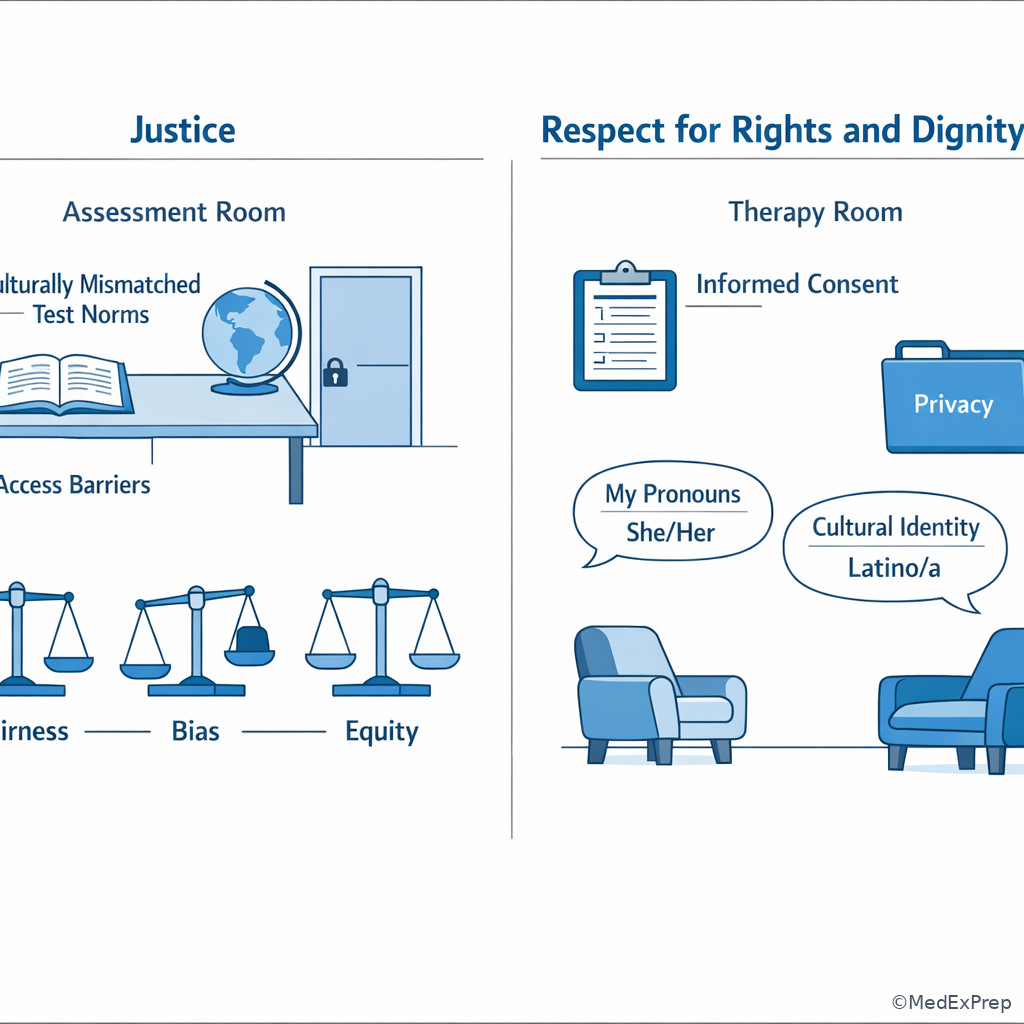
1.1.1.6 Justice, fairness, and respect for rights, dignity, and diversity
A Explanation
These two principles are frequently paired because both reject unfair treatment, but they are not identical. The exam conflict is: Is the problem about fairness in access, process, and bias, or about the person’s autonomy, privacy, and cultural dignity? Justice is about equitable benefit from psychological knowledge and fair treatment free from bias. Respect for People's Rights and Dignity emphasizes privacy, confidentiality, self-determination, and attention to cultural, individual, and role differences. If the single clue is unfair process or biased exclusion, lean Justice. If the clue is autonomy, privacy, consent, or honoring identity, lean Respect.
WHY THIS IS TESTED: many candidates choose Justice whenever diversity appears. That is too broad. Diversity may be tested under Respect when the issue is honoring identity and dignity, or under Justice when the issue is fair access, unbiased assessment, or equal opportunity.
For instance, using a norm group that does not fit the examinee may test Justice because the process is unfair. Pressuring a client to disclose sensitive identity information without clear necessity may test Respect because dignity and autonomy are central. See Fig 5.
Exam takeaway: Use fairness and bias cues for Justice, but autonomy, privacy, and cultural dignity cues for Respect.
B Worked example
A 17-year-old bilingual student is referred for evaluation of attention problems. She has migraines, high absenteeism after caring for younger siblings, and a recent move from another country. The psychologist administers an English-heavy measure normed on a substantially different population without considering language dominance, then interprets low verbal scores as evidence of broad cognitive weakness. The stem asks which general ethical principle is most directly implicated.
Identify task: principle. Extract key facts: culturally and linguistically mismatched assessment process, noise includes migraines and family stress, tempting clue is the student’s privacy around immigration status. Apply rule: unfair assessment process and biased application of psychological knowledge point most strongly to Justice. Eliminate distractors: Respect is relevant because cultural differences matter, but the core problem is inequitable, invalid test use. Verify: Justice is the best answer.
C Exam trap
D Checkpoint
Question: Which scenario most directly reflects Respect for People's Rights and Dignity rather than Justice?
- A clinic denies all evening appointments to uninsured clients
- A psychologist discloses a client’s sexual orientation to a team member who has no need to know
- A school uses outdated norms that underidentify disability in multilingual students
- A testing site offers only one inaccessible format for examinees with disabilities
Answer: B
- A: Tempting because access concerns are common; wrong because unequal service availability primarily reflects Justice.
- B: Correct because unnecessary disclosure directly violates privacy, dignity, and rights.
- C: Tempting because culture is present; wrong because the primary fault is unfair assessment process, a Justice issue.
- D: Tempting because accommodations relate to dignity; wrong because the central issue is fair and equal access, pointing more directly to Justice.
- The principle most tied to privacy and autonomy is Respect for People's Rights and Dignity.
- True or False: Any culture-related stem is automatically a Justice question. False.
- Name the best principle when testing procedures are biased or invalid for the examinee: Justice.
1.1.1.7 Integrating principles when more than one applies
A Explanation
Real EPPP ethics questions rarely isolate one principle neatly. The advanced foundational task is to ask: Which principle leads, and which principles constrain how you carry out the action? This is the most realistic reading strategy. For example, Beneficence may lead because harm risk is present, but Respect constrains you to disclose only necessary information; Fidelity requires consultation; Integrity requires accurate documentation; Justice asks whether your response is biased or inequitable.
WHY THIS IS TESTED: the best answer is often the one that protects the highest-priority value while preserving as many other principles as possible. Poor distractors protect one value too absolutely. Good distractors protect a real value but ignore the rest of the ethical field.
Use a sequence: identify the threatened interests, decide whether substantial harm is present, determine the leading principle, then choose the least rights-restrictive, most accurate, fair, and professionally responsible response consistent with that leading principle. See Fig 6.
Exam takeaway: Let the leading principle decide the direction, then use the other principles to shape the safest and least overreaching action.
flowchart TD
A[Ambiguous ethics stem] --> B[Identify threatened interests]
B --> C{Significant foreseeable harm?}
C -->|Yes| D[Lead with Beneficence/Nonmaleficence]
C -->|No| E[Find main value: trust, honesty, fairness, or dignity]
D --> F[Limit action to what is necessary]
E --> F
F --> G[Check: role responsibility, honesty, fairness, rights]
G --> H[Choose least overreaching defensible action] B Worked example
A psychologist in private practice treats a 28-year-old graduate student with panic symptoms, cannabis misuse, and intermittent passive suicidal ideation. The client asks that no one be contacted because her parents are “controlling,” and she also requests a letter excusing her from all class presentations by tomorrow morning. She has no stated plan or intent, but she has stopped attending work and reports giving away a pet “because I can’t handle responsibility.” The stem asks for the most appropriate ethical framing of the next step.
Identify task: best ethical framing, not a statute. Extract key facts: possible risk but not clearly imminent, autonomy concerns, functional decline, urgent documentation request, distracting detail about presentations. Apply rule: multiple principles apply. Beneficence requires careful risk assessment; Respect requires not overdisclosing without sufficient basis; Fidelity supports consultation if uncertain; Integrity requires an honest, accurate letter rather than advocacy beyond facts. Eliminate distractors: immediate breach of confidentiality is overreaching without clearer danger; automatic refusal to address risk overvalues privacy; writing whatever the client requests violates Integrity. Verify: the best answer is to assess risk promptly, respond within scope, and take only necessary protective or documentary action.
C Exam trap
D Checkpoint
Question: Which answer best reflects integrated principle-based reasoning?
- Honor privacy completely because confidentiality is the foundation of treatment
- Immediately contact all family members because any suicidal statement justifies broad disclosure
- Conduct a focused risk assessment, consult if needed, and limit any disclosure to what is necessary if safety concerns escalate
- Provide the requested letter immediately to preserve the alliance and reduce distress
Answer: C
- A: Tempting because confidentiality is central; wrong because it ignores the duty to assess possible harm.
- B: Tempting because safety matters; wrong because it overreaches and ignores least-necessary, rights-sensitive action.
- C: Correct because it leads with welfare while preserving consultation, proportionality, and respect for rights.
- D: Tempting because alliance is valuable; wrong because accuracy and appropriate assessment must come before advocacy.
Exam Traps & Differentiators
| Looks similar | Actually tested concept | Single discriminator |
|---|---|---|
| Fidelity vs Integrity | Trust/role duty vs honesty/accuracy | If the behavior is misleading, false, or distorted → Integrity |
| Justice vs Respect | Fair process vs autonomy/privacy/dignity | If the issue is biased access or invalid assessment process → Justice |
| Respect vs Beneficence | Autonomy vs harm prevention | If substantial foreseeable harm is present → Beneficence leads |
| Principle vs Standard | Aspirational value vs enforceable rule | If the stem asks for broad ethical rationale → Principle |
| Consultation as optional vs necessary | Personal confidence vs professional responsibility | If ambiguity or high stakes exceed certainty → Fidelity supports consultation |
If the stem says...
- “Most directly implicated” → choose the closest principle, not every relevant one.
- “Best ethical rationale” → think General Principles before standards.
- “Biased testing procedure” → think Justice.
- “Privacy, consent, disclosure, dignity” → think Respect for Rights and Dignity.
- “Misleading credentials, inaccurate note, deceptive omission” → think Integrity.
- “Risk to client/public if nothing is done” → think Beneficence and Nonmaleficence.
Exam takeaway: Match the stem’s key clue to the principle being tested instead of choosing the most familiar ethical word.
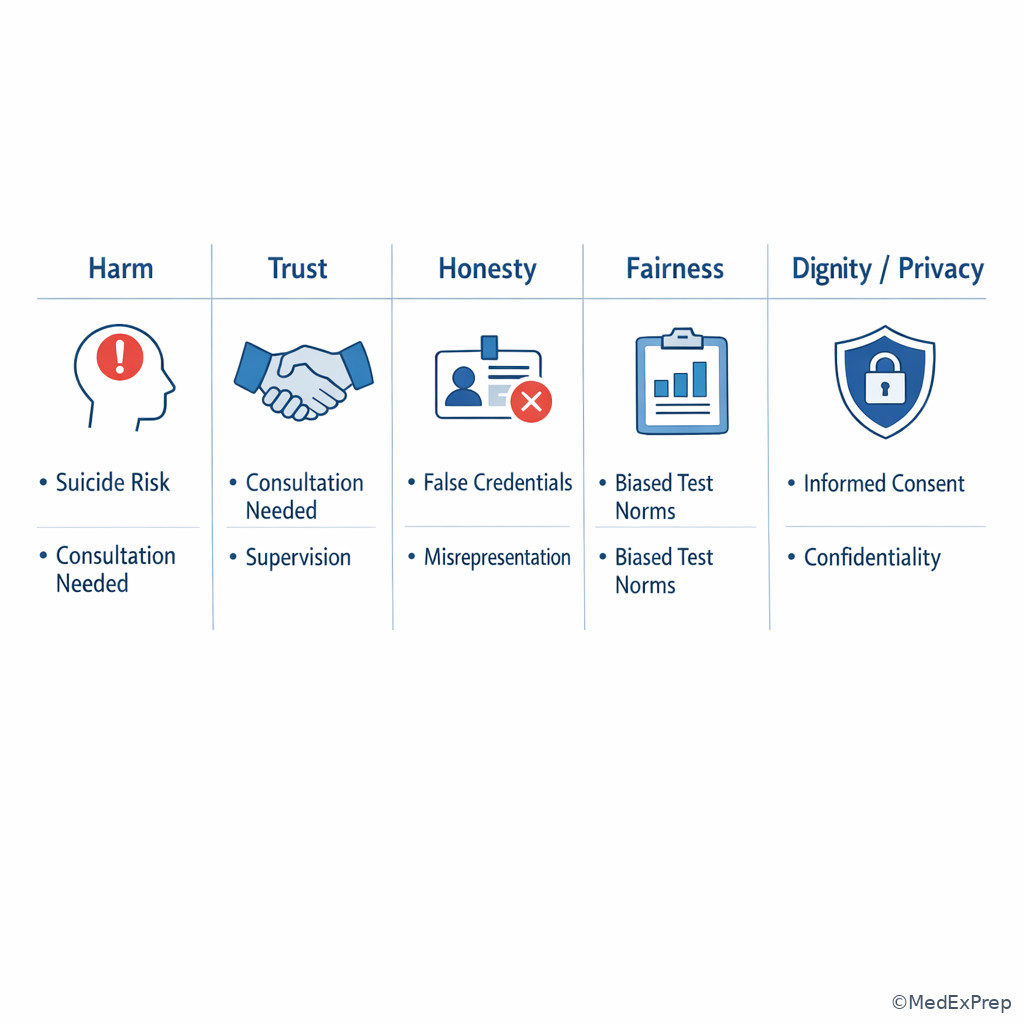
Exam takeaway: Use the nearest distinguishing cue to separate close ethics answer choices quickly.
flowchart TD
A[Ethics answer choices seem all plausible] --> B{Key clue}
B --> C[Harm risk]
B --> D[Truthfulness]
B --> E[Professional duty]
B --> F[Bias or inequity]
B --> G[Privacy or autonomy]
C --> H[Beneficence/Nonmaleficence]
D --> I[Integrity]
E --> J[Fidelity/Responsibility]
F --> K[Justice]
G --> L[Respect for Rights and Dignity] Forward link: in Enforceable Ethical Standards, many of these same traps reappear, but the correct answer will hinge on rule-based conduct rather than aspirational values.
Tables
| High-yield summary fact | What to remember |
|---|---|
| Number of General Principles | Five |
| Enforceable? | No; they are aspirational guides |
| Immediate risk cue | Beneficence and Nonmaleficence usually leads |
| Misleading or false information cue | Integrity |
| Consultation/accountability cue | Fidelity and Responsibility |
| Biased process or unfair access cue | Justice |
| Privacy/autonomy/confidentiality cue | Respect for Rights and Dignity |
| When several principles fit | Choose the most direct one, then cross-check the others |
| Comparison | Principle A | Principle B | Discriminator |
|---|---|---|---|
| Fidelity vs Integrity | Trust, role duty, consultation | Honesty, accuracy, nondeception | False or misleading content favors Integrity |
| Justice vs Respect | Fair process, equal access, reduce bias | Autonomy, privacy, dignity, diversity respect | Unfair system favors Justice; privacy/consent favors Respect |
| Respect vs Beneficence | Honor choice and rights | Prevent harm and protect welfare | Meaningful foreseeable harm favors Beneficence |
| Principle vs Standard | Broad value guidance | Specific rule of conduct | “Best rationale” favors principle; “violation” often favors standard |
| Stem feature | Most likely principle | Why not the close distractor? |
|---|---|---|
| Client wants informed consent details before agreeing | Respect for Rights and Dignity | Beneficence is supportive but less direct than autonomy |
| Psychologist inflates training credentials | Integrity | Fidelity is broader; the central issue is truthfulness |
| Assessment tool invalid for cultural/language context | Justice | Respect matters, but unfair process is the core fault |
| High-risk client requires active safety evaluation | Beneficence and Nonmaleficence | Respect cannot override substantial foreseeable harm |
| Uncertain case requires consultation | Fidelity and Responsibility | Integrity is not the lead unless deception or inaccuracy is involved |
| Unnecessary disclosure of private identity information | Respect for Rights and Dignity | Justice is not primary unless the issue is systemic fairness |
Exam takeaway: Grouping common stem cues around each principle improves fast recognition under timed conditions.
Algorithm / Approach
Exam takeaway: A simple if-then pathway reduces confusion when several ethical answers appear plausible.
flowchart TD
A[Read stem] --> B{Principle or rule?}
B -->|Principle| C{Key clue}
B -->|Rule| D[Save for next lesson on standards]
C --> E[Harm]
C --> F[Duty]
C --> G[Honesty]
C --> H[Fairness]
C --> I[Rights/Dignity]
E --> J[Beneficence/Nonmaleficence]
F --> K[Fidelity/Responsibility]
G --> L[Integrity]
H --> M[Justice]
I --> N[Respect]
J --> O[Check least overreaching action]
K --> O
L --> O
M --> O
N --> O
Monitoring checklist for your reasoning:
- Did I answer at the level asked: principle vs standard?
- Did I identify the single stem clue that best discriminates the correct answer?
- Did I prioritize harm prevention only when meaningful foreseeable harm is present?
- Did I avoid an answer that exceeds a psychologist’s role?
- Did I reject an overbroad disclosure or an overpassive respect-for-autonomy response?
Jurisdictional requirements vary; confirm with your licensing board or governing authority when a question moves from broad ethics into specific legal obligations.
Rapid Review
- General Principles → aspirational ethical values, not disciplinary rules by themselves
- Beneficence/Nonmaleficence → strongest when foreseeable harm is substantial
- Fidelity/Responsibility → consultation and accountable role management
- Integrity → misleading claim beats generic trust language
- Justice → biased process or unequal access, not merely “diversity mentioned”
- Respect for Rights/Dignity → autonomy, privacy, consent, dignity, identity
- Culture in assessment → unfair test use points to Justice more than Respect
- Confidentiality conflict → Respect leads unless harm risk shifts priority
- Several principles fit → choose the most direct one, then cross-check the rest
- Broad rationale question → think principle before standard number
- False note or inflated credential → Integrity, even if trust is also affected
- Uncertain but high-stakes dilemma → Fidelity supports consultation
- Least overreaching action → best integrated ethics answer
Self-check quiz
1. A psychologist is asked which APA General Principle most directly supports honoring a competent adult client’s decision to decline nonemergency treatment after a clear informed consent discussion. Which is the single best answer?
- Beneficence and Nonmaleficence
- Fidelity and Responsibility
- Justice
- Respect for People's Rights and Dignity
2. A group practice updates marketing materials. One clinician adds specialty credentials she has not earned, noting that “everyone in town exaggerates a little.” Which General Principle is most directly implicated?
- Integrity
- Justice
- Fidelity and Responsibility
- Beneficence and Nonmaleficence
3. A 29-year-old client with panic disorder, recent job loss, and heavy weekend alcohol use tells his psychologist, “I’m tired of being here,” but denies plan or intent. He asks that nothing be discussed outside therapy. He also mentions giving away prized music equipment because “I need less clutter.” Which principle should most directly guide the psychologist’s immediate next step?
- Respect for People's Rights and Dignity
- Beneficence and Nonmaleficence
- Justice
- Integrity
4. A psychologist evaluates a 15-year-old recent immigrant with limited English proficiency for learning problems. The school requests a rapid answer before placement deadlines. The psychologist considers using a familiar instrument with norms that do not fit the student’s language and cultural background. Which General Principle is most directly implicated by the concern about proceeding this way?
- Respect for People's Rights and Dignity
- Fidelity and Responsibility
- Justice
- Integrity
5. A hospital psychologist, already carrying a high caseload and supervising a trainee, receives a consultation request in a specialty area outside routine competence. The patient is medically stable, and no emergency is present. Which General Principle most directly supports obtaining consultation before offering recommendations?
- Integrity
- Fidelity and Responsibility
- Beneficence and Nonmaleficence
- Justice
6. A psychologist treating a 38-year-old client with trauma history, insomnia, and intermittent cannabis misuse is asked by the client’s employer for “any and all information” supporting a leave extension. The client signs a rushed release without reading it and says, “Just send them everything so this gets approved.” The records contain sensitive family and sexual history not needed for work accommodation. What is the most appropriate ethical framing of the psychologist’s next step?
- Send the full file because the client signed a release, making Respect for autonomy controlling
- Decline any disclosure because confidentiality always overrides employer requests
- Clarify the scope of the release and disclose only information necessary for the purpose, guided primarily by Respect for Rights and Dignity and constrained by beneficence and integrity
- Call the employer to discuss the client informally because Fidelity supports collaboration
7. A 52-year-old psychologist in private practice learns that a long-time colleague has recently returned to work after a neurological event. During a peer consultation lunch, the colleague forgets major details of active cases and laughs off concerns. The colleague has excellent rapport, no known complaints, and says canceling patients would be financially devastating. Which General Principle should lead the psychologist’s ethical reasoning about the next step?
- Fidelity and Responsibility
- Beneficence and Nonmaleficence
- Respect for People's Rights and Dignity
- Justice
8. A university counseling center psychologist is pressured by administrators to report aggregate “student risk trends” after several campus incidents. One administrator asks for case examples involving international students because “that group seems especially overwhelmed.” The psychologist has deidentified data available but worries the request may reinforce stereotypes and invite improper inference from a small subgroup. Which principle is most directly implicated by resisting the biased framing of the request?
- Justice
- Integrity
- Beneficence and Nonmaleficence
- Fidelity and Responsibility
Answer key
1. Correct answer: D — Respect for People's Rights and Dignity
- A: Tempting because informed refusal can affect welfare. Incorrect here because the stem centers on a competent adult’s autonomous choice after adequate consent; the discriminating clue is decline nonemergency treatment.
- B: Tempting because the psychologist still has professional duties. Incorrect because duty is not the main value tested; the clue is the client’s right to choose.
- C: Tempting because fairness matters broadly in care. Incorrect because the scenario is not about equitable access or bias.
- D: Correct because autonomy and informed self-determination are the central values. The clue is competent adult client’s decision.
2. Correct answer: A — Integrity
- A: Correct because the main ethical fault is a misleading claim about credentials. The discriminating clue is credentials she has not earned.
- B: Tempting because inaccurate advertising could affect fair access. Incorrect because the stem is about honesty, not systemic fairness.
- C: Tempting because public trust is at stake. Incorrect because Fidelity is broader; the direct issue is truthfulness.
- D: Tempting because clients could be harmed by misrepresentation. Incorrect because harm is secondary to the core act of deception.
3. Correct answer: B — Beneficence and Nonmaleficence
- A: Tempting because the client requests privacy. Incorrect for this scenario because the stem includes concerning self-harm indicators; the discriminating clue is I’m tired of being here plus giving away prized items.
- B: Correct because possible foreseeable harm requires active risk assessment before autonomy can fully control the response. The clue is the cluster of warning signs, not just one statement.
- C: Tempting because fairness is always relevant in care. Incorrect because no access or bias issue is central.
- D: Tempting because clear communication matters. Incorrect because no deception or falsehood is the focus.
4. Correct answer: C — Justice
- A: Tempting because culture and dignity matter. Incorrect because the stem’s core problem is fairness and validity of the evaluation process; the discriminator is norms that do not fit.
- B: Tempting because the psychologist has duties to the school and student. Incorrect because role duty is secondary to biased process.
- C: Correct because using inappropriate norms creates inequitable and potentially biased assessment outcomes. The clue is the culturally and linguistically mismatched measure.
- D: Tempting because inaccurate interpretation may follow. Incorrect because the stem is not about dishonesty; it is about unfair application.
5. Correct answer: B — Fidelity and Responsibility
- A: Tempting because transparency is a virtue. Incorrect because no misleading statement or deception is the issue.
- B: Correct because seeking consultation reflects accountable professional role management and responsible practice. The discriminating clue is outside routine competence with no emergency.
- C: Tempting because consultation may indirectly protect welfare. Incorrect because the direct principle is professional responsibility, not immediate harm prevention.
- D: Tempting because fair care matters. Incorrect because the stem does not describe bias or unequal access.
6. Correct answer: C — Clarify the scope of the release and disclose only necessary information
- A: Tempting because a signed release appears to authorize disclosure. Incorrect because ethical practice is not “send everything automatically”; the discriminating clue is sensitive material not needed for work accommodation, which makes overdisclosure inconsistent with dignity and privacy.
- B: Tempting because confidentiality is foundational. Incorrect because the client has authorized some disclosure, so the best answer is not total refusal but proportional clarification.
- C: Correct because it integrates principles: Respect supports privacy and informed choice, Integrity supports accurate purpose-limited communication, and Beneficence supports avoiding unnecessary harm from overdisclosure. The clue is the rushed, unread release plus irrelevant sensitive content.
- D: Tempting because collaboration can be useful. Incorrect because informal disclosure without clarifying scope increases privacy risk and bypasses purpose-limited communication.
7. Correct answer: B — Beneficence and Nonmaleficence
- A: Tempting because collegial responsibility and consultation are central in peer matters. Incorrect as the lead principle because the key clue is client risk from apparent impairment, not merely a duty to the profession.
- B: Correct because potential cognitive impairment in active practice creates foreseeable harm to clients. The discriminating clue is forgets major details of active cases.
- C: Tempting because the colleague’s dignity and privacy matter. Incorrect because concern for a colleague cannot outrank client safety when impairment affects practice.
- D: Tempting because fairness toward the colleague is relevant. Incorrect because systemic equity is not the main issue.
8. Correct answer: A — Justice
- A: Correct because the request is framed in a way that risks biased treatment and unfair stereotyping of a subgroup. The discriminating clue is especially overwhelmed applied to one identity group from limited examples.
- B: Tempting because accurate data representation matters. Incorrect because although Integrity is relevant, the more direct ethical issue is unfair and biased use of psychological information.
- C: Tempting because stigmatizing reports could cause harm. Incorrect because the stem is most centrally about equity and avoiding bias, not immediate individual safety.
- D: Tempting because administrators are part of the professional system. Incorrect because accountability to colleagues is not the leading value being tested.
Keep going with the full EPPP Prep Course (EPPP)
You just studied the way members do, in the same lesson interface. Full access unlocks every lesson, the question bank and flashcards for a full year.
One payment · 1 year of access · No auto-renewal