1.1.1 - Preventive Visit Components
Preventive Visit Components
What you’ll learn
- DOMAIN: Preventive care → Visit framework → Build a complete preventive women’s health visit around history, focused exam, screening review, and counseling priorities.
- DOMAIN: Clinical decision-making → Best next step → Decide what information must be clarified before recommending screening, contraception, or medication.
- DOMAIN: Gynecologic/obstetric history → Focused data gathering → Obtain a high-yield menstrual, sexual, reproductive, and safety history without missing red flags.
- DOMAIN: Prevention and counseling → Risk-based prevention → Recognize which preventive tasks belong in the visit and which details are deferred to age/risk-based screening decisions.
- DOMAIN: Scope-aware escalation → Triage safety → Identify when a “routine preventive” visit becomes an urgent same-day evaluation or requires supervisor involvement.
- Women’s health prevention domain → Preventive visit organization and health maintenance review
- History and physical subskill → Focused gynecologic, obstetric, sexual, social, and preventive history collection
- Clinical reasoning subskill → Determine pregnancy status, identify red flags, and choose best next step
- Counseling subskill → Preventive counseling, safety screening, and follow-up planning
- Weight: Official percentage not specified; treat as foundational across multiple women’s health question types
Why it matters
- Many women’s health questions are not truly about a disease; they test whether you collected the minimum information needed before choosing screening, counseling, or treatment.
- A preventive visit is where exam writers hide red flags: abnormal bleeding, pregnancy possibility, intimate partner violence, STI risk, or breast symptoms that should change the plan.
- If you know the visit framework, you can answer “most appropriate next step” questions even when exact screening intervals vary by guideline or institution.
- Safe student-level reasoning starts with structure: confirm pregnancy context, identify urgent symptoms, then proceed to prevention and counseling.
Key Terms & Must-Know Facts
1.1.1.1 Key terms
- Preventive visit: Planned health maintenance encounter focused on screening, risk reduction, counseling, and early detection.
- Chief preventive priorities: Screening review, immunization review, reproductive goals, sexual health, and safety assessment.
- LMP: First day of the last menstrual period; often needed to assess pregnancy possibility and cycle pattern.
- Gravida/para: Pregnancy count and delivery history; frames obstetric context.
- Menstrual history: Frequency, regularity, duration, flow, pain, and intermenstrual bleeding.
- Sexual history: Partners, practices, pregnancy prevention, STI risk, prior infections, and consent/safety concerns.
- Reproductive life plan: Whether the patient desires pregnancy now, later, or not at all.
- Red flag symptom: Finding that changes a routine visit into diagnostic or urgent evaluation.
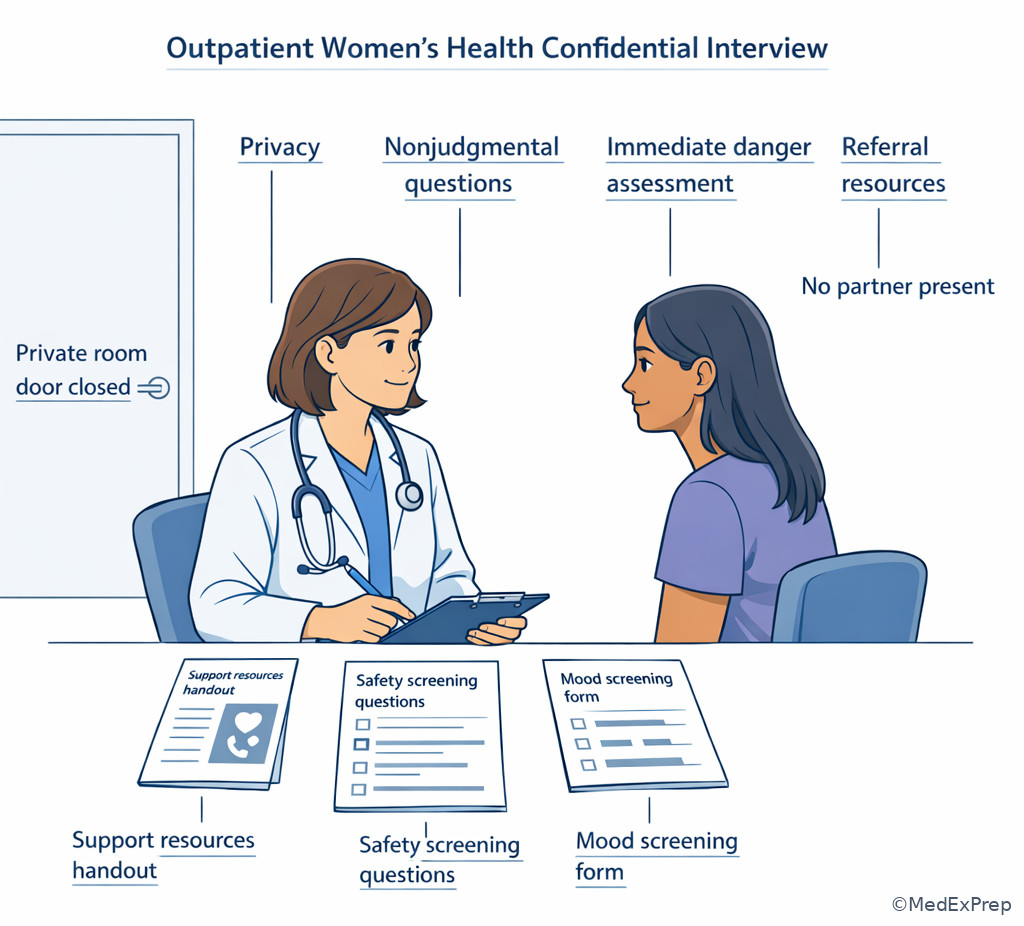
- Intimate partner violence screening: Confidential assessment for coercion, abuse, and immediate safety risk.
- Preconception counseling: Prevention-focused counseling for patients who may become pregnant.
- Contraindication screen: Review that identifies reasons to avoid a medication or contraceptive option.
- Chaperone-sensitive exam: Pelvic or breast exam performed when clinically indicated with appropriate consent and practice standards.
- Shared decision-making: Counseling approach that aligns options with patient goals and risk profile.
- Learner-safe escalation: Recognize instability or out-of-scope issues and involve the supervising clinician promptly.
1.1.1.2 Must-know facts
- Before counseling on contraception or medication, ask whether pregnancy is possible now.
- Not every preventive visit requires a pelvic exam; do it when indicated by symptoms, screening needs, or specific evaluation.
- Abnormal uterine bleeding, pelvic pain, vaginal discharge, breast mass, and positive pregnancy test can convert a routine visit into a problem-focused evaluation.
- Menstrual history is both gynecologic and pregnancy-risk information.
- Confidentiality matters, especially for sexual history, violence screening, and reproductive goals.
- Prevention questions often test information gathering before action.
- Reproductive intentions affect medication safety, folic acid counseling, and contraceptive planning.
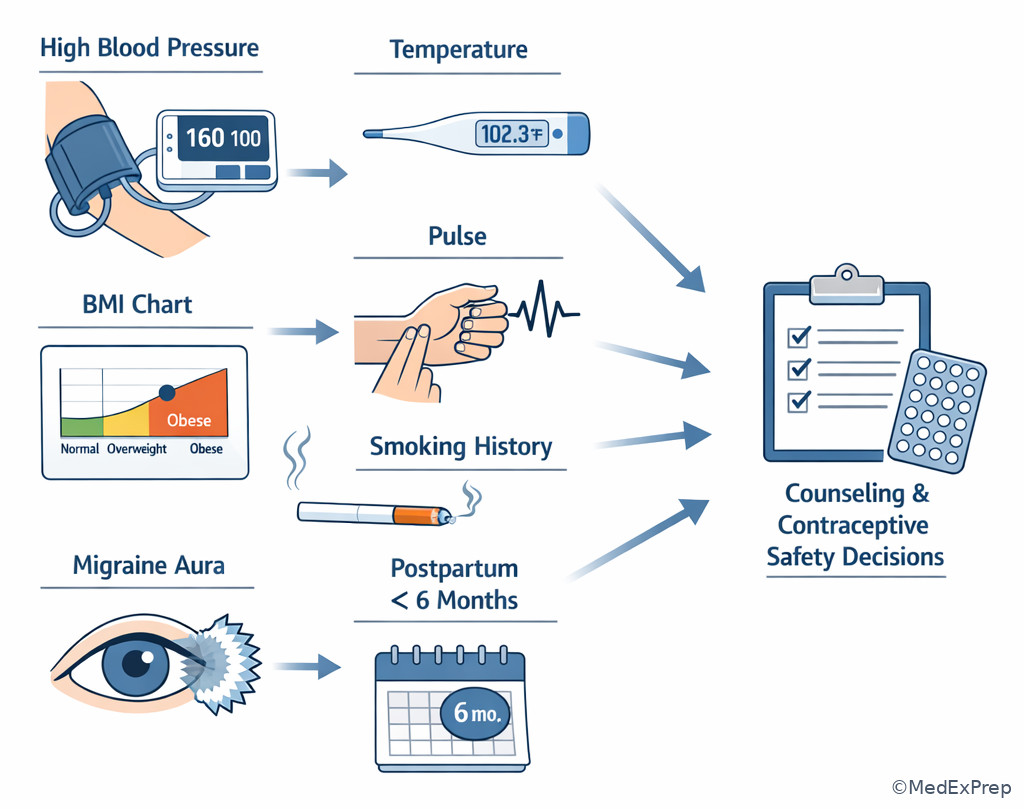
- Smoking, migraine with aura, hypertension, VTE history, and postpartum status commonly alter contraceptive choices.
- A normal preventive visit still includes mental health and safety screening.
- When instability, severe pain, syncope, heavy bleeding, or suspected ectopic pregnancy is present, escalate rather than continue routine preventive counseling.
Exam takeaway: Start by ruling out urgency and pregnancy context before moving to screening and counseling.
flowchart TD
A[Patient presents for preventive visit] --> B{Any urgent symptoms or instability?}
B -->|Yes| C[Convert to problem-focused or urgent evaluation]
B -->|No| D[Confirm age, reproductive goals, pregnancy possibility]
D --> E[Gather focused history and risk factors]
E --> F[Review screening and vaccines]
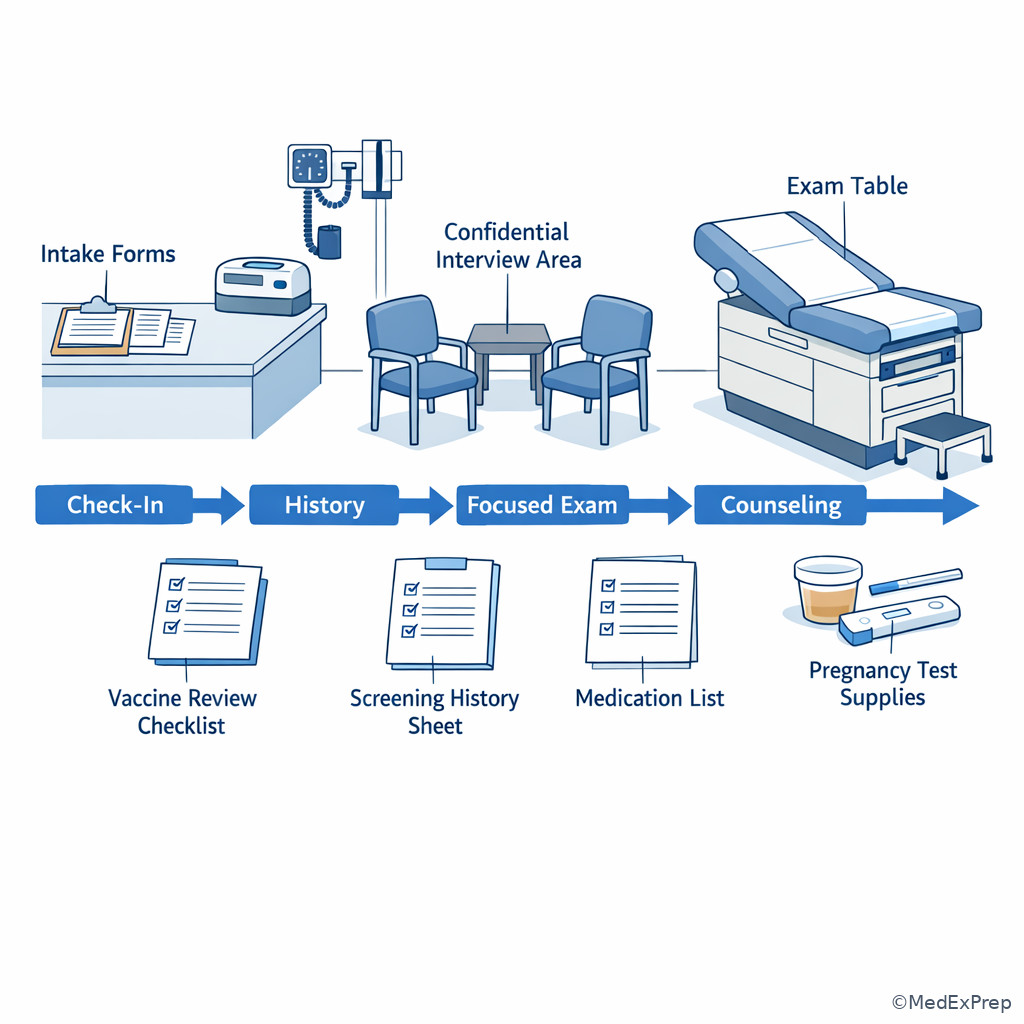
F --> G[Provide counseling and follow-up plan] Exam takeaway: A structured office workflow helps you avoid missing confidential history, screening review, and counseling tasks.
Core content
1.1.1.3 Foundational structure: what belongs in a preventive women’s health visit
A Explanation
The first exam conflict is simple: Is this still a preventive visit, or has it become an acute evaluation? The single rule that resolves this is whether the patient has red flags, instability, or a symptom requiring diagnostic workup now. If a patient presents for an annual visit but reports heavy bleeding, severe pelvic pain, syncope, fever, breast mass, or possible pregnancy complications, do not continue as though this were only a routine screening visit. Shift to problem-focused reasoning first.
For an uncomplicated preventive encounter, your framework is: establish the visit purpose, review urgent symptoms, confirm reproductive context, obtain focused history, perform indicated exam elements, review screening and immunizations, then counsel and plan follow-up. See Fig 1. In women’s health, “preventive” is broader than Pap testing. It includes menstrual health, sexual health, contraception or pregnancy intention, safety assessment, mental health, substance use, and chronic disease factors that affect reproductive safety.
WHY THIS IS TESTED: exam stems often ask for the most appropriate next step when multiple preventive tasks are possible. The correct answer is often the first missing piece of structure: rule out urgency, clarify pregnancy possibility, or identify whether the visit goal is screening versus symptom evaluation.
B Worked example
A 27-year-old G2P1 patient presents for her annual visit. She has obesity and migraine without aura, takes sertraline, and wants to discuss contraception. During intake she mentions “periods have been a little off” and one episode of dizziness last week after passing a large clot. She also reports recent unprotected intercourse 2 weeks ago. Hemoglobin from a work screening 6 months ago was 11.1 g/dL, which is tempting noise because it invites immediate anemia management. The task is not “best long-term contraceptive” yet. The task is to decide the safest next step.
Reasoning chain: identify task → this is a preventive visit with a possible acute issue. Extract key facts → irregular bleeding, large clot, dizziness, recent unprotected intercourse, pregnancy possible. Apply rule → do not proceed directly to contraception selection until pregnancy status and bleeding severity are clarified. Eliminate distractors → combined hormonal contraception may sound reasonable, and iron studies may seem attractive because of prior mild anemia, but neither addresses the first safety question. Verify → the best next step is focused evaluation of abnormal bleeding and pregnancy possibility, including urine pregnancy testing and assessment of current stability.
C Exam trap
D Checkpoint
Question: A 31-year-old patient presents for a preventive visit and requests STI screening. She also reports severe unilateral pelvic pain that began this morning, nausea, and a missed period. Which is the most appropriate next step?
- Proceed with routine preventive counseling and schedule follow-up for the pain
- Obtain pregnancy testing and urgent focused evaluation of the pelvic pain
- Order routine cervical cancer screening only
- Start empiric treatment for dysmenorrhea and reassess in 3 months
Answer: B
- A: Tempting because the visit is preventive and STI screening is appropriate, but wrong because acute unilateral pain plus missed period raises ectopic concern.
- B: Correct because the discriminating rule is that possible pregnancy with acute pelvic pain requires immediate focused evaluation before routine prevention.
- C: Tempting because screening belongs in preventive care, but wrong because it ignores a time-sensitive red flag.
- D: Tempting because pelvic pain in reproductive-age patients can be benign, but wrong because the missed period makes watchful waiting unsafe.
1.1.1.4 The must-have history: menstrual, obstetric, sexual, medication, and social context
A Explanation
The second exam conflict is which history details are optional versus mandatory before making decisions. The single finding that resolves this is whether the missing detail changes safety or eligibility. In women’s health, the highest-yield mandatory elements are menstrual pattern, pregnancy possibility, obstetric history, sexual history, reproductive goals, current medications, and social risks. If missing any of these would change what you recommend, you need that information before acting.
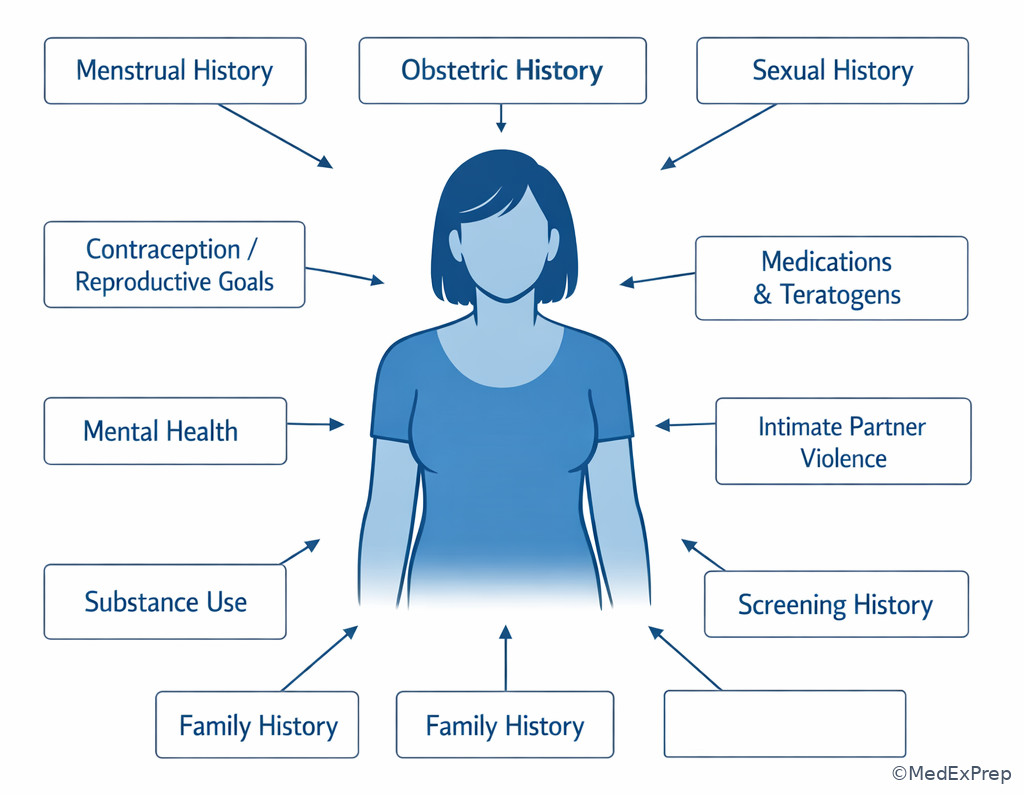
For menstrual history, ask frequency, regularity, duration, amount, pain, intermenstrual bleeding, and LMP. For obstetric context, ask gravida/para, prior pregnancy complications, mode of delivery when relevant, and postpartum status. For sexual history, ask partners, practices, STI history, condom use, and pregnancy prevention. For medications, ask about teratogens, anticoagulants, enzyme inducers, hormones, and over-the-counter supplements. Social history should include smoking, alcohol, substance use, housing/safety, and intimate partner violence. These are not “soft” additions; they change contraceptive safety, preconception advice, STI testing decisions, and urgency.
WHY THIS IS TESTED: board-style questions commonly present an almost-complete visit and ask what requires immediate clarification. The answer is usually the single missing item that affects next-step safety: pregnancy status, migraine with aura, smoking in an older patient, postpartum timing, or bleeding pattern.
B Worked example
A 39-year-old patient with hypertension and tobacco use presents for an annual exam. She wants to “restart the pill” because she used it in college and liked it. She also reports migraines, but the nurse note does not clarify aura status. Her last period was 5 weeks ago, and she says her cycles are “usually weird anyway.” A recent lipid panel is mildly abnormal, which is distracting but not the key issue. The board-style task is: what requires immediate clarification before recommending a method?
Reasoning chain: identify task → choose safe contraception at a preventive visit. Extract key facts → age near 40, HTN, smoking, possible delayed menses, migraines not characterized. Apply rule → before estrogen-containing contraception, clarify pregnancy possibility and migraine aura because both directly affect safe method selection. Eliminate distractors → lipid values and college-era tolerance do not decide current eligibility. Verify → the best next step is to clarify LMP/pregnancy possibility and whether migraines include aura; if pregnancy is possible, obtain a pregnancy test.
C Exam trap
D Checkpoint
Question: A 24-year-old patient presents for a routine preventive visit and wants treatment for acne and a discussion of contraception. Which missing history element is most important to clarify first?
- Whether she has ever had a prior abnormal lipid panel
- Whether pregnancy is currently possible
- Whether she prefers monthly or quarterly bleeding
- Whether her mother reached menopause before age 50
Answer: B
- A: Tempting because metabolic risk can matter for long-term counseling, but it does not immediately govern medication safety in the same way pregnancy status does.
- B: Correct because pregnancy possibility changes the safety of acne medications and the immediate approach to contraception.
- C: Tempting because bleeding preference helps method matching, but it comes after safety screening.
- D: Tempting because reproductive history matters in some contexts, but it does not determine the immediate next step here.
- The most important history detail before starting many women’s health medications is whether pregnancy is possible.
- True or False: A sexual history is optional in a preventive women’s health visit. False.
- Name 3 history elements that change contraceptive safety: migraine aura, smoking status, postpartum status.
1.1.1.5 Focused preventive exam: what to examine, what not to overuse, and when symptoms change the plan
A Explanation
The third exam conflict is performing enough exam to be safe without assuming every preventive visit requires a pelvic or breast exam. The rule that resolves this is indication. A routine preventive visit generally includes vitals, BMI context, general appearance, and targeted exam based on age, symptoms, and screening needs. Pelvic and breast exams are not automatic checkboxes for every asymptomatic patient; they are performed when clinically indicated, requested, or needed for evaluation, screening follow-up, or symptom assessment.
High-yield vitals matter because they change counseling and safety. Elevated blood pressure alters contraceptive choices; weight/BMI supports preventive counseling; fever pushes concern toward infection; tachycardia with bleeding suggests more urgent assessment. A breast exam is indicated when there is a new lump, focal pain, skin change, discharge, or patient concern. A pelvic exam is indicated for symptoms such as pain, discharge, lesions, bleeding, trauma, retained foreign body concern, or other evaluation needs. On exam questions, do not select invasive or low-yield exams just because the setting is gynecology.
WHY THIS IS TESTED: exam writers frequently tempt learners to overuse pelvic exams, Pap tests, or broad testing in low-risk asymptomatic patients. The correct answer often rewards targeted evaluation rather than reflexive examination.
Exam takeaway: Perform breast or pelvic exams when symptoms or specific indications are present, not just because the visit is annual.
flowchart TD
A[Preventive visit] --> B{Symptoms present?}
B -->|No| C[Vitals and targeted general exam]
B -->|Yes| D[Choose focused exam by complaint]
D --> E{Breast complaint?}
E -->|Yes| F[Breast exam]
E -->|No| G{Pelvic symptoms?}
G -->|Yes| H[Pelvic exam]
G -->|No| I[Other targeted exam] Exam takeaway: Know the labeled parts of a symptom-directed pelvic exam so you can choose it only when the complaint justifies it.
{"prompt":"Realistic medical educational illustration, clean white background, textbook atlas quality. Labeled diagram of a symptom-directed pelvic exam setup showing external inspection, speculum visualization of vagina and cervix, bimanual assessment of uterus and adnexa, and sample collection sites for STI or vaginitis testing. Include discreet arrows and labels only. No cartoon, no stock photo, no 3D render.","caption":"Focused pelvic exam components\nExam takeaway: Know the labeled parts of a symptom-directed pelvic exam so you can choose it only when the complaint justifies it.","size":"1024x1024"} B Worked example
A 22-year-old patient presents for a school physical and preventive gynecologic visit. She has no vaginal symptoms, no pelvic pain, and no breast concerns. She requests STI screening because of a new partner and says she is anxious because a friend “needed a pelvic exam for everything.” Her medical history includes asthma and eczema; she takes albuterol and topical steroids. A tempting but wrong clue is that she has mild dysuria after a workout, which might push you toward broad pelvic evaluation, but there is no persistent urinary or vaginal complaint.
Reasoning chain: identify task → decide what exam components are needed. Extract key facts → asymptomatic gynecologically, wants preventive care and STI screening, no pelvic pain/discharge/lesions. Apply rule → no automatic pelvic exam is required simply because STI screening is requested in an asymptomatic patient. Eliminate distractors → full pelvic exam or empiric vaginitis treatment would be excessive. Verify → targeted preventive exam with appropriate testing and counseling is sufficient unless new symptoms emerge.
C Exam trap
D Checkpoint
Question: A 29-year-old patient presents for preventive care. Which finding most strongly changes the visit from routine screening toward focused pelvic evaluation?
- A request to review vaccine records
- A desire to discuss future pregnancy planning
- New malodorous vaginal discharge and pelvic discomfort
- A family history of type 2 diabetes
Answer: C
- A: Tempting because vaccines are core preventive care, but they do not themselves require pelvic evaluation.
- B: Tempting because preconception counseling is high yield, but it remains counseling rather than urgent symptom assessment.
- C: Correct because active vaginal discharge with pelvic discomfort creates a symptom-based indication for focused pelvic exam and diagnostic testing.
- D: Tempting because chronic disease risk belongs in prevention, but it does not convert the visit into gynecologic symptom workup.
1.1.1.6 Prevention tasks in the visit: screening review, immunizations, reproductive planning, and counseling priorities
A Explanation
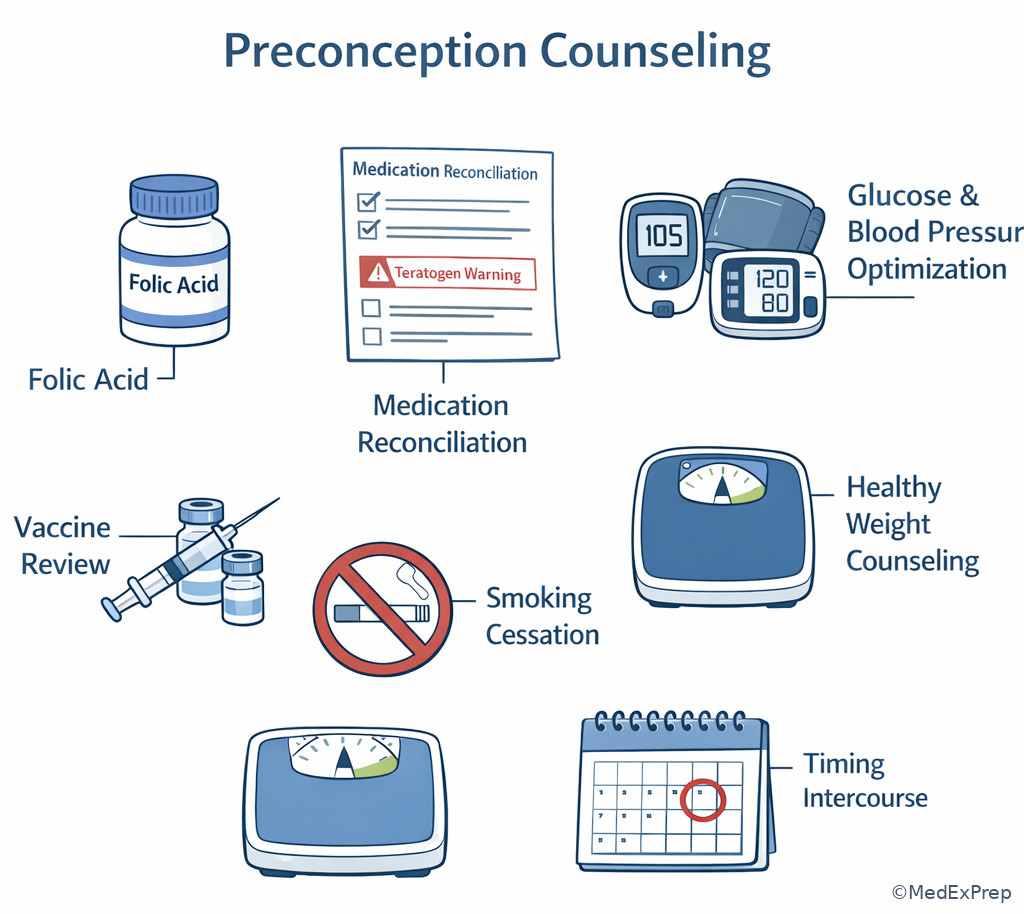
The fourth exam conflict is what to do during the preventive visit once urgent issues are excluded. The rule is to prioritize tasks that prevent harm now and support future decision-making: screening review, immunization review, reproductive planning, sexual health counseling, substance use counseling, folic acid/preconception issues when pregnancy is possible, and return precautions. The exact age-based intervals are covered in upcoming lessons, but this topic focuses on what categories must be reviewed.
Screening review includes cervical screening history, STI risk, breast and bone risk context when relevant, mood and interpersonal safety, and chronic disease factors that affect reproductive health. Immunization review includes routine adult vaccines and vaccines relevant to reproductive care. Reproductive planning means asking whether pregnancy is desired in the next year, later, or never; that answer shapes contraception, folic acid, medication review, and counseling. Office counseling also includes healthy weight, tobacco cessation, alcohol/substance use, and warning symptoms that should prompt urgent evaluation. See Fig 2 for how symptoms determine whether counseling stays preventive or becomes diagnostic.
WHY THIS IS TESTED: stems often list many possible counseling topics. The correct answer is usually the one most directly tied to the patient’s immediate risk profile or reproductive goals.
B Worked example
A 33-year-old patient with type 2 diabetes and obesity presents for an annual exam. She is taking metformin and a statin, reports inconsistent condom use, and says she is “not trying but would be okay if pregnancy happened.” She wants vaccine updates and asks whether she should start folic acid “only once I get a positive test.” Her Pap history is unclear. A mildly elevated LDL in the chart is distracting because it is chronic, not the main preventive conflict.
Reasoning chain: identify task → prioritize preventive counseling. Extract key facts → pregnancy possible, ambivalent reproductive intention, medication list, unclear screening history. Apply rule → if pregnancy is possible, the visit should include preconception-safe counseling now, not after a positive test; medication review and folic acid counseling matter before conception. Eliminate distractors → waiting for pregnancy confirmation misses prevention. Verify → review screening history, reconcile medications for pregnancy safety, discuss folic acid and contraception or pregnancy planning, and update vaccines per routine care.
C Exam trap
D Checkpoint
Question: During a preventive visit, which counseling topic becomes highest priority when a patient reports she may want pregnancy within the next year?
- Deferring all medication review until conception is confirmed
- Preconception counseling, including folic acid and medication safety review
- Avoiding all discussion of contraception because pregnancy may be desired later
- Focusing only on family history and skipping STI counseling
Answer: B
- A: Tempting because pregnancy may not occur soon, but wrong because teratogenic risk and folate status matter before conception.
- B: Correct because reproductive planning changes preventive priorities immediately.
- C: Tempting because the patient may desire pregnancy, but wrong because timing still matters and contraception may still be needed until ready.
- D: Tempting because family history is part of prevention, but wrong because it ignores modifiable reproductive and sexual health risks.
- The most useful first reproductive planning question is whether the patient wants pregnancy now, later, or not at all.
- True or False: Preconception counseling starts only after a positive pregnancy test. False.
- Name 3 routine prevention categories to review in the visit: screening, vaccines, reproductive counseling.
1.1.1.7 Red flags, safety screening, and scope-aware escalation
A Explanation
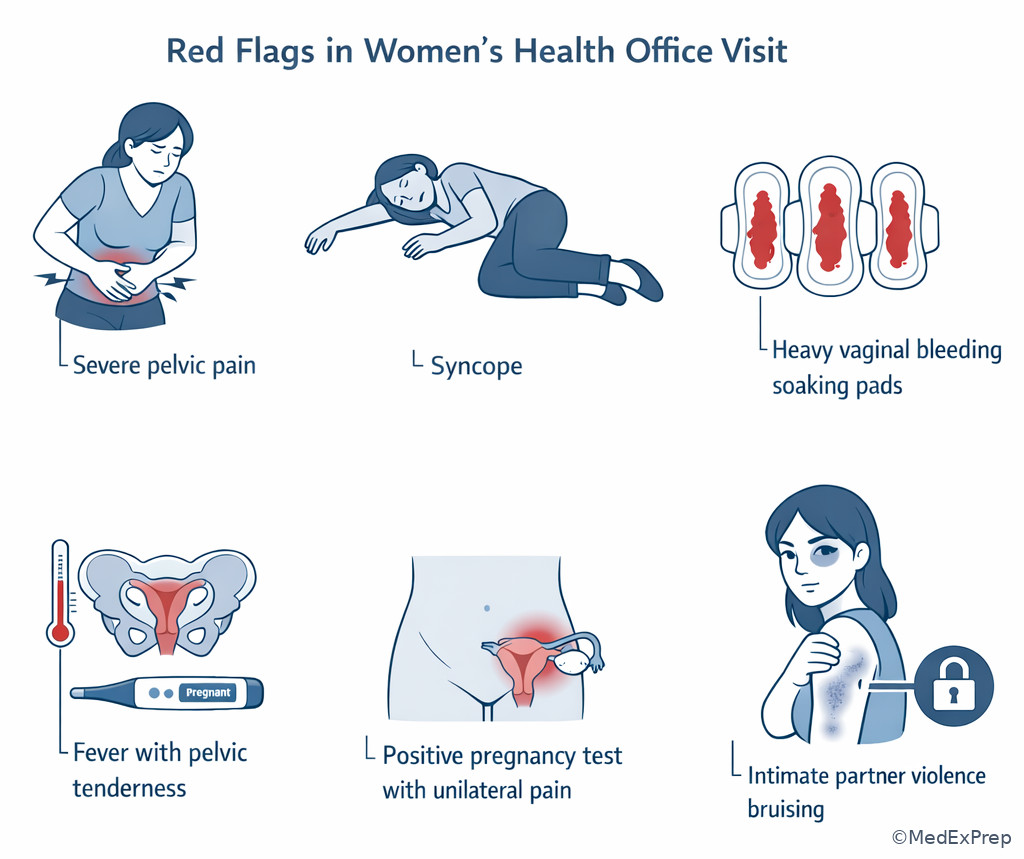
The final integration question is when must a preventive visit stop being preventive? The single clue is any finding that threatens immediate safety or requires urgent diagnostic evaluation. Common red flags in women’s health include severe pelvic pain, syncope, heavy vaginal bleeding, positive pregnancy test with pain or bleeding, fever with pelvic pain, postpartum complications, suspected sexual assault, suicidality, and intimate partner violence with immediate danger.
Student-level exam reasoning here is about recognition and escalation, not definitive specialist management. If the stem drifts toward unstable vital signs, peritoneal signs, hemorrhage, or suspected ectopic pregnancy, the best answer is stabilization within scope and prompt involvement of the supervising clinician, emergency team, or OB-GYN. If the issue is safety-related rather than medical instability, privacy and immediate support matter: interview confidentially when possible, assess immediate danger, and follow local protocols for support and escalation.
WHY THIS IS TESTED: preventive visits are common places for hidden emergency clues. The exam rewards the learner who recognizes the red flag and changes course rather than completing the planned wellness checklist.
Exam takeaway: Heavy bleeding, severe pain, fever, or pregnancy-related symptoms should trigger urgent evaluation rather than routine preventive care.
flowchart TD
A[Preventive visit underway] --> B{Red flag appears?}
B -->|No| C[Continue prevention plan]
B -->|Yes| D{Instability or pregnancy complication concern?}
D -->|Yes| E[Urgent escalation and supervisor involvement]
D -->|No| F[Focused same-day diagnostic evaluation]
F --> G[Document precautions and close follow-up] Exam takeaway: Visual recognition of bleeding, pain, fever, and pregnancy context helps identify when a routine visit must convert to urgent evaluation.
B Worked example
A 35-year-old G3P2 patient presents for a postpartum preventive visit 2 weeks after delivery. She has chronic hypertension and depression treated with labetalol and sertraline. She planned to discuss contraception and breastfeeding support. During the visit, she reports a severe headache, visual spots, and new right upper quadrant pain. She also asks about a flu shot, which is tempting because preventive care remains appropriate in general. Blood pressure is 168/110 mm Hg.
Reasoning chain: identify task → determine whether this is still a preventive visit. Extract key facts → postpartum, severe headache, visual symptoms, RUQ pain, severe-range hypertension. Apply rule → this is a hypertensive emergency concern, not routine counseling. Eliminate distractors → contraception counseling, lactation questions, and vaccines are all important but not first. Verify → urgent escalation and immediate evaluation are required.
C Exam trap
D Checkpoint
Question: Which finding during a preventive women’s health visit most strongly requires urgent escalation rather than completion of routine counseling?
- Irregular but light menses over the last 3 months
- Desire to become pregnant within the next year
- Positive home pregnancy test with unilateral pelvic pain and lightheadedness
- Request for catch-up immunizations
Answer: C
- A: Tempting because abnormal bleeding may require workup, but it does not carry the same immediate instability signal as pregnancy with unilateral pain and presyncope.
- B: Tempting because reproductive planning changes counseling, but it is still preventive rather than emergent.
- C: Correct because possible ectopic pregnancy is time-sensitive and unsafe to manage as routine prevention.
- D: Tempting because vaccines are part of prevention, but they do not compete with an emergency clue.
Tables
| Preventive visit component | What to ask/review | Why it matters on exam |
|---|---|---|
| Urgent symptom screen | Heavy bleeding, severe pain, syncope, fever, breast mass, pregnancy symptoms | Determines whether the visit stays preventive or becomes urgent/problem-focused |
| Menstrual history | LMP, regularity, duration, flow, pain, intermenstrual bleeding | Guides pregnancy possibility and abnormal bleeding recognition |
| Obstetric history | Gravida/para, prior complications, recent delivery, postpartum status | Changes risk interpretation and counseling |
| Sexual history | Partners, practices, protection, STI history, coercion concerns | Guides STI testing and counseling |
| Reproductive goals | Pregnancy now, later, or not desired | Directs contraception versus preconception counseling |
| Medication review | Prescription, OTC, supplements, teratogens, hormones | Essential before contraception or pregnancy-related counseling |
| Vitals | BP, pulse, temperature, weight/BMI context | Can reveal contraindications or acute illness |
| Screening review | Cervical screening history, vaccines, mental health, safety | Core preventive purpose of the visit |
| Decision point | Choose this | Reject this | Discriminating clue |
|---|---|---|---|
| Preventive vs urgent evaluation | Urgent/focused workup | Continue routine wellness checklist | Severe pain, heavy bleeding, syncope, fever, pregnancy complication concern |
| History first vs method selection first | Clarify pregnancy possibility and contraindications | Recommend contraception immediately | Missing safety information changes eligibility |
| Targeted exam vs routine pelvic exam | Exam only if indicated by symptoms/screening need | Pelvic exam for all annual visits | Asymptomatic patient with no indication |
| Preconception counseling now vs later | Counsel now if pregnancy is possible or desired soon | Wait for positive test | Preconception folate and medication review prevent harm before conception |
| Confidential safety screen vs defer | Assess violence/coercion and mental health risk | Skip because visit is “routine” | Safety risks often emerge in preventive settings |
| Looks similar | Actually preventive | Actually problem-focused/urgent | Single clue |
|---|---|---|---|
| Irregular cycles discussion | Review pattern and counsel if mild/stable | Immediate evaluation if heavy bleeding or presyncope | Hemodynamic symptoms or large-volume bleeding |
| Contraception request | Method counseling after history review | Pregnancy test/focused workup if missed period or pregnancy symptoms | Pregnancy may already be present |
| STI screening request | Routine testing/counseling if asymptomatic | Pelvic exam and testing if discharge, pain, fever | Active symptoms change the approach |
| Postpartum preventive visit | Contraception, mood, lactation, BP review if stable | Urgent escalation if severe headache, visual changes, dyspnea, heavy bleeding | Postpartum red-flag symptoms |
| Vaccine update | Review routine immunizations | Stabilize first if acute illness or emergency clues present | Urgency outranks prevention |
Exam takeaway: The highest-yield preventive history combines menstrual, sexual, obstetric, medication, and safety domains in one structured review.
Exam takeaway: Blood pressure, weight context, fever, and smoking status can change screening, medication, and contraceptive recommendations.
Exam takeaway: Asking whether pregnancy is desired now, later, or never immediately organizes counseling priorities.
flowchart TD
A[Ask reproductive goals] --> B{Pregnancy desired now?}
B -->|Yes| C[Preconception counseling and medication review]
B -->|Later| D[Interim contraception plus future fertility planning]
B -->|No| E[Contraception matching and STI prevention]
C --> F[Folic acid and vaccine review]
D --> F
E --> F Exam takeaway: Patients who may become pregnant need folic acid, medication review, and chronic disease optimization before conception occurs.
Exam takeaway: Intimate partner violence and mental health risk screening are core preventive tasks, not optional extras.
Exam Traps & Differentiators
- Most common wrong answer: treating the annual visit label as permission to ignore acute symptoms. Why wrong: a preventive setting never overrides red-flag triage.
- Looks similar but isn’t: STI screening request in an asymptomatic patient is preventive; STI screening request with discharge, fever, or pelvic pain is diagnostic.
- Looks similar but isn’t: counseling on contraception is preventive; prescribing or recommending a method before confirming pregnancy possibility and contraindications is unsafe.
- Looks similar but isn’t: a Pap/cervical screening history review is preventive; pelvic pain/bleeding evaluation is problem-focused.
- If the stem says “missed period,” think pregnancy status before medication or contraceptive decisions.
- If the stem says “severe unilateral pain,” think urgent pelvic pathology rather than routine annual care.
- If the stem says “wants to restart prior pill,” think current contraindication screen, not historical tolerance.
- If the stem says “would be okay if pregnancy happened,” think preconception counseling now.
- If the stem says “new partner, no symptoms,” think preventive STI screening rather than automatic pelvic exam.
- If the stem says “postpartum severe headache/vision changes,” think urgent escalation, not routine postpartum counseling.
| Trap pair | Tempting wrong answer | Correct exam logic |
|---|---|---|
| Annual visit + acute symptom | Finish preventive checklist first | Triage the symptom first |
| Contraception request + late period | Pick a method immediately | Clarify pregnancy status first |
| STI screening + no symptoms | Routine pelvic exam required | Targeted testing may be enough |
| Possible future pregnancy | Delay counseling until positive test | Start preconception counseling now |
| Request to restart prior estrogen method | Prior tolerance proves safety | Current contraindications determine safety |
Related traps will appear again in upcoming topics. For example, Screening By Age And Risk will test over-screening and unnecessary testing in low-risk patients, while Office Counseling Priorities will test whether you prioritized contraception, STI prevention, folic acid, and smoking cessation according to the patient’s goals and risk factors rather than discussing every topic equally.
Algorithm / Approach
Use this approach whenever the stem asks for the most appropriate next step in a preventive setting. See Fig 3, Fig 5, and Fig 6 for the most testable decision points.
Rapid Review
- Annual visit label → does not cancel red-flag triage
- Missed period → pregnancy status before treatment or contraception
- Past tolerance of estrogen → does not override current contraindications
- Asymptomatic STI screening request → may not require pelvic exam
- Pelvic pain + positive pregnancy test → urgent ectopic rule-out pattern
- Reproductive life plan → organizes contraception vs preconception counseling
- Menstrual history → doubles as gynecologic and pregnancy-risk data
- Vitals in prevention → can change safety decisions immediately
- Postpartum headache + vision changes → escalate, do not continue routine counseling
- Preventive exam → targeted, not automatically pelvic or breast
- Safety screening → core preventive task, not optional add-on
- Medication review → especially high yield when pregnancy is possible
- “Okay if pregnancy happened” → preconception counseling now
- Symptom plus screening request → evaluate the symptom first
Self-check quiz
1. A 26-year-old patient presents for a routine preventive visit and asks to start acne treatment and contraception. She has no pain or bleeding. Which question most requires immediate clarification before recommending therapy?
- Whether pregnancy is currently possible
- Whether she prefers telehealth follow-up
- Whether her mother has osteoporosis
- Whether she exercises 3 times per week
2. A 23-year-old patient presents for preventive care with a new sexual partner and requests STI screening. She denies pelvic pain, discharge, lesions, fever, or bleeding. Which is the most appropriate interpretation?
- The visit requires an automatic pelvic exam because STI screening is requested
- The visit remains preventive unless symptoms or specific indications justify focused pelvic evaluation
- The visit should be postponed until she develops symptoms
- The best next step is empiric treatment for cervicitis
3. A 38-year-old patient with hypertension, tobacco use, and migraines presents for an annual exam and asks to restart combined oral contraceptives. Her last period was 6 weeks ago, and the chart does not specify whether her migraines include aura. Which is the most appropriate next step?
- Restart the prior pill because she tolerated it in college
- Clarify pregnancy possibility and migraine aura status before choosing a method
- Choose a method based only on her bleeding preference
- Delay all counseling until her lipid panel is repeated
4. A 32-year-old G1P1 patient presents for a preventive visit 10 months after delivery. She says, “We are not trying, but if I got pregnant it would be fine.” She takes metformin and asks whether she can wait to start folic acid until she misses a period. Which is the most appropriate counseling point?
- Start preconception counseling now because pregnancy is possible
- Wait for a positive pregnancy test before changing any preventive plan
- Avoid discussing contraception because she might want pregnancy later
- Focus only on weight counseling because it is the strongest modifiable factor
5. A 21-year-old patient presents for a school physical and preventive gynecologic visit. She wants STI screening because of a new partner but has no discharge, pelvic pain, lesions, or fever. Which is the most appropriate next step?
- Perform an urgent pelvic exam because all STI concerns are high acuity
- Provide symptom-directed counseling and arrange appropriate STI screening without assuming a full pelvic exam is required
- Start empiric broad-spectrum antibiotics before testing
- Defer all sexual health discussion until a separate gynecology appointment
6. A 29-year-old patient presents for an annual exam and asks for contraception. She has obesity and anxiety treated with escitalopram. During the interview, she mentions sudden severe right-sided pelvic pain, one episode of vomiting, and a menstrual period that is 2 weeks late. She is afebrile and wants to “just get the birth control sorted out today.” Which is the most appropriate next step?
- Recommend a long-acting reversible method after standard counseling
- Obtain pregnancy testing and urgent focused evaluation of the pelvic pain
- Defer evaluation and schedule a follow-up after her next cycle
- Start NSAIDs for presumed ovulation pain and complete the preventive visit
7. A 34-year-old patient presents for a postpartum preventive visit 12 days after delivery. She has chronic hypertension and obesity. She planned to discuss breastfeeding and contraception but now reports severe headache, visual spots, and right upper quadrant pain. Blood pressure is 166/108 mm Hg. Which is the most appropriate next step?
- Continue the visit and address contraception first because the postpartum visit is time sensitive
- Provide reassurance that headaches are common postpartum and arrange routine follow-up
- Urgently escalate for evaluation of a postpartum hypertensive complication
- Focus on lactation technique because inadequate sleep is the likely cause
8. A 41-year-old patient presents for a preventive visit to review vaccines and screening. She also reports a week of fever, foul vaginal discharge, and worsening bilateral pelvic pain. She has a copper IUD, a history of chlamydia 5 years ago, and mild anemia on prior labs. Which feature most strongly explains why the visit should shift away from routine prevention?
- Her age over 40
- Her history of prior STI
- Her copper IUD use
- Her current fever with pelvic pain and discharge
Answer key
1. Correct answer: A
The mechanism-to-management logic is safety first: when contraception and acne treatment are discussed together, pregnancy possibility is the key discriminator because it changes medication safety and immediate plan.
- A: Tempting because it feels basic, and it is correct because current pregnancy possibility directly affects both contraceptive planning and acne medication safety. Single clue: the stem asks about starting therapy now. Sources: ACOG preventive care guidance; CDC contraceptive guidance.
- B: Tempting because follow-up logistics matter in outpatient care, but incorrect because logistics do not determine immediate safety. Single clue: therapy selection is being made today.
- C: Tempting because family history matters for long-term prevention, but incorrect because it does not govern today’s medication decision. Single clue: osteoporosis risk is not the immediate conflict.
- D: Tempting because exercise is preventive counseling, but incorrect because it is not the discriminating factor for treatment safety. Single clue: the question asks what most requires clarification before therapy.
2. Correct answer: B
The key principle is targeted rather than reflexive examination. In an asymptomatic patient requesting STI screening, the preventive visit remains preventive unless symptoms or another specific indication justify pelvic evaluation.
- A: Tempting because gynecologic care is often associated with pelvic exams, but incorrect because screening request alone does not automatically require one. Single clue: she denies symptoms. Sources: ACOG well-woman care; CDC STI screening guidance.
- B: Correct because asymptomatic STI screening can often proceed within preventive care without assuming a full pelvic exam is necessary. Single clue: no pain, discharge, lesions, fever, or bleeding.
- C: Tempting because symptoms sometimes guide testing, but incorrect because preventive screening is appropriate even when asymptomatic. Single clue: she requested preventive STI screening.
- D: Tempting because new partner raises STI risk, but incorrect because empiric treatment without symptoms or diagnosis is not the best next step. Single clue: no syndrome suggesting cervicitis.
3. Correct answer: B
The pathophysiology/treatment logic is that estrogen safety depends on contraindication screening, and delayed menses raises pregnancy possibility. The best next step is not choosing a method yet; it is clarifying the missing factors that determine eligibility.
- A: Tempting because past success suggests patient preference and adherence, but incorrect because current smoking, hypertension, migraine aura status, and possible pregnancy matter more than historical tolerance. Single clue: the chart lacks aura status and the period is late. Sources: CDC U.S. Medical Eligibility Criteria; ACOG contraception guidance.
- B: Correct because these are the immediate missing discriminators for safe method selection. Single clue: 6-week interval since last menses plus unclarified migraine subtype.
- C: Tempting because bleeding preference helps choose among acceptable methods, but incorrect because safety comes before preference matching. Single clue: method eligibility is not established yet.
- D: Tempting because cardiovascular risk matters in prevention, but incorrect because repeating lipids is not the first safety step in this scenario. Single clue: other factors are more immediately decisive.
4. Correct answer: A
The correct logic is prevention before conception. If pregnancy would be acceptable and is possible, folic acid and medication review should begin now rather than after pregnancy is established.
- A: Correct because ambivalent-but-acceptable pregnancy means the patient benefits from immediate preconception-safe counseling. Single clue: “if I got pregnant it would be fine.” Sources: ACOG prepregnancy counseling; standard preventive women’s health texts.
- B: Tempting because many patients think prevention starts after confirmation, but incorrect because early embryonic development occurs before many patients realize they are pregnant. Single clue: pregnancy is possible now.
- C: Tempting because later pregnancy desire influences planning, but incorrect because timing still matters and contraception may still be needed until ready. Single clue: desire is not immediate.
- D: Tempting because weight counseling is relevant, but incorrect because the question asks the most appropriate counseling point; preconception safety is more discriminating.
5. Correct answer: B
The mechanism-to-management logic is that a new partner increases STI screening and counseling needs, but without symptoms the encounter remains preventive and testing can be targeted.
- A: Tempting because STI concerns feel urgent, but incorrect because urgency comes from symptoms or instability, not from screening need alone. Single clue: no discharge, pain, lesions, or fever. Sources: CDC STI screening recommendations; ACOG well-woman visit guidance.
- B: Correct because it matches preventive care with indication-based examination. Single clue: asymptomatic patient requesting screening.
- C: Tempting because empiric treatment is used for some syndromic presentations, but incorrect because this is not a symptomatic syndrome.
- D: Tempting because specialty follow-up is common, but incorrect because preventive sexual health discussion belongs in this visit.
6. Correct answer: B
This question tests integration of prevention and acute triage. Sudden unilateral pelvic pain, vomiting, and a late period create a possible ectopic pregnancy or other urgent pelvic process; that mechanism makes immediate focused evaluation more important than long-term contraceptive counseling.
- A: Tempting because long-acting methods are effective and the patient asked for contraception, but incorrect because urgent diagnosis comes first. Single clue: sudden severe pain with late menses. Sources: ACOG ectopic pregnancy guidance; emergency gynecology standards.
- B: Correct because pregnancy testing and urgent evaluation are the safest next step. Single clue: unilateral pain plus delayed period plus vomiting.
- C: Tempting because some menstrual irregularity is benign, but incorrect because the stem includes acute severe pain and systemic symptoms.
- D: Tempting because ovulation pain can be unilateral, but incorrect because the late period and severity/light symptoms make presumptive benign diagnosis unsafe.
7. Correct answer: C
The mechanism is postpartum hypertensive disease, which can present after delivery with severe headache, visual changes, RUQ pain, and severe blood pressure elevation. The presence of this emergency pattern overrides routine postpartum preventive care.
- A: Tempting because contraception counseling is important postpartum, but incorrect because severe symptoms plus markedly elevated BP require urgent escalation first. Single clue: 166/108 mm Hg with headache and visual spots. Sources: ACOG hypertension in pregnancy/postpartum guidance.
- B: Tempting because headaches are common postpartum, but incorrect because the associated severe features make reassurance unsafe.
- C: Correct because this is the appropriate scope-aware action for a supervised learner faced with a postpartum red flag.
- D: Tempting because sleep deprivation can worsen headaches, but incorrect because it does not explain the severe BP and RUQ pain.
8. Correct answer: D
The reasoning is that current syndrome drives urgency. Fever, foul discharge, and worsening pelvic pain signal active infection or another acute pelvic process, converting the visit from preventive to diagnostic/urgent care. Past STI history and IUD use are contextual but not the immediate discriminator.
- A: Tempting because screening often changes with age, but incorrect because age alone does not explain the need to shift visit type. Single clue: acute infectious symptoms are present now. Sources: CDC PID/STI guidance; ACOG acute gynecologic evaluation principles.
- B: Tempting because prior STI raises risk, but incorrect because history alone does not require urgent conversion without current symptoms.
- C: Tempting because device-associated questions often concern learners, but incorrect because the IUD is less discriminating than the current fever and pain syndrome.
- D: Correct because current fever with pelvic pain and discharge is the active red-flag pattern that changes the visit immediately.
Keep going with the full EOR Women’s Health Prep Course (EOR WH)
You just studied the way members do, in the same lesson interface. Full access unlocks every lesson, the question bank and flashcards for a full year.
One payment · 1 year of access · No auto-renewal