1.1.1 - Psychiatric History Elements
Why it matters
- The Psychiatry EOR often tests the most appropriate next question before it tests the diagnosis.
- Many stems include partial histories; the correct answer is often the missing discriminating element, not a medication name.
- A good psychiatric history prevents dangerous anchoring on depression, anxiety, or psychosis when the true issue is intoxication, withdrawal, delirium, mania, or imminent self-harm.
- Board-style vignettes reward learners who use a sequence: safety first → syndrome pattern → timeline → substances/medical causes → functional impact → disposition.
Exam takeaway: Start with immediate safety and then use timeline, substances, and functional impact to narrow the syndrome.
flowchart TD
A[Chief concern] --> B{Immediate danger?}
B -->|Yes| C[Suicidal or homicidal intent, psychosis, mania, delirium, withdrawal]
B -->|No| D[Clarify symptoms in patient's own words]
D --> E[Define onset, duration, course, triggers]
E --> F[Screen substances, meds, medical illness]
F --> G[Assess impairment, supports, prior treatment]
G --> H[Choose disposition and initial plan] Exam takeaway: A labeled interview map helps you remember the core domains the exam expects you to ask in nearly every vignette.
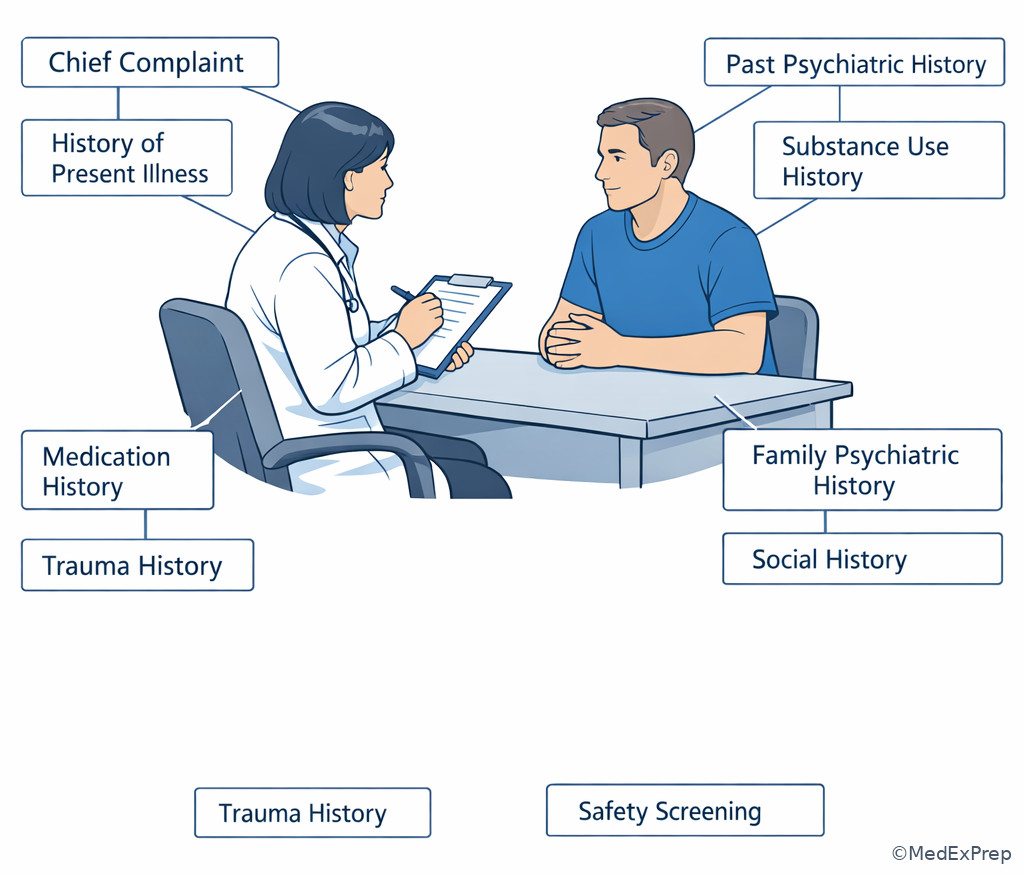
Use Fig 1 as your default order of operations. Use Fig 2 to avoid leaving out one of the commonly tested domains.
Key Terms & Must-Know Facts
1.1.1.1 Key terms
- Chief concern: the patient’s main reason for seeking care, ideally in their own words.
- HPI: symptom timeline, triggers, severity, associated features, and functional impact.
- Past psychiatric history: prior diagnoses, hospitalizations, suicide attempts, self-harm, therapies, and medication trials.
- Collateral history: information from family, EMS, staff, or records when reliability is limited.
- Substance history: alcohol, opioids, stimulants, cannabis, sedatives, hallucinogens, nicotine, caffeine, and timing of last use.
- Medication history: prescribed drugs, adherence, recent changes, over-the-counter agents, supplements, and adverse effects.
- Medical contributors: endocrine, neurologic, infectious, metabolic, and medication-induced causes of psychiatric symptoms.
- Functional impairment: effects on work, school, sleep, relationships, ADLs, and self-care.
- Safety screening: suicidal ideation, homicidal ideation, psychosis, access to means, inability to care for self.
- Timeline threshold: duration clue that separates brief stress reactions, mood episodes, psychotic disorders, and substance-related states.
- Episodic course: discrete periods of symptoms with interepisode recovery.
- Context: postpartum state, adolescence, older age, trauma exposure, medication changes, and substance withdrawal timing.
1.1.1.2 Must-know facts
- Psychiatric interviews start with safety, not diagnostic curiosity.
- “Depression” in a stem is incomplete until you ask about mania/hypomania.
- “Anxiety” is incomplete until you ask about substance use, caffeine, thyroid disease, and panic timing.
- “Psychosis” is incomplete until you ask about medical illness, intoxication/withdrawal, and delirium features.
- Prior suicide attempt is one of the strongest historical risk markers for future suicide attempt.
- Recent medication changes can explain agitation, insomnia, confusion, tremor, akathisia, or mood change.
- Loss of function often determines severity and disposition better than symptom count alone.
- In unreliable historians, collateral information is not optional when risk is high.
- Board questions often hinge on one missing detail: duration, substances, family history of bipolar disorder, or access to lethal means.
- Local protocols vary; confirm with your institution or rotation site.
| History domain | Best question to ask | Why examiners care |
|---|---|---|
| Chief concern | “What problem made you seek help today?” | Anchors the task and symptom priority |
| Timeline | “When did this start, and has it been constant or episodic?” | Separates syndromes by duration/course |
| Safety | “Any thoughts of harming yourself or others?” | Changes disposition immediately |
| Mania screen | “Any periods of decreased need for sleep with elevated energy?” | Prevents missed bipolar spectrum illness |
| Substances | “What do you use, how much, and when was the last use?” | Clarifies intoxication/withdrawal timing |
| Past psych history | “Any prior hospitalizations, attempts, or medication trials?” | Risk severity and treatment planning |
| Function | “How has this affected work, school, sleep, and self-care?” | Determines severity and impairment |
Core content
1.1.1.3 Foundational structure: what must be asked in every psychiatric history
A Explanation
The first exam conflict is simple: Do you keep gathering narrative detail, or do you switch immediately to a structured psychiatric history? The resolving rule is this: once a psychiatric complaint appears in the stem, you must quickly sort the complaint into a predictable set of domains—chief concern, HPI, past psychiatric history, substances, medications, medical contributors, family history, social context, trauma, and safety. Missing any one of these can produce the wrong diagnosis.
WHY THIS IS TESTED: Board questions frequently hide the answer in the category you forgot to ask about. A patient “with depression” may actually have bipolar disorder because of a missed hypomanic history. A patient “with anxiety” may actually be experiencing stimulant use or hyperthyroidism. A patient “with hallucinations” may have delirium or intoxication if the history includes fluctuating attention or recent substance exposure.
Choose a patient-centered opening first, then move rapidly to clarifying questions: What is happening? When did it begin? What else came with it? What makes it better or worse? How severe is it? How is it affecting function? Then ask what the stem most often withholds: prior episodes, prior treatment, and whether the patient has ever had decreased need for sleep, racing thoughts, grandiosity, or risky behavior. Reject the temptation to diagnose before you define course and context.
B Worked example
A 21-year-old woman presents for “depression” during finals week. She has migraine headaches and mild asthma. She reports low mood, poor concentration, and sleeping only 3 hours nightly for 5 days. She says she feels “amazing” and has started three online businesses. Her TSH from last year was normal, and she mentions one energy drink daily. The stem asks for the most appropriate next step in the history.
Identify task: this is not asking for treatment yet; it asks what history detail best clarifies diagnosis. Extract key facts: reduced sleep, increased goal-directed activity, inflated confidence, short timeline, “depression” label may be misleading. Apply rule: in any mood complaint, you must ask about prior manic or hypomanic symptoms and episode history. Eliminate distractors: asking only about caffeine is tempting because of the energy drink, but one drink does not explain classic elevated energy with reduced need for sleep. Asking only about migraine medication helps less than clarifying bipolar-spectrum symptoms. Verify: the best next question is whether she has had prior episodes of elevated mood, racing thoughts, impulsivity, and decreased need for sleep.
C Exam trap
D Checkpoint
Question: A 32-year-old man presents with “anxiety and insomnia” after losing a job. He has hypertension and drinks 4–5 beers nightly. He reports racing thoughts and sleeping 2 hours per night for 1 week without feeling tired. Which history question is most important to clarify first?
- Whether he has a family history of generalized anxiety disorder
- Whether he has had prior periods of decreased need for sleep with elevated mood or risky behavior
- Whether he prefers coffee or tea in the morning
- Whether he has seasonal allergies
- A: Tempting because family history matters in psychiatry, but it does not beat the immediate need to clarify possible mania.
- B: Correct because reduced sleep without fatigue plus racing thoughts requires a bipolar-spectrum history before labeling this as anxiety.
- C: Tempting because stimulants can worsen insomnia, but the symptom pattern is too syndromic for caffeine to be the first clarifier.
- D: Wrong because it does not meaningfully narrow the psychiatric differential.
1.1.1.4 Safety-first history: when the interview must pivot immediately
A Explanation
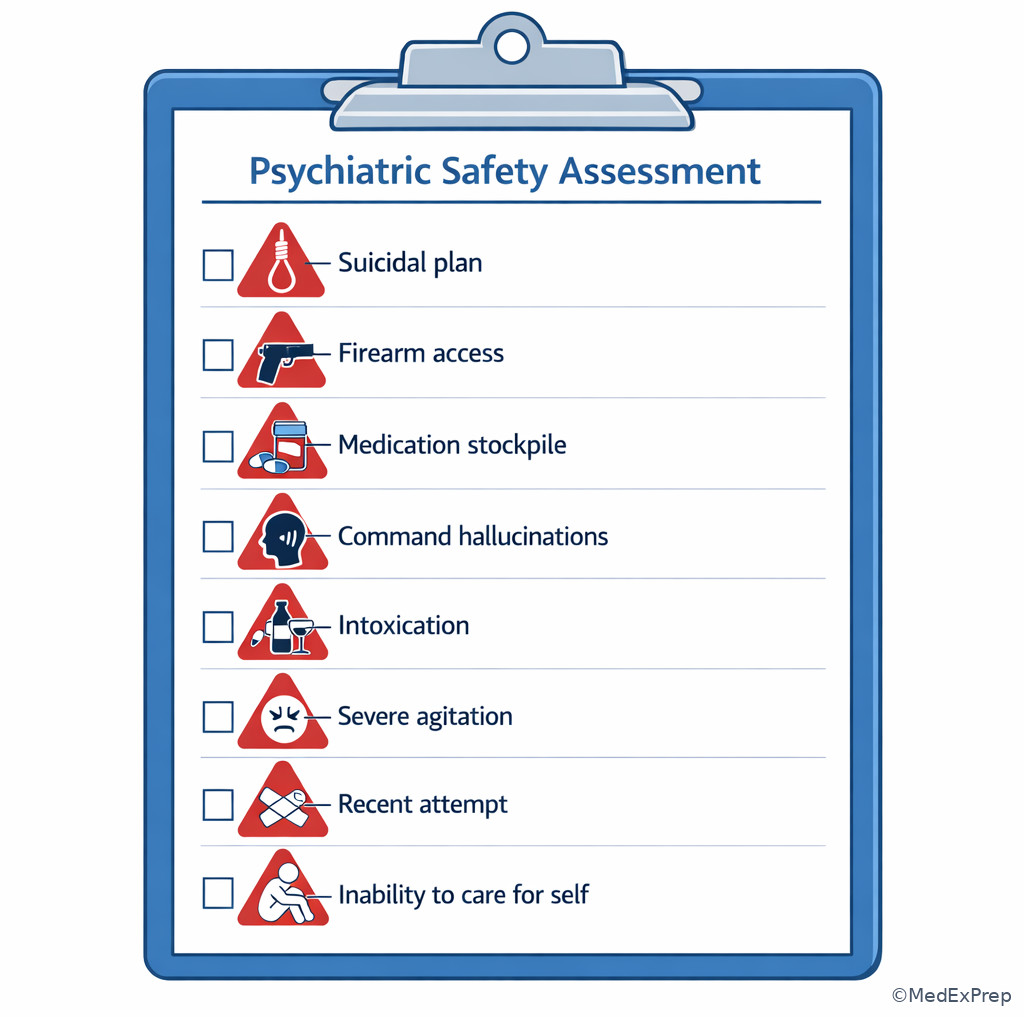
The next conflict is rapport-building versus immediate safety clarification. On exams, safety wins. If the stem suggests suicidal thoughts, homicidal ideation, command hallucinations, recent self-harm, severe agitation, inability to care for self, or psychosis with impaired reality testing, the most appropriate next step is a focused safety history and urgent disposition assessment.
The single rule that resolves many stems is this: passive distress is not the same as active, imminent risk. You must ask about ideation, intent, plan, means, timing, prior attempts, preparatory behaviors, protective factors, and whether the patient can engage in a safe plan. For homicidality, ask target, intent, access, and immediacy. For psychosis, ask whether hallucinations are commanding action and whether delusions impair judgment. Reject the mistake of treating every suicidal statement as equivalent, but do not minimize direct self-harm clues.
WHY THIS IS TESTED: Psychiatry exam items often ask for the one detail that changes outpatient management to emergency evaluation. The difference is usually not diagnosis; it is risk acuity. “I wish I would not wake up” is different from “I bought pills yesterday and plan to take them tonight.”
See Fig 3 for a compact risk structure you can apply under time pressure.
Exam takeaway: Intent, plan, means, and recent preparatory behavior are the details that most often convert outpatient care to emergency escalation.
flowchart TD
A[Suicidal thought present] --> B{Passive only or active?}
B -->|Passive| C[Clarify frequency, hopelessness, supports, prior attempts]
B -->|Active| D[Ask intent, plan, means, timing]
D --> E{Plan and means available?}
E -->|Yes| F[Emergency evaluation / higher level of care]
E -->|No| G[Assess prior attempts, intoxication, psychosis, ability to contract for safety]
C --> H[Risk stratify and plan close follow-up] Exam takeaway: Visual recognition of plan, means, intent, psychosis, and intoxication helps you identify when disposition becomes urgent.
B Worked example
A 47-year-old man with chronic back pain, alcohol use disorder, and recent divorce presents to clinic for insomnia. He says, “Sometimes everyone would be better off without me.” He denies chest pain, has mildly elevated BP, and smells of alcohol. He laughs and says he was “just venting,” but his sister reports he gave away tools this morning and asked where she keeps her firearm key.
Identify task: determine the safest next step in the history and disposition. Extract key facts: hopeless statement, alcohol use, collateral evidence of preparatory behavior, possible firearm access. Apply rule: collateral information and preparatory actions greatly increase concern, even if the patient downplays symptoms. Eliminate distractors: discussing sleep hygiene or starting trazodone is tempting because insomnia is the stated reason for visit, but those steps ignore imminent safety risk. Verify: the interview must pivot to direct suicide-risk clarification and urgent escalation for emergency evaluation.
C Exam trap
D Checkpoint
Question: A 29-year-old woman with depression and migraine presents after saying, “I wish I could disappear.” She denies plan, denies access to firearms, lives with supportive parents, and requests help because she is afraid of “getting worse.” Which additional history element most strongly increases concern for urgent escalation?
- Past suicide attempt requiring medical treatment
- Family history of panic disorder
- Preference for sleeping during the day
- History of seasonal allergies
- A: Correct because prior attempt is a major risk amplifier even when current language sounds less organized.
- B: Tempting because family psychiatric history matters, but it does not acutely raise suicide risk the way prior attempt does.
- C: Tempting because circadian disruption can worsen mood, but it is not the strongest immediate danger clue.
- D: Wrong because it does not meaningfully affect suicide-risk stratification.
- The history detail that most often forces urgent escalation is active suicidal ideation with plan and means.
- True or False: A patient’s denial always outweighs collateral information in suicide assessment. False.
- Name 3 risk escalators: prior attempt, intoxication, command hallucinations.
1.1.1.5 Timeline, symptom clusters, and episode framing
A Explanation
Once immediate danger is addressed, the major exam conflict becomes symptom list versus episode structure. The student who memorizes diagnoses without building a timeline gets trapped. Ask not just what symptoms are present, but when they started, whether they were abrupt or gradual, whether they come in episodes, what triggered them, and what the patient is like between episodes.
The single rule: course narrows the field faster than isolated symptoms. Depressive symptoms for 2 weeks suggest a major depressive episode if other criteria fit. Panic symptoms peaking within minutes suggest panic attacks. Brief psychosis after a stressor has a different frame than chronic psychotic symptoms. Mood symptoms that alternate with periods of elevated energy and reduced need for sleep suggest bipolar-spectrum illness. Symptoms that occur only during intoxication or withdrawal point away from a primary psychiatric disorder.
WHY THIS IS TESTED: Examiners often provide overlapping symptoms across anxiety, mood, psychosis, and substance-related categories. Duration, onset, and recovery pattern are the one or two clues that separate correct from best distractor.
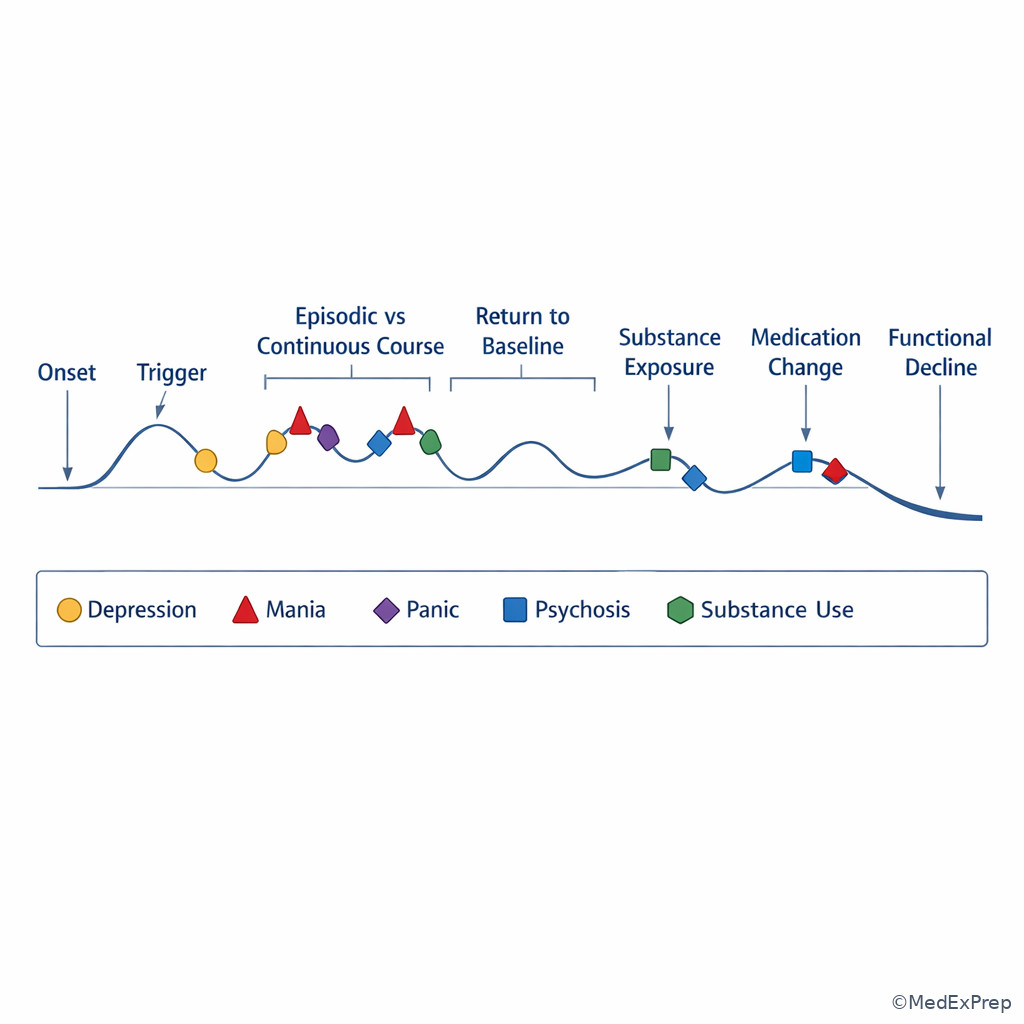
Do not ask only “How severe?” Ask “What was the very first change? What happened just before it began? Has this happened before? How long did it last? What returned to baseline?” These questions convert vague complaints into syndromic data. See Fig 4 for a timeline comparison.
Exam takeaway: Duration and relation to substances or stressors often separate diagnoses that otherwise share the same symptoms.
flowchart LR
A[Minutes] --> B[Panic attack or intoxication effect]
C[Days] --> D[Withdrawal, mania, brief reactive states]
E[Weeks] --> F[Major depressive episode, acute stress patterns]
G[Months] --> H[Persistent anxiety, chronic psychosis, personality patterns]
I[Only around use or stopping use] --> J[Substance-induced frame]
K[Fluctuating attention] --> L[Think delirium, not primary psychiatric illness]
Exam takeaway: A visual timeline helps you connect onset, triggers, and return to baseline when stems include overlapping symptoms.
B Worked example
A 38-year-old man with obesity and chronic insomnia reports “panic attacks.” He describes 10-minute surges of palpitations, dyspnea, trembling, and fear of dying that peak rapidly and then resolve. He also drinks pre-workout stimulant supplements and 5 cups of coffee daily. The stem asks for the most useful history detail to distinguish panic disorder from substance effect.
Identify task: distinguish two close possibilities. Extract key facts: episodes peak within minutes, but heavy stimulant intake could mimic panic symptoms. Apply rule: ask whether episodes occur only after stimulant use or also unexpectedly at other times, and ask about anticipatory anxiety/avoidance. Eliminate distractors: asking about sleep apnea is reasonable given obesity, but it does not directly separate panic disorder from caffeine-related symptoms in this stem. Verify: the key history is temporal relation to stimulant use versus spontaneous recurrent attacks.
C Exam trap
D Checkpoint
Question: A 26-year-old woman presents with depressed mood, poor appetite, and low energy for 3 weeks after a breakup. She has no prior episodes, no psychosis, no substance use, and continues working full time. Which history element is most useful to clarify next?
- Whether she has ever had periods of elevated mood with decreased need for sleep
- Whether she has a history of eczema
- Whether she prefers exercising in the morning
- Whether she had tonsillectomy as a child
- A: Correct because every depressive presentation should be screened for bipolar-spectrum history before assigning unipolar depression treatment.
- B: Tempting because chronic illness can affect mood, but it does not narrow the psychiatric syndrome as efficiently.
- C: Tempting because routine and activation matter in treatment, but it is not the key diagnostic clarifier.
- D: Wrong because it adds no useful psychiatric discrimination.
1.1.1.6 Past psychiatric, medication, substance, and medical history: the hidden diagnosis changers
A Explanation
This section tests a classic board conflict: Do you trust the current symptom description alone, or do you check the background domains that can completely reframe the case? The answer is to check them. Past psychiatric history, medication history, substance use, and medical history are where many stems hide the discriminator.
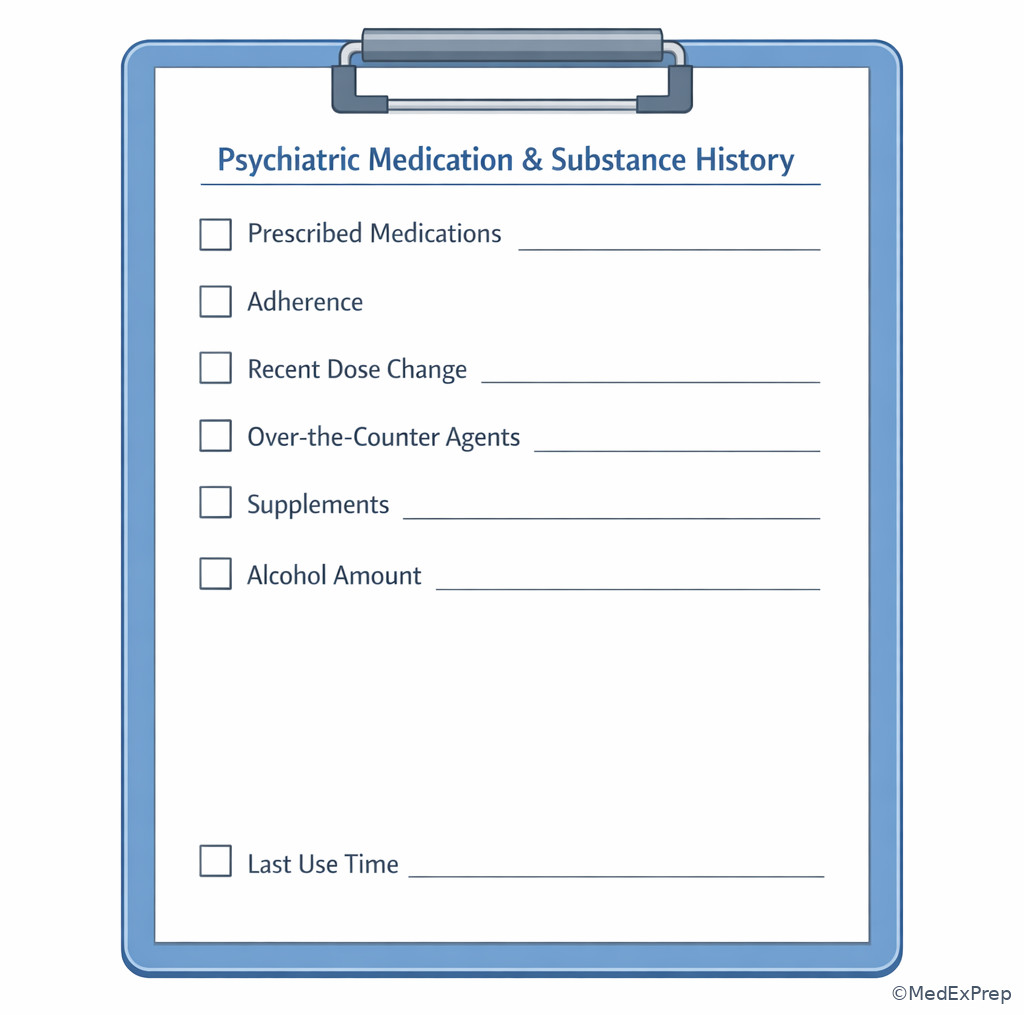
The single rule: new psychiatric symptoms are never interpreted in isolation from exposures. Past psychiatric history tells you recurrence, severity, prior response, and prior dangerous behavior. Medication history tells you whether symptoms could be adverse effects, withdrawal, nonadherence, or activation. Substance history requires amount, frequency, route, and last use—not just “yes/no.” Medical history identifies endocrine disease, seizure disorder, infection, chronic pain, neurologic disease, pregnancy/postpartum context, and sleep disorders that alter interpretation.
WHY THIS IS TESTED: Questions often present a symptom cluster that fits a primary psychiatric disorder but include one reorienting clue—steroid use, recent SSRI initiation, abrupt benzodiazepine discontinuation, heavy alcohol cessation, thyroid symptoms, or fluctuating attention. Learners who skip exposure history overdiagnose primary psychiatric illness.
See Fig 5 for an exposure-first comparison. This topic also sets up the next lesson on differential building.
Exam takeaway: Medication changes, substance timing, and medical red flags must be ruled in or out before you assume a primary psychiatric disorder.
flowchart TD
A[Psychiatric symptom] --> B{Recent medication change?}
B -->|Yes| C[Consider activation, withdrawal, adverse effect]
B -->|No| D{Recent substance use or cessation?}
D -->|Yes| E[Intoxication or withdrawal frame]
D -->|No| F{Medical red flags?}
F -->|Yes| G[Delirium / endocrine / neurologic / infection]
F -->|No| H[Primary psychiatric disorder more likely] Exam takeaway: The most testable exposure details are recent start/stop, dose change, amount used, and last use time.
Exam takeaway: Red-flag medical features such as fluctuating attention, fever, tremor, and focal deficits should redirect your history and workup.
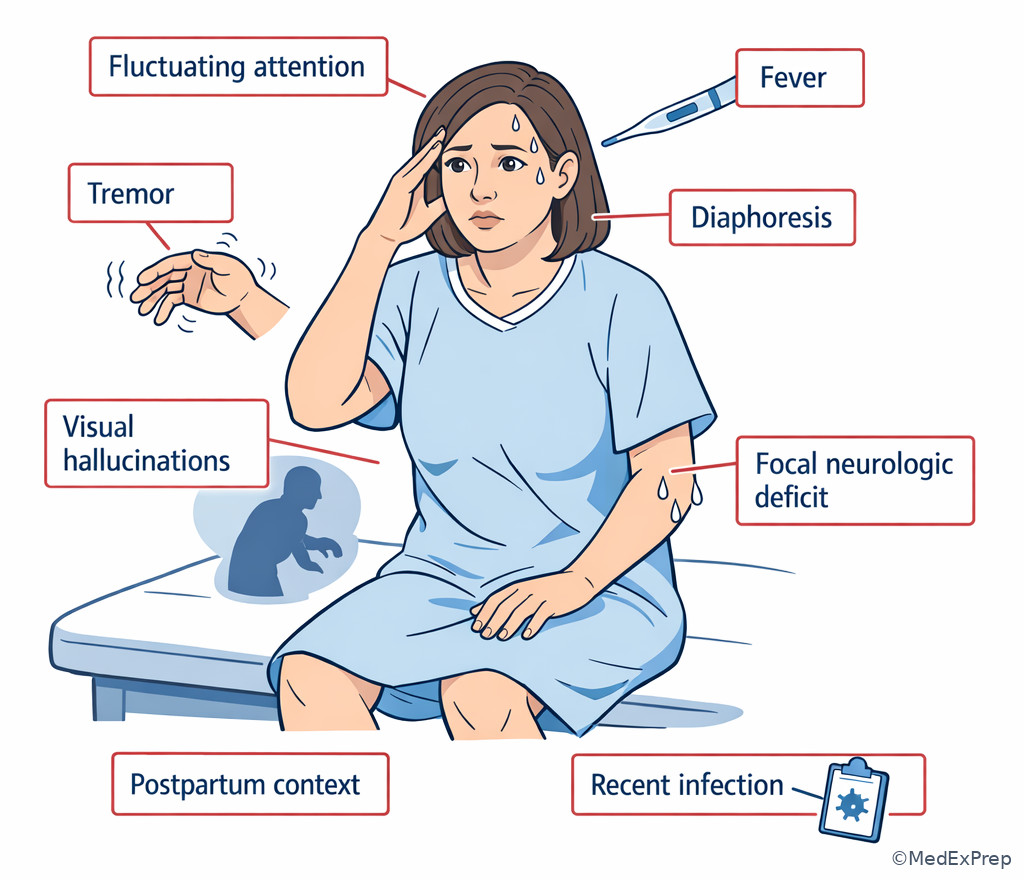
B Worked example
A 64-year-old woman presents with new anxiety, insomnia, and irritability. She has COPD, rheumatoid arthritis, and recent bronchitis. Her daughter says the symptoms began 4 days ago. The patient denies substance use. Exam shows mild tremor and pressured speech. The stem includes that she completed a “respiratory medication pack” last week and asks for the most important additional history detail.
Identify task: the vignette asks for the clue that reframes diagnosis. Extract key facts: abrupt onset, older adult, tremor, pressured speech, recent medication pack. Apply rule: recent corticosteroid exposure can provoke mood and psychotic symptoms; medication history beats immediate primary bipolar labeling in this context. Eliminate distractors: family history of bipolar disorder is tempting because of pressured speech, but the abrupt onset after a medication course is a stronger discriminator. Verify: ask specifically whether she recently took prednisone or another systemic steroid and when symptoms began relative to that medication.
C Exam trap
D Checkpoint
Question: A 35-year-old man presents with tremor, anxiety, insomnia, and vivid visual phenomena 2 days after stopping heavy nightly drinking. He has GERD and psoriasis. Which history element is most important to establish next?
- His exact alcohol amount and time of last drink
- Whether he had childhood ADHD
- Whether his father had OCD
- Whether he prefers red or white wine
- A: Correct because amount used and last drink timing are the key details for identifying alcohol withdrawal risk and severity.
- B: Tempting because childhood psychiatric history matters, but it does not explain the acute autonomic symptoms and timing.
- C: Tempting because family history can guide vulnerability, but it is not the urgent discriminator.
- D: Wrong because beverage preference does not replace quantitative exposure history.
- The most important substance-use details are what, how much, how often, and last use.
- True or False: A yes/no substance question is enough for exam-quality history taking. False.
- Name 3 background domains that can overturn the diagnosis: medications, substances, medical illness.
1.1.1.7 Family, social, trauma, and functional history: how context changes interpretation and disposition
A Explanation
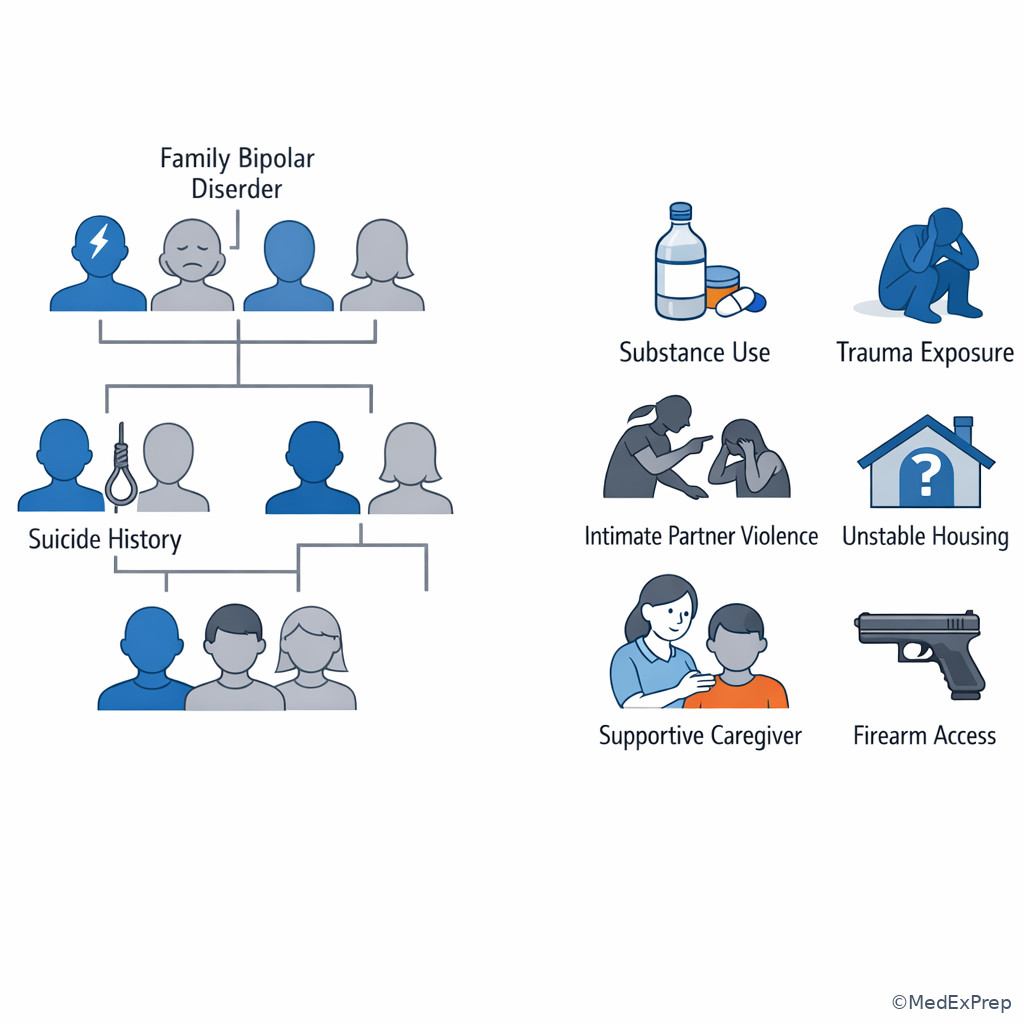
The final major conflict is symptoms alone versus symptoms in context. Family history, social history, trauma history, and functional history do not merely decorate the interview; they determine plausibility, risk, and disposition. A patient with panic symptoms who has stopped leaving home is a different management problem from a patient with brief panic symptoms who is fully functioning. A patient with depression and a strong family bipolar history deserves more caution before assuming unipolar disease. A patient with trauma-related symptoms requires careful sequencing around triggers, avoidance, hyperarousal, and intrusive symptoms.
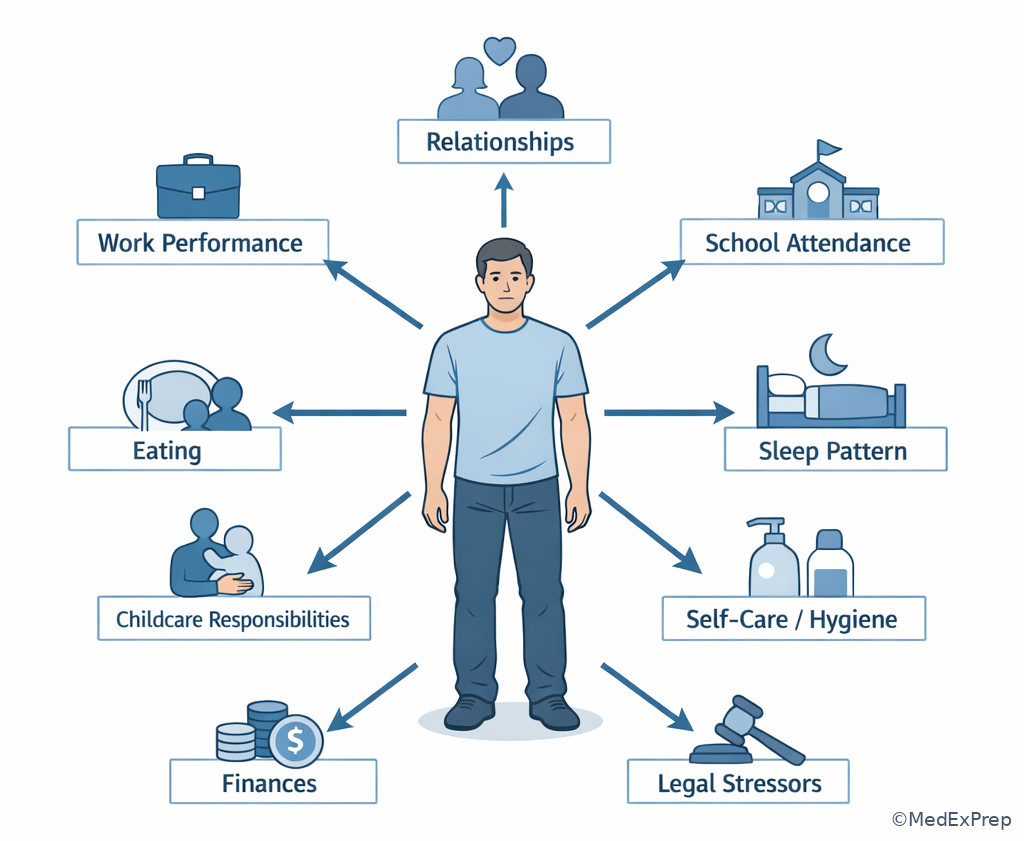
The single resolving rule: context tells you severity, vulnerability, and next step. Social history includes housing, employment/school, relationships, caregiving burden, legal stressors, access to weapons, and support system. Functional history asks what the patient can no longer do. Trauma history should be relevant and purposeful, not indiscriminate; ask enough to identify exposure and symptom linkage without forcing unnecessary detail in unstable settings.
WHY THIS IS TESTED: On board exams, the best answer often depends on disposition. Function and supports determine whether outpatient follow-up is reasonable or whether escalation is safer. Family history is often the clue that nudges a mood differential toward bipolar risk. Trauma and developmental context help prevent mislabeling hypervigilance, dissociation, or behavioral disturbance.
See Fig 6 for a context-based disposition visual.
Exam takeaway: Functional decline, lack of supports, trauma context, and access to lethal means can matter as much as the symptom label itself.
flowchart TD
A[Psychiatric symptoms identified] --> B[Assess function: work, school, sleep, ADLs]
B --> C{Major impairment?}
C -->|Yes| D[Higher concern; reassess safety and supports]
C -->|No| E[Likely outpatient if no red flags]
A --> F[Assess supports, housing, and access to means]
F --> G{Reliable support and safe setting?}
G -->|No| D
G -->|Yes| E Exam takeaway: Work, school, sleep, self-care, and relationships are the high-yield function areas that determine severity.
Exam takeaway: Family bipolar history, suicide history, trauma exposure, and limited supports are classic hidden clues in psychiatry stems.
B Worked example
A 19-year-old college student presents with worsening anxiety, insomnia, and poor concentration. She has type 1 diabetes and a history of childhood bullying. She reports missing classes for 3 weeks, avoiding the dining hall, and staying in bed all day. She denies suicidal ideation and says she “just needs something for nerves.” Her mother has bipolar I disorder, and her roommate reports the patient has been alternating between tearfulness and nights of near-total sleeplessness with online shopping sprees.
Identify task: decide which contextual history details matter most before routine treatment. Extract key facts: functional collapse, family bipolar history, possible episodic elevated behavior, social withdrawal. Apply rule: family history and loss of function change interpretation and urgency. Eliminate distractors: prescribing an anxiolytic immediately is tempting because anxiety is the presenting complaint, but the context raises concern for mood disorder and unsafe outpatient simplification. Verify: the next history step should clarify manic/hypomanic symptoms, duration, and current safety while assessing whether she can function safely in her current setting.
C Exam trap
D Checkpoint
Question: A 42-year-old woman presents with worsening depression after job loss. She has hypothyroidism and chronic low back pain. She denies suicidal plan, but has stopped bathing, has not worked for a month, and lives alone with no nearby supports. Which history element most strongly affects disposition?
- Whether she prefers evenings to mornings
- Whether she has access to transportation
- Degree of functional impairment and ability to care for herself at home
- Whether she has seasonal pollen allergies
- A: Tempting because sleep-wake preference may relate to mood, but it does not determine safety or level of care here.
- B: Plausible because transportation influences follow-up, but it is secondary to the question of self-care and grave disability.
- C: Correct because severe self-neglect and inability to manage basic needs can require escalation even without a stated suicide plan.
- D: Wrong because it does not change psychiatric disposition.
Exam Traps & Differentiators
Most common wrong answer and why: Labeling the complaint exactly as the patient names it—“depression,” “anxiety,” “panic,” or “stress”—without first checking safety, mania, substances, medications, and medical contributors. This is tempting because the chief concern is easy to anchor on. The exam punishes premature closure.
| Looks similar | Tempting shared features | Single discriminating history clue | Think instead |
|---|---|---|---|
| Anxiety vs hypomania/mania | Insomnia, agitation, racing thoughts | Decreased need for sleep with elevated energy or risky behavior | Bipolar-spectrum screen required |
| Panic disorder vs stimulant effect | Palpitations, tremor, fear, sweating | Symptoms occur only after caffeine/stimulant use | Substance-related cause |
| Primary psychosis vs delirium | Hallucinations, confusion, agitation | Fluctuating attention and acute medical context | Medical mimic workup |
| Major depression vs bipolar depression | Low mood, anhedonia, impaired function | Prior episodes of elevated mood/decreased need for sleep | Bipolar-spectrum illness |
| Adjustment symptoms vs major syndrome | Stress-linked sadness or anxiety | Severity, duration, and functional collapse exceed expected stress response | More than situational distress |
| Passive suicidal thoughts vs imminent suicide risk | Hopeless statements | Intent, plan, means, preparatory behavior | Emergency risk escalation |
- If the stem says “depression,” think “Have I ruled out past mania or hypomania?”
- If the stem says “anxiety with palpitations,” think “What is the caffeine, stimulant, thyroid, or withdrawal history?”
- If the stem says “hearing voices,” think “Is attention fluctuating, and is there a medical or substance trigger?”
- If the stem says “I don’t want to wake up,” think “Need intent, plan, means, prior attempts, and collateral.”
- If the stem says “stress after a life event,” think “What is the time course and degree of impairment?”
- If the stem says “new psychiatric symptoms in an older adult,” think “Medication, delirium, neurologic, endocrine, infection.”
| History element | Commonly tested trap from nearby topics | How to avoid it now |
|---|---|---|
| Current symptoms only | Later confusion with Mental Status Examination findings | Remember: \(history = timeline/context\); \(MSE = present observed state\) |
| No timeline | Later failure in Psychiatric Differential Building | Always ask onset, duration, episodic pattern, baseline |
| No safety screen | Later errors in Suicide Risk Assessment | Pivot early when ideation, psychosis, or severe agitation appears |
| No substance details | Later confusion with intoxication/withdrawal syndromes | Ask what, how much, how often, last use |
Tables
| Summary table: must-not-miss history questions | Why it matters |
|---|---|
| “Any thoughts of harming yourself or others?” | Immediate safety stratification |
| “Any periods of decreased need for sleep with high energy?” | Bipolar-spectrum screen in mood complaints |
| “What substances do you use, how much, and when was last use?” | Intoxication/withdrawal timing |
| “Any new medications, dose changes, or missed doses?” | Adverse effect, activation, withdrawal, nonadherence |
| “How has this affected work, school, sleep, or self-care?” | Severity and disposition |
| “Has this happened before, and what helped?” | Recurrence and prior response |
| “Anyone in the family with bipolar disorder, psychosis, substance use, or suicide?” | Inherited vulnerability and diagnostic weighting |
| Comparison table | History pattern | Best next focus |
|---|---|---|
| Primary anxiety complaint | Persistent worry, autonomic symptoms, insomnia | Substances, thyroid/medical triggers, panic timing |
| Primary depressive complaint | Low mood, anhedonia, fatigue, guilt | Mania/hypomania history, suicidality, function |
| Primary psychosis complaint | Hallucinations, delusions, disorganization | Medical mimic and substance screen, collateral, safety |
| Primary insomnia complaint | Sleep reduction, irritability, concentration problems | Mania, substances, sleep schedule, withdrawal |
| Primary agitation complaint | Restlessness, pacing, aggression risk | Intoxication, withdrawal, psychosis, delirium, means access |
| Differential/classification table | History clue | Most likely frame | Initial implication |
|---|---|---|---|
| Symptoms tied to recent cocaine use | Clear temporal relation to use | Substance-induced | Treat intoxication/safety first |
| Fluctuating attention with confusion | Acute onset, waxing/waning course | Delirium/medical mimic | Medical evaluation urgently |
| Low mood plus prior reduced-sleep high-energy episodes | Episodic mood polarity | Bipolar-spectrum | Avoid premature unipolar framing |
| Panic symptoms only after energy supplements | Exposure-linked episodes | Substance effect | Clarify use; reduce/stop exposure |
| Hopelessness with plan and stockpiled pills | Preparatory behavior | High acute suicide risk | Escalate disposition |
| Stress-linked sadness with preserved function | Milder impairment | Lower-acuity adjustment-type frame | Outpatient support if safe |
Algorithm / Approach
Rapid Review
- Chief complaint → patient’s label is a starting point, not the diagnosis
- Mood complaint → always screen for reduced need for sleep and elevated energy
- Suicidal statement → intent/plan/means discriminate urgency
- Psychosis in older adult → medical or substance cause first until excluded
- Panic-like episodes → temporal link to stimulant use separates substance effect
- Acute confusion with psychiatric symptoms → fluctuating attention points to delirium
- Past psychiatric hospitalization → severity marker, not background trivia
- Prior suicide attempt → stronger risk signal than vague current reassurance
- Medication “pack” or dose change → possible adverse effect or activation clue
- Substance history → ask amount and last use, not just yes/no
- Family bipolar history → raises caution in depressive presentations
- Functional decline → often determines disposition more than symptom name
- Collateral history → essential when reliability is poor or risk is high
- Trauma history → ask purposefully to link exposure with current symptoms
Self-check quiz
1. A 24-year-old woman presents with low mood, fatigue, and poor concentration for 1 month after moving for graduate school. She has asthma and iron deficiency and denies substance use. Before diagnosing unipolar depression, which additional history question is most important?
- Whether she has ever had periods of decreased need for sleep with increased energy
- Whether she had chickenpox as a child
- Whether she prefers to study at night
- Whether her roommate snores
2. A 31-year-old man presents for anxiety and insomnia. He has obesity and GERD and drinks multiple energy drinks daily. Which substance-history detail is most necessary to clarify first?
- His favorite energy-drink brand
- The amount used and timing of last use
- Whether he drinks from a can or bottle
- Whether his coworkers also use caffeine
3. A 52-year-old man with depression, alcohol use disorder, and chronic knee pain says, “My family would be better off if I were gone.” He smells of alcohol and initially laughs it off. His wife reports he organized his life insurance papers and hid pills in the bathroom. What is the most appropriate next step?
- Begin outpatient SSRI therapy and routine follow-up in 4 weeks
- Perform immediate focused suicide-risk assessment and arrange urgent emergency evaluation
- Recommend sleep hygiene and ask him to reduce caffeine
- Delay further action until he is fully sober at home
4. A 67-year-old woman with COPD, rheumatoid arthritis, and hypertension develops insomnia, irritability, tremor, and pressured speech over 3 days. She completed treatment for a COPD flare 1 week ago. What history clarification is most likely to change the diagnosis?
- Whether she recently used systemic corticosteroids
- Whether she had adolescent separation anxiety
- Whether her husband snores
- Whether she prefers reading before bed
5. A 28-year-old woman has recurrent episodes of chest tightness, tremor, and fear lasting about 10 minutes. She has PCOS and migraine and takes no daily psychiatric medication. She uses pre-workout supplements and 5 cups of coffee on exercise days. Which history question best distinguishes panic disorder from stimulant-related symptoms?
- Whether the episodes occur unexpectedly when she has not used stimulants
- Whether she had recurrent ear infections in childhood
- Whether she prefers indoor exercise
- Whether her mother has osteoarthritis
6. A 40-year-old man with type 2 diabetes and chronic insomnia presents with “anxiety,” distractibility, and reduced sleep for 6 days. He reports high work stress and 2 cups of coffee daily. His wife says he has been euphoric, talking rapidly, and spending large amounts online, but he insists he is “finally productive.” Which additional history detail most strongly supports a bipolar-spectrum episode rather than situational anxiety?
- He feels tired during the day because he is sleeping less
- He has decreased need for sleep without feeling fatigued
- He worries about finances after overspending
- He has had occasional headaches this week
7. A 74-year-old woman with hypertension and osteoarthritis is brought by family for new visual hallucinations and agitation over 1 day. She had a UTI last week and appears distractible during the interview. Family asks whether this is schizophrenia. Which history feature most strongly requires medical evaluation before assigning a primary psychiatric diagnosis?
- Remote history of bereavement
- Acute onset with fluctuating attention
- Family history of depression
- Poor sleep for 2 nights
8. A 34-year-old woman with hypothyroidism and recent divorce presents with depressed mood. She denies active suicidal plan, but has stopped going to work, is not bathing, eats little, and lives alone. Her sister lives out of state. Which factor most strongly pushes disposition toward urgent escalation rather than routine outpatient follow-up?
- Major functional impairment with poor ability to care for herself
- History of seasonal mood worsening
- Preference for staying in bed during the day
- Remote family history of alcohol use disorder
Answer key
1. Correct answer: A
The mechanism-based reasoning is that a depressive presentation must be screened for past mania or hypomania because bipolar-spectrum illness can first appear as depression, and missing that history leads to unsafe premature unipolar framing. This question tests the rule from 1.1.1.1 and 1.1.1.3 that symptom clusters require timeline and polarity clarification before diagnosis. Source support: American Psychiatric Association diagnostic framework; First Aid emphasizes bipolar screening in depressive complaints.
- A: Tempting because it directly targets a high-yield hidden diagnosis; it is correct because prior reduced-sleep high-energy episodes are the single best discriminator. Stem clue: depressed mood without prior polarity clarification.
- B: Tempting only because childhood medical history can matter broadly; it is incorrect because it does not narrow the psychiatric differential in this scenario. Stem clue: no infectious or neurologic question is being tested.
- C: Tempting because sleep schedule can affect mood; it is incorrect because study preference does not identify bipolar-spectrum illness. Stem clue: diagnostic clarification, not habit counseling, is needed.
- D: Tempting because sleep problems can worsen mood; it is incorrect because roommate snoring is not the central hidden diagnosis changer in a depression stem. Stem clue: the exam wants a mania screen.
2. Correct answer: B
The mechanism-based reasoning is that stimulant-related anxiety depends on exposure magnitude and timing. A yes/no caffeine history is inadequate; the diagnostic value comes from quantity and relation of symptoms to last use. Source support: Harrison’s and general psychiatry texts emphasize timing and amount in substance-induced symptom assessment.
- A: Tempting because brand may imply caffeine content; it is incorrect because the clinically necessary detail is total amount and last use timing, not branding. Stem clue: energy drinks daily with insomnia.
- B: Tempting because it sounds more detailed than the others; it is correct because quantity and last use are the core discriminators for stimulant-related symptoms. Stem clue: multiple energy drinks daily.
- C: Tempting because container size could loosely affect amount; it is incorrect because it is an indirect, inferior substitute for direct quantitative history. Stem clue: precise exposure details are needed.
- D: Tempting because social normalization can minimize concern; it is incorrect because peers’ behavior does not diagnose this patient’s symptoms. Stem clue: patient-specific exposure timing matters.
3. Correct answer: B
The mechanism-based reasoning is that suicidal risk escalates sharply with preparatory behavior, possible means, alcohol use, and collateral confirmation even when the patient minimizes symptoms. The safest next step is immediate focused risk assessment and urgent emergency evaluation, not routine outpatient management. Source support: APA suicide risk principles and emergency psychiatry recommendations.
- A: Tempting because depression treatment is ultimately needed; it is incorrect because SSRI initiation does not address acute safety. Stem clue: hidden pills and organized papers indicate preparation.
- B: Tempting because it sounds intensive; it is correct because the combination of suicidal statement, alcohol use, and preparatory behavior requires urgent escalation. Stem clue: life insurance papers and hidden pills.
- C: Tempting because insomnia and alcohol can worsen mood; it is incorrect because lifestyle advice is unsafe in a high-risk situation. Stem clue: risk acuity overwhelms routine symptom counseling.
- D: Tempting because intoxication complicates evaluation; it is incorrect because intoxication is a risk amplifier, not a reason to defer action to an unsupervised home setting. Stem clue: current alcohol use plus suicidality.
4. Correct answer: A
The mechanism-based reasoning is that abrupt behavioral activation, irritability, tremor, and pressured speech after treatment for a COPD flare strongly suggest medication-induced symptoms, especially corticosteroid-associated mood activation. Source support: standard psychopharmacology references and Harrison’s discussion of medication-induced psychiatric symptoms.
- A: Tempting because it links directly to the recent flare treatment; it is correct because systemic steroids can provoke mood and psychotic symptoms within days. Stem clue: completed treatment for COPD flare 1 week ago.
- B: Tempting because developmental psychiatric history can matter; it is incorrect because remote adolescent anxiety does not explain abrupt late-life change after treatment exposure. Stem clue: acute onset in older adult.
- C: Tempting because sleep disruption can cause irritability; it is incorrect because spouse snoring does not explain pressured speech and tremor after recent medical treatment. Stem clue: medication timing is stronger.
- D: Tempting because bedtime habits affect sleep; it is incorrect because it misses the likely exposure-related syndrome. Stem clue: abrupt onset post-treatment.
5. Correct answer: A
The mechanism-based reasoning is that recurrent panic-like episodes may reflect either a primary panic disorder or stimulant-induced autonomic surges. The key discriminator is whether episodes occur unexpectedly independent of stimulant exposure. Source support: DSM-based panic disorder framework and substance-induced symptom assessment principles.
- A: Tempting because it directly compares spontaneous versus exposure-linked episodes; it is correct because unexpected attacks away from stimulant use favor panic disorder. Stem clue: heavy pre-workout and caffeine use.
- B: Tempting only because childhood history is sometimes relevant; it is incorrect because ear infections do not distinguish panic from stimulant effect. Stem clue: current episodic autonomic symptoms need timing clarification.
- C: Tempting because environmental exercise preferences can influence triggers; it is incorrect because it is not the key psychiatric discriminator. Stem clue: relation to stimulant use matters most.
- D: Tempting because family history can influence psychiatric risk; it is incorrect because osteoarthritis is unrelated to this differential. Stem clue: same-category distractor quality favors exposure questions, not general family medical history.
6. Correct answer: B
The mechanism-based reasoning is that anxiety-related insomnia usually produces fatigue, whereas mania/hypomania classically features decreased need for sleep without feeling tired, along with euphoric or expansive mood and risky behavior. Source support: APA bipolar disorder criteria and First Aid summary points.
- A: Tempting because reduced sleep is present; it is incorrect because daytime tiredness fits ordinary insomnia or anxiety more than mania. Stem clue: the question asks what supports bipolar-spectrum illness.
- B: Tempting because it is a classic buzz phrase; it is correct because lack of fatigue despite markedly reduced sleep is the key discriminator. Stem clue: euphoric, rapid speech, overspending.
- C: Tempting because financial worry follows impulsive spending; it is incorrect because remorse can occur in many states and is less specific than decreased need for sleep. Stem clue: specificity matters.
- D: Tempting because headaches can accompany sleep loss; it is incorrect because it does not distinguish anxiety from mania. Stem clue: close-call distractors are separated by one classic bipolar feature.
7. Correct answer: B
The mechanism-based reasoning is that acute onset visual hallucinations with fluctuating attention in an older adult after recent infection are classic red flags for delirium, a medical syndrome, not a primary psychotic disorder. Source support: Harrison’s and standard delirium guidelines emphasizing acute fluctuating attention disturbance.
- A: Tempting because bereavement can alter mood and sleep; it is incorrect because it does not explain abrupt hallucinations with distractibility. Stem clue: the presentation is acute and fluctuating.
- B: Tempting because it sounds like a medical clue; it is correct because acute onset with waxing/waning attention is the single key discriminator for delirium. Stem clue: 1 day of symptoms with distractibility.
- C: Tempting because family psychiatric history matters in psychotic differentials; it is incorrect because it is weaker than the immediate delirium pattern. Stem clue: acute medical context outweighs inherited risk.
- D: Tempting because sleep deprivation can worsen perception; it is incorrect because two nights of poor sleep do not by themselves explain fluctuating attention after a recent infection. Stem clue: distractibility is more discriminating.
8. Correct answer: A
The mechanism-based reasoning is that severe functional collapse and inability to perform basic self-care can indicate grave disability and unsafe outpatient management even without an articulated suicide plan. Source support: emergency psychiatry disposition principles and standard safety-first teaching.
- A: Tempting because it sounds broad; it is correct because inability to bathe, eat, work, and maintain self-care while living alone directly affects safe disposition. Stem clue: self-neglect and no local supports.
- B: Tempting because seasonal patterns can matter diagnostically; it is incorrect because it does not determine urgent level of care in this stem. Stem clue: current functional status is more important than specifier details.
- C: Tempting because staying in bed reflects depression severity; it is incorrect because the broader functional collapse and self-care failure are the real disposition drivers. Stem clue: multiple ADL failures.
- D: Tempting because family substance history can increase psychiatric burden; it is incorrect because it is not the acute determinant of safety. Stem clue: the question asks what pushes disposition.
Keep going with the full EOR Psychiatry Prep Course (EOR Psych)
You just studied the way members do, in the same lesson interface. Full access unlocks every lesson, the question bank and flashcards for a full year.
One payment · 1 year of access · No auto-renewal