1.1.1 - Diagnostic Terminology Standards
Diagnostic Terminology Standards
What you’ll learn
- Domain: Diagnosis → Pulpal/apical terminology → apply standard pulpal and apical diagnostic terms in board-style cases.
- Domain: Diagnosis → Test interpretation → separate a diagnosis label from the test finding that supports it.
- Domain: Clinical decision-making → Documentation → choose wording that is precise, defensible, and useful for treatment planning.
- Domain: Prognosis/treatment planning → Diagnostic synthesis → distinguish when terminology describes current disease versus prior treatment status.
- Domain: Scope-aware endodontic reasoning → Referral recognition → recognize when symptoms exceed endodontic terminology alone and require broader differential diagnosis or referral.
- Diagnosis → pulpal diagnosis terminology → specialist use of accepted labels
- Diagnosis → apical diagnosis terminology → correlation with history, testing, and imaging
- Treatment planning → diagnostic synthesis → choosing action after terminology assignment
- Documentation → standardized charting language → communication across providers
Why it matters
- Board questions often make two options sound plausible; the correct choice turns on whether you know the exact accepted diagnostic term, not just the general disease idea.
- Standard terminology prevents a common specialist error: confusing a test response with a diagnosis, or confusing treatment history with active pathology.
- Accurate labels drive treatment planning, prognosis communication, referral timing, and defensible documentation.
- Diagnostic terminology is the language that connects history, testing, imaging, and treatment; if the label is wrong, the next step is usually wrong.
Key Terms & Must-Know Facts
1.1.1.1 Key terms
- Normal pulp
- Reversible pulpitis
- Symptomatic irreversible pulpitis
- Asymptomatic irreversible pulpitis
- Pulp necrosis
- Previously treated
- Previously initiated therapy
- Normal apical tissues
- Symptomatic apical periodontitis
- Asymptomatic apical periodontitis
- Acute apical abscess
- Chronic apical abscess
- Condensing osteitis
- Clinical correlation
- Diagnostic synthesis
1.1.1.2 Must-know facts
- A pulpal diagnosis and an apical diagnosis are assigned separately for the same tooth.
- “Irreversible pulpitis” is not complete enough on boards unless qualified as symptomatic or asymptomatic when indicated.
- “Previously treated” and “previously initiated therapy” describe treatment status, not pulpal vitality.
- Pulp sensibility tests assess neural response, not direct vascular vitality.
- Normal apical tissues can coexist with symptomatic pulpal disease.
- Symptomatic apical periodontitis can occur with or without radiographic rarefaction.
- Acute apical abscess implies rapid onset, pain, and pus formation; swelling may be present.
- Chronic apical abscess implies gradual onset with drainage tract and often little discomfort.
- Condensing osteitis is a radiopaque osseous response usually associated with low-grade irritation.
- If findings do not fit accepted odontogenic terminology, broaden the differential rather than forcing a diagnosis.
| Term | What it means on exam day | What it does not mean |
|---|---|---|
| Normal pulp | Expected response to testing; no symptoms indicating inflammation beyond normal | Not simply “responds to cold,” because controls and symptom context matter |
| Reversible pulpitis | Provoked pain that resolves quickly after stimulus removal | Not lingering spontaneous pain |
| Symptomatic irreversible pulpitis | Lingering thermal pain, spontaneous pain, or pain consistent with irreversible inflammation | Not every strong cold response |
| Asymptomatic irreversible pulpitis | Irreversible inflammation without current symptoms, often from caries/exposure/deep restoration | Not “healthy but deep filling” |
| Pulp necrosis | Nonresponsive pulp in the right context, often with additional findings | Not a single failed test by itself |
| Previously treated | Root canal treatment completed | Not a pulpal inflammation diagnosis |
| Previously initiated therapy | Partial endodontic treatment already started | Not equivalent to necrosis |
Core content
1.1.1.3 Foundational framework: two diagnoses, one tooth
A Explanation
The first board-level choice is whether the answer option is naming the pulpal condition, the apical condition, or the treatment history status. Many candidates miss easy points because they treat these as one bucket. The correct framework is: every evaluated tooth gets a pulpal diagnosis or treatment-status designation and an apical diagnosis. The decision conflict is simple: Are you describing tissue status inside the tooth, tissue status around the apex, or prior endodontic intervention? The single rule that resolves it: if the label tells you whether pulp tissue is inflamed, necrotic, or previously treated, it is pulpal/treatment status; if it describes pain to biting/palpation or periapical radiographic changes, it is apical.
WHY THIS IS TESTED: exam stems often include both thermal symptoms and percussion findings; they want to see whether you can assign two parallel diagnoses rather than collapse the case into one phrase.
Standard endodontic terminology exists to make diagnosis reproducible, treatment planning coherent, and communication with referring dentists precise. “Hot tooth with lingering pain” is not the final answer. “Symptomatic irreversible pulpitis with symptomatic apical periodontitis” may be. A root-canal-treated tooth with tenderness is not “necrotic”; it is “previously treated” with the appropriate apical diagnosis. This distinction matters because treatment options differ: initial treatment versus retreatment versus surgery versus nonendodontic referral.
See Fig 1 for the highest-yield sorting map. See Fig 2 for how pulpal and apical labels combine in actual cases.
Exam takeaway: First sort the finding into pulpal status, apical status, or treatment history before choosing a diagnosis label.
flowchart TD
A[Tooth evaluation] --> B{What are you labeling?}
B --> C[Pulp status inside tooth]
B --> D[Apical tissues around root]
B --> E[Prior endodontic treatment status]
C --> C1[Normal pulp]
C --> C2[Reversible pulpitis]
C --> C3[Symptomatic irreversible pulpitis]
C --> C4[Asymptomatic irreversible pulpitis]
C --> C5[Pulp necrosis]
D --> D1[Normal apical tissues]
D --> D2[Symptomatic apical periodontitis]
D --> D3[Asymptomatic apical periodontitis]
D --> D4[Acute apical abscess]
D --> D5[Chronic apical abscess]
D --> D6[Condensing osteitis]
E --> E1[Previously treated]
E --> E2[Previously initiated therapy] Exam takeaway: One tooth can carry a pulpal label and a separate apical label at the same time.
flowchart LR
A[History and tests] --> B[Pulpal diagnosis]
A --> C[Apical diagnosis]
B --> D[Chart both]
C --> D
D --> E[Treatment decision]
E --> F[Initial treatment or retreatment or referral]
B Worked example
A 36-year-old patient with controlled asthma and hypothyroidism presents with severe cold pain on tooth #19 for 4 days. The pain lingers for about a minute after iced water, wakes the patient at night, and the tooth is mildly tender to biting. There is a large distal-occlusal composite and no swelling. A small unrelated cervical abrasion on #20 makes the patient insist the pain is from that tooth. Cold on #19 produces intense lingering pain; percussion is mildly positive; palpation is negative; radiograph shows no periapical radiolucency.
Reasoning chain: Identify task: choose the correct terminology, not the treatment. Extract key facts: lingering cold pain and spontaneous nocturnal pain support irreversible pulpal inflammation; mild biting tenderness supports apical tissue inflammation even without radiographic change. Apply rule: pulpal and apical diagnoses are assigned separately. Eliminate distractors: reversible pulpitis is tempting because cold provokes pain, but the lingering quality and spontaneous pain reject it; normal apical tissues are tempting because the radiograph is normal, but percussion tenderness rejects that. Verify: the best terminology is symptomatic irreversible pulpitis with symptomatic apical periodontitis.
C Exam trap
D Checkpoint
Question: A tooth with a completed root canal treatment is tender to percussion and shows a periapical radiolucency. Which terminology set is most appropriate?
- A. Pulp necrosis with symptomatic apical periodontitis
- B. Previously treated with asymptomatic apical periodontitis
- C. Previously treated with symptomatic apical periodontitis
- D. Previously initiated therapy with symptomatic apical periodontitis
Answer: C
- A: Tempting because the tooth has periapical disease, but wrong because a root-canal-treated tooth is not labeled by vitality status.
- B: Tempting because the radiolucency suggests apical periodontitis, but wrong because percussion tenderness makes it symptomatic.
- C: Correct because completed treatment requires “previously treated,” and current tenderness supports symptomatic apical periodontitis.
- D: Tempting because prior intervention occurred, but wrong because “previously initiated therapy” applies when treatment was started, not completed.
1.1.1.4 Accepted pulpal terminology: what each label commits you to
A Explanation
The second board-level choice is between pulpal terms that seem adjacent: normal pulp versus reversible pulpitis; reversible versus symptomatic irreversible pulpitis; asymptomatic irreversible pulpitis versus normal pulp in a deep caries/restoration case; pulp necrosis versus inconclusive testing. The decision conflict is: What single symptom pattern or test pattern moves the tooth across the threshold into a stronger diagnosis? The rule is not “how intense was the response?” but whether the overall pattern supports transient, potentially reversible inflammation, irreversible inflammation, no vital neural response, or a tooth already altered by prior treatment.
WHY THIS IS TESTED: many stems are built around one seductive clue, such as a strong cold response, while hiding the real discriminator in the duration, spontaneity, history of exposure, or repeatability of the finding.
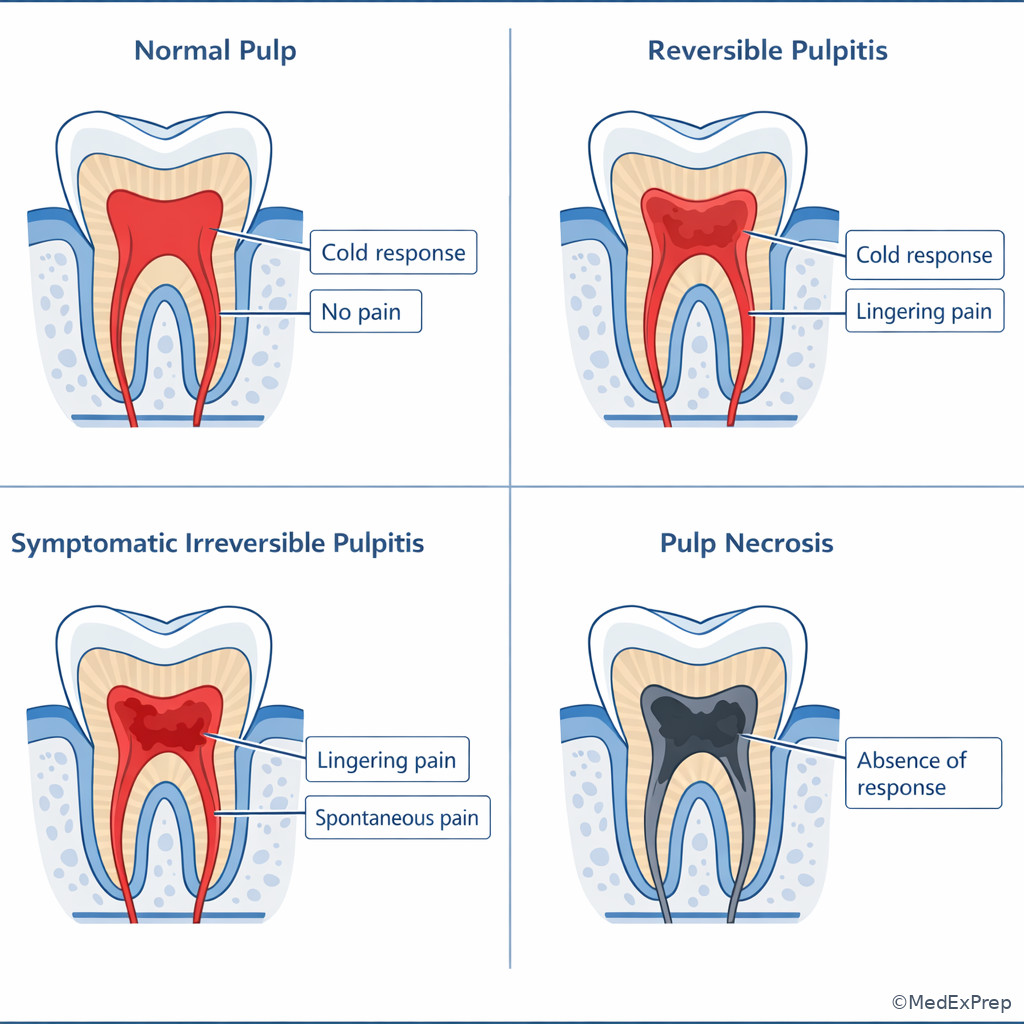
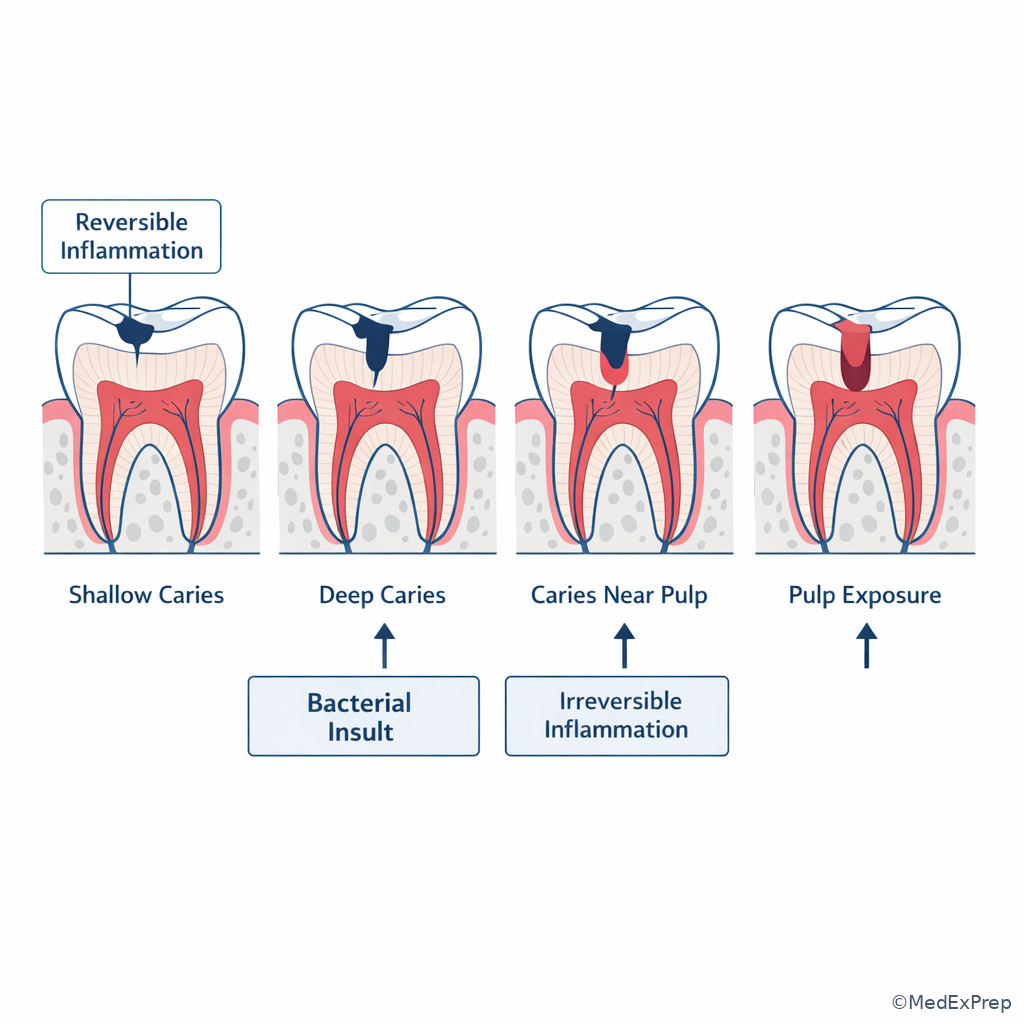
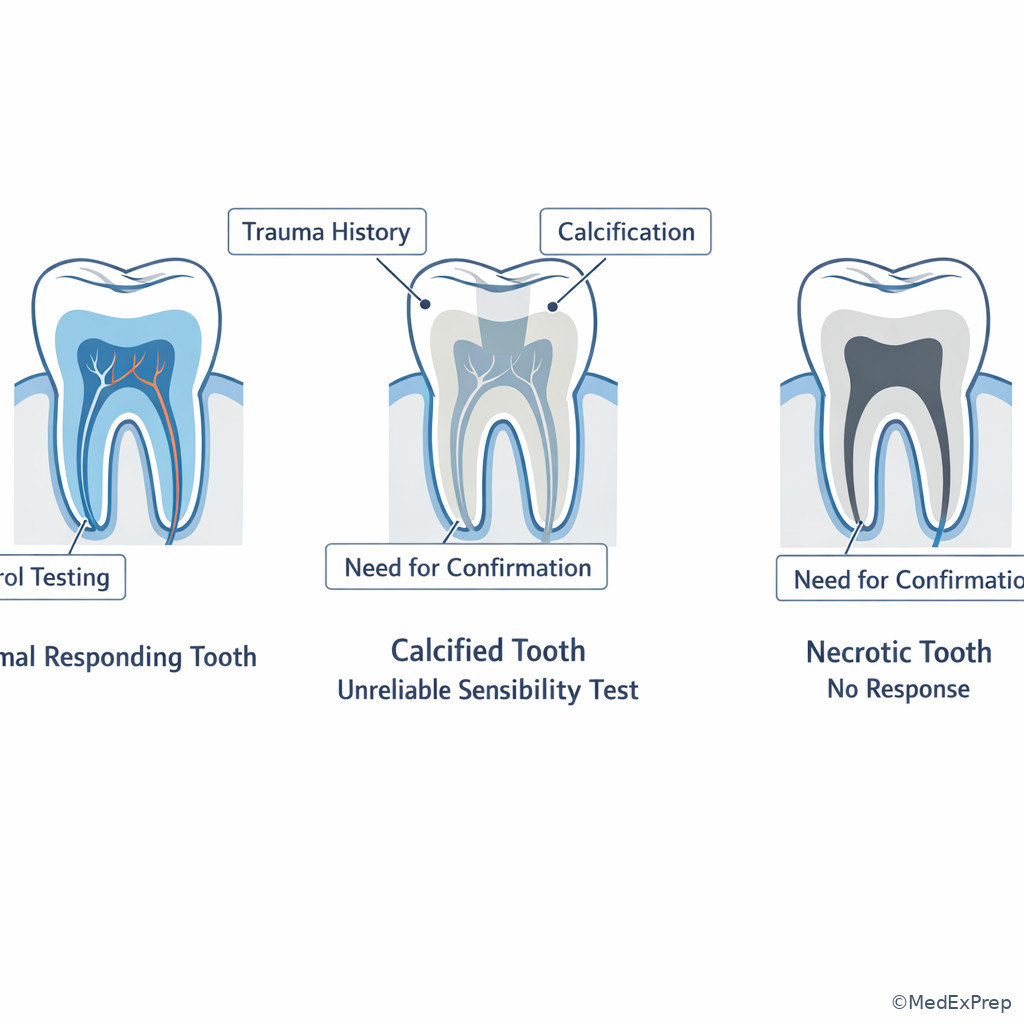
Use terms precisely. Normal pulp means the tooth is symptom-free and responds within expected limits compared with controls. Reversible pulpitis means pain is provoked, typically by thermal or sweet stimuli, and resolves quickly after stimulus removal. Symptomatic irreversible pulpitis is supported by lingering thermal pain, spontaneous pain, referred pain patterns, or symptoms consistent with irreversibility. Asymptomatic irreversible pulpitis is used when clinical findings such as carious exposure, deep caries, or other irreversible insults support irreversible inflammation despite absence of current symptoms. Pulp necrosis is used when the pulp is nonvital; however, board-quality reasoning requires the full context, including controls, restorations, calcification, trauma history, and repeat testing, before declaring necrosis from a single nonresponse.
See Fig 3 for a compact comparison of pulpal labels. Forward reference: in the upcoming topic Pulp Vitality Test Interpretation, you will learn how to interpret cold, heat, and electric tests without overcalling necrosis.
Exam takeaway: Distinguish reversible, symptomatic irreversible, asymptomatic irreversible, and necrotic patterns by symptom duration and test context rather than response intensity alone.
Exam takeaway: Deep caries or exposure without current pain can still support asymptomatic irreversible pulpitis when the tissue insult is irreversible.
B Worked example
A 52-year-old patient with hypertension and controlled type 2 diabetes is referred for tooth #30 after intermittent sensitivity to cold and sweets. The patient reports the discomfort ends within seconds once the drink is swallowed. A recent crown on #31 makes the patient suspect that tooth instead. Tooth #30 has a deep distal carious lesion but no spontaneous pain. Cold causes a brief sharp response that resolves immediately; percussion and palpation are negative; radiograph shows caries approximating the pulp but no periapical change.
Reasoning chain: Identify task: choose the most appropriate pulpal term. Extract key facts: the pain is provoked, brief, and nonlingering; no spontaneous pain; no apical signs. Apply rule: brief stimulus-dependent pain favors reversible pulpitis. Eliminate distractors: asymptomatic irreversible pulpitis is tempting because of deep caries, but symptoms are present and reversible in pattern; symptomatic irreversible pulpitis is tempting because cold pain exists, but the lack of lingering excludes it. Verify: reversible pulpitis with normal apical tissues is best supported.
C Exam trap
D Checkpoint
Question: Which finding most strongly supports asymptomatic irreversible pulpitis rather than normal pulp?
- A. Brief cold sensitivity that resolves immediately in an unrestored tooth
- B. Deep caries with carious pulp exposure and no current pain
- C. Slight tenderness to percussion with no thermal response data
- D. A completed root canal treatment with no symptoms
Answer: B
- A: Tempting because it involves cold response, but the quick resolution is more compatible with normal or reversible patterns, not asymptomatic irreversible pulpitis.
- B: Correct because irreversible tissue insult can exist despite no current symptoms, especially with deep caries or exposure.
- C: Tempting because apical tenderness suggests disease, but it does not by itself establish a pulpal label.
- D: Tempting because it implies no symptoms, but a treated tooth gets the status term “previously treated,” not a vitality diagnosis.
- The pulpal label that requires prior completed root canal therapy is previously treated.
- True or False: a normal periapical radiograph excludes symptomatic apical periodontitis. False.
- Name the 3 high-yield separators among reversible pulpitis, symptomatic irreversible pulpitis, and necrosis: duration, spontaneity, and reproducible sensibility response.
1.1.1.5 Accepted apical terminology: symptoms, radiographic change, and drainage
A Explanation
Apical terminology is where many candidates overdepend on imaging. The decision conflict is: Should the diagnosis follow the patient’s symptoms and clinical signs, the radiograph, or both? The resolving rule is that apical terms are assigned from the total pattern; a radiographic lesion is not required for symptomatic apical periodontitis, and the presence or absence of drainage distinguishes abscess patterns better than pain intensity alone.
WHY THIS IS TESTED: stems often hide the answer in percussion, palpation, swelling, or sinus tract findings while presenting a radiograph that appears normal or only subtly changed.
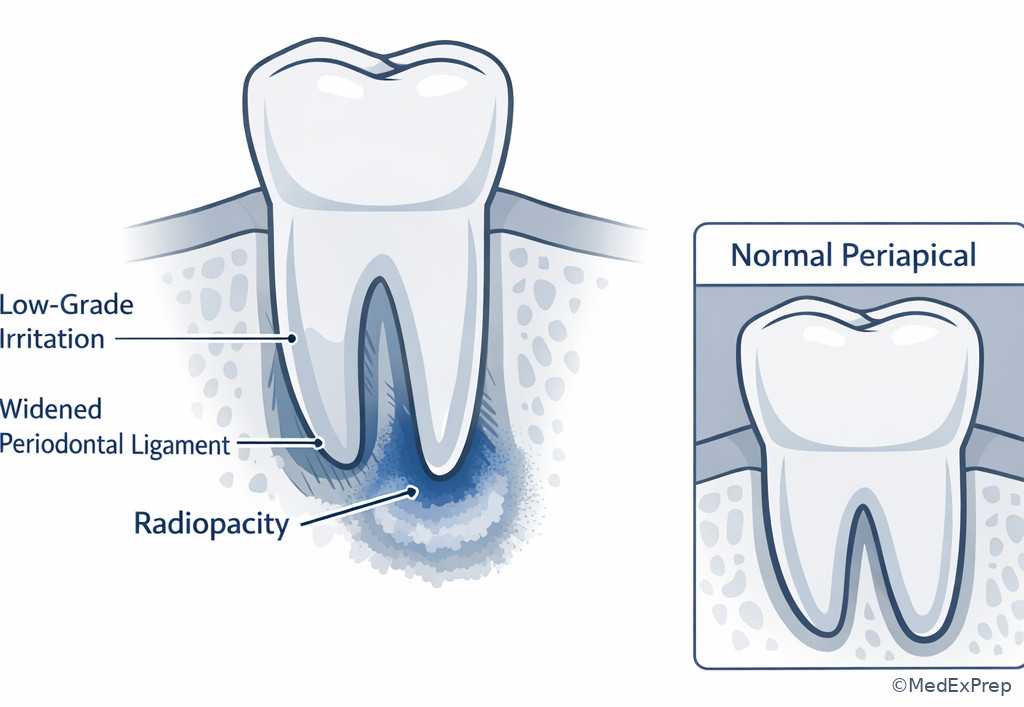
Normal apical tissues means no pain on percussion or palpation and no apical pathosis signs. Symptomatic apical periodontitis is characterized by pain to biting, percussion, or palpation and may or may not show radiographic changes. Asymptomatic apical periodontitis indicates apical periodontitis of pulpal origin without clinical symptoms, usually with apical radiolucency. Acute apical abscess involves rapid onset, spontaneous pain, tenderness, pus formation, and often swelling. Chronic apical abscess is associated with an intermittent or continuous sinus tract and often minimal discomfort. Condensing osteitis is diffuse radiopacity adjacent to the apex, typically reflecting a low-grade osseous response to inflammation.
See Fig 4 for the apical diagnosis comparison, and see Fig 5 for the decision pathway that separates apical periodontitis from acute versus chronic abscess. This topic overlaps strongly with upcoming History And Symptom Patterns, because drainage, swelling, and pain timing often decide the correct apical term.
Exam takeaway: Use tenderness, swelling, drainage, and radiographic context together to choose the apical term rather than relying on imaging alone.
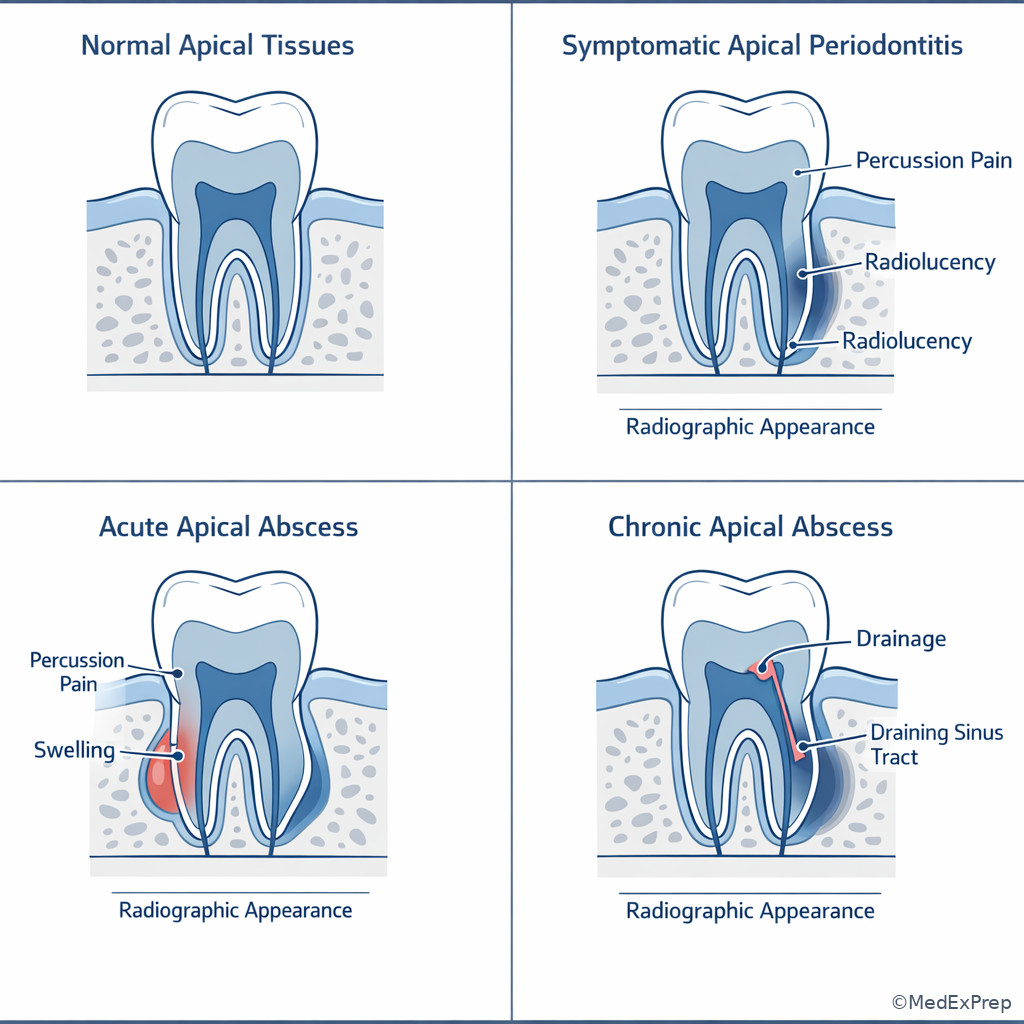
Exam takeaway: Tenderness alone supports symptomatic apical periodontitis, while drainage and swelling move the diagnosis toward acute or chronic abscess.
flowchart TD
A[Apical findings present] --> B{Pain to biting or percussion?}
B -->|Yes| C[Symptomatic apical periodontitis]
B -->|No| D{Radiolucency without symptoms?}
D -->|Yes| E[Asymptomatic apical periodontitis]
D -->|No| F{Swelling or pus?}
F -->|Rapid painful swelling| G[Acute apical abscess]
F -->|Sinus tract with drainage| H[Chronic apical abscess]
A --> I{Diffuse apical radiopacity with low-grade irritation?}
I -->|Yes| J[Condensing osteitis] Exam takeaway: A radiopaque periapical response suggests low-grade chronic irritation and should not be confused with a sclerotic normal variant without clinical correlation.
B Worked example
A 61-year-old patient with osteoarthritis and GERD presents for evaluation of tooth #8. The patient reports no current pain but noticed a recurrent “gum pimple” for several months. There was trauma to the area decades ago and a recent whitening treatment that the patient blames for the problem. Tooth #8 does not respond to cold; it is not tender to percussion; a sinus tract is present and traces to the apex; radiograph shows a periapical radiolucency.
Reasoning chain: Identify task: select both pulpal and apical diagnoses. Extract key facts: no response to sensibility testing supports necrosis in context; sinus tract with drainage and minimal symptoms points to chronic rather than acute abscess. Apply rule: drainage tract is the key differentiator. Eliminate distractors: asymptomatic apical periodontitis is tempting because there is no pain and a radiolucency exists, but the sinus tract elevates the diagnosis to chronic apical abscess; acute apical abscess is tempting because “abscess” suggests swelling, but the chronic draining pattern rejects acute. Verify: pulp necrosis with chronic apical abscess.
C Exam trap
D Checkpoint
Question: A patient has severe pain on biting tooth #3, marked percussion sensitivity, no swelling, and no radiographic lesion. Which apical diagnosis is most appropriate?
- A. Normal apical tissues
- B. Symptomatic apical periodontitis
- C. Asymptomatic apical periodontitis
- D. Acute apical abscess
Answer: B
- A: Tempting because the radiograph is normal, but wrong because clinical tenderness rules out normal apical tissues.
- B: Correct because biting and percussion pain define symptomatic apical periodontitis even before radiographic change appears.
- C: Tempting because apical periodontitis can be radiographic, but “asymptomatic” is contradicted by pain.
- D: Tempting because the pain is severe, but wrong because abscess terminology requires suppuration and typically swelling or drainage findings.
1.1.1.6 Treatment status terms, incomplete data, and documentation discipline
A Explanation
The final foundational integration step is knowing when not to use a vitality term. The decision conflict is: Should you call this pulp necrosis or irreversible pulpitis, or does the stem really require a treatment-status designation or additional diagnostic qualification? The resolving rule: once a tooth has completed root canal treatment, use previously treated; if endodontic therapy has been started but not completed, use previously initiated therapy. These terms replace pulpal vitality labels because the original pulp status is no longer the clinically operative category.
WHY THIS IS TESTED: exam writers use common charting shortcuts and casual language as distractors. “RCT tooth with necrotic pulp” is internally inconsistent. So is guessing necrosis from one failed sensibility test in a calcified or traumatized tooth without corroboration.
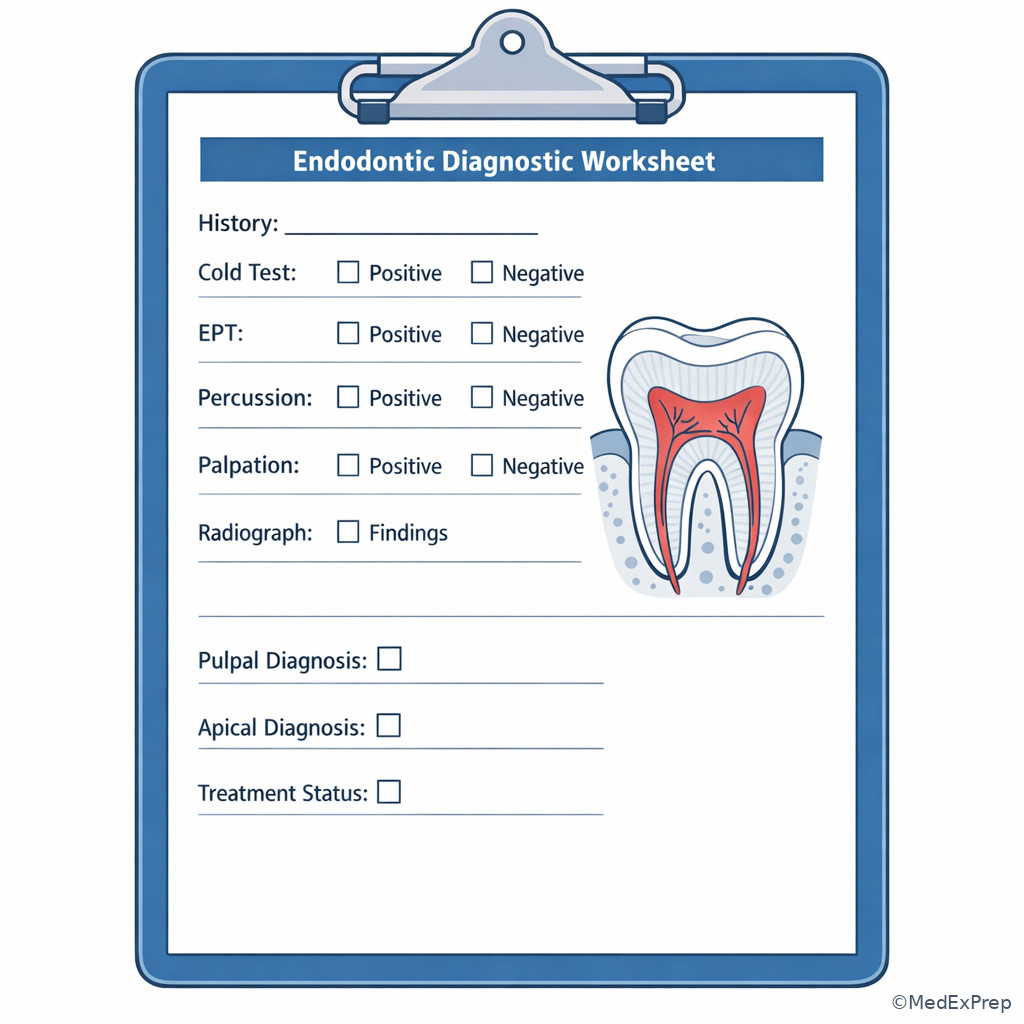
Documentation discipline also means recognizing uncertainty honestly. A board-level endodontist should not force a neat label when data are incomplete or conflicting. Instead, gather more history, repeat sensibility testing with controls, obtain appropriate imaging, consider crack testing, or expand the differential diagnosis. Within scope, your job is to assign accepted terminology when justified and to recognize when broader evaluation is safer. This is especially important when the true pivot in the case is not endodontic terminology but restorability, fracture, periodontal support, or nonodontogenic pain.
See Fig 6 for the documentation and terminology safety checklist. This section will connect directly to upcoming lessons on symptom patterns and pulp test interpretation, where many apparent “terminology mistakes” are actually evidence-collection mistakes.
Exam takeaway: When prior treatment exists or data are incomplete, chart treatment status accurately and gather missing evidence before forcing a vitality label.
flowchart TD
A[Diagnostic charting] --> B{Has root canal treatment been completed?}
B -->|Yes| C[Use Previously Treated]
B -->|No| D{Has endodontic therapy started?}
D -->|Yes| E[Use Previously Initiated Therapy]
D -->|No| F[Choose pulpal vitality diagnosis]
F --> G{Data conflicting or incomplete?}
G -->|Yes| H[Repeat tests, add imaging, expand differential]
G -->|No| I[Finalize paired pulpal and apical diagnoses] Exam takeaway: Structured charting reduces the common error of mixing treatment status, pulpal diagnosis, and apical diagnosis in one imprecise label.
Exam takeaway: A single nonresponse should trigger confirmation steps, especially in calcified, traumatized, or heavily restored teeth.
B Worked example
A 47-year-old patient with migraines and bruxism presents with dull discomfort on tooth #14, which had root canal treatment 5 years ago. A large crown is present, and the patient recently started chewing gum more often, making occlusal overload a tempting explanation. Percussion is mildly positive; palpation is negative; radiograph shows a small periapical radiolucency. The referring dentist writes, “possible necrotic tooth after prior endo.”
Reasoning chain: Identify task: correct the terminology. Extract key facts: root canal treatment was completed; therefore vitality terminology is no longer appropriate. Apical findings include tenderness and radiolucency, supporting symptomatic apical periodontitis. Apply rule: treatment history term replaces pulpal status term. Eliminate distractors: pulp necrosis is tempting because the lesion persists, but a completed RCT tooth cannot be charted as necrotic; previously initiated therapy is tempting because treatment happened in the past, but it was completed, not partial. Verify: previously treated with symptomatic apical periodontitis.
C Exam trap
D Checkpoint
Question: Which chart entry is most appropriate for a tooth in which pulpectomy was begun at an emergency visit, canals were partially instrumented, and the patient now returns with no obturation completed?
- A. Previously treated
- B. Previously initiated therapy
- C. Pulp necrosis
- D. Asymptomatic irreversible pulpitis
Answer: B
- A: Tempting because treatment has occurred, but wrong because it was not completed.
- B: Correct because endodontic treatment was started but not completed.
- C: Tempting because pulpal tissue may no longer be viable, but treatment-status terminology is the proper label once therapy has been initiated.
- D: Tempting if the original emergency diagnosis was irreversible pulpitis, but that history no longer serves as the current chart term after therapy was started.
- The key finding that separates chronic apical abscess from asymptomatic apical periodontitis is a sinus tract or drainage.
- True or False: a root-canal-treated tooth can be labeled “pulp necrosis.” False.
- Name the two treatment-status terms: previously treated and previously initiated therapy.
Exam Traps & Differentiators
- Most common wrong answer and why: choosing a single diagnosis phrase when the tooth actually needs both pulpal and apical labels. This happens because the stem emphasizes one symptom stream more than the other.
- Looks similar but isn’t: a strong cold response is not automatically symptomatic irreversible pulpitis; the duration after stimulus removal is more important than response intensity alone.
- Looks similar but isn’t: a periapical radiolucency without symptoms is not chronic apical abscess unless a sinus tract or drainage is present.
- Looks similar but isn’t: a previously treated tooth with apical disease is not “necrotic”; the pulpal side is charted as treatment status.
- If the stem says lingering cold pain, spontaneous nocturnal pain think symptomatic irreversible pulpitis.
- If the stem says provoked cold sensitivity that stops immediately think reversible pulpitis unless a stronger contradicting clue is present.
- If the stem says no symptoms but carious exposure or deep irreversible insult think asymptomatic irreversible pulpitis.
- If the stem says percussion tenderness with normal radiograph think symptomatic apical periodontitis can still be correct.
- If the stem says sinus tract tracing to apex think chronic apical abscess, not just asymptomatic apical periodontitis.
- If the stem says completed RCT in the history think previously treated before considering the apical label.
| Confusable pair | Why candidates confuse them | Single best differentiator |
|---|---|---|
| Reversible pulpitis vs symptomatic irreversible pulpitis | Both can hurt to cold | Lingering/spontaneous pain supports symptomatic irreversible pulpitis |
| Asymptomatic irreversible pulpitis vs normal pulp | Both may be painless at the visit | Deep irreversible insult or exposure supports asymptomatic irreversible pulpitis |
| Symptomatic apical periodontitis vs normal apical tissues | Radiograph may look normal in both | Pain to percussion, biting, or palpation supports symptomatic apical periodontitis |
| Asymptomatic apical periodontitis vs chronic apical abscess | Both can have radiolucency and little pain | Drainage tract indicates chronic apical abscess |
| Previously treated vs pulp necrosis | Both imply nonvital internal status | Completed root canal history requires previously treated |
| Stem clue | Think first | Reject if |
|---|---|---|
| “Cold causes pain that lingers 45 seconds” | Symptomatic irreversible pulpitis | The pain actually resolves immediately on repeated testing |
| “No pain, sinus tract present” | Chronic apical abscess | Tracing does not connect to the apex or source is nonodontogenic |
| “RCT completed years ago” | Previously treated | The procedure was only an emergency pulpotomy or partial instrumentation |
| “Tender to percussion, no lesion” | Symptomatic apical periodontitis | Tenderness localizes instead to crack/occlusion and endodontic findings are absent |
| “Deep caries, no symptoms today” | Consider asymptomatic irreversible pulpitis | The tissue insult is not clearly irreversible and tests are normal |
Related trap from upcoming topics: in History And Symptom Patterns, the exam will often make a wrong tooth sound guilty based on referred pain or a recent restoration. In Pulp Vitality Test Interpretation, a single false-negative sensibility test can make necrosis look appealing. Here, the key defense is terminology discipline: do not label beyond what the total evidence supports.
Algorithm / Approach
Rapid Review
- Normal pulp → expected response pattern with no symptom history suggesting active inflammation
- Reversible pulpitis → provoked pain that stops quickly after stimulus removal
- Symptomatic irreversible pulpitis → lingering or spontaneous pain outweighs mere response intensity
- Asymptomatic irreversible pulpitis → irreversible insult present even when the patient denies pain
- Pulp necrosis → nonresponse must fit the full context, not a single isolated test
- Previously treated → completed root canal therapy replaces vitality terminology
- Previously initiated therapy → treatment started but not finished
- Normal apical tissues → no percussion/palpation pain and no apical pathosis evidence
- Symptomatic apical periodontitis → tenderness can exist before radiographic change
- Asymptomatic apical periodontitis → radiolucency without clinical symptoms
- Acute apical abscess → rapid painful suppurative process, often swelling
- Chronic apical abscess → draining sinus tract is the discriminator
- Condensing osteitis → radiopaque apical response to low-grade irritation
- Board stems → ask yourself first: pulpal term, apical term, or treatment-status term?
Self-check quiz
1. A 29-year-old patient with seasonal allergies and a recent occlusal composite on tooth #12 reports cold sensitivity that lasts 2 to 3 seconds and stops immediately. Percussion and palpation are negative, and the radiograph is unremarkable. Which pulpal diagnosis is most appropriate?
- A. Normal pulp
- B. Reversible pulpitis
- C. Symptomatic irreversible pulpitis
- D. Asymptomatic irreversible pulpitis
2. A tooth had complete root canal treatment 3 years ago. The patient now presents for evaluation because of a periapical radiolucency found on a routine radiograph, but there are no symptoms. Which pulpal or status term is most appropriate?
- A. Pulp necrosis
- B. Previously initiated therapy
- C. Previously treated
- D. Asymptomatic irreversible pulpitis
3. A 41-year-old patient with hyperlipidemia and controlled anxiety presents with tooth #19 pain that begins with cold and lingers for 45 seconds. The tooth is mildly tender to percussion. There is a large mesio-occlusal restoration and no swelling. The periapical radiograph shows no apical radiolucency. Which paired diagnosis is most appropriate?
- A. Reversible pulpitis with normal apical tissues
- B. Symptomatic irreversible pulpitis with symptomatic apical periodontitis
- C. Symptomatic irreversible pulpitis with asymptomatic apical periodontitis
- D. Pulp necrosis with symptomatic apical periodontitis
4. A 58-year-old patient with controlled hypertension and a history of childhood trauma to tooth #9 presents with a recurrent sinus tract in the labial mucosa. The tooth does not respond to cold, is not tender to percussion, and shows an apical radiolucency. The patient denies pain and blames recent bleaching. Which apical diagnosis is most appropriate?
- A. Asymptomatic apical periodontitis
- B. Symptomatic apical periodontitis
- C. Acute apical abscess
- D. Chronic apical abscess
5. A 34-year-old patient with GERD and bruxism was seen emergently 1 week ago for severe pain on tooth #30. The referring dentist opened the pulp chamber and removed part of the coronal pulp, but no obturation was completed. The patient now returns for definitive care. Which status term requires charting?
- A. Previously treated
- B. Previously initiated therapy
- C. Pulp necrosis
- D. Symptomatic irreversible pulpitis
6. A 63-year-old patient with type 2 diabetes and coronary artery disease presents with biting pain on tooth #3. The tooth has a full crown and no prior endodontic treatment. Cold produces no response compared with adjacent controls; percussion is positive; palpation is negative; there is no swelling. Radiograph shows widened periodontal ligament space but no distinct radiolucency. Which paired diagnosis is most appropriate?
- A. Pulp necrosis with symptomatic apical periodontitis
- B. Symptomatic irreversible pulpitis with symptomatic apical periodontitis
- C. Pulp necrosis with asymptomatic apical periodontitis
- D. Previously treated with symptomatic apical periodontitis
7. A 50-year-old patient with hypothyroidism and chronic sinus issues presents with tooth #14, which has deep distal recurrent caries under a crown. The patient reports no spontaneous pain, but examination reveals a pinpoint carious exposure during caries removal by the referring dentist. Cold testing before anesthesia had shown no lingering pain, and percussion is negative. Which pulpal diagnosis is most appropriate before definitive endodontic treatment planning?
- A. Normal pulp
- B. Reversible pulpitis
- C. Asymptomatic irreversible pulpitis
- D. Pulp necrosis
8. A 45-year-old patient with migraines and a recent orthodontic adjustment presents with diffuse maxillary pain. Tooth #10 had root canal treatment 6 years ago. It is mildly tender to percussion and shows a small apical radiolucency. Another untreated premolar has intense lingering cold pain but no apical tenderness. Which charting choice most appropriately applies diagnostic terminology to tooth #10 specifically?
- A. Pulp necrosis with symptomatic apical periodontitis
- B. Previously treated with symptomatic apical periodontitis
- C. Previously treated with asymptomatic apical periodontitis
- D. Symptomatic irreversible pulpitis with symptomatic apical periodontitis
Answer key
1. Answer: B — Reversible pulpitis
- A: Tempting because the symptoms are mild and the radiograph is normal. Incorrect for this scenario because the tooth does have provoked sensitivity after a recent restoration; that pattern fits reversible pulpitis rather than a completely normal pulp. Single discriminating clue: cold sensitivity is present but brief. Source: AAE diagnostic terminology guidance; Torabinejad and Walton.
- B: Correct because provoked cold pain that stops immediately after stimulus removal is classic for reversible pulpitis when correlated with the restorative history. Single discriminating clue: response resolves within seconds. Source: AAE Consensus Conference Recommended Diagnostic Terminology; Hargreaves and Berman.
- C: Tempting because cold pain exists. Incorrect because symptomatic irreversible pulpitis usually includes lingering or spontaneous pain, neither of which is present here. Single discriminating clue: no lingering pain. Source: AAE terminology; Ingle’s Endodontics.
- D: Tempting because a restoration can be deep. Incorrect because asymptomatic irreversible pulpitis requires an irreversible insult without current symptoms, whereas this stem gives a reversible symptom pattern. Single discriminating clue: symptoms are present and brief, not silent with irreversible evidence. Source: AAE terminology; Walton and Torabinejad.
2. Answer: C — Previously treated
- A: Tempting because a treated tooth is functionally nonvital. Incorrect because completed root canal history changes the chart terminology to treatment status, not vitality diagnosis. Single discriminating clue: complete root canal treatment 3 years ago. Source: AAE diagnostic terminology guidance.
- B: Tempting because prior endodontic intervention occurred. Incorrect because this term is reserved for therapy started but not finished. Single discriminating clue: treatment was complete. Source: AAE terminology consensus.
- C: Correct because a fully root-canal-treated tooth is designated previously treated regardless of the current apical diagnosis. Single discriminating clue: completed treatment history. Source: AAE terminology; Cohen’s Pathways of the Pulp.
- D: Tempting because the tooth is asymptomatic. Incorrect because vitality terms no longer apply after completed root canal treatment. Single discriminating clue: status term supersedes pulpal vitality label. Source: AAE terminology consensus.
3. Answer: B — Symptomatic irreversible pulpitis with symptomatic apical periodontitis
- A: Tempting because cold triggers pain and the radiograph is normal. Incorrect because pain lingering 45 seconds exceeds a reversible pattern, and percussion tenderness rules out normal apical tissues. Single discriminating clue: lingering cold pain plus percussion tenderness. Source: AAE terminology; Hargreaves and Berman.
- B: Correct because lingering cold pain supports symptomatic irreversible pulpitis and percussion tenderness supports symptomatic apical periodontitis even without radiographic rarefaction. Single discriminating clue: duration of cold pain and clinical tenderness. Source: AAE terminology consensus; Torabinejad and Walton.
- C: Tempting because apical periodontitis can appear radiographically later. Incorrect because the patient is symptomatic apically now; asymptomatic apical periodontitis would not fit percussion pain. Single discriminating clue: tenderness makes the apical term symptomatic. Source: AAE guidance.
- D: Tempting because severe pulpal inflammation can progress to necrosis. Incorrect because the tooth still gives a meaningful lingering cold response, which argues against necrosis in this stem. Single discriminating clue: positive lingering cold response. Source: Cohen’s Pathways; AAE terminology.
4. Answer: D — Chronic apical abscess
- A: Tempting because the patient has no pain and there is an apical radiolucency. Incorrect because the presence of a sinus tract indicates a draining abscess rather than simple asymptomatic apical periodontitis. Single discriminating clue: recurrent sinus tract. Source: AAE terminology; Ingle’s Endodontics.
- B: Tempting because trauma history can create apical disease. Incorrect because the patient is not apically symptomatic. Single discriminating clue: no percussion pain and no tenderness. Source: AAE terminology consensus.
- C: Tempting because abscess terminology seems to fit drainage. Incorrect because acute apical abscess implies rapid onset and painful swelling, not a chronic draining tract with minimal discomfort. Single discriminating clue: longstanding drainage with little pain. Source: AAE guidance; Walton and Torabinejad.
- D: Correct because a sinus tract draining from an apical lesion with minimal symptoms defines chronic apical abscess. Single discriminating clue: sinus tract traced to the apex. Source: AAE terminology consensus.
5. Answer: B — Previously initiated therapy
- A: Tempting because endodontic treatment has begun. Incorrect because “previously treated” requires completed root canal treatment. Single discriminating clue: no obturation was completed. Source: AAE terminology.
- B: Correct because the dentist began endodontic therapy but did not complete it, which is exactly the use of previously initiated therapy. Single discriminating clue: emergency partial treatment. Source: AAE terminology consensus.
- C: Tempting because the remaining pulp may be compromised. Incorrect because once therapy has started, treatment-status terminology is preferred over vitality labeling for charting. Single discriminating clue: access and partial pulp removal already occurred. Source: AAE terminology guidance.
- D: Tempting because that may have been the original disease. Incorrect because the chart now must reflect current treatment status, not merely the likely pretreatment diagnosis. Single discriminating clue: prior endodontic intervention supersedes original vitality term in charting. Source: Cohen’s Pathways; AAE terminology.
6. Answer: A — Pulp necrosis with symptomatic apical periodontitis
- A: Correct because the tooth has no prior endodontic treatment, shows no response to cold compared with controls, and is tender to percussion; together these findings support pulp necrosis with symptomatic apical periodontitis. Single discriminating clue: absent cold response in an untreated tooth plus percussion pain. Source: AAE terminology; Hargreaves and Berman.
- B: Tempting because symptomatic apical periodontitis is clearly present and crowned teeth can be difficult to test. Incorrect because there is no lingering thermal response or spontaneous pulpal pain; instead the stem gives nonresponse. Single discriminating clue: absent cold response, not lingering response. Source: AAE terminology consensus.
- C: Tempting because the radiographic changes are subtle. Incorrect because the tooth is not asymptomatic apically; percussion is positive. Single discriminating clue: biting/percussion pain. Source: AAE guidance.
- D: Tempting because crowned teeth are often restored and confusing. Incorrect because there is no prior root canal treatment in the history. Single discriminating clue: no prior endodontic treatment. Source: AAE terminology.
7. Answer: C — Asymptomatic irreversible pulpitis
- A: Tempting because there is no spontaneous pain and percussion is negative. Incorrect because carious exposure during removal indicates an irreversible tissue insult inconsistent with normal pulp. Single discriminating clue: pinpoint carious exposure. Source: AAE terminology; Walton and Torabinejad.
- B: Tempting because cold had not lingered, which might suggest a reversible pattern. Incorrect because the direct evidence of irreversible insult from exposure overrides a purely reversible interpretation. Single discriminating clue: exposure/deep irreversible lesion, not just symptom duration. Source: AAE guidance; Cohen’s Pathways.
- C: Correct because the tooth lacks current spontaneous symptoms but shows a clinical condition consistent with irreversible pulpal involvement. Single discriminating clue: irreversible structural insult without current symptoms. Source: AAE terminology consensus.
- D: Tempting because deep recurrent caries may lead to necrosis. Incorrect because the stem does not provide convincing nonresponse or necrotic evidence. Single discriminating clue: no necrosis-specific testing pattern. Source: Hargreaves and Berman.
8. Answer: B — Previously treated with symptomatic apical periodontitis
- A: Tempting because the tooth has apical pathology and prior RCT implies no vital pulp. Incorrect because a completed RCT tooth is charted as previously treated, not pulp necrosis. Single discriminating clue: root canal treatment 6 years ago. Source: AAE terminology.
- B: Correct because tooth #10 specifically has completed endodontic treatment, is tender to percussion, and has an apical radiolucency; that supports previously treated with symptomatic apical periodontitis. Single discriminating clue: completed RCT plus current percussion tenderness. Source: AAE terminology consensus; Ingle’s Endodontics.
- C: Tempting because the apical radiolucency could be chronic and the patient has diffuse pain from other causes. Incorrect because the tooth itself is mildly tender to percussion, making the apical component symptomatic. Single discriminating clue: tenderness on percussion. Source: AAE guidance.
- D: Tempting because another tooth in the case has lingering cold pain, creating diagnostic noise. Incorrect because the question asks specifically about tooth #10, which is already treated and cannot be labeled symptomatic irreversible pulpitis. Single discriminating clue: the lingering cold pain belongs to a different untreated tooth. Source: AAE terminology; specialist charting standards.
Keep going with the full Endodontics Board Prep Course (Endo)
You just studied the way members do, in the same lesson interface. Full access unlocks every lesson, the question bank and flashcards for a full year.
One payment · 1 year of access · No auto-renewal