1.1.1 - DTR Role And Supervision
DTR Role And Supervision
What you'll learn
- Distinguish what an entry-level DTR may carry out independently within assigned protocols versus what requires referral, consultation, or escalation under supervision. Communication, Education, Ethics, and Professional Practice: Role boundaries - Supervision decisions
- Choose the most appropriate next step when a patient/client issue falls within routine implementation versus beyond technician authority. Nutrition Care Support: Monitoring support - Referral triggers
- Identify how supervision, delegated authority, and facility policy shape safe daily DTR actions in healthcare, foodservice, and community settings. Communication, Education, Ethics, and Professional Practice: Standards use - Delegated practice
- Use objective communication and documentation when reporting findings to the RDN, nurse, foodservice leader, or supervising professional. Quality, Resource, and Data Support: Reporting routine findings - Documentation accuracy
- Avoid common exam traps involving screening versus assessment, reinforcement versus prescribing, and observation versus diagnosis. Nutrition Care Support: Screening support - Scope awareness
- Communication, Education, Ethics, and Professional Practice → role boundaries and professional accountability → supervision, delegated authority, safe chain-of-command action
- Nutrition Care Support → screening and monitoring support → recognize findings that require referral or escalation
- Quality, Resource, and Data Support → data collection and reporting → document only what was observed, performed, and reported
- Food and Nutrition Programs and Services → implementation support → carry out authorized diet, meal, and education procedures consistently with policy
Why it matters
- Many DTR exam questions are really role-boundary questions disguised as nutrition, documentation, or foodservice scenarios.
- The safest answer is often not the most aggressive action; it is the most scope-appropriate action that protects the patient/client and follows policy.
- Supervision decisions affect meal safety, allergy handling, education reinforcement, sanitation correction, and referral timing.
- Early mastery of role boundaries prevents errors across the entire course, especially in screening, clinical support, documentation, and ethics.
Exam takeaway: Use this choose-versus-refer framework to identify the safest technician-level next step.
flowchart TD
A[Task appears in stem] --> B{Within routine DTR role?}
B -->|Yes| C[Collect or implement per policy]
C --> D{Any safety red flag?}
D -->|No| E[Document objective facts]
D -->|Yes| F[Escalate promptly]
B -->|No or unclear| G[Consult RDN or supervisor]
G --> H[Do not change order independently]
See Fig 1 for the core decision logic that appears repeatedly on exam stems.
Key Terms & Must-Know Facts
1.1.1.1 Key terms
- DTR: Entry-level nutrition and foodservice practitioner working within delegated authority and supervision.
- Supervision: Oversight by an authorized professional or leader according to role, policy, and setting.
- Delegated authority: Permission to perform specified tasks within policy and competence.
- Scope of practice: The boundary of actions allowed for the role.
- Escalation: Prompt reporting of a concern that exceeds routine action or poses safety risk.
- Referral: Sending the issue to the appropriate clinician or supervisor for further action.
- Nutrition screening: Brief process to identify risk and need for referral.
- Nutrition assessment: Deeper interpretation and synthesis, generally beyond independent DTR decision-making in complex cases.
- Objective documentation: Recording observed facts, actions taken, and who was notified.
- Therapeutic diet order: Authorized nutrition-related order that the DTR implements, not independently changes.
- Approved education reinforcement: Repeating and supporting education already authorized in the care plan.
- Chain of command: Correct reporting pathway for concerns or unsafe conditions.
- Policy/protocol: Institution-specific operational rule that guides action.
1.1.1.2 Must-know facts
- The DTR supports care; the DTR does not independently diagnose or prescribe medical nutrition therapy.
- If a stem asks you to change an order independently, that is usually outside DTR scope.
- When patient/client safety is at risk, escalate promptly rather than wait for routine follow-up.
- Document what you observed, what you did, and who you notified.
- Education reinforcement is usually in scope; creating a new therapeutic counseling plan is not.
- Screening and routine monitoring are commonly in scope; advanced interpretation and independent treatment decisions are not.
- Follow local policy/protocols where they apply; do not assume one facility's workflow is universal.
- In close-call questions, choose the answer that is safest, policy-consistent, and within delegated authority.
| Term | Exam meaning | What the DTR does |
|---|---|---|
| Screening | Identify possible nutrition risk | Collect indicators and refer per protocol |
| Assessment | Interpret multiple data sources | Contribute data; escalate for clinical interpretation |
| Diagnosis | Name a nutrition problem requiring clinical judgment | Do not independently diagnose |
| Implementation | Carry out approved plan or order | Perform assigned steps accurately |
| Monitoring | Track response or routine indicators | Observe, document, report changes |
| Education reinforcement | Support existing teaching plan | Reinforce approved content |
Core content
1.1.1.3 Foundational role: what the DTR is expected to do
A Explanation
The exam often creates a decision conflict between routine support work and provider-level clinical judgment. Your task is to choose whether the action in the stem is implementation, monitoring, communication, or an out-of-scope treatment decision. The single rule that resolves most questions: if the action involves collecting data, carrying out an approved plan, reinforcing authorized education, monitoring routine outcomes, or reporting findings, it is commonly within DTR role; if it requires diagnosing, independently prescribing, changing an order, or overriding policy, it must be referred or escalated.
WHY THIS IS TESTED: Exam writers know candidates confuse being useful with being authorized. A highly functional DTR is still bounded by supervision, delegated authority, and policy. Choose the answer that protects safety without overstepping.
Examples of in-role actions include obtaining intake data, checking tray accuracy, reinforcing approved low-sodium teaching, documenting observed poor appetite, monitoring weights per protocol, following HACCP records, and reporting sanitation failures. Out-of-role signals include words such as diagnose, prescribe, write the diet order, independently change texture level, authorize enteral regimen, or decide medical nutrition therapy without supervision.
Key rule: If the stem asks for a new clinical decision, think refer; if it asks for execution of an existing authorized plan, think perform.
Exam takeaway: Separate routine implementation from independent clinical judgment before choosing an answer.
See Fig 2 for the simplest exam-day sorting rule.
B Worked example
A 76-year-old long-term care resident with hypertension, osteoarthritis, and mild cognitive impairment tells the DTR, “My food is too bland. Put me back on regular salt.” The chart shows a sodium-restricted diet order. Morning intake was 30%, and the resident also complains about cold coffee. The tempting clue is the dissatisfaction with food quality, which may push you toward fixing the order yourself.
Reasoning chain: Identify task: the question is asking for the most appropriate next step. Extract key facts: existing therapeutic order is present; resident request conflicts with the order; the DTR can address service quality but cannot independently change the diet. Apply rule: implement current order, communicate the concern to the appropriate clinician per policy, and address non-order issues such as temperature/service recovery. Eliminate distractors: changing to regular diet is outside scope; dismissing the complaint ignores patient-centered care; counseling extensively about hypertension may exceed reinforcement if not part of the approved plan. Verify: safest answer is to maintain the current order, document the complaint objectively, and notify the appropriate supervisor/RDN according to policy.
C Exam trap
Common wrong answer: “Change the diet to improve intake.”
WHY IT IS TEMPTING: Better intake sounds patient-centered and operationally efficient.
SINGLE CLUE THAT ELIMINATES IT: There is an existing therapeutic order; the DTR does not independently modify it.
D Checkpoint
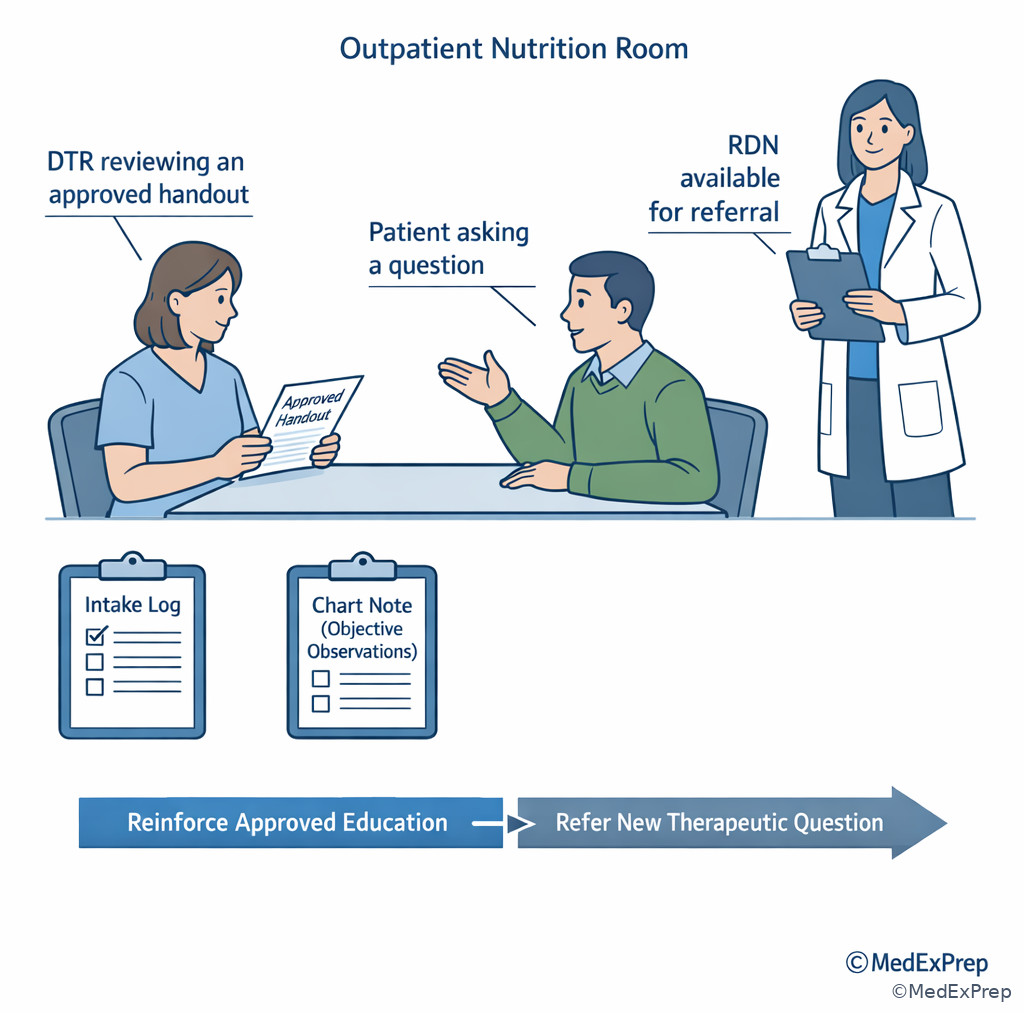
Question: A DTR in outpatient follow-up reviews a client handout already approved by the RDN and demonstrates how to measure a 1-cup portion. Which action is most appropriate?
- Independently redesign the meal plan based on the client’s new lab results.
- Reinforce the approved education and report questions about new lab interpretation to the RDN.
- Discontinue the current meal pattern because the client reports boredom.
- Diagnose poor adherence and document the client as noncompliant.
- A: Tempting because lab changes often prompt diet revision, but this requires clinical interpretation beyond routine DTR authority.
- B: Tempting because it may feel less decisive, and it is correct because reinforcement of approved education plus referral for new interpretation fits DTR scope.
- C: Tempting because boredom affects adherence, but discontinuing or changing the plan independently is not the technician’s decision.
- D: Tempting because documentation is expected, but “noncompliant” is interpretive and judgmental rather than objective.
1.1.1.4 Supervision, delegated authority, and policy
A Explanation
A DTR does not practice in a vacuum. Even a clearly in-role task must be done under the setting’s rules: delegated authority, facility policy, state requirements where applicable, and competence. The exam conflict here is often between “I know how to do this” and “Am I authorized to do this here, now, under this protocol?” The single rule: competence alone does not replace policy or supervision. If the task depends on a protocol, order set, or supervisory structure, follow that structure.
WHY THIS IS TESTED: Candidates often choose technically reasonable actions that ignore chain-of-command or local procedure. Exam stems reward the safer policy-based response.
In foodservice, this may mean following the department manager’s correction process for a receiving discrepancy. In clinical support, it may mean notifying nursing and the RDN when intake drops below protocol thresholds. In community settings, it may mean using approved scripts rather than improvising therapeutic counseling. Supervision does not mean you do nothing; it means you act within delegated limits and know when to loop in the right person.
Recall: This is the first topic in the course, so use it as the base layer. In the upcoming lesson Standards, Policy, And Accountability, we build this into documentation rules: not just who acts, but exactly how that action must be charted.
Memory anchor: PACE = Policy first, Authorized task, Chain of command, Escalate if outside role. If an option breaks PACE, reject it.
Exam takeaway: When policy, delegated authority, and safety conflict, policy-consistent escalation is the best next step.
B Worked example
A newly hired DTR in a rehabilitation hospital is asked by a busy nurse to “just switch the patient to nectar-thick liquids for dinner because he coughed at lunch.” The patient is 68 years old with diabetes and a recent stroke; he also reports dislike of hospital food. The distracting detail is the coughing episode, which makes immediate texture modification sound protective.
Reasoning chain: Identify task: determine the most appropriate next step within scope. Extract key facts: swallowing safety concern is present; a texture change would alter the order; the request came informally from a nurse rather than through policy-defined authorization. Apply rule: the DTR should not independently change texture level; swallowing safety concerns require prompt escalation through the designated chain. Eliminate distractors: making the change without authorization oversteps role; waiting until the next day delays a safety issue; explaining stroke dysphagia management independently misses the urgent operational task. Verify: safest action is to hold to current authorized process, notify the appropriate nurse/speech-language pathology/RDN team per protocol, and document the observation/reporting.
C Exam trap
Common wrong answer: “Make the safe-sounding change immediately.”
WHY IT IS TEMPTING: On the surface, altering texture seems protective and patient-centered.
SINGLE CLUE THAT ELIMINATES IT: Changing texture is an order/protocol decision, not an independent technician action.
D Checkpoint
Question: In a school nutrition program, a DTR notices that a menu substitution would conflict with a documented food allergy list. The manager is off-site for 30 minutes. What is the most appropriate next step?
- Serve the substitute because it matches the calorie target.
- Choose an allergy-safe option allowed by protocol and notify the designated supervisor according to policy.
- Rewrite the allergy accommodation plan for the site.
- Ask the student to decide whether the substitute is usually tolerated.
- A: Tempting because menu service must continue, but calorie matching never overrides allergy safety.
- B: Tempting because it requires extra coordination, and it is correct because it uses delegated protocol action plus timely notification.
- C: Tempting because the problem seems systematic, but rewriting the accommodation plan exceeds routine technician authority.
- D: Tempting because the student knows personal history, but self-report does not replace documented allergy controls.
- The safest first filter in a role-boundary question is: Is this an approved implementation task or a new clinical decision?
- True or False: If a DTR knows the likely best diet change, independent modification is acceptable. False.
- Name the 3 key limits tested most often: diagnose, prescribe/change order, override policy.
Exam takeaway: Safety concerns may require immediate reporting even when the DTR can manage routine workflow tasks.
flowchart TD
A[Routine task] --> B{Safety concern present?}
B -->|No| C[Perform per policy]
C --> D[Document]
B -->|Yes| E{Within protocol to correct now?}
E -->|Yes| F[Correct immediate hazard]
F --> G[Notify supervisor]
E -->|No| H[Escalate promptly]
H --> I[Document facts and notification]
See Fig 3 for the common testable difference between a routine workflow issue and a safety-triggered escalation.
1.1.1.5 Applied role boundaries in patient/client education, screening, and monitoring
A Explanation
This subsection moves from basic definitions to application. The exam conflict is often subtle: the DTR is allowed to be active, but not independent in areas requiring clinical interpretation. Three commonly tested pairs are screening versus assessment, reinforcement versus counseling/prescribing, and monitoring versus diagnostic conclusion. The single rule that resolves these pairs is whether the task mainly gathers or supports information already authorized, or whether it creates a new clinical judgment.
WHY THIS IS TESTED: Many wrong answers sound educational or compassionate but actually cross into independent nutrition therapy.
Choose screening when the task is to identify risk indicators using a tool or protocol and refer appropriately. Reject assessment when the option asks the DTR to independently synthesize labs, disease state, intake, and anthropometrics into a diagnostic conclusion. Choose reinforcement when the RDN-approved message already exists and the DTR is helping the patient/client carry it out. Reject independent counseling when the option invents a new therapeutic meal prescription. Choose monitoring when observing intake, tolerance, weights, or service outcomes. Reject diagnostic interpretation when the option labels the patient/client with a nutrition diagnosis or medical conclusion.
High-Yield Connection: This concept is tested alongside Screening Versus Assessment Boundaries and Objective Nutrition Documentation. Know both the action boundary and the wording boundary: gather data and chart facts, but do not independently interpret beyond scope.
Exam takeaway: Gather and reinforce within protocol, but escalate when the stem asks for synthesis or new therapy decisions.
B Worked example
A 59-year-old outpatient with obesity, GERD, and newly reported elevated fasting glucose attends a follow-up class. The RDN previously taught label reading and portion-control strategies. The client asks the DTR, “Based on these new numbers, how many carbohydrate grams should I eat at each meal?” He also complains about the parking fee and says he started a herbal supplement last week. The tempting clue is the glucose value, which makes a detailed carbohydrate prescription feel urgent.
Reasoning chain: Identify task: best DTR-level response. Extract key facts: approved education already exists; new lab-related therapeutic planning is requested; distracting issues include parking and supplement use. Apply rule: reinforce approved label-reading and portion tools, but refer the new therapeutic carbohydrate prescription question to the RDN/supervising clinician. Eliminate distractors: giving a specific carb prescription is independent treatment planning; dismissing the question is poor service; discussing the supplement’s medical effect in depth may exceed approved education. Verify: the best response reinforces existing content, encourages question list preparation, and routes new clinical planning questions appropriately.
C Exam trap
Common wrong answer: “Answer the exact therapeutic question because the client asked directly.”
WHY IT IS TEMPTING: It feels responsive and educational.
SINGLE CLUE THAT ELIMINATES IT: The question asks for a new individualized nutrition prescription based on new clinical data.
D Checkpoint
Question: A DTR collects routine intake records on a medical unit. A patient with heart failure, chronic kidney disease, and poor appetite has eaten less than 25% of meals for 2 days. Which action is most appropriate?
- Document the intake objectively and report the pattern to the RDN/nursing team according to protocol.
- Diagnose severe malnutrition and place a supplement order immediately.
- Change the patient to a liberalized diet without approval to improve intake.
- Wait one more week to see whether appetite improves spontaneously.
- A: Tempting because it seems less dramatic, and it is correct because monitoring, documentation, and reporting are classic DTR actions.
- B: Tempting because low intake is clinically significant, but diagnosis and independent order changes exceed DTR scope.
- C: Tempting because liberalization may improve intake in some contexts, but independent diet changes are not the technician’s decision.
- D: Tempting because appetite can fluctuate, but 2 days of poor intake in a higher-risk patient warrants timely reporting.
Exam takeaway: Visual cues help separate approved education reinforcement from new therapeutic counseling requests.
1.1.1.6 Communication and documentation under supervision
A Explanation
Once the DTR recognizes a concern, the next tested skill is how to communicate and document it. The decision conflict is between objective reporting and unsupported interpretation. The single rule: chart facts, actions, timing, and notifications; avoid diagnosing motives, making unsupported conclusions, or documenting care not performed. This is where role and supervision become visible in the record.
WHY THIS IS TESTED: Documentation is the operational proof that the DTR acted appropriately. Exam items often hide the real answer inside wording choices.
Good documentation includes measurable intake, observed tolerance issues, tray discrepancies, refusal statements in the patient/client’s own words when relevant, and who was notified. Poor documentation includes vague labels such as “noncompliant,” “confused about diet” without supporting facts, or speculative medical interpretation. Under supervision, communication should also follow chain of command: urgent safety issue to the appropriate person promptly; routine findings through standard workflow. The exam may ask for “best note,” “best next communication,” or “most appropriate report.” Choose concise, objective, time-linked wording.
Recall: In the upcoming topic Standards, Policy, And Accountability, you will learn the exact difference between objective charting and interpretation. Here, the key build is that scope boundaries should shape your documentation language.
Exam takeaway: Document observed facts and notification steps rather than opinions or unsupported conclusions.
See Fig 4 when a stem asks which note or report is best.
B Worked example
A DTR on a hospital floor observes that a 72-year-old patient with COPD, hypertension, and anxiety consumed 10% of lunch, refused the oral supplement, and said, “It tastes chalky.” Oxygen tubing is present, and the patient also complains that the soup arrived lukewarm. A tempting wrong path is to infer a diagnosis such as severe nutrition decline or depression.
Reasoning chain: Identify task: choose the most appropriate documentation/communication. Extract key facts: measurable intake, supplement refusal, patient quote, service issue, chronic conditions, but no authority to diagnose cause. Apply rule: document objective findings and notify the appropriate team according to protocol if the intake pattern meets reporting criteria. Eliminate distractors: “patient is noncompliant” is judgmental; “severe malnutrition likely” is diagnostic; omitting the refusal reason loses useful data. Verify: best note includes intake percentage, refusal, quoted reason, corrective service response if taken, and notification.
C Exam trap
Common wrong answer: “Write the likely explanation for the poor intake.”
WHY IT IS TEMPTING: Interpretation feels clinically sophisticated.
SINGLE CLUE THAT ELIMINATES IT: The DTR should document observable facts and report concerns, not independently assign causes without support.
D Checkpoint
Question: Which documentation entry is most appropriate for a DTR after a patient consumed 15% of breakfast and refused milk?
- “Patient is noncompliant with therapeutic diet and likely depressed.”
- “Breakfast intake poor. Encourage more food next time.”
- “Consumed approximately 15% of breakfast; refused milk, stating ‘it upsets my stomach’; intake recorded and nurse notified per unit protocol.”
- “Likely lactose intolerant; changed milk to juice permanently.”
- A: Tempting because it sounds clinically explanatory, but it includes unsupported judgment and diagnosis.
- B: Tempting because it is brief, but it lacks measurable detail and does not document any reporting step.
- C: Tempting because it requires precise wording, and it is correct because it documents fact, quote, action, and notification objectively.
- D: Tempting because symptom-based substitutions can be appropriate under some protocols, but the note claims a diagnosis and permanent independent change without authorization.
- Fill in the blank: Objective charting records what the patient/client did or said, not what the DTR assumes.
- True or False: “Noncompliant” is usually the best first-line DTR documentation term. False.
- One-line Q&A: If a concern is urgent and outside role, document both the finding and who was notified.
Exam takeaway: The best note includes measurable facts, direct quotes when useful, actions taken, and the notification pathway.
flowchart LR
A[Observed intake 15%] --> B[Quote symptom or refusal reason]
B --> C[State action taken]
C --> D[State who was notified]
D --> E[Objective complete note]
X[Opinion words] --> Y[Delete]
Z[Diagnosis words] --> Y
See Fig 5 for a fast note-building pattern.
1.1.1.7 Integration: choosing the safest next step when role, safety, and workflow collide
A Explanation
Final exam questions usually combine several themes: a role boundary, a safety issue, and a workflow pressure. The conflict becomes choose-versus-reject among four actions that all sound useful. The rule that resolves the hardest items is priority sequencing: correct immediate hazards within protocol, maintain safety, escalate what exceeds role, and document the loop. Do not let convenience, staffing pressure, or a tempting “fix” push you into independent clinical decisions.
WHY THIS IS TESTED: Real DTR practice involves interruptions, mixed messages, and partial information. The exam simulates that noise.
Examples: a tray ticket mismatch with an allergen, poor intake in a high-risk patient/client, a sanitation lapse during service, or a patient request that conflicts with an order. In each case, first identify whether there is immediate harm. If yes, use any protocol-approved protective step. Next, determine whether the full resolution is within role. If not, notify the appropriate person promptly. Hard stems may include a distractor that is clinically correct for another provider, such as independently revising the plan. Reject it if it exceeds DTR authority.
Common traps & distractors: Being helpful can still be wrong if it requires changing an order, diagnosing a cause, or bypassing policy. The single best answer is the safest authorized action, not the most comprehensive action in theory.
High-Yield Connection: This concept overlaps with Scope Limits And Escalation and later with Priority And Next Step Questions. Know the triad: immediate safety action if allowed, prompt escalation, objective documentation.
Exam takeaway: In mixed scenarios, resolve immediate hazard, stay within protocol, escalate beyond scope, and document the chain.
See Fig 6 when several answers seem reasonable.
B Worked example
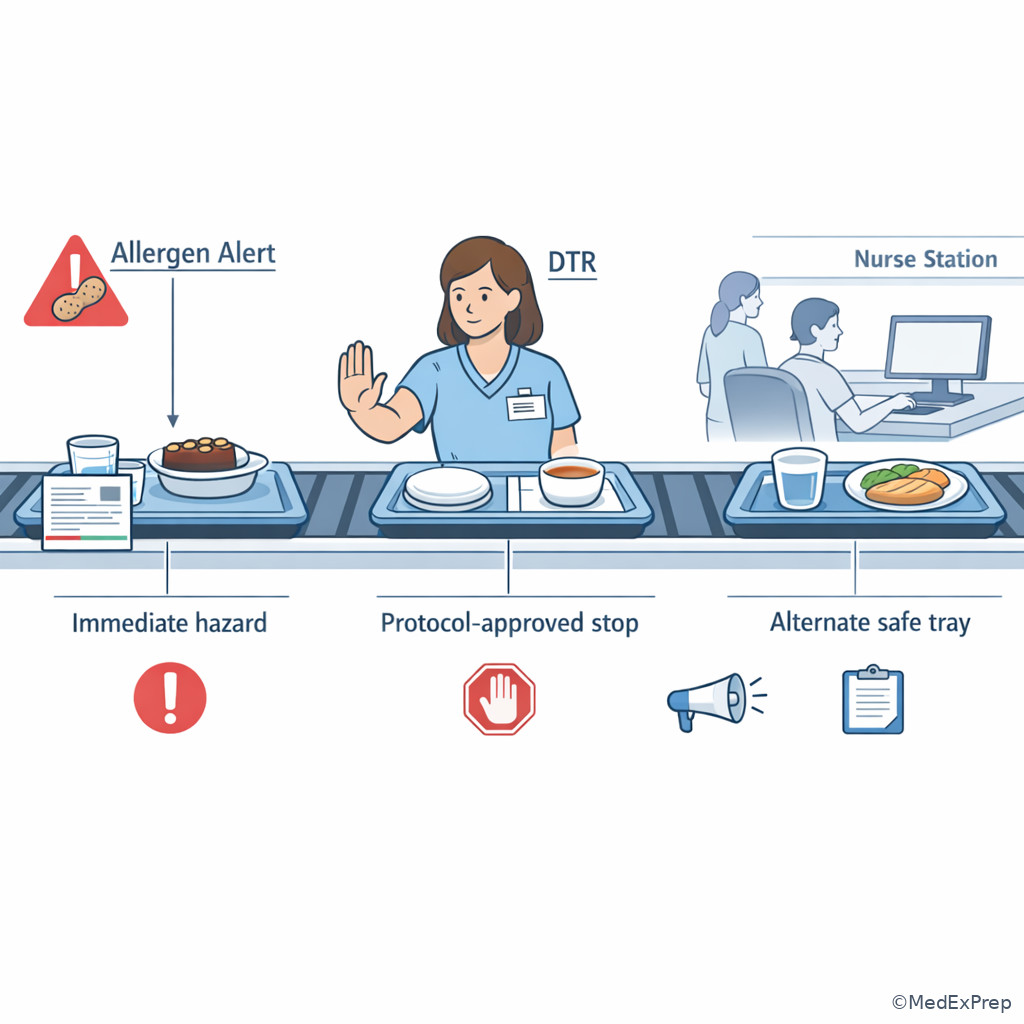
A DTR in acute care receives a tray line call: a 64-year-old patient with chronic kidney disease, atrial fibrillation, and a documented peanut allergy has a tray ticket showing a peanut-butter dessert due to a recent menu substitution. The patient also had low breakfast intake, and the unit is short staffed. A nurse says, “Just send it now and I’ll check later.” The tempting wrong clue is the workflow pressure.
Reasoning chain: Identify task: best immediate next step. Extract key facts: documented allergy creates immediate harm potential; there is a tray accuracy problem; staffing pressure is noise; low breakfast intake matters but is not the immediate hazard. Apply rule: prevent the immediate hazard within protocol by stopping the tray and arranging an allergy-safe alternative per policy, then notify the appropriate supervisor/clinical team as required and document the event. Eliminate distractors: sending the tray and relying on bedside catch is unsafe; changing the full diet order independently is outside scope; focusing first on low breakfast intake misses the highest-priority issue. Verify: safest next step is hazard prevention plus policy-based reporting.
C Exam trap
Common wrong answer: “Handle the less urgent nutrition concern before the immediate safety risk.”
WHY IT IS TEMPTING: Intake monitoring feels clinically important and familiar.
SINGLE CLUE THAT ELIMINATES IT: The stem contains a current allergy hazard, which takes priority.
D Checkpoint
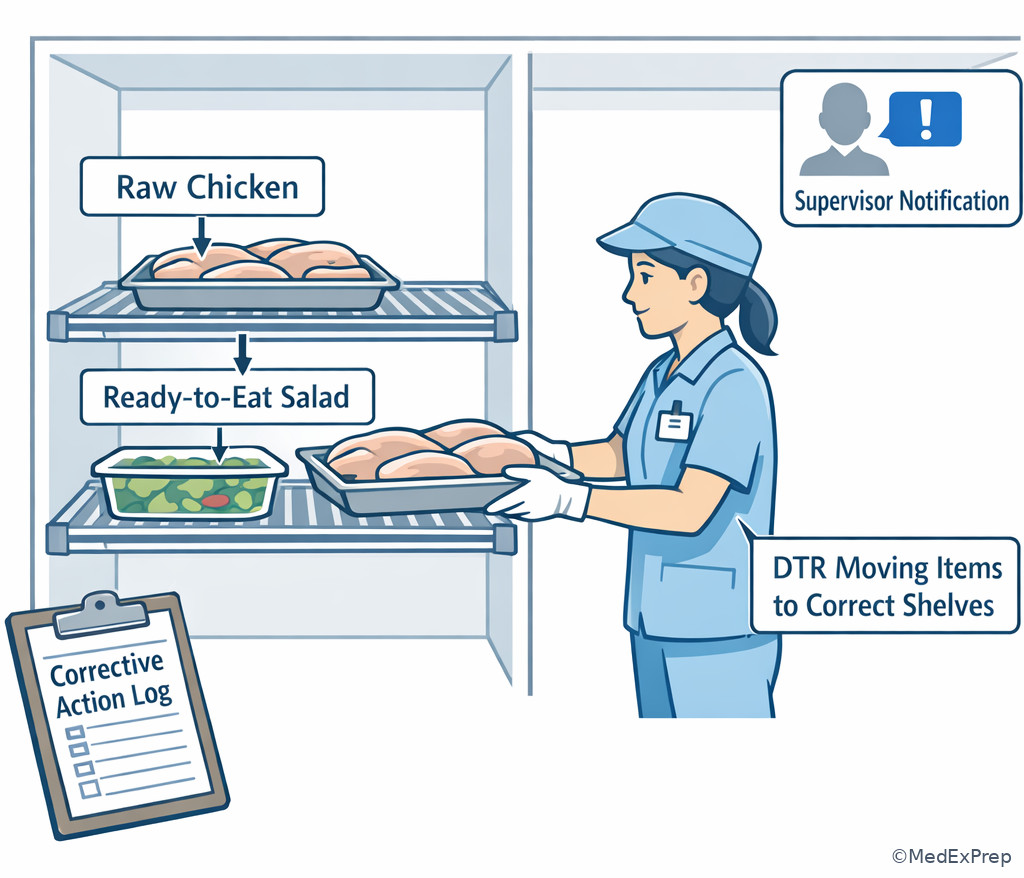
Question: A DTR in foodservice notices raw chicken stored above ready-to-eat salad during a refrigerator check. Production is starting, and the supervisor is in a meeting. What is the most appropriate next step?
- Immediately correct the storage hazard per protocol, report the issue to the supervisor/manager, and document the corrective action.
- Leave the refrigerator untouched so the supervisor can see the original problem.
- Discard all refrigerated food and rewrite department policy.
- Ignore the issue because it occurred before the DTR’s shift started.
- A: Tempting because it requires initiative, and it is correct because immediate hazard correction within protocol plus reporting fits DTR responsibility.
- B: Tempting because evidence preservation sounds logical, but delaying correction leaves a known contamination risk in place.
- C: Tempting because a broad response seems thorough, but rewriting policy exceeds routine role and indiscriminate disposal may be outside assigned authority.
- D: Tempting because ownership can feel unclear, but known food safety hazards require action regardless of who created them.
Exam takeaway: Immediate food allergy and tray accuracy hazards take priority over routine workflow pressure.
Exam takeaway: Correct immediate sanitation risks within protocol, then escalate and document rather than waiting for convenience.
Exam Traps & Differentiators
The most common wrong answer is the one where the DTR independently changes something clinical because the change sounds beneficial. The exam rewards safe role awareness, not overreach.
| Looks similar | Actually tested distinction | Choose | Reject |
|---|---|---|---|
| Nutrition screening vs nutrition assessment | Risk identification vs interpretive clinical synthesis | Use screening tools and refer | Independently conclude diagnosis or severity |
| Education reinforcement vs independent counseling | Repeat approved content vs create new therapeutic advice | Reinforce handout/care-plan teaching | Write personalized MNT plan from new labs |
| Monitoring vs diagnosis | Observe trends vs label the cause/problem | Document intake, weights, tolerance | State malnutrition diagnosis independently |
| Corrective action vs policy override | Fix immediate hazard within protocol vs redesign system independently | Remove unsafe tray, restack storage safely | Rewrite policy or change orders alone |
| Objective documentation vs opinion | Facts and quotes vs judgments and assumptions | “Consumed 15%; nurse notified” | “Noncompliant and careless” |
If the stem says...
- “existing diet order” → think implement or report, not independently change.
- “new lab results” → think reinforce approved teaching and refer new interpretation.
- “allergy,” “swallowing,” or “sanitation hazard” → think immediate safety action within protocol plus escalation.
- “which note is best” → think measurable facts, direct quote, action, notification.
- “busy unit” or “short staffed” → think noise; workflow pressure does not expand scope.
- “the nurse/manager asked you to just change it” → think authorization still matters; follow protocol and chain of command.
Exam takeaway: The best DTR answer usually preserves safety and policy while avoiding independent clinical decision-making.
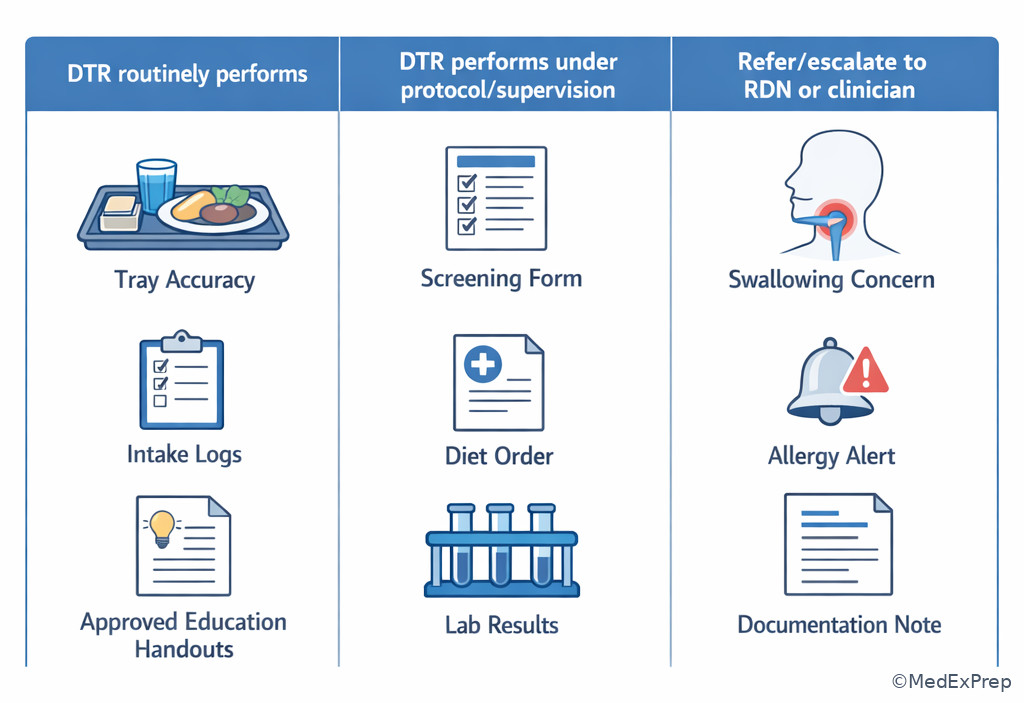
flowchart TD
A[Possible action] --> B{Within scope and policy?}
B -->|Yes| C[Collect data]
B -->|Yes| D[Implement approved plan]
B -->|Yes| E[Monitor and document]
B -->|No| F[Refer or escalate]
F --> G[Do not change order]
F --> H[Do not diagnose]
F --> I[Do not override policy] Exam takeaway: A visual boundary map can help you separate technician actions from RDN or provider-level decisions in mixed stems.
Related upcoming traps appear in Scope Limits And Escalation: there the confusable pair is not just perform versus refer, but when to escalate immediately. Another related trap in Standards, Policy, And Accountability is choosing an accurate note over an interpretive note.
Tables
| Situation | Within typical DTR role | Beyond independent DTR role | Best next step |
|---|---|---|---|
| Low meal intake trend | Record percentages and observe tolerance | Diagnose malnutrition or change diet order alone | Document and report per protocol |
| Question about approved handout | Reinforce existing teaching | Create new individualized therapeutic prescription | Reinforce, then refer advanced questions |
| Tray ticket mismatch | Hold unsafe tray and correct per protocol | Ignore and let bedside staff discover it later | Prevent hazard and notify |
| Swallowing concern | Observe, stop unsafe routine action if protocol allows, notify | Independently change texture order | Escalate promptly |
| Sanitation breach | Correct immediate hazard within policy | Rewrite department policy alone | Correct, report, document |
| New abnormal labs | Forward concern and reinforce approved teaching | Interpret and prescribe new plan independently | Refer to RDN/clinician |
| Documentation wording | Why tempting | Why wrong/right |
|---|---|---|
| “Noncompliant with diet” | Short explanation for refusal | Wrong: judgmental and not objective without supporting facts |
| “Likely lactose intolerant” | Links symptom to familiar cause | Wrong: diagnostic interpretation may exceed role |
| “Consumed 15%; refused milk stating ‘it upsets my stomach’” | Requires more exact wording | Right: measurable, quoted, objective |
| “Poor intake; monitor” | Efficient and generic | Incomplete: lacks action and often lacks notification detail |
| “Tray held due to allergy conflict; supervisor notified” | Operationally specific | Right: fact, action, notification, safety-centered |
| Who should act? | DTR action | RDN/supervising clinician action | Exam clue |
|---|---|---|---|
| Routine intake collection | Collect, document, report | Interpret significance and revise care plan if needed | Asked to record or monitor |
| Approved education handout review | Reinforce and answer basic approved questions | Provide new individualized MNT counseling | Existing teaching plan present |
| Therapeutic diet change request | Communicate request and maintain current order | Evaluate and authorize change | Client wants a different diet |
| Allergy or swallowing concern | Take immediate protocol-allowed safety action and report | Make broader clinical management decisions | Current risk of harm |
| Complex disease-based lab interpretation | Route concern and support data collection | Interpret and prescribe plan | New labs drive therapeutic question |
Algorithm / Approach
Exam takeaway: A repeatable decision framework helps resolve close-call stems with safety, policy, and scope cues.
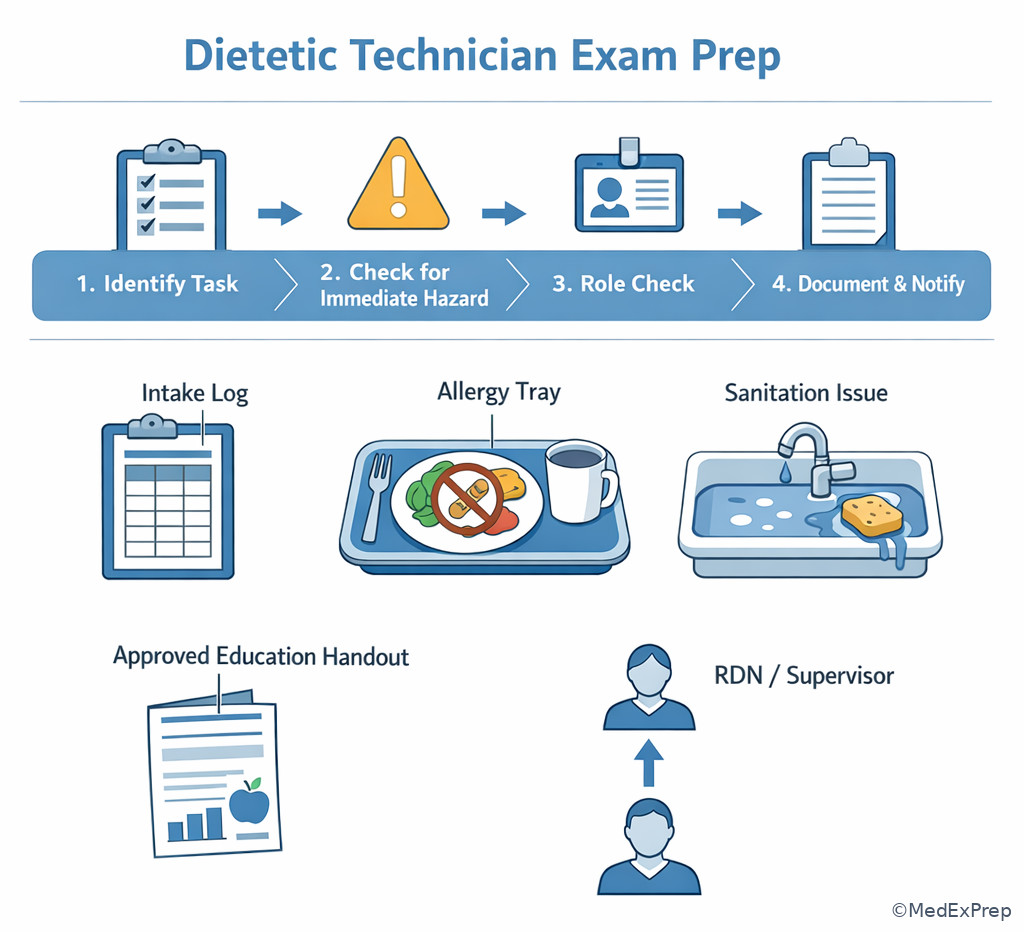
Rapid Review
- DTR role → perform routine support tasks; do not independently prescribe or diagnose.
- Supervision → competence does not replace delegated authority or policy.
- Existing diet order → maintain and report concerns; do not change independently.
- Approved education → reinforce it; new individualized therapy questions go to the RDN.
- Screening → identify risk and refer; assessment synthesis is a higher-level clinical task.
- Monitoring → collect intake/tolerance trends; avoid independent diagnostic labels.
- Urgent safety cue → allergy, swallowing, incorrect tray, sanitation breach = immediate protocol-based action plus notification.
- Best note → measurable fact + quote when useful + action + who was notified.
- Workflow pressure → never expands scope.
- Tempting wrong answer → clinically reasonable but belongs to another provider.
- Chain of command → use the designated reporting path, not informal shortcuts.
- Objective wording → “consumed 25%” beats “poorly compliant.”
- Policy conflict → follow local protocol and escalate if unclear.
Memory anchor: SAFE = Spot hazard, Act within protocol, Forward beyond scope, Enter objective documentation.
Self-check quiz
1. A DTR in outpatient education is reviewing an RDN-approved low-sodium handout with a 52-year-old client who has hypertension and obesity. The client asks for another copy and wants help identifying high-sodium canned foods. Which is the most appropriate action?
- Create a new individualized sodium prescription based on estimated urine sodium losses.
- Reinforce the approved handout and review label-reading examples from the existing education plan.
- Discontinue the current plan because the client reports frustration with shopping.
- Diagnose the client as nonadherent and document that further education is unlikely to help.
2. During meal rounds, a DTR notes that a patient with COPD and arthritis consumed 20% of lunch and refused the supplement, stating, “It tastes too sweet.” Which documentation entry is most appropriate?
- “Patient likely malnourished and noncompliant with plan.”
- “Poor intake. Will try again later.”
- “Consumed approximately 20% of lunch; refused supplement, stating ‘It tastes too sweet’; intake recorded per protocol.”
- “Changed supplement to a high-protein modular and discontinued original supplement.”
3. A 70-year-old long-term care resident with heart failure and chronic kidney disease asks the DTR to change from a therapeutic diet to a regular diet because food is bland. The resident also complains that breakfast was late and coffee was cold. Which is the most appropriate next step?
- Change the diet immediately to improve intake and satisfaction.
- Maintain the current order, address service concerns within role, and report the diet request according to policy.
- Explain that the diet will never change and no further action is needed.
- Write a note that the resident is refusing medical treatment.
4. A DTR screening new admissions identifies a patient with unintentional weight loss, poor intake, diabetes, and a newly elevated creatinine. The patient also mentions dislike of hospital pillows. Which action is most appropriate?
- Complete the screening findings, document the risk indicators objectively, and refer according to protocol.
- Determine the definitive nutrition diagnosis and start a complex renal-diabetes diet plan.
- Ignore the findings because screening is less important than formal assessment.
- Wait for another week of data before communicating the concern.
5. In a school foodservice setting, a DTR sees that a documented peanut-allergic student is about to receive a menu substitute containing peanut sauce. Staff are short-handed, and lunch service is busy. Which is the most appropriate action?
- Allow the tray to go out because the substitute meets nutrient standards.
- Stop the tray, provide an allergy-safe option allowed by protocol, and notify the designated supervisor.
- Ask the student whether the sauce usually causes a reaction.
- Rewrite the site's allergy management policy before resuming service.
6. A 66-year-old acute care patient with recent stroke, hypertension, and type 2 diabetes coughs during lunch. A busy nurse tells the DTR to switch the patient to nectar-thick liquids for dinner. The patient also reports that the soup was cold. Which is the most appropriate next step?
- Change the tray order to nectar-thick liquids immediately to reduce aspiration risk.
- Continue routine service without reporting because a nurse already noticed the issue.
- Follow the facility’s escalation pathway for swallowing concerns and avoid independently changing the texture order.
- Document the patient as aspirating and discontinue oral feeding.
7. A DTR in foodservice checks a walk-in refrigerator and finds raw poultry stored above ready-to-eat desserts. Production starts in 10 minutes, the supervisor is off the floor, and a coworker says to leave it until inspection rounds. Which is the most appropriate next step?
- Correct the storage hazard immediately per protocol, report it to the supervisor/manager, and document the corrective action.
- Leave the items as they are to preserve evidence for inspection.
- Discard all items in the refrigerator and independently retrain all staff.
- Move only the desserts and say nothing because service is behind schedule.
8. A 61-year-old outpatient with obesity, GERD, and newly elevated fasting glucose returns after prior RDN counseling on label reading and portion control. The client asks the DTR, “Exactly how many carbohydrate grams should I eat at each meal now?” and also asks where to park for free next visit. Which is the most appropriate response?
- Provide a new carbohydrate prescription based on common diabetes targets.
- Reinforce the approved label-reading and portion-control materials, answer logistical questions, and refer the individualized carbohydrate prescription question to the RDN.
- Tell the client the question is outside the department’s responsibility and end the visit.
- Advise eliminating all grains until the next follow-up.
Answer key
1. Correct answer: B
- A: Tempting because sodium counseling relates to hypertension, but creating a new individualized prescription requires higher-level clinical planning beyond routine DTR reinforcement. The single discriminating clue is that the handout is already RDN-approved and the client is asking within an education session, not for independent therapy redesign. Source: Academy of Nutrition and Dietetics standards emphasize role-appropriate practice and supervision.
- B: Tempting because it may seem too basic, and it is correct because reinforcing approved education and helping with label reading fit DTR scope. The clue is the existing approved handout and practical food-selection question.
- C: Tempting because frustration can affect adherence, but discontinuing the plan independently is not a DTR decision. The clue is that no authorized plan change has been made.
- D: Tempting because documentation matters, but labeling the client nonadherent is judgmental and not the best action. The clue is that the client is actively engaging in education, not refusing care.
2. Correct answer: C
- A: Tempting because poor intake can raise concern for malnutrition, but this note contains unsupported diagnosis and judgmental language. The discriminating clue is that the stem asks for documentation, not interpretation.
- B: Tempting because it is brief and practical, but it lacks measurable intake and the patient’s stated reason. The clue is the precise observed data provided in the stem.
- C: Tempting because it takes more detail, and it is correct because it documents measurable intake and a direct quote objectively. The clue is the exact observable facts available to chart.
- D: Tempting because product changes may improve acceptance, but independently discontinuing and substituting nutrition support products may exceed role depending on protocol and is not supported in the stem. The clue is no authorization for order change.
3. Correct answer: B
- A: Tempting because liberalizing a diet may improve intake and satisfaction, but independently changing a therapeutic order is outside routine DTR authority. The key clue is the existing therapeutic order.
- B: Tempting because it seems less direct than changing the diet, and it is correct because it separates service issues the DTR can address from order changes that require reporting/escalation. The clue is the mix of one in-role concern (cold coffee/late tray) and one out-of-role request (diet change).
- C: Tempting because it preserves the order, but it fails patient-centered communication and does not route the request appropriately. The clue is the need for policy-based communication, not dismissal.
- D: Tempting because the resident disagrees with treatment, but it overstates the situation and uses legalistic language unsupported by the stem. The clue is that the resident made a request; refusal management is not the primary issue presented.
4. Correct answer: A
- A: Tempting because it may feel incomplete compared with a full care response, and it is correct because screening identifies risk and triggers referral rather than independent diagnosis. The key clue is that the DTR is performing screening on admission.
- B: Tempting because the patient has multiple risk factors, but creating a complex renal-diabetes plan independently exceeds role. The clue is that the findings come from a screening stage, not a provider-level care planning directive.
- C: Tempting because assessment may seem more important, but screening exists precisely to identify who needs further assessment. The clue is the presence of multiple risk indicators that require communication.
- D: Tempting because more data can be useful, but delaying communication after identifying clear risk indicators is unsafe and inconsistent with screening purpose. The clue is unintentional weight loss plus poor intake and abnormal clinical data.
5. Correct answer: B
- A: Tempting because service must continue and nutrient standards matter, but allergy safety overrides routine menu matching. The discriminating clue is the documented peanut allergy.
- B: Tempting because it interrupts busy service, and it is correct because it removes the immediate hazard, uses an approved safe alternative, and follows chain-of-command notification. The clue is an active allergy conflict with a tray about to be served.
- C: Tempting because the student may know personal tolerance, but documented allergy procedures should not be replaced by informal self-report. The clue is the documented allergy list.
- D: Tempting because the issue suggests a systems problem, but policy rewriting is not the immediate or scope-appropriate next step during active service. The clue is the question asks what to do now.
6. Correct answer: C
- A: Tempting because thickened liquids can reduce aspiration risk in some patients, but independently changing texture is an order/protocol decision beyond routine DTR authority. The discriminating clue is that the nurse informally requested a diet-texture change.
- B: Tempting because another team member already noticed the issue, but the DTR still has a duty to follow the designated escalation pathway for a current swallowing concern. The clue is active coughing during intake.
- C: Tempting because it may feel indirect, and it is correct because it keeps the DTR within role while responding promptly to a safety concern. The clue is the combination of swallowing risk and lack of authorization for texture modification.
- D: Tempting because aspiration is a feared complication, but documenting a definitive diagnosis and discontinuing oral intake independently exceed role and protocol in most settings. The clue is absence of an authorized order or evaluation result.
7. Correct answer: A
- A: Tempting because it requires immediate action during a busy period, and it is correct because a cross-contamination hazard should be corrected promptly within protocol, then reported and documented. The discriminating clue is the current unsafe storage arrangement involving raw poultry above ready-to-eat food. Source: FDA Food Code principles support immediate correction of contamination risks.
- B: Tempting because preserving evidence sounds procedural, but leaving a known contamination hazard in place is unsafe. The clue is that production starts soon, increasing risk of use.
- C: Tempting because a broad response seems protective, but mass disposal and staff retraining decisions may exceed immediate assigned authority and are not the best first step. The clue is the question asks for the most appropriate next step, not the full department response plan.
- D: Tempting because partial correction helps service stay on time, but failing to report a serious sanitation issue leaves a documentation and accountability gap. The clue is the need for both corrective action and reporting.
8. Correct answer: B
- A: Tempting because the client asks directly for a carbohydrate target and common diabetes targets are familiar, but giving a new individualized prescription based on new clinical data exceeds routine DTR reinforcement. The discriminating clue is the request for a specific therapeutic prescription after newly elevated glucose.
- B: Tempting because it may seem less satisfying than answering fully, and it is correct because it combines in-scope reinforcement of approved materials with referral for individualized therapy. The clue is the existence of prior RDN counseling and the new need for therapy adjustment.
- C: Tempting because the exact prescription is outside role, but ending the visit ignores appropriate supportive education and customer service tasks. The clue is that some aspects of the visit, including reinforcement and logistics, remain within role.
- D: Tempting because reducing grains can lower carbohydrate intake, but advising a restrictive elimination approach is a new treatment recommendation unsupported by the approved plan. The clue is that the stem asks for exact individualized guidance, which should be referred.
Keep going with the full DTR Prep Course (DTR)
You just studied the way members do, in the same lesson interface. Full access unlocks every lesson, the question bank and flashcards for a full year.
One payment · 1 year of access · No auto-renewal