1.1.1 - Inferred Domain Structure
Lesson 1.1.1 Inferred Domain Structure
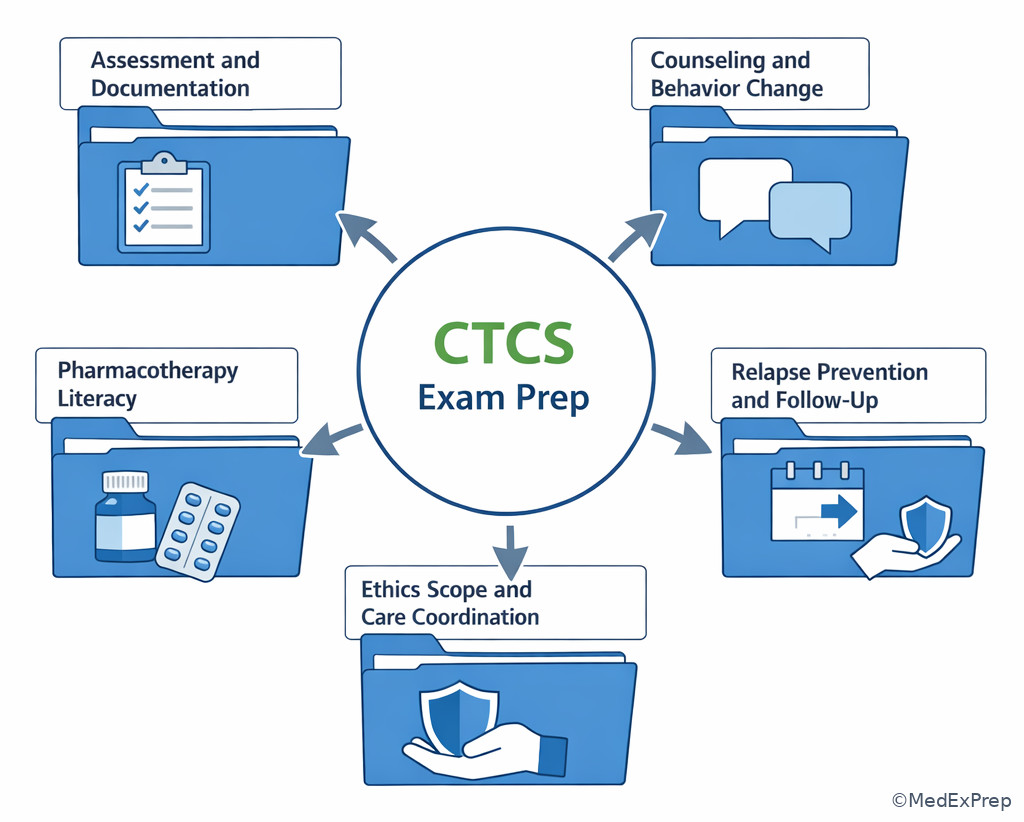
- Inferred Domain: Assessment and Documentation → screening, use history, dependence, readiness, barriers
- Inferred Domain: Counseling and Behavior Change → motivational interviewing, brief intervention, quit planning
- Inferred Domain: Pharmacotherapy Literacy → medication education, use principles, precautions, referral triggers
- Inferred Domain: Relapse Prevention and Follow-Up → monitoring, re-engagement, recovery-oriented support
- Inferred Domain: Ethics, Scope, and Care Coordination → confidentiality, boundaries, referral, safest-next-step reasoning
- Map this course's inferred CTCS study domains to likely exam-relevant tasks in assessment, counseling, treatment planning, pharmacotherapy literacy, relapse prevention, and scope-safe referral.
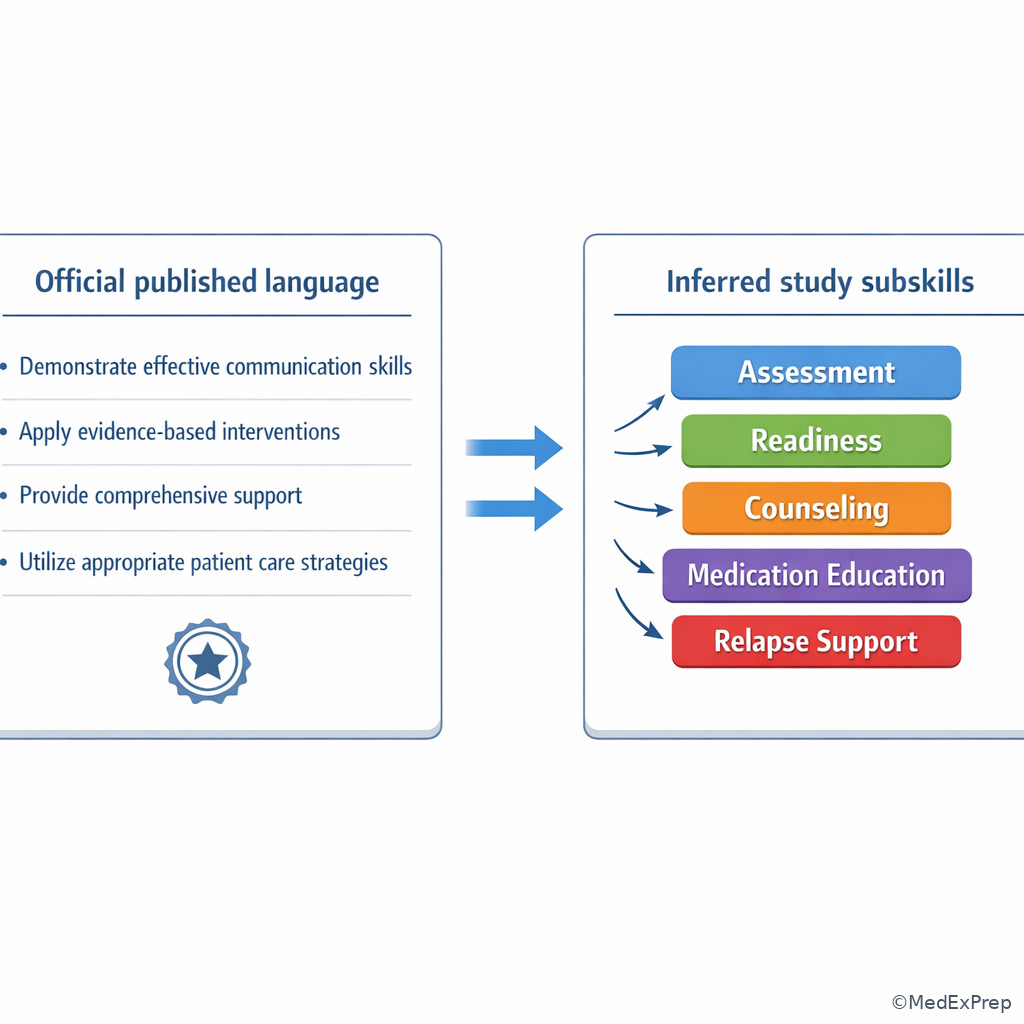
- Recognize the difference between an officially published blueprint detail and an inferred exam-relevant subskill.
- Choose the safest answer when a question tests the tobacco treatment specialist role rather than prescriber or diagnostic authority.
- Use a repeatable problem-solving framework: identify task → extract key facts → select governing rule → choose within scope → verify safety.
- Sort common CTCS-style stems into content clusters so you study the right competency instead of memorizing isolated facts.
Why it matters
- Many missed questions are not knowledge failures; they are mapping failures where the learner studies one competency but the stem is really testing another.
- CTCS-style questions often reward the safest in-scope action, especially when distractors sound medically impressive but exceed specialist authority.
- A clear domain map helps you separate assessment tasks from counseling tasks, medication education, and referral/escalation.
- When blueprint detail is sparse, a disciplined inferred structure prevents random studying and improves retention across the whole course.
Exam takeaway: First classify the stem by domain before choosing an answer, because the right action usually follows from the task category.
flowchart TD
A[CTCS exam-style stem] --> B[Assessment]
A --> C[Counseling]
A --> D[Pharmacotherapy literacy]
A --> E[Relapse prevention]
A --> F[Ethics and scope]
B --> B1[Screen use]
B --> B2[Assess dependence]
B --> B3[Assess readiness and barriers]
C --> C1[Use MI and 5 As]
C --> C2[Build quit plan]
D --> D1[Educate on options]
D --> D2[Identify precautions and refer]
E --> E1[Monitor progress]
E --> E2[Re-engage after lapse]
F --> F1[Protect confidentiality]
F --> F2[Stay within role]
Use this map immediately when reading questions. See Fig 1.
Exam takeaway: Visual grouping of tasks into assessment, counseling, medication education, follow-up, and referral improves question classification under time pressure.
Key Terms & Must-Know Facts
1.1.1.1 Key terms
- Blueprint: published content framework when available.
- Inferred subskill: a study-support category derived from accepted CTCS competencies when official detail is broad or limited.
- Domain: large content area such as assessment or counseling.
- Objective: a testable competency within a domain.
- Task pattern: the action the item wants, such as identify, interpret, counsel, refer, or monitor.
- Safest next step: the best action that fits the specialist role and protects client safety.
- Scope-safe answer: an answer that stays within education, support, monitoring, coordination, and referral authority.
- Red-flag trigger: a finding that requires escalation or clinician involvement.
- Readiness: willingness to consider behavior change now or later.
- Dependence pattern: amount, timing, triggers, prior withdrawal, and urgency of use.
- Behavioral intervention: counseling strategy used to build motivation and coping.
- Pharmacotherapy literacy: ability to educate about approved medications without prescribing beyond role.
- Lapse: brief return to use after abstinence.
- Relapse: broader return to prior pattern requiring re-engagement, not blame.
- Care coordination: collaboration with clinicians, quitlines, and community resources.
1.1.1.2 Must-know facts
- When official blueprint detail is limited, study should still map to clearly labeled inferred domains, not random facts.
- The CTCS candidate role emphasizes assessment, counseling, education, monitoring, and referral.
- Questions often reward client-centered communication over directive or shaming approaches.
- Answers that involve prescribing, diagnosing unrelated conditions, or ignoring safety concerns are usually outside scope.
- The best answer may be clarify, coordinate, or refer rather than act independently.
- Common content clusters recur across the course: use history, dependence, motivation, quit planning, medication education, relapse prevention, special populations, ethics.
- High-quality question solving starts with the task: What is the stem asking me to do?
- Noise in the stem matters only if it changes domain, safety, or scope.
| Study term | What it means for exam prep | What to do with it |
|---|---|---|
| Official blueprint language | Use exactly when available | Anchor notes and tags to published wording |
| Inferred domain | Course-built support category | Use to organize review when official detail is sparse |
| Task pattern | The action being tested | Classify stem before evaluating choices |
| Scope-safe answer | In-role, evidence-based action | Prefer educate, support, monitor, refer |
| Red-flag trigger | Potential safety issue | Escalate or coordinate promptly |
| Distractor family | Plausible but wrong options | Eliminate with one discriminating clue |
Core content
1.1.1.3 Foundational domain map: what broad buckets the exam is likely testing
A Explanation
The first decision conflict is simple but high yield: Is this question testing content knowledge within a domain, or is it testing whether you can classify the problem into the correct domain first? Many stems look like they are about medication, motivation, or documentation all at once. The resolving rule is: choose the domain that matches the primary action requested in the stem. If the task is to gather history, you are in assessment. If the task is to respond to ambivalence, you are in counseling. If the task is to explain medication options, precautions, or use principles, you are in pharmacotherapy literacy. If the task is to address a return to use or monitor ongoing progress, you are in relapse prevention and follow-up. If the task is about confidentiality, boundaries, or referral/escalation, you are in ethics and scope.
WHY THIS IS TESTED: exam items often layer multiple true facts into one vignette, but only one competency is being scored. The best answer follows the primary decision task, not the most medically interesting detail.
B Worked example
A 46-year-old client with hypertension and chronic low back pain says, “I smoke within 10 minutes of waking, tried to quit twice last year, and want to know what might help.” He adds that his cousin quit after “just using willpower,” and he also mentions mild seasonal allergies. The stem asks for the most appropriate next step by the tobacco treatment specialist. Identify task → the question is not asking for a diagnosis or prescription; it is asking for structured next-step support. Extract key facts → early-morning smoking and prior quit attempts point to dependence assessment; interest in help points to treatment planning. Apply rule → classify this as assessment leading into counseling and education. Eliminate distractors → “write a prescription,” “diagnose severe nicotine dependence as a medical disorder,” or “guarantee a medication will work” exceed role or evidence. Verify → the best answer is to assess dependence pattern and prior quit experience, then provide evidence-based counseling and education about approved options within policy.
C Exam trap
D Checkpoint
Question: A vignette asks the tobacco treatment specialist to identify the best next step for a client who uses cigarettes and e-cigarettes, is unsure about quitting, and has had several short quit attempts. Which domain best frames the first response?
- A. Assessment and counseling — Tempting because it may feel too broad; right because the first response must clarify use pattern, motivation, and barriers before advancing.
- B. Independent diagnosis of tobacco-related disease — Tempting because dual use signals risk; wrong because diagnosing unrelated conditions is outside specialist role.
- C. Immediate medication prescribing — Tempting because prior failed attempts suggest pharmacotherapy may help; wrong because prescribing is not the default specialist action.
- D. Employer policy determination — Tempting if the stem mentions workplace restrictions; wrong because policy/legal rulings are not universal clinical answers.
Best answer: A.
Exam takeaway: Each domain has a limited action family, so reject answers that belong to the wrong bucket even if they sound clinically smart.
flowchart LR
A[Assessment] --> A1[Ask and document]
A --> A2[Clarify pattern and readiness]
B[Counseling] --> B1[Use MI and quit planning]
C[Pharmacotherapy literacy] --> C1[Educate on approved options]
C --> C2[Identify precautions]
D[Follow-up] --> D1[Monitor withdrawal and adherence]
D --> D2[Address lapse]
E[Ethics and scope] --> E1[Protect confidentiality]
E --> E2[Refer or escalate]
See Fig 2 when you want a fast “answer family” check.
1.1.1.4 Foundational mapping rules: official blueprint language versus inferred subskills
A Explanation
The next decision conflict is whether to treat the course framework as an official blueprint or as a study aid. The resolving rule is: use official language when it is published; when detail is incomplete, label your study categories as inferred and never present them as official CPS scoring or content specifications. For exam prep, that means you can absolutely organize material into defensible subskills such as dependence assessment, readiness interviewing, medication education, and relapse support. What you cannot do is claim exact weightings, passing standards, or formal CPS categorizations without published support.
WHY THIS IS TESTED: professionalism and ethics are part of competent prep. The exam may indirectly test whether you can reason safely when rules vary by institution or are not fully specified. In those cases, the best answer often includes confirm policy rather than assuming a universal rule.
B Worked example
A 34-year-old community health worker is studying for CTCS while also helping build an internal staff training checklist. She has asthma, no tobacco use, and asks whether “relapse prevention” is definitely a separate official CPS content domain. A distracting detail in the prompt notes that her agency also offers diabetes education. The task asks for the best interpretation. Identify task → this is not a clinical counseling item; it is a framework interpretation item. Extract key facts → official detail may be limited, and the course uses inferred mappings. Apply rule → you can study relapse prevention as an inferred exam-relevant content cluster without calling it an official CPS domain. Eliminate distractors → answers claiming exact CPS weight percentages or official scoring linkage are unsupported. Verify → the best answer is to use the inferred cluster for study, while recognizing that official blueprint specifics may be broader or unpublished.
C Exam trap
D Checkpoint
Question: Which statement best reflects correct use of inferred domain structure in CTCS prep?
- A. Inferred domains can replace all official language permanently — Tempting because inferred domains are practical; wrong because official wording should be used when available.
- B. Inferred domains are acceptable as learner-facing study scaffolds when clearly labeled as nonofficial — Tempting because it sounds cautious; right because it matches ethical prep practice.
- C. Inferred domains justify assigning exact CPS percentages to topics — Tempting because percentages help prioritize study; wrong because unsupported weights should not be invented.
- D. Inferred domains allow the specialist to decide legal or institutional policy questions independently — Tempting when local workflow is discussed; wrong because such rules vary and require confirmation.
Best answer: B.
- The safest phrase when local rules may vary is: confirm with your institution or governing body.
- True or False: A well-designed study outline automatically becomes an official blueprint. False.
- Name the two labels you must keep separate: official blueprint detail and inferred exam-relevant subskill.
Exam takeaway: When source authority is uncertain, use the material for study support but avoid overstating it as official policy or scoring guidance.
flowchart TD
A[Need to classify a framework detail] --> B{Published by CPS?}
B -->|Yes| C[Use official wording]
B -->|No or incomplete| D[Use inferred subskill label]
D --> E[State it is for study support]
E --> F[Do not assign official scoring or legal status]
See Fig 3 for the fastest way to avoid overclaiming.
Exam takeaway: Keep source authority visible in your notes so you do not confuse official competency language with study-organizing labels.
1.1.1.5 Application: how stems signal assessment, counseling, pharmacotherapy literacy, or referral
A Explanation
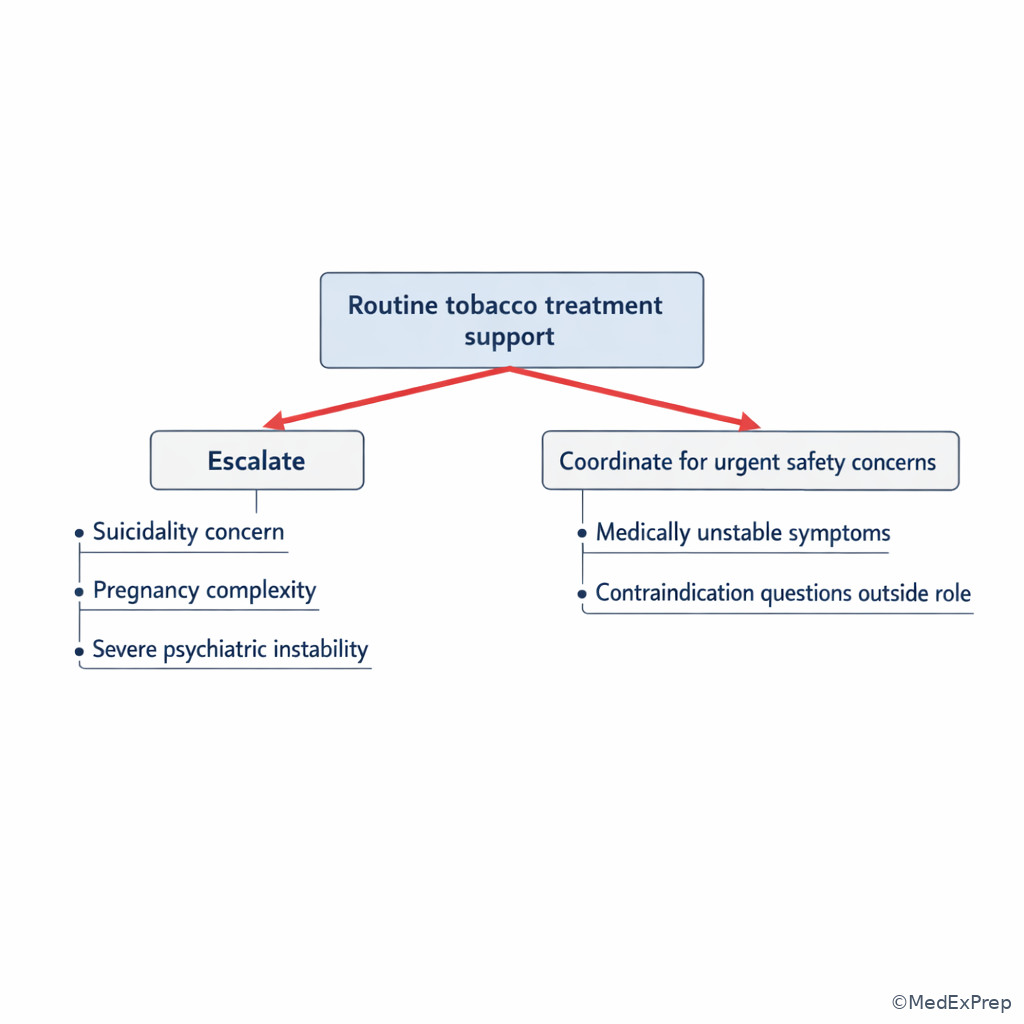
Once you know the broad map, the next decision conflict is recognizing stem signals. The resolving rule is: look for the verb of the task and the missing piece in the scenario. If the missing piece is history, the stem is asking for assessment. If the missing piece is motivation handling, it is counseling. If the missing piece is accurate information about approved medications, expected use, precautions, or adherence support, it is pharmacotherapy literacy. If the missing piece is action around urgent safety, severe instability, pregnancy complexity, suicidality, or another red flag, it is referral/escalation. In short, identify what the specialist must supply next.
WHY THIS IS TESTED: board-style stems often include realistic noise: age, coexisting conditions, opinions from family, a tempting product myth, or irrelevant laboratory information. The best test takers separate signal from noise by focusing on the question task and the one fact that changes what the specialist should do.
B Worked example
A 52-year-old client with diabetes and generalized anxiety says, “I know tobacco is bad, but I am not ready to set a quit date. I smoke more when my son visits.” He reports one prior quit attempt, asks whether nicotine replacement “is cheating,” and the chart also shows mildly elevated cholesterol. A tempting but wrong clue is the medication question. Identify task → the stem asks for the most appropriate response to ambivalence, not a product recommendation alone. Extract key facts → not ready to quit, emotional trigger tied to visits, value statement that tobacco is harmful. Apply rule → this is a counseling-domain item with motivational interviewing focus. Eliminate distractors → a detailed pharmacotherapy lecture without engaging readiness misses the task; pressure-based advice also misses client-centered technique. Verify → the best answer is to explore ambivalence, elicit reasons for change, and connect coping planning to his trigger pattern.
C Exam trap
D Checkpoint
Question: A client says, “I smoke first thing in the morning, my partner smokes, and I am afraid of withdrawal.” The stem asks for the most important information to gather next. Which domain is primary?
- A. Assessment — Tempting because the case already includes some history; right because the task explicitly asks what to gather next.
- B. Legal policy interpretation — Tempting if workplace rules are mentioned elsewhere; wrong because policy is not the identified gap.
- C. Immediate relapse counseling — Tempting because withdrawal fear predicts relapse; wrong because the client has not yet made a quit attempt in this stem.
- D. Independent psychiatric diagnosis — Tempting if anxiety is present; wrong because diagnosing is outside role and not the task.
Best answer: A.
Exam takeaway: Specific wording in the task line often reveals whether the best answer is assess, counsel, educate, monitor, or refer.
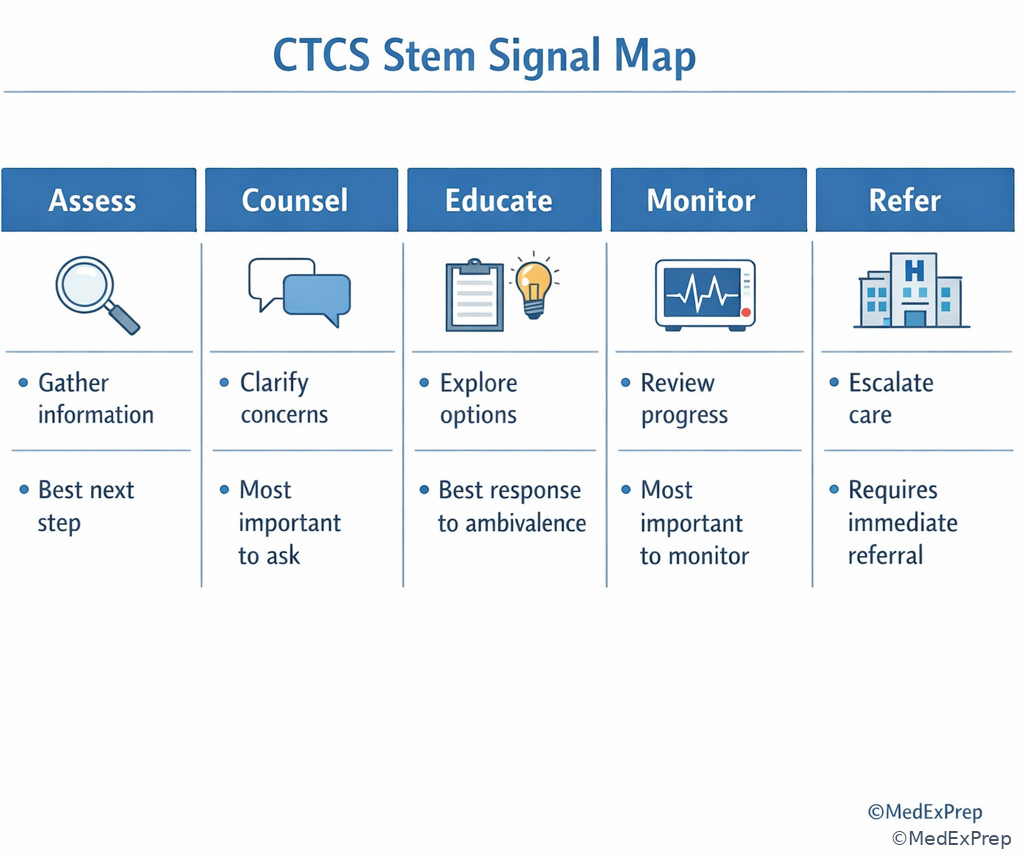
See Fig 4 for common task-line cues.
1.1.1.6 Integration: scope-safe answering within the inferred domain structure
A Explanation
The core integration conflict is choosing between a technically appealing action and a role-appropriate action. The resolving rule is: within the correct domain, choose the strongest answer that remains inside the tobacco treatment specialist role and addresses safety. That means education, supportive counseling, follow-up planning, monitoring, documentation, coordination, or referral are often right. By contrast, independently prescribing, diagnosing unrelated medical or psychiatric disorders, guaranteeing outcomes, or making legal determinations are wrong even if they sound decisive.
WHY THIS IS TESTED: certification exams do not just test content recall; they test professional judgment. A realistic specialist must know when to act, when to clarify, and when to hand off. The best answer is not always the most advanced intervention; it is the safest next step within scope.
B Worked example
A 29-year-old postpartum client with a history of depression reports daily vaping, intermittent cigarette use under stress, and says she feels “like giving up on everything” after a recent argument. She asks whether she should stop her antidepressant and whether you can tell her which drug to start for quitting. A distracting detail notes that she also drinks three cups of coffee daily. Identify task → the stem asks for the most appropriate next step by the specialist. Extract key facts → postpartum context, depression history, statement suggesting possible safety concern, medication-management question beyond role. Apply rule → this is ethics/scope with referral/escalation overriding routine counseling. Eliminate distractors → detailed product matching or advice to stop or continue psychiatric medication independently is out of role. Verify → the best answer is to address immediate safety concerns and coordinate urgent evaluation while maintaining supportive, nonjudgmental communication.
C Exam trap
D Checkpoint
Question: Which answer best reflects scope-safe reasoning for a CTCS candidate?
- A. Recommend the client stop all other medications today and begin a new cessation medication immediately — Tempting because it sounds proactive; wrong because altering regimens independently exceeds role.
- B. Explore concerns, provide evidence-based education, and coordinate with the appropriate clinician when safety or contraindication questions arise — Tempting because it may feel less decisive; right because it advances care safely within scope.
- C. Diagnose a psychiatric relapse based on the interview and document a treatment plan independently — Tempting because symptoms may be concerning; wrong because diagnosis is outside role.
- D. Promise that a selected cessation option will work if the client is motivated enough — Tempting because confidence-building matters; wrong because outcomes cannot be guaranteed.
Best answer: B.
- Most CTCS-safe answer family: educate, support, monitor, coordinate, refer.
- True or False: The most medically detailed option is usually the best exam answer. False.
- One phrase that should trigger caution: independently alter medication regimens.
Exam takeaway: After identifying the domain, screen for red flags and then choose the best in-role action rather than overreaching.
flowchart TD
A[Identify question domain] --> B{Any safety red flag or out-of-scope request?}
B -->|Yes| C[Coordinate, refer, or escalate]
B -->|No| D[Provide in-role education and counseling]
D --> E[Plan follow-up and monitoring]
C --> E
E --> F[Document clearly]
Use this as your master exam filter. See Fig 5.
1.1.1.7 Integration: using the domain structure as a study plan and test-day framework
A Explanation
The final conflict is whether to study by isolated facts or by decision structures. The resolving rule is: study facts inside the domain where you will use them. For example, a quit-attempt history belongs under assessment because it informs treatment planning. A medication myth belongs under counseling if the task is to respond to ambivalence, but under pharmacotherapy literacy if the task is to explain proper use. Lapse language belongs under relapse prevention when the task is re-engagement, and under scope/ethics when the vignette includes stigma, blame, or confidentiality concerns. This structure is efficient because it mirrors how stems are written.
WHY THIS IS TESTED: adult credential exams reward transfer, not memorization. You may know every definition but still miss items if you cannot place facts into the right decision sequence. Domain-based studying improves retrieval because each fact has a job.
B Worked example
A 61-year-old client with COPD and osteoarthritis says he wants to quit “someday,” uses cigarettes and smokeless tobacco, and asks whether cutting down counts. He reports two prior quit attempts, one lasted 3 weeks, and his brother insists “cold turkey is the only real way.” His oxygen saturation and arthritis medications are listed, but the stem asks what study category this vignette mostly trains. Identify task → the vignette integrates several facts, but the decision is about organizing response. Extract key facts → mixed product use, ambivalence, prior attempts, social myth. Apply rule → the primary domains are assessment plus counseling; product details matter later. Eliminate distractors → calling it mainly legal policy, unrelated respiratory diagnosis, or prescriptive medication management misreads the task. Verify → use the case to practice classification, then sequencing: assess pattern, explore readiness, address myths, and build toward a quit plan.
C Exam trap
D Checkpoint
Question: Which study strategy best matches the inferred domain structure taught in this lesson?
- A. Memorize isolated facts without linking them to likely item tasks — Tempting because it feels efficient; wrong because it weakens transfer to scenario-based questions.
- B. Organize facts by domain and attach each to likely task verbs and scope limits — Tempting because it requires more planning; right because it mirrors exam reasoning.
- C. Prioritize only medication names and ignore counseling or ethics items — Tempting because medications feel testable; wrong because CTCS scope spans much more than pharmacotherapy literacy.
- D. Assume all questions are really asking for the same kind of response — Tempting under time pressure; wrong because different domains call for different answer families.
Best answer: B.
Exam takeaway: Notes built around task verbs and decision rules are easier to retrieve than topic lists alone.
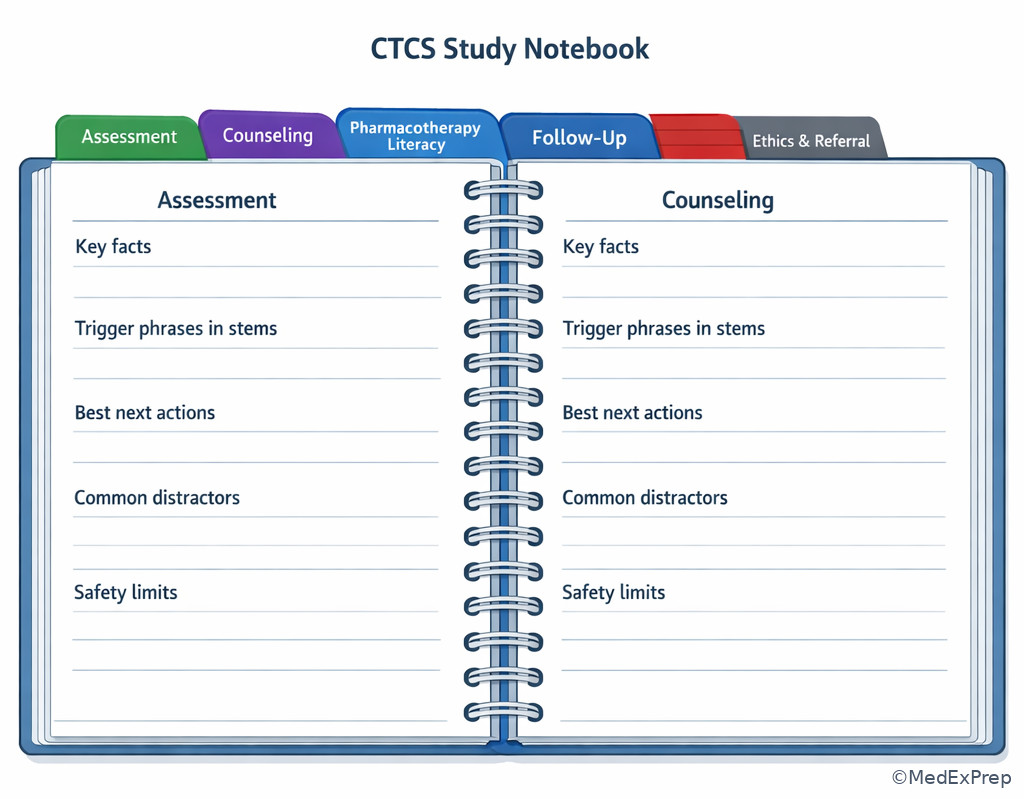
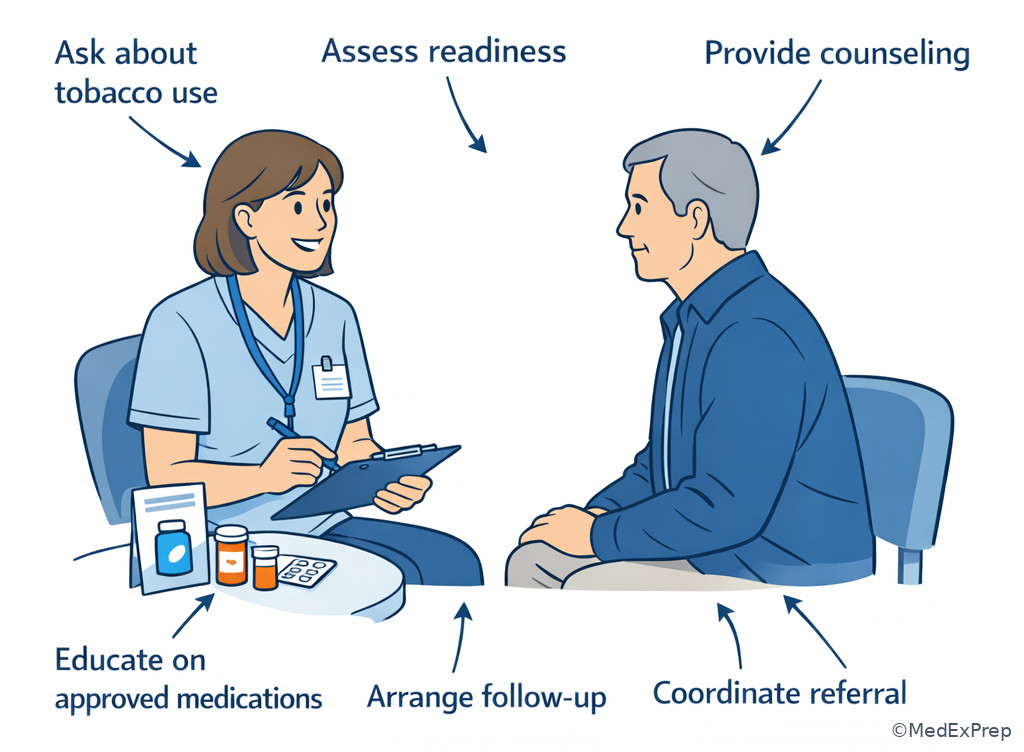
Exam takeaway: The specialist role centers on asking, listening, educating, documenting, and coordinating rather than diagnosing or prescribing.
Exam takeaway: Safety concerns change priority from routine counseling to prompt coordination or referral.
Exam Traps & Differentiators
| Looks similar | But actually tests | Single clue | Best answer tendency |
|---|---|---|---|
| Client mentions a product | Counseling about readiness | Ambivalence is the barrier | Use MI, not product matching first |
| Client asks “what should I use?” | Assessment first | Dependence history is incomplete | Clarify pattern, prior attempts, and contraindication concerns before specifics |
| Client has complex comorbidity | Scope and referral | Safety concern overrides routine support | Coordinate or escalate |
| Question includes policy or employer details | Boundary recognition | Local rules vary | Confirm institutional/governing policy |
| Question mentions relapse | Recovery-oriented follow-up | Return to use is current issue | Re-engage without blame and revise plan |
Most common wrong answer and why: The most common wrong answer is the one that sounds most medically forceful. It is tempting because learners confuse confidence with correctness. The discriminator is whether the action fits the specialist's role and the stem's primary task.
If the stem says...
- “Most important to ask next” → think assessment gap.
- “Best response to a client who is unsure” → think motivational counseling.
- “What should be explained about approved options?” → think pharmacotherapy literacy within scope.
- “Requires immediate clarification” → think red flag, contraindication, or out-of-scope issue.
- “Best next step after a lapse” → think re-engagement and relapse prevention.
- “Policy, legal, or coverage question” → think do not assume universality; confirm applicable policy.
| Wrong answer type | Why it is tempting | How to eliminate it |
|---|---|---|
| Premature medication answer | Feels efficient and concrete | Reject if readiness or assessment is still unresolved |
| Out-of-scope diagnosis | Appeals to clinical seriousness | Reject if specialist is asked to diagnose unrelated medical or psychiatric conditions |
| Independent prescribing or regimen change | Seems action-oriented | Reject unless separate licensure/authority is explicitly granted |
| Guarantee of success | Sounds supportive and confident | Reject because evidence-based care cannot promise outcomes |
| Universal policy claim | Mimics administrative certainty | Reject if institution/jurisdiction may vary |
Exam takeaway: Eliminate choices by identifying whether they solve the wrong problem, exceed scope, or skip a necessary earlier step.
flowchart LR
A[Answer choice] --> B{Matches task?}
B -->|No| C[Reject: wrong domain]
B -->|Yes| D{Within scope?}
D -->|No| E[Reject: overreach]
D -->|Yes| F{Safety addressed?}
F -->|No| G[Reject: misses red flag]
F -->|Yes| H[Keep as contender]
Use this final screen on close-call items. See Fig 6.
Tables
| Inferred domain | Typical stem wording | Best answer family | Common wrong family |
|---|---|---|---|
| Assessment and documentation | Most important to ask; what history is needed; what should be documented | Clarify pattern, dependence, readiness, barriers | Jumping to treatment before enough data |
| Counseling and behavior change | Best response; address ambivalence; support motivation | Use client-centered, nonjudgmental counseling | Directive, shaming, or purely informational response |
| Pharmacotherapy literacy | What should be explained; proper use considerations; precautions | Educate within role and coordinate as needed | Prescribing or changing regimens independently |
| Relapse prevention and follow-up | After lapse; follow-up priority; monitor progress | Re-engage, normalize recovery, revise plan | All-or-nothing failure framing |
| Ethics, scope, and care coordination | Requires immediate clarification; confidentiality; best next step with red flags | Protect privacy, confirm policy, refer or escalate | Independent legal/medical determinations |
| Category | Examples inside role | Examples outside role |
|---|---|---|
| Assessment | Ask about products, timing, triggers, prior quit attempts | Diagnose unrelated cardiopulmonary disease independently |
| Counseling | Use MI, support goal setting, discuss coping | Coerce, shame, or promise success |
| Medication support | Educate on approved options, use principles, side-effect reporting | Prescribe, dispense, or alter regimens without authority |
| Monitoring | Track withdrawal, adherence, triggers, follow-up plan | Manage unstable medical deterioration independently |
| Referral | Coordinate with clinician, quitline, behavioral health, emergency resources | Delay escalation when urgent safety concerns are present |
| Differential question type | What the stem really wants | Discriminator |
|---|---|---|
| Assessment vs counseling | Whether data are still missing or ambivalence is the main barrier | Missing history favors assessment; expressed uncertainty favors counseling |
| Counseling vs pharmacotherapy education | Whether the barrier is motivation or product understanding | Readiness conflict favors counseling; use/principle question favors education |
| Routine support vs referral | Whether safety red flags override ordinary care | Urgent concern favors escalation |
| Official rule vs local variation | Whether a universal claim is justified | If institution/jurisdiction could differ, confirm policy |
| Lapse vs failure narrative | Whether to re-engage or judge | Recovery framing favors re-entry and plan revision |
Algorithm / Approach
Rapid Review
- Domain map → classify the stem before judging options.
- Assessment item → asks for missing history or documentation.
- Counseling item → ambivalence, confidence, or resistance is the barrier.
- Pharmacotherapy literacy item → explain options and precautions without prescribing beyond role.
- Follow-up item → monitor progress, withdrawal, adherence, lapse risk.
- Ethics/scope item → confidentiality, boundaries, referral, policy variation.
- Best answer → strongest action that remains in scope.
- Most dangerous distractor → medically impressive but solves the wrong problem.
- Inferred subskill → acceptable study label, not official scoring language.
- Local variation cue → confirm institutional or governing-body policy.
- Urgent safety cue → escalation outranks routine counseling.
- Recovery framing → lapse calls for re-engagement, not blame.
- Task verb → usually predicts answer family faster than background details.
- Close-call elimination → use one clue, not general impression.
Self-check quiz
1. A study guide for CTCS candidates organizes content into assessment, counseling, pharmacotherapy literacy, follow-up, and ethics/scope because official detail is broad. Which statement is the best interpretation?
- A. These categories are acceptable inferred study domains when clearly labeled as nonofficial.
- B. These categories prove the exact official CPS blueprint percentages.
- C. These categories allow a learner to infer passing standards.
- D. These categories replace all need to confirm local policy variation.
2. A 43-year-old client with hypertension and insomnia says, “I am not ready to quit, but I know I should.” The stem asks for the best response by the tobacco treatment specialist. Which domain is most likely primary?
- A. Counseling and behavior change
- B. Independent diagnosis
- C. Employer policy adjudication
- D. Emergency medical management
3. A 58-year-old client with COPD and hyperlipidemia reports smoking within 5 minutes of waking, two failed quit attempts, and concern about withdrawal. He asks, “What should I do first?” A distracting chart note mentions seasonal rhinitis. Which is the most appropriate next step for the specialist?
- A. Clarify dependence pattern and prior quit experience, then provide counseling and education within role
- B. Diagnose severe tobacco use disorder and determine his medication regimen independently
- C. Delay assessment and begin with a guarantee that one approach will work
- D. Focus mainly on rhinitis because it may affect quitting confidence
4. A 37-year-old client with anxiety and migraine says, “My partner wants me to quit, but I am not sure I want to.” She also asks whether nicotine replacement is “just trading one addiction for another.” The stem asks for the best initial action. Which answer is best?
- A. Explore ambivalence and reasons for change before moving into detailed product education
- B. Immediately select a product and instruct her to start it without further discussion
- C. State that motivation is irrelevant if the medication choice is correct
- D. Tell her she must commit to abstinence before any conversation can continue
5. A program manual in one clinic says all tobacco users must be referred to the quitline at the first visit. Another clinic where you rotate uses an opt-in approach. An exam item asks for the best interpretation. Which answer is most appropriate?
- A. Assume the first clinic's rule is universally required for all CTCS settings
- B. State that workflow requirements may vary and should be confirmed with the institution or governing body
- C. Ignore clinic policy because counseling principles are enough
- D. Decide independently which clinic rule is legally superior
6. A 29-year-old postpartum client with prior depression, current vaping, intermittent cigarette use, and a statement that she feels “like giving up on everything” asks you to tell her whether to stop her antidepressant and which cessation medication to start. She also notes reduced sleep because of the baby. What is the most appropriate next step?
- A. Provide routine cessation counseling only and schedule follow-up next month
- B. Tell her to stop the antidepressant if it might interfere with quitting
- C. Address the potential safety concern and coordinate urgent evaluation with the appropriate clinician or emergency resource
- D. Choose a cessation medication for her so she feels immediate progress
7. A 64-year-old client with diabetes and coronary disease says he wants to quit “eventually,” uses cigarettes and smokeless tobacco, and asks whether cutting down counts. His spouse says, “He just needs stronger discipline.” The stem asks which approach the case is primarily testing. Which answer is best?
- A. Assessment plus counseling, because mixed-product history and readiness both drive the next step
- B. Independent cardiology management, because coronary disease is the most serious issue
- C. Pure pharmacotherapy selection, because any tobacco use automatically makes medication the first domain
- D. Legal adjudication of household pressure and coercion
8. A 51-year-old client with chronic pain and controlled bipolar disorder says he relapsed after 2 smoke-free weeks and now feels the quit attempt was a “total failure.” He asks if he should stop trying. His employer also recently changed tobacco-free campus signage. Which answer is the best next step?
- A. Reframe the lapse as data, reassess triggers and supports, and revise the quit plan within scope
- B. Tell him the previous attempt does not count because it was shorter than a month
- C. Focus first on interpreting the employer signage because policy details are central to recovery
- D. Diagnose mood destabilization as the main cause of relapse and manage it independently
Answer key
1. Correct answer: A
- A. Tempting because it sounds cautious rather than authoritative; correct because inferred domains are valid study scaffolds when official detail is broad or limited and the nonofficial status is kept clear. The single clue is the phrase organizes content because official detail is broad.
- B. Tempting because learners want percentages to prioritize study; incorrect because inferred categories cannot establish exact official CPS weights. The single clue is the absence of published percentage data.
- C. Tempting because blueprint language and scoring often feel linked; incorrect because passing standards cannot be inferred from study categories. The single clue is that the item asks about organization, not scoring.
- D. Tempting because a good framework feels complete; incorrect because local workflow and policy issues may still vary and require confirmation. The single clue is that study organization does not erase institutional variation.
2. Correct answer: A
- A. Tempting because it may seem less concrete than medication action; correct because “not ready to quit” signals ambivalence, making counseling and behavior change the primary domain. The single clue is not ready to quit, but I know I should.
- B. Tempting because insomnia and tobacco use can coexist with broader clinical issues; incorrect because the specialist is not being asked to diagnose. The single clue is the request for the best response, not diagnosis.
- C. Tempting if workplace issues are common in practice; incorrect because no policy conflict is central here. The single clue is the client's ambivalence, not an employer question.
- D. Tempting because tobacco harms are serious; incorrect because there is no emergency cue in the stem. The single clue is the absence of urgent instability.
3. Correct answer: A
- A. Tempting because it begins with assessment rather than a dramatic intervention; correct because early-morning use, failed quit attempts, and withdrawal concern indicate the need to clarify dependence and prior experience before counseling and medication education within role. The single clue is that the client asks what to do first.
- B. Tempting because high dependence may suggest formal diagnostic language and medication need; incorrect because independently diagnosing and determining a regimen exceed the specialist's default role. The single clue is for the specialist.
- C. Tempting because confidence-building matters; incorrect because guarantees are not evidence-based and skipping assessment is premature. The single clue is incomplete treatment-planning information.
- D. Tempting because any symptom in the chart can attract attention; incorrect because rhinitis is background noise and does not drive the tobacco treatment task. The single clue is that rhinitis does not affect the main decision requested.
4. Correct answer: A
- A. Tempting because it sounds slower than jumping to product details; correct because explicit ambivalence is the main barrier, so motivational exploration should come before detailed product counseling. The single clue is not sure I want to.
- B. Tempting because the client asked a medication question; incorrect because answering the concrete side question misses the stem's main readiness conflict. The single clue is ambivalence, not product selection readiness.
- C. Tempting because medication can support cessation; incorrect because motivation is highly relevant to engagement and adherence. The single clue is the client's uncertain desire to change.
- D. Tempting because commitment is important; incorrect because requiring commitment before discussion is not client-centered and can shut down change talk. The single clue is that the best initial action should engage, not block, conversation.
5. Correct answer: B
- A. Tempting because one clinic policy may sound highly organized and evidence-based; incorrect because institutional workflows can vary and should not be universalized without authority. The single clue is that the stem explicitly shows two different clinic approaches.
- B. Tempting because it sounds less concrete than choosing one policy; correct because the safest interpretation is that workflow requirements may vary and need confirmation. The single clue is the presence of conflicting clinic manuals.
- C. Tempting because counseling principles matter across settings; incorrect because policy still matters operationally and cannot simply be ignored. The single clue is that the item asks for interpretation of workflow difference.
- D. Tempting because learners want a definitive answer; incorrect because legal superiority is outside the specialist's authority and unsupported by the vignette. The single clue is the absence of a governing legal standard in the stem.
6. Correct answer: C
- A. Tempting because routine counseling is a core CTCS function; incorrect because the statement about “giving up on everything” introduces a potential urgent safety concern that changes priority. The single clue is the possible self-harm signal.
- B. Tempting because medication questions often appear in cessation care; incorrect because advising medication discontinuation independently is outside role and unsafe here. The single clue is the request to stop an antidepressant.
- C. Tempting because it may feel like stepping away from tobacco content; correct because safety concerns override routine cessation planning, and coordination with the appropriate clinician or emergency resource is the scope-safe next step. The single clue is the concerning statement in a vulnerable context.
- D. Tempting because immediate action can feel reassuring; incorrect because selecting a cessation medication ignores both safety priority and role limits. The single clue is that urgent evaluation comes before routine option matching.
7. Correct answer: A
- A. Tempting because it seems broad; correct because the vignette combines mixed-product assessment needs with readiness/counseling needs, making that paired domain interpretation the best fit. The single clue is the combination of dual-product use and “eventually.”
- B. Tempting because coronary disease raises clinical stakes; incorrect because the question asks what the case is primarily testing for the specialist, not for cardiology management. The single clue is the educational framing of the item.
- C. Tempting because tobacco use can make medication relevant; incorrect because readiness and product pattern must be addressed before treating the case as pure pharmacotherapy selection. The single clue is unresolved ambivalence.
- D. Tempting because spouse pressure may raise ethical concerns; incorrect because household pressure is secondary noise here, not the central tested competency. The single clue is that the spouse statement mainly functions as a counseling distractor.
8. Correct answer: A
- A. Tempting because it may seem less forceful than restarting everything; correct because lapse should be framed as data, not failure, and the specialist should reassess triggers, supports, and plan revision within scope. The single clue is relapsed after 2 smoke-free weeks, which calls for re-engagement.
- B. Tempting because a short abstinence period may feel insignificant; incorrect because dismissing the attempt undermines recovery-oriented care and misses the learning value of the lapse. The single clue is that the question asks for the best next step, not a judgment.
- C. Tempting because employer signage appears concrete; incorrect because it is irrelevant noise compared with the client's relapse narrative. The single clue is that the client asks if he should stop trying.
- D. Tempting because bipolar disorder can affect relapse risk; incorrect because independently diagnosing or managing mood destabilization exceeds role and is not supported by the stem. The single clue is controlled bipolar disorder without urgent destabilization evidence.
Keep going with the full CTCS Prep Course (CTCS)
You just studied the way members do, in the same lesson interface. Full access unlocks every lesson, the question bank and flashcards for a full year.
One payment · 1 year of access · No auto-renewal