1.1.1 - Specialty Pharmacy Characteristics
Specialty Pharmacy Characteristics
What you'll learn
- CSPT DOMAIN: specialty pharmacy fundamentals -> defining specialty practice features — Identify the operational characteristics that separate specialty pharmacy from traditional dispensing.
- CSPT DOMAIN: prescription intake, processing, and documentation -> specialty workflow complexity recognition — Recognize why high-cost, high-touch, and high-complexity medications require enhanced documentation and coordination.
- CSPT DOMAIN: interdisciplinary coordination and escalation -> stakeholder awareness and technician role boundaries — Distinguish technician-supported workflow tasks from pharmacist-, prescriber-, payer-, and manufacturer-level decisions.
- CSPT DOMAIN: fulfillment, handling, storage, and distribution -> product integrity risk recognition — Identify storage, shipping, and distribution traits commonly associated with specialty products.
- CSPT DOMAIN: safety, quality, and compliance -> compliance-sensitive workflow recognition — Spot workflow situations that require strict policy adherence, documentation, or escalation.
- Domain: Specialty pharmacy fundamentals → defining specialty practice model
- Domain: Prescription intake, processing, and documentation → recognizing specialty-specific operational needs
- Domain: Interdisciplinary coordination and escalation → identifying when technician workflow ends and escalation begins
- Domain: Fulfillment, handling, storage, and distribution → recognizing specialty product handling complexity
- Domain: Safety, quality, and compliance → understanding why specialty workflow requires stronger controls
Why it matters
- Exam questions rarely ask for a vague definition of specialty pharmacy; they test whether you recognize the workflow implications of expensive, complex, high-risk, or access-restricted medications.
- Many distractors sound reasonable unless you notice the specialty signals: limited distribution, temperature control, REMS awareness, frequent follow-up, benefits barriers, and multi-party coordination.
- Your technician role is operational, documentation-focused, and safety-focused. The exam rewards knowing what you can do, what you must document, and what must be escalated.
- This topic anchors later lessons on settings, stakeholders, intake, benefits investigation, fulfillment, refill support, and compliance. If you miss the defining characteristics here, later workflow questions become much harder.
Key Terms & Must-Know Facts
1.1.1.1 Key terms
- Specialty medication: A medication associated with high cost, high complexity, special handling, intensive monitoring, or restricted access requirements.
- High-touch: Workflow involving repeated patient and care-team contacts, refill coordination, and issue follow-up.
- High-cost: Medication with significant financial impact that often triggers benefits investigation, prior authorization, or affordability support.
- Limited distribution drug (LDD): Product available only through selected pharmacies or networks.
- REMS: Risk Evaluation and Mitigation Strategy; a safety program with product-specific requirements.
- Benefits investigation: Verification of coverage, benefit type, payer restrictions, and access barriers.
- Prior authorization (PA): Payer-required approval before coverage is granted.
- Cold chain: Temperature-controlled storage and shipment process used to preserve product integrity.
- Product integrity: Assurance that the medication remained within required storage and handling conditions.
- Chain of custody: Documented control of product movement and handling.
- Patient management: Nonclinical support activities such as scheduling refills, documenting contacts, and coordinating logistics.
- Escalation: Hand-off to pharmacist, prescriber office, payer, supervisor, or program contact when the issue exceeds technician scope or policy authority.
1.1.1.2 Must-know facts
- Specialty pharmacy is defined more by workflow complexity than by any single drug list.
- Not every expensive drug is a specialty medication, but cost is a major specialty signal.
- Access barriers are central: network restrictions, PA, financial assistance, and manufacturer program rules commonly affect specialty prescriptions.
- Technicians may support access and documentation workflows but may not make clinical coverage determinations.
- Specialty operations depend on accurate handoffs, audit-ready notes, and time-sensitive coordination.
- Storage, packaging, and shipping requirements are often more stringent than in conventional dispensing.
- Specialty pharmacies often manage chronic, serious, rare, or complex conditions requiring longitudinal support.
- If the scenario asks for therapy selection, clinical interpretation, or independent approval, the safe answer is escalation within policy.
Exam takeaway: Use these signals together rather than relying on cost alone when deciding whether a workflow requires specialty handling.
flowchart TD
A[Prescription arrives] --> B{Specialty signals present?}
B -->|High cost| C[Access support likely needed]
B -->|Special handling| D[Storage and shipping controls needed]
B -->|Frequent follow-up| E[High-touch workflow needed]
B -->|Restricted access| F[Network or program checks needed]
C --> G[Specialty workflow]
D --> G
E --> G
F --> G Exam takeaway: Visualize specialty pharmacy as a coordinated system linking intake, payer review, fulfillment, shipping, and follow-up.
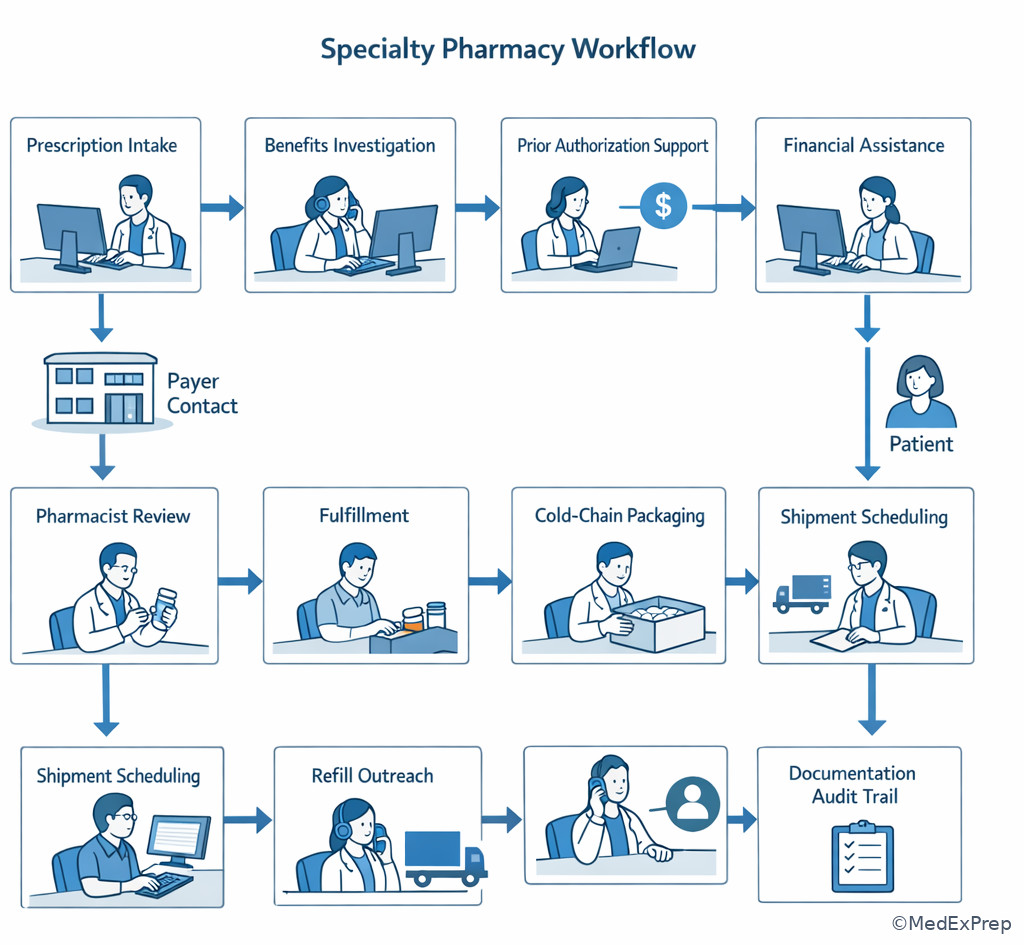
Core content
1.1.1.3 Foundational question: what makes a pharmacy workflow “specialty” instead of standard dispensing?
A Explanation
The exam often presents a prescription and asks you to choose between a routine processing mindset and a specialty workflow mindset. The decision conflict is simple: Do I treat this as a standard fill, or do I recognize extra access, handling, coordination, or documentation requirements? The single rule that resolves the conflict is this: specialty pharmacy is identified by operational burden and care coordination needs, not by price alone.
Common specialty signals include high acquisition cost, chronic or rare disease use, patient-specific access barriers, frequent refill coordination, special storage or shipping requirements, restricted distribution, REMS-related steps, and ongoing communication needs. A drug can be high-cost but not require the full specialty infrastructure; conversely, a medication with moderate price may still trigger specialty handling because of limited distribution, cold-chain shipment, or strict documentation requirements.
WHY THIS IS TESTED: exam items want you to spot the pattern that specialty pharmacy is a service model built around complexity, coordination, and control. If you anchor only on “expensive drug,” you will miss questions about restricted distribution, patient support, or shipment integrity. See Fig 1.
B Worked example
A 46-year-old patient with multiple sclerosis, hypertension, and hyperlipidemia has a new prescription for a disease-modifying therapy injection, one pen subcutaneously every 14 days. The patient mentions traveling next week and asks whether the drug can be mailed to a hotel. The claim has not yet been adjudicated, and the medication has a manufacturer-limited distribution network. A distracting detail in the profile is a slightly outdated secondary phone number. The tempting but wrong clue is that the copay card on file was used successfully for a different branded drug six months ago.
Reasoning chain: identify task → determine whether this is routine filling or specialty workflow. Extract key facts: chronic complex disease, self-injected specialty drug, travel timing issue, LDD restriction, likely access review, shipment logistics concern. Apply rule: multiple specialty signals are present even before payment is resolved. Eliminate distractors: do not assume prior copay-card success means this medication can be processed the same way; do not schedule shipment to an alternate address without confirming policy, product handling rules, and network/program requirements. Verify: document contact attempt, route for benefits and distribution review, and escalate shipment exceptions per site policy.
C Exam trap
D Checkpoint
Question: A prescription for an oral oncology agent 100 mg by mouth once daily arrives for a 62-year-old patient with rheumatoid arthritis, diabetes, and Medicare Part D coverage. The technician notices that the product requires temperature-controlled shipment and payer authorization, but the patient asks for “the normal fastest mail-out.” What is the best technician action?
- Treat it as a routine mail-order fill because the patient already has active insurance.
- Process it through specialty workflow because handling and access complexity, not coverage alone, determines the pathway.
- Call the prescriber to recommend a cheaper alternative so prior authorization can be avoided.
- Skip benefits review and move directly to shipment scheduling because oncology drugs are usually urgent.
Answer: B
- A: Tempting because active insurance feels like the main barrier; wrong because active coverage does not remove specialty handling or PA requirements.
- B: Correct because the discriminating rule is that specialty workflow is triggered by complexity signals such as authorization and shipping controls.
- C: Tempting because cost concerns are common; wrong because recommending therapeutic alternatives is outside technician scope.
- D: Tempting because urgency is common in oncology; wrong because shipment cannot bypass required access and integrity steps.
1.1.1.4 Foundational question: which prescription and product features drive specialty complexity?
A Explanation
Once you recognize that specialty pharmacy is about complexity, the next tested choice is which complexity matters most operationally. The exam may ask you to decide whether the main issue is access, product handling, patient follow-up, or program restriction. The rule: map the signal to the workflow burden it creates. High cost drives benefits investigation and affordability workflows. Special handling drives storage, packaging, and shipping controls. Limited distribution drives network verification and sourcing constraints. Ongoing therapy support drives refill coordination and documentation continuity.
This is why specialty technicians work in a highly structured environment. One order can require insurance verification, benefit-type clarification, outreach to the prescriber office for missing nonclinical information, use of approved packaging, delivery timing confirmation, and follow-up documentation. The question is not whether the medication is “serious”; it is whether the workflow requires multiple controlled steps to get the right product to the right patient safely and compliantly.
WHY THIS IS TESTED: stems often include several facts, but only one determines the operational next step. If the clue is “limited distribution,” think network/source restriction; if the clue is “must remain refrigerated,” think product integrity; if the clue is “payer requires approval,” think access support. See Fig 2.
Exam takeaway: The best next step depends on which specialty feature is actually driving the operational burden.
flowchart LR
A[Specialty feature] --> B{Primary issue}
B -->|High cost| C[Benefits investigation or affordability support]
B -->|PA required| D[Authorization tracking]
B -->|Limited distribution| E[Network or source verification]
B -->|Cold chain| F[Packaging and shipment control]
B -->|Frequent monitoring/follow-up| G[Refill and outreach workflow] Exam takeaway: Product handling clues should immediately trigger packaging, temperature, and delivery-timing checks.
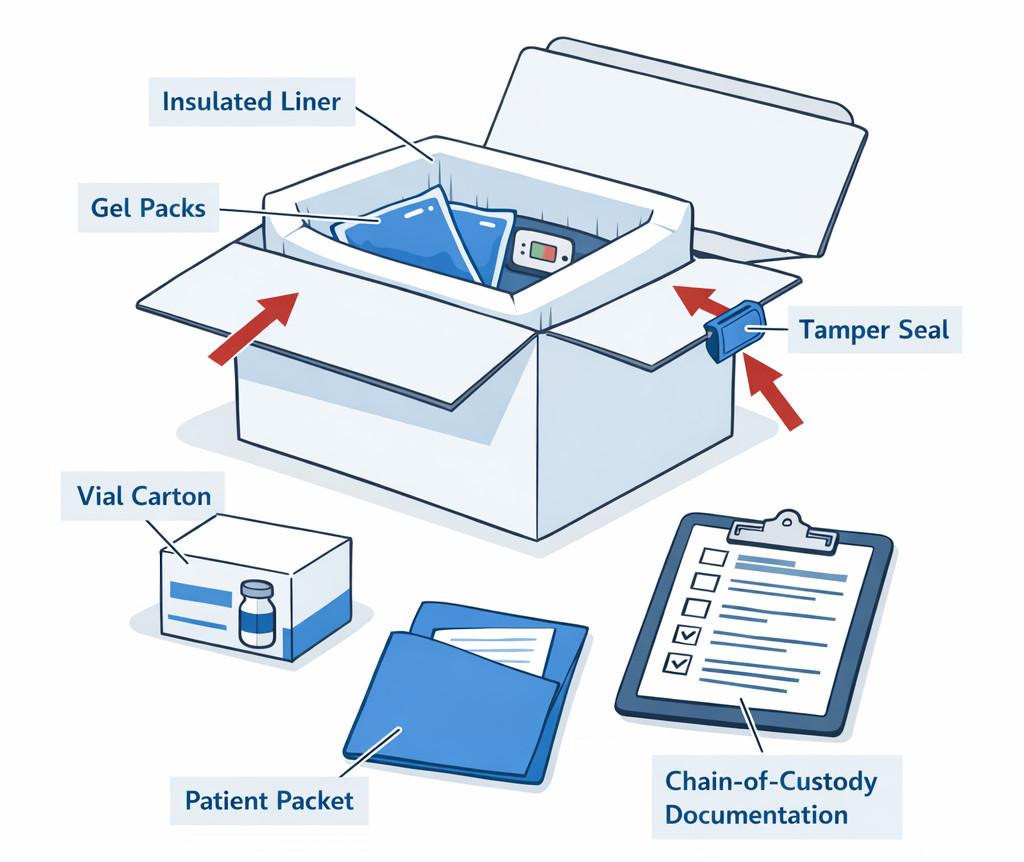
B Worked example
A 58-year-old patient with pulmonary arterial hypertension, chronic kidney disease, and commercial insurance has a prescription for an oral specialty agent, 1 tablet by mouth twice daily. The patient says the prescriber’s office “already got approval last year” and asks for same-day shipment to a workplace address. The claim rejects for prior authorization required, and the manufacturer uses a narrow network. A distracting detail is that the patient’s home address was verified recently for another maintenance medication.
Reasoning chain: identify task → determine the feature driving the immediate action. Extract key facts: PA rejection, narrow network, alternate delivery request. Apply rule: the dominant initial barrier is access and network restriction, not general address verification. Eliminate distractors: do not assume last year’s authorization applies now; do not bypass network verification because the patient prefers speed. Verify: document claim response, route to PA support and network review, and delay shipment scheduling until the order is eligible and policy requirements are met.
C Exam trap
D Checkpoint
Question: A new prescription for a biologic pen 40 mg subcutaneously every other week is received for a 39-year-old patient with Crohn disease, asthma, and obesity. The patient requests overnight delivery, but the claim rejects with “pharmacy not in network.” Which feature should guide the technician’s most appropriate next step?
- Injection route, because all injectables require the same handling and network pathway.
- Diagnosis, because inflammatory diseases always use the same payer rules.
- Network restriction, because distribution eligibility must be resolved before shipment planning.
- Patient preference for speed, because specialty workflow prioritizes convenience first.
Answer: C
- A: Tempting because injectables often need special handling; wrong because the stem’s immediate discriminator is network rejection.
- B: Tempting because diagnosis matters in specialty practice; wrong because technician action is driven by operational eligibility, not disease category alone.
- C: Correct because a non-network rejection blocks distribution and must be addressed before shipment logistics.
- D: Tempting because service matters; wrong because preference cannot override payer/network limits.
- The most common specialty access barrier in many claims-based stems is prior authorization or network restriction.
- True or False: High cost alone always tells you the first operational step. False.
- Name the 3 common workflow lanes triggered by specialty features: access support, handling/logistics control, follow-up coordination.
1.1.1.5 Applied question: why do specialty prescriptions require high-touch coordination and stronger documentation?
A Explanation
Now move from definition to application. The exam may ask why specialty operations involve repeated outreach, status checks, and detailed notes. The decision conflict is whether extra documentation is optional customer service or a core safety and continuity function. The rule: in specialty pharmacy, documentation is infrastructure. It preserves continuity across handoffs, supports reimbursement and audit readiness, tracks unresolved barriers, protects product integrity, and proves that required steps occurred in the correct sequence.
High-touch means more than being “nice” to patients. It means there are predictable touchpoints: intake clarification, coverage follow-up, scheduling, shipment confirmation, refill outreach, missed-contact attempts, and issue escalation. Because specialty workflows often span days or weeks and involve several parties, undocumented work can create duplicate tasks, preventable delays, shipment failures, or compliance gaps.
WHY THIS IS TESTED: the exam often gives you two seemingly reasonable actions, such as calling first versus documenting first, or rescheduling shipment versus waiting. The best answer usually protects workflow continuity: document what happened, what is pending, and what team owns the next action. See Fig 3.
Exam takeaway: In specialty workflow, each contact should create a clear next-step record that keeps the case moving safely.
flowchart TD
A[Patient or payer contact] --> B[Record date, source, and issue]
B --> C[State pending barrier]
C --> D[Assign next action owner]
D --> E[Set follow-up or handoff]
E --> F[Case remains traceable]
Exam takeaway: A strong specialty note captures who did what, what is pending, and what happens next.
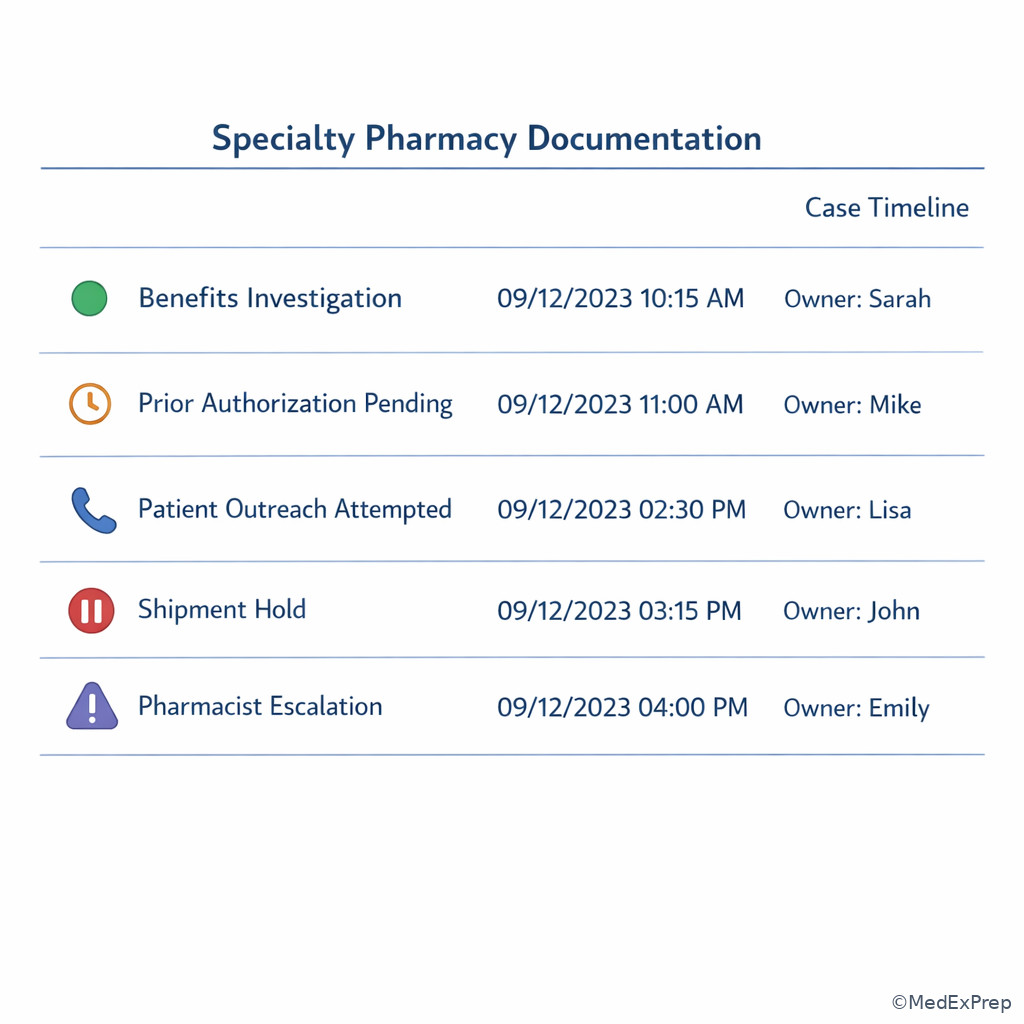
B Worked example
A 71-year-old patient with metastatic breast cancer, atrial fibrillation, and hypothyroidism is prescribed an oral oncology capsule, 125 mg by mouth daily for 21 days on, 7 days off. The spouse reports that the home refrigerator recently failed, although the product has not yet shipped. The payer call from yesterday is noted only as “spoke with rep” with no outcome. A tempting wrong clue is that the prescriber office sent a complete fax cover sheet this morning.
Reasoning chain: identify task → determine the safest technician action in a high-touch case. Extract key facts: oral oncology medication, incomplete payer note, unresolved storage concern at home, multiple handoffs likely. Apply rule: before the case moves forward, the record must clearly show payer status and next ownership; vague notes are unsafe in specialty workflow. Eliminate distractors: a complete fax cover sheet does not replace missing case details; shipment should not proceed on assumptions. Verify: document the current barrier, assign follow-up for payer clarification, and escalate any clinical or storage-counseling question to the pharmacist as required by policy.
C Exam trap
D Checkpoint
Question: A technician reviews a specialty refill request for an HIV medication 1 tablet by mouth once daily in a patient with chronic hepatitis B and depression. The prior note states only “left message” and “follow up later.” Which documentation element is most important to add for safe continuity?
- The exact ringtone pattern used during the call attempt.
- The date/time of outreach, reason for contact, pending barrier, and next action owner.
- The patient’s likely adherence level based on technician impression.
- A recommendation to hold therapy until laboratory results improve.
Answer: B
- A: Tempting because detailed communication seems thorough; wrong because it is not a meaningful operational element.
- B: Correct because this creates a usable audit trail and supports the next handoff.
- C: Tempting because adherence is relevant; wrong because subjective clinical-style assessment is not the key documentation need here.
- D: Tempting because safety matters; wrong because clinical therapy holds require pharmacist or prescriber direction per policy.
1.1.1.6 Applied question: where do technician responsibilities stop in specialty pharmacy?
A Explanation
One of the most tested CSPT patterns is scope recognition. Specialty pharmacy includes complex therapy, adverse-effect concerns, payer requirements, and prescriber coordination, so it is easy to drift into decisions that sound helpful but exceed technician authority. The decision conflict is Do I resolve this issue myself, or do I escalate? The rule: technicians manage operational workflow; pharmacists and prescribers make clinical judgments and final therapy decisions.
Within scope, technicians may gather information, document payer requirements, route cases, submit claims, coordinate shipment timing, maintain records, and communicate nonclinical status updates. Outside scope: interpreting lab values to decide readiness, selecting alternative therapy, counseling on side effects beyond protocol, independently approving PA criteria, authorizing refills without permitted workflow authority, or overriding REMS or program rules based on personal judgment.
WHY THIS IS TESTED: distractors often reward “being proactive” in the wrong way. The best technician answer is not the most heroic one; it is the safest scope-appropriate one. See Fig 4.
Exam takeaway: When a specialty workflow problem requires clinical judgment or authority, the safest answer is escalation with documentation.
flowchart TD
A[Issue identified] --> B{Operational or clinical?}
B -->|Operational and allowed| C[Technician acts per policy]
B -->|Clinical judgment needed| D[Escalate to pharmacist or prescriber team]
B -->|Program authority unclear| E[Confirm policy or program requirement]
C --> F[Document completion]
D --> F
E --> F Exam takeaway: Effective specialty technicians escalate early when a case shifts from logistics to clinical decision-making.
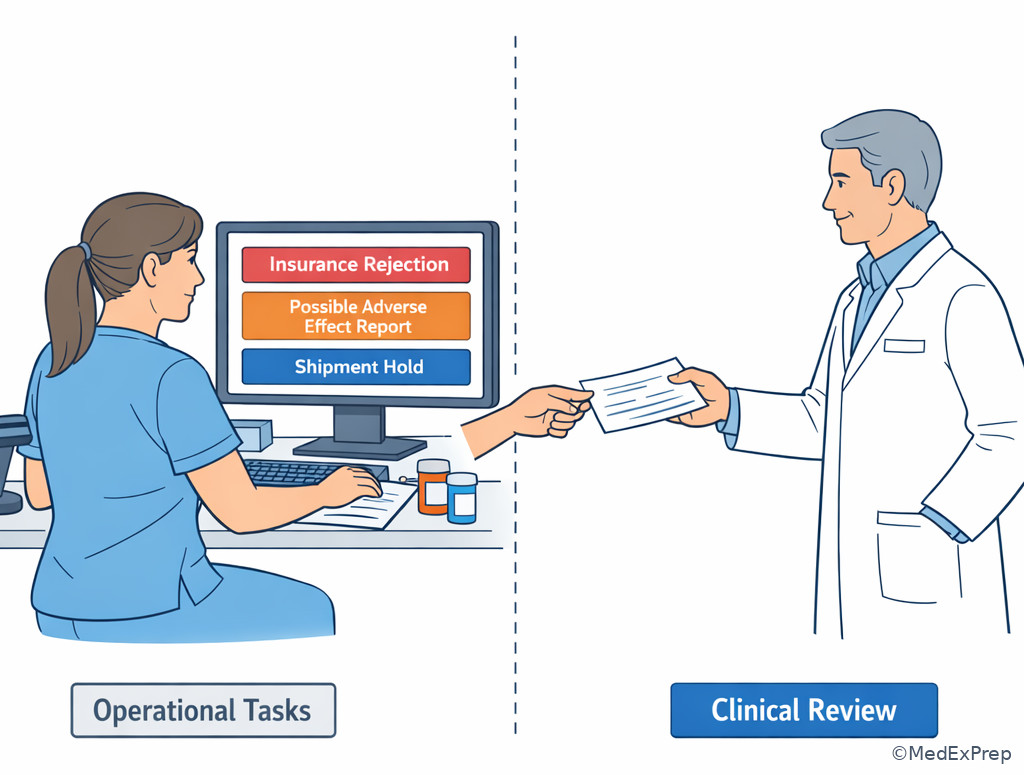
B Worked example
A 34-year-old patient with ulcerative colitis and migraine is taking a biologic injection every 8 weeks and calls before the refill is due. The patient says, “I developed redness after the last dose and skipped the next one; can you tell me if I should restart at the same schedule?” The account also shows a recent insurer request for chart notes. A distracting detail is that the shipping address was recently updated successfully.
Reasoning chain: identify task → scope question. Extract key facts: adverse-effect concern, missed dose, restart question, payer document request. Apply rule: the clinical restart/adverse-effect question requires pharmacist or prescriber evaluation; the insurer paperwork can be routed operationally. Eliminate distractors: do not provide restart advice because the address update is complete; do not ignore the payer task. Verify: document the patient report, escalate the clinical question per protocol, and continue nonclinical routing for the insurer request as allowed.
C Exam trap
D Checkpoint
Question: A prescription for a REMS-associated specialty capsule 10 mg by mouth once daily is ready for processing for a 29-year-old patient with multiple sclerosis and anxiety. The patient asks whether a newly reported symptom means the dose should be lowered before shipment. What is the safest action within technician scope?
- Suggest holding one dose and restarting if the symptom improves.
- Compare the symptom to online patient forums and advise based on the most common response.
- Document the report and escalate to the pharmacist or authorized clinical team before proceeding per policy.
- Ship the medication as scheduled because technicians cannot discuss symptoms at all.
Answer: C
- A: Tempting because it appears cautious; wrong because it is still a clinical dosing recommendation.
- B: Tempting because informal pattern recognition feels helpful; wrong because outside sources do not replace authorized clinical review.
- C: Correct because the technician role is to document and escalate when symptoms affect treatment decisions.
- D: Tempting because it avoids overstepping; wrong because it ignores a safety concern that must be routed, not bypassed.
- True or False: A technician may independently approve a prior authorization if all fields appear complete. False.
- The best first action when a patient asks whether to change a specialty drug dose is document and escalate.
- Name 3 out-of-scope signals: dose change, lab interpretation, therapy selection.
1.1.1.7 Integration question: how do access barriers, product control, and longitudinal support combine in the specialty practice model?
A Explanation
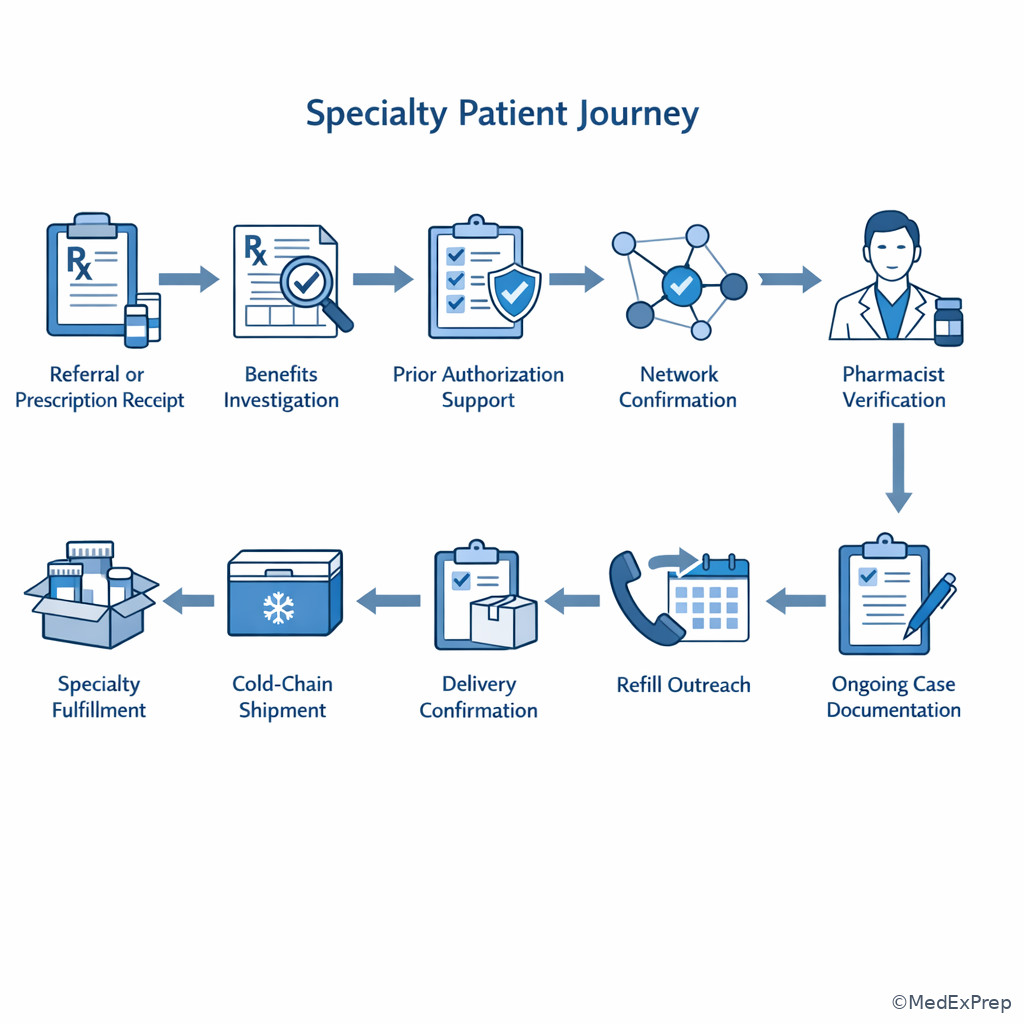
The final integration step is seeing specialty pharmacy as an interconnected model rather than separate tasks. The decision conflict is whether to solve the immediate visible problem only, or to think through the entire chain from access to delivery to follow-up. The rule: specialty success depends on synchronized access, product integrity, and ongoing support. A case is not truly “ready” when one step is complete; it is ready when all required operational conditions align.
For example, payer approval without network eligibility is insufficient. Cold-chain packaging without a confirmed delivery window is unsafe. A refill date without patient confirmation may create waste or failed delivery. A successful first shipment without documented follow-up planning undermines adherence support. Specialty pharmacy therefore functions as a closed-loop model: verify eligibility, secure access support, preserve product integrity, coordinate delivery, document thoroughly, and sustain follow-up over time.
WHY THIS IS TESTED: integration questions use noise. They mix a correct intermediate step with an unresolved blocker and ask for the best next action. The best answer is the one that identifies the remaining dependency rather than celebrating partial progress. See Fig 5.
Exam takeaway: A specialty case is operationally complete only when access, handling, delivery, and follow-up all align.
flowchart LR
A[Coverage and network cleared] --> B[Prescription can be sourced]
B --> C[Handling and packaging verified]
C --> D[Delivery timing confirmed]
D --> E[Documentation completed]
E --> F[Refill or follow-up plan established]
Exam takeaway: Integration questions test whether you can see the whole specialty pathway rather than one isolated task.
B Worked example
A 65-year-old patient with hepatitis C, type 2 diabetes, and congestive heart failure is prescribed a specialty oral antiviral, 3 tablets by mouth once daily with food. Prior authorization is approved, and the patient reports being “ready now.” However, the plan requires use of a contracted pharmacy, the current site’s inventory is unavailable, and the patient will be away from home during the expected ship window. A distracting clue is that financial assistance is no longer needed because the copay is zero.
Reasoning chain: identify task → determine whether the case is ready to dispense. Extract key facts: PA approved, but network requirement unresolved; inventory unavailable; delivery timing mismatch. Apply rule: access approval alone does not equal readiness. Eliminate distractors: zero copay does not solve network or delivery dependencies; patient willingness does not remove sourcing barriers. Verify: document remaining blockers, coordinate rerouting or next authorized source per policy, and resolve delivery timing before shipment planning.
C Exam trap
D Checkpoint
Question: A refill for a refrigerated biologic 150 mg subcutaneously every 4 weeks is approved for a 55-year-old patient with psoriasis, hyperlipidemia, and sleep apnea. The claim pays, but the patient cannot receive the shipment for 4 days and requests that it be left outside if needed. What is the best technician action?
- Release the order because claim approval is the last required step in specialty workflow.
- Ship immediately and tell the patient to call if the product feels warm on arrival.
- Document the delivery conflict and follow site policy for rescheduling or approved delivery arrangements that protect product integrity.
- Recommend the patient switch to a room-temperature alternative.
Answer: C
- A: Tempting because paid claims often signal readiness; wrong because delivery conditions still matter.
- B: Tempting because speed seems patient-centered; wrong because unattended delivery may compromise cold-chain integrity.
- C: Correct because specialty workflow requires alignment of payment, product protection, and patient availability.
- D: Tempting because it solves the logistics issue in theory; wrong because therapy selection is outside technician scope.
Exam Traps & Differentiators
Most common wrong answer and why: choosing the action that moves the prescription fastest instead of the action that preserves specialty workflow safety and compliance. This is tempting because specialty practice often feels urgent. However, the exam rewards controlled progression, not shortcuts.
| Looks similar | Actually means | Best technician mindset | Common wrong move |
|---|---|---|---|
| High-cost medication | Possible specialty access barrier | Check for coverage, PA, affordability, and network issues | Assume cost alone defines the entire workflow |
| Refrigerated product | Handling and delivery control issue | Protect product integrity and delivery timing | Focus only on claim status |
| Patient asks whether to restart after missed dose | Clinical decision point | Document and escalate | Provide package-insert-style individualized advice |
| Claim paid | One barrier resolved | Confirm remaining sourcing, shipping, and follow-up needs | Treat payment as final readiness |
| Manufacturer program mentioned | Possible restricted access or program requirement | Verify current rules per site policy | Assume rules match a previous drug or patient case |
If the stem says... think:
- “Pharmacy not in network” → distribution eligibility problem before fulfillment.
- “Needs refrigeration” → packaging and delivery timing must be addressed before release.
- “Patient asks if dose should be changed” → technician must escalate, not decide.
- “PA approved” plus another unresolved issue → case is not complete; identify the remaining dependency.
- “Left message” in prior note → documentation is incomplete unless it states reason, barrier, and next action.
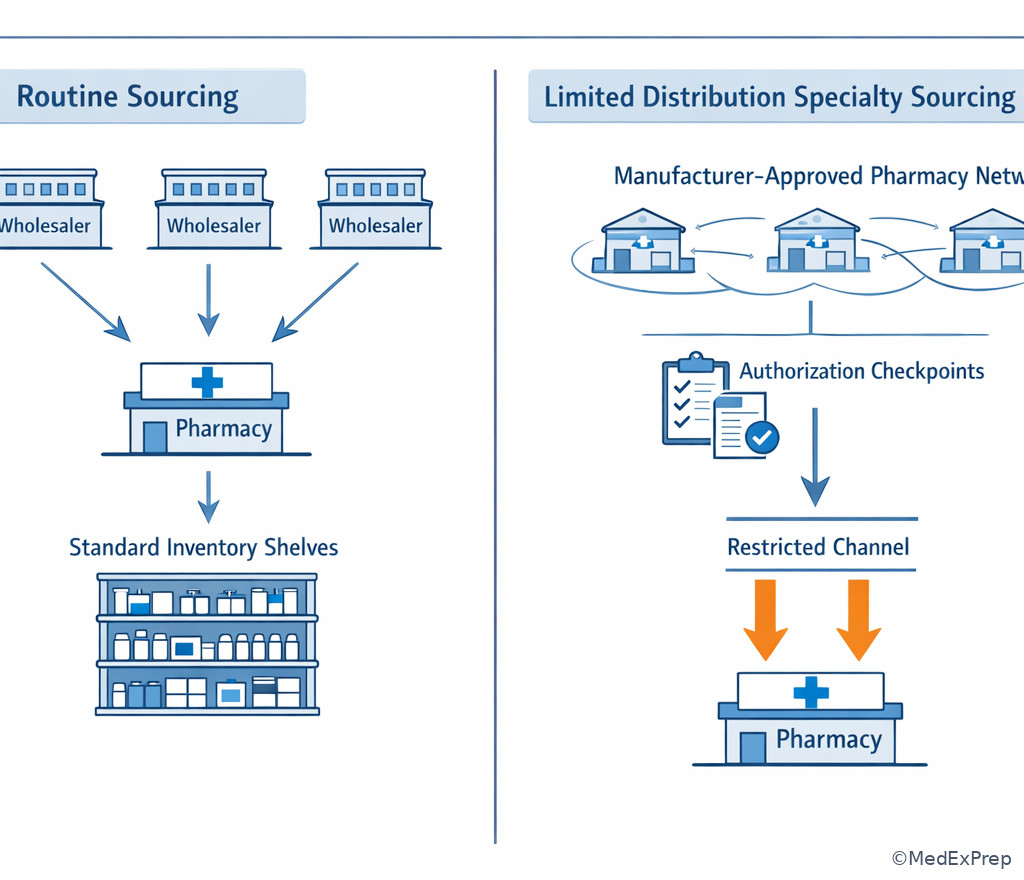
- “Limited distribution” → source/network verification, not routine inventory logic.
Exam takeaway: Eliminate fast-moving but unsafe choices by checking access, integrity, and scope in that order.
flowchart TD
A[Tempting answer moves case forward quickly] --> B{Does it ignore a barrier?}
B -->|Access barrier ignored| C[Reject answer]
B -->|Handling risk ignored| D[Reject answer]
B -->|Scope boundary ignored| E[Reject answer]
B -->|No barrier ignored| F[Possible correct choice] Exam takeaway: Limited distribution questions test sourcing and network logic, not ordinary inventory substitution habits.
Related trap from upcoming topics: in Practice Settings and Stakeholders, you will see that the correct escalation target changes by setting. Here, the differentiator is simply recognizing that a handoff is needed at all. In High-Touch Workflow Elements, a similar distractor appears when learners complete one step but forget the downstream documentation or outreach step.
Tables
| Specialty characteristic | What it usually triggers | Technician focus | Escalation risk |
|---|---|---|---|
| High cost | Benefits investigation, PA, affordability review | Collect and document coverage/access information | Do not independently decide clinical necessity |
| Cold-chain requirement | Special packaging and delivery timing control | Confirm storage/shipment workflow and documentation | Do not release if integrity is at risk |
| Limited distribution | Network verification and sourcing constraints | Check authorized route and document status | Do not bypass restricted channel rules |
| REMS awareness | Program-specific completion steps | Follow site policy and required workflow checks | Do not override program requirements |
| Frequent follow-up needs | Refill outreach and adherence support tasks | Maintain timeline and contact records | Do not provide clinical adherence counseling beyond protocol |
| Complex chronic disease use | Multi-stakeholder coordination | Keep handoffs clear and timely | Do not interpret disease status clinically |
| Comparison point | Traditional dispensing mindset | Specialty pharmacy mindset |
|---|---|---|
| Main workflow driver | Prescription processing and claim payment | Access + handling + coordination + continuity |
| Documentation intensity | Transaction-focused | Case-focused and audit-ready |
| Common barriers | Basic adjudication issues | PA, network restrictions, affordability, delivery constraints |
| Shipment considerations | Often standard | Frequently time-sensitive and temperature-sensitive |
| Patient contact pattern | Periodic or as needed | Longitudinal, scheduled, and barrier-driven |
| Scope risk on exam | Lower emphasis on clinical escalation | Frequent need to distinguish technician from pharmacist tasks |
| Stem clue | Category | Best next-step lens | Why similar answers fail |
|---|---|---|---|
| “Prior authorization required” | Access barrier | Route to authorization support workflow | Shipping answers fail because eligibility is unresolved |
| “Medication must remain refrigerated” | Handling barrier | Protect cold chain and delivery timing | Paid-claim answers fail because integrity is still at risk |
| “Patient asks if the dose should be changed” | Clinical decision | Escalate with documentation | Helpful-sounding advice answers fail on scope |
| “Pharmacy not in network” | Distribution restriction | Verify authorized source or routing | Inventory answers fail because sourcing is contract-limited |
| “Prior note says only left message” | Documentation gap | Add barrier, timestamp, and ownership | General follow-up answers fail if they do not create continuity |
| “Claim paid, but patient unavailable for refrigerated delivery” | Readiness mismatch | Reschedule per policy to preserve integrity | Immediate shipment answers fail because the case is not operationally ready |
Algorithm / Approach
Rapid Review
- Specialty pharmacy → defined by workflow complexity, not price alone
- High-cost drug → think access support, not automatic readiness
- Limited distribution → sourcing/network problem, not routine inventory problem
- Cold-chain product → delivery timing matters as much as claim status
- High-touch service → repeated documented contacts, not just customer service
- Paid claim → one barrier cleared, not case completion
- Patient asks about dose or symptoms → escalate, do not advise
- Incomplete note → continuity risk in specialty workflow
- Specialty case → closed-loop process from intake through refill support
- Program requirement mentioned → verify current rule, do not assume
- Urgent disease state → does not justify bypassing access or integrity controls
- Technician role → operational coordination, documentation, and safe handoff
- Best next step → usually the action that resolves the blocking dependency
- Patient preference → cannot override payer, policy, or handling requirements
Self-check quiz
1. A new prescription for a biologic pen 80 mg subcutaneously every 2 weeks is received for a 44-year-old patient with psoriatic arthritis, hypertension, and obesity. The medication is expensive, requires prior authorization, and must be shipped with temperature control. Which characteristic most strongly supports treating this as a specialty pharmacy workflow?
- It is administered by injection.
- It combines access barriers and handling complexity.
- It is for a chronic condition.
- It is prescribed every 2 weeks.
2. A prescription for an oral oncology tablet 50 mg by mouth once daily arrives for a 67-year-old patient with diabetes and chronic obstructive pulmonary disease. The patient asks whether a new rash means the dose should be lowered before the first shipment. What is the best technician action?
- Recommend delaying the start until the rash resolves.
- Advise taking the first dose every other day instead.
- Document the report and escalate to the pharmacist or authorized clinical team.
- Ship immediately because the prescription is otherwise complete.
3. A 53-year-old patient with multiple sclerosis, depression, and commercial insurance has a new prescription for a specialty injection 1 pen subcutaneously monthly. The claim rejects for prior authorization, the manufacturer restricts distribution, and the patient wants overnight shipment to a vacation rental. Which is the most appropriate next step?
- Schedule shipment first, then finish access steps once the delivery address is confirmed.
- Route the case for authorization and network review before arranging delivery.
- Tell the patient to pay cash now and seek reimbursement later.
- Request that the prescriber change to a nonrestricted alternative.
4. A refill request for a refrigerated specialty syringe 200 mg subcutaneously every 4 weeks is reviewed for a 61-year-old patient with asthma, diabetes, and chronic sinus disease. The claim pays, but the patient will not be home for 3 days and asks for the package to remain outside if delivered early. Which factor should drive the technician’s decision?
- Claim approval status
- Patient convenience alone
- Cold-chain integrity and approved delivery conditions
- Disease severity
5. A 49-year-old patient with HIV, hyperlipidemia, and neuropathy is due for a refill of a specialty tablet 1 tablet by mouth once daily. The last note says only “spoke to insurance” with no outcome, and the current queue shows shipment pending. Which documentation update is most important before the case moves forward?
- Record the payer representative’s first name only.
- Add the call time, issue discussed, current status, next step, and owner.
- Estimate whether the patient is clinically stable enough for refill.
- Delete the incomplete note and start over after shipment.
6. A 70-year-old patient with hepatitis C, cirrhosis, and type 2 diabetes has a prescription for a specialty antiviral packet, 3 tablets by mouth once daily. Prior authorization is approved, the copay is $0, and the patient confirms the home address. However, the payer requires use of a contracted pharmacy, and the current site is not in network. Which is the best technician action?
- Process and ship because authorization and copay have already been resolved.
- Escalate to the pharmacist to decide whether the current pharmacy can remain an exception.
- Document the network barrier and follow site policy to reroute or coordinate the authorized dispensing channel.
- Advise the patient to ask the prescriber for a therapeutically similar nonnetwork drug.
7. A 36-year-old patient with Crohn disease, anxiety, and iron-deficiency anemia is prescribed a specialty biologic 90 mg subcutaneously every 8 weeks. During refill outreach, the patient reports missing the last dose because of fever and asks whether to restart now or wait. The same profile also shows a plan request for updated demographic information and a valid prior authorization. Which action is most appropriate?
- Use the valid prior authorization to release the refill and address the fever question later.
- Document the missed dose and symptom report, escalate the clinical question, and continue allowed nonclinical demographic updates.
- Tell the patient to resume immediately because delays can reduce adherence.
- Cancel the refill permanently because any fever means the therapy is unsafe.
8. A 59-year-old patient with pulmonary arterial hypertension, chronic kidney disease, and rheumatoid arthritis is taking a limited-distribution oral tablet 1 tablet by mouth twice daily. The claim now pays after prior authorization approval, but inventory is unavailable at the site, the patient requests shipment to a hotel, and the note from yesterday does not state whether alternate-address delivery is allowed under program policy. What is the best next step?
- Ship to the hotel because the claim has already paid and the patient requested it.
- Document unresolved sourcing and delivery-policy barriers and verify the authorized channel and address rules before scheduling shipment.
- Ask the patient to split doses from an old supply until inventory arrives.
- Recommend the prescriber convert the patient to a locally stocked equivalent.
Answer key
1.1.1.8 1. Answer: B
A. Tempting because injectables are commonly associated with specialty products. Incorrect for this scenario because injection route alone does not distinguish specialty workflow from other self-administered products. The single stem clue is the combination of prior authorization and temperature-controlled shipment, which creates clear access and handling complexity. This aligns with the specialty model described in 1.1.1.1 and 1.1.1.2. Sources: ASHP specialty pharmacy operations guidance; FDA labeling and product handling standards.
B. Correct because the paired presence of access barriers and handling requirements is the strongest specialty discriminator here. The PK/PD detail is not the deciding factor; the operational workflow burden is. The single stem clue that discriminates is that the medication both requires PA and temperature control. Sources: ASHP; specialty pharmacy accreditation-focused workflow standards.
C. Tempting because chronic disease management is common in specialty practice. Incorrect because many chronic-condition medications are not processed through specialty channels. The single stem clue eliminating it is the additional access/handling burden absent from routine chronic therapies. Sources: ASHP; AHFS Drug Information.
D. Tempting because scheduled biologic dosing sounds specialized. Incorrect because frequency alone does not create specialty workflow. The single clue eliminating it is that every-2-week dosing is less important than the payer and shipment requirements. Sources: AHFS; FDA labeling.
1.1.1.9 2. Answer: C
A. Tempting because holding therapy can sound safety-conscious. Incorrect because recommending a delay is a clinical judgment about treatment initiation. The single stem clue is the patient asking whether the dose should be lowered because of a rash. That requires pharmacist or prescriber evaluation. Sources: FDA drug labeling; Lexicomp drug information.
B. Tempting because dose reduction appears conservative. Incorrect because every-other-day use would be an unauthorized regimen change. The single clue eliminating it is the request for individualized dose guidance. Sources: Lexicomp; AHFS Drug Information.
C. Correct because the specialty technician’s role is to document the reported issue and escalate to the pharmacist or authorized clinical team when a symptom may affect therapy. The single clue is the rash-based dose question. Sources: ASHP technician scope principles; FDA labeling.
D. Tempting because the prescription is otherwise processable and technicians should avoid clinical advice. Incorrect because ignoring a possible clinical concern is not the same as staying in scope; the proper in-scope response is escalation. The single clue is the patient’s request tied to possible adverse effects. Sources: ASHP; Lexicomp.
1.1.1.10 3. Answer: B
A. Tempting because delivery logistics matter and the patient has a pressing travel issue. Incorrect because shipment cannot be finalized while PA and restricted-distribution barriers remain unresolved. The single discriminating clue is the active PA rejection plus manufacturer distribution restriction. Sources: ASHP; payer workflow standards.
B. Correct because access and network eligibility are the immediate gating steps. Specialty workflow logic requires solving the blocking dependency before working on shipment details. The single clue is that the claim rejects and the product is restricted. Sources: ASHP specialty workflow guidance; FDA distribution program information where applicable.
C. Tempting because urgent patient need may push learners toward out-of-pocket workarounds. Incorrect because cash payment does not solve limited-distribution eligibility and may violate payer or site procedures. The single clue is the network restriction. Sources: ASHP; institutional specialty pharmacy policies.
D. Tempting because nonrestricted alternatives might seem to simplify access. Incorrect because requesting therapeutic substitution is outside technician scope and depends on clinical appropriateness. The single clue is that the stem asks for the technician’s next step. Sources: ASHP technician scope guidance; Lexicomp.
1.1.1.11 4. Answer: C
A. Tempting because paid claims often signal progress toward dispensing. Incorrect because reimbursement status does not guarantee product integrity during unattended delivery. The single clue is the refrigerated syringe and 3-day absence. Sources: FDA labeling on storage/handling; ASHP fulfillment standards.
B. Tempting because patient-centered care values convenience. Incorrect because convenience cannot override cold-chain requirements or approved delivery conditions. The single clue is the request to leave the package outside. Sources: FDA labeling; product handling guidance.
C. Correct because the operational discriminator is preservation of cold-chain integrity. Specialty practice requires aligning shipment timing with safe receipt. The single clue is the refrigerated product plus lack of patient availability. Sources: FDA labeling; ASHP logistics guidance.
D. Tempting because serious disease may create urgency. Incorrect because disease severity does not remove the need for proper handling. The single clue is the shipment condition, not the diagnosis. Sources: AHFS; FDA labeling.
1.1.1.12 5. Answer: B
A. Tempting because identifying the payer contact may feel sufficient. Incorrect because a name alone does not tell downstream staff what happened or what remains pending. The single clue is the vague prior note “spoke to insurance.” Sources: ASHP documentation expectations; accreditation-oriented workflow principles.
B. Correct because specialty documentation must support continuity: timestamp, issue, current status, next step, and owner. The single clue is that shipment is pending despite unclear payer outcome, making a complete note essential. Sources: ASHP; specialty pharmacy documentation standards.
C. Tempting because refill appropriateness sounds clinically relevant. Incorrect because estimating clinical stability is outside technician scope and does not resolve the documentation gap. The single clue is that the problem is missing workflow information, not therapy assessment. Sources: ASHP technician scope guidance; Lexicomp.
D. Tempting because rewriting the note sounds cleaner. Incorrect because deleting the existing trail can reduce continuity and audit integrity; the better action is to update the record accurately. The single clue is that the case is still active and needs traceable continuity. Sources: ASHP; quality documentation principles.
1.1.1.13 6. Answer: C
A. Tempting because PA approval and zero copay can feel like complete access clearance. Incorrect because network restrictions still control which pharmacy may dispense. The single stem clue is “current site is not in network.” Sources: ASHP; payer network rules.
B. Tempting because pharmacist involvement is often appropriate in complex cases. Incorrect for this scenario because the key issue is an operational network barrier, not a clinical exception request. Unless site policy specifically requires pharmacist handling, the technician should route through the authorized channel workflow. The single clue is that no clinical judgment is being asked. Sources: ASHP workflow guidance.
C. Correct because the technician should document the barrier and follow policy for rerouting or coordinating authorized dispensing. This preserves compliance and continuity. The single discriminating clue is the non-network status despite PA approval. Sources: ASHP; specialty payer operations guidance.
D. Tempting because changing to a different drug might avoid the network problem. Incorrect because therapeutic substitution is outside technician scope and may not be clinically appropriate. The single clue is that the issue is dispensing channel eligibility, not drug efficacy. Sources: Lexicomp; ASHP technician scope guidance.
1.1.1.14 7. Answer: B
A. Tempting because the valid prior authorization suggests refill eligibility. Incorrect because a missed dose plus fever question introduces a clinical decision point that must be addressed before release under policy. The single clue is the request about whether to restart now or wait. Sources: FDA labeling; Lexicomp; ASHP scope guidance.
B. Correct because it separates operational and clinical tasks appropriately: document and escalate the clinical issue while continuing nonclinical demographic updates as allowed. The single discriminating clue is the combination of a clinical restart question and a separate administrative request. Sources: ASHP; Lexicomp.
C. Tempting because timely restart may support adherence. Incorrect because instructing immediate resumption is an individualized clinical recommendation. The single clue is the report of fever with a missed dose. Sources: FDA labeling; AHFS.
D. Tempting because fever raises safety concerns. Incorrect because a permanent stop decision is also a clinical judgment beyond technician scope. The single clue is that the stem asks for the most appropriate technician action, not definitive therapy discontinuation. Sources: Lexicomp; ASHP.
1.1.1.15 8. Answer: B
A. Tempting because paid claims and patient preference may create pressure to move quickly. Incorrect because sourcing is unresolved and alternate-address policy has not been verified. The single clue is the undocumented hotel-shipment rule in a limited-distribution program. Sources: ASHP; manufacturer/program policy principles.
B. Correct because multiple dependencies remain: inventory/sourcing, limited-distribution channel compliance, and alternate-address rules. The best next step is to document and verify before scheduling shipment. The single discriminating clue is that the note does not state whether the hotel shipment is permitted. Sources: ASHP; specialty program compliance standards.
C. Tempting because it offers a short-term bridge. Incorrect because instructing dose splitting from old supply is a clinical/medication-use recommendation outside technician scope and may be unsafe. The single clue is that this changes how the patient uses therapy. Sources: Lexicomp; FDA labeling.
D. Tempting because a locally stocked equivalent sounds operationally easier. Incorrect because converting therapy is a prescriber-level clinical decision. The single clue is that the barrier is logistical compliance, not the need for therapeutic redesign. Sources: AHFS; ASHP scope guidance.
Keep going with the full CSPT Prep Course (CSPT)
You just studied the way members do, in the same lesson interface. Full access unlocks every lesson, the question bank and flashcards for a full year.
One payment · 1 year of access · No auto-renewal