1.1.1 - Candidate Role Boundaries
Candidate Role Boundaries
What you'll learn
- FOUNDATIONS: Core Terminology and Definitions - High-yield concept recognition and discrimination → Distinguish role boundary terms such as scope, protocol, escalation, authorization, and independent judgment.
- APPLICATION: Rules, Procedures, and Decision Points - Scenario-based execution → Choose the most appropriate next step when a task is within role, outside role, or unclear.
- APPLICATION: Documentation and Interpretation - Accurate reading and response selection → Identify what may be documented directly, what requires clarification, and what must be escalated.
- JUDGMENT: Prioritization and Error Prevention - Best-next-step reasoning and distractor control → Recognize common boundary breaches and the single clue that makes escalation mandatory.
- REVIEW: Retrieval Practice and Readiness Checks - Mini-assessment performance → Apply a repeatable exam framework: identify task → extract key facts → apply boundary rule → act or escalate → verify/document.
- FOUNDATIONS → Core Terminology and Definitions → role, scope, protocol, authorization, escalation
- APPLICATION → Rules, Procedures, and Decision Points → within-role vs out-of-role action selection
- APPLICATION → Documentation and Interpretation → documenting facts without overstepping interpretation
- JUDGMENT → Prioritization and Error Prevention → boundary breaches, unclear orders, unsafe situations
- REVIEW → Retrieval Practice and Readiness Checks → exam-style scenario discrimination
Why it matters
- Many CRAS questions are not asking for advanced diagnosis; they are asking whether the candidate recognizes the limit of authority and chooses the safest next step.
- Boundary questions reward disciplined thinking: do what is authorized, document what is observed, and escalate what is unsafe, abnormal, conflicting, or unclear.
- The most common exam trap is choosing an action that sounds helpful but exceeds role or bypasses protocol.
- In real practice, boundary errors create safety, legal, documentation, and workflow failures long before a technical skill issue appears.
Exam takeaway: Use role authority, protocol fit, and escalation triggers to choose the safest next step.
flowchart TD
A[Task appears in workflow] --> B{Is task explicitly within role and protocol?}
B -->|Yes| C{Information complete and safe?}
B -->|No| D[Do not proceed independently]
C -->|Yes| E[Perform authorized step]
C -->|No| F[Clarify or escalate]
D --> G[Notify supervisor or licensed professional]
E --> H[Document action and result]
F --> H
Start your thinking with the boundary screen in Fig 1: if the task is not clearly authorized, or if the information is incomplete, the correct answer usually shifts from acting to clarifying or escalating.
Key Terms & Must-Know Facts
1.1.1.1 Key terms
- Scope of role: The actions permitted by training, policy, and supervision.
- Protocol: A standardized instruction set that governs routine actions.
- Authorization: Permission established by policy, role, or direct order.
- Escalation: Promptly notifying the appropriate supervisor or licensed professional when the situation exceeds routine guidance.
- Clarification: Resolving incomplete, conflicting, illegible, or ambiguous information before proceeding.
- Observation: Recording what is directly seen, heard, measured, or reported without adding unsupported interpretation.
- Independent judgment: Deciding beyond standing guidance; this is often restricted.
- Boundary breach: Any action that exceeds authorized role limits.
- Standing instruction: A preapproved direction that applies under defined conditions.
- Chain of command: The sequence for reporting concerns upward.
- Objective documentation: Charting facts, actions, times, and responses without speculation.
- Abnormal finding: A result outside expected parameters requiring follow-up per protocol.
- Unsafe condition: Any immediate risk to patient, staff, equipment, or environment.
1.1.1.2 Must-know facts
- If the stem asks you to diagnose, prescribe, override, or independently interpret beyond protocol, it is usually outside CRAS role.
- The safest CRAS-level response to unclear, conflicting, or high-risk information is clarify or escalate, not guess.
- Documenting an observation is within role; assigning a definitive diagnosis is not.
- A provider order does not erase role boundaries; if an action exceeds authorization, it requires clarification through proper channels.
- The exam often tests whether you can separate helpful support action from unauthorized independent action.
- When protocols vary by site, choose the safest general principle and confirm local policy.
- If there is urgent risk, escalation priority increases; do not delay by performing unauthorized steps.
- “Best next step” often means notify, hold, clarify, and document rather than complete the task.
| Term | What it means on exam day | What to do |
|---|---|---|
| Within role | Authorized by training and protocol | Proceed, then document |
| Outside role | Requires higher-level judgment or authority | Do not perform independently; escalate |
| Unclear order | Missing, conflicting, or ambiguous instructions | Clarify before acting |
| Abnormal finding | Outside expected range or pattern | Follow protocol; escalate if indicated |
| Objective charting | Facts only, no unsupported conclusion | Record observation, action, response, time |
| Urgent safety risk | Immediate hazard or serious concern | Prioritize immediate escalation |
Exam takeaway: Separate observation, action, documentation, and escalation when deciding what a CRAS candidate may do.
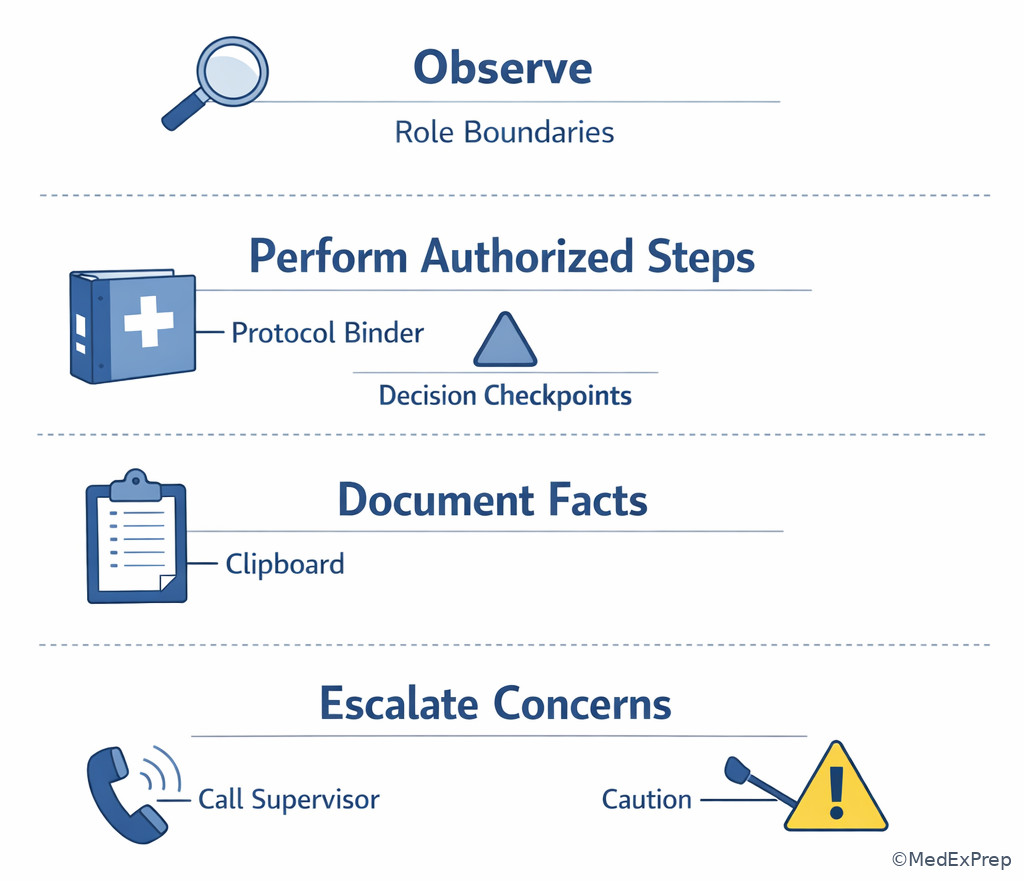
Core content
1.1.1.3 Foundational boundary rule: act within authorization, not beyond it
A Explanation
The first decision conflict is simple but heavily tested: Should you carry out the task, or should you stop because it exceeds role? The single rule that resolves it is whether the action is clearly authorized by role, training, protocol, and supervision. A CRAS candidate is expected to support workflow, gather information, document accurately, and recognize when something needs a higher-level decision. A CRAS candidate is not expected to independently diagnose, prescribe, override a provider order, or make legal or regulatory determinations.
WHY THIS IS TESTED: Board-style stems often dress an out-of-role action in practical language such as “to save time,” “because the provider is busy,” or “the patient is asking for help now.” The exam wants to know whether you can reject an unsafe shortcut even when it sounds efficient or compassionate.
Choose proceed when the task is routine, clearly described, and covered by protocol. Reject proceeding independently when the task requires interpretation beyond protocol, treatment selection, unauthorized procedure performance, or order override. If the task might be appropriate but the information is incomplete, do not guess; clarification is the next step.
Key rule: A task is not “within role” just because it appears in the workflow. It must also be supported by authorization, clarity, and safety.
B Worked example
A 67-year-old patient with hypertension and chronic kidney disease arrives for a routine outpatient service. A partially completed order sheet is present. The patient says, “My medication makes me dizzy; can you tell me which one to stop today?” A busy clinician is delayed, and a coworker says, “Just advise the patient to hold the blood pressure pill until the provider comes.” The chart also contains a distracting note about mild seasonal allergies.
Identify task: The question is asking whether you should give medication-management advice. Extract key facts: The patient is asking which medication to stop; that is treatment decision-making. The clinician is delayed, but no protocol authorizes independent prescribing advice. Apply rule: Independent medication changes are outside CRAS role. Eliminate distractors: Advising which drug to hold is tempting because dizziness sounds safety-related, but it still requires higher-level judgment. Ignoring the concern is also wrong because a symptom was reported. Verify: The best next step is to document the reported symptom and promptly notify the appropriate licensed professional or supervisor for clarification.
C Exam trap
Common wrong answer: Give a temporary recommendation “just until the provider arrives.”
WHY IT IS TEMPTING: It feels patient-centered and fast, especially when the symptom could be medication-related.
SINGLE CLUE THAT ELIMINATES IT: The requested action changes treatment, which exceeds CRAS role even if the change is framed as temporary.
D Checkpoint
Question: A CRAS candidate is asked to complete a routine step, but the step includes choosing between two treatment options because the supervising clinician is unavailable. What is the most appropriate next step?
- A. Select the option that seems most consistent with the patient’s recent symptoms.
- B. Delay all care and leave the area until the clinician returns.
- C. Perform only the clearly authorized preparatory steps and escalate the treatment decision.
- D. Ask the patient which treatment they prefer and document that choice as the plan.
Answer: C
- A is tempting because symptom matching sounds practical, but wrong because selecting treatment exceeds role; the discriminating clue is the need to choose between treatment options.
- B is tempting because it avoids overstepping, but wrong because authorized supportive workflow may still continue; the clue is that only the treatment decision is restricted.
- C is tempting because it balances progress and safety, and right because it preserves within-role actions while escalating the restricted judgment.
- D is tempting because patient preference matters, but wrong because preference does not authorize the CRAS candidate to establish a treatment plan.
1.1.1.4 Documentation boundaries: record facts, not unsupported conclusions
A Explanation
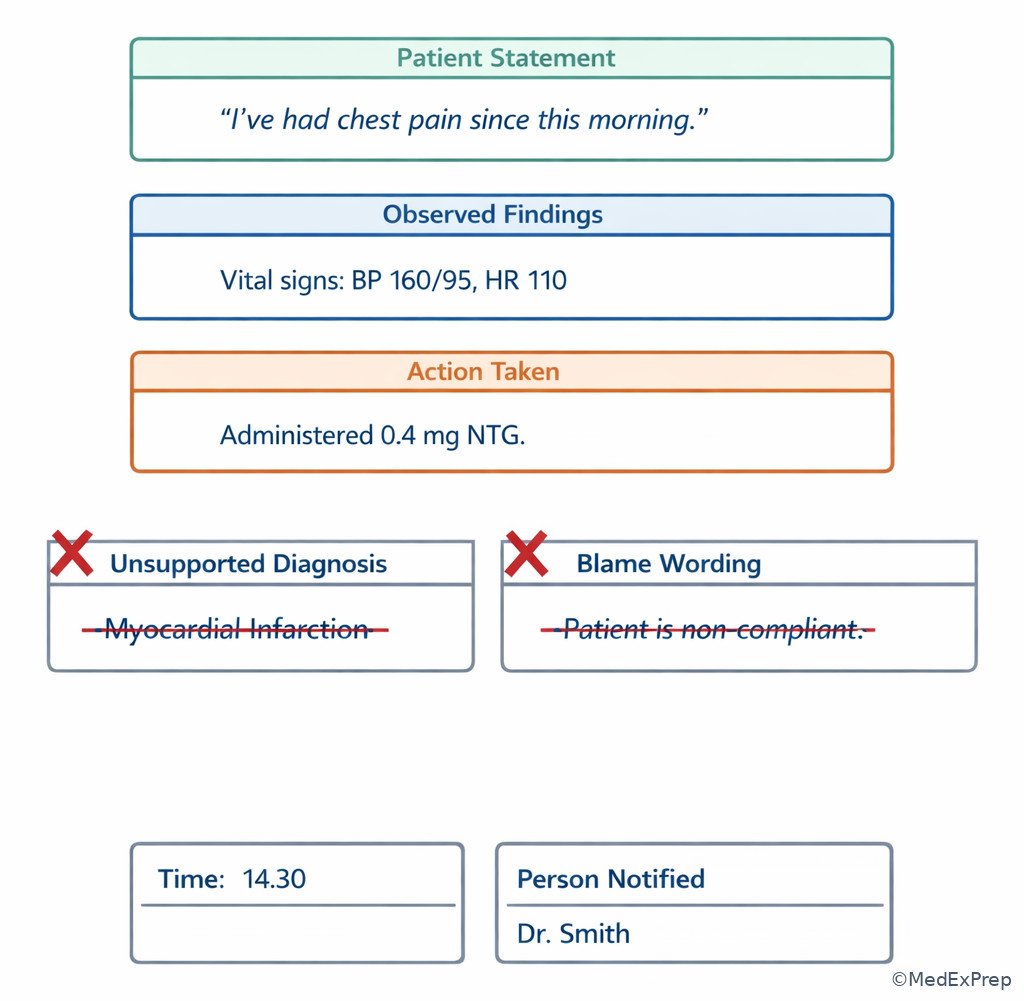
The next decision conflict is whether to document what happened or to document an interpretation that goes beyond the available facts. The single rule: document observations, actions taken, responses, times, and notifications; reject labels or conclusions that require independent diagnosis or specialist interpretation unless your protocol explicitly permits standardized classification.
This distinction is testable because documentation answers often all look responsible. The wrong choices usually overreach by turning an observation into a diagnosis, motive, or legal conclusion. A CRAS candidate may document “patient reported chest pressure rated 7/10, appeared pale, supervising nurse notified at 10:42.” A CRAS candidate should not chart “patient had myocardial infarction” unless entering an already-confirmed diagnosis from authorized documentation and according to local policy.
WHY THIS IS TESTED: The exam rewards precise wording. Candidates lose points when they confuse noticing with concluding. In practice, good documentation supports safety and escalation; poor documentation creates downstream confusion.
B Worked example
A 54-year-old patient with diabetes and osteoarthritis becomes tearful during intake and says, “I feel like my heart is racing.” The pulse is 112/min. The patient drank two large coffees before arrival and reports poor sleep. A new staff member suggests documenting “acute cardiac event” so the chart looks urgent enough to get quick attention. The patient also mentions chronic knee pain, which is irrelevant noise.
Identify task: The stem is testing documentation wording. Extract key facts: You have a patient report, an observed emotional state, and an elevated pulse. You do not have authority to diagnose the cause. Apply rule: Chart the report and measured finding, then notify the appropriate clinician per protocol. Eliminate distractors: “Acute cardiac event” is tempting because it conveys urgency, but it assigns a medical conclusion not established by the facts. Verify: The best documentation is objective: patient stated heart racing, pulse recorded, patient tearful, clinician notified, time documented.
C Exam trap
Common wrong answer: Use stronger diagnostic language to make the team respond faster.
WHY IT IS TEMPTING: Candidates think urgency requires dramatic wording.
SINGLE CLUE THAT ELIMINATES IT: Urgency is created by prompt escalation and accurate facts, not by unsupported interpretation in the record.
D Checkpoint
Question: Which charting entry best stays within CRAS documentation boundaries?
- A. “Patient likely had a drug reaction; condition worsening.”
- B. “Patient reports itching after medication; rash noted on forearms; supervising clinician notified.”
- C. “Provider error caused patient distress.”
- D. “Patient is noncompliant and exaggerating symptoms.”
Answer: B
- A is tempting because it links symptoms to a plausible cause, but wrong because “drug reaction” is an interpretive conclusion; the clue is causal language.
- B is tempting because it is plain and specific, and right because it includes report, observed finding, and notification without unsupported judgment.
- C is tempting because it seems transparent, but wrong because it makes a fault/legal attribution beyond objective charting; the clue is blame assignment.
- D is tempting because it feels like a behavioral summary, but wrong because it is subjective and pejorative rather than factual; the clue is motive/judgment wording.
- Fill in the blank: Document what was observed, not what was ________.
- True or False: Stronger wording is appropriate if it speeds team response.
- Name the 3 key elements of safe charting in a concerning event: observation, ________, and ________.
Exam takeaway: Document symptoms, measurements, actions, and notifications while avoiding unsupported diagnoses or blame statements.
flowchart LR
A[Observed or reported fact] --> B[Can it be directly measured or quoted?]
B -->|Yes| C[Document it]
B -->|No| D[Recheck source]
C --> E{Does wording imply diagnosis, cause, or blame?}
E -->|No| F[Finalize entry]
E -->|Yes| G[Revise to objective wording]
When choosing between charting options, use the screen in Fig 2. The best answer usually preserves direct facts and strips away unsupported causality or fault language.
1.1.1.5 Unclear, conflicting, or incomplete information: clarify before you proceed
A Explanation
This section moves from definitions to application. The key conflict is whether to continue routine workflow despite a missing or conflicting detail, or to stop and clarify. The single rule is: if a required piece of information is unclear and affects safety, identity, action choice, timing, or documentation integrity, clarification comes before continuation.
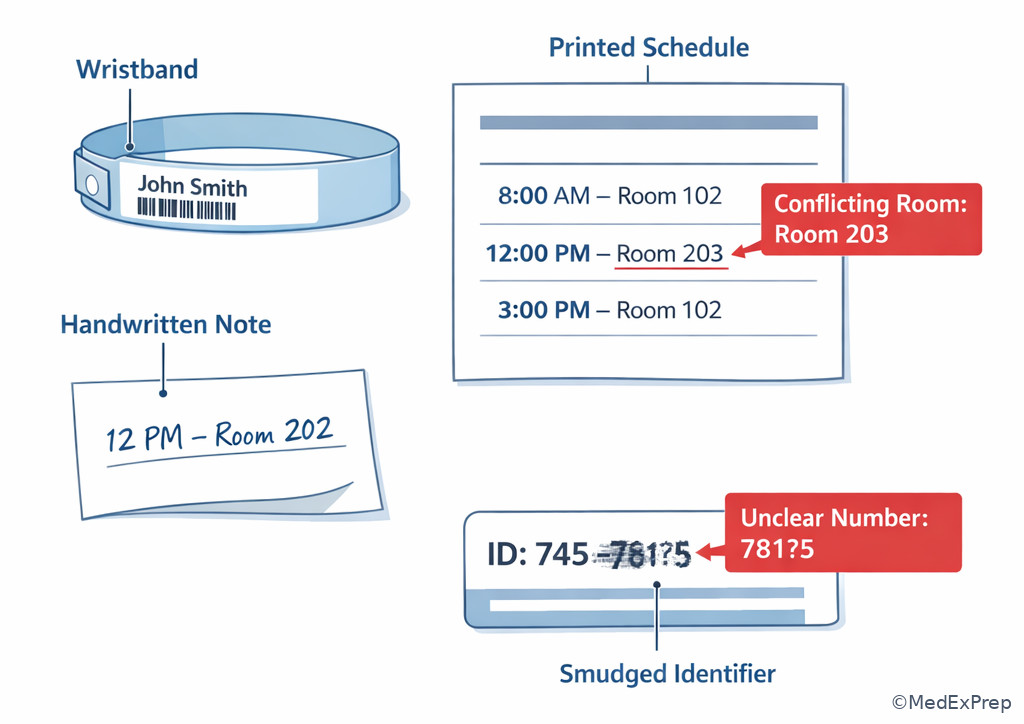
Examples include incomplete orders, mismatched labels, missing identifiers, conflicting instructions, illegible entries, or contradictory verbal and written guidance. CRAS candidates are expected to recognize these as process failures, not as puzzles to solve by assumption. Choosing the “most likely meaning” is a classic distractor because it feels efficient. The exam instead rewards verification.
WHY THIS IS TESTED: Routine healthcare errors often begin with small information defects. Questions test whether you can identify the defect and interrupt the chain before harm occurs. This is not passivity; it is controlled, protocol-based safety action.
B Worked example
A 72-year-old patient with COPD and atrial fibrillation presents for a scheduled service. The printed schedule lists one room, but a handwritten note redirects the patient to another room with a different clinician name. The patient also says, “I usually go wherever they tell me.” The wristband is present, but one digit on the paperwork appears smudged. A coworker says, “It is probably fine; the clinic is behind today.” The patient is wearing a bright holiday sweater, which is distracting but irrelevant.
Identify task: Determine whether to continue routine processing. Extract key facts: There is conflicting location/clinician information and a potentially unclear identifier. Apply rule: A discrepancy affecting identity or destination requires clarification before proceeding. Eliminate distractors: Following the handwritten note because it is more recent is tempting, but recency does not resolve the mismatch. Sending the patient based on the patient’s memory is also weak because identity/workflow verification must be system-based. Verify: The best next step is to pause, confirm identifiers and assignment through the approved source or supervisor, then document the clarification as required by local process.
C Exam trap
Common wrong answer: Use the source that looks newest or most confident and keep the line moving.
WHY IT IS TEMPTING: In real workflow pressure, recent handwriting or verbal certainty feels more trustworthy than delay.
SINGLE CLUE THAT ELIMINATES IT: The discrepancy affects identity or routing; when a core verification element conflicts, assumption is unsafe.
D Checkpoint
Question: Which situation most clearly requires clarification before proceeding?
- A. A patient arrives five minutes early and asks how long the visit will take.
- B. The patient’s preferred name differs from the legal name, but identifiers match per policy.
- C. A routine form has an unreadable note in a section unrelated to the scheduled task.
- D. The action to be performed depends on an order that is partially illegible and could change the next step.
Answer: D
- A is tempting because schedule questions feel operational, but wrong because timing estimates do not usually affect safety of the ordered task.
- B is tempting because name differences can matter, but wrong here because the stem says identifiers match per policy; the key clue is “per policy.”
- C is tempting because unreadable notes are concerning, but wrong because the unreadable item is unrelated to the task.
- D is tempting because illegibility often signals trouble, and right because the unclear order changes the actual action choice.
Exam takeaway: A mismatch in identifiers, location, or instructions is a verification problem first, not a speed problem.
1.1.1.6 Escalation boundaries: know when support ends and handoff begins
A Explanation
The final foundational-to-integration shift is recognizing the moment when a CRAS candidate stops routine support and initiates escalation. The decision conflict is whether to keep working within familiar tasks or to treat the situation as exceeding standing guidance. The single rule: escalate when findings are abnormal, unsafe, rapidly changing, conflicting, or outside protocol—and do not independently bridge the gap with advanced clinical judgment.
Escalation is not failure. It is correct boundary performance. Candidates sometimes confuse helpfulness with taking over. On the exam, the right answer may be to stay with the patient, gather permitted facts, notify the appropriate person, and document the handoff—not to invent the next clinical move. This distinction matters most when the stem introduces urgency. Urgency changes priority, not scope.
WHY THIS IS TESTED: Many boundary stems are really prioritization stems in disguise. The exam wants to know whether you can recognize that immediate escalation is the safest next step even when you could imagine several other actions.
B Worked example
A 61-year-old patient with heart failure and diabetes arrives for a routine encounter. During check-in, the patient becomes pale, sweaty, and says, “I feel like I might pass out.” The blood pressure machine has not yet been set up. A family member urges you to “just give something sweet,” while another staff member says, “Maybe it is anxiety.” The patient also has a scheduled paperwork question about parking validation, which is irrelevant noise.
Identify task: Determine the most appropriate next step under urgent uncertainty. Extract key facts: The patient has concerning symptoms and a possible acute change. You do not yet know the cause. Apply rule: Urgent, potentially unsafe change requires immediate escalation and within-role support, not independent diagnosis or treatment selection. Eliminate distractors: Giving sugar is tempting if hypoglycemia comes to mind, but the cause is unconfirmed and treatment selection may exceed role or protocol. Dismissing it as anxiety is also wrong because it interprets rather than escalates. Verify: Promptly notify the appropriate licensed professional/supervisor, stay with the patient, follow emergency or urgent protocol within authorized limits, and document the event and notification.
C Exam trap
Common wrong answer: Treat the most likely cause before notifying anyone.
WHY IT IS TEMPTING: Pattern recognition is powerful, and a familiar emergency pattern can make an unsupported intervention seem obvious.
SINGLE CLUE THAT ELIMINATES IT: The scenario is uncertain and potentially urgent; the CRAS-level response is escalation plus authorized immediate support, not independent treatment.
D Checkpoint
Question: A patient develops a sudden concerning symptom during routine workflow, and the cause is not yet clear. Which response best fits CRAS role boundaries?
- A. Choose the most likely cause and begin treatment to avoid delay.
- B. Notify the appropriate licensed professional or supervisor immediately while performing only authorized support actions.
- C. Wait for more symptoms so the picture becomes clearer before escalating.
- D. Ask the family which intervention has helped before and use that now.
Answer: B
- A is tempting because rapid action sounds safer, but wrong because treatment choice without authorization exceeds role; the discriminating clue is uncertain cause.
- B is tempting because it addresses urgency without overstepping, and right because escalation priority rises while scope stays fixed.
- C is tempting because more data can help, but wrong because urgent changes should not wait for pattern completion.
- D is tempting because prior response may seem relevant, but wrong because family report does not authorize action beyond protocol.
- True or False: Urgent symptoms can temporarily expand the CRAS candidate’s independent role.
- Fill in the blank: Urgency changes ________, not scope.
- Name 3 escalation triggers: abnormal, ________, and ________.
Exam takeaway: When abnormality, uncertainty, or risk appears, escalate promptly and avoid independent clinical decisions.
flowchart TD
A[New finding or request] --> B{Within protocol and clearly safe?}
B -->|Yes| C[Continue authorized steps]
B -->|No| D{Abnormal, unclear, conflicting, or urgent?}
D -->|Yes| E[Escalate now]
D -->|No| F[Clarify before proceeding]
E --> G[Document concern, time, and notification]
F --> G
C --> G
See Fig 3 for the tested pattern: once abnormality or uncertainty crosses a safety threshold, the correct answer transitions from “do more” to “escalate correctly.”
1.1.1.7 Integrating boundary decisions under exam pressure
A Explanation
In mixed stems, candidates miss questions because they focus on the medical detail instead of the exam task. The final decision conflict is choosing between a clinically appealing answer and a role-appropriate answer. The single rule is to identify the actual task before reacting to the content. Ask: Is this stem mainly about action authority, documentation wording, discrepancy resolution, or escalation priority?
If the task is boundary recognition, the best answer is usually the option that preserves safety, respects protocol, and avoids unsupported independence. The test writers often add noise: age, comorbidities, one memorable symptom, or a coworker suggestion that sounds efficient. Those details are there to tempt you into overreaching. Your job is not to solve the whole clinical problem. Your job is to choose the CRAS-level next step.
WHY THIS IS TESTED: The exam measures disciplined first-line performance. Strong candidates resist “hero answers” and instead choose the answer that is safe, authorized, and documentable.
B Worked example
A 46-year-old patient with asthma and depression calls after receiving a routine medication refill package and says, “These pills look different from last month. Should I take two tonight or skip it?” The medication name on the package is visible, but the patient also mentions a mild headache from earlier in the day. A colleague says, “If the pill looks different, it is probably a generic swap—tell the patient it is fine.” Another note in the chart mentions an upcoming dental cleaning, which is noise.
Identify task: This is not a diagnosis question; it is a boundary and clarification question in medication context. Extract key facts: The patient is asking for dosing advice about a possibly changed product. The appearance difference may be benign, but dosing confirmation matters. Apply rule: Do not independently guess. Use approved verification channels and escalate/clarify with the supervising pharmacist or licensed professional per policy. Eliminate distractors: “It is probably fine” is tempting because generic substitutions are common, but “probably” is the red-flag word. Telling the patient to skip or double a dose independently is also outside role. Verify: The best next step is to hold dosing advice until the medication identity and instructions are confirmed through approved sources and the appropriate professional is notified.
C Exam trap
Common wrong answer: Reassure based on what is most likely true.
WHY IT IS TEMPTING: Many routine discrepancies do turn out to be harmless, and reassurance feels efficient.
SINGLE CLUE THAT ELIMINATES IT: The patient is asking for a dosing decision; once the answer changes how the medication is taken, guesswork is not acceptable.
D Checkpoint
Question: Which answer best reflects the CRAS exam framework when a scenario includes clinical noise but the task is role-boundary recognition?
- A. Choose the option with the most complete medical explanation.
- B. Choose the option that resolves the patient’s problem fastest, even if policy is unclear.
- C. Choose the safest authorized next step, then document or escalate as required.
- D. Choose the option supported by the coworker’s prior experience.
Answer: C
- A is tempting because medical detail sounds sophisticated, but wrong because the exam task is role performance, not advanced diagnosis.
- B is tempting because speed matters, but wrong because unclear policy and scope limits require clarification.
- C is tempting because it sounds procedural, and right because CRAS questions center on safe authorized execution.
- D is tempting because experience can help workflow, but wrong because anecdote does not replace policy, protocol, or chain of command.
Exam takeaway: In noisy board-style scenarios, first identify whether the decision is about scope, documentation, clarification, or escalation.
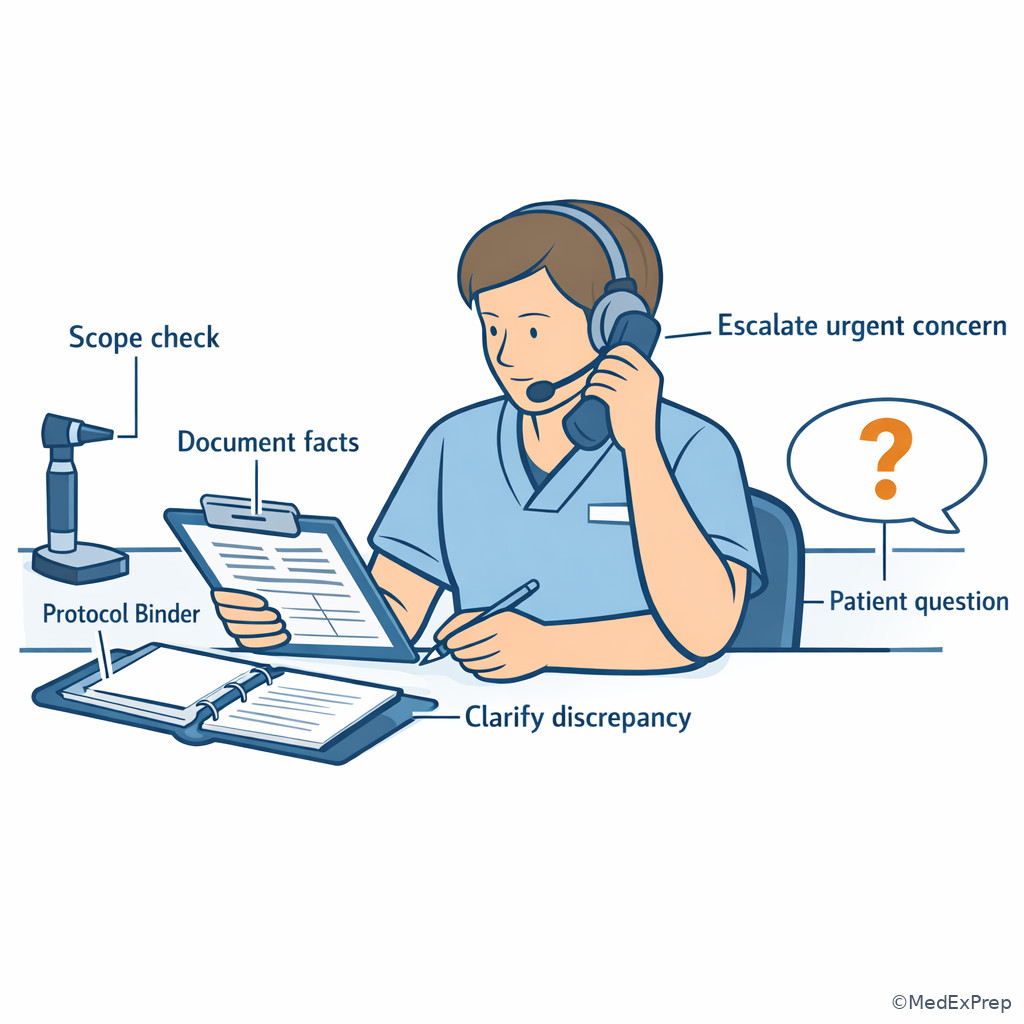
See Fig 4 whenever a stem feels crowded. The testable move is to classify the decision type first, then apply the matching role rule.
Exam takeaway: Compare what can be observed, documented, and escalated with what requires licensed-provider judgment.
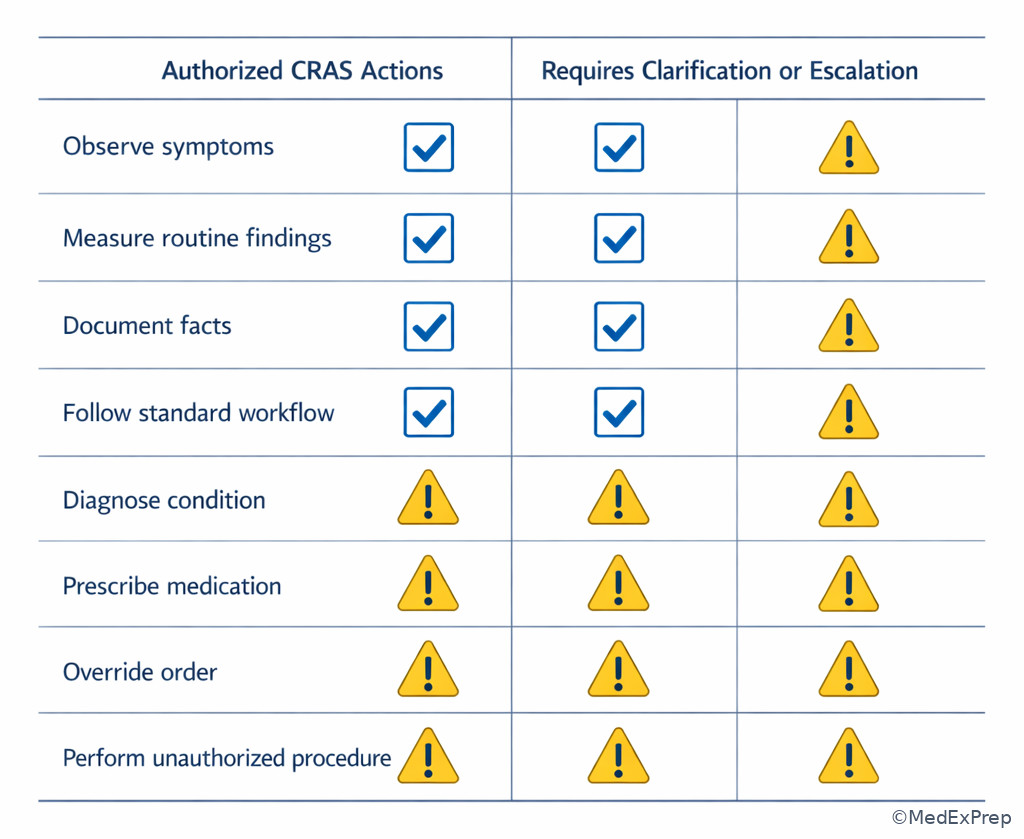
The compare-and-contrast in Fig 5 is the fastest way to eliminate hero-style distractors.
Exam takeaway: Sort each question into proceed, clarify, document, or escalate before considering finer details.
flowchart TD
A[Read stem] --> B[Identify requested action]
B --> C{Authorized and clear?}
C -->|Yes| D[Proceed and document]
C -->|No| E{Unclear/conflicting but not urgent?}
E -->|Yes| F[Clarify first]
E -->|No| G{Urgent or unsafe?}
G -->|Yes| H[Escalate immediately]
G -->|No| I[Seek supervisor guidance]
D --> J[Verify response stays in role]
F --> J
H --> J
I --> J
Use Fig 6 as your test-day mental algorithm: proceed, clarify, document, or escalate. Most wrong answers fail because they skip one of those gates.
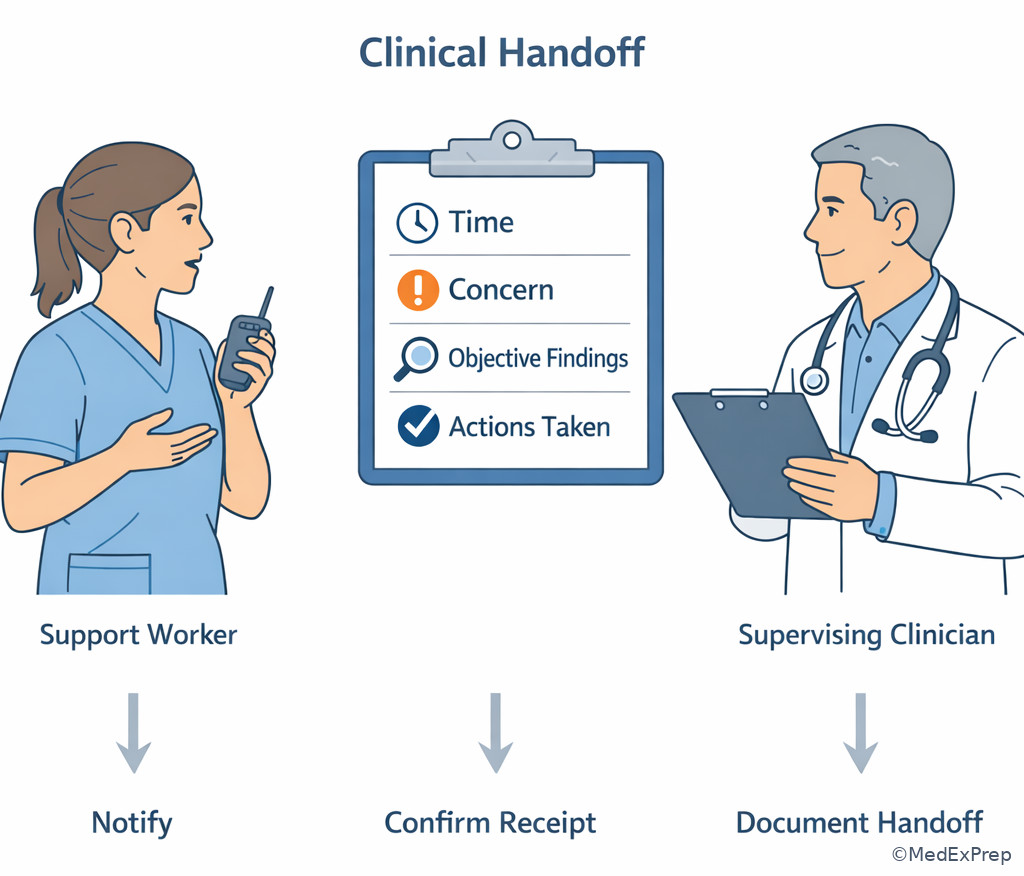
Exam takeaway: Effective escalation includes the concern, relevant facts, and confirmation that the handoff reached the right person.
Exam takeaway: Accurate notes focus on patient statement, observed finding, action, time, and notification rather than causation or blame.
Exam Traps & Differentiators
1.1.1.8 Most common wrong answer and why
Wrong answer pattern: “Take a small independent step while waiting.” This is tempting because it feels moderate and practical. The problem is that many “small” steps still involve diagnosis, treatment selection, causality assignment, or order override.
1.1.1.9 Looks similar but isn't
| Looks similar | Within role | Outside role | Single discriminator |
|---|---|---|---|
| Documenting symptoms vs diagnosing condition | Record report and findings | State definitive medical conclusion | Does the wording assign diagnosis/cause? |
| Following workflow vs choosing treatment | Perform standard authorized steps | Select or change therapy | Does the action alter treatment? |
| Clarifying order vs interpreting order by guess | Pause and verify | Assume intended meaning | Is a safety-relevant detail unclear? |
| Urgent response vs independent emergency management | Escalate and do authorized support actions | Treat based on presumed cause | Does the step require clinical judgment beyond protocol? |
| Patient education support vs prescribing advice | Repeat approved instructions | Advise a new regimen or change | Are you changing how therapy is used? |
1.1.1.10 If the stem says..., think...
- “The clinician is busy/unavailable” → role boundaries do not expand; think escalate or hold.
- “The patient asks what to stop/start/change” → think treatment decision beyond role.
- “The note/order is unclear or conflicting” → think clarify before proceeding.
- “A coworker suggests what it probably means” → think assumption trap.
- “Symptoms are concerning and rapidly changing” → think urgent escalation, not independent diagnosis.
- “Document so it sounds more serious” → think objective facts only.
| Trap from this topic | Confusable upcoming topic | How to separate them |
|---|---|---|
| Boundary breach | Allowed Vs Disallowed Actions | This lesson asks whether the action class itself exceeds role; the next topic drills the action lists in detail. |
| Urgent uncertainty | Escalation Trigger Recognition | This lesson sets the scope limit; the next topic teaches which abnormalities and risks raise escalation priority fastest. |
| Objective charting | Objective Vs Subjective Data | Here the focus is role boundary; later the focus is precise chart construction. |
Tables
| Boundary cue in stem | Best CRAS-level response | Reject this distractor |
|---|---|---|
| Patient asks for medication change | Hold advice; notify supervising clinician/pharmacist; document question | Recommend skip/double/stop dose independently |
| Objective symptom appears | Observe, measure if authorized, notify, document | Assign diagnosis without confirmation |
| Order is incomplete or illegible | Clarify before proceeding | Infer the intended instruction |
| Conflicting paperwork | Verify using approved source or chain of command | Use whichever source seems newer |
| Urgent deterioration | Immediate escalation and authorized support actions | Treat presumed cause independently |
| Pressure from coworker/family | Stay within protocol and role | Act outside role to satisfy urgency or convenience |
| Documentation wording | Why it works or fails | Classification |
|---|---|---|
| “Patient reports dizziness after morning dose.” | Direct patient report without added conclusion | Acceptable |
| “Likely adverse drug reaction.” | Adds unsupported causation unless protocol explicitly allows | Not acceptable independently |
| “Red rash observed on both forearms.” | Objective observed finding | Acceptable |
| “Provider error caused complication.” | Assigns blame/legal conclusion | Not acceptable |
| “Supervising nurse notified at 14:05.” | Closes loop with action and time | Acceptable |
| “Patient was dramatic and noncompliant.” | Subjective and pejorative | Not acceptable |
| Situation type | Primary decision | Secondary step | Typical exam wording |
|---|---|---|---|
| Clearly authorized routine task | Proceed | Document completion | “Most appropriate next step” |
| Information gap without immediate danger | Clarify | Then proceed if resolved | “Requires clarification” |
| Urgent abnormality or unsafe condition | Escalate | Authorized immediate support + document | “Best immediate action” |
| Request for independent treatment choice | Do not decide independently | Notify appropriate professional | “Patient asks whether to stop/start” |
| Charting decision | Use objective wording | Record notification | “Best documentation entry” |
Algorithm / Approach
Use this five-step method on nearly every question in this course. It prevents the two biggest CRAS exam errors: acting beyond role and skipping verification.
Rapid Review
- Scope boundary → authorization, not convenience, determines whether you may act.
- Urgency → raises escalation priority; does not expand independent scope.
- Patient request for dose change → treatment decision trap, not customer service task.
- Objective note → symptom + finding + action + time + notification.
- Unsupported diagnosis wording → reject even if clinically plausible.
- Illegible order detail → clarify if it changes action, timing, or safety.
- Conflicting sources → approved verification beats the newest-looking note.
- Coworker reassurance → anecdote never overrides protocol.
- Helpful shortcut → common distractor when it bypasses authorization.
- Family suggestion → information source, not authorization source.
- Documentation urgency → achieved by rapid notification, not exaggerated wording.
- Best next step → often clarify or escalate rather than complete the task.
Self-check quiz
1.1.1.11 Question 1
A patient receiving lisinopril 10 mg by mouth once daily asks whether the dose should be doubled today because the home blood pressure was high this morning. The patient also mentions seasonal allergies and mild knee pain. What is the most appropriate next step for the CRAS candidate?
- A. Advise taking lisinopril 20 mg by mouth once today, then resume 10 mg daily tomorrow.
- B. Advise skipping lisinopril today and rechecking blood pressure tomorrow.
- C. Document the question and notify the supervising clinician/pharmacist for dosing clarification before advising a change.
- D. Recommend taking lisinopril 10 mg twice daily until the next visit.
1.1.1.12 Question 2
A refill package contains metformin 500 mg by mouth twice daily, but the tablets look different from last month. The patient asks whether the medication was changed. Which documentation entry best stays within role boundaries?
- A. “Patient likely received the wrong medication and should stop therapy.”
- B. “Patient states tablets look different; medication identity requires verification; supervising pharmacist notified.”
- C. “Dispensing error confirmed.”
- D. “Generic substitution caused side effects.”
1.1.1.13 Question 3
A 73-year-old patient with chronic kidney disease and heart failure is scheduled to receive furosemide 40 mg by mouth every morning per routine medication support workflow. The printed medication list shows 40 mg daily, but a handwritten note appears to read 80 mg daily. The patient says, “I think they changed it last week,” and also reports constipation. What is the most appropriate next step?
- A. Use the handwritten note and proceed with furosemide 80 mg because newer notes usually supersede older lists.
- B. Use the printed list and proceed with furosemide 40 mg because it is the formal document.
- C. Clarify the discrepancy through the approved source or supervising clinician before proceeding with dose-dependent workflow steps.
- D. Ask the patient which dose worked better and document that as the correct regimen.
1.1.1.14 Question 4
A 58-year-old patient taking warfarin 5 mg by mouth once daily reports new gum bleeding and says a neighbor suggested skipping tonight’s dose. The patient also takes amlodipine and omeprazole and mentions a recent haircut. What is the most appropriate CRAS-level response?
- A. Advise the patient to skip warfarin 5 mg tonight because bleeding suggests the dose is too high.
- B. Advise the patient to continue warfarin 5 mg and ignore the bleeding unless it worsens.
- C. Document the report, promptly notify the supervising clinician/pharmacist, and avoid independent dosing advice.
- D. Recommend reducing warfarin from 5 mg to 2.5 mg by mouth tonight until contacted.
1.1.1.15 Question 5
A 41-year-old patient with asthma and GERD receives albuterol inhaler instructions of 2 puffs inhaled every 4 to 6 hours as needed. During follow-up, the patient says, “I used it 8 times today and now I feel shaky.” A coworker says this is expected and probably fine. What is the most appropriate next step?
- A. Reassure the patient that shakiness is expected and no follow-up is needed.
- B. Tell the patient to stop the inhaler permanently.
- C. Notify the supervising clinician/pharmacist because the usage pattern and symptom may indicate an issue requiring review.
- D. Instruct the patient to switch to 1 puff every hour as needed.
1.1.1.16 Question 6
A 66-year-old patient with diabetes and atrial fibrillation arrives for medication review with insulin glargine 20 units subcutaneously nightly and apixaban 5 mg by mouth twice daily listed in the chart. The patient becomes pale, diaphoretic, and says, “I feel faint.” A family member offers juice and says this happened once before. The patient also asks whether tonight’s apixaban should be held because of a dental cleaning tomorrow. What is the most appropriate next step?
- A. Tell the patient to hold apixaban tonight and drink juice immediately because both requests sound reasonable.
- B. Ask the family which medication usually helps and follow that plan to avoid delay.
- C. Promptly escalate the acute change to the supervising clinician, provide only authorized immediate support actions per protocol, and defer medication-change advice pending clarification.
- D. First answer the apixaban question so the patient leaves with a complete plan, then address the faintness if it persists.
1.1.1.17 Question 7
A patient calls about a new bottle labeled sertraline 50 mg by mouth once daily. The tablet appearance differs from the prior refill. The patient takes sertraline, hydrochlorothiazide, and atorvastatin, and says, “I missed yesterday’s dose, so should I take 2 tablets today if this is the same drug?” The prescriber’s office is at lunch, and a coworker says generic swaps happen all the time. What response requires the best application of role boundaries?
- A. Advise taking sertraline 100 mg today because the missed dose should be made up.
- B. Confirm through approved resources or supervising personnel before giving dosing advice, because both identity verification and missed-dose guidance affect therapy.
- C. Tell the patient to skip sertraline for two days until the office reopens.
- D. Assume it is a generic equivalent and advise taking 50 mg now and 50 mg tonight.
1.1.1.18 Question 8
A 70-year-old patient with hypertension, chronic kidney disease, and osteoarthritis presents with a medication list showing losartan 50 mg by mouth once daily. A faxed refill request appears to say losartan 100 mg daily, but the last signed clinic note still lists 50 mg daily. The patient says, “I think they increased it because my ankles were swollen,” and a staff member asks you to update the chart to “dose increased for worsening heart failure” so the refill can move faster. What is the most appropriate action?
- A. Update the chart to losartan 100 mg daily for worsening heart failure because the patient’s statement supports the change.
- B. Leave the chart unchanged and ignore the fax because only signed notes count.
- C. Clarify the dose discrepancy with the appropriate authorized source and document objective facts without adding the diagnostic reason.
- D. Enter both doses in the chart and let the pharmacist choose which one is correct later.
Answer key
1.1.1.19 Question 1 answer: C
- A: Tempting because a high home reading may suggest under-treatment. Incorrect because doubling lisinopril changes therapy independently; the single clue is that the patient asks for a dose change. Confirm with authorized clinician/pharmacist guidance and institutional policy.
- B: Tempting because it sounds cautious. Incorrect because skipping lisinopril is still an independent treatment change; the clue is unauthorized dosing advice.
- C: Tempting because it sounds procedural rather than clinical. Correct because documenting the question and notifying the supervising clinician/pharmacist preserves role boundaries and supports safe workflow. This follows the governing rule of no independent treatment adjustment without authorization.
- D: Tempting because split dosing can sound pharmacologically reasonable. Incorrect because changing frequency is also a prescription-level decision; the clue is altered regimen design.
1.1.1.20 Question 2 answer: B
- A: Tempting because a different tablet appearance can suggest a dispensing problem. Incorrect because “received the wrong medication” and “should stop therapy” assign cause and treatment direction without verification; the clue is unsupported conclusion.
- B: Tempting because it is simple. Correct because it records the patient’s observation, identifies the need for verification, and documents notification without diagnosing the issue.
- C: Tempting because it sounds decisive. Incorrect because “error confirmed” states a conclusion not yet established; the clue is certainty without verification.
- D: Tempting because tablet changes often reflect generic substitution. Incorrect because it adds causation and side-effect attribution not supported by the stem; the clue is inferred cause.
1.1.1.21 Question 3 answer: C
- A: Tempting because handwritten changes may be recent. Incorrect because recency does not resolve a dose discrepancy involving furosemide 40 mg versus 80 mg; the clue is conflicting dose information.
- B: Tempting because printed records often feel more official. Incorrect because formal appearance alone does not settle a conflict when a newer note may exist; the clue is unresolved contradiction.
- C: Tempting because it delays action slightly. Correct because a discrepancy in dose-dependent workflow must be clarified through an approved source before proceeding. The discriminating clue is that the dose itself changes the action.
- D: Tempting because the patient may recall recent changes. Incorrect because patient preference or memory does not authorize final regimen selection when documentation conflicts; the clue is reliance on anecdote over verification.
1.1.1.22 Question 4 answer: C
- A: Tempting because gum bleeding may make skipping warfarin 5 mg seem appropriate. Incorrect because advising a hold is an independent anticoagulation decision; the clue is dose interruption advice.
- B: Tempting because not all bleeding is severe. Incorrect because dismissing new bleeding ignores a potentially important medication-related concern; the clue is new bleeding while taking warfarin.
- C: Tempting because it avoids guessing. Correct because documenting the symptom and promptly notifying the supervising clinician/pharmacist respects role boundaries and addresses potential risk without independent dose change.
- D: Tempting because dose reduction sounds gentler than a full hold. Incorrect because changing from warfarin 5 mg to 2.5 mg is still unauthorized regimen adjustment; the clue is altered dose selection.
1.1.1.23 Question 5 answer: C
- A: Tempting because tremor can occur with albuterol inhaler use. Incorrect because 2 puffs every 4 to 6 hours as needed does not align with 8 uses in one day, and the pattern may require review; the clue is possible overuse plus symptom.
- B: Tempting because the patient has a symptom after frequent use. Incorrect because permanent discontinuation is an unauthorized treatment decision; the clue is instruction to stop therapy entirely.
- C: Tempting because it sounds conservative. Correct because the usage pattern and symptom suggest a concern that should be escalated to the supervising clinician/pharmacist rather than independently managed.
- D: Tempting because it appears to fine-tune the regimen. Incorrect because changing frequency to 1 puff every hour creates a new dosing strategy outside role; the clue is regimen redesign.
1.1.1.24 Question 6 answer: C
- A: Tempting because juice may help if hypoglycemia is suspected and holding apixaban 5 mg sounds practical before dental work. Incorrect because both actions involve clinical assumptions and medication-change advice without verified protocol or authorization; the clue is simultaneous acute symptoms plus a separate therapy question.
- B: Tempting because the family has prior experience. Incorrect because prior family experience does not replace protocol in an acute uncertain event; the clue is reliance on anecdote.
- C: Tempting because it may feel less decisive than treating immediately. Correct because the patient’s acute change requires prompt escalation and only authorized immediate support actions, while the apixaban question also requires clarification rather than independent advice. The discriminating clue is urgent uncertainty.
- D: Tempting because the patient asked a direct medication question. Incorrect because answering the apixaban hold question first misprioritizes a potentially acute instability and still exceeds role; the clue is pale, diaphoretic, faint.
1.1.1.25 Question 7 answer: B
- A: Tempting because missed-dose questions commonly trigger “make-up dose” thinking. Incorrect because advising sertraline 100 mg changes therapy without confirming both product identity and missed-dose instructions; the clue is dual uncertainty.
- B: Tempting because it slows the interaction. Correct because tablet identity must be verified and missed-dose guidance directly affects therapy; both require approved resources or supervising personnel before advice is given.
- C: Tempting because it avoids an overdose. Incorrect because telling the patient to skip sertraline for two days is still independent regimen advice unsupported by verified instructions; the clue is unauthorized missed-dose management.
- D: Tempting because generic substitutions are common and a same-day split dose may seem benign. Incorrect because assumption about equivalence plus additional same-day dosing exceeds role; the clue is “assume.”
1.1.1.26 Question 8 answer: C
- A: Tempting because the fax and patient comment both suggest a dose increase from losartan 50 mg to 100 mg. Incorrect because the chart update is not verified and “for worsening heart failure” adds an unsupported diagnosis/reason; the clue is both dose discrepancy and diagnostic overreach.
- B: Tempting because signed notes are authoritative. Incorrect because ignoring a conflicting refill request leaves a clinically relevant discrepancy unresolved; the clue is active conflict between sources.
- C: Tempting because it may feel slower than updating the chart immediately. Correct because the proper response is to clarify the discrepant dose with an authorized source and document only objective facts without adding the indication. This applies both the clarification rule and documentation boundary rule.
- D: Tempting because it keeps all information visible. Incorrect because entering both doses creates ambiguity instead of resolving it and does not protect the workflow; the clue is unresolved contradiction affecting therapy.
Keep going with the full CRAS Prep Course (CRAS)
You just studied the way members do, in the same lesson interface. Full access unlocks every lesson, the question bank and flashcards for a full year.
One payment · 1 year of access · No auto-renewal