1.1.1 - Candidate Role Boundaries
Candidate Role Boundaries
What you'll learn
- DOMAIN: Exam Scope and Role - Candidate posture - Distinguish what a CPVP candidate is expected to do from what is outside role boundaries.
- DOMAIN: Documentation and workflow judgment - Evidence-based action selection - Choose verification, hold, consult, or escalate when evidence is incomplete.
- DOMAIN: Standards-aware reasoning - Authority limits - Recognize when a scenario requires following documented procedure rather than personal preference.
- DOMAIN: Professional judgment - Defensible next steps - Identify the most appropriate next step without inventing policy, legal requirements, or technical authority.
- DOMAIN: Risk and integrity - Safe decision posture - Prioritize data integrity, traceability, and controlled workflow over speed or convenience.
Blueprint mapping
- Inferred DOMAIN: Exam Scope and Role → Candidate role expectations → Boundary recognition
- Inferred DOMAIN: Documentation and Traceability → Record sufficiency review → Evidence before decision
- Inferred DOMAIN: Risk and Change → Risk-based escalation → Hold/consult/escalate triggers
- Inferred DOMAIN: Workflow Judgment → Best next step logic → Stay within delegated authority
Why it matters
- Many CPVP-style questions are not testing raw memory; they test whether you stay inside the professional role when documentation is incomplete.
- The most tempting wrong answers often sound decisive but cross a boundary: certifying compliance without evidence, waiving documentation, or acting beyond delegated authority.
- Role-boundary questions reward a consistent pattern: identify the task, extract stated facts, apply the governing procedure or standard, then choose the safest defensible next step.
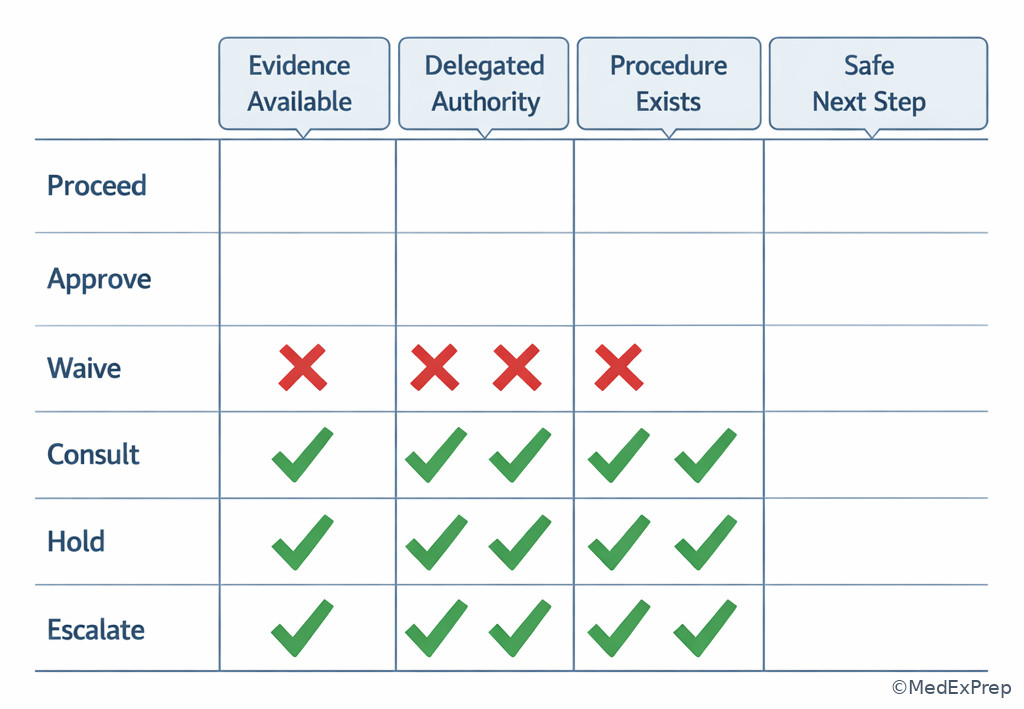
- Understanding this lesson early makes every later topic easier because qualification, verification, change control, and deviation handling all depend on the same decision posture. See Fig 1.
Key Terms & Must-Know Facts
1.1.1.1 Key terms
- Candidate role boundary: The limit of what the CPVP practitioner may conclude, recommend, or approve based on evidence and delegated authority.
- Defensible decision-making: Selecting actions that can be supported by records, procedure, standard, and documented rationale.
- Delegated authority: The authority explicitly assigned by role, procedure, or governance structure.
- Escalation: Routing an issue to quality, compliance, technical, or management personnel when required authority or expertise is missing.
- Verification: Confirming whether stated requirements, records, or conditions are actually met.
- Hold: Pausing progress or disposition until a required condition, review, or record is completed.
- Consult: Seeking input from the relevant function without independently overruling the system.
- Evidence sufficiency: Whether the available records adequately support the decision being considered.
- Control gap: A missing requirement, unclear acceptance criterion, absent approval, or broken workflow step that prevents defensible progression.
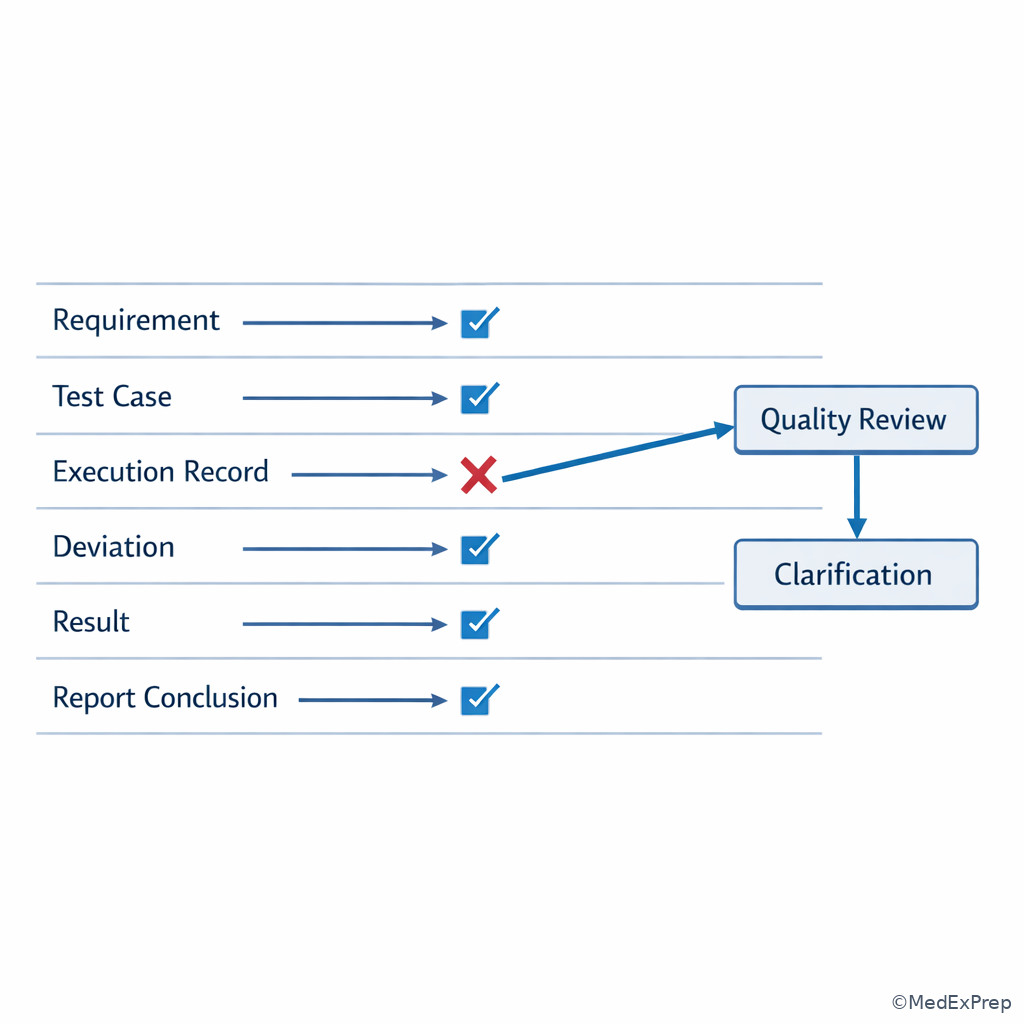
- Traceability: Ability to connect requirements, execution, results, deviations, and conclusions.
- Site-specific procedure: A local controlled document whose content must not be invented if not provided in the question.
- Out-of-role signal: A phrase or action showing the candidate is acting like a regulator, legal authority, or final approver without evidence.
1.1.1.2 Must-know facts
- When records are incomplete, the exam-safe posture is usually verify, hold, consult, or escalate—not assume.
- Never certify compliance, release, or suitability without documented evidence in the scenario.
- Do not invent SOP content, local law, or unpublished organizational policy.
- The best answer usually follows the documented procedure or governing standard named in the stem.
- Convenience never outranks documentation integrity.
- Authority limits matter as much as technical correctness.
- Unclear acceptance criteria are a control problem, not a minor formatting issue.
- A candidate may identify gaps and recommend next steps, but should not unilaterally waive required controls.
| Signal in the stem | What it usually means | Best exam posture |
|---|---|---|
| Missing approval/signature/date | Record not complete for disposition | Hold and obtain completion per procedure |
| Acceptance criteria not stated | Control gap; conclusion cannot be defended | Clarify criteria before proceeding |
| Procedure conflict or ambiguity | Interpretation risk | Consult governing document owner/quality |
| Evidence inconsistent with conclusion | Unsupported report or decision | Investigate discrepancy before approval |
| Pressure to move quickly | Potential bypass of controls | Maintain documented workflow |
| Question asks you to declare legality/compliance status | Possible out-of-role leap | Stay with facts, procedure, and escalation |
Core content
Exam takeaway: Choose evidence-based next steps inside the practitioner role and reject unsupported authority leaps.
flowchart TD
A[Question stem] --> B[Identify task]
B --> C[What facts are explicitly stated?]
C --> D{Enough evidence?}
D -->|Yes| E[Apply procedure or standard]
D -->|No| F[Verify hold consult or escalate]
E --> G{Within delegated authority?}
G -->|Yes| H[Recommend or execute next step]
G -->|No| I[Escalate to appropriate function]
F --> I Exam takeaway: The single best answer usually turns on whether the action requires authority or evidence the stem does not provide.
flowchart LR
A[Possible action] --> B{Supported by records?}
B -->|No| C[Reject action]
B -->|Yes| D{Allowed by role?}
D -->|No| E[Escalate or consult]
D -->|Yes| F{Procedure available?}
F -->|No| G[Seek governing standard or controlled instruction]
F -->|Yes| H[Proceed per documented workflow] Exam takeaway: Visualize which functions own review, approval, consultation, and escalation so you do not overstep the candidate role.
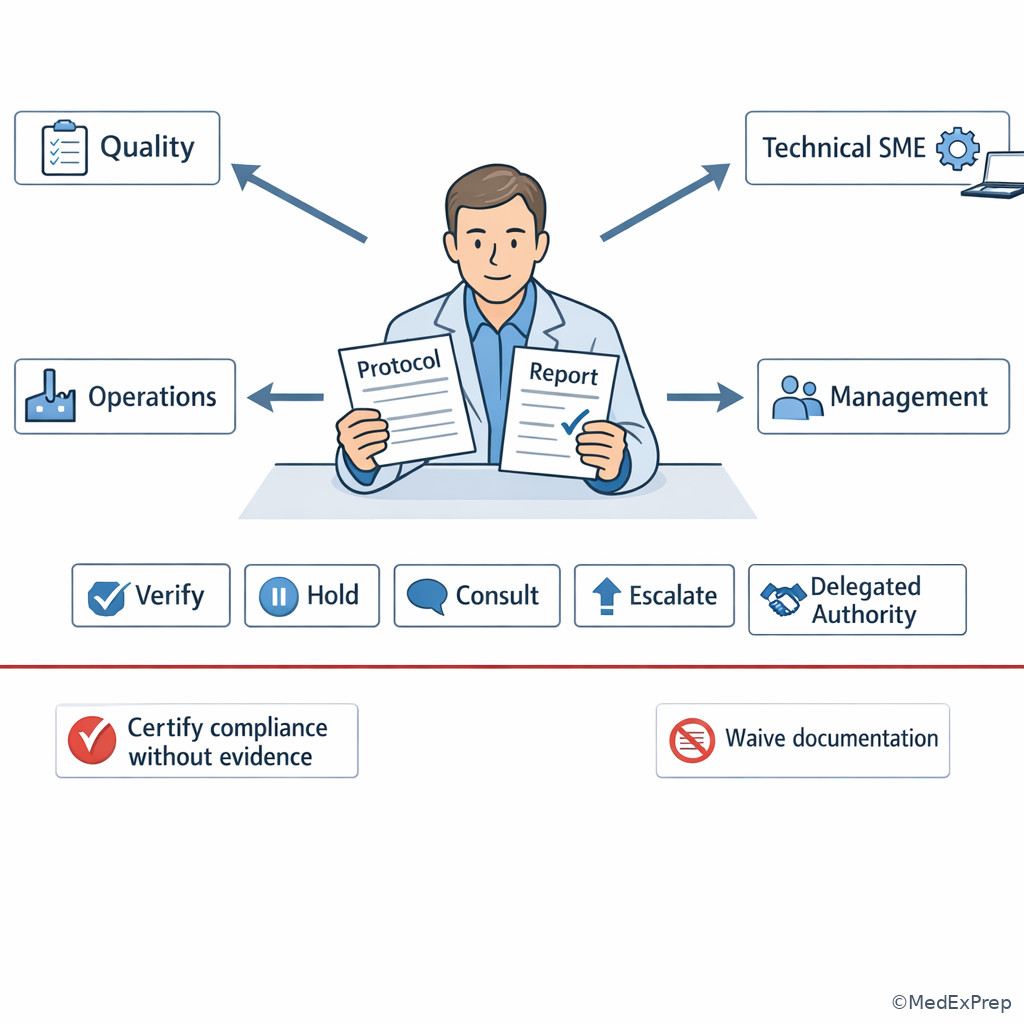
Exam takeaway: Incomplete records break the chain from execution to defensible conclusion and should trigger verification or hold.
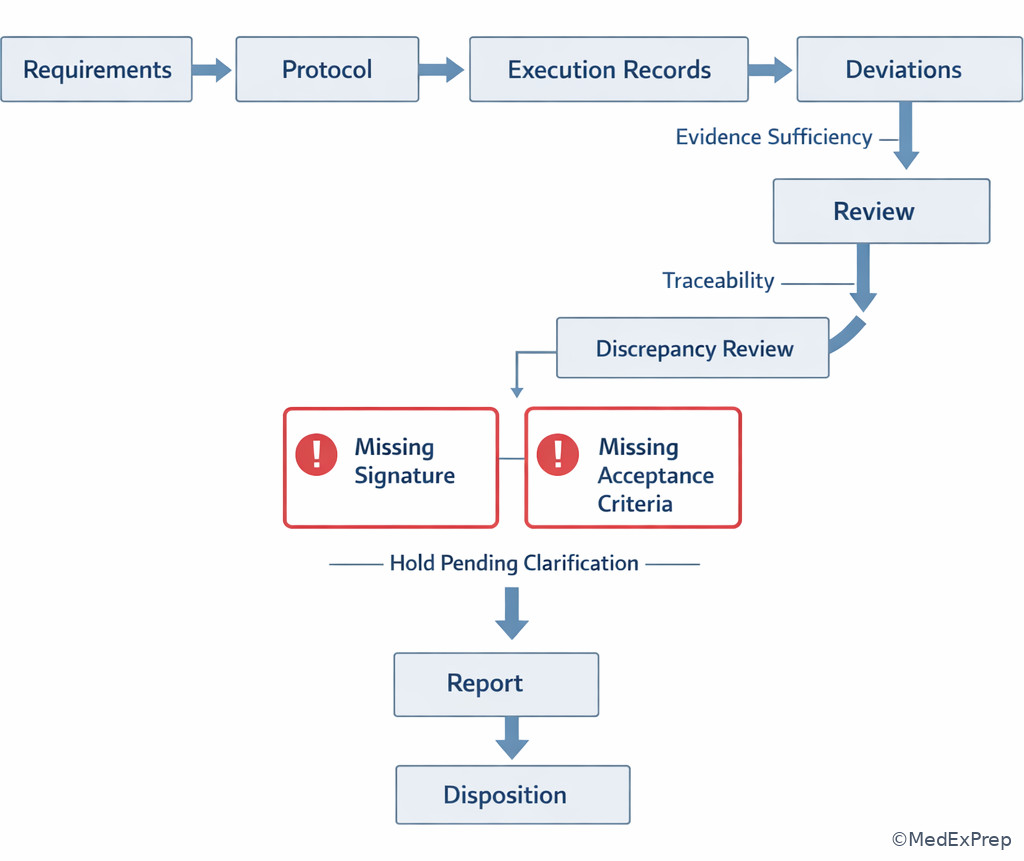
Exam takeaway: Red-flag phrases in a stem often indicate the wrong answer is pushing beyond practitioner authority.
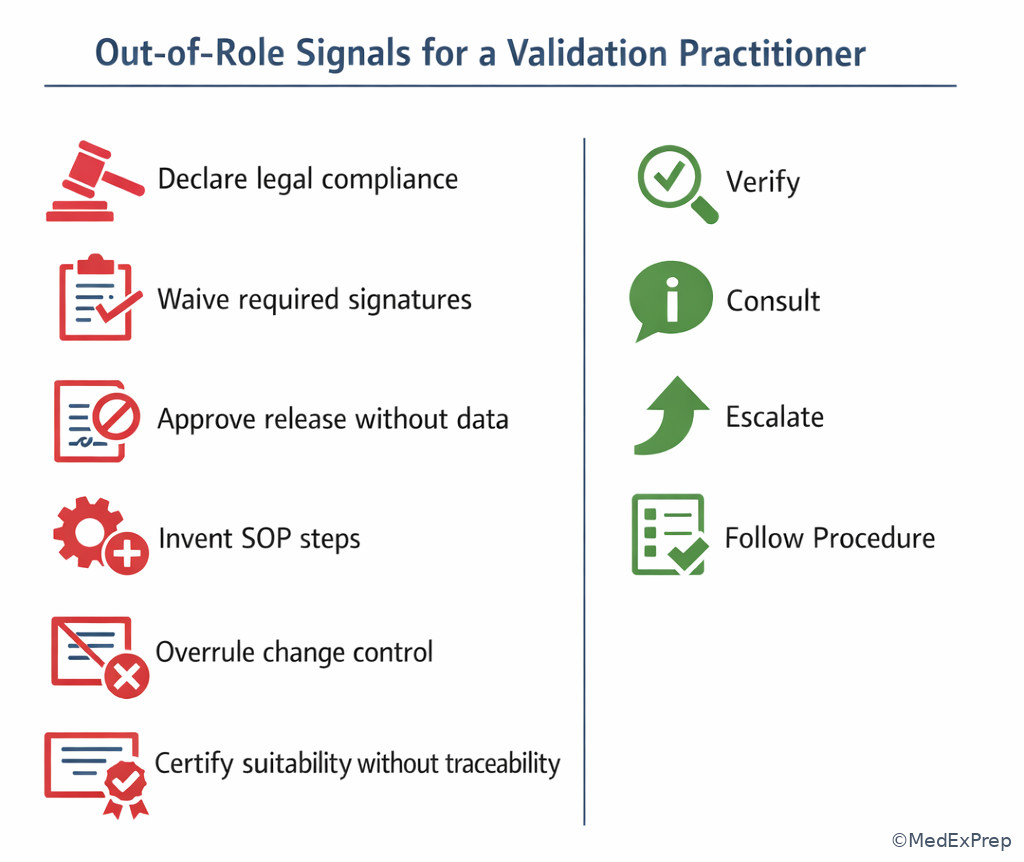
Exam takeaway: When a stem withholds a critical requirement or record, your next step should restore control before work continues.
flowchart TD
A[Critical information missing] --> B{Can it be verified immediately from controlled records?}
B -->|Yes| C[Verify and document]
B -->|No| D[Pause progression]
D --> E[Consult procedure owner or quality]
E --> F[Clarify criteria or required record]
F --> G[Resume only when control is restored] Exam takeaway: The correct action in pressured scenarios is to protect the record and workflow, not to backfill assumptions.
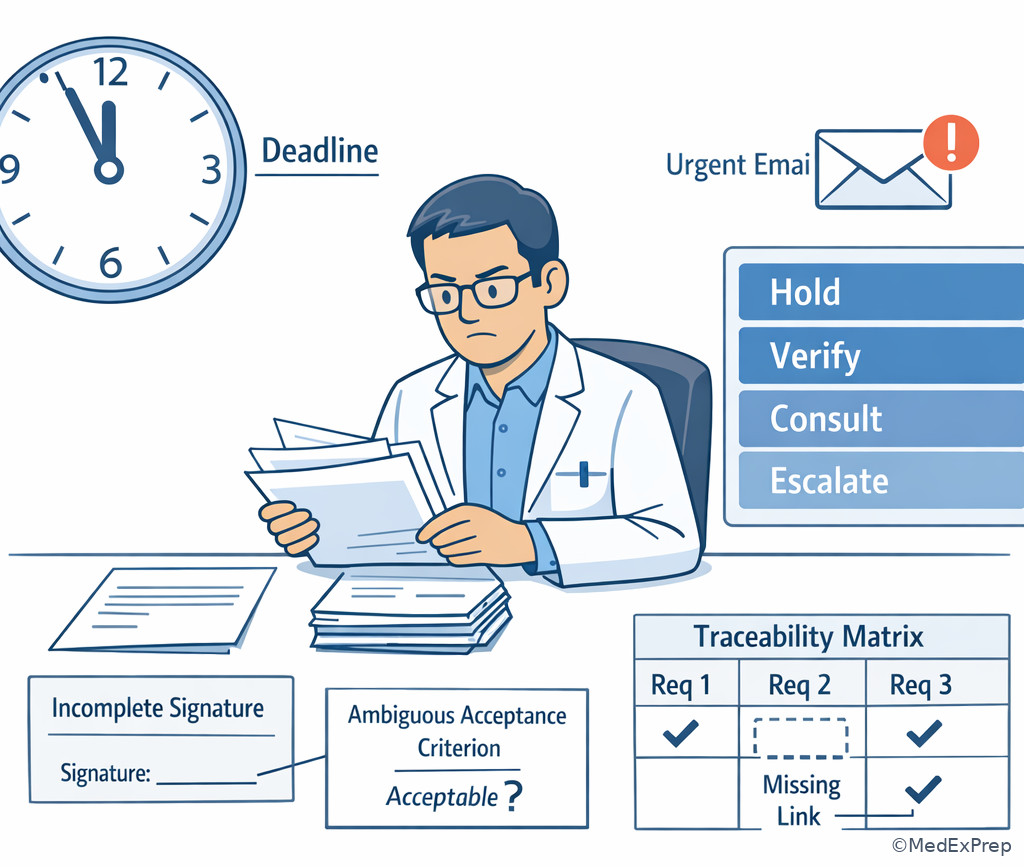
Exam takeaway: Eliminate answer choices first by authority and evidence before debating technical preference.
Exam takeaway: A missing link between requirement, test, result, and conclusion is a boundary trigger for clarification, not assumption.
1.1.1.3 Foundational boundary: what the CPVP candidate is expected to do
A Explanation
The central decision conflict in this topic is simple: Should you act as a practitioner applying procedures and evidence, or as an authority creating conclusions the scenario does not support? The rule that resolves this conflict is: stay within the candidate role by interpreting stated facts, reviewing documentation, identifying gaps, and selecting the most appropriate next step under established controls. That means you can assess completeness, notice inconsistencies, compare records against requirements, and recommend hold/consult/escalate actions. You should not invent missing policy, certify compliance without evidence, or override required approvals.
WHY THIS IS TESTED: exam questions frequently present a tempting action that sounds efficient or confident but crosses the role boundary. The best answer is often the one that preserves evidence integrity and respects authority limits.
Think of the candidate role as a lane, not a job title. Inside the lane: interpret, review, compare, flag, recommend, sequence, verify. Outside the lane: declare legality, waive controls, sign on behalf of absent authority, or assume site-specific rules not given. See Fig 1 and Fig 5.
Key rule: If the action requires evidence not in the stem or authority not assigned in the stem, reject it and choose a verification, hold, consult, or escalation step instead.
Memory anchor: V-H-C-E = Verify, Hold, Consult, Escalate. When the stem feels unsafe or incomplete, your first thought should run through these four options before any approval-type action.
B Worked example
A CPVP candidate is reviewing a qualification summary package for a new utility skid. The package includes executed test forms, a calibration attachment, and an unsigned summary page. The operations lead states that the missing signature is “always added later” and asks the candidate to mark the package as acceptable so installation can stay on schedule. A recent unrelated maintenance note about room temperature variation appears in the file, making environmental concerns look important. The most appropriate next step is not to speculate about impact or endorse informal practice.
Reasoning chain: identify task → this is a documentation review and disposition-readiness question. Extract key facts → executed forms exist, but the summary page is unsigned; the stem gives no delegated authority to waive signatures; schedule pressure is present; the maintenance note is distracting noise. Apply rule → records required for the package must be complete before defensible acceptance. Eliminate distractors → “accept based on past practice” fails because informal practice is not a substitute for controlled completion; “ignore because tests passed” fails because passing data do not erase record incompleteness; “rewrite the summary yourself” may exceed assigned authorship or approval authority. Verify → the role-appropriate answer is to hold disposition pending required completion per procedure and, if needed, consult the responsible approver.
C Exam trap
Common wrong answer: “Approve the package because the technical evidence appears sufficient.”
Why it is tempting: Candidates often overvalue technical results and undervalue document status, especially when the missing item looks administrative.
Single clue that eliminates it: The stem does not give authority to waive the missing signature or treat the package as complete without required review.
D Checkpoint
Question: A practitioner reviews a validation record set and finds all test results acceptable, but one required approval field is blank. The supervisor says the site often fills it in after the review meeting. What is the most appropriate next step?
- A. Accept the package because the technical results meet expectations.
- B. Hold progression until the required approval is completed per controlled process.
- C. Add the missing approval on behalf of the team to keep the workflow moving.
- D. Ignore the missing field because it is a documentation detail, not a performance issue.
Answer: B
- A: Tempting because passing results feel like the main purpose of validation, but wrong because record completeness is part of defensible disposition.
- B: Correct because the missing approval is a control gap and the safe role-appropriate action is to hold until completion.
- C: Tempting because it appears proactive, but wrong because it assumes authority and authorship the stem does not assign.
- D: Tempting because the missing item seems clerical, but wrong because required approvals are workflow controls, not optional formatting.
If you missed this: Review 1.1.1.1 Foundational boundary: what the CPVP candidate is expected to do — focus on the rule that technical sufficiency does not eliminate required record completion.
1.1.1.4 Foundational boundary: what the candidate must not do
A Explanation
The second foundational conflict is between professional judgment and unauthorized substitution. The exam often asks whether you should solve a problem directly or recognize that doing so would bypass the formal system. The single resolving rule: do not perform actions that require regulatory, legal, executive, engineering-of-record, or final release authority unless the scenario explicitly grants that role and evidence base.
Out-of-role actions include declaring a process compliant with law based on limited facts, waiving documentation because “everyone knows the intent,” approving work outside delegated authority, and inventing missing procedure content. These answers are attractive because they sound senior, decisive, and efficient. But they are exam-unsafe because they break the controlled quality framework. See Fig 2 and Fig 4.
This lesson sets up the next topic, Allowed Versus Disallowed Actions. Here, focus on the principle: the candidate's strength is disciplined judgment, not unilateral policy-making.
Recall: This is the first topic in the course, so build your base rule now: when facts are missing or authority is unclear, resist decisive-sounding shortcuts. The upcoming topic on Allowed Versus Disallowed Actions will turn this boundary into a practical action checklist.
High-Yield Connection: This concept is tested alongside Documentation Integrity Principles and Escalation And Consultation Paths. Know both the record problem and the governance response—they are frequently paired in stems.
B Worked example
A candidate is asked to review a draft report summarizing process validation activities. The draft concludes that the process is “fully compliant with all regulations” even though the stem only provides internal procedure references and selected data tables. The manufacturing manager asks the candidate to leave the compliance statement in place because it “sounds stronger” for management review. A distracting detail notes that all sampled lots met in-process criteria. The correct action is to challenge the unsupported conclusion, not to accept the language.
Reasoning chain: identify task → report review for statement support. Extract key facts → internal procedures and selected data are present, but the claim reaches legal/regulatory compliance status; no authority or complete evidentiary basis is given. Apply rule → a candidate should not certify compliance beyond the facts provided. Eliminate distractors → “keep the statement because data were good” is wrong because positive data on selected lots do not support a broad legal conclusion; “soften the language privately without documenting the issue” is incomplete because the unsupported conclusion itself is a review finding; “approve and let quality adjust later” improperly passes forward a known problem. Verify → the best next step is to flag the unsupported conclusion and revise the report to match documented evidence and scope.
C Exam trap
Common wrong answer: “Leave the statement because compliance review belongs to another department.”
Why it is tempting: Candidates may confuse staying in role with ignoring an obvious overreach.
Single clue that eliminates it: Staying in role does not mean overlooking unsupported statements; it means identifying the gap and routing it appropriately rather than personally certifying the claim.
D Checkpoint
Question: Which action is most clearly outside the CPVP candidate role when the stem does not explicitly assign final authority?
- A. Reviewing a report for consistency between data tables and conclusions
- B. Recommending escalation when acceptance criteria are unclear
- C. Certifying that the process meets all legal requirements based on partial records
- D. Identifying a missing traceability link and requesting clarification
Answer: C
- A: Tempting because it sounds analytical rather than administrative, and it is appropriate because consistency review is inside role.
- B: Tempting because escalation can feel passive, but it is correct behavior when criteria are unclear and therefore not outside role.
- C: Correct because it crosses from practitioner review into unsupported legal/compliance certification.
- D: Tempting because it may seem minor, but identifying traceability gaps is core practitioner work and not outside role.
If you missed this: Review 1.1.1.2 Foundational boundary: what the candidate must not do — focus on the difference between flagging a problem and personally certifying a broad compliance conclusion.
- Fill in the blank: When evidence is incomplete, the safest first posture is to verify or hold.
- True or False: A candidate may invent likely SOP steps if the local process is not provided. False.
- Name the 4-step safety anchor: Verify, Hold, Consult, Escalate.
1.1.1.5 Application: using role boundaries to choose the best next step
A Explanation
Once you know the boundary, the next exam skill is action selection. Many stems give several plausible responses: fix it yourself, move forward based on experience, wait passively, or escalate. The resolving rule is: choose the narrowest safe action that restores control without claiming unsupported authority. This often means verifying against the controlled record if the answer is available there; if not, hold progression and consult the responsible function.
Choose-versus-reject framing helps. Choose verification when the missing fact can be confirmed from controlled documentation already expected in the workflow. Choose hold when progression would create risk or unsupported status. Choose consult when interpretation of a requirement or procedure is needed. Choose escalate when the issue exceeds your authority, could affect compliance posture, or involves unresolved control gaps. Reject options that rely on memory, informal precedent, or convenience.
WHY THIS IS TESTED: CPVP questions often hide the correct answer among several technically sympathetic choices; the winner is the option that matches both evidence status and authority limit. See Fig 3 and Fig 4.
Common pitfall: “Escalate” is not automatically the best answer if the missing fact can be directly verified from an existing controlled record. Use escalation when the issue truly exceeds role or requires governance input.
B Worked example
A candidate reviewing a traceability packet finds that one user requirement is linked to a test case, but the result reference is missing from the summary matrix. The underlying executed test script exists in the archive and appears complete. The project manager wants the matrix approved immediately because the team “knows the test passed.” A distracting clue notes that a separate noncritical formatting issue was already corrected elsewhere in the matrix. The most appropriate next step is to verify the missing result link from the controlled test record and update or route the matrix through the proper process before acceptance.
Reasoning chain: identify task → traceability review. Extract key facts → likely evidence exists, but summary traceability is incomplete; the issue appears resolvable by checking an existing controlled record. Apply rule → use the narrowest safe action first: verify from controlled documentation rather than escalate immediately or approve based on memory. Eliminate distractors → “approve because the archive probably contains proof” is still unsupported until verified; “declare the matrix invalid and restart the package” is disproportionate without first checking the underlying controlled record; “ignore because only the summary is affected” is wrong because traceability is part of defensible review. Verify → confirm the record, reconcile the traceability gap, and proceed through controlled update/review steps.
C Exam trap
Common wrong answer: “Escalate immediately to senior management.”
Why it is tempting: Candidates may think any gap automatically requires high-level escalation.
Single clue that eliminates it: The stem says the executed test record already exists in the archive, so the issue may be resolved first by controlled verification.
D Checkpoint
Question: A summary document lacks one result reference, but the underlying executed record appears available in the controlled archive. What is the most appropriate next step?
- A. Approve the summary because the underlying record probably supports it
- B. Verify the missing reference against the controlled record, then reconcile the summary per procedure
- C. Delete the requirement from the matrix so the gap no longer appears
- D. Escalate to executive leadership before reviewing the archive
Answer: B
- A: Tempting because the evidence likely exists, but wrong because “probably” is not verification.
- B: Correct because it restores control using the narrowest safe, role-appropriate action.
- C: Tempting because it removes the discrepancy on paper, but wrong because it destroys traceability instead of resolving it.
- D: Tempting because escalation feels cautious, but wrong because the issue can first be checked in the existing controlled record.
If you missed this: Review 1.1.1.3 Application: using role boundaries to choose the best next step — focus on choosing the narrowest safe action that restores control without overreacting or assuming.
1.1.1.6 Application: handling ambiguity, pressure, and incomplete instructions
A Explanation
A high-yield exam pattern is the pressured stem: a deadline, a manager request, a missing criterion, and a suggestion to “use common sense.” The role-boundary issue here is not technical knowledge alone; it is whether you will protect the control system under pressure. The single resolving rule: when acceptance criteria, required approvals, or procedure steps are unclear, treat the ambiguity as a control gap rather than filling it with assumption.
This is where many candidates fall for soft-sounding wrong answers such as “use prior similar projects,” “apply standard site practice,” or “make a provisional approval.” Unless the scenario explicitly authorizes such handling, these answers are unsafe because they convert ambiguity into undocumented personal judgment. The safer alternative is clarification through the governing procedure, document owner, quality, or designated authority.
See Fig 4. The exam is not rewarding indecision; it is rewarding controlled action. A hold or consult step can be the fastest route to a defensible answer because it prevents compounding an already unclear condition.
High-Yield Connection: This concept overlaps heavily with the upcoming topic Exam-Safe Decision Posture. Know the distinction between “best technical guess” and “most appropriate next step under controlled procedure.”
Memory anchor: \(UNCLEAR = Do not CLEAR it yourself\). If criteria are unclear, your job is to clarify through the system, not silently normalize the gap.
B Worked example
A candidate reviews a protocol addendum drafted after a change in instrument configuration. The addendum references “acceptable performance” but provides no measurable acceptance criterion. Engineering informally states that the team usually uses last project’s threshold, and operations wants testing to start today because the unit is needed for production support. A distracting note mentions that the calibration sticker is current. The best next step is to obtain clarification of acceptance criteria through the controlled process before execution proceeds.
Reasoning chain: identify task → execution readiness review. Extract key facts → criterion missing, informal precedent offered, schedule pressure present, calibration current but not the issue. Apply rule → missing acceptance criteria are a control gap; do not substitute remembered thresholds. Eliminate distractors → “start testing and decide later” produces data without a valid decision rule; “use the prior project threshold” invents local practice not provided in a controlled form; “approve because calibration is current” confuses equipment status with protocol adequacy. Verify → the correct role-based response is to hold or clarify through the document owner/quality path before work proceeds.
C Exam trap
Common wrong answer: “Use the prior project’s acceptance threshold since the configuration is similar.”
Why it is tempting: Similarity feels pragmatic, and candidates may equate consistency with legitimacy.
Single clue that eliminates it: The current addendum itself lacks measurable acceptance criteria, so importing a prior threshold would be an undocumented assumption.
D Checkpoint
Question: A draft controlled document says “acceptable performance” but does not state measurable criteria. Testing is scheduled to begin today. What is the most appropriate next step?
- A. Begin testing and let the reviewer decide later whether results look acceptable
- B. Use the threshold from a similar prior project without revising the document
- C. Clarify and document the acceptance criteria through the controlled process before execution
- D. Proceed because the equipment involved is already calibrated
Answer: C
- A: Tempting because it preserves schedule, but wrong because data generated without a defined decision rule are hard to defend.
- B: Tempting because similarity suggests reuse, but wrong because the current document must contain or formally reference its own criteria.
- C: Correct because unclear acceptance criteria are a control gap requiring clarification before work continues.
- D: Tempting because calibration status sounds compliance-relevant, but wrong because instrument status does not replace protocol adequacy.
If you missed this: Review 1.1.1.4 Application: handling ambiguity, pressure, and incomplete instructions — focus on the rule that unclear acceptance criteria must be clarified, not guessed.
- The most common cause of a wrong boundary answer is confusing urgency with authorization.
- True or False: Similar prior projects automatically justify reusing unstated criteria. False.
- Name the single discriminator when criteria are unclear: treat ambiguity as a control gap.
1.1.1.7 Integration: evidence, traceability, and authority in one decision
A Explanation
The final integration step is to combine three screens at once: Do the records support the conclusion? Is the workflow traceable? Am I authorized to take the next action? Strong exam performance comes from answering these three questions in sequence. A decision can fail on any one of them. For example, you may have good technical data but poor traceability, or complete traceability but no delegated authority for final approval.
The single rule that resolves integrated scenarios is: a defensible action requires evidence sufficiency, workflow completeness, and appropriate authority. If any one of the three is missing, the safe answer is not final approval. It is a narrower step that closes the gap. See Fig 3 and Fig 5.
This is why some questions include lots of technical detail that turns out to be noise. Candidates sometimes overanalyze performance data when the real discriminator is a missing approval, unsupported conclusion, or unresolved discrepancy. In foundational topics, remember that the exam frequently rewards governance logic over technical flourish.
Recall: In the upcoming topic Allowed Versus Disallowed Actions, you will classify specific actions. Here, we build on that by learning how evidence, traceability, and authority combine to determine whether an action is even available.
B Worked example
A candidate reviews a final report for a software configuration update. The report states that all user requirements were challenged and met. The appendix contains most test summaries, but one critical requirement links only to a draft worksheet, not an approved executed record. A deviation number is referenced without disposition details. The department head asks whether the report can be sent for approval while “cleanup” happens later. A distracting detail mentions that training records for operators are complete. The correct next step is to withhold support for approval until the critical traceability and deviation documentation gaps are resolved through the controlled workflow.
Reasoning chain: identify task → review whether the report is ready for approval. Extract key facts → a critical requirement lacks complete approved evidence, deviation disposition is incomplete, request to send forward now, training records irrelevant to the missing link. Apply rule → evidence sufficiency and traceability both fail; regardless of technical optimism, final approval support is not defensible. Eliminate distractors → “approve because most requirements are covered” fails because a single critical unresolved link can block defensibility; “ignore the deviation since the requirement probably passed” fails because undocumented disposition is itself a control issue; “rewrite the conclusion more cautiously and send it anyway” still pushes an incomplete package forward. Verify → the correct role-based choice is to hold/reconcile unresolved critical documentation before approval routing.
C Exam trap
Common wrong answer: “Send the report forward with a note that missing items will be completed later.”
Why it is tempting: It seems collaborative and preserves schedule while acknowledging the issue.
Single clue that eliminates it: The gap involves a critical requirement and an undispositioned deviation, which means the package is not merely untidy—it is not yet defensibly complete.
D Checkpoint
Question: Which combination most strongly supports withholding a report from approval routing?
- A. Minor formatting inconsistency and complete traceability
- B. Complete data tables and complete approval signatures
- C. Critical requirement linked only to draft evidence plus unresolved deviation disposition
- D. Complete operator training records and current calibration status
Answer: C
- A: Tempting because inconsistency can matter, but with complete traceability it is less likely to block approval than unresolved critical evidence gaps.
- B: Tempting because completeness sounds strong, but this option actually supports progression rather than withholding.
- C: Correct because it combines failed evidence sufficiency with failed deviation closure on a critical element.
- D: Tempting because both items are quality-relevant, but neither cures a critical traceability or deviation gap in the report itself.
If you missed this: Review 1.1.1.5 Integration: evidence, traceability, and authority in one decision — focus on the three-screen check of evidence, traceability, and authority.
Exam Traps & Differentiators
Most common wrong answer and why: The single most common wrong answer is the “decisive shortcut” option—approve, waive, declare compliant, or proceed based on experience. It is tempting because it sounds efficient and senior. It is wrong because CPVP questions reward controlled, evidence-based action inside the candidate role.
| Looks similar | But isn't | Key differentiator |
|---|---|---|
| Reviewing a conclusion for support | Certifying compliance or legality | Review is inside role; legal/compliance certification exceeds role without explicit authority and evidence |
| Verifying a missing link from archived records | Approving based on memory that the evidence exists | Verification uses controlled evidence; memory is not evidence |
| Consulting quality on unclear criteria | Inventing criteria from prior similar projects | Consult restores control; invention creates undocumented assumption |
| Holding progression pending completion | Blocking everything permanently without checking available records | Hold is controlled and proportionate; overreaction ignores the narrowest safe step |
| Escalating when authority is missing | Escalating every minor issue before checking obvious records | Use escalation for role/authority or material control issues, not as a substitute for basic verification |
If the stem says ... think ...
- If the stem says “we always do it this way”, think informal practice is not a substitute for controlled procedure.
- If the stem says “sign it later”, think record completeness may block defensible progression now.
- If the stem says “similar project”, think do not import unstated criteria without controlled basis.
- If the stem says “all tests passed”, think passing results do not cure missing approvals, traceability, or unresolved deviations.
- If the stem says “urgent timeline”, think pressure is a distractor unless it changes controlled authority or evidence status.
- If the stem says “declare compliant”, think role boundary—review findings, do not make unsupported broad certifications.
Common traps & distractors: Questions in the next two neighboring topics often create confusable pairs: Candidate Role Boundaries versus Allowed Versus Disallowed Actions, and Candidate Role Boundaries versus Exam-Safe Decision Posture. The first asks “May I do this at all?”; the second asks “What specific action is permitted?”; the third asks “What is the safest best next step under uncertainty?”
Review connection: The traps above test role-limited procedural judgment. If any felt unfamiliar, revisit 1.1.1.3 Application: using role boundaries to choose the best next step before attempting the Self-check quiz.
Tables
| Reference cue | What to do | What not to do |
|---|---|---|
| Missing signature/approval | Hold and obtain completion through controlled workflow | Assume it can be backfilled later without impact |
| Unclear acceptance criterion | Clarify with document owner/quality before execution or disposition | Use memory or prior project thresholds informally |
| Summary conflicts with raw/executed record | Investigate and reconcile before approval | Keep the stronger summary statement for convenience |
| Evidence likely exists in archive | Verify from controlled record | Approve based on probability |
| Action exceeds delegated authority | Consult or escalate to proper owner | Act unilaterally to keep schedule |
| Pressure from management/operations | Maintain procedure and document rationale | Bypass controls due to urgency |
| Action choice | Use when | Reject when |
|---|---|---|
| Verify | The needed fact can be confirmed from an existing controlled record | The issue is interpretive, authority-based, or the record does not exist |
| Hold | Progression would create an unsupported or risky state | A quick controlled verification can immediately close the gap without progression risk |
| Consult | A requirement or procedure needs interpretation by the responsible function | The answer is already explicit in the governing record |
| Escalate | The issue exceeds role, involves governance significance, or remains unresolved | The issue is routine and directly verifiable within current authority |
| Differential situation | Likely best answer | Single discriminator |
|---|---|---|
| Missing summary result reference but executed test record exists | Verify and reconcile | Evidence likely exists in controlled form |
| Missing measurable acceptance criterion in protocol | Clarify before execution | No decision rule exists yet |
| Unsupported legal/compliance statement in report | Revise/flag and route appropriately | Claim exceeds evidence and role |
| Unsigned required approval with pressure to proceed | Hold pending completion | Required control not complete |
| Critical requirement linked only to draft evidence plus open deviation | Do not support approval routing | Critical evidence and disposition both incomplete |
Algorithm / Approach
Exam takeaway: On exam stems, screen every answer by evidence, authority, and control status before choosing the next step.
flowchart TD
A[Read the stem] --> B[Identify the task]
B --> C[Extract only stated facts]
C --> D{Required record or criterion missing?}
D -->|Yes| E[Verify if controlled source exists]
E --> F{Gap closed?}
F -->|Yes| G[Proceed within procedure]
F -->|No| H[Hold and consult or escalate]
D -->|No| I{Does answer choice exceed authority?}
I -->|Yes| H
I -->|No| J[Choose narrowest safe next step] Use this algorithm any time a stem feels vague. First, identify the task. Second, strip out noise and list only stated facts. Third, ask whether a required criterion, approval, or evidence link is missing. Fourth, reject any option that assumes greater authority than the scenario grants. Fifth, pick the narrowest safe action that restores control. See Fig 6.
Rapid Review
- Role boundary → interpret and review; do not certify broad compliance without explicit authority and evidence
- Passing data → not enough if required approvals or traceability are incomplete
- Urgency → distractor unless it changes documented authority or evidence status
- Missing criterion → clarify before execution; do not generate a private threshold
- Existing controlled record available → verify first before escalating broadly
- Informal site habit → weaker than controlled procedure
- Out-of-role verb → “waive,” “certify,” “declare legal status,” and “approve release” should trigger elimination
- Traceability gap → resolve link from requirement to result before endorsing conclusion
- Unsupported conclusion → revise/flag; do not pass it forward knowingly
- Critical unresolved deviation → blocks defensible closure more than minor formatting defects
- Best next step → narrowest safe action that restores control
- Hold → proportionate protection step, not indecision
- Consult → appropriate for ambiguity; not a substitute for easy direct verification
- Escalate → right when authority is missing or the issue is governance-significant
Self-check quiz
1.1.1.8 Question 1
A CPVP candidate reviews an executed qualification package. All recorded values meet stated limits, but a required approver signature is missing. Operations asks to move forward now and add the signature tomorrow. What is the most appropriate next step?
- A. Accept the package because all test values passed
- B. Hold progression until the required approval is completed per controlled process
- C. Add the missing signature as a documentation correction
- D. Treat the missing signature as noncritical because operations confirmed the intent
1.1.1.9 Question 2
A candidate is asked to review a report statement saying a system is “fully compliant with all regulations.” The stem provides only selected internal procedures and summarized results. Which action is most clearly outside the candidate role?
- A. Checking whether the conclusion matches the attached data
- B. Flagging the statement as broader than the documented support
- C. Certifying the report’s regulatory compliance status based on the limited packet
- D. Recommending consultation with quality before final wording is approved
1.1.1.10 Question 3
A candidate reviewing a traceability matrix for a utility qualification finds one requirement linked to a test case but not to a result. The executed test record appears to exist in the controlled archive, although the matrix reference is blank. The project manager says the team remembers it passed and asks for immediate approval. What is the most appropriate next step?
- A. Approve the matrix because the test record probably exists
- B. Verify the missing link against the controlled archive and reconcile the matrix through procedure
- C. Delete the requirement from the matrix to remove the discrepancy
- D. Escalate to executive leadership before checking the archive
1.1.1.11 Question 4
A protocol addendum for an instrument change states that performance must be “acceptable,” but no measurable acceptance criterion is listed. Engineering informally recommends using the threshold from a similar prior project, and operations wants testing to begin today. Which option is the best answer?
- A. Begin testing and interpret results later using engineering judgment
- B. Use the prior project threshold without revising the current addendum
- C. Clarify and document the acceptance criterion through the controlled process before execution
- D. Proceed because the instrument’s calibration is current
1.1.1.12 Question 5
A draft report claims that all critical requirements were met. On review, one critical requirement links only to a draft worksheet rather than an approved executed record, and the referenced deviation number lacks documented disposition. The department head asks whether the report can still be routed for approval while documentation is completed later. What is the most appropriate next step?
- A. Route the report now because most other requirements are complete
- B. Rewrite the conclusion to be less definitive and route it anyway
- C. Withhold support for approval routing until the critical evidence and deviation disposition are resolved
- D. Ignore the deviation issue because the draft worksheet suggests the requirement passed
1.1.1.13 Question 6
A candidate reviews a controlled package where one summary table conflicts with a raw data attachment. The discrepancy may be a transcription error, but the raw data file version is not clearly identified. A supervisor says to keep the summary because it matches the expected trend and the difference is small. The package is otherwise complete. What is the most appropriate next step?
- A. Approve the package because the discrepancy is minor and likely clerical
- B. Investigate the discrepancy and confirm the authoritative controlled record before supporting the conclusion
- C. Replace the raw data attachment with the summary table because summaries are easier to review
- D. Escalate immediately for final release decision without checking record version control
1.1.1.14 Question 7
A candidate is asked during a meeting to “sign off” that a validation issue is not compliance-relevant so production can continue. The stem states that the deviation is still under review, local procedure content is not provided, and the candidate is present as a validation reviewer rather than a final approver. A manager argues that the issue is low risk based on prior experience with similar events. What is the best answer?
- A. Sign off verbally because low-risk issues do not require full closure before continuation
- B. State that continuation is acceptable because prior similar events were benign
- C. Decline to make the unsupported sign-off and follow the documented review/escalation path for the open deviation
- D. Write a temporary waiver based on professional judgment so the meeting can conclude
1.1.1.15 Question 8
A qualification package includes complete execution records, complete approvals, and acceptable numerical results. However, one acceptance criterion cited in the report references an obsolete document version, while the current version has a slightly tighter limit. The tested result passes the obsolete limit but narrowly fails the current one. The report author says the obsolete version was the one everyone intended to use. What is the most appropriate next step?
- A. Accept the report because the team’s intent was clear and all execution records are complete
- B. Determine which controlled version governed the work and resolve the impact through the formal process before acceptance
- C. Change the current document version to match the obsolete limit used in the report
- D. Ignore the version issue because the result was close and operationally acceptable
Answer key
1.1.1.16 Question 1 Answer: B
A. Tempting because passing data feel like the primary purpose of qualification. Incorrect for this scenario because required approval completion is part of defensible workflow, and the single discriminator is the missing required signature.
B. Tempting because it may seem bureaucratic, but it is correct because the package cannot progress defensibly until the required approval is completed through the controlled process. The single discriminator is the blank required approval field.
C. Tempting because it sounds efficient and corrective. Incorrect because adding a signature on behalf of another role assumes authorship/approval authority not granted in the stem; the single discriminator is the signature belongs to a required approver.
D. Tempting because operations confirms intent, which sounds practical. Incorrect because informal confirmation does not replace the controlled approval requirement; the single discriminator is controlled record completeness outweighs verbal assurance.
If you missed this: Review 1.1.1.1 Foundational boundary: what the CPVP candidate is expected to do — focus on the discriminator that passing results do not override missing required approvals.
1.1.1.17 Question 2 Answer: C
A. Tempting because it involves judgment, but it is appropriate because checking conclusion-to-data consistency is within role. The discriminator is reviewing support is not the same as certifying compliance.
B. Tempting because it could be seen as challenging others’ language. It is appropriate because flagging unsupported breadth is exactly what a reviewer should do; the discriminator is identifying an overstatement rather than endorsing it.
C. Tempting because it sounds decisive and high-level. Correct because certifying regulatory compliance status from a limited packet exceeds the practitioner role and available evidence; the discriminator is broad compliance certification based on partial records.
D. Tempting because consultation can feel indirect. It is appropriate because unresolved wording that reaches beyond support should be routed through the proper review path; the discriminator is consultation preserves boundaries.
If you missed this: Review 1.1.1.2 Foundational boundary: what the candidate must not do — focus on the difference between reviewing support and certifying compliance.
1.1.1.18 Question 3 Answer: B
A. Tempting because the record probably exists and the team remembers success. Incorrect because probability and memory are not verification; the discriminator is the matrix reference is still blank.
B. Correct because the issue may be resolved by controlled verification from the archive, which is the narrowest safe next step. The discriminator is the executed record appears available in a controlled source.
C. Tempting because it removes the visible discrepancy. Incorrect because deleting the requirement destroys traceability rather than resolving it; the discriminator is the requirement still exists and must remain linked.
D. Tempting because escalation feels cautious. Incorrect because the issue should first be checked through available controlled records before broad escalation; the discriminator is an immediate verification path exists.
If you missed this: Review 1.1.1.3 Application: using role boundaries to choose the best next step — focus on when verification is better than assumption or premature escalation.
1.1.1.19 Question 4 Answer: C
A. Tempting because it protects schedule and leaves judgment for later. Incorrect because execution without measurable acceptance criteria produces results without a defined pass/fail rule; the discriminator is no measurable criterion is listed.
B. Tempting because prior similar projects seem relevant. Incorrect because importing criteria without controlled documentation is an undocumented assumption; the discriminator is the current addendum itself lacks the criterion.
C. Correct because unclear acceptance criteria are a control gap that must be clarified and documented before execution. The discriminator is “acceptable” is not a measurable criterion.
D. Tempting because calibration status is an important control. Incorrect because current calibration does not fix protocol inadequacy; the discriminator is equipment readiness is separate from criterion definition.
If you missed this: Review 1.1.1.4 Application: handling ambiguity, pressure, and incomplete instructions — focus on the rule that unclear criteria must be clarified before work proceeds.
1.1.1.20 Question 5 Answer: C
A. Tempting because most of the package is complete. Incorrect because one critical requirement lacks approved evidence and the deviation lacks disposition; the discriminator is critical unresolved gaps block defensible approval routing.
B. Tempting because softer wording seems like a compromise. Incorrect because changing tone does not cure missing evidence or undispositioned deviation status; the discriminator is supporting documentation is still incomplete.
C. Correct because evidence sufficiency and deviation closure are both incomplete for a critical element, so approval routing should be withheld. The discriminator is critical requirement plus open deviation documentation.
D. Tempting because the draft worksheet suggests the underlying outcome may be acceptable. Incorrect because draft evidence and implied passing status do not replace approved executed records and documented deviation disposition; the discriminator is draft is not final controlled evidence.
If you missed this: Review 1.1.1.5 Integration: evidence, traceability, and authority in one decision — focus on why a single critical unresolved evidence gap can block approval routing.
1.1.1.21 Question 6 Answer: B
A. Tempting because the discrepancy looks small and perhaps clerical. Incorrect because a conclusion cannot be supported until the authoritative controlled record is confirmed; the discriminator is the raw data file version is unclear.
B. Correct because the proper role-based action is to investigate the discrepancy and determine which versioned record is authoritative before supporting the summary. The discriminator is summary conflicts with a not-clearly-versioned raw attachment.
C. Tempting because summaries are easier to review and may match expectations. Incorrect because replacing raw data with summary tables removes primary evidentiary support; the discriminator is raw data authority cannot be bypassed.
D. Tempting because escalation may seem safer when data conflict. Incorrect because the first needed step is still record verification and discrepancy investigation, not immediate final-release routing; the discriminator is version control ambiguity can be directly investigated.
If you missed this: Review 1.1.1.5 Integration: evidence, traceability, and authority in one decision — focus on evidence sufficiency when summary and source data conflict.
1.1.1.22 Question 7 Answer: C
A. Tempting because the issue is described as low risk and the request is only verbal. Incorrect because the deviation remains under review and the stem does not grant authority to sign off continuation based on that verbal assessment; the discriminator is open deviation plus absent authority.
B. Tempting because prior experience with similar events feels risk-informed. Incorrect because historical similarity does not replace the current documented review path; the discriminator is site-specific procedure content is not provided and the deviation is still open.
C. Correct because the candidate should decline unsupported sign-off and follow the documented review/escalation path for the unresolved issue. The discriminator is the candidate is a reviewer, not a final approver.
D. Tempting because a temporary waiver sounds like a structured middle ground. Incorrect because issuing a waiver exceeds role and assumes governance authority not assigned in the scenario; the discriminator is no waiver authority is granted.
If you missed this: Review 1.1.1.2 Foundational boundary: what the candidate must not do — focus on out-of-role requests to sign off, waive, or declare acceptability without assigned authority.
1.1.1.23 Question 8 Answer: B
A. Tempting because execution records and approvals are complete, and team intent sounds practical. Incorrect because the governing acceptance criterion may be the current controlled version, not the intended obsolete one; the discriminator is version-controlled criterion conflict affecting pass/fail status.
B. Correct because the first requirement is to determine which controlled version governed the work and then resolve any impact through the formal process before accepting the report. The discriminator is the result passes one version but fails the current controlled version.
C. Tempting because aligning documents would reduce the apparent mismatch. Incorrect because changing the current document version to fit completed work is a major control breach and outside the candidate role; the discriminator is document control cannot be rewritten to rescue a result.
D. Tempting because the failure is narrow and may feel operationally acceptable. Incorrect because “close enough” is not a controlled basis when the applicable criterion is uncertain and potentially failed; the discriminator is acceptance must follow the governing controlled version, not proximity.
If you missed this: Review 1.1.1.4 Application: handling ambiguity, pressure, and incomplete instructions — focus on treating version and criterion ambiguity as a control gap requiring formal resolution.
Keep going with the full CPVP Prep Course (CPVP)
You just studied the way members do, in the same lesson interface. Full access unlocks every lesson, the question bank and flashcards for a full year.
One payment · 1 year of access · No auto-renewal