1.1.1 - Recovery-Oriented Practice Principles
Recovery-Oriented Practice Principles
What you'll learn
- Foundations of Recovery and Peer Support: Principles -> Recovery orientation — identify the core beliefs that guide peer support decisions.
- Roles and Responsibilities: Peer function -> Within-scope supportive action — choose what a peer should do first in common engagement scenarios.
- Ethics and Boundaries: Self-determination -> Respecting choice without abandoning safety — separate empowerment from taking over.
- Communication and Engagement: Person-centered practice -> Hopeful, collaborative language — recognize wording that supports dignity and mutuality.
- Crisis/Safety Awareness: Safety recognition -> Escalation within role — know when recovery-oriented care still requires immediate consultation or emergency action.
- Foundations of Recovery and Peer Support: Principles of recovery -> person-centered, hopeful, self-directed support
- Roles and Responsibilities: Peer role identity -> support rather than treatment or authority
- Ethics and Boundaries: Respect and self-determination -> preserving autonomy and informed choice
- Communication and Engagement: Engagement approach -> nonjudgmental, collaborative communication
- Crisis/Safety Awareness: Recognize limits -> escalate imminent safety concerns per policy
Why it matters
- Many CPRS questions ask for the best action, not the kindest-sounding action. The best answer usually protects choice, dignity, and role boundaries at the same time.
- Recovery-oriented practice is the lens that separates peer support from counseling, case management, discipline, or clinical authority.
- Exam distractors often sound helpful but quietly shift the peer into directing, fixing, diagnosing, or overpromising confidentiality.
- These principles become the base for later topics such as Multiple Recovery Pathways and Strengths-Based Support, so getting the framework right now will simplify many later scenarios.
Key Terms & Must-Know Facts
1.1.1.1 Key terms
- Recovery-oriented: support that centers the person's own goals, choices, values, and hope.
- Self-determination: the peer's right to direct their own recovery.
- Person-centered: starting with what matters to the person, not what the helper prefers.
- Mutuality: a human-to-human relationship, not expert-over-patient hierarchy.
- Strengths-based: noticing abilities, resources, resilience, and past success.
- Trauma-informed: avoiding coercion, shame, and power-over responses.
- Hope: belief that recovery is possible.
- Empowerment: helping the person build voice, choice, and action.
- Advocacy: supporting the person to speak up or access support within scope.
- Pathway: the person's chosen route in recovery; not one-size-fits-all.
- Scope: what the peer role may and may not do.
- Escalation: bringing in supervisor, clinical staff, or emergency responders when safety or policy requires it.
1.1.1.2 Must-know facts
- The person owns the recovery plan; the peer supports rather than directs.
- The most recovery-oriented answer usually preserves autonomy plus safety.
- Respecting choice does not mean ignoring imminent risk.
- A peer can share lived experience purposefully; the focus stays on the peer receiving support.
- Do not promise absolute confidentiality when law, policy, or safety requires reporting or consultation.
- Recovery-oriented language avoids labels, blame, and predictions of failure.
- If two answers seem helpful, prefer the one that supports self-advocacy over taking over.
- Clinical interpretation, diagnosis, treatment planning, and independent crisis management are out of role.
| Principle | What it sounds like | What it does not sound like |
|---|---|---|
| Self-direction | “What matters most to you right now?” | “Here’s what you need to do next.” |
| Hope | “Change is possible, even if today is hard.” | “You always relapse, so lower expectations.” |
| Strengths focus | “What helped you get through before?” | “Let’s list everything you do wrong.” |
| Mutuality | “I can walk with you as you decide.” | “I know best because I’m the helper.” |
| Trauma-informed practice | “Would it feel okay to talk about options?” | “You have to tell me everything right now.” |
| Safety within role | “I want to get support with you because safety comes first.” | “Keep this secret even if you might hurt yourself.” |
Core content
Exam takeaway: Use this sequence to choose supportive, person-centered actions before more directive distractors.
flowchart TD
A[Question stem asks for best action] --> B[Identify the person's stated goal or concern]
B --> C[Check role: support vs treatment or authority]
C --> D{Any imminent safety or mandatory reporting issue?}
D -- No --> E[Choose action that preserves autonomy and hope]
D -- Yes --> F[Follow policy, consult, escalate, document factually]
E --> G[Reject answers that direct, diagnose, or take over]
F --> G
Use Fig 1 whenever answer choices all sound compassionate. The correct CPRS answer is usually the one that starts with the person’s goal, stays within scope, and only becomes more directive when safety or policy requires it.
Exam takeaway: Separate peer support from counseling, case management, and clinical authority by asking who owns the decision and plan.
flowchart LR
A[Peer support] --> A1[Uses lived experience purposefully]
A --> A2[Builds hope and connection]
A --> A3[Supports self-directed goals]
B[Overreach] --> B1[Directs choices]
B --> B2[Interprets symptoms]
B --> B3[Writes treatment plan]
C[Best exam answer] --> C1[Encourage]
C --> C2[Explore options]
C --> C3[Refer or escalate when needed]
See Fig 2 for the core exam contrast: peer support does not mean passive agreement, but it also does not mean becoming the authority.
Exam takeaway: Visualize the peer sitting alongside the person, using collaborative body language and shared decision-making rather than expert authority.
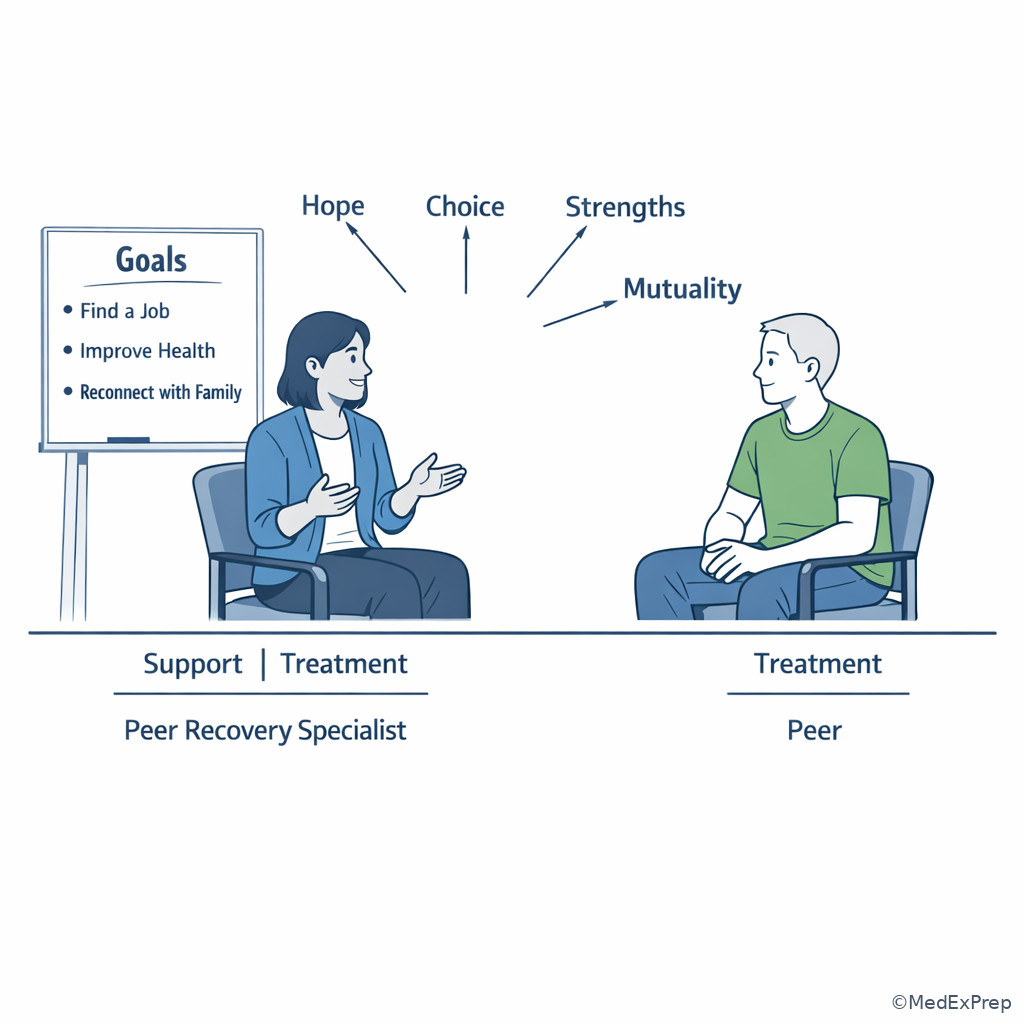
See Fig 3 to remember the posture of recovery-oriented practice: alongside, not above.
Exam takeaway: Core values such as hope, choice, dignity, culture, and connection should drive wording in scenario answers.
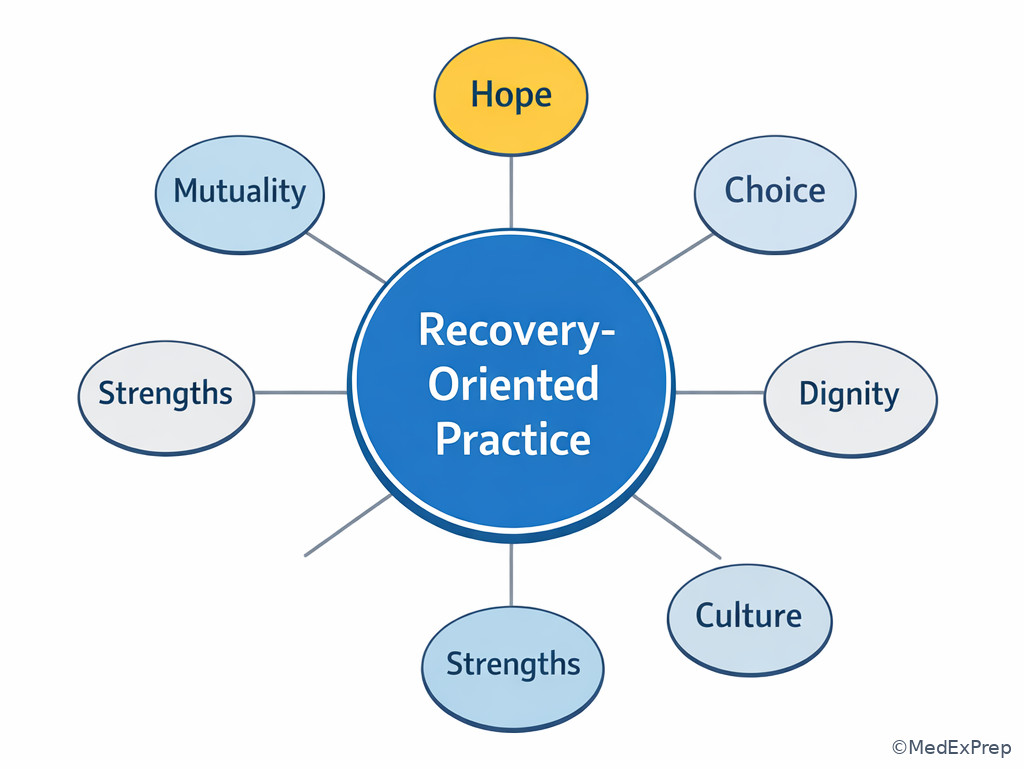
1.1.1.3 Foundational principle: recovery is person-directed, not provider-directed
A Explanation
The first exam conflict is usually choose support of the person’s own goals versus choose the answer that sounds most efficient or expert-driven. The rule that resolves it: in recovery-oriented practice, the person is the decision-maker for their own recovery whenever safety and law allow. The peer helps the person clarify goals, identify options, and build confidence to act; the peer does not seize control just because the peer thinks another path is better.
WHY THIS IS TESTED: Many stems hide a control-versus-choice issue inside a helpful-sounding answer. The wrong answer often promises to “make sure” something happens, while the right answer supports the person to choose, prepare, or connect.
Board-style clue: when the stem asks for the most appropriate next step with no immediate safety concern, reject answers that direct the person, define success for them, or substitute the peer’s preference for the person’s stated goal. Choose the answer that uses collaborative language such as explore, ask, support, identify, prepare, connect, or encourage.
B Worked example
A 34-year-old peer in an outpatient recovery program says, “My family wants me in residential treatment now, but I want to try intensive outpatient first because I need to keep my job.” He has diabetes and probation appointments next month. He also mentions that his cousin thinks “people only recover if they cut off everyone from their old neighborhood,” which makes a forceful answer sound attractive. He denies current thoughts of harming himself or others and is asking for help deciding what to say at tomorrow’s team meeting.
Reasoning chain: Identify task — the stem asks for the best in-scope peer action. Extract key facts — the person has a stated preference, wants support preparing to speak up, and there is no immediate safety emergency in the stem. Apply rule — recovery-oriented practice centers self-determination and self-advocacy. Eliminate distractors — do not choose “tell him residential is best,” “contact the team and speak for him without consent,” or “decide which level of care he needs,” because those answers overstep into directing or clinical authority. Verify — the best answer is to help him clarify his goals, questions, and concerns so he can participate in the meeting and express his preferences.
C Exam trap
D Checkpoint
Question: A peer says, “Everyone keeps telling me what recovery should look like. I’m not sure what I want yet.” What is the most appropriate next step for the peer recovery specialist?
- A. Ask what recovery would look like from the peer’s perspective and explore options that fit their values.
- B. Recommend the pathway that worked best for most people in the program.
- C. Tell the peer they need to commit to one plan immediately to avoid mixed messages.
- D. Explain that the treatment team should decide because they have more expertise.
Answer: A
- A: Tempting because it may feel less “active” than giving advice, but it is right because it centers self-direction and collaborative exploration.
- B: Tempting because it appeals to experience and program norms, but it is wrong because recovery-oriented care is not one-size-fits-all.
- C: Tempting because decisiveness can sound helpful, but it is wrong because pressure undermines autonomy and ignores readiness.
- D: Tempting because experts do have roles, but it is wrong here because the issue is the person’s goals, not a need to hand over ownership.
1.1.1.4 Foundational principle: peer support is rooted in hope, mutuality, and strengths
A Explanation
The next conflict is choose an answer that builds hope and capability versus choose an answer that focuses on deficits, compliance, or authority. The resolving rule: recovery-oriented peer support communicates that change is possible, the person has strengths, and the relationship is collaborative rather than expert-dominated. Hope is not empty reassurance; it is credible encouragement linked to the person’s own efforts, supports, and prior successes.
WHY THIS IS TESTED: Exams often present discouraging facts in the stem—missed appointments, relapse history, housing instability, strained family relationships—to tempt you into a deficit-only response. Recovery-oriented practice notices barriers, but does not define the person by them.
Mutuality matters because the peer role draws from lived experience without turning the interaction into a story about the specialist. A brief, purposeful self-disclosure can normalize struggle or model possibility; a long self-focused story shifts attention away from the peer and weakens the support function.
B Worked example
A 49-year-old peer with depression, alcohol-use recovery, and recent eviction says, “I always mess things up. I missed two appointments, so there’s no point trying.” He also says he once stayed sober for eight months while caring for his mother, but he dismisses that period as “luck.” A tempting wrong answer would be to confront him sharply about accountability because missed appointments appear central. The better reasoning is different.
Reasoning chain: Identify task — choose the best recovery-oriented response. Extract key facts — hopeless language, but also evidence of resilience: eight months of sobriety and caregiving responsibility. Apply rule — peer support builds hope through strengths and possibility, not shame. Eliminate distractors — avoid “You need to be more compliant,” “Let me tell you exactly how I stayed sober,” or “The team probably needs to reconsider your treatment commitment.” Verify — the best response reflects the difficulty, highlights the prior success, and invites the person to identify what supported that earlier period and what small step feels possible now.
C Exam trap
D Checkpoint
Question: Which response is most consistent with hope-based, strengths-focused peer support?
- A. “You need to prove you are serious by following exactly what staff recommend.”
- B. “You made it eight months before; what was helping then that might still fit now?”
- C. “Relapse means your original plan was unrealistic.”
- D. “Let me tell you my full story so you can copy what I did.”
Answer: B
- A: Tempting because it sounds structured, but it is wrong because it centers compliance over the person’s own strengths and goals.
- B: Tempting because it may seem too simple, yet it is right because it identifies existing resilience and converts hope into a practical conversation.
- C: Tempting because setbacks do require planning, but it is wrong because it frames the person as failed rather than resourceful.
- D: Tempting because lived experience matters, but it is wrong because it shifts the encounter away from the person and toward imitation.
- The most recovery-oriented response to hopelessness is to identify strengths and supports, not to intensify control.
- True or False: Purposeful self-disclosure is appropriate when it clearly serves the peer’s goal. True.
- Name the 3 cues of mutuality: alongside, collaborative, non-authoritarian.
Exam takeaway: In stems with setbacks, look for the answer that names resilience, resources, and next steps instead of blame or compliance pressure.
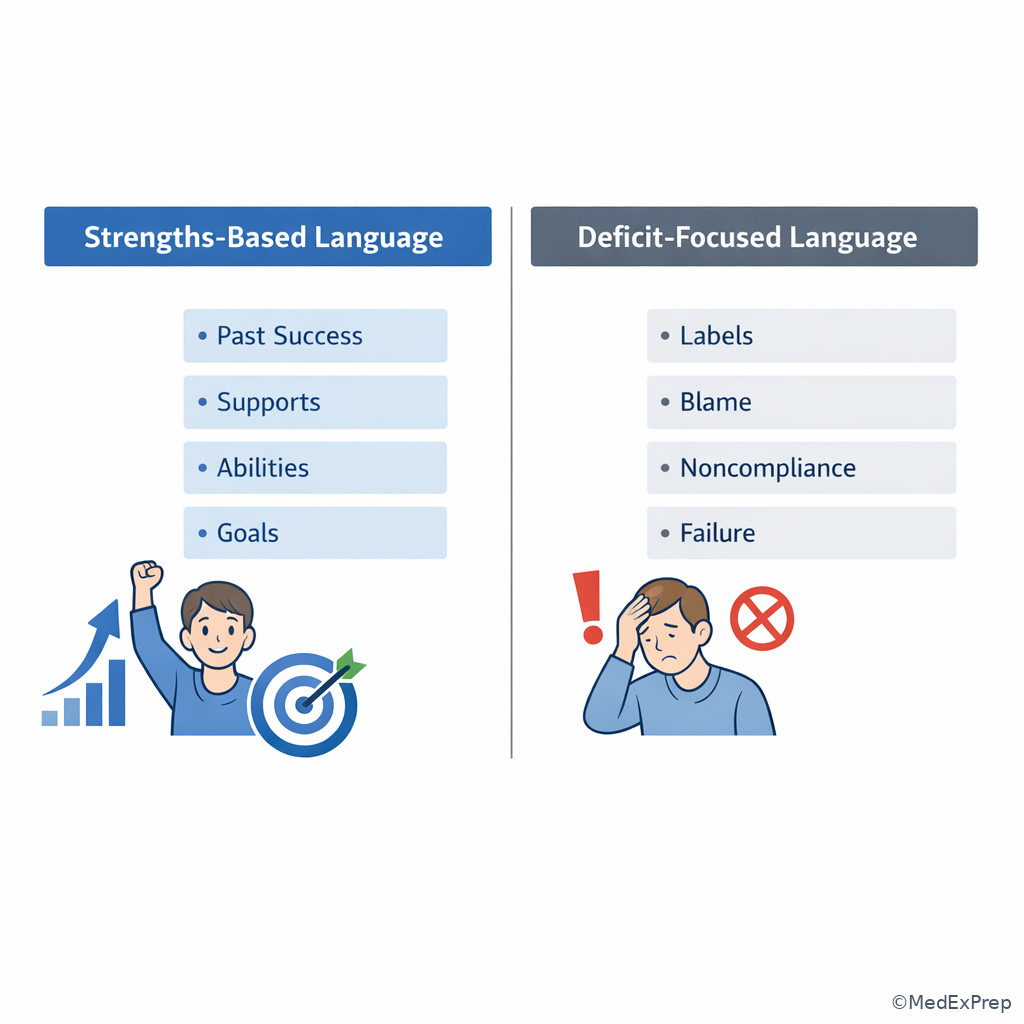
See Fig 4 when answer choices differ mainly in tone. Tone is not cosmetic on this exam; it signals whether the action is recovery-oriented or authority-driven.
1.1.1.5 Applied principle: choose collaborative language and avoid directing, coercive, or stigmatizing responses
A Explanation
Once you know the values, the next exam task is language selection. The conflict is choose words that invite participation versus choose words that pressure, label, or subtly shame. The rule: recovery-oriented practice uses respectful, person-centered, non-stigmatizing language and avoids coercion. This matters even when the peer specialist feels urgency. Collaborative wording protects dignity and keeps engagement open.
WHY THIS IS TESTED: CPRS questions often turn on one phrase. “Support the person in preparing to speak with staff” is in role; “tell staff what should happen” may be overreach. “Explore options” is recovery-oriented; “convince them” often signals coercion.
Reject answers that include threats, ultimatums, labels, or certainty about what the person “must” do when no safety exception is present. Also reject false reassurance that dismisses barriers. Recovery-oriented language combines respect with realism: acknowledge concerns, ask permission, offer options, and support the person’s voice.
B Worked example
A 27-year-old peer with opioid-use recovery, anxiety, and unstable housing says, “I’m tired of everyone calling me noncompliant because I missed an appointment when the bus never came.” She also mentions a pending court date, which makes authoritative answers sound tempting. The stem asks for the most appropriate peer response after she says, “Maybe I should just stop trying with services.”
Reasoning chain: Identify task — select the best communication response. Extract key facts — stigma is already present, transportation barrier is real, and the person is considering disengagement. Apply rule — use person-centered language that validates the barrier and supports problem-solving without taking over. Eliminate distractors — reject “You need to be more responsible,” “I’ll call and demand they stop labeling you,” and “You should file a complaint right now,” because each either shames or takes control. Verify — the best answer acknowledges the frustration, asks what support would help for the next appointment, and offers to help the person prepare to raise the transportation issue.
C Exam trap
D Checkpoint
Question: Which statement most clearly reflects recovery-oriented, non-stigmatizing language?
- A. “You are resistant, so let’s focus on compliance first.”
- B. “What got in the way this time, and what would make the next step easier?”
- C. “If you keep missing appointments, people will stop helping you.”
- D. “I’ll explain your behavior to staff so they understand why you act this way.”
Answer: B
- A: Tempting because it sounds direct, but it is wrong because labeling and compliance framing are not person-centered.
- B: Tempting because it may seem soft, but it is right because it explores barriers and supports next steps without blame.
- C: Tempting because consequences are real, but it is wrong because it relies on fear rather than collaborative support.
- D: Tempting because it sounds advocacy-focused, but it is wrong because it interprets behavior and speaks for the person before supporting self-advocacy.
Exam takeaway: When options differ by tone, choose the one that validates, explores barriers, and supports the person's own voice.
flowchart TD
A[Read response option] --> B{Contains labels or pressure?}
B -- Yes --> C[Reject]
B -- No --> D{Takes over for the person?}
D -- Yes --> C
D -- No --> E{Supports choice and next step?}
E -- Yes --> F[Strong candidate]
E -- No --> G{Safety escalation required?}
G -- Yes --> H[Choose collaborative escalation option]
G -- No --> C
Use Fig 5 to eliminate distractors quickly when several options look supportive on the surface.
Exam takeaway: Small wording shifts can change an answer from empowering to coercive, so compare verbs carefully.
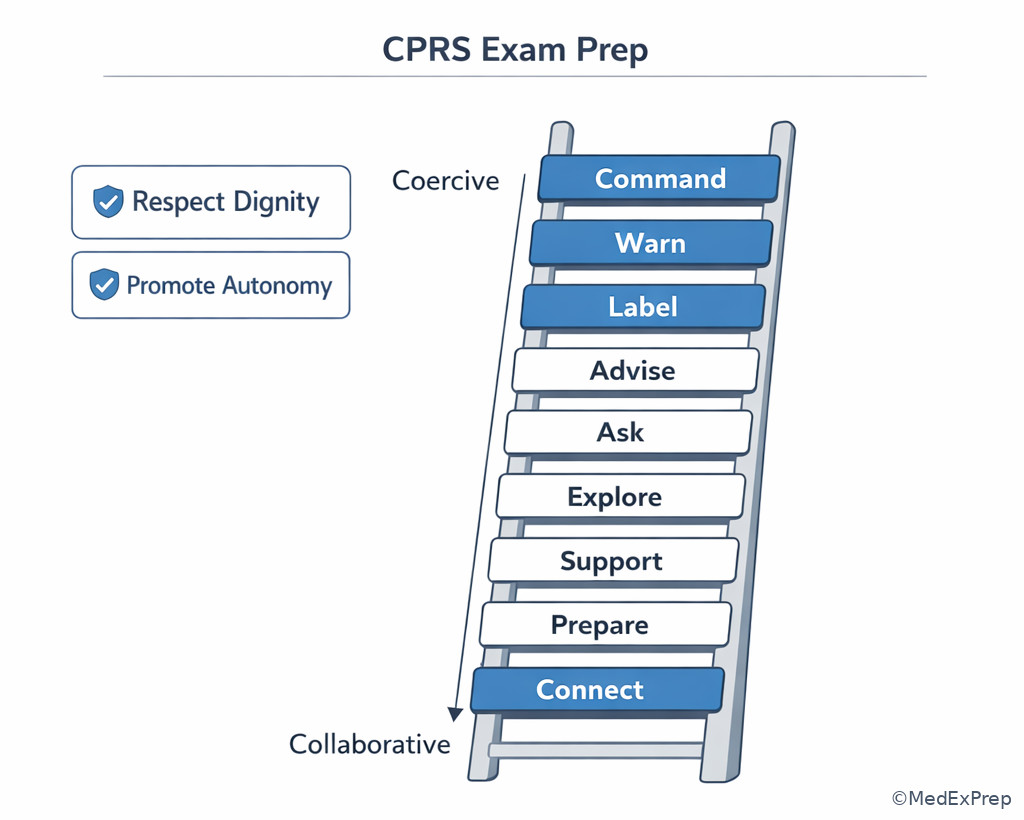
Exam takeaway: The peer's role is to help the person prepare their own voice for meetings and systems navigation, not to replace it.
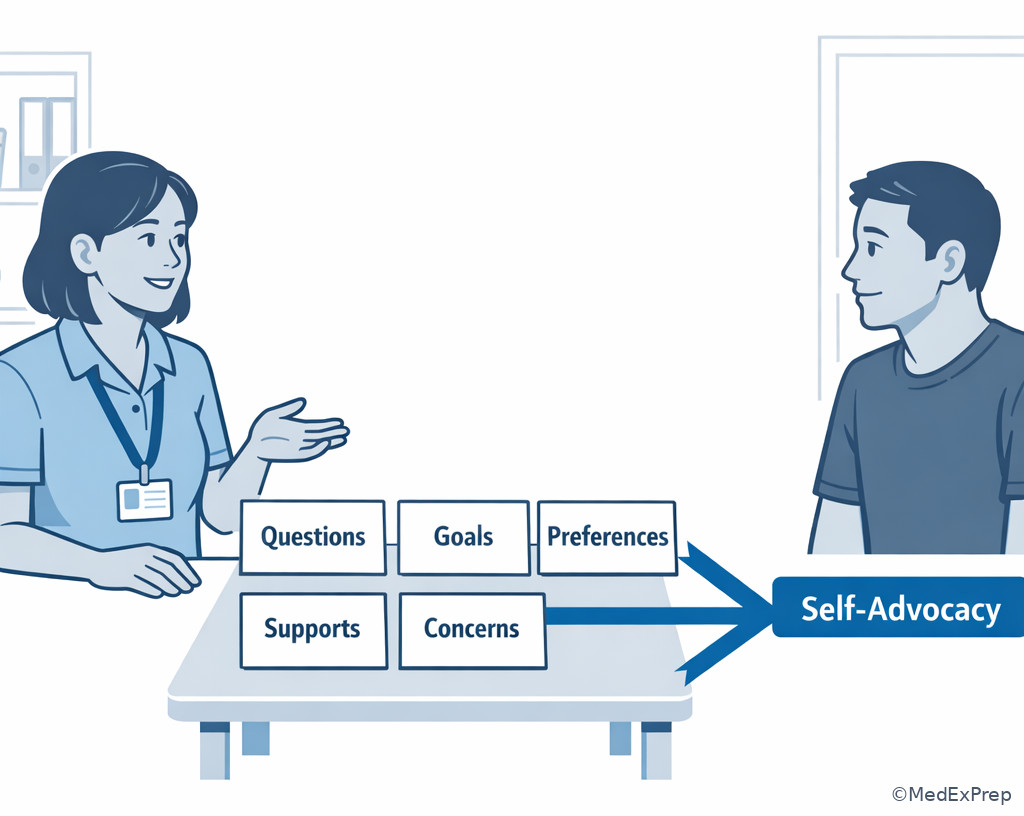
1.1.1.6 Applied principle: autonomy is primary, but safety and policy create exceptions
A Explanation
This is one of the most tested recovery-oriented distinctions: choose the answer that honors autonomy versus choose the answer that protects safety and follows protocol. The resolving rule is not “autonomy always wins.” Instead: autonomy guides routine peer support, but when there is imminent safety risk, abuse/neglect concerns, duty-to-warn situations, or another policy-triggering issue, the peer must follow policy, consult supervision, and connect the person to appropriate responders.
WHY THIS IS TESTED: The exam wants to know whether you can avoid two opposite errors: overcontrol in routine situations and underreaction in emergencies. The peer is not expected to perform independent clinical assessment, but the peer is expected to recognize red flags and act promptly within protocol.
Do not confuse respect for confidentiality with secrecy. You cannot promise to keep dangerous disclosures private if policy or law requires action. The best answer often includes staying calm, being honest about limits, remaining with the person if safe and consistent with policy, contacting the supervisor or emergency support, and documenting factually afterward.
B Worked example
A 41-year-old peer with bipolar disorder, alcohol-use recovery, and recent job loss says during a support visit, “Don’t tell anyone, but I’ve been thinking everyone would be better off if I disappeared tonight.” He adds that he does not want to “go through hospital stuff again.” A distracting detail is that he also complains that his medication makes him tired, which can tempt an out-of-role response about treatment changes. The question asks for the most appropriate next step for the peer recovery specialist.
Reasoning chain: Identify task — this is now a safety question. Extract key facts — possible suicidal intent, timeframe tonight, request for secrecy. Apply rule — safety overrides routine confidentiality and ordinary autonomy; follow policy and escalate immediately. Eliminate distractors — reject “respect his wishes and keep talking privately,” “advise him to adjust medication,” and “perform your own risk assessment to decide if hospitalization is needed.” Verify — the best answer is to stay with the person if safe and according to protocol, tell him you need to get immediate help, contact a supervisor/clinical or emergency resource per policy, and document the facts afterward.
C Exam trap
D Checkpoint
Question: A peer says, “Please don’t tell anyone, but I have a plan to overdose after I leave here.” What is the most appropriate next step?
- A. Promise confidentiality so the person keeps talking, then revisit the topic later.
- B. Explain that safety limits confidentiality, stay with the person as appropriate, and follow emergency/supervisory protocol immediately.
- C. Ask detailed clinical questions to determine whether the risk meets admission criteria.
- D. Encourage the person to think positively and attend a meeting tonight instead.
Answer: B
- A: Tempting because it tries to preserve rapport, but it is wrong because secrecy cannot override imminent danger.
- B: Tempting because it may feel more formal than peer support, yet it is right because it combines honesty, safety, and role-appropriate escalation.
- C: Tempting because assessing danger seems responsible, but it is wrong because independent clinical risk assessment is outside the peer role.
- D: Tempting because mutual support may help, but it is wrong because a meeting referral does not replace immediate safety action.
- True or False: Recovery-oriented care means always following the person's request, even during imminent danger. False.
- The single clue that turns a routine support stem into a safety stem is often immediacy of risk.
- Name 3 actions within role during imminent safety concern: explain limits, consult/escalate, document factually.
Exam takeaway: Autonomy guides routine care, but imminent risk, abuse concerns, or policy triggers require immediate consultation and escalation.
flowchart TD
A[Peer shares concern or disclosure] --> B{Imminent safety or mandatory reporting trigger?}
B -- No --> C[Use person-centered support and self-directed planning]
B -- Yes --> D[State limits of confidentiality honestly]
D --> E[Stay with person if safe and policy-consistent]
E --> F[Contact supervisor, clinical staff, crisis line, or emergency responders per protocol]
F --> G[Document observed facts and actions taken]
See Fig 6 for the high-yield exception pattern that appears repeatedly across CPRS scenarios.
Exam takeaway: The peer remains supportive and calm while routing the situation through policy rather than acting as the sole crisis responder.
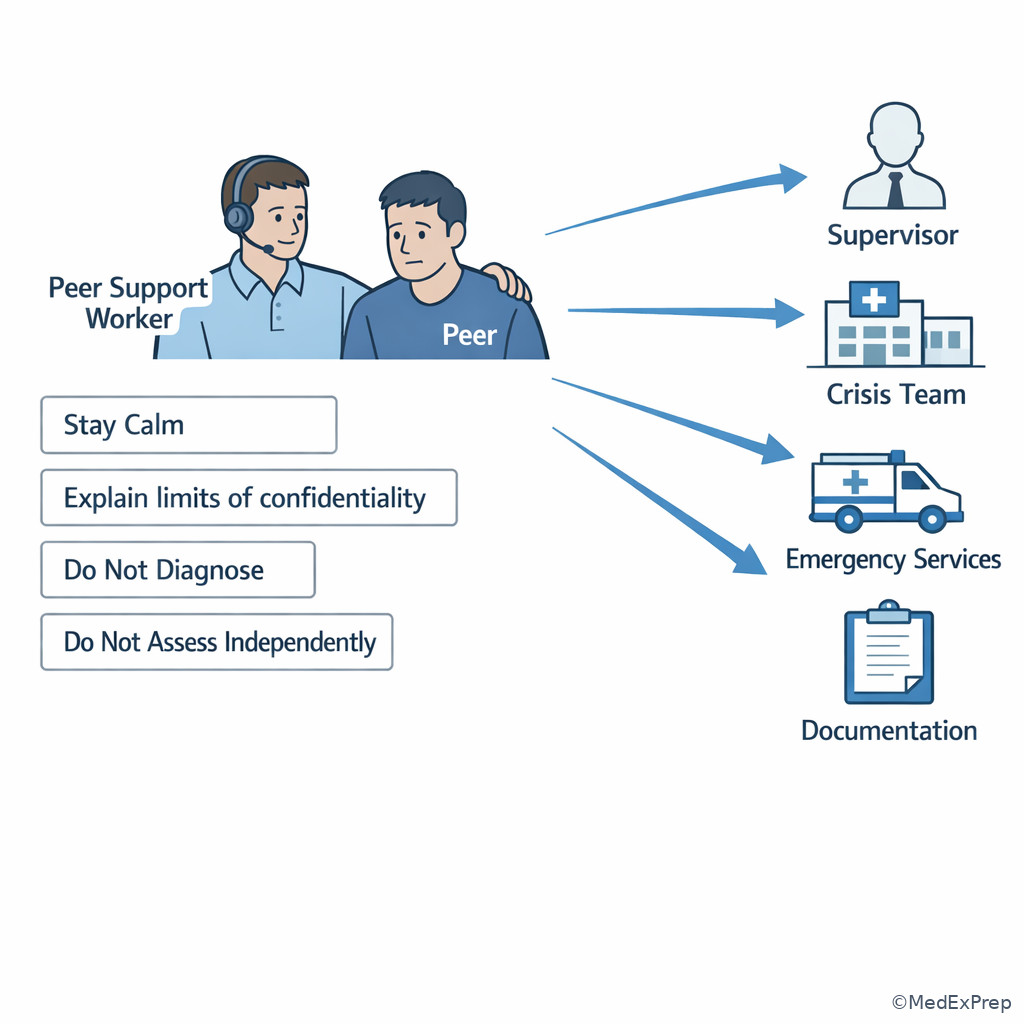
1.1.1.7 Integration: use recovery-oriented practice to choose the best action in complex stems
A Explanation
In harder questions, several principles compete at once. The conflict is usually which value leads the next step right now: self-direction, hope, advocacy, boundaries, or safety. The resolving rule is sequence. First identify the task. Then ask: What is the person asking for? Is there any safety or policy trigger? If not, what response best preserves dignity, autonomy, and mutuality? If yes, what response preserves dignity while escalating appropriately? This sequencing is why Fig 1 and Fig 6 are so useful.
WHY THIS IS TESTED: The exam rewards judgment, not memorized slogans. Many wrong answers use one true value in the wrong order—for example, “advocacy” that becomes speaking for the person without consent, or “confidentiality” applied despite imminent danger.
In integrated stems, the best answer often includes four features: it stays within scope, supports the person’s own voice, uses respectful language, and responds appropriately to any safety trigger. If one option is supportive but controlling, and another is empowering but ignores safety, neither is best. Look for the option that balances recovery principles with role boundaries.
B Worked example
A 52-year-old peer with PTSD, stimulant-use recovery, and chronic pain says she wants to stop attending a weekly group because she feels judged there. She asks the peer specialist, “Can you just tell them I’m done and make them stop pressuring me?” She also says she has no transportation to a different group and is worried her probation officer will view any change negatively. A wrong answer may sound attractive because direct advocacy seems helpful.
Reasoning chain: Identify task — determine the best next step within role. Extract key facts — she wants to change participation, feels judged, requests the peer to take over communication, and there is no clear imminent safety issue. Apply rule — recovery-oriented practice supports self-advocacy, not substitution of the peer’s voice for the person’s unless policy and consent require a limited supportive action. Eliminate distractors — do not force the current group, do not speak for her without first centering her preferences, and do not advise on legal consequences beyond scope. Verify — the best answer is to explore what did not feel safe or useful, discuss alternatives, and help her prepare what she wants to say to the relevant provider or officer, including whether she wants support during that conversation.
C Exam trap
D Checkpoint
Question: In a complex scenario with no immediate safety issue, which answer is usually best?
- A. The one that gets the fastest outcome, even if the peer directs the plan.
- B. The one that most strongly protects confidentiality, even if it blocks needed collaboration.
- C. The one that supports the person’s own goals, keeps the peer within scope, and uses collaborative language.
- D. The one that sounds most authoritative because systems respect certainty.
Answer: C
- A: Tempting because practical efficiency feels helpful, but it is wrong because speed does not justify taking over.
- B: Tempting because privacy matters, but it is wrong because confidentiality is not the only principle and must be balanced with the person’s goals and proper collaboration.
- C: Tempting because it may seem less dramatic, but it is right because it reflects the core testable decision framework.
- D: Tempting because certainty can sound professional, but it is wrong because peer support is grounded in mutuality rather than authority.
Exam Traps & Differentiators
1.1.1.8 Most common wrong answer and why
Most common wrong answer: a directive “fix-it” response that tells the person what to do. It is tempting because decisiveness sounds competent. It is wrong because recovery-oriented practice privileges self-direction and shared problem-solving unless there is a clear safety exception.
1.1.1.9 Looks similar but isn’t
| Looks similar | Recovery-oriented answer | Why the other choice is wrong |
|---|---|---|
| Advocacy | Help the person prepare to speak with staff or accompany them with consent | Speaking for the person without centering their wishes takes over rather than empowers |
| Hope | Connect prior success to a realistic next step | False reassurance minimizes real barriers |
| Confidentiality | Protect privacy within policy and explain limits honestly | Absolute secrecy is unsafe and outside policy when risk is imminent |
| Support | Explore options the person chooses among | Advice-giving or directing substitutes the peer’s judgment |
| Use of lived experience | Brief, purposeful sharing tied to the peer’s goal | Long storytelling shifts the focus away from the person |
| Trauma-informed care | Ask permission, avoid coercion, preserve dignity | Pressuring disclosure or demanding immediate agreement can re-create power harm |
1.1.1.10 If the stem says ___, think ___
- If the stem says “What should the peer do first?”, think start with the person’s goal and role check before acting.
- If the stem says “Don’t tell anyone” plus imminent harm language, think limits to confidentiality and immediate escalation.
- If the stem says “I’m not sure what I want”, think explore values and options, not pressure for commitment.
- If the stem says “Can you tell them for me?” in a routine setting, think support self-advocacy first.
- If the stem says “This is what worked for me” in an answer option, think check whether the sharing serves the person or shifts focus to self.
- If the stem uses labels like noncompliant, manipulative, resistant, think that option likely conflicts with recovery-oriented language.
| Commonly confused pair | Choose this when... | Reject this when... |
|---|---|---|
| Support vs counseling | The action is listening, encouraging, connecting, or helping the person plan their own next step | The option interprets symptoms, processes trauma clinically, or provides therapy-like intervention |
| Advocacy vs taking over | The peer helps the person prepare, practice, accompany, or request information | The peer makes the decision or speaks in place of a capable person without centering consent |
| Confidentiality vs secrecy | There is routine sharing within policy and privacy protection | The situation includes imminent risk or mandatory reporting trigger |
| Respecting choice vs abandonment | The person is making a routine preference decision and you remain engaged | The option ignores danger, severe instability, or need for protocol-based escalation |
Forward reference: in Multiple Recovery Pathways, a major trap will be assuming one correct route to recovery. In Strengths-Based Support, another trap will be focusing only on barriers and forgetting resilience. Those topics extend the same recovery-oriented decision lens introduced here.
Algorithm / Approach
| Step | Ask yourself | Best exam move |
|---|---|---|
| 1. Person's goal | What does the person want help with? | Center their stated priorities |
| 2. Safety screen | Is there imminent risk or a reporting trigger? | Escalate per policy if yes |
| 3. Scope check | Is this support, or am I drifting into treatment/authority? | Stay within peer role |
| 4. Language test | Does the option sound collaborative or controlling? | Choose collaborative wording |
| 5. Autonomy test | Does the person still own the decision? | Prefer empowerment over taking over |
Rapid Review
- Self-direction → best answer starts with the person’s goals, not the helper’s preference.
- Hope → credible encouragement tied to strengths beats reassurance without action.
- Mutuality → alongside the person, not expert-above-person.
- Advocacy → prepare and support the person’s voice; do not replace it.
- Strengths focus → prior success and resilience matter more than deficit-only framing.
- Person-centered language → explore barriers; avoid labels like noncompliant or manipulative.
- Lived experience → purposeful and brief, never the center of the interaction.
- Confidentiality → protect privacy, but do not promise secrecy when safety/policy requires action.
- Routine dilemma → choose collaboration over directing.
- Safety dilemma → choose escalation over secrecy.
- Best-action stems → eliminate options that diagnose, prescribe, assess clinically, or determine level of care.
- Trauma-informed practice → ask permission, preserve dignity, reduce power-over responses.
- Recovery pathway conflict → no single method fits all; this will expand in the next topic.
Self-check quiz
1.1.1.11 1. A peer says, “I’m tired of everyone deciding for me.” What response is most consistent with recovery-oriented practice?
- A. “Let’s talk about what matters most to you and what options fit your goals.”
- B. “The team probably knows the best plan, so try to follow their lead.”
- C. “I’ll tell you which option has the highest success rate.”
- D. “It is better not to question the process too much right now.”
1.1.1.12 2. A peer specialist wants to use lived experience in a conversation with a person who feels discouraged after a setback. Which use is most appropriate?
- A. Share a brief example only if it supports the person’s goal and then return the focus to them.
- B. Give a detailed story so the person can copy the same path exactly.
- C. Avoid all lived experience because peer support should be fully neutral.
- D. Use the story to persuade the person that your preferred recovery plan is best.
1.1.1.13 3. A 29-year-old peer with anxiety, recent stimulant-use recovery, and unstable housing says, “My counselor wants one thing, my family wants another, and I don’t even know what I want.” He missed a bus appointment last week and feels embarrassed. What is the most appropriate next step?
- A. Tell him to follow the most restrictive option so he does not make a mistake.
- B. Help him clarify his own goals, identify barriers, and prepare questions for the treatment team.
- C. Call the team immediately and instruct them on the plan he should receive.
- D. Explain that until he becomes more motivated, planning is not useful.
1.1.1.14 4. A 46-year-old peer with depression and alcohol-use recovery says, “I always fail. I missed two meetings, so I should probably give up.” She also reports caring for her nephew most evenings, which has made scheduling harder. Which response best reflects strengths-based, recovery-oriented practice?
- A. “Missing meetings shows you are not ready to change.”
- B. “You were handling caregiving and recovery at the same time; what helped you keep going before?”
- C. “You need stricter rules if you want this to work.”
- D. “Let me explain to you why people relapse psychologically.”
1.1.1.15 5. A 37-year-old peer with opioid-use recovery, chronic pain, and transportation barriers says staff keep calling her “noncompliant” after missed visits. She asks, “Can you just talk to them for me?” What is the most appropriate next step?
- A. Contact staff without discussing it further so they stop using stigmatizing language.
- B. Explore what she wants staff to understand and help her prepare to communicate her transportation barrier and preferences.
- C. Tell her that labels are part of the system and she should ignore them.
- D. Advise her which complaint process will get the fastest result and complete it for her.
1.1.1.16 6. A 43-year-old peer with bipolar disorder, recent alcohol relapse, and insomnia says during a support visit, “Please keep this between us. I already decided I’m taking all my pills tonight.” He also says he is upset that his prescriber reduced a medication dose last month. Which action is most appropriate?
- A. Keep the disclosure confidential to preserve rapport and continue supportive conversation.
- B. Advise him to restart the previous dose and go to a mutual-aid meeting tonight.
- C. Explain that you cannot keep imminent safety concerns secret, remain with him as appropriate, and activate supervisory/emergency protocol.
- D. Ask enough clinical questions to decide whether he meets criteria for involuntary treatment before contacting anyone.
1.1.1.17 7. A 54-year-old peer with PTSD, opioid-use recovery, and probation involvement says she wants to stop attending a particular group because it feels shaming. She asks the peer specialist to tell everyone she refuses to return. She denies any immediate safety concern and says she still wants recovery support, just in a different format. What is the most appropriate next step?
- A. Tell the program she is dropping out because the group is harmful.
- B. Encourage her to stay no matter what because dropping out is a red flag.
- C. Explore what is not working, discuss alternatives, and help her prepare to communicate her preferences to the appropriate people.
- D. Decide which alternative service best meets probation expectations and enroll her.
1.1.1.18 8. A 31-year-old peer with depression, cannabis-use recovery, and recent family conflict says, “I don’t want my parent involved in my care conversations anymore.” Later in the same meeting, the parent asks the peer specialist privately, “Just tell me everything so I can make the right decisions.” There is no immediate safety issue in the stem. What is the most appropriate response?
- A. Share the details because family involvement usually improves outcomes.
- B. Decline to share beyond policy and encourage discussion that centers the peer’s preferences and consent.
- C. Avoid the topic entirely so the family does not feel rejected.
- D. Tell the parent what you personally think the peer should do next.
Answer key
1.1.1.19 1. Correct answer: A
- A: Tempting because it may seem less forceful than the other options, but it is correct because it centers self-direction and collaborative exploration. Single stem clue: “I’m tired of everyone deciding for me” points directly to the need for autonomy-supportive action.
- B: Tempting because treatment teams do have expertise, but it is incorrect here because the question tests recovery-oriented practice, not deference to authority. Single stem clue: the person objects to others deciding for them.
- C: Tempting because giving advice can feel efficient, but it is incorrect because the peer should not take ownership of the decision. Single stem clue: the best response must preserve the person’s role in choosing.
- D: Tempting because it sounds stabilizing, but it is incorrect because it dismisses the person’s concern and reinforces passivity. Single stem clue: the person is seeking voice, not silence.
1.1.1.20 2. Correct answer: A
- A: Tempting because it may seem modest, but it is correct because purposeful self-disclosure in peer support is brief, relevant, and returns focus to the person. Single stem clue: the question asks for the most appropriate use of lived experience, not the most detailed.
- B: Tempting because modeling can be helpful, but it is incorrect because copying the specialist’s path undermines individual choice and shifts focus away from the peer. Single stem clue: “copy the same path exactly” contradicts self-direction.
- C: Tempting because over-sharing can be harmful, but it is incorrect because lived experience is a legitimate peer support tool when used purposefully. Single stem clue: the peer role does include thoughtful use of lived experience.
- D: Tempting because personal stories can be persuasive, but it is incorrect because persuasion toward the specialist’s preferred plan is not recovery-oriented. Single stem clue: “preferred recovery plan” signals directing.
1.1.1.21 3. Correct answer: B
- A: Tempting because more structure can sound protective when the person feels overwhelmed, but it is incorrect because imposing the most restrictive option overrides self-determination. Single stem clue: “I don’t even know what I want” calls for exploration, not imposed direction.
- B: Tempting because it is collaborative rather than dramatic, and it is correct because it helps the person clarify goals, identify barriers, and participate in decisions. Single stem clue: multiple outside opinions are present, but there is no imminent safety threat.
- C: Tempting because immediate action with the team sounds efficient, but it is incorrect because directing the plan is overreach and bypasses the person’s voice. Single stem clue: the task is to support the person, not instruct staff.
- D: Tempting because motivation matters, but it is incorrect because the person’s ambivalence is exactly why collaborative exploration is needed. Single stem clue: uncertainty does not equal inability to engage.
1.1.1.22 4. Correct answer: B
- A: Tempting because missed meetings can look like low readiness, but it is incorrect because it labels the person instead of exploring real-life barriers and strengths. Single stem clue: caregiving responsibility is a concrete barrier, not proof of unwillingness.
- B: Tempting because it sounds simple, and it is correct because it reframes the situation through resilience and invites strengths-based problem-solving. Single stem clue: the stem includes caregiving, which signals existing responsibility and strength.
- C: Tempting because structure can help, but it is incorrect because stricter rules are not the first recovery-oriented response to discouragement. Single stem clue: the person says “I should probably give up,” so hope and strengths are central.
- D: Tempting because explanation can sound educational, but it is incorrect because interpreting relapse psychologically drifts toward clinical framing rather than peer support. Single stem clue: the best next step is engagement, not analysis.
1.1.1.23 5. Correct answer: B
- A: Tempting because confronting stigma sounds like advocacy, but it is incorrect because it bypasses the person’s role in deciding what should be communicated and how. Single stem clue: she asks, “Can you just talk to them for me?” in a routine context, which calls for self-advocacy support first.
- B: Tempting because it may seem slower, and it is correct because it supports the person’s own voice while addressing the practical barrier of transportation. Single stem clue: transportation barriers explain the missed visits and should shape collaborative planning.
- C: Tempting because it avoids conflict, but it is incorrect because dismissing stigmatizing language does not support dignity or problem-solving. Single stem clue: she is asking for help, not minimization.
- D: Tempting because formal complaint systems exist, but it is incorrect because completing it for her takes over and may not match her preference. Single stem clue: the best answer should center her choice before escalating advocacy steps.
1.1.1.24 6. Correct answer: C
- A: Tempting because preserving rapport matters in peer work, but it is incorrect because imminent suicidal intent overrides routine confidentiality. Single stem clue: “I already decided I’m taking all my pills tonight.”
- B: Tempting because medication frustration and mutual-aid support are mentioned, but it is incorrect because advising on medication and substituting a meeting for immediate safety action are both wrong here. Single stem clue: imminent intent makes medication discussion a distracting detail.
- C: Tempting because it may feel more procedural than peer-like, and it is correct because it combines honesty about confidentiality limits with immediate protocol-based escalation. Single stem clue: request for secrecy plus tonight’s plan triggers emergency response within role.
- D: Tempting because assessing severity sounds responsible, but it is incorrect because the peer should not independently determine admission criteria or conduct a full clinical risk assessment. Single stem clue: the role is recognition and escalation, not clinical determination.
1.1.1.25 7. Correct answer: C
- A: Tempting because it sounds protective and advocacy-oriented, but it is incorrect because it takes over communication before exploring the person’s preferences and options. Single stem clue: there is no immediate safety concern, so self-advocacy support should come first.
- B: Tempting because continuity matters in recovery, but it is incorrect because forcing continued participation in a shaming setting ignores self-direction and trauma-informed practice. Single stem clue: she still wants recovery support, just not that format.
- C: Tempting because it may seem less decisive, and it is correct because it balances autonomy, alternatives, and supported self-advocacy. Single stem clue: routine preference change plus desire for continued support points to collaborative planning.
- D: Tempting because probation consequences are mentioned, but it is incorrect because choosing and enrolling her in the “best” service crosses into taking over decisions and possibly case-management authority. Single stem clue: legal pressure is a distracting detail, not a license to remove autonomy.
1.1.1.26 8. Correct answer: B
- A: Tempting because family support can be helpful, but it is incorrect because the peer has clearly expressed not wanting parental involvement in care conversations. Single stem clue: “I don’t want my parent involved in my care conversations anymore.”
- B: Tempting because it may feel uncomfortable to set limits with family, and it is correct because recovery-oriented practice respects the peer’s preferences and confidentiality within policy. Single stem clue: no immediate safety issue is present to override routine privacy expectations.
- C: Tempting because avoiding conflict may preserve the moment, but it is incorrect because it fails to uphold confidentiality boundaries and the peer’s stated choice. Single stem clue: the parent is directly requesting information; silence is not a sufficient boundary response.
- D: Tempting because families often ask for guidance, but it is incorrect because telling the parent what the peer “should” do both breaches role boundaries and undermines self-determination. Single stem clue: the question is about privacy and choice, not the specialist’s opinion.
Keep going with the full CPRS Prep Course (CPRS)
You just studied the way members do, in the same lesson interface. Full access unlocks every lesson, the question bank and flashcards for a full year.
One payment · 1 year of access · No auto-renewal