1.1.1 - CPOCTP Scope And Audience
CPOCTP Scope And Audience
What you’ll learn
- D1: Exam Orientation -> Candidate role framing: Identify who the exam is written for and what decisions that role is expected to make.
- D2: POCT Governance and Program Oversight -> Operational authority: Distinguish POCT coordination responsibilities from treating-provider or laboratory-director responsibilities.
- D3: Compliance and Documentation Readiness -> Governing requirements: Prioritize institutional policy, manufacturer instructions, and applicable regulatory/accreditation requirements in exam scenarios.
- D4: Quality Management -> Safety-first judgment: Recognize when patient safety, result integrity, and traceability outweigh speed or convenience.
- D9: Scenario-Based Operational Judgment -> Best next action: Choose the safest in-scope next step when a stem includes quality, documentation, training, or device concerns.
- D1: Exam Orientation -> Candidate role framing
- D2: POCT Governance and Program Oversight -> POCT coordinator authority and limits
- D3: Compliance and Documentation Readiness -> Requirement hierarchy and documentation mindset
- D4: Quality Management -> Safety, containment, and traceability priorities
- D9: Scenario-Based Operational Judgment -> Best-next-step logic for POCT oversight
Why it matters
- The exam does not test you as an independent diagnostician or prescriber; it tests you as an operational POCT leader choosing the safest compliant action.
- Many wrong answers sound efficient or clinically helpful but are outside role, undocumented, or unsafe when QC, competency, maintenance, or identification conditions are not met.
- Understanding the audience and scope early prevents a large share of exam errors because you can eliminate answers that exceed authority before analyzing technical details.
- This topic builds the lens for the entire course: patient safety, result integrity, documentation, traceability, and escalation come before convenience.
Exam takeaway: Start every question by identifying the operational POCT role before choosing any action.
flowchart TD
A[Exam stem appears] --> B[Identify your role]
B --> C[POCT oversight and coordination]
C --> D[Check scope and authority]
D --> E[Prioritize safety integrity documentation]
E --> F[Choose in-scope best next step]
B --> G[Not treating provider]
B --> H[Not laboratory director for reserved actions]
See Fig 1. This role-first filter is the fastest way to avoid out-of-scope distractors throughout the course.
Key Terms & Must-Know Facts
1.1.1.1 Key terms
- Point-of-care testing (POCT): Testing performed near or at the site of patient care.
- POCT professional/coordinator: Person overseeing POCT operations, quality processes, training support, documentation, and compliance workflows.
- Institutional policy: Local approved rules governing how POCT is performed and documented.
- Manufacturer instructions: Device-specific required use, QC, maintenance, storage, and limitation guidance.
- Applicable requirement: The controlling current requirement from policy, manufacturer, regulator, accreditor, or state authority, as relevant.
- Traceability: Ability to connect a result to patient ID, operator, device, reagents, QC status, and documentation trail.
- Containment: Immediate action to stop unsafe testing or prevent further risk.
- Escalation: Routing an issue to the correct authority based on severity and scope.
- Nonconformity: A failure to meet a required process, standard, policy, or instruction.
- Competency: Demonstrated ability to perform authorized testing correctly; not the same as initial training.
- QC failure: Quality control not meeting criteria required for patient testing release.
- Inspection readiness: Ongoing state of organized compliance records and defensible practice.
- Result integrity: Confidence that the reported result is accurate, attributable, and valid.
- Best next step: The single safest and most compliant immediate action in the given scenario.
1.1.1.2 Must-know facts
- The CPOCTP role is operational, oversight-focused, and compliance-sensitive.
- Patient safety and result integrity outrank workflow speed.
- If QC, maintenance, competency, or identification requirements are not met, testing may need to be held.
- Documentation matters; verbal awareness alone is rarely enough.
- When requirements differ, follow the most current applicable rule and local policy.
- Out-of-role answers often ask you to diagnose, prescribe, authorize treatment, or override controls.
- The exam favors containment first when immediate risk exists.
- The POCT professional supports and escalates; does not assume the laboratory director’s legally reserved authority.
- Unsafe convenience choices are common distractors.
- A correct answer often includes both action and traceable follow-up.
| Exam term | What it means operationally | What it usually signals in a question |
|---|---|---|
| Best next step | Immediate safest in-scope action | Do not jump to long-term redesign before containing risk |
| Requires immediate clarification | Do not proceed until a critical uncertainty is resolved | Often involves identity, authorization, QC, or documentation gaps |
| Most important to monitor | Choose the variable that protects validity or compliance | Think QC status, maintenance, competency, connectivity, traceability |
| Escalate according to policy | Send issue to the correct chain of command | Used when issue exceeds POCT coordinator authority |
| Hold testing/results | Pause release or performance to protect safety | Common with failed QC, serious documentation gaps, or device concerns |
| Document corrective action | Create traceable record of issue, response, and follow-up | Verbal notification alone is not enough |
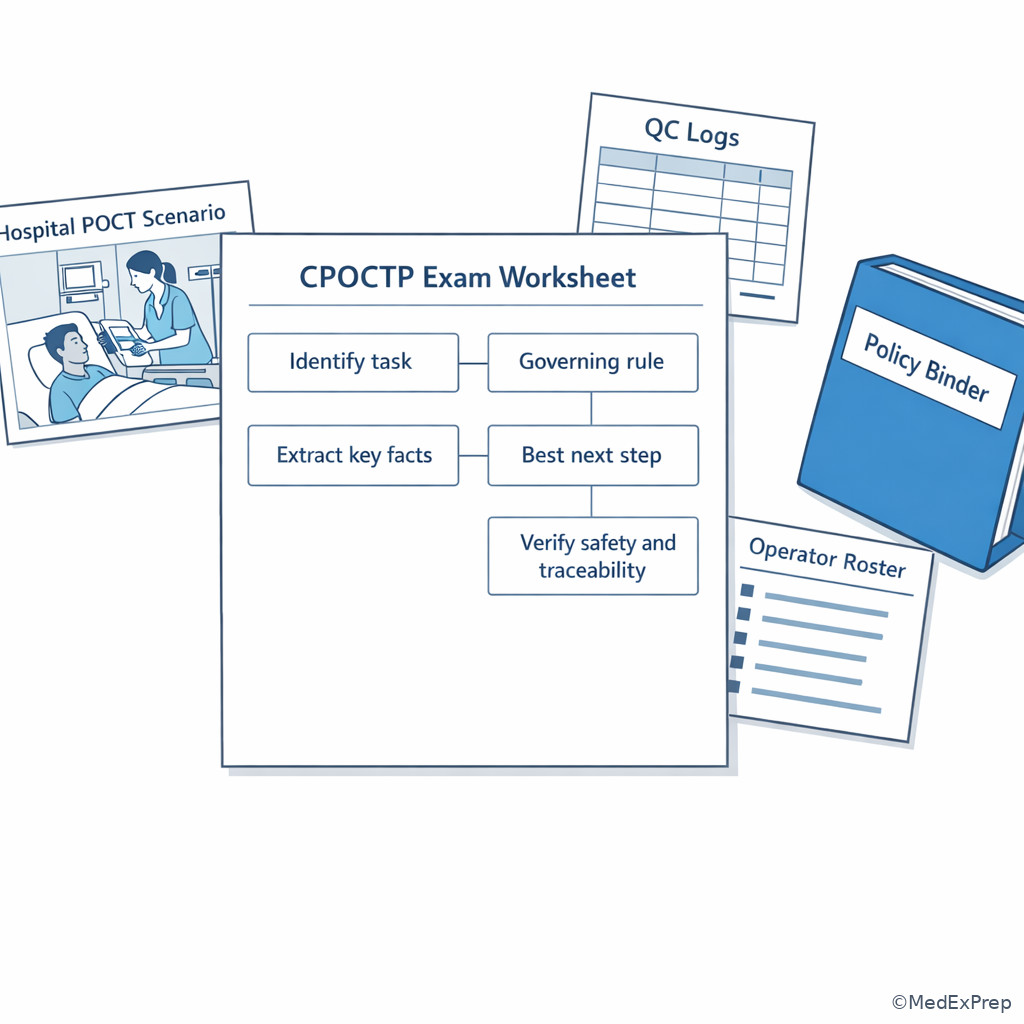
Exam takeaway: Visualize POCT as a workflow that connects patient ID, operator action, device controls, and documentation.
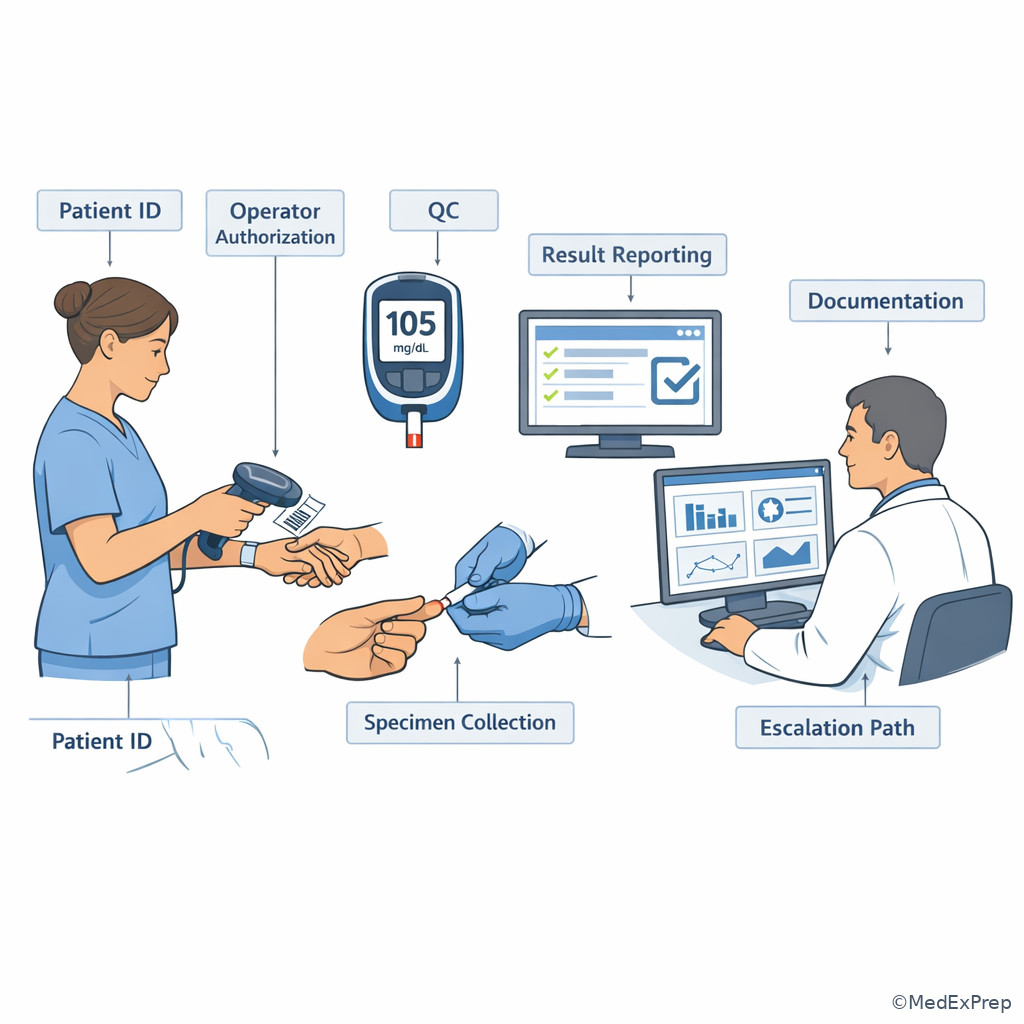
Core content
1.1.1.3 Foundational role: who the exam is actually testing
A Explanation
The first decision conflict in this course is simple but decisive: Are you being asked to act as a POCT oversight professional, or are you being lured into acting as someone else? The resolving rule is that the CPOCTP perspective is an operational oversight role within institutional policy, manufacturer instructions, and applicable regulatory/accreditation requirements. You coordinate, review, educate, monitor, document, investigate, and escalate. You do not independently diagnose disease, prescribe therapy, authorize treatment changes, or clear unsafe testing for use just because the unit is busy.
WHY THIS IS TESTED: Exam writers can build attractive distractors by offering clinically decisive actions that sound helpful but exceed POCT authority. The correct answer is often the one that protects safety and compliance while staying within role boundaries.
Choose answers that emphasize operator training support, QC oversight, documentation review, competency tracking, device workflow support, incident investigation, and escalation through the proper chain of command. Reject answers that ask you to behave as the treating physician, independently release testing after QC failure, sign out as laboratory director, or alter patient management directly.
See Fig 1 for the role-first approach. Also see Fig 2 for the choose-vs-reject logic that separates in-scope and out-of-scope actions.
B Worked example
A 62-year-old inpatient in a telemetry unit has diabetes, chronic kidney disease, and heart failure. A nurse calls the POCT coordinator after a bedside glucose meter result of 42 mg/dL was obtained just after the device displayed a prior QC warning earlier in the shift. The nurse says the patient is awake and asks whether dextrose should be given immediately, and also notes that the unit is short-staffed and another nurse “already knows how to fix the meter.” The electronic connectivity feed is delayed, but a handwritten value is on a scrap note. What is the most appropriate response by the POCT coordinator?
Reasoning chain: Identify task: this is not a treatment question; it is a role-and-safety question. Extract key facts: prior QC warning, delayed connectivity, informal handwritten note, busy unit, and request for treatment guidance. Apply rule: the POCT coordinator must not prescribe therapy or clear questionable testing; the coordinator must address result integrity and escalate clinically significant concerns through policy-defined channels. Eliminate distractors: giving treatment instructions is out of role; allowing the unit to “fix it later” ignores a control failure; accepting the scrap note as enough documentation breaks traceability. Verify: the best response is to direct immediate containment of questionable testing on that device, require follow-up according to policy, ensure the appropriate clinician is notified through the correct patient-care pathway, and document/escalate the QC and connectivity concerns.
The tempting clue is the low glucose value, which pushes you toward direct patient-management thinking. The single rule that resolves the case is role scope: a POCT coordinator protects testing validity and communication pathways but does not independently direct treatment.
C Exam trap
Common wrong answer: “Instruct the nurse to treat the hypoglycemia immediately and continue using the meter because the patient’s symptoms fit the result.”
Why it is tempting: The value is critical and action-oriented learners want to help the patient fast.
Single clue that eliminates it: The question asks for the POCT coordinator’s response in the presence of a QC warning; that makes result-integrity containment and policy-based escalation the in-scope action, not independent treatment direction.
D Checkpoint
Question: A POCT professional is reviewing an exam scenario that asks for the “most appropriate next step” after bedside testing was performed by an operator with expired authorization. Which option best fits the tested role?
- A. Independently determine whether the patient’s diagnosis is still obvious despite the authorization lapse.
- B. Hold acceptance of the testing workflow, document the nonconformity, and escalate per policy.
- C. Tell the operator to keep testing because they were trained years ago.
- D. Enter the result manually without comment so treatment is not delayed.
Answer: B
- A: Tempting because it sounds clinically pragmatic, but wrong because diagnosis is outside POCT oversight role.
- B: Tempting because it may slow workflow, but right because expired authorization creates a compliance and traceability problem requiring containment and escalation.
- C: Tempting because prior experience feels reassuring, but wrong because past training does not substitute for current authorization/competency controls.
- D: Tempting because manual entry preserves speed, but wrong because undocumented circumvention worsens traceability risk.
Exam takeaway: If an option changes diagnosis or treatment rather than the testing process, it is usually the wrong role on this exam.
flowchart LR
A[Possible action] --> B{Does it manage the testing process?}
B -- Yes --> C[Likely in scope]
B -- No --> D{Does it diagnose prescribe or authorize treatment?}
D -- Yes --> E[Reject as out of role]
D -- No --> F{Does it override failed controls or missing documentation?}
F -- Yes --> G[Reject as unsafe]
F -- No --> H[Check policy and escalation]
Memory anchor: Think \(POCT = P-O-C-T\): Protect safety, Oversight not treatment, Compliance and documentation, Traceability first.
High-Yield Connection: This concept is tested alongside POCT Role Boundaries. Know both the positive scope (what you may do) and the prohibited scope (what you must reject) for exam day; they are frequently paired in the same stem.
1.1.1.4 Scope boundaries: what the POCT professional may do, must not do, and must escalate
A Explanation
The key decision conflict here is local action versus required escalation. The single resolving rule is this: act within your operational authority, but do not override reserved authority or bypass failed controls. In exam stems, you may develop procedures aligned with policy, coordinate training and competency processes, review records, investigate incidents, monitor QC and quality indicators, support implementation, enforce identification and specimen requirements, and escalate failed QC, critical compliance issues, connectivity failures, and patient safety concerns.
You must reject any answer that says to release testing despite failed QC, perform unauthorized complexity testing, change patient results without correction procedures, repair internal device electronics yourself, or make legal determinations about regulations. Those actions exceed role, bypass policy, or create traceability risk. The exam favors answers that recognize limits and use the chain of command appropriately.
WHY THIS IS TESTED: Strong candidates know facts; excellent candidates know where their authority stops. Exam writers often make the wrong answer attractive by pairing speed, convenience, or experience with an unsafe or reserved action.
Recall: This is the first lesson, so there is no prior topic to revisit yet. Build the habit now: when a question feels “clinical,” pause and ask whether the tested decision is actually about oversight, authorization, documentation, or escalation.
See Fig 3 for the escalation lanes. It compresses what would otherwise require several paragraphs of prose.
B Worked example
A POCT coordinator in a multisite clinic network discovers that a waived device is being used in an urgent care area by a medical assistant whose competency record is overdue by 2 months. The assistant has worked there for 11 years, the site manager says “everyone knows she is excellent,” and the analyzer has passed today’s internal electronic checks. A provider asks the coordinator to “just let it continue until HR catches up on files” because the clinic is full of patients with respiratory symptoms. One paper training sign-in sheet is available, but no current authorization record can be found.
Reasoning chain: Identify task: determine authority and best next operational response. Extract key facts: overdue competency, missing current authorization, pressure to continue, electronic checks passed, experienced operator, and incomplete documentation. Apply rule: experience and a passed device check do not replace current operator authorization requirements. Eliminate distractors: allowing continued testing for convenience bypasses personnel control; accepting a generic sign-in sheet as equivalent to documented authorization is weak traceability; asking the provider to decide whether to ignore the lapse shifts a compliance issue to the wrong role. Verify: the best next step is to follow policy for unauthorized/overdue operator status, which may include holding that operator’s testing privileges, documenting the nonconformity, arranging remediation, and escalating as required.
C Exam trap
Common wrong answer: “Allow the operator to continue temporarily because the device checks passed and the site is busy.”
Why it is tempting: It separates device performance from personnel qualification and feels operationally practical.
Single clue that eliminates it: The operator’s current competency/authorization control is missing; device readiness does not cancel personnel qualification requirements.
D Checkpoint
Question: Which action is most clearly outside the CPOCTP exam role?
- A. Reviewing QC records for completeness and follow-up documentation.
- B. Coordinating retraining after an identified operator error pattern.
- C. Independently authorizing patient treatment based on a POCT result.
- D. Escalating a connectivity failure that risks delayed result transmission.
Answer: C
- A: Tempting because it sounds administrative, but it is rightfully within POCT oversight scope, so not the answer.
- B: Tempting because training decisions feel supervisory, but this is a core POCT coordination function, so not the answer.
- C: Tempting because rapid patient care matters, but wrong for the role because authorizing treatment belongs to licensed clinical decision-makers, not POCT oversight staff.
- D: Tempting because IT issues may involve other teams, but escalation of connectivity risk is appropriate and in scope.
Exam takeaway: Escalate to the role that owns the problem rather than solving outside your authority.
flowchart TD
A[Issue identified] --> B{Primary issue type}
B --> C[QC or quality event]
B --> D[Operator authorization or competency]
B --> E[Connectivity or interface failure]
B --> F[Patient safety or identification risk]
C --> G[POCT leadership and laboratory chain]
D --> H[POCT education/supervisory pathway]
E --> I[IT vendor laboratory coordination]
F --> J[Clinical leadership and safety escalation]
G --> K[Document containment and follow-up]
H --> K
I --> K
J --> K - True or False: A passed device check can substitute for current operator authorization. False.
- The most common reason an answer is out of role is that it asks you to diagnose, prescribe, or override controls.
- Name the 3 safest verbs for early course questions: contain, document, escalate.
Exam takeaway: Match the problem to the proper authority instead of bypassing governance during busy workflows.
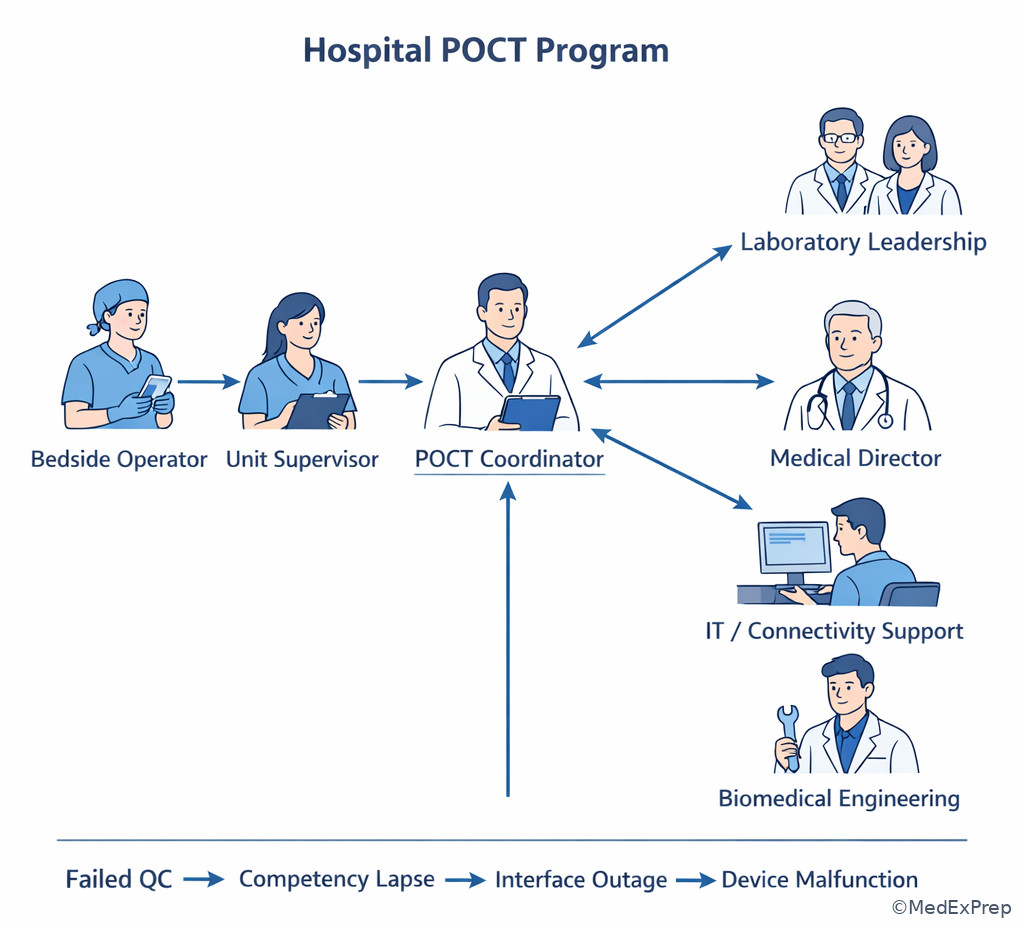
1.1.1.5 Governing principles: policy, manufacturer instructions, and applicable requirements
A Explanation
This subsection tests a recurring exam conflict: What controls the decision when the stem gives multiple possible rules? The resolving rule is that the POCT professional should follow the most current applicable requirement and local policy, while aligning practice with manufacturer instructions and relevant regulatory/accreditation expectations. You do not invent a personal standard. You do not choose the easiest rule. You identify which requirement governs the specific process in the scenario.
In practice, questions often embed this as a mismatch: a unit says “we always do it this way,” but the device instructions require something else; or a local shortcut conflicts with approved documentation steps; or state/accreditor expectations add constraints. Your job on the exam is not to win a legal argument but to choose the safest compliant next action: stop the drift, follow current approved requirements, and escalate conflicts through policy channels.
WHY THIS IS TESTED: POCT occurs across multiple departments and sites, so variation and shortcut culture are common. Exam stems use this reality to see whether you default to approved controls or to convenience/custom.
See Fig 4. It gives a practical hierarchy for interpreting stems when several requirements appear at once.
B Worked example
In a community hospital, a respiratory unit uses a POCT coagulation device. During an internal audit, the POCT specialist finds that staff have been skipping one required documentation step because “the analyzer stores it automatically anyway.” The manufacturer instructions require operator confirmation and the institutional procedure mirrors that step. A senior charge nurse says the accreditor has never cited the unit for this and that manually acknowledging the step slows emergent care. One result from the prior week also shows a delayed interface transmission, which the nurse argues proves the manual step is unnecessary.
Reasoning chain: Identify task: determine what governs practice and what next action fits POCT oversight. Extract key facts: there is a documented local shortcut, manufacturer instructions require the step, institutional policy matches it, and the unit is relying on habit and workflow pressure. The delayed interface transmission is noise. Apply rule: local custom and absence of prior citation do not override current approved requirements. Eliminate distractors: “no citation before” is not a standard; “stored automatically” does not negate required operator confirmation; emergent care pressure does not authorize silent procedure drift. Verify: the best response is to address the nonconforming practice through policy-based correction, education, documentation, and follow-up monitoring.
C Exam trap
Common wrong answer: “Allow the local variation because no patient harm has yet been documented and the unit has not been cited.”
Why it is tempting: Learners often anchor on outcome and inspection history instead of process control.
Single clue that eliminates it: The manufacturer instructions and institutional procedure both require the step; process nonconformity exists even before documented patient harm appears.
D Checkpoint
Question: A stem says a unit has a long-standing POCT shortcut, but current approved policy and manufacturer instructions require a different process. What principle should drive the answer?
- A. The longest-used local custom should prevail because it is practical.
- B. The absence of an adverse event means either approach is acceptable.
- C. The most current applicable approved requirement should govern.
- D. The busiest unit’s workflow preference should govern because turnaround time is critical.
Answer: C
- A: Tempting because experience feels validated, but wrong because habit is not a governing requirement.
- B: Tempting because outcomes matter, but wrong because compliance is judged by controlled process, not only by known harm.
- C: Tempting because it may require unpopular correction, but right because approved current requirements control the process.
- D: Tempting because POCT values speed, but wrong because speed never outranks approved safety/compliance requirements.
Exam takeaway: When multiple rules appear, choose the current applicable approved requirement rather than custom or convenience.
flowchart TD
A[Scenario requirement conflict] --> B[Manufacturer instructions]
A --> C[Institutional policy and procedure]
A --> D[Applicable regulator or accreditor expectations]
B --> E[Find current approved process]
C --> E
D --> E
E --> F[Use the controlling requirement]
F --> G[Document and escalate conflicts rather than improvising]
Memory anchor: Use MAP when rules collide: Manufacturer instructions, Applicable requirements, Policy. If custom conflicts with MAP, custom loses.
Exam takeaway: Picture policy, manufacturer instructions, and regulatory expectations as layered controls that guide the best next step.
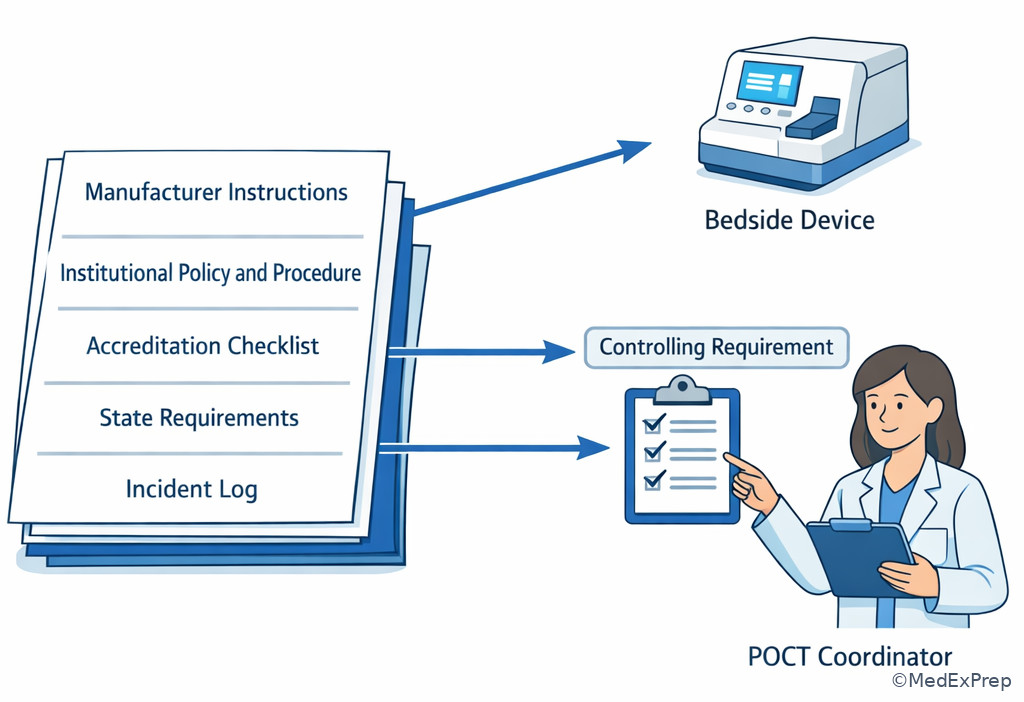
1.1.1.6 The exam’s decision lens: safety, result integrity, traceability, and documentation before convenience
A Explanation
At this stage, the main decision conflict is speed versus defensibility. The single resolving rule is that patient safety, specimen/result integrity, and traceability come before convenience or turnaround pressure. That does not mean POCT ignores workflow. It means that when workflow conflicts with controls, the answer must protect the validity and accountability of testing.
Common exam signals include missing patient identification steps, undocumented manual result entry, failed QC with pressure to continue, maintenance overdue but “working fine,” or connectivity downtime with incomplete backup process. In each case, the right answer usually starts with containment, then documentation, then escalation or correction. A wrong answer often skips straight to convenience: continue testing, chart later, rely on memory, or accept verbal assurance.
WHY THIS IS TESTED: POCT environments are busy and decentralized. The exam checks whether you can resist unsafe shortcuts when the stem deliberately increases urgency, staffing stress, or clinical pressure.
High-Yield Connection: This concept overlaps heavily with later topics in Patient Identification Controls, Specimen Acceptability Factors, and Result Documentation Elements. On exam day, the same safety-first rule reappears across pre-analytic, analytic, and post-analytic questions.
See Fig 5 for the core safety-versus-convenience split. It is a decision visual, not a generic concept map.
B Worked example
A 74-year-old emergency department patient with sepsis, atrial fibrillation, and anemia has a bedside hemoglobin result ready on a POCT device. During a network outage, the operator manually writes the result on a sticky note because the printer is down. At the same time, the patient is transferred from one room to another and registration merges a duplicate chart. The charge nurse asks the POCT coordinator to “just enter the result later from the note” so transfusion decisions are not delayed. The device operator is authorized and the QC earlier in the shift passed.
Reasoning chain: Identify task: determine the best oversight action when speed conflicts with traceability. Extract key facts: duplicate chart merge, handwritten temporary note, patient transfer, manual delayed entry request, and no secure verified result pathway in the moment. Apply rule: patient identification and result traceability risks outrank convenience. Eliminate distractors: later manual entry from a sticky note creates attribution risk; prior passed QC does not solve chart-identity risk; operator authorization does not fix post-analytic traceability problems. Verify: the best next action is to follow downtime and identification policy, secure correct patient/result matching before result release or entry, document the event, and escalate as appropriate.
C Exam trap
Common wrong answer: “Enter the result later from the handwritten note because the analyzer and operator were both acceptable.”
Why it is tempting: It narrows the problem to analytic validity and ignores post-analytic identity and documentation risk.
Single clue that eliminates it: The duplicate chart merge and room transfer create traceability uncertainty; you cannot assume the note preserves the correct patient-result link.
D Checkpoint
Question: Which principle best explains why a busy unit may still need to stop or delay a POCT workflow?
- A. Turnaround time is secondary when result integrity or patient identification is uncertain.
- B. POCT should never be used in urgent clinical areas.
- C. Documentation can always be reconstructed later if staff remember the sequence.
- D. Verbal reporting is equivalent to traceable result documentation.
Answer: A
- A: Tempting because it may delay care processes, but right because integrity and patient identification are foundational controls.
- B: Tempting because urgent settings are error-prone, but wrong because POCT is specifically used in such settings when controls are followed.
- C: Tempting because humans rely on memory in crises, but wrong because retrospective reconstruction is weak traceability.
- D: Tempting because verbal communication feels immediate, but wrong because it does not replace required documented result pathways.
- The first priority when result integrity is uncertain is containment.
- True or False: Passed QC earlier in the shift resolves a wrong-patient documentation risk. False.
- Name the three high-yield priorities: safety, integrity, traceability.
Exam takeaway: When a workflow shortcut threatens identification or traceability, the exam favors containment over speed.
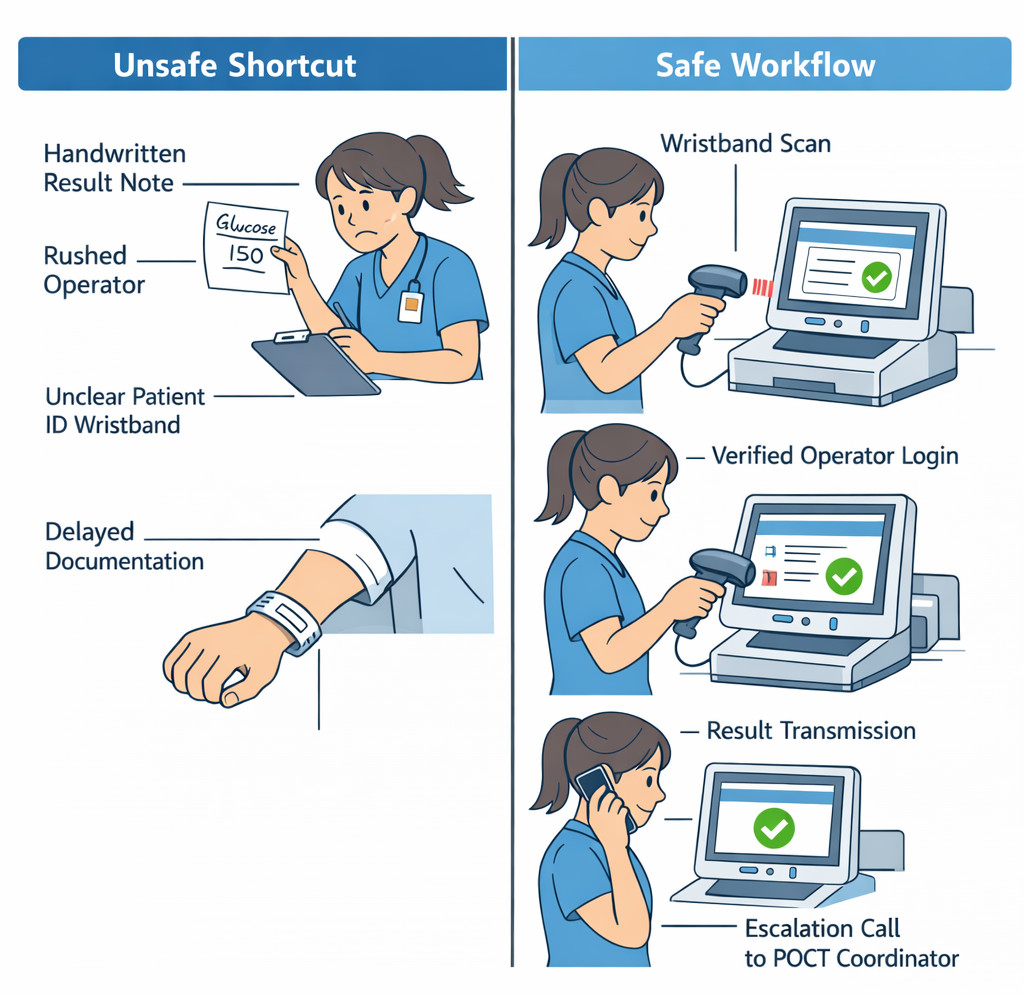
1.1.1.7 How to read CPOCTP exam scenarios: identify task, extract facts, choose governing rule, act, verify
A Explanation
This final core concept turns the lesson into a repeatable exam method. The decision conflict is reacting to noise versus solving the tested operational problem. The single resolving rule is to read every scenario through a five-part framework: identify the task, extract key facts, choose the governing rule, act, and verify. This course will use that framework repeatedly, and the next upcoming lesson, Best Next Step Logic, expands it in detail.
Operational noise in stems includes busy units, experienced staff, clinically dramatic results, old habits, one irrelevant lab value, or a persuasive supervisor asking for a shortcut. Those details are not random; they are designed to pull you toward the wrong rule. The key is to ask: what domain is actually being tested? If the problem is authorization, do not get distracted by a normal QC. If the problem is patient ID, do not get distracted by correct therapy. If the problem is connectivity, do not solve it as a specimen issue.
WHY THIS IS TESTED: The CPOCTP exam rewards disciplined process reasoning. High-performing candidates do not simply know isolated facts; they match the fact pattern to the governing principle and choose the safest in-scope action.
Recall: In this lesson, we established the role-first filter and safety-first lens. Here, we build on that by turning them into a formal stepwise reasoning process you will reuse across the course.
See Fig 6 for the exam-solving algorithm that ties the lesson together.
B Worked example
A 58-year-old outpatient with COPD and diabetes is seen in a satellite clinic. The clinic’s POCT INR instrument is functional, today’s QC passed, and the operator is current on competency. However, the patient was registered under two medical record numbers after a recent merger of health-system records, and the result did not cross into the electronic chart. The provider asks the POCT coordinator to manually place the INR result into whichever chart “looks active” because the patient traveled far and is waiting for a dose decision. A recent lot change is also mentioned in the stem, making it sound analytically complex.
Reasoning chain: Identify task: choose best next operational action, not dose management. Extract key facts: duplicate record numbers, failed result crossover, manual entry request into uncertain chart, current competency, and passed QC. The lot change is likely distracting noise unless linked to a performance problem. Choose governing rule: patient/result traceability and correct record attribution must be established before reporting. Act: hold unsafe result posting pathway, follow downtime/result correction or interface procedures, and escalate according to policy. Verify: this protects the patient-result link and stays inside the POCT role.
C Exam trap
Common wrong answer: “Manually enter the value into the chart that appears most current because the analytic portion of testing was valid.”
Why it is tempting: Learners anchor on passed QC, current competency, and the patient’s wait time.
Single clue that eliminates it: The exact patient record destination is uncertain; traceability failure makes manual posting unsafe until identity is resolved.
D Checkpoint
Question: Which step should come before choosing an answer in a complex CPOCTP scenario?
- A. Decide which option sounds most efficient for the unit.
- B. Identify the operational task and the governing rule.
- C. Assume the most clinically urgent detail always controls the answer.
- D. Ignore documentation details because they can be fixed later.
Answer: B
- A: Tempting because exam pressure favors quick choices, but wrong because efficiency is not the first filter.
- B: Tempting because it slows you briefly, but right because correct answer selection depends on matching the stem to the governing operational rule.
- C: Tempting because urgency matters, but wrong because clinical urgency may be noise if the tested issue is compliance or traceability.
- D: Tempting because documentation can feel secondary, but wrong because documentation often contains the very clue that determines the answer.
Exam takeaway: Use a fixed sequence—task, facts, rule, action, verification—to defeat noise-heavy stems.
flowchart TD
A[Read the stem] --> B[Identify the task]
B --> C[Extract key facts]
C --> D[Choose governing rule]
D --> E[Select immediate action]
E --> F[Verify safety integrity traceability compliance]
F --> G[Answer]
C --> H[Discard operational noise]
Exam takeaway: A structured parsing method prevents noise from pulling you toward unsafe or out-of-scope answers.
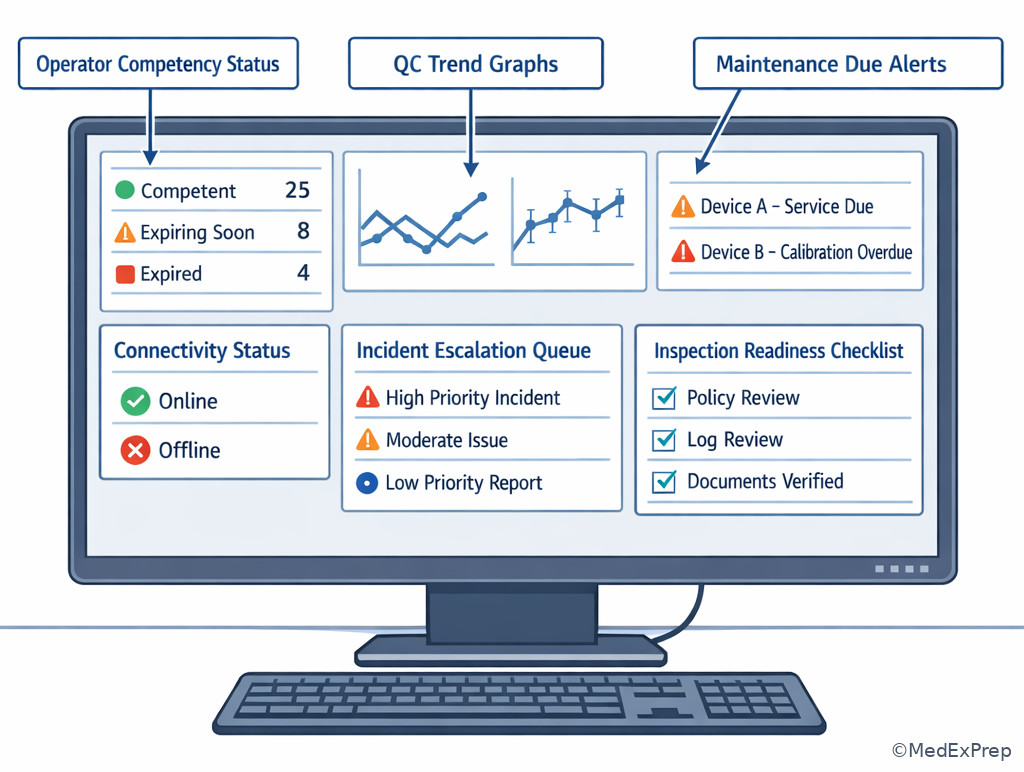
Exam takeaway: The tested audience works through records, QC, competency, and incident data rather than direct treatment decisions.
Exam Traps & Differentiators
Common traps & distractors: The exam often rewards the answer that feels less heroic but more defensible. Watch for options that sound decisive while quietly breaking scope, documentation, or safety controls.
1.1.1.8 Most common wrong answer and why
Most common wrong answer: choosing a clinically useful or workflow-efficient action that bypasses POCT scope or required controls. Examples include telling staff to continue testing after failed QC because the patient needs results fast, manually entering an uncertain result later from memory, or letting an experienced but unauthorized operator proceed “just this once.”
Why it is tempting: these answers appeal to urgency, experience, or good intentions. They sound helpful because they keep the line moving.
What separates the correct answer: a single clue showing a control failure or authority limit—failed QC, missing documentation, duplicate chart, overdue competency, unclear patient ID, or a request to make a treatment decision.
1.1.1.9 Looks similar but isn’t
| Looks similar | Actually tested concept | Discriminator |
|---|---|---|
| Urgent patient result | Role boundary | If the option asks you to direct treatment, it is out of role. |
| Working device with passed checks | Operator authorization control | Device readiness does not replace operator competency/authorization. |
| Valid analytic process | Post-analytic traceability | Correct analysis cannot rescue wrong-patient or wrong-chart risk. |
| Long-standing unit custom | Requirement hierarchy | Custom loses when it conflicts with current approved instructions or policy. |
| Verbal awareness of a problem | Documentation readiness | Traceable documentation is required; awareness alone is not enough. |
| Technical malfunction report | Escalation boundary | Do not repair reserved internal components yourself; escalate appropriately. |
1.1.1.10 If the stem says ___, think ___
- If the stem says “busy unit,” “patient waiting,” or “turnaround is critical,” think convenience trap.
- If the stem says “experienced operator” but records are incomplete, think authorization and documentation still control.
- If the stem says “the provider asks what treatment to give,” think out-of-role signal.
- If the stem says “the unit has always done it this way,” think custom versus current approved requirement.
- If the stem says “result can be entered later,” think traceability and audit trail risk.
- If the stem says “device seems fine despite a failed control,” think do not release testing without required conditions met.
Forward reference: In the upcoming lesson POCT Role Boundaries, you will turn these broad limits into sharper do/do-not rules. In Best Next Step Logic, you will formalize how to choose containment, documentation, and escalation in the correct order.
Tables
| Area | Usually in scope for POCT professional | Usually not in scope |
|---|---|---|
| Quality oversight | Review QC, trend issues, investigate nonconformities, recommend corrective action | Ignore failed QC or release testing despite unmet conditions |
| Training and competency | Coordinate training, track competency, support retraining, manage authorization controls | Allow unauthorized testing because staff are experienced |
| Result processes | Support compliant reporting workflows, investigate documentation gaps, escalate interface problems | Change results without correction process or enter uncertain results from memory |
| Clinical care | Notify through policy pathways and support result integrity | Diagnose, prescribe, or independently select therapy |
| Device issues | Coordinate maintenance oversight, remove devices from service as policy requires, escalate service needs | Repair internal electronics beyond authorized support role |
| Compliance | Maintain records, inspection readiness, policy alignment, and traceability | Override policy for convenience or make legal determinations beyond escalation |
| Priority order | What it means | Typical exam example |
|---|---|---|
| 1. Safety | Prevent patient harm or high-risk misuse now | Hold unsafe testing pathway when controls fail |
| 2. Result integrity | Ensure the value is analytically and operationally valid | Do not use result from a device under failed control conditions |
| 3. Patient/result match | Preserve correct attribution and traceability | Do not post to an uncertain chart after merge/duplicate MRN issue |
| 4. Documentation | Create defensible record of issue and response | Document corrective action and notifications |
| 5. Escalation | Route unresolved or reserved issues to proper authority | Notify laboratory leadership or IT according to policy |
| 6. Convenience | Only after controls are secured | Resume efficient workflow after compliant resolution |
| Scenario cue | Best governing rule | Reject this distractor |
|---|---|---|
| Request to decide therapy from a POCT result | Role boundary | Any option that directs treatment independently |
| Expired competency or missing authorization | Personnel control | “Let them continue because they are experienced” |
| Failed QC or maintenance concern | Containment before use | “Continue testing and document later” |
| Duplicate chart or unclear ID | Traceability and patient identification | “Manually enter into the likely chart” |
| Local shortcut conflicts with policy/IFU | Current approved requirement | “Do what the unit always does” |
| Interface outage or missing transmission | Downtime/result integrity workflow | “Use handwritten notes as final record” |
Algorithm / Approach
This algorithm previews the next lesson’s deeper best-next-step framework. For now, the key move is to avoid answering as a clinician or as a convenience-driven manager. Answer as a POCT oversight professional whose first obligation is controlled, traceable, safe testing.
Rapid Review
- CPOCTP perspective -> operational POCT oversight, not independent diagnosis or prescribing
- Busy unit pressure -> convenience trap, not a reason to bypass controls
- Passed device check -> does not excuse expired operator authorization
- Clinically dramatic result -> may still require containment if QC or traceability is compromised
- Long-standing unit habit -> loses to current approved requirement
- Handwritten note -> temporary aid at most, not a substitute for traceable final documentation
- Duplicate chart/MRN issue -> think wrong-patient attribution risk first
- Provider asks what to do for the patient -> role-boundary signal, not a treatment authorization cue
- Failed QC -> testing release problem before anything else
- Missing records -> compliance and traceability issue even if everyone “knows” the process occurred
- Escalation -> not weakness; it is the correct action when authority is reserved or risk is significant
- Best next step -> immediate safest in-scope action, not the entire long-term improvement plan
- Documentation -> part of the action, not an optional add-on
- Exam noise -> keep only facts tied to safety, integrity, traceability, scope, or applicable requirements
Memory anchor: Use SIT-DV for answer checking: Safety, Integrity, Traceability, Documentation, Verify scope. If an option fails any part of SIT-DV, reject it.
Self-check quiz
1. A bedside operator asks the POCT coordinator whether to increase a patient’s insulin dose after a glucose meter result appears higher than expected. The operator is authorized, and the device passed QC. What is the most appropriate response from the perspective tested on the CPOCTP exam?
- A. Recommend the insulin dose adjustment if the value matches the patient’s symptoms.
- B. Refer treatment decisions to the appropriate licensed clinician while supporting result integrity and documentation processes.
- C. Change the result to a more likely value if the patient’s prior trends differ.
- D. Delay all communication until the POCT coordinator personally evaluates the patient.
2. A clinic supervisor says an experienced medical assistant should keep performing waived POCT today even though current authorization documentation cannot be found. Which principle most directly rules this out?
- A. Long-term staff experience replaces current authorization requirements.
- B. Device readiness is more important than personnel controls.
- C. Current authorization and competency controls remain necessary even for experienced staff.
- D. If patient volume is high, documentation gaps can be corrected after testing.
3. A 67-year-old inpatient with CKD and pneumonia has a POCT potassium result documented on a paper note during an interface outage. The analyzer had valid QC, and the operator is current, but the patient’s wristband was replaced after a transfer and the electronic chart shows a duplicate encounter. The nurse asks the POCT coordinator to enter the result into the chart manually “so the team can act now.” What is the best next step?
- A. Manually enter the result into the most recently active encounter because the analytic process was valid.
- B. Hold result posting until patient/result attribution is confirmed through downtime and identification procedures, then document and escalate as needed.
- C. Ask the nurse to choose which encounter looks correct because bedside staff know the patient better.
- D. Discard the event because interface outages are IT issues rather than POCT concerns.
4. During a unit audit, a POCT coordinator learns that staff skip a required confirmation step because “the instrument stores everything automatically.” Manufacturer instructions and institutional procedure both require the step. No adverse event has been reported. What is the most appropriate interpretation?
- A. The shortcut is acceptable because no patient harm has been documented.
- B. The shortcut is acceptable if the unit manager approves it verbally.
- C. The process is nonconforming and should be corrected according to current approved requirements.
- D. The step can be ignored when turnaround time is an issue.
5. A 53-year-old outpatient with atrial fibrillation and diabetes has a POCT INR performed in a satellite clinic. The operator is competent and today’s QC passed. The provider asks the POCT coordinator to manually place the result into a chart after a recent registration merge, because the result did not cross electronically and the patient traveled two hours for the visit. Which governing rule should drive the answer?
- A. Passed QC means any posting pathway is acceptable.
- B. Travel burden justifies using the chart that appears most active.
- C. Correct patient-result attribution and traceability must be established before posting the result.
- D. The provider’s request overrides documentation concerns.
6. A 71-year-old ICU patient with sepsis, diabetes, and anemia has repeated bedside glucose testing. A nurse reports that the meter gave a low result, but earlier in the shift the same device displayed a QC warning that another nurse thought had been cleared. The unit is short-staffed, the patient is symptomatic, and a physician asks the POCT coordinator whether the value should be treated as real. What is the most appropriate response by the POCT coordinator?
- A. Confirm that the result fits the symptoms and advise treatment while continuing meter use.
- B. Treat the issue as a result-integrity problem, ensure policy-based containment of the questionable device workflow, and route clinical decision-making through appropriate patient-care channels.
- C. Ignore the prior QC warning because current symptoms make the low result more believable.
- D. Reset the meter internally and return it to service if the next patient result looks plausible.
7. In a community clinic, a waived POCT device is functional, daily controls passed, and the lead medical assistant has years of experience. During an inspection-prep review, the POCT coordinator finds that the assistant’s competency assessment expired last month and the site manager asks for a one-week grace period until records are updated. A nearby urgent care site offers to “share” a paper sign-in sheet from an old training class as proof. What is the best next step?
- A. Allow continued testing for one week because the device and staff member both appear reliable.
- B. Accept the old training sheet because it shows the assistant was trained at some point.
- C. Follow policy for expired competency/authorization, which may include suspending that operator’s testing privileges pending remediation and documentation.
- D. Ask the provider team whether the assistant seems accurate enough to keep testing.
8. A POCT coordinator is reviewing a scenario in which a respiratory unit manually documents critical POCT results on scrap paper during downtime, then transcribes them later into the electronic record. Today’s QC passed, maintenance is current, and the operator roster is current. However, one patient was transferred twice, and registration created two encounter numbers. The charge nurse says the paper process has “always worked” and no citation has occurred. Which is the best next step?
- A. Continue the paper-first workaround because all analytic controls are current.
- B. Allow the workaround only for critical results because they are time-sensitive.
- C. Address the workflow as a traceability and documentation risk, apply downtime policy, and correct the nonconforming process.
- D. Defer the issue unless a treating physician reports an incorrect treatment decision.
Answer key
1. Correct answer: B
- A: Tempting because the result may appear actionable and time-sensitive. Incorrect because independent treatment recommendation is outside the POCT oversight role. Single clue: the question asks for the POCT coordinator’s response, not the treating clinician’s.
- B: Tempting because it may feel less direct, but correct because it preserves role boundaries while supporting valid communication and documentation pathways. Single clue: the correct role response is to support testing integrity and refer treatment decisions appropriately.
- C: Tempting because prior trends can influence clinical interpretation. Incorrect because altering results without authorized correction procedures and audit trail violates integrity and traceability. Single clue: changing the result is not permitted.
- D: Tempting because personal evaluation sounds careful. Incorrect because it delays communication unnecessarily and still does not make the coordinator the treating clinician. Single clue: patient-care decisions belong to the licensed care team.
2. Correct answer: C
- A: Tempting because experience often predicts confidence. Incorrect because experience does not replace current authorization and competency controls. Single clue: current documentation cannot be found.
- B: Tempting because a working device seems reassuring. Incorrect because personnel controls and device controls are separate requirements. Single clue: the issue is missing authorization, not device performance.
- C: Correct because current authorization/competency status remains necessary regardless of years of experience. Single clue: lack of current authorization documentation is the governing issue.
- D: Tempting because high workload pressures create real-world shortcuts. Incorrect because documentation gaps tied to authorization are not safely deferred for convenience. Single clue: staff volume does not override personnel qualification requirements.
3. Correct answer: B
- A: Tempting because the analytic process appears valid and the care team wants speed. Incorrect because uncertain encounter attribution creates a traceability and wrong-patient posting risk. Single clue: duplicate encounter plus wristband replacement after transfer.
- B: Correct because result posting must wait until identity and attribution are verified through approved downtime and identification processes, with documentation and escalation as needed. Single clue: patient/result link is uncertain.
- C: Tempting because bedside staff often know the patient. Incorrect because identity and result posting require controlled process, not subjective choice. Single clue: “looks correct” is not a traceable standard.
- D: Tempting because interface problems involve IT. Incorrect because POCT oversight still owns the result-integrity and downtime workflow implications. Single clue: interface failure affects reporting integrity, which is within POCT concern.
4. Correct answer: C
- A: Tempting because lack of known harm can feel reassuring. Incorrect because process nonconformity exists even before adverse outcomes occur. Single clue: manufacturer instructions and procedure both require the step.
- B: Tempting because local managerial approval sounds practical. Incorrect because verbal local approval does not override current approved requirements. Single clue: the controlling documents already define the process.
- C: Correct because the shortcut conflicts with both the manufacturer instructions and institutional procedure, making it a nonconforming process that requires correction. Single clue: both governing sources align against the shortcut.
- D: Tempting because POCT emphasizes speed. Incorrect because turnaround concerns do not cancel required steps. Single clue: speed is secondary to approved controls.
5. Correct answer: C
- A: Tempting because passed QC supports analytic validity. Incorrect because QC does not solve wrong-chart or duplicate-record posting risk. Single clue: recent registration merge and failed electronic crossover.
- B: Tempting because the patient’s travel burden seems compelling. Incorrect because inconvenience does not justify uncertain result attribution. Single clue: chart identity is not confirmed.
- C: Correct because traceability requires secure patient-result attribution before posting any result. Single clue: the problem is not the assay—it is destination certainty.
- D: Tempting because a provider request sounds authoritative. Incorrect because provider request does not override controlled documentation and traceability requirements. Single clue: POCT oversight must still protect the reporting pathway.
6. Correct answer: B
- A: Tempting because symptoms match the value and urgent care feels necessary. Incorrect because the POCT coordinator should not independently direct treatment and the prior QC warning creates a result-integrity concern. Single clue: earlier unresolved QC warning on the same device.
- B: Correct because it separates clinical decision-making from POCT oversight while appropriately containing the questionable device workflow and preserving patient safety through proper channels. Single clue: both role boundary and QC integrity issue are present.
- C: Tempting because concordant symptoms can falsely reassure. Incorrect because symptom fit does not validate a device under questionable control conditions. Single clue: QC control status outranks plausibility.
- D: Tempting because a reset sounds like a quick fix. Incorrect because internal corrective actions beyond authorized procedure and service logic cannot be improvised based on a plausible patient result. Single clue: “if the next result looks plausible” is not an approved verification method.
7. Correct answer: C
- A: Tempting because both device controls and staff experience appear reassuring. Incorrect because expired competency/authorization remains a controlling personnel issue. Single clue: competency assessment expired last month.
- B: Tempting because a training sign-in sheet sounds like proof of qualification. Incorrect because historical training attendance is not equivalent to current competency/authorization status. Single clue: old training evidence does not resolve current expiration.
- C: Correct because policy-based response to expired competency may require suspending testing privileges until remediation and current documentation are completed. Single clue: current personnel control has lapsed.
- D: Tempting because clinicians may trust the assistant’s performance. Incorrect because provider opinion does not replace personnel authorization controls. Single clue: this is a compliance and qualification issue, not a clinical confidence survey.
8. Correct answer: C
- A: Tempting because current QC, maintenance, and operator roster all look strong. Incorrect because analytic controls do not eliminate a documentation and wrong-encounter traceability risk. Single clue: two encounter numbers plus delayed transcription from scrap paper.
- B: Tempting because critical results feel worth extra speed. Incorrect because criticality increases the need for reliable traceability; it does not justify weaker documentation. Single clue: critical results heighten, not reduce, documentation stakes.
- C: Correct because the process is nonconforming and vulnerable to patient/result mismatch, so downtime policy and corrective workflow redesign are required. Single clue: duplicate encounters make paper-first later transcription unsafe.
- D: Tempting because outcome-based thinking waits for proven harm. Incorrect because POCT oversight addresses process risk before harm is documented. Single clue: “has always worked” is a classic shortcut trap, not a control standard.
Keep going with the full CPOCTP Prep Course (CPOCTP)
You just studied the way members do, in the same lesson interface. Full access unlocks every lesson, the question bank and flashcards for a full year.
One payment · 1 year of access · No auto-renewal