1.1.1 - RN Pediatric Scope
Why it matters
- The CPN exam repeatedly tests whether the nurse can recognize what is within RN scope versus what requires provider notification or emergency escalation.
- Pediatric stems become easier when you first identify the child’s age, setting, and the exact nursing task being asked.
- Many wrong answers are tempting because they are medically reasonable but outside RN authority, or they are correct actions done at the wrong priority.
- Safe pediatric nursing judgment depends on using age-specific norms, caregiver context, and early recognition of deterioration rather than adult assumptions.
Key Terms & Must-Know Facts
1.1.1.1 Key terms
- RN scope: Actions a registered nurse can independently perform under licensure, policy, and protocol.
- Escalation: Promptly notifying the provider, rapid response team, or emergency system when the child is unstable or a red flag is present.
- Standing protocol: Institution-approved process allowing defined nursing actions under specific conditions.
- Family-centered care: Care that includes caregiver perspectives, education needs, culture, and shared decision support.
- Developmental context: Age-appropriate interpretation of behavior, communication, vital signs, and safety needs.
- ABCs: Airway, breathing, circulation; the core priority framework for unstable patients.
- Red flag: A finding that suggests potential deterioration or immediate safety risk.
- Provider notification: Communicating urgent or significant assessment findings to the licensed independent clinician.
- Mandated reporting: Required reporting of suspected abuse or neglect according to law and policy.
- Teach-back: Asking caregiver or patient to explain instructions in their own words to confirm understanding.
- Within scope but wrong priority: A valid nursing action that should occur later, not first.
- Out-of-role signal: Stem language that points to provider work, such as diagnosing, prescribing, or independently changing a treatment plan.
1.1.1.2 Must-know facts
- On nursing exams, the safest answer is usually the highest-priority RN action, not the definitive medical treatment.
- In pediatrics, normal interpretation depends on age; adult defaults are a common trap.
- If a child is unstable, assess and intervene within RN scope first, then escalate immediately.
- Family concerns are data, not background noise; they can be early cues of deterioration.
- The RN can recognize urgent problems and act within protocol, but does not independently prescribe or make provider-level treatment decisions.
- Documentation should include assessment findings, interventions, caregiver communication, and response to care.
- Local protocols vary; confirm with your institution.
- Delegation questions often hinge on stability, predictability, and whether assessment or teaching must remain with the RN.
| High-yield cue | What it usually means on the exam | Best RN framing |
|---|---|---|
| “Most appropriate next step” | Prioritize action, not full medical plan | Choose the safest assess/intervene/escalate step |
| “Requires immediate clarification” | Order, dose, parameter, or role boundary issue | Hold unsafe action and clarify per policy |
| Child looks worse than numbers suggest | Pediatric compensation can hide severity | Trust clinical red flags and escalate |
| Caregiver says “something is different” | Important cue, especially in nonverbal children | Reassess and integrate caregiver concern |
| Option says diagnose/prescribe/order | Likely outside RN scope | Reject and choose safety + notification |
| Several correct interventions listed | Priority test | Use ABCs, safety, and nursing process |
Exam takeaway: Use role boundaries plus ABCs to choose the safest nursing action before provider-level management.
flowchart TD
A[Read stem] --> B[Identify child age and setting]
B --> C[Identify nursing task]
C --> D{Is child unstable?}
D -->|Yes| E[Immediate RN assessment and intervention within protocol]
E --> F[Escalate to provider or rapid response]
D -->|No| G{Is action within RN scope?}
G -->|Yes| H[Assess teach monitor document]
G -->|No| I[Hold unsafe step and notify appropriate clinician] Exam takeaway: Read the room for age-specific cues, family concerns, and immediate safety needs before choosing an action.
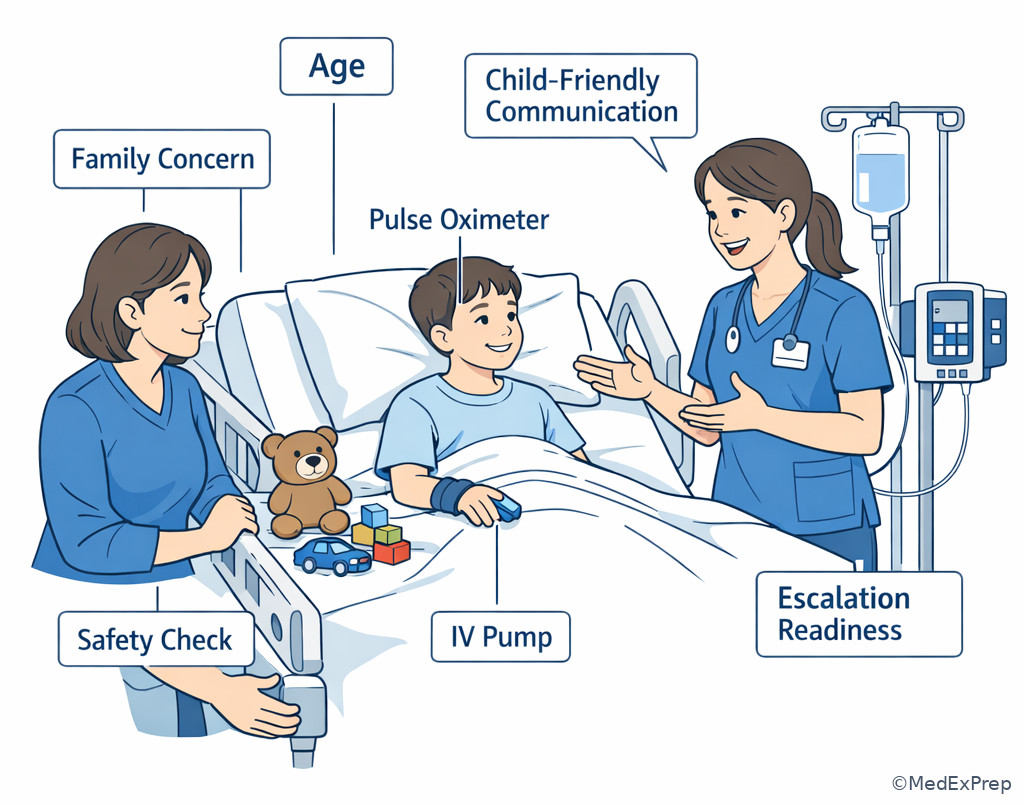
Core content
1.1.1.3 Foundational role boundaries: what the pediatric RN can do, cannot do, and must escalate
A Explanation
The main decision conflict is choosing between an action that is clinically sensible and one that is legally and professionally within RN scope. On this exam, the RN should assess, monitor, educate, implement ordered or protocol-based care, document, and escalate concerning findings. The RN should reject options that require independent diagnosis, prescribing, or selecting the definitive medical treatment plan. The single rule that resolves most scope questions is this: If the action changes the medical plan outside protocol, it is not the RN’s independent decision. The nurse’s job is to recognize the issue, stabilize within scope, and notify the appropriate clinician.
WHY THIS IS TESTED: Test writers want to know whether you will stay inside pediatric RN scope under pressure, especially when a tempting provider-level option appears more “decisive.”
Choose actions such as reassessing respiratory effort, obtaining a repeat vital sign, applying oxygen per protocol or order, holding a questionable medication, implementing seizure precautions, teaching caregivers, and documenting response. Reject answers that say to diagnose pneumonia, independently select an antibiotic, independently order labs without protocol, or change a prescribed regimen on your own. In stable situations, nursing process leads: assess first, then implement appropriate nursing care, then evaluate. In unstable situations, ABCs lead: act to support airway, breathing, and circulation, then escalate.
B Worked example
A 6-year-old with asthma, eczema, and obesity is in the outpatient clinic for cough and fever. The caregiver reports the child “is breathing harder than usual.” The child is anxious, has mild intercostal retractions, oxygen saturation 91% on room air, and a scattered rash from chronic eczema. A tempting clue is a sibling recently diagnosed with pneumonia. The question asks for the most appropriate next step by the RN.
Identify the task: This is a nursing-priority action question, not a diagnosis question. Extract key facts: Hypoxemia, increased work of breathing, caregiver concern, and asthma history matter more than the rash or sibling diagnosis. Apply the rule: The RN should perform the highest-priority assessment/intervention within scope, such as focused respiratory assessment, positioning, oxygen per protocol/order, and rapid provider notification if distress persists. Eliminate distractors: “Diagnose pneumonia” and “select antibiotics” are provider-level actions. “Teach home fever care” is valid but wrong priority. Verify: Breathing takes priority over nonurgent teaching.
C Exam trap
D Checkpoint
Question: A 10-year-old with type 1 diabetes, mild abdominal pain, and vomiting arrives to urgent care with a glucose of 312 mg/dL. The child is tired but alert, respirations are slightly rapid, and the caregiver says, “He seems off.” Which action is the highest-priority RN response?
- Perform focused assessment for hydration, breathing pattern, mental status, and ketone-related red flags, then notify the provider promptly.
- Teach the caregiver to give the usual home correction dose and recheck glucose in 2 hours.
- Independently diagnose diabetic ketoacidosis and prepare a treatment plan.
- Document the glucose and ask dietary intake from the last 24 hours before any further action.
Answer: A
- A: Tempting because it may seem slower than giving treatment immediately; correct because RN priority is focused assessment for stability and escalation when DKA is possible. The breathing pattern and “seems off” clue make this the safest nursing action.
- B: Tempting because insulin management is relevant; wrong because teaching a routine home plan is not the first step when vomiting and possible deterioration are present.
- C: Tempting because the findings suggest DKA; wrong because independently making the diagnosis and treatment plan exceeds RN scope.
- D: Tempting because nutrition history matters in diabetes care; wrong because it delays evaluation of a potentially unstable child.
Exam takeaway: Separate assessment and safety actions from provider-only diagnosis and treatment planning.
flowchart LR
A[Assessment] --> A1[Focused reassessment]
A --> A2[Trend vitals]
A --> A3[Monitor response]
B[Intervention] --> B1[Ordered meds]
B --> B2[Protocol actions]
B --> B3[Safety measures]
C[Education] --> C1[Teach-back]
C --> C2[Return precautions]
D[Out of scope] --> D1[Diagnose]
D --> D2[Prescribe]
D --> D3[Independently change plan]
Exam takeaway: Worsening breathing, altered behavior, and caregiver concern should trigger immediate reassessment and escalation within RN scope.
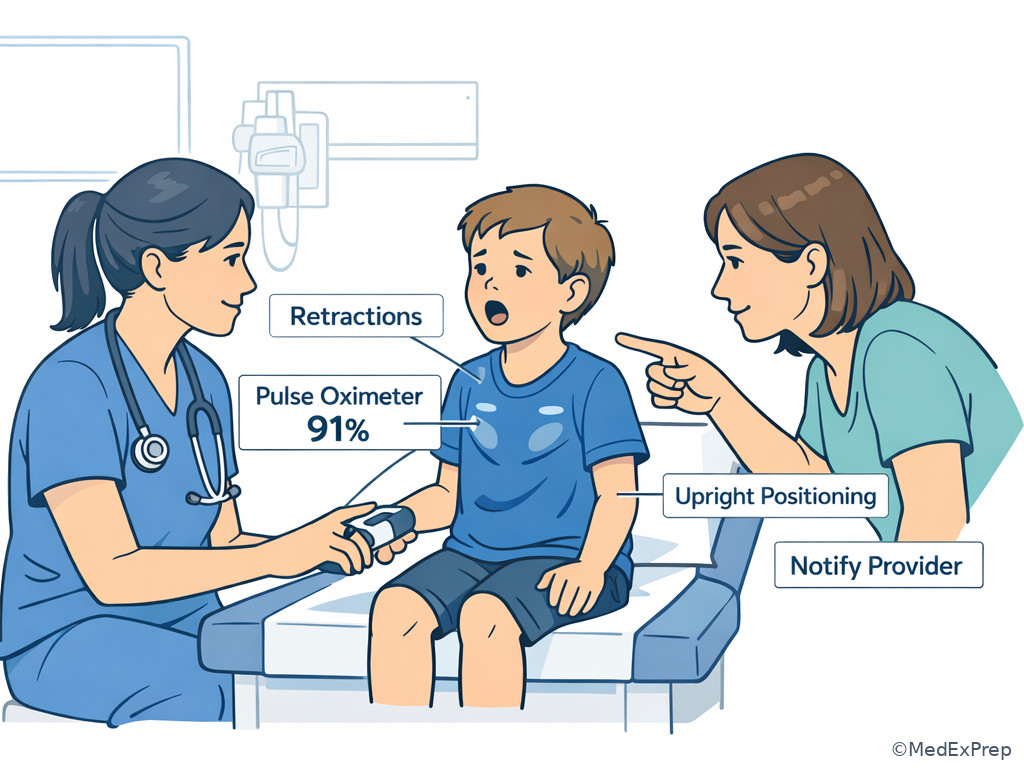
1.1.1.4 Age, setting, and family context: the first frame for every pediatric question
A Explanation
The decision conflict here is whether to interpret the child as a small adult or as a patient whose normal findings, communication needs, and safety risks change with age and setting. The rule is simple: Before choosing any action, identify the child’s age, developmental level, and care setting. A toddler in a primary care office, a school-age child on a med-surg unit, and an adolescent in a school clinic may have very different normal behaviors and nursing priorities. Family context is part of the assessment because caregivers often supply the baseline, symptom history, and early warning signs.
WHY THIS IS TESTED: Many distractors become attractive only when the learner forgets pediatric norms or ignores caregiver input. The exam rewards age-specific interpretation and caregiver-inclusive care.
Choose communication that matches development: concrete words for young children, choices within limits for toddlers and preschoolers, private respectful conversation for adolescents when appropriate, and caregiver-inclusive education across ages. Choose safety steps based on developmental behavior: an infant cannot verbalize symptoms, a toddler explores and resists, a school-age child can report symptoms more clearly, and an adolescent may prioritize privacy and autonomy. Reject answers based on adult assumptions, such as normalizing lethargy because an adult is febrile or expecting a young child to follow complex instructions without caregiver support.
See Fig 1 for the first-pass decision sequence, and see Fig 2 for how age/context fit inside scope decisions.
B Worked example
A 15-year-old with sickle cell disease and depression presents to the school clinic with headache and “feeling weird.” The school nurse notes pallor, mild tachycardia, and the student says she has not eaten lunch. A distracting clue is that she stayed up late studying. The question asks for the best initial RN action.
Identify the task: Prioritize within school-clinic nursing scope. Extract key facts: Adolescent, chronic illness, school setting, pallor, tachycardia, and vague complaint. Apply the rule: Do not dismiss symptoms as stress or skipped lunch until age- and condition-specific assessment is done. Focused assessment, vital signs, symptom review, hydration status, and guardian/provider notification as indicated are appropriate. Eliminate distractors: Advising rest in the nurse’s office without assessment is a wrong-priority response. Ordering lab evaluation independently is out of scope. Verify: The setting limits resources, so the RN must rapidly determine whether the student can remain in school or needs escalation.
C Exam trap
D Checkpoint
Question: A 2-year-old in the ED has fever, poor oral intake, and irritability. The parent says, “He is not acting like himself.” Which nursing approach is most appropriate?
- Ask the child detailed symptom questions first because self-report is the most reliable source.
- Use caregiver report, observe behavior and hydration cues, and perform an age-appropriate assessment while minimizing distress.
- Delay assessment until the child stops crying because findings during distress are not useful.
- Focus teaching on independent self-management because toddlers learn best from direct instruction alone.
Answer: B
- A: Tempting because patient self-report is valuable; wrong because toddlers have limited ability to provide a complete, reliable history.
- B: Tempting because it integrates caregiver and observed cues; correct because that is the developmentally appropriate pediatric nursing approach.
- C: Tempting because crying can alter some findings; wrong because delaying assessment in an ill toddler can miss important cues.
- D: Tempting because teaching matters; wrong because a toddler requires caregiver-centered education and immediate assessment takes priority.
- The first frame for any pediatric stem is child age, care setting, and family baseline.
- True or False: If a caregiver says a nonverbal child is “different than usual,” that statement is low-priority background information. False.
- Name the 3 first-pass context checks: age, setting, and caregiver baseline.
Exam takeaway: Match your assessment style and teaching approach to developmental level and caregiver role.
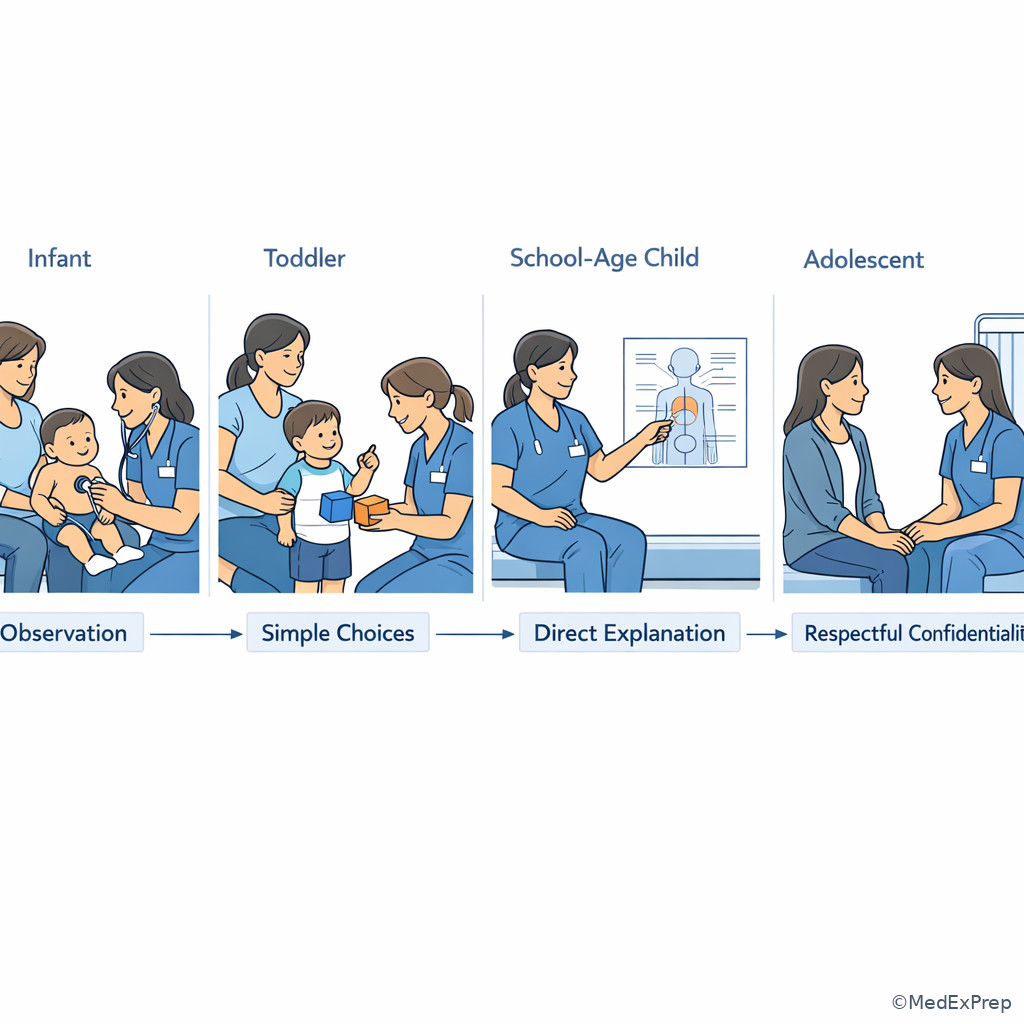
Exam takeaway: Age, setting, and family context help separate urgent from routine nursing actions.
flowchart TD
A[Child presents] --> B[Age/development]
A --> C[Setting/resources]
A --> D[Caregiver concern]
B --> E[Assessment style]
C --> F[Urgency and escalation route]
D --> G[Baseline vs new change]
E --> H[Best RN action]
F --> H
G --> H
1.1.1.5 Scope + priority: using ABCs, safety, and nursing process to select the best RN action
A Explanation
The common decision conflict is between several actions that are all reasonable but differ in urgency. The rule that resolves these questions is: Choose the action that addresses the greatest immediate threat to airway, breathing, circulation, or safety, while remaining within RN scope. If the child is stable, nursing process usually starts with assessment. If unstable, an immediate supportive intervention within protocol may come first or alongside rapid reassessment. Correct exam answers often combine both: a focused assessment plus prompt intervention and escalation.
WHY THIS IS TESTED: Board-style questions reward prioritization, not task completion. Many distractors are correct actions done later.
For example, caregiver teaching is important, but not before managing respiratory distress. Documentation is required, but not before responding to a seizure. Getting a full intake history matters, but not before addressing signs of shock. Pediatric compensation can be deceptive; a child may maintain blood pressure until late. That means work of breathing, mental-status changes, skin findings, and family concern often outrank a single “acceptable” number. See Fig 1 for the sequence and use it together with ABCs.
B Worked example
A 4-month-old with bronchiolitis, gastroesophageal reflux, and a history of prematurity is on a pediatric floor. The infant has increased nasal flaring, poor feeding, intermittent desaturation to 88%, and one episode of spit-up after a feeding. A distractor is the reflux history, which may pull attention toward feeding management. The stem asks for the highest-priority RN action.
Identify the task: Prioritize nursing care for an inpatient infant. Extract key facts: Prematurity, bronchiolitis, increased work of breathing, and desaturation matter most. Apply the rule: Breathing outranks reflux management. Focused respiratory reassessment, suctioning per policy, positioning, oxygen support per order/protocol, and prompt escalation if worsening are within scope. Eliminate distractors: Adjusting the feeding plan may be appropriate later but is not first. Calling dietary, documenting, or extensive parent teaching are all lower priority. Verify: The child has an active respiratory threat; ABCs decide the answer.
C Exam trap
D Checkpoint
Question: A 7-year-old with pneumonia, ADHD, and recent vomiting is admitted with fever and tachypnea. Which action is the best initial RN response?
- Begin discharge teaching about antibiotic adherence because early teaching improves retention.
- Assess work of breathing, lung sounds, oxygen saturation trend, and level of alertness before proceeding with less urgent tasks.
- Request a change in the antibiotic regimen because vomiting suggests oral intolerance.
- Document the child’s home medication list and school attendance history first.
Answer: B
- A: Tempting because teaching is important in pneumonia care; wrong because education is not first when respiratory status may be unstable.
- B: Tempting because it sounds like an assessment-heavy option; correct because ABCs make respiratory assessment the priority.
- C: Tempting because vomiting may affect treatment; wrong because changing the regimen is provider-level management and not first priority.
- D: Tempting because medication reconciliation matters; wrong because it delays evaluation of breathing.
Exam takeaway: Among plausible nursing options, the correct answer is usually the action tied to the highest ABC or safety threat.
flowchart TB
A[ABCs or active safety threat] --> B[Focused reassessment + immediate RN intervention]
B --> C[Escalate urgent change]
C --> D[Ongoing monitoring]
D --> E[Teaching]
E --> F[Documentation and routine planning]
Exam takeaway: In pediatrics, work of breathing and behavior changes often reveal urgency before late hemodynamic signs appear.
{"prompt":"Clean pediatric nursing illustration on white background of an infant with bronchiolitis being assessed by an RN; show nasal flaring, mild retractions, pulse oximeter, upright positioning, suction setup, and caregiver nearby; labels emphasize work of breathing, oxygen saturation trend, and RN reassessment priorities.","caption":"Respiratory distress assessment in an infant\nExam takeaway: In pediatrics, work of breathing and behavior changes often reveal urgency before late hemodynamic signs appear.","size":"1024x1024"} 1.1.1.6 Family-centered care, communication, documentation, and safeguarding within RN role
A Explanation
The decision conflict in this section is how to include caregivers and support the child without losing safety, confidentiality, or legal duty. The rule is: Family-centered care means partnership, not automatic agreement with every request. The pediatric RN should listen to caregiver concerns, assess health literacy and readiness to learn, use interpreter services when needed, adapt teaching to developmental level, and protect the child’s rights and safety. This includes documenting objectively and following mandated reporting laws when abuse or neglect is suspected.
WHY THIS IS TESTED: Pediatric care is never just child + symptom. The exam frequently embeds communication barriers, caregiver anxiety, or conflicting requests to test nursing judgment.
Choose teach-back rather than simply asking “Do you understand?” Choose objective documentation rather than labels or conclusions. Choose privacy and respectful direct communication with adolescents when appropriate, while still involving caregivers according to policy and the clinical situation. Reject actions that ignore caregiver concerns, promise confidentiality beyond policy, confront suspected abuse aggressively at bedside, or delay reporting because the story is incomplete. When safety is threatened, the RN’s duty is to protect the child, document findings carefully, and follow reporting/escalation procedures. See Fig 3 for age-linked communication cues and Fig 4 for how communication fits under priority rather than replacing it.
B Worked example
A 13-year-old with depression, obesity, and poorly controlled asthma is admitted overnight after an exacerbation. The parent answers every question for the teen and minimizes the teen’s report of vaping. A distracting clue is that the parent appears very engaged and knowledgeable. The stem asks for the most appropriate RN action during assessment and teaching.
Identify the task: Communication and family-centered care within RN role. Extract key facts: Adolescent developmental stage, chronic disease, possible sensitive risk behavior, and caregiver dominance. Apply the rule: Respectfully include the parent but also create space for direct adolescent communication according to policy. Use nonjudgmental assessment and teach-back. Eliminate distractors: Excluding the parent entirely is not family-centered. Promising absolute confidentiality regardless of safety is unsafe. Accepting the parent’s answers without speaking to the teen misses key data. Verify: The best nursing approach balances adolescent dignity, safety, and caregiver partnership.
C Exam trap
D Checkpoint
Question: A school-age child is hospitalized for an injury. The caregiver’s explanation does not fit the observed pattern, and the child avoids eye contact and becomes tearful during the exam. What is the most appropriate RN action?
- Document objective findings, ensure immediate safety, and follow institutional and legal reporting procedures.
- Confront the caregiver at the bedside and demand a revised explanation before taking further action.
- Wait to report until a provider confirms the diagnosis of abuse.
- Ask the child leading questions to obtain a full legal statement for the chart.
Answer: A
- A: Tempting because it may feel less definitive than confronting the issue; correct because the RN’s duty is safety, objective documentation, and mandated reporting based on suspicion, not proof.
- B: Tempting because clarifying the story seems direct; wrong because confrontation can escalate risk and is not the recommended nursing response.
- C: Tempting because confirmation sounds safer legally; wrong because mandated reporting is triggered by reasonable suspicion, not a provider’s final diagnosis.
- D: Tempting because more details seem helpful; wrong because leading questioning is inappropriate and can compromise subsequent investigation.
- True or False: Family-centered care means agreeing to any caregiver request. False.
- The best way to confirm understanding is teach-back, not “Do you understand?”
- Suspected abuse requires objective documentation and reporting per policy/law.
Exam takeaway: Partner with caregivers, communicate directly with the child at the right developmental level, and protect safety when concerns arise.
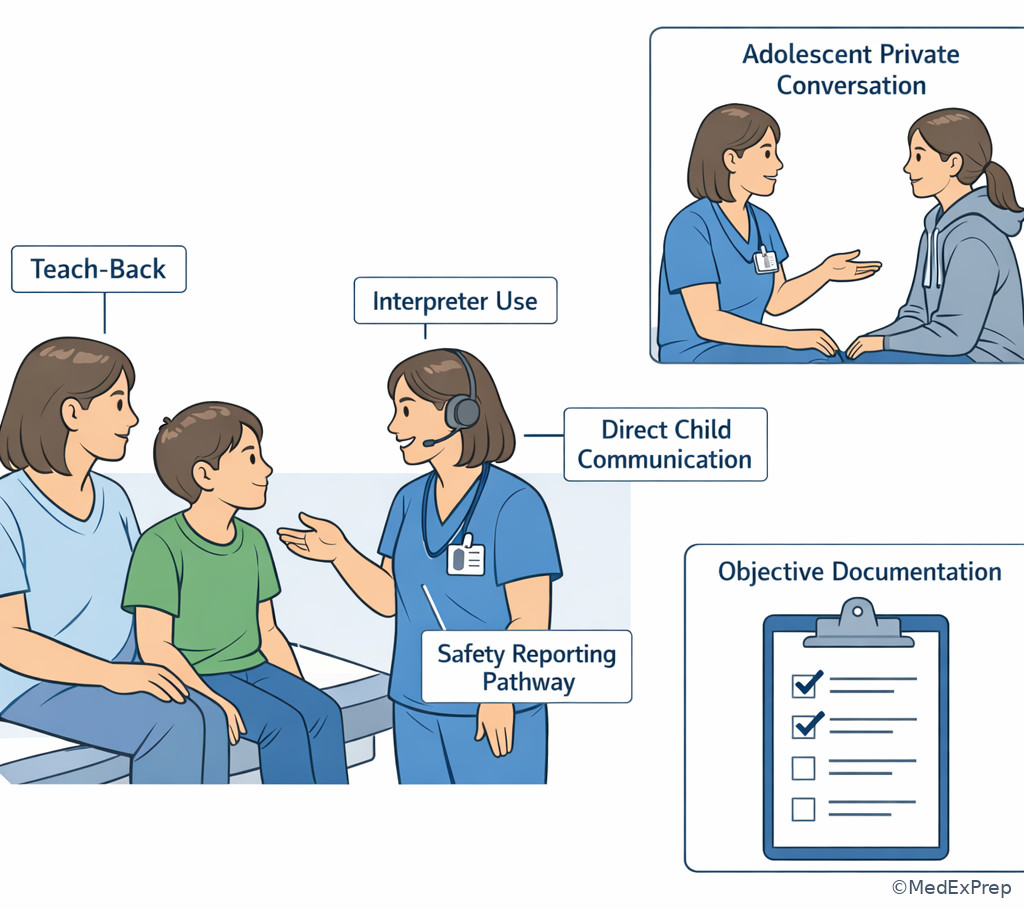
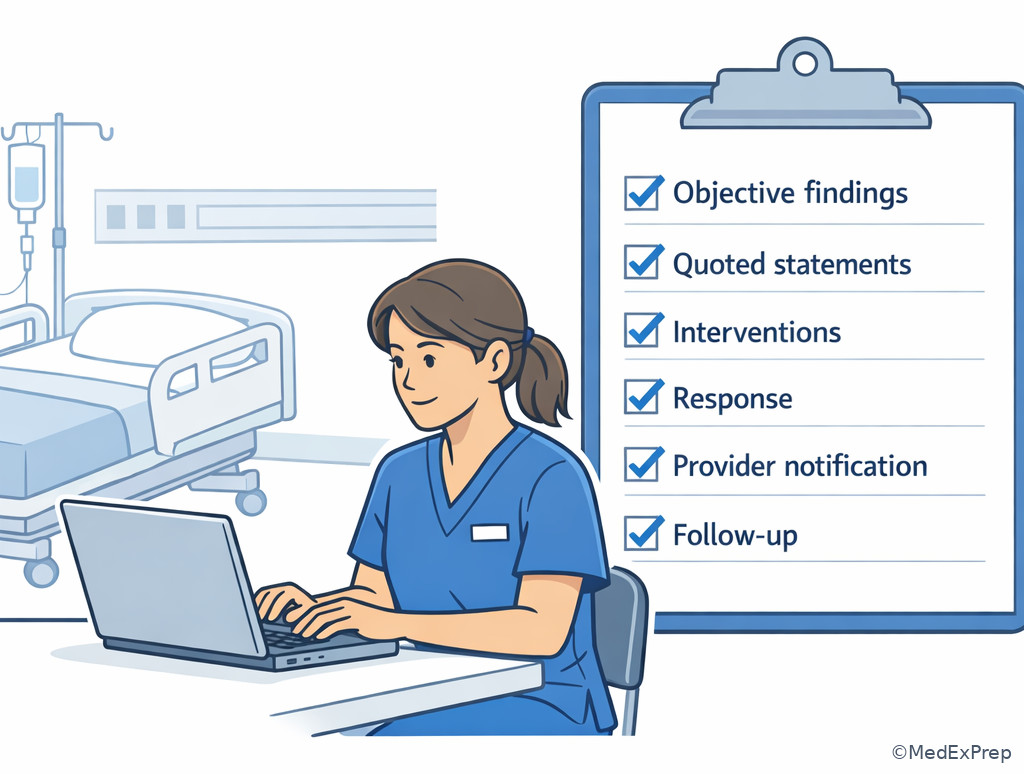
Exam takeaway: Chart facts, child and caregiver statements in quotes when needed, nursing actions, and responses without labels or conclusions.
1.1.1.7 Escalation, delegation, and safe collaboration in pediatric practice
A Explanation
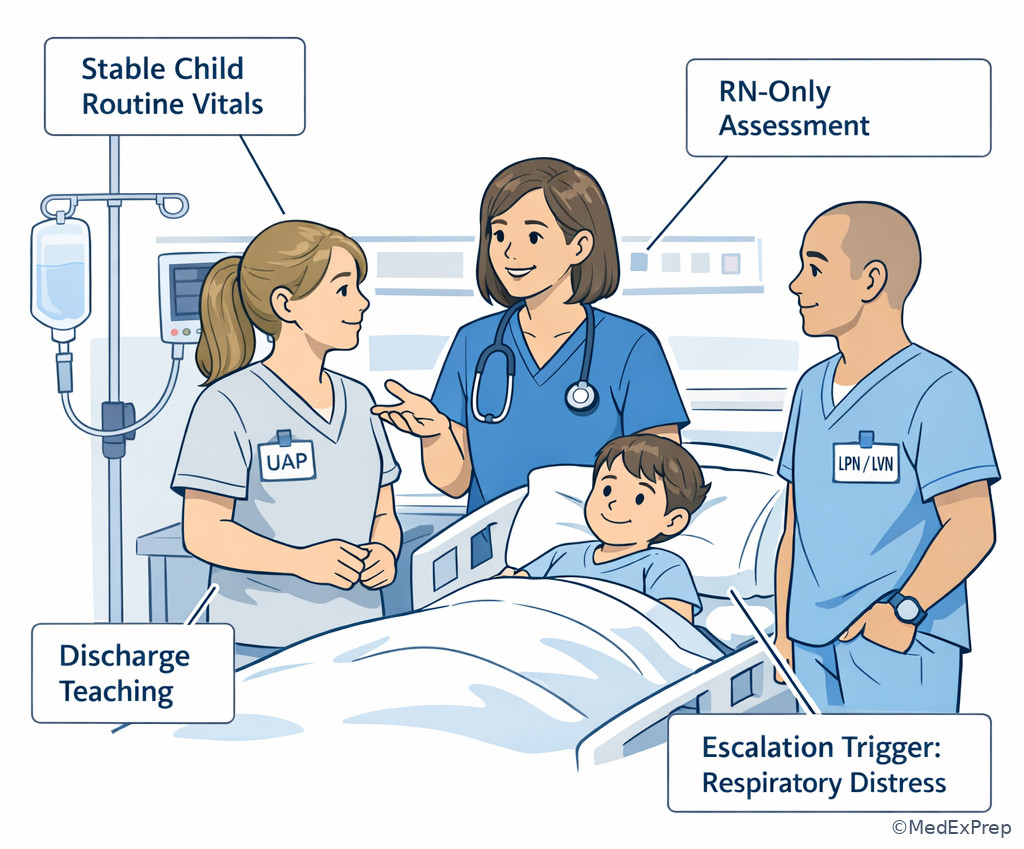
The final integration challenge is deciding when the RN must keep the task, when limited delegation is appropriate, and when immediate escalation is required. The rule is: The RN keeps initial assessment, clinical judgment, unstable patients, new findings, teaching, and evaluation; delegation is reserved for predictable, low-risk, clearly defined tasks according to policy. Escalation is required when the child is unstable, the trend worsens, a red flag appears, or the needed action would exceed RN authority.
WHY THIS IS TESTED: These questions combine priority, scope, and teamwork. The wrong answer is often a reasonable task assigned to the wrong person or done too late.
Choose delegation carefully: obtaining routine vitals on a stable child may be delegated per policy, but interpreting abnormal trends cannot. Reinforcing a standard teaching point may sometimes be appropriate for an LPN/LVN within local rules, but initial teaching, discharge readiness evaluation, and complex assessment remain with the RN. In pediatrics, instability can evolve quickly; therefore, any new breathing difficulty, altered responsiveness, poor perfusion, seizure activity, or caregiver report of sudden change should keep the RN at the bedside and trigger escalation. See Fig 5 for the communication side of escalation, and see Fig 4 for the overall priority ladder.
B Worked example
A busy pediatric unit has four children. One is a stable 9-year-old awaiting discharge instructions after appendectomy. Another is a 3-year-old newly admitted with wheezing and increasing respiratory rate. A third is a teen with stable IV antibiotics for cellulitis. A fourth is an infant whose parent says, “She is harder to wake up than earlier.” A distractor is the pending discharge, which feels time-sensitive operationally. The stem asks what the RN should do first.
Identify the task: Prioritization plus delegation. Extract key facts: New wheeze and decreased responsiveness are red flags; pending discharge is operational, not physiologic urgency. Apply the rule: The RN must personally assess the infant with possible neurologic change or the child with respiratory worsening based on exact option wording; discharge teaching can be delayed or delegated only in limited parts, but final evaluation remains with the RN. Eliminate distractors: Assigning full discharge teaching away or focusing first on routine antibiotic timing misses the unstable or potentially unstable child. Verify: The RN stays with instability and delegates lower-risk predictable tasks.
C Exam trap
D Checkpoint
Question: Which task is most appropriate to delegate according to general pediatric RN principles and local policy?
- Initial discharge teaching for a child newly diagnosed with seizure disorder.
- Focused reassessment of a toddler with increasing stridor after a nebulized treatment.
- Routine vital signs for a stable school-age child awaiting provider rounds.
- Evaluation of whether a caregiver understands home insulin administration.
Answer: C
- A: Tempting because education can seem task-based; wrong because initial teaching for a new diagnosis requires RN assessment and evaluation.
- B: Tempting because reassessment follows an intervention; wrong because worsening airway findings require RN judgment.
- C: Tempting because it appears basic; correct because routine vitals on a stable predictable patient are often delegable per policy.
- D: Tempting because it sounds like checking a box; wrong because evaluating understanding is a nursing judgment task.
Exam takeaway: Keep unstable children and judgment-heavy tasks with the RN, and delegate only stable predictable work per policy.
flowchart TD
A[Task appears] --> B{Stable child?}
B -->|No| C[RN assesses and intervenes]
C --> D[Escalate if red flags or worsening]
B -->|Yes| E{Needs nursing judgment?}
E -->|Yes| F[RN keeps task]
E -->|No| G[Delegate per role and policy]
G --> H[RN supervises and evaluates] Exam takeaway: Safe delegation depends on patient stability, task predictability, supervision, and clear escalation triggers.
Exam Traps & Differentiators
Looks similar but isn't: a correct intervention performed at the wrong priority is still wrong. Teaching, documenting, discharge planning, and routine comfort care may all be appropriate later, but not before ABC threats or new instability.
| Confusable pair | Tempting wrong interpretation | Discriminator |
|---|---|---|
| RN assessment vs medical diagnosis | “If I recognize the condition, I should name and treat it.” | The RN recognizes red flags and notifies; does not independently make the final diagnosis or treatment plan. |
| Teaching vs urgent intervention | Education is always valuable, so do it now. | If airway, breathing, circulation, mental status, or safety is threatened, teaching waits. |
| Caregiver request vs child safety | Family-centered means comply with the request. | Family-centered care includes partnership, but the nurse must still protect safety and follow policy. |
| Delegable task vs RN-only task | If it is common, anyone on the team can do it. | Assessment, interpretation, teaching, and evaluation remain with the RN. |
| Pediatric norm vs adult assumption | Symptoms should be interpreted like adult patients. | Always use age-specific norms and developmental context. |
| If the stem says... | Think... |
|---|---|
| “Most appropriate next step by the nurse” | Highest-priority in-scope nursing action |
| “Caregiver says the child is different than usual” | Baseline change may be an early red flag |
| “Requires immediate clarification” | Unsafe order, dose, parameter, or role boundary issue |
| “New retractions,” “harder to arouse,” “poor perfusion” | Assess/intervene/escalate now |
| “New diagnosis” or “discharge teaching” | RN keeps initial education and evaluation of understanding |
| “School clinic,” “community,” or “home setting” | Adjust resources, escalation pathway, and family teaching |
Related trap from upcoming topics: the next lessons on Clinical Judgment Framework and Question Pattern Recognition will show how test writers hide the right answer among same-category nursing actions by shifting only priority or scope.
Algorithm / Approach
| Step | Ask yourself | Common error to avoid |
|---|---|---|
| 1. Child/context | How old is the child, and where is this happening? | Using adult assumptions |
| 2. Task | What is the nurse being asked to do? | Answering a different question than the stem asks |
| 3. Urgency | Is there an ABC, neurologic, or safety threat? | Choosing teaching or documentation too early |
| 4. Scope | Is this action independently within RN authority? | Picking a provider-level option |
| 5. Verify | What reassessment or escalation follows? | Forgetting evaluation and documentation |
Rapid Review
- RN scope -> assess, monitor, educate, document, escalate; not diagnose or prescribe
- Pediatric stem start -> identify age, setting, and caregiver baseline first
- Best next step -> highest-priority in-scope nursing action
- Multiple good options -> rank by ABCs, safety, then nursing process
- Caregiver concern -> treat as clinical data, especially in nonverbal children
- Teaching -> valuable but delayed if physiologic instability is present
- Documentation -> objective findings and responses, not labels or conclusions
- Adolescent communication -> direct respectful conversation plus appropriate caregiver inclusion
- Mandated reporting -> triggered by suspicion and safety concern, not proof
- Delegation -> stable, predictable, low-risk tasks only, per policy
- RN-only work -> assessment, clinical judgment, initial teaching, evaluation, unstable patients
- Out-of-role wording -> diagnose, prescribe, independently order, change treatment plan
- Pediatric deterioration -> behavior and work-of-breathing changes may appear before late hemodynamic collapse
Self-check quiz
1. A stable 8-year-old is waiting for provider rounds after overnight observation for mild dehydration. Which action is most appropriate to delegate according to general RN pediatric principles and local policy?
- Initial discharge teaching about return precautions and oral rehydration.
- Routine vital signs collection.
- Evaluation of whether the caregiver understands home care instructions.
- Focused reassessment of new abdominal pain.
2. A 5-year-old with fever and cough is breathing comfortably but has an order that appears to contain a weight-based medication dose much higher than expected. What is the most appropriate RN action?
- Administer the medication because the provider signed the order.
- Hold the medication and clarify the order per policy before administration.
- Reduce the dose independently to what seems safer.
- Ask the caregiver whether this is the usual dose at home and use that answer to decide.
3. A 3-month-old with RSV, history of prematurity, and reflux is on the pediatric unit. The infant now has nasal flaring, poor feeding, and oxygen saturation drifting from 95% to 90% on room air. The parent says, “She looks worse than earlier.” Which action is the best initial RN response?
- Begin discharge teaching because the infant may still go home later today.
- Perform focused respiratory reassessment, position for easier breathing, implement ordered/protocol respiratory support, and notify the provider if distress persists or worsens.
- Request an immediate change in diagnosis from reflux to pneumonia.
- Document the feeding intake for the last 24 hours before taking further action.
4. A 14-year-old with asthma and anxiety presents to the clinic with chest tightness after gym class. The parent says the teen “always gets dramatic,” but the teen appears anxious, is speaking in short phrases, and has mild retractions. Which nursing action is most appropriate?
- Address the parent’s concern first and postpone the assessment until the teen calms down.
- Recognize the adolescent’s respiratory cues, perform focused assessment, support breathing within order/protocol, and escalate if symptoms do not improve.
- Tell the teen this is most likely anxiety and provide relaxation teaching only.
- Independently select a new rescue medication because exercise is the trigger.
5. A 2-year-old in the ED has fever, decreased intake, and irritability. The caregiver says, “He is not acting like himself.” The child cries during the exam, has dry lips, and reaches for the caregiver. Which action is the best pediatric nursing approach?
- Rely mainly on the child’s verbal history because caregiver interpretation is subjective.
- Use caregiver report plus observation and an age-appropriate assessment while minimizing distress.
- Wait until the child is asleep to assess because crying invalidates findings.
- Focus first on independent self-care teaching for the toddler.
6. On a pediatric unit, the RN is supervising team assignments. Which task is the best to keep with the RN?
- Routine temperature check for a stable school-age child.
- Obtaining a fresh weight on a stable toddler before breakfast.
- Initial discharge teaching and evaluation of caregiver understanding for a child newly diagnosed with type 1 diabetes.
- Delivering extra blankets to a stable adolescent with mild fever.
7. A school nurse evaluates a 9-year-old with headache, pallor, and fatigue. The child has sickle cell disease and ADHD. The teacher reports poor concentration today, and the child skipped breakfast. Which action is the most appropriate RN response?
- Provide a snack and send the child back to class because poor intake is the likely cause.
- Perform focused assessment, obtain available vital signs per school protocol, compare to baseline symptoms if known, notify parent/guardian, and escalate urgent concerns according to school policy.
- Independently order laboratory work because anemia is suspected.
- Document the complaint and reassess at the end of the school day.
8. A hospitalized 12-year-old with abdominal pain, obesity, and depression tells the RN privately, “I do not feel safe going home.” The caregiver later requests discharge and says the child is “just trying to avoid school.” Vital signs are stable, and there is no immediate respiratory distress. What is the most appropriate next step by the RN?
- Honor the caregiver request because the child is medically stable.
- Promise the child complete secrecy and avoid documenting the statement to preserve trust.
- Document the statement objectively, assess immediate safety, follow institutional safeguarding procedures, and notify the appropriate clinician/team.
- Determine independently that the child is experiencing abuse and cancel the discharge order.
Answer key
1. Correct answer: B
- A: Tempting because discharge teaching is a common nursing task. Incorrect because initial teaching and return-precaution instruction require RN assessment of understanding and readiness. The discriminating clue is that this is initial discharge teaching. Priority principle: nursing process and evaluation remain with the RN. Sources: NCSBN delegation principles; ANA standards.
- B: Tempting because it may look too basic. Correct because routine vital signs on a stable child are predictable, low-risk, and commonly delegable per policy. The discriminating clue is that the child is stable and only waiting for rounds. Priority principle: delegate routine predictable tasks. Sources: NCSBN delegation principles; ANA standards.
- C: Tempting because it sounds like a quick check. Incorrect because evaluating understanding is nursing judgment and cannot be delegated away as a routine task. The discriminating clue is evaluation of understanding. Sources: NCSBN delegation principles; ANA standards.
- D: Tempting because reassessment is common. Incorrect because new abdominal pain requires nursing assessment and interpretation, which stay with the RN. The discriminating clue is new pain. Sources: NCSBN delegation principles; ANA standards.
2. Correct answer: B
- A: Tempting because provider signature may falsely imply safety. Incorrect because medication safety requires the RN to clarify questionable orders before administration. The discriminating clue is that the dose appears much higher than expected for weight. Priority principle: safety before implementation. Sources: NCSBN medication safety guidance; ANA standards.
- B: Tempting because it may feel like delaying treatment. Correct because the RN must hold a potentially unsafe medication and clarify the order per policy rather than proceed. The discriminating clue is weight-based dose much higher than expected. Priority principle: do no harm, clarify unsafe orders. Sources: NCSBN; Saunders Comprehensive Review for the NCLEX-RN.
- C: Tempting because reducing the dose seems protective. Incorrect because independently changing the prescribed regimen is outside RN authority. The discriminating clue is reduce independently. Sources: ANA standards; NCSBN scope principles.
- D: Tempting because caregivers may know home regimens. Incorrect because caregiver report does not replace verification of a questionable inpatient order. The discriminating clue is that the issue is order safety, not usual home practice. Sources: NCSBN medication safety guidance; ANA standards.
3. Correct answer: B
- A: Tempting because discharge teaching is a real nursing responsibility. Incorrect because breathing status is worsening now, so teaching is the wrong priority. The discriminating clue is the drop in oxygen saturation with nasal flaring. Priority principle: ABCs. Sources: NCSBN prioritization guidance; Lewis Medical-Surgical Nursing.
- B: Tempting because it includes several steps rather than one. Correct because it combines focused assessment, in-scope intervention, and timely escalation for respiratory compromise. The discriminating clue is the infant’s worsening work of breathing plus parent concern. Priority principle: ABCs and reassessment. Sources: NCSBN; Saunders Comprehensive Review for the NCLEX-RN.
- C: Tempting because the findings raise concern for worsening illness. Incorrect because changing the diagnosis is a provider-level function, not the RN’s independent action. The discriminating clue is change in diagnosis. Sources: ANA standards; NCSBN scope principles.
- D: Tempting because feeding history matters in infants. Incorrect because documenting intake before addressing breathing delays urgent care. The discriminating clue is active respiratory deterioration. Sources: NCSBN prioritization guidance; Lewis Medical-Surgical Nursing.
4. Correct answer: B
- A: Tempting because family dynamics and anxiety matter. Incorrect because delaying respiratory assessment in a teen speaking in short phrases with retractions ignores an ABC threat. The discriminating clue is short phrases and mild retractions. Priority principle: breathing before psychosocial concerns. Sources: NCSBN prioritization guidance; Saunders Comprehensive Review for the NCLEX-RN.
- B: Tempting because it respects both assessment and intervention. Correct because the RN should respond to the respiratory cues, support breathing within scope, and escalate if symptoms persist. The discriminating clue is objective breathing difficulty despite the parent’s minimizing comment. Sources: NCSBN; Lewis Medical-Surgical Nursing.
- C: Tempting because anxiety can cause chest tightness. Incorrect because the stem provides physical signs of respiratory distress that outweigh a psych-only explanation. The discriminating clue is the presence of retractions. Sources: NCSBN prioritization guidance; HESI review content.
- D: Tempting because trigger-related medication management matters in asthma. Incorrect because independently selecting a new rescue medication exceeds RN scope. The discriminating clue is independently select. Sources: ANA standards; NCSBN scope principles.
5. Correct answer: B
- A: Tempting because direct patient history is often valued. Incorrect because a 2-year-old cannot reliably supply the full history, so caregiver report is essential. The discriminating clue is the child’s developmental stage. Priority principle: developmentally appropriate assessment. Sources: Saunders Comprehensive Review for the NCLEX-RN; ANA standards.
- B: Tempting because it may seem less “objective” to include caregiver input. Correct because toddlers are assessed through caregiver baseline, observation, and age-appropriate techniques while minimizing distress. The discriminating clue is the combination of young age, dehydration cues, and caregiver concern. Sources: NCSBN pediatric communication principles; Saunders review.
- C: Tempting because crying can affect some findings. Incorrect because delaying assessment risks missing important cues in an ill toddler. The discriminating clue is the child’s decreased intake and dry lips, which require timely evaluation. Sources: NCSBN prioritization guidance; pediatric nursing texts.
- D: Tempting because patient education is a nursing role. Incorrect because toddlers depend on caregivers, and immediate assessment comes before teaching. The discriminating clue is both age and current illness. Sources: ANA standards; Saunders review.
6. Correct answer: C
- A: Tempting because all bedside tasks matter. Incorrect because routine temperature checks on stable patients are generally predictable and may be delegated per policy. The discriminating clue is routine and stable. Sources: NCSBN delegation principles; ANA standards.
- B: Tempting because weights are clinically important. Incorrect because obtaining a fresh weight on a stable patient is typically a routine task that may be delegated with RN interpretation afterward. The discriminating clue is that only the measurement, not analysis, is requested. Sources: NCSBN delegation principles; ANA standards.
- C: Tempting because teaching may look time-consuming rather than high-level. Correct because initial discharge teaching for a new diabetes diagnosis requires assessment, instruction, and evaluation of caregiver understanding, all of which remain with the RN. The discriminating clue is newly diagnosed. Priority principle: nursing judgment and safety in home management. Sources: NCSBN; Saunders Comprehensive Review for the NCLEX-RN.
- D: Tempting because comfort measures involve the nurse-patient relationship. Incorrect because providing blankets to a stable adolescent is a low-risk supportive task. The discriminating clue is stable with a simple comfort request. Sources: NCSBN delegation principles; ANA standards.
7. Correct answer: B
- A: Tempting because skipped breakfast can cause headache and fatigue. Incorrect because pallor and sickle cell disease create a higher-risk context that requires assessment first. The discriminating clue is sickle cell disease plus pallor. Priority principle: assess before assuming a benign cause. Sources: NCSBN prioritization guidance; pediatric nursing references.
- B: Tempting because it may seem less decisive than sending the child back or calling EMS immediately. Correct because in the school setting, the RN should assess within available resources, compare with baseline when possible, involve parent/guardian, and escalate urgent concerns according to policy. The discriminating clue is the combination of chronic disease and concerning symptoms in a limited-resource setting. Sources: ANA school nursing standards; NCSBN clinical judgment principles.
- C: Tempting because anemia evaluation seems medically appropriate. Incorrect because independently ordering lab work is outside RN scope in the usual school-nurse role unless a specific protocol authorizes it. The discriminating clue is independently order. Sources: ANA standards; NCSBN scope principles.
- D: Tempting because symptoms may improve with rest. Incorrect because delaying action ignores potential worsening in a child with a significant hematologic history. The discriminating clue is the child’s chronic condition and current pallor. Sources: NCSBN prioritization guidance; pediatric nursing references.
8. Correct answer: C
- A: Tempting because the child appears medically stable and caregivers usually coordinate discharge. Incorrect because a direct statement of not feeling safe changes the situation from routine discharge to safeguarding assessment. The discriminating clue is the child’s private disclosure. Priority principle: safety before routine disposition. Sources: ANA standards; child safeguarding guidance.
- B: Tempting because privacy helps build trust with adolescents. Incorrect because the RN cannot promise secrecy when safety concerns may require team involvement and reporting. The discriminating clue is that the content of the disclosure raises possible harm. Sources: ANA standards; safeguarding guidance.
- C: Tempting because it may seem less definitive than canceling discharge outright. Correct because the RN should document objectively, assess immediate safety, and follow institutional safeguarding procedures with appropriate notification. The discriminating clue is “I do not feel safe going home.” Priority principle: safety and chain of command within scope. Sources: ANA standards; NCSBN clinical judgment principles.
- D: Tempting because the statement strongly raises concern. Incorrect because independently determining abuse and canceling discharge on one’s own exceeds RN authority; the RN initiates safety measures and escalation instead. The discriminating clue is determine independently. Sources: ANA standards; NCSBN scope principles.
Keep going with the full CPN Prep Course (CPN)
You just studied the way members do, in the same lesson interface. Full access unlocks every lesson, the question bank and flashcards for a full year.
One payment · 1 year of access · No auto-renewal